Lost London – Winchester Palace

This week we look at another “lost” palace of London but this time it’s not one built primarily for kings and queens. Rather we’re taking a look at the former Thameside home of the Bishops of Winchester.

Located in Southwark, Winchester Palace (also known as Winchester House) was built in the 12th century as the London residence of the bishop, a major landowner in the area.

The palace’s hall was extravagantly decorated and is known to have played host to royalty including King James I of Scotland and Joan Beaufort whose wedding feast was held there in 1424. It’s also suggested that King Henry VIII may have met wife number five, Catherine Howard, there.

The remainder of the palace was arranged around two courtyards and as well as buildings including its own prison and brewhouse, it also boasted a tennis court, bowling alley and pleasure gardens. It was used up until the Civil War – during which it served as a prison – before, in a growing state of deterioration, being let out for tenements and warehouses. Much of what remained was destroyed by fire in 1814.

Today all that remains above ground is a wall which stood at the west end of the great hall, mostly dating for the 14th century. Now in the care of English Heritage, it features a magnificent (albeit glassless) rose window, 13 feet in diameter, and three doors, believed to have led to the buttery, pantry and kitchen.

The palace was located in what was known variously as the ‘Manor of Southwark’, the ‘Liberty of Winchester’ or the ‘Liberty of the Clink’ (the word ‘clink’ refers to the bishop’s notorious prison – more on this another time). This was an area of land under the direct jurisdiction of the Bishop of Winchester and outside the jurisdiction of the City of London and become particularly known for prostitution – the Bishop was granted the power to licence prostitutes in the 12th century – with the prostitutes referred to as “Winchester Geese”.

The current ruins were found during the area’s redevelopment in the 1980s. Remains of Roman buildings were also found underneath where the palace once stood.

WHERE: Clink Street, Southwark (nearest tube station is London Bridge); WHEN: Anytime; COST: Free; WEBSITE: www.english-heritage.org.uk/daysout/properties/winchester-palace/

Around London – Burial place of Bunyan, Defoe and Blake gets Grade I listing; Kew Gardens joins Streetview; and, Afghan treasures on show…

The London burial place of writers John Bunyan and Daniel Defoe and artist and poet William Blake has been recognised as one of the city’s most significant historic landscapes with a Grade I listing on the national Register of Parks and Gardens. The news, which was announced last month, also sees 75 tombs located within Bunhill Fields Cemetery individually listed. Bunhill, located between City Road and Bunhill Row, is one of 106 registered cemeteries in London (and now one of only seven Grade I listed cemeteries). It was established in 1660 and, thanks to its not being associated with Anglican place of worship, is viewed as the “pre-eminent graveyard for Nonconformists in England” . About 123,000 burials took place in its four acres before it was closed in 1869. The oldest monument is that of theologian Theophilus Gale, who died in 1678. As well as the tombs of Buynan, Defoe and Blake, others listed on the register include that of Dame Mary Page, who died in 1728 and whose tomb inscription talks of her stoicism in the face of 240 gallons of water being taken out of her prior to her death, and Joseph Denison, a banker who died in 1806 and was one of England’s wealthiest commoners at the time. The listing was made by the Department of Culture, Media and Sport following advice from English Heritage. For more on Bunhill Fields, follow this link

Kew Gardens has joined Google Streetview, meaning it’s now possible to navigate your way around the gardens from the comfort of your own home. More than 26 kilometres of paths and the interiors of some of the garden’s glasshouses – including the Palm House and the Temperate House – can now be seen on Streetview which offers 360 degree views. Professor Stephen Hopper, director at Kew, says the new technology is “bound to encourage people to visit us and experience Kew for themselves”. Follow this link to see the gardens on Streetview.

• On Now: Afghanistan’s heritage is on display in a newly opened exhibition at the British Museum. Afghanistan: Crossroads of the Ancient World showcases more than 200 objects from the National Museum of Afghanistan as well as some items from the British Museum and includes sculptures, ivory inlays once attached to furniture, Roman glassware and Egyptian stone tableware, and inlaid gold ornaments once worn by the area’s “nomadic elite”. The objects were found between 1937 and 1978 and were preserved thanks to officials who kept them out of harm’s way during the Soviet and Taliban eras. The museum announced this week that they would be joined by carved ivory fragments that were stolen from Afghanistan’s national museum in the early 1990s and only recently presented to the British Museum by a benefactor with the idea that they will eventually be returned to Kabul. The exhibition runs until 3rd July. There is an admission charge. For more information, see www.britishmuseum.org.

Curious London Memorials – 8. Edith Cavell Memorial

Prominently located on Charing Cross Road near Trafalgar Square, this memorial is a war memorial with a difference. Rather than commemorating armies or great war leaders, its subject is Edith Cavell, a British nurse who was executed by a German firing squad during World War I.

Cavell, originally from Norfolk, was working at a medical institute in Brussels when the German army invaded in 1914. The institute become a Red Cross hospital and Cavell continued caring for injured soldiers regardless of their nationality until, on 5th August, 1915, she was arrested on charges of treason for helping as many as 200 British and French soldiers escape to neutral Holland.

Held for a time in solitary confinement, she was tried at a court martial after signing a confession. Cavell was sentenced to death, and on, 12th October, was shot dead at the age of 49 – an event that sparked worldwide headlines and prompted an international outcry. She subsequently featured prominently in propaganda designed to boost British recruitment.

The 1920 memorial, designed by Sir George Frampton, features comments Cavell made to an English Anglican chaplain with her on the night before her death: “Patriotism is not enough. I must have no hatred or bitterness for anyone”.

Cavell was buried next to the prison where she had been held before her body was later exhumed before being reburied in Norwich Cathedral.

Happy St David’s Day!

It’s St David’s Day, Wales’ national day of celebration, so you may have noticed the Welsh flag flying in a few places you wouldn’t normally see it – including at 10 Downing Street. In keeping with the theme of all things Welsh, we’re taking a look at a couple of Welsh-related sites in London…

St Benet, Paul’s Wharf – Known as London’s “Welsh church”, the current St Benet’s was rebuilt to the designs of Christopher Wren after the Great Fire of 1666 although a church has stood on this site for 900 years. Services have been held at the church (pictured right) in Welsh since 1879 after Queen Victoria granted Welsh Anglicans the right to worship in their own language there. Known formally at St Benet’s Metropolitan Welsh Church, the premises, located just off Queen Victoria Street in the City, has also been the church of the College of Arms since 1555. Among other historic titbits is the suggestion that both Anne Boleyn and Lady Jane Grey – the “nine day Queen” – may have received the last rites here before going on to their executions at the Tower of London, that 17th century architect Inigo Jones was buried here, and that King Charles II had a special door built for himself in the side of the building and a private room where he could take part in services. See www.stbenetwelshchurch.org.uk

The London Welsh Centre – Located in Gray’s Inn Road, the centre’s origins go back to the founding of the Young Wales Association in 1920, created to provide a focus for young Welsh people in London. The organisation, which initially didn’t have a permanent home, held meetings in several locations before moving to the current premises in the 1930s. Today the premises is used by the London Welsh Centre and is the base for three choirs – the London Welsh Chorale, The London Welsh Gwalia Male Choir and The London Welsh Male Voice Choir. It also provides Welsh language classes and hosts concerts and other cultural events. See www.londonwelsh.org.

Memorial to Welsh poet Iolo Morganwg – A memorial plaque to this Welsh poet and antiquarian stands on Primrose Hill on the site where the first meeting of the Gorsedd of Bards of the Isle of Britain, convened by Morganwg, was held in 1792. The plaque was unveiled in 2009. Follow this link for more information.

Do you know of any other Welsh-related sites in London? Let us know…

LondonLife – Vroom Vroom


Lorenzo Quinn’s sculpture of a giant hand playing with a full-sized vintage Fiat 500 sits on a traffic island in the midst of busy Park Lane, not far from Hyde Park Corner. Vroom Vroom – which features the first car the sculptor bought using money from the sale of his art –  is on show until April. It was installed as part of Westminster council’s City of Sculpture Festival.

Treasures of London – The Cheapside Hoard

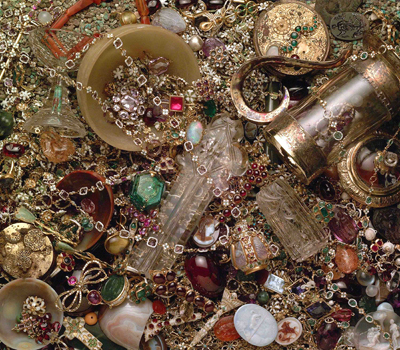
It’s been described as the greatest find of Jacobean and Elizabethan jewellery ever made – an extraordinary cache of some 500 gemstones, jewellery and other related items found buried under the floor during the demolition of a building at 30-32 Cheapside on 18th June, 1912.

Now known as the Cheapside Hoard, it dates from the 16th and 17th centuries and includes neck chains, pendants, hat ornaments, cameos and rings – among the items is a gold watch set into a hinged case made from a Columbian emerald, a tiny bejewelled gold scent bottle, and an onyx cameo of Queen Elizabeth I.

Other items include unfinished ornaments and unmounted gemstones which have origins spanning the world – from Asia and Middle East to South America. While these give support to the idea that the hoard is part of a goldsmith’s reserve stock, mystery still surrounds why it was buried in the building (although Cheapside was known for its goldsmiths during the era which the hoard dates from).

The majority of the hoard is held at the Museum of London where some of the items are on display. Other items are at the British Museum and one, an enamelled gold chain, is at the Victoria & Albert Museum. The Museum of London is planning major exhibition of the hoard starting in late 2013. Stay tuned for more information.

WHERE: Museum of London, 150 London Wall (nearest tube station is Barbican, St Paul’s or Moorgate); WHEN: 10am to 6pm, Monday to Sunday; COST: Free; WEBSITE: www.museumoflondon.org.uk

PICTURE: Museum of London

Around London – Sir John Soane’s private apartments to be restored; Highland cattle to return to Richmond; and two new photographic exhibitions…

• An appeal has been launched to raise the final £500,000 of a £7 million project to restore Sir John Soane’s private apartments in his former home overlooking Lincoln’s Inn Fields in Holborn. Phase one of the three year restoration project, Opening up the Soane, is expected to be complete by late 2012 with the entire project – which will see all of the rooms open to the public – to be completed by 2o14. The eight rooms being restored in the project, all of which are located on the second floor of No. 13 Lincoln’s Inn Fields – one of three adjoining properties Soane owned , include the architect’s bedroom, bathroom, oratory and book passage as well as Mrs Soane’s morning room and a room containing Soane’s architectural models. The building  already contains the Sir John Soane Museum which features an eclectic and at time outright strange mix of artefacts Soane, designer of the Bank of England (although it has since been substantially altered), collected during his lifetime. For more information, see www.soane.org.

Highland cattle will return to Richmond Park in autumn to help create patches of bare ground for wildflowers to grow after the success of a recent grazing trial. Richmond Park has the most extensive area of natural grassland in London and the type of grassland – known as ‘acid grassland’ – is a nationally rare habitat. Richmond Park is already home to 650 red and fallow deer. For more information, see www.royalparks.org.uk.

On Now – A new exhibition of street photography in London has just opened at the Museum of London. London Street Photography showcases 200 candid images of everyday life in the city with images ranging from sepia-toned scenes of horse-drawn cabs captured by tripod mounted cameras through to the use of digital cameras in snapping images of 21st century residents. Among the 59 photographers whose work is on display is that of Paul Martin, who pioneered the idea of candid street photography in London in the early 1890s, freelance photojournalist Henry Grant who photographed London’s streets in the Fifties and Sixties, and Stephen McLaren, known for his contemporary “quirky and colorful” street images. Entry is free. The exhibition runs until 4th September. For more information, see www.museumoflondon.org.uk.

On Now – The first major exhibition in 30 years of the work of EO Hoppe has opened at the National Portrait Gallery. Hoppe, who lived from 1878 to 1972, is considered one of the most important photographers of the early 20th century and is described as the “prototypical celebrity photographer”, shooting among others Margot Fonteyn, George Bernard Shaw, King George V, David Lloyd George and Ezra Pound. He also published the Book of Fair Women – photographs of women he believed to be the most beautiful of earth – in 1922 and in the Twenties and Thirties increasinly spent time outside the studio photographing street life. Hoppe Portraits: Society, Studio and Street runs until 30th May. For more information, see www.npg.org.uk.

Curious London Memorials – 7. Tower Hill scaffold memorial

Nestled on Tower Hill, somewhat overshadowed by the monumental memorial to the merchant naval casualities of World War I and II nearby, lay a series of plaques commemorating more than 125 people who were executed there.

The plaques, which stand on the site of the former scaffold, list the names of some of the most prominent who died there including Simon of Sudbury, Archbishop of Canterbury, who was beheaded by an angry mob during the Peasant’s Revolt in 1381, John Fisher, the Bishop of Rochester, and former chancellor Sir Thomas More – both of whom were executed in 1535 on the orders of King Henry VIII, and Thomas Cromwell, another chancellor who fell foul of King Henry VIII and was executed in 1540.

Later executions include William Laud, another Archbishop of Canterbury who was executed in 1645, James, Duke of Monmouth, the illegitimate son of King Charles II who was executed in 1685, and Simon Fraser, Lord Lovat, who became the last man to be executed there in 1747 (and the last man in England to be beheaded) after his capture following the Battle of Culloden in Scotland.

An inscription at the site reads that the memorial was created to “commemorate the tragic history and in many cases the martyrdom of those who for the sake of their faith, country or ideals staked their lives and lost”.

It’s worth noting that contrary to popular belief only 10 people were ever executed on Tower Green inside the Tower of London including two of King Henry VIII’s queens – Anne Boelyn (1536) and Catherine Howard (1542) – as well as the tragically young Lady Jane Grey, queen for only nine days before she was beheaded in 1554, and three Black Watch soldiers who were shot in 1743 after being charged with mutiny.

Famous Londoners – Geoffrey Chaucer

Best remembered for his landmark Middle English work in The Canterbury Tales, Geoffrey Chaucer is known by many as “the father of English literature”.

But he also had a distinguished career as a diplomat, civil servant and courtier and while much of his life (and death) remain something of a mystery, there’s no doubt that he spent a considerable part of it in London.

Chaucer (the name comes from the Latin for ‘shoemaker’) was born into a wealthy London family sometime between 1340 and 1345 and nothing is known of his early life or education. In 1357 he was working as a page in the household of Elizabeth, Countess of Ulster and daughter-in-law of King Edward III.

Two years later, he travelled in the retinue of the countess’ husband, Lionel, Duke of Clarence, to France with the army of King Edward III but in 1360 was captured near Rheims. He was subsequently ransomed with the king himself contributing to the sum needed.

Soon after Chaucer formally joined King Edward III’s court and was over the next two decades was sent on numerous missions by him to places as far flung as France, Genoa, Florence and possibly Padua (it was on these trips that he was apparently exposed to the writings of men such as Dante, Boccaccio and Froissart).

In 1366 he married Philippa Roet, a lady-in-waiting to Philippa of Hainault, King Edward III’s queen (and, some suggest, the sister to Katherine Swynford, mistress to John of Gaunt). Chaucer and his wife are believed to have three or four children – their son, Thomas, was later chief butler to English kings and served as the Speaker of the House of Commons.

In 1374, Chaucer was appointed as Comptroller of Customs for the Port of London, a post which he held until 1386 or so. It was during this time that he wrote many of his other major works including Parlement of Foules and Troilus and Criseyde (he had written his first major work, The Book of the Duchess, in honor Blanche of Lancaster, the late wife of his friend John of Gaunt sometime earlier following her death in 1369). Chaucer was also known at this time to have lived rent free in an apartment above the now removed Aldgate.

At some time in the 1380s, it is suggested Chaucer moved out to Kent where he is thought to have started work on The Canterbury Tales and where he also served as a local MP. His wife is believed to have died while they were there.

In 1389, he was appointed to the position of Clerk of the King’s Works and oversaw building projects at the Palace of Westminster, St George’s Chapel at Windsor Castle, and at the Tower of London (building the wharf). Later he served as deputy forester of the royal forest of North Petherton in Somerset.

Chaucer’s name disappears from records in 1400 and he is believed to have died either that year or shortly after. The cause of his death remains unknown although writer Terry Jones, in his book Who Murdered Chaucer?, has suggested Chaucer was murdered in 1402 at the behest of Thomas Arundel, the Archbishop of Canterbury – a claim which has met with short shrift with many.

Chaucer’s remains were later transferred to a more elaborate tomb and he become the first writer to occupy a space in Poet’s Corner – a fitting place for a towering figure of English literature.

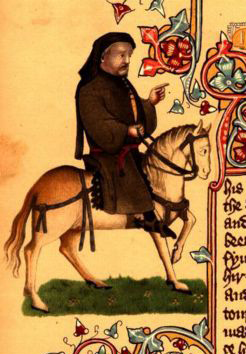
PICTURE: Image of Chaucer as a pilgrim from Ellesmere Manuscript in the Huntington Library in San Marino, California. The manuscript is an early publishing of the Canterbury Tales. Source: Wikipedia.

Happy Valentine’s Day!

It’s Valentine’s Day, so we’re pausing from our usual updates to give you a couple of interesting historical titbits…

• The first recorded written Valentine’s Day card is generally attributed to Charles, the Duke of Orleans, who wrote it to his wife while imprisoned in the Tower of London following King Henry V’s defeat of the French at the Battle of Agincourt in 1415;

• Geoffrey Chaucer, author of 1382 text Parlement of Foules – a poem written in honor of King Richard II’s engagement to Anne of Bohemia which is generally attributed with first linking St Valentine’s Day and romantic love, was born in and lived in London (although it should be noted that many don’t believe Chaucer was referring to 14th February in his reference but to another day associated with a different St Valentine).

PICTURE: Andrew C. (www.sxc.hu)

Lost London – Newgate Prison

The most notorious of London’s many prisons, Newgate remained in use for more than 700 years.

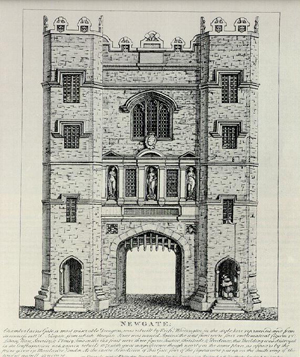
The prison – located on the corner of Newgate Street and Old Bailey on the site of what is now London’s Central Criminal Court (known as the Old Bailey thanks to its position on the street known as Old Bailey) – was apparently first constructed around the end of the 1100s on the orders of King Henry II at the site of one of the gates in the Roman wall (see picture).

It was enlarged and renovated several times over the ensuing centuries (including a complete rebuilding after the Great Fire of London in 1666 and another to the design of George Dance after the prison was badly damaged during the Gordon Riots of 1780, sparked by opposition to Catholic emancipation).

The prison, which was infamous for the squalid conditions in which prisoners were housed, was used for a range of purposes including housing debtors and the incarceration of people awaiting execution (by the 18th century, it’s said that more than 350 crimes had become punishable by death).

In 1783 public executions were moved from Tyburn, west of the city, to a site just outside the prison. In 1868, executions were no longer open to the public at large and the gallows moved inside. The prison closed in 1902 and was eventually demolished in 1904.

Famous prisoners who spent time in Newgate include Shakespeare’ contemporary Ben Jonson (for killing a man in a duel), 17th century author Daniel Defoe (for his authorship of political pamphlets), Captain William Kidd (for piracy), and William Penn, Quaker and founder of Pennsylvania (for contempt of court during a case brought after he was accused of having illegally preached ).

But perhaps the most infamous is the 18th century criminal Jack Sheppard, known for having escaped from the prison several times before finally being hanged at Tyburn (close to where Marble Arch now stands).

The only surviving part of the prison in its original location is part of the prison wall which can be seen in Amen Corner.

PICTURE: Wikipedia.com

Around London – A clowning Sunday, and Sir William Ramsay honored…

Clowns turned out en masse for the annual clown service held in honour of the ‘father of modern clowning’, Joseph Grimaldi, at Holy Trinity Church in Dalston last weekend. The London-born clown, who lived from 1778 to 1837, is became widely known for his pantomine performances and is believed to have been the first ‘white face’ clown. He has been honored at a “clown service”, held on the first Sunday in February, since the mid-1940s. It was originally held at St James’ Church, Islington – where Grimaldi was buried – but was moved after the church was demolished. His grave is preserved in a memorial garden on the site.

• Sir William Ramsay, the Nobel Prize-winning chemist credited with discovering the noble gases, has been commemorated with a blue plaque at his former home in Notting Hill. The Glasgow-born Ramsay moved to London in 1887 when appointed chair of chemistry at University College London and it was while living at 12 Arundel Gardens, Notting Hill, that he discovered the five noble gases. Ramsay lived at the property until 1902. He died in 1916. English Heritage unveiled  the plaque on Wednesday.

Curious London memorials – 6. The Buxton Memorial Fountain

Standing in Victoria Tower Gardens at the southern end of the Houses of Parliament, not far from more high profile monuments such as Rodin’s The Burghers of Calais, is a memorial to those who fought for the emancipation of slaves.

The gothic memorial, designed by Samuel Sanders Tuelon, was erected in 1865 by MP Charles Buxton to commemorate the work of his father, Sir Thomas Fowell Buxton and his associates including William Wilberforce, Thomas Clarkson, Zachary Macaulay, Henry Brougham, and Dr Stephen Lushington – all of whom played important roles in the eventual passing of the 1833 Slavery Abolition Act.

Sir Thomas, a founding member of the Anti-Slavery Society along with Wilberforce and Clarkson, took over as leader of the abolitionist movement in parliament after Wilberforce retired in 1825.

The memorial, which looks a little like a smaller version of the Albert Memorial (without the figure within) and is actually a public drinking fountain, was originally erected in Parliament Square but was removed in 1949 and placed in its current location in 1957, marking the 150th anniversary of the 1807 Act which abolished the trans-Atlantic slave trade.

The memorial originally bore eight statues representing the rulers of Britain from the Roman era to Queen Victoria but these were long since stolen. It as restored by Royal Parks in the mid-Noughties and unveiled again on the 27th March, 2007, to commemorate the 200th anniversary of the same act.

PICTURE: © Giles Barnard

Daytripper – St Albans

An ancient town with a history of settlement that goes back to the Romans, St Albans is these days known not only for its Roman ruins but as the home of Britain’s longest cathedral (and one of the country’s oldest pubs!)

Settled by the Romans and known then as Verulamium, St Albans was Britain’s second largest Roman settlement after London. Destroyed in the Boadicean rebellion, of 60-61 AD, it was rebuilt but declined after the Romans withdrew in 410 before gradually regaining prominence in the later Saxon and then early medieval ages.

The town, which had been known by the Saxon name Verlamchester after the Romans left, was subsequently named St Albans after the Christian martyr Alban who was believed to be executed by the Romans sometime in the 3rd century for his faith and whose shrine was attracting increasing interest from pilgrims.

The town, which continued to attract pilgrims through the medieval period, subsequently played an important role during the Wars of the Roses – with two battle fought there – but wasn’t directly affected by the later English Civil War. These days, given its location only some 22 miles north of London, it’s easy to reach by car or rail.

As might be expected given it’s prominence during the Roman era, St Albans today boasts a plethora of Roman ruins including the excavated remains of a former theatre on the town’s outskirts (it suggested this could have had seating for as many as 7,000 spectators, most of the town’s then population) as well as what’s left of the Roman wall and an exposed hypocaust and mosaic floor now located in a purpose-built building in the middle of Verulamium Park. On the edge of the park, which covers much of what was the Roman town, there’s also a terrific museum (the Verulamium Museum) with artefacts from the period as well as reconstructed rooms.

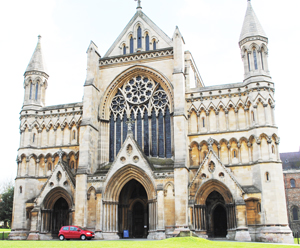
Towering over the town is another reminder of the city’s past – the Cathedral and Abbey Church of St Alban (pictured). Completed in about 1115, it has the longest nave of any cathedral in England and also hosts St Alban’s Shrine – a rare survivor dating from 1308, it still contains some of the martyr’s remains.

The only other piece of the abbey which survives from medieval times is the Great Gatehouse which dates from the 1360s and has served, among other things, as the town gaol. The grounds around the cathedral are these days pleasant parklands -among the graves is that of the former Archbishop of Canterbury (and former Bishop of St Albans), Robert Runcie.

Other medieval survivors in the town are the Clock Tower – built between 1403-1412, it’s one of only two “curfew towers” left in the country (you can now climb it for a great view of the surrounding area), and Ye Olde Fighting Cocks, believed by some to be England’s oldest surviving pub. Not far from here is Sopwell Nunnery, actually the remains of a Tudor mansion built in around 1560 by Sir Richard Lee on the site of what was a nunnery.

The town’s history is also on show in the Museum of St Albans which stands in Hatfield Road opposite the Marlborough Almshouses, built as a gift from Sarah, the 1st Duchess of Marlborough.

The tourist information centre, housed in the Georgian-era Town Hall, has a mini visitor guide which provides a walk through the town, taking in many of its historic sites – perfect if you’ve only got a day to spend there!

What’s in a name?…Covent Garden

Now a favored place for people-watching among Londoners and visitors alike, Covent Garden takes its name from the ‘Convent Garden’ which occupied the site in medieval times.

The ‘convent garden’, said to be a 40 acre kitchen garden, belonged to the Abbey or ‘Convent’ of St Peter in Westminster (Westminster Abbey was once the church of this religious foundation) which owned the site from the 13th century until 1548 when the land passed into control of King Henry VIII during the Great Dissolution.

He granted much of the land to John Russell, the 1st earl of Bedford, and it was the 4th earl, Francis Russell, who commissioned Inigo Jones to design a great public square. The new square featured grand houses along the northern and eastern sides and a church – St Paul’s (pictured right) – on the west while to the south, between the square and the Strand, stood the mansion of the Bedford family.

A fruit and vegetable market was licensed in 1670 but its growth – and the development of other squares offering a much greater level of privacy – led the wealthy who had originally occupied the houses to move elsewhere. The market, meanwhile, continued to grow and in the 1830s, the main market building which still stands there today was constructed.

Further buildings followed in the 1800s and the market continued to occupy the site until as recently as 1973 when it was finally moved out to Nine Elms and the area began a transformation into the shopping precinct it now is.

Treasures of London – The ‘Old Lion’ Maidenhair Tree, Kew Gardens

Celebrated in the 2002 list of 50 “Great British Trees”, the Maidenhair Tree is one of a number at Kew Gardens known as an “Old Lion” – the name collectively given to the few remaining trees with a planting date of 1762.

The Gingko biloba or Maidenhair Tree was one of the first of its species to be planted in Britain and, along with the other ‘Old Lions’, was brought from the Twickenham estate of the Duke of Argyll in 1762.

It was planted in what was then a new five acre arboretum laid out by William Aiton, employed as the gardener at the first botanic garden at Kew (this was established in 1759 at the behest of Princess Augusta, wife of Frederick, Prince of Wales – who had died in 1751 – and mother of King George III, and John Stuart, 3rd Earl of Bute).

Originally located against the wall of the ‘Great Stove’ glasshouse to provide it with protection, the tree has stood alone since 1861 when the glasshouse was demolished. It can now be found adjacent to the Wisteria arch close to the Secluded Garden Conservatory. Several further Gingko trees were planted in the garden in 1773 under the direction of botanist Sir Joseph Banks.

The other four ‘Old Lions’ at Kew are a False Acacia (Robinia pseudoacacia), an Oriental Plane (Platanus orientalis), a Caucasian Elm (Zelkova carpinifolia), and a Pagoda Tree (Sophora japonica).

WHERE: Kew Gardens (nearest tube station is Kew Gardens); WHEN: 9.30am to 4.15pm daily (check closing times for glasshouses); COST: £13.90 adults; £11.90 concessions; children under 17 free; WEBSITE: www.kew.org.

Around London – Year of the Rabbit celebrations; virtual art galleries; and, to the moon and back on ‘Boris bikes’

London will celebrate Chinese New Year this Sunday as it once again hosts the largest celebrations outside of Asia attracting some 250,000 people from around the globe. The event programme, which celebrates 2011 as the Year of the Rabbit, kicks off at 11am on the main stage in Trafalgar Square with firecrackers at noon, a Lion and Dragon performance at 1.10pm and dance and song during the afternoon culminating in a finale just before 6pm. There will also be a stage in Shaftesbury Avenue with performances throughout the day. Roads in the area will be closed for the event.

You no longer have to be in London to walk through the galleries of the Tate Britain or the National Gallery. Both institutions are among 17 around the world taking part in the Google Art Project which allows web surfers to virtually “walk” around the museum using the organisation’s Street View technology and turn 360 degrees to view the artworks in situ on the walls. The project also allows viewers to look through images of more than 1,000 artworks and, in addition, each institution has selected one artwork which then captured in “super high resolution” and then placed on line (Hans Holbein’s The Ambassadors‘ for the National Gallery, Chris Ofili’s No Woman, No Cry for the Tate). See www.googleartproject.com for more.

Cyclists have ridden the distance to the moon and back 13 times – 10 million kilometres – since the launch of Mayor Boris Johnson’s cycle scheme. Transport for London released figures this week showing riders have made more than 2.5 million journeys on the “Boris bikes” since the scheme was launched six months ago. The TfL has announced plans to expand the Barclays Cycle Hire scheme to new areas of east London including all of the Borough of Tower Hamlets, North Shoreditch, Bethnal Green, Bow, Canary Wharf, Mile End and Poplar by spring 2012. Almost 110,000 people are now signed up to the scheme. www.tfl.gov.uk.

The youngest Spitfire pilot in the Battle of Britain is to be granted the Freedom of the City of London in a special ceremony next month. Squadron Leader Geoffrey Wellum was awarded the Distinguished Flying Cross for his service in a front line squadron during the battle.

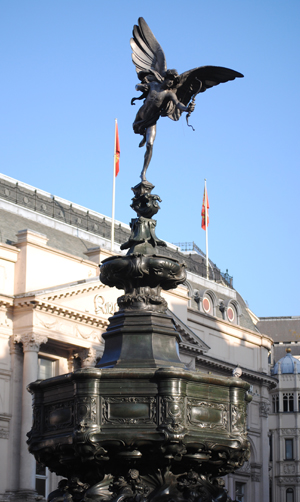
Curious London Memorials – 5. Eros (or the Shaftesbury Memorial Fountain)

Situated in the heart of Piccadilly Circus, the Eros statue has become an icon of London. Yet few of those who cluster around this iconic figurine realise that the aluminium statue (a rarity in itself) is actually a memorial, not to mention that it wasn’t intended to represent Eros at all.

The monument – which also features a bronze fountain below – was erected in the late nineteenth century to commemorate Anthony Ashley-Cooper, the 7th Earl of Shaftesbury and a well-regarded Christian reformer and philanthropist of the Victorian era, and is formerly known as the Shaftesbury Memorial Fountain.

Designed by Alfred Gilbert and unveiled in 1893, the winged figure holding a bow was apparently actually intended to represent Eros’ brother, Anteros – a Greek god associated with selfless love as opposed to his brother Eros, who is associated with erotic love – and, according to some, bore the name The Angel of Christian Charity, which makes sense given the man whom it is intended to commemorate.

While the statue attracted controversy when it was first unveiled thanks not least to its nudity, it has stood in Piccadilly Circus ever since (or at least mostly ever since – there have been a couple of brief periods such as when it was moved while Piccadilly Underground station was built and during World War II when it was moved for safe-keeping). It was restored in the 1980s.

A copy of the fountain and statue by Gilbert was later placed in Liverpool’s Sefton Park.

LondonLife – Jonquils in Bow Lane

Jonquils add a splash of color on a grey day during a busy lunchhour in Bow Lane in the City. Bow Lane runs from Poultry down to the junction of Queen Victoria and Cannon Streets.

Where’s London’s oldest…underground line?

The city’s first underground line – and the first underground line in the world – was the Metropolitan Line, which opened in 1863 with the aim of helping to reduce London’s growing traffic congestion problem.

Running for three miles, the new railway, constructed by the Metropolitan Railway Company, ran for three miles under New Road, from Paddington to Farrington Street and took three years to build.

It was constructed using a technique known as “cut and cover” which involved digging a trench and building a tunnel inside before covering it back up.

Almost 40,000 passengers journeyed between Paddington and Farringdon on the day it opened, with the journey taking about 18 minutes.

The success of the new railway sparked a flurry of interest and in 1868, the first section of the District Line was opened, the same year the St John’s Wood Railway Company opened a line from Baker Street to Swiss Cottage.

Having grown substantially since it’s earliest days, today only six miles (9.7 kilometres) of the Metropolitan Line’s 41.5 miles (66.7) kilometres actually run underground.

The line now carries about 53 million passengers annually and 49 trains operate on it during peak periods.