This Week in London – Behind the scenes at the Tate; keep the Christmas tree up, says English Heritage; and, a new mineral found at Natural History Museum…

Take a behind the scenes look at how Tate gallery curators have been looking after their art during the coronavirus period. A new film released by the Tate just before Christmas features art handlers, conservators, archivists and registrars discussing the challenges of transporting, installing and preparing artworks during this unprecedented time.

The Tate has also released a range of online resources through which people can experience exhibitions online – check the Tate’s YouTube channel for artist interviews and exhibition guides as well as in-depth exhibition guides available on the Tate website.

English Heritage has urged people to keep their Christmas decorations up until February to “bring some cheer” into the dark winter months. The organisation says Candlemas, which falls exactly 40 days after Christmas, was observed as the official end to Christmas during the medieval period. More formally known as the Feast of the Purification of the Blessed Virgin Mary, Candlemas was so called because the candles which would be used in churches in the coming year would be blessed on that day. Dr Michael Carter, English Heritage’s senior properties historian adds: “The tradition that it is bad luck to keep decorations up after Twelfth Night and the Epiphany is a modern invention, although it may derive from the medieval notion that decorations left up after Candlemas eve would become possessed by goblins! I’m of the opinion that, after the year we’ve all had, we certainly deserve to keep the Christmas cheer going a little longer.”

A new mineral, named kernowite after the Cornish name for Cornwall where it was originally found, has been discovered in the collection of the Natural History Museum. The mineral, which was probably collected in the 1700s and which entered the museum’s collection in 1964, was previously believed to be a green variety of the traditionally blue liroconite. It was only when the museum’s principal curator of minerals, Mike Rumsey, decided to investigate colour variation in liroconite that it was recognised as a new species. “Although many liroconites are greenish, with this unusually dark-green ‘liroconite’ specimen in question my colleagues and I discovered a subtle difference in its chemistry,” he said. “Overall, one part of its internal structure was dominated by iron instead of aluminium, so we found it worthy of a new name, kernowite.”

Send all items to exploringlondon@gmail.com

Four unusual London Christmas traditions…4. The Boy Bishop of St Paul’s…

Inside St Paul’s Cathedral. PICTURE: It’s No Game (licensed under CC BY 2.0)

This tradition is actually one which is no longer observed – but we thought it worth a mention to finish this short series.

The creation of temporary of ‘boy bishops’ was relatively widespread at greater churches in Middle Ages (and several other churches in London also observed the tradition apparently including Westminster Abbey).

At St Paul’s, it involved one of the choir boys being elected to be the ‘boy bishop’, usually on 6th December, for a role that would run through until Holy Innocents Day on 28th December.

Dressed in child-sized bishop’s robes, the ‘boy bishop’ performed various ceremonial duties throughout the season, culminating with them delivering a sermon and leading a procession through the city.

The tradition apparently became more raucous as time went on, so much so that eventually it was abolished during the Reformation by King Henry VIII, revived by his successor Queen Mary I, and then abolished again by Queen Elizabeth I.

Since then, the idea of a ‘boy bishop’ or ‘youth bishop’ has been revived in a somewhat updated form in certain cathedrals including those in Salisbury and Hereford.

We’ll start a new Wednesday series next week.

LondonLife – Back in lockdown…

The City of London, as seen from Tower Bridge. PICTURE: Claudia Owczarek/Unsplash

London Pub Signs – The Dove, Hammersmith…

While many establishments have been temporarily forced to close as a result of the coronavirus pandemic, we publish this piece in the hope you’ll be able to visit soon…

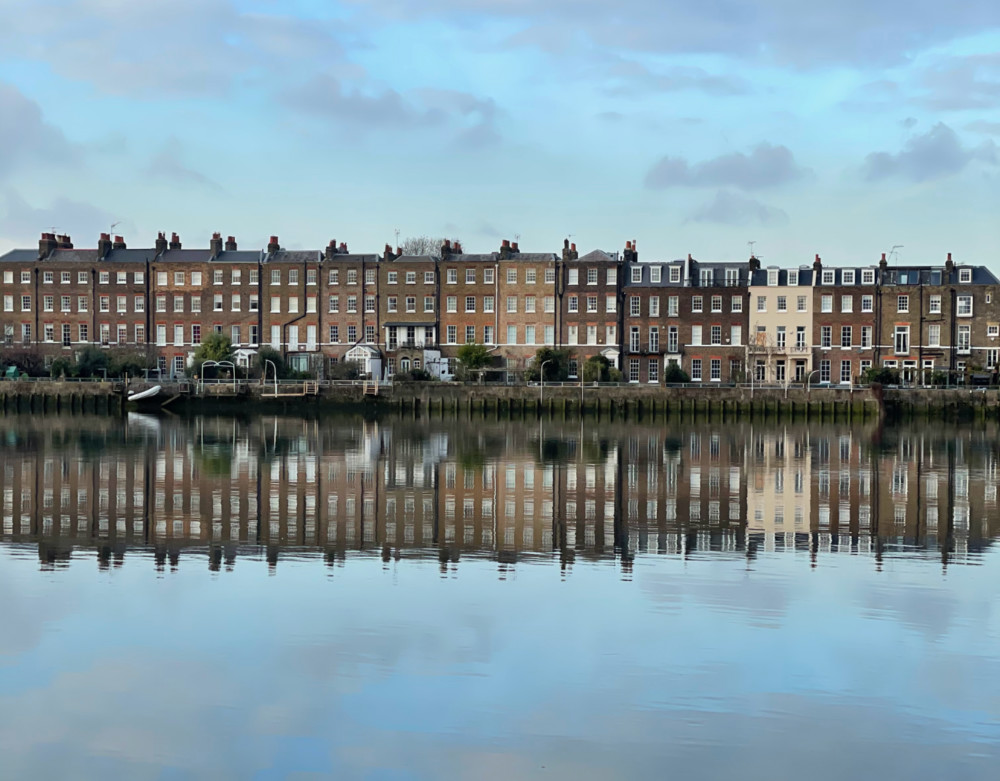
The Dove, Hammersmith, seen from the Thames. PICTURE: Tarquin Binary (public domain)

This storied Thames-side pub in London’s west apparently has associations with everyone from King Charles II to Arts and Crafts designer William Morris and author Graham Greene and is known as a prime site to watch the annual Boat Race between Cambridge and Oxford universities.

This image has an empty alt attribute; its file name is the-dove-hammersmith-3.jpg
The Dove, Hammersmith. PICTURE: Michael Gwyther-Jones (licensed under CC BY 2.0)

The establishment, now Grade II-listed, at 19 Upper Mall is said to have a history dating back to the late mid 18th century and was originally founded as a coffee house.

The rooms within are fittingly small given the building’s age; in fact, the bar was once listed by Guinness World Records as the smallest bar room in the world.

The pub’s name apparently comes from the Biblical story of Noah’s Ark in which a dove is sent out after the great flood to find dry land and returns with an olive leaf in its beak indicating the receding waters (it’s also interesting to note that the pub was known for almost 100 years as ‘The Doves’ for many years – it has been said this was due to a sign-writer’s error which was only corrected in the last 1940s).

King Charles II is said to have met his mistress Nell Gwyn at this riverside location prior to its current incarnation. Others who have come to be associated with the pub itself – Morris and Greene aside – include American author Ernest Hemingway, Welsh poet Dylan Thomas and Scottish poet, playwright and lyricist James Thompson who is said to have written the words for his 1740 song, Rule, Britannia!, here.

Another association comes from Thomas James Cobden-Sanderson, founder of the Doves Bindery and the Doves Press, both of which he named after this pub. It’s also mentioned in the pages of Sir Alan Herbert’s 1930 popular novel, The Water Gipsies.

Now part of the Fuller’s chain. For more information, see www.dovehammersmith.co.uk.

Exploring London’s 100 most popular posts of all time! – Numbers 2 and 1…

And so we’ve made it – the end of our year-long countdown of Exploring London’s most popular posts in honour of our 10th anniversary. And so, without any further ado, here’s the final two (and surprisingly, they both relate to the same fictional character)…

2. 10 iconic London film locations…1. Mary Poppins and feeding the birds at St Paul’s Cathedral

1. 10 fictional character addresses in London – 5. 17 Cherry Tree Lane…

We hope you’ve enjoyed this look at where we’ve been and look forward to bringing you some exciting new stories as we continue to explore London’s history and culture in 2021!

Exploring London’s 100 most popular posts of all time! – Numbers 6, 5, 4 and 3…

The next four in our countdown as we head to the final couple of entries…

6. 10 fictional character addresses in London – 4. 186 Fleet Street…

5. 10 fictional character addresses in London – 2. ‘Whitehaven Mansions’…

4. A look back at 10 fictional character addresses in London…

3. 10 fictional character addresses in London – 8. The Darling’s House…

New Year’s greetings from Exploring London!

Looking forward to a better year ahead in 2021! Don’t forget to check the site on New Year’s Day for the final two in top 100 posts countdown!

Exploring London’s 100 most popular posts of all time! – Numbers 10, 9, 8 and 7…

We’re into the top 10! Here’s the next four in our countdown…

10. 10 London sites associated with Sir Winston Churchill – 5. London residences…

9. 10 fictional character addresses in London – 3. 32 Windsor Gardens…

8. 10 fictional character addresses in London – 9. 7 Savile Row, Burlington Gardens…

7. 10 fictional character addresses in London – 7. Saffron Hill…

Exploring London’s 100 most popular posts of all time! – Numbers 14, 13, 12 and 11…

And, just before we get to the top 10, here’s the next four in our countdown…

14. Treasures of London – The Cheapside Hoard

13. Lost London – The Devil Tavern…

12. 10 fictional character addresses in London – 1. 221b Baker Street…

11. London Pub Signs – The Hung, Drawn and Quartered…

Exploring London’s 100 most popular posts of all time! – Numbers 18, 17, 16 and 15…

The next four in our countdown…

18. LondonLife – New Underground line named in honour of Queen Elizabeth II…

17. Treasures of London – The Pearl Sword…

16. 10 (more) fictional character addresses in London – 8. A square in Soho?…

15. 10 fictional character addresses in London – 10. 165 Eaton Place

Merry Christmas (and the next four in our countdown!)…

Christmas tree outside St Paul’s Cathedral. PICTURE: Alex Liivet
(licensed under CC BY 2.0)

In what has been, and continues to be, such a hard year for so many, we at Exploring London hope you’re still able to celebrate Christmas in some form this year…

Meantime, here’s the next four in our countdown of the 100 most popular posts of all time…

22. Lost London – The Savoy Palace…

21. What’s in a name?…St Mary Overie…

20. Treasures of London – The Whispering Gallery, St Paul’s Cathedral

19. Treasures of London – Admiral Lord Nelson’s coat

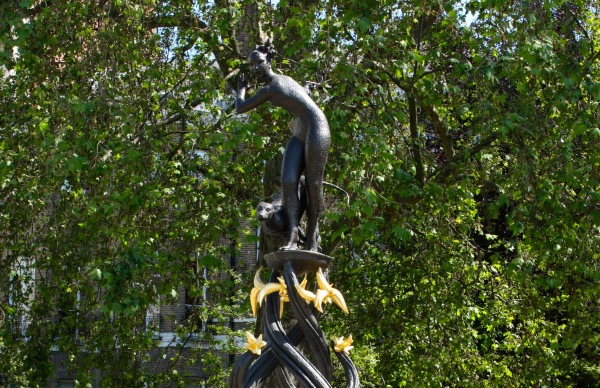
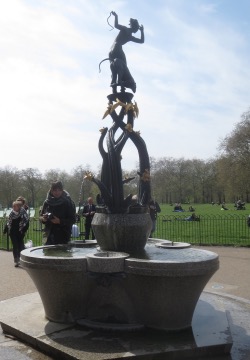
Four unusual London Christmas traditions…3. The Peter Pan Cup…

Postponed due to the coronavirus pandemic this year, the Peter Pan Cup is a swimming event that usually takes place on Christmas Day in Hyde Park’s Serpentine.

The bracing 9am event, which is only open to members of the Serpentine Swimming Club, is a handicapped race across a 100 yard course.

While the tradition of a Christmas Day swimming event goes back to 1864, it became the ‘Peter Pan Cup’ in 1904 when JM Barrie, creator of Peter Pan and a member of the club, presented the first cup to the winner. It was the same year Peter Pan debuted on the London stage (and Barrie would continue to present the cup to the winner until 1932).

Club members have to complete a certain number of winter races to be eligible to swim on Christmas Day. These days the race, which usually starts and ends on the southern bank of the Serpentine, is usually quite a spectacle with hundreds turning out to cheer the swimmers on.

Exploring London’s 100 most popular posts of all time! – Numbers 26, 25, 24 and 23…

The next four in our countdown…

26. 10 iconic London film locations…5. Belle at Kenwood House (but not as you know it)…

25. 10 fictional character addresses in London – 6. Wimbledon Common…

24. Where’s London’s oldest…department store?

23. LondonLife – A rare glimpse inside King Henry V’s chantry chapel…

Exploring London’s 100 most popular posts of all time! – Numbers 28 and 27…

The next two in our countdown…

28. 10 (more) fictional character addresses in London – 4. 138 Piccadilly…

27. Lost London – The ‘Tyburn Tree’

Exploring London’s 100 most popular posts of all time! – Numbers 30 and 29…

London’s back under restrictions meaning doors to many of the city’s institutions are once again closed. So, for the moment, here’s the next two in our countdown…

30. 10 small, ‘secret’ and historic gardens in central London…5. Seething Lane Garden…

29. Lost London – Jacob’s Island…

Four unusual London Christmas traditions…2. The Smithfield Meat Auction…

Reportedly cancelled for this year, the boisterous Christmas Eve meat auction at Smithfield usually draws a considerable crowd eager to snag a bargain.

The origins of the tradition, which apparently started at least 30 years ago, stems from the fact that most of the market butchers take at least a week off over Christmas, generally not returning to their stalls until the new year.

As a result, they would auction off their remaining stock on Christmas Eve to those keen enough to brave the cold and come out.

There has been a market at Smithfield since the 12th century – the premises was rebuilt in the mid-19th century after being formally established by the 1860 Metropolitan Meat and Poultry Market Act.

LondonLife – Vale John Le Carré (but George Smiley lives on)…

PICTURE: Courtesy of Google Maps

News this week that spy turned novelist John Le Carré has died at the age of 89. His family reportedly confirmed the author had died of pneumonia at the Royal Cornwall Hospital on Saturday night. Born as David Cornwall, Le Carré worked as an intelligence officer for the British Foreign Service and, drawing in his work, began writing Cold War spy thrillers under the pseudonym of Le Carré with his first, Call for the Dead, published in 1961. It was in this novel – Le Carré went on to write others – that his most famous character, George Smiley, made his first appearance. Initially a minor character, Smiley went on to become a star in three novels published in the 1970s, the most famous of which is Tinker Tailor Soldier Spy (Smiley’s last appearance was in a later book, 2017’s A Legacy of Spies). In tribute to Le Carré and George Smiley, pictured is 9 Bywater Street in Chelsea, the fictional home of Smiley (albeit a very real property!)

Exploring London’s 100 most popular posts of all time! – Numbers 32 and 31…

The next two in our countdown…

32. 10 London sites to celebrate Charles Dickens – 5. Seven pubs associated with Dickens (including one he never visited)…

31. The Royal Wedding – Eight curious facts about Royal Weddings past and present…

Exploring London’s 100 most popular posts of all time! – Numbers 34 and 33…

The next two in our countdown…

34. Treasures of London – The lions of Trafalgar Square…

33. Lost London – Mrs Salmon’s Waxworks…

This Week in London – ‘Fantastic Beasts’; artwork of The Blitz; and, ‘The Adoration of the Kings’ explored…

The links between mythical and fictional creatures with animals of the natural world are explored in a new exhibition which opened at the Natural History Museum this week. Fantastic Beasts: The Wonder of Nature, a partnership between the museum, Warner Bros Consumer Products and the BBC Studios Natural History Unit, features some 120 exhibits including Dracorex Hogwartsia dinosaur – named in recognition of Harry Potter’s school, Hogwarts, along with a hoax mermaid, a 16th century map depicting sea monsters, and what was once believed to be a unicorn horn. There’s also the chance to learn more about the Galapagos marine iguana and the boneless hagfish as well as fictional creatures like the mooncalf and erumpent. Admission charge applies and pre-booking required. For more, see www.nhm.ac.uk.

Preparing for the Natural History Museum’s ‘Fantastic Beasts: The Wonder of Nature Conservation’ PICTURE: Trustees of the Natural History Museum

Artworks depicting The Blitz are the subject of a new exhibition at the Churchill War Rooms. Art of the Blitz shines a new light on the experiences of ordinary people who lived through the Nazi air raids. The display includes works by Henry Moore, William Matvyn Wright, Eric Ravilious, Ernest Boye Uden, Mabel Hutchinson, Evelyn Gibbs, Evelyn Dunbar, and Leila Faithfull. Free with general admission ticket purchase, the display can be seen until 30th April. For more, see www.iwm.org.uk/events/wartime-london-art-of-the-blitz.

Jan Gossaert’s 16th-century masterpiece The Adoration of the Kings is at the heart of a new immersive digital experience which launched at the National Gallery this week. Sensing the Unseen: Step into Gossaert’s ‘Adoration, which has been designed with social distancing in mind, starts with the voice of the African King Balthasar speaking to viewers before light and sound guide them to an individual pod where they can experience an interactive version of the painting. The experience can be seen in Room 1 until 28th February. Admission is free but pre-booking is required. Meanwhile, Father Christmas is making a special appearance at the National Gallery on the 12th and 13th December – and again on 17th to 23rd December – along with the chance to step into a ‘winter wonderland’ inspired by the iconic National Gallery painting A Winter Scene with Skaters near a Castle (about 1608–9) by Hendrick Avercamp (1585–1634). Admission charge applies and pre-booking required. For more, see www.nationalgallery.org.uk.

Send all items for inclusion to exploringlondon@gmail.com.