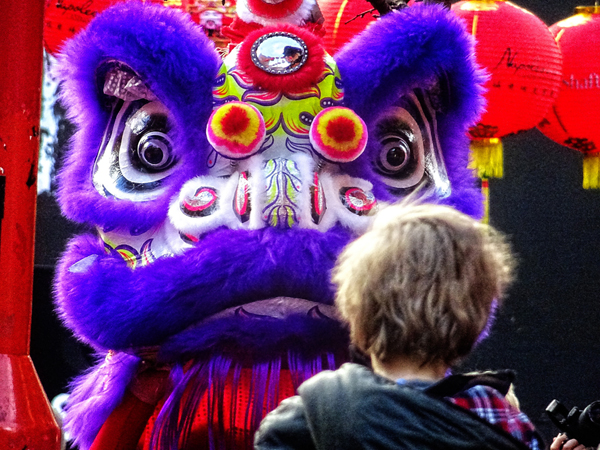
A scene from Chinese New Year celebrations heralding the Year of the Rooster held in central London last weekend. PICTURE: Garry Knight/Flickr/CC BY 2.0
A scene from Chinese New Year celebrations heralding the Year of the Rooster held in central London last weekend. PICTURE: Garry Knight/Flickr/CC BY 2.0
 Now located on a street of another name, London’s oldest street sign is generally believed to be that of Yorke Street and dates from 1636.
The rather small sign, which is located on a building dating from the 1730s, is now located high up at 34-36 Tavistock Street in Covent Garden (above a blue plaque commemorating author Thomas de Quincey (1785-1859), writer of Confessions of an English Opium Eater).
Another of the oldest signs can be found at the corner of Chigwell Hill and The Highway – it refers to ‘Chigwell Streate’ and bears the date 1678.
PICTURE: The Yorke Street sign is the white oblong at the top right under which can be seen the blue plaque (Via Spudgun67/Wikimedia Commons/CC BY-SA 4.0)
 • Roman tools and other artefacts from the era including a stamp for metal ingots and pottery are among objects found in London’s ‘lost’ Walbrook Valley which have gone on display at the Museum of London. Working the Walbrook features objects excavated during the past 170 years of digs around the watercourse which once cut the city in half, running from Finsbury Circus to Cannon Street. Created as part of a PhD project being supervised by the Museum of London and the University of Reading, the objects on show include an iron stamp dating from the Roman period inscribed with the letters MPBR (understood to be an abbreviation for ‘Metal Provinciae Britanniae’ – “the mines of the province of Britannia”) which is believed to have been used by officials to stamp metal ingots passing through London on their way to the Continent. Other items include Roman farming and gardening tools, and a pot decorated with a smith’s hammer, anvil and tongs which was found at the bottom of a well in Southwark and which may have been linked to worship of the god Vulcan. The free display is on show until March. For more, see www.museumoflondon.org.uk. PICTURE: Gardening tools from Roman London. A pruning hook, bailing fork and shears © Museum of London
• A series of prints by Pablo Picasso spanning the period from the late 1940s to the late 1950s form the heart of a new exhibition at the British Museum in Bloomsbury. The prints, which include 16 lithograph prints and three aquatint prints, were recently acquired by the museum in what represents the final part of the museum’s effort to more fully represent the artist’s work as a printmaker. Six of the lithographs were inspired by the beauty of Picasso’s lover Francoise Gilot while others feature Bacchanalian scenes and portraits of German-born dealer Daniel-Henry Kahnweiler. On display from Friday in Gallery 90A, they can be seen in the free exhibition until 3rd March. For more, see www.britishmuseum.org.
• The details of some 160,000 people buried at Highgate Cemetery in north London have been made available online. Deceased Online has announced that all records for the period from May, 1839, to August, 2010 – a total of 159,863 people, are now available, including digital scans of original registers, details of who is buried in each grave and location maps for most graves. Notable people buried at Highgate include author Douglas Adams, philosopher Karl Marx and chemist and physicist Michael Faraday. For more, see www.deceasedonline.com
Send all items for inclusion to exploringlondon@gmail.com.
Lemuel Gulliver, the ‘hero’ of Jonathan Swift’s 1726 book, Gulliver’s Travels, wasn’t a native Londoner but moved to the city for work and lived in several different locations before embarking on his famous voyage to the land of Lilliput.
 According to the book, the Nottinghamshire-born Gulliver studied at Emanuel College (sic) in Cambridge before he was apprenticed to London surgeon known as James Bates after which he spent a couple of years studying in the Dutch town of Leiden (spelt Leydon in the book).
Returning to England briefly, he spent the next few years voyaging to the “Levant” before returning to London where he “took part of a small house in Old Jewry” (Old Jewry lies in the City of London runs between Poultry and Gresham Street) and married Mary Burton, daughter of a Newgate Street hosier.
His master Bates dying, however, a couple of years later and with a failing business, he took up the position of surgeon on two different ships and it was when he eventually returned to London that he moved to Fetter Lane – which runs north from Fleet Street – and then from there to Wapping where hoping to retire from the sea and “get business (presumably he meant medical cases) among the sailors”.
But it was not to be and so, in 1699, Mr Gulliver set off on the voyage accounted in the famous book.
The name Fetter Lane, incidentally, has nothing to do with fetters (ie chains) – see our earlier post for more. And it’s also worth noting that the author, Jonathan Swift, also visited and lived in London at various times of his career – we’ll take a more in depth look at his experiences in a later post.
PICTURE: Lemuel Gulliver, depicted in a first edition of Gulliver’s Travels/Wikipedia.
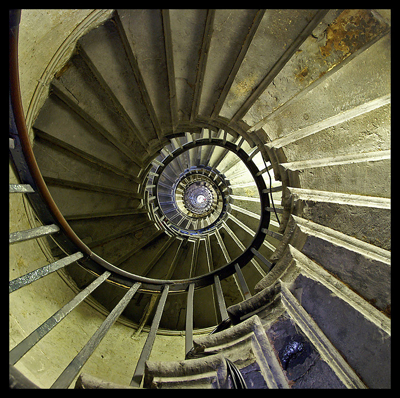
Inside The Monument, built to commemorate the Great Fire of London, in the City of London. For more on the history of The Monument. PICTURE: Flickr/CC BY 2.0.
• A charter granted by King William the Conqueror to the City of London in 1067 is on display at the City of London Heritage Gallery. The 950-year-old charter, known as the William Charter, was given by the king soon after his coronation at Westminster Abbey but before he had entered the City and is seen as key in his winning the support of the City as well as in how the City came to have its special autonomy. Written in Old English, the charter measures only 2 x 16 centimetres and has one of the earliest seal impressions of King William I. The oldest item in the City of London Corporation’s 100 kilometres of archives, it’s on display at the gallery until 27th April. For more, follow this link.
• Madame Tussauds in Marylebone has unveiled a wax figure of US President-elect Donald J Trump this week in the lead-up to his inauguration in Washington, DC, on Friday. The future president stands in the ‘Oval Office’ section of the display. The organisation’s team of sculptors, make-up artists and hair inserters have been working on the figure since his victory in the US election back in October. For more, see www.madametussauds.com/london/en/.
• A scoop of ice-cream with a visiting fly and micro-drone, a recreation of an ancient sculpture destroyed by the so-called Islamic State and a tower made of a VW, scaffolding, oil drums and a ladder among the possibilities to replace David Shrigley’s Really Good on Trafalgar Square’s Fourth Plinth next year. Maquettes of five short-listed sculptures are on show at the National Gallery from today until 26th March. Two of those displayed will be chosen to be featured on the plinth – one next year and the other in 2020. Admission is free. As well as Heather Phillipson’s The End, Michael Rakowitz’s The Invisible Enemy Should Not Exist, and Damián Ortega’s High Way, the short-listed works include Huma Bhabha’s Untitled (a massive figure like something from a sci-fi film) and Raqs Media Collective’s The Emperor’s Old Clothes (an empty robe).
Send all items for inclusion to exploringlondon@gmail.com.
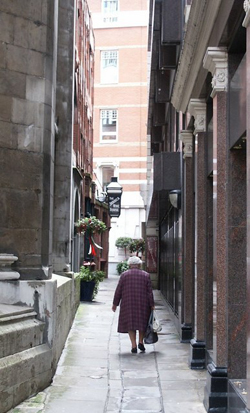
The first coffee house to be located in London, this premises was opened by a Greek, Pasqua Rosée, in 1652 and is believed to have been located in St Michael’s Alley off Cornhill.
 Rosée had come to England as the manservant of Daniel Edwards, a member of the Levant Company who had first encountered him in Smyrna (in modern Turkey) and returned with him. One story says that Rosée decided to start the business after a falling out with Edwards on their return to England; another that Edwards helped Rosée start the business when they realised the interest people had in trying the new drink.
The establishment, which was originally located in a shed in the churchyard of St Michael’s Cornhill, was advertised by a sign which was apparently a portrait of Rosée – hence the name ‘The Sign of Pasqua Rosee’s Head’ – but it was also referred to as ‘The Turk’s Head’. Such was its success that Rosée was apparently selling up to 600 dishes of coffee a day.
Not everyone, however, was a fan of Rosée’s business – in particular tavern owners who saw it as a threat to their own – and aware of his status as an outsider, he is said to have decided to forge a partnership with a freeman of the City of London so there could be no dispute over his right to trade. He found just such a partner in a grocer, Christopher Bowman, in 1654.
The business was relocated following the creation of their partnership across the alley out of the shed and into a rather ruinous house but the new lease was signed only by Bowman. There is a suggestion that Rosée had to flee for some misdemeanour but for whatever reason, his name is no longer mentioned and Bowman was now apparently the sole owner of the business.
Despite the change of ownership, the business continued to trade under Rosée’s sign and it is said to have been Bowman who authored the handbill The Vertue of the Coffee Drink (sic) – an advertising document which credits its creation to Rosée and is filled with some rather dubious claims about the miraculous powers of the drink.
Notable visitors included Samuel Pepys who visited the famous coffee house in 1660, mentioning it in his famous diary.
Bowman apparently died in 1662 and the business went into decline before any trace of it was wiped away in the conflagration of the Great Fire of 1666. The Jamaica Wine House, which features a blue plaque to Rosée’s coffee house apparently erected by the Corporation of London in 1952, now stands near the site Rosée’s original shed.
PICTURE: View down St Michael’s Alley with the church on the left looking toward’s the Jamaica Wine House. © Copyright Paul Collins/CC BY-SA 2.0

• A new exhibition celebrating the life of John Lockwood Kipling – described as an “artist, writer, museum director, teacher,  conservationist and influential figure in the Arts and Crafts movement” as well as being the father of world famous writer Rudyard Kipling – opens at the V&A in South Kensington on Saturday. The exhibition is the first exploring the life and work of Kipling (1837-1911) who campaigned for the preservation of Indian crafts as well as being a craftsman himself (his terracotta panels can still be seen on the exterior of the V&A) and an illustrator of his son’s books. Lockwood Kipling: Arts and Crafts in the Punjab and London features paintings of the Indian section of the 1851 Great Exhibition as well as objects which were on display (the exhibition was visited by Kipling while a teenager), Kipling’s sketches of Indian craftspeople observed during his many years living in India as well as objects he selected for the V&A while there, designs and illustrations for books, and furniture he helped his former student architect Bhai Ram Singh design for royal residences Bagshot Park and Osborne. The free exhibition, a collaboration between the V&A and the Bard Graduate Centre in New York, runs until 2nd April (it will be on display at the Bard Graduate Center, New York, from 15th September this year). For more, see www.vam.ac.uk/kipling. PICTURES: Top: The Great Exhibition, India no. 4, by Joseph Nash/Royal Collection Trust © Her Majesty Queen Elizabeth II 2016 ©; Right: Lockwood Kipling with his son Rudyard Kipling, 1882/© National Trust, Charles Thomas
• Anyone named Emma will receive free entry into the National Maritime Museum’s exhibition on Emma Hamilton this weekend in honour of the 202nd anniversary of her death on 15th January, 1815. Emma Hamilton: Seduction and Celebrity shines a light on the remarkable woman who overcame poverty to become one of the most famous international celebrities of her age. The display features more than 200 objects on loan from public and private collections as well as from the museum’s own collection including paintings, personal letters, prints and caricatures, costumes and jewellery. Simply bring proof that your name is Emma – such as a passport, driver’s licence or utility bill – and gain free entry on 14th and 15th January. The exhibition runs until 17th April. Admission charges usually apply. For more, see www.rmg.co.uk/emmahamilton.
• Members of the public will be granted a close-up look of the ceiling of the Painted Hall at the Old Royal Naval College in Greenwich this April. The hall, described as the “Sistine Chapel of the UK” is undergoing a two year transformation which includes conservation of Sir James Thornhill’s famous painted ceiling. As part of the project, a series of ceiling tours will be launched on 1st April this year with visitors taken up close via a lift where they can see the conservators at work. For more, see www.ornc.org.
Send all items for consideration to exploringlondon@gmail.

The upmarket department store chain John Lewis traces its origins back to 1864 when the man himself opened a drapers at 132 Oxford Street (later renumbered, it’s the site of the current store).
Originally from Somerset and brought up by an aunt after he was orphaned at a young age, Lewis served as an apprentice to a linen draper in Wells as a teenager before he moved to London to work as salesman for an Oxford Street draper, eventually becoming a silk buyer. He apparently turned down offer of partnership in that business, deciding instead to put out his own shingle.
Lewis slowly expanded his business into neighbouring properties and diversified into a growing range of goods – everything from clothing to furniture to kitchen china. By 1895 he had rebuilt his original shop, which now had fronts on Oxford and Holles Streets, into a multi storey department store with retail showrooms as well as a warehouse and a restaurant for customers.
More than 40 years after he opened his first shop in London, in 1905 Lewis acquired Peter Jones in Sloane Square. His sons, John Spedan Lewis and Oswald, became partners in the business in 1907. Oswald was later bought out but John, particularly while convalescing following a riding accident, began to think about how he could improve staff wages and working conditions.
However, his new ideas led to conflict with his father (known to be a tough employer) and so, in 1914, Spedan Lewis took over total control of the Peter Jones business in exchange for no longer taking any part in the Oxford Street store. Instead, turning his attention to the Sloane Square business, he introduced a profit-sharing scheme for employees as well as a representative staff council and other initiatives including the introduction of the weekly in-house magazine, The Gazette.
In 1924, Spedan Lewis was reconciled with his father and so it was that following his father’s death in 1928, he became sole owner of both businesses, bringing them together into a single entity. The famous motto – “Never Knowingly Undersold” – has apparently been in use in the Peter Jones store since it was introduced by Spedan Lewis in 1925.
In 1929, he created the John Lewis Partnership Ltd and while he continued to have practical control of the business, his reforms meant profits were distributed among employees. Twenty-one years later, in 1950, he signed settlement which saw the partnership become the property of the employees.
In 1933, the partnership purchased its first store outside London in Nottingham and it is now regarded as the largest department store retailer in the UK with 46 John Lewis shops including 32 department stores. It also owns the Waitrose supermarket chain.
The flagship Oxford Street store was almost completely destroyed during World War II. The present premises, which features a roof garden, opened in 1961. It features a famous (now Grade II*-listed) artwork – Barbara Hepworth’s Winged Figure – on the Holles Street facade near the corner with Oxford Street.
In 2008 this store was awarded a Royal Warrant from Queen Elizabeth II as “suppliers of haberdashery and household goods”.
This is the final in our current Wednesday series. We’ll be starting a new series shortly.
PICTURE: James Petts/Wikipedia/CC BY-SA 2.0
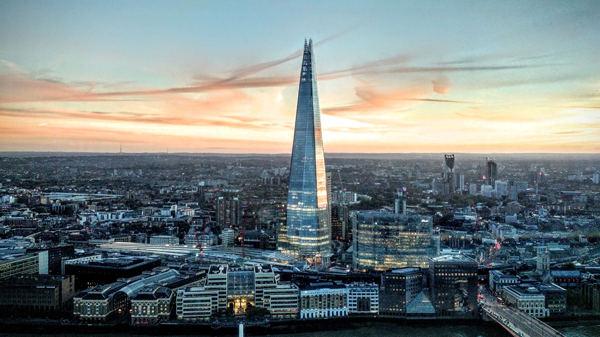
No sign of Tube turmoil as we look south across the River Thames to The Shard and Southwark. The 95 storey high building is the tallest in London (and the fourth tallest in Europe). PICTURE: Fred Mouniguet/Unsplash
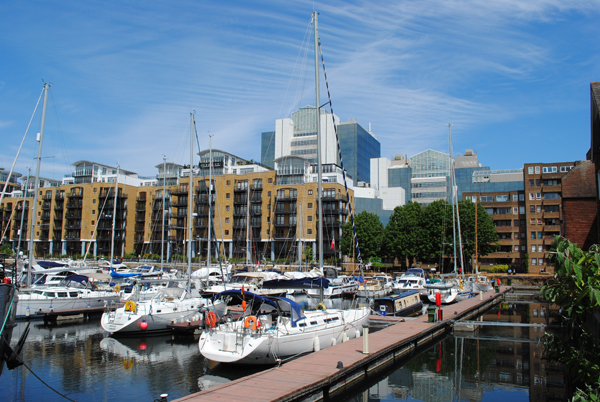 The name for this dock, located just to the east of Tower Bridge, comes from a 12th century established to help the poor known as St Katharine’s Hospital which was once located in the vicinity.
The hospital, which was named at St Katharine – whom tradition holds was martyred in the 4th century by the Roman Emperor Maxentius – was founded by Matilda, the wife of King Stephen, in 1147, for the maintenance of 13 poor people.
It was supported by various English queens over the ensuing centuries, including Eleanor, beloved wife of King Edward I, who granted it a new charter in 1273, and Queen Philippa, wife of King Edward III, who drew up new regulations for the running of the hospital in 1351.
Having survived an attempt to have the hospital abolished by Puritans in the 17th century and an attempt to burn it down during the late 18th century Gordon Riots, in the early 19th century demand for new docks brought about the old hospital’s final demolition.
In 1825, the hospital relocated to Regent’s Park. Now known as the Royal Foundation of St Katharine, it is currently located in Limehouse, having moved there in 1948 (we’ll take a more in depth look at the history of St Katharine’s Hospital in an upcoming post).
The docks, meanwhile, was opened in 1828 following the removal of more than 1,200 homes and a brewery as well as the old hospital – works carried out despite a public outcry and, apparently, no compensation. Designed by Thomas Telford (of the Iron Bridge fame – this was apparently his only London project), the docks occupy a 23 acre site and featured a central basin opening to two docks lined with brick warehouses.
The docks were closed in 1968 and in the years since, the warehouses have been converted into shops, eateries, offices and residences while the waters are now used as a marina for luxury yachts.
 Have a great start to 2017 – we at Exploring London are looking forward to more of doing just that – exploring London’s history and culture – with you in the coming year!
And so here are the five most popular new articles we published in 2016…
5. LondonLife – New Underground line named in honour of Queen Elizabeth II…
3. A Moment in London’s History – Sir Walter Raleigh leaves the Tower…
2. Lost London – The King’s Mews at Charing Cross…
1. (10) iconic London film locations…1. Mary Poppins and feeding the birds at St Paul’s Cathedral…
It’s been another busy year and we hope you’ve enjoyed our coverage of London’s history and culture in 2016. But we’ve now reached the end and that means it’s time to review Exploring London’s 10 most popular new posts this year. To kick if off, we’re looking at numbers 10 through to six (we’ll look at numbers five to one tomorrow). So, without further ado…
10. 10 iconic London film locations…8. The Tube and Sliding Doors’ defining moment…
9. A Moment in London’s History – The (other) Great Fire of London…
8. A Moment in London’s history…The ‘longest night’…
7. 10 sites commemorating the Great Fire of London – 1. Thomas Farriner’s plaque

Trafalgar Square at Christmas. PICTURE: London & Partners
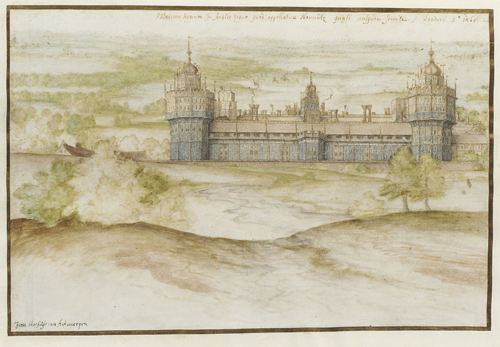 The earliest and most detailed depiction of King Henry VIII’s famed Nonsuch Palace, a watercolour by the celebrated Flemish painter Joris Hoefnagel, has been recently acquired by the V&A.
The painting, made in 1568, is the most faithful only six surviving images of the palace which was located in Cheam, Surrey. The fanciful building was commissioned by the king in 1538 and featured a facade decorated with elaborate plasterwork in Franco-Italianate style with the aim of rivalling the Fontainebleau residence of French King Francois I.
One of the most important buildings of the English Renaissance period, it was unfinished when the king died in 1547 and was subsequently purchased from Queen Mary I by Henry Fitzalan, 12th Earl of Arundel, in 1557 – it was he who finished the building and most likely commissioned the Antwerp-born Hoefnagel to paint it. Later acquired by Queen Elizabeth I, it became one of her favourite residences and was eventually demolished by King Charles II’s mistress, the Duchess of Cleveland, between 1682 and 1688 to pay off gambling debts.
Nonsuch Palace from the South, which is the first major work of Hoefnagel to enter the collection, can be seen in the museum’s British Galleries in South Kensington. Entry is free. For more, see www.vam.ac.uk.
PICTURE: Nonsuch Palace from the South, Joris Hoefnagel, 1558, Watercolour © Victoria and Albert Museum, London.
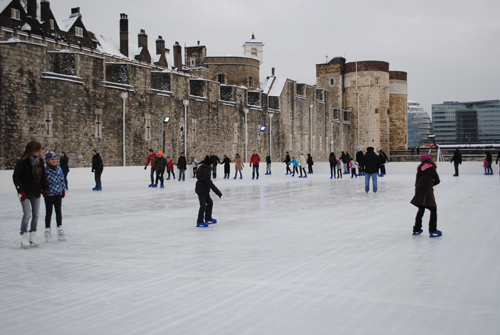 • London’s obsession with ice-skating is the subject of an exhibition which opened at the Museum of London earlier this month. Skating on Ice looks at the history of the popular pastime, from the 12th century – when locals are described strapping animals bones to their feet to skate on ice at Moorfields – across the centuries (and the developments that went with them) to today. Among the artefacts on show is an 1839 oil painting by J Baber depicting skaters on the Serpentine in Hyde Park, sketches from the London Illustrated News showing a rescue operation to recover the 40 of some 40 skaters who plunged beneath the ice in Regent’s Park on 15th January, 1867, a navy blue gabardine skirt suit from Fortnum & Mason dating from the 1930s and a series of skates, ranging from some made of animal bones through to a pair of Victorian racing skates known as Fen Runners and a pair of ice skates used from the late 1930s by Londoner Christina Greenberry at Streatham Ice Arena. Runs until 8th February. Entry is free. See www.museumoflondon.org.uk for more. (Pictured – ice-skating in the Tower of London moat).
• Christmas is looming and so, if you haven’t been out and about already, here’s five Christmas trees worth seeing over the coming few days (excluding the obvious one in Trafalgar Square):
• Prince Charles last week unveiled the foundation stone for a tower that will take visitors to Westminster Abbey into the institution’s new museum and galleries. The tower is being built outside Poet’s Corner – between the 13th century Chapter House and 16th-century Henry VII’s Lady Chapel – and will be the principal entrance to the medieval triforium, which has never before been opened to the public and which house the proposed The Queen’s Diamond Jubilee Galleries. The tower and galleries, costing almost £23 million, will be the most significant addition to the abbey since Nicholas Hawksmoor’s west towers were completed in 1745. The galleries, which will be located 70 feet above the abbey’s floor, are due to open in summer 2018, and will display treasures from the abbey’s history as well as offering magnificent views of Parliament Square and the Palace of Westminster. To help meet the cost of the new galleries, the abbey has launched a #makehistory campaign asking for public donations to the project. For more, see www.westminster-abbey-galleries.org/Content/Filler.
Send all items for inclusion to exploringlondon@gmail.com.
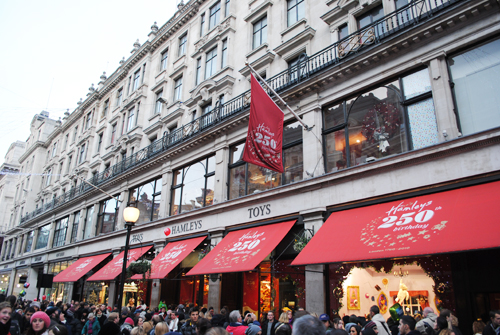 This Regent Street establishment – the oldest and largest toy store in the world – dates back to 1760 when Cornishman William Hamley came to London and founded his toy store – then called ‘Noah’s Ark’ – on High Holborn.
Selling everything from wooden hoops to tin soldiers and rag dolls, the business aimed to capture the trade of affluent Bloomsbury families and proved rather successful, attracting a clientele in the early 19th century which included not only wealthy families but royalty.
Such was its success that in 1881, Hamley’s descendants opened a new branch of the shop at 200 Regent Street. The Holborn store, meanwhile, burned down in 1901 and was subsequently relocated to a larger premises at numbers 86-87 in the same street.
Faced with the Depression in the 1920s, the shop closed briefly in 1931 but was soon reopened by Walter Lines, chairman of Tri-ang Toys, and in 1938 was given a Royal Warrant by Queen Mary, consort of King George V.
The premises at 188-196 Regent Street was bombed five times during the Blitz but the shop (and its tin hat-wearing staff survived). In 1955, having presented a Grand Doll’s Salon and sizeable model railway at the 1951 Festival of Britain, the shop was given a second Royal Warrant – this time by Queen Elizabeth II, who has been given Hamleys toys as a child – as a ‘toys and sports merchant’.
The business, which has passed through several owners since the early 2000s, is now owned by Chinese-based footwear retailer C.banner. The flagship store is spread over seven floors and tens of thousands of toys on sale, located in various departments.
As well as the Regent Street premises (it moved into the current premises at number 188-196 Regent Street in 1981), Hamlets has some 89 branches located in 23 countries, from India to South Africa. A City of Westminster Green Plaque was placed on the store in February 2010, in honour of the business’s 250th anniversary.
The toy store holds an annual Christmas parade in Regent Street which this year featured a cast of 400 and attracted an estimated 750,000 spectators.
PICTURED: Hamleys during its 250th birthday celebrations.
London is illuminated for Christmas. Here’s some of what photographers on Flickr have captured this year…

Christmas in Regent Street. PICTURE: Michael Reilly/Flickr/CC BY 2.0
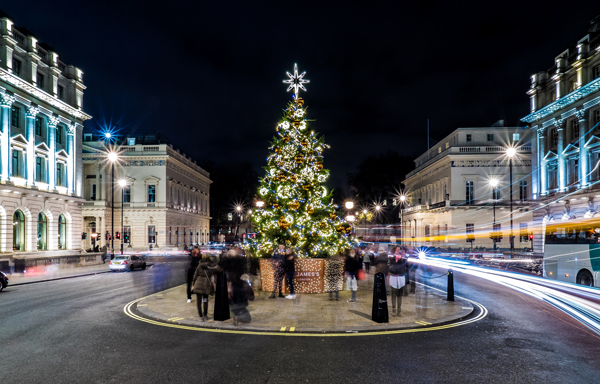
Christmas tree in Waterloo Place. PICTURE: William Warby/Flickr/CC BY 2.0
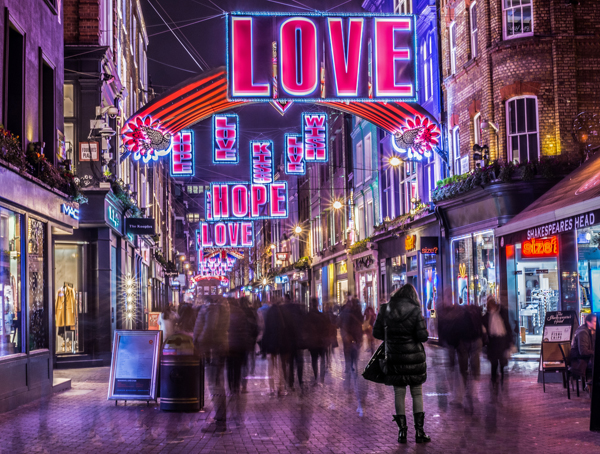
Carnaby Street. decorations PICTURE: Roger/Flickr/CC BY-SA 2.0

Oxford Street under lights. PICTURE: Paolo Braiuca/Flickr/CC BY 2.0 (image cropped).
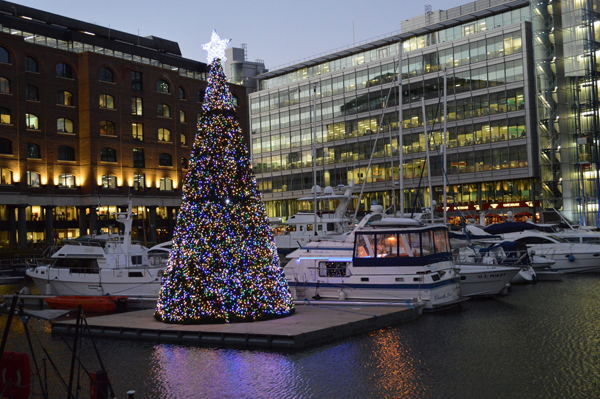
A floating Christmas tree at St Katharine Docks. PICTURE: Matt Brown/Flickr/CC BY-SA 2.0
The practice of sending Christmas cards really began in the Victoria era and it was in London, in 1843, that the first commercial Christmas cards are widely said to have been designed and printed.
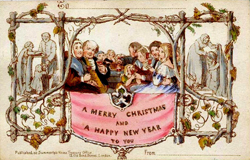 The idea had come from Sir Henry Cole, the first director of the Victoria and Albert Museum, who, overwhelmed with the volume of correspondence he was receiving, conceived it as answer to his problem, allowing him to send Christmas greetings to a wide group of people – all at once.
He asked his friend, artist John Callcott Horsley, to design the card and an edition of 1,000 were printed by Jobbins of Warwick Court in Holborn.
The hand-coloured card, published by Summerley’s Home Treasury Office in Old Bond Street, showed a family gathered for a Christmas celebration with two side images showing people engaged in charitable acts and a message, ‘A Merry Christmas and a Happy New Year to You’. Designed as a single flat card (not foldable like they are today), it came complete with ‘To’ and ‘From’ spaces for the sender to fill in.
The cards which Sir Henry didn’t need for his personal use were placed on sale for a shilling each but it was a fairly steep price and that – and the fact that the image of people drinking at the festive season apparently roused the ire of temperance campaigners, helped to ensure the cards weren’t an immediate success.
Nonetheless, further cards were produced in the following years and within a couple of decades, they were being mass produced.
One of Sir Henry’s original cards was reportedly sold at an auction in 2013 for £22,000.
 Exploring London
