10 London bishop’s palaces, past and present – 1. Lambeth Palace…

Dame Sarah Mullally, Bishop of London since 2018, was named as the 106th Archbishop of Canterbury in October so we thought it a good time to explore some of the grand palaces which served as bishop’s palaces, some of them still standing and others not.

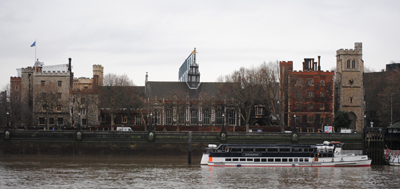
And what more appropriate place to start than Lambeth Palace, the official Thames-side residence of the Archbishop of Canterbury.

Subscribe for just £3 a month to access all of Exploring London’s content…

What’s in a name?…Stockwell…

This district in the Borough of Lambeth in south London was formerly a rural manor located on the southern edge of London.

The name, variants of which date back to at least the late 12th century, is said to relate to the Old English words for a tree trunk – ‘stoc’ – and a well or spring, ‘wella’, and has been interpreted as meaning the well or spring by a tree stump, tree truck or perhaps a wood (there was apparently a Stockwell Wood which has long since disappeared).

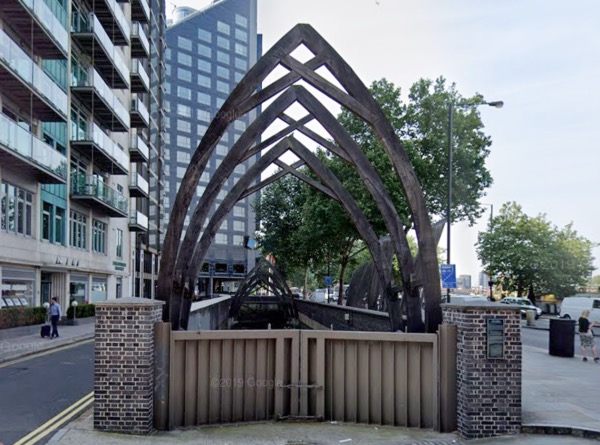
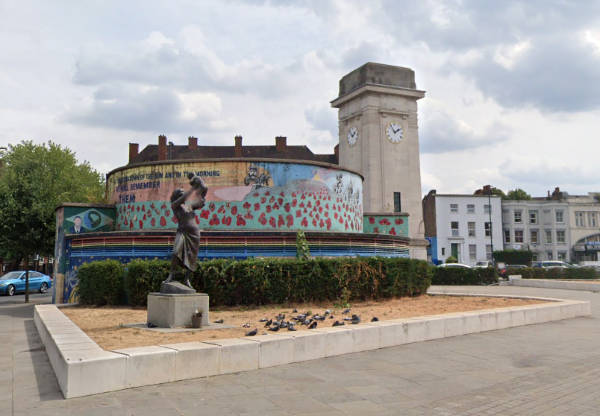
The War Memorial and mural painted on a ventiliation house in Stockwell. PICTURE: Courtesy of Google Maps

The manor of Stockwell was formed at the end of the 13th century when King Edward I acquired the manor of South Lambeth and divided it into two, creating the manors of Stockwell and Vauxhall (the manor house itself, parts of which survived until the 19th century, stood on the north side of Stockwell Road).

The area become known for its market gardens and was transformed into an urban landscape until the mid-19th century. Remnants of the 19th century housing stock can still be found in areas including the Stockwell Park Conservation Area in the west of the district.

The area around Stockwell Tube station, which first opened in 1890 and has since been rebuilt a couple times, was heavily bombed during World War II and rebuilt following the war. New developments included a number of social housing estates.

Today, Stockwell and nearby South Lambeth host the district known as Little Portugal which, centred on South Lambeth Road, is home to one of the UK’s largest Portuguese communities. The area is also home to several other immigrant communities.

Local landmarks include the oldest surviving building in the area – St Andrew’s Church, Stockwell Green (built in 1767), the Stockwell Congregational Church (1798) and the Stockwell War Memorial.

The latter – a white stone tower – is located on a site first laid out in the 1920s and features a mural on an adjoining ventilation shelter commemorating French Resistance fighter Violette Szabo (there’s a Blue Plaque on her former home in Burnley Road) and other Stockwell residents who died in war. There is also the ‘Bronze Woman’ statue which was unveiled in 2008 as a tribute to Black Caribbean women.

Residents of Stockwell have included artist Arthur Rackham and pioneering theatre director Joan Littlewood as well as musician David Bowie (born in Stansfield Road), actors Joanna Lumley (who still lives there) and Roger Moore (born in Aldebert Terrace).

Tragically, Stockwell Tube station was where Brazilian man Jean Charles de Menezes was fatally shot by police on 22nd July, 2005, after being misidentified as one of four suicide bombers who were on the run after their devices had failed to detonate the previous day (the attempts had come just two weeks after the 7th July bombings in which more than 50 people had been killed).

This Week in London – Rare Tudor choirbook at Lambeth; Sculpture in the City returns; and, picturing Blondie…

One of only two surviving choirbooks from the reign of King Henry VIII is on display in a new exhibition at the Lambeth Palace Library. Sing Joyfully: Exploring Music in Lambeth Palace Library displays the ‘Arundel’ or ‘Lambeth’ Choirbook (Arundel, Sussex, c. 1525) – this year marking its 500th birthday – along with other items from the library’s collection such as two leaves of a 14th century polyphony recently discovered in the binding of an early printed book. The exhibition, which is free, can be seen until 6th November. For more, see www.lambethpalacelibrary.info/sing-joyfully/.

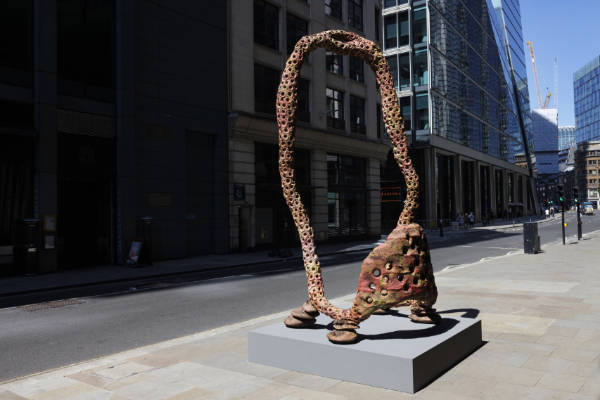
Looping Loop, © Andrew Sabin, Courtesy of the artist and Brooke Benington. PICTURE © Nick Turpin

On Now: Sculpture in the City. The 14th edition of the annual sculpture exhibition in the City of London features 11 pieces including three new works as well as six works which have been retained from previous iterations of the exhibition and two permanent acquisitions. The new works include: Ai Weiwei’s Roots: Palace, a cast-iron tree root sculpture located outside St Botolph without Bishopsgate which, as part of a series created in collaboration with Brazilian artists and communities, explores the concept of unrootedness; Jane and Louise Wilson’s Dendrophiles which, located beneath the escalators of The Leadenhall Building, combines ink drawings based on images of DNA with 3D scans of ancient oak wooden samples; and, Andrew Sabin’s Looping Loop which, located outside 70 St Mary Axe, which forms a continuous loop creating what’s described as a “lively, pulsating sensation”. Runs until April. For more – including a map of the locations – see https://www.sculptureinthecity.org.uk/.

Rare, behind the scenes images of US band Blondie have gone on show at the Barbican Music Library from today. Taken by photographer Martyn Goddard during the group’s breakthrough year of 1978, the 50 images show the band in concert, backstage, in the studio and during photo shoots. The display of photographs is complemented by poster prints, album covers, tour and concert memorabilia, period cameras, and photographic equipment. There are also items lent by Alan Edwards, who has handled Blondie’s publicity since 1978, from his private collection. Blondie in Camera 1978 runs until 5th January. Admission is free. For more see, www.cityoflondon.gov.uk/services/libraries/barbican-music-library.

Send all items for inclusion to exploringlondon@gmail.com.

10 World War II memorials commemorating Londoners…2. Kennington Park air raid shelter…

More than 100 people died when, on the night of 15th October, 1940, a bomb destroyed an air raid shelter located in Kennington Park in Lambeth.

Subscribe for just £3 a month to access all of Exploring London’s content (and support our work!)

While no official death toll was announced at the time, it’s now believed that 104 people died in the bombing. Forty-eight bodies were recovered and buried in Streatham Cemetery while the remainder still lie under the park.

The majority of those killed were women and children with the youngest just three-months-old. The oldest known victim was 75.

While Lambeth’s civilian dead are commemorated in a memorial at Lambeth Cemetery dedicated in 1952, in early 2000s the Friends of Kennington Park raised funds for a permanent memorial to those killed in the tragedy in the park.

The memorial, which was designed by Richard Kindersley and is located in the South Field close to the Tinworth Fountain Gate, is an upright stab of Caithness stone brought from Scotland standing 2.6 metres tall.

It is inscribed with a quote from poet Maya Angelou – “History despite its wrenching pain cannot be unlived but if faced with courage need not be lived again.”

While another inscription around the edge of the stone commemorates the more than “50 men, women and children” who died during the bombing, a nearby interpretation board puts the toll at more than 100.

A list of known victims can be found in a pamphlet by Rob Pateman published by the The Friends of Kennington Park.

WHERE: Kennington Park, inside the Tinworth Fountain Gate, Kennington Park Road, Lambeth (nearest Tube station is Oval); WHEN: Usually 7.30am until 15 minutes before sunset; COST: Free; WEBSITE: www.lambeth.gov.uk/parks/kennington-park

10 towers with a history in London – 7. Tower of the former Church of St Mary-at-Lambeth…

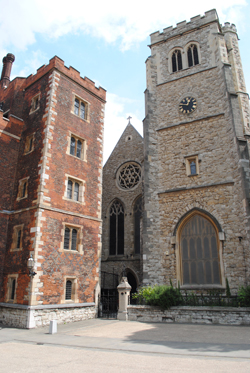
Part of the deconsecrated Church of St Mary-at-Lambeth – now the home of the Garden Museum, is a tower which was first built in the 14th century.

Support our work and subscribe for just £3 a month to see all of Exploring London’s content

Lost London – ‘Canute’s Canal’…

A waterway said to have been cut by the Viking Canute (also spelled Cnut) in the 11th century, the canal, according to the story, was constructed so his fleet of ships – blocked by London Bridge – could get upstream.

The entrance to Greenland Dock from The Thames in 2012 – one of the many places posited as the location where Canute’s Canal started. PICTURE: Public Domain

The story goes that in May, 1016, the Dane Canute (and future King of England), led an army of invasion into England to reclaim the throne his father, Sweyn Forkbeard, had first won three years earlier.

Canute needed to get his ships upriver of London Bridge to besiege the city which was held by the Saxons under Edmund Ironside (made king in April after his father Athelred’s death) but was blocked by the fortified, although then wooden, London Bridge.

So Canute gave orders for the digging of a trench or canal across some part of Southwark so his ships could pass into the river to the west of the bridge and he could encircle the city.

The canal – also known as ‘Canute’s Trench’ – was duly dug and the city was besieged – although the Vikings lifted the siege without taking the city (which does seems like a lot of work for not much result in the end) and the war was eventually decided elsewhere.

Various routes of the canal have been posited as possibilities – including the suggestion that there was an entry at Rotherhithe (Greenland Dock has been sited as one location) and exit somewhere near Lambeth or further south at Vauxhall (and one possibility is that Canute, rather than digging a long canal, simply cut through the bank holding back the Thames on either side of London Bridge and flooded the lands behind).

Various waterways have also been identified with it including the River Neckinger, parts of which survive, and the now lost stream known as the Tigris.

Whether the canal actually existed – and what form it took – remains a matter of some debate (although the low-lying, marshy land of Southwark at the time surely would have helped with any such project). But whether lost or simply mythical, the truth of ‘Canute’s Canal’ remains something of a mystery. For the moment at least.

10 disease-related memorials in London…6. Human BSE (vCJD) memorial…

Located on the Albert Embankment outside St Thomas’ Hospital just to the south of Westminster Bridge, is a small plaque commemorating the victims of Human BSE (bovine spongiform encephalopathy), sometimes referred to as the human form of ‘Mad Cow Disease’.

The memorial, which was erected by the now defunct Human BSE Foundation, reads: “In loving memory of the victims of Human BSE (vCJD). Always in our thoughts.” There’s also an image of a chrysanthemum, a flower sometimes placed on graves to honour the dead.

It was reported in March, 2010, that since 1990, 168 people have died from Human BSE, also known as vCJD (variant Creutzfeldt–Jakob disease).

There has in recent years been a push to relocate the plaque from its position on the Albert Embankment to a more prominent place.

PICTURE: Cograng (licensed under CC BY-SA 4.0)

10 disease-related memorials in London…3. The Lambeth cholera epidemic memorial…

Located at White Hart Dock on Albert Embankment in Lambeth is a plaque with a rather lengthy inscription commemorating residents who died in the cholera epidemic of 1848-49.

More than 1,500 inhabitants of this waterfront district died in the outbreak first reported in September, 1848. The River Thames was believed the cause – with people drinking the river water due to lack of alternatives – and the absence of sanitation in the area and close living conditions were seen as exacerbating factors.

The plaque records that the first victim was recorded as John Murphy, a 22-year-old unemployed labourer who lived at of 26 Lower Fore Street. He fell ill on 30 September, 1848, and died the following morning.

The inscription also states that at least 1,618 Lambeth waterfront residents perished in the outbreak and and were buried in unmarked graves in the burial ground in Lambeth High Street, now the Lambeth Recreation Ground. However, the plaque adds that “it is likely many victims were unrecorded and the death toll was much higher.”

The plaque also features the text of a letter to the editor written concerning the cholera outbreak which had waned by autumn 1849.

The plaque, the text of which was written by Amanda J Thomas – author of two books on the subject of cholera in the Victorian era, was erected on a public artwork commemorating the former White Hart Dock in 2010.

PICTURE: White Hart Dock with the plaque on the right-hand side (via Google Maps).

LondonLife – Archbishops’ tomb discovered under Lambeth church…

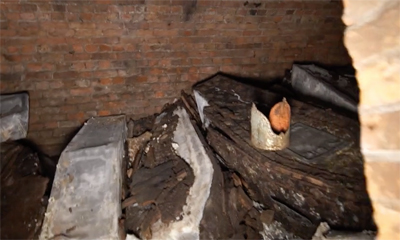
The remains of several archbishops of Canterbury are believed to have been found beneath a former parish church in Lambeth. Workers were carrying out renovation works at the deconsecrated St Mary-at-Lambeth, removing flagstone, when they found a hitherto unknown crypt containing some 20 lead coffins one of which had a small gold archbishops’ mitre resting on top of it. Among those whose coffins have been identified are those of Archbishop Richard Bancroft (in office 1604-1610), who played an important role in the creation of the King James Bible, and Archbishop John Moore (1783-1805) as well as Moore’s wife Catherine and that of John Bettesworth, Dean of Arches, Judge of the Archbishop Prerogative court. It is also believed that archbishops Frederick Cornwallis (1768-1783), Matthew Hutton (1757-1758) and Thomas Tenison (1694-1715) were buried in the tomb under the church’s chancel. The church, which is located beside the River Thames adjacent to Lambeth Palace – London home of the archbishops of Canterbury, originally dates from the 11th century and was deconsecrated in the 1960s. The burial place of John Tradescant (c1570-1638), described as the first “great gardener” in British history, it was subsequently transformed into what is now known as the Garden Museum, the world’s first museum of garden history. The museum closed in 2015 for a £7.5 million redevelopment project and is expected to reopen in late May. PICTURE: Top – the lead coffins with metallic bishop’s mitre; a still taken from video posted on the Garden Museum website/Right – St Mary-at-Lambeth (right side of image).

Lost London – Canterbury Music Hall, Lambeth

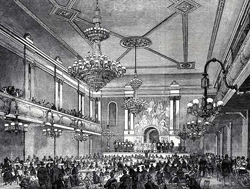
Described by the Theatres Trust as a “key building” in music hall history, the Canterbury Music Hall was first erected in Westminster Bridge Road in 1852 on the site of an old skittles alley which had been attached to the Canterbury Tavern.

It was the tavern owner, Charles Morton, who erected the building which he apparently paid for out of the profits he made on selling drink while offering the entertainment for free.

Morton built upon the “song and supper room” tradition by employing a resident group of singers and such was its popularity that only a couple of years after the doors to the first hall opened, Morton was able to build a second, much larger music hall on the same site complete with a grand staircase, supper room and art gallery as well as seating for some 1,500 people.

Among stars to perform there was French acrobat Charles Blondin, who apparently made his way across the hall on a tightrope tied between the balconies.

In 1867 William Holland took a lease from Morton and the programmes then began to move away from the light music and ballads it was known for toward a more varied program with comedy prevailing. The art gallery was converted into a bar and a proscenium stage may have been added at this time.

RE Villiers took over management in 1876 and the building was again largely rebuilt – this time as a three tier theatre with a sliding roof. The venue hosted regular ballet performances and these proved popular with royalty – the Prince of Wales (later King Edward VII) was said to be a regular patron. The interior was again remodelled, this time with an Indian theme, in 1890.

The decline of the popularity of music halls saw it start to show films from 1914 and eventually to become a dedicated cinema. It survived until it was destroyed during a World War II bombing raid in 1942.

PICTURE: A print showing the hall after its 1856 rebuild (via Wikipedia)


This Week in London – MC Escher at Dulwich; West Africa’s literary history at the British Library; and, two new war-related exhibitions…

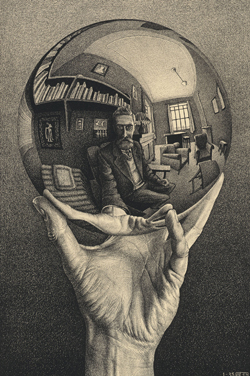
Escher_Hand-with-a-Reflecting-Sphere-1935The first major UK retrospective of the work of 20th century Dutch artist Maurits Cornelis (MC) Escher opened at Dulwich Picture Gallery in London’s south yesterday following its run at the Scottish National Gallery of Art. The Amazing World of MC Escher showcases more than 100 works – including original drawings, prints, lithographs, and woodcuts – as well as previously unseen archive material from the collection of Gemeentenmuseum Den Haag in The Netherlands. Arranged chronologically, highlights include 1934’s Still Life with Mirror – perhaps the first time the artist used surreal illusion, well-known 1948 lithograph Drawing Hands, the almost four metre long 1939-40 woodcut Metamorphosis II, the 1943 lithograph Reptiles and two of his most celebrated works, Ascending and Descending (1960) and Waterfall (1961). Runs until 17th January and is accompanied by a series of special events. Admission charge applies. For more, see www.dulwichpicturegallery.org.uk. PICTURE: M.C. Escher, Hand with Reflecting Sphere (Self-Portait in Spherical Mirror), January 1935, Collection Gemeentemuseum Den Haag, The Hague, The Netherlands/All M.C. Escher works © 2015 The M.C. Escher Company-The Netherlands. All rights reserved. http://www.mcescher.com.

West Africa’s literary history comes under examination in a new exhibition opening at the British Library at St Pancras on Friday. West Africa: Word, Symbol, Song features more than 200 manuscripts, books, sound and film recordings, artworks, masks and textiles taken from the library’s African collections and elsewhere. It explores how key figures – from Nobel Prize winning Nigerian author Professor Wole Soyinka through to human rights activist Fela Kuti, the creator of Afrobeat, and a generation of enslaved 18th century West Africans who agitated for the abolition of the slave trade – used words to both build society and fight injustice. Key items on show include a 1989 letter Kuti wrote to the president of Nigeria, General Ibrahim Babangida, in which he agitated for political change, a pair of atumpan ‘talking drums’ similar to those still used in Ghana, a carnival costume newly designed by Brixton-based artist Ray Mahabir, and letters, texts and life accounts written by the most famous 18th century British writer of African heritage, Olaudah Equiano, enslaved and freed scholar Ayuba Suleiman Diallo, and Phillis Wheatley, who, enslaved as a child, went on to write Romantic poetry. The exhibition, which will be accompanied by a major series of talks, events and performances, runs until 16th February. Admission charge applies. For more, see  www.bl.uk/west-africa-exhibition.

Two new war related exhibitions opened in London this week. Opened on Monday at the City of London’s Guildhall Library, Talbot House – An Oasis in a World Gone Crazy, recounts the story of army chaplains Philip ‘Tubby’ Clayton and Neville Talbot and their creation of an Everyman’s Club – where countless soldiers spent time away from the fighting – in a house in the Belgian town of Poperinge, a few miles from the frontline at Ypres. The exhibition, created to celebrate the centenary of the house’s creation in 1915, features items from Talbot House, the memoirs of ‘Tubby’ and part of the hut where he wrote them after fleeing the Germans. Runs until 8th January and the exhibition also features two ticketed events. Entry to the exhibition is free. For more, follow this link. Meanwhile, Lee Miller: A Woman’s War opens at the Imperial War Museum in Lambeth today, displaying 150 photographs depicting women’ experiences during World War II. The four part exhibition looks at women before the war, in wartime Britain, in wartime Europe and after the war. Runs until 24th April. Admission charge applies. For more, see www.iwm.org.uk.

Send all items for inclusion to exploringlondon@gmail.com.
What’s in a name?…Waterloo…

Waterloo-Bridge

Given the recent commemorations surrounding the bicentenary of the Battle of Waterloo (including a re-enactment of the arrival of news of Wellington’s victory in London where it was delivered to the Prince Regent), we thought it only fitting to take a look at the use of the name in London.

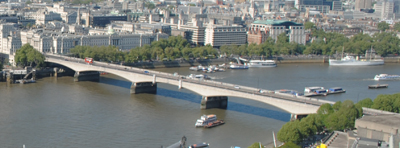
The name Waterloo, which now refers to a district in Lambeth centred on Waterloo Station, was first used to designate the bridge which crosses the Thames here.

Opened in 1817 as a toll bridge, the John Rennie-designed structure was known as Strand Bridge during its construction but renamed Waterloo at its opening two years after the battle. (Rennie’s bridge was later demolished and rebuilt in the 20th century – the current bridge is pictured above).

The name was also used to designate Waterloo Road and in the early 1820s was given to the church St John’s Waterloo (now St John’s and St Andrew’s at Waterloo) located on the road.

In 1848, Waterloo Station opened and it was after this that the surrounding district, known in past ages for its swampiness (hence streets like Lower Marsh), generally became known as Waterloo.

Landmarks in the Waterloo district include the historic Old Vic Theatre, which opened in 1818, and the Young Vic Theatre as well as the Lower Marsh Market.

On 3rd July, Waterloo will host the Waterloo Carnival with a picnic on Waterloo Millennium Green and a procession (for more on that, see www.waterlooquarter.org/news/come-and-support-this-years-waterloo-carnival) while the month-long Waterloo Food Festival kicks on on 1st July. For more on events in Waterloo commemorating bicentenary, see www.wearewaterloo.co.uk/waterloo200/.

10 sites from London at the time of the Magna Carta – 5. Lambeth Palace…

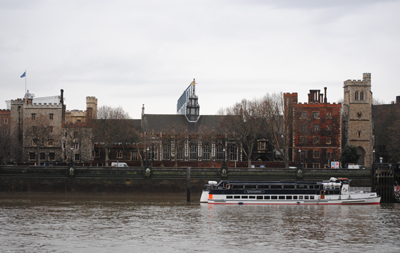
Lambeth-palaceThe London residence of the Archbishop of Canterbury, Lambeth Palace was first acquired by the archbishopric in around the year 1200 with Archbishop Stephen Langdon – an important figure in the whole Magna Carta saga – believed to be the first to have lived there.

Lambeth-Palace2The complex built in the early 13th century included a chapel, a great hall, a ‘great chamber’ where the archbishop would receive guests, and private apartments for Archbishop Langdon, who was appointed to the archbishopric in 1207 and remained in the post until his death in 1228 (his appointment was a major point of contention between King John and Pope Innocent III and a key factor in the dispute which led to the creation of the Magna Carta).

Not much remains of the original palace but the sections that do include the originally free-standing Langdon’s Chapel (although now much altered and connected to the rest of the complex) and the crypt beneath it (described as one of the best preserved medieval stone vaults in London it is now a chapel but was originally used for the storage of wine and beer).

They are both believed to have been completed in about 1220 with the other buildings now present added later over the centuries.

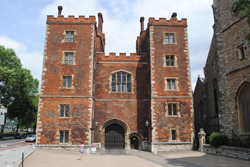
These include the formidable red brick gatehouse that fronts the complex today – known as Morton’s Tower, it is named after Archbishop Cardinal John Morton and dates from 1490 – while the Guard Room, which has its origins in the archbishop’s ‘great chamber’, dates from the 14th century and the infamous Lollard’s Tower – used as a prison in the 17th century – from the 15th century.

The Great Hall – now used as a library, first established in 1610 – was rebuilt in the mid 17th century although it is believed to stand on the site of that first used by Langdon (we’ll deal more with the later history of Lambeth Palace in a later post).

WHERE: Lambeth Palace, corner of Lambeth Palace Road and Lambeth Road (nearest tube stations are Westminster, Waterloo, Vauxhall, and Lambeth North); WHEN: Guided tours (90 minutes) only – check website for details; COST: £12 a person plus £2.95 booking fee (under 17s are free); WEBSITE: www.archbishopofcanterbury.org/pages/about-lambeth-palace.html.

This Week in London – Dunkirk Little Ships at Royal Docks a highlight of ‘Museums at Night’; the Magna Carta in stitches; and Peter Kennard’s works on show…

Dunkirk-Little-Ships-More than 20 Dunkirk Little Ships will gather at London’s Royal Docks this weekend ahead of their Return to Dunkirk journey marking the 75th anniversary of the Dunkirk evacuations. The event, which is part of the UK’s annual festival of late openings Museums at Night, will see the ships parade around Royal Victoria Dock on Saturday night with the Silver Queen offering twilight trips and the chance to step on board some of the other ships (the Little Ships will continue with their own festival on Sunday commencing with a church service by the quayside at 11am). Other events being offered in London as part of Museums at Night include ‘Dickens After Dark’ in which the Charles Dickens Museum will open its doors to visitors for night of Victorian entertainment on Friday night and a night of music featuring the Royal College of Music at Fulham Palace (also on Friday night). Among the other London properties taking part are the Handel House Museum, Benjamin Franklin House, the Wellcome Collection, Museum of the Order of St John, and the National Archives in Kew. For a full list of events, check out http://museumsatnight.org.uk

Meanwhile, Dulwich Picture Gallery in south London is holding its first weekend culture festival, MayFest: Men of Mystery, as part of Museums at Night. On Friday and Saturday nights, there will be tours of the gallery’s new exhibition featuring the work of artist Eric Ravilious followed by outdoor cinema screenings of Alfred Hitchcock’s Rear Window and The 39 Steps as well as free swing dance lessons, street foods and a pop-up vintage shop which will help people get the vintage look. Visitors are being encouraged to dress up in styles of the 1930s and 1940s with a prizes awarded to those with the “best vintage style”. The gallery will also be inviting visitors to take part in a mass installation drop-in workshop held in the gallery’s grounds over the weekend and Saturday morning will see special events for children. For more, see www.dulwichpicturegallery.org.uk/whats-on/.

A major new work by acclaimed artist Cornelia Parker goes on display in the entrance hall of the British Library in King’s Cross tomorrow to mark the 800th anniversary of the Magna Carta. The almost 13 metre long Magna Carta (An Embroidery) replicates the entire Wikipedia entry on the Magna Carta as it was on the 799th anniversary of the document and was created by many people ranging from prisoners and lawyers to artists and barons. It accompanies the library’s exhibition Magna Carta: Law, Liberty, Legacy. Entry to see the artwork is free. For more, see www.bl.uk/cornelia-parker.

The works of Peter Kennard, described as “Britain’s most important political artist”, are on display in a new exhibition which opens at the Imperial War Museum in London today. Peter Kennard: Unofficial War Artist is the first major retrospective exhibition of his work and features more than 200 artworks and other items drawn from his 50 year career including an art installation, Boardroom, created especially for the display. Works on show include his iconic transposition of Constable’s painting Haywain which he showed carrying cruise missiles about to be deployed in Greenham Common, the Decoration paintings created in 2004 in response to the Iraq War of 2003, his seminal STOP paintings which reference events of the late 1960s such as the ‘Prague Spring’ and anti-Vietnam war protests and his 1997 installation Reading Room. The free exhibition runs at the Lambeth institution until 30th May next year. For more, see www.iwm.org.uk/london.

Send all items for inclusion to exploringlondon@gmail.com.
This Week in London – Greek sculpture at the British Museum; Hew Locke at HMS Belfast; an interactive high seas adventure at the National Maritime Museum; and, coral reefs at the Natural History Museum…

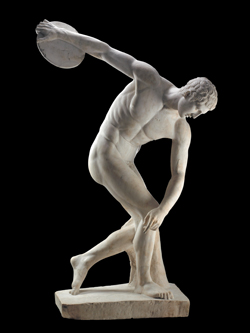
DiscobolusThe ancient Greek “preoccupation with the human form” is the subject of a new exhibition which opens at the British Museum in Bloomsbury today. Defining beauty: The body in ancient Greek art features about 150 objects dating from the prehistoric to the age of Alexander the Great. Highlights include a newly discovered bronze sculpture of a new athlete scraping his body with a metal tool after exercise before bathing, six Parthenon sculptures from the museum’s collection including a sculpture by Phidias of the river god Ilissos, and  copies of Greek originals including the Towny Discobolus (discus-thrower – pictured) – a Roman copy of Myron’s lost original – and Georg Romér’s reconstruction of Polykleitos’ Doryphoros (spear-bearer) . Runs until 5th July. Admission charge applies. For more, see www.britishmuseum.org/definingbeauty. PICTURE: © The Trustees of the British Museum.


London-based contemporary artist Hew Locke has transformed an entire deck of the HMS Belfast in a major new work, ironically titled work, The Tourists. The installation – which is on show until 7th September – depicts imaginative events in which the crew of the ship are preparing to arrive at Trinidad in time for Carnival in 1962 (the ship’s last international journey – to Trinidad – actually arrived three months after the celebration). Free with general admission charge. For more see www.iwm.org.uk/visits/hms-belfast. Meanwhile, the Imperial War Museum in Lambeth is hosting a free exhibition of Locke’s work in which he explores the idea of naval power through a series of ship sculptures. This free exhibition can be seen until 4th May. For more, see www.iwm.org.uk/visits/iwm-london.

Families are invited to take part in a new interactive experience on the “high seas of maritime history” which launches at the National Maritime Museum in Greenwich on Saturday. The museum has joined with Punchdrunk Enrichment to take six to 12 year-olds and their families on an adventure, Against Captain’s Orders: A Journey into the Uncharted. Visitors don life jackets as they become part of the crew of the HMS Adventure and take on various seafaring roles as they navigate their way through the exhibition. Admission charge applies. Runs until 31st August. For more, see www.rmg.co.uk/againstcaptainsorders.

See a real coral reef and take a virtual dive in new exhibition at the Natural History Museum in South Kensington. Coral Reefs: Secret Cities of the Sea – which opens tomorrow on World Oceans Day – also features more than 200 specimens including coral, fish and fossils. These include examples collected by Charles Darwin on the voyage of the HMS Beagle in the 1830s, giant Turbinate coral and creatures ranging from the venomous blue-ringed octopus to tiny sponge crabs. For more see www.nhm.ac.uk.

Send items for inclusion to exploringlondon@gmail.com.
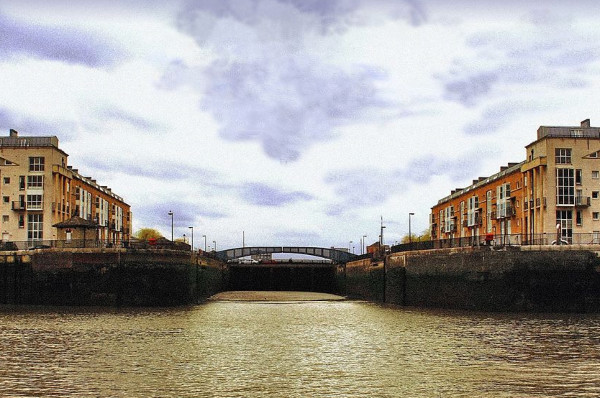
This Week in London – War fashions; the “inventor” of Impressionism; looking a Gift Horse in the mouth; and, having a look at the Queen’s House…

A new exhibition exploring how fashion survived and even flourished during World War II has opened at the Imperial War Museum in Lambeth to mark the 70th anniversary of the war’s end. Fashion on the Ration brings together more than 300 exhibits including clothes and accessories like the ‘respirator carrier handbag’, photographs and films as well as official documents from the period, letters and interviews. The exhibition is divided into six parts which examine in detail everything from the uniforms worn during the period to clothes rationing (introduced in 1941) and how the end of the war impacted fashion. Runs until 31st August. Admission charge applies. For more, see www.iwm.org.uk.

The UK’s first major exhibition devoted to Paul Durand-Ruel, the man who “invented Impressionism”, has opened at the National Gallery off Trafalgar Square this week. Inventing Impressionism features around 85 works including some of Impressionism’s greatest masterpieces, a number of which have never been seen in the UK before. The majority of the works were traded by Durand-Ruel (1831-1922) who is noted for having discovered and supported Impressionist painters like Monet, Pisarro, Degas and Renoir. Durand-Ruel purchased an astonishing 12,000 pictures between 1891 and 1922, including more than 1,000 Monets, about 1,500 Renoirs, more than 400 Degas’, some 800 Pissarros and close to 200 Manets. The images on display include a series of rarely-seen portraits of the dealer and his family by Renoir which are being exhibited in the UK for the first time as well as five paintings from Manet’s ‘Poplars’ series and all three of Renoir’s famous ‘Dances’, not seen in the country together since 1985. The exhibition finishes with a reference to an exhibition Durand-Ruel organised in London in 1905. Held at the Grafton Galleries, it presented 315 paintings. Admission charge applies. Runs until 31st May. For more, see www.nationalgallery.org.uk.

Gift Horse, New York-based German artist Hans Haacke’s sculpture of a skeletal riderless horse, will be unveiled on the Fourth Plinth in Trafalgar Square today. The horse, derived from an etching by English painter George Stubbs – whose works are in the nearby National Gallery, features an electronic ribbon tied to the horse’s front leg showing a live ticker of the London Stock Exchange. The statue, described as a ‘wry comment’ on the equestrian statue of King William IV which was originally to occupy the plinth, is the 10th to occupy the plinth since the first commission – Marc Quinn’s sculpture Alison Lapper Pregnant – was unveiled in 2005.

 Contemporary artist Dryden Goodwin’s first feature-length film is on show as part of a new exhibition, Unseen: The Lives of Looking, at the Queen’s House in Greenwich. Continuing Goodwin’s investigations into portraiture, the newly commissioned film focuses on three individuals who have a “compelling” relationship to looking – eye surgeon Sir Peng Tee Khaw, planetary explorer Professor Sanjeev Gupta and human rights lawyer Rosa Curling. Alongside the screening is a series of drawings made by Goodwin after observing the three individuals as well as tools and papers related to each of their trades and a series of objects connected three leading observers related to the history of the Royal Museums Greenwich sites – John Flamsteed, first Astronomer Royal, Edward Maunder, who observed Mars from the Royal Observatory Greenwich, and the artist Willem van de Velde the Elder who made detailed drawings of naval battles in preparation for producing paintings in his studio at the Queen’s House. Runs until 26th July. Admission is free. For more, see www.rmg.co.uk.

Send all items for inclusion to exploringlondon@gmail.com.
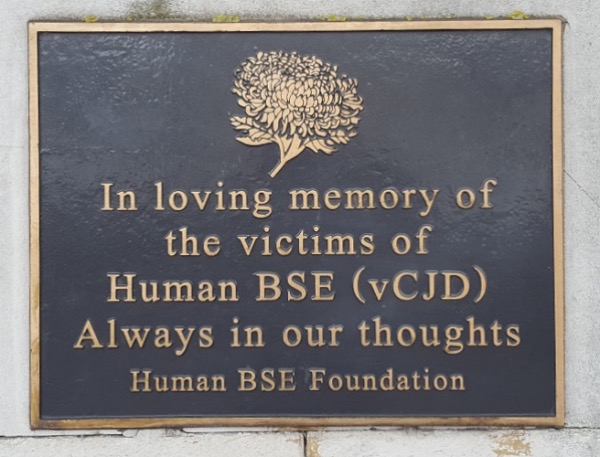
What’s in a name?…Lambeth…

LambethThe origins of the Thames-side district Lambeth’s name are not as obscure as it might at first seem.

First recorded in the 11th century, the second part of the name – which apparently is related to/a derivative of the word ‘hithe’ or ‘hythe’ – means a riverside landing place while the first part of the name is exactly what it seems – ‘lamb’. Hence, Lambeth was a riverside landing or shipping place for lambs and cattle.

There has apparently been a suggestion in the past that the word ‘lamb’ actually derived from an Old English word meaning muddy place, hence the meaning was ‘muddy landing place’. That theory, however, is now generally discounted.

Lambeth these days is still somewhat in the shadow of the much more famous Westminster river bank opposite but among its attractions is the Imperial War Museum (located in the former Bethlem Hospital, see our earlier post here), Lambeth Palace (pictured above) – London residence of the Archbishop of Canterbury, and, of course, the promenade of Albert Embankment (sitting opposite Victoria Embankment).

The headquarters of MI6 is also located here in a 1994 building designed by Terry Farrell (among its claims to fame is its appearance in the opening scenes of the James Bond film, The World Is Not Enough).

Lambeth – the name is also that of the borough in which the district is located – was formerly home to the Vauxhall Pleasure Gardens which closed in the mid 19th century (see our earlier post here).

This Week in London – Hampton Court Palace turns 500; celebrating the influence of Rubens; and, remembering the liberation of Auschwitz…

Hampton-Court-Palace Hampton Court Palace turns 500 this year and the palace is conducting a programme of events in celebration of the landmark anniversary. Sadly, the first in a series of events – a night in which Historic Royal Palace’s chief curator Lucy Worsley, inspired by the recent BBC Two programme Britain’s Tudor Treasure: A Night at Hampton Court, will explore one of the greatest nights in Hampton Court’s history, the christening of King Henry VIII’s longed for son, Edward (later King Edward VI) – is already sold out but there are a range of further events planned (we’ll try and keep you informed as they come up through the year). In the meantime, HRP have announced that a rare 16th century hat which is rumoured to have once belonged to King Henry VIII is to return to the palace later this year after undergoing restoration. The story goes that the hat, which will become the oldest item of dress in the palace’s collection by almost a century, was caught by Nicholas Bristowe, the king’s Clerk of the Wardrobe, when Henry threw it in the air on hearing of the French surrender of Boulogne in 1544. Treasured by the Bristowe’s descendants, it has now been acquired by HRP and is expected to go on show in a future exhibition. We’ll be looking at the hat in more detail in a future post. For more on the palace, see www.hrp.org.uk/HamptonCourtPalace/. PICTURE: HRP/Newsteam

The first major exhibition in the UK to examine the influence of Peter Paul Rubens on the history of art opens at the Royal Academy of Arts on Piccadilly on Saturday. Rubens and His Legacy: Van Dyck to Cezanne brings together more than 160 works by Rubens and artists who were inspired by him both during his lifetime and later including everyone from Van Dyck, Watteau, Turner and Delacroix to Manet, Cezanne, Renoir, Klimt and Picasso. The exhibition is organised around six themes: poetry, elegance, power, lust, compassion and violence. Runs until 10th April in the Main Galleries. For more, see www.royalacademy.co.uk.

The 70th anniversary of the liberation of Auschwitz will be marked at Westminster Abbey with a special service at 6.30pm on 1st February. At least 1.1 million prisoners died at the camp, located in south-west Poland, around 90 per cent of them Jewish. It was liberated on 27th January, 1945 by the Red Army. Tickets are free but need to be booked. Follow this link to book. Meanwhile, the Imperial War Museum London in Lambeth has invited people to mark Holocaust Memorial Day – 27th January – with a visit to the free Holocaust Exhibition which has a 13 metre long model depicting the arrival of a deportation train from Hungary at the Auschwitz-Birkenau camp in 1944, accompanied by testimonies from 18 survivors. Recommended for children aged 14 and above. For more, see www.iwm.org.uk/visits/iwm-london.

Treasures of London – A fragment of the Berlin Wall…

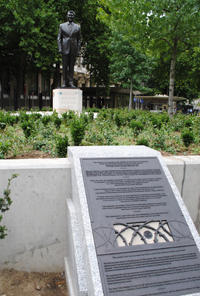
Berlin-WallThis Sunday marks 25 years since the fall of the Berlin Wall so we decided it was a fitting time to mention the fragment of the wall which accompanies the bronze statue of former US President Ronald Reagan in Grosvenor Square, Mayfair.

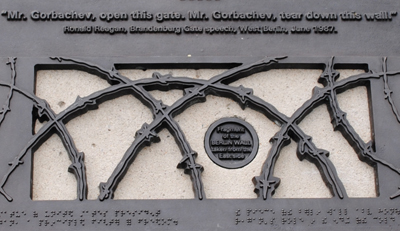
Reagan2The remnant of the wall, recorded as taken from the “east side”, can be seen through a window in a bronze plaque which commemorates the role President Reagan played in the coming down of the wall.

The plaque also features quotes from President Reagan – including the famous line from his 1987 Brandenburg Gate speech, “Mr Gorbachev, open this gate. Mr Gorbachev, tear down this wall” – and other figures including former UK PM Margaret Thatcher and Mikhail Gorbachev as well as information about the wall itself.

In a dedication to the president, it further reads: “Ronald Reagan, the 40th President of the United States of America, was a principled fighter for freedom. With a clear vision and will, he gave hope to the oppressed and shamed the oppressors. His contribution to world history in the 20th century, culminated in his determined intervention to end the Cold War. President Reagan has left a lasting legacy as a campaigner for global peace.”

The memorial was unveiled on 4th July, 2011, outside the US Embassy by the Ronald Reagan Presidential Foundation, to mark the 100th birthday of the former president. Among those present at the unveiling of the statue were then Foreign Minister William Hague and former US Secretary of State Condoleezza Rice.

There are also larger sections of the wall outside the Imperial War Museum in Lambeth and in the National Army Museum in Chelsea (closed for redevelopment until 2016).

For more on London’s monuments, check out Andrew Kershman’s aptly named London’s Monuments.

This Week in London – Giovanni Batista Moroni at the RA; German history on show; and, Afghanistan at the IWM…

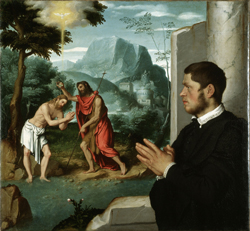
MoroniThe works of 16th century artist Giovanni Battista Moroni go on show at the Royal Academy of Arts this week. The exhibition will feature more than 40 works including portraiture as well as his lesser-known religious paintings. They include a number of altarpieces from the churches of Bergamo in northern Italy as well as portraits including Portrait of a Lady (c1556-60), A Knight with a Jousting Helmet (c1556), and The Tailor (1565-1570) – the first known portrait of a man depicted undertaking manual labour. The exhibition in The Sackler Wing, off Piccadilly, runs until 25th January. Admission charge applies. For more, see www.royalacademy.org.uk. PICTURED: A Gentleman in Adoration before the Baptism of Christ, (c.1555-60) (Gerolamo and Roberta Etro).

This year marks 25 years since the fall of the Berlin Wall and the birth of modern Germany so it’s a fitting time for the British Museum in Bloomsbury to host an exhibition looking at Germany’s tumultuous history. Germany: memories of a nation features 200 objects reflecting themes ranging from ’empire and nation’ to ‘arts and achievement’ and ‘crisis and memory’ spanning a period from the 15th century to today. They include Tischbein’s iconic portrait Goethe in der Campagna, an early edition of Grimm’s fairy tales, a home-made banner from demonstrations in late 1989 and Ernst Barlach’s bronze figure Der Schwebende, designed as a World War I memorial for Gustrow Cathedral. The exhibition, sponsored by Betsy and Jack Ryan, runs until 25th January. Admission charge applies. For more, see www.britishmuseum.org.

Britain’s 13 year involvement in Afghanistan is the subject of a new display at the Imperial War Museum London in Lambeth. Opening today, War Story: Afghanistan 2014 features new objects, photographs, film and video interviews and looks at the experiences of the Afghan national security forces and UK government and NGO workers as well as those of British troops. Objects, all collected between 2012 and this year, include a beadwork lamp made by Afghan prisoners in training workshops aimed at developing skills prior to their release and an Afghan dress and trousers. The display is part of the War Story project which started in 2009. Runs until 6th September next year. For more, see www.iwm.org.uk.

Send all items for inclusion to exploringlondon@gmail.com.