Special – Roman London’s first basilica found under an office block – here’s what it reveals about the ancient city

In an article first published on The Conversation, LACEY WALLACE of the University of Lincoln, looks at the recent discovery….

Archaeologists from the Museum of London have discovered a well-preserved part of the ancient city of London’s first Roman basilica underneath the basement of an office block. The basilica was constructed for use as a public building in the 70s or early 80s AD.
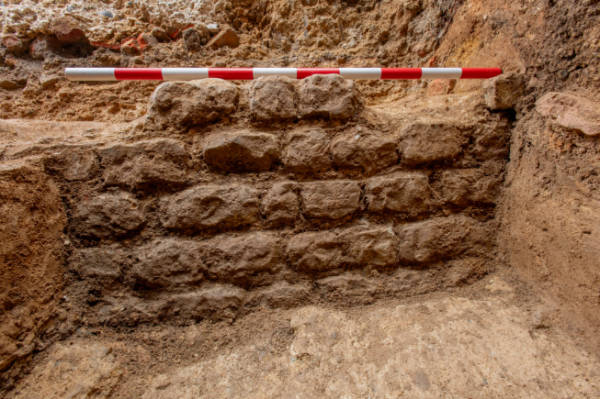
A section of the wall from the Roman basilica. PICTURE: MOLA

In a Roman town, a basilica was a multi-functional civic building. Often paid for by leading local inhabitants, it provided a large indoor space for public gatherings. These ranged from political speeches to judicial proceedings.

Along with the connected forum – an arrangement of buildings that surrounded an open courtyard space – the building formed the centre of administrative and civic life in the ancient Roman city of Londinium.

Other walls of London’s basilica and forum have been known by archaeologists since the early 1880s. But they were only recognised as remains of the social and civic centre of Londinium in 1923.

The story until now

Peter Marsden, the author of The Roman Forum Site in London (1987), compiled disconnected evidence for the different phases of London’s forum basilica complex.

Referring to the current area of excavations (on Gracechurch Street), he noted that: “More than half of the archaeological deposits still remain, and should be carefully excavated when the opportunity arises, since only then will the history of the site be elucidated.”

Occasional opportunities have arisen to reveal small parts of the forum basilica. For example, during construction of a shaft to install a lift at 85 Gracechurch Street, some important remains from the first century were found. But the excavated area was too small to contribute greatly to our knowledge.

In contrast, the recent work is part of a major redevelopment. It has opened targeted excavation areas where walls of the basilica were expected to be found, exposing substantial parts of the building.

Archaeologists have found one-metre-wide foundations and walls of the interior, some of which probably extend for more than 10 metres in length. The walls are constructed of flint, tile and Kentish ragstone (a type of limestone quarried in Kent), and some stand at four metres high.

What was the basilica for?

Londinium was constructed on an unoccupied site beginning in about AD47 or 48. It began to gain the trappings of a Roman-style town, including a basilica building, in the lead-up to its destruction in the Boudican Revolt in AD60 or 61.

The city did not have a monumental forum and basilica complex until later, however, when a major programme of public and private construction was undertaken in the Flavian period (AD69–96).

London’s Flavian basilica took the plan of a long rectangle (44m x 22.7m) divided into three aisles. There is good evidence from the deeper central aisle (nave) wall foundations that the nave roof was raised to two storeys, to allow for windows to provide internal light.

A reconstruction drawing of the first London forum. PICTURE: PeterMarsden/MOLA

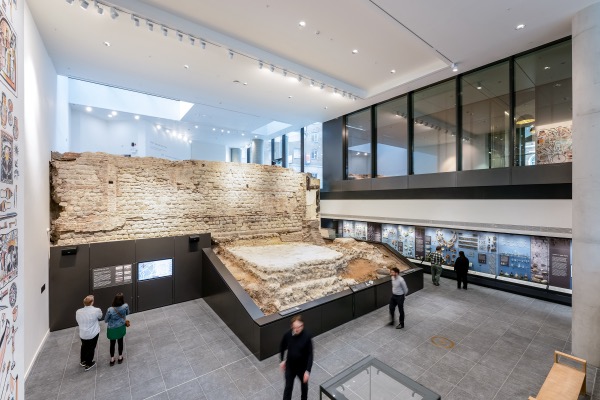
Shallow foundations crossing the nave are evidence of a raised dais or platform at the eastern end. The speaker or judge would sit there, elevated above the crowds, increasing both his visibility and status. This platform, or “tribunal”, is the area that has recently been revealed.

The basilica would have risen above the north side of the buildings that formed the forum courtyard. It would have dominated the high ground of this monumental space at the highly visible crossroads leading straight up from the Roman Thames bridge.

It would have been the largest building in the area and firmly announced that the people of Londinium were constructing a high-status Roman city.

Rebuilding following the British Queen Boudica’s revolt had been swift. The post-Revolt fort that was built only 100 metres or so down the street had likely been decommissioned and the people were ready to embark on a new phase and a major expansion of the urban centre.

The designs of late first century forum basilica complexes varied across the provinces. But generally they combined religious, civic, judicial and mercantile space.
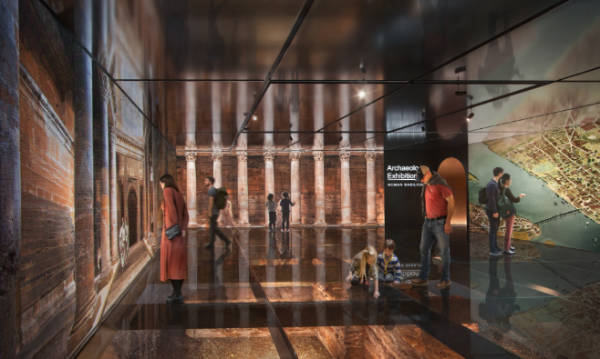
An artist’s impression of the proposed exhibition space that will showcase the newly discovered walls. PICTURE: Woods Bagot/MOLA

In places like Pompeii, the forum had developed over time. But, when the town was buried by the ash of Vesuvius in AD79 (approximately the same time the forum basilica of London was built), the focus of the elongated monumental space was the Temple of Jupiter, symbol of the Roman state.

Although a classical temple was constructed to the west of the exterior of Londinium’s Flavian forum, it was clearly separate. No forum in Britannia was dominated by a temple, setting the core of urban space in this province apart from most examples in the rest of the empire.

The Flavian forum basilica at Londinium is one of the earliest examples to demonstrate this characteristic, along with that at Verulamium (St Albans). There, an inscription links the circa AD79–81 construction to the governor Agricola, who is well known among historians from the celebratory biography written by his son-in-law, Tacitus.

The Flavian basilica and forum only stood for about 20 or 30 years, however. With increased prosperity in the early second century, they were demolished and replaced by a new structure which was five times larger, leaving the remains of the first basilica underneath the surface of the later courtyard space.

Museum of London Archaeology will now analyse and publish the results of its find, applying modern methods to advance our understanding of the development of the first forum basilica. We can expect refined dating evidence and an improved understanding of the architecture from the post-excavation analyses. An exhibition space to make the remains visible for the public is also planned.

The Conversation

Lacey Wallace is a senior lecturer in Roman history & material culture at the University of Lincoln. This article is republished from The Conversation under a Creative Commons license. Read the original article.
A Moment in London’s History…London Mithraeum refound…

It was on 18th September, 1954 – 70 years ago this month – that archaeologists working on a site in central London discovered one of the greatest archaeological finds in London of the 20th century – a head of Mithras in the remains of a mid-3rd century Roman temple.

Support our work and subscribe for just £3 a month to get full access to our stories.

10 atmospheric ruins in London – 7. London Wall, Noble Street…

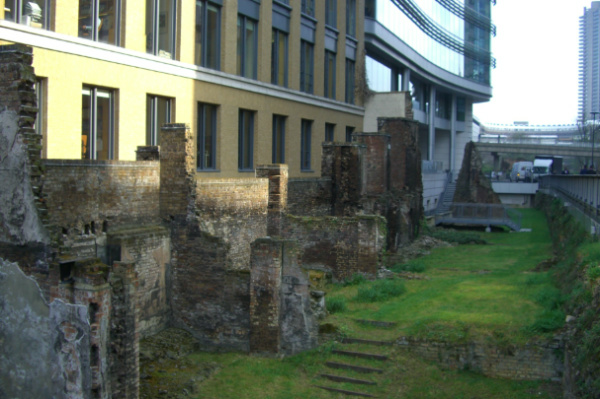
There’s many remnants of the Roman and later medieval wall which once surrounded the City of London – the towering section at Tower Hill near the Tower of London no doubt the most famous.

PICTURE: Esther Dyson (licensed under CC BY-NC 2.0)

But there are several other stretches of the stone and brick wall left which evoke a sense of the structure it once was and the defensive role it played in protecting Londoners – among them is a substantial section of the wall located in Noble Street on the city’s western side.

The 80 metre long section of Roman and later medieval remains includes two internal turrets on what was the west side of the Roman Cripplegate fort (built between 120 and 150 AD) as well as a substantial bastion located at the southern end of the site.

The highest fragment of the Roman wall can be seen opposite Oat Lane, near the southern end of the site, while the highest section of the wall – which stands some 4.5 metres high and is mostly medieval – can be seen at the northern end of the site.

As well as reflecting the City’s Roman and medieval history, this section of wall also evokes a sense of the horrors of the Blitz.

Projecting eastward on the inside of the wall are party walls from World War II bomb-damaged and later demolished homes which once fronted onto Noble Street.

WHERE: Noble Street, London (nearest Tube stations are Barbican and Bank; WHEN: Anytime; COST: Free.

This Week in London – New section of London’s Wall revealed; ‘Summer on the Square’; and, Heath Robinson’s fairy tale illustrations…

PICTURES: Courtesy of Urbanest.

A large section of London’s Roman wall had gone on show to the public thanks to an innovative collaboration between Urbanest, the City of London Corporation, Historic England, and the Museum of London. A new free display – The City Wall at Vine Street – has been created by Urbanest as part of a redevelopment of the site. At its heart is a segment of London’s Roman wall, including the foundations of a bastion or tower. Alongside the wall is a permanent display of artefacts from the Museum of London ranging from a tile marked with a cat’s paw print to Roman coins and ceramics. Completed between AD 190 and 230, the Roman wall was between two and three metres thick and faced with blocks of Kentish ragstone. This section of the wall was first rediscovered in 1905 when a new building – Roman Wall House – was constructed on the site and the inner face of the wall was exposed and preserved in the basement. In 1979, the outer face of the wall and the bastian foundations were also uncovered – but the wall was still left largely forgotten in the building’s basement. The site was acquired by Urbanest in 2016 and during the subsequent construction of Urbanest City in 2018, the wall was protected by a timber enclosure. Tickets to The City Wall at Vine Street, located at 12 Jewry Street in the City of London, can be booked for free. For more head to https://citywallvinestreet.org.

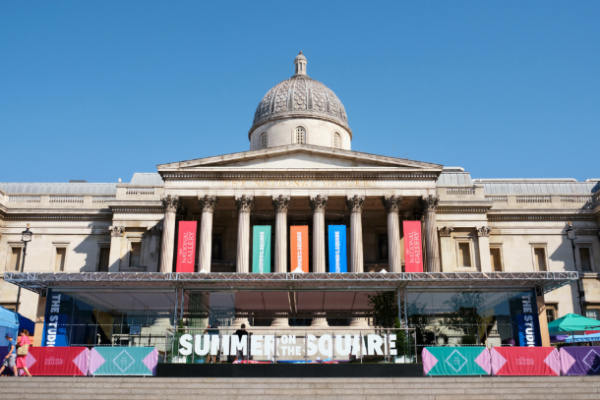
Summer on the Square PICTURE: © James Ross, courtesy The National Gallery, London

‘Summer on the Square’ has returned to The National Gallery’s North Terrace with a series of workshops aimed at inspiring the local community and visitors to engage with themes around the gallery’s collection. The programme sees the gallery work with a variety of artists and creative practitioners in a shared focus of creating child-led art, design and play activities. The workshops – which range from a session on discovering what you can do with bamboo to discovering movement and shapes in the National Gallery paintings – are free, drop-in and open to all ages and abilities. Summer on the Square, which runs until 28th August, is supported by and part of Westminster City Council’s Inside Out Programme. For the full programme, see www.nationalgallery.org.uk/whats-on/summer-on-the-square.

On Now: Happily Ever After? Illustrating Andersen & Perrault. This exhibition at the Heath Robinson Museum in Pinner focuses on works Heath Robinson created for the fairy tale collections of Hans Christian Andersen, which he illustrated three times, and Charles Perrault’s Old Time Stories published in 1921. The display, which also features works on the same subjects by Michael Foreman, shows how Heath Robinson was able to explore subjects and characters which ranged from sleeping princesses to adventurers and monsters in some of his lesser known works. Runs until 17th September. Admission charge applies. For more, see www.heathrobinsonmuseum.org.

Lost London – Greenwich’s Romano-Celtic temple…

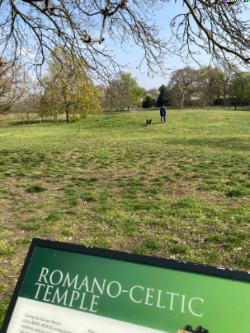
Although little now remains of it (and none to be seen above ground), a mound in Greenwich Park is thought to have once been the location of a Romano-Celtic temple.

Site of the temple remains in Greenwich Park. PICTURE: Matt Brown (licensed under CC BY 2.0)

Given its site close to Watling Street – the main Roman road linking London and the Kent ports, it’s believed that the temple may have served travellers as well as the local community. The Historic England listing for the ruins, which are a scheduled monument, suggests the temple was in use by 100AD and continued to be used until about 400AD.

The remains, which are now located on the eastern side of Greenwich Park on a site known as Queen Elizabeth’s Bower, was excavated in 1902 after they were stumbled across during works on the park. Three different floor surfaces were revealed, one of which was a tessellated pavement, along with the right arm of an almost life-sized statue, fragments of stone inscriptions and more than 300 coins dating between the 1st and 5th centuries.

A further excavation occurred in the early 1970s and another in 1999 – all of which provided further evidence of a temple.

Finds from the 1999 dig – which was undertaken by TV Channel Four’s ‘Time Team’, Birkbeck University of London and the Museum of London in the creation of a programme broadcast the following year – included part of an inscription to Jupiter and the spirits of the emperors and a stamped tile.

It is thought the temple precinct, known as a temenos, would have included a main temple building known as a cella as well as ancillary buildings and been surrounded by a stone wall.

LondonLife – Largest Roman mosaic found in 50 years…

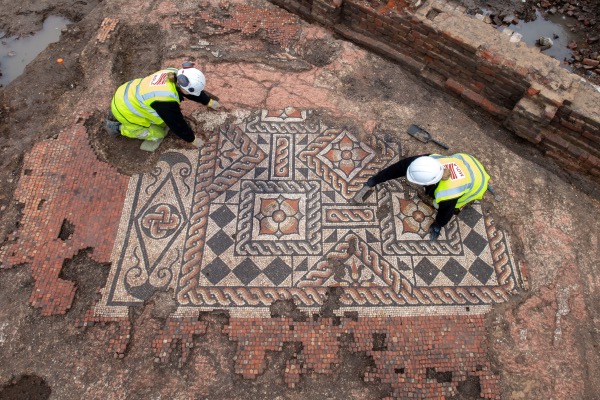
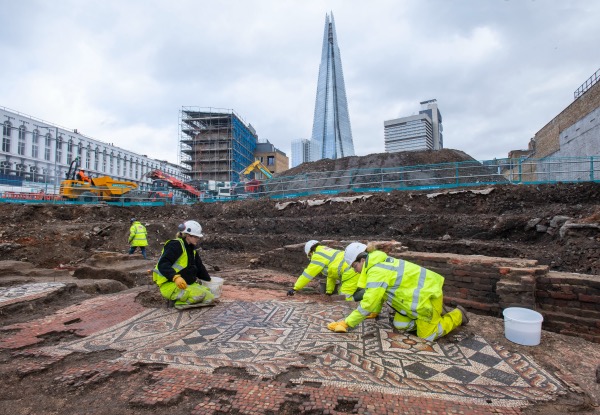
MOLA archaeologists at work on the mosaic unearthed in Southwark. PICTURE: © MOLA/Andy Chopping

The largest Roman mosaic to be unearthed in London in 50 years has been found near The Shard in Southwark.

The well-preserved mosaic, parts of which are thought to be 1,800-years-old, features two highly decorated panels.

The largest of the two shows large, colourful flowers surrounded by bands of intertwining strands – a motif known as a guilloche – while the design also features lotus flowers and several different geometric elements, including a pattern known as Solomon’s knot which is made of two interlaced loops.

The smaller panel features a simpler design, with two Solomon’s knots, two stylised flowers and striking geometric motifs in red, white and black. Its design is the “almost exact parallel” of a mosaic found in the German city of Trier which suggests a travelling group of artists may have been responsible for both.

The mosaic is believed to be floor of a dining room or ‘triclinium’ of a Roman ‘mansio’, an “upmarket ‘motel'” which offered accommodation, stabling, and dining facilities to people of high rank. The room would have contained couches on which people would have reclined to eat and would have featured brightly painted walls. Fragments of colourful wall plaster have been found on the site as well as traces of an earlier mosaic underneath the one they discovered.

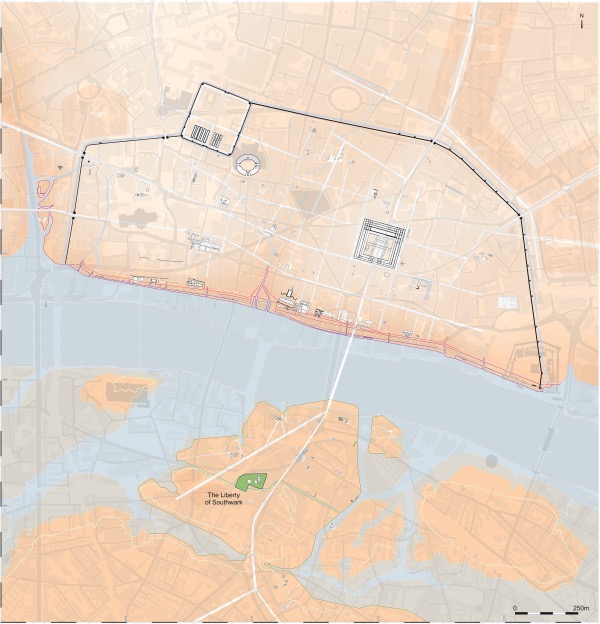
Location of The Liberty of Southwark site in Roman London (detail). PICTURE: © MOLA reproduced with permission of Ordnance Survey.

The discovery was made by archaeologists from Museum of London Archaeology (MOLA) during an excavation ahead of building work on a new mixed use development to be constructed on the site, which was previously used as a car park.

MOLA site supervisor, Antonietta Lerz, described the discovery in a statement as a “once-in-a-lifetime find in London”.

“It has been a privilege to work on such a large site where the Roman archaeology is largely undisturbed by later activity-when the first flashes of colour started to emerge through the soil everyone on site was very excited!” 

The archaeologists have identified another large Roman building neighbouring the mansio which they believe is likely to have been the private residence of a wealthy individual or family.

Plans for the future display of the mosaic are currently under discussion.

MOLA archaeologists at work on the mosaic unearthed in Southwark. PICTURE: © MOLA/Andy Chopping

10 London hills – 7. Brockley Hill…

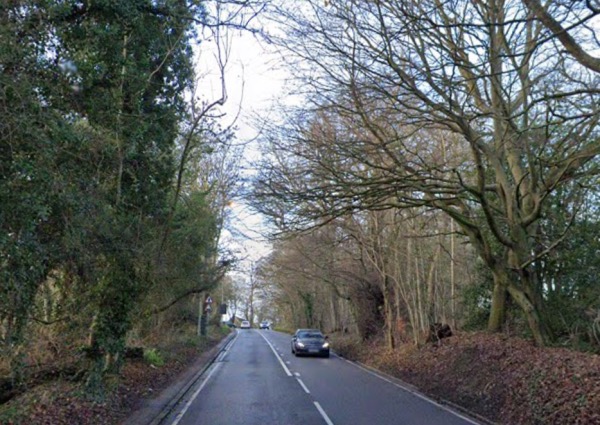
Looking north along the A5 as it passes over Brockley Hill. PICTURE: Google Maps

Located in Stanmore in London’s northern outskirts, Brockley Hill has an elevation of 136 metres above sea level.

The name apparently comes from an Old English word for badger holes (the sandy soil on top of the hill being easier for them to dig than the surrounding clay).

The Celtic tribe the Catuvellauni is believed to have had a settlement on the hill top and legend says that it was on the hill that a battle was fought between the Catuvellauni, under their leader Cassivellanus, and the Roman Julius Caesar in 54 BC.

The Romans later are understood to have established their own settlement on the hill – Sulloniacae – which was served as an imperial posting station on Watling Street as it made its way north from Marble Arch to Verulamium (St Albans).

The sandy soil also meant the area was a centre for pottery making during the Roman period, in particular flagons and vessels known as mortaria (bricks were made here in more recent centuries). There’s a plaque commemorating the Roman pottery on the A5 (just pass the junction with Wood Lane)

There is an obelisk commemorating the battle on top of the hill which was erected in 1750 (which can still be seen although it suggests the Catuvellauni won the battle when historians today believe the reverse). It stands now in the grounds of the Royal National Orthopaedic Hospital which moved into the site of an earlier hospital in the late 1920s.

10 London hills – 2. Cornhill…

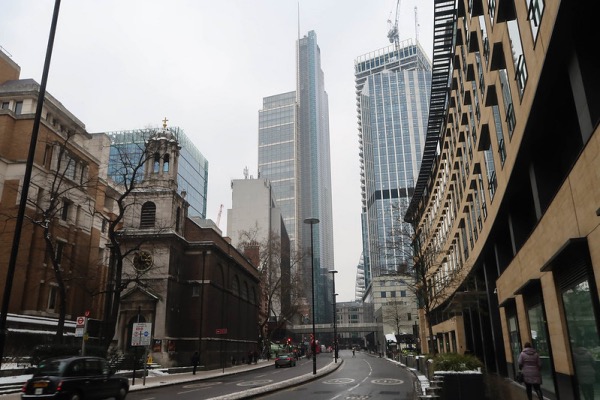
Looking along the street named Cornhill from its western end with the Royal Exchange on the left. PICTURE: Teseum
(licensed under CC BY-NC 2.0)

The highest of the city’s three ancient hills (at 17.7 metres or 58 feet above sea level), it was on Cornhill that the first Romans settled following the invasion of 43AD and the later the site of the basilica.

In medieval times, a grain market was established on Cornhill which gave it the name it now bears.

Cornhill was also the location of a pillory (Daniel Defoe famously spent a day here in 1703 after writing a seditious pamphlet), stocks, and a prison known as the Tun where street walkers and lewd women were incarcerated.

Remembered in the name of the street which today runs from Bank junction to the western end of Leadenhall Street as well as being the name of one of London’s 25 wards, the hill is the site of several churches.

These include the aptly named St Michael Cornhill and St Peter-upon-Cornhill (said to be the oldest place of Christian worship in London) as well as the curiously named St Benet Fink (despite being rebuilt by Sir Christopher Wren after the Great Fire of 1666 this was eventually demolished in 1844 when the Royal Exchange was rebuilt).

The hill was also the location of The Standard, at the junction of Cornhill and Leadenhall Streets. Constructed in 1582, this was the first mechanically pumped public water supply in London. It was sometimes used as a point from where to measure distances out of London.

The area became famed for its coffee houses in the 16th to 19th centuries (Pasqua Rosée opened what is claimed to be London’s first in St Michael’s Alley in 1652) and as such was a financial centre. Much of Cornhill is now occupied by offices.

What’s in a name?…London Wall…

The name of this street is self-explanatory – it follows the line of part of the wall that once surrounded the City of London, of which only fragments now remain.

The wall dates from as far back as Roman times and this street – which runs from the intersection with Aldersgate Street to the west to Old Broad Street in the east – broadly follows the course of its northern edge.

View from the west end of London Wall. PICTURE: Romazur (licensed under CC BY-SA 3.0)

The road was re-laid out – it features dual carriageways at the east and west ends – after the area was devastated by bombing during World War II.

A roundabout at the western end of London Wall – named the Rotunda – provides a link with Aldersgate Street, which runs perpendicular, and in the centre was built the Museum of London (which is now being relocated to West Smithfield).

Looking toward the eastern end of London Wall with All Hallows on the Wall to the left. PICTURE: Keith Murray (licensed under CC BY-NC-ND 2.0)

The western end of the street, part of which is straddled by the hulking early 1990s building known as Alban Gate, has until recent years also featured a series of raised walkways which were part of the post war redevelopment of the area (and partly integrated with office buildings).

Known as ‘pedways’, some of them are now in the process of being replaced with a more modern take on the idea (such as can be seen at London Wall Place).

Part of the Roman gate, known as Bastion 14, near the western end of London Wall. PICTURE: Ethan Doyle White (licensed under CC BY-SA 4.0)

The street features a number of remnants of the actual wall along its length including the remains of a Roman gate close to the western end (on the street’s north side, it’s known as Bastion 14) and in St Alphage Gardens (St Alphage, London Wall is one of several now lost churches along the street – St Olave, Silver Street is another).

Close to the eastern end of the street is the church of All Hallows-on-the-Wall which dates from 1767 (replacing an earlier church that had survived the Great Fire of London).

Other prominent buildings on London Wall include the Brewer’s Hall, the Carpenter’s Hall and the Plaisterer’s Hall.

LondonLife – Roman “pen” souvenir among thousands of finds on Bloomberg site…

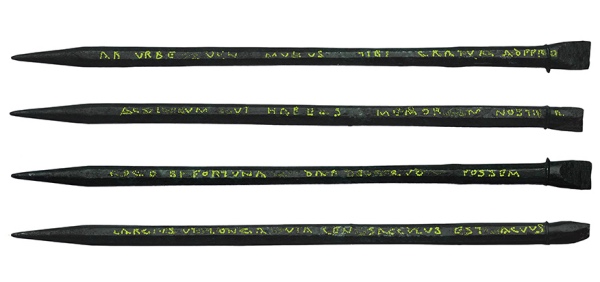
An iron stylus bearing an inscription – described as the sort of cheap souvenir you might bring back for a friend after visiting a foreign city – is among thousands of Roman-era artefacts discovered during excavations for Bloomberg’s new European headquarters in Cannon Street. The stylus, which is about the length of a modern pen, dates from about AD70 and was used to write on wax-filled wooden writing tablets. It is inscribed in Latin text which, translated by classicist and epigrapher Dr Roger Tomlin, reads: “I have come from the city. I bring you a welcome gift with a sharp point that you may remember me. I ask, if fortune allowed, that I might be able [to give] as generously as the way is long [and] as my purse is empty”. It is believed the “city” referred to is Rome. The stylus is one of some 14,000 items Museum of London Archaeology archaeologists unearthed on the dig – including 200 styli (although only one bears an inscription) – which took place on what was the bank of the (now lost) Thames tributary, the Walbrook, between 2010 and 2014. It is among items on show in an exhibition now on at the Ashmolean Museum in Oxford called Last Supper in Pompeii. Head here for more details. Other finds from the excavations can be seen at the recently opened London Mithraeum Bloomberg SPACE. PICTURE: © MOLA

This Week in London – Open House London’s 25th; the London Design Festival; the ‘discovery’ of Roman London; and, the story of the Scythians retold…

Open House London marks its 25th anniversary this weekend, with free entry into more than 800 of the city’s buildings. For the first time, every London borough is participating in the event which sees the doors flung wide on buildings including the recently revamped New Scotland Yard (right), the skyscraper One Blackfriars nick-named ‘The Vase’ (above), an urban farm in Waterloo and the Francis Crick Institute at King’s Cross as well as traditional crowd-pleasers like BT Tower, William Morris’s Red House and the office towers known as the Cheesegrater and the Gherkin.  The weekend also features some 66 walks and talks. Open House have this year  launched a free app which, available for both Android and Apple, allows users to plan their weekend, view nearby buildings, and filter results by day, architectural type and period. To download the app and to see the full programme of events, head to www.openhouselondon.org.uk. PICTURES: Top – CGI/Right – Tim Soar (Open House London).

The London Design Festival, now in its 15th year, also kicks off this weekend with a programme of 450 projects and events across the coming week. The V&A will once again form the festival hub with iconic spaces within the museum transformed by a series of special commissions and displays including an immersive coloured light experienced known as Reflection Room and a 21.3-metre-long uid and free-standing three dimensional tapestry called Transmission. Somerset House will host a new group exhibition called Design Frontiers featuring 30 leading international designers while the Oxo Tower Wharf Courtyard will host a specially created micro house, called URBAN CABIN – one of many ‘landmark projects’ to be seen during the week. The festival runs until 24th September. For more – including the full programme of events, see www.londondesignfestival.com.

The rediscovery of Roman London under the modern city is the subject of a new exhibition which opened at the Guildhall Library in the City this week. The Discovery of Roman London, with a display of objects, archives and 19th century illustrations, looks at the early pioneers of Roman London archaeology over the past three centuries and the establishment of the Guildhall Museum – the precursor to the Museum of London – in 1826 to provide a suitable place for the found artefacts. Runs until 30th November. Entry is free. For more, follow this link.

The story of ancient nomadic tribes known as the Scythians is told in a new exhibition at the British Museum. Scythians: warriors of ancient Siberia features more than 200 objects, many of which have been preserved under permafrost, providing fascinating insights into the lives of the Scythian tribes who lived between 900 and 200 BC. The objects include fur-lined clothes, headgear for horses, gold jewellery, weapons, wooden drinking bowls and even tattooed human remains. There are also a series of painted clay death masks decorated to resemble the faces of the dead which are being shown alongside a reconstructed log-cabin tomb in which they were found. Runs until 14th January in the Sainsbury Exhibition Gallery. Supported by BP, the exhibition has been organised in partnership with the State Hermitage Museum in St Petersburg. Admission charge applies. For more, see www.britishmuseum.org.

Send all items for inclusion to exploringlondon@gmail.

Top posts of 2015 – The site of Queen Boudicca’s defeat?; and, just what was The Great Conduit?…

2016 is fast approaching and to celebrate, we’re looking back at the 10 most popular posts we published in 2015. Today, we look at numbers four and three…

boudicca4. Number four is another in our current series on London battlefields – this time looking at the site where Queen Boudicca is believed to have been defeated by the Romans – 10 London ‘battlefields’ – 1. Queen Boudicca takes on the Romans

3. Our second top 10 entrant from the Lost London series, this post, published back in September, looked at the history of the Great Conduit – Lost London – The Great Conduit

The countdown finishes tomorrow with a look at the most and second most popular articles were posted in 2015…

LondonLife – Rediscovering Londinium’s residents…

Harper Road Woman (c) Museum of LondonA detailed picture of the inhabitants of Roman London, known as Londinium, has been created for the first time, the Museum of London announced this week. Detailed analysis of the DNA of four skeletons has revealed a culturally diverse population. The examined skeletons include that of a Roman woman (pictured left), likely to have been born in Britain with northern European ancestry, found buried with high status grave goods at Harper Road, Southwark, in 1979, and another of a man, whose DNA revealed connections to Eastern Europe and the Near East, who was found at London Wall in 1989 with injuries to his skull which suggest he may have been killed in the nearby amphitheatre before his head was dumped in a pit. The other two skeletons examined were found to be that of a blue-eyed teenaged girl found at Lant Street, Southwark, in 2003, believed to have been born in north Africa, whose ancestors lived in south-eastern Europe and west Eurasia, and that of an older man found at Mansell Street who was born in London and whose ancestry had links to Europe and north Africa. The examination – the first multi-disciplinary study of the inhabitants of a Roman city anywhere in the empire – also revealed that all four suffered from gum disease. Caroline McDonald, senior curator at the museum, said that while it has always been understood Roman London was a culturally diverse place, science was now “giving us certainty”. “People born in Londinium lived alongside people from across the Roman Empire exchanging ideas and cultures, much like the London we know today.” The four skeletons will form the basis of a new free display, Written in Bone, opening at the Museum of London on Friday. PICTURE: © Museum of London
WHERE: Museum of London, 150 London Wall (nearest Tube stations are Barbican and St Pauls); WHEN: 10am to 6pm daily; COST: Free; WEBSITE: www.museumoflondon.org.uk.

10 London ‘battlefields’ – 1. Queen Boudicca takes on the Romans…

boudicca

This month marks the 600th anniversary of the Battle of Agincourt and to mark the occasion, we’re looking at 10 of London’s “battlefields” (well, maybe not officially recognised battlefield sites but 10 places where fighting took place – or, as in this instance, legend says took place – at various times throughout London’s history).

First up it’s to King’s Cross, once said to have been site of a village known as ‘Battle Bridge’, so named because, according to tradition, it here in about 60AD that the rebellious hoards of Queen Boudicca (also known as Boadicea or Boudica) ran into the well-disciplined army of the Roman Governor of Britain, Gaius Suetonius Paulinus.

Paulinus had been campaigning in northern Wales when the Iceni rebellion broke out in East Anglia, apparently sparked by the Romans’ refusal to honour the will of the deceased King Prasutagus. He had left his land to the Emperor Nero and his two daughters but instead, the story goes that the Romans seized the land, flogged his wife Boudicca and raped his two daughters.

Understandably incensed at this treatment, the Iceni and members of other tribes rose in rebellion under Boudicca and laid waste to the Roman city of Camulodunum (what is now Colchester in Essex).

Boudicca then turned toward Roman Londinium, the provincial capital, and while Paulinus beat her there with a small number of troops, he quickly concluded he couldn’t defend it and ordered it evacuated. Boudicca, who is claimed to have fought from a chariot, and her army of tribesman apparently spared no-one when they arrived and burnt it to the ground. They then moved on to attack another Roman city – Verulamium (St Albans).

Paulinus, meanwhile, marshalled his forces – still apparently vastly outnumbered – and chose his battleground carefully. One legend suggests King’s Cross – then site of an ancient bridge across the River Fleet – as the battle’s location (although we should mention there are also numerous other sites which have been suggested as the location for the battle including locations in the Midlands along the Roman road of Watling Street, now the A5).

Where-ever it was, Paulinus had apparently chosen his position so that Boudicca couldn’t bring her greater numbers to bear on his flanks. Her army collapsed and, according to the Roman historian Tacitus, there was a rumour that 80,000 Britons were killed and just 400 Romans in the ensuing battle (although fair to say such numbers may be a stretch!).

The outcome was obviously devastating for Boudicca – there’s various accounts of what happened to her next with one being that she fell during the battle and another that, having survived, she committed suicide by poisoning herself. There is a legend that Boudicca was subsequently buried at a site now covered by platform nine or 10 at King’s Cross railway station. It’s also been suggested she was buried at Parliament Hill.

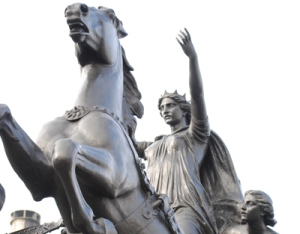
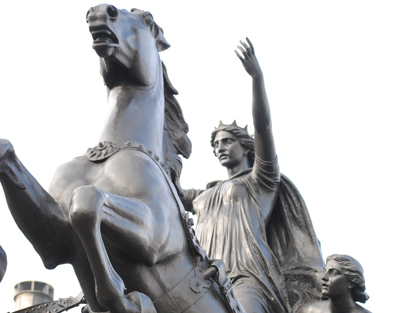
There’s a statue commemorating Boudicca and her daughters (pictured above) at the western end of Westminster Bridge. Designed by Thomas Thornycroft, it was made in 1850 but not erected on the site until 1902.

Famous Londoners – The Unknown Roman Girl…

GherkinIn an unusual ‘Famous Londoners’, this week we’re looking at a former inhabitant of London who we still know relatively little about.

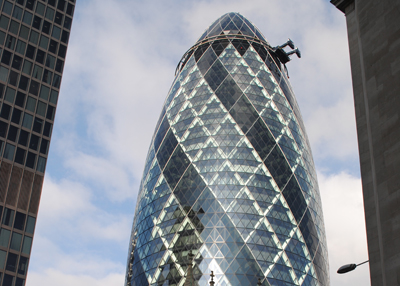
The remains of the teenaged girl – believed to have been aged between 13 and 17 years – were found in 1995 when the conically-shaped skyscraper at 30 St Mary Axe, fondly known as the Gherkin (and then formally known as the Swiss Re Tower), was being constructed.

The girl, whose skeleton was unearthed where the foundations now stand, was buried sometime between 350 and 400 AD in what appeared to be an isolated grave which would have lain just outside the edge of early Roman Londinium.

The body lay with the girl’s head to the south and the arms folded across. Pottery was found associated with the body which provided dating information.

After being exhumed, the skeleton was housed at the Museum of London for some 12 years before in 2007 it was reburied near the new building. The burial featured a ceremony at nearby St Botolph-without-Aldgate followed by a procession to the gravesite where a dedication took place which included “music and libations”. Among those who attended was the Lady Mayoress of the City of London.

There’s an inscription in honour of the girl on a stone feature outside the building in both Latin and English while a stone set in the pavement decorated with laurel leaves marks the (re)burial spot.

Other recent Roman remains found in London include the skeleton of a young Roman woman, believed to date from the 4th century, which was found still inside its sarcophagus at a site in Spitalfields and a series of two dozen Roman-era skulls which, likely to date from the first century A, were found during excavations for the Crossrail project in 2013. It has been suggested they may have been Britons executed for their role in the famed Queen Boudicca’s rebellion against the Romans in 61 AD.