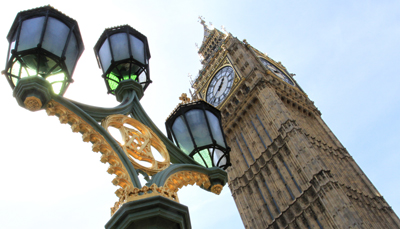
The Clock Tower of the Houses of Parliament, home to Big Ben. For more on it, see our earlier posts on the Palace of Westminster, the Clock Tower and Big Ben. PICTURE: Tony Kerrigan.

Aerial combat probably isn’t the first thing that springs to mind when thinking about the fighting in World War I but, as the Royal Air Force Memorial on Victoria Embankment records, air crew played a vital role.
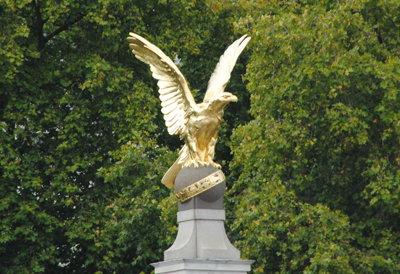
The memorial features a bronze eagle perched on an orb girded with a belt depicting the signs of the zodiac which sits atop a Portland stone pylon. It was designed by Sir Reginald Blomfield with the eagle, inspired by the RAF’s badge, sculpted by William Reid Dick. Along with the dedication, it carries an inscription from the Bible (Exodus 19:4) – “I bare you on eagles wings and brought you unto myself” (sic).
Various other sites were apparently considered for the memorial before the location – amid a string of other memorials between Westminster and Hungerford Bridge – was settled upon (as were other designers including the renowned Edwin Lutyens).
Unveiled on 13th July, 1923, by the Prince of Wales, the memorial was dedicated to the memory of all those who gave their lives in the ranks of the Royal Flying Corps, the Royal Naval Air Service and the Royal Air Force (formed through the amalgamation of the RFC and RNAS at a hotel in Strand in 1918) during World War I, along with those who had died while serving in air forces from across the British Empire.
A further dedication was later unveiled in 1946 on Battle of Britain Sunday remembering the men and women of air forces from across the Commonwealth and Empire who died during World War II.
A simple, yet still evocative, memorial.
A memorial to Admiral Arthur Phillip, described as the “father of modern Australia”, was unveiled in Westminster Abbey back in July. Admiral Phillip (1738-1814) commanded the ‘First Fleet’ which left the UK in 1787, transporting convicts and military to the new colony Phillip founded as New South Wales. Prince Phillip, the Duke of Edinburgh, attended the memorial’s dedication service on 9th July which was conducted by the Dean of Westminster, Dr John Hall, who credited Admiral Phillip – a “modest, yet world-class seaman, linguist and patriot”- with laying the foundations “on which was developed the Commonwealth of Australia”. Among other dignitaries who attended was Dame Marie Bashir, the Governor of the Australian state of New South Wales, who described Admiral Phillip as “enlightened, far-sighted and indeed humane” and paid tribute to his attempts to actively foster harmonious relations with the Aboriginal people. Carved from Sydney sandstone, the memorial is set in the floor of the nave of the minster close to memorials of David Livingstone, Thomas Cochrane and Isaac Newton. The memorial stone is among a number of projects around Britain instigated by the Britain-Australia Society to mark the bicentenary year of Admiral Phillip’s death. For more on the abbey, see www.westminster-abbey.org. PICTURE: Andrew Dunsmore/Westminster Abbey.
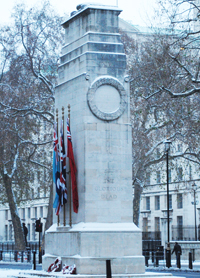
We’re looking at some of London’s World War I memorials so it’s only fitting we look at the life of acclaimed architect Sir Edwin Lutyens, the man credited with designing the Cenotaph – the UK’s national war memorial – in Whitehall (pictured below).
Lutyens was born in London at 16 Onslow Square, South Kensington, on 29th March, 1869, and – the ninth son and 10th of 13 children of soldier Captain Charles Lutyens and his wife Mary – was named for painter and sculptor Edwin Henry Landseer, a friend of his father’s. He grew up in London and Surrey and in 1885 commenced studying architecture at the South Kensington School of Art. In 1887, he left before completing the course, briefly joining the practice of Ernest George and Harold Peto before starting his own practice in 1889.
Early commissions included country houses and it was during this period that he met with mentor and landscape gardener Gertrude Jekyll, a relationship which led him to design her home, Munstead Wood near Godalming in Surrey.
In 1897, Lutyens, known familiarly as ‘Ned’, married Emily Lytton – daughter of the late Viceroy of India and first earl of Lytton, Edward Buller-Lytton – and by 1908 the couple had five children. The family’s London addresses included 29 Bloomsbury Square (which also served as his office), 31 Bedford Square and 13 Mansfield Street, Marylebone, while his offices were located in numerous places including at 17 Queen Anne’s Gate.
Lutyens continued designing country houses – he eventually designed more than 35 major properties and altered and added many more – and among his commissions were Castle Drogo in Devon and the refurbishment of Northumberland’s spectacularly sited Lindisfarne Castle – both now National Trust properties. He was also involved in helping to plan and design Hampstead Garden Suburb in London, work which included designing two churches.
In 1912, Lutyens was invited to advise on the planning of the new Indian capital in New Delhi and his most important contribution was the design of the Viceroy’s House which combined elements of classical architecture with traditional Indian decoration. He was knighted in 1918 for his contributions in India and for his advice to the Imperial War Graves Commission.
It was his role in this latter effort which led to his becoming a national figure. He was involved in the creation of numerous monuments to commemorate the war dead, the best known of which are the Cenotaph in Whitehall – initially commissioned as a temporary structure (see our earlier post here) – and the Memorial to the Missing of the Somme in Thiepval in northern France as well as the Australian War Memorial at Villers-Bretonneux and the Anglo-Boer War Memorial in Johannesburg.
He also designed more than 100 war cemeteries in France and Belgium and other war memorials – including overseas in places like Dublin – as well as London’s Tower Hill Memorial (see our earlier post here). Other London buildings he designed included the headquarters of Country Life magazine in Tavistock Street, Britannic House in Finsbury Square, the head office of the Midland Bank in Poultry and the Reuters and Press Association headquarters at 85 Fleet Street (now home to the Lutyens Restaurant, Bar and Private Rooms).
Lutyens was elected a fellow of the Royal Academy in 1920 (he was later president) and in 1924 was appointed a founding member of the Royal Fine Arts Commission. Even as he continued work in Delhi, he took on other commissions – such as the British Embassy in Washington, DC – and in 1924 he completed one of his most lauded – and smallest – designs: that of the one twelfth scale Queen Mary’s Dolls’ House which was shown at the 1924 British Empire Exhibition at Wembley and which can still be seen at Windsor Castle.
In 1929 Lutyens was commissioned to design a new Roman Catholic Cathedral for Liverpool but when he died on 1st January, 1944, this work was still unfinished with only the crypt completed thanks to the outbreak of World War II broke. Lutyens’ funeral was held in Westminster Abbey a few days later and his ashes were subsequently placed in the crypt of St Paul’s Cathedral.
For more information on Lutyens’ life and works, check out The Lutyens Trust, founded in 1984 to preserve and protect his legacy.
This short street in Westminster – which runs between Buckingham Gate and Broadway – was so-named for its association with…well, the French.
Petty France literally means ‘Little France’ and, like Petty Wales, takes its name from the fact there was obviously a hub of people of a certain ethnicity – in this case, the French, living in the street.
We’ve found various theories on which French it was – from wool merchants to some of the estimated 40,000 Huguenots who had fled France for England in the 17th and 18th centuries.
In The Book of London Place Names, however, Caroline Taggart argues that because the name is first recorded late in the 15th century – long before the Huguenots started fleeing – it’s likely to be the wool merchants who settled here.
It’s been suggested Petty France at one time had its name changed to York Street after Frederick, Duke of York and son of King George II, who had a residence there.
The street is now home to, among others, the Ministry of Justice.
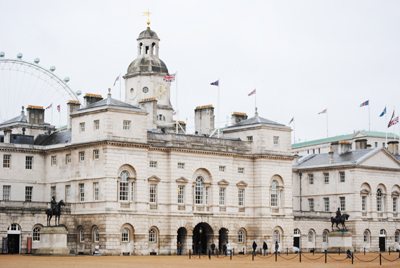
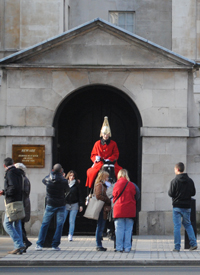
Known around the world for the stoic mounted troopers which stand guard here, this rather fanciful building straddling a site between Whitehall and St James’s Park was built in the early 1750s on land which had previously served as a tiltyard for King Henry VIII.
In the 1660s King Charles II had a barracks built here for the guards manning the entrance to what was then the Palace of Whitehall, but in 1749 it was demolished and the present building constructed.
William Kent had apparently drawn up designs but it was architect John Vardy who oversaw construction of the neo-Palladian building after Kent’s death in 1748. The windows on the St James’s Park side of the building are said to have been based on a drawing by Lord Burlington (he of Chiswick House fame – see our earlier post here).
While the site previously marked the entrance to the Palace of Whitehall, it is now considered the formal entrance to St James’s Palace (although the palace is located some distance away) and, as a result, only the monarch can drive through the central archway without displaying a pass.
Until 1904, the Grade I-listed building housed the office of the Commander-in-Chief of the Forces but the title was then abolished and replaced with Chief of the General Staff, who relocated to the War Office Building. Horse Guards subsequently became the home of the army commands of London District and the Household Division, a role it still fulfils.
As well as being the site of the daily Changing of the Queen’s Life Guard (this free event takes place at 11am every day; 10am on Sundays), Horse Guards is also now home to the Household Cavalry Museum.
Among treasures in the museum are two silver kettledrums presented to the regiment in 1831 by King William IV, a cork leg used by the first Marquess of Anglesey after his real leg was amputated following the Battle of Waterloo (and subsequently became a tourist attraction in its own right) and silverware by Faberge. Visitors to the museum can also see into the working stables via a glazed petition.
The parade ground behind the building is the site of the annual Trooping the Colour ceremony which officially celebrates the Sovereign’s birthday. Although the ceremony has only been held since 1748, it’s interesting to note that some of the birthday celebrations of Queen Elizabeth I were held in the same place.
WHERE: The Household Cavalry Museum, Horse Guards, Whitehall (nearest Tube stations are Westminster, Embankment, St James’s Park and Charing Cross); WHEN: Open 10am to 5pm (November to March)/10am to 6pm (April to October); COST: £6 adults/£4 children (aged 5-16) and concessions/£15 family ticket; WEBSITE: www.householdcavalrymuseum.co.uk.
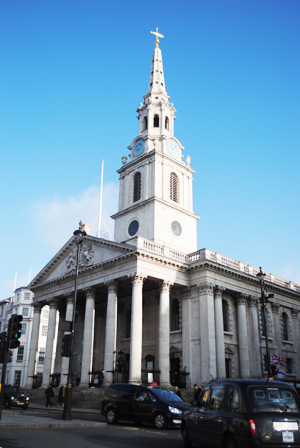
This iconic church on the edge of Trafalgar Square, known for its musical associations, is another of the works of architect James Gibbs and, as with St Mary le Strand, the current building was constructed in the first half of the 18th century to replace an earlier building.
The first references to a church on the site of the present building date back to the 13th century when, constructed upon a Roman burial site, it was apparently used by monks from Westminster. It was replaced by King Henry VIII around 1542 and enlarged in 1602 before finally being demolished in 1721.
Gibbs’ apparently first suggested the design feature a round nave with a dome over the top but the proposal was rejected as too expensive and a simpler, rectangle-shaped church was subsequently agreed upon and eventually completed in 1726. Part of the design inspiration comes from Sir Christopher Wren, although Gibbs’ integration of the tower into the church was a departure from Wren’s designs (the church spire rises 192 foot into the air).
Among the features of the interior are ceiling panels in the nave which feature cherubs and shells and are the work of ceiling experts Giuseppe Artari and Giovanni Bagutti. Other items of interest include Chaim Stephenson‘s sculpture, Victims of Injustice and Violence, remembering all victims during apartheid in South Africa (it was dedicated by Desmond Tutu in 1994), a statue of St Martin and the Beggar by James Butler, and, on the porch, Mike Chapman‘s sculpture marking the millennium, Christ Child. Paintings include one of James Gibbs himself by Andrea Soldi and dating from 1800.
Among those buried in the church are furniture-maker Thomas Chippendale, sculptor Louis-François Roubiliac and notorious robber Jack Sheppard (he’s buried in the churchyard). The crypt also contains a life-sized marble statue of Henry Croft, London’s first pearly king, which was moved there from St Pancras Cemetery in 2002.
As well as being the location of the first religious broadcast, its musical heritage includes performances by Handel and Mozart and being the location of the first performance of its namesake chamber orchestra, the Academy of St Martin in the Fields.
Since the early 20th century, the church has been noted for its work with the homeless (thanks in particular to the work of Vicar Dick Sheppard). Meanwhile, its connections with music – which date back to its rebuilding – continue in the concerts held in the crypt cafe. The crypt also hosts art exhibitions.
The church underwent a £36 million renewal project in the Noughties. Additions included the new east window by Shirazeh Houshiary.
WHERE: St Martin-in-the-Fields on the north-east corner of Trafalgar Square (nearest tube stations are Charing Cross, Leicester Square and Embankment); WHEN: Open weekdays and weekends – times vary, see website for details; COST: free; WEBSITE: www.stmartin-in-the-fields.org.
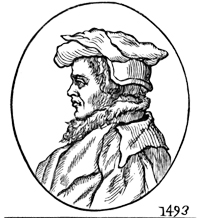
Known as the “Father of Fleet Street”, Wynkyn de Worde was key figure in the early use of the printing press in England.
Born on the continent (candidates include Wœrth in Alsace in north-east France and Wœrden in The Netherlands), Wynkyn – whose name comes in various spellings, although it is said to have originally been Jan van Wynkyn – is believed to have become apprenticed to a printer in Cologne before meeting with famed pioneering English printer William Caxton in the early 1470s.
He apparently accompanied Caxton from Cologne to Bruges and then back to London in the late 1470s or early 1480s where he started working with Caxton at his premises in Westminster. During this period he is said to have lived with his English wife Elizabeth in a premises located with the sanctuary of Westminster Abbey (they are known to have attended St Margaret’s Church and even rented a pew there until Elizabeth’s death in 1498, after which Wynkyn is believed to have remarried.)
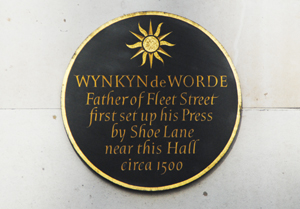
After Caxton’s death in 1492, Wynkyn took over his printing business and, around 1500, he relocated his office from Caxton’s Westminster premises to the “sign of the Sun” in Fleet Street near Shoe Lane – in fact, he is credited as being the first printer to locate in the street which becomes famously associated with publishing. There’s a plaque (pictured below), on the wall of the hall of the Worshipful Company of Stationers, located off Ave Maria Lane near St Paul’s Cathedral, commemorating the move (although Shoe Lane is located some distance away). Wynkyn later also ran a shop in St Paul’s Churchyard.
While Wynkyn, like Caxton before him, relied on the patronage of the rich and famous (Margaret Beaufort, mother of King Henry VII among them), he also printed relatively inexpensive books in a bid to capture a wider market. In all he published more than 400 different books in at least 750 editions ranging from religious texts and poetry to fictional romantic works, educational textbooks and books aimed at children. He is noted for his use of woodcuts illustrations while his other claims to fame include being the first English printer to use italic type and the first to print music from moveable type.
De Worde died around 1534 but his legacy lives on through the mass media publishing of today (albeit not longer from Fleet Street). There is a Wynkyn de Worde Society based in Suffolk which is aimed at furthering the printing industry.
PICTURE: Wikipedia
Once a visible sign of London’s legal system, the city had several pillories which were used to degrade and humiliate those offenders put within them.
Originating in medieval times, the pillories were wooden contraptions in which a standing person’s head and hands were held in place and exposed to the ridicule of the crowd (not to mention their rotten foodstuffs and other less savoury things). They were a similar form of punishment to the stocks and were designed to humiliate those put within them.
They were used to punish a broad range of offenders including everyone from con-men and forgers to traders who didn’t play fair with their customers, people publishing unlicensed literature, and homosexuals.
Some people were pilloried repeatedly and additional punishments could be handed out to some put in the pillory – such as the nailing of the offender’s ears to the structure. There was cases of enraged mobs injuring the person locked in the pillory so badly that they died and the journey to the pillory – a formal parade of the malefactor before the people – was another chance for people to shout abuse and throw things at the offender.
As well as in Charing Cross where the pillory was located just to the south of Trafalgar Square, pillories were found at locations in Cheapside, Cornhill and Old Bailey in the City as well as Old Palace Yard and Tyburn in Westminster.
Among the most famous occupants of London’s pillories was the writer Daniel Defoe. The author of Robinson Crusoe and Moll Flanders, he was placed here on 31st July,1703, due to his publication of pamphlets criticising the church. It didn’t prove the harshest of punishments, however – Defoe was greeted with flowers, not stones, by a crowd rather sympathetic to his cause.
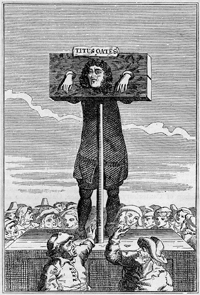
Others to suffer the punishment of the pillory included Titus Oates, who fabricated a plot to kill King Charles II, and puritan William Prynne, who lost both his ears when pilloried for libelling Queen Henrietta Maria (although they were apparently sewed back on before he lost them again for a subsequent offence).
The punishment was formally abolished in 1837 – the last time it was used was in 1830.
PICTURE: Wikipedia. Image is from Robert Chambers’ Book of Days, 1st edition.
Today we kick off our new Wednesday series with a look at some of the most famous addresses in London where fictional characters once lived. Most, if not all, of the addresses we’ll look at are not fictional in themselves – they do actually exist – but the characters said to have lived there owe their lives solely to the imaginations of their creators and the readers and audiences who have loved and admired them.
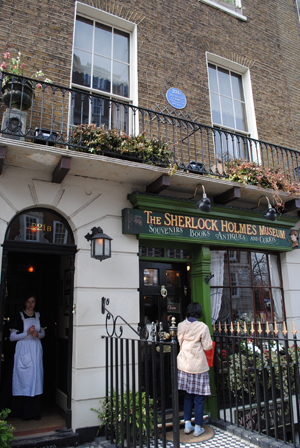
To kick it off, we take a quick look at what is certainly the most visited address of a fictional character in London – 221b Baker Street, the home of Sherlock Holmes and his associate Dr John Watson.
We’ve looked mentioned this Baker Street address in a couple of earlier posts – including a look at the origins of the naming of Baker Street and a piece on Sherlock Holmes himself.
So, to somewhat recap, the writer Sir Arthur Conan Doyle has Holmes and Watson living at this address from 1881 (it becomes their address in the first book featuring them – A Study in Scarlet, published in 1887) to 1904 when Holmes retired (Watson was not a continual presence here, moving in and out a couple of times).
What’s interesting is that the address now belongs to the Sherlock Holmes Museum, although in terms of the other numbers in the street, this is actually located between numbers 237 and 241 (in a street which was, prior to the 1930s, known as Upper Baker Street).
What is now number 221 is a 1930s art deco building formerly known as Abbey House (but this would have been 41 Upper Baker Street in 1887). It was the headquarters of Abbey National which had a long-running dispute with the museum over the right receive mail at the address 221b (since the closure of Abbey House in the early Noughties, the museum has received the mail).
It should be noted that there are also numerous other theories over the ‘real’ location of 221b Baker Street – in particular one which suggests the real address is opposite the former location of Camden House in Baker Street, thanks to a reference in The Empty House.
The museum, which is located in a house built in 1815, is set up as it was in Holmes’ day and contains his first floor study, filled with artefacts relating to the many cases he solved – including his famous pipe as well as his deerstalker hat, magnifying glass, violin, and the wicker chair which was used in Sidney Paget’s famous illustrations.
Other rooms include Dr Watson’s small second floor bedroom and the housekeeper Mrs Hudson’s room.
Worth noting is that there is also reconstruction of Holmes’ study at The Sherlock Holmes pub, located at 10-11 Northumberland Street in Westminster. This had been created for the Festival of Britain in 1951 by the Marylebone Borough Library and Abbey National and was located at Abbey House. For on this, check out the Westminister Libraries & Archives site.
WHERE: The Sherlock Holmes Museum, 221b Baker Street (nearest Tube station is Baker Street); WHEN: 9.30am to 6pm daily; COST: £8 adults; £5 children (under 16); WEBSITE: www.sherlock-holmes.co.uk.
Dwarfed by the towering form of Nelson’s Column in the southern part of Trafalgar Square, the four lions at the base of the column’s plinth – known to some as Landseer’s Lions – are now a favourite of tourists and Londoners alike. But it wasn’t always so.
While the column was erected in 1843 and the fountains in 1845, it wasn’t until 1867 that the lions – designed by Sir Edwin Landseer – appeared in the square. The reasons for the delay were apparently several including arguments over the artistic vision of the sculptures and funding and Landseer’s own ill-health.
Indeed, Landseer, best known as a painter of animal subjects, wasn’t the first choice as sculptor but was only commissioned after the models of the first sculptor – Thomas Milnes – was rejected (there’s a terrific painting by John Ballantyne of Landseer working on the lions in the National Portrait Gallery).
As a result when the lions were eventually unveiled, they were held to general ridicule when they finally arrived, costing thousands of pounds more than what had been budgeted for them.
While the lions were initially going to be made of granite, Landseer’s 20 foot long lions were cast by Baron Marochetti in bronze at his Kensington studio. The form of the lions was apparently modelled on a dead lion which, according to Ed Glinert in The London Compendium, were brought to his studio in St John’s Wood by cab from the London Zoo, although all four lions have distinct faces.
Legend has it that the Grade I-listed lions will come to life if Big Ben chimes 13 times.
There has been concern in recent years about the damage people are doing to the lions in climbing on them with one report recommending that the public be banned from climbing on them.
For more, see our previous posts on Nelson’s Column and Trafalgar Square.
For more on London’s monuments, check out Peter Matthews’ London’s Statues and Monuments (Shire Library).
Opened in the Strand in 1706, Thomas Twining’s tea shop can still be found there today.
Twining, a tea merchant whose family originally hailed from Gloucestershire, started selling tea from what had been a coffee house – Tom’s Coffee House – in an effort to tap into tea’s growing popularity. It had apparently been introduced to England by Catherine of Braganza, the Portuguese wife of King Charles II, soon after the Restoration.
Amid resistance from other coffee house owners and despite high taxes on tea, Twining’s venture succeeded, attracting a wealthy clientele which apparently included Jane Austen, thanks at least in part to its location on the border between the City of Westminster and the City of London.
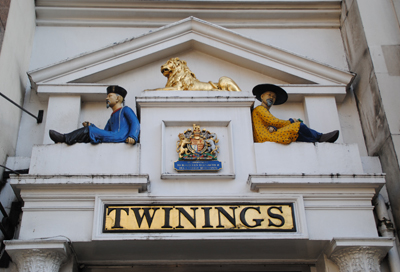
By 1717, Twining had purchased three houses adjacent to his coffee house and converted them into a shop which still stands today at number 216 Strand (the original Tom’s Coffee House was located behind this premises). He was soon selling more dry tea than wet at the sign of the “Golden Lyon”.
Following Thomas’ death in 1741, Twining’s son Daniel took over the business and by the mid-1700s, was exporting to America where he counted the Governor of Boston among his clients (but, apparently it was not Twining’s tea which was tossed into the sea at the Boston Tea Party).
It was Daniel’s son (and Thomas’ grandson), Richard Twining, who was successful in lobbying for the lowering of tea taxes and so paving the way for tea to become the commonly consumed drink it is today. It was also Richard who built the shop’s current entrance portal in 1787 incorporating the golden lion.
The Twinings shop today is the oldest in the City of Westminster while the company’s logo, which dates back to 1787, is the oldest commercial logo in continuous use.
Twinings, which since 1964 had been owned by Associated British Foods, was granted a Royal Warrant in 1837 by Queen Victoria.
For more, see www.twinings.co.uk.
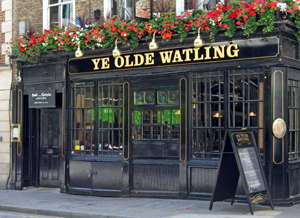
This pub, located in the City, takes its name from the street upon which it stands – Watling Street.
The street, which is just 180 metres long, bears the same name as a great Roman road which ran all the way from Dover through London to the long gone Roman town of Viroconium (now known as Wroxeter in Shropshire).
The Roman road followed, to some extent, the route of an ancient Celtic pathway. But while the Celtic pathway crossed the Thames at Westminster, the Roman road, once the bridge was constructed, crossed at London Bridge and headed through London, apparently taking in this surviving piece.
The building itself – located on the intersection with Bow Lane – is said to have been constructed from old ship’s timbers by none other than Sir Christopher Wren in 1668. The upstairs rooms were said to have been used as a drawing office during the construction of Wren’s masterpiece, St Paul’s Cathedral. It may have also been used as pub by the workmen building the cathedral – in fact it’s said to have been the first pub built after the Great Fire of 1666.
The pub is part of the Nicholson group. For more on it, check out www.nicholsonspubs.co.uk/yeoldewatlingwatlingstreetlondon.
PICTURE: Duncan Harris/Wikipedia
The largest square in Mayfair, Grosvenor Square was laid out in the 1720s on the orders of Sir Richard Grosvenor of Cheshire.
Sir Richard owned the Grosvenor Estate, a considerable tract of land in London’s west which includes in its northern part the land upon which the square was created (the estate is now owned by Gerald Cavendish Grosvenor, the 6th Duke of Westminster).
It’s proximity to Hyde Park and Whitehall quickly made it, like many other historic squares, a fashionable place for politicians to live – among those who lived here in the late 18th century were three prime ministers.
The oval-shaped gardens in the middle of the square – which was only opened to the public in 1948 – were once home to a statue of King George I but this was removed at some point. Originally thought to have been laid out by gardener John Alston, they took on their current form in 1948 when they were redesigned by architect BWL Gallannaugh (interestingly, Grosvenor Square is also said to have been the last part of London to exchange gas lighting for electric lighting).
There’s almost no residential buildings on the square these days but among the most prominent buildings (in fact it dominates the west end of the square) is the US Embassy. Designed by Eero Saarinen, the building was completed in 1960 with US President John F Kennedy one of the first visitors.
The hulking embassy is only one of the many American connections to the square, connections which at one point led to it being known as “Little America”. Dwight Eisenhower, commander of the US armed forces in World War II, based his headquarters at number 20 in 1944, while number nine – one of the few residences to survive – was home to John Adams, first American ambassador to the Court of St James and later the country’s second president.
The American theme, which has meant the square has been the focus of demonstrations such as those protesting the Vietnam War as well as outpourings of support such as in the wake of the September 11 attacks, is also evident in the statutory in the square’s gardens with grand, full size statues of President Franklin D. Roosevelt (a bronze by William Reid Dick unveiled by Eleanor Roosevelt on the third anniversary of the president’s death – 12th April, 1948 – it is pictured above), President Eisenhower (a bronze by Robert Dean dating from 1989), and President Ronald Reagan (unveiled on 4th July, 2011, pictured right).
On the eastern side of the garden square is the September 11 Memorial Garden opened in 2003 while on the south side is the Monument to the Eagle Squadrons, the three RAF squadrons in World War II mostly composed of American volunteers before the US entered the war. There’s also a set of memorial “Diplomatic Gates”, installed in 1984 to commemorate the bicentennial of the Treaty of Paris and honour US and UK politician who have worked in the service of peace.
Other notable buildings include number one, the Canadian High Commission (previously the US embassy); and number four, one of square’s oldest houses. Now demolished, number 44 was the home of the Earl of Harrowby and where the British Cabinet were dining when word arrived of Wellington’s victory at Waterloo.
• Margaret Thatcher’s funeral will be held next Wednesday at St Paul’s Cathedral from 11am with Queen Elizabeth II among those attending (the first time she has attended the funeral of a British politician since Sir Winston Churchill’s in 1965). The funeral procession of the former Prime Minister, who died on Monday aged 87, will start at the Houses of Parliament and make its way down Whitehall to Trafalgar Square before moving down the Strand, Fleet Street and Ludgate Hill to St Paul’s Cathedral. Baroness Thatcher’s coffin will carried in a hearse for the first part of the journey and will be transferred to a gun carriage drawn by six horses of the King’s Troop Royal Horse Artillery at St Clement Danes church on the Strand for the final part of the journey. There will be a gun salute at the Tower of London. Meanwhile, a Book of Condolence has opened at St Margaret’s Church, beside Westminster Abbey, this morning and will be available for people to pay their respects until 17th April, during the church’s opening hours. St Margaret’s – which stands between Westminster Abbey and the Houses of Parliament – is commonly known as the parish church of the House of Commons.
• The story of the Jewel Tower – one of the last remaining parts of the medieval Palace of Westminster – is told in a new exhibition at the historic property. Now in the care of English Heritage, the tower – located to the south of Westminster Abbey, was built in 1365 to house King Edward III’s treasury, later used as King Henry VIII”s ‘junk room’, the record office for the House of Lords, and, from 1869, served was the “testing laboratory” for the Office of Weights and Measures. The exhibition, which opened this month, is part of the English Heritage celebrations commemorating the centenary of the 1913 Ancient Monuments Act. The Jewel Tower is open daily until November. Admission charge applies. For more, see www.english-heritage.co.uk.
• See some of the earliest underground trains, a Lego version of Baker Street station and ride the Acton Miniature Railway. The London Transport Museum’s depot in Acton is holding it’s annual spring open weekend this Saturday and Sunday and in celebration of the Underground’s 150th anniversary, attractions will include the Metropolitan Steam Locomotive No. 1 and the recently restored Metropolitan Carriage 353 along with model displays, rides on the miniature railway, film screenings, talks, and workshops. Wales’ Ffestiniog Railway team – celebrating their own 150th anniversary – will also be present with the narrow gauge train, Prince. Open from 11am to 5pm both days. Admission charge applies. For more, see www.ltmuseum.co.uk.
• Now On: Designs of the Year. The Design Museum has unveiled contenders for the sixth annual Designs of the Year competition and you can what they are in this exhibition. Consisting of more than 90 nominations spanning seven categories, the nominated designs include the Olympic Cauldron by Heatherwick Studio, The Shard – western Europe’s tallest building – by Renzo Piano, a non-stick ketchup bottle invented by the Varanasi Research Group at MIT, and Microsoft’s Windows phone 8. The exhibition runs until 7th July – the winners will be announced this month. Admission charge applies. For more, see www.designmuseum.org.
Apologies for the delay in posting this piece – next week we’ll post the final in this series!
The first underground railway system in the world, the London Underground – fondly known as the ‘Tube’ – is this year celebrating the 150th anniversary of its creation.
Born out of an idea to link the inner city with the various large rail termini on the outskirts, the first section of what is now the underground system – a six kilometre stretch between Paddington and Farringdon – opened on 9th January, 1863, and was run by the Metropolitan Railway, known less formally as the ‘Met’.
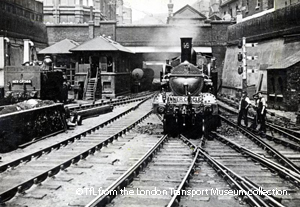
It was constructed using the ‘cut and cover’ method in which streets were dug up and tracks laid in a trench before being covered by brick-lined tunnels and the street above replaced (the method was later abandoned, apparently due to the disruption it caused to traffic). The first trains were steam-driven locomotives and drew gas-lit wooden carriages behind them (the first journey was re-enacted earlier this year – see our earlier post here. Other events commemorating the 150th included a visit to Baker Street Station by Queen Elizabeth II, Prince Philip and the Duchess of Cambridge).
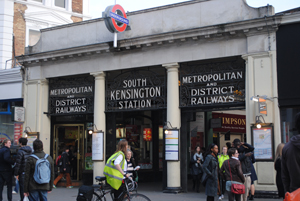
The idea proved a success – 26,000 people used the new railway every day during the first six months of its operation – and the Metropolitan District Railway opened a new line between Westminster and South Kensington (station is pictured) in December, 1868, while the first Tube tunnel under the Thames, from the Tower of London to Bermondsey, opened in 1880, and what is now the Circle Line was completed in 1884.
In December 1890, the world’s first deep-level electric railway opened, running between King William Street in the City and passing under the Thames to Stockwell. Ten years later the ‘Twopenny Tube’, more formally known as the Central London Railway, opened between Shepherd’s Bush and Bank (it was from this that the use of the word ‘Tube’ to describe the Underground system caught on).
The uniting of the system began the following year with the creation of the Underground Electric Railway Company of London and by World War I, all but the Met were within a single group organisation. The name Underground first appeared on stations in 1908, the same year electric ticket machines were introduced.
In 1933, the Underground came under the control of the London Passenger Transport Board – the same year that Harry Beck’s first diagrammatic map of the underground system appeared.
Stations in the system were used as air raid shelters during World War II – part of the Piccadilly Line was closed and used as a storage site for treasures from the British Museum. Following the war, the organisation running the system went through various name changes until the formation of London Underground in 1985.
The system has since expanded – the Victoria Line was opened in the late 1960s and the Jubilee Line a decade later – and now consists of more than 408 kilometres of railway lines and 275 stations which serve more than three million passengers a day – equating to more than a billion a year, the same as the entire national rail network.
For more on the history of the Underground, see our earlier 10 Questions with London Transport Museum curator Simon Murphy. Poster Art 150 – London Underground’s Greatest Designs runs at the London Transport Museum until October. Admission charge applies. For more (including the many events around the exhibition), see www.ltmuseum.co.uk/whats-on/events/events-calendar#posterart150.
For more, check out David Bownes’ Underground: How the Tube Shaped London or Andrew Martin’s Underground, Overground: A Passenger’s History of the Tube
.
Simon Murphy is a curator at the London Transport Museum in Covent Garden – the museum is currently celebrating the 150th birthday of the Underground with a series of events including a landmark exhibition on the art of the Tube (Poster Art 150 – London Underground’s Greatest Designs)…
How significant was the construction of the London Underground in world terms? And how does it stack up 150 years later? “The Metropolitan Railway was a true world class pioneer, but like all pioneers it made mistakes that subsequent operators learned from. Similarly the first tube railways tested the ground for others to follow. But these pioneering lines are still part of today’s world class Tube network, and some of the original stations, like King’s Cross, are still amongst the busiest, so they must have been on the right track.”
I understand the initial stretch of line ran between Farringdon and Paddington. How quickly were other sections opened? “The Metropolitan Railway’s first extension was authorised by Parliament in 1861, two years before the original line even opened. The railway made a profit in its first year, so financial backing was relatively easy to find, and the extension east to Moorgate opened in 1865, with a westward extension to South Kensington following in 1868. The Met’s main competitor, the Metropolitan District Railway, opened its first section from South Ken to Westminster in 1868. The plan was for the two companies to work together to create an Inner Circle service, but their respective directors fell out and the Circle was not completed until 1884.”
How many miles of line is the Underground composed of today? “The first underground started with less than four miles of track and seven stations; today’s system has 250 miles of track, serving 270 stations.”
When were steam trains on the Underground replaced? “Steam trains worked in central London until 1905, but were still used on the furthest reaches of the Met until 1961.”
When did the Underground take on the name ‘Tube’? “The Central London Railway opened with a flat fare of 2d in 1900, and was promoted as the Twopenny Tube – the name caught on, although the Underground has only been referring to itself officially as the Tube since the 1990s.”
It’s fairly widely known that Underground stations and tunnels were used as air raid shelters during World War II. Do you know of any other different uses they have been put to? “The station at South Kentish Town on the Northern Line closed in 1924, but the surface building, still looking very much like a station is now occupied by a branch of Cash Converters. During the war unfinished tunnels on the Central line were occupied by a secret factory run by Plessey Components. Also during the war, paintings from the Tate Gallery were stored in a disused part of Piccadilly Circus station for safe keeping.”
Stylish design has always been an important part of the Underground’s appeal. What’s your favourite era stylistically when it comes to the Underground and why? “Most people admire the golden age of the 1920s and 30s when the Underground’s corporate identity and personality reached its peak with Charles Holden’s architecture, the roundel, Harry Beck’s diagrammatic map and the amazing posters issued in that era, but personally I find the earlier period from 1908 to 1920 more interesting. You can trace the roots of each element of today’s brand being developed at this time, under Frank Pick’s critical eye, starting with the early solid-disc station name roundels, the joint promotion of the individual tube railways under the UndergrounD brand and the introduction of Edward Johnston’s typeface. You can see the company gaining confidence and momentum, especially in relation to the increasingly sophisticated posters and promotion that Pick commissioned.”
Can you tell us a bit about how the London Transport Museum is marking the 150th anniversary? “We started the year by bringing steam back to the Circle line, after restoring an original Metropolitan Railway carriage and overhauling an original Met steam locomotive, and have just opened our fabulous overview of the 150 best Underground posters at the museum in Covent Garden, which runs until October. We are opening our Depot store, near Acton Town station in April for a steam weekend, and have a range of lectures and evening events at Covent Garden linking to the history of the Underground and its poster art heritage. There’s also our comprehensive new history of the Tube published last year and a wide range of new products and souvenirs in our amazing shop.”
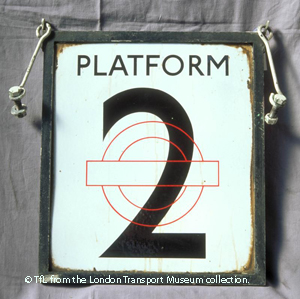
What are some of your favourite Underground-related objects on display at the museum? “The Design for Travel gallery on the ground floor is the literal and metaphorical heart of the Museum for me. Packed with close to 300 objects including signs, posters, models, leaflets and other documents, it’s hard to single out individual items, but I love the simplicity of the small ‘Platform 2’ hanging sign (pictured right) – it’s a real example of the design consistency and attention to detail that I associate with the Underground.”
And lastly, can you tell us a couple of little-known facts about the Underground? History is more than a chronological list of facts, and what one person finds fascinating sends another to sleep, so it’s quite a challenge to choose something that is little known, but genuinely interesting, but I’ll try: I grew up near Brent Cross station so I might be biased, but I reckon that if there was a top trumps for Underground lines, the Northern line would win. It has the longest escalators (at Euston), the deepest lift shaft (at Hampstead), the highest point ve sea level (on a viaduct near Mill Hill East), the longest tunnels (between East Finchley and Morden – 17 miles) and has had more names than any other line – it only became the Northern line in 1937.”
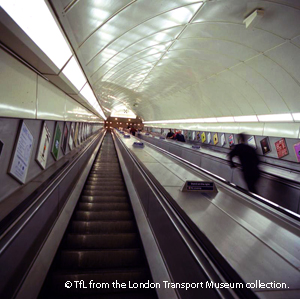
IMAGES: Top: Steam engine at Aldgate (1902); Middle: Platform 2 sign, 1930s design; and Bottom, Angel Underground Station (1990s). © TfL from the London Transport Museum collection.
Poster Art 150 – London Underground’s Greatest Designs runs at the London Transport Museum until October. Admission charge applies. For more (including the many events around the exhibition), see www.ltmuseum.co.uk/whats-on/events/events-calendar#posterart150.
It was King Henry VII, father of King Henry VIII, who brought the name Richmond to London.
Inheritor of the title of the Earl of Richmond (the title relates to lands in Yorkshire and centres on the castle of Richmond), on being crowned king, Henry VII gained the use of Sheen (or Shene) Palace located on the banks of the Thames, about seven miles south west of Westminster (the history of which we’ll look at in greater detail in an upcoming post).
Sheen Palace was largely destroyed in a fire in 1497 and the king gave orders for it to be rebuilt (Richmond Palace is pictured here – found on a sign at Richmond). It was on its completion in around 1502 that Henry decided to rename the palace after his former earldom – Richmond.
The name Richmond, by the way, comes from a French word for ‘old hill’.
The once separated town of Richmond is now at the centre of the London Borough of Richmond upon Thames (it became a municipal borough in 1890) and a popular residential suburb for London’s wealthy (among those who have lived there are Mick Jagger and Jerry Hall) – sought after for its riverside amenity, quaint village green, and panoramic views from Richmond Hill as well as its fine shopping and dining.
Richmond’s other great drawcard is Richmond Park, one of the city’s eight Royal Parks, and home to more than 600 deer (see our earlier entry on it here).
Says the photographer, Sam C Moore (of SCM Photography): “I was on my way to St Clement Danes and the telephone box against the snowy street background really caught my eye, and almost directly adjacent to it was a bike that had been parked up which added to help frame the shot. All I needed now was a black cap to drive past, so waited (very briefly) and, of course, being London. I got my wish” For more of Sam’s work, see www.flickr.com/people/84891527@N00/.
Taken an interesting photograph of somewhere in London? We’re always looking for interesting images of the city so if you’ve got one you reckon captures a snippet of life in London, please contact us at exploringlondon@gmail.com or via Flickr at www.flickr.com/groups/exploringlondon/
One of 12 casts made of an original which stands in Calais, France, this sculptural group commemorates one of the most poignant moments of the bloody Hundred Years War.
The original work, by the renowned Auguste Rodin who beat five others with his design, was completed in 1889 and stands outside Calais’ town hall. This cast was produced in 1908 and presented to the nation in 1914 by the National Art Collections Fund. It stands in Victoria Tower Gardens, just to the south of the Houses of Parliament in Westminster.
The sculpture commemorates an event which took place in 1347. Calais, then, as now, an important French port, had been besieged by the English for more than a year and, in a desperate situation as the townspeople starved (and despite orders from the French King Philip IV to hold out), the city authorities were seek terms from the English king, Edward III, still flushed with the success of the Battle of Crecy the year before.
Edward’s conditions for their surrender were harsh – six of the city’s leaders had to be handed over and the rest of the city would be spared. But more than that, the six had to leave the city stripped of almost all their clothes, wearing nooses around their necks and carrying the keys to the city and castle.
Six burghers, led by Eustache de Saint Pierre and also including John Daire and brothers James and Peter Wisant, did so and it is the scene of them making their way to King Edward that Rodin has captured. Their bravery was rewarded – while King Edward apparently order them to be beheaded, his pregnant English Queen, Philippa of Hainault, intervened on their behalf and they were spared execution, dressed and fed before they were safely escorted away.
Only 12 casts of the group were ever permitted under French law – the London cast was the third to be made.