10 sites from Shakespearean London – 1. The Globe…

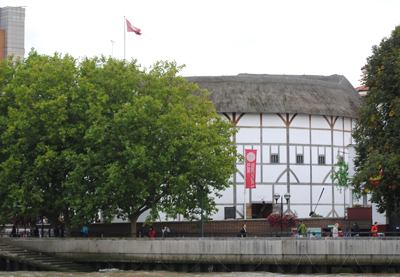
The-GlobeMention William Shakespeare and London in the same breath and everyone immediately thinks of one building – the reconstructed Globe on Bankside. So we thought that to kick off our new series – being run in honour of the 450th anniversary of the playwright’s birth – we’d take a look at history of the iconic structure.

The-Globe2The original Globe Theatre, located a few hundred metres to the south, opened in 1599 as a home for the actors’ company known as the Lord Chamberlain’s Men (later renamed the King’s Men on the accession of King James I in 1603), of which Shakespeare was a member. Founded by James Burbage, this merry band was originally was housed at London’s first purpose-built playhouse Shoreditch before lease disputes led them to establish a new theatre in Southwark, close to the then existing theatre, The Rose.

Up and running by 1599 (Shakespeare was among four actors who bought a share in the property to help fund the new building which used timbers from the former Shoreditch theatre), the new theatre was used for 14 years until, during a performance of Henry VIII in 1613, wadding from a stage cannon ignited and the theatre burned to the ground. Rebuilt with a tiled roof, it remained the home of the company until it was closed down by the Puritan government in 1642 and demolished two years later.

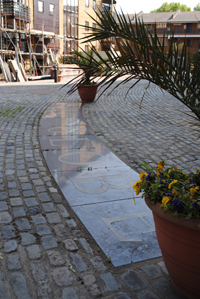
You can see the original site of The Globe just in nearby Park Street. The shape of the structure is marked by a dark line embedded in the pavement (pictured).

The reconstructed building which stands proudly by the water today was the vision of the late American actor, director and producer, Sam Wanamaker. He founded the Shakespeare Globe Trust which, with the on-site assistance of Queen Elizabeth II, opened the theatre at its current site in 1997 (sadly, Wanamaker had died three-and-a-half-years previously).

The building’s design was drawn from sifting through what little historical evidence could be found including the findings of an archaeological dig at the original site, descriptions contained in Shakespeare’s plays (including the line from Henry V – “Or may we cram within this wooden ‘O’), and printed panoramas from the time, although it should be noted that much – particularly the design of the stage – is speculative.

Meanwhile the techniques used in the construction of the theatre were the subject of years of research and were in accord with those of the early 17th century  and included using oak laths and staves to support lime plaster and then covering the walls in white lime wash while the roof was made of water reed thatch.

One of the best ways to see the theatre and make the most of the atmosphere is to see a play from a standing position in the pit!

WHERE: Globe Theatre Exhibition & Tour, Shakespeare’s Globe, 21 New Globe Walk (nearest Tube stations are Southwark and London Bridge); WHEN: Exhibition is open 9am to 5.30pm daily – tours run at various times, see website for details; COST: Exhibition and tour cost is £13.50 adults/£12 seniors/£11 students/£8 children (5-15 with children under five free)/£36 family of four; WEBSITE: www.shakespearesglobe.com.

London Pub Signs – The Anchor…

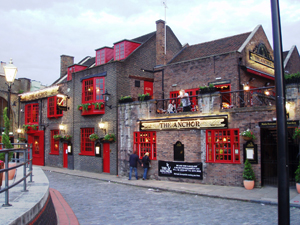
While the first official records of this Bankside pub only date from 1822, the pub’s history goes back much further. Like many pubs in London, nailing down its exact origins is tough but the story goes that it was named The Anchor by seventeenth century merchant Josiah Child.

The-AnchorChild owned the brewhouse which had been established in 1616 by James Monger at a site known as Dead Man’s Place (close to where the original Globe Theatre had stood before burning down in 1613) and was also a merchant who supplied the navy with everything from masts and spars to stores and beer. Hence the name The Anchor.

It’s speculated that William Shakespeare himself might have had a drink here and it’s believed to be from this pub – “a little alehouse on Bankside” – that diarist Samuel Pepys witnessed the destructive power of the Great Fire of London in 1666.

Dr Samuel Johnson – apparently a close friend of later brewery owners, Henry and Hester Thrale – was among regular drinkers. Other patrons, according to the pub’s website, included the artist Joshua Reynolds, Irish poet Oliver Goldsmith, actor David Garrick and Irish statesmen Edmund Burke.

The pub was apparently rebuilt a couple of times after being destroyed by fire. The brewery, meanwhile, rose to become one of the largest in the world before it was finally demolished in 1981 leaving the pub, the brewery tap, still standing.

Refurbished in recent years, the pub today contains a room dedicated to The Clink prison, the Bishop of Winchester’s lock-up which was located in nearby Clink Street.

The waterside pub at 34 Park Street is now part of the Taylor Walker chain. You can find out more about it here.

PICTURE: Ewan Munro/Flickr

LondonLife – Celebrate Shakespeare with a cake…

Jane-Asher

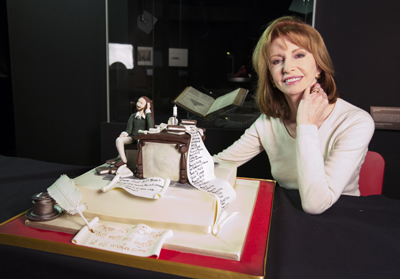
Time is running out for your entry into Cakespeare – the V&A’s competition to find the best Shakespeare-themed cake as part of the institution’s celebration of the 450th anniversary of William Shakespeare’s birth. The competition, which closes on 4th May, was launched earlier this month with an almost 15 kilogram cake created by Jane Asher Party Cakes (actress Jane Asher and the cake are pictured). A fruitcake, it features the playwright at work with a writing table and feature quill made from icing while a scroll lists the 36 plays in Shakespeare’s First Folio (which is on show in the V&A’s Theatre and Performance Galleries). To enter the competition, design, bake and decorate your cake celebrating Shakespeare and then upload an image of it to social media, tagged #Cakespeare. Oh, and the winner – selected by Asher and Geoff Marsh, director or the V&A’s department of theatre and performance – will receive a weekend for two in Stratford-upon-Avon complete with tickets to see the Royal Shakespeare Company. The V&A’s Shakespeare Festival runs until 4th May. For more, see www.vam.ac.uk. So enjoy your Shakespeare – and your cake…might be a way to take your mind off London’s transport woes! PICTURE: Victoria and Albert Museum, London.

This Week in London – Meet King George I this Easter; celebrating Shakespeare’s 450th; and feasting with St George in Trafalgar Square…

Historic Royal Palaces are offering you the chance to meet King George I and explore the world in which he lived at his former real-life home of  Hampton Court Palace this Easter weekend. A re-enactment marking the 300th anniversary of his accession will have the new Hanoverian king arrive by royal barge on the River Thames and will also include courtiers taking part in a “stately dance”, the King’s troupe of Hanoverian horses performing a “horse ballet” and a Georgian Army encampment with soldiers involved in firing displays. Visitors to the palace will also be able to see a new re-presentation of the Queen’s State Apartments which explores who the Hanoverians were, how they came to rule and their many and bitter family feuds. Runs from tomorrow (18th April) to 21st April. Admission charge applies. For more, see www.hrp.org.uk/HamptonCourtPalace/.

The 450th anniversary of Shakespeare’s birth is being celebrated with a week of events at the Guildhall Library next week. Kicking off on Tuesday, 22nd April, and running until Friday, 25th April, events include talks – with subjects including ‘Shakespeare’s London Theatreland’ and ‘Imaging Shakespeare’s Indoor Theatre’, and a six hour complete reading of Shakespeare’s sonnets with readers including actor Damian Lewis, author Alan Hollinghurst and Lord Mayor of City of London Fiona Woolf as well as Shakespeare-themed walks around the City and Southwark, and the free Shakespeare in Print exhibition at the Library. For more, see www.cityoflondon.gov.uk/things-to-do/visiting-the-city/archives-and-city-history/guildhall-library/Pages/default.aspx. Meanwhile, the V&A is also holding a Shakespeare Festival, kicking off next Monday and running until 4th May. Highlights of the festival include screenings of some of the best theatre productions of Shakespeare in the last 20 years, live performances by actors and musicians and a series of debates and talks including the “interactive lecture” Marchpane to Mutton – A Taste of Shakespeare’s Time by food historian and artists Tasha Marks. There’s also a competition – Cakespeare – in which the public are invited to design, bake and decorate a Shakespeare-themed cake and share an image of it on social media (#Cakespeare) by 4th May with the winner to receive a weekend for two to Stratford-upon-Avon and tickets to the Royal Shakespeare Company. The festival is being complemented by a display in the Theatre and Performance Galleries, Shakespeare: Greatest Living Playwright which features the First Folio as its centrepiece. Admission is free. See www.vam.ac.uk for more.

It might be two days ahead of the official saint’s day, but the Feast of St George will be celebrated in Trafalgar Square this Bank Holiday Monday with a banquet and guests including a five metre high interactive dragon. The festivities, hosted by Mayor of London Boris Johnson, will also include an English Farmers’ Market featuring 20 stalls, a kid’s marquee and traditional wooden garden games, harlequins on stilts, swing boats and circus lessons for children, a bandstand located in front of Nelson’s Column and a 12 foot tall Maypole. Runs from noon to 6pm. For more, see www.london.gov.uk/feast.

Send all items of interest for inclusion to exploringlondon@gmail.com. 

This Week in London – Queen Elizabeth Olympic Park opens fully this weekend; Shakespeare at the Guildhall Library; and, the V&A celebrates Italian fashion…

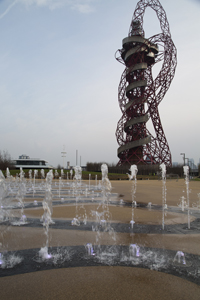
QEOP• The UK’s tallest sculpture, the ArcelorMittal Orbit, will be open to the public in Queen Elizabeth Olympic Park – described as the “biggest new park to open in Europe in 150 years” – in London’s east from this weekend. While the northern part of the 560 acre park, the Copper Box Arena, Lee Valley VeloPark and Aquatics Centre have been open to the public since July last year, from Saturday visitors will be able to visit the southern part of the park featuring the 114.5 metre high sculpture. Features in the southern part of the park include a new tree-lined promenade with giant globes, interactive water fountains, an adventure playground and four themed walking trails focusing on the 2012 Games, nature and biodiversity, education, and art and culture. Visitors who head to the top of ArcelorMittal Orbit will be able to view across 20 miles of London from a 76 or 80 metre high platform (admission charges apply – £15 adults/£7 children/£40 for a family of four – and, be warned, you may need to book) while at the base of the sculpture is a cafe and event space. The opening weekend will see a host of special events including a parade of children, an aerial acrobatic performance, choirs, bands, dancers, poets, circus performers and story tellers and ‘try out’ sports and fitness sessions. There’s more yet to come with the Lee Valley Hockey and Tennis Centre opening to the public in June and the Olympic Stadium reopening for the 2015 Rugby World Cup next year. For more on the park, see www.queenelizabetholympicpark.co.uk and for tickets to the ArcelorMittal Orbit, see http://arcelormittalorbit.com.

The printed works of William Shakespeare are the focus of a new exhibition which opened at the Guildhall Library in the city this week. Shakespeare in Print explores the library’s Shakespearean works and looks at how they were produced. Among the treasures on display will be a First Folio, the first collected edition of his plays, contemporary writers quartos and later editions of the Bard’s plays and poetry. This free exhibition is running until 29th May. The library will be hosting a series of Shakespeare-related events in the week of 22nd to 25th April to mark the 450th anniversary of his birth. For more, head here.

Italian fashion from 1945 until today is the subject of the V&A’s spring exhibition opening on Saturday. The Glamour of Italian Fashion 1945-2014 will feature 100 ensembles and accessories by leading Italian fashion houses including Dolce & Gabbana, Giorgio Armani, Gucci, Prada, Valentino and Versace as well as creations from the “next generation of talent” including Giambattista Valli and Fausto Puglisi and will also showcase the creativity of less well remembered figures such as Sorelle Fontana and Walter Albini. As well as charting the shifting international perception of Italian style, the display will also highlight techniques and materials used in the creation of Italian fashion with a digital map visualising the industry. Runs until 27th July. Admission charge applies. For more, see www.vam.ac.uk.

Send all items of interest for inclusion to exploringlondon@gmail.com.

This Week in London – William Shakespeare’s influence; new Fourth Plinth commissions; the car and landscape; and London Stories…

First up, apologies that we were unable to launch our new Wednesday series yesterday due to some technical difficulties (stayed tuned for next week). And now, on with the news…

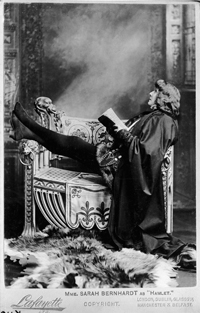
Sarah_Bernhardt_by_Lafayette_Ltd_1899_c__Victoria_and_Albert_Museum_London__William Shakespeare’s influence on successive generations of theatrical performance is the subject of a new exhibition at the V&A to mark the 450th anniversary of his birth on 23rd April. Shakespeare: Greatest Living Playwright centres on the Bard’s First Folio which, published in 1623, contains 36 plays including 18 works – Macbeth, The Tempest and Twelfth Night among them – which would be unknown without it. The display includes interviews, archive footage and photography and objects from the V&A collections as well as an audio-visual presentation by Fifty Nine Productions featuring interviews with contemporary theatre practitioners such as actors, directors and designers. Objects on display include a skull used by Sarah Bernhardt when playing Hamlet in 1899, an embroidered handkerchief used by Ellen Terry when playing Desdemona in 1881 at the Lyceum Theatre, and a pair of red boots worn by actor-manager Henry Irving in an 1887 production of Richard III. Runs in the V&A’s Theatre and Performance Galleries until 21st September. Admission is free. For more, see www.vam.ac.uk. PICTURE: Sarah Bernhardt as Hamlet, 1899, © Victoria and Albert Museum, London.

A skeletal horse and a giant hand giving a thumbs up will adorn the Fourth Plinth in Trafalgar Square during 2015-16. Hans Haacke’s Gift Horse is derived from an etching by painter George Stubbs and, while being a comment on the equestrian statue of King William IV which was intended for the plinth, also features an electronic ribbon displaying a live ticker of the London Stock Exchange on its front leg. Meanwhile David Shrigley’s Really Good is a 10 metre high hand giving a thumbs up – sending a positive message to those who see it. For more, see www.london.gov.uk/priorities/arts-culture/fourth-plinth.

The impact of the car on England’s landscape and the listed buildings of motoring history are the focus of a new exhibition in Wellington Arch. Carscapes: How the Motor Car Reshaped England features archive photographs, historic advertising, cartoons and motoring magazines as well as a 1930s traffic light, a petrol pump and other accessories and memorabilia. Wellington Arch, which is managed by English Heritage, is a fitting location for the exhibition – it was moved to its current position due to increasing traffic back in 1883. Admission charge apply. For more, see www.english-heritage.co.uk.

A new exhibition exploring some of the true and not-so-true stories inspired by and produced in London opens at the London Transport Museum in Covent Garden tomorrow. London Stories features the best entries from The Serco Prize for Illustration 2014 with more than 50 works of art on display depicting a well-known or obscure London narrative. The short-listed illustrations tackle everything from ghost buses to Buffalo Bill’s Wild West Show of 1887, a Pearly King and Queen, Lenin’s ‘Love letter to London’ and an escaped monkey jazz band. There’s also a host of musical and literary references – everything from Mary Poppins to Sweeney Todd and Oranges and Lemons. Tomorrow there will be a late opening of the exhibition complete with cash bar, DJ and story-telling for adults as well as the chance to create your own London story with illustration workshops and a photo-booth. Organised by London Transport Museum in partnership with the Association of Illustrators, it runs until 6th April. Admission charge applies. For more, see www.ltmuseum.co.uk.

Send all items of interest for inclusion to exploringlondon@gmail.com.

Famous Londoners – Ben Jonson…

Often noted as the second greatest English dramatist of his generation (after that Shakespeare guy), the playwright Ben Jonson stands tall in his own right as one of the leading literary figures of the late 16th and early 17th century.

Born in 1572, Jonson was educated at Westminster School in London and possibly went on to Cambridge before he started work as a bricklayer with his stepfather and later served as a soldier, fighting with English troops in The Netherlands.

It was on his return to London that he ventured into acting – among his early roles was Hieronimo in Thomas Kyd’s The Spanish Tragedie – and by 1597 he was employed as a playwright.

While one of his early play-writing efforts (The Isle of Dogs, co-written with Thomas Nashe) led to a term of imprisonment in Marshalsea Prison in 1597 (he was also briefly imprison about this time for killing another actor in a duel, escaping a death sentence by pleading “benefit of the clergy”), the following year – 1598 – the production of his play Every Man In His Humour  established his reputation as a dramatist. Shakespeare, whom some suggest was a key rival of Jonson’s during his career – is said to have been among the actors who performed in it.

Further plays followed including Every Man Out Of His Humour (1599), his only tragedy Sejanus (1603), the popular Volpone (1606) and The Alchemist (1610), and Bartholomew Fair (1614) and it was during these years, particularly following the accession of King James I in 1603, that he became an important figure at the royal court).

His political views continued to cause trouble at times – he was again imprisoned in the early 1600s for his writings and was questioned over the Gunpowder Plot after apparently attending an event attended by most of those later found to be co-conspirators – but his move into writing masques for the royal court – saw his star continue to rise.

All up he wrote more than 20 masques for King James and Queen Anne of Denmark including Oberon, The Faery Prince which featured the young Prince Henry, eldest son of King James, in the title role. Many of these masques saw him working with architect Inigo Jones, who designed extravagant sets for the masques,  but their relationship was tense at times.

In 1616 – his reputation well established – Jonson was given a sizeable yearly pension  (some have concluded that as a result he was informally the country’s first Poet Laureate) and published his first collection of works the following year. Noted for his wit, he was also known to have presided over a gathering of his friends and admirers at The Mermaid Tavern and later at the Devil’s Tavern at 2 Fleet Street (Shakespeare was among those he verbally jousted with).

Jonson spent more than a year in his ancestral home of Scotland around 1618 but on his return to London, while still famous, he no longer saw the same level of success as he had earlier – particularly following the death of King James and accession of his son, King Charles I, in 1625.

Jonson married Anne Lewis – there is a record of such a couple marrying at St Magnus-the-Martyr church near London Bridge in 1594 – but their relationship certainly wasn’t always smooth sailing for they spent at least five years of their marriage living separately. It’s believed he had several children, two of whom died while yet young.

Jonson, meanwhile, continued to write up until his death on 6th August, 1637, and is buried in Westminster Abbey (he’s the only person buried upright in the abbey – apparently due to his poverty at the time of his death).

For an indepth look at the life of Ben Jonson, check out Ian Donaldson’s Ben Jonson: A Life.

Around London – The Bard is back; Foundling Museum displays; and, exhibitions on iconoclasm and explicit Japanese art…

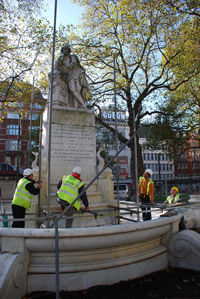
The Bard is back in Leicester Square with the announcement last week that restoration work on the square’s 19th century Grade II listed statue of William Shakespeare – the only full-length statue the playwright in central London – has been completed. The 11 month restoration was carried out as part of £17 million revamp of the square which has seen the installation of a new fountain. The statue, which was the work of James Knowles, has been in the square since it was completed in its current configuration in 1874. Meanwhile, in other sculpture-related news, Sorry, Sorry Sarajevo – a life-size statue of a man holding  a dead or badly injured man in his arms has been placed in St Paul’s Cathedral where it will remain for the rest of the year. The work by Nicola Hicks dates from 1993 – when the Bosnian war was at its height – and has been placed opposite Henry Moore’s 1983 sculpture, Mother and Child: Hood as part of the cathedral’s approach to next year’s World War I centenary.

Two new displays opened at the Foundling Museum in Bloomsbury last month. Hogarth and Copyright, which runs until 5th January, looks at the role the artist William Hogarth played in the passing of the 1735 Engravers’ Copyright Act (also known as Hogarth’s Act – it was the first law to protect artist’s rights over their work) while Handel and Lucretia, presented in conjunction with The Sir Denis Mahon Charitable Trust and running until 26th January, shows Guercino’s painting Lucretia alongside two early manuscripts of Handel’s cantata La Lucretia. Entry is part of admission price. For more, see www.foundlingmuseum.org.uk.

A new exhibition tracing the history of attacks on artworks in Britain from the 16th century to today opened at Tate Britain in Millbank this week. Art under Attack: Histories of British Iconoclasm looks at why and how monuments have been damaged over the past 500 years. The display includes the remarkable pre-Reformation sculpture, the Statue of the Dead Christ (about 1500-1520), which was discovered in 1954 beneath the chapel floor at the Mercer’s Hall. Already damaged – most likely at the hands of Protestant iconoclasts – it may have been buried there to protect it. Also displayed are fragments of monuments destroyed in Ireland last century, paintings including Edward Burne-Jones’ 1898 painting Sibylla Delphica which was attacked by suffragettes in 1913-14, and Allen Jones’ 1969 work Chair – damaged in a feminist attack in 1986. Runs until 5th January. Admission charge applies. For more, see www.tate.org.uk.

A controversial exhibition of sexually explicit Japanese works of art created between 1600-1900 opened at the British Museum this week. Shunga: sex and pleasure in Japanese Art – which carries a warning of “parental guidance for visitors under 16 years – features 170 works including paintings, prints and illustrated books. Drawn from collections in the UK, Japan, Europe and the US, the exhibition of explores the phenomena of what are known as shunga (‘spring pictures’), looking at why it was produced and to whom it was circulated. Admission charge applies. Runs until 5th January. For more, see www.britishmuseum.org.

Famous Londoners – David Garrick…

Playwright. Actor. Theatre manager. David Garrick stands out as a towering figure of the theatrical world in the 18th century and is remembered, at least in part, for his friendship with the irrepressible lexicographer Samuel Johnson.

Born on 19th February, 1717, in Hereford to an army officer (with French Huguenot roots) as the third of five children, Garrick attended school in Lichfield, north of Birmingham, including, at the short-lived Edial Hall School where Dr Johnson himself taught Latin and Greek. It was during his youth that he first took an interest in the stage, appearing in George Farquhar’s The Recruiting Officer.

When the school closed due to lack of funds, Garrick accompanied Dr Johnson to London (they had become friends) and there he and his younger brother Peter established a wine business (Peter eventually went back to Lichfield to run part of the business from there). While the business wasn’t a great success, Garrick took to acting in amateur theatricals and eventually – according to Peter Thomson, writing in the Oxford Dictionary of National Biography – made his professional debut acting incognito in a pantomime in London in March, 1741, although Garrick apparently said placed his debut in Ipswich that summer when he was acting in Thomas Southerne’s Oroonoko, or the Royal Slave (meanwhile the first performance of one of his dramatic works – Lethe, or Aesop in the Shades – had taken place at Drury Lane the previous year).

His breakthrough role came later that year – in October – when he appeared in London on the stage of the unlicensed Goodman’s Fields Theatre in the title role of Richard III. Soon acclaimed by the likes of Alexander Pope and William Pitt as the greatest actor of his time, further roles followed at Goodman’s Fields and at the famous Drury Lane Theatre as well as in Dublin (where he started an ultimately ill-fated love affair with Irish actress Peg Woffington who returned with him to London where he continued acting at Drury Lane).

Having also performed for a season, at the rival Covent Garden Theatre, in April 1747, Garrick entered into a partnership with James Lacy for the ownership of the Drury Lane Theatre. The first performance was apparently by Garrick himself, reading Ode to Drury Lane Theatre, on dedicating a Building and erecting a Statue, to Shakespeare – a piece written by Dr Johnson.

It was two years later – on 22nd June, 1749 – that he married a German dancer Eva Marie Veigel. They lived at a house at 27 Southampton Street and Garrick’s increasing wealth led him to buy a country property in Hampton, today in south west London, in 1754 which became known as “Garrick’s Villa”. Considerably altered, the Grade I-listed property still stands there today (albeit having suffered extensive damage in a 2008 fire) along with the summerhouse he built to house his collection of Shakespearian memorabilia – known as Garrick’s Temple to Shakespeare, it’s open to the public over from April to October.

Meanwhile, as well as managing the theatre, Garrick continued acting and writing plays. In September, 1769, he staged the Shakespeare Jubilee in Stratford-upon-Avon, celebrating 200 years since the playwright’s birth – even though it was five years too late and was ultimately a bit of a disaster, he took his celebration of Shakespeare back to Drury Lane and there it was a huge success.

Garrick, who moved from Southampton Street into the newly built Adelphi Terrace in 1772, remained manager of Drury Lane until his retirement in 1776 during which time it became widely acknowledged as the country’s leading theatre. He died at home on 20th January, 1779. His wife outlived him by 43 years. The couple had no children. Garrick was subsequently interred in Poet’s Corner, Westminster Abbey – the first actor to receive the honour.

Garrick’s legacy was enormous – not only is he famed for bringing a new ‘realistic’ style to the profession he so loved, he set new standards in the arts of public relations and was also an instrumental figure in having Shakespeare recognised as England’s national icon. Legend goes that he was also the actor responsible for the phrase “Break a leg!” – apparently so engrossed in a performance of Richard III that he overlooked the fact he’d fractured his bone.

Garrick’s name lives on in the Garrick Theatre (still operating in Charing Cross Road) and the Garrick Club, and there’s memorial to him on his former home in Adelphi Terrace.
Treasures of London – Shakespeare’s Blackfriars deed…

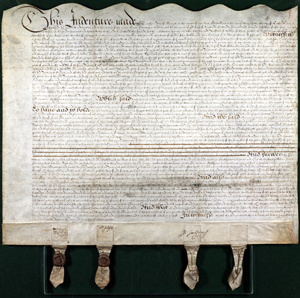
Shakespeare's-DeedIn 1613, the playwright William Shakespeare – now widely regarded as the greatest writer of the English language – purchased a property in Blackfriars.

The only real estate he was to buy in London, the purchase of the gatehouse – which may have stood on the junction of St Andrew’s Hill and Ireland Yard – was apparently made as an investment (Shakespeare never lived there).

The deed which recorded the sale (dated 10th March, 1613) – only one of six documents in the entire world which bears Shakespeare’s authenticated signature – is in the care of the London Metropolitan Archives.

According to the deed, he bought the property from Henry Walker, a minstrel, paying £140 for the property (he mortgaged £60 of it the next day – the document for this is located in the British Library).

Other parties mentioned on the document are William Johnson, a London-based vintner and possibly landlord of the Mermaid tavern in Cheapside, and two ‘gentlemen’ John Jackson and John Heminges, an actor, manager and editor of Shakespeare’s first folio.

They were appointed as trustees in Shakespeare’s interest and handled the sale of the property after Shakespeare’s death in 1616. The copy of the deed held by the LMA was that of Henry Walker (Shakespeare’s copy is in the Folger Shakespeare Library in Washington).

The deed is currently on display as part of an exhibition surrounding the 400th anniversary of its signing. ‘Shakespeare and London’, a free exhibition, also features other documents from the period as well as maps, prints and models and runs at the LMA (40 Northampton Road) until 26th September. Due to the age and importance of the deed, the deed itself will only be displayed at specific times – check the LMA website for details.

Around London – Celebrating the Coronation’s 60th anniversary; Benjamin Britten; Keat’s House Festival; and, silver service in Roman Britain…

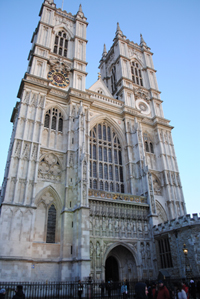
Westminster-Abbey3Sunday marks 60 years since Queen Elizabeth II’s coronation and Westminster Abbey – site of that event – is celebrating with a series of events. These include a special 60th Anniversary of the Coronation Service on Tuesday (4th June) to be attended by the Queen, Duke of Edinburgh and members of the royal family as well as a public lecture to be given by the Bishop of London Richard Chartres on Friday night (7th June – booking is essential), a concert performed by the abbey choir (13th June), and a new exhibition in the chapter house featuring archive images of the 1953 coronation ceremony and of preparations which took place at the abbey. Meanwhile the Coronation Chair, used in most coronations since the 14th century and having just undergone conservation work, is the subject of a new display in St George’s Chapel, and two new commemorative stained glass windows have been installed in King Henry VII’s Lady Chapel – the first commissioned by the abbey for more than a decade, they have been designed by artist Hughie O’Donoghue. For more on the abbey’s celebrations, see www.westminster-abbey.org.

Composer Benjamin Britten is the subject of a new exhibition opening at the British Library tomorrow. Poetry in Sound: The Music of Benjamin Britten (1913-1976) looks at the poetic and literary influences on the work of the man often described as the greatest English composer since Purcell. In particular it examines his collaboration with WH Auden and the interplay of his work with authors such as William Blake, Wilfred Owen, Alfred Lord Tennyson and William Shakespeare. As well as composition manuscripts, the exhibition features photographs, concert programmes and unpublished recordings of his music. There are a range of events accompanying the exhibition which runs until 15th September. An admission charge applies. For more, see www.bl.uk.

The Keats House 2013 Festival is underway this week with activities ranging from poetry readings to felt-making demonstrations, free family workshops and musical performances. The programme of events runs until 2nd June, all under this year’s theme of ‘Health is My Expected Heaven’: The Body and The Imagination. Poet John Keats lived at the house in Hampstead, not far from Hampstead Heath, from 1818 to 1820 and it is the setting for some of his most acclaimed poetry including Ode to a Nightingale. It was this house that he left to travel to Rome where he died of tuberculosis at the age of 25. For more on the festival programme, follow this link.

On Now: Silver Service – Fine dining in Roman Britain. This free exhibition at the British Museum recreates the experience of dining late in the Roman era and uses the Mildenhall Great Dish, Britain’s finest late Roman silver dining service, as an example of the type of large platter on which food for sharing would have been presented. The exhibition, which runs until 4th August, is free (keep an eye out for our upcoming Treasures of London on the Mildenhall Great Dish). For more information, see www.britishmuseum.org.

10 Historic London Garden Squares…1. Leicester Square…

In the first of a new Wednesday series looking at historic London garden squares, we take a look at what next to Trafalgar Square, is the most famous square in the entire city – Leicester Square.

Located in the heart of the West End, Leicester Square’s history finds its origins back in the 17th history when Robert Sidney, the 2nd Earl of Leicester acquired property on the site where the square now stands. Then known as St Martin’s Field and located within the parish of St Martin’s, Sidney purchased four acres in 1630 and constructed Leicester House on land now located at the square’s northern end.

Leicester-SquareThe earl raised the ire of locals, however, when – having subsequently fenced off the land to prevent people from wandering on to his property – he enclosed what had previously been common land.

The people appealed to King Charles I who appointed three members of the Privy Council to look at the issue. Their decision? That the earl keep a section of his land open for the use of the parishioners of St Martin’s.

First known as Leicester Field, it was this land which later became known as Leicester Square. Fine homes were built around the square (its proximity to the Royal Court and centre of government made it a desirable place to live for the well-to-do and those seeking influence) with the centre enclosed with rails (it’s pictured here in 1750).

The square’s reputation also had a royal boost when, in 1717/1718, Leicester House became home to Prince George (later King George II) and his wife Princess Caroline along with their court after the prince fell out with his father King George I and was banished from St James’ Palace (this story is recounted in marvellous detail in Lucy Worsley’s terrific book, Courtiers: The Secret History of the Georgian Court).

The prince remained at the house for 10 years and was proclaimed King George II after his father’s death at its gate. Interestingly, King George II’s eldest son, Prince Frederick, also lived here for a time after he too fell out with his father (King George II). Apparently their relationship was even worse than the previous generation’s had been.

Despite its royal attractions, even at this stage the square apparently had it’s darker side with some less than savoury characters attending the hotels and livery stables that were built there. But things were to get worse as the wealthy moved out – a situation not helped when Leicester House was demolished in the 1790s.

Leicester Square became known as an entertainment venue in the 19th century (among attractions was the short-lived Royal Panopticon of Science and Art which showcased the best in science and art and Wyld’s Great Globe which contained a gigantic model of the earth) and received a new injection of life when theatres and music halls moved in, bringing the crowds back with them.

Shakespeare-StatueMeanwhile, the status of the square – and whether it could be built upon – remained a matter of debate well into the 19th century. That ended in 1874 when businessman Albert Grant bought the freehold of the land, had the garden created upon it and then donated it to the Metropolitan Board of Works as a gift to the city.

Responsibility for the management of the square now rests with the City of Westminster. The square area – which is now known for hosting film premieres as well as the tourists who inevitably gather there – was pedestrianised in the 1980s and has just undergone a redevelopment and modernisation which was unveiled last year.

Meanwhile, work to restore the 19th century Shakespeare statue and fountain in the square’s centre is about to be completed (pictured). The square also contains a statue of actor Charlie Chaplin in the square as well as busts of scientist Sir Isaac Newton, painter and first president of the royal Academy Sir Joshua Reynolds, 18th century pioneer surgeon John Hunter, and painter William Hogarth.

The tradition of the entertainment continues in the modern era through the cinemas which now stand in the square and regularly host film premieres (an interesting, if oft-repeated, film-related anecdote connected to the square is that it was in a phone booth located at the square that during the 1960s a young actor Maurice Micklewhite saw a poster for The Caine Mutiny and decided to change his name to Michael Caine).

PICTURES (top) Wikipedia and (below) City of Westminster.

LondonLife – The one-time home of King Richard III…

Crosby-HallIn honour of the stunning news this week that a skeleton found under a Leicester carpark last year is indeed that of the King Richard III, here’s a picture of the front of Crosby Hall, London home to the king when he was still merely the Duke of Gloucester.

Now located in Cheyne Walk, Chelsea, the Grade II* hall was previously located in Bishopsgate and was the great hall of the 15th century property Crosby Place. As well as being occupied by Richard who rented it from the owner in 1483, a wool merchant named Sir John Crosby (in fact, it also appears in a scene of William Shakespeare’s play, Richard III), the property – built between 1466-75 – was also, from 1523-24, the home of Sir Thomas More, the ill-fated sixteenth century chancellor of King Henry VIII.

The hall was moved piece-by-piece to Chelsea in 1910 when it was threatened with demolition and now stands on land where there was once an orchard owned by Sir Thomas. It served as a dining hall for the British Federation of University Women but is now in private ownership.

The body was confirmed as being, “beyond reasonable doubt”, that of King Richard III, England’s last Plantagenet king, at an extraordinary press conference at the University of Leicester yesterday. Bent by severe scoliosis of the spine, the skeleton’s back had been further twisted to fit into the hole dug for it near the high altar at the church of Grey Friars which had previously stood on the site. Work has now begun a new tomb for the king at nearby Leicester Cathedral.

King Richard III was killed at the Battle of Bosworth on 22nd August, 1485, and was the last English king to die in battle. The researchers found the body was likely to have been killed by one of two fatal wounds – one in which the base of his skull had been sliced off with a weapon believed to be a bladed weapon like a halberd and another from a sword which penetrated his brain. The evidence showed the body had been significantly mutilated after death with a total of 10 wounds on the skeleton.

While radiocarbon dating placed the body in the right time frame and the wounds on the body and burial site were consistent with historical evidence, the key to the identification was the matching of the bones’ DNA with that of a Canadian man, Michael Ibsen, a direct descendant of the king’s sister, Anne of York.

For more on the amazing find, see www.le.ac.uk/richardiii/.

What’s in a name?…Barbican

Though it’s these days associated with a Brutalist housing estate and performing arts centre based in the north of the City of London, the name Barbican has been associated with the area on which the estate stands for centuries.

BarbicanThe word barbican (from the Latin barbecana) refers to an outer fortification designed to protect the entrance to a city or castle. In this case it apparently referred to watchtower which may have had its origins in Roman or Saxon times (or maybe both). The City of London website suggests it was located “somewhere between the northern side of the Church of St Giles Cripplegate and the YMCA hostel on Fann Street”.

When-ever it was built, the watchtower was apparently demolished on the orders of King Henry III in 1267, possibly as a response to Londoners who had supported England’s barons when they had rebelled against him. One source suggests the tower was rebuilt during the reign of King Edward III but, if so, the date of its subsequent demolition remains unknown.

Later residents of the area – which become known as a place to trade new and used clothes – included John Milton and William Shakespeare.

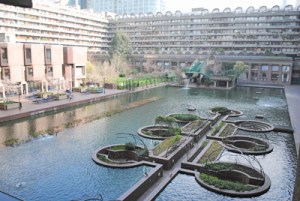
The area known as Barbican was devastated by bombing raids in World War II. Discussions on the future of the site started in 1952 and for more than 10 years plans for redeveloping the area were debated until finally, in the early 1960s, work began on what is now the Barbican Estate including three tall residential towers (part of the residential estate is pictured above). Completed in the mid 1970s, the Brutalist design of the complex, which features buildings named after historical figures associated with the area, means it meets with strong reactions from those who encounter it whether love – or hate.

Construction of the arts centre – known as the Barbican Centre – the largest performing arts centre in Europe and home to the London Symphony Orchestra – was started in the early 1970s. The £156 million centre was eventually opened by Queen Elizabeth II in 1982.

Other buildings within the Grade II listed complex include the Guildhall School of Music and Drama, the City of London School for Girls and a YMCA.

LondonLife – Hats…err, on to London’s statues…

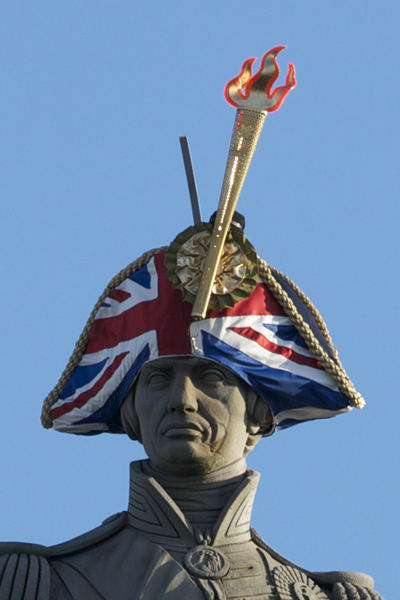
One of the stranger sights in London during this week of Olympic celebration are the many statues around the city adorned with hats – including Trafalgar Square’s iconic statue of Admiral Lord Nelson which now wears a Union Jack hat featuring a replica of the Olympic flame. Designed by Sylvia Fletcher and made by London’s oldest hatters Lock & Co, makers of Nelson’s original bicorn hat, the hat is one of 20 which has been placed upon London statues. It’s all part of Hatwalk, an initiative which aims to take visitors on a tour of the city by bringing some of its most well-known statues to life. Other statues wearing hats include those of former US President Franklin D Roosevelt and former British PM Winston Churchill in Bond Street, the Duke of Wellington near Wellington Arch, and William Shakespeare in Leicester Square. Hatwalk, which features hats designed by some of the UK’s top milliners, was commissioned by the Mayor of London, in partnership with BT, Grazia magazine, the British Fashion Council and the London 2012 Festival. The hats, which appeared on the statues yesterday, will remain on the statues for only four days before they are auctioned for charity. For more on Hatwalk and a map of where the hats are, see www.molpresents.com/hatwalk


Celebrating the Diamond Jubilee with 10 royal London locations – 8. Golden Jubilee memorials…

UPDATED: Last week we looked at some of the monuments marking Queen Elizabeth II’s Silver Jubilee in London, so this week we’re taking a look at some of the monuments marking the Queen’s Golden Jubilee celebrating what were then 50 years on the throne in 2002.

The year  was marked with celebrations, including a Golden Jubilee Weekend, not unlike that experienced in London over last weekend, which featured public concerts in Buckingham Palace gardens including the ‘Party at the Palace’ pop concert, flyovers including one by a Concorde with the Red Arrows, a National Thanksgiving Service at St Paul’s Cathedral and a Jubilee Procession down The Mall.

In addition, the celebrations included the first ever parade of all the Queen’s bodyguards – this 300 strong group featured detachments from the Gentlemen at Arms (created by King Henry VIII in 1509), the Yeoman of the Guard (created by King Henry VII in 1485) and Yeoman Warders (based at the Tower of London).

As with the Silver Jubilee, the Queen more than 70 towns in the UK and visited countries overseas including Jamaica, New Zealand, Australia and Canada.

Among the monuments in London marking the Golden Jubilee are:

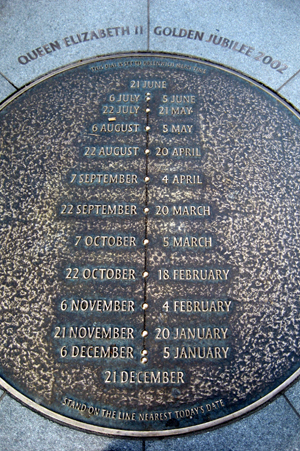
• Golden Jubilee Sundial, Old Palace Yard (pictured). Designed by Quentin Newark, this was Parliament’s gift to the Queen and was installed in 2002 as part of the yard’s revamp. The dial, which is ‘set’ to Greenwich Mean Time and can be found just outside the eastern end of Westminster Abbey, features a quote in its outer circle from William Shakespeare’s play, Henry VI, part III: “To carve out dials quaintly, point by point, thereby to see the minutes how they run: how many makes the hour full complete, how many hours brings about the day, how many days will finish up the year, how many years a mortal man may live.”

• King’s Stairs Memorial Stone, Bermondsey. This memorial stone located on the edge of King’s Stairs Gardens by the Thames in Bermondsey was first installed to mark the Queen’s Silver Jubilee. In 2002, the other side of the stone was inscribed to mark the Golden Jubilee and unveiled in the presence of the Earl and Countess of Wessex.

• Dovehouse Green, Royal Borough of Kensington and Chelsea. We omitted to mention this last week – located on an old burial ground granted by Sir Hans Sloane in 1733,  Dovehouse Green was laid out in 1977 to commemorate the Silver Jubilee and the Golden Jubilee of the Chelsea Society and was refurbished in 2002 to mark the Queen’s Golden Jubilee (it reopened in 2003).

• Great Ormond Street Hospital. Not strictly a Golden Jubilee memorial, there is a plaque close to the hospital’s main entrance which commemorates the Queen’s visit to the hospital to mark its 150th anniversary in 2002, “Her Majesty’s Golden Jubilee Year”.

• Golden Jubilee Footbridges. One memorial accidentally left off the list initially was the Golden Jubilee Bridges which run along either side of the Hungerford Bridge, between Westminster and Waterloo Bridges. The new four metre wide footbridges, which feature a particularly complex design, were named the Golden Jubilee Footbridges in honor of the Queen’s Golden Jubilee. They replaced an earlier – and somewhat notorious – footbridge which cantilevered off the side of the railway bridge.

PICTURE: Wallyg

Around London – Leicester Square reopens; RA and MOL exhibitions mark Diamond Jubilee; ‘Jed’ retires; and, the history of horses at the British Museums…

• Leicester Square officially reopened last night following a £15.3 million transformation which has seen every paving stone replaced, new plants, and 40 new water jets placed around the Grade II listed fountain and statue of William Shakespeare. The 17 month makeover also included new lighting, new seating and a refurb of the underground toilets. The square – which owes its name to Robert Sidney, the 2nd Earl of Leicester, who purchased this land in 1630 and, after building himself a mansion, kept aside part of the land for public use – now welcomes as many as 250,000 tourists a day and is known as one of the world’s premiere sites for the release of new films.

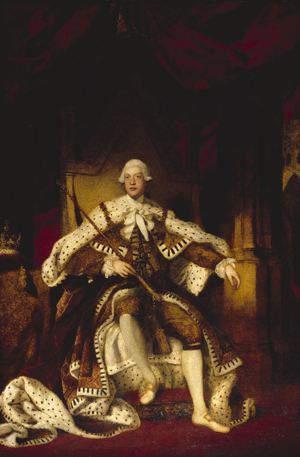
• The Royal Academy of Arts is marking the Queen’s Diamond Jubilee with a new exhibition opening tomorrow which features a selection of paintings by Royal Academicians elected during the early part of the Queen’s reign. The Queen’s Artists will include works by Jean Cooke, Frederick Gore and Ruskin Spear and will be displayed in the Reynolds and Council Rooms. Meanwhile The Saloon will house a collection of sculptures, paintings and drawings prepared by Royal Academicians for British coins and royal seals on loan from the Royal Mint Museum. The collection includes portraits of the Queen by Edward Bawden and Sir Charles Wheeler which have never before been shown in public, and Sir Anthony Caro’s new coin design of the London 2012 Olympic Games. Over in the Tennant Gallery, The King’s Artist’s George III’s Academy, will look at the king’s role in the foundation of the academy in 1768 and his influence in selecting the first artists. Highlights include portraits of King George III (pictured) and Queen Charlotte painted by the academy’s first president, Sir Joshua Reynolds. Admission charge applies. For more, see www.royalacademy.org.uk. PICTURE: Copyright Royal Academy of Arts, London/John Hammond.

• A new exhibition focusing on Londoners and their treasured souvenirs commemorating Queen Elizabeth II opens tomorrow at the Museum of London. At Home with the Queen features 12 photographic portraits of Londoners at home with their mementos as well as a selection of royal commemorative objects from the museum’s collection. The latter include trinkets produced for Queen Victoria’s Diamond Jubilee in 1897, official Coronation Day street decorations, Silver Jubilee paper tableware and souvenirs relating to the current Diamond Jubilee. Runs until 28th October. Admission is free. For more (including a series of events running on conjunction with the exhibition), see www.museumoflondon.org.uk.

The Royal Parks’ Shire horse, Jed, retired last week after a decade of service working in Richmond Park. The Queen presented a commemorative retirement rosette to Jed who was born in 1993 and joined the Royal Parks from Bass Brewery in Burton upon Trent almost 10 years ago. Horses have been used in Richmond Park since it was enclosed by King Charles I in 1637. The horses took a break in 1954 but the Shires were reintroduced in 1993 as a way to sustainably manage the parkland. For more on Richmond Park, see www.royalparks.org.uk/parks/richmond-park.

On Now: The horse: from Arabia to Royal Ascot. This major free exhibition at the British Museum is part of the august institution’s Diamond Jubilee celebrations and traces the history of the horse from domestication around 3,500 BC through to present day, with a particular focus on Britain’s equestrian tradition, from the introduction of the Arabian breed in the 18th century to events like Royal Ascot. Highlights include one of the earliest known depictions of horse and rider – a terracotta mould found in Mesopotamia dating from around 2000 to 1800 BC, a cylinder seal of Darius dating from 522 to 486 BC depicting the king hunting lions in a chariot, a 14th century Furusiyya manuscript, an Arabian manual of horsemanship, and the 19th century Abbas Pasha manuscript, the primary source of information about the lineage of purebred Arabian horses acquired by Abbas Pasha (mid-nineteenth century viceroy of Egypt). The exhibition is being held in Room 35. Runs until 30th September. For more, see www.britishmuseum.org.