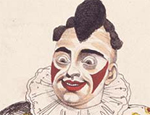
The most renowned of English clowns, Joseph Grimaldi rose to the heights of fame in early 19th century London despite a private life characterised by hardships and pain.
Grimaldi was born in Clare Market, London on 18th December, 1778, the son of actor and clown Joseph Giuseppe Grimaldi (known simply as the “Signor”), and Londoner Rebecca Brooker, a dancer who was more than 50 years younger than Grimaldi when she become one of a string of mistresses.
 Joe was groomed for the stage by his father from an early age and made his debut at Sadler’s Wells Theatre in late 1780. He was soon also working at Drury Lane Theatre, running between the two to make performances (at the same time, he did attend a theatrical academy in Putney known for educating the children of performers).
Joe’s father died when he was just nine-years-old and he became the family’s main breadwinner and while he was still able to work at both Sadler’s Wells and Drury Lane, his pay was cut after his father’s death meaning the family had to move out of their home in Holborn and into the slum of St Giles where they took lodgings in Great Wild Street.
In 1799, having met three years before, he married Maria Hughes, the eldest daughter of Richard Hughes, the proprietor of Sadler’s Wells Theatre. The newlyweds moved to a home at 37 Penton Street in Pentonville. It was not to be a long-lasting marriage – Maria died during childbirth on 18th October, 1800.
Further hardship was to come soon after when, while performing at Drury Lane Theatre, he accidentally shot himself in his foot and was forced to bed to recover. But there was a silver lining – his mother employed a dancer, Mary Bristow, to look after him during his rehabilitation and they formed a bond which led to them being married on 24th December, 1801.
After recovering from his injury, meanwhile, he had resumed his hectic schedule at London theatres as well as country venues and it was during this period that he redesigned the way in which he painted his face – adopting a white face design still used by many clowns today – and created the iconic clown which he named simply ‘Joey’.
In 1802, his only child was born – Joseph Samuel, known simply as ‘JS’ – and from the age of 18 months, he was introduced to the theatre, making his own acting debut at Sadler’s Wells in 1814.
In 1806, Joe played what is arguably his most famous roles – as both Bugle and the Clown in Thomas Dibdin’s Harlequin and Mother Goose, which opened at the Covent Garden Theatre on 29th December, 1806, and ran for the next two years.
Financial need saw him continue to take on roles in London and elsewhere but finally, in 1823, ill health – the consequence of his many years of physically abusing his body for his act – forced him into retirement. In 1828, two farewell benefit performances were held in which he had a limited role, his last was at Drury Lane on 27th June.
The last years of his life were marked with tragedy – relations which his son were strained (and they spent years estranged) before JS died on 11th December, 1832, at just the age of 30 while his wife died in 1834.
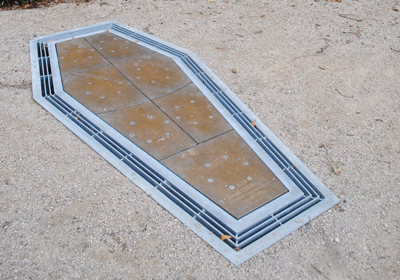
Grimaldi spent the last years of his life living alone in Southampton Street, Islington, before he was found dead in his bed by his housekeeper on 1st June, 1837. He was buried in St James’s churchyard, Pentonville, on 5th June, 1837 – the area is now Joseph Grimaldi Park and features, as well as his grave, a coffin-shaped memorial (pictured, top) that plays musical notes when danced upon (it’s apparently possible to play his signature song, Hot Codlins when “dancing upon his grave”).
Described as being the pre-eminent entertainer of his day, Grimaldi is credited with transforming the role of the Clown in pantomime and ushering in a whole new era in the art of clowning. His legacy – still remembered by clowns everywhere – received a boost when after his death, Charles Dickens edited his memoirs in 1838.
He is remembered in an annual service held on the first Sunday in February every year in Holy Trinity Church, Hackney (the Sunday just past), an event which is attended by clowns in full get-up.
For a detailed look at the life of Grimaldi, see Andrew McConnell Stott’s The Pantomime Life of Joseph Grimaldi: Laughter, Madness and the Story of Britain’s Greatest Comedian .
.
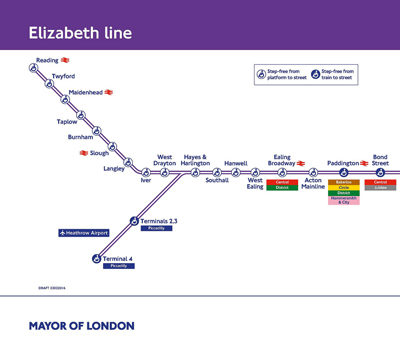
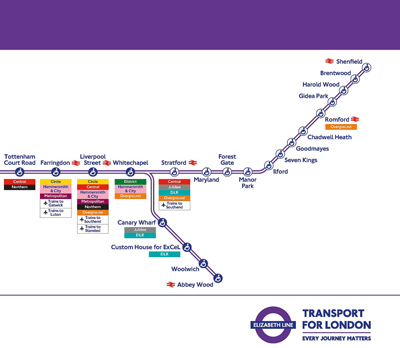
 Boris Johnson, the Mayor of London, announced last week that the new Underground line under construction in the Crossrail project will be named the Elizabeth line, in honour of Queen Elizabeth II. The Queen (pictured above with Transport Commissioner Mike Brown), who became the first ruling monarch to travel on the Underground when she did so in 1969 at the opening of the Victoria line, was on hand for a tour of the line’s Bond Street Station site and was presented with a commemorative Elizabeth line roundel. The new line, which will change the way people travel across London, stretches from Reading and Heathrow in the west to Shenfield and Abbey Wood in the east. PICTURES: © Transport for London/James O Jenkins (above).