Top 10 stories for 2014 – part 1…

Here are the first five of the top 10 stories we posted in 2014 (based on reader visits)…

Starting with number 10, they were…

10. What’s in a name?…Fetter Lane…

9. What’s in a name?…Seven Dials…  

8. London Pub Signs – The Hung, Drawn and Quartered…

7. LondonLife – Farewell to the poppies… 

6. A Moment in London’s History – When the last ‘frost fair’ was held on the Thames… 


Happy New Year!

Wishing you a very happy start to 2015! Keep an eye out over the next couple of days for our Top Posts of 2014 feature…

Merry Christmas from Exploring London!

Christmas-2014

Wishing all of Exploring London’s readers, a very Merry Christmas!


This Week in London – New Year’s Eve sold out; New Year’s Day Parade; and, National Gallery buys Corot work…

All 100,000 tickets for London’s New Year’s Eve fireworks are now booked, the Greater London Authority announced this week. They’ve advised those without a ticket to avoid the area around Embankment and South Bank on the night, saying that the best alternative view of the fireworks will be live on BBC One. Meanwhile, don’t forget the New Year’s Day Parade which will kick off in Piccadilly (near junction with Berkeley Street) from noon on New Year’s Day. The parade – which takes in Lower Regent Street, Pall Mall, Trafalgar Square and Whitehall before finishing at 3.30pm at Parliament Square in Westminster – will feature thousands of performers. Grandstand tickets are available. For more, see www.londonparade.co.uk.

The National Gallery has acquired French artist Jean-Baptiste-Camille Corot’s work, The Four Times of Day, it was announced this month. The 1858 work, acquired with the aid of the Art Fund, has something of a star-studded pedigree – it was bought by Frederic, Lord Leighton, in 1865, and the four large panels were displayed at his London home until his death. In the same family collection for more than a century after that, they have been on loan to the National Gallery since 1997. They complement 21 other paintings by Corot in the gallery’s collection. The Four Times of Day can be seen in Room 41. Entry is free. For more, see www.nationalgallery.org.uk.

Exploring London is taking a break over Christmas, so this will be the last This Week in London update until mid-January. But we’ll still be posting some of our other usual updates including our most popular posts for 2014 round-up!

LondonLife – Sir David Wilkie’s ‘A Young Woman Kneeling at a Prayer Desk’ rediscovered…

A-Young-WomanThought to be lost for more than 140 years, a painting by Scottish artist Sir David Wilkie went on display at the National Gallery off Trafalgar Square last month. A Young Woman Kneeling at a Prayer Desk was discovered in the US having previously been last heard of in 1872 when it was sold by a relative of the 1st Earl of Mulgrave, Henry Phipps, whose daughter, Lady Augusta Phipps, was thought to be the subject of the painting which dates from 1813 (she died that year at the age of just 12). While the work was known to exist thanks to it having featured in an oil sketch the artist had sent to his brother – an army officer in India, it was only recently rediscovered when spotted by London-based art dealer Ben Elwes in a catalogue advertising its sale in New York. The National Gallery says it was only able to purchase the painting thanks to late Birmingham art teacher Marcia Lay, who left a bequest to the gallery. The painting is displayed alongside masterpieces by the likes of Turner, Constable, Gainsborough and Reynolds in Room 34. For more, see www.nationalgallery.org.uk. PICTURE: David Wilkie, A Young Woman Kneeling at a Prayer Desk, 1813, © National Gallery, London.

Treasures of London – Newgate execution bell…

Contained in a glass cabinet within the walls of St Sepulchre-without-Newgate, this bell was traditionally rung 12 times outside the condemned cell in nearby Newgate Prison at midnight on the eve of an execution (ensuring, no doubt, that no-one had a good night’s sleep before their final morning). 

Execution-BellAccording to an inscription on the cabinet, the sexton of St Sepulchre – who reached the condemned cell from the church via a tunnel under the road – recited the following verse  (other sources have a longer a version thereof) while standing outside the cell:

“All you that in the condemned hole do lie,
Prepare you for tomorrow you shall die;
Watch all and pray: the hour is drawing near
That you before the Almighty must appear;
Examine well yourselves in time repent,
That you may not to eternal flames be sent.
And when St Sepulchre’s Bell in the morning tolls
The Lord above have mercy on your soul.”

The tradition of ringing the bell apparently dates from 1605 and has its origins in a bequest of £50 made by one Robert Dow(e), a prominent member of the Worshipful Company of Merchant Taylors. (Dow had apparently wanted a clergyman to be the one to ring the bell but his money didn’t stretch that far).

A rather grim piece of London’s history.

WHERE: St Sepulchre-without-Newgate, Holborn Viaduct (nearest Tube stations are St Paul’s, Blackfriars and Farringdon); WHEN: Check website for service times; COST: Free; WEBSITE: www.stsepulchres.org

This Week in London – Hampton Court Palace lights up; doll house histories; more on Christmas; and, memories of a royal progress at The Queen’s Gallery…

Hampton Court Palace’s world famous gardens have been transformed into an “illuminated wonderland” which can be explored using a specially created trail. From tomorrow, visitors can use a glow-in-the-dark map to follow the trail which starts at the palace’s hedge maze – the UK’s oldest – and meanders through various locations around the grounds – including the formal gardens – before ending up at the palace’s East Front where, through the use of interactive technology, visitors can ‘paint’ the building’s facade just by moving around. Allow about an hour. Entry is timed between 5pm and 8pm. Runs until 23rd December. Admission charge applies. For more, see www.hrp.org.uk/HamptonCourtPalace/.

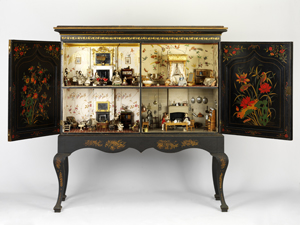
Killer_Cabinet_1840sThe stories behind some of the UK’s best-known dolls’ houses are the focus of a new exhibition which opens at the V&A Museum of Childhood in Bethnal Green on Saturday. Small Stories: At home in a dolls’ house tells the story of 12 dolls’ houses dating as far back as 300 years. Each of the houses – which are displayed chronologically – has been set up to represent a particular time of day and, using interactive technology, tells the story of those who live and work in the building in a series of stories featuring marriages, parties, politics and even crimes. Highlights include: the Tate Baby House – dating from 1760, it features original wallpapers and painted panelling in the style of Robert Adam; the Killer House (pictured) – a gift from surgeon John Egerton Killer to his wife and daughters in the 1830s, this Chinese-style cabinet has gilded wallpapers, a four poster bed and liveried servants; Whiteladies House – a Modernist country villa designed by artist Moray Thomas and built in the 1930s; the Hopkinson House – based on the homes built in the 1930s in the London County Council suburb, the St Helier Estate; and, the Kaleidoscope House – designed by Laurie Simmons to suit a “design conscious step-family living in the new millennium”. There’s a further 20 dolls’ houses, dating from 1673 to 2014, on display in the museum’s permanent galleries (just some of the more than 100 in the museum’s collection). Admission is free. Runs until 6th September, 2015. For more, see www.museumofchildhood.org.uk. PICTURE: Victoria and Albert Museum, London.

The V&A has unveiled its 2014 Christmas Tree at the grand entrance to its South Kensington building. Designed by Gareth Pugh, Ceremony stands at more than four metres in height and, along with a shape not unlike a traditional Christmas tree, features nine tiered gold pyramids located around a central beacon of light to represent the nativity. For more, see www.vam.ac.uk/content/articles/c/christmas-tree-installation-by-gareth-pugh/Meanwhile Winter Wonderland continues to entertain in Hyde Park with rides, markets, ice-skating and all the usual attractions. Open 10am to 10pm every day until 4th January (closed on Christmas Day). For more, see www.hydeparkwinterwonderland.com.

On Now: Cairo to Constantinople: Early Photographs of the Middle East. This exhibition at The Queen’s Gallery, Buckingham Palace, features objects collected by the 20-year-old Prince of Wales, Albert Edward (later King Edward VII), during an educational tour of the Middle East in 1862. The display, which also features photographs taken by Francis Bedford – the first photographer to join a royal tour, follows the prince as he progresses through Egypt, Palestine and the Holy Land, Syria, Lebanon, Turkey and Greece. The exhibition is being show alongside Gold, a display of 50 gold items drawn from the Royal Collection. They include the Rillaton Cup, found in a Bronze Age burial dating from between 1700 and 1500 BC, a gold crown from Ecuador that predates the Incas, and an 18th century tiger’s head made from gold and rock crystal and taken from the throne of the Tipu Sultan of Mysore in India. Both run until 22nd February. Admission charge applies. For more, see www.royalcollection.org.uk.

Send all items for inclusion to exploringlondon@gmail.com.

LondonLife – Oliver Cromwell’s coffin plate goes to auction…

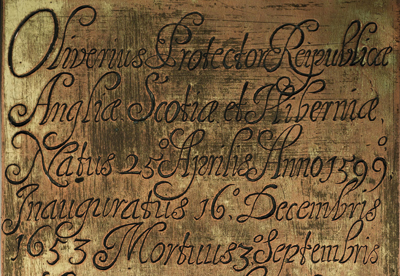
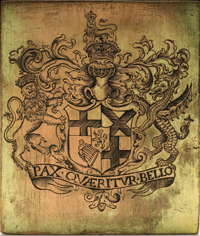
Coffin-Plate-(i)The copper gilt plate found on former Lord Protector Oliver Cromwell’s breast when his body was exhumed will be put up to auction in London later today. Sotheby’s says that according to contemporary reports, the plate was found in a leaden canister lying on Cromwell’s chest when the coffin – interred in Coffin-Plate-(ii)the Henry VII Chapel in Westminster Abbey – was opened by James Norfolke, Serjeant of the House of Commons, on the orders of parliament on 26th January, 1661 – just two years from Cromwell was buried. Norfolke apparently took the plate which was subsequently handed down through his family. It was not the only relic associated with Cromwell to survive – while Cromwell’s body, along with that of regicides Henry Ireton and John Bradshaw, was hanged at Tyburn and then apparently buried in an unmarked grave pit, his head was placed on a spike above Westminster Hall and remained there for more than 20 years until it blew down in a gale and was taken by a guard. It apparently subsequently passed through numerous private hands before, in 1960, it was interred in a secret location in the chapel of Sidney Sussex College in Cambridge. Meanwhile, the plate – which bears the arms of the Protectorate on one side and an inscription in Latin with the dates of Cromwell’s birth, inauguration as Lord Protector and death on the other – is listed with an estimated price of between £8,000 and £12,000. For more on the item, see www.sothebys.com/en/auctions/ecatalogue/2014/english-literature-history-childrens-books-illustrations-l14408/lot.3.html.

Famous Londoners – Dr Richard Mead…

Eighteenth century physician Dr Richard Mead is noted not only for his attendance on the rich and famous of his time – including royalty – but also for his philanthropy, his expansive collections and, importantly, his contributions in the field of medicine.

Born in Stepney, London, on the 11th August, 1673, as the 11th of 13 children of nonconforming minister Matthew Mead, Mead studied both Utrecht and Leiden before receiving his MD in Italy. Returning to England in 1696, he founded his own medical practice in Stepney.

He married Ruth Marsh in 1699 and together the couple had at least eight children, several of whom died young, before her death in 1720 (he subsequently married again, this time to Anne, daughter of a Bedfordshire knight, Sir Rowland Alston).

Having published the then seminal text – A Mechanical Account of Poisons – in 1702, the following year Mead was admitted to the Royal Society. He also took up a post as a physician at St Thomas’ Hospital, a job which saw him move to a property in Crutched Friars in the City – his home until 1711, when he relocated to Austin Friars.

It was after this that he become friends with eminent physician John Radcliffe who chose Mead as his successor and, on his death in 1714, bequeathed him his practice and his Bloomsbury home (not to mention his gold-topped cane, now on display at the Foundling Museum – see note below).

Following Radcliffe’s death, in August of that year Dr Mead attended Queen Anne on her deathbed. Other distinguished patients over his career included King George I, his son Prince George and daughter-in-law Princess Caroline – in fact he was appointed as official physician to the former prince when elevated to the throne as King George II – as well as Sir Isaac Newton, lexicographer Dr Samuel Johnson, Alexander Pope, Sir Robert Walpole and painter Antoine Watteau.

Mead, who had been named a governor of St Thomas’ in 1715 and elected a fellow of the Royal College of Physicians in 1716, was over the years recognised as an expert in a range of medical fields – including, as well as poisons, smallpox, scurvy and even the transmission of the plague.

Among the many more curious stories about Dr Mead is one concerning a ‘duel’ (or fistfight) he apparently fought with rival Dr John Woodward outside Gresham College in 1719 over their differences in tackling smallpox and others which concern experiments he conducted with venomous snakes to further his knowledge of venom before writing his text on poisons.

Dr Mead was also known for his philanthropy and became one of the founding governors of the Foundling Hospital (as well as being its medical advisor) – a portrait of him by artist Allan Ramsay (for whom he was a patron), currently hangs at the museum.

Dr Mead, who by this stage lived in Great Ormond Street in Bloomsbury (the property, which backed onto the grounds of the Foundling Museum and which Mead had moved into after his first wife’s death, later formed the basis of the Great Ormond Street Hospital for Children), is also noted for the large collection he gathered of paintings – including works by Dürer, Holbein, Rembrandt, and Canaletto, a library of more than 10,000 books, antiquities and classical sculpture as well as coins and jewels, all of which scholars and artists could access at his home (it took some 56 days to sell it all after his death).

While Dr Mead – who died on 16th February, 1754 – was buried in the Temple Church, there is a monument to him – including a bust by Peter Scheemakers – in the north aisle of Westminster Abbey.

Dr Mead is currently being honoured in an exhibition at the Foundling Museum – The Generous Georgian: Dr Richard Meadwhich runs until 4th January. There’s an accompanying blog here which provides more information on his life and legacy.
This Week in London – Christmas celebrations; photographic history on show; and, architects as artists…

Events celebrating Christmas continue to make our post this week. Sunday will see the annual ‘Blessing of the Crib’ – featuring a torch-lit procession on the steps of St Martin-in-the-Fields before the crib is blessed in Trafalgar Square – while on Monday carol singers will kick off their annual program of carolling in the square. More than 50 carol groups are taking part in the singing this year, which takes place from 4pm to 8pm on weeknights and 2pm to 6pm on weekends and runs until 23rd December.  For more on the blessing, see www.stmartin-in-the-fields.org and for more on the carolling in Trafalgar Square and other Christmas events in the city, see www.london.gov.uk/events.

A showcase of works from the Royal Photographic Society Collection has gone on show at the Science Museum’s Media Space. The images include some of the earliest known photographic pictures – dating from the 1820s, they are the work of pioneers like Roger Fenton, William Henry Fox Talbot and Julia Margaret Cameron – alongside contemporary works by the likes of influential modern figures such as Don McMullin, Terry O’Neill and Martin Parr. The exhibition also features artefacts from the history of the craft, such as Niepce’s heliographs, Fox Talbot’s experimental cameras and The Pencil of Nature – the first commercially published book to be illustrated by photographs. Masters of Light: Treasures from the Royal Photographic Society Collection, presented in collaboration with the Reiss-Engelhorn Museen in Mannheim, Germany, runs at the South Kensington institution until 1st March. Admission charge applies. For more, see www.sciencemuseum.org.uk/mastersoflight.

On Now: Architects as Artists. This exhibition, marking the 10th anniversary of the partnership between the V&A and RIBA, examines the relationship between architecture and art and features about 50 works from the collections of the V&A and RIBA. They include everything from a drawing by Raphael of the Pantheon in Rome to a lithograph by Cyril Power depicting staircase in Russell Square tube station and a volume of architectural fantasies by the Russian architect Iakov Chernikhov. Held in the V&A + RIBA Architecture Gallery Room at the V&A in South Kensington, it runs until 15th March. Admission is free. For more, see www.vam.ac.uk/architecture.

Send items to inclusion to exploringlondon@gmail.com.

8 structures from the London that never was – 5. Sir Joseph Paxton’s Great Victorian Way…

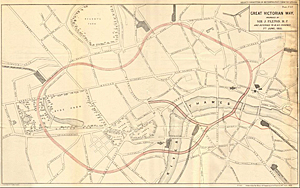
Fresh from the success of designing The Crystal Palace for the Great Exhibition of 1851 (see our earlier post here), in 1855 Sir Joseph Paxton came up with the idea of building a covered elevated railway “girdle” which would circle parts of central and west London and alleviate traffic congestion.

Great-Victorian-WayThe proposed 10 mile long, eight track railway – which would feature trains propelled by air pressure (an “atmospheric” system) rather than conventional steam engines and included  “express” trains which would only stop at select stations – was to be constructed inside a vast, 108 foot high glass covered arcade which would also contain a road, shopping and even housing.

The trains would travel at such a speed that to get from any one point on the “girdle” to its opposite point would only take 15 minutes.

Paxton presented his proposal to a Parliamentary Select Committee in June 1855 – he had already shown it to Prince Albert whom, he said, “gives it his approval”.

He estimated the cost of his proposal – which he thought would carry some 105,000 passengers every day – at some £34 million – a figure which parliament, which had initially been supportive of the idea, found a little hard to stomach.

This was especially thanks to the fact they were already dealing with the costs of Sir Joseph Bazalgette’s vast sewer system (see our earlier post here), created as a result of the ‘Great Stink’ in 1858 when the smell of untreated human excrement and other waste in the Thames became so strong, parliament had to act.

As a result, the project – which would have crossed the Thames three times, once with a spur line that ended near Piccadilly Circus – never eventuated but the Underground’s Circle Line today follows roughly the same route Paxton’s railway would have.

LondonLife – Thames life…


Thameslife


What’s in a name?…Holborn…

Prudential-Assurance-Building

The origins of the name of this part of central London, to the west of the City, lie in the fact that the Fleet River runs through the area (albeit, since the 18th century, underground).

Mentioned as far back as the 950s, the name Holborn comes from the Old English “hol” or “holh” (“hollow”) and “burne” or “bourne” (“stream”) and means the “stream in the hollow” with the hollow in this case being the valley over which the Holborn Viaduct was built in the 1860s.

The term ‘Holburne’ was either used to refer to a tributary of the Fleet or part of the river itself. There was a bridge which apparently bore the same name and spanned either the Fleet or its tributary up until the river was covered.

The street now known as High Holborn – the main street in the area – was originally a Roman road and by the 19th century had become a centre for the entertainment industry featuring theatres, restaurants and pubs (including one of our favorites, the Cittee of Yorke).

The street is also home to the Holborn Bar, which marked the boundary of the City of London and was once site of a toll gate – it’s now the site of the Royal Fusilier’s War Memorial.

Other famous monuments in the area include an equestrian statue of Prince Albert – the City of London’s official statue of him – which was removed from its position in the centre of Holborn Circus in the east of the area to a new position on the western side of the intersection during a renovation last year.

Now dominated by offices and some shopping precincts (these include a street market in Leather Lane), among other notable buildings are pre-Great Fire of London survivor Staple Inn (see our earlier post here), churches including St Andrew Holborn, and St Alban the Martyr, Holborn, and, to the east, St Etheldreda’s Church (see our earlier post here) and Ye Olde Mitre pub (see our earlier post here).

The area is also home to the Inns of Court Lincoln’s Inn and Gray’s Inn and the Grade II*-listed Prudential Assurance Building (pictured above), constructed on the former site of Furnival’s Inn in the late 19th century/early 20th century, as well as Hatton Garden, famous for being the centre of London’s jewellery trade.

Lost London – Alsatia…

A Thames-side slum area located between Temple and Whitefriars Street (and south of Fleet Street), an area previously occupied by the Whitefriars Monastery, Alsatia was known as something of a lawless district where residents resisted any intervention by City officials.

The district came into existence following the dissolution of the monastery by King Henry VIII (he apparently gave the buildings and land to his physician Dr William Butts) and the area, despite some initial efforts to build substantial houses there, eventually degenerated into an overcrowded slum (apparently even when the priory was still existent, some of the surrounding areas had been somewhat disreputable).

The right of sanctuary apparently existed in the area which meant that debtors and criminals who entered gained immunity from arrest while they remained here.

Authorities were certainly loathe to enter the district given the strength which residents showed in resisting any attempts to grab hold of wanted persons and the maze-like narrow thoroughfares of the area and it became mockingly referred to as Alsatia in a reference to Alsace, a much disputed region on the French-German border which was historically outside normal legal jurisdiction.

Among those who took refuge here was Daniel Defoe – he is said to escaped here in 1692 after he was wanted by authorities for writing seditious material.

There were several attempts to clean up the slum but these had little effect (although the Great Fire of London did burn through here in 1666) and in 1608, King James I confirmed the area’s liberties in a formal charter. The rights remained in place until 1697 when they were abolished by an Act of Parliament (along with those of other liberties), although the area maintained its disreputable character for some time after.

Alsatia was mentioned in several books including in Thomas Shadwell’s 1688 play The Square of Alsatia and Sir Walter Scott’s 1822 novel, The Fortunes of Nigel, and the term continued to be used to refer to run-down neighbourhoods until late in the 19th century.

This Week in London – Italian Cast Court reopens at V&A; Christmas Past at the Geffrye; and, last call for NYE celebrations…

Weston-Cast-CourtThe V&A’s spectacular Italian Cast Court will reopen on Saturday after the completion of the first phase in the museum’s programme of renovating its day-lit courts. The Italian court, which has been renamed the Weston Cast Court, features more than 60  19th century reproductions of Italian Renaissance monuments including a five metre high cast of Michelangelo’s David, a cast of the massive Gates of Paradise from Florence Cathedral, a plaster cast of a pulpit from Pisa Cathedral and a monumental cast of Jacopo della Quercia’s great arch from the Basilica of San Petronio in Bologna. The displays have been reconfigured with a new interpretation following extensive examination and preservation of the collection during the gallery’s renovation. The two cast courts at the South Kensington-based museum first opened in 1873. Entry is free. For more, see www.vam.ac.uk. PICTURE: © Victoria and Albert Museum.

The annual ‘Christmas Past’ exhibition – in which 11 period rooms have been decorated in period style for the Christmas season – opened at the Geffrye Museum in Shoreditch this week. Along with the chance to see how Christmas looked in bygone years, there’s a series of Christmas-themed events including “A Georgian Christmas” on 4th December, “festive food” in the cafe and Christmas gifts to stuff your stocking with.  Entry to the museum is free. Christmas Past runs until 4th January. For more, see www.geffrye-museum.org.uk.

We’ve mentioned it already but London’s public New Year’s Eve celebration – featuring its spectacular fireworks and lighting display – will this year be a ticketed event and the final tickets will be released during the first couple of weeks in December. A batch of new tickets will be released at noon each day from the 1st to 15th December. Those wishing to snag a ticket – and you can book up to four with a £10 administration fee payable for each – need to head to www.london.gov.uk/nye. Meanwhile the city is gearing up for Christmas and, in the wake of the Christmas lights getting turned on all across the metropolis, comes the annual lighting of the Christmas Tree in Trafalgar Square. The tree – a gift from the citizens of Oslo as a token of London’s support for them during World War II – takes place next Thursday (4th December) at 6pm (more on further Christmas events next week).

Send all items for inclusion to exploringlondon@gmail.com.

Apologies that the headline originally had a mis-spelling of the Geffrye Museum (auto-correct run amok!)

8 structures from the London that never was – 4. Whitehall Palace (remodelled)…

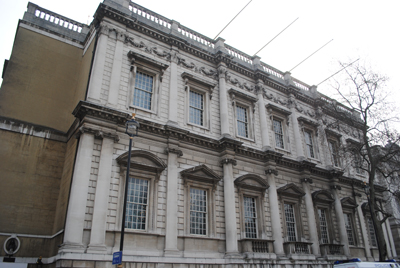
Banqueting-House

Still on designs for royal palaces and today we’re looking at two designs for the same palace. Both Inigo Jones (1573-1652) and Sir Christopher Wren (1632-1723) drew up designs for the remodelling and expansion of Whitehall Palace.

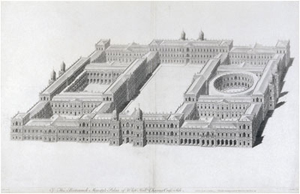
Inigo-Jones-proposalFirst up was the neo-classical architect Jones who drew up plans for a vast complex of buildings (pictured left) which would replace the Tudor palace King Henry VIII had created when he transformed the grand house formerly known as York Place into a residence suitable for a king (York Place had previously been a residence of Cardinal Thomas Wolsey and prior to that, the London residence of the Archbishops of York).

Jones’ complex – which apparently featured seven internal courts – covered much of what is now known as Whitehall as well as neighbouring St James’s Park with a magnificent River Thames frontage.

The first part of Jones’ grand scheme – the Banqueting House (see our earlier post here) – opened in 1622. It still survives today – pictured above – and gives a taste of the grandeur of his overall scheme.

Yet, despite the eagerness of King James I for the project, it failed to materialise. English Heritage chief executive Simon Thurley told the BBC in 2012 that the hall represented only five per cent of what Jones had planned.

King James I died in 1625 and his son King Charles I was apparently keen to continue the project – so much so that Jones submitted new plans in 1638 – but he didn’t find the funds the project needed (and, of course, as we know, then became consumed by the events of the Civil War before being beheaded outside the Banqueting House in 1649).

Following the Restoration, in the 1660s King Charles II apparently had Sir Christopher Wren quietly draw up plans to redevelop the palace but these weren’t follow through on although during the reign of King James II he did work on several projects at the palace including a new range of royal riverside apartments, terrace (remains of which can still be seen) and a chapel.

In 1698, much of the bloated Whitehall Palace – then the largest palace in Europe with more than 1,500 rooms – burnt down although the Banqueting House, though damaged, survived basically intact (in fact there’s an interesting anecdote, its veracity questionable, which has it that on hearing of the fire Wren rushed to the site and had an adjacent building blown up to create a firebreak and ensure the Banqueting House was saved).

The then king, King William III, approached Wren and he again submitted plans for its rebuilding (prior to the fire, he had already worked on several aspects of the palace including a new range of royal apartments and a chapel for King James II).

But Wren’s plans – images show a grand domed building – were largely never realised (although he did convert the Banqueting House into a chapel) and the destroyed palace never rebuilt (no doubt in large part due to the fact that King William III preferred a more rural and less damp location – such as that of Kensington Palace – thanks to his asthma).

For more on the history of the Palace of Whitehall, see Simon Thurley’s Whitehall Palace: The Official Illustrated History.

London Pub Signs – The Gladstone Arms…

GladstoneThis Borough pub is, of course, named after the 19th century Prime Minister, William Gladstone, who not only served in the office four times but also lends his name to the ‘Gladstone bag’.

Such was the renown of Gladstone – who served as PM in stints between 1868 to 1894 (he resigned the final time at the ripe old age of 84, dying just over four years later) – that his name also adorns monuments, parks, streets and geographic features around the world as well as his fair share of pubs (including the William Gladstone in the heart of Liverpool).

Gladstone is recalled in the pub’s name but also in a large images of his face adorning the external walls.

The pub is located at 64 Lant Street (the street is famous for being where Charles Dickens lodged while his father was imprisoned in nearby Marshalsea Prison), less than a minutes walk from the Tube station.

Along with food and a pint, ‘The Glad’ these days offers live music several nights a week and boasts a long list of names – some you’ll know, some you won’t – have played there. For more on the pub, check out www.thegladpub.com.

Treasures of London – Queen Caroline’s Temple…

Queen-Caroline's-Temple

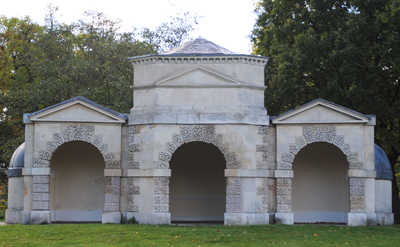
Located in Kensington Gardens, this neo-classical summer house was designed by William Kent for Queen Caroline (who was responsible for much of the shape of the gardens as they are now).

Standing amid naturalistic plantings overlooking the Long Water (which was among the features created at the order of Queen Caroline – consort of King George II), it was built in 1734-35 and designed to be glimpsed down one of the avenues of trees which radiated out from the Round Pond in front of Kensington Palace.

The Grade II-listed ‘temple’, which features graffiti inside dating back until 1821, was later converted to a park keeper’s home but restored to its use as a summer house in 1976.

Kent apparently also designed a second summer house for Kensington Gardens which revolved – it stood on a 13 metre high mound constructed by Kent’s predecessor Charles Bridgeman using spoil from the excavation of the Serpentine in the south-eastern corner of the gardens (the summer house was later demolished and the mound levelled).

Not the most prominent feature of the gardens but like the much later Princess Caroline’s Bath in Greenwich Park (see our earlier post here), it does have an important royal connection and is worthy of a stop when visiting the gardens.

WHERE: Kensington Gardens (nearest tube stations are that of Queensway, Bayswater, Lancaster Gate, South Kensington, Gloucester Road and Kensington High Street); WHEN: 6am to dusk; COST: Free; WEBSITE: www.royalparks.org.uk/parks/kensington-gardens.

This Week in London – New gallery at Hampton Court; Northwest Passage explorers remembered; and, celebrating Churchill’s birthday…

A new gallery opens today in the restored Cumberland Suite at Hampton Court Palace. The Gothic Revival suite of rooms, designed by William Kent for William Augustus, Duke of Cumberland and the youngest son of King George II, were the last major royal commission ever undertaken at the palace. They will now house a selection of the Royal Collection’s finest paintings including masterpieces by Holbein, Van Dyck, Rembrandt, Caravaggio, Bassano and Gainsborough. The restoration followed two years of research aimed at returning the rooms to a state which as closely as possible represents Kent’s original decorative scheme. One of the rooms – the duke’s large light closet – is being opened to the public for the first time in 25 years and will house 12 of Canaletto’s smaller Grand Canal views of Venice. Admission charge applies. For more, see www.hrp.org.uk/HamptonCourtPalace/.

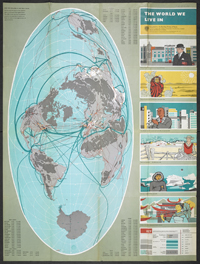
Map• The exploration of the Northwest Passage is the subject of a new exhibition which has opened at the British Library in King’s Cross. Lines in the Ice: Seeking the Northwest Passage looks back over 400 years with exhibits including King Charles II’s personal atlas, 19th century woodcut illustrations and wooden maps made by Inuit communities, and artefacts related to three of the most eminent explorer to seek out the Northwest Passage – Martin Frobisher, Sir John Franklin and Roald Amundsen, the first man to reach the South Pole. The exhibition has opened just weeks after the discovery of the HMS Erebus, one of Sir John Franklin’s lost ships. There’s a full programme of events to accompany the exhibition. Runs until 29th March. Admission is free. For more, see www.bl.uk. PICTURE: The world we live in, c. 1958, on display in Lines in the Ice. Courtesy of British Library.

Celebrate Winston Churchill’s birthday at a special after-hours event in the Churchill War Rooms in Whitehall next week. Advance booking is required to buy tickets for the event which will include a silent disco, drink tasting workshops and the chance to strike your best Churchill pose in a special photo booth. The event runs on the evening of 27th November. To book, head to www.iwm.org.uk/events/churchill-war-rooms/lates-at-churchill-war-rooms-churchill-s-birthday.

 Send all items for inclusion to exploringlondon@gmail.com.

8 structures from the London that never was – 3. Sir John Soane’s royal palace…

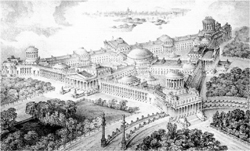
Prolific early 19th century architect Sir John Soane designed many public buildings in London including, famously, the Bank of England (since considerably altered) and the somewhat revolutionary Dulwich Picture Gallery. He also designed a number that were merely fanciful works and never commissioned nor constructed.

Royal-PalaceForemost among them was a sprawling royal palace which would occupy part of Green Park off Constitution Hill.

While Soane had been designing royal palaces as far back as the late 1770s when in Rome on his Grand Tour, in 1821 he designed one, apparently as a new home for the newly crowned King George IV.

Birds-eye view drawings show a triangular-shaped palace with grand porticoes at each of the three corners as well as in the middle of each of the three sides. Three internal courtyards surround a large central dome.

Despite Soane’s hopes for a royal commission, the king appointed John Nash to the job of official architect and so Soane’s palace never went any further than the drawing board.

He also designed a grand gateway marking the entrance to London at Kensington Gore through which the monarch would travel when heading to the State Opening of Parliament in Westminster – it, too, was never realised.

 PICTURE: Wikipedia