This Week in London – The ‘William Charter’ on show; Donald Trump in London; and the Fourth Plinth shortlist…

A charter granted by King William the Conqueror to the City of London in 1067 is on display at the City of London Heritage Gallery. The 950-year-old charter, known as the William Charter, was given by the king soon after his coronation at Westminster Abbey but before he had entered the City and is seen as key in his winning the support of the City as well as in how the City came to have its special autonomy. Written in Old English, the charter measures only 2 x 16 centimetres and has one of the earliest seal impressions of King William I. The oldest item in the City of London Corporation’s 100 kilometres of archives, it’s on display at the gallery until 27th April. For more, follow this link.

Madame Tussauds in Marylebone has unveiled a wax figure of US President-elect Donald J Trump this week in the lead-up to his inauguration in Washington, DC, on Friday. The future president stands in the ‘Oval Office’ section of the display. The organisation’s team of sculptors, make-up artists and hair inserters have been working on the figure since his victory in the US election back in October. For more, see www.madametussauds.com/london/en/.

• A scoop of ice-cream with a visiting fly and micro-drone, a recreation of an ancient sculpture destroyed by the so-called Islamic State and a tower made of a VW, scaffolding, oil drums and a ladder among the possibilities to replace David Shrigley’s Really Good on Trafalgar Square’s Fourth Plinth next year. Maquettes of five short-listed sculptures are on show at the National Gallery from today until 26th March. Two of those displayed will be chosen to be featured on the plinth – one next year and the other in 2020. Admission is free. As well as Heather Phillipson’s The End, Michael Rakowitz’s The Invisible Enemy Should Not Exist, and Damián Ortega’s High Way, the short-listed works include Huma Bhabha’s Untitled (a massive figure like something from a sci-fi film) and Raqs Media Collective’s The Emperor’s Old Clothes (an empty robe).

Send all items for inclusion to exploringlondon@gmail.com.
Lost London – Pasqua Rosee’s Coffee House…

The first coffee house to be located in London, this premises was opened by a Greek, Pasqua Rosée, in 1652 and is believed to have been located in St Michael’s Alley off Cornhill.

st-michaels-alleyRosée had come to England as the manservant of Daniel Edwards, a member of the Levant Company who had first encountered him in Smyrna (in modern Turkey) and returned with him. One story says that Rosée decided to start the business after a falling out with Edwards on their return to England; another that Edwards helped Rosée start the business when they realised the interest people had in trying the new drink.

The establishment, which was originally located in a shed in the churchyard of St Michael’s Cornhill, was advertised by a sign which was apparently a portrait of Rosée – hence the name ‘The Sign of Pasqua Rosee’s Head’ – but it was also referred to as ‘The Turk’s Head’. Such was its success that Rosée was apparently selling up to 600 dishes of coffee a day.

Not everyone, however, was a fan of Rosée’s business – in particular tavern owners who saw it as a threat to their own – and aware of his status as an outsider, he is said to have decided to forge a partnership with a freeman of the City of London so there could be no dispute over his right to trade. He found just such a partner in a grocer, Christopher Bowman, in 1654.

The business was relocated following the creation of their partnership across the alley out of the shed and into a rather ruinous house but the new lease was signed only by Bowman. There is a suggestion that Rosée had to flee for some misdemeanour but for whatever reason, his name is no longer mentioned and Bowman was now apparently the sole owner of the business.

Despite the change of ownership, the business continued to trade under Rosée’s sign and it is said to have been Bowman who authored the handbill The Vertue of the Coffee Drink (sic) – an advertising document which credits its creation to Rosée and is filled with some rather dubious claims about the miraculous powers of the drink.

Notable visitors included Samuel Pepys who visited the famous coffee house in 1660, mentioning it in his famous diary.

Bowman apparently died in 1662 and the business went into decline before any trace of it was wiped away in the conflagration of the Great Fire of 1666. The Jamaica Wine House, which features a blue plaque to Rosée’s coffee house apparently erected by the Corporation of London in 1952, now stands near the site Rosée’s original shed.

PICTURE: View down St Michael’s Alley with the church on the left looking toward’s the Jamaica Wine House. © Copyright Paul Collins/CC BY-SA 2.0

Exploring London’s most popular posts for 2016 (part II)…

And so here are the five most popular new articles we published in 2016…

5. LondonLife – New Underground line named in honour of Queen Elizabeth II…

4. This Week in London – Norway on show at Dulwich; Bruegel the Elder at the Courtauld; and, Kew Gardens celebrates the orchid… 

3. A Moment in London’s History – Sir Walter Raleigh leaves the Tower… 

2. Lost London – The King’s Mews at Charing Cross…

1. (10) iconic London film locations…1. Mary Poppins and feeding the birds at St Paul’s Cathedral… 

A Moment in London’s History – Sir Henry Cole sends Christmas cards…

The practice of sending Christmas cards really began in the Victoria era and it was in London, in 1843, that the first commercial Christmas cards are widely said to have been designed and printed.

first-christmas-cardThe idea had come from Sir Henry Cole, the first director of the Victoria and Albert Museum, who, overwhelmed with the volume of correspondence he was receiving, conceived it as answer to his problem, allowing him to send Christmas greetings to a wide group of people – all at once.

He asked his friend, artist John Callcott Horsley, to design the card and an edition of 1,000 were printed by Jobbins of Warwick Court in Holborn.

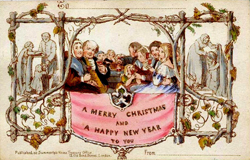
The hand-coloured card, published by Summerley’s Home Treasury Office in Old Bond Street, showed a family gathered for a Christmas celebration with two side images showing people engaged in charitable acts and a message, ‘A Merry Christmas and a Happy New Year to You’. Designed as a single flat card (not foldable like they are today), it came complete with ‘To’ and ‘From’ spaces for the sender to fill in.

The cards which Sir Henry didn’t need for his personal use were placed on sale for a shilling each but it was a fairly steep price and that – and the fact that the image of people drinking at the festive season apparently roused the ire of temperance campaigners, helped to ensure the cards weren’t an immediate success.

Nonetheless, further cards were produced in the following years and within a couple of decades, they were being mass produced.

One of Sir Henry’s original cards was reportedly sold at an auction in 2013 for £22,000.

This Week in London – Marie Duval explored; Christmas in Trafalgar Square and at Dulwich; and, Australian Impressionists at The National Gallery…

The life and work of 19th century London actress, cartoonist and illustrator Marie Duval is the subject of a new exhibition which opens at the Guildhall Library in the City tomorrow. Marie Duval: Laughter in the First Age of Leisure is the first one solely dedicated to Duval’s work (her real name was Isabelle Émilie de Tessier) as a 19th century pioneer of the art of comics. Her work first appeared in a range of cheap British ‘penny papers’ and comics of the 1860s to 1880s aimed at working class people. The exhibition has been produced by the University of Chester in partnership with the library and with the support of the British Library.

Carol singing has kicked off in Trafalgar Square to mark the Christmas season. More than 40 groups are taking part in the sessions – free to watch – which take place between 4pm and 8pm on weekdays and from 2pm on weekends until 23rd December. The square is also home to a traditional Norwegian spruce Christmas Tree which has, as has been the case every year since 1947, been brought from forest near Oslo in thanks for Britain’s support of Norway during World War II. For more, see www.london.gov.uk/events.

The Dulwich Picture Gallery’s Christmas festival – featuring the ‘Winterlights’ lights trail, artisan Christmas market, pop-up carollers and other entertainments – has opened at the south London gallery. This year’s festivities also include two contemporary baroque-inspired Christmas trees by 3D art specialists, Nagual Creations, and visitors also have the chance to create their own festive family photo using a specially commissioned giant gold frame in the grounds as well as listen to Christmas story-telling in the gallery’s Keeper’s Cottage. The Winterlights display runs from 6pm to 10pm until 18th December (excluding Mondays; admission charges apply) with the market, featuring 50 stalls, held over the next two weekends – 10th-11th December and 17th-18th December (entry is free). For more, see www.dulwichpicturegallery.org.uk.

The first UK exhibition to focus on Australian impressionist paintings has opened at The National Gallery. Australia’s Impressionists features 41 paintings including some never shown before in the UK and explores the impact of European Impressionism on Australian painting of the 1880s and 1890s with a particular focus on four artists: Tom Roberts, Arthur Streeton, Charles Conder and John Russell. The exhibition is organised into three sections: the first looking at the landmark 1889 9 by 5 Impression Exhibition held in Melbourne, the second looking at the role of Australian Impressionism in the forging of a national identity, and the third looking at the work and influence of John Russell. The exhibition can be seen in the Sunley Room until 26th March. Entry is free. For more, see www.nationalgallery.org.uk.

Where’s London’s oldest…public clock (with a minute hand)?

st-dunstans-clock

We reintroduce an old favourite this month with our first ‘Where’s London’s oldest’ in a few years. And to kick it off, we’re looking at one of London’s oldest public clocks.

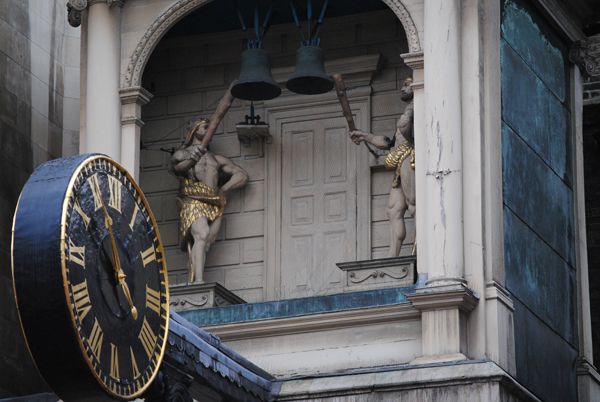
Hanging off the facade of the church of St Dunstan-in-the-West in Fleet Street is a clock which is believed to have been the first public clock to be erected in London which bears a minute hand.

The work of clockmaker Thomas Harris, the clock was first installed on the medieval church in 1671 – it has been suggested it was commissioned to celebrate the church’s survival during the Great Fire of London and was installed to replace an earlier clock which had been scorched in the fire. Its design was apparently inspired by a clock which had once been on Old St Paul’s Cathedral and was destroyed in the fire.

Like the clock it replaced, this clock sat in brackets and projected out into Fleet Street which meant it was able to be seen from a fair distance away (and being double-sided meant the black dials could be seen from both the east and the west). Like the Roman numerals that decorate it, the two hands, including the famous minute hand, are gold.

To the rear and above the clock dials are located the bells and striking mechanism. The bells are struck on the hours and the quarters by ‘automata’ – Herculean figures, perhaps representing Gog and Magog (although to most they were traditionally simply known as the ‘Giants of St Dunstan’s’), who do so using clubs and turn their heads.

Such was the attention these figures attracted that when the clock was first installed the area became notorious for pick-pockets who apparently went to work on unsuspecting passersby who had stopped to watch the giants at work.

This church was demolished in the early 1800s to allow the widening of Fleet Street and when it was rebuilt in 1830, the clock was absent. Having decided it couldn’t be accommodated in the new design, it had been auctioned off with the art collector, Francis Seymour-Conway, the 3rd Marquess of Hertford, the successful bidder.

He had it installed on his Decimus Burton-designed villa in Regent’s Park and there it remained until 1935 when Lord Rothermere, who had bought the villa in 1930, returned it to the church to mark the Silver Jubilee of King George V.

There are numerous literary references to the clock including in Charles Dickens’ David Copperfield, Thomas Hughes’ Tom Brown’s Schooldays, Oliver Goldsmith’s Vicar of Wakefield and a William Cowper poem.

This Week in London – London and the slave trade; a rare VC; and, Sir Elton John’s photo collection…

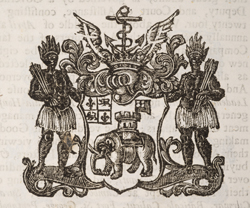
royal-african-company• London’s role in the slave trade during the 17th and 18th centuries is the subject of a new display opening at the Museum of London Docklands tomorrow. Called The Royal African, it tells the story of the Royal African Company, founded as a joint venture between the Duke of York (the future King James II) and leading London merchants in 1672 (the coat-of-arms of which is pictured), through looking in-depth at the life of William Sessarakoo. An African prince, Sessarakoo grew up in a Royal African Company fort at Annamaboe in modern Ghana but when his father sent him to London to be educated, he was tricked and instead sold into slavery in Barbados. He spent four years as a slave until he was freed by members of the Royal African Company who wanted to retain good relations with his father and subsequently brought him to London. The display is being housed in the museum’s London, Sugar & Slavery Gallery and can be seen until 4th June next year. Entry is free. For more, see www.museumoflondon.org.uk/museum-london-docklands. PICTURE: © Museum of London.

• A rare Victoria Cross found on the foreshore of the River Thames has gone on show at the Museum of London in the City. Mystery surrounds the medal which was given for actions at the Battle of Inkerman during the Crimean War. While a number of medals were awarded for actions in the battle, only two have a location recorded as unknown. The first is that awarded to Scottish Private John McDermond from the 47th (the Lancashire) Regiment for saving the life of Lt Col O’Grady Hall who had been injured and surrounded by the enemy which leading a charge against a Russian column while the second is that awarded to Irish Private John Byrne of the 68th (Durham) Light Infantry who rescued a wounded comrade under fire. On show alongside the medal is a record book which details the engraving on each VC issued between 18554 and 1927, the original medal design from the jewellers Hancocks and a modern copy of a VC. The medal, which was found and then reported by Tobias Neto, is on show until 15th December. For more, see http://www.museumoflondon.org.uk/museum-london.

Sir Elton John’s collection of modernist photography is the subject of an exhibition which opened at the Tate Modern in South Bank earlier this month. The Radical Eye: Modernist Photography from the Sir Elton John Collection features more than 150 works from more than 60 artists including Man Ray, André Kertész, Berenice Abbot, Alexandr Rodchenko and Edward Steichen. Among the subjects show in the images are Henri Matisse, Pablo Picasso and Jean Cocteau. The exhibition runs until 7th May. For more, see www.tate.org.uk/visit/tate-modern.

Send all items for inclusion to exploringlondon@gmail.com.
This Week in London – New museum on policing in the Square Mile; the 801st Lord Mayor’s Show; and maps on show at the BL…

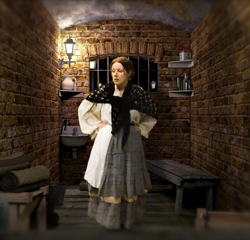
catherineeddowes2Stories including that of Catherine Eddowes, one of the victims of the notorious Jack the Ripper whose tale is brought to life through a virtual hologram (pictured), that of the Houndsditch Murders which claimed the lives of three police officers, and those of the more than 70 horses which have served in the City of London Police are among those told in the new purpose-built City of London Police Museum. A collaboration between the City of London Police and the City of London Corporation’s Guildhall Library, the new facility covers the 177 year history of the men and women charged with policing the Square Mile. Other stories highlighted in the museum include that of the recruitment of women into the force, the impact of the two World Wars on policing in the capital (featuring photographs taken by City of London police officers Arthur Cross and Fred Tibbs), the force’s tackling of terrorism and the progress of its communications, uniforms and kit and the victory of the City of London Police as the winner of the Olympic gold medal for the tug of war in 1920 (which, given the event was dropped, leaves them as the current champions). Entry to the museum, which opened this week at Guildhall, is free. For more, see www.cityoflondon.police.uk/about-us/history/museum/Pages/default.aspx. PICTURE: Courtesy City of London Police Museum.

The Lord Mayor’s Show takes place this Saturday, kicking off with a river pageant followed by the grand procession through City streets and fireworks over the Thames. The 801st Lord Mayor’s Show celebrates the election of Andrew Parmley as the 689th Lord Mayor of the City of London. This year’s procession, which kicks off at 11am and runs from Mansion House down Cheapside to the Royal Courts of Justice – where the Lord Mayor swears allegiance to the Crown – and back again at 1pm via Victoria Embankment, features 6,500 participants, 180 horses and 164 vehicles including steam engines, fire engines and a tank. The Show’s Pageantmaster, Dominic Reid, is celebrating his 25th consecutive show this year (his father organised 20 shows before him). The river pageant, featuring the QRB Gloriana, sets off from Westminster at 8.30am with Tower Bridge opening in salute at 9.25am. The fireworks display, which takes place over the Thames between Blackfriars and Waterloo, starts at 5.15pm. The tradition dates back to 1215. For more, see https://lordmayorsshow.london.

A major new exhibition looking at the history of the 20th century through maps has opened at the British Library in King’s Cross. Maps and the 20th Century: Drawing the Line features maps ranging from the first sketch of the London Underground dating from 1931, to declassified Ministry of Defence maps from the Cold War era, John Betjeman’s personal set of Ordinance Survey maps from the 1920s, a Russian moon globe from 1961 and EH Shepard’s first map of the Hundred Acre Wood (home of Winnie the Pooh). Other highlights include 3D relief models of the Western Front from 1917, a dress made of World War II escape maps printed on silk, an aerial photograph of Liverpool with targets marked used by the Luftwaffe, a map of the Atlantic Ocean floor from 1968. The exhibition, which runs to 1st March, is running in conjunction with a series of events exploring how maps continue to shape and influence our world. Admission charge applies. For more, follow this link.

Send all items for inclusion to exploringlondon@gmail.com

Famous Londoners – Five notable Lord Mayors of London…

The Lord Mayor’s Show will be held on 12th November so we thought in the lead-up to it, we’d look briefly at the lives of five of the notable Lord Mayors of London during the 801 years of the institution…

William Hardel: Mayor of London (the title Lord didn’t come until a century later) in 1215, Hardel was the only commoner on the committee – known as the enforcers – appointed to see that the provisions of the Magna Carta were carried out.

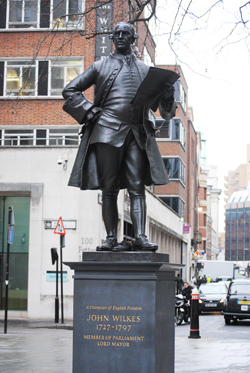
john-wilkesJohn Wilkes: A radical, politician, journalist and notorious womaniser, he was Lord Mayor of Lord in 1774. He is noted for being the subject of what is reputedly the only cross-eyed statue in London (pictured), found at the intersection of Fetter Lane and New Fetter Lane in the City of London. It is said to be a true-to-life depiction.

David Salomans: The first Jewish Lord Mayor of London, the banker and MP was elected in 1855. One of his tasks during his time as Lord Mayor was the removal of the inscription on The Monument which had blamed Roman Catholic conspirators for the Great Fire of London.

Robert Fowler: The last Lord Mayor of London to have served in the office more than once, Fowler held the office in 1883 and 1885. Many others had done so previously – including the famous Richard ‘Dick’ Whittington – but none since.

Dame Mary Donaldson: The first female Lord Mayor of London, she was elected in 1983, having previously held the honours of being first female alderman (1975) and first female sheriff (1981). Dame Fiona Woolf became the second female Lord Mayor in 2013.

For more on the Lord Mayors, see our earlier entries on Henry Fitz-Ailwyn, Richard ‘Dick’ Whittington, William Walworth and Thomas Bludworth.

This Week in London – Museums at Night; Roman London rediscovered; and, Pablo Picasso on show…

museums-at-night From tonight (and across this weekend), museums all over Greater London will be opening their doors after usual closing time as part of the annual Museums at Night event. Among those institutions taking part in the event, produced by Culture24, are such well-known icons as the British Museum, Tower Bridge and The National Gallery as well as lesser known establishments like Queen Elizabeth’s Hunting Lodge in Chingford, Southside House on Wimbledon Common and the Grant Museum of Zoology in central London. The October event follows an earlier Museums at Night in May. For the full programme of events, see www.museumsatnight.org.uk.

Roman London is the subject of a new exhibition at the City of London Corporation’s Guildhall Library. Londinium AD43 features the work of photographer Eugenio Grosso who takes the visitors on a photographic journey through time from London’s foundations to its present. The display shows how much of London’s Roman settlement has been preserved and features photographs of locations once home to significant London sites. Runs until 31st March. For more, see www.cityoflondon.gov.uk/things-to-do/guildhall-library/Pages/default.aspx

More than 75 portraits in all media by Spanish artist Pablo Picasso can be seen at the recently opened Picasso Portraits exhibition at the National Portrait Gallery. Including well-known masterpieces and some works never seen in Britain before, the works include a group of self-portraits as well as caricatures of Picasso’s friends, lovers, wives and children and images he created inspired by artists of the past. Runs until 5th February. Admission charge applies. For more, see www.npg.org.uk.

Send all items for inclusion to exploringlondon@gmail.com.

What’s in a name?…Mansion House

the-mansion-houseMansion House, perhaps best known as a tautological-sounding Tube station, is actually the name of the official residence of the Lord Mayor of London (a suitable subject, we felt, given the upcoming Lord Mayor’s Show in November).

mh2Designed by George Dance the Elder and built between 1739 to 1753 (many years after the idea of an official residence for the Lord Mayor was proposed in the aftermath of the Great Fire of London), the Palladian-style property – located a stone’s throw from the Royal Exchange and the Bank of England on a short stretch of street named after the property – has been the home of the Lord Mayor since the latter date.

It was built on the site of what was known as the Stocks Market (it had previously been the location of some stocks – used to punish people for various misdemeanours), the name isn’t actually as repetitive as it looks but actually means “official residence” and was previously used to designate homes which went with particular ecclesiastical jobs.

As well as accommodation for the Lord Mayor, the interior of the Grade I-listed property features two halls known as the Egyptian Hall and what was initially known as the Dancing Gallery but is now the Ballroom (we’ll be taking a more in-depth look at the property at a later date).

The Tube station opened in 1871 as the eastern terminus of the Metropolitan District Railway. Interestingly, Bank station is actually closer to the property with Mansion House station located to the south-west down Queen Victoria Street.

A Moment in London’s History – The (other) Great Fire of London…

fireOf course, the Great Fire of London in 1666 is only one of numerous fires which have occurred in London (although it was no doubt the greatest in terms of destruction). But among others was a fire in 1212 which has been described as London’s worst in terms of the death toll which some have put as high as 3,000 (although it’s generally believed it’s unlikely to have been that high).

The fire, which only came some 77 years after another great conflagration destroyed a stretch of the city reaching from Westminster to St Paul’s Cathedral in 1135, began in Southwark on 10th July (hence it’s also known as the Great Fire of Southwark). Crossing London Bridge, it went on to destroy a large part of the City itself.

As well as destroying buildings on London Bridge including houses and the chapel (the structure itself, having recently been rebuilt in stone, survived somewhat intact although it only remained in partial use for some time afterward), also destroyed the Southwark church known as St Mary Overie (precursor to today’s Southwark Cathedral) as well as many buildings around Borough High Street.

There were apparently numerous deaths – the story goes that many of them occurred when a mass of people poured onto London Bridge from the City as they attempted to cross to Southwark to help put out the fire (or perhaps just gawk at it).

They were trapped in the middle of the bridge when, with the south end was already ablaze, the north end caught fire from sparks. As well as suffering fatally from the effects of flames and smoke, people were apparently crushed in panic and others were pushed off the bridge to drown in the River Thames (along with some of the boat crews who tried to rescue them).

And, just as the Great Fire of 1666, the fire of 1212 did result in some building reforms including the placement of a ban on the use of thatch for rooves.

10 sites commemorating the Great Fire of London – 10. Two mysterious mice…

To end our series on memorials in London commemorating the Great Fire of 1666 – marking the event’s 350th anniversary – we’re taking a look at what is one of the smallest monuments in the City (and, despite all rumour, possibly not a memorial to the Great Fire at all).

philpot-lane-miceMidway up the wall of a building at the corner of Eastcheap and Philpot Lane, not far from The Monument (for more on its history, see our earlier post here), can be seen two brown mice fighting over a piece of cheese.

The mice are commonly said to be a memorial, not to anyone who died during the fire, but to two men who died while building The Monument itself.

The cheese apparently relates to the story in that the two men fell to the deaths while fighting after one accused the other of eating his cheese sandwich. The two mice, one for each of the men, relate to the fact that it was apparently mice who were later found to be the culprits.

But we need to point out that not all agree on the memorial aspect of the mice, which have apparently been decorating the building’s cornice since the mid-1800s – and there are legitimate questions: why, for example, would the Victorians when constructing the property commemorate two long dead workers and how had the story even reached them of their deaths?

One theory is that the mice do commemorate two men who died in the circumstances described, but while building the property they are located upon and not The Monument at all.

The building, meanwhile, is said to have been constructed as offices and warehouses for spice merchants Hunt & Crombie – it’s been suggested the mice were merely part of the decorations made for the building and not a memorial at all.

Whatever the origins of the mice – and whether they represent a memorial or not – we thought they were a nice way to close out the special series on Great Fire of London commemorative sites. We’ll kick off a new Wednesday series shortly.

PICTURE: Spudgun67/Flickr/CC BY 2.0

This Week in London – Saxons camp out in Hyde Park on the way to battle; “ordinary punks” at Museum of London; and, Bridget Riley meets Seurat…

battle-of-hastings

A temporary ‘Saxon’ camp will appear in Hyde Park this Saturday as Battle of Hastings’ re-enactors pause on their journey south to meet the forces of William, the Duke of Normandy, in an event marking the battle’s 950th anniversary. English Heritage is recreating the hurried march south of the Saxon King Harald and his followers following the Battle of Stamford Bridge in Yorkshire to Battle Abbey where they will join in an annual re-enactment of the world famous Battle of Hastings on 15th and 16th October. Having already visiting British landmarks like Lincoln’s Roman arch, Peterborough Cathedral, and Waltham Abbey, they will be found at a free “pop-up living history encampment” near Apsley House in Hyde Park between 11am and 3pm on Saturday. People are invited to visit the encampment and meet the re-enactors, learn how the armies lived and ate while on the march, discover which weapons they used and play some Norman games as well as see the Battle of Hastings recreated using vegetables. Later on Saturday, the re-enactors will head across London to the Jewel Tower in Westminster and then on, Sunday, on to Eltham Palace in the city’s south-east, before setting off for Battle to the south. For more – including a day-by-day calendar of the march – head to www.english-heritage.org.uk/learn/1066-and-the-norman-conquest/the-1066-march/. PICTURE: An earlier re-enactment of the Battle of Hastings/David Adams.

A free exhibition celebrating all things punk has opened at the Museum of London to mark the end of a year long festival commemorating 40 years of the movement’s influence. Punks, which tells the stories of “ordinary punks” living in London in the late 1970s, features artefacts like handmade mixtape sleeves, DIY fanzines and the radical clothes sold on the King’s Road. The exhibition, which runs until 15th January, is accompanied by what is promised to be a “no holds barred” debate centred on the punk phenomena in November. For more information, see www.museumoflondon.org.uk and for more about other events related to the 40th anniversary of punk, see www.punk.london.

On Now – Bridget Riley: Learning from Seurat. This exhibition at The Courtauld Gallery explores Riley’s breakthrough encounter with Georges Seurat’s 1887 work Bridge at Courbevoie. For the first time, it brings together a copy Riley made of the painting in 1959 with the original work as well as presenting a small group of Riley’s seminal works to show how her understanding of Seurat’s art led her to create what are described as “some of the most radical and original abstract works of the past five decades”. Part of the gallery’s ongoing series of displays focusing on major contemporary artists, it runs until 17th January. Admission charge applies. For more, see www.courtauld.ac.uk/gallery.

Send all items for inclusion to exploringlondon@gmail.com.

10 sites commemorating the Great Fire of London – 9. A memorial to a fire prevention breakthrough (erected on the Great Fire’s 110th)…

This rather unremarkable obelisk on Putney Heath actually commemorates the invention of ‘Fireproof House’ and was erected, not coincidentally, on the 110th anniversary of the great conflagration.

hartley-obeliskThe rather eccentric David Hartley, an inventor and MP, came up with the idea of sheathing joists under floorboards with thin layers of what were initially iron and later iron and copper plating to prevent the spread of fire in homes and ships and was granted a patent for his system in 1773.

Known as ‘Hartley’s Fire Plates’, he claimed in a pamphlet that a single fireplate might have prevented the Great Fire – a claim which got other MPs excited and led them to grant him cash – £2,500 – to continue his experiments as well as an extension on his patent, from the usual 15 to 31 years.

His experiments included building homes for the express purpose of setting them alight to test his invention, one of which he built on Wimbledon Common. Known as the ‘Fireproof House’, the property was repeatedly set alight in front of prominent witnesses.

These included MPs, the Lord Mayor of London and Aldermen of the City of London – who granted Hartley the Freedom of the City and encouraged fire plates to be included in all new buildings in London – and, of course, King George III and his wife Queen Charlotte. One of the tests was apparently carried out while the royal family was eating breakfast in an upstairs room inside (they survived unscathed – one hates to think of Hartley’s fate should they not have).

The house is now gone but the Hartley Memorial Obelisk, erected just off Wildcroft Road in what were formerly the grounds of Wildcroft Manor, remains.

The red brick and stone Grade II-listed structure was erected by the City of London Corporation in 1776, the 110th anniversary of the Great Fire of London, to commemorate Hartley’s invention of fire plates. The first stone in the monument – which is attributed to George Dance – was laid by the then Lord Mayor, John Sawbridge.

PICTURE: David Antis/Geograph/CC BY-SA 2.0

This Week in London – Medieval embroidery; Maino on show; former toilet block becomes Kensington Garden’s newest eatery; and, a new Lord Mayor…

the_jesse_cope_detail_ca-_1310-25_c_victoria_and_albert_museum_londonObjects associated with some of the most notable personages of the Middle Ages – from King Edward I and his wife, Queen Eleanor of Castile through to Edward, the Black Prince, and martyred archbishop, Thomas Becket – will go on show at the V&A in South Kensington as part of a display of medieval embroidery. Opening Saturday, Opus Anglicanum: Masterpieces of English Medieval Embroidery features embroidered treasures such as a seal-bag which, dating from the early 12th century, was made to hold the foundation document of Westminster Abbey, the Toledo Cope which has been brought back to England from Spain for the first time since its creation in the 14th century and an embroidered vestment associated with Thomas Becket. There’s also the Hólar Vestments from Iceland, the Jesse Cope from the V&A’s own collections (pictured), the Daroca Cope from Madrid and an embroidered tunic worn by Edward, the Black Prince. As well as embroidery, the display features panel paintings, manuscripts, metalwork and sculpture. Runs until 5th February along with a season of events. Admission charges apply. See www.vam.ac.uk/opus for more. PICTURE: © Victoria and Albert Museum, London.

Two works by Spanish painter Fray Juan Bautista Maino have gone on exhibition for the first time in the UK at The National Gallery, off Trafalgar Square. The Adoration of the Shepherds and The Adoration of the Kings, dating from 1612-14, have been loaned from the Museo Nacional del Prado in Madrid, Spain, and can be seen for free in a display being held in conjunction with the upcoming exhibition Beyond Caravaggio. Each of the paintings measures more than three metres in height and were originally part of a retable (altarpiece) created for the altar of the Dominican church of San Pedro Martir in Toledo. The work took three years to complete and it was while he was doing so that Maino took religious vows and joined the Dominican Order (there’s also a chance he included a self portrait in the work in the form of a pilgrim on the altar’s far left). Can be seen until 29th January. For more, see www.nationalgallery.org.uk.

A former disused toilet block has been converted into a new cafe overlooking the 150-year-old Italian Gardens in the Kensington Gardens. Formally opened by Loyd Grossman, chairman of the Royal Parks charity, earlier this month, the cafe has a “living roof” aimed at supporting the biodiversity and wildlife of the gardens and has been designed in sympathy with the gardens and the nearby Grade 2* listed Queen Anne’s Alcove, currently being restored. The Italian Gardens were a gift from Prince Albert to Queen Victoria. For more on the cafe, including opening times, head here.

Alderman Andrew Parmley has been elected as the 689th Lord Mayor of London. In keeping with tradition, he will take up the office after the ‘Silent Ceremony’ in Guildhall on 11th November followed by the annual Lord Mayor’s Show parade through the City the following day.

Send all items to exploringlondon@gmail.com for inclusion.

10 sites commemorating the Great Fire of London – 8. St Paul’s memorial to John Donne…

As mentioned earlier, there are several memorials to the Great Fire of London at St Paul’s Cathedral – we’ve already mentioned one of them, the Resurgam, which can be found on the south side of the cathedral’s exterior. 

john-donneAnother can be found in a monument which actually commemorates the poet and priest, John Donne, a dean of St Paul’s who died in 1631 (incidentally, it’s not the only place he’s commemorated – there’s also a bronze bust of him outside the cathedral, placed there in 2012).

The marble effigy inside the cathedral, however, is significant because, erected within 18 months of his death,  it is among the few monuments to survive the Great Fire of London. Located in the south quire aisle, the effigy, the work of Nicholas Stone, depicts Donne in his funeral shroud (he apparently posed for it while still alive, wrapped in a sheet).

The effigy was apparently saved by the fact that when the fire raged through the cathedral, it fell into the crypt. And, in a poignant reminder of the fire’s destructive power, if you look closely at the base you can still see scorch marks from the blaze.

It lay in the crypt among other remains of the Great Fire until the late 19th century when it was recovered and restored to its place in the cathedral above in a position close to where it had formerly stood in the Old Cathedral.

PICTURE: Victor Keegan/Flickr/CC BY 2.0/image cropped and lightened.

Famous Londoners – Sir Thomas Bludworth…

fireSir Thomas Bludworth (also spelt Bloodworth) is usually only remembered as the man who had the unfortunate job of being Lord Mayor of London when the Great Fire broke out in 1666. So, given the fire’s 350th anniversary this month, we thought it timely to take a more in-depth look at his life and career.

Bludworth was born in London in February, in about 1620, the second surviving son of John Bludworth, master of the Vintner’s Company and a wealthy merchant. Trained to succeed his father – his elder brother having joined the clergy, Bludworth was himself admitted to the Vintner’s Company in the 1640s and joined the Levant Company in 1648.

First elected an alderman in 1658, he was discharged when he refused to serve as a sheriff and the following year served as the master of the Vintner’s Company. In 1660, he was briefly arrested along with 10 other members of City of London’s common council after the body refused to pay taxes until a representative parliament was convened.

Elected MP for Southwark later that year, Bludworth among city and parliamentary representatives who sailed to The Netherlands to attend the king, Charles II, in exile, and invite him to return to England. It was while attending the king in The Hague that he was knighted. Re-elected in 1661, he was an active parliamentarian who served in numerous different capacities.

Sir Thomas was twice married and had a number of children including a formidable daughter Anne who eventually married the historically unpopular George Jeffreys, (later King James II’s Lord Chief Justice and Lord Chancellor).

In mid-1662, he was once again made a City of London alderman and appointed one of two sheriffs for the following year. He became Lord Mayor of London in November, 1665, but apparently there was no pageant as was customary due to the plague.

During his year in the office – “the severest year any man had” – he faced both the plague and the Great Fire and his reputation has been largely formed out of his response to the latter thanks in large part his alleged response when woken and told of the fire as being: “Pish, a woman might piss it out!”.

Bludworth was heavily criticised at the time and over the years since his reaction to the fire – including not pulling down homes to create a firebreak and thus prevent the spread of the fire, but it should be noted that had he done so before he had received the king’s permission, he would have found himself personally liable.

Diarist Samuel Pepys’ who, following two encounters in the months before the fire had already described Bludworth as “mean man of understanding and despatch of any public business”, recorded that when he finally brought a message from the king ordering the creation of a firebreak, Sir Thomas seemed like “a man spent”.

“To the King’s message (to create a firebreak by pulling down houses), he cried, like a fainting woman, ‘Lord, what can I do? I am spent: people will not obey me. I have been pulling down houses, but the fire overtakes us faster than we can do it’.”

Another eyewitness describes him as looking like he was “frighted out of his wits” during the fire.

Sir Thomas’ own property at Gracechurch Street was among the casualties of the fire but he later built a new mansion in Maiden Lane.

He continued to serve as an MP after the fire and was, perhaps ironically, appointed to a committee working on a bill to provide “utensils” for the “speedy quenching of fire”. In the mid-1670s, he become one of the governing members of the Royal African Company.

Sir Thomas died on 12th May, 1682, aged around 60. He was apparently buried in Leatherhead.

This Week in London – Marking the transatlantic cable’s 150th; Sir James Thornhill celebrated; and, food at the Foundling Museum…

commerce-and-sea-power_william-lionel-wyllie

• This year marks the 150th anniversary of the transatlantic cable connecting Europe and America and in celebration of the event, the City of London Corporation’s Guildhall Art Gallery is holding an exhibition looking at the impact of cable telegraphy on people’s understanding of time, space and the speed of communication. Victorians Decoded: Art and Telegraphy, a collaboration between the gallery, King’s College London, The Courtauld Institute of Art and the Institute of Making at University College London, features never-before-seen paintings from the gallery’s collection as well as rare artefacts such as code books, communication devices, samples of transatlantic telegraph sales and ‘The Great Grammatizor’, a messaging machine that will enable the public to create a coded message of their own. It took nine years, four attempts and the then largest ship in the world, the Great Eastern, to lay the cable which stretched from Valentia Island in Ireland to Newfoundland in Canada and enabled same-day messaging across the continents for the first time. Displayed over four themed rooms – ‘Distance’, ‘Resistance’, ‘Transmission’ and ‘Coding’, the exhibition features works by artists including Edward John Pointer, Edwin Landseer, James Clarke Hook, William Logsdail, William Lionel Wyllie and James Tissot. The free exhibition, which runs until 22nd January, is accompanied by a series of special curator talks. For more information, see www.cityoflondon.gov.uk/victoriansdecoded. PICTURE: Commerce and Sea Power, William Lionel Wyllie/Courtesy Guildhall Art Gallery.

• The life of artist Sir James Thornhill – the painter behind the remarkable Painted Hall at the Old Royal Naval College in Greenwich, has opened at The Stephen Lawrence Gallery in Greenwich. A Great and Noble Design: Sir James Thornhill’s Painted Hall explores the story behind the commissioning of the Painted Hall, painted between 1708 and 1727, through a series of preparatory sketches made by the artist, including three newly-conserved original sketches by Thornhill. Also on show will be the results of new research undertaken into the paintings in the light of upcoming conservation work on the hall’s ceiling. The free exhibition runs at the centre at Stockwell Street until 28th October. For more, see www.ornc.org.

The food served at the Foundling Hospital comes under scrutiny in a new show at The Foundling Museum in Bloomsbury. Based on new research, Feeding the 400 looks at the impact food and eating regimes had on children at the hospital between 1740 and 1950 through an examination of art, photographs, objects including tableware and the voices of former student captured in the museum’s extensive sound archive. Guest curated by Jane Levi, the exhibition also includes a newly commissioned sound work which evokes the experience of communal eating. A programme of events accompanies the exhibition which runs until the 8th January. Admission charge applies. For more, see www.foundlingmuseum.org.

Send all items for inclusion to exploringlondon@gmail.com.

10 sites commemorating the Great Fire of London – 7. The ancient plaque commemorating St Olave Silver Street…

st-olave-silver-streetMany of the monuments commemorating the Great Fire of London, date from succeeding centuries (the Monument being a notable exception), one of the earliest can apparently commemorating the site of the Church of St Olave Silver Street.

The church dated from at least the 12th century and is one of a number in London which were apparently named after King Olaf, the first Christian King of Norway who fought alongside the Anglo-Saxon King Ethelred II against the Danes in England in the 11th century.

The church served as the parish church of the silversmiths and apparently in recognition of that boasted a figure of Christ on the cross which had silver shoes.

The church had been rebuilt in the early 1600s but was completely destroyed in the Great Fire of London and never rebuilt, the parish united with that of St Alban Wood Street.

The site of the church, now on the corner of London Wall and Noble Street, is now a garden and boasts an almost illegible plaque featuring a skull and crossbones, which is believed to date from the late 17th century, and which commemorates the destruction of the church in the Great Fire.

PICTURE: © Chris Downer/CC BY-SA 2.0