Lost London: Gates Special – Aldgate

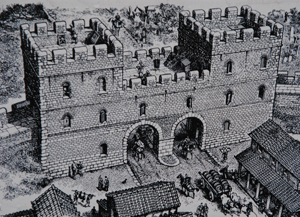
Once the eastern-most gateway into London, Aldgate is another of London’s gates which dates from Roman times.

The gate, which stood over the short street in the City now simply known as Aldgate, was rebuilt several times during the Middle Ages before, thanks again to the need for road widening, it was demolished in 1761.

Some sections of the gate were apparently taken to Bethnel Green, just to the east, where they were rebuilt as an addition to a 17th century mansion known as Aldgate House.

The name Aldgate is generally thought to mean ‘Old Gate’ but alternative theories suggest it derives from ‘Ale Gate’ (a connection with a local alehouse perhaps?) or ‘All Gate’ (that, is, all are free to enter).

The most famous person associated with the gate is the Middle English writer Geoffrey Chaucer – he lived in apartments above it for more than 10 years – from 1374 to 1386 – while working as a customs official.

Aldgate is also one of the wards of the City of London.

PICTURE: An artist’s impression of how Roman Aldgate may have looked as seen on a plaque marking the site of the former gate (part of a series of plaques on the former London Wall Walk).

10 curiously named churches of London – 6. St Katharine Cree

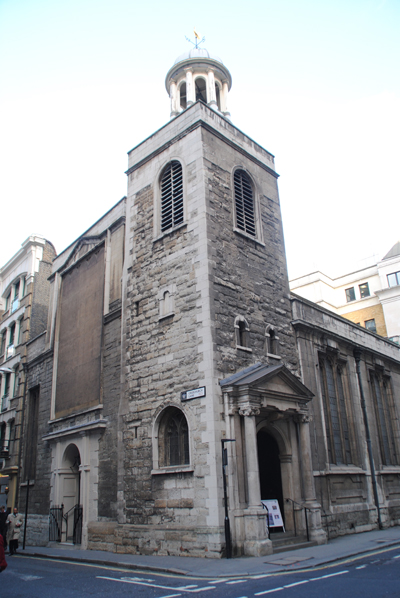
Contrary to what some may, St Katharine Cree is not named after a person of that name (or at least not entirely). St Katherine, certainly, but the addition of ‘Cree’ is simply a medieval corruption of ‘Christ Church’.

The name Christ Church, abbreviated to Cree, was applied to this church because it was the prior of the Augustinian Priory of the Holy Trinity in Aldgate, also known as Christ Church, who founded St Katharine Cree in 1280 for the use of the area’s parishioners (apparently their use of the priory church was causing problems).

The current building dates from 1630 (although the tower dates from 1504), making it the only surviving Jacobean church in London.

It  was consecrated by William Laud, then Bishop of London (and later beheaded for, among other things, his support of King Charles I). He is commemorated in one of the church’s chapels.

Unlike so many other of London’s churches, St Katharine Cree was not destroyed in the Great Fire of London and only suffered minor damage in the Blitz. But structural problems meant it did need substantial restoration in the 1960s.

Inside, is a mid 17th century font and stained glass dating from the same era which depicts a Catherine wheel (St Katherine/Catherine is said to have died strapped to a spiked wheel when martyred during the time of the Roman Empire.).

There is also a rose window which was modelled on that of old St Paul’s Cathedral (before it was destroyed by the Great Fire). Parts of the organ, which was restored in the early Noughties, date from the 17th century and the original was played by none other than George Frideric Handel and Henry Purcell. The six bells were restored in 2009 following an appeal.

Among those buried at St Katharine Cree are Sir Nicholas Throckmorton, a 16th century diplomat (his monument is inside), and the artist Hans Holbein the Younger (his grave is also claimed by St Andrew Undershaft).

The church today has no parish but is the Guild Church to Finance, Commerce and Industry (its rector is that of St Olave Hart Street). Among its annual events is the Lion Sermon given in October, a tradition that dates back to 1643 and owes its origins to the former Lord Mayor of London, Sir John Gayer, who decided to finance the sermon after he survived an encounter with a lion in Syria.

WHERE: Leadenhall Street, London (nearest Tube stations are Aldgate and Tower Hill); WHEN: See website for service timesCOST: Free; WEBSITE: www.sanctuaryinthecity.net/St-Katharine-Cree.html.

LondonLife – New Year’s Day Parade 2012

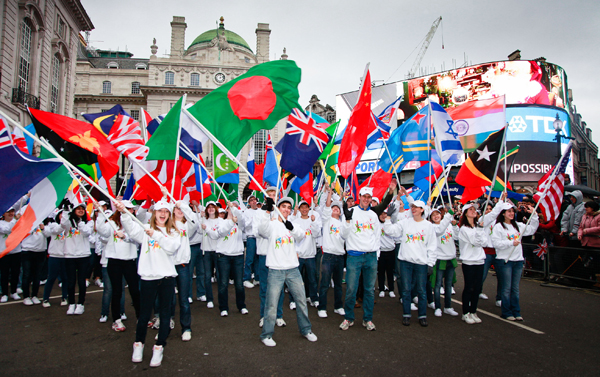
More than 8,500 performers – including those pictured celebrating the launch of London’s Olympic year – took part in this year’s New Year’s Day Parade in London, the wettest in the event’s 26 year history. But the wild weather didn’t put off the more than 500,000 people who turned out to watch the parade as it made its way from the starting point outside the Ritz Hotel in Piccadilly via Trafalgar Square to Parliament Square. As many as 19 London boroughs submitted entries in a competition based on the themes of the Olympics and the Queen’s Diamond Jubilee with Merton (its entry ‘From Horsepower To High Speed Rail’ featured animatronics) and the City of Westminster (its entry ‘Peter Pan’ involved a giant galleon and the The Sylvia Young Theatre School) announced as joint winners. For more on the parade, see www.londonparade.co.uk.

IMAGE: Courtesy of www.londonparade.co.uk

Exploring London’s 10 most popular posts for 2011 – Numbers 4 and 3…

We’re getting down to the pointy end of the countdown now. Here’s numbers four and three in Exploring London’s list of our most popular posts for 2011…

4. Curious London Memorials – 4. The Suffragette MemorialOne of our series on curious London memorials, this looked at a memorial in St James, erected in the 1970s to mark the contribution of those who fought for women’s right to vote;

3. The Royal Wedding – London’s royal reception venue: Another of our Royal Wedding themed posts, this looked at the history of Buckingham Palace, location of the reception which took place after the wedding of Prince William and Kate Middleton, now the Duchess of Cambridge.

10 curiously named churches of London – 5. St Magnus the Martyr

St Magnus the Martyr has to be one of the most oddly dedicated churches in London. Indeed, for many years there was confusion over which St Magnus it was dedicated to – candidates including  a second and a third century martyr and a Viking who was slain in the Orkney Isles around 900 years ago.

Revived interest in the latter St Magnus in the early 20th century thanks to the discovery of his remains hidden in a pillar in the Orkney ‘capital’ of Kirkwall , however, led to a confirmation of the church’s dedication in 1924.

There is believed to have been a church on the site since Roman times (a fact which has contributed to the confusion over it’s more recent dedication) but its first known mention as that of St Magnus is shortly after the Norman Conquest.

The church’s location, on the approach to London Bridge (see the picture, right, of the church tower overlooking the Thames), meant it occupied an important place in the life of medieval London. Following the Reformation, the patronage of the church was held alternately by the Abbey of Bermondsey and the Abbot and Convent of Westminster – this later passed into the hands of the Bishop of London, Edmund Grindall, and it was he who appointed the church’s most famous rector, Miles Coverdale, best remembered today as a Bible translator (there is a large monument to him in the church).

The church had been repaired in the early 17th century but was destroyed completely in the Great Fire of 1666. It was subsequently rebuilt to the designs of the ubiquitous Sir Christopher Wren.

A fire in 1760 did considerable damage to Wren’s building but it was restored and improvements continued to be made on a sporadic basis until 1831 when Sir John Rennie’s new London Bridge was opened and the old bridge demolished, meaning St Magnus no longer occupied the ‘gateway’ position it had for centuries prior.

The church only received relatively minor damage during World War II when a bomb struck London Bridge but was later restored. Features of the church now include the exterior clock, which dates from 1700, and a piece of wood believed to have one formed part of the Roman wharf which has been placed under the porch.

Among those buried at St Magnus’ during medieval times were Henry Yevele, master mason to King Edward III and King Richard II (his monument was destroyed in 1666). The church still has connections to the Fishmonger’s Company and the Plumber’s Company.

WHERE: Lower Thames Street, London (nearest Tube stations are Monument and London Bridge); WHEN: 10am to 4pm Tuesday to FridayCOST: Free; WEBSITE: www.stmagnusmartyr.org.uk.

LondonLife: Those Christmas Lights (part two)…

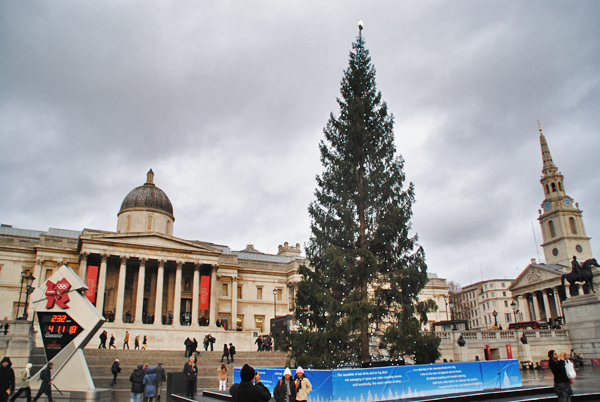
The Trafalgar Square Christmas Tree – donated  by the people of Oslo each year since 1947 as a thanks for the support Britain gave to Norway during World War II. On the left is the Olympic countdown clock.

A giant hedge-like reindeer outside Covent Garden, a market since at least the 1600s but once the site of a large kitchen garden for the monks of the Convent of St Peter, Westminster (see our earlier post for more).

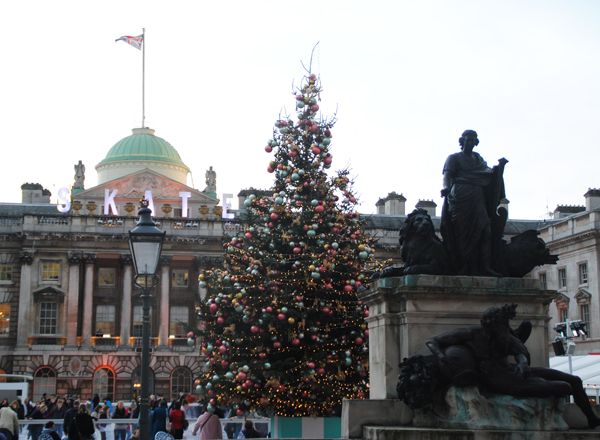
Christmas tree near the ice-skating rink at Somerset House, now an arts and cultural centre but originally built on the site of a Tudor palace in the late 1770s as a home for three “learned societies” – the Royal Academy of Arts, the Royal Society, and the Society of Antiquaries – as well as government offices (including the Navy Board).

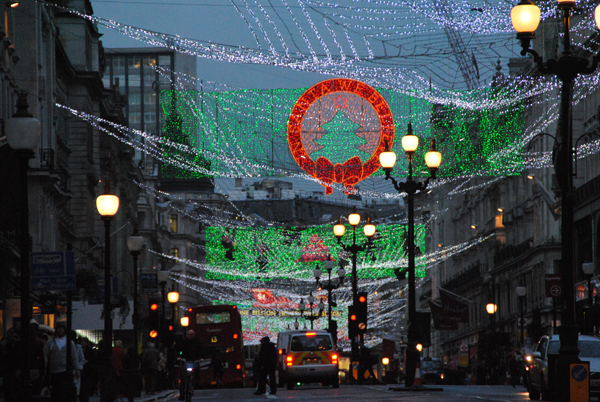
Christmas lights in Regent Street, one of the city’s premier shopping streets, in the West End. It’s current shape was designed by architect John Nash in the early 19th century.

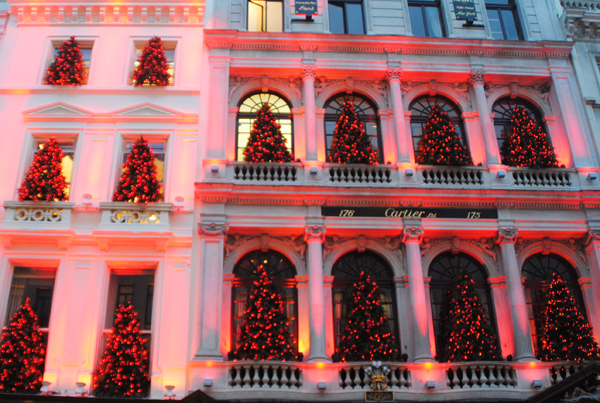
Christmas decorations on the exterior of Cartier in Old Bond Street, Mayfair. The area takes its name from the May Fair once held there and is now one of the most expensive areas within London (see our earlier post for more).

Looking for a book about London? See The Exploring London Little List of Books for Christmas…

Lost London: Gates Special – Aldersgate

Its name now more well known as one of the City of London’s 25 wards, Aldersgate was a gate opening to the city’s north, located close to where the Museum of London now stands, and was one of the city’s four original gates.

A plaque in Aldersgate Street marks where the gate once stood (there’s also an explanatory ‘London Wall’ plaque nearby) – it was finally knocked down in 1761.

The gate’s origins go back to late Roman times – it was apparently created to strengthen the city’s northern defences against Saxon incursions – and was built with two roadways passing through the wall protected by semi-circular towers. (The name apparently has nothing to do with the age of the gate as many believe but may be a corruption of a Saxon name Ealdred or come from a type of tree which grew nearby.)

An important link to places like the fair at Smithfield, St Bartholomew’s Priory and the Charterhouse in the Middle Ages, it was used as a prison and even as late as 1660, diarist Samuel Pepys writes of seeing the limbs of executed traitors displayed upon it. It was also had residential quarters above it – these were said to have been occupied at times by the City Crier and in the mid-1500s were used by printer and stationer John Day (he is said to have printed an early copy of the Bible, dedicated to King Edward VI, there in 1549).

In 1603, it was through Aldersgate that King James I entered London (his arms were later placed over the gate), and just 14 years later, in 1617, the entire gate was rebuilt. Repaired in the aftermath of the Great Fire of London in 1666 (it’s final form was said to feature, as well as the arms of King James I, statues of the Biblical figures Jeremiah and Samuel), it was finally demolished in 1761 to improve the flow of traffic.

PICTURE: Site of where Aldersgate once stood. To the right of the picture is the Church of St Botolph-without-Aldersgate.

Around London: A new pleasure garden for London; music hall star Dame Gracie Fields honored; mystery portraits at the NPG; and, celebrating the Olympics (from a Peruvian perspective)…

A new pleasure garden will be built in the city’s east as part of celebrations for next year’s Diamond Jubilee. London Pleasure Gardens, announced back in March, will be built upon a 60,000 square metre site at Pontoon Dock, opposite the ExCeL Exhibition Centre, and consist of an “ever-evolving creative playground for both resident Londoners and tourists alike”. The gardens, which will feature landscaped walkways, a floating cinema, an ‘adult’s playground’ and a range of facilities such as a ‘glass cafe’ – are expected to be open for the Queen’s Jubilee Weekend on 1st June. It’s expected that more than 40,000 people a day will pass through the site during the Olympics. London has had a long association with the concept of pleasure gardens – places where people gathered to listen to music, see art, eat and drink and talk, the most famous of which was the Vauxhall Pleasure Gardens. But the Royal Docks also had its own pleasure gardens in the past – these existed between 1851 and 1884 and were named the Royal Victoria Gardens.  For more, see www.londonpleasuregardens.com.

• Music hall star Dame Gracie Fields has been honored by English Heritage with a blue plaque on the Islington house where she lived for three years in the 1920s. It was while living at 72a Upper Street with her parents and first husband Archie Pitt, that she consolidated her reputation as one of Britain’s most popular performers and it was also during this time that she recorded for the first time (she was to become a regular on the BBC and by 1933 had cut a massive four million discs) and appeared before King George V and Queen Mary at a Royal Variety Performance. Following her success, Fields and Pitt built a mansion in The Bishop’s Avenue, Hampstead, called ‘The Tower’ in honor of the show which had made her a star – Mr Tower of London. She later separated from Pitt and married an Italian born director Monty Banks. They moved to the US in 1940 amid fears her husband would be interned and, after the war, she settled on the Italian island of Capri where, following Banks’ death in 1950, she married again. She made her final appearance on the London stage in 1978 – closing a Royal Variety Performance – and died back in Capri the following year.

• And, briefly…..A new species of dinosaur – Spinops sternbergorum – has reportedly been discovered at the Natural History Museum, identified from bones previously gathering dust on a shelf at the museum.

On Now: Imagined Lives: Portraits of Unknown People. This exhibition at the National Portrait Gallery centres on a group of 14 portraits from the 16th and 17th centuries which depict unknown people. Originally thought to represent famous figures like Queen Elizabeth I, the identity of the sitters is now considered unknown. In response to the pictures, eight internationally renowned authors – from Alexander McCall Smith and Joanna Trollope to Julian Fellowes and Terry Pratchett – have written imaginative short stories about the portraits, bringing them to life. The exhibition was originally shown in Somerset but is now running at the NPG until 22nd July. Admission is free. For more information, see www.npg.org.uk.

On Now: London and the Olympics. The Museum of London is hosting a new display which looks at the 1908 and 1948 Olympic Games held in London but, in twist, looks at not only the experiences of Londoners but those of the 41 man team Peru sent to the 1948 games. Pictures included in the display come from an album made by one of the athletes, Enrique Mendizabal Raig, recording the team’s visit (you can find the images on Flickr here). Entry is free. Runs until September. For more, see www.museumoflondon.org.uk.

10 curiously named churches of London – 4. St James Garlickhythe

Situated close to London’s riverfront, there is believed to have been a church on this site since at least 1100, although it is believed to have been previously dedicated jointly to the apostles St James and St John.

The name of Garlickhythe can be explained by its location – the word ‘hythe’ is a Saxon word for a landing place or jetty and it is believed garlic, used as a preservative and medication, was unloaded nearby and even possibly traded on Garlick Hill where the church stands.

The church was rebuilt in the 1300s and again after the Great Fire (it was another of Sir Christopher Wren’s designs and thanks to the abundance of natural light inside was known as ‘Wren’s Lantern’) but it largely escaped damaged in World War II (the projecting tower clock was among the casualities but while a 500 lb bomb buried itself in the south-east corner of the church, it failed to explode).

What bombs failed to do, however, a death watch beetle did and when one was discovered in the roof timbers in the 1950s, the church was closed until 1963 while it was restored. The exterior clock was restored in 1988 and repairs to the south transept were required after a crane counterweight smashed into the church in 1991.

Inside, the church boasts the second highest ceiling  – 40 foot – of any churches in London (St Paul’s being the highest) and much of the carved woodwork inside, including the font cover, altar table and churchwardens pews, is still original.

There is also original ironwork including a mayoral swordrest as well as a Stuart and Georgian coat-of-arms (the Stuart arms are among a number of features which come from St Michael Queenhithe – it was combined with this parish in the late 1800s; St Michael’s was pulled down in 1894 ).

The magnificent Bernhard Schmidt organ was installed in 1718. The church also houses two rare chalices dating from the time of Edward VI in the mid-16th century and some other rare plate as well as the oldest parish registers in England (these date from the 16th century with the first entry being that of the baptism of Edward Butler on 18th November, 1535).

St James Garlickhythe, which sits in the parish of St James Garlickhythe with St Michael Queenhithe and Holy Trinity-the-Less (the latter being another now demolished church), boasts connections to 12 livery companies including the Vintners (the church is located in Vintry Ward) and the Joiners. Among those buried there are six former mayors.

The church is currently appealing for funds for a new ring of eight bells to mark the Diamond Jubilee of Queen Elizabeth II next year.

And we couldn’t mention the church without referring to Jimmy Garlick, the church’s mummy. An embalmed body of an older man, this was discovered in the church vaults in 1855 and, identity unknown, was subsequently put on display so that curious onlookers could, for a small fee, look upon him or apparently even touch him. Jimmy, whose identity remains unknown, is no longer on public view.

WHERE: Garlick Hill (just off Upper Thames Street) (nearest Tube station is Mansion House). WHEN: See website for service timesCOST: Free; WEBSITE: www.stjamesgarlickhythe.org.

LondonLife – Poet Ted Hughes commemorated in Poets’ Corner


The late Poet-Laureate Ted Hughes was honored in a ceremony in Westminster Abbey’s Poets’ Corner last week with the dedication of a hand-carved memorial slab. 
The memorial includes a quotation from his work That Morning: “So we found the end of our journey, So we stood alive in the river of light, Among the creatures of light, creatures of light…”. The memorial to Hughes, who died in 1998 at the age of 68, was placed at the foot of that of TS Eliot, who was a mentor to Hughes. Among those who attended the commemoration were Hughes’ widow Carol and his daughter Frieda as well as literary figures including Nobel Laureate Seamus Heaney, Sir Andrew Motion, Michael Morpurgo and Graham Swift. Other literary luminaries commemorated in Poets’ Corner (only some of whom are buried here) include Geoffrey Chaucer, Edmund Spenser, John Milton, Lord Byron and John Keats as well as Charles Dickens, William Shakespeare and Rudyard Kipling. For more on Poets’ Corner, see www.westminster-abbey.org.

PICTURE: Carol Hughes lays a bouquet of flowers and herbs from the garden of the Hughes’ Devon home at the memorial. (Copyright Dean and Chapter of Westminster).

Around London – Dickens at the Museum of London; looking at Leicester Square’s past; Mr Chinnery’s art; and, Wellcome’s Miracles & Charms…

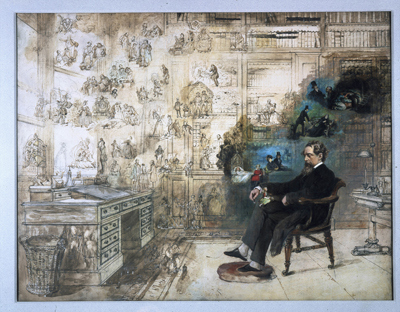
• Dickens fever is well and truly upon us in the lead-up to the bicentenary of his birth in February and tomorrow the Museum of London opens its own unmissable exhibition, Dickens and London. Displays centre on the relationship between Dickens and the city and visitors will be able to follow in the great novelist’s footsteps as they visit some of the places which sparked his imagination as well as confront some of the great social issues of the 19th century – including childhood mortality, prostitution and poverty – and be taking on a tour of some of the age’s greatest innovations – everything from railways and steamboats to the Penny Post. Among the objects on display will be Dickens’ writing desk and chair, his bank ledger, excavated items from Jacob’s Island, a notorious slum which was located near Bermondsey, and manuscript pages describing an East End opium den which was featured in Dicken’s unfinished novel, The Mystery of Edwin Drood (this, along with William Powell Frith’s celebrated portrait of the author, are being lent by the Victoria and Albert Museum). The exhibition also features a specially commissioned film looking at London after dark in Dickens’ time and today. Costumes from the upcoming BBC One drama series, Great Expectations, will also be on display and there is also a specially commissioned window display by acclaimed creative director and set designer Simon Costin showing a wintery London in the mid-19th century. The museum is also offering a new iPhone and iPad graphic novel app, Dickens: Dark London, which will take users on a “journey through the darker side” of Dickens’ London. Opens on 9th December (tomorrow) and runs until 10th June, 2012. Admission charges apply. For more, see www.museumoflondon.org.uk. For more on Dickens, see www.dickens2012.org. PICTURE: Dickens Dream by Robert William Buss (Courtesy Museum of London).

New hoardings have gone up at Leicester Square celebrating the area’s history as work continues on an £18 million plan by Westminster City Council to revitalise the Leicester Square streetscape. The more than 160 square metres of hoardings feature 11 images spanning a period of 250 years (and selected from thousands of archive images of the square). Meanwhile in Trafalgar Square, the famous Norwegian Christmas Tree was lit in a ceremony last Thursday. The tree is an annual gift from the people of Oslo as thanks for British support during Norway’s years of occupation in World War II. It will be lit from noon until midnight every day until 6th January.

And, briefly…..London’s Kew Gardens has been voted the top visitor attraction in Britain at the British Airways magazine travel award while the London Eye and Tate Modern came runner’s up…..Figures released to mark the 10th anniversary of free admission to England’s national museums show that visitor numbers to the museums have more than doubled over the past decade…..and, the first woman Tube driver, Hannah Dadds, reportedly died at the age of 70.

On Now: The Flamboyant Mr. Chinnery: An English artist in India and China. This exhibition at Asia House in New Cavendish Street in the West End, focuses on the work of 19th century artist George Chinnery and features landscapes and portraits he painted while in China and India. Runs until 21st January. Admission is free. For more, see www.asiahouse.org.

• On Now: Miracles & Charms. The Wellcome Collection is hosting this exhibition which features two shows – Infinitas Gracias: Mexican miracle paintings, the first major exhibition of Mexican votive paintings outside of Mexico, and Charmed life: The solace of objects, an exhibition of unseen London amulets from Henry Wellcome’s collection. Runs until 26th February, 2012. For more, see www.wellcomecollection.org.

10 curiously named churches of London – 3. St Mary-le-Bow

We’ve already touched on the history of St Mary-le-Bow in our earlier series on Sir Christopher Wren but thought it was worth revisiting in a bit more detail. 

Another of Wren’s churches (after all, remember he designed more than 50 in the city), St Mary-le-Bow, on the corner of Cheapside and Bow Lane, has a history dating back at least to the Norman Conquest (although it is thought it may stand on the site of an earlier Saxon church) when it was constructed of Caen stone on the orders of Lanfranc, the new Archbishop of Canterbury, and was perhaps seen as a symbol of Norman oppression.

The name ‘le Bow’ is said to come from the Norman arches (it was apparently initially known as St Mary de Arcubus) which stand in what is now the crypt – this would have only been partially underground when built. From 1251, it hosted one of the church’s most important courts, which, thanks to its location, was known as the Court of the Arches. There is now a cafe in the crypt.

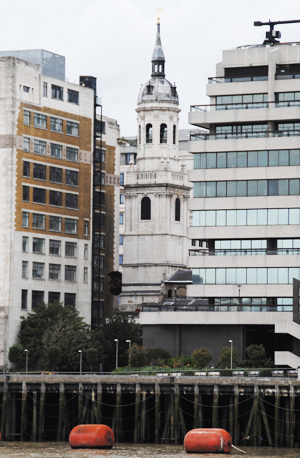
Like many other churches in the City, St Mary-le-Bow has been repeatedly repaired and rebuilt – following damage in a tornado in the late 11th century, the collapse of its tower in 1271, and, of course, the Great Fire of London in 1666 – Wren’s subsequent rebuilding included the construction of the fine great tower (pictured here against the backdrop of more modern City buildings, it was his second tallest structure after St Paul’s and was built to accommodate the Bow bells ). The church’s most recent remodelling was in 1964 after it was almost completely destroyed during bombing in May, 1941.

One of the church’s most important claims to fame is its bells. These included the city’s principal curfew bell, rung at 9pm each day since at least as far back as 1363. It is said that ‘true Londoners’ or ‘Cockneys’ must be born within hearing of the Bow bells and it was the pealing of the Bow bells (or what may have only been one bell at the time) which, of course, caused thrice-mayor Dick Whittington to turn back when leaving London. The church (in particular, its curfew bell) is also among a number of City churches mentioned in various versions of the rhyming song, Oranges and Lemons.

Features inside include a memorial to the first British Governor of New South Wales in Australia, Admiral Arthur Phillip, who was born nearby, and a bronze relief of St George and the Dragon given by Norway in commemoration of the work of the Norwegian Resistance during World War II. The churchyard outside contains a statue of Captain John Smith, founder of Virginia, and former parishioner.

For an indepth history of the church, you can’t go past the rather comprehensive St Mary-le-Bow: A History.

WHERE: Cheapside (nearest Tube station is St Paul’s). WHEN: 7.30am to 6pm Monday to Wednesday (closes 6.30pm Thursday and 4pm Friday and not usually open on weekends or bank holidays)COST: Free; WEBSITE: www.stmarylebow.co.uk.

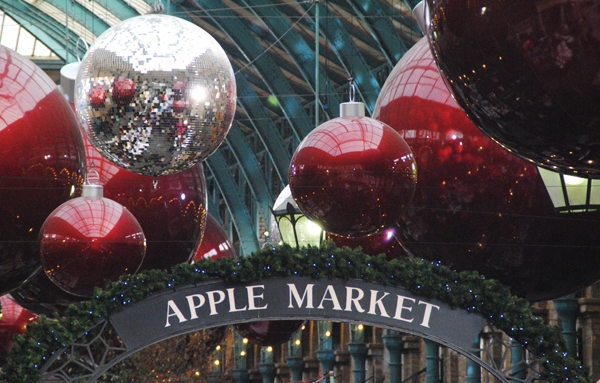
LondonLife – Giant baubles at Covent Garden…

Covent Garden is all decked out for Christmas, including the hanging of giant baubles above each of its two halls and a giant green hedge-like reindeer at the market’s eastern end. For more on Covent Garden, see our earlier ‘What’s in a name?’ entry

What’s In a Name?…Elephant and Castle

A somewhat neglected area located in the Borough of Southwark, just south-east of Borough, Elephant and Castle takes its rather odd name from a coaching inn which once stood on the site – the Elephant and Castle.

The area is more correctly known as Newington but the name Elephant and Castle was apparently adopted informally in the mid 18th century as the area rose in prominence thanks in part to the opening of Westminster Bridge.

The inn, which stood on the site of a former playhouse, was apparently rebuilt several times but there is now no sign of it – the current, rather ugly, Elephant and Castle pub which is said to stand a short distance from where the tavern once stood, was built in the 1960s.

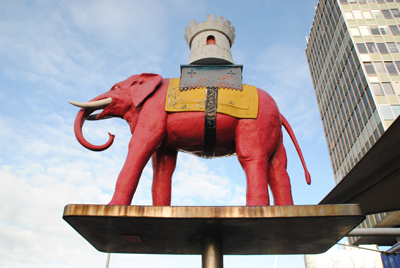
The origins of the sign of the Elephant and Castle, meanwhile, apparently comes from the mid-15th century when members of the Cutler’s Company adopted the sign of the elephant as their symbol (perhaps representing the ivory they used in their trade). The Worshipful Company of Cutlers still has an elephant carrying a castle on its back in its coat-of-arms.

The area of Elephant and Castle, meanwhile, was known for its shopping and theatres before it was heavily bombed in the Blitz. It still features a rather grim shopping mall (pictured is the sign of the elephant and castle out front) which was said to have been the first covered shopping mall in Europe when it opened in the mid-1960s – it is apparently due for demolition as part of a larger regeneration project. The area has already seen some major new developments like the the residential tower known as Strata.

Other prominent buildings include the Metropolitan Tabernacle – standing opposite the shopping centre, this was founded by preacher Charles Hadden Spurgeon in the 19th century and rebuilt after World War II (interestingly, the site of the tabernacle is where three men, known as the Southwark Martyrs, were burnt at the stake for heresy in 1557 during a period of religious persecution in the reign of Queen Mary I).

Famous residents have included Charlie Chaplin – who lived in a workhouse in the area as a child – while other notable features include a large stainless box which stands at the centre of the area’s major road intersection, linking what is now New Kent Road and Kennington Park Road (via Newington Butts) with roads leading to Lambeth, Westminster, Waterloo and London Bridges among others (this is actually a memorial to scientist Michael Faraday, who was born in nearby Newington Butts). The area also boasts its own Tube station, Elephant & Castle.

Lost London: Gates Special – Ludgate

We’re launching a new ‘Lost London’ special looking at some of the now disappeared gates of London. First up is Ludgate which once stood on the western side of the city.

The gate is believed to have been constructed in Roman times and is known to have been rebuilt a several times – once in 1215 and another time after it was destroyed in the Great Fire – before being demolished in 1760 to allow for the road to be widened.

The origins of the name – which is today commemorated in street names like Ludgate Hill and Ludgate Circus – are sketchy but may have been named after the mythical pre-Roman King Lud, who was, so the legend goes, buried underneath this portal (this myth was popularised by the 12th century writer Geoffrey of Monmouth). Others have suggested ‘lud’ is a corruption of ‘flud’ or ‘flood’ and the gate was so named because it prevented the city being flooded by the River Fleet. Another possibility is that ‘lud’ is simply an old English word for a postern gate, a small secondary gate.

Whatever the origins of its name, it has been suggested it was through Ludgate that William the Conqueror passed when first entering the city. In 1377 it became a prison for petty criminals like debtors and trespassers – serious criminals were sent to Newgate – and this lasted until its final destruction.

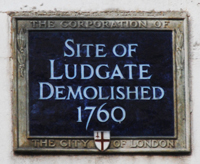
There is a blue plaque on the wall of the church of St Martin-within-Ludgate in Ludgate Hill marking where Ludgate once stood (pictured above). It is believed that some badly corroded statues standing under a porch at the church of St Dunstan-in-the-West on Fleet Street are of Lud and his sons and were taken down from the gate before its demolition. William Kerwin’s statue of Queen Elizabeth I which dates from 1586 sits in a niche on the front of the church is also believed to have been removed from Ludgate.

Around London – Dickens’ supernatural leanings at the British Library; Art Fund looking to relocate Shop in a Bottle; HMS Belfast closed; and, Winter Wonderland returns to Hyde Park…

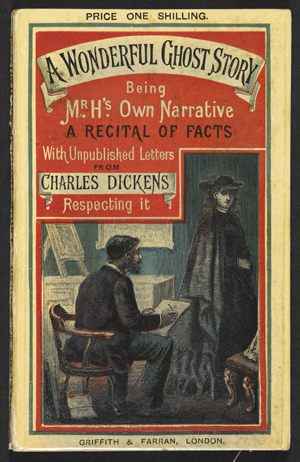
• Next year – 7th February to be precise – marks 200 years since the birth of celebrated 19th century novelist Charles Dickens and to mark the bicentenary, London institutions are among those across the country organising a raft of exhibitions under the banner of Dickens 2012. First up for us is a new exhibition launched this week at the British Library. A Hankering after Ghosts: Charles Dickens and the Supernatural explores the way in which Dickens used supernatural phenomena in his works (remember the ghosts of A Christmas Carol anyone?), while at the same time placing them in the context of the “scientific, technological and philosophical debates of his time”. The exhibition includes a letter from Dickens to his wife Catherine written in 1853 (this alludes to a disagreement which arose between them after Catherine became jealous of the attention Dickens was paying to another lady; he apparently used mesmerism to treat Catherine’s “nervous condition”), an article in an 1858 Household Words magazine in which Dickens questions the motivation of the spirits who supposedly tapped out messages to spiritualists, and, a 1821 copy of The Terrific Register: or, record of crimes, judgements, providences and calamities, a publication which was one of Dickens’ favorite reads as a youth. There is a range of accompanying events including talks by Dickens’ biographer Claire Tomalin (author of Charles Dickens: A Life) and John Bowen, author of Other Dickens: Pickwick to Chuzzlewit. Admission is free. Runs until 4th March. For more, see www.bl.ukImage: Courtesy of British Library

• The Art Fund has launched an appeal to have Yinka Shonibare’s Ship in a Bottle, currently sitting atop Trafalgar Square’s fourth plinth, relocated to a permanant home outside the National Maritime Museum in Greenwich. The fund, which has kick started the campaign with a £50,000 grant, needs £362,500 to buy the work – a scaled down replica of Nelson’s flagship, HMS Victory – which has been on display in Trafalgar Square since May, 2010, but is due to be removed in January next year. The replica work features 80 cannon and 37 sails, set as on a day of battle, and is made out of materials including oak, hardwood, brass, twine and canvas. For more, see www.artfund.org/ship/.

• The historic ship HMS Belfast, moored on the Thames between London Bridge and Tower Bridge, has been closed until further notice after a section of gangway which provides access to the ship collapsed earlier this week. Two contractors received minor injuries in the collapse and staff and visitors were evacuated by boat. The HMS Belfast is described as the most significant surviving Royal Navy warship from World War II and later served in places like Korea. It contains extensive displays on what life was like aboard the vessel. Keep on eye on www.iwm.org.uk for more information.

Now On: Winter Wonderland in Hyde Park. Hyde Park’s annual festival of all things Christmas is on again and this year’s festive offerings include, an ice rink, circus, giant observation wheel, rides and the chance for younger people to visit Santa Land as well as a plethora of opportunities to purchase presents at the Angels Christmas Market and warm-up with some of the fare available at eateries including the Bavarian Village, English Food Fair, and Spiegel Saloon. Winter Wonderland is free to enter and open between 10am and 10pm daily. Runs until 3rd January. For more, see www.hydeparkwinterwonderland.com.

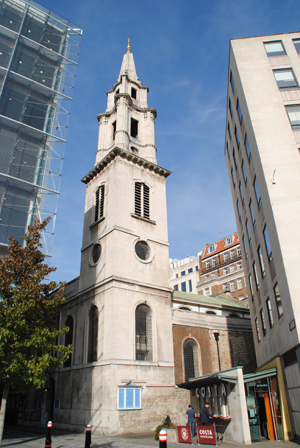
10 curiously named churches of London – 2. St Vedast-alias-Foster

This strangely named church has its origins at least as far back as the 12th century when it was under the jurisdiction of the Prior and Convent of Canterbury. 
The name St Vedast is in itself unusual – St Vedast (known as St Vaast elsewhere) is said to have been the Bishop of Arras in northern France during the late fifth and early sixth centuries. How his name came to be associated with a church in London remains a matter of speculation but one plausible explanation is that the church was founded in the twelfth century by a small group of French merchants who had emigrated from Arras.

The ‘alias Foster’ part of the name is perhaps easier to explain although it has led to considerable confusion over the years. While some have in the past suggested the name refers to a different obscure saint – that is, the church is dedicated to St Vedast and St Foster – Foster is actually just an corrupted Anglicised version of Vedast.

But back to the church’s history. The medieval building was apparently replaced at the beginning of the sixteenth century and in the early 1600s this was enlarged and “beautified”. It escaped total destruction during the Great Fire of London but was badly enough damaged to require restoration and this was carried out, albeit not very well, so that in the late 1600s, Sir Christopher Wren was asked to rebuild it.

Given the demands of Wren’s time elsewhere, it’s not known if he personally designed the resulting church (the spire is possibly the work of Nicholas Hawksmoor), but the church was rebuilt and stood until 194o when the body of the building was ruined in the Blitz. The spire, however, survived and the restoration of the remainder of the church was completed in 1962.

It was also after World War II that the city parishes were reorganised and St Vedast-alias-Foster was united with three other former parishes – St Alban Wood Street, St Anne & St Agnes, St Lawrence Jewry, St Mary Aldermanbury, St Michael-le-Querne, St Matthew Friday Street, St Peter Chepe, St Olave Silver Street, St Michael Wood Street, St Mary Staining, St Mary Magdalene Milk Street, St John Zachary, and St Michael Bassishaw, of which only the buildings of St Lawrence Jewry and St Anne and St Agnes remain along with the tower of St Alban Wood Street).

Although the bulk of the building of St Vedast-alias-Foster is modern, the church does retain its seventeenth century Great West Doors and the font also comes from that century, having been designed by Wren and carved by Grinling Gibbons for the church of St Anne and St Agnes. The reredos which stands behind the altar, meanwhile, is inscribed with the Ten Commandments, the Lord’s Prayer and The Creed, and originally stood in St Christopher-le-Stock Parish Church in Threadneedle Street. Other features to come from other churches include the seventeenth century pulpit (All Hallows, Bread Street) and swordrest (St Anne and St Agnes).

The church’s Fountain Courtyard features part of a Roman floor found under St Matthew Friday Street and a stone (actually baked brick) upon which is inscribed cuneiform writing. The latter, which comes from a Zigurrat in modern Iraq built in the 9th century BC, was presented to Canon Mortlock, rector of the church, marking his work with novelist Agatha Christie and her husband, archaeologist Sir Max Mallowan and was found during his 1950-65 dig on the site. The lump of stone bears the name of Shalmaneser who reigned from 858 to 834 BC.

Famous figures associated with the church include John Browne, sergeant painter to King Henry VIII, Sir Thomas More, Lord Chancellor of King Henry VIII who was born in nearby Milk Street, and Thomas Rotherham, rector of the church from from 1463-48 and later Archbishop of York and Lord Chancellor of King Edward IV.

WHERE: 4 Foster Lane (nearest Tube station is St Paul’s). WHEN: 8am to 5.30pm weekdays/11am to 4pm Saturday (Mass is held between 12.15 and 12.45 weekdays and a sung Eucharist at 11am on Sundays) COST: Free but a donation of at least £1 per head is asked; WEBSITE: www.vedast.org.uk.
Where is it? #12

The latest in the series in which we ask you to identify where in London this picture was taken and what it’s of. If you reckon you know the answer, leave a comment below. We’ll reveal the answer early next week. Good luck!

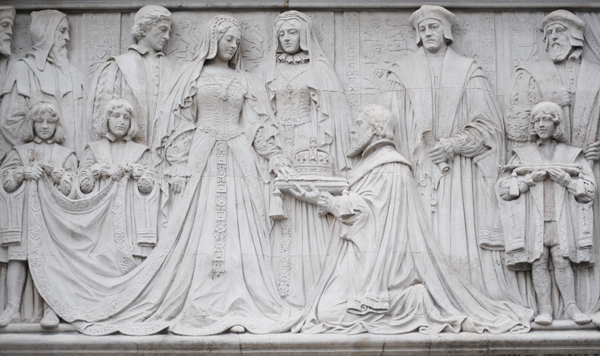
And the answer is…this is part of the decorative facade of the Middlesex Guildhall which stands opposite the Houses of Parliament in Parliament Square. The building, which dates from 1912-13 and stands on the former site of the Westminster Abbey Sanctuary Tower and Old Belfry (where fugitives from the law could seek sanctuary), is now home to the Supreme Court and the Judicial Committee of the Privy Council.

Designed by architect James Gibson, it is the latest in a series of buildings which stood on the site which have served as courthouses and the headquarters of the Middlesex County Council (the first Middlesex Guildhall was built here in 1889). Described by Nikolaus Pevsner as “art nouveau Gothic”, it features a series of medieval-looking decorative friezes and sculptures by Henry Charles Fehr.

The image pictured above shows one of the friezes – this one of the Duke of Northumberland offering the ill-fated Lady Jane Grey the Crown (known as the “Nine Days Queen”, she was later imprisoned and eventually executed on 12th February, 1554). Others show King John handing the Magna Carta to the English barons and the granting of the charter of Westminster Abbey.

It was refurbished for use of the Supreme Court in 2007 and the court has occupied it since its creation in 2009.

Interestingly, according to Ed Glinert of The London Compendium, it was here that courts martial were held of those suspected of giving aid to the enemy during World War I.

Around London – New Year’s Eve fireworks; a Resurrectionist diary; and, Russian architecture at the Royal Academy…

Plans for this year’s New Year’s Eve fireworks – marking the beginning of the year in which London hosts the Olympic and Paralympic Games – have been announced by the Mayor of London, Boris Johnson. The EDF London Eye on South Bank will once again form the focus of the fireworks display and those wishing to attend have been warned to take their places early with some areas filling up by 9pm or 10pm. Parents with young children are advised to consider attending fireworks displays closer to home (for more, see www.london.gov.uk/newyearseve). The display will be followed by a parade on New Year’s Day (for more, see www.londonparade.co.uk). Meanwhile, the annual Christmas Tree lighting ceremony will take place next Thursday. The tree is a gift from the people of Oslo, the Norwegian capital, given annually for more than 60 years in recognition of Britain’s support during World War II.

On Now – The Diary of a Resurrectionist. This month marks the 200th anniversary of an intriguing diary which offers insights into the work of a group of grave robbers and to mark the moment, the Hunterian Museum at the Royal College of Surgeons of England is hosting an exhibition featuring extracts from the diary and charting the rise and fall of grave robbing. The exhibition, which is being hosted in the Library Reading Room, runs until 22nd December. There is a special lecture by Kirsty Chilton at the museum from 7pm tonight (24th November, entry fee applies). For more, see www.rcseng.ac.uk/museums/exhibitions/index.html.

• On Now – Building the Revolution: Soviet Art and Architecture 1915-1935. The Royal Academy of Arts is hosting this exhibition which looks at the avant-garde architecture which appeared in Russia from 1922 to 1935, and its design origins in the earlier flowering of Constructivisit art which emerged around 1915. Large scale photographs, taken by Richard Pare, are juxtaposed with relevant Constructivisit drawings and paintings as well as vintage photographs. A reconstruction of Vladimir Tatlin’s Monument to the Third International (known as Tatlin’s Tower) has been built in the Annenberg Courtyard to coincide with the exhibition. Runs until 22nd January. Admission charge applies. For more, see www.royalacademy.org.uk.

10 curiously named churches of London – 1. St Andrew-by-the-Wardrobe

Look a little deeper and you’ll find there’s often a fascinating story behind many of London’s seemingly odd place names. Churches are no exception and in this new series we’re looking at some of the stories behind the name. First up, it’s the church of St Andrew-by-the-Wardrobe, a rather austere-looking church which looms up over Queen Victoria Street.

While the present church largely dates from after World War II – it was bombed during the Blitz and only the outer walls remain of what was there before (the previous church was itself a rebuild to the designs of Sir Christopher Wren after an earlier version was burnt down in the Great Fire of 1666) – there has apparently been a church on the site since at least the 12th century. Indeed, in the 13th century it was associated with the then royal residence known as Baynard’s Castle.

The church’s rather unusual name owes its origins to King Edward III’s decision in 1361 to move the Royal Wardrobe – which included his state robes and other valuables – from the Tower of London to a new building which lay near to the church (there’s a plaque in nearby Wardrobe Place marking the former location of the King’s Wardrobe which also burnt down in the Great Fire and was subsequently relocated). Hence St Andrew-by-the Wardrobe.

While the interior of the church is a complete reconstruction of Wren’s original, it does still boast some early treasures including  an original pulpit as well as a font and cover of Wren’s period (these come from the now long gone church of St Matthew Friday Street), a figure of St Andrew dating from about 1600 and another of St Ann (mother of Mary), who is holding her daughter who is in turn holding Jesus, dating from about a century earlier. There’s also a royal coat of arms – dating from the Stuart period – which originally came from St Olave’s Old Jewry.

Among the most prominent residents in the church’s parish was the playwright William Shakespeare (there’s a rather odd oak and limewood memorial to him and a contemporary composer, singer and musician, John Dowland – who was  buried in the churchyard, inside). Another Shakespearian contemporary, Ben Jonson, also apparently lived in the parish. The church also has links with with the Mercers, Apothecaries and Blacksmiths livery companies.

Earlier this year St Andrew-by-the-Wardrobe, which is a sister church to St James Garlickhythe (another unusually named church), celebrated 50 years since its post war reopening in 1961.

WHERE: Access is via St Andrew’s Hill or Queen Victoria Street (nearest Tube stations are St Paul’s and Mansion House). WHEN: The church building and the Chapel of St Ann are normally open for visitors between 10am and 4pm weekdays while the nave is open on Fridays from 11am to 3pm (check with the church before going); COST: Free; WEBSITE: www.standrewbythewardrobe.net.