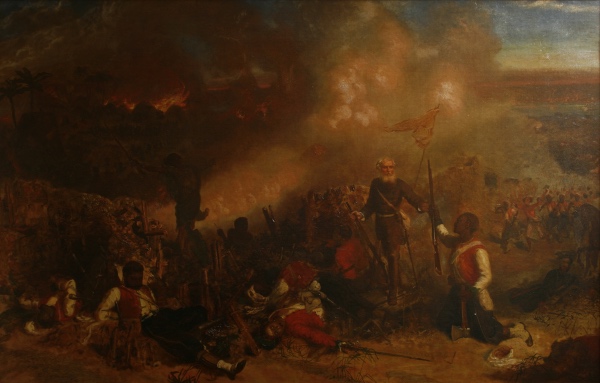
• Soldiers of African and Caribbean descent who fought for the British Empire in the 19th century as part of the West India Regiments are the subject of a new display at the Museum of London Docklands. Fighting for Empire: From Slavery to Military Service in the West India Regiments focuses particularly on the story of Private Samuel Hodge, the first soldier of African-Caribbean descent to receive the Victoria Cross, Britain’s highest military honour. Central to the display in the museum’s ‘London, Sugar & Slavery’ gallery, is Louis William Desanges’ painting, The Capture of the Tubabakolong, Gambia 1866 (pictured above), which gives greater prevalence to the British commanding officer Colonel George D’Arcy than to Hodge and which was never displayed with Desanges’ other military paintings in the Victoria Cross Gallery at the Crystal Palace in the 1870s. The exhibition also includes prints, ephemera and maps. Runs until 9th September next year. Admission is free. Meanwhile, this weekend the museum is hosting a Maritime Music Festival celebrating the Docklands’ proud maritime heritage. The festival offers the opportunity to try your hand at a poetry rhyming session, learn knot tying skills and listen to sea shanty crews performing. The festival runs from noon to 4pm on Saturday and Sunday. Entry is free. For more, see www.museumoflondon.org.uk/docklands.
• An English Heritage Blue Plaque has been unveiled at the former South Kensington home of artist Francis Bacon. Bacon moved to the converted Victorian coach house at 7 Reece Mews in 1961. He kept a studio on the first floor and lived at the property, described as “insanely eccentric”, until his death in 1992. Among significant works he completed there was his first large-scale triptych, Three Studies for a Crucifixion, in 1962 as well as portraits including his 1966 work Portrait of George Dyer Talking. Six years after Bacon’s death in 1992, his studio and its entire contents – including the walls, doors, floor and ceiling – were removed and recreated in The Hugh Lane Gallery in the city of his birth, Dublin. The property is today in the care of The Estate of Francis Bacon. Meanwhile, another Blue Plaque was unveiled this week, this time commemorating Sister Nivedita. She was one of the most influential female figures in India, an Indian independence campaigner and someone who helped introduce Hindu philosophies to a western audience. The plaque can be found at 21A High Street in Wimbledon, where Nivedita stayed with Swami Vivekananda in 1899. For more on Blue Plaques, see www.english-heritage.org.uk/visit/blue-plaques/.
• The first UK exhibition dedicated to the works Finnish artist Akseli Gallen-Kallela has opened at The National Gallery. Lake Keitele: A Vision of Finland centres on the work titled Lake Keitele which, acquired by the gallery in 1999, is one of four versions, all of which have been reunited for the first time in the UK in this display. They are some of the dozen or so works in the exhibition which spans 30 years of Gallen-Kallela’s career. The free show, which can be seen in Room 1 until 4th February, marks the centenary of Finland’s independence. For more, see www.nationalgallery.org.uk.
Send all items for inclusion to exploringlondon@gmail.com



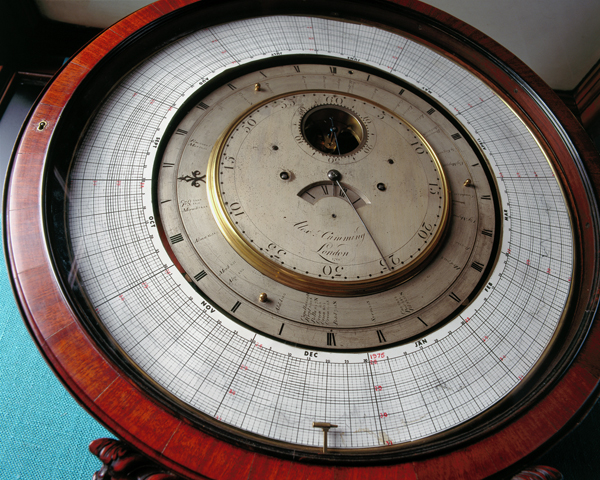
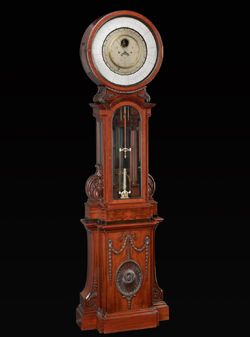 Dating from 1766, the clock (pictured) sits in a seven foot tall decorated case, believed to have been made by London cabinet-maker Thomas Chippendale. Inside is a barograph – comprised of two tubes of mercury in which a float rises and falls as atmospheric pressure changes and the data is recorded on the clock dial which rotates once a year.

 conservationist and influential figure in the Arts and Crafts movement” as well as being the father of world famous writer Rudyard Kipling – opens at the V&A in South Kensington on Saturday. The exhibition is the first exploring the life and work of Kipling (1837-1911) who campaigned for the preservation of Indian crafts as well as being a craftsman himself (his terracotta panels can still be seen on the exterior of the V&A) and an illustrator of his son’s books. Lockwood Kipling: Arts and Crafts in the Punjab and London features paintings of the Indian section of the 1851 Great Exhibition as well as objects which were on display (the exhibition was visited by Kipling while a teenager), Kipling’s sketches of Indian craftspeople observed during his many years living in India as well as objects he selected for the V&A while there, designs and illustrations for books, and furniture he helped his former student architect Bhai Ram Singh design for royal residences Bagshot Park and Osborne. The free exhibition, a collaboration between the V&A and the Bard Graduate Centre in New York, runs until 2nd April (it will be on display at the Bard Graduate Center, New York, from 15th September this year). For more, see
 Exploring London