Famous Londoners – David Garrick…

Playwright. Actor. Theatre manager. David Garrick stands out as a towering figure of the theatrical world in the 18th century and is remembered, at least in part, for his friendship with the irrepressible lexicographer Samuel Johnson.

Born on 19th February, 1717, in Hereford to an army officer (with French Huguenot roots) as the third of five children, Garrick attended school in Lichfield, north of Birmingham, including, at the short-lived Edial Hall School where Dr Johnson himself taught Latin and Greek. It was during his youth that he first took an interest in the stage, appearing in George Farquhar’s The Recruiting Officer.

When the school closed due to lack of funds, Garrick accompanied Dr Johnson to London (they had become friends) and there he and his younger brother Peter established a wine business (Peter eventually went back to Lichfield to run part of the business from there). While the business wasn’t a great success, Garrick took to acting in amateur theatricals and eventually – according to Peter Thomson, writing in the Oxford Dictionary of National Biography – made his professional debut acting incognito in a pantomime in London in March, 1741, although Garrick apparently said placed his debut in Ipswich that summer when he was acting in Thomas Southerne’s Oroonoko, or the Royal Slave (meanwhile the first performance of one of his dramatic works – Lethe, or Aesop in the Shades – had taken place at Drury Lane the previous year).

His breakthrough role came later that year – in October – when he appeared in London on the stage of the unlicensed Goodman’s Fields Theatre in the title role of Richard III. Soon acclaimed by the likes of Alexander Pope and William Pitt as the greatest actor of his time, further roles followed at Goodman’s Fields and at the famous Drury Lane Theatre as well as in Dublin (where he started an ultimately ill-fated love affair with Irish actress Peg Woffington who returned with him to London where he continued acting at Drury Lane).

Having also performed for a season, at the rival Covent Garden Theatre, in April 1747, Garrick entered into a partnership with James Lacy for the ownership of the Drury Lane Theatre. The first performance was apparently by Garrick himself, reading Ode to Drury Lane Theatre, on dedicating a Building and erecting a Statue, to Shakespeare – a piece written by Dr Johnson.

It was two years later – on 22nd June, 1749 – that he married a German dancer Eva Marie Veigel. They lived at a house at 27 Southampton Street and Garrick’s increasing wealth led him to buy a country property in Hampton, today in south west London, in 1754 which became known as “Garrick’s Villa”. Considerably altered, the Grade I-listed property still stands there today (albeit having suffered extensive damage in a 2008 fire) along with the summerhouse he built to house his collection of Shakespearian memorabilia – known as Garrick’s Temple to Shakespeare, it’s open to the public over from April to October.

Meanwhile, as well as managing the theatre, Garrick continued acting and writing plays. In September, 1769, he staged the Shakespeare Jubilee in Stratford-upon-Avon, celebrating 200 years since the playwright’s birth – even though it was five years too late and was ultimately a bit of a disaster, he took his celebration of Shakespeare back to Drury Lane and there it was a huge success.

Garrick, who moved from Southampton Street into the newly built Adelphi Terrace in 1772, remained manager of Drury Lane until his retirement in 1776 during which time it became widely acknowledged as the country’s leading theatre. He died at home on 20th January, 1779. His wife outlived him by 43 years. The couple had no children. Garrick was subsequently interred in Poet’s Corner, Westminster Abbey – the first actor to receive the honour.

Garrick’s legacy was enormous – not only is he famed for bringing a new ‘realistic’ style to the profession he so loved, he set new standards in the arts of public relations and was also an instrumental figure in having Shakespeare recognised as England’s national icon. Legend goes that he was also the actor responsible for the phrase “Break a leg!” – apparently so engrossed in a performance of Richard III that he overlooked the fact he’d fractured his bone.

Garrick’s name lives on in the Garrick Theatre (still operating in Charing Cross Road) and the Garrick Club, and there’s memorial to him on his former home in Adelphi Terrace.

Around London – 1863 FA Minute Book at BL; marking International Slave Remembrance Day at the NMM; Kenwood House concerts; and Dylan at the NPG…

FA-Cup-Minute-BookThe 1863 FA Minute Book forms the centrepiece of a new display at the British Library marking the 150th anniversary of The Football Association. Handwritten by Ebenezer Cobb Morley, the minute book contained the 13 original rules of football and is valued at £2.5 million. It is being displayed along with other football related artefacts – such as a Guide for Referees from the 1930s – in the Sir John Ritblat Treasures Gallery alongside the Magna Carta, Shakespeare’s First Folio and Captain Scott’s diary and is the first time the library has had a football-themed display. The Football Association was formed on 26th October, 1863, at the Freemason’s Tavern in London with the meeting documented in the minute book which also records the establishment of The FA Cup and the first international football match. Football Rules, entry to which is free, runs at the British Library in King’s Cross until 17th December. For more, see www.bl.uk. For more on the FA’s 150th anniversary, check out www.thefa.com.

As mentioned last week, Hidden London kicks off today and runs over this August bank holiday weekend. The second year it’s been held, the initiative is your chance to see some of the country’s finest museum collections and archives.  To see what’s on, head to www.hiddentreasures.org.uk/?page_id=118.

The National Maritime Museum tomorrow marks International Slavery Remembrance Day tomorrow with a series of free family-oriented events. The programme, which takes place at the museum and around Greenwich, involves music, workshops, talks and walking tours and will culminate in a commemorative ceremony by the River Thames. The day falls on the date of the first successful slave uprising in the western hemisphere which took place in Haiti on 23rd August, 1791, and led to the island’s independence. For more, see www.rmg.co.uk/national-maritime-museum/.

English Heritage’s season of concerts at Kenwood House beside Hampstead Heath kicks off this weekend. Live by the Lake features artists including Suede and Keane, an outdoor live screening of Singin’ in the Rain featuring the Royal Philharmonic Concert Orchestra, Opera Alfresco and An Evening of Gershwin. Events run until 1st September. For more, see www.english-heritage.org.uk/daysout/properties/kenwood-house/.

Pastel portraits by Bob Dylan go on show at the National Portrait Gallery in the West End from Saturday. Bob Dylan: Face Value features 12 new works by singer/songwriter and the portraits represent characters, some of which are real and some fictitious. Dylan, who has 110 million record sales to his name, has been sketching and drawing since childhood but only starting exhibiting his portraits six years ago. The exhibition, in Room 40, is free and runs until 5th January. For more, check www.npg.org.uk.

Around London: Masques of the Stuart Court; saving London’s heritage; IEDs at the NAM; and, Eighties fashion at the V&A…

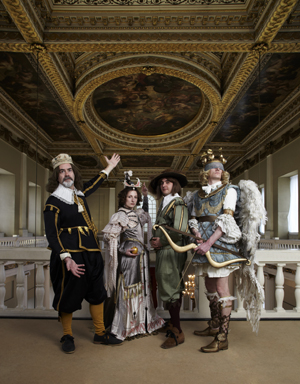
Stuart-masque-at-Banqueting-HouseThe sights and sounds of the elaborate masques of the early Stuart Court – described as a cross between a ball, an amateur theatrical, and a fancy dress party – are being recreated at the Banqueting House in Whitehall. Historic Royal Palaces have joined with JB3 Creative to create an “immersive theatrical experience” for visitors to the building – one of the last surviving parts of the Palace of Whitehall – with the chance to try on costumes, learn a masque dance and witness performance rehearsals for Tempe Restored, last performed in the building in 1632. Inigo Jones will be ‘present’ as masque designer to talk about his vision for the performance. Weekends will also see musicians performing period music and on 27th July there will be a one-off evening event at the Banqueting House based on Tempe Restored. Admission charge applies. Performing for the King opens tomorrow and runs until 1st September. For more, see www.hrp.org.uk/BanquetingHouse/. PICTURE: HPR/newsteam.

A new exhibition looking at how some of London’s great Georgian and Victorian buildings were lost to bombs and developers before, after and during World War II – and how people such as poet John Betjeman campaigned to save them – opened in the Quadriga Gallery at Wellington Arch near Hyde Park Corner yesterday. Pride and Prejudice: The Battle for Betjeman’s Britain features surviving fragments and rare photographs of some of the “worst heritage losses” of the mid-20th century. They include Robert Adam’s Adelphi Terrace (1768-72) near the Strand, the Pantheon entertainment rooms (1772) on Oxford Street, and Euston Arch (1837). The English Heritage exhibition runs until 15th September. Admission charge applies. For more, see www.english-heritage.org.uk/daysout/properties/wellington-arch/.

IEDs (Improvised Explosive Devices) will be ‘uncovered’ in a new exhibition opening tomorrow at the National Army Museum. Unseen Enemy will tell the stories of the men and women in Afghanistan who search for, make safe and deal with the impact of the IEDs through personal interviews, images and mementoes. The exhibition has been developed with “unprecedented access” from the British Army, Royal Air Force and Royal Navy and will include a range of equipment used in detecting and disarming the devices, such as bombsuits and robots as well as medical equipment used to help those injured in explosions. The exhibition is free. For more, see www.nam.ac.uk.

On Now: Club to Catwalk – London Fashion in the 1980s. This exhibition at the V&A explores the “creative explosion” of London fashion during the decade and features more than 85 outfits by designers including John Galliano, Vivienne Westwood and Katherine Hamnett as well as accessories by designers such as Stephen Jones and Patrick Cox. While the ground floor gallery focuses on young fashion designers who found themselves on the world stage, the upper floor focuses on club wear, grouping garments worn by ‘tribes’ such as Fetish, Goth, High Camp and the New Romantics and featuring clothes such as those worn by the likes of Boy George, Adam Ant and Leigh Bowery. The exhibition also includes a display of magazines of the time. Entry charge applies. Runs until 16th February, 2014. For more, see www.vam.ac.uk. Meanwhile, tomorrow (Friday) night the V&A will celebrate the 25th anniversary of designer Jenny Packham with a series of four free catwalk shows in its Raphael Gallery. Booking is essential. Head to the V&A website for details.

Lost London – Wyld’s Great Globe…

This former fixture of Leicester Square featured a giant globe containing in its innards a detailed physical relief map of the earth’s surface.

The-Great-GlobeThe globe was the brainchild of James Wyld (the Younger), a Charing Cross cartographer and map publisher as well as an MP and Geographer to Queen Victoria, who originally planned on exhibiting it at the Great Exhibition of 1851.

At more than 60 feet high, its proposed dimensions, however, meant it would be too big to be housed inside the Crystal Palace being erected in Hyde Park (besides which, Wyld did want to use the globe to promote his map business, something which was frowned upon by the exhibition’s organisers).

So he turned to Leicester Square and, after a rather complicated series of negotiations with the owners of the gardens, was granted permission locate the globe there for 10 years. An exhibition hall large enough to house the globe – and the globe itself – was hastily constructed in time for the Great Exhibition (and the increased visitor numbers it would draw). It opened on 2nd June, 1851, one month after the Great Exhibition.

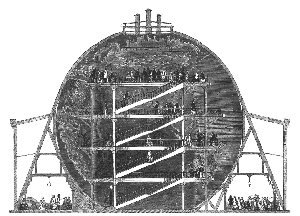
Inside the gas-lit interior of the globe – entered through four loggias – were a series of galleries and stairways which people could climb to explore the concave surface of the earth depicted – complete with plaster-of-Paris mountain ranges and other topographical details, all created to scale – on the inner side of the great orb.

Initially a great success (visitor numbers are believed to have topped a million in its first year), its appeal faded after a few years amid increasing competition from other attractions such as Panopticon of Science and Art (more of that in an upcoming post) and Wyld was obliged to introduce other entertainments to keep the public satisfied. Wyld himself was among those who gave public lectures at the site.

When the lease expired in 1862, the exhibition hall and the globe were both demolished and the globe sold off for scrap. Wyld, meanwhile, apparently didn’t keep his promise to return the gardens to a satisfactory state but after much wrangling over their fate, they were eventually donated to the City of London.

 PICTURE: The Great Globe in cross-section from the Illustrated London News, 7th June, 1851 (via Wikipedia).

Around London – Celebrating London’s architecture; space at the NMM; Tate Britain redux; remembering Waterloo at Apsley House; and, ‘Coins and the Bible’ at the British Museum…

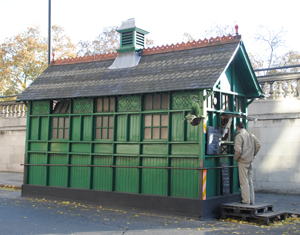
Cabmen's-ShelterThe London Festival of Architecture has returned with a month long celebration of the city’s built form in a program of events including talks, tours and exhibitions. Among the latter is Lesser Known Architecture – A Celebration of Underappreciated London Buildings – a free exhibition at the Design Museum which runs until 22nd July and looks at 10 structures ranging from London Underground Arcades and Cabmen’s Shelters (one of which is pictured) to Nunhead Cemetery. Other events include an exhibition at Somerset House – Nicholas Hawksmoor: Methodical Imaginings – looking at churches designed by Hawksmoor in the late 17th and early 18th centuries (this runs until 1st September), and The Secret Society – A Sculptural Banquet, a large scale installation by artist and designer Kathy Dalwood at Pitzhanger Manor in Ealing, west London (ends this Sunday). For more on the festival, check out www.londonfestivalofarchitecture.org or for fringe events, http://londonarchitecturediary.com.

A new exhibition featuring more than 100 images from space – including images of the colourful dust clouds in which new stars are formed, the aurora on the surface of Saturn and the sight of Earth from the International Space Station – opens at the National Maritime Museum in Greenwich tomorrow. Visions of the Universe takes visitors on a “visual trip through our solar system” with images of the moon, sun, plants and distant galaxies. It looks at the development of telescopy and photography and examines our understanding of our place in the cosmos. Space scientists including Astronomer Royal Sir Martin Rees and The Sky at Night‘s Chris Lintott introduce each section of the exhibition which has at its centre a 13×4 metre curved wall known as the ‘Mars Window’. It has the latest images from NASA’s Mars Curiosity Rover projected onto it. There is a programme of events accompanying the exhibition which runs until 15th September. For more, see www.rmg.co.uk.

Tate Britain is undergoing an overhaul this year with the opening of new galleries and a rearrangement of the institution’s collection. Last month, a new chronological presentation of the institution’s British art opened across more than 2o of the institution’s galleries. BP Walk through British Art features around 500 artworks, dating from the 1500s to present day, by artists ranging from Sir Joshua Reynolds and William Hogarth to JMW Turner, John Constable, Lucien Freud and David Hockney. Meanwhile new galleries have opened dedicated to the works of sculptor Henry Moore and artist William Blake. Around 30 of Moore’s works are featured in the rooms as well as more than 40 of Blake’s works. For more see www.tate.org.uk.

Apsley House, regency home of the Duke of Wellington, is hosting a series of events every weekend in June in the lead-up to the anniversary of the Battle of Waterloo. Interpreters will be at the house, known as Number 1 London, this weekend to discuss the dress and manners of the era while next weekend (15th and 16th June) visitors have the chance to meet some of Wellington’s soldiers and their wives. Gentry from the Napoleonic era will be celebrating the victory at Waterloo on 22nd and 23rd June while on the final weekend of the month, the focus will be on the 200th anniversary of the Battle of Vitoria in 1813, which led to eventual victory in the Peninsular War. For more, see www.english-heritage.org.uk/daysout/properties/apsley-house/.

On Now: Coins and the Bible. This free exhibition at the British Museum looks at how money was referred to in the Old and New Testament, and the use of Christian symbols such as crosses or monograms derived from Greek letters on later coins. These include the first coin, dating from about 450 AD, to depict an image of Jesus (the coin, on loan from the Hunterian Museum in Glasgow, is included in the exhibition). There are also early Biblical fragments on papyrus and vellum lent by the British Library and an ivory panel dating from the early 400s AD which includes an image of the purse of 30 pieces of silver Judas received after his betrayal of Jesus. Held in Room 69a, the exhibition runs until 20th October. For more, see www.britishmuseum.org.

10 Historic London Garden Squares…6. Grosvenor Square

Grosvenor-Square-1

The largest square in Mayfair, Grosvenor Square was laid out in the 1720s on the orders of  Sir Richard Grosvenor of Cheshire.

Sir Richard owned the Grosvenor Estate, a considerable tract of land in London’s west which includes in its northern part the land upon which the square was created (the estate is now owned by Gerald Cavendish Grosvenor, the 6th Duke of Westminster).

It’s proximity to Hyde Park and Whitehall quickly made it, like many other historic squares, a fashionable place for politicians to live – among those who lived here in the late 18th century were three prime ministers.

The oval-shaped gardens in the middle of the square – which was only opened to the public in 1948 – were once home to a statue of King George I but this was removed at some point. Originally thought to have been laid out by gardener John Alston, they took on their current form in 1948 when they were redesigned by architect BWL Gallannaugh (interestingly, Grosvenor Square is also said to have been the last part of London to exchange gas lighting for electric lighting).

There’s almost no residential buildings on the square these days but among the most prominent buildings (in fact it dominates the west end of the square) is the US Embassy. Designed by Eero Saarinen, the building was completed in 1960 with US President John F Kennedy one of the first visitors.

Grosvenor-Square-2The hulking embassy is only one of the many American connections to the square, connections which at one point led to it being known as “Little America”. Dwight Eisenhower, commander of the US armed forces in World War II, based his headquarters at number 20 in 1944, while number nine – one of the few residences to survive – was home to John Adams, first American ambassador to the Court of St James and later the country’s second president.

The American theme, which has meant the square has been the focus of demonstrations such as those protesting the Vietnam War as well as outpourings of support such as in the wake of the September 11 attacks, is also evident in the statutory in the square’s gardens with grand, full size statues of  President Franklin D. Roosevelt (a bronze by William Reid Dick unveiled by Eleanor Roosevelt on the third anniversary of the president’s death – 12th April, 1948 – it is pictured above), President Eisenhower (a bronze by Robert Dean dating from 1989), and President Ronald Reagan (unveiled on 4th July, 2011, pictured right).

On the eastern side of the garden square is the September 11 Memorial Garden opened in 2003 while on the south side is the Monument to the Eagle Squadrons, the three RAF squadrons in World War II mostly composed of American volunteers before the US entered the war. There’s also a set of memorial “Diplomatic Gates”, installed in 1984 to commemorate the bicentennial of the Treaty of Paris and honour US and UK politician who have worked in the service of peace.

Other notable buildings include number one, the Canadian High Commission (previously the US embassy); and number four, one of  square’s oldest houses. Now demolished, number 44 was the home of the Earl of Harrowby and where the British Cabinet were dining when word arrived of Wellington’s victory at Waterloo.

LondonLife – Celebrating the 60th anniversary of Queen Elizabeth II’s coronation…

Regent-Street-turns-purple-to-celebrate-The-Queen’s-Coronation-

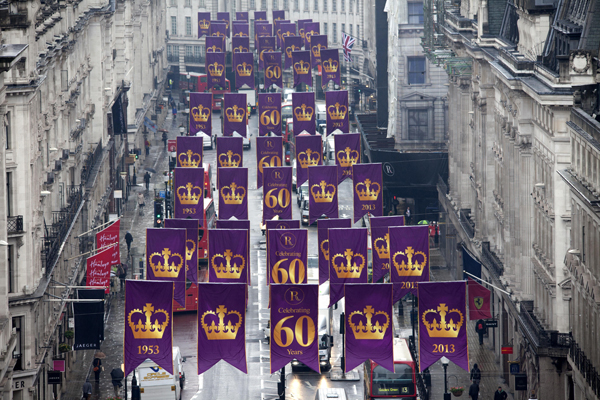
Regent Street is adorned with flags in celebration of the 60th anniversary of Queen Elizabeth II’s coronation, among the many ways in which London has been celebrating the occasion. The official anniversary was on Sunday – it was 2nd June, 1953, some 16 months after the 25-year-old Queen took the throne following the death of her father King George VI, that Queen Elizabeth II was crowned in Westminster Abbey. In celebrations yesterday, the King’s Troop Royal Horse Artillery fired a 41-gun salute in Green Park at midday followed an hour later by a 62-gun salute fired by the Honourable Artillery Company across the River Thames from the Tower of London. The Queen and other members of the royal family (along with some 2,000 guests) is attending a special service at Westminster Abbey today (for more on how the abbey is celebrating the event, see our earlier post here). More than 8,000 people attended the coronation which was watched by an estimated 27 million people across the country. PICTURE: RegentStreetOnline


10 Historic London Garden Squares…5. Berkeley Square…

Berkeley-Square

Located in the south-west of Mayfair in London’s West End, Berkeley Square was originally laid out by architect William Kent in the mid 1700s.

It takes its name from the Berkeley family of Gloucestershire (the first Lord Berkeley of Stratton was a Royalist commander in the Civil War) whose London residence, Berkeley House, stood on what is now the south side of the square until it was destroyed in a fire in 1733 (Devonshire House, whose residents included the 5th Earl of Devonshire and his somewhat notorious wife Georgiana, was subsequently built on the site and remained there until it was demolished in the 1920s).

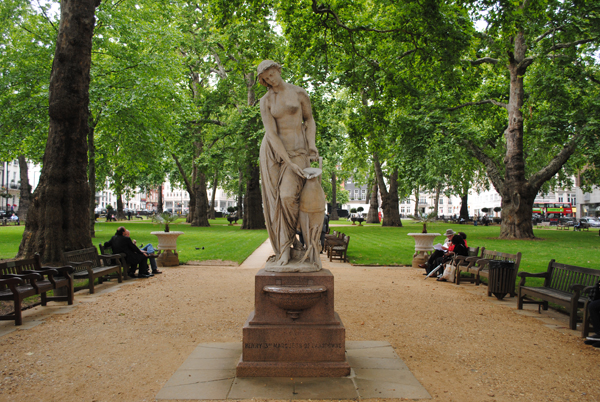
The gardens, which feature some of the city’s oldest London Plane trees (dating from 1789), have a pump house at the centre which was built in 1800 and is now Grade II listed (it stands on the site of an earlier equestrian statue of King George III). Other features including the statue Lady of Sumaria (Water Carrier) – pictured above – which was made by Pre-Raphaelite sculptor Alexander Munro in 1858 and stands at the garden’s southern end.

Among notable buildings which face onto the square are Lansdowne House – located on the south-west corner of the square, it was designed by Robert Adam and now home of the Lansdowne Club – and number 50 Berkeley Square, home of short-lived early 19th century PM George Canning (and said to be the most haunted house in London). The square was also the home of society favorite, Gunter’s Tea Shop, which dated from the mid-1700s.

Famous residents have included wartime PM Sir Winston Church (he lived at number 48 as a child); Horace Walpole, some of the first Prime Minister Robert Walpole (he lived at number 11 during the 1700s), Robert Clive (more famously known as Clive of India, he committed suicide in number 45 in 1774), and the fictional Bertie Wooster and his valet Jeeves (creations of author PG Wodehouse). The square also featured in the famous wartime song, A Nightingale Sang in Berkeley Square.

The square is open from 8am daily with closing times varying based on the season.

Lost London – The Egyptian Hall…

The-Egyptian-HouseThe Egyptian Hall was a London institution located in Piccadilly. 

Built in 1812, the temple-like structure was drawn up by architect Peter Frederick Robinson and was one of the first buildings in England design in a style resembling that found in ancient Egyptian architecture. It had been commissioned by William Bullock, originally a goldsmith and jeweller who was collector of curiosities and had previously founded a museum in Liverpool.

Having relocated to London in 1809, he established a new museum at an existing property in Piccadilly before deciding to build the Egyptian Hall as a purpose-built museum (shown here is an image of The Egyptian House in Penzance, Cornwall, which was built in 1835 in imitation of The Egyptian Hall and gives some sense of what the Egyptian Hall must have looked like).

Bullock’s collection of thousands of items – including arms and armour and objects brought back by Captain James Cook on his expeditions to the southern hemisphere – was housed in the new museum, also known variously as Bullock’s Museum or the London Museum, after its opening (at least until 1819 when Bullock auctioned the collection off) and the hall was also used to house exhibitions.

Perhaps the most famous exhibition held there was in 1816, when hundreds of thousands visited an exhibition of Napoleonic memorabilia including the bullet-proof carriage of the Emperor Napoleon captured at Waterloo. Other exhibitions included the display of artworks by the likes of Benjamin Haydon and JMW Turner and in 1822, Bullock held an exhibition of some of the artefacts he himself had collected during a visit to Mexico.

Bookseller George Lackington bought the hall in 1825 and continued to use the premises for exhibits but the tone gradually changed and the premises became more associated with the display of such ‘curiosities’ as Siamese twins Cheng and Eng, the ‘living skeleton’ – Frenchman Claude Amboise Seurat, General ‘Tom Thumb’, an entire family of Laplanders (they apparently gave lectures on their lifestyle) and the entire skeleton of a mammoth.

Having already been hired by performers and lecturers for shows relating to magic and spiritualism over the latter half of the 18th century, when the building later came into control of the Maskelyne family this association was formalised and the building was renamed England’s Home of Mystery.

In 1905, the building was demolished and flats and offices built on the site at 170-173 Piccadilly.

For more on William Bullock and the Egyptian Hall, check out William Bullock: Connoisseur and Virtuoso of the Egyptian Hall: Piccadilly to Mexico (1773-1849).

Around London – Tudor and Stuart fashion; Wellington Arch treasures; Hunterian celebrates 200 years; Regent Street and the world; and, Kaffe Fassett at the FTM…

Queen-Henrietta-Maria-(Royal-Collection)A landmark exhibition looking at fashion in the Tudor and Stuart eras opens at The Queen’s Gallery, Buckingham Palace, tomorrow. In Fine Style: The Art of Tudor and Stuart Fashion features everything from a diamond ring given by King Charles I to his then 19-year-old wife Henrietta Maria, an ornate set of armour which belonged to 13-year-old Henry, Prince of Wales (the older brother of King Charles I – he died of typhoid fever at the age of 19), and a diamond-encrusted box in which Queen Mary II kept black fabric patches worn to conceal blemishes or highlight the creaminess of skin. A 58.5 carat pearl, named ‘La Peregrina’ (‘The Wanderer’) and given to Queen Mary I as an engagement gift from Philip II of Spain (and later presented to Elizabeth Taylor by Richard Burton on Valentine’s Day, 1969), is also among the objects on show along with a pendant featuring a miniature of Queen Elizabeth I. The exhibition also features more than 60 portraits from the Royal Collection showing the fashions of the time, including a portrait by Sir Peter Lely of court beauty Frances Stuart, Duchess of Richmond, who famously refused to become King Charles II’s mistress. Admission charge applies. Runs until 6th October. For more, see www.royalcollection.co.uk. PICTURE: Sir Anthony van Dyck, Queen Henrietta Maria, 1609-69. Royal Collection Trust/© 2013, Her Majesty Queen Elizabeth II.

A medieval crozier and bejewelled ring discovered in Cumbria in 2010 are on public display for the first time in a new exhibition at Wellington Arch. The artefacts, which were discovered at Furness Abbey, are featured in an English Heritage exhibition, A Monumental Act: How Britain Saved Its Heritage, which explores how the Ancient Monuments Act of 1913 helped protect Britain’s historical fabric. Other objects in display include some of the historic artefacts found in the 20 years following the act – a Roman bronze weight from Richborough Roman Fort in Kent and a 13th century sculpture of Christ found at Rievaulx Abbey in Yorkshire. Admission charge applies. The exhibition runs until 7th July. For more, see www.english-heritage.org.uk/daysout/properties/wellington-arch/.

The Hunterian Museum at the Royal College of Surgeons is celebrating its bicentenary this year and to mark the occasion, they’re holding a free exhibition focusing on the museum’s collections of human anatomy and pathology; natural history and artworks. The display will consider how the objects in the collection have informed the medical world and fallen under the gaze of visitors who have included surgeons as well as monarchs. The exhibition in the Qvist Gallery at the museum in Lincoln’s Inn Fields opens on Tuesday, 14th May, and runs until 9th November. For more, see www.rcseng.ac.uk/museums/hunterian.

The world comes to Regent Street this Sunday with the ‘InsureandGo The World on Regent Street’ festival. Representatives from countries including Argentina, Egypt, Trinidad and Tobago, Turkey and China as well as the UK will showcasing the best of each country’s culture, music and dance, art, food and fashion. Activities will include tango lessons from Argentina, professional henna drawing from Egypt, a steel band from Trinidad and Tobago, and a Chinese drumming performance and lion dancing. The street will be closed for the day. For more, see www.regentstreetonline.com.

On Now: Kaffe Fassett – A Life in Colour. This exhibition at the Fashion and Textile Museum in Bermondsey Street celebrates the work of American-born artist Kaffe Fassett and features more than 100 works including nine foot wide knitted shawls, coats and throws, patchwork quilts and a ‘feeling wall’ where visitors can touch the textiles on display. Admission charge applies. Runs until 29th June. For more, see www.ftmlondon.org.

10 Historic London Garden Squares…3. Soho Square…

Soho-Square

Originally named King’s Square in honour of King Charles II, Soho Square was laid out on what had been known as Soho Fields as a residential square with a garden at its centre in the late 1670s – part of the general demand for homes that came about after the Great Fire of London in 1666.

A fashionable place to live when built, among the early mansions was Monmouth House, a grand mansion originally built for James Scott, the Duke of Monmouth (and illegitimate son of King Charles II who lost his head after leading a rebellion against King James II) and later used by the French ambassador before it was demolished in the 1770s. Two of the square’s original homes are located at numbers 10 and 15.

A number of trees and shrubs were recorded as being planted here including cherry, peach and almond trees as well as lilacs, jessamine and honeysuckle – it’s suggested these may have been chosen by botanist Sir Joseph Banks who lived at number 32 from 1777 until his death in 1820.

King-Charles-IIThe square, which was opened to the public in 1954, is today at the heart of the West-End district of Soho, once synonymous with late night entertainment including the sex industry but also home to a growing number of film and media-related organisations (for a look at the derivation of the name Soho, see our earlier post).

Indeed, a number of media companies are based in the square itself – British Movietone, which was produced the Movietone news, was located here at number 22 for years while current inhabitants include Twentieth Century Fox (located in a building at number 31-32 where the botanically minded Linnean Society once met).

Other buildings of note in the square include the French Protestant Church, built in 1891-93 and located at numbers eight and nine and St Patrick’s Church, located at on the corner of Soho Square and Sutton Row. While a chapel was first consecrated here in 1792, the current building dates from the 1890s (reopened in 2011 after a £3.5 million restoration) and has catacombs which spread a considerable distance under the square. In a nod to less savoury aspects of the square’s past, the White House Brothel was also located here – at number 21 – in the late 18th century (the building is now known as Manor House).

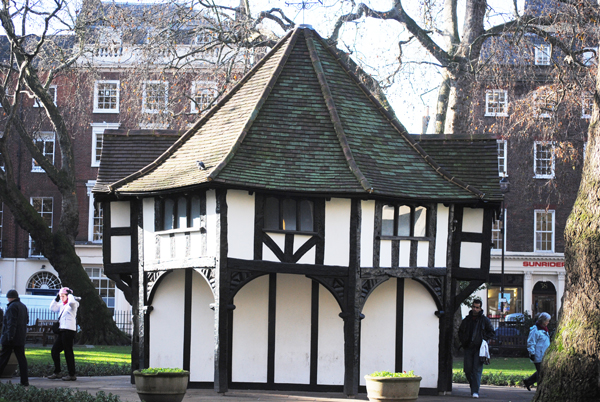
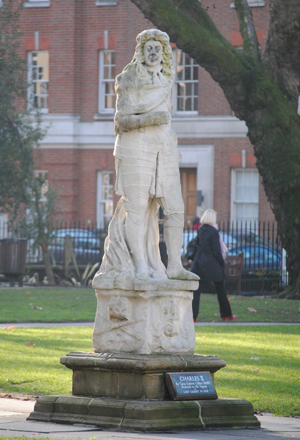
The oldest statue in the square is that of Caius Gabriel Cibber’s King Charles II which dates from 1681 (pictured right) – a reminder of the square’s past name.  Originally part of a larger monument containing a fountain, it was removed in 1875 to make way for the distinctive half-timbered Tudor-style hut (pictured above) used by gardeners which, having been rebuilt in the 1930s, currently sits at the square’s centre and only returned to the gardens in 1938. There’s also a bench in the square which commemorates the late singer Kirsty MacColl, writer of the song Soho Square.

For more on London’s squares, see Gary Powell’s Square London.

10 Historic London Garden Squares…1. Leicester Square…

In the first of a new Wednesday series looking at historic London garden squares, we take a look at what next to Trafalgar Square, is the most famous square in the entire city – Leicester Square.

Located in the heart of the West End, Leicester Square’s history finds its origins back in the 17th history when Robert Sidney, the 2nd Earl of Leicester acquired property on the site where the square now stands. Then known as St Martin’s Field and located within the parish of St Martin’s, Sidney purchased four acres in 1630 and constructed Leicester House on land now located at the square’s northern end.

Leicester-SquareThe earl raised the ire of locals, however, when – having subsequently fenced off the land to prevent people from wandering on to his property – he enclosed what had previously been common land.

The people appealed to King Charles I who appointed three members of the Privy Council to look at the issue. Their decision? That the earl keep a section of his land open for the use of the parishioners of St Martin’s.

First known as Leicester Field, it was this land which later became known as Leicester Square. Fine homes were built around the square (its proximity to the Royal Court and centre of government made it a desirable place to live for the well-to-do and those seeking influence) with the centre enclosed with rails (it’s pictured here in 1750).

The square’s reputation also had a royal boost when, in 1717/1718, Leicester House became home to Prince George (later King George II) and his wife Princess Caroline along with their court after the prince fell out with his father King George I and was banished from St James’ Palace (this story is recounted in marvellous detail in Lucy Worsley’s terrific book, Courtiers: The Secret History of the Georgian Court).

The prince remained at the house for 10 years and was proclaimed King George II after his father’s death at its gate. Interestingly, King George II’s eldest son, Prince Frederick, also lived here for a time after he too fell out with his father (King George II). Apparently their relationship was even worse than the previous generation’s had been.

Despite its royal attractions, even at this stage the square apparently had it’s darker side with some less than savoury characters attending the hotels and livery stables that were built there. But things were to get worse as the wealthy moved out – a situation not helped when Leicester House was demolished in the 1790s.

Leicester Square became known as an entertainment venue in the 19th century (among attractions was the short-lived Royal Panopticon of Science and Art which showcased the best in science and art and Wyld’s Great Globe which contained a gigantic model of the earth) and received a new injection of life when theatres and music halls moved in, bringing the crowds back with them.

Shakespeare-StatueMeanwhile, the status of the square – and whether it could be built upon – remained a matter of debate well into the 19th century. That ended in 1874 when businessman Albert Grant bought the freehold of the land, had the garden created upon it and then donated it to the Metropolitan Board of Works as a gift to the city.

Responsibility for the management of the square now rests with the City of Westminster. The square area – which is now known for hosting film premieres as well as the tourists who inevitably gather there – was pedestrianised in the 1980s and has just undergone a redevelopment and modernisation which was unveiled last year.

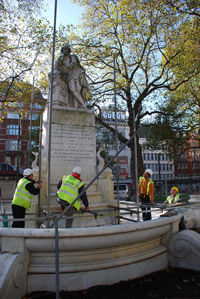
Meanwhile, work to restore the 19th century Shakespeare statue and fountain in the square’s centre is about to be completed (pictured). The square also contains a statue of actor Charlie Chaplin in the square as well as busts of scientist Sir Isaac Newton, painter and first president of the royal Academy Sir Joshua Reynolds, 18th century pioneer surgeon John Hunter, and painter William Hogarth.

The tradition of the entertainment continues in the modern era through the cinemas which now stand in the square and regularly host film premieres (an interesting, if oft-repeated, film-related anecdote connected to the square is that it was in a phone booth located at the square that during the 1960s a young actor Maurice Micklewhite saw a poster for The Caine Mutiny and decided to change his name to Michael Caine).

PICTURES (top) Wikipedia and (below) City of Westminster.

Lost London – Mrs Salmon’s Waxworks…

Before Madame Tussaud arrived in London, there was Mrs Salmon and her famous waxworks, one of several such establishments in London.

Prince-Henry's-RoomsFirst sited at the Sign of the Golden Ball in St Martin’s Le Grand – where it filled six rooms – in 1711, the display was relocated to the north side of Fleet Street where it remained until 1795 when it moved across the road to number 17 Fleet Street, now housing Prince Henry’s Room (pictured, room takes its name from Prince Henry, eldest son of the king, who died at the age of 18 and was apparently the inspiration for an inn which previously occupied the building called The Prince’s Arms).

The waxworks were apparently originally run by Mr Salmon – there are references to him being a “famous waxwork man” – but his wife, Mrs Salmon, continued it alone after his death in 1718 until her own death, variously said to have been in 1760 or as late as 1812. At some point after his death, Mrs Salmon is said to have remarried, to a Mr Steers.

Described in a handbill published soon after its initial move to Fleet Street, the exhibitions were said to include a scene of King Charles I upon the scaffold, another of the ill-fated Queen Boudicea, and more exotic tableaux including one showing Canaannite ladies offering their children in sacrifice to the god Moloch, another of a Turkish seraglio, and another of Margaret, Countess of Heningbergh with the 365 children she is said to have given birth to (all at once!). There was also a mechanised figure of the “famous English prophetess” Old Mother Shipton, who is said to have given a boot to visitors as they left.

While some accounts say the waxworks – which, according to the City of London website remained at the site until 1816 – were taken over by a Chancery Lane surgeon named Clarke after Mrs Salmon’s death (and by his wife after his death), it is also suggested that at some point they moved to Water Lane in east London where they were ruined by thieves.

Whatever its fate, it’s generally accepted that the famous waxworks were visited by the likes of James Boswell and artist William Hogarth. They were also mentioned by author Charles Dickens in David Copperfield. 

For more of London’s past, see Philip Davies’ Lost London 1870-1945.

Around London – Architects on show; Queen’s Orchard at Greenwich; first women dentist honoured; and Patrick Heron and TS Eliot at the NPG…

Regent Street is showcasing a number of architectural installations created by architects in an initiative being conducted in conjunction with the Royal Institute of British Architects (RIBA). Now in its fourth year, the Regent Street Windows project can be seen free in store windows including those of Topshop, Espirit, Jack Spade, Ferrari Store and Moss Bros until 6th May. Participating architects include Carl Turner Architects, naganJohnson architects, Gensler, Mamou-Mani, and AY Architects. Free 45 minute to one hour walking tours of the completed installations will be conducted by RIBA representatives at lunch time today, midday on Sunday and at 5.30pm next Wednesday. Prior booking is essential – email antonia.faust@riba.org for details.

The Queen’s Orchard has reopened in Greenwich Park having been restored with the addition of heritage fruit trees, new gates, pathways and ponds. The orchard dates back to the 17th century  – its name has been found on a records dating back to 1693 and now features on a new metal decorative gate which, as well as a well cover, was designed by local artist Heather Burrell along with local school students and the Friends of Greenwich Park. The heritage fruit trees, which have a provenance dating back to the 1500s, include apple, pear, cherry, plum, peach, apricot, nectarine, quince, and medlar trees. For more, see www.royalparks.org.uk.

The first woman to qualify as a dentist in Britain has been honoured by English Heritage with a blue plaque at her former home in Islington. Lilian Lindsay (1871-1960) lived at the house at 3 Hungerford Road, Lower Holloway, from 1872 until 1892 when she decided to become a dentist. Refused entry to the National Dental Hospital in London, she trained at the Edinburgh Dental Hospital and School (where she also met her husband Robert) before setting up a practice in Upper Holloway. Following her marriage, Lindsay relocated to Edinburgh where she and her husband ran a dental practice, only returning to London after their retirement in the 1920s. Both were actively involved in the British Dental Association. For more, see www.english-heritage.org.uk.

A 13-year-old photographer, Gideon Knight, is holding his first exhibition, ‘Wild About Photography’, at The Temple, Wanstead Park in Epping Forest. Self-taught, Knight has drawn on his passion for bird-watching in capturing a series of images of birds and other wildlife in a range of natural environments – from the forests of Essex to the countryside of southern Ireland. The exhibition is free. Open on weekends and bank holidays until the end of June, between noon and 5pm. You can follow Gideon at  http://earlywormbirder.blogspot.co.uk.

On Now: Patrick Heron: Studies for a Portrait of TS Eliot. On display for the first time at the National Portrait Gallery, the 10 paintings and drawings were completed in preparation for a 1949 modernist painting of the poet. They include two oil studies which have never before been seen in public. Heron secured permission to paint Eliot in January 1947 with the first sitting held two months later. Runs until 22nd September. For more, see www.npg.org.uk.

LondonLife – The Tweed Run London…

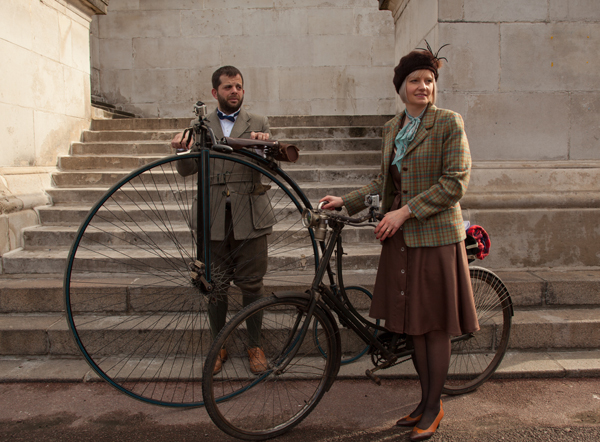
Tweed-RunThe Tweed Run London celebrated its fifth anniversary last Saturday with more than 500 taking part in the rather unusual annual event in which participants combine their passion for British fashion with their love for cycling. Among those taking part (entry was via a lottery system) on bikes of all shapes and sizes were people from as far afield as The Netherlands, Korea, Russia, Australia, Japan and even Afghanistan. The two hour ride took in Marylebone High Street, Savile Row, Regent Street, Piccadilly Circus and the Houses of Parliament before finishing at Trafalgar Square. The ride has been copied by other cities around the world including, Tokyo, Toronto and St Petersburg. For more on the Tweed Run, see www.tweedrun.comPICTURE: Selim Korycki, Tweed Run LLP.

Around London – Margaret Thatcher’s funeral; telling the Jewel Tower’s story; depot open weekend; and, Designs of the Year…

Margaret Thatcher’s funeral will be held next Wednesday at St Paul’s Cathedral from 11am with Queen Elizabeth II among those attending (the first time she has attended the funeral of a British politician since Sir Winston Churchill’s in 1965). The funeral procession of the former Prime Minister, who died on Monday aged 87, will start at the Houses of Parliament and make its way down Whitehall to Trafalgar Square before moving down the Strand, Fleet Street and Ludgate Hill to St Paul’s Cathedral. Baroness Thatcher’s coffin will carried in a hearse for the first part of the journey and will be transferred to a gun carriage drawn by six horses of the King’s Troop Royal Horse Artillery at St Clement Danes church on the Strand for the final part of the journey. There will be a gun salute at the Tower of London. Meanwhile, a Book of Condolence has opened at St Margaret’s Church, beside Westminster Abbey, this morning and will be available for people to pay their respects until 17th April, during the church’s opening hours. St Margaret’s – which stands between Westminster Abbey and the Houses of Parliament – is commonly known as the parish church of the House of Commons.

The story of the Jewel Tower – one of the last remaining parts of the medieval Palace of Westminster – is told in a new exhibition at the historic property. Now in the care of English Heritage, the tower – located to the south of Westminster Abbey, was built in 1365 to house King Edward III’s treasury, later used as King Henry VIII”s ‘junk room’, the record office for the House of Lords, and, from 1869, served was the “testing laboratory” for the Office of Weights and Measures. The exhibition, which opened this month, is part of the English Heritage celebrations commemorating the centenary of the 1913 Ancient Monuments Act. The Jewel Tower is open daily until November. Admission charge applies. For more, see www.english-heritage.co.uk.

See some of the earliest underground trains, a Lego version of Baker Street station and ride the Acton Miniature Railway. The London Transport Museum’s depot in Acton is holding it’s annual spring open weekend this Saturday and Sunday and in celebration of the Underground’s 150th anniversary, attractions will include the Metropolitan Steam Locomotive No. 1 and the recently restored Metropolitan Carriage 353 along with model displays, rides on the miniature railway, film screenings, talks, and workshops. Wales’ Ffestiniog Railway team – celebrating their own 150th anniversary – will also be present with the narrow gauge train, Prince. Open from 11am to 5pm both days. Admission charge applies. For more, see www.ltmuseum.co.uk.

Now On: Designs of the Year. The Design Museum has unveiled contenders for the sixth annual Designs of the Year competition and you can what they are in this exhibition. Consisting of more than 90 nominations spanning seven categories, the nominated designs include the Olympic Cauldron by Heatherwick Studio, The Shard – western Europe’s tallest building – by Renzo Piano, a non-stick ketchup bottle invented by the Varanasi Research Group at MIT, and Microsoft’s Windows phone 8. The exhibition runs until 7th July – the winners will be announced this month. Admission charge applies. For more, see www.designmuseum.org.

LondonLife – New pelicans fly into St James’s Park from Prague…

Pelicans

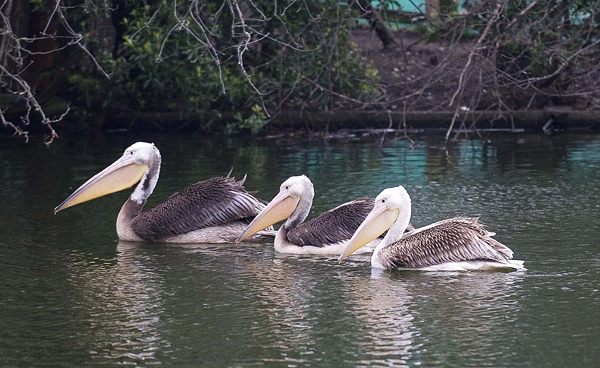
Following a tradition that dates back to 1664, three new pelicans have taken up residence in St James’s Park in front of Buckingham Palace. A gift from the City of Prague in the Czech Republic (the birds were donated by Prague Zoo), one of the pelicans is named Tiffany (in honour of New York-based The Tiffany & Co Foundation – which funded transport of the birds) while the other two have yet to be named with the public invited to join in the process by voting for their favourite name for one of the birds from a shortlist published on the Royal Parks Foundation website, www.supporttheroyalparks.org (the poll closes on 16th April). Choices include Bela, Karola, Queenie and Isla. The first pelican to live in the Royal Parks was a gift to King Charles II from the Russian ambassador in 1664 and they have been there ever since. The new arrivals, join the existing ‘scoop’ of pelican residents in the park – Gargi, Vaclav and Louis. PICTURE: Courtesy of Royal Parks Foundation.

Where is it?…#60…

Where-is-it--#60
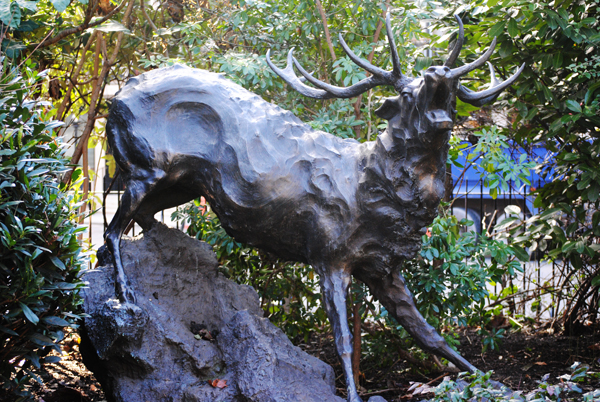
Can you identify where in London this picture was taken and what it’s of? If you think you can, leave a comment below. We’ll reveal the answer early next week. Good luck!

Well done to Jameson, this is indeed located in St James’s Square. Called – rather aptly – Stag, the sculpture dates from 2001 and is the work of Marcus Cornish. The larger-than-life bronze sculpture is located in the south-west corner of the West End square. For more on the work of Mr Cornish, see www.marcuscornish.com. Other statues in the square include an equestrian statue of King William III, the work of John Bacon Senior and Junior, which was installed in 1808.

Around London – John Snow’s legacy; a spotlight on the music hall; Alice Kettle at the Queen’s House; and, Sydney Lee at the RA…

A new exhibition on the work and legacy of John Snow – who traced the source of a deadly cholera outbreak in the 1850s to a Soho water pump – opened at the London School of Hygiene and Tropical Medicine this week. Cartographies of Life & Death – John Snow and Disease Mapping – part of a series of events planned for the bicentenary of Snow’s birth – features both historical treasures, such as disease maps from the school’s archives, and new artworks inspired by science with the entire display presented as a disease mapping ‘detective trail’. There will be a pop-up water bar and street lectures and performances. Snow (1813-1858) is considered the founder of modern epidemiology, the study of patterns and causes of health and disease in populations. His work remain influential even today. Admission is free. The exhibition runs until 17th April at the school in Keppel Street. For more, see www.johnsnow.org.uk.

A new installation at the V&A opening on Saturday will explore the rise – and fall – of the music hall. Music Hall: Sickert and the Three Graces picks up on artist Walter Sickert’s obsession with the New Bedford Music Hall in Camden Town and features film, music and objects presented in a ‘theatrical narrative’ which focuses on the world of the Edwardian Music Hall. Highlights include filmed extracts of Tanika Gupta’s specially produced play The Boy I Love (directed by Katie Mitchell) which takes its name from George Ware’s celebrated music hall song The Boy I Love is Up in the Gallery. Admission is free. The exhibition, which is in the Theatre and Performance Galleries of the V&A, runs until 5th January next year. For more see www.vam.ac.uk.

Three specially commissioned artworks by British textile artist Alice Kettle will be unveiled today at the Queen’s House in Greenwich. The Garden of England – Royal Museums Greenwich’s first contemporary arts program – features Flower Helix (hanging in the Tulip Stairs), Flower Bed (a “textile garden” found in the North West Parlour), and Queen Henrietta Maria (a stitched portrait of the wife of King Charles I also found in the North West Parlour). The display is accompanied by a program of events – for more on them, see www.rmg.co.uk. Entry is free – the exhibition is on show until 18th August.

On Now – From the Shadows: The Prints of Sydney Lee RA. This exhibition at the Royal Academy represents a reappraisal of the work of painter-printmaker Sydney Lee (1866-1949) and features more than 50 prints and two major paintings. Lee studied in Manchester and Paris before coming to London where he lived in a house and studio in Holland Park Road in Kensington. He was elected a Royal Academician in 1930 and served as Treasurer from 1932-1940. The first exhibition devoted to his art since 1945, the event coincides with the publication of the first book on Lee written by its curator Professor Robert Meyrick, head of the School of Art at Aberystwyth University. Runs until 26th May. Admission charge applies. For more, see www.royalacademy.org.uk.

Where’s London’s Oldest…wine bar?

The honour of being London’s oldest winebar goes to Gordon’s Wine Bar at 47 Villiers Street in the West End (just up from Embankment Tube Station or down from Charing Cross Station, whichever you prefer).

Gordon's-Wine-BarThe venerable establishment – still a favoured place to stop for a drink for many Londoners – opened its doors in the 1890s and still conveys a powerful sense of old world charm with the decor pretty much unchanged (there’s been no fancy makeover here) and the wine still served from wooden casks behind the bar.

The site on which the bar is located was once occupied by York House (home to, among others during its centuries of life, Robert Devereaux – 2nd Earl of Essex and favourite of Queen Elizabeth I and Sir Francis Bacon – Lord Chancellor during the reign of King James I) and then, later on, by a large house lived in by diarist Samuel Pepys in the late 1600s before, thanks to its position close to the river, a building was built upon it in the 1790s which served as a warehouse.

The usefulness of the warehouse came to an end when Victoria Embankment was built and the river pushed back and the building was subsequently used for accommodation. Writer Rudyard Kipling was among tenants who lived here (from 1889-1891 during which wrote The Light that Failed – in fact, the building was renamed after him, Kipling House, in 1950.

It was Angus Gordon, a “free vintner” meaning he didn’t have to apply for a licence thanks to the largesse of King Edward III in 1364, who established the premises in the vaults here in the 1890s (interestingly the current owners are also Gordons, but not related). Among the other uses of the building, of which Gordon’s only occupies a part, was apparently as a brothel in the 1920s.

For more on Gordon’s head to www.gordonswinebar.com.