A Moment in London’s History – Peace Day Parade, 1919…

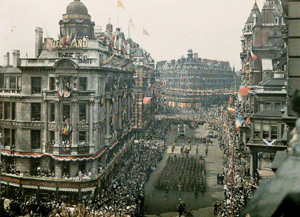
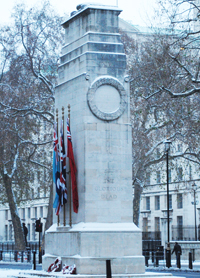
With Remembrance Sunday having been observed earlier this month, we thought it was an appropriate time to take a quick look at the Peace Day Parade of 19th July, 1919, at which the Cenotaph – the National War Memorial – was first unveiled.

London-Victory-ParadeThe parade, organised by a Peace Celebrations Committee appointed by the War Cabinet, was seen as the high point of a series of celebrations to mark the end of the war which had only officially ended on 28th June with the signing of the Treaty of Versailles.

Prime Minister David Lloyd George, on hearing French troops were to salute a ‘great catafalque’ (a raised structure upon which sits a coffin) built beside the Arc de Triomphe in honour of their war dead as part of their victory march, commissioned architect Edwin Lutyens to create a similar monument for the occasion.

Lutyens had apparently already started sketching, having been sounded out earlier about the possibility of such a structure, and eventually opted for a cenotaph, an empty tomb erected in honour of people buried elsewhere, in place of the catafalque.

The Cenotaph, one of a number of temporary structures built for the day, was unveiled in Whitehall early on the morning of Saturday, 19th July. Made of plaster and wood, it had been constructed in just two weeks (and, of course, it was replaced the following year with the stone Cenotaph which now stands there). Wreaths were soon piled high around its base.

As many as five million people reportedly turned out for the parade along a seven mile route from Knightsbridge (depicted above) through to Westminster and onto Buckingham Palace on Saturday – many of them had arrived from other parts of the country the previous night – and, eager not to miss out, had secured their space by sleeping in parks or streets overnight.

Also known as the London Victory Parade, the procession included some 15,000 Allied forces representing 12 victorious nations including, of course, Britain as well as France, the US, various European and Asian nations and small contingents from Australia, New Zealand and South Africa.

Also marching were military commanders such as Field Marshall Sir Douglas Haig – the British Commander-in-Chief, French Marshal Ferdinand Foch – Supreme Allied Commander during the last year of the war, and General John J Pershing, head of the American Expeditionary Force.

Some veterans apparently refused to take part, seeing the parade as “militaristic celebrations”.

After splitting into two columns and filing past the Cenotaph – inscribed with the words ‘The Glorious Dead”, those in the parade then marched down the Mall, which was lined with stands set aside for widows and orphans before King George V took their salute standing beneath a golden cupola erected at the base of the Victoria Memorial outside Buckingham Palace.

This Week in London – Paddington comes to town; it’s Christmas decorations time; Guards Memorial upgraded; and Grayson Perry…

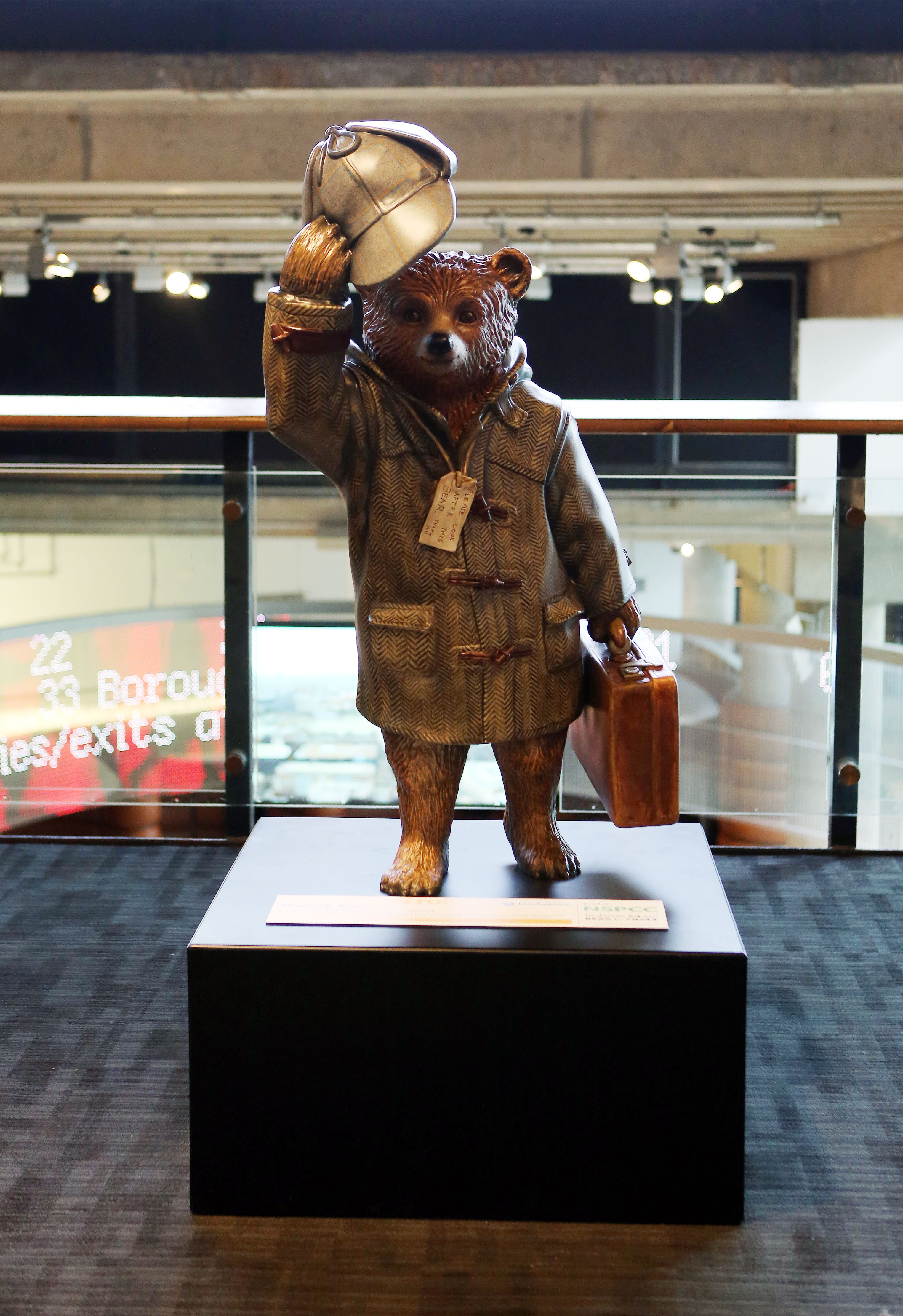
The Paddington Trail, London, 2014Paddington comes to the Museum of London in a new exhibition opening tomorrow to coincide with the bear’s big-screen debut. A Bear called Paddington charts the story of the character from his genesis on Christmas Eve, 1956, when creator Michael Bond bought his wife a small toy bear and named him after the railway station near where they loved across the next almost 60 years to today. Objects on display include: a first edition A Bear Called Paddington – dating from 1958, it belonged to Bond’s daughter Karen Jankel; an original illustration of Paddington by Paddy Fortnum; the typewriter Bond used to write Paddington at Work and Paddington Goes To Town; the original Paddington puppet from the 1970s TV animations; and, props from the upcoming film Paddington (released on 28th November). The free exhibition runs until 4th January. See www.museumoflondon.org.uk for more. The museum, meanwhile, is also playing host to a new life-sized statue of the famous bear designed by Benedict Cumberbatch (and known as Sherlock Bear for obvious reasons given Cumberbatch’s penchant for playing a certain detective – pictured). It forms just one stop on the Paddington Trail which, as the work of VisitLondon.com, NSPCC and film-makers StudioCanal, links 50 sites – each with their own statue of the bear – across the capital. Designed by everyone from Mayor Boris Johnson to football star David Beckham and actors Sandra Bullock and Hugh Bonneville, the bears can be found around town until 30th December. For more on the trail, including a map of locations, check out www.visitlondon.com/paddington/.

While the Oxford Street lights are already switched on (as are those in Covent Garden), Carnaby Street’s Christmas decorations are to be officially launched at 6.30pm tonight. The launch coincides with a shopping party (including 20 per cent discount), live music, free drinks, good bags and “trend masterclasses” with Grazia Magazine’s editor-at-large Angela Buttolph. Oh, and the decorations consist of eight red and white oversized sets of headphones and sunglasses. Meanwhile the Regent Street lights get turned on this Sunday with an event featuring a star-studded cast including Take That’s Mark Owen, Gary Barlow and Howard Donald (who are switching on the lights but not playing). While there’s entertainment along the street from noon, the music kicks off at 4pm and the lights, designed around the theme of the film Night at the Museum: Secret of the Tomb, get switched-on at 5pm and will be followed by a fireworks display. For more, see www.regentstreetonline.com.

The Guards Memorial in Horseguards Parade, Westminister, has been upgrade to a Grade 1-listed structure on the advice of English Heritage. Unveiled in 1926 by the Duke of Connaught, Senior Colonel of the Guards, and General George Higginson, a Crimean veteran, the memorial commemorates the 14,000 Guardsmen who died in the First World War. Designed by architect Harold Chalton Bradshaw and sculpted by Gilbert Ledward, it features five bronze soldiers, each representing a typical soldier from each of the divisions – Grenadiers, Coldstreams, Scots, Welsh and Irish Guards.

On Now: Grayson Perry: Who Are You? This exhibition at the National Portrait Gallery near Trafalgar Square features a series of new works created by Perry during the making of his Channel 4 TV series of the same name. Interspersed with 19th and 20th century collections of the gallery, the portraits – which include a tapestry, sculptures and pots – are of families, groups and individuals and include everyone from a young Muslim convert and Celebrity Big Brother contestant Rylan Clark. Runs until 15th March. Entry is free. For more, see www.npg.org.uk.

Send all items for inclusion to exploringlondon@gmail.com.

10 of London’s World War I memorials – 10. Grave of the Unknown Warrior, Westminster Abbey…

In this, the final in our series looking at London’s World War I memorials, we’re taking a look at one of the city’s most visited monuments – the grave of the Unknown Warrior in Westminster Abbey.

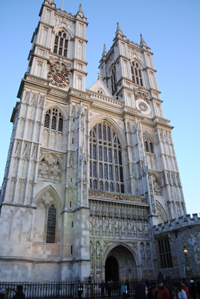
Located at the west end of the minster nave (pictured is the west front of the abbey inside of which lies the grave), the grave is that of a British soldier whose body was brought back from France and buried on the site on 11th November, 1920. The grave, which also contains soil brought from France, is covered by a slab of black marble from Belgium.
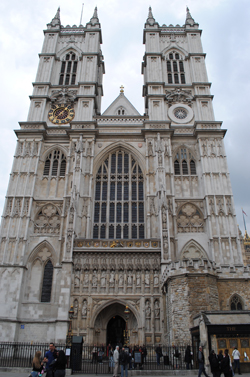
Westminster-Abbey2The slab bears an inscription written by Herbert Ryle, then dean of the abbey, which commemorates the “many multitudes” who died during World War I. “They buried him among the kings because he had done good toward God and toward his house”.

It is believed the idea for the memorial was that of a chaplain at the front during the war – Rev David Railton – who in 1916 saw a grave in northern France which featured a cross upon which was written, “An Unknown British Soldier”. He wrote to Ryle about what he’d seen and the idea for the new memorial slowly took shape – albeit with the initial misgivings of some including King George V.

Representing servicemen from the army, navy or air force from anywhere within Britain and its dominions who died in the war and have no other memorial or known grave, the unidentified body which lies in the grave is believed to have been selected at random from among a number bodies of soldiers who died early in the war – accounts suggest they numbered either four or six – and which were exhumed from battle areas at the Aisne, the Somme, Arras and Ypres.

Covered with Union flags, the bodies were taken to a chapel at St Pol on 7th November, 1920, and one selected by Brigadier General LJ Wyatt, commander of troops in France and Flanders. 

The three remaining bodies were reburied while the selected remains were placed in two coffins, the outer one made of oak harvested from a tree which had grown at Hampton Court Palace. A 16th century crusader’s sword taken from the Tower of London’s collection was placed in the wrought iron bands of the coffin and it was then covered with a flag which Rev Railton had used as an altar cloth during the war (known as the Ypres or Padre’s Flag, it now hangs nearby in St George’s Chapel at the abbey).

The coffin was then transported on the destroyer HMS Verdun to Dover and then taken by train to Victoria Station before, on the morning of 11th November, it was placed on a gun carriage drawn by six black horses and transported through massive but silent crowds which lined the streets.

Pausing at the Cenotaph in Whitehall, King George V unveiled the monument which represent an empty tomb (see our earlier post here) and placed a wreath on the coffin and then, followed by the king, other royal family members and dignitaries, it was taken to the abbey minster and lowered into the grave at a special service attended by the king, Queen Alexandra, the queens of Spain and Norway, and Prime Minister David Lloyd George and former Prime Minister HH (later Lord) Asquith (a recording made of some of the service – apparently conducted simultaneously with one at the Arc de Triomphe in Paris – became the first ever electrical recording to be sold to the public).

Thousands of mourners paid their respects at the open grave before the grave was filled in and covered with temporary stone on 18th November. The marble stone which now stands there was unveiled at a special service on 11th November the following year. A framed US Congressional Medal of Honor, conferred by General John J Pershing on the unknown warrior on 17th October, 1921, hangs from a pillar nearby.

WHERE: Westminster Abbey, Westminster (nearest Tube station is Westminster or St James’s Park); WHEN: Generally open to tourists everyday except Sunday  (times vary so check the website); COST: £18 an adult/£15 concessions/£8 schoolchildren (11-18 years), free for children aged under 11/£44 for a family (two adults, two children); WEBSITE: www.westminster-abbey.org.
LondonLife – Another perspective on a London icon…

Clock-tower


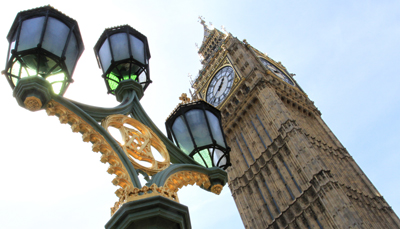
The Clock Tower of the Houses of Parliament, home to Big Ben. For more on it, see our earlier posts on the Palace of Westminster, the Clock Tower and Big Ben PICTURE: Tony Kerrigan.

10 of London’s World War I memorials – 8. The RAF Memorial…

RAF-Memorial
Aerial combat probably isn’t the first thing that springs to mind when thinking about the fighting in World War I but, as the Royal Air Force Memorial on Victoria Embankment records, air crew played a vital role.

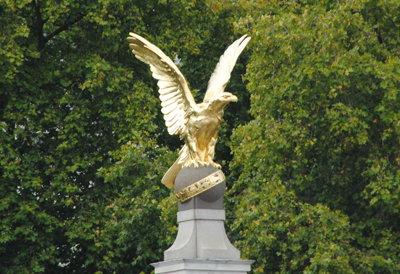
The memorial features a bronze eagle perched on an orb girded with a belt depicting the signs of the zodiac which sits atop a Portland stone pylon. It was designed by Sir Reginald Blomfield with the eagle, inspired by the RAF’s badge, sculpted by William Reid Dick. Along with the dedication, it carries an inscription from the Bible (Exodus 19:4) –  “I bare you on eagles wings and brought you unto myself” (sic).

Various other sites were apparently considered for the memorial before the location – amid a string of other memorials between Westminster and Hungerford Bridge – was settled upon (as were other designers including the renowned Edwin Lutyens).

Unveiled on 13th July, 1923, by the Prince of Wales, the memorial was dedicated to the memory of all those who gave their lives in the ranks of the Royal Flying Corps, the Royal Naval Air Service  and the Royal Air Force  (formed through the amalgamation of the RFC and RNAS at a hotel in Strand in 1918) during World War I, along with those who had died while serving in air forces from across the British Empire.

A further dedication was later unveiled in 1946 on Battle of Britain Sunday remembering the men and women of air forces from across the Commonwealth and Empire who died during World War II.

A simple, yet still evocative, memorial.

LondonLife – Admiral Arthur Phillip honoured in Westminster Abbey…

Admiral-Arthur-PhillipA memorial to Admiral Arthur Phillip, described as the “father of modern Australia”, was unveiled in Westminster Abbey back in July. Admiral Phillip (1738-1814) commanded the ‘First Fleet’ which left the UK in 1787, transporting convicts and military to the new colony Phillip founded as New South Wales. Prince Phillip, the Duke of Edinburgh, attended the memorial’s dedication service on 9th July which was conducted by the Dean of Westminster, Dr John Hall, who credited Admiral Phillip – a “modest, yet world-class seaman, linguist and patriot”- with laying the foundations “on which was developed the Commonwealth of Australia”. Among other dignitaries who attended was Dame Marie Bashir, the Governor of the Australian state of New South Wales, who described Admiral Phillip as “enlightened, far-sighted and indeed humane” and paid tribute to his attempts to actively foster harmonious relations with the Aboriginal people. Carved from Sydney sandstone, the memorial is set in the floor of the nave of the minster close to memorials of David Livingstone, Thomas Cochrane and Isaac Newton. The memorial stone is among a number of projects around Britain instigated by the Britain-Australia Society to mark the bicentenary year of Admiral Phillip’s death. For more on the abbey, see www.westminster-abbey.org. PICTURE: Andrew Dunsmore/Westminster Abbey.

Famous Londoners – Sir Edwin Lutyens…

We’re looking at some of London’s World War I memorials so it’s only fitting we look at the life of acclaimed architect Sir Edwin Lutyens, the man credited with designing the Cenotaph – the UK’s national war memorial – in Whitehall (pictured below).

Lutyens was born in London at 16 Onslow Square, South Kensington, on 29th March, 1869, and – the ninth son and 10th of 13 children of soldier Captain Charles Lutyens and his wife Mary – was named for painter and sculptor Edwin Henry Landseer, a friend of his father’s. He grew up in London and Surrey and in 1885 commenced studying architecture at the South Kensington School of Art. In 1887, he left before completing the course, briefly joining the practice of Ernest George and Harold Peto before starting his own practice in 1889.

Cenotaph-in-LondonEarly commissions included country houses and it was during this period that he met with mentor and landscape gardener Gertrude Jekyll, a relationship which led him to design her home, Munstead Wood near Godalming in Surrey.

In 1897, Lutyens, known familiarly as ‘Ned’, married Emily Lytton – daughter of the late Viceroy of India and first earl of Lytton, Edward Buller-Lytton – and by 1908 the couple had five children. The family’s London addresses included 29 Bloomsbury Square (which also served as his office), 31 Bedford Square and 13 Mansfield Street, Marylebone, while his offices were located in numerous places including at 17 Queen Anne’s Gate.

Lutyens continued designing country houses – he eventually designed more than 35 major properties and altered and added many more – and among his commissions were Castle Drogo in Devon and the refurbishment of Northumberland’s spectacularly sited Lindisfarne Castle – both now National Trust properties. He was also involved in helping to plan and design Hampstead Garden Suburb in London, work which included designing two churches.

In 1912, Lutyens was invited to advise on the planning of the new Indian capital in New Delhi and his most important contribution was the design of the Viceroy’s House which combined elements of classical architecture with traditional Indian decoration. He was knighted in 1918 for his contributions in India and for his advice to the Imperial War Graves Commission.

It was his role in this latter effort which led to his becoming a national figure. He was involved in the creation of numerous monuments to commemorate the war dead, the best known of which are the Cenotaph in Whitehall – initially commissioned as a temporary structure (see our earlier post here) –  and the Memorial to the Missing of the Somme in Thiepval in northern France as well as the Australian War Memorial at Villers-Bretonneux and the Anglo-Boer War Memorial in Johannesburg.

He also designed more than 100 war cemeteries in France and Belgium and other war memorials – including overseas in places like Dublin – as well as London’s Tower Hill Memorial (see our earlier post here). Other London buildings he designed included the headquarters of Country Life magazine in Tavistock Street, Britannic House in Finsbury Square, the head office of the Midland Bank in Poultry and the Reuters and Press Association headquarters at 85 Fleet Street (now home to the Lutyens Restaurant, Bar and Private Rooms).

Lutyens was elected a fellow of the Royal Academy in 1920 (he was later president) and in 1924 was appointed a founding member of the Royal Fine Arts Commission. Even as he continued work in Delhi, he took on other commissions – such as the British Embassy in Washington, DC – and in 1924 he completed one of his most lauded – and smallest – designs: that of the one twelfth scale Queen Mary’s Dolls’ House which was shown at the 1924 British Empire Exhibition at Wembley and which can still be seen at Windsor Castle.

In 1929 Lutyens was commissioned to design a new Roman Catholic Cathedral for Liverpool but when he died on 1st January, 1944, this work was still unfinished with only the crypt completed thanks to the outbreak of World War II broke. Lutyens’ funeral was held in Westminster Abbey a few days later and his ashes were subsequently placed in the crypt of St Paul’s Cathedral.

For more information on Lutyens’ life and works, check out The Lutyens Trust, founded in 1984 to preserve and protect his legacy.

This Week in London – Breaker’s Yard opens at Sutton House; WWI remembered; and, preparing for an Open House…

A former car breaker’s yard in Hackney has reopened as a “pocket park” of “installations and hidden spaces” following an extensive transformation project. Located next to the National Trust’s Tudor manor house, Sutton House, Breaker’s Yard incorporates elements from the site’s history including car tyres, a bus greenhouse, bespoke metal gates made out of more than 1,000 toy cars donated by celebrities, locals and artists, and a multi-storey caravan sculpture, The Grange, created by landscape designer Daniel Lobb who also designed the park in collaboration with arts-based educational charity, The House of Fairy Tales. The flower-filled park also features an ice-cream van, decorated by Rose Blake – daughter of Sir Peter Blake, which will act as a “playful shop”. The park is one of a 100 ‘pocket parks’ created under a $2 programme by the Mayor of London, Boris Johnson, in this case in collaboration with the National Trust and a host of volunteers. Entry to the park is free but admission charge applies to the house. For more on the park and Sutton House, see www.nationaltrust.org.uk/sutton-house/.

A photographic exhibition, Exploring London’s First World War Memorials, is running at City Hall near Tower Bridge in Southwark. Organised by the Mayor of London with aid from the War Memorials Trust, English Heritage and others, the exhibition is centred on new images of war memorials by London-based photographer James O Jenkins. As well as more traditional monuments, the memorials take the form of everything from fountains to paintings, buildings and landscape features. Entry is free. Runs until 12th September. For more, see www.london.gov.uk/events. Meanwhile, the Guildhall Library is showcasing images taken by photographer Simon Gregor for the Remembrance Image Project. Runs until 12th November and is part of a series of World War I commemorative events the library is running. Others include an installation by artist Rebecca Louise Law called Poppy made up of 8,000 paper poppies from the Royal British Legion. For more on World War I commemorative events at the Guildhall LIbrary follow this link.

Open House London’s programme is available for download from tomorrow (Friday, 15th August). The event, which will be held over the weekend of 20th and 21st September, will this year be conducted under the theme of ‘revealing’ and will feature more than 800 buildings, from Open House “favourites” like The Gherkin (aka 30 St Mary Axe) and the Foreign and India Office through to lesser known properties like Wandsworth’s Quaker Meeting House or the Butcher’s Hall in the City (some of which have to be booked before the weekend). There will also be a free programme of neighbourhood walks, engineering and landscape tours, cycle rides and talks by experts. To see the programme, head to www.openhouselondon.org.uk.

Send all items for inclusion to exploringlondon@gmail.com.

A Moment in London’s History – The death of Queen Anne…

Queen-Anne

While much attention is being paid this year to the fact it’s the 300th anniversary of the accession of King George I (and the House of Hanover), we thought we’d take a quick look at the event which precipitated that moment – the death of the last Stuart monarch, Queen Anne, on 1st August, 1714.

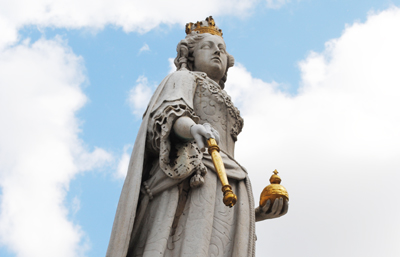
The queen (depicted here in Richard Belt’s copy of a Francis Bird original outside St Paul’s Cathedral), who had ruled since 1702 and was the first monarch of Great Britain thanks to the 1707 Act of Union, died at Kensington Palace at about 7.30am. She had apparently suffered a series of strokes, having experienced declining health for the previous couple of years (this included gout which had severely limited her mobility and saw her carried in a chair even at her coronation). She was 49.

Her body was so swollen at the time of her death that she had to be placed in a large square-shaped coffin which was carried by 14 men.

Following her funeral, on 24th August she was laid to rest next to her husband, George of Denmark (he’d died at Kensington six years before), in the Stuart vault on the south side of King Henry VII’s chapel in Westminster Abbey.

Many of the bones of her infant and stillborn children lie nearby (Anne was pregnant 18 times) and apparently due to a lack of space, only a “small stone” marks her grave site. Anne’s seated wax funeral effigy, modelled from her death mask, can be seen in the abbey’s museum.

The idiom “Queen Anne is dead” – used as a response to someone who brings old news or who states the obvious – is thought to have its origins in the idea that while news of her death was officially kept quiet so the Hanoverian succession could be shored up, news of it nonetheless leaked quite quickly meaning that by the time it was officially announced, it was already well known.

10 sites from Shakespearean London – 10: London in Shakespeare’s plays…

In this, the final in our series looking at Shakespeare’s London, we take a quick look at some of the plethora of London locations mentioned by the Bard in his historical plays. Some we have already covered, but here are a few more…

Westminster-AbbeyWestminster Abbey (pictured): We’ve already talked about Poet’s Corner but Shakespeare himself makes mention of Westminster Abbey in his plays, notably in Henry VI, Part I, when it’s the scene of Henry V’s funeral. The Jerusalem Chamber, principal room of Cheyneygates, the medieval house of abbots of Westminster is mentioned in Henry IV, Part II.

The Houses of Parliament: True, the buildings have changed somewhat since Shakespeare’s day but the former Palace of Westminster is the site of scenes in numerous plays including Richard IIHenry IV, Part II and Henry VI, Part III are set. Among rooms mentioned is Westminster Hall which survives today from the original building.

The Tower of London: As one would expect, this prominent London landmark pops up in several of Shakespeare’s plays including Henry VI, Part I and Richard III where its plays a rather central role – among the events recorded in the latter play are the infamous drowning of Richard III’s elder brother George in a butt of Malmsey wine.

Ely House: The London residence of the bishops of Ely, this long gone building is mentioned in Richard II (for more on Ely House see our earlier posts on Ye Olde Mitre Tavern here and St Etheldreda’s Church here ).

The London Stone: Now at 111 Cannon Street, the London Stone originally was located at another location in Cannon Street and its here in Henry VI, Part II, that rebel Jack Cade stops to strike his sword upon the stone (for more on the London Stone, see our earlier post here).

Other London sites mentioned in Shakespeare’s plays include generic “London Streets” (mentioned in a number of plays), “Eastcheap, near the Boar’s Head Tavern” (Henry IV, Part II), the Temple Garden (Henry VI, Part I) and Blackheath (Henry VI, Part II).

This Week in London – ‘Disobedient objects’ at the V&A; war at the Westminster Abbey; and, ‘Stranger Than Fiction’ at the Science Museum…

The role of objects as tools of social change will be explored at a new exhibition opening at the V&A on Saturday. Disobedient Objects will feature everything from Chilean folk art textiles that document political violence and a graffiti-writing robot to defaced currency, giant inflatable cobblestones thrown during demonstrations in Barcelona and a video game about the making of mobile phones. Spanning the period from the 1970s to today, it aims to illustrate how political activism has driven creativity with most of the objects on display made by amateurs. Many of the exhibits have been loaned from activist groups around the world. The free exhibition runs at the South Kensington museum until 1st February. For more, see www.vam.ac.uk/disobedientobjects.

A new exhibition of three large scale works in oil by artist Hughie O’Donoghue has opened in the Westminster Abbey Chapter House. The three works featured in The Measure of All Things exhibition are a reflection on both world wars and influenced by his father’s service in the British Army, his own visits to battlefields and a photo album he found in France depicting a young woman’s holidays in the north of that country in 1903-04. The exhibition, part of the abbey’s efforts to mark the centenary of the start of World War I, is open until 30th November. Admittance with general abbey admission. For more, see www.westminster-abbey.org.

Reality and fiction come together in a new photographic exhibition which opened at the Science Museum in South Kensington this week. Stranger Than Fiction is the first major UK exhibition by Catalan artist Joan Fontcuberta and is a collaboration between the Science Museum and the National Media Museum in Bradford. The second show to be held in the Science Museum’s Media Space gallery, it features some of Fontcuberta’s best known works including photography, film, dioramas and scientific reports presented through six independent narratives which combine the real and imagined. Runs until 9th November after which it will move to the National Media Museum in Bradford. For more, see www.sciencemuseum.org.uk.

Send all items for inclusion to exploringlondon@gmail.com.

10 sites from Shakespearean London – 8: Memorialising Shakespeare (part 1)…

Shakespeare

This week (and next week) as part of our look at Shakespeare’s London, we’re taking a look at a few of the many memorials to William Shakespeare located around London…

• Westminster Abbey: Perhaps the most famous of London’s memorials to Shakespeare can be found in Poet’s Corner, an area of the abbey which has become noted as a burial place and memorial site for writers, playwrights and poets. Designed by William Kent, the memorial statue of Shakespeare was placed here in January, 1741 (there had apparently been some earlier talk of bringing his bones from Stratford-upon-Avon but that idea was squashed). The life-size statue in white marble, sculpted by Peter Scheemakers, was erected by Richard Boyle, the 3rd Earl of Burlington, Dr Richard Mead, Alexander Pope and Tom Martin. The memorial also features the heads of Queen Elizabeth I, King Henry V and King Richard III on the base of a pedestal and shows Shakespeare pointing to a scroll on which are painted a variation of lines taken from The Tempest. A Latin inscription records the date the memorial was created and an English translation of this was added in 1977. For more on the abbey, see www.westminster-abbey.org.

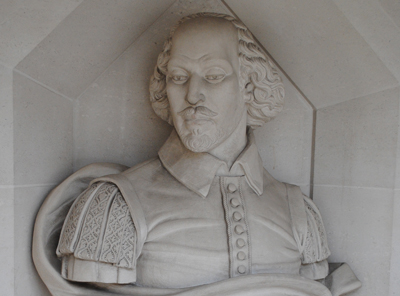
• Guildhall Art Gallery (pictured above): Facing into Guildhall Yard from niches under the loggia of the Guildhall Art Gallery are four larger-than-life busts of historical figures connected with the City of London. As well as one of Lord Protector Oliver Cromwell, architect Christopher Wren, and diarist Samuel Pepys (along with a full-length statue of Dick Whittington and his famous cat) is a bust depicting Shakespeare. Carved out of Portland stone by sculptor Tim Crawley, the busts were installed in 1999. Much attention was apparently paid to creating a bust which resembled pictures of Shakespeare. Follow this link for more on the gallery.

Former City of London School: This Thames-side building, dating from the 1880s, features a full length statue of Shakespeare who gazes out over the river. He’s not alone – poet John Milton, Sir Isaac Newton, Sir Thomas More and Sir Francis Bacon stand nearby, selected, apparently, to represent various disciplines taught at the school. The statues were the work of John Daymond who depicted Shakespeare flanked by representations of classics and poetry and drawing and music. The school vacated the building on Victoria Embankment  in the 1980s and it’s now occupied by JP Morgan.

We’ll be looking at some more works depicting Shakespeare next week…

LondonLife – Remembering London’s bridges now and then…

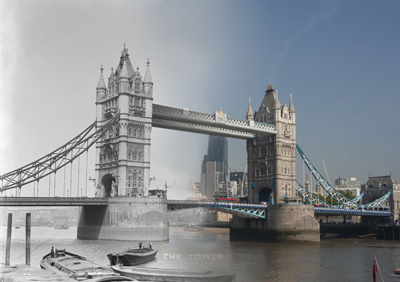
Tower-Bridge

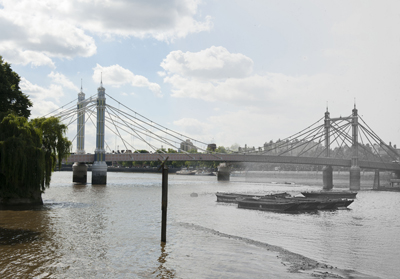
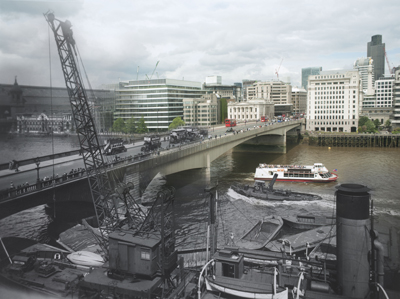
Some of 16 hybrid images showing London’s bridges old and new which have been released by the Museum of London Docklands to mark the recent opening of the museum’s new free art exhibition Bridges. The images have been created using historic photographs showcased in the exhibition which opened last Friday and runs until 2nd November. The photographs were taken by renowned late 19th and 20th century photographers, including Henry Grant, Henry Turner, Sandra Flett, Christina Broom, Roger Mayne and George Davison Reid. Above is Tower Bridge, taken by Christina Broom (c. 1903–10) from Shad Thames Jetty. For more, see www.museumoflondon.org.uk/docklands/PICTURE © Christina Broom/Museum of London.

Albert-bridge

Albert Bridge (unknown photographer), Chelsea. Glass lantern slide, c. late 19th century. © Museum of London.

Vauxhall-bridge

Vauxhall Bridge from Cambridge Wharf (taken by Albert Gravely Linney), 1928. Taken from the north bank of the Thames. © Albert Gravely Linney/Museum of London

London-Bridge

Looking north across London Bridge (taken by George Davison Reid), c. 1920s. Taken from inside on the 5th floor of No1 London Bridge. © George Davison Reid/Museum of London

Richmond-Bridge

Richmond Bridge, glass lantern slide, c. late 19th century. Taken from the south side of the river. © Museum of London.

LondonLife – Shop pops up in Carnaby Street to help Asian lions…

HeidiA new pop-up shop has appeared in iconic Carnaby Street as part of a campaign aimed at helping to save endangered Asian lions, like Heidi, pictured above.

The initiative, supported by ZSL London Zoo and Carnaby, aims to help raise £5.7 million in funds for the Zoological Society of London’s Lions400 campaign through the sale of specially designed products.

There are only some 400 Asian lions left in the wild, living in the isolated Gir Forest in Western Gujarat, India, and vulnerable to threats including disease, disaster, poaching and a growing human population. 

The funds raised in the campaign will be used to build a state-of-the-art lion breeding centre and visitor experience at the zoo – where about a million people a year come into contact with the Asian lions including Heidi – as well as being used to extend conservation work in the field.

Among the items for sale in the shop at 15 Carnaby Street (pictured below) are T-shirts, bone china pieces, notebooks and badges created by fashion designer Elizabeth Emanuel and based on her lion sketch drawings as well as animal print notebooks and cards created by pop artist Rose Hill.

As well as selling products, the shop – which is only open for six weeks – is also hosting a series of free events. On Thursday, 19th June, Phd student Simon Dures will talk about African lions and their genetics at 1pm, 1,30pm, 6pm and 6.30pm. On 3rd July, Joanna Barker, the UK and Europe Conservation Programme coordinator will talking about marine mammal conservation in the Thames Estuary at similar times and, on 17th July, Nisha Owen, EDGE Conservation Biologist will talk about EDGE (Evolutionary Distinct and Globally Endangered) species.

For more, on the campaign, see www.zsl.org/support-us/lions400. For more on Carnaby Street, see www.carnaby.co.uk.

ZSL-pop-up

What’s in a name?…Petty France…

This short street in Westminster – which runs between Buckingham Gate and Broadway – was so-named for its association with…well, the French.

Petty France literally means ‘Little France’ and, like Petty Wales, takes its name from the fact there was obviously a hub of people of a certain ethnicity – in this case, the French, living in the street.

We’ve found various theories on which French it was – from wool merchants to some of the estimated 40,000 Huguenots who had fled France for England in the 17th and 18th centuries.

In The Book of London Place Names, however, Caroline Taggart argues that because the name is first recorded late in the 15th century – long before the Huguenots started fleeing – it’s likely to be the wool merchants who settled here.
It’s been suggested Petty France at one time had its name changed to York Street after Frederick, Duke of York and son of King George II, who had a residence there.

The street is now home to, among others, the Ministry of Justice.

10 significant sites from Georgian London – 5. Horse Guards…

Horse-Guards1

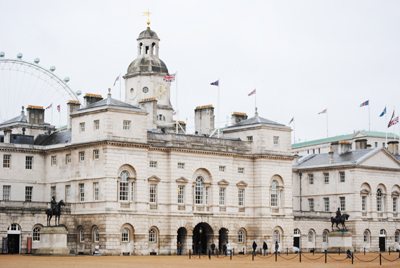
Known around the world for the stoic mounted troopers which stand guard here, this rather fanciful building straddling a site between Whitehall and St James’s Park was built in the early 1750s on land which had previously served as a tiltyard for King Henry VIII.

In the 1660s King Charles II had a barracks built here for the guards manning the entrance to what was then the Palace of Whitehall, but in 1749 it was demolished and the present building constructed.

William Kent had apparently drawn up designs but it was architect John Vardy who oversaw construction of the neo-Palladian building after Kent’s death in 1748. The windows on the St James’s Park side of the building are said to have been based on a drawing by Lord Burlington (he of Chiswick House fame – see our earlier post here).

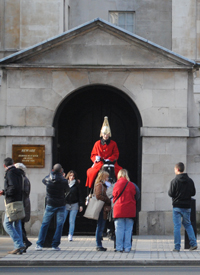
While the site previously marked the entrance to the Palace of Whitehall, it is now considered the formal entrance to St James’s Palace (although the palace is located some distance away) and, as a result, only the monarch can drive through the central archway without displaying a pass.

Horse-GuardsUntil 1904, the Grade I-listed building housed the office of the Commander-in-Chief of the Forces but the title was then abolished and replaced with Chief of the General Staff, who relocated to the War Office Building. Horse Guards subsequently became the home of the army commands of London District and the Household Division, a role it still fulfils.

As well as being the site of the daily Changing of the Queen’s Life Guard (this free event takes place at 11am every day; 10am on Sundays), Horse Guards is also now home to the Household Cavalry Museum.

Among treasures in the museum are two silver kettledrums presented to the regiment in 1831 by King William IV, a cork leg used by the first Marquess of Anglesey after his real leg was amputated following the Battle of Waterloo (and subsequently became a tourist attraction in its own right) and silverware by Faberge. Visitors to the museum can also see into the working stables via a glazed petition.

The parade ground behind the building is the site of the annual Trooping the Colour ceremony which officially celebrates the Sovereign’s birthday. Although the ceremony has only been held since 1748, it’s interesting to note that some of the birthday celebrations of Queen Elizabeth I were held in the same place.

WHERE: The Household Cavalry Museum, Horse Guards, Whitehall (nearest Tube stations are Westminster, Embankment, St James’s Park and Charing Cross); WHEN: Open 10am to 5pm (November to March)/10am to 6pm (April to October); COST: £6 adults/£4 children (aged 5-16) and concessions/£15 family ticket; WEBSITE: www.householdcavalrymuseum.co.uk.

Treasures of London – Sculptures and reliefs on 55 Broadway…

Night

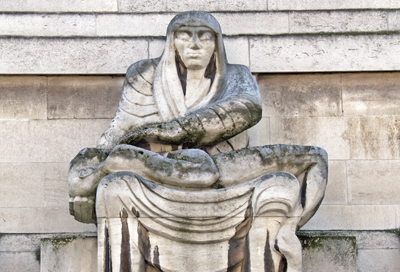
Controversial when first unveiled in the late 1920s, Jacob Epstein’s sculptures of Day and Night adorn the facade on the Grade I-listed building at 55 Broadway – home, for the present at least, to the London Underground HQ and St James’s Park Underground station.

It was the nudity and, no doubt, the stark modernist styling which provoked outrage (and newspaper campaigns) when the two sculptures – Day, depicting a seated smiling male figure with a naked boy standing in front of him and the other, Night, depicting a cowled female seated and cradling a prone, apparently resting, figure (pictured above) – were unveiled.

Such was the outcry that Frank Pick, the then head of the Underground Electric Railways Company of London (predecessor to London Underground and the organisation for whom the building was constructed), even apparently offered his resignation over it. But a compromise was reached – Epstein agreed to alter the naked figure of the boy (a rather painful snip) and the fuss soon died down. These days many people pass the building without even noticing the sculptures upon it.

Epstein’s statues aren’t the only sculptural works to adorn 55 Broadway – a series of eight smaller relief works representing the winds of each cardinal point can also be seen on the facade. All eight representations are of nude figures of different genders and were created by six different artists –  Eric Gill, Alfred Gerrard, Allan Wyon, Eric Aumonier, Samuel Rabinovitch and Henry Moore (interestingly, it was Moore’s first public commission).

It’s been reported that London Underground will be vacating the building next year with the property to be converted into rather expensive flats.

PICTURE:  Wikipedia

10 significant sites from Georgian London – 4. St Martin-in-the-Fields…

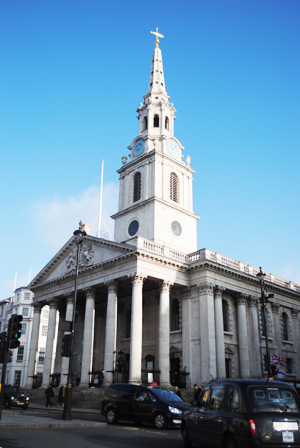
This iconic church on the edge of Trafalgar Square, known for its musical associations, is another of the works of architect James Gibbs and, as with St Mary le Strand, the current building was constructed in the first half of the 18th century to replace an earlier building.

St-Martin-in-the-fieldsThe first references to a church on the site of the present building date back to the 13th century when, constructed upon a Roman burial site, it was apparently used by monks from Westminster. It was replaced by King Henry VIII around 1542 and enlarged in 1602 before finally being demolished in 1721.

Gibbs’ apparently first suggested the design feature a round nave with a dome over the top but the proposal was rejected as too expensive and a simpler, rectangle-shaped church was subsequently agreed upon and eventually completed in 1726. Part of the design inspiration comes from Sir Christopher Wren, although Gibbs’ integration of the tower into the church was a departure from Wren’s designs (the church spire rises 192 foot into the air).

Among the features of the interior are ceiling panels in the nave which feature cherubs and shells and are the work of ceiling experts Giuseppe Artari and Giovanni Bagutti. Other items of interest include Chaim Stephenson‘s sculpture, Victims of Injustice and Violence, remembering all victims during apartheid in South Africa (it was dedicated by Desmond Tutu in 1994), a statue of St Martin and the Beggar by James Butler, and, on the porch, Mike Chapman‘s sculpture marking the millennium, Christ Child. Paintings include one of James Gibbs himself by Andrea Soldi and dating from 1800.

Among those buried in the church are furniture-maker Thomas Chippendale, sculptor Louis-François Roubiliac and notorious robber Jack Sheppard (he’s buried in the churchyard). The crypt also contains a life-sized marble statue of Henry Croft, London’s first pearly king, which was moved there from St Pancras Cemetery in 2002.

As well as being the location of the first religious broadcast, its musical heritage includes performances by Handel and Mozart and being the location of the first performance of its namesake chamber orchestra, the Academy of St Martin in the Fields.

Since the early 20th century, the church has been noted for its work with the homeless (thanks in particular to the work of Vicar Dick Sheppard). Meanwhile, its connections with music – which date back to its rebuilding – continue in the concerts held in the crypt cafe. The crypt also hosts art exhibitions.

The church underwent a £36 million renewal project in the Noughties. Additions included the new east window by Shirazeh Houshiary.

WHERE: St Martin-in-the-Fields on the north-east corner of Trafalgar Square (nearest tube stations are Charing Cross, Leicester Square and Embankment); WHEN: Open weekdays and weekends – times vary, see website for details; COST: free; WEBSITE: www.stmartin-in-the-fields.org.

Famous Londoners – Wynkyn de Worde…

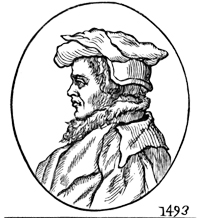
Known as the “Father of Fleet Street”, Wynkyn de Worde was key figure in the early use of the printing press in England.

Wynkyn_de_WordeBorn on the continent (candidates include Wœrth in Alsace in north-east France and Wœrden in The Netherlands), Wynkyn – whose name comes in various spellings, although it is said to have originally been Jan van Wynkyn – is believed to have become apprenticed to a printer in Cologne before meeting with famed pioneering English printer William Caxton in the early 1470s.

He apparently accompanied Caxton from Cologne to Bruges and then back to London in the late 1470s or early 1480s where he started working with Caxton at his premises in Westminster. During this period he is said to have lived with his English wife Elizabeth in a premises located with the sanctuary of Westminster Abbey (they are known to have attended St Margaret’s Church and even rented a pew there until Elizabeth’s death in 1498, after which Wynkyn is believed to have remarried.)

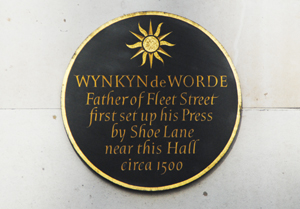
After Caxton’s death in 1492, Wynkyn took over his printing business and, around 1500, he relocated his office from Caxton’s Westminster premises to the “sign of the Sun” in Fleet Street near Shoe Lane – in fact, he is credited as being the first printer to locate in the street which becomes famously associated with publishing. There’s a plaque (pictured below), on the wall of the hall of the Worshipful Company of Stationers, located off Ave Maria Lane near St Paul’s Cathedral, commemorating the move (although Shoe Lane is located some distance away). Wynkyn later also ran a shop in St Paul’s Churchyard.

Wynkyn-de-Worde2While Wynkyn, like Caxton before him, relied on the patronage of the rich and famous (Margaret Beaufort, mother of King Henry VII among them), he also printed relatively inexpensive books in a bid to capture a wider market. In all he published more than 400 different books in at least 750 editions ranging from religious texts and poetry to fictional romantic works, educational textbooks and books aimed at children. He is noted for his use of woodcuts illustrations while his other claims to fame include being the first English printer to use italic type and the first to print music from moveable type.

De Worde died around 1534 but his legacy lives on through the mass media publishing of today (albeit not longer from Fleet Street). There is a Wynkyn de Worde Society based in Suffolk which is aimed at furthering the printing industry.

PICTURE: Wikipedia

This Week In London – Kensington Palace celebrates Christmas; plant a tree at Epping; and, the Long Range Desert Group memorial unveiled at Westminster Abbey…

Apologies we didn’t post a new instalment in our Wednesday series yesterday – it will resume next week!

Inspired by a spectacular month of partying by King William III in December, 1699, Kensington Palace is celebrating Christmas with a month of family-friendly entertainment in the Georgian State Apartments. Historic Royal Palaces has joined with games makers Hide & Seek to create Game of Crowns, transforming Kensington into a play palace with games, mummery and the chance to proclaim yourself king or queen for a day. On the weekends, there’s also the chance to join in parlour games from 1700 onward and a Christmas Day sensory room which brings to life King William III and Queen Mary II’s Christmas morning (by which time they must have been exhausted!). The palace will also play host to its largest ever Christmas tree – 30 feet tall – and on December 16th, you can join in Carols by Candlelight. Admission charge applies. Runs until 6th January. For more, see www.hrp.org.uk/KensingtonPalace/.

Epping Forest is expanding and this weekend, you have a chance to help by planting some new saplings. The City of London Corporation, which runs the forest, is creating a new area of woodland, named Gifford Wood in honour of former Lord Mayor Roger Gifford, after purchasing 30 acres of land at Upshire last year. Members of the public are invited to join City of London staff and the Friends of Epping Forest at Upshire Village Hall, Horseshoe Hill (EN9 3SP) between 11am and 1pm on Saturday to plant 2,000 new oaks and hornbeam as well as a mix of alder, birch, beech, cherry, field maple, rowan, small lime, wild apple, wild service, holly and yew. Bring your spade. For more, phone 0208 532 1010 or email epping.forest@cityoflondon.gov.uk.

A memorial to the Long Range Desert Group was dedicated in Westminster Abbey this week.  The LRDG was formed in 1940 by Major Ralph Bagnold to act as the forward intelligence arm of the British army in North Africa. The group later shared their expertise in desert navigation with the fledgling SAS (Special Air Service) who also carried out offensives in the desert from 1941. The memorial is located in the west cloister below that of the SAS. For more, see www.westminster-abbey.org.