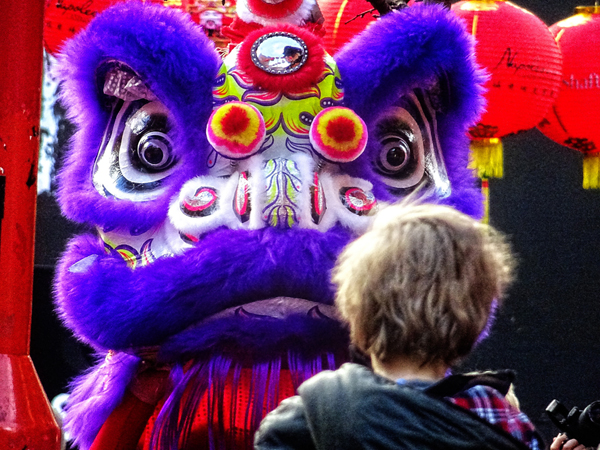
A scene from Chinese New Year celebrations heralding the Year of the Rooster held in central London last weekend. PICTURE: Garry Knight/Flickr/CC BY 2.0
A scene from Chinese New Year celebrations heralding the Year of the Rooster held in central London last weekend. PICTURE: Garry Knight/Flickr/CC BY 2.0
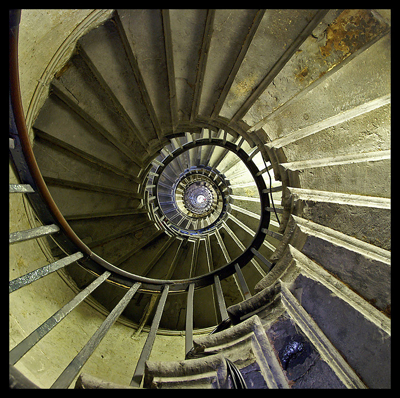
Inside The Monument, built to commemorate the Great Fire of London, in the City of London. For more on the history of The Monument. PICTURE: Flickr/CC BY 2.0.
• A charter granted by King William the Conqueror to the City of London in 1067 is on display at the City of London Heritage Gallery. The 950-year-old charter, known as the William Charter, was given by the king soon after his coronation at Westminster Abbey but before he had entered the City and is seen as key in his winning the support of the City as well as in how the City came to have its special autonomy. Written in Old English, the charter measures only 2 x 16 centimetres and has one of the earliest seal impressions of King William I. The oldest item in the City of London Corporation’s 100 kilometres of archives, it’s on display at the gallery until 27th April. For more, follow this link.
• Madame Tussauds in Marylebone has unveiled a wax figure of US President-elect Donald J Trump this week in the lead-up to his inauguration in Washington, DC, on Friday. The future president stands in the ‘Oval Office’ section of the display. The organisation’s team of sculptors, make-up artists and hair inserters have been working on the figure since his victory in the US election back in October. For more, see www.madametussauds.com/london/en/.
• A scoop of ice-cream with a visiting fly and micro-drone, a recreation of an ancient sculpture destroyed by the so-called Islamic State and a tower made of a VW, scaffolding, oil drums and a ladder among the possibilities to replace David Shrigley’s Really Good on Trafalgar Square’s Fourth Plinth next year. Maquettes of five short-listed sculptures are on show at the National Gallery from today until 26th March. Two of those displayed will be chosen to be featured on the plinth – one next year and the other in 2020. Admission is free. As well as Heather Phillipson’s The End, Michael Rakowitz’s The Invisible Enemy Should Not Exist, and Damián Ortega’s High Way, the short-listed works include Huma Bhabha’s Untitled (a massive figure like something from a sci-fi film) and Raqs Media Collective’s The Emperor’s Old Clothes (an empty robe).
Send all items for inclusion to exploringlondon@gmail.com.

• A new exhibition celebrating the life of John Lockwood Kipling – described as an “artist, writer, museum director, teacher,  conservationist and influential figure in the Arts and Crafts movement” as well as being the father of world famous writer Rudyard Kipling – opens at the V&A in South Kensington on Saturday. The exhibition is the first exploring the life and work of Kipling (1837-1911) who campaigned for the preservation of Indian crafts as well as being a craftsman himself (his terracotta panels can still be seen on the exterior of the V&A) and an illustrator of his son’s books. Lockwood Kipling: Arts and Crafts in the Punjab and London features paintings of the Indian section of the 1851 Great Exhibition as well as objects which were on display (the exhibition was visited by Kipling while a teenager), Kipling’s sketches of Indian craftspeople observed during his many years living in India as well as objects he selected for the V&A while there, designs and illustrations for books, and furniture he helped his former student architect Bhai Ram Singh design for royal residences Bagshot Park and Osborne. The free exhibition, a collaboration between the V&A and the Bard Graduate Centre in New York, runs until 2nd April (it will be on display at the Bard Graduate Center, New York, from 15th September this year). For more, see www.vam.ac.uk/kipling. PICTURES: Top: The Great Exhibition, India no. 4, by Joseph Nash/Royal Collection Trust © Her Majesty Queen Elizabeth II 2016 ©; Right: Lockwood Kipling with his son Rudyard Kipling, 1882/© National Trust, Charles Thomas
• Anyone named Emma will receive free entry into the National Maritime Museum’s exhibition on Emma Hamilton this weekend in honour of the 202nd anniversary of her death on 15th January, 1815. Emma Hamilton: Seduction and Celebrity shines a light on the remarkable woman who overcame poverty to become one of the most famous international celebrities of her age. The display features more than 200 objects on loan from public and private collections as well as from the museum’s own collection including paintings, personal letters, prints and caricatures, costumes and jewellery. Simply bring proof that your name is Emma – such as a passport, driver’s licence or utility bill – and gain free entry on 14th and 15th January. The exhibition runs until 17th April. Admission charges usually apply. For more, see www.rmg.co.uk/emmahamilton.
• Members of the public will be granted a close-up look of the ceiling of the Painted Hall at the Old Royal Naval College in Greenwich this April. The hall, described as the “Sistine Chapel of the UK” is undergoing a two year transformation which includes conservation of Sir James Thornhill’s famous painted ceiling. As part of the project, a series of ceiling tours will be launched on 1st April this year with visitors taken up close via a lift where they can see the conservators at work. For more, see www.ornc.org.
Send all items for consideration to exploringlondon@gmail.
 Have a great start to 2017 – we at Exploring London are looking forward to more of doing just that – exploring London’s history and culture – with you in the coming year!
And so here are the five most popular new articles we published in 2016…
5. LondonLife – New Underground line named in honour of Queen Elizabeth II…
3. A Moment in London’s History – Sir Walter Raleigh leaves the Tower…
2. Lost London – The King’s Mews at Charing Cross…
1. (10) iconic London film locations…1. Mary Poppins and feeding the birds at St Paul’s Cathedral…
It’s been another busy year and we hope you’ve enjoyed our coverage of London’s history and culture in 2016. But we’ve now reached the end and that means it’s time to review Exploring London’s 10 most popular new posts this year. To kick if off, we’re looking at numbers 10 through to six (we’ll look at numbers five to one tomorrow). So, without further ado…
10. 10 iconic London film locations…8. The Tube and Sliding Doors’ defining moment…
9. A Moment in London’s History – The (other) Great Fire of London…
8. A Moment in London’s history…The ‘longest night’…
7. 10 sites commemorating the Great Fire of London – 1. Thomas Farriner’s plaque

Trafalgar Square at Christmas. PICTURE: London & Partners
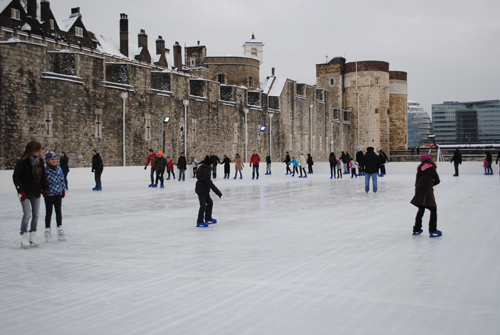 • London’s obsession with ice-skating is the subject of an exhibition which opened at the Museum of London earlier this month. Skating on Ice looks at the history of the popular pastime, from the 12th century – when locals are described strapping animals bones to their feet to skate on ice at Moorfields – across the centuries (and the developments that went with them) to today. Among the artefacts on show is an 1839 oil painting by J Baber depicting skaters on the Serpentine in Hyde Park, sketches from the London Illustrated News showing a rescue operation to recover the 40 of some 40 skaters who plunged beneath the ice in Regent’s Park on 15th January, 1867, a navy blue gabardine skirt suit from Fortnum & Mason dating from the 1930s and a series of skates, ranging from some made of animal bones through to a pair of Victorian racing skates known as Fen Runners and a pair of ice skates used from the late 1930s by Londoner Christina Greenberry at Streatham Ice Arena. Runs until 8th February. Entry is free. See www.museumoflondon.org.uk for more. (Pictured – ice-skating in the Tower of London moat).
• Christmas is looming and so, if you haven’t been out and about already, here’s five Christmas trees worth seeing over the coming few days (excluding the obvious one in Trafalgar Square):
• Prince Charles last week unveiled the foundation stone for a tower that will take visitors to Westminster Abbey into the institution’s new museum and galleries. The tower is being built outside Poet’s Corner – between the 13th century Chapter House and 16th-century Henry VII’s Lady Chapel – and will be the principal entrance to the medieval triforium, which has never before been opened to the public and which house the proposed The Queen’s Diamond Jubilee Galleries. The tower and galleries, costing almost £23 million, will be the most significant addition to the abbey since Nicholas Hawksmoor’s west towers were completed in 1745. The galleries, which will be located 70 feet above the abbey’s floor, are due to open in summer 2018, and will display treasures from the abbey’s history as well as offering magnificent views of Parliament Square and the Palace of Westminster. To help meet the cost of the new galleries, the abbey has launched a #makehistory campaign asking for public donations to the project. For more, see www.westminster-abbey-galleries.org/Content/Filler.
Send all items for inclusion to exploringlondon@gmail.com.
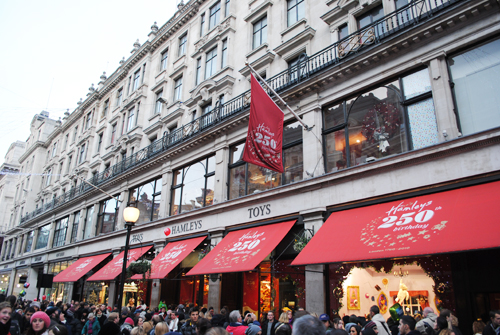 This Regent Street establishment – the oldest and largest toy store in the world – dates back to 1760 when Cornishman William Hamley came to London and founded his toy store – then called ‘Noah’s Ark’ – on High Holborn.
Selling everything from wooden hoops to tin soldiers and rag dolls, the business aimed to capture the trade of affluent Bloomsbury families and proved rather successful, attracting a clientele in the early 19th century which included not only wealthy families but royalty.
Such was its success that in 1881, Hamley’s descendants opened a new branch of the shop at 200 Regent Street. The Holborn store, meanwhile, burned down in 1901 and was subsequently relocated to a larger premises at numbers 86-87 in the same street.
Faced with the Depression in the 1920s, the shop closed briefly in 1931 but was soon reopened by Walter Lines, chairman of Tri-ang Toys, and in 1938 was given a Royal Warrant by Queen Mary, consort of King George V.
The premises at 188-196 Regent Street was bombed five times during the Blitz but the shop (and its tin hat-wearing staff survived). In 1955, having presented a Grand Doll’s Salon and sizeable model railway at the 1951 Festival of Britain, the shop was given a second Royal Warrant – this time by Queen Elizabeth II, who has been given Hamleys toys as a child – as a ‘toys and sports merchant’.
The business, which has passed through several owners since the early 2000s, is now owned by Chinese-based footwear retailer C.banner. The flagship store is spread over seven floors and tens of thousands of toys on sale, located in various departments.
As well as the Regent Street premises (it moved into the current premises at number 188-196 Regent Street in 1981), Hamlets has some 89 branches located in 23 countries, from India to South Africa. A City of Westminster Green Plaque was placed on the store in February 2010, in honour of the business’s 250th anniversary.
The toy store holds an annual Christmas parade in Regent Street which this year featured a cast of 400 and attracted an estimated 750,000 spectators.
PICTURED: Hamleys during its 250th birthday celebrations.
London is illuminated for Christmas. Here’s some of what photographers on Flickr have captured this year…

Christmas in Regent Street. PICTURE: Michael Reilly/Flickr/CC BY 2.0
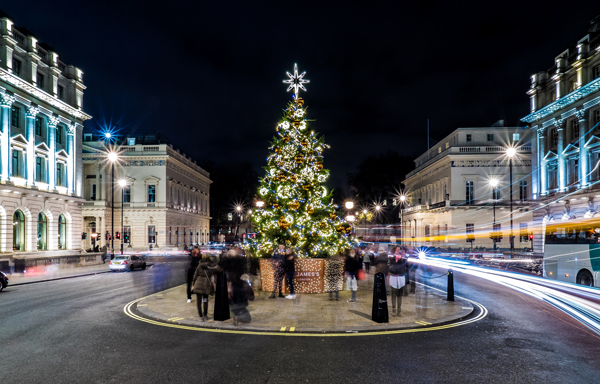
Christmas tree in Waterloo Place. PICTURE: William Warby/Flickr/CC BY 2.0
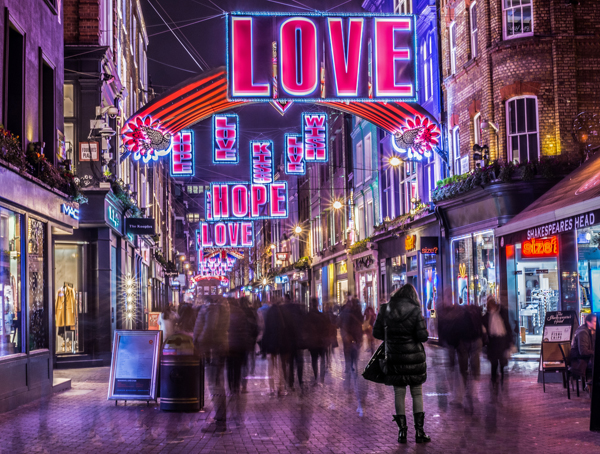
Carnaby Street. decorations PICTURE: Roger/Flickr/CC BY-SA 2.0

Oxford Street under lights. PICTURE: Paolo Braiuca/Flickr/CC BY 2.0 (image cropped).
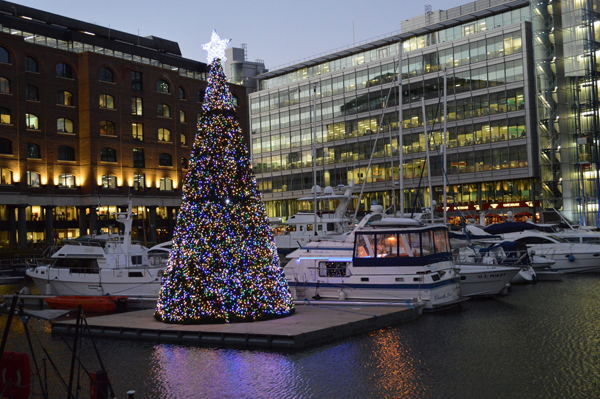
A floating Christmas tree at St Katharine Docks. PICTURE: Matt Brown/Flickr/CC BY-SA 2.0
The practice of sending Christmas cards really began in the Victoria era and it was in London, in 1843, that the first commercial Christmas cards are widely said to have been designed and printed.
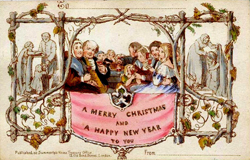 The idea had come from Sir Henry Cole, the first director of the Victoria and Albert Museum, who, overwhelmed with the volume of correspondence he was receiving, conceived it as answer to his problem, allowing him to send Christmas greetings to a wide group of people – all at once.
He asked his friend, artist John Callcott Horsley, to design the card and an edition of 1,000 were printed by Jobbins of Warwick Court in Holborn.
The hand-coloured card, published by Summerley’s Home Treasury Office in Old Bond Street, showed a family gathered for a Christmas celebration with two side images showing people engaged in charitable acts and a message, ‘A Merry Christmas and a Happy New Year to You’. Designed as a single flat card (not foldable like they are today), it came complete with ‘To’ and ‘From’ spaces for the sender to fill in.
The cards which Sir Henry didn’t need for his personal use were placed on sale for a shilling each but it was a fairly steep price and that – and the fact that the image of people drinking at the festive season apparently roused the ire of temperance campaigners, helped to ensure the cards weren’t an immediate success.
Nonetheless, further cards were produced in the following years and within a couple of decades, they were being mass produced.
One of Sir Henry’s original cards was reportedly sold at an auction in 2013 for £22,000.

Kinson Leung captures the vibrant colours of the annual Winter Wonderland fair in Hyde Park. PICTURE: Via Unsplash.
 This pub’s name isn’t too mysterious – it is, of course, named after Albert, Prince Consort to Queen Victoria, and given the date on which the building that now occupies the site was built – between 1862 and 1867, nor is the motivation to name it so – Prince Albert died on 14th December, 1861, leaving a bereft queen and a nation in mourning.
There had been a pub on this site at 52 Victoria Street prior to the current building – it was called The Blue Coat Boy and named after the nearby Blue Coat school – but in the mid-19th century the Artillery Brewery, which was located next door, bought the premises and renamed it.
The four storey building, which is now Grade II-listed (and dwarfed by the glass towers surrounding it), survived the Blitz and is the only building remaining from the first phase of the development of Victoria Street (and redevelopment of the area which had been a slum known as Devil’s Acre), only a stone’s throw from Westminster Abbey and the Houses of Parliament.
Inside, the Victorian features include ornate ceilings and hand-etched frosted windows and wrought iron balconies. Also of note is the Prime Minister’s gallery – including some who were patrons here – as well as memorabilia including a House of Commons Division Bell and one of Queen Victoria’s napkins.
For more, see www.taylor-walker.co.uk/pub/albert-victoria/c6737/.
PICTURE: Patche99z/Wikimedia
A fixture of London’s Christmas festivities since 1947, the Trafalgar Square Christmas Tree is given annually to the people of Britain by the city of Oslo as gift thanking them for their support of Norway during World War II.
 This included hosting the Norwegian Government-in-exile and the Royal Family during the Nazi occupation of the country between 1940 and 1945.
The tree is harvested from forests near the Norwegian capital and the selection process for the giant, known by forestry workers as the “Queen of the Forest”, starts in May.
The tree is typically a Norway spruce aged somewhere between 50 and 60 years and stands at least 20 metres high. This year’s tree – the 70th – is said to be 116-years-old, stands 22 metres tall and weighs
In keeping with tradition, it was cut down on 16th November in a special ceremony attended by the Mayor of Oslo, Marianne Borgen, and the Lord Mayor of Westminster, Cr Steve Summers, along with various local school children so it can shipped to Britain ready in time for its unveiling at the start of December.
The tree is adorned with lights – in more recent years these are energy efficient light bulbs – in Norwegian style and these are turned on at a special ceremony on the first Thursday in December. The tree remains on display until just before the Twelfth Night of Christmas when it is taken down and recycled as mulch.
The tree now has its own Twitter account.
• The life and work of 19th century London actress, cartoonist and illustrator Marie Duval is the subject of a new exhibition which opens at the Guildhall Library in the City tomorrow. Marie Duval: Laughter in the First Age of Leisure is the first one solely dedicated to Duval’s work (her real name was Isabelle Émilie de Tessier) as a 19th century pioneer of the art of comics. Her work first appeared in a range of cheap British ‘penny papers’ and comics of the 1860s to 1880s aimed at working class people. The exhibition has been produced by the University of Chester in partnership with the library and with the support of the British Library.
• Carol singing has kicked off in Trafalgar Square to mark the Christmas season. More than 40 groups are taking part in the sessions – free to watch – which take place between 4pm and 8pm on weekdays and from 2pm on weekends until 23rd December. The square is also home to a traditional Norwegian spruce Christmas Tree which has, as has been the case every year since 1947, been brought from forest near Oslo in thanks for Britain’s support of Norway during World War II. For more, see www.london.gov.uk/events.
• The Dulwich Picture Gallery’s Christmas festival – featuring the ‘Winterlights’ lights trail, artisan Christmas market, pop-up carollers and other entertainments – has opened at the south London gallery. This year’s festivities also include two contemporary baroque-inspired Christmas trees by 3D art specialists, Nagual Creations, and visitors also have the chance to create their own festive family photo using a specially commissioned giant gold frame in the grounds as well as listen to Christmas story-telling in the gallery’s Keeper’s Cottage. The Winterlights display runs from 6pm to 10pm until 18th December (excluding Mondays; admission charges apply) with the market, featuring 50 stalls, held over the next two weekends – 10th-11th December and 17th-18th December (entry is free). For more, see www.dulwichpicturegallery.org.uk.
• The first UK exhibition to focus on Australian impressionist paintings has opened at The National Gallery. Australia’s Impressionists features 41 paintings including some never shown before in the UK and explores the impact of European Impressionism on Australian painting of the 1880s and 1890s with a particular focus on four artists: Tom Roberts, Arthur Streeton, Charles Conder and John Russell. The exhibition is organised into three sections: the first looking at the landmark 1889 9 by 5 Impression Exhibition held in Melbourne, the second looking at the role of Australian Impressionism in the forging of a national identity, and the third looking at the work and influence of John Russell. The exhibition can be seen in the Sunley Room until 26th March. Entry is free. For more, see www.nationalgallery.org.uk.
 • A 17th century Peruvian gold bowl recovered from a shipwreck, Tudor fashion accessories and a collection of ‘micromosaics’ including tabletops commissioned by Tsar Nicholas I are among highlights of the newly reopened Rosalinde and Arthur Gilbert Galleries at the V&A. The South Kensington museum reopened the four galleries last month after the objects within the collection were removed in 2014 as part of the V&A’s Exhibition Road building project which will be completed in July next year. Amassed by collectors Rosalinde and Arthur Gilbert over a period of 40 years from the 1960s, the collection features about 1,200 objects, more than 500 of which are now on display. The collection was on display at the Los Angeles County Museum of Art before being transferred to the UK in 1996 and accepted as a gift to the nation by the Queen Mother in 2000. It was displayed at Somerset House until coming to the V&A where it opened to the public in 2009. Other highlights on display include a newly acquired silver christening gift presented by King George II to his god-daughter, Lady Emilia Lennox, in 1731, and a life-sized silver swan made by Asprey, London, in 1985 (pictured). Entry to the galleries is free. For more, see www.vam.ac.uk. PICTURE: © Victoria and Albert Museum, London
• The period living rooms at the Geffrye Museum of the Home have been transformed for Christmas in its annual Yuletide display. Now in its 25th year, the exhibition at the Shoreditch establishment recreates the Christmas traditions of times past including everything from kissing under the mistletoe to decorating the tree, parlour games such as blind man’s bluff to hanging up stockings and sending cards. Christmas Past is accompanied by a programme of events including craft fairs, festive evenings, carol sings and decoration workshops with festive food and drinks available in the cafe. Runs until 8th January. Entry is free. For more, see www.geffrye-museum.org.uk.
Send all items for inclusion to exploringlondon@gmail.com.
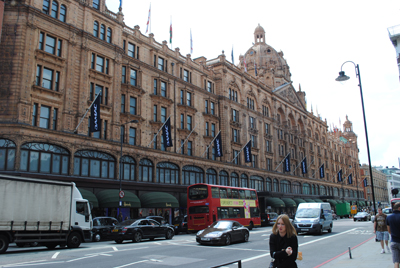
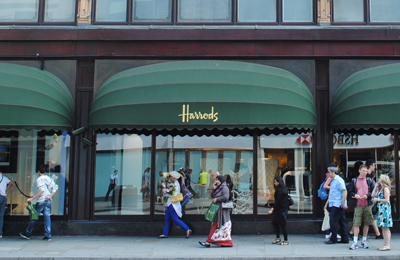
Famed as a luxury shopping destination for the rich and famous, Harrods on Brompton Road in Knightsbridge takes its name from founder Charles Henry Harrod.
Harrod first established a drapery business in Southwark in 1824 and in 1832, founded Harrods & Co Grocers in Clerkenwell. Two years later he established another grocery, this time in Stepney, with a particular interest in tea.
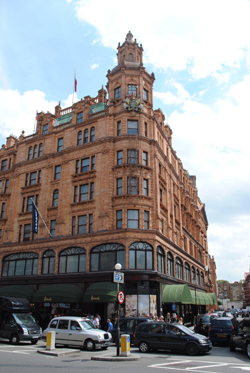 In 1849, to capitalise on trade to the upcoming Great Exhibition in Hyde Park in 1851, he took over a small shop on the site of the current store – initially with just two assistants and a messenger boy. In 1861 his son, the similarly-named Charles Digby Harrods, took over the business and by 1880, the store was employing more than 100 people offering customers everything from medicines and perfumes to clothing and food and already attracting the wealthy customers it would become known for.
Even the burning down of the store in late 1883, failed to dint its long-term success, and Harrod took the opportunity to build a capacious new building on the site. Designed by Charles Williams Stephens, the building, which wasn’t finished until 1905, featured Art Nouveau windows and was topped with a dome. One of its attractions opened on 16th November, 1898, when it became home to England’s first “moving staircase” (escalator). Nervous customers were apparently offered a brandy once they’d made the journey.
Harrods’ fame continued to grow and over the years a who’s who of London society has been associated with the store – everyone from writers like Oscar Wilde, and AA Milne, actors Ellen Terry, Charlie Chaplin and Laurence Olivier and luminaries such as the “father of psychoanalysis” Sigmund Freud and many members of the Royal family.
Under the motto of Omnia Omnibus Ubique (All Things for All People, Everywhere), the store became famous for selling whatever the customer wanted including, thanks to an exotic pets department which lasted up until the 1970s, a lemur called Mah-Jongg which was sold to Stephen and Virginia Courtauld in 1923 and lived with them at Eltham Palace and a lion called Christian to Australian expats John Rendall and Anthony “Ace” Bourke in 1969 (it was later set free in Kenya).
The ownership meanwhile has long since left the Harrods family – Charles Digby had sold his shares as far back as 1889 when the company was floated on the London Stock Exchange and renamed Harrods Stores Limited with Sir Alfred James Newton as chairman and Richard Burbridge as managing director. Burbridge was succeeded by his son in 1917 and he by his son in 1935.
In 1959, the company was bought by House of Fraser and in 1985, the store was sold to the Al-Fayed brothers (Mohamed Al-Fayed famously had two memorials created inside dedicated to Diana, Princess of Wales, and his son Dodi Fayed, both of whom died in a car crash in Paris in 1997. He also decided not to renew the company’s Royal warrants – it has had up to four). Current owners Qatar Holding, the sovereign wealth fund of Qatar, bought the company in 2010.
The company has opened a number of other Harrods stores over the years – including its only ever foreign branch (long since independent) in Argentina in 1914 and, in 2000, a shop aboard the ship RMS Queen Elizabeth 2.
The Knightsbridge store, meanwhile, has been twice bombed by the IRA – in 1983 when six were killed and scores more injured after a car bomb exploded in an adjoining street and in 1993 when a bomb was placed in a litter bin, injuring four. In 1989, it controversially introduced a dress code, banning casual wear like flip-flops and Bermuda shorts.
Now the largest department store in Europe, the Brompton Road store has more than million square feet of selling floor over seven stories. It attracts some 15 million customers a year to its more than 300 different departments and other facilities including more than 25 restaurants and cafes, a concierge, bank, spa and personal shopping service.
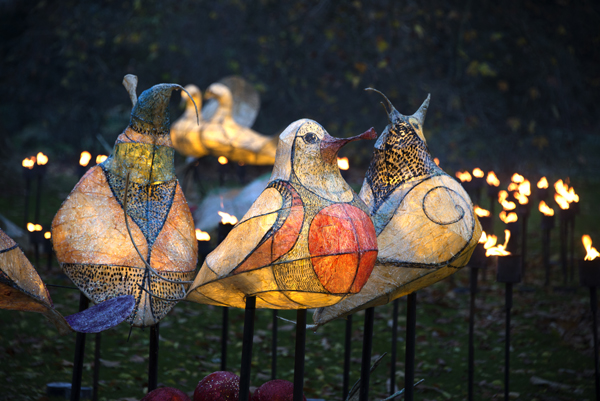
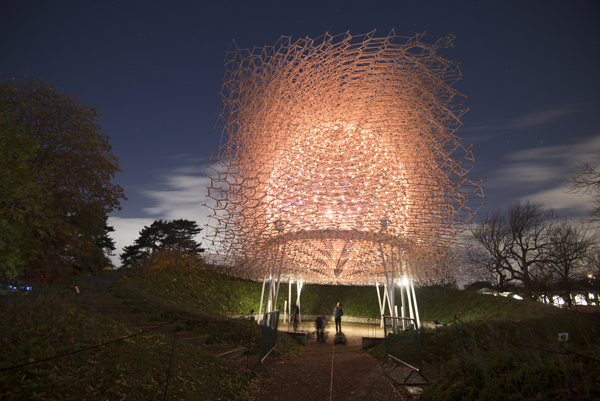
 More than 60,000 lights are being used to illuminate Kew Gardens this Christmas in a mile long trail through the foliage. The trail features eight newly commissioned installations from UK and international artists including Bloom – a display of 1,700 swaying flowers by the group Squidsoup (above), and the roaring scented Fire Garden – a display themed around the Twelve Days of Christmas by And Now: (pictured below are three French hens from the installation). The trail also features Wolfgang Buttress’ bee-inspired installation, known as the The Hive (pictured second below), which has been lit with 1,000 LEDs that pulsate and glow against the night sky, and finishes with an “explosion” of brightly coloured laser beams across the Palm House Pond (pictured third below). There’s also a panto featuring Santa and his elves and a Victorian carousel. The night lights can be seen until 2nd January. Admission charge applies (and there’s timed entry). Kew is also running a program of family-oriented Christmas activities during the day across the period. For more, see www.kew.org. PICTURES: Jeff Eden, RBG Kew.

We reintroduce an old favourite this month with our first ‘Where’s London’s oldest’ in a few years. And to kick it off, we’re looking at one of London’s oldest public clocks.
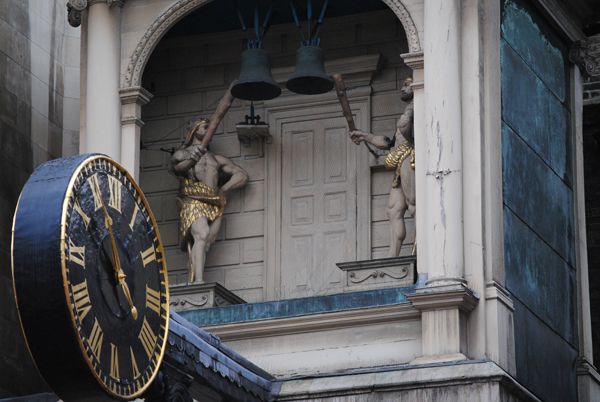
Hanging off the facade of the church of St Dunstan-in-the-West in Fleet Street is a clock which is believed to have been the first public clock to be erected in London which bears a minute hand.
The work of clockmaker Thomas Harris, the clock was first installed on the medieval church in 1671 – it has been suggested it was commissioned to celebrate the church’s survival during the Great Fire of London and was installed to replace an earlier clock which had been scorched in the fire. Its design was apparently inspired by a clock which had once been on Old St Paul’s Cathedral and was destroyed in the fire.
Like the clock it replaced, this clock sat in brackets and projected out into Fleet Street which meant it was able to be seen from a fair distance away (and being double-sided meant the black dials could be seen from both the east and the west). Like the Roman numerals that decorate it, the two hands, including the famous minute hand, are gold.
To the rear and above the clock dials are located the bells and striking mechanism. The bells are struck on the hours and the quarters by ‘automata’ – Herculean figures, perhaps representing Gog and Magog (although to most they were traditionally simply known as the ‘Giants of St Dunstan’s’), who do so using clubs and turn their heads.
Such was the attention these figures attracted that when the clock was first installed the area became notorious for pick-pockets who apparently went to work on unsuspecting passersby who had stopped to watch the giants at work.
This church was demolished in the early 1800s to allow the widening of Fleet Street and when it was rebuilt in 1830, the clock was absent. Having decided it couldn’t be accommodated in the new design, it had been auctioned off with the art collector, Francis Seymour-Conway, the 3rd Marquess of Hertford, the successful bidder.
He had it installed on his Decimus Burton-designed villa in Regent’s Park and there it remained until 1935 when Lord Rothermere, who had bought the villa in 1930, returned it to the church to mark the Silver Jubilee of King George V.
There are numerous literary references to the clock including in Charles Dickens’ David Copperfield, Thomas Hughes’ Tom Brown’s Schooldays, Oliver Goldsmith’s Vicar of Wakefield and a William Cowper poem.
 Exploring London