Treasures of London – The Queen Victoria Memorial…

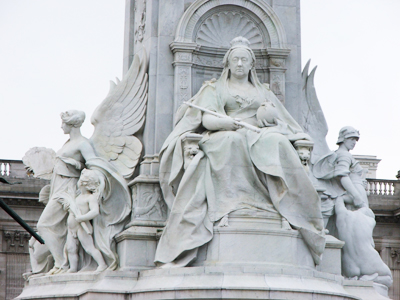
It’s partly obscured now, thanks to preparations for the current Diamond Jubilee, and we have touched on it before (see our earlier post here) but we thought it appropriate to take a look at the main London memorial to the only other British monarch ever to have celebrated a Diamond Jubilee – Queen Victoria.

Prominently located outside of Buckingham Palace at the head of The Mall, work on the Grade I listed Queen Victoria Memorial commenced in 1903.  Dedicated to the Queen, who ruled from 1819-1901, it was unveiled by King George V, grandson of King Victoria, and that of his cousin German Emperor Wilhelm II in May, 1911 (although it wasn’t completed until 1924).

The statue, nicknamed the Wedding Cake, was designed by Sir Aston Webb (he who also designed the currently facade to Buckingham Palace and The Mall – down which the statue of Victoria serenely gazes), and sculpted by Sir Thomas Brock, who, so the story goes, received his knighthood after King George V was so moved at the dedication that he spontaneously decided to knight him then and there.

At 25 metres high, this vast statue is made of 2,300 tons of white marble, 800 tones of granite and 70 tons of bronze. It is the largest statue in London with the exception of that dedicated to Prince Albert in Kensington (it could be described as a companion piece) and is the largest statue of a monarch in England.

The statue is redolent with symbolism – four bronze lions at the base represent the idea of Power (a pair of these was apparently donated by New Zealand) while other bronze figures represent Peace, Progress, Manufacture and Agriculture. There is a nautical theme around the base with depictions of mermaids and ship’s prows among the scenes depicted, all of which evoke Seapower.

On the same level as the seated Queen are Truth, Justice and what’s variously described as Charity or Motherhood while above her are gilded figures representing Courage, Constancy and Winged Victory.

PICTURE: Louise Schuller (www.sxc.hu)

Around London – Diamond Jubilee celebrations special…

UPDATED: Excitement has been building for months ahead of this weekend’s Diamond Jubilee celebrations which include a 1,000 boat flotilla which will sail down the Thames on Sunday, the Diamond Jubilee concert on Monday and National Service of Thanksgiving at St Paul’s Cathedral on Tuesday which will be followed by a ceremonial procession back to Buckingham Palace.
• First to the flotilla. The formal river procession will be held between 2pm and 6pm, starting upriver of Battersea Bridge and finishing downriver of Tower Bridge. The Queen and her family will be boarding the Royal barge, the Spirit of Chartwell, near Albert Bridge at 2.30pm and will travel upriver at the centre of the flotilla with the aim of pulling up alongside HMS President, near Tower Bridge, at 4.15pm.

The flotilla will be one of the largest ever assembled on the river and feature rowing, working and pleasure boats of all shapes and sizes decked out for the occasion. In addition as many as 30,000 people will be aboard passenger boats and there will also be music barges and boats spouting geysers as well as specially constructed craft like a floating belfry. It is estimated that it will take the flotilla around 75 minutes to pass any static point along the route.

Downriver of London Bridge, near the end of the pageant’s seven mile (11 kilometre) course, a gun salute will be fired and the procession will pass through an ‘Avenue of Sail’ formed by traditional sailing vessels, oyster smacks, square riggers, naval vessels and others. For more on the pageant (including the location of large viewing screens – these positions will be regulated from 8am onwards – and road closures as well as an interactive map of the route), head to www.thamesdiamondjubileepageant.org.

• Diamond Jubilee Concert and Beacons. To be held outside Buckingham Palace, close to the Victoria Memorial, on the evening of Monday, 4th June, the concert – which starts at around 7.30pm and features everyone from Elton John to Paul McCartney and Shirley Bassey – will be televised live by the BBC (unless you’re lucky enough to have one of the 10,000 balloted tickets meaning you get to have a picnic in the palace gardens and see the concert). For those who can’t go but would like to experience some of the atmosphere, Royal Parks are setting up screens along The Mall, in St James’s Park and in Hyde Park.

At 10.30pm that night, the Queen will light the National Beacon outside Buckingham Palace, the last in a network of beacons to be lit across the country. More than 4,000 beacons will be lit by communities across the UK and in Commonwealth countries around the world between 10-10.30pm that night (for more on the beacons, see www.diamondjubileebeacons.co.uk).

• National Service of Thanksgiving and Carriage Procession. On Tuesday, the Queen and the Duke of Edinburgh will leave Buckingham Palace at 10.15am and travel by car to St Paul’s Cathedral via the Mall, through Trafalgar Square, down the Strand and Fleet Street and up Ludgate Hill to St Paul’s. There they and the 2,000 invited guests will attend the National Service of Thanksgiving, conducted by the Dean of St Paul’s, the Very Rev Dr David Ison (the Archbishop of Canterbury will preach).

At 11.30am, the Queen and Duke will then head to Mansion House for a reception (via St Paul’s Churchyard and Queen Victoria Street), hosted by the Lord Mayor of London David Wootton, Court of Aldermen and Court of Common Council. Other members of the Royal family will attend a reception at Guildhall. At 12.30pm, the  Queen and members of the Royal Family will then head to Westminster Hall (via Queen Victoria Street, St Paul’s Churchyard, Ludgate Hill, Fleet Street, the Strand, Whitehall and Parliament Square), entering through the Sovereign’s Entrance of the Palace of Westminster (Houses of Parliament) at 12.40pm. There, they will attend the Diamond Jubilee Lunch.

At 2.20pm, the Queen and Prince Philip will lead a carriage procession from the Palace of Westminster to Buckingham Palace (via New Palace Yard, Whitehall, Trafalgar Square and The Mall), riding in a 1902 State Landau. They will be followed by the Prince of Wales and Duchess of Cornwall in a State Landau, and the Duke and Duchess of Cambridge (Prince William and Kate) and Prince Harry in another State Landau. If it’s raining, these will be replaced by the Australian State Coach, Queen Alexandra’s State Coach and the Glass Coach. Military personnel will line the route, a 60 gun salute will be fired and a Guard of Honor will await them in the Buckingham Palace forecourt.

At 3.30pm, the Queen and members of the Royal Family in the carriage procession will appear on the balcony at Buckingham Palace to wave to the crowds and witness an RAF flypast and a Feu de Joie – a celebratory volley of rifle fire – which will be given as a salute in the palace forecourt.

There’s plenty more happening over the weekend including many local street parties – far too much for us to record here. So for more, head to the official Diamond Jubilee site, www.thediamondjubilee.org (or The Big Lunch for local lunches – www.thebiglunch.com). You can purchase a copy of the official souvenir programme online at www.royalcollectionshop.co.uk/diamond-jubilee-1/diamond-jubilee-official-souvenir-programme.html or download it at www.itunes.co.uk.

Reckon you can take a good photo? We’re looking for great images of this weekend’s Diamond Jubilee celebrations (just email us at exploringlondon@gmail.com).

Want to read more about the Queen? Why not check out Sixty Glorious Years: Queen Elizabeth II, Diamond Jubilee, 1952-2012, Queen Elizabeth II: A Diamond Jubilee Souvenir Album, or Debrett’s: The Queen – The Diamond JubileeFor related music, check out Diamond Jubilee: A Classical CelebrationThe Diamond Jubilee Album or Gary Barlow & the Commonwealth Band’s Sing EP (featuring Prince Harry).

Celebrating the Diamond Jubilee with 10 royal London locations – 7. Silver Jubilee memorials…

For those who may not be aware, the current Diamond Jubilee is, of course, not the first jubilee Queen Elizabeth II has celebrated. In 1977, the Queen and the nation marked her Silver Jubilee, celebrating her 25th year on the throne.

Just as this year is designed as a year of celebration, so too was 1977 with the anniversary of the Queen’s accession culminating in a series events run over a week in early June. They included street parties, the lighting of a chain of beacons across the country (the Queen lit the first fire at Windsor), a national service of thanksgiving at St Paul’s Cathedral (which the Queen went to in the Gold State Coach) and a river progress from Greenwich to Lambeth.

To mark the Jubilee, the Queen and Prince Philip also travelled across the country, visiting as many as 36 counties during a Royal Tour, and went overseas where they visited nine countries as far afield as Australia and New Zealand, the West Indies and Canada.

In London, a number of memorials were installed which can still be visited today. They include:

The Silver Jubilee Walkway. Opened by the Queen on 9th junee 1977, this is made up of five circular sections which are themselves located in a 15 mile (24 kilometre) circle around the city and takes in many of the city’s greatest sites, including St Paul’s Cathedral, Buckingham Palace, Tower Bridge and Shakespeare’s Globe. For more on the walk, see www.walklondon.org.uk/route.asp?R=3

• South Bank Jubilee Gardens. Originally created to celebrate the Silver Jubilee in 1977, these gardens, located between Waterloo and Westminster Bridges, have recently been remade – including planting 70 new trees – for the Queen’s Diamond Jubilee and the Olympic Games.

Memorial Urn in Queen Square, Bloomsbury. This monument has inscriptions by poets Philip Larkin (“In times when nothing stood, But worsened or grew strange, There was one constant good, She did not change”) and Ted Hughes (A nation’s a soul, A soul is a wheel, With a crown for a hub, To keep it whole”) in front of and behind it.

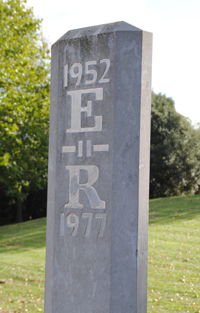
King’s Stairs Memorial Stone. This memorial stone (pictured) located on the edge of King’s Stairs Gardens by the Thames in Bermondsey was first installed to mark the Queen’s Silver Jubilee. The other side of the stone was inscribed during the Golden Jubilee in 2002.

• Plaque on Queen Elizabeth II’s birthplace. We’ve mentioned this plaque at 17 Bruton Street in Mayfair in an earlier entry but it’s interesting to note that it was erected in 1977.

Any others you can think of?

LondonLife – An upsized Royal Family…

Like your Royal Family large? The largest ever photograph of Queen Elizabeth II, her husband, the Duke of Edinburgh, and their four children has been displayed on South Bank building, Sea Containers, in celebration of the Queen’s Diamond Jubilee. The iconic picture of the family – which also includes Earl Mountbatten, uncle to Prince Philip, and Princess Anne’s then husband Mark Phillips – was taken during 1977’s Silver Jubilee by an unknown photographer. The 100 by 70 metre image, which weighs nearly two tons, took eight people more than 45 hours to put into place on the building’s facade overlooking the Thames. It was erected by the owner of Sea Containers as a tribute to be seen during this weekend’s Jubilee Flotilla (and also to hide development work taking place behind as the building is transformed into a Mondrian hotel – Europe’s first – and office space.

Around London – Leicester Square reopens; RA and MOL exhibitions mark Diamond Jubilee; ‘Jed’ retires; and, the history of horses at the British Museums…

• Leicester Square officially reopened last night following a £15.3 million transformation which has seen every paving stone replaced, new plants, and 40 new water jets placed around the Grade II listed fountain and statue of William Shakespeare. The 17 month makeover also included new lighting, new seating and a refurb of the underground toilets. The square – which owes its name to Robert Sidney, the 2nd Earl of Leicester, who purchased this land in 1630 and, after building himself a mansion, kept aside part of the land for public use – now welcomes as many as 250,000 tourists a day and is known as one of the world’s premiere sites for the release of new films.

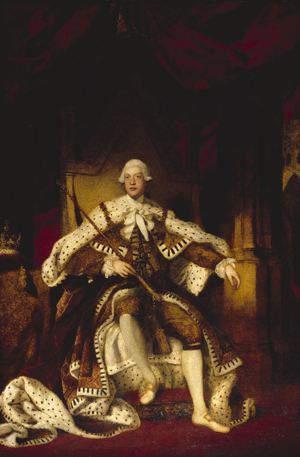
• The Royal Academy of Arts is marking the Queen’s Diamond Jubilee with a new exhibition opening tomorrow which features a selection of paintings by Royal Academicians elected during the early part of the Queen’s reign. The Queen’s Artists will include works by Jean Cooke, Frederick Gore and Ruskin Spear and will be displayed in the Reynolds and Council Rooms. Meanwhile The Saloon will house a collection of sculptures, paintings and drawings prepared by Royal Academicians for British coins and royal seals on loan from the Royal Mint Museum. The collection includes portraits of the Queen by Edward Bawden and Sir Charles Wheeler which have never before been shown in public, and Sir Anthony Caro’s new coin design of the London 2012 Olympic Games. Over in the Tennant Gallery, The King’s Artist’s George III’s Academy, will look at the king’s role in the foundation of the academy in 1768 and his influence in selecting the first artists. Highlights include portraits of King George III (pictured) and Queen Charlotte painted by the academy’s first president, Sir Joshua Reynolds. Admission charge applies. For more, see www.royalacademy.org.uk. PICTURE: Copyright Royal Academy of Arts, London/John Hammond.

• A new exhibition focusing on Londoners and their treasured souvenirs commemorating Queen Elizabeth II opens tomorrow at the Museum of London. At Home with the Queen features 12 photographic portraits of Londoners at home with their mementos as well as a selection of royal commemorative objects from the museum’s collection. The latter include trinkets produced for Queen Victoria’s Diamond Jubilee in 1897, official Coronation Day street decorations, Silver Jubilee paper tableware and souvenirs relating to the current Diamond Jubilee. Runs until 28th October. Admission is free. For more (including a series of events running on conjunction with the exhibition), see www.museumoflondon.org.uk.

The Royal Parks’ Shire horse, Jed, retired last week after a decade of service working in Richmond Park. The Queen presented a commemorative retirement rosette to Jed who was born in 1993 and joined the Royal Parks from Bass Brewery in Burton upon Trent almost 10 years ago. Horses have been used in Richmond Park since it was enclosed by King Charles I in 1637. The horses took a break in 1954 but the Shires were reintroduced in 1993 as a way to sustainably manage the parkland. For more on Richmond Park, see www.royalparks.org.uk/parks/richmond-park.

On Now: The horse: from Arabia to Royal Ascot. This major free exhibition at the British Museum is part of the august institution’s Diamond Jubilee celebrations and traces the history of the horse from domestication around 3,500 BC through to present day, with a particular focus on Britain’s equestrian tradition, from the introduction of the Arabian breed in the 18th century to events like Royal Ascot. Highlights include one of the earliest known depictions of horse and rider – a terracotta mould found in Mesopotamia dating from around 2000 to 1800 BC, a cylinder seal of Darius dating from 522 to 486 BC depicting the king hunting lions in a chariot, a 14th century Furusiyya manuscript, an Arabian manual of horsemanship, and the 19th century Abbas Pasha manuscript, the primary source of information about the lineage of purebred Arabian horses acquired by Abbas Pasha (mid-nineteenth century viceroy of Egypt). The exhibition is being held in Room 35. Runs until 30th September. For more, see www.britishmuseum.org.

Celebrating the Diamond Jubilee with 10 royal London locations – 6. The Mall…

For many Londoners, an opportunity to see the Queen means heading to Buckingham Palace to watch her wave from the balcony – or standing in the Mall to watch as her carriage goes by.

Given that, we thought we’d take the time to have a quick look at the history of The Mall, an important player in events like the annual Trooping the Colour.

This one kilometre long grand processional route which links Trafalgar Square to Buckingham Palace, was originally cut through St James’s Park in 1660 when King Charles II was looking for a new paille-maille pitch (see our earlier entry on Pall Mall for more on this). Two long avenues of trees were planted on either side, giving it a leafy feel that’s still in evidence today.

The Mall had become notorious by the 18th century and was spruced up in 1911 under the eye of Sir Aston Webb (who also designed other elements in the area including a new facade for Buckingham Palace, the Queen Victoria Memorial in front of the palace, and Admiralty Arch at the western end of the route) to become the grand avenue, complete with red-carpet like surface (this was done later), that it is today.

It is bordered by St James’s Park on the south side and on the north side is overlooked by various grand buildings – including Clarence House and the Institute of Contemporary Arts – as well as, toward the western end, Green Park.

These days the Queen publicly processes down The Mall for a number of events throughout the year – among them are the State Opening of Parliament (held earlier this month) as well as military ceremonies like Trooping the Colour and events like last year’s Royal Wedding when is it said that more than a million people were said to have filled the broad street.

The Mall is also the route along which Heads of State process in a horse drawn carriage during official visits (the road is then decorated with Union Jacks and flags of the visitor’s country). During the Olympics, it will be the start and end location of the marathons and cycling road races.

Apart from the Queen Victoria Memorial at the eastern end of The Mall, statues and monuments lining the road include the Queen Mother Memorial, a statue of explorer Captain James Cook, and a recently installed statue of cosmonaut, Yuri Gagarin.

There are apparently a series of tunnels underneath with link Buckingham Palace with Whitehall.

We should also briefly mention Horseguards, which is at The Mall’s eastern end and where Trooping the Colour and Beating Retreat takes place. This was formerly the site of a tiltyard of the Palace of Whitehall and jousting tournaments were held here during the time of King Henry VIII. It has been used for parades and ceremonies since the 17th century. While cars were parked here for much of the 20th century, this practice was stopped in the mid-1990s.

LondonLife – The RHS Chelsea Flower Show…

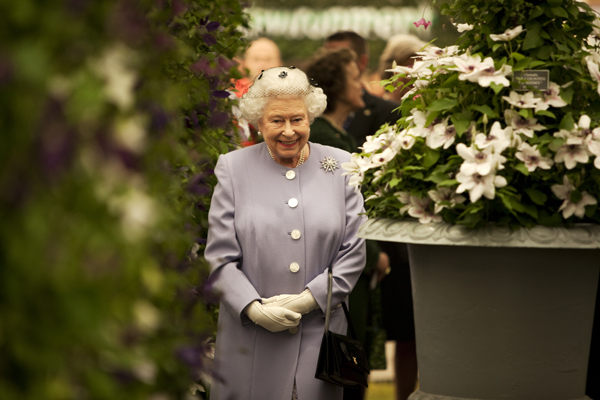
Yes, it’s that time of the year again when Chelsea is all abloom! This year the flower show is marking the Queen’s Diamond Jubilee with a specially designed flower bed designed by the Parish of St Helier in Jersey, the centrepiece of which is a rotating Jersey Accession Issue Postal stamp (pictured above). During a visit to the Flower Show on Monday (pictured below, this took place prior to the public opening today), Queen Elizabeth II, patron of the show, awarded the first ever Diamond Jubilee Award for the Best Exhibit in the Great Pavilion to HM Hyde & Son for their display of lilies. Among the other ways in which the show is marking the Diamond Jubilee is the opening of an exhibition of photographs of the Queen’s past visits to the show. The flower show runs until Saturday (while tickets are sold out, you can check in person daily at the ticket office for returned tickets). For more, see www.rhs.org.uk/Shows-Events/RHS-Chelsea-Flower-Show/2012. PICTURES: Andy Paradise (courtesy of RHS).

Daytripper – Windsor Castle…

Given we’re marking the Queen’s Diamond Jubilee with a look at sites of significance to her story located in London, it’s perhaps only fitting that we take a look at the nearest royal residence outside the city.

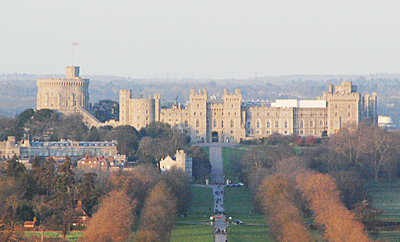
Windsor, located as close as half an hour by train from London’s Paddington station (or around 50 minutes to an hour from Waterloo), boasts plenty to see including the historic town centre, nearby Eton, great river and country walks and, of course, Legoland. But today our attention will remain on Windsor Castle, the oldest and largest inhabited castle in the world.

There has been a fortress on this site since shortly after the Norman invasion when in about 1080 King William the Conqueror ordered it constructed on a ridge above the river bank as part of a series of defensive fortifications around London. The earth and timber Norman castle was gradually added to over the years – King Henry I (reigned 1100-1135), the first king to live here, added domestic quarters while King Henry II (reigned 1154-1189) built substantial royal apartments transforming the castle into a palace and began replacing the outer timber walls with stone fortifications as well as rebuilding the Norman Keep as the Round Tower (parts of which still date from this period). King Henry III (reigned 1216-1272) built upon and expanded his work.

But it was in the reign of King Edward III (1307-1327) that the castle was expanded enormously. This included the reconstruction of the lower ward including the rebuilding of the chapel, naming it St George’s (although the current chapel dates from the reign of King Edward IV – 1461-1470), and the reconstruction of the upper ward complete with apartments for him and his wife, Queen Phillipa, arranged around courtyards (although some of the work wasn’t completed until the reign of his successor, King Richard II – 1377-1399). It was also during King Edward III’s reign that the castle became the base for the Order of the Garter (which he created in 1348), a role it still fulfills.

Other works were ordered by successive Tudor monarchs including King Henry VIII, Queen Elizabeth I, and Queen Mary I. Parliamentary forces seized the castle during the Civil War (Oliver Cromwell did use it as his headquarters for a time) and Royalists were imprisoned here (King Charles I was in fact buried in a vault beneath St George’s Chapel after his execution having been previously imprisoned here).

The next major additions came in the reign of King Charles II (1660-1685) when the Upper Ward and State Apartments were reconstructed in baroque splendor, the latter complete with splendid murals ceiling paintings by Italian artist Antonio Verro (the murals were later destroyed but some of the ceiling paintings survive).

From the time of King William III (1689-1702), monarchs began spending more time at Hampton Court Palace but the focus returned to Windsor with King George III. He ordered a range of improvements and updates including modernising Frogmore House in the Home Park for his wife Queen Caroline (the property was subsequently used by various royals but no-one currently lives there), but many of these were stopped prematurely due to his illness. His son, King George IV, picked up where his father left off.

In the reign of Queen Victoria, Windsor became the royal family’s principal residence and was visited by heads of state including King Louis Philippe in 1844 and Emperor Napoleon III in 1855. The Queen’s husband, Prince Albert, died here on 14th December, 1861.

King Edward VII (1901-1910) and King George V (1910-1936) both had a hand in redecorating the palace and the Queen’s father, King George VI (1936-1952), was living in the Royal Lodge in Windsor Great Park when he succeeded to the throne.

In more recent times, the castle was the home to the Queen, then Princess Elizabeth and her sister Princess Margaret, for much of World War II. The castle suffered its greatest setback in recent times in 1992 when a serious fire broke out in the Queen’s Private Chapel which destroyed several rooms including the ceiling of St George’s Hall which dated from the reign of King George IV. Restoration works took five years to complete.

Today the Queen spends many private weekends at the castle while the court is officially in residence here for a month over the Easter period and during Ascot Week in June – it’s at this time that the Garter Day celebrations take place with the installation of new knights.

The Queen also hosts State Visits here with banquets held in St George’s Hall as well as what are known as a ‘sleep and dine’ in which high profile figures are invited to dinner with the Queen before being shown a special display of items from the Royal Library and then spending the night. The Royal Standard flies from the Round Tower when the Queen is in residence.

As well as touring the State Apartments, the Gallery, Queen Mary’s Dolls’ House (completed in the 1920s for Queen Mary, wife of King George V), and St George’s Chapel, visitors to the castle can experience the Changing of the Guard at 11am every day but Sundays between May and early August (and every second day after that).

WHERE: Windsor (a short walk from either Windsor Central Station or Windsor & Eton Riverside Station); WHEN: 9.45am to 5.15pm until 27th July (times vary after this date – check the website); COST: £17 an adult/£10.20 a child (under 17s – under fives free)/£15.50 concession/£44.75 family (price includes an audio tour); WEBSITE: www.royalcollection.org.uk/visit/windsorcastle.

Celebrating the Diamond Jubilee with 10 royal London locations – 5. Buckingham Palace…

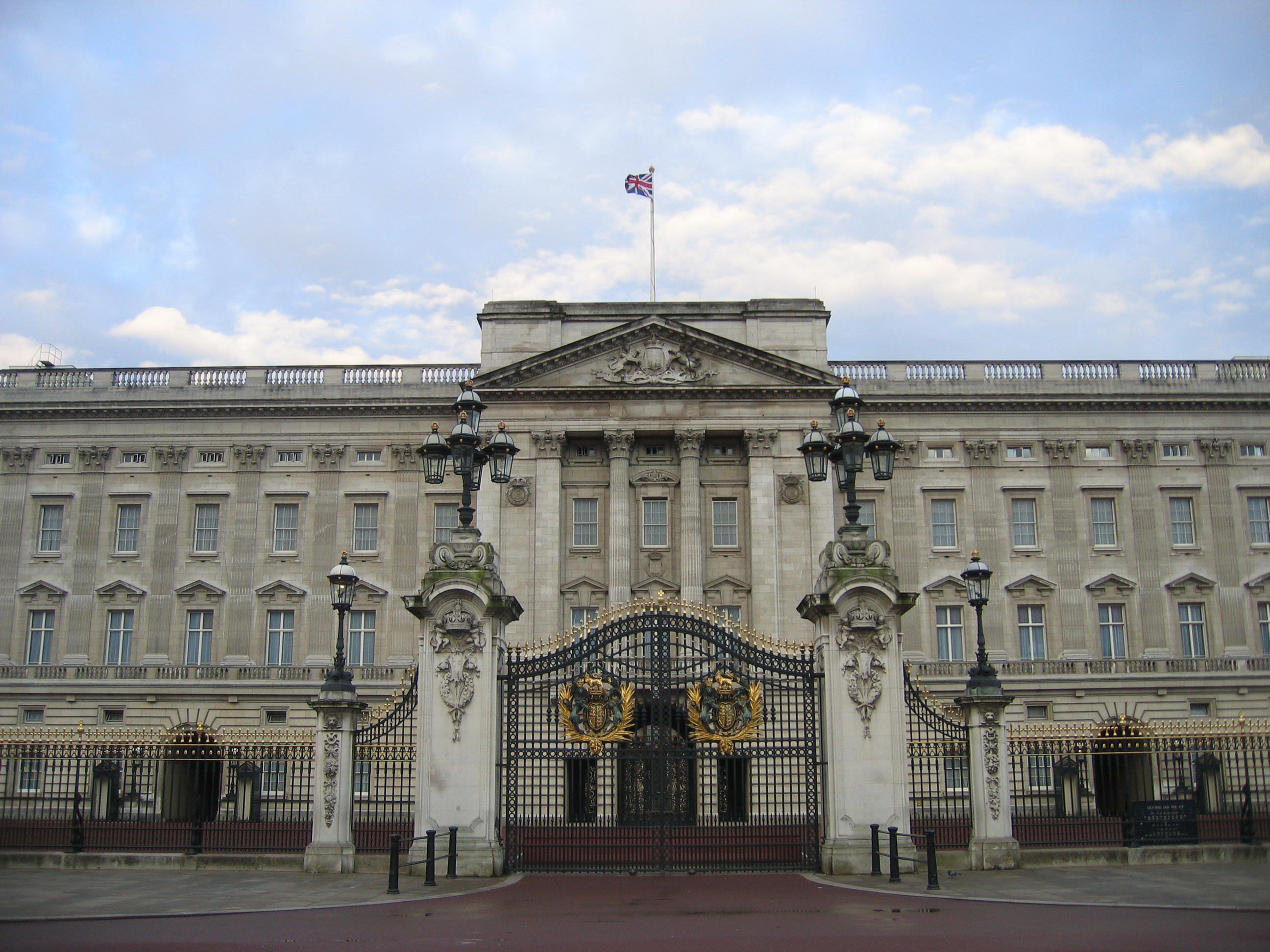
Following her coronation, Queen Elizabeth II and Prince Philip, the Duke of Edinburgh, took up residence in Buckingham Palace and have resided there ever since.

The Queen and her family’s appearance on the palace’s balcony to wave to crowds at events like Trooping the Colour and last year’s Royal Wedding have become symbols of her reign.

We’ve already written about some of the history of the 775 room palace (see our earlier post here), so today we’re looking specifically at the palace as the residence of Queen Elizabeth II.

While the focus for visitors to the palace is on the grand state rooms (of which there are 19 located in the west block facing the palace gardens – they include the Throne Room and State Dining Room), the Queen and the Duke of Edinburgh live in private apartments on the north side of the palace while rooms on the upper floors of the palace’s north and east sides are occupied by other members of the Royal Family. A large part of the ground floor and palace’s south wing are occupied by service quarters and members of the Royal Household.

As well as weekly meetings at the palace – including audiences with the Prime Minister, foreign and British ambassadors, clergy and senior members of the civil service, the Queen also hosts a variety of grand events at the palace throughout the year. These include the Diplomatic Reception given for members of the diplomatic corps in the autumn (more than 1,500 people attend from more than 130 countries), three large garden parties in the summer and grand State Banquets which are held in the Ballroom on the first evening of a visit from a foreign head of state. The Queen is also noted for the small private lunch parties she holds to which community leaders are invited.

The head of the 1,200 strong Royal Household is the Lord Chamberlain (since 2006 The Earl Peel), a non-political office responsible for the organisation of ceremonial activities at court as well as the palace’s upkeep. Under him are the various departments heads – these include the Comptroller, who heads the Lord Chamberlain’s Office (this oversees everything from State Visits to the Royal Mews), the Keeper of the Privy Purse (responsible for the management of the sovereign’s financial affairs) and the Master of the Household (responsible for domestic and staff arrangements as well as catering and official entertainment, this position dates back to 1539).

A typical day in the life of the Queen when at the palace involves her spending the morning at her desk where she reviews a sample of incoming letters (an estimated 200 to 300 arrive each day almost all of which are answered by her staff) and meets with her Private Secretaries to deal with official papers which arrive in the famous ‘red boxes’.

The Queen will then often hold a series of audiences during which she’ll meet with a range of people – from retiring senior members of the armed forces to newly appointed ambassadors and judges and people who have won awards for excellence in a particular field. She may then participate in an investiture at which honors and decorations are presented (about 25 of these are held every year, usually in the palace Ballroom).

Lunch is often private although as previously mentioned, the Queen and Duke of Edinburgh are known for hosting small lunch gatherings for a range of people. In the afternoon, the Queen will often attend engagements outside the palace (she attends about 430 engagements and audiences a year) before possibly meeting with the Privy Council.

Evenings are spent reviewing a report of the day’s parliamentary proceedings, meeting with the Prime Minister (something she does every Wednesday when both are in London), attending further engagements or hosting events at the palace.

And, of course, when the Queen is in residence, Buckingham Palace is also home to the Queen’s corgis – Monty, Willow and Holly – and dorgis (a cross between a corgi and a dachshund) – Cider, Candy and Vulcan.

For more on Buckingham Palace and the life of the Queen, go www.royal.gov.uk.

WHERE: State Rooms, Buckingham Palace (includes special exhibition Diamonds: A Jubilee Celebration) (nearest Tube stations are Victoria, Green Park and Hyde Park Corner); WHEN: 9.45am to 6.30pm, 30th June to 8th July and 31st July to 7th October; COST: £18 an adult/£10.50 a child (under 17s/under fives free)/£16.50 concession/£47 family; WEBSITE: www.royalcollection.org.uk/visit/buckinghampalace.

PICTURE: Christa Richert/sxc.hu

Around London – ‘Wild London’; National Trust photography contest; JK Rowling gets Freedom; and, Royal Devotion at Lambeth…

• Celebrate the Diamond Jubilee next Tuesday in Richmond Park as it hosts ‘Wild London’, the borough’s “first festival aimed at celebrating London’s woodlands, parks and gardens”. The event, which is being put on by Richmond Council and Royal Parks, will mark the Queen’s first visit to the borough in 23 years. It will showcase the conservational, recreational and inspirational role that parks and gardens play in London and will include hands-on exhibits, demonstrations, displays and performances. The event will be the first in a series celebrating the Diamond Jubilee held in Royal Parks. For more information, see www.richmond.gov.uk/home/leisure_and_culture/diamond_jubilee.htm

• The National Trust has launched a new photography competition aimed at celebrating green spaces and the life of the Trust founder Octavia Hill. The competition, called Your Space, is running in conjunction with National Trust Magazine and is open for entries until August. The competition was launched by internationally acclaimed photographers – Mary McCartney, Joe Cornish, Arnhel de Serra and Charlie Waite – with a new collection of pictures at National Trust places. One of the three Trust founder, Octavia Hill was a leading environmental campaigner in the Victorian Age and campaigned to save places in and around London like Parliament Hill. Entries in the competition, which aims to capture images of everyday green spaces, could include pictures from the local park or countryside. For details on how to enter, follow this link

• The author of the Harry Potter books, JK Rowling, received the Freedom of the City of London this week. The books have sold an estimated 450 million copies worldwide and have been made into films. The Freedom ceremony took place at Mansion House, the official residence of the Lord Mayor of London. Speaking before the ceremony on Tuesday, Rowling was quoted as saying that both her parents were Londoners. “They met on a train departing from King’s Cross Station in 1964, and while neither of them ever lived in London again, both their daughters headed straight for the capital the moment that they were independent.  To me, London is packed with personal memories, but it has never lost the aura of excitement and mystery that it had during trips to see family as a child. I am prouder than I can say to be given the Freedom of the City, which, on top of all the known benefits (and few people realize this), entitles me to a free pint in The Leaky Cauldron and a ten Galleon voucher to spend in Diagon Alley.” For more, see www.cityoflondon.gov.uk.

• On Now: Royal Devotion. This exhibition in the Great Hall of Lambeth Palace is being held to mark both the Diamond Jubilee of Queen Elizabeth II and the 350th anniversary of the revised Book of Common Prayer. The display charts the relationship between Crown and Church and its embodiment in the history of the Book of Common Prayer, one of the most important books in the English language. As well as the 1662 revision of the Book of Common Prayer, highlights include a 1549 printing of the Book of Common Prayer, medieval illuminated manuscripts, including the Book of Hours of King Richard III, Queen Elizabeth I’s personal prayer book and a copy of the book of private devotions compiled for Queen Elizabeth II in preparation for her coronation, the Book of Common Prayer used at the wedding of Queen Victoria, and King Charles I’s own handwritten revision of State Prayers. Admission fee applies. Runs until 14th July. For more, see www.lambethpalacelibrary.org/

Celebrating the Diamond Jubilee with 10 royal London locations – 4. Westminster Abbey…

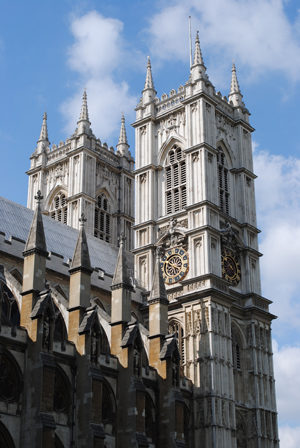
Westminster Abbey has played a key role in the life of Queen Elizabeth II – it was here on 20th November, 1947, that she was married to Prince Philip (then Lieutenant Philip Mountbatten) and it was here on 2nd June, 1953, that she was crowned Queen Elizabeth II.

First to the wedding. Princess Elizabeth was only the 10th royal to be married in the Abbey (her predecessors included her parents who married here on 26th April, 1923). The ceremony started at 11.30am and the princess, who wore a white dress designed by Norman Hartnell, entered to a specially composed fanfare accompanied by eight bridesmaids and two pages.

Due to post war austerity measures, only about 2,000 people attended the wedding (we’ve previously mentioned that the princess had to save coupons for her wedding dress like any other bride). On the day, the grave of the Unknown Warrior was the only stone that was not covered by the special carpet and the day after the wedding, the now married Princess Elizabeth followed a royal tradition started by her mother, Queen Elizabeth, which involved sending her wedding bouquet back to the Abbey to be laid on the grave.

It was about five-and-a-half years after her wedding that the princess returned to the Abbey to be crowned a queen.

Then Princess Elizabeth was in Kenya (on her way to Australia) when news reached her on 6th February that year of the death of her father, King George VI. After Prince Philip broke the news to her, the new queen chose Elizabeth as her “regnal name”, and the couple returned to England.

Queen Elizabeth II’s grandmother, Queen Mary, died on 24th March, but it was decided to proceed with the coronation anyway (Queen Mary had apparently asked that the coronation not be delayed by her death).

The coronation, the 38th to be conducted in the Abbey, was the first to be televised (with the exception of the anointing and communion) and was “instrumental” in helping to popularise it in the UK and elsewhere.

The building was closed for five months so preparations could be made for the more than 8,000 wedding guests. The Queen’s coronation dress, meanwhile, was made by Norman Hartnell (as had been her wedding dress) and was made of white satin embroidered with emblems of the United Kingdom and the Commonwealth.

Having arrived from Buckingham Palace in the Gold State Coach, the Queen entered the Abbey at 11.20am and, having been invested with the Regalia while seated in the Coronation Chair, was crowned with St Edward’s Crown at 12.34pm. She left the Abbey at 2.53pm and rode through the streets of London back to the palace.

Of course, the Queen has since attended many other events at the Abbey – including thanksgiving services for their golden and silver wedding anniversaries and last year’s Royal Wedding – since her coronation which we don’t have space to talk about here. But it is worth noting before signing off that the Abbey continues to have a special relationship to her – it is a “Royal Peculiar” meaning it is exempt from any ecclesiastical jurisdiction but that of the Sovereign.

WHERE: Westminster Abbey, Westminster (nearest Tube station is Westminster or St James’s Park); WHEN: Open to tourists everyday except Sunday  (times vary so check the website); COST: £16 an adult/£13 concessions/£6 schoolchildren (11-18 years), free for children aged under 11/£38 for a family (two adults, two children); WEBSITE: www.westminster-abbey.org

Lost London – Vauxhall Pleasure Gardens

First laid out in the mid 17th century, Vauxhall Pleasure Gardens, on the east bank of the Thames just south of Lambeth, rose in fame to become one of London’s leading public entertainment venues.

The gardens, initially known as New Spring Gardens, are believed to have opened around the time of the Restoration of 1660 on a site which had been formerly an estate owned by vintners John and Jane Vaux (Jane was apparently widowed).

Initially apparently no more than an ale-house with a garden attached, the gardens grew to span several acres and featured a central hub and long avenues for strolling. Admission was initially free with money made from food and drink sold there. Among the earliest recorded visitors to the gardens was John Evelyn in 1661, describing it as a “pretty contrived plantation” and diarist Samuel Pepys, who wrote of a visit he made on 29th May, 1662 (he is known to have returned numerous times).

From 1729, the gardens came under ownership and management of John Tyers, entrepreneur, property developer and patron of the arts, and it was he who, until his death in 1767, oversaw the transformation of the area into an arts hotspot which included sculpture (in particular a fine statue of the composer Handel), music, painting and architecture. Thanks partly due to the patronage of Frederick, Prince of Wales, the gardens become the fashionable place to be seen.

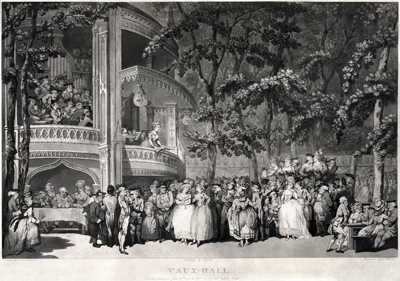
The variety of entertainment on offer at the gardens – the name of which was only officially changed to Vauxhall Gardens in 1785 – grew substantially over the years: from concerts and fireworks displays to performances by tight rope walkers and lion tamers and even re-enactments of famous battles. The gardens became renowned as site for balloon ascents and, for its architecture – the number of buildings there grew over the years to include a rococo ‘Turkish tent’, Chinese pavilion, and, another rococo building, the Rotunda (where concerts could be held in wet weather). There was also a cascade and private ‘supper boxes’ for those who could afford them; those who couldn’t could dine at tables set under the trees.

From the outset, Vauxhall was known as a place where the sexes could mix freely and, therefore, for romantic assignations – in fact, one area of the gardens became known as the ‘Dark Walk’ for the fact it was, unlike other areas of the gardens, never illuminated by lamps and it was in this area, frequented by prostitutes, that many of the more illicit liaisons took place.

By the late 1700s and early 1800s, the gardens, one of a number of pleasure gardens in London, had reached the height of their popularity with reportedly more than 60,000 people said to have  attending a fancy dress party held one night in the late 1700s.

Those who attended events in the gardens included royalty as well as the likes of Samuel Johnson and James Boswell (see Thomas Rowlandson’s image above, Vauxhall Gardens, showing the likes of Johnson and Boswell, along with Georgina, Duchess of Devonshire, and the future King George IV, at the gardens in about 1779) as well as, much later, Charles Dickens (by the time Dickens visited, however, the heyday of the gardens was already well over).

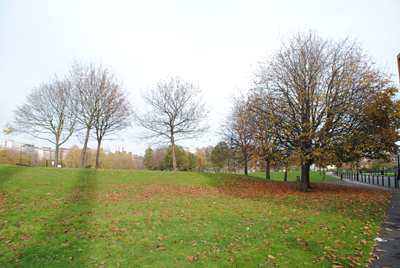
The gardens closed in 1859 due apparently to declining popularity and were eventually replaced with housing. After being badly bombed in World War II, however, the site once again returned to being a garden, known as Spring Gardens. The gardens (pictured) still occupy the site not far from Vauxhall tube station – part of them is used by the Vauxhall City Farm as paddocks for horses and livestock and they also contain a multi-use games court.

For an authoritative and comprehensive work on the Vauxhall Gardens, try David Coke and Dr Alan Borg’s Vauxhall Gardens: A History. There’s also much more information on David Coke’s website here. There’s also a detailed history here.

David Coke is curating an exhibition at The Foundling Museum, The Triumph of Pleasure, which looks at the way in which the gardens and the establishment of the Foundling Hospital in 1739 “changed the face of British art forever”. Runs from 11th May to 9th September. For more, see www.foundlingmuseum.org.uk.

PICTURES: Wikipedia and David Adams

LondonLife – The ‘Royal River’ celebrated at the National Maritime Museum

Canaletto’s image of Greenwich Hospital from the north bank of the Thames (1750-52) is among almost 400 paintings, manuscripts and objects selected to be part of the National Maritime Museum’s new exhibition, Royal River: Power, Pageantry & The Thames.

Curated by historian David Starkey, the exhibition, part of the Diamond Jubilee celebrations, focuses on the use of the river across five centuries covering events including Anne Boleyn’s coronation procession and Admiral Lord Nelson’s stately funeral through to the evolving Lord Mayor’s pageant and the ‘Great Stink’ of the mid-1800s.

Highlights include the oldest known copy of Handel’s Water Music, the sixteenth century Pearl Sword (which the monarch must touch on entering the City of London), a stuffed swan, treasures from the City’s livery companies, and another Canaletto work – this time his famous view of the river filled with boats getting ready for the Lord Mayor’s Day, seen as an inspiration for this year’s Diamond Jubilee Pageant and on show in the UK for the first time since its completion.

As well as celebrating the Diamond Jubilee, the exhibition also marks the 75th anniversary of the opening of the National Maritime Museum by King George VI on 27th April, 1937. The king’s speech from that day and his Admiral of the Fleet uniform also feature in the exhibition.

WHERE: National Maritime Museum Greenwich (nearest DLR station is Cutty Sark); WHEN: Daily 10am to 5pm (opening times may vary during the Paralympic and Olympic Games) until 9th September; COST: £11 adult/£9 concession/family ticket £24.50; WEBSITE: www.rmg.co.uk.

PICTURE: © National Maritime Museum, London

Around London – Cutty Sark reopens; Genghis Khan at Marble Arch; New theatre for the West End; and, Shakespeare’s cash…

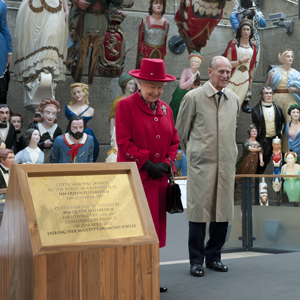
• The Cutty Sark, the world’s last surviving 19th century tea clipper, reopens to the public today following a £50 million, six year conservation project. The project to restore the Greenwich-docked ship has involved raising it more than three metres so visitors can walk underneath and see for themselves the sleek lines which helped the vessel set a then record-breaking speed of 17.5 knots or 20mph in sailing from Sydney to London. As well as raising the ship three metres, the project has involved encasing the ship’s hull in a glass casing to protect it from the weather – this area also contains the museum’s extensive collection of more than 80 ships’ figureheads, never been seen in its entirety on the site. The ship’s weather deck and rigging, meanwhile, have been restored to their original specification and new, interactive exhibitions on the vessel’s history have been installed below deck. Originally launched in 1869 in Dumbarton, Scotland, Cutty Sark visited most major ports around the world, carrying cargoes including tea, gunpowder, whiskey and buffalo horns and made its name as the fastest ship of the era when carrying wool between Australia and England. The ship became a training vessel in the 1920s and in 1954 took up her current position in the dry dock at Greenwich before opening to the public. In November 2006, the ship’s rig was dismantled in preparation for a restoration project – this received a setback on 21st May, 2007, when a fire broke out aboard the ship and almost destroyed it. The ship – which was officially reopened by Queen Elizabeth II and the Duke of Edinburgh (pictured) yesterday – is now under the operational management of the umbrella body, Royal Museums Greenwich. For more (including the online purchasing of tickets), see www.rmg.co.uk/cuttysark or www.cuttysark.org.uk. PICTURE: National Maritime Museum, London.

• A large statue of Genghis Khan has invaded Marble Arch. The 16 foot (five metre) tall sculpture of the Mongolian warlord, created by artist Dashi Namdakov, was erected by Westminster City Council as part of its ongoing City of Sculpture festival which is running in the lead-up to the Olympics. The statue has sparked some controversy – Labour councillors at Westminster have reportedly suggested Dambusters hero Guy Gibson would be a more suitable subject for a statue than the warlord Khan. The Russian artist, who has an exhibition opening at the Halcyon Gallery in Mayfair next month, told the Evening Standard he simply wanted to honor Khan on the 850th anniversary of his birth.

• Development of a new West End theatre, the first to be built in the area in 30 years, has been given the green light. The new 350 seat theatre will be part of a development project located between Charing Cross Road and Oxford Street which will also feature office and retail spaces. The site was occupied by a pickle factory in the 19th and 20th centuries and from 1927 was the home of the Astoria cinema, remodelled as a live venue in the 1980s. Live music was last presented there in 2009 when the site was compulsorily acquired for the Crossrail project.

• On Now: Crowns and Ducats: Shakespeare’s money and medals. This exhibition at the British Museum explores the role of money in Shakespeare’s world and looks at how coins – a frequently recurring motif in Shakespeare’s work – and medals were issued to mark major events. Objects in the display include Nich0las Hilliard’s ‘Dangers Averted’ medal of Elizabeth I and William Roper’s print of the Queen, the first to be signed and dated by a British artist, as well as a money box such as might have been used at the Globe and a hoard of coins, including a Venetian ducat, deposited in Essex around the time of Shakespeare’s birth. Almost every coin mentioned in Shakespeare’s plays will be on show – from ‘crack’d drachmas’ to ‘gilt twopences’. Runs until 28th October in room 69a. Entry is free. For more, see www.britishmuseum.org.

Celebrating the Diamond Jubilee with 10 royal London locations – 2. The Queen’s childhood homes

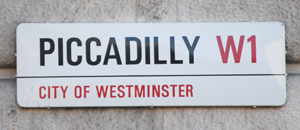
Having spent the first few months of her life at 17 Bruton Street, the future Queen Elizabeth II moved into her parents’ new property at 145 Piccadilly.

The property, located close to Hyde Park Corner, was previously the townhouse of the Marquesses of Northampton (interestingly, it was while living here that her father the Duke of York first started visiting the Harley Street-based Australian speech therapist Lionel Logue, as depicted in The King’s Speech). The 25 bedroom house was later destroyed by a bomb during the war, long after the Yorks had moved out.

As well as the house at 145 Piccadilly, the young Princess Elizabeth (and from 1930 her younger sister and only sibling Princess Margaret) also lived at White Lodge in the centre of Richmond Park in the city’s south-west. The Lodge, a Georgian property built as a hunting lodge for King George II, now houses part of the Royal Ballet School.

She also considerable time outside the city, staying in places including Scotland with her grandparents at either Balmoral Castle (owned by the Royal Family) or at Glamis Castle (owned by the parents of her mother, the Earl and Countess of Strathmore) as well as, from the age of six, at Royal Lodge in Windsor Great Park, the country home of the Yorks. The princess apparently had her own small house, known as Y Bwthyn Bach (the Little Cottage), in the grounds  – a gift from the people of Wales in 1932.

Following the death of King George V and subsequent abdication of King Edward VIII in 1936, new King George VI and his family moved from 145 Piccadilly to Buckingham Palace. Following the outbreak of World War II in 1939, the princesses lived in Balmoral, Scotland, and Sandringham but spent most of the war at Windsor Castle.

Princess Elizabeth, meanwhile, had met Prince Philip of Greece during the 1930s and in 1947, he asked for permission to marry her.

What’s in a name?…Earls Court

A residential district in inner west London, the origins of the name Earls Court apparently go back almost to the time of the Norman Conquest when the area was granted to the de Vere family as part of the Manor of Kensington. 

The de Veres, who held a court at the manor, were named the Earls of Oxford in 1141 and hence, according to Cyril M. Harris, author of What’s in a Name?: Origins of Station Names on the London Underground, came about the name Earl’s Court. The courthouse, which was demolished in the late 1800s, apparently stood on a site by Old Manor Lane now occupied by gardens.
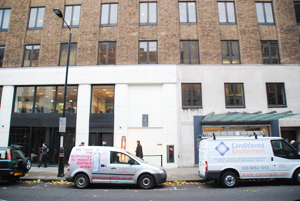
Originally fertile farmland, Earl’s Court’s development took place in the mid to late 1800s after the arrival of the railway line (the station was built in 1869). The area officially became part of London in 1889 when the London County Council was formed and the city’s boundaries extended.

The area became famous for the Earls Court Exhibition Grounds – established by John Robinson Whitley in 1887 –  which featured rides and an arena which hosted Buffalo Bill’s Wild West Show. A giant wheel was added 10 years later.

After the Second World War, the area attracted large numbers of Polish immigrants leading to Earl’s Court Road being named ‘The Danzig Corridor’. The arrival of large numbers of Australian and New Zealander travellers in the late Sixties saw it earning a new nickname – this time ‘Kangaroo Valley’. The area is now undergoing gentrifcation.

Notable buildings include the art deco Earl’s Court Exhibition Centre, former home of the Royal Tournament and site of the volleyball competition during this year’s Olympic Games, while notable residents have included the Egyptian archaeologist Howard Carter, film director Alfred Hitchcock, and Queen frontman Freddie Mercury.

Around London – Europe’s oldest intact book at British Library; 100 days to the Games; world’s largest archaeological archive; the London Marathon; and, Turner at the National Gallery…

• The British Library has paid £9 million for a 7th century text, the St Cuthbert Gospel, which is also the oldest intact European book. The acquisition follows the library’s most successful fund-raising effort ever – it included a £4.5 million grant from the National Heritage Memorial Fund. The book – a Gospel of John bound in beautifully tooled red leather – was produced in north-east England in the late 7th century and was placed in the saint’s coffin after his death on the Isle of Lindisfarne in 698. It was retrieved when the coffin was opened at Durham Cathedral in 1104. The Gospel is on display in the Sir John Ritblat Treasures Gallery at the library in St Pancras and following a conservation review, it is anticipated it will soon be displayed with the pages open for the first time. There will be a public event celebrating the acquisition on 15th May. For more, see www.bl.uk/whatson/events/may12/index.html.

• London this week marked 100 days until the Opening Ceremony of the 2012 Olympic Games. This included unveiling the latest installation of the Olympic rings – made of 20,000 plants the 50 metre long rings are located in the Royal Botanic Gardens at Kew in the city’s west and can be seen from planes on the Heathrow flight path. The organising committee also announced the Red Arrows aerobatic display team will perform a nine-ship flypast in ‘big battle’ formation on the day of the Opening Ceremony (27th July) and stated that the games motto will be ‘Inspire a Generation’. For more, see www.london2012.com.

• The Museum of London’s archaeological archive – known as the London Archaeological Archive and Research Centre (LAARC) – is officially the largest in the world according to Guinness World Records. The archive contains more than five million artefacts and the records of almost 8,500 excavations dating back to 1830. Items in the archive include shoes dating back to Roman times, a 200-year-old set of false teeth, ‘witching bottles’ including one with human hair and toenails, and coffin plates from London’s cemeteries. The world record has been recorded as part of World Record London, a series of world record breaking events being held in the run-up to the Olympics. Others have included the Faberge Big Egg Hunt.

• Thousands of people are expected to take part in the Virgin London Marathon this Sunday. The 26.2 mile route starts in Blackheath, passes through Woolwich and Greenwich and crosses the Thames at Tower Bridge before looping around the east end of London, through Canary Wharf, and the west along The Highway (formerly known as The Ratcliffe Highway) and Embankment to Parliament Square, Birdcage Walk and finally to Buckingham Palace. The first London marathon was run in 1981. For more, see www.virginlondonmarathon.com.

• On Now: Turner Inspired – In the Light of Claude. The first major presentation of 17th century artist Claude Gellée’s influence on the English romantic artist J M W Turner, the exhibition focuses on Claude-inspired themes which run through Turner’s work including “the evocation of light and air in landscape, the effect of light upon water and his often radical reworking of contemporary scenes”. The display includes works from large scale oils on canvas through to leaves from Turner’s pocket sketchbooks. Interestingly, the exhibition also explores the story behind the so-called Turner Bequest – that on his death, Turner linked himself to Claude forever by leaving the National Gallery two pictures – Dido building Carthage (1815) and Sun rising through Vapour: Fishermen cleaning and selling Fish (before 1807) –  on condition that they were hung between two pictures by Claude, Seaport with the Embarkation of the Queen of Sheba (1648) and Landscape with the Marriage of Isaac and Rebecca (1648). Runs until 5th June. Admission charge applies. For more, see www.nationalgallery.org.uk.

Celebrating the Diamond Jubilee with 10 royal London locations – 1. The Queen’s birthplace

This week we start a new series in honour of this year being the Diamond Jubilee of Queen Elizabeth II. We’ll be looking at locations across the city which have played an important role in the story of the Queen. First up, it’s the Queen’s birthplace – a now non existent townhouse in Mayfair.

The property at 17 Bruton Street, which is marked by a small plaque installed in 1977 – the Queen’s Silver Jubilee (it’s in the middle of the image to the right), was actually the home of the Queen Mother’s parents, the Earl and Countess of Strathmore. It and the neighbouring townhouse at 18 Bruton Street have both been demolished and replaced with a rather bland office building.

Born here at 2.40am on 21st April, 1926, the Queen, named Elizabeth Alexandra Mary, was the first child of the then Duke and Duchess of York (later King George VI and Queen Elizabeth). At her birth, Queen Elizabeth II was only third in line to the throne after her uncle, the Prince of Wales (later, briefly, King Edward VIII), and her father.

The Queen’s grandparents, King George V and Queen Mary, both visited the newborn child at the property (along with an apparently large crowd outside). Elizabeth was christened five weeks later at the Chapel Royal in Buckingham Palace. She spent the first few months of her life living in a room at 17 Bruton Street which had been previously used by her mother before her marriage.

Recent books on the Queen include Andrew Marr’s  The Diamond Queen: Elizabeth II and Her People, the souvenir album Queen Elizabeth II: A Diamond Jubilee Souvenir Album, and Sarah Bradford’s Queen Elizabeth II: Her Life in Our Times.

• Correction: Bruton Street was mistakenly copied here as Brunton Street. It has been corrected. Apologies for the error!

Daytripper – Rochester

We’ve talked about the Medway town of Rochester earlier in the week as part of our Dickens series but it’s also worth talking about this town in Kent in its own right. 

While Dickens’ connection with the town is a key part of the reason for its charm, this town, which dates from as far back as Roman times and remained an important centre thanks to its strategic position on the Medway, has plenty more to offer.

Foremost among its attractions are the Norman castle and cathedral. Rochester Castle has its origins in a wooden castle built soon after the Battle of Hastings in 1066 with the stone defences following soon after.

The tallest Norman keep in England, from which there are spectacular views, was built around 1127 on the order of its then owner, the Archbishop of Canterbury, William de Corbeil. It was about 90 years later, in 1215, when King John laid siege to it during the rebellion of his barons, only taking the castle after a seven week siege when his sappers undermined the south-east tower of the keep (famously it was the fat of 40 pigs which stoked the fire they laid in the tunnels under the tower). The castle was repaired and continued to be used until late medieval times when it fell into disuse and while much of the keep – the highest in England – is now ruined, it remains a stirring sight.

Rochester Cathedral, meanwhile, was first built in Saxon times (there has been a bishop here since 604) although no trace remains of this above ground. The current building, rather, dates from the Norman era – it was consecrated in 1130 in a ceremony attended by King Henry I – and was extensively added to over the following centuries with the completion of the Lady Chapel in 1492 the last major work. Among the most famous bishops here were Bishop Fisher and Bishop Ridley – both of whom died for their faith.

Strolling through the cobbled streets of this historic town, about 30 to 40 minutes from London by train, you’ll also come across the Guildhall Museum, which is housed in the 17th century guildhall and features a range of displays and exhibitions on the history of the Medway including a Dickens discovery room.

Also worth seeing is Eastgate House, the model for Dickens’ Westgate House and now the location of the Swiss chalet in which he wrote, and Restoration House – created from two medieval buildings in the 16th or 17th centuries and the inspiration for Miss Havisham’s home  (see our earlier post).

One unmissable gem is the Six Poor Travellers – an atmospheric and well preserved almshouse in the High Street which dates from Elizabethan times and has an amazing backstory which you can explore as you make your way through its narrow rooms.

Part of the charm of Rochester (and for more on Rochester generally visit www.cometorochester.co.uk/visit/index.htm) lies in its close proximity to Chatham and Gillingham and here you’ll find much more to amuse and entertain including Chatham’s Historic Dockyards (see our earlier daytripper on this), Fort Amherst, Britain’s largest Napoleonic fortress, and for those who can’t get enough of Charles Dickens, Dickens World.

Just to the north of Rochester is Upnor Castle, a rare surviving Elizabethan artillery fortress built to defend the fleet at Chatham Dockyard.

Around London – Of a dramatic Boat Race; celebrating bluebells; Cockney slang; WT Stead; and, Titian’s early masterpiece…

 • Cambridge took the line honours over Oxford in this year’s Boat Race on the Thames in what has been billed as one of the most dramatic races in its 158 race history. The race was interrupted when a swimmer, described as an anti-elitist protestor, was spotted in the water and, following a restart near the Chiswick Eyot, the boat crews clashed oars and one of the Oxford crew lost his oar’s spoon. Cambridge pulled steadily ahead with Oxford an oar down and was declared the winner by four and a quarter lengths. The presentation ceremony was subsequently not held after Oxford’s bow man collapsed and was rushed to hospital where was reported to be recovering well. The win takes Cambridge’s victories to 81 compared to Oxford’s 76. For more, see http://theboatrace.org. (For more on the history of the Boat Race, see our entry from last year).

Epping Forest’s bluebells are out in force and to celebrate the City of London Corporation is holding a series of events including an art exhibition at The Temple in Wanstead Park. The exhibition, Out of the Blue, celebrates the bluebells of Chalet Wood and features a “miscellany of bluebell images, artwork, folklore and fairies”. A free event, it runs until 27th May. This Sunday the Temple will also host an art afternoon with local artist Barbara Sampson and on 29th April photographer Robert Good will hold a course on photography around the forest. Both are free events. For more details, see www.cityoflondon.gov.uk/epping.

• “Porky pies” (lies) is the most used Cockney phrase, according to a survey of Britons on their knowledge and use of Cockney. The Museum of London survey of 2,000 people, including 1,000 from London, also found that “apples and pears” (stairs) was the most well-known Cockney phrase and that while a majority of people knew what common phrases like “brown bread” meant (in this case dead), only small percentages of people used them. And while 63 per cent of respondents believed Cockney slang was crucial to London’s identity, 40 per cent were convinced it is dying out and 33 per cent were sad at its passing. Strictly speaking, a ‘Cockney’ is someone who was born within the sound of bow bells at the church of St Mary-le-Bow in Cheapside, but according to Alex Werner, head of history collections at the museum, “people from all corners of London identify themselves as being Cockney”. He said that while for many people “Cockney rhyming slang is intrinsic to the identity of London”, the research the Cockney dialect “may not be enjoying the same level of popularity”. The research found that among the least known Cockney rhyming slang phrases included “white mice” (ice), “donkey’s ears” (years), and “loop de loop” (soup). For more from the museum, see www.museumoflondon.org.uk.

• The life of influential newspaper editor and Titanic victim, William Stead, will be celebrated at a two day conference next week. Hosted by the British Library, in association with Birkbeck College and the University of Birmingham, the conference will feature 40 speakers from around the world. Stead, who was editor of The Pall Mall Gazette, was a controversial figure who is credited with being one of the inventors of the modern tabloid. He died on the Titanic‘s maiden voyage – the 100th anniversary of which is being marked this month. W.T. Stead: A Centenary Conference for a Newspaper Revolutionary takes place from 16th to 17th April, 2012. Tickets (£45 for one day or £85 for two days) can be booked by visiting the box office in the St Pancras building or phoning 01937 546546. The programme for the conference can be found at https://sites.google.com/site/stead2012/.

• On Now: Titian’s First Masterpiece: The Flight into Egypt. The National Gallery is hosting a new exhibition focused on the then young artist’s creation of the magnificent painting The Flight into Egypt in the 16th century. The artwork, lent to the National Gallery by the Hermitage Museum, St Petersburg, has recently been restored and the exhibition represents the first time the painting has been seen outside Russia since 1768 when Empress Catherine the Great purchased it in Venice. Admission is free. Runs until 19th August. For more, see www.nationalgallery.org.uk.