The Royal Wedding – London’s royal reception venue

Following the wedding ceremony at Westminster Abbey on Friday, the now married happy couple will head in a carriage via a processional route down The Mall to Buckingham Palace.
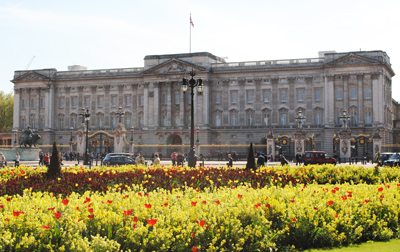
There, they will enjoy a champagne reception with 600 guests hosted by the Queen before, at 1.30pm, appearing on the balcony of the palace to wave to the crowds and watch an aircraft flypast expected to include a Lancaster, Spitfire, Hurricane, two Typhoons and two Tornados.

Buckingham Palace, which has served as the official London residence of the reigning monarch since 1837, has a long tradition of hosting royal events. Then much smaller and known as Buckingham House, the property was built for the Duke of Buckingham in 1705.

It passed into royal hands when it was bought by King George III in 1761 for his wife, Queen Charlotte, to use as a family home located conveniently close to St James’s Palace where many court functions were held.

The house was extensively remodelled in 1762 and again, this time on the orders of King George IV, in the 1820s (after initially wanting to use it, like his father, as a family home, the king decided after the works had started to instead transform it into a palace, created to the designs of architect John Nash).

When King George IV died in 1830, his brother King William IV ordered the works to be continued albeit with a new architect, Edward Blore (the spiralling costs of Nash’s work are said to have cost him the contract). The king himself never lived in the house – even offering at at one stage as a seat for Parliament after the Houses of Parliament were destroyed by fire in 1834 – and it wasn’t until the accession of Queen Victoria in 1837 that the palace became the sovereign’s official residence.

Further works were subsequently needed to ensure there was adequate accommodations for the Queen’s family and it was during these works that the monumental Marble Arch – designed as the centrepiece of the palace’s courtyard – was moved away to its present location on the north-eastern corner of Hyde Park.

The palace, which now boasts 775 rooms including 19 staterooms, has since been the site of numerous royal wedding receptions – it was on the balcony  where Queen Elizabeth II and Philip, the Duke of Edinburgh, greeted crowds on 20th November, 1947, after their wedding in Westminster Abbey and, similarly, where Prince William’s parents, Prince Charles and Princess Diana, held a reception before greeting crowds on 29th July, 1981, after their ceremony at St Paul’s Cathedral.

Buckingham Palace was also the location for Queen Victoria’s wedding breakfast following the ceremony in the Chapel Royal at St James’s Palace on 10th February, 1840.
The Royal Wedding – London’s Royal Wedding venues

In the first of a series this week looking at aspects of royal weddings in London in days past, we canvas some of the venues which have hosted the sometimes glittering occasions.

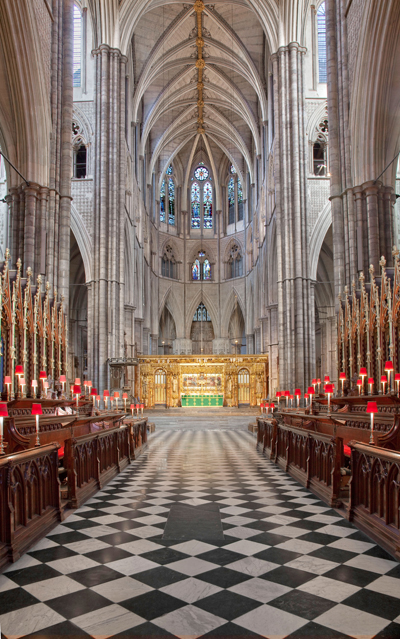
First up is Westminster Abbey (pictured), the location of Prince William and Kate Middleton’s wedding this Friday, which, despite its thousand year history, is only believed to have hosted 15 royal weddings.

Among them is said to have been the wedding of King Henry I to Matilda of Scotland on 11th November, 1100, as well as that of Richard, Earl of Cornwall and brother of King Henry III, who married his second wife, Sanchia of Provence, there on 4th January, 1243, and Joan of Acre, daughter of King Edward I, who married Gilbert, Earl of Gloucester, on 30th April, 1290 (her sister Margaret married John, Duke of Brabant, at the same venue less than three months later). The abbey also hosted the wedding of King Richard II to Anne, daughter of Emperor Charles IV of Bohemia, on 20th January, 1382.

The abbey church has become increasingly favored as a venue for royal weddings in more recent times. Among the most prominent hosted there last century were that of Prince Albert, Duke of York (later King George VI), who married Lady Elizabeth Bowes-Lyon on 26th April, 1923 and that of their daughter Princess Elizabeth (later Queen Elizabeth II) who married Prince Philip of Greece (later the Duke of Edinburgh) there on 20th November, 1947.

Two of the current Queen’s children were also married there – Princess Anne, who married Captain Mark Phillips on 14th November, 1973, and Prince Andrew, who married Sarah Ferguson on 23rd July 1986. (For more on Royal Weddings at the Abbey, see www.westminster-abbey.org/our-history/royals/weddings)

A notable break with the trend in recent times was the marriage of Prince Charles and Lady Diana Spencer – they were married in a fairytale ceremony at St Paul’s Cathedral on 29th July, 1981.

Other London locations for royal weddings have included the now non-existent Greenwich Palace (King Henry VIII married Katherine of Aragon on 11th June, 1509) and Hampton Court Palace (another of King Henry VIII’s marriages – that in which he was wed to Catherine Parr – was held here in a private chapel on 12th July, 1543).

Along with St George’s Chapel at Windsor, the Chapel Royal at St James’s Palace  in London was particularly popular in Victorian times – Queen Victoria married Prince Albert there on 10th February, 1840, and their eldest daughter, Princess Victoria, married Prince Frederick (the future German Emperor Frederick III) there on 25th January, 1858. On 6th July, 1893, the chapel also hosted the wedding of the future King George V and Princess Mary of Teck.

PICTURE: Copyright Dean and Chapter of Westminster

Happy St George’s Day!

Amid the celebration of Easter and the flurry of preparations for the upcoming Royal Wedding, you could be forgiven for overlooking the fact that today was St George’s Day.

Hard to do in central London, however, where Trafalgar Square was the centrepoint for celebrations of a musical kind.

Held on the 23rd April each year, St George’s Day – a national day of celebration in England although not yet a national holiday – commemorates the death of St George in 303 AD.

Tradition says St George was a Roman soldier who served the Emperor Diocletian before he was executed for refusing the adjure his Christian faith.

His story – which gradually morphed into a tale in which he defeats a dragon in a symbolic triumph of good over evil – came to England with returning crusaders during the Middle Ages.

He was later adopted as the country’s patron saint (it has been suggested this took place after King Henry V’s victory at the Battle of Agincourt in 1415 but while his feast day was made a national holiday in 1222, it remains a matter of conjecture as to when he become the country’s patron saint).

As one would expect of a national saint, there are numerous depictions of St George around London – the image above is of a massive bronze sculpture by Michael Sandle (1988) which sits in Salisbury Court in the City of London.

Around London – South Bank marks 60 years since the Festival of Britain; Royal wedding cakes; and, a new cable car for London…

• South Bank is celebrating the 60th anniversary of the 1951 Festival of Britain with a four month series of events. The official celebrations kicked off yesterday and will run until early September. Highlights of the celebrations include the Museum of 1951 – a temporary museum located in Royal Festival Hall featuring exhibits relating to the 1951 festival, themed weekends including next weekend’s ‘London in Love’, featuring performances by Billy Bragg, and a Festival of Britain-inspired ‘Meltdown’ curated by Ray Davies of The Kinks (runs from 10th to 19th June). The original Festival of Britain was opened on 3rd May, 1951, with the intention of developing a sense of “recovery and progress” among the British in the aftermath of World War II and marked the centenary of the 1851 Great Exhibition. The South Bank Exhibition was at the heart of what were national celebrations and was attended by more than eight million people. For more information on what’s happening, see www.southbankcentre.co.uk.

• Historic royal wedding cakes have been recreated this Easter weekend  in an exhibition celebrating the lead-up to this Friday’s Royal Wedding. The English Heritage-event Let Them Eat Cake, which is being held at Wellington Arch near Hyde Park Corner, features a “four-and-20 blackbirds pie” of the sort King Henry VIII gave to his new wife Anne Boleyn as well as recreations of Prince Charles and Lady Diana’s wedding cake and that of Queen Elizabeth II. The event, which is sponsored by Tate & Lyle Sugars, involves some of Britain’s leading bakers. For more, see www.english-heritage.org.uk/daysout/events/765107/. See Exploring London this week for more on the upcoming Royal Wedding.

• The Mayor of London, Boris Johnson, confirmed this week that work will begin on a new cable car to cross the Thames River in East London this summer. The 34 gondola cable car will stretch for 1.1 kilometres, connecting Greenwich Peninsula and the O2 on the river’s south bank with Royal Victoria Docks and the ExCel centre on the north and carrying up to 2,500 people every hour. Construction will be carried out by a consortium of firms led by Mace – the company currently building the Shard Tower – and it is hoped it will be completed before next year’s Olympics.

Around London – Giant screens for the Royal Wedding; Graham Greene plaque; and, getting down and dirty at the Wellcome Collection…

• The Royal Wedding will be broadcast live on giant screens at Trafalgar Square and Hyde Park under plans announced by the Department for Media, Culture & Sport, the Mayor of London and The Royal Parks. The live coverage will be free to watch from 7am on 29th April and guests are advised to get there early. A “celebration wheel” has also been set up in Hyde Park – fees apply. See www.london.gov.uk/royalwedding.

• A blue plaque has been unveiled at the house where novelist Graham Greene wrote Brighton Rock. Greene, who died in 1991, lived at 14 Clapham Common North Side in London from 1935 to 1940 and while here wrote several works – these also included the Cannes’ winning collaboration with Carol Reed, The Third Man, and The Power and the Glory – before he joined the forerunner to intellgience service MI6 in 1941. Graham moved out of the house at Clapham Common after it was hit by a bomb in October 1940 (the Queen Anne-style property has since been rebuilt). No-one was in the house at the time – Greene’s wife Vivien and his children had been evacuated to Sussex while Greene himself was staying in Bloomsbury with his lover Dorothy Glover when the bomb hit. The English Heritage plaque was unveiled by Greene’s daughter, Caroline Bourget.

• On Now: Dirt, the Filthy Reality of Everyday Life. Get down amongst it at the Wellcome Collection where they’re running an innovative exhibition on dirt and humanity’s at times desperate efforts to keep it under control. The exhibition features 200 artefacts including visual art, scientific artefacts, film and literature with highlights including the earliest sketches of bacteria, John Snow’s ‘ghost map’ showing the spread of cholera in London in the 1850s, and a bejewelled broom. The exhibition features six different locations – from a street in Victorian London to a New York landfill site in 2030 – from where to begin the exhibition. Runs until 31st August. See www.wellcomecollection.org.

King James I’s London – 3. Golf on Blackheath

When King James I came south to take up the throne England, he is known to have brought that peculiarly Scottish game of golf with him and it is believed that it was at Blackheath, above the then Royal Palace of Placentia in Greenwich, that his courtiers first played the game.

According to the Royal Blackheath Golf Club, now located some way to the south of Blackheath in Eltham (the club moved there is 1923), documentary evidence shows the earliest players included James I’s son Henry Frederick, Prince of Wales, who is known to have gone golfing in 1606. The club itself notes that while it is generally accepted it was established in 1608, no documentary evidence to support this has yet been unearthed (records prior to 1787 are missing).

The first course at Blackheath – which has played a significant role in several events including as a rallying point during the Peasant’s Revolt of 1381 –  apparently consisted of five holes, each of which was played three times.

LondonLife – The Olympic countdown…

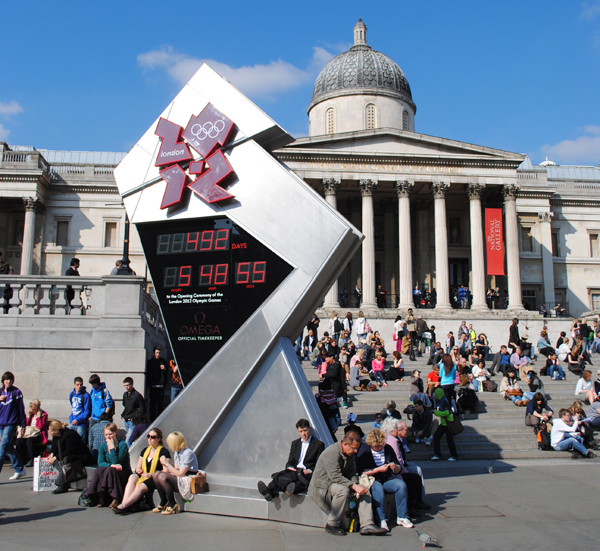
OK, it’s had some teething issues (stopping less than 24 hours after it was launched was one; being daubed with paint another). But the countdown to next year’s Olympics on the official 6.5 metre high clock located in Trafalgar Square continues unabated. The clock was unveiled in mid-March, 500 days before the start of the Games.

Where’s London’s oldest…hospital?

London’s oldest hospital – St Bartholomew’s Hospital in what is known now as Smithfield – was founded in the 12th century.

The hospital owes its foundations – like the neighbouring Priory of St Bartholomew (London’s oldest church – see our previous story on this here) – to Rahere, a courtier (possibly a minstrel or jester) at the court of King Henry I who, tired with triviality, may have become a priest.

In any event, after the death of Henry’s son William – he is believed to have drowned when the White Ship foundered in November 1120 – and that of his wife Queen Matilda, Rahere went on pilgrimage to Rome. He did so but contracted malaria while there and, while under the care of  monks, he vowed to found a hospital for poor men if he recovered.

He did recover and on his return journey had a vision of St Bartholomew who informed him that it was he who had helped him to recover and now desired him to found a church in Smithfield (then known as Smedfield).

Back in London, Rahere as he’d promised and, after petitioning the king, was granted a royal charter in 1122 to found the priory of Augustinian canons and the hospital.Work began in March 1123 and it was completed by 1145 when Rahere died (his tomb can still be seen in the church).

The hospital – one of a number in London at the time – was probably little more than a single hall with a chapel at one end. Other buildings and some cloisters were added later as was the Church of St Bartholomew the Less.

Under a charter of 1147, it was open to the needy, orphans, outcasts and the poor as well as sick people and homeless wanderers. In the 14th century, the definition was honed to include the sick until they recovered, pregnant women (until delivery) and for the maintenance of children born there until they were seven-years-old.

As well as the master (Rahere was the first), other ‘staff’ at the hospital initially included eight Augustinian brothers and four sisters but the hospital gradually became independent of the priory and by 1300, the hospital has its own dedicated master. By 1420, the two institutions had apparently become completely separate.

Following the Dissolution in 1539, the hospital was refounded in the 1540s thanks to a deal brokered between King Henry VIII and the Corporation of the City of London. Along with Bethlem, Bridewell and St Thomas’, St Bartholomews was one of four Royal Hospitals administered by the City.

The first regular physician – a Portuguese man by the name of Roderigo Lopez – was appointed around 1567 (he was later hung, drawn and quartered for an allegedly plotting against Queen Elizabeth I). Among the most famous physicians to serve at St Barts in later years was William Harvey, renowned for having ‘discovered’ the circulatory system.

The hospital survived the Great Fire in 1666 but in the 1700s most of the medieval buildings, with the exception of the tower in the Church of St Bartholomew the Less, were demolished as the hospital was rebuilt to the design of James Gibbs. The new design featured a central courtyard with a Great Hall contained in the north wing, reached by a ‘Grand Staircase’ decorated with images of the Good Samaritan and Christ at the Pool of Bethesda by celebrated artist William Hogarth.

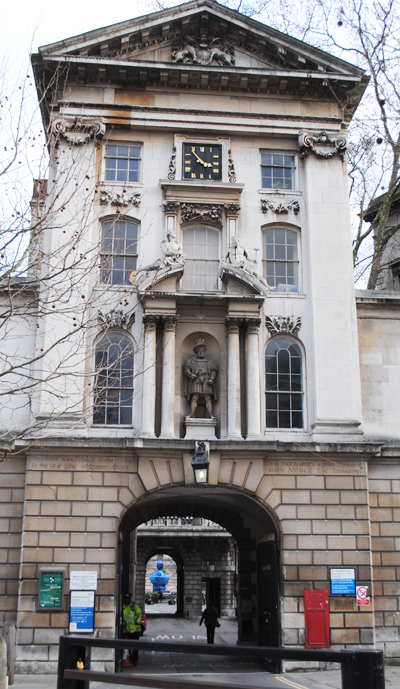
The famous Henry VIII gate (pictured above) dates from 1702, slightly before Gibb’s rebuilding project. Other buildings have been added in more recent times.

In more recent times, the hospital was amalgamated with The Royal London and the London Chest Hospitals in 1994 with the establishment of The Royal Hospitals NHS Trust (now known as the Barts and The London NHS Trust). St Barts is now a specialist cancer and cardiac hospital.

There is a museum at the hospital which houses exhibits including a facsimile of Rahere’s grant of 1137 (now in the hospital’s archives), amputation instruments dating from the early 1800s once used by surgeon John Abernathy and a display on William Harvey. Hogarth’s paintings are visible from the museum.  There are also guided tours of the hospital.

WHERE: Museum at St Barts Hospital (nearest tube station is Barbican); WHEN: 10am to 4pm Tuesday to Friday ; COST: Free (donations welcomed); WEBSITE:  www.bartsandthelondon.nhs.uk/about-us/museums-and-archives/st-bartholomew-s-museum/

Keats’ love letter to be returned home; a royal wedding Oyster; youngest Spitfire pilot honored; and, The Cult of Beauty at the V&A

A love letter Romantic poet John Keats wrote to his beloved Fanny Brown will be returned to the house in which it was written. Keats wrote the letter in 1820 while living next door to her at Wentworth House in Hampstead, north London – his home from 1818 to 1820 and the setting that inspired some of his most memorable poetry including Ode to a Nightingale. The City of London Corporation, who manage the house – now a museum known as Keats House, recently purchased the letter with the support of the Heritage Lottery Fund for £80,000. They say it will now be returned to the house and displayed there. In the letter Keats wrote: “I shall Kiss your name and mine where your Lips have been – Lips! why should a poor prisoner as I am talk about such things.” He said his consolation was “in the certainty of your affection”. See www.keatshouse.cityoflondon.gov.uk.

Amid the host of souvenirs and trinkets up for sale in the lead-up to the wedding of Prince William and Catherine Middleton comes news of a unusual offering from Transport for London – a limited edition royal wedding Oyster card. The card, which will go on sale in the week leading up to the ceremony, features a portrait of the couple and their wedding date – 29th April, 2011. More than 750,000 of the cards will be offered for sale. The move is not without precedent – in 1981, a unique ticket was produced for the marriage of Prince Charles and Lady Diana.

• Squadron Leader Geoffrey Wellum, the youngest Spitfire pilot to take part in the Battle of Britain, was granted the Freedom of the City of London at a ceremony at Guildhall last week. Wellum was just 18-years-old when he joined the RAF in August 1939. Serving in a frontline squadron, he flew many combat missions including dogfights during the Battle of Britain and was subsequently awarded the Distinguished Flying Cross.

• On Now: The Cult of Beauty: The Aesthetic Movement 1860-1900 at the Victoria & Albert Museum in . Said to be the “most comprehensive” exhibition ever staged on the Aesthetic Movement in Britain, it brings together masterpieces in painting as well as sculpture, design, furniture, architecture, fashion and literature of the era and explores some of the key personalities  involved in the movement – from William Morris and Frederic Leighton through to James McNeil Whistler, Dante Gabriel Rossetti, Edward Burne-Jones and Oscar Wilde. Organised in collaboration with the Fine Arts Museums of San Francisco, the exhibition runs until 17th July. Tickets are £12 (concessions available). See www.vam.ac.uk.

LondonLife – The Oxford and Cambridge Boat Race

PICTURE: Oxford celebrate their win. Source: Getty Images

Last weekend saw the running of the 157th Oxford and Cambridge Boat Race from Putney to Mortlake on the River Thames in London. Oxford this year added to its tally with a victory which now has the running scores as 80 Cambridge, 76 Oxford.

The origins of the race go back a friendship between two men who’d met at the prestigious Harrow School – Charles Merivale and Charles Wordsworth (incidentally, the nephew of the poet William Wordsworth). Merivale went on to attend Cambridge and Wordsworth, Oxford. The first race was organised after Cambridge challenged Oxford.

The first race, said to have been watched by 20,000 people, was held at Henley on Thames, Oxfordshire, in 1829 after Cambridge sent a challenge to Oxford (Oxford won after a restart). It was such a success that the townfolk decided to organise an annual regatta – the Henley Royal Regatta – but the race itself moved to London with the second event held in 1836.

Initially Westminster was the chosen location but growing crowds led it to be moved again in 1845 – this time what was then the village of Putney, about six miles upstream. It became an annual event in 1856 and has run every year ever since, with the exception of the war years.

The races have featured several sinkings (including 1912 when both boats sank), a win in a blizzard (1952), and a “dead heat” (1877 – although some controversy surrounds how close it was – in any event it was almost repeated in 2003 when Oxford won by just one foot).

Sponsored by Xchanging, the race – in which Oxford traditionally wear dark blue and Cambridge light blue with both teams known as “Blues” – is now watched by some 250,000 people who crowd along the river’s bank as well as millions around the world. Among the traditions which have continued are that it’s the loser of the previous year’s race who challenges the victor to the next race.

For more about the race, see www.theboatrace.org or visit the River & Rowing Museum at Henley on Thames.

Around London – Apsley House’s State Dining Room reopens; St Pancras Renaissance Hotel restored; Sir Basil Spence honored; and, your chance to lift Tower Bridge…

The State Dining Room at Apsley House, the Duke of Wellington’s former London residence, reopened to the public last weekend after a make-over. The revitalisation works included repairing and cleaning the ceiling and chandelier as well as the Portuguese silver centre piece, which was presented to Wellington by the Portuguese Council of Regency to commemorate his victories over Napoleon in the Peninsular War. The house, which bears the landmark address of Number One London, was given to the nation in 1947 by the 7th Duke of Wellington, whose family continues to occupy private rooms in the premises. See www.english-heritage.org.uk/daysout/properties/apsley-house/.

Seventy-six years after it last hosted a guest, the former Midland Grand Hotel at London’s St Pancras station reopened its doors quietly earlier this month following a 10 year, £150 million restoration project. The Grade I-listed Victorian Gothic building, designed by Sir George Gilbert Scott (he also designed the Albert Memorial), originally opened in 1873. It closed in 1935 but was saved from demolition in the 1960s after a campaign led by poet laureate Sir John Betjeman. Among the highlights of the recent project is the restoration of the Sir George Gilbert Scott suite to look like it did in the Victorian era. The hotel, rebranded the St Pancras Renaissance Hotel,  will be officially opened on 5th May, exactly 138 years after it first opened. See www.marriott.com/hotels/travel/lonpr-st-pancras-renaissance-london-hotel/.

Architect Sir Basil Spence (1907-1976) has been honored with an English Heritage blue plaque outside his former home and office in Islington. The architect, best known for his redesign of Coventry Cathedral after it was bombed by the Luftwaffe during World War II, lived and worked at 1 Canonbury Place from 1956 until the mid-1960s. He and his family then moved next door while he continued to use the property as his offices (it remained in use as architectural offices long after his death). Other commissions for which Sir Basil is known include Kensington and Chelsea Town Hall, the controversial Knightsbridge Barracks and the Swiss Cottage Library. Internationally, his works included the unusual ‘beehive’ extension to the Parliament Building in Wellington, New Zealand.

• Now On: Your chance to lift the two 1,100 tonne bascules at Tower Bridge. The City of London Corporation this week launched their annual competition to find a “guest bridge driver”. Enter by going to Tower Bridge’s website (www.towerbridge.co.uk) and answering a question about the bridge or the Square Mile. The winner will be drawn next month and as well as using the controls to lift and lower the bridge, will receive a commemorative certificate in the control cabin, a tour of the Tower Bridge Exhibition and the chance to visit the underground bascule chamber and fifth-level turrets, neither of which are normally open to the public. They’ll also be presented with a bottle of champagne.

Curious London Memorials – 10. The Bard or not The Bard?

For the last in our series of curious London memorials, we’re looking at one which isn’t quite what it seems.

At first glance, the granite plinth topped by a bronze bust of William Shakespeare which stands in gardens at the junction of Love Lane and Aldermanbury in the City, looks like yet another tribute to the Bard.

But take a closer look and you’ll read that the inscriptions in fact refer to John Heminge and Henry Condell, two actors and friends of the Bard, who were responsible for collecting his works and giving them “to the world”.

The two men were partners with Shakespeare at the Globe and it was they who were behind the publication of his First Folio in 1623. They were both buried here in what was formerly the churchyard of St Mary Aldermanbury (first destroyed in the Great Fire of 1666 and then again in the Blitz although the surviving walls were later rebuilt in the US – more on that another time), Heminge on 12th October, 1630, and Condell on 29th December, 1627.

It’s worth quoting the inscription on the memorial – and there is a lot of it – at greater length. “The fame of Shakespeare,” it reads, “rests on his incomparable dramas. There is no evidence that he ever intended to publish them and his premature death in 1616 made this the interest of no-one else. Heminge and Condell had been co-partners with him in the Globe Theatre Southwark and from the accumulated plays there of thirty-five years with great labour selected them. No men living were so competent having acted with him in them for many years and well knowing his manuscripts. They were published in 1623 in folio, thus giving away their private rights therein. What they did was priceless, for the whole of his manuscripts with almost all those of the dramas of the period have perished.”

The memorial was erected by Charles Clement Walker, of Shropshire, in 1896. Walker, who has his own memorial in Northampton Square in Clerkenwell, was a Justice of the Peace for the counties of Salop and Stafford and a native of the parish of Clerkenwell.

The bronze bust of Shakespeare was by Charles Allen.

Around London – Transport depot open day; Brixton Windmill to reopen; and, St Pancras’ Olympic Rings

The London Transport Museum Depot’s ‘Open Weekend’ kicks off on Saturday. The weekend of events at the depot in Gunnersbury Lane, Acton, will feature model railways, the chance to ride the Acton Miniature Railway – on either a replica 1938 tube train or a Metropolitan steam train – as well as heritage buses, and talks by author and broadcaster Christian Wolmar on his books Engines of War and Subterranean Railway. There will also be events specifically for children. The depot is home to more than 370,000 objects including road and rail vehicles, posters and artwork, and ticket machines. Events run from 11am to 5pm (last entry 4pm). There is an admission charge. For more information, see www.ltmuseum.co.uk/whats-on/museum-depot/events

Brixton Windmill, the only surviving windmill in inner London, will be open to the public from 2nd May after a major restoration project. The Grade II* listed building, located in Windmill Gardens in Brixton, south-east London, was built in 1816 and was owned by the Ashby family until it ceased production in 1934. It was purchased by the London County Council in 1957 but had since fallen into disrepair. The restoration project, which kicked off in October last year, was partly funded by a £397,700 Heritage Lottery Fund grant obtained by Friends of Windmill Gardens and Lambeth Council. It is envisaged that interpretation materials will be installed and a programme of educational activities run at the site – including growing wheat and mixing flour – after the completion of the restoration work. See www.brixtonwindmill.org for more information.

Giant Olympic Rings were unveiled at St Pancras International earlier this month. The 20 metre wide and nine metre high rings, which have been suspended from the station’s roof, weigh 2,300 kilograms and are made from aluminium. Built in Hertfordshire over four weeks, they took seven nights to install. They’re the first in a series of Olympic Rings that will appear around the city in the lead-up to the 2012 Games. The Olympics was last held in London in 1948.

Curious London memorials – 9. The Golden Boy of Pye Corner

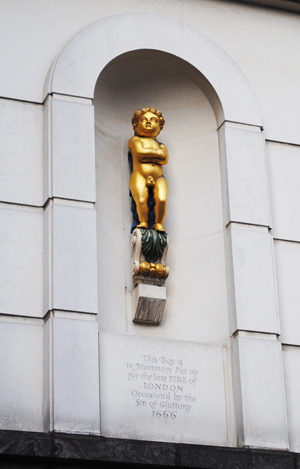
It’s widely known that Pudding Lane was the place where the Great Fire of London is believed to have started in 1666 – hard to miss given the site is commemorated nearby in the form of The Monument, the world’s tallest freestanding stone column – but what about where it was stopped? Standing in a niche on the corner of a building overlooking the junction of Giltspur Street and Cock Lane is a small gilt statue known as the ‘Golden Boy of Pye Corner’.

It’s not known how old the statue is but it is known that it was previously located on the front of a pub, The Fortune of War, which stood on the site until it was demolished in 1910 (and was apparently used by body-snatchers as a place to display stolen corpses for surgeons to peruse).

The statue – which apparently marks the place where the fire was ‘stayed’ (that is, buildings were destroyed to stop the fire spreading any further) –  is accompanied by an inscription which reads “This Boy is in Memmory put up for the late Fire of London Occasion’d by the Sin of Gluttony 1666”.

Below it an explanatory note below explains that the boy was made deliberately fat in reference to the fact the fire was started in Pudding Lane as a result of gluttony and not by Papists as was claimed on The Monument (this reference – “But Popish frenzy, which wrought such horrors, is not yet quenched” – was added to the inscriptions on the Monument in 1681 but was removed in 1831).

Famous Londoners – Sir Thomas Gresham

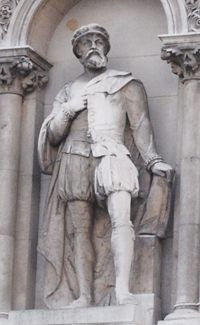
Remembered primarily for having founded the Royal Exchange as a centre for commerce in London and Gresham College, Sir Thomas Gresham was one of London’s leading merchants and financiers and an important advisor to successive monarchs during the sixteenth century.

Gresham was born in Milk Lane, London, to merchant Sir Richard Gresham (himself Lord Mayor of London in 1537-38) around 1518-19. He studied at Cambridge before being apprenticed to learn the family trade with his uncle, Sir John Gresham.

In 1543, he was admitted to the Mercers’ Company and subsequently spent time in the Low Countries, residing principally in Antwerp and acting as an agent for King Henry VIII. In 1544 he married Anne Fernley, widow of another London merchant. He also had a house in Lombard Street at this time.

Sir Thomas became an important advisor  to King Edward VI, helping him alleviate financial concerns, a role he continued to play during the successive reigns of Queen Mary I and Queen Elizabeth I (although he spent some time out of favor during Mary’s reign).

Knighted for his services to the crown in 1559, he proposed to built his ‘exchange’ in 1565, offering to pay for it himself if the City of London and Mercers’ Company provided the land. Modelled on the bourse in Antwerp with a trading floor and shops and offices set around a large central courtyard, it was officially awarded the title ‘royal’ by Queen Elizabeth I in 1571.

Sir Thomas died suddenly in 1579, apparently of a heart attack, and left the majority of his wealth to his widow but included clauses in his will stating that after her death rents from the Royal Exchange be used to create a college which would see seven professors offer free lecturers on subjects ranging from astronomy and geometry to rhetoric and divinity.

Known as Gresham College, it became the first institution of higher education in London when it was founded in 1597 and was initially based at Sir Thomas’ mansion in Bishopsgate (it’s now based in Barnard’s Inn Hall and, as it has for the past 400 years, still offers free public lectures).

In 1666, Sir Thomas’ Royal Exchange burnt down along with much of London but it was rebuilt immediately afterward (King Charles II laid the foundation stone of the new building) and rebuilt again following another fire in 1838 (at the time the building was largely occupied by two insurance companies, one of which was Lloyds of London).

It’s this third building, designed by Sir Thomas Tite to resemble the original plan, which stands on the site today. While trading has long since ceased there – it’s now a luxury-end shopping centre – Sir Thomas’s symbol, the gold ‘Gresham Grasshopper’, can still be seen on the weathervane. For more information on the Royal Exchange, see www.theroyalexchange.co.uk.


Where’s London’s oldest…lived in house?

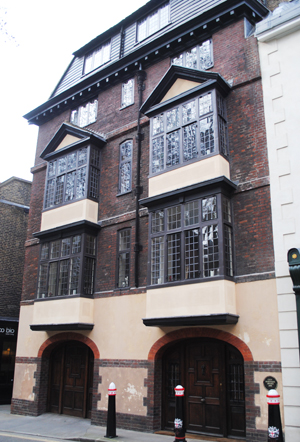
Like many in our series on London’s oldest, this one is a little subjective. But based on our survey of the data out there, we’re opting for 41-42 Cloth Fair, right beside St Bartholowmew the Great, in the City.

The only house to have survived the Great Fire of London in 1666, this five bedroom property – which we can confirm is still up for sale with a guide price of more than £5.9 million following a major restoration – was apparently completed around 1614.

It was originally constructed as part of a development initiated by Robert, Baron Rich, which featured 11 houses around a courtyard and was known as Launders Green (being located on what was the former laundry ground of the monastery at St Barts).

The red brick house, which was awarded a City Heritage award in 2000 for the sensitive restoration work, retains many of its original features.

Interestingly, windows on the second floor contain autographs of some of the famous people who have been to the property over the years including Queen Elizabeth, the Queen Mother, former PM Winston Churchill and Poet Laureate John Betjeman.

Curious London Memorials – 8. Edith Cavell Memorial

Prominently located on Charing Cross Road near Trafalgar Square, this memorial is a war memorial with a difference. Rather than commemorating armies or great war leaders, its subject is Edith Cavell, a British nurse who was executed by a German firing squad during World War I.

Cavell, originally from Norfolk, was working at a medical institute in Brussels when the German army invaded in 1914. The institute become a Red Cross hospital and Cavell continued caring for injured soldiers regardless of their nationality until, on 5th August, 1915, she was arrested on charges of treason for helping as many as 200 British and French soldiers escape to neutral Holland.

Held for a time in solitary confinement, she was tried at a court martial after signing a confession. Cavell was sentenced to death, and on, 12th October, was shot dead at the age of 49 – an event that sparked worldwide headlines and prompted an international outcry. She subsequently featured prominently in propaganda designed to boost British recruitment.

The 1920 memorial, designed by Sir George Frampton, features comments Cavell made to an English Anglican chaplain with her on the night before her death: “Patriotism is not enough. I must have no hatred or bitterness for anyone”.

Cavell was buried next to the prison where she had been held before her body was later exhumed before being reburied in Norwich Cathedral.

Happy St David’s Day!

It’s St David’s Day, Wales’ national day of celebration, so you may have noticed the Welsh flag flying in a few places you wouldn’t normally see it – including at 10 Downing Street. In keeping with the theme of all things Welsh, we’re taking a look at a couple of Welsh-related sites in London…

St Benet, Paul’s Wharf – Known as London’s “Welsh church”, the current St Benet’s was rebuilt to the designs of Christopher Wren after the Great Fire of 1666 although a church has stood on this site for 900 years. Services have been held at the church (pictured right) in Welsh since 1879 after Queen Victoria granted Welsh Anglicans the right to worship in their own language there. Known formally at St Benet’s Metropolitan Welsh Church, the premises, located just off Queen Victoria Street in the City, has also been the church of the College of Arms since 1555. Among other historic titbits is the suggestion that both Anne Boleyn and Lady Jane Grey – the “nine day Queen” – may have received the last rites here before going on to their executions at the Tower of London, that 17th century architect Inigo Jones was buried here, and that King Charles II had a special door built for himself in the side of the building and a private room where he could take part in services. See www.stbenetwelshchurch.org.uk

The London Welsh Centre – Located in Gray’s Inn Road, the centre’s origins go back to the founding of the Young Wales Association in 1920, created to provide a focus for young Welsh people in London. The organisation, which initially didn’t have a permanent home, held meetings in several locations before moving to the current premises in the 1930s. Today the premises is used by the London Welsh Centre and is the base for three choirs – the London Welsh Chorale, The London Welsh Gwalia Male Choir and The London Welsh Male Voice Choir. It also provides Welsh language classes and hosts concerts and other cultural events. See www.londonwelsh.org.

Memorial to Welsh poet Iolo Morganwg – A memorial plaque to this Welsh poet and antiquarian stands on Primrose Hill on the site where the first meeting of the Gorsedd of Bards of the Isle of Britain, convened by Morganwg, was held in 1792. The plaque was unveiled in 2009. Follow this link for more information.

Do you know of any other Welsh-related sites in London? Let us know…

Around London – Sir John Soane’s private apartments to be restored; Highland cattle to return to Richmond; and two new photographic exhibitions…

• An appeal has been launched to raise the final £500,000 of a £7 million project to restore Sir John Soane’s private apartments in his former home overlooking Lincoln’s Inn Fields in Holborn. Phase one of the three year restoration project, Opening up the Soane, is expected to be complete by late 2012 with the entire project – which will see all of the rooms open to the public – to be completed by 2o14. The eight rooms being restored in the project, all of which are located on the second floor of No. 13 Lincoln’s Inn Fields – one of three adjoining properties Soane owned , include the architect’s bedroom, bathroom, oratory and book passage as well as Mrs Soane’s morning room and a room containing Soane’s architectural models. The building  already contains the Sir John Soane Museum which features an eclectic and at time outright strange mix of artefacts Soane, designer of the Bank of England (although it has since been substantially altered), collected during his lifetime. For more information, see www.soane.org.

Highland cattle will return to Richmond Park in autumn to help create patches of bare ground for wildflowers to grow after the success of a recent grazing trial. Richmond Park has the most extensive area of natural grassland in London and the type of grassland – known as ‘acid grassland’ – is a nationally rare habitat. Richmond Park is already home to 650 red and fallow deer. For more information, see www.royalparks.org.uk.

On Now – A new exhibition of street photography in London has just opened at the Museum of London. London Street Photography showcases 200 candid images of everyday life in the city with images ranging from sepia-toned scenes of horse-drawn cabs captured by tripod mounted cameras through to the use of digital cameras in snapping images of 21st century residents. Among the 59 photographers whose work is on display is that of Paul Martin, who pioneered the idea of candid street photography in London in the early 1890s, freelance photojournalist Henry Grant who photographed London’s streets in the Fifties and Sixties, and Stephen McLaren, known for his contemporary “quirky and colorful” street images. Entry is free. The exhibition runs until 4th September. For more information, see www.museumoflondon.org.uk.

On Now – The first major exhibition in 30 years of the work of EO Hoppe has opened at the National Portrait Gallery. Hoppe, who lived from 1878 to 1972, is considered one of the most important photographers of the early 20th century and is described as the “prototypical celebrity photographer”, shooting among others Margot Fonteyn, George Bernard Shaw, King George V, David Lloyd George and Ezra Pound. He also published the Book of Fair Women – photographs of women he believed to be the most beautiful of earth – in 1922 and in the Twenties and Thirties increasinly spent time outside the studio photographing street life. Hoppe Portraits: Society, Studio and Street runs until 30th May. For more information, see www.npg.org.uk.

Lost London – Newgate Prison

The most notorious of London’s many prisons, Newgate remained in use for more than 700 years.

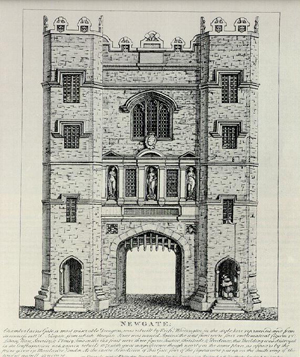
The prison – located on the corner of Newgate Street and Old Bailey on the site of what is now London’s Central Criminal Court (known as the Old Bailey thanks to its position on the street known as Old Bailey) – was apparently first constructed around the end of the 1100s on the orders of King Henry II at the site of one of the gates in the Roman wall (see picture).

It was enlarged and renovated several times over the ensuing centuries (including a complete rebuilding after the Great Fire of London in 1666 and another to the design of George Dance after the prison was badly damaged during the Gordon Riots of 1780, sparked by opposition to Catholic emancipation).

The prison, which was infamous for the squalid conditions in which prisoners were housed, was used for a range of purposes including housing debtors and the incarceration of people awaiting execution (by the 18th century, it’s said that more than 350 crimes had become punishable by death).

In 1783 public executions were moved from Tyburn, west of the city, to a site just outside the prison. In 1868, executions were no longer open to the public at large and the gallows moved inside. The prison closed in 1902 and was eventually demolished in 1904.

Famous prisoners who spent time in Newgate include Shakespeare’ contemporary Ben Jonson (for killing a man in a duel), 17th century author Daniel Defoe (for his authorship of political pamphlets), Captain William Kidd (for piracy), and William Penn, Quaker and founder of Pennsylvania (for contempt of court during a case brought after he was accused of having illegally preached ).

But perhaps the most infamous is the 18th century criminal Jack Sheppard, known for having escaped from the prison several times before finally being hanged at Tyburn (close to where Marble Arch now stands).

The only surviving part of the prison in its original location is part of the prison wall which can be seen in Amen Corner.

PICTURE: Wikipedia.com