Lost London – The Skylon

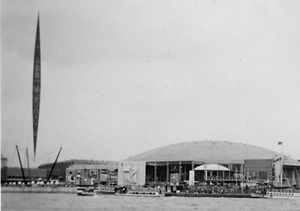
A sleek, futuristic, cigar-like sculpture that resembled what early science-fiction writers thought space-craft would look like, the Skylon was the centrepiece of the 1951 Festival of Britain site in South Bank and remains the enduring icon of the post-war celebration.

Designed by young architects Hidalgo Moya and Philip Powell (with the assistance of engineer Felix Samuely), the 300 foot tall Skylon, which, supported by cables, seem to hang in the air over the Thames, some 40 foot above the ground.

The structure (seen on the left of the picture of the Festival of Britain site) was dismantled in 1952 on the orders of the then-Prime Minister Winston Churchill who apparently saw it as an unwanted symbol of Clement Attlee’s Labour Government which had lost power earlier that year.

Strangely, the fate of the structure remains something of a mystery – Jude Kelly, artistic director at the Southbank Centre describes it as being “like the Loch Ness monster” in an interview with the Guardian newspaper earlier this year. “People have sightings of Skylon – they think – and bits of it, but nobody really knows what happened to it,” she said, adding that it was very hard to understand why it was thrown away.

While some fragments remain – including the base (and a model of it) which can be found at the Museum of London –  a common theory is that the rest of it was cut up and dropped into the Thames while other theories have it being buried under Jubilee Gardens or simply sold for scrap metal and “turned into ashtrays”.

There is an ongoing campaign to have the Skylon, which these days lends its name to a riverside restaurant at the Southbank Centre, rebuilt, although not necessarily in its original location.

The story of the Skylon, which sat on a site now occupied by the Southbank Centre, is told in the Museum of 1951 (see Southbank Centre website for details), open as part of the celebrations of the 60th anniversary of the 1951 Festival of Britain. On Tuesday, architect Nicholas Grimshaw and former president of the Royal Institute of British Architects Jack Pringle will lead a discussion at the Southbank Centre on the Skylon. For more information, follow this link.

PICTURE: John Ritchie Addison (via Wikipedia)

Around London – Website to showcase UK’s oil paintings; Arctic explorer John Rae gets Blue Plaque; sharing experiences of kindness; and Toulouse-Lautrec and Jane Avril hit the Courtauld…

• A new website has been launched to showcase the UK’s vast national collection of oil paintings. While the website, which is a partnership between the BBC, the Public Catalogue Foundation, and participating collections and museums, currently hosts around 60,000 works, it is envisaged that by the end of 2012 it will carry digitised images of all 200,000 oil paintings in the UK (in an indicator of how many there are, the National Gallery currently has around 2,300 oil paintings, about one hundredth of all those in the nation). The works on the site will eventually include almost 40,000 by British artists. The 850 galleries and organisations participating so far include 11 in London – among them the National Gallery, the Tate Gallery, the Victoria and Albert Museum, the Bank of England, the Imperial War Museum and Dr Johnson’s House. For more, see www.bbc.co.uk/arts/yourpaintings/

• Arctic explorer John Rae has had a Blue Plaque unveiled in his honor at his former home in Holland Park. Although his feats were relatively unsung in his lifetime, the explorer’s expeditions in the Canadian Arctic saw him travel 13,000 miles by boat and foot and survey more than 1,700 miles of coastline. He is also credited with having “signposted” the only north-west passage around America that is navigable without icebreakers. Rae, who died in 1893, lived at the property at 4 Lower Addison Gardens in Holland Park for the last 24 years of his life.

Transport For London is calling on Londoners to share experiences of “kindness” that they have witnessed or participated in while travelling on the Underground. Artist Michael Landy has created a series of posters which are calling on people to submit their stories. Some of the stories will then be shown at Central Line stations (the first four posters go up on 23rd July at stations including Hollard Park, Holborn and Liverpool Street). For more, go to www.tfl.gov.uk/art.

On the Olympic front, the City of London Corporation has announced Tower Bridge will be bedecked with a set of giant Olympic Rings and the Paralympic Agitos during the 45 days of next year’s Games. Meanwhile, the Corporation has also unveiled it will host next week the launch of a London-wide campaign to get people involved in sport and activity in the lead-up to the Games. More to come on that.

On Now: Toulouse-Lautrec and Jane Avril Beyond the Moulin Rouge. The Courtauld Gallery, based at Somerset House, is running an exhibition celebrating the “remarkable creative partnership” between Jane Avril, a star of the Moulin Rouge in Paris during the 1890s, and artist Henri de Toulouse-Lautrec. Lautrec created a series of posters featuring Avril which ensured she became a symbol of Lautrec’s world of “dancers, cabaret singers, musicians and prostitutes”. Runs until 18th September. See www.courtauld.ac.uk for more.


LondonLife – The Championships, Wimbledon

With Wimbledon now in its second week, we thought it would be a good time to take a look at the origins of what is the world’s most famous tennis championship.

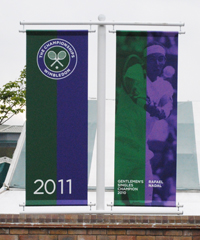
This year’s Wimbledon marks the 125th time that the All England Lawn Tennis Club has hosted The Championships. The first championships (Gentlemen’s Singles only with a field of 22) were held in 1877, just nine years after the founding of what was then the All England Croquet Club (lawn tennis was added at the club in 1875 and the name changed to the All England Lawn Tennis and Croquet Club the same year the first tennis championships were held).

It’s important to note that the first championships were not held at the current site opposite Wimbledon Park but at the club’s former site off Worple Road (it’s from this site that the term Centre Court was adopted for the main arena – at the Worple Road site, Centre Court was indeed in the middle of the grounds). It moved to its present site in Church Road in 1922.

Such was the success of the game that in 1882, the name croquet was dropped from the club’s title but it was returned in 1899 for “sentimental reasons”.

In 1884, the first Ladies Singles tournament was held as was the first Gentlemen’s Doubles. Other milestone years include:

• 1905 – US citizen May Sutton become the first foreigner to win at the tournament when she won the Ladies’ Singles;

• 1907 – Australian Norman Brookes became the first foreign man to win;

• 1940 – 1,200 seats in Centre Court were destroyed when a bomb hit the arena;

• 1968 – Australia’s Rod Laver and America’s Bille Jean King become the first winners of the Open Championships era;

• 1985 – Boris Becker, at age 17, becomes the youngest Wimbledon champion (as well as the first German and the first unseeded player);

• 1987 – Martina Navratilova of the US becomes the first to win the Ladies’ Singles six times in succession;

• 2010 – John Isner and Nicolas Mahut played the longest tennis match in history with Isner eventually winning 70 games to 68 in the fifth set, having played a total of 138 games, and spent 11 hours and five minutes on court over three days.

There is a museum based at Wimbledon which details more of the history of the place (only open to ticket-holders during the Championships). Exhibits include the Championship trophies, tennis memorabilia dating back to 1555 and the ‘ghost’ of John McEnroe talking about the games and his opponents in his old dressing room.

There are also a range of events being held this year marking the 125th year of The Championships – these include a new museum exhibition called The Queue.

WHERE: All England Lawn Tennis Club, Church Road, Wimbledon – between gates 3 and 4 (nearest tube Southfields); WHEN: 10am to 5pm (last admission 4.30pm) daily (not during the championships); COST: Museum only £11 an adult/£9.50 concessions/£6.75 child, or Museum plus tour £20 an adult/£17 concessions/£12.50 child; WEBSITE: www.wimbledon.com

Around London – 250,000 British Library titles to be available online; summer in Bunhill Fields Burial Ground; funding for church and synagogue repairs; and, the British Museum takes a closer look at relics and reliquaries…

The British Library is to digitise 250,000 books and make them available on the internet under a deal with tech giant Google. The works, which are all out of copyright, date from between 1700 and 1870 and include printed books, pamphlets and periodicals. Among them are feminist pamphlets about the ill-fated French Queen Marie Antionette dating from 1791, blueprints of the first combustion engine-driven submarine dating from 1858, and a 1775 account which tells of a stuffed hippopotamus owned by the Prince of Orange. The works will all be available online via Google Books which has partnered with more than 40 libraries around the world. The project will include material published in a range of European languages and will focus on works not already freely available in digital form online. For more see www.bl.uk.

A series of events running under the banner of ‘Green Garden Lunchtimes’ will be held at the Bunhill Fields Burial Group (off City Road) in the City of London from next Monday until 1st July. The events include free yoga and tai chi classes, a bike repair workshop, a history tour from City Guides and a wildlife talk courtesy of the Natural History Museum. The Wren Clinic will also be providing free advice and treatments. Bunhill Fields is famous for its connections to the Nonconformists and contains the graves of writers William Blake, Daniel Defoe and John Bunyan. For dates and times, follow this link.

• Six churches and a synagogue in London have been granted £582,000 to carry out repair works under the Repair Grants for Places of Worship scheme. The grants, which are administered by English Heritage and funded by the Heritage Lottery Fund, include £199,000 for the Church of St Augustine in Honor Oak Park – an early example of the Gothic Revival in the Early English style, £122,000 for Christ Church in Christchurch Park, Sutton, and £111,000 for the Golders Green Synagogue in Barnet. The grants were part of £8 million worth of funding given to 67 of England’s most important Grade II listed churches, chapels and synagogues. For more, see www.hlf.org.uk.

On Now: Treasures of Heaven: saints, relics and devotion at the British Museum. The museum’s major summer exhibition looks at the spiritual and artistic significance of Christian relics and reliquaries in medieval Europe. Among the highlights are: an arm reliquary of St George, which was housed in the treasury of St Mark’s in Venice following its capture in the sack of Constantinople in 1204; the British Museum’s bejewelled Holy Thorn reliquary, dating from 1390-97 and said to contain a relic from the Crown of Thorns; and, a 12th century bust of St Baudime from France, which once contained a vial of the saint’s blood and is being seen for the first time in Britain. Other exhibits come from the Cleveland Museum of Art in Ohio and the Walters Art Museum in Baltimore as well as from the Vatican. Runs until 9th October. There is an admission charge. For more, see www.britishmuseum.org.

King James I’s London – 9. Hampton Court Palace

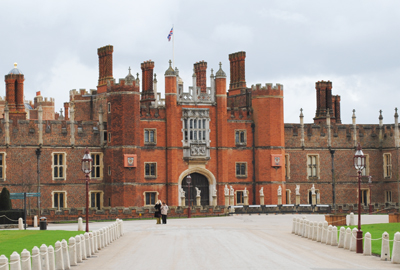
It’s fitting given the important role Hampton Court Palace played in the creation of the King James Bible that we include it in this series. But Hampton Court Palace is also notable for some other events during King James I’s reign. First, however, we turn to the Hampton Court Conference…

It was in 1604 that King James I meet at Hampton Court with representatives of the Church of England, including one party led by Archbishop John Whitgift (representing the church hierarchy) and another party led by John Rainolds (representing the Puritans), to discuss complaints made by the Puritans concerning a range of matters. While a new Bible wasn’t initially on the agenda, the three days of discussions did eventually lead to King James I commissioning the creation of a new Bible which eventually became known as the King James Version.

King James I was already familiar with Hampton Court Palace – it was in the palace that he had celebrated his first Christmas as king the previous year. Notably, it was during this Christmas and New Year period that Shakespeare’s acting company, the King’s Men, performed in the palace’s Great Hall for the king and his court.

At that stage, the palace hadn’t been dramatically updated since Tudor times – in fact, it wasn’t until after the accession of King William III and Queen Mary II following the “Glorious Revolution” in 1689 that the Tudor palace was given a major overhaul.

King James I continued to visit Hampton Court during the remainder of his reign and his visits, which were generally proceeded by a program of repairs, were noted for the lavish entertainment that took place when they occurred.

It was also at Hampton Court Palace that James’ wife, Queen Anne, died of dropsy in 1619. And where his son King Charles I, who had commissioned some improvements to the palace, was imprisoned for a period during the Civil War. But more of that another time…

WHERE: Hampton Court Palace, East Molesey, Surrey (nearest station is Hampton Court from Waterloo); WHEN: 10am to 6pm everyday (winter hours 10am to 4.30pm from 31st October to 26th March); COST: Adult £15.40, Concession £12.65, Child under 16 £7.70 (under fives free), family tickets, garden only tickets and online booking discounts available; WEBSITE:www.hrp.org.uk/HamptonCourtPalace/

Lost London – Blackfriars Priory

The London area of Blackfriars – centred on Blackfriars Railway Station – takes its name from the former Dominican friary (known as the “black friars” thanks to their dark robes) which stood on the site.

The Dominicans first came to England in the 1220s and soon took up residence in Holborn. But the limitations of that site led them to move to a new location between Ludgate and the River Thames in the latter part of the 13th century. There, they constructed a substantial priory.

The priory subsequently played an important part in London’s civic and religious life – Parliament and the Privy Council is known to have met here and in 1529, a hearing was held here with regard to the divorce of King Henry VIII and Catherine of Aragon.

It was also a place of burial for the wealthy and influential – among those buried there was the beloved wife of Edward I, Eleanor of Castille (at least her heart was – her body was buried at Westminster Abbey).

The priory was dissolved in 1538 during the Dissolution. The Blackfriars Playhouse was built on the site during Elizabethan times and the Apothecaries Company also took up residence there. Those of the original buildings that survived were destroyed in the Great Fire of 1666. In more recent times, the area became the site of Blackfriars Railway Station.

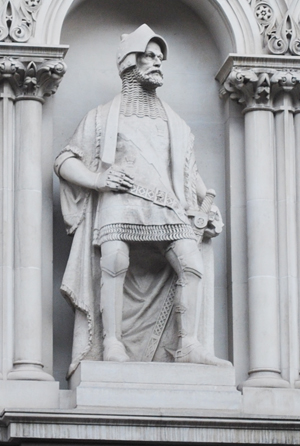
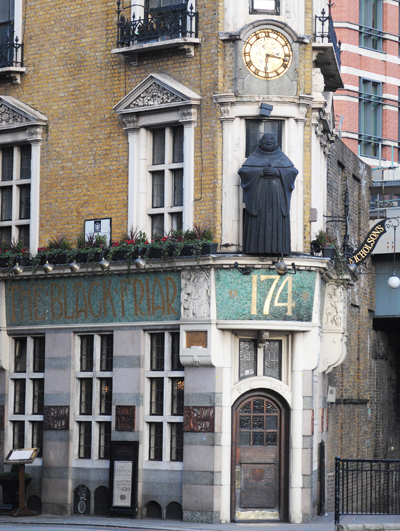
A reminder of the area’s origins can be found on the facade of The Black Friar pub (1875) which sits opposite Blackfriars Bridge at the western end of Queen Victoria Street (pictured). There you can see a statue of a black friar, the work of Henry Poole which dates from around the beginning of the 20th century. There is also a plaque commemorating the friary in nearby Carter Lane.

Around London – The Tower hosts Royal Beasts; take a ride on a 1938 tube train; Lambeth Palace Library celebrates the King James Bible; and, see model cathedrals at Sir John Soane’s house…

• The history of the Royal Menagerie is the focus of a new exhibition on now at the Tower of London. Royal Beasts explores the history of the Tower menagerie which, founded during the reign of King John in the early 1200s, remained there for more than 600 years. Among the animals were lions (the first record of which dates from 1210), a grizzly bear (a gift from the Hudson Bay Company to King George III), elephants, tigers, ostriches and kangaroos. Highlights of the exhibition include modern animal sculptures by artist Kendra Haste and interactive sensory displays. The recently restored north wall walk and the never before opened Brick Tower will host some of the displays, including sights, sounds and smells of some of the animals. See www.hrp.org.uk/TowerofLondon.

A 1938 tube train will run along the western end of the Piccadilly Line this Sunday (that’s Father’s Day in case you’ve forgotten) as part of the London Transport Museum’s Heritage Vehicles on the Move 2011 programme. Leaving Northfields, the train will travel to High Street Kensington via Earl’s Court (crossing from the Piccadilly to the District Line in a move not normally experienced by the general public) before heading back down the District Line to Acton Town where it will change back onto the Piccadilly Line. The train will then undertake the “fishhook move”, visiting Heathrow Terminal 4 before going to Terminals 1,2,3 and 5. The entire journey is expected to last about two hours. Tickets, which can be purchased at the museum ticket desk or by calling 020 7565 7298, will need to be collected at Northfields Station. For more, see www.ltmuseum.co.uk/whats-on/events/vehicles-on-the-move.

• Lambeth Palace Library is celebrating the 400th anniversary of the King James Bible with a new exhibition. The exhibits include a 1611 edition of the Bible as well as Medieval Bible translations, landmark editions of the Bible which drew on the textual scholarship of the Renaissance and Reformation and early printed vernacular versions. Runs until 29th July. Admission is by pre-booking only. For information on buying tickets and more, see www.lambethpalacelibrary.org/content/2011exhibition.

On Now: Time is running out to see Sir Herbert Oakley’s collection of 27 models of European and English cathedrals at the Sir John Soane Museum. The models were made in the 1850s by William Gorringe, who was a modelmaker by appointment to Queen Victoria. Runs until 25th June. For more, see www.soane.org/exhibitions/

LondonLife – Knollys Rose Ceremony

A London tradition which has its origins in the fourteenth century, the Knollys Rose Ceremony surrounds the presentation of a single red rose to the Lord Mayor of London at Mansion House.

The ceremony, which was held in the City yesterday, relates to a judgement of 1381 in which the fine was the annual payment of a single red rose.

The fine was levied after Lady Constance Knollys, the wife of prominent citizen Sir Robert Knollys, bought a property opposite her own in Seething Lane and then added a footbridge linking the two without first gaining planning permission (it’s suggested that she bought the property which had previously been used as a threshing ground because she was annoyed with the constant chaff in the air).

Following discovery of her breach, it was agreed that she would pay the annual ‘peppercorn rent’ of a single red rose from the new property’s garden to the Lord Mayor.

Lady Constance’s footbridge is long gone but the tradition of paying the annual rent was revived last century and is now presided over by the Company of Watermen and Lightermen of the River Thames.

The ceremony starts at the church of All Hallows by the Tower and then involves a procession to Seething Lane Gardens (a modern garden close to where the original may have been; the gardens were once the site of the Navy Office) where the Master of the Company of Watermen and Lightermen snips off a rose before heading on to Mansion House where it is presented to the Lord Mayor on a velvet altar cushion from All Hallows.

The ceremony usually takes place on the second Monday in June.

Where’s London’s oldest…public park?

Dating from the early 1600s, London’s oldest public park is Finsbury Circus Gardens, located just to the north of London Wall and east of Moorgate.

The now heritage-listed gardens were open as a public park from 1606 (and was originally known as Moor Fields – the moors were drained and gravel walks laid out in 1527 but it wasn’t until 1606 that the area was laid out with elm trees and benches).

The park wasn’t enclosed until 1815-17 when City of London surveyor William Montague laid the area out according to the designs of prominent London architect George Dance the Younger.

The gardens were acquired by the City of London Corporation in 1900 and in 1909 were replanned. The oval-shaped park, the largest of the City’s gardens, is these days home to the City of London Bowling Club, the only bowling club in the City (founded in 1924; the bowling green dates from the following year and the current pavilion from 1968).

During World War II a barrage balloon was anchored here to deter low level air raids. Among it’s other claims to fame is the Tudor era bat (apparently a forerunner of the modern cricket bat) found on the site in the 1980s and skulls which have also been found dating from the Roman period.

The gardens are currently partly closed due to the Crossrail development.

PICTURE: Wikipedia

LondonLife – Trooping the Colour…

A ceremony first believed to have been performed during the reign of King Charles II, since 1748 the parade has been used to mark the Official Birthday of the Sovereign.

 Queen Elizabeth II inspects the Guards in her phaeton.

Prince William, Prince Charles, the Duke of Kent and Princess Anne riding Queen’s Escort behind the Queen.

The parade includes six Guards groups. This year it was the turn of the Scots Guards, raised in 1642 at the behest of King Charles I, to parade their colours.

Part of the Household Mounted Cavalry, the Blues and Royals.

At 1pm, back at Buckingham Palace following the firing of a 41 gun salute, the Queen and the Royal Family watch Royal Air Force aircraft performing a fly past overhead.

The RAF’s Red Arrows aerobatic display team perform a colorful flypast over Buckingham Palace.
All images and text are © David S. Adams

King James I’s London – 7. The Gunpowder Plot

One of the most significant events during the early year of King James I’s reign was the discovery of the Gunpowder Plot.

The plot, which involved a group of Catholic conspirators including Robert Catesby and  Guido ‘Guy’ Fawkes (you can read more about Fawkes in our earlier entry on Bonfire Night), centred on a plan to blow up the House of Lords in Westminster Palace during the State Opening of Parliament in November 1605, thus killing the king (who had aggrieved Catholics in a public denunciation at the Hampton Court Conference in 1604; it should also be noted that he was already aware of several other failed Catholic plots to kill him) and, presumably, many MPs and Lords.

It is believed they intended replacing James with his daughter, Princess Elizabeth, whom they hoped could be made more amendable to Catholic worship.

But such a plot was hard to keep mum and an anonymous tip-off to Lord Monteagle, a Catholic, not to attend the event, led authorities to eventually uncover the plot in a basement storeroom below the House of Lords where, at around midnight on 4th November, they found Fawkes guarding the 36 barrels of gunpowder.

Fawkes was sentenced to be hung, drawn and quartered – a sentence never fully carried out after he leapt off the scaffold and broke his neck – and the other plotters, who had fled from London soon after the discovery, were either killed during subsequent arrest attempts, imprisoned or executed.

So happy was King James I – that he had Act of Parliament passed which made the 5th November a day of thanksgiving – it remained in force until 1859. Celebrations of the plot’s foiling continue every year on Bonfire Night.

But what were some of the significant places in the event? The cellar where Fawkes was arrested no longer exists – it was destroyed during a fire in 1834.

The conspirators who had been arrested were subsequently taken to the Tower of London where King James I authorised the torture of at least Fawkes and perhaps others among the conspirators. Fawkes capitulated quickly and signed two confessions (which are now in The National Archives). Another of the conspirators, Francis Tresham, died of natural causes while in the Tower.

The eight surviving conspirators went on trial at Westminster Hall – still part of the Houses of Parliament complex today; the end of the hall is visible in the above picture – in late January 1606 and were all condemned to death for treason.

Four of them were executed on 30th January in St Paul’s Churchyard outside St Paul’s Cathedral while the remaining four including Fawkes were executed the next day outside Westminster Hall in Old Palace Yard. The heads of Catesby and Thomas Percy, both of whom had been killed during a shoot-out in Staffordshire, were set up outside the Houses of Parliament.

Arrests – and in some cases executions – of others believed to be associated with the plot continued in the following months.

Another place of note in the story of the Gunpowder Plot is Syon Park in the city’s west, now the London home of the Duke of Northumberland. The aforementioned Thomas Percy was a cousin of the then Earl of Northumberland, Henry Percy, and apparently dined with the Catholic earl at the house on the night of 4th November, before the plot was uncovered.

That association subsequently led to the earl’s arrest and he was confined to the Tower for the next 15 years on the order of the king.

LondonLife – Beating Retreat…

This week Horse Guards in London hosts the annual ceremony of Beating Retreat with massed bands playing and marching in formation. But where does the tradition come from?

The origins of the ceremony date back several hundred years to at least the 16th century when the beating of drums signalled the end of a day’s fighting, the closure of camp gates and the lowering of flags. Among the English kings credited with having ordered troops to “beat retreat” are old enemies King James II and King William III.

The ceremony was standard practice by the early 1700s with flutes or fifes added to the drum beating before, following the Napoleonic Wars, these were both replaced with bugles, to help ensure the sound reached greater distances.

The ceremony has been held annually at Horse Guards Parade since 1966 and this year involves the Massed Bands and Corps of Drums of the army’s Household Division along with The King’s Troop Royal Horse Artillery as well as The United States Army Europe Band and Chorus.

The event is a prelude to the Trooping the Colour on Saturday when more than 1,300 troops will parade in honor of the Queen’s Official Birthday.

Beating Retreat will be held at Horse Guards Parade on 8th and 9th of June (Wednesday and Thursday night), from 9pm. For more information and tickets, see www.guardsbeatingretreat.com

LondonLife – Beating the Bounds at All Hallows

Thursday is Ascension Day and, at All Hallows by the Tower in the City, that means conducting the ancient ceremony of Beating the Bounds.

The origins of the custom go back to medieval times when parishes annually reaffirmed their boundaries by undertaking a procession during which each parish boundary marker was beaten with wands while praying for protection and blessings.

At All Hallows, the beating party consists of students from Dunstan College in Catford (these students have an association with the church of St Dunstan-in-the-East which is now part of the parish of All Hallows) along with parish clergy and the masters of livery companies associated with the parish and Thames waterboatmen. (Pictured right is last year’s procession).

Highlights of the procession at All Hallows include the beating of the parish’s southern marker – this is located in the middle of the Thames and must be reached by boat – and the mock ‘confrontation’ which occurs between the beating party and the Governor and Yeoman Warders of the Tower of London.

The ‘confrontation’ relates to the fact that the parish and the tower share a boundary – this was apparently a common cause of dispute in the Middle Ages and led, in 1698, to a ‘battle’ between the people of the parish and those of the tower. The ceremony is followed by attendance at a festal evensong at the church.

For more, see www.ahbtt.org.uk/history/beating-the-bounds/

PICTURE: Courtesy of All Hallows by the Tower.

LondonLife – Chelsea Flower Show

The Queen visits the Chelsea Flower Show. PICTURE: Courtesy Royal Horticultural Society.

More correctly known as the Royal Horticultural Society Great Spring Show, the history of the Chelsea Flower Show traces its origins back to the 1820s when the society, then known as the The Horticultural Society in London, held a series of “floral fetes” at the Duke of Devonshire’s estate in Chiswick.

The fortunes of the society were on the wane when, thanks in part to its then president, Prince Albert, it was reborn with a new charter and name – the Royal Horticultural Society – and a new garden in Kensington.

The first Great Spring Show was held there in 1862 and continued to be so for the next 26 years until, in 1888, the site of the show was moved to Temple Gardens near Embankment in central London.

It was subsequently held there until 1912. During this year, the show was cancelled and the Royal International Horticultural Exhibition held instead in the grounds of the Royal Hospital, Chelsea. So popular did this prove that the Great Spring Show was subsequently moved there. It’s been held almost every since with cancellations during World Wars I and II.

Today, the show – claimed to be “the world’s most famous gardening event” – attracts 157,000 visitors from around the world who view the exhibits of 600 companies including nurseries, florists and floral arranges. This year’s show, which has sold out, features 17 show gardens, 15 smaller gardens and 100 of nurseries and growers. It runs from today until Saturday.

For more information on the show, see www.rhs.org.uk/chelsea.

Where’s London’s oldest…outdoor statue?

It’s generally believed that London’s oldest outdoor statue is that of King Alfred the Great which stands in Trinity Church Square in Southwark but there are a few others worth mentioning for their age.

But first, to the statue of Alfred the Great. Located now in Trinity Church Square, it is thought to have been made in the late 14th century (although it’s also suggested it could be much younger) in honor of the man who ruled Wessex in the 9th century and is often credited as being the first “king of the English”.

The statue (right) was apparently located at the Palace of Westminster before it was brought to its present location in 1823 at about the time the square was being laid out.

Others among London’s oldest statues is that of King Charles I sitting astride his horse and looking from Whitehall from its position on the southern side of Trafalgar Square.

Credited as being London’s “oldest equestrian bronze”, this statue is the work of French sculptor Hubert Le Sueur and was cast in 1633 (during King Charles I’s rule) at the behest of Richard Weston, one of the king’s favorites, who that year became the 1st Earl of Portland.

It was removed during the Civil War but later reacquired by the Portland family and, following the Restoration, was reinstalled on its current site – once that of the Charing Cross (see our previous entry for more details) – in 1675 by King Charles II.

Another of London’s oldest statues is that of Queen Elizabeth I which stands on the facade of the church St Dunstan-in-the-West in Fleet Street. This statue, which has been attributed to William Kerwin although other names have also been suggested, dates from 1586 (created during her reign) and decorated the west side of Ludgate until its demolition in 1760, after which it was apparently put into storage until being brought to the church in the 19th century.

Standing nearby in the vestry porch as statues of the legendary pre-Roman British king, Lud, and his sons, Androgeus and Tenvantius, which were also removed from Ludgate and probably date from the same period (about 1586).

Lost London – The ‘Tyburn Tree’

For six centuries, the gallows at Tyburn, in the city’s west, was one of London’s sites of public execution. Today, little remains to remind visitors of the infamous past of the area, which lies close to Marble Arch, but for a plaque set in the middle of a road.

From 1196 to 1783, it’s suggested that thousands of people (some have estimated as many as 60,000) were hanged at various gallows erected at Tyburn, known by numerous names over the centuries including ‘The Elms’, the ‘The Deadly Never Green Tree’, and most infamously the ‘Tyburn Tree’.

Hangings were apparently initially carried out using the branches of a tree on the bank of the Tyburn River but the first gallows date from 1220. In Elizabeth times these were upgraded to a larger gallows known as the ‘Triple Tree’ which enabled many more people to be hanged simulteously – as many as 24 at once in 1649.

The gallows was removed in 1759 because it was blocking the road and a mobile gallows used until hangings were moved into Newgate Prison (see our earlier entry on Newgate).

Executions were a public spectacle and it’s estimated that at times the crowds at Tyburn swelled to more than 50,000 people, all eager to witness someone “dancing the Tyburn jig”.

Among those to be hanged at Tyburn were William Fitz Osbern (a champion of London’s poor who was hanged in 1196), Roger Mortimer, 1st Earl of March (hanged in 1330 after being accused of assuming royal power), Perkin Warbeck (pretender to the throne of King Henry VII who was hanged in 1499), and Elizabeth Barton, the ‘Holy Maid of Kent’ (hanged for treason after prophesying King Henry VIII would die within six months of marrying Anne Boleyn).

Others included key figures in the so-called Pilgrimage of Grace (an uprising in England’s north in 1536 which followed King Henry VIII’s break with Rome) and many other Catholics including Oliver Plunkett, the Archbishop of Armagh and Primate of all Ireland (1681).

In an unusual move, the body of already deceased Oliver Cromwell, along with that of John Bradshaw and Henry Ireton, was exumed from his grave and and hanged there to mark the first anniversary of the Restoration.

What is believed to have been the site of the Tyburn Tree is today marked by a plaque set in a traffic island at the corner of Edgware Road and Bayswater Road (nearest tube station is Marble Arch).

There is a Shrine of the Martyrs dedicated to the more than 105 Roman Catholics who were hung at Tyburn for their faith at the Tyburn Convent in Hyde Park Place (for visiting details, see www.tyburnconvent.org.uk).

Note: This article originally referred to the Shrine of the Martyrs commemorating more than 350 Catholic martyrs who died during the Reformation as all being executed at Tyburn but it is believed some 105 were – the greater figure refers to those martyred across England and Wales during the Reformation.

Around London – Captain Kidd at Docklands; London’s Olympic Torch Relay path; St Giles’ seedy past; speech therapist Lionel Logue honored; and, The Seven Seas at Selfridges…

The true story of Captain Kidd and an exploration of London’s links with piracy is the focus of a new major exhibition at the Museum of London Docklands. Pirates: The Captain Kidd Story features original artefacts dating from 300 years ago when London was a site of pirate executions and tells the story of the infamous Captain Kidd’s life until his execution at Wapping’s Execution Dock. Among the artefacts is the original costume worn by actor Johnny Depp as he played Captain Jack Sparrow in the film Pirates of the Caribbean. The exhibition, which opens tomorrow and runs until 30th October, is being held in conjunction with a series of pirate related events including an adults-only pirate night on 27th May where you have the chance to sample some genuine “pirate drink” and take part in pirate speech lessons. Admission charges apply. For more information, visit the Museum of London Docklands website www.museumoflondon.org.uk/Docklands/Whats-on/Exhibitions-Displays/Pirates.htm.

The path of London’s Olympic Torch Relay has been announced and will finish with a week long jaunt through London. The torch will arrive in Waltham Forest on 21st July next year and then pass through Bexley, Wandsworth, Ealing, Haringey and Westminster before its arrival at the Olympic Stadium on 27th July. To find out how to nominate someone to carry the torch or for more information on the relay, visit www.london2012.com/olympic-torch-relay.

• On Now: London’s Underworld Unearthed: the Secret Life of the Rookery. The seedy side of the St Giles Rookery, a once infamous quarter of the capital, is laid bare in this new exhibition at the Coningsby Gallery. Back in 1751, the area was known as “a pit of degradation, poverty and crime” known for its free-flowing gin. Artist Jane Palm-Gold has displayed 18th and 19th century artifacts found during the Museum of London Archaeology’s recent excavation of old St Giles (conducted prior to the construction of the recent Central St Giles development which now covers the site) alongside her paintings, building what has been described as a “multi-layered psycho-geography that both mesmerises and disturbs”. Runs until 3rd June at the Coninsby Gallery at 30 Tottenham Street (nearest tube station is Goodge Street). Admission is free. For more information, see www.coningsbygallery.com

Australian speech therapist Lionel Logue – known for having helped cure King George VI of his stammer, the story of which is told in the recent Oscar-winning film, The King’s Speech – has been honored with a green plaque by Westminster Council. The plaque was expected to be unveiled today at 146 Harley Street, where Logue, who is known to have used fees from wealthier client to subsidise free treatments for those who could not afford them, lived from 1926 until 1952. The plaque is one of 94 which Westminster Council has placed to mark buildings of particular significance for their association with people who have made lasting contributions to society.

• On Now: The Seven Seas at Selfridges in Oxford Street. Conceptual artist Beth Derbyshire’s seven minute video installation features seven films of seven different seas around the globe. On show as part of Project Ocean – an initiative by Selfridges and 20 environmental and conservation groups aimed at celebrating the ocean’s beauty and highlighting the issue of overfishing. Runs until 8th June. For more information, see www.selfridges.com.

King James I’s London – 6. The Queen’s House, Greenwich

Long an admired landmark of Greenwich, the origins of the Queen’s House go back to the reign of King James I.

It was the Queen, Anne of Denmark, who commissioned the building of The Queen’s House in 1616 and gave it the name by which it is still known. Sadly, however, she died before it was completed.

King James I was said to have been a frequent visitor to the Tudor Palace of Greenwich (the building had earlier been known as the Palace of Placentia and was the birthplace of King Henry VIII in 1491).

King James  is traditionally said to have awarded the Manor of Greenwich to Queen Anne as an apology after he had publicly sworn at her when she had accidentally shot one of his favorite hunting dogs.

In 1616, Queen Anne decided to build a new property on the site as both a private retreat and a place where she could entertain and it was to the rising star Inigo Jones that she turned to for the design (in recognition of his growing status, he was appointed Surveyor of the King’s Works the following year).

The house was Jones’ most important job to date and the design he came up – based on a H with the two sides joined by a bridge over the Greenwich to Woolwich road – with is said to be the first Classical building in England.

Among the original features which survive to this day are the striking black and white geometrically patterned marble floor of the Great Hall (the room having been designed as a perfect cube), the painted ceiling of the Queen’s Presence Chamber and the iron balustrade the Tulip Stairs – said to be the first “geometric self-supporting spiral stair in Britain”.

Queen Anne became ill in 1618 and died the following year without seeing the end result of her commission. The work subsequently was shelved and only restarted (and completed in 1638) after King Charles I gave it to his wife, Queen Henrietta Maria.

She only had possession for a short time before Parliamentary forces seized it during the Civil War. After the Restoration, the Queen’s House was returned briefly to her by her son King Charles II (it was at this time that the original H-shape of the house was altered to a square) before part of it as later used as studio for painters and then as grace and favor apartments.

With the Old Royal Naval College now occupying the surrounding site, in 1805, King George III gave the property to the Royal Naval Asylum – a charity caring for the orphan children of seamen – and it later became part of the Royal Hospital School.

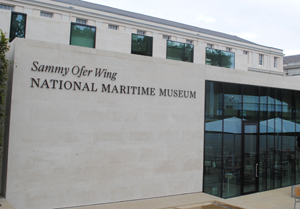
The National Maritime Museum took possession in 1934 and the building now houses the National Martime Museum’s collection of fine art. As an interesting aside, there have been several reported sightings of ghosts in the house, the latest as recently as 2002.

WHERE: The Queen’s House, National Maritime Museum, Greenwich (nearest DLR station is Cutty Sark); WHEN: 10am to 5pm daily (check website for closures); COST: Free; WEBSITE: www.nmm.ac.uk/places/queens-house

Around London – See museums after hours; the White Tower is white again; and, foundation stone for Bomber Command is laid…

• The annual Museums at Night event returns to London (and Britain) this weekend with hundreds of museums and galleries across the country opening their doors for special after hours events. Among those places in London taking part is the Churchill War Rooms, which is hosting a 1940s evening on Friday night, the London Canal Museum which is hosting”candle-lit tours, atmospheric lighting, and exhibits of art and film in dark places”, and the Petrie Museum of Egyptian Archaeology which is hosting a double hill of Hammer films and a “Gothic Egypt” trail. Other institutions taking part include the Sir John Soane Museum, the National Gallery, the Bank of England Museum, and Orleans House Gallery in Twickenham.  For more information about what’s on see www.museumsatnight.org.uk

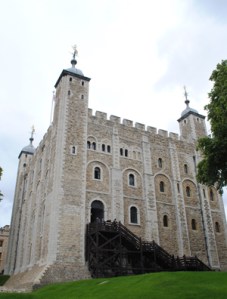
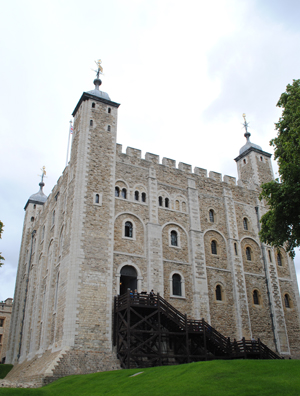
King William the Conqueror celebrated at the Tower of London this week following the completion of a £2 million, three year project to clean the White Tower. First built shortly after the Norman Conquest of 1066, the tower had become blackened by pollution but has now been restored to its original color. For more information on visiting the Tower, see www.hrp.org.uk/toweroflondon/.

A foundation stone has reportedly been laid for a Bomber Command Memorial in Green Park. The memorial, which is due to be completed for the Queen’s Jubilee celebrations in 2012, will be constructed of Portland stone and will feature a nine foot tall statue of a bomber command aircrew. Bomber Command lost more than 55,000 airmen during World War II. The foundation stone was laid by the Duke of Gloucester. Supporters of the monument’s construction have included former Bee Gee Robin Gibb, Sir Michael Beetham, Marshal of the RAF, and  The Daily Telegraph newspaper which is running an appeal to help raise funds for the memorial.

King James I’s London – 5. Holland House

A Jacobean mansion located in Kensington’s Holland Park, Holland House was first built in 1605 for Sir Walter Cope, Chancellor of the Exchequer for King James I. 

Sir Walter apparently entertained the king and his wife, Queen Anne of Denmark, at the property – then named Cope Castle – on numerous occasions at the property and reportedly hosted the king the night after his son, Henry Frederick, the Prince of Wales, died in 1612.

Its name came with a later owner – the ill-fated Henry Rich, Cope’s son-in-law, who was made the 1st Earl of Holland in 1624 and was later executed for his role in supporting the Royalist cause during the Civil War during which the house was occupied by parliamentary troops.

The home was later used by various family members – among luminaries associated with the property are the essayist Joseph Addison who died there in 1719 as well as, in later years, the likes of Lord Byron, Benjamin Disraeli, Charles Dickens and Sir Walter Scott, all of whom visited the property during the property’s golden age in the 19th century when it was an important social gathering place.

The house was largely destroyed in a bombing raid in September 1940 and passed into ownership of the local authority. A youth hostel is now housed inside the restored east wing of the building while other buildings are used for a restaurant and function centre – all set within the 22 hectare (55 acre) Holland Park. Some of the ruins provide a backdrop for open-air theatre performances and concerts in summer.

WHERE: Holland Park (nearest tube stations are Holland Park, Kensington High Street and Notting Hill); WHEN: 7.30am to 30 minutes before dusk (check signs by entrance); COST: Park entrance is free (house is not open to the public); WEBSITE: www.rbkc.gov.uk/leisureandlibraries/parksandgardens/yourlocalpark/hollandpark.aspx