10 London sites associated with Sir Winston Churchill – 4. 10 Downing Street…

10-Downing-Street

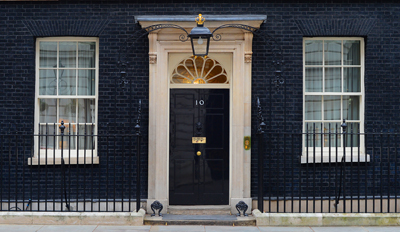
Sir Winston Churchill lived a number of residences in London but, of course, the most famous in its own right is the traditional home of British PMs, 10 Downing Street.

Located in a short street just off Whitehall (now closed to the public), the property has been home to Prime Ministers since Sir Robert Walpole, officially First Lord of the Treasury but effectively the first PM, took up residence in 1735.

Churchill moved in following his election to the office of Prime Minister in 1940 and he and his wife Clementine took up residence in a second floor flat. It was in this property where, cigar in hand, he is famously known to have dictated speeches and letters to his secretary while propped up in bed.

The building suffered some bomb damage during the Blitz – on 14th October, 1940, a bomb fell on nearby Treasury Green and damaged the home’s kitchen and state rooms. Three civil servants doing Home Guard duty were killed but the kitchen staff were saved thanks to Churchill who, dining in the Garden Rooms when the bombing raid began, ordered them to leave their duties and get into a bomb shelter.

The Garden Rooms – which included a bedroom, meeting area and the small dining room – were subsequently reinforced with steel and heavy metal shutters although these apparently would have made little difference had there been a direct hit.

Cabinet moved out of Number 10 into the underground bunker complex now referred to as the Churchill War Rooms (see last week’s post) in October, 1939, and, after several near misses, the Churchills – Sir Winston apparently very begrudgingly – moved into the Number 10 Annex above the war rooms in 1940 (although Churchill continued to visit Number 1o for working and dining).

Much of the furniture and valuables were removed from Number 10 and only the Garden Rooms, Cabinet Room and Private Secretaries’ office remained in use (along with a reinforced bomb shelter built underneath – King George VI is known to have sheltered here when he was dining with Churchill when a raid began).

At the end of the war the Churchills quickly moved back into Number 10 and it was from the Cabinet Room that he made his Victory in Europe (VE) Day broadcast on 8th May, 1945.

He vacated the premises after his election defeat later in 1945 but returned when re-elected PM in 1951 and left after he resigned in 1955 having held a dinner party attended by Queen Elizabeth II and Prince Philip the night before.

A couple of interesting facts about Churchill’s time at number 10: Churchill had many pets who usually had free rein in the house – even at 10 Downing Street his poodle Rufus was known to have wandered into a meeting in the Cabinet Room (before he was ejected) – while in 1958, Georgina Landemare, the cook during his time at number 10, famously published a book, Recipes from No. 10, which featured an introduction by Churchill’s wife, Clementine.

There are apparently two portraits of Churchill among those of other PMs which grace the wall of the Grand Staircase.

For more on the history of 10 Downing Street, see www.gov.uk/government/history/10-downing-street

PICTURE: Sergeant Tom Robinson RLC/Crown Copyright 


10 London sites associated with Sir Winston Churchill – 3. Churchill War Rooms…

Churchill2

Now a museum, the Churchill War Rooms is actually the underground bunker system beneath Whitehall from where Churchill directed operations during the Blitz of World War II.

Churchill1The subterranean complex includes a series of historic rooms where Churchill and his cabinet met which remain in the same state they were in when the lights were switched off at the end of the war in 1945. There’s also a substantial cutting-edge museum dedicated to exploring Churchill’s life which boasts an interactive “lifeline” containing more than 1,100 images and a similar number of documents as well as animations and films.

With the coming conflict on the horizon, the complex was constructed from 1938 to 1939 as an emergency government centre in the basement of the now Grade II* listed government building then known as the New Public Offices (and now home to HM Treasury). It became operational on 27th August, 1939, shortly before the outbreak of the war.

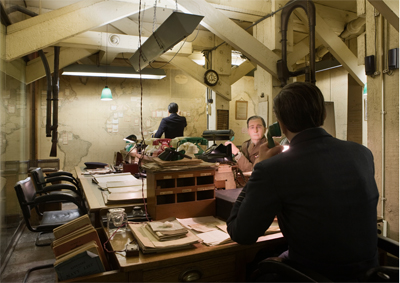
Key rooms include the Map Room (pictured, top, it was manned around the clock by military officers producing intelligence reports) and the War Cabinet Room where more than 100 meetings of Cabinet were held (including just one gathering of Prime Minister Neville Chamberlain’s cabinet in October, 1939).

Other facilities included a private office/bedroom for Churchill (this came with BBC broadcasting equipment which Churchill used four times and, although it had a bed, Churchill apparently rarely used it), the Transatlantic Telephone Room (pictured above, it was disguised as a toilet) from where Churchill could speak directly to the US President. There are also staff dormitories, bedrooms for officers and government ministers, and rooms for typists and telephone switchboard operators.

In October, 1940, a massive layer of concrete – up to five feet thick and known simply as ‘The Slab’ – was added to protect the rooms. Other protective devices included a torpedo net slung across the courtyard overhead to catch falling bombs and an air filtration system to prevent poisonous gases entering.

Abandoned after the war, the premises hosted some limited tours but, despite growing demand to see inside, it wasn’t until the early 1980s when PM Margaret Thatcher pushed for the rooms to be opened to the public that the Imperial War Museum eventually took over the site. The museum opened on 4th April, 1984, in a ceremony attended by the PM as well as members of Churchill’s family and former staff.

Then known as the Cabinet War Rooms, they were extended in 2003 to include rooms used by Churchill, his wife and associates, and, in 2005, following the development of the Churchill Museum, it was rebranded the Churchill Museum and Cabinet War Rooms. In 2010, the name was shortened to the Churchill War Rooms. The entrance to the premises was redesigned in 2012.

Among the objects in the museum are one of Churchill’s famous “siren suits”, an Enigma machine and the flag from his funeral.

WHERE: Churchill War Rooms, Clive Steps, King Charles Street (nearest Tube stations are Westminster and St James’s Park); WHEN: 9.30am to 6pm daily; COST: £18 adults (with donation)/£9 children aged 5-15 (with donation)/£14.40 concessions (with donation) (family tickets available); WEBSITE: www.iwm.org.uk/visits/churchill-war-rooms/

PICTURES: Churchill War Rooms/Imperial War Rooms

10 London sites associated with Sir Winston Churchill – 2. Houses of Parliament…

Houses-of-Parliament

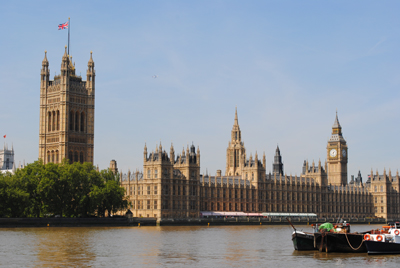
Of course, no look at London sites associated with Sir Winston Churchill would be complete without a mention of the Palace of Westminster, better known as the Houses of Parliament.

Churchill made his maiden speech in the House of Commons on 18th February, 1901, having won the seat of Oldham for the Conservative Party the year before (he switched to the Liberal Party in 1904 and eventually rejoined the Conservatives in 1924).

Over his long career in politics (he was an MP for 62 years), he served in a variety of roles including the President of the Board of Trade, Home Secretary, First Lord of the Admiralty, Minister of Munitions, Chancellor of the Exchequer, and twice, Prime Minster.

Some of the most famous speeches Churchill gave in the House of Commons were during World War II – they include the ‘blood, toil, tears and sweat’ speech given on 13th May, 1940 – the first after he had been made Neville Chamberlain’s replacement as PM, the ‘we shall fight them on the beaches’ speech given on 4th June, 1940, and the ‘this was their finest hour’ speech of 18th June, 1940, in which he gave the ‘Battle of Britain’ its name and, as the name suggests, first recorded the phrase “their finest hour” (the speech ended with it).

Churchill’s last speech to Parliament was given on 1st March, 1955, in which he spoke about the British development of a hydrogen bomb.

There’s several places within the Houses of Parliament which now bear Churchill’s name. Among them are the Churchill Room (named as such in 1991 when ownership of the room passed from the Lords to the Commons, it features two of his paintings and a bronze bust of the PM).

They also include the Churchill Arch – this leads from the Members’ Lobby into the Commons Chamber and is flanked by a 1969 statue of Churchill ( and one of fellow former PM, David Lloyd George (one foot on each of the statues has been burnished thanks to the practice of MPs to touch them as they enter the Commons Chamber).

It took on its current name after it was rebuilt following damage from bombs during World War II – at Churchill’s suggestion damaged stone was reused in its construction as a memorial to the “ordeal” Westminster had endured during the war. The statue of Churchill, incidentally, was the focus of recent commemorations on the 50th anniversary of his death.

Churchill’s stamp can also be seen on the Commons Chamber itself – it was he who recommended that when the chamber was rebuilt after World War II that it retain its rectangular shape rather than be redesigned in a semi-circle.

Churchill’s body lay in state in Westminster Hall prior to his funeral service in January, 1965 (for more on that, see our previous post here.

For more on Churchill’s Parliamentary career, check out the UK Parliament’s Living History page here: www.parliament.uk/about/living-heritage/transformingsociety/private-lives/yourcountry/collections/churchillexhibition/.

LondonLife – Mary and infant Jesus back on display in St Paul’s…

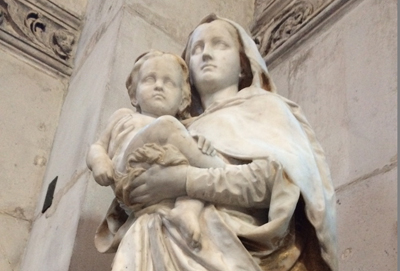
The-Madonna-and-ChildThis Victorian-era marble statue of the Virgin and Child has gone back on show in St Paul’s Cathedral more than 70 years after it taken down following bombing during World War II. Part of an ornate high altar and reredos installed at the cathedral’s east end in 1888, the statue – the work of Thomas Garner – was put into storage after that part of the cathedral took a direct hit during the Blitz of 1940 and what remained of the altar was dismantled (the statue and a crucifix were the only parts retained by the cathedral). It can now be seen in the Chapel of St Erkenwald and St Ethelburga (also known as the Middlesex Chapel) in the north transept. For more, see www.stpauls.co.uk. PICTURE: The Chapter of St Paul’s Cathedral.


10 sites from Shakespearean London – 7. Shakespearean connections in the Elizabethan world – St John’s Gate and Staple Inn…

Following on from our post last week, we take a look at a couple more of London’s buildings that had some sort of association with William Shakespeare…

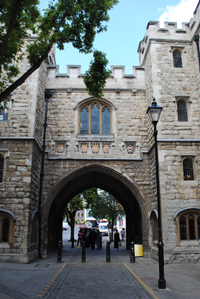
St-John's-Gate St John’s Gate, Clerkenwell (pictured): This former gatehouse into Clerkenwell Priory was at the time of Shakespeare home to the Master of the Revels and where the playwright would have had to have brought his plays for official government approval. Thirty of the Bard’s plays were licensed here and the Master of Revels during all but the final few years of Shakespeare’s career was Edmund Tilney (or Tylney), who served in the post under both Queen Elizabeth I and King James I. The gatehouse was later used as a coffee house and pub among other things and is associated with everyone from artist William Hogarth (his father Richard ran the coffee house), Dr Samuel Johnson and Charles Dickens. These days, the gatehouse is part of the Museum of the Order of St John (for more on that, see our earlier post here).

Staple Inn, Holborn: OK, there’s no direct link at all between Shakespeare and this building on High Holborn but it was built during his lifetime – in 1585 – and as such is one of very few surviving examples of buildings of his era. Its name comes from the fact the site where it stands was originally a covered market where wool was weighed and taxed (the word ‘staple’ apparently relates to the duty on wool introduced in 1275). It later became an Inn of Chancery – a medieval school for lawyers which fed students through to the Inns of Court (in this case mostly Gray’s Inn), and it was members of the Society of Staple Inn who built the new building here in the 1580s. The building – which still boasts a grand hall – survived the Great Fire of London in 1666 and, albeit with considerable damage, the Blitz. Since the late 1800s, it has been home to what’s now known as the Institute and Faculty of Actuaries. The building, which was restored in the 1990s, is a great example of an Elizabethan-era structure and gives some sense of what Shakespeare’s London was like.

10 significant sites from Georgian London – 9. Dr Johnson’s House…

In contrast to some of the grand homes we’ve featured as part of this series (and there are many more that we haven’t, meaning we might have a future series solely dedicated to them!), comes the rather more humble City home of lexicographer and renowned wit Samuel Johnson.

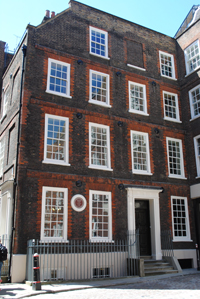
Gough-SquareThe brick townhouse at 17 Gough Square – which lies between Fleet Street and Holborn – was actually built in the late 17th century (before the Hanoverian accession) for wool merchant Richard Gough.

Johnson – who apparently had at least 17 different London residences – didn’t move in here as a tenant until 1748 and stayed for more than a decade until 1759 (seven years after the death of his wife – for more on Johnson, see our earlier ‘Famous Londoners’ post). It was during his tenancy here that he compiled his famous text, A Dictionary of the English Language. The first comprehensive English language dictionary, it was published in 1755.

The four level property, which is now a museum and has been set up as it was in Johnson’s day, was used by the writer as a residence as well as a workplace and the top floor garret is where six copyists worked transcribing the entries for the dictionary.

As well as the rather spectacular staircase, the property features furnishings from the period as well as portraits, prints and other Johnson-related memorabilia. There is a plaque which was placed on the exterior of the property by the Royal Society of Arts in 1876.

After Johnson vacated the premises, the property was used for various purposes including as a small hotel, B&B and a printer’s workshop. It had fallen into disrepair by the early twentieth century but was saved by MP Cecil Harmsworth who restored it and opened it to the public in 1914 (the small curator’s house was built after this). The house was damaged during World War II bombings – when it was used as a canteen by fireman – but survived. It is now operated by a charitable trust.

Outside the house in Gough Square is a statue of Johnson’s cat Hodge (see our earlier post here) and the property is only a short walk from the historic pub Ye Olde Cheshire Cheese (see our earlier post here).

WHERE: Dr Johnson’s House, 17 Gough Square (nearest Tube station Chancery Lane, Temple, Farringdon and Blackfriars);  WHEN: 11am to 5.30pm (May to September); COST: £4.50 adults/£1.50 children (5-17 years)/£3.50 concession/£10 family; WEBSITE: www.drjohnsonshouse.org

10 significant sites from Georgian London – 3. St Mary le Strand…

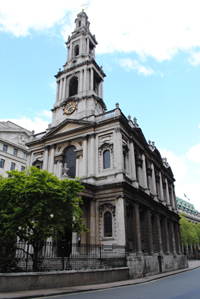
This oddly located church on the Strand is the work of acclaimed architect James Gibbs – the first public project he embarked upon after returning from Italy where he had trained.

St-Mary-le-StrandWhile the history of St Mary le Strand goes at least back to the Middle Ages (and it initially stood just south of the current churches’ position on land currently occupied by Somerset House), the construction of the current church – the first of 50 built in London under a special commission aimed at, well, seeing more churches built in the capital to meet the needs of the growing population – began around 1715 (the foundation stone was laid on 25th February, the year after the accession of King George I.)

While building was briefly delayed by the Jacobite rising which broke out in 1715, the church was finally consecrated for use on 1st January, 1723.

Gibbs, who trained under a baroque master – a style which contrasted with the Palladian-style favoured by Lord Burlington and others, had apparently originally intended the church to be in the Italianate style with a campanile over the west end instead of the steeple  but this scheme also included a 250 foot high column surmounted by a statue of Queen Anne located to the west of the church which would celebrate the work of the commission (it’s also worth noting that the churches built by the committee – and they didn’t get close to building 50 – were known as “Queen Anne Churches” despite their construction taking place largely after her death).

However, plans for the column were abandoned on the queen’s death on 1st August, 1714, and instead Gibbs – a Roman Catholic who thanks to his supposed Jacobite sympathies apparently finished the project without pay, was ordered to use the stone which had been gathered to build the steeple and, thanks to that, amend his plans for the church into an oblong form rather than the square form he had initially intended. The work shows the influence of Sir Christopher Wren as well as churches in Italy.

The interior has been remodelled several times since its creation. The white and gold plastered ceiling was apparently inspired by the work of Italian sculptor and architect Luigi Fontana on two Roman churches and other features include paintings by American artist Mather Brown (these were put in place in 1785 and are located on panels on the side walls of the chancel – they were restored in 1994), while the crucifix behind the altar was presented by parishioners in 1893.

It the late 1800s, the London County Council proposed demolishing the church so it could widen the Strand for traffic but this plan was abandoned after an outcry led by artist Walter Crane (although the graveyard was removed).

Famous faces associated with the church include Charles Dickens’ parents, John and Elizabeth, who were married here in 1809, and there’s a story that during a secret visit to London in 1750, Bonnie Prince Charlie (Charles Edward Stuart) renounced the Roman Catholic Church by receiving Anglican communion here. The parish currently includes that of nearby St Clement Danes after the church was bombed in 1941 (it’s now central church of the Royal Air Force).

WHERE: St Mary le Strand, Strand (nearest tube stations are Temple, Covent Garden, Holborn, Charing Cross and Embankment); WHEN: Usually open 11am to 4pm from Tuesdays to Thursdays and 10am to 1pm Sundays; COST: free; WEBSITE: www.stmarylestrand.org.

London Pub Signs – The Sutton Arms…

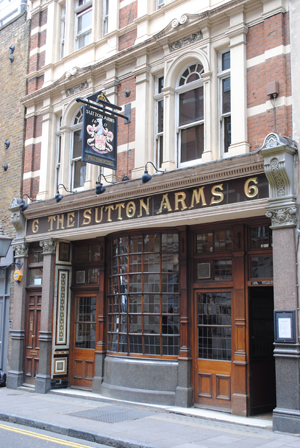
This pub, located just off Charterhouse Square near Barbican, has a distinctive barrel-shaped front window and a name that evokes a sense of the rich history of the area in which it stands.

The-Sutton-ArmsThe name of this pub at 6 Carthusian Street comes directly from Sir Thomas Sutton, a late 16th century/early 17th century businessman and moneylender who owned nearby land on which a Carthusian monastery once stood and who founded the Charterhouse School based at the site.

The monastery, which had been founded in 1371, was dissolved by King Henry VIII in the Dissolution of the Monasteries which took place in the first half of the 16th century – it was a nasty business with some of the monks executed at Tyburn.

The land was subsequently granted to Sir Edward North who built a mansion on the site which was subsequently sold to the fourth Duke of Norfolk. It was his son, Thomas Howard – the first Earl of Suffolk, who, in 1611, sold the property to Sir Thomas (and subsequently built the magnificent Audley End House in Essex with the funds).

Said to have been the “wealthiest commoner in England”, Sutton, who died that same year, used his wealth to endow a charitable foundation to both educate boys and care for elderly men.

The Charterhouse school later moved out to Surrey while elderly “brothers” are still housed at the original location today (for more on the Charterhouse, see our previous posts on King James I’s London and on 10 Historic London Squares).

Some of the glass in the  pub’s great barrel-shaped window was apparently replaced after a bomb knocked some of the original out during the Blitz.

Incidentally, there’s another pub of the same name only a few streets away in Great Sutton Street.

Lost London – St Dunstan in the East…

St-Dunstan-in-the-East

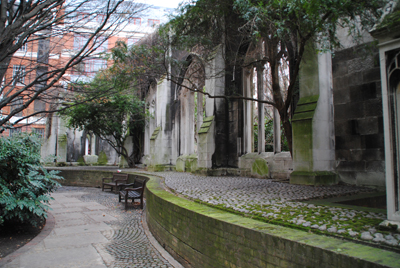
The ruins of this medieval church can still be found in the eastern end of the City of London and now play host to a rather delightful little park.

Originally built around 1,100 in the Gothic style, the church – which stands between St Dunstan’s Hill and Idol Lane (off Great Tower Street) was enlarged and repaired in ensuing centuries before suffering severe damage in the Great Fire of London in 1666. Not enough to destroy the church, however, and it was repaired in the late 1660s with a new steeple and tower designed by Sir Christopher Wren to fit with the existing structure, was added in the late 1690s. Inside were carvings by Grinling Gibbons.

St-Dunstan-in-the-East-smallBut by the early 19th century, however, the weight of the roof had pushed the walls dramatically out of line and, after an unsuccessful attempt to repair the church, it was decided to demolish it (with the exception of Wren’s tower) and rebuild.

Built in the Perpendicular style to the designs of David Laing, the new church reopened in 1821.

The church lasted for more than 100 years before it was again severely damaged, this time during the Blitz of 1941. Wren’s spire and tower thankfully remained but other than that it was a shell with only the north and south walls remaining.

The Anglican Church decided not to rebuild – the parish was incorporated into that of All Hallows by the Tower – and the City of London Corporation opted to turn the (now) Grade I-Iisted remains into a public park. It was opened in 1971 by the then Lord Mayor of London, Sir Peter Studd.

It remains there today, with beautiful climbing foliage – including many exotic plants – and a fountain in the nave. The tower, meanwhile, is used by a complementary medical centre.

A great place to pass a lunch hour!

10 (more) curious London memorials…4. ‘People of London’ Memorial…

People-of-London

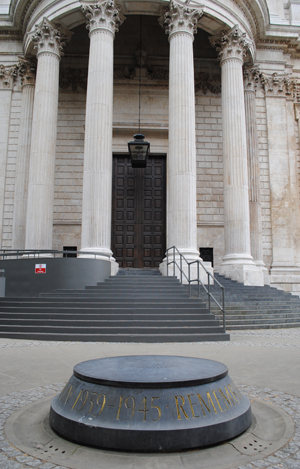
Amid all the grand war-related memorials of London, this rather humble memorial sitting outside the north transept of St Paul’s Cathedral in St Paul’s Churchyard can easily be overlooked. 

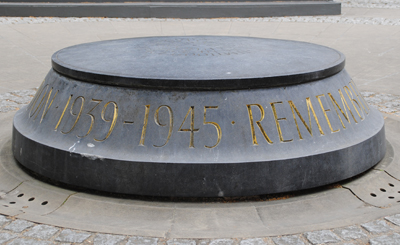
Known as the Memorial to the Londoners killed in World War II Bombardments or simply as the ‘People of London’ memorial as it’s called on the sculptor’s website, it commemorates the 30,000 Londoners who were killed during the Blitz  (not to be confused with the National Firefighters’ Memorial, known informally to many as the Blitz Memorial, which sits opposite the cathedral’s south transept and commemorates firefighters who died during the Blitz).

People-of-London---smallThe round memorial was carved from a three tonne block of Irish limestone and is set into paving (it was initially very shiny).

The gilded inscription which runs around the outside reads “Remember before God the people of London 1939-1945” while on top, written in a spiral, is an inscription written by Sir Edward Marsh – “In war resolution, in defeat defiance, in victory magnanimity, in peace goodwill”, the text of which was used by Sir Winston Churchill in the frontispiece to his history, The Second World War.

Unveiled by the Queen Mother on 11th May, 1999, the memorial is the work of Richard Kindersley, whose other memorials include the Commonwealth Memorial on Constitution Hill.

Kindersley writes on his website, that the “position of the memorial adjacent to St Paul’s is most appropriate, as most people will remember the dramatic photograph of the Cathedral dome of the taken during a devastating attack in 1941.”

It was paid for by public funds raised following an appeal in the Evening Standard newspaper, launched in connection with the 50th anniversary of VE Day.

LondonLife – A look into London’s wartime past…

StreetMuseum

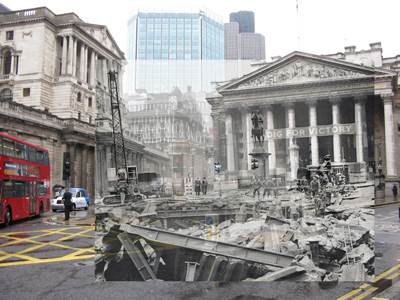
Images from the Museum of London’s Streetmuseum app give a glimpse into London’s past – in this case, its wartime history. The image above, taken by Police Constable Arthur Cross, official photographer of the City of London Police, and his assistant PC Fred Tibbs, shows bomb damage at Bank Underground Station, following a direct hit on 10th January, 1941. An estimated 111 people who had been sheltering in the Tube died, some of them thrown into the path of an incoming train. The crater that was left outside the Royal Exchange was so large the Royal Engineers had to build a bridge across it. For details on how to download the app, head to www.museumoflondon.org.uk/Resources/app/you-are-here-app/home.htmlPICTURE: © Museum of London/By Kind Permission of The Commissioner of the City of London Police.

Where is it?…#64…And the answer is…

Where-is-it--#64

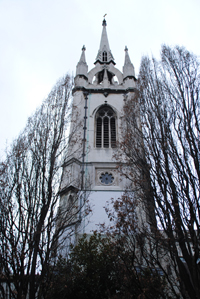
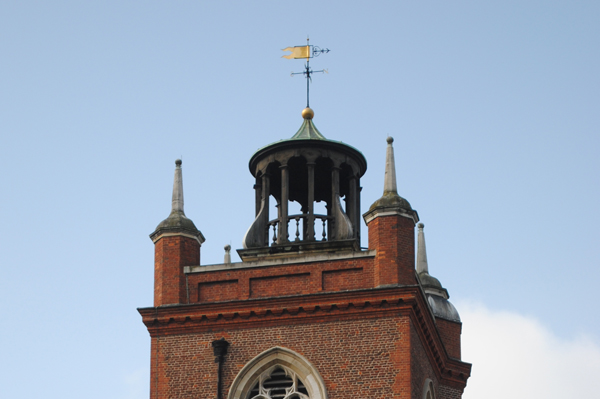
Can you identify where in London this picture was taken? If you think you can, leave a comment below. We’ll reveal the answer early next week. Good luck!

Well done to Jamie, this is indeed the tower of St Giles Cripplegate, located  just off Fore Street in the Barbican Estate. The church – the oldest building in the area – dates from about 1090 and was rebuilt in 1545 after it was destroyed by a fire. The new building survived the Great Fire of 1666 but didn’t fare so well in a fire of 1897 or in the Blitz when all but the outer shell was destroyed. Oliver Cromwell was married here in 1620 and the poet John Milton was buried here in 1674 (he had written much of Paradise Lost locally) (interestingly, his body was apparently exhumed about 100 years later, workman took some souvenirs including teeth and a rib). Others buried here include explorer Sir Martin Frobisher, John Foxe, author of The Book of Martyrs, and Bible translator Lancelot Andrews. For more on the church, see www.stgilescripplegate.com.

Where’s London’s oldest…Catholic church?

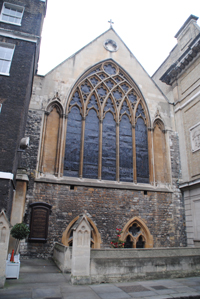
Hidden away to the north-west of the City of a quiet cul-de-sac, the oldest still-in-use Roman Catholic church in London (indeed, in England) is St Etheldreda’s Church in Holborn.

St-EtheldredaLocated in Ely Place, this atmospheric church – named for Etheldreda, seventh century female abbess of Ely – opened as a Roman Catholic Church in 1878, although the building in which it is lodged is much older, indeed a rare survivor from the 13th century. It was built in 1290 by John De Kirkeby, the Bishop of Ely and Treasurer of England during the reign of King Edward I, as a chapel to a residence he constructed on the site.

It and the adjoining palace remained in use by subsequent bishops and other nobles (including John of Gaunt who lived here after his own residence, Savoy Palace , was burnt down during the Peasant’s Revolt) up to and after the Reformation – the first reformer Bishop to use it was Thomas Goodrich, who built the nearby Mitre Tavern. (Worth noting is that the church also has some strong links to Shakespeare – there’s a great article on the church’s website exploring these).

In 1620, the Spanish Ambassador, the Count of Gondomar, moved into Ely Place and the chapel was used once again for Catholic masses (the residence was considered part of Spanish territory) – this was a relatively short-lived development for, thanks to deteriorating relations between England and Spain following a failed match between Prince Charles (later King Charles I) and the Infanta of Spain, the next ambassador was refused permission to live there.

Having escaped destruction in the Great Fire of London, the chapel was requisitioned by Parliament as a prison and hospital during the Civil War and subsequently fell into disuse before in 1772, the property – including the chapel – was sold to the Crown who in turn sold it to a surveyor and builder, Charles Cole.

Cole demolished the palace buildings with the exception of the chapel and had the current Ely Place built with neat rows of Georgian homes, modernising the chapel for the use of residents as an Anglican place of worship. The church attracted few worshippers, however, and in 1820 was taken over by the National Society for the Education of the Poor.

In 1873, the chapel was again to be sold and following a somewhat controversial auction was bought by the Catholic Institute of Charity (aka the Rosminians) and restored under the eye of Father William Lockhart (the Catholic Emancipation Act had been passed in 1829, allowing Catholics to have churches and say mass).

Interestingly, it was during this work that 18 bodies were discovered buried in the crypt – they had died in the ‘Fatal Vespers’ of 1623 when, during a secret meeting of Catholics at the French ambassador’s house in Blackfriars, the floor collapsed and more than 100 were killed. Not able to be buried publicly due to anti-Catholic feeling, they were buried in secret with some of them buried here.

A mass commemorated the completion of the restoration work on 23rd June, 1878, and the church has been in use as a Roman Catholic Church ever since (although years of repairs were needed following significant bomb damage in World War II). Further restoration work was carried out in the 1990s when Flemish tiles from the original cloister were discovered.

These days the church – which features a relic of St Etheldreda contained in a bejewelled cask sitting by the altar – is a quiet oasis in the midst of the bustling city – a great place to take some time out in the midst of a busy day. Also of note is the east window – the work of Joseph Edward Nuttgens, it was completed in 1952 and, like all the other windows, replaced a Victorian window destroyed in the Blitz (look for the image of St Etheldreda) – and the  west window – the work of Charles Blakeman, it is apparently the largest stained glass window in London and depicts a series of English Catholic martyrs.

WHERE: St Etheldreda’s Church, Ely Place (nearest Tube stations are Chancery Lane and Farringdon); WHEN: 8am to 5pm Monday to Saturday; 8am-12.30pm Sunday; COST: Free; WEBSITE: www.stetheldreda.com.

10 of London’s greatest Victorian projects – 4. The Palace of Westminster…

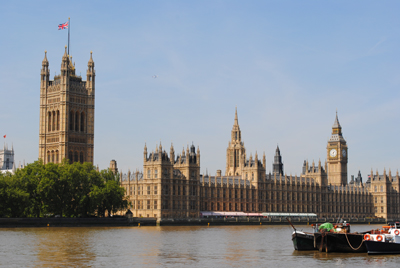
Commonly thought to be older than it actually is due to its Gothic stylings (although, to be fair, parts of it do date from medieval times), the Palace of Westminster – or, as it’s more commonly known, the Houses of Parliament – didn’t actually take on much of its current appearance until the latter half of the 19th century.

The need for a new building for parliament arose after 1834 when a fire, caused by the overheating of two underfloor stoves used to incinerate the Exchequer’s obsolete tally sticks, tore through the former complex, leaving only some structures from the old palace intact. They included the 11th century Westminster Hall (the largest in Europe when it was built), 14th century Jewel Tower and a chapterhouse, crypt and cloisters, all of which was once attached to the now gone St Stephen’s Chapel.

Houses-of-Parliament2While King William IV offered the use of Buckingham Palace for Parliament, the idea – along with a host of other options – was rejected as unsuitable. Instead, a competition was held for a new design and after almost 100 entries were considered, architect Charles Barry and his design for a new palace in the perpendicular Gothic style was chosen. Interestingly, while Barry was a classical architect, under the terms of the competition, designs were required to be in a Gothic style, thought to embody conservative values .

Incorporating some of the remains of the old palace – including Westminster Hall but not the Jewel Tower which to this day stands alone – the design was based around a series of internal courtyards with the House of Commons and House of Lords located on either side of a central lobby (first known as Octagonal Hall). The design involved reclaiming some land from the Thames so the building’s main river-facing facade could be completed.

Towers stand at either end of the complex – the Victoria Tower over the Sovereign’s Entrance at the southern end of the complex (for many years the tallest square stone tower in the world) and the narrower tower formerly known as the Clock Tower which houses the bell Big Ben, at the northern end – and there is a central Octagonal Tower which stands directly over the Central Lobby. The Clock Tower, incidentally, was renamed the Elizabeth Tower last year in honour of Queen Elizabeth II’s Diamond Jubilee (for more on it and Big Ben, see our earlier entries here and here).

Other towers include the Speaker’s Tower (located at the northern end of the building on the waterfront, this contains a residence for the Speaker), the Chancellor’s Tower (located at the southern end, it too contained a residence originally used by the Lord Chancellor) and St Stephen’s Tower – located in the middle of the building’s west front, it contains the public entrance to the building. Significant other rooms in the palace complex include the Robing Room – where the Queen puts on her ceremonial robes and crown before the State Opening of Parliament – and the Royal Gallery, used for state occasions.

The foundation stone (the building was constructed out of sand-coloured limestone from Yorkshire) was laid in 1840 and construction of the monumental building – which features more than 1,100 rooms and two miles of passageways – wasn’t completely finished until the 1870s although most of the work had been completed by 1860 (the year Barry died). The House of Lords first sat in their new chamber in 1847 and the House of Commons in 1852 (it was at this point that Barry was knighted for his work).

The cost, meanwhile, originally estimated at less than £750,000, ended up coming in at more than £2 million.

Much of the interior decoration owes its appearance to the Gothic revivalist Augustus Pugin who designed everything from wallpapers, to floor tiles and furnishings. Pugin also helped Barry with the external appearance but like Barry died before the project was completely finished (in 1852).

The palace was bombed numerous times in World War II – in one raid, the Commons Chamber was destroyed as firefighters opted to save the much older Westminster Hall instead. It was later rebuilt under the direction of Sir Giles Gilbert Scott and completed by 1950. Other aspects of the building have also been restored.

A Grade I-listed building classified as a World Heritage Site, Barry’s Houses of Parliament remain one of London’s most iconic structures. We’ll be looking in more detail at some of the building’s features in future posts.

WHERE: Houses of Parliament (nearest Tube stations are Westminster, St James’s Park and Embankment); WHEN: Tours (75 minutes) are run from 9.15am to 4.30pm on Saturdays (also six days a week during summer opening); COST: £15 adults/£10 concessions/£6 children five to 15 years (children under five are free). Prices go up after 1st April – check website for details and to purchase tickets (tours for UK residents, including climbing the Elizabeth Tower, can also be arranged through your MP); WEBSITE: www.parliament.uk.

For more, see Robert Wilson’s guide to the The Houses of Parliament or David Cannadine’s indepth,  The Houses of Parliament: History, Art, Architecture. For more on the story of the fire in 1834, see head parliamentary archivist Caroline Shenton’s recent book The Day Parliament Burned Down.

Famous Londoners – Gog and Magog…

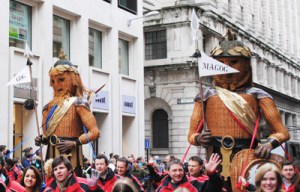
Regular watchers of London’s Lord Mayor’s Show parade will be familiar with the two giants Gog and Magog who for centuries have been an integral part of the procession. But just who are the two stern figures who strike fear into the hearts of all they pass (well, perhaps not so much the fear)?

Gog-and-MagogWhile the names Gog and Magog appear several times in different contexts in the Bible came t0 epitomise the enemies of God, legend has it that the Gog and Magog seen in this context were leaders of a race of giants who inhabited Britain in times of prehistory.

Defeated by Brutus, a descendent of the Trojan Aeneas and the founder of London and first king of Britain, they were then chained to the gate of his palace which stood on the site of where Guildhall – home of the City of London Corporation – now stands.

Seen as guardians of the City of London, figures of the giants have been carried in the Lord Mayor’s Show – the annual procession surrounding the election of the new Lord Mayor – since as far back as the reign of King Henry V (originally made of ‘wickerwork and pasteboard’, they were later replaced with wooden ones).

The seven foot high wicker versions of the giants which are now carried in the parade were donated by the Worshipful Company of Basketweavers in 2006 (pictured here in the 2010 parade) and are the just latest in a series of effigies and statues of the two giants which have been associated with Guildhall.

These include pair of nine foot high limewood statues of the giants which currently stand in Guildhall – carved in 1953 by David Evans, they replaced two earlier, 14 foot high oak versions made by Richard Saunders in the early 1700s which were destroyed in the Blitz during World War II. They, in turn, were created to replace earlier papier mache versions.

As well as being found in numerous cities around the world, figures of the two giants also famously feature as the clock’s bell ringers on the facade of the Church of St Dunstan-in-the-West in Fleet Street. The clock, incidentally, was the first public clock in London to have a minute hand.

What’s in a name?…Barbican

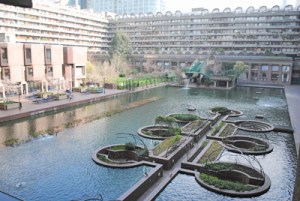
Though it’s these days associated with a Brutalist housing estate and performing arts centre based in the north of the City of London, the name Barbican has been associated with the area on which the estate stands for centuries.

BarbicanThe word barbican (from the Latin barbecana) refers to an outer fortification designed to protect the entrance to a city or castle. In this case it apparently referred to watchtower which may have had its origins in Roman or Saxon times (or maybe both). The City of London website suggests it was located “somewhere between the northern side of the Church of St Giles Cripplegate and the YMCA hostel on Fann Street”.

When-ever it was built, the watchtower was apparently demolished on the orders of King Henry III in 1267, possibly as a response to Londoners who had supported England’s barons when they had rebelled against him. One source suggests the tower was rebuilt during the reign of King Edward III but, if so, the date of its subsequent demolition remains unknown.

Later residents of the area – which become known as a place to trade new and used clothes – included John Milton and William Shakespeare.

The area known as Barbican was devastated by bombing raids in World War II. Discussions on the future of the site started in 1952 and for more than 10 years plans for redeveloping the area were debated until finally, in the early 1960s, work began on what is now the Barbican Estate including three tall residential towers (part of the residential estate is pictured above). Completed in the mid 1970s, the Brutalist design of the complex, which features buildings named after historical figures associated with the area, means it meets with strong reactions from those who encounter it whether love – or hate.

Construction of the arts centre – known as the Barbican Centre – the largest performing arts centre in Europe and home to the London Symphony Orchestra – was started in the early 1970s. The £156 million centre was eventually opened by Queen Elizabeth II in 1982.

Other buildings within the Grade II listed complex include the Guildhall School of Music and Drama, the City of London School for Girls and a YMCA.

10 Historic London Markets – 8. Columbia Road Flower Market…

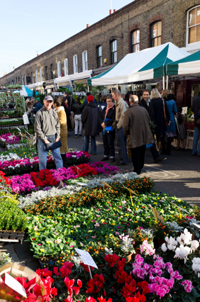
Originally founded in the early 1800s, the Columbia Road market in East London has since evolved into a specialist flower market on Sundays.

First emerging as a general street market in the early 1800s, the market was formalised in the mid 1800s when banking heiress Angela Burdett-Coutts financed the construction of the now demolished – and somewhat architecturally fanciful – Columbia Market. This opened in 1869 at the northern end of the road but didn’t prove a great success. Despite efforts to save it – including apparently relaunching it as a fish market – it closed in 1885.

The market building – which is said to have resembled the sort of market hall that might be found in rural areas – was later used as a warehouse but after suffering bomb damage in World War II were demolished.

The market, meanwhile, reappeared on the street and as the area’s Jewish population grew, moved to a Sunday, a decision which allowed traders from Covent Garden and Spitalfields to trade their leftover goods from the previous day.

The introduction of new regulations – including those introduced in the 1960s requiring traders to attend regularly – saw the market gradually transform itself into the colorful market selling cut flowers, plants and bulbs you can find there today. Popular with film makers and photographers thanks to the colourful backdrop it provides, the surrounding streets also feature a range of interesting independent shops and cafes.

WHERE: Columbia Road, Bethnal Green (nearest Tube stations are Shoreditch, Liverpool Street, Aldgate East and Bethnal Green); WHEN: 8am to 2pm Sunday; COST: Free; WEBSITE(S): www.columbiaroad.info/www.columbia-flower-market.freewebspace.com/index.html.

PICTURE: Dynasoar/www.istockphoto.com

Lost London – Greyfriars…

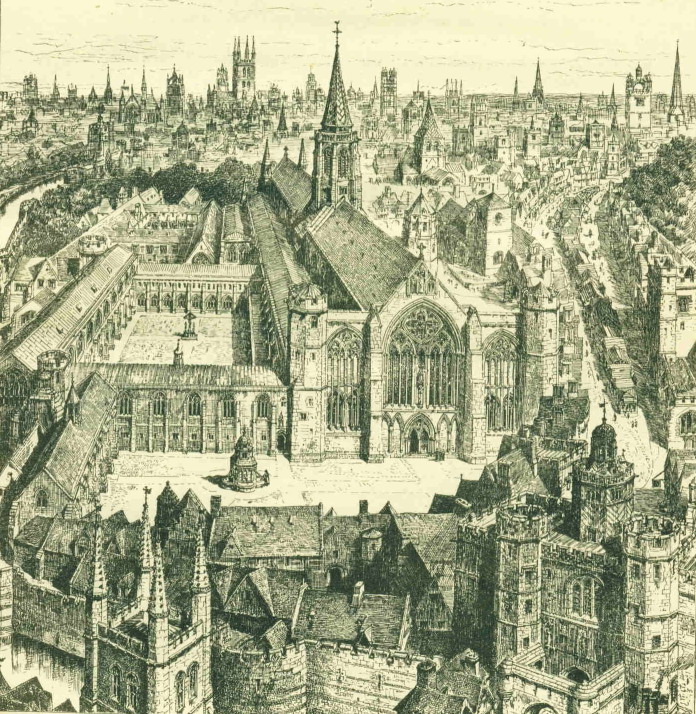
A now long gone Franciscan friary located in the north-west of the City of London near Newgate (just to the north of St Paul’s Cathedral), Greyfriars, so known for the color of the friars’ clothing, was the second Franciscan religious house to have been founded in England.

The foundations of the friary date from the early part of the 13th century – the Franciscans, as members of the Order of Friars Minor were known, had arrived in 1224 and are recorded as settling on land granted to them by a rich mercer, John Iwyn, just inside the City wall, in 1225, in the butcher’s quarter of the city.
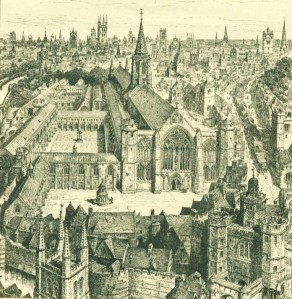
King Henry III apparently gave them some oak to build their own friary in 1229 and by the mid 1200s, there were more than 80 friars living on the site which was gradually extended over the ensuing years to the north and the west.

Using funds given them by Sir William Joyner, Lord Mayor of London in 1239, they built a chapel which was later extensively enlarged and improved in the late 13th and early 14th centuries – the new church was said to be 300 feet long – with much of the work funded by Queen Margaret, second wife of King Edward I, and later in the 14th century, Queen Isabella, wife of Edward III. It apparently suffered some damage in a storm in 1343 but was restored by King Edward III.

When it was finally completed in 1348, the church is said to have been the second largest in London. A library was later added to the buildings, founded by the famous Lord Mayor of London, Richard “Dick” Whittington.

Such was the fame of the church that, the heart of Queen Eleanor, wife of King Henry III, was buried here after her death in 1291 while, despite dying at her castle in Marlborough, Queen Margaret was also buried here in 1318 (apparently wearing a Franciscan habit).

But perhaps the most notorious person to be buried here was Queen Isabella, wife of King Edward II and known by many as the “She-Wolf of France”, after her death in 1358. In fact, it’s said that the ghost of Isabella still haunts the former location of Greyfriars, driven forth from the grave for her role in deposing her husband.

Other non royal luminaries said to have been buried here include the 15th century writer Sir Thomas Mallory, author of Le Morte d’Arthur and 16th century Catholic nun Elizabeth Barton, the so-called ‘mad maid of Kent’ who was executed for her rather unwise prophecies predicting King Henry VIII’s death if he married Anne Boleyn.

The end of the friary, pictured above in the sixteenth century, came in 1538 when it fell victim to King Henry VIII’s policy of dissolving monasteries and was surrendered to his representatives.

Some of the houses were subsequently converted for private use and the church, which was somewhat damaged during this period with many of the elaborate tombs destroyed, was briefly closed before it and other buildings were given to the City of London Corporation who reopened it again in 1547 as Christ Church Greyfriars, a parish church serving the now joined parishes of St Nicholas Shambles and St Ewen.

Only a few year’s later King Edward IV founded a school for poor orphans in some of the old friary buildings known as Christ’s Hospital or informally as The Bluecoat School thanks to the uniforms students wore. Some of the school buildings, along with part of the church which was also used by the school, was destroyed by the Great Fire of London in 1666, but the school was rebuilt and remained in use until the late 1800s when the last of the students were relocated to a new facility in Sussex (where the school still exists today).
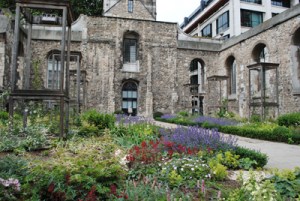
The church (also known as Christ Church Newgate Street), meanwhile, was also rebuilt after the Great Fire – it was one of Sir Christopher Wren’s designs and was completed in 1704. The church remained in use until World War II when a firebomb struck it during a German raid on 29th December, 1940, all but destroying it.

The church was not rebuilt and the parish merged with the nearby St Sepulchre-without-Newgate – the largest parish church in London – and eventually what’s left of the church – the tower with rebuilt steeple and the west and north walls – were converted into a public garden (rose beds were planted where the pews once stood and there are wooden towers representing the church’s pillars). Pictured right, it’s now a terrific place to sit and have lunch pondering the past which the bustle of the city goes on about you.

PICTURE: (top) Wikipedia

For a great biography of Isabella, the She-Wolf of France, see Alison Weir’s Isabella: She-Wolf of France, Queen of England. For more on Sir Christopher Wren’s churches in London, see John Christopher’s Wren’s City of London Churches.

Treasures of London – Temple Church knight effigies…

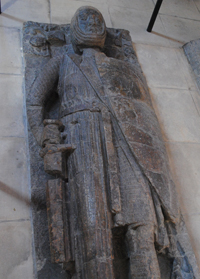
A relic of the early medieval age, the late 12th century Temple Church in the City of London is a marvel in its own right, its circular nave modelled on the Church of the Holy Sepulchre in Jerusalem (for more on its history, see our earlier entry here). But it’s inside the round church – once based inside property that formed the London headquarters of the Templar Knights – that we are concerned with in this piece – for there can be found are series of remarkable effigies of knights which date from the 13th century.

There are nine effigies in all (and one grave cover) and, having survived the Great Fire of 1666, most of them were damaged during World War II when, in a bombing raid on 10th May, 1941, the roof was set alight and came crashing down on top of them. They have since been repaired, using as much of the original material as possible, and still make an imposing sight redolent with the history they depict.

Pre-eminent (at least in his lifetime) among those depicted is William Marshal, the 1st Earl of Pembroke (1146 -1219) and an advisor of kings including King Henry II, King Richard ‘the Lionheart’ and King John who was named Regent during the infancy of King Henry III.

One of the most influential men of his age (described by early thirteenth century Archbishop of Canterbury, Stephen Langton, as the “greatest knight who ever lived”), he lies in the southern group of effigies near his sons William, 2nd Earl of Pembroke (1190-1231) and Gilbert, the 4th Earl of Pembroke (1194-1241). (The 3rd Earl of Pembroke, Richard, was the second son of William – he died after being captured during fighting in Ireland and was buried in Kilkenny). Another of this group is believed t0 depict Robert, Lord de Ros, one of the 25 barons to guarantee the observance of the Magna Carta, signed by King John in 1215.

The only identified effigy in the northern group is that of Geoffrey de Mandeville, the 1st Earl of Essex and a man known for the cruelties he inflicted during the troubled reign of King Stephen (he shifted his allegiances between King Stephen and his rival, the Empress Matilda several times), particularly in the eastern counties where he seized Ramsey Abbey near Peterborough to use as his base.

Interestingly, none of the men named was a Templar but are believed to have been benefactors of the Templar Knights. Some of those shown are cross-legged but whether this denotes a crusader or not remains a matter of debate.

WHERE: Off Fleet Street and down Inner Temple Lane (nearest tube station is Temple); WHEN: Check website for times; COST: £4 (free to under 18s, seniors); WEBSITE: www.templechurch.com.

LondonLife – BBC World Service bids adieu to Bush House…

Seventy-one years of broadcasting from Bush House in Aldwych came to an end last week when the BBC World Service formally left the building. The building has been used by the BBC for foreign language broadcasting since 1941 (the service’s previous home, Broadcasting House in Portland Place having been bombed out), initially for the European Service and, since 1958, for the rest of what was then called the Overseas Service. Designed by American architect Harvey Corbett, the building at the end of Kingsway in west London was constructed in 1923 and opened in 1925 (additions were made in 1928 and 1935). Built for an Anglo-American trading company at the enormous cost of around £2 million (a price tag which led to it being declared the most expensive building in the world), it was named for American businessman, Irving T. Bush. Noted for its distinctive portico featuring two male statues depicting Anglo-American friendship, the premises has been the site of important events including General Charles De Gaulle’s wartime broadcasts to the Free French while among those who worked in the building were George Orwell, who worked for the Eastern Service during World War II. The BBC, who have returned the World Service to Broadcasting House following a major extension, have never actually owned the building – owners during its residency there have included the Church of Wales and its current Japanese owners. For more on Bush House and its BBC connections, see www.bbc.co.uk/historyofthebbc/collections/buildings/bush_house.shtml. For the final broadcast, see www.bbc.co.uk/news/entertainment-arts-18805063. PICTURE: Bush House, 1951 – Courtesy BBC.