Lost London – The Cockpit at Whitehall…

Once part of the Palace of Whitehall, the Cockpit (also referred to as Cockpit-in-Court or the Royal Cockpit) was initially built as a pit in which to watch cockfighting as part of renovations carried out by King Henry VIII after he “acquired” Cardinal Wolsey’s former property of York Place and before transforming it into a royal palace.

It was one of a number of entertainment related buildings constructed by the king in the new palace precinct – others included a real tennis court, bowling alley and a tiltyard.

By Jacobean times, the use of the octagonal-shaped cockpit – located between today’s Downing Street and Horse Guards Parade – had changed into that of a private royal theatre and in 1629 Inigo Jones was given the task of redesigning it to accommodate King Charles I’s elaborate court masques (Jones had previously redesigned the Cockpit Theatre in Drury Lane).

Following the Restoration in 1660, the Cockpit again returned to its use as a theatre and King Charles II had new dressing rooms added and the decor given an overhaul (the ever-present diarist Samuel Pepys was among those who attended theatrical presentations during this period and Ben Jonson among those whose work was presented here).

The theatre building is believed to have been demolished around 1675 and the site subsequently used to house government officials including those of the Foreign Office (see our earlier post here) and Privy Council.

In the 1730s, William Kent designed the building (which although since expanded and modified) now stands on the site and is currently the home of the Cabinet Office.

While the Cockpit is long gone, its name lives on in ‘Cockpit Passage’ – a gallery inside the Cabinet Office from where one could once watch tennis being played.

Around London – Royal Court treasures at V&A; Sir Michael Caine celebrated; a tunic with a past; and, George Catlin’s American Indian portraits…

Water_potA new exhibition opens at the V&A in South Kensington this Saturday which charts the development of cultural trade and diplomacy between Britain and Russia from the founding of the Muscovy Company in 1555 until the end of King Charles II’s reign in 1685. Treasures of the Royal Courts: Tudors, Stuarts and the Russian Tsars reveals the “majesty and pageantry” of the royal courts of both countries – from that of King Henry VIII to King Charles II in Britain and from that of Ivan the Terrible (Ivan IV) to the early Romanovs in Russia. The display features more than 150 objects including heraldry and processional armour,  furnishings, clothing, jewellery and portraiture including paintings and miniatures painted by court artists. Highlights include a rarely viewed portrait of Queen Elizabeth I, the Barbor Jewel – a pendant set with an onyx cameo of the queen; a hand-colored map of ‘Muscovy’ dating from 1570, and literature including Shakespeare’s First Folio as well as a showcase of British and French silver given to the Tsars by British merchants and kept in the Kremlin. The 20 pieces include the Dolphin Basin, made by Christiaen van Vianen – said to be a favoured silversmith of King Charles I and II – in 1635. The exhibition marks the 400th anniversary of the Romanov dynasty. Admission charge applies. Runs from Saturday, 9th March, until 14th July. For more, see www.vam.ac.uk. PICTURE: Water pot (1604-05), Historic collectino of the Armoury, © The Moscow Kremlin Museums.

The life and work of Sir Michael Caine – who turns 80 this month – is the focus of a new free exhibition at the Museum of London. Michael Caine, which opens tomorrow, features photographs including some never exhibited before as well as iconic portraits by the likes of David Bailey and Terry O’Neill as well as a selection of audio and film clips from movies such as Alfie, The Italian Job, Get Carter, Hannah and Her Sisters and Educating Rita. The exhibition follows Sir Michael’s life from “Cockney rebel, through to Hollywood legend and inspirational Londoner” and looks at how the city influenced his life and career. Runs until 14th July. To coincide with the exhibition, the Museum of London Docklands is running Caine on Screen, a selection of free films which can been voted for by the public (see our earlier post here). The schedule of films will be announced after 14th March. For voting details and more information, see www.museumoflondon.org.uk.

A bullet-pierced military tunic worn during the Indian Mutiny in the mid 19th century has been donated to the National Army Museum in Chelsea. The tunic, worn by Lieutenant Campbell Clark, of the 2nd Bengal European Fusiliers, at Cawnpore in 1857. The lieutenant was ambushed by rebels Indian infantry and shot at point-blank range. Despite being grievously wounded (the musket ball had passed through his stomach and remained in the wound), he survived the injury and the military hospital he was taken to and went on to have a long career, rising to the rank of colonel. He died in 1896 in Sussex. The tunic was donated to the museum by Clark’s great-great-nephew, John Gordon Clark. For more, see www.nam.ac.uk.

On Now: George Catlin: American Indian Portraits. Opening today, this exhibition at the National Portrait Gallery is the first major exhibition of the American artist’s works to be held in Europe since the 1840s and has been designed to demonstrate to the viewer how Catlin constructed a particular view of Native Americans in the minds of his audiences. Catlin made five trips into the western United States in the 1830s before the Native American peoples had been subsumed into the United States and, inspired by those trips, went on to create an Indian Gallery which featured 500 portraits, pictures and indigenous artefacts. He subsequently toured with the gallery in both the US and Europe. The exhibition is organised in collaboration with the Smithsonian American Art Museum in Washington. Runs until 23rd June. Admission charge applies. For more, see www.npg.org.uk.

LondonLife – A new crown for King Henry VIII…

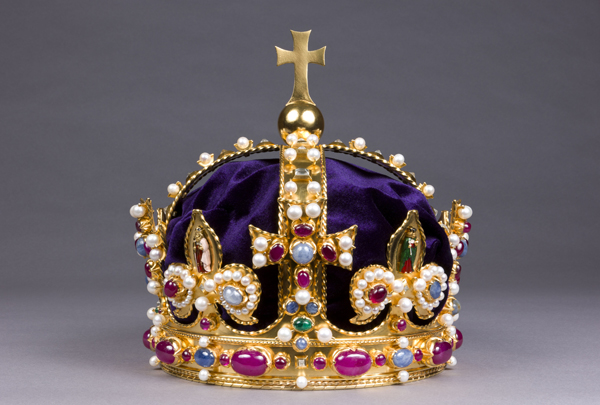
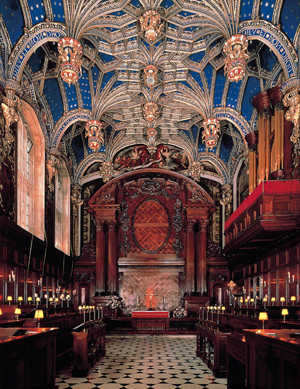
A recreation of King Henry VIII’s imperial crown, destroyed after the English Civil War, has gone on show in the Chapel Royal at Hampton Court Palace. Originally created for either King Henry VIII or his father, King Henry VII, the crown was worn at the coronations of Henry VIII’s children and possibly the king’s own as well as at Hampton Court Palace during major liturgical and court ceremonies. It was subsequently used by his successors down to King Charles I before being melted down by the Commonwealth Government in 1649 at the Tower of London. The replica crown, which is being displayed in the Royal Pew – allowing visitors access to the balcony in the chapel for the first time in seven years, is the result of detailed historical research by Dr Kent Rawlinson, curator at Hampton Court Palace, and was made by Crown Jeweller Harry Collins and his master craftsmen. Hand-crafted in silver gilt, it features 344 jewels including pearls and precious and semi-precious stones. Five enameled figures are set within five fleur-de-lis – the figures represent the Virgin and Child, St George and English kings believed to be St Edmund, St Edward the Confessor and King Henry VI (King Henry VIII had the latter three figures added to the crown to underline the political and religious authority of the Crown). For more on Hampton Court Palace, see www.hrp.org.uk/HamptonCourtPalace/PICTURE: HRP/Newsteam

Celebrating the Diamond Jubilee with 10 royal London locations – 9. Royal chapels…

Palaces aside, the Queen also owns a series of chapels – the Chapels Royal – in London which, although not as grand as Westminster Abbey, have each played an important role in the history of the monarchy. 

The term Chapel Royal originally referred to a group of priests and singers dedicated to serving the Sovereign’s personal spiritual needs and as such would follow the monarch around the country. It was in Stuart times that they became more settled establishments with the two main Chapels Royal – the Chapel Royal and the Queen’s Chapel – located in St James’s Palace.

• The Chapel Royal, St James’s Palace. Constructed by King Henry VIII, the chapel was decorated by Hans Holbein the Younger in honor of the king’s (short) marriage to Anne of Cleves. Queen Mary I’s heart is said to be buried beneath the choir stalls and it was here that Queen Elizabeth I apparently prayed waiting for news of the progress of the Spanish Armada. King Charles I took the Sacrament of Holy Communion here before his execution in 1649 and the chapel was where Queen Victoria married Prince Albert (her marriage certificate still hangs on the wall). In more recent times, the coffin of Diana, Princess of Wales, was placed before the altar so family and friends could pay their respects before her 1997 funeral. Among the composers and organists associated with the chapel are Thomas Tallis, William Byrd, Henry Purcell and George Frideric Handel. The chapel is not open to the public except for services.

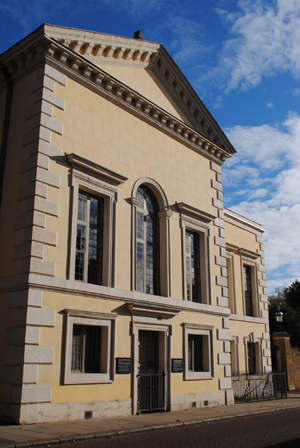
• The Queen’s Chapel, St James’ Palace (pictured right). Now located outside the palace walls, this chapel was built by King James I for the Catholic Henrietta Maria, the bride of his son, then Prince Charles (later King Charles I). Designed by Inigo Jones, Grinling Gibbons and Sir Christopher Wren were also involved in its creation. The chapel was used by Henrietta Maria until the Civil War and later became the home of the Danish Church in London. The chapel is not open to the public except for services.For more on this chapel or the Chapel Royal at St James’s Palace, follow this link.

• The Queen’s Chapel of the Savoy. Built in the Middle Ages to serve the now long gone Savoy Palace, London home of Count Peter of Savoy (uncle to King Henry III’s wife, Eleanor of Provence, the original building was destroyed in the Peasant’s Revolt of 1381. The current building, located in Savoy Hill, off the Strand, was built on the orders of King Henry VII in the late 15th and early 16th century to serve the hospital he founded on the site of the palace. The chapel since served many other congregations – including a German Lutheran congregation – but remains royal property via the Duchy of Lancaster, which is held in trust for the Sovereign and used to provide an income for the British monarch. It is officially the Chapel of the Royal Victorian Order. For more, see www.duchyoflancaster.co.uk/duties-of-the-duchy/the-queens-chapel-of-the-savoy/.

• Chapel Royal, Hampton Court Palace (pictured right). There has been a chapel here since the Knights Hospitallers occupied the site in the 13th century but it was Cardinal Wolsey who built the chapel to its present dimensions after acquiring the property in 1518. The current building, however, dates from the later ownership of King Henry VIII – Wolsey surrendered the property to him when he fell from favour – and further works in the eighteenth and nineteenth centuries. Many subsequent monarchs have worshipped here. The chapel, with its stunning ceiling, is open to the public when visiting Hampton Court Palace. For more, see www.chapelroyal.org. PICTURE: Historic Royal Palaces/newsteam.co.uk

• The Chapel Royal of St Peter ad Vincula, Tower of London. Originally a parish church, this was incorporated into the walls of the Tower in the reign of King Henry III. It was subsequently rebuilt at least twice – in the reign of King Edward I and King Henry VIII – and is home to the graves of important personages executed at the Tower including Henry VIII’s one-time wives, Anne Boleyn and Catherine Howard as well as Jane Grey, the nine day queen, and Sir Thomas More and Bishop John Fisher. The chapel can be accessed during a Yeoman Warder’s tour of the Tower of London. For more, including details of an appeal for its restoration, see www.hrp.org.uk/TowerOfLondon/stories/thechapelproject.

• Chapel Royal of St John the Evangelist, Tower of London. Located within the White Tower, this beautiful chapel – arguably the oldest church in London – dates back to the construction of the tower by King William the Conqueror the late 11th century and remains one of the best preserved examples of Anglo-Norman architecture in England. King Henry III added stained glass windows but for much of its later history the chapel was used for records storage. Tradition records that King Henry VII’s wife, Elizabeth of York, was laid in state here following her death in childbirth and that it was here Queen Mary was betrothed by proxy to Philip of Spain. This can be visited as part of a visit to the Tower of London. For more, see www.hrp.org.uk/TowerOfLondon/Sightsandstories/Prisoners/Towers/ChapelofStJohns

For more on churches in London, check out Stephen Millar’s London’s City Churches
and Stephen Humphrey’s London’s Churches and Cathedrals: A Guide to London’s Most Historic Churches and Cathedrals, Leigh Hatt’s London’s 100 Best Churches: An Illustrated Guide or the Pevsner Architectural Guide London: City Churches.
The Royal Parks – 8. Bushy Park

And so we come to the final entry in our special series on Royal Parks – Bushy Park (Royal Parks also look after Brompton Cemetery, but given it’s not strictly a park, we’ll deal with that in an upcoming post).

Lying off the beaten track near Hampton Court in south-west London, Bushy Park’s location means it’s perhaps the least glamourous of the Royal Parks we have looked at. Yet, like the other parks, its connection with royalty goes back a long way – in this case to the time of King Henry VIII.

The park was included as part of the Hampton Court estate given to the king by Cardinal Wolsey. Henry immediately transformed what had been farmland (complete with artifical medieval rabbit warrens, the remains of which can still be seen) into a deer chase and enclosed the park with a brick wall (a section of the original wall lies on the north side of Hampton Court Road).

The character of the park was altered again in 1610 when King Charles I ordered the creation of the Longford River, a 12 mile ornamental canal designed to bring water from the River Colne in Hertfordshire to the park’s water features.

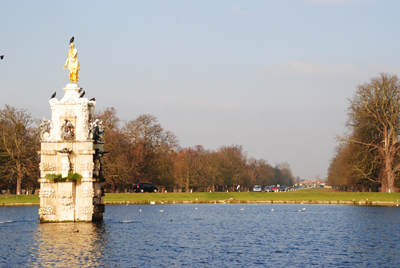
Christopher Wren had a hand in the park’s design in 1699 when he designed Chestnut Avenue – a mile long formal roadway which runs through the centre of the park. He also added the round pond at its end and placed a fountain topped with a statue in its midst.

Known as the Diana Fountain after the Roman goddess of hunting, the statue (pictured above with Chestnut Avenue behind) actually represents one of Diana’s nymphs Arethusa. It was commissioned by King Charles I for his wife, Queen Henrietta Maria, and originally stood at Somerset House before Oliver Cromwell moved it to the Privy Garden at Hampton Court and Wren then moved it to its current location.

The 17th and 18th century also saw the appearance of houses at the park to be used as hunting lodges (and the ranger’s home), and gardens were added.

Worth noting here is the story of shoemaker Timothy Bennet. A resident of nearby Hampton Wick, in 1752, when an old man, he successfully fought to ensure a public right-of-way through the park after the then ranger, Lord Halifax, ordered it closed to the public. There’s a monument to him outside Hampton Wick Gate and a walking path which runs across the park at perpendicular to Chestnut Avenue is still known as Cobbler’s Walk.

More gardens were added in the 20th century including the Waterhouse and Pheasantry Plantations. Other areas include the tranquil Woodland Gardens and the Water Gardens which are comprised of a Baroque-style collection of pools, cascades, basins and the canal. There are also a series of ponds – including a pond for model boats – to the east of Chestnut Avenue.

The park saw service in both World Wars. During the first, Canadian troops were stationed there (there’s a totem pole in the Woodland Garden marking this) and other areas within the park were used for growing produce as part of the “Dig for Victory” campaign.

During the second, it was used again for food production and in 1942 became a US base and later Supreme Headquarters Allied Expeditionary Forces – the location where General Dwight Eisenhower planned Operation Overland, the reinvasion of Europe which kicked off with the D-Day landings. There are memorials concerning this connection in the park’s north-east corner.

Facilities today include the Pheasantry Welcome Centre, which opened in 2009, and includes a cafe, toilets and information. There are also sporting facilities, a small cafe near the carpark and a children’s playground.

WHERE: The park lies north of Hampton Court Palace, just west of Kingston and Hampton Wick and south of Teddington (nearest train station is Hampton Wick or Hampton Court). WHEN: 24 hours except in September and November when it’s open between 8am and 10.30pm; COST: Free; WEBSITE: www.royalparks.gov.uk/Bushy-Park.aspx

LondonLife – Open House London, The Middle Temple Hall

Last weekend saw thousands of people make their way to rarely opened properties across London as part of Open House London. Among the properties we visited was the Middle Temple Hall, one the finest example of a 15th century hall in London (if not the UK). The hall was built in the 1560s and early 1570s – by which time the Middle Temple, one of the medieval Inns of Court (more of which we’ll be talking about in an upcoming series), had already existed for about 200 years – and the hall which the Temple currently used, that of the former Templar Knights, was starting to fall apart. The new hall was constructed under the direction of law reporter Edmund Plowden, then Treasurer of the Inn, and funded by members of the Middle Temple. In use by about 1570, Queen Elizabeth I is, according to some stories, said to have dined there many times and it was in the hall that the first performance of Shakespeare’s Twelfth Night took place. While it suffered some damage in World War II bombings, the hall still looks much as it did in the late 1500s. It remains at the centre of the Middle Temple’s collegiate and social life and it is here that members are called to the Bar. Among the notable objects inside are numerous paintings and stained glass memorials of people associated with the Inn (including Sir Walter Raleigh and numerous monarchs – from King Charles I to King Edward VII) as well as the High Table – a table made of three 29 foot long planks from a single oak, it is said to be a gift from Queen Elizabeth I – and the ‘cupboard’, a smaller table which was apparently made from the hatch cover of Sir Francis Drake’s ship, the Golden Hind. Late note: I should add that the Middle Temple Hall is not normally open to the public.

10 small (and fascinating) museums in London…1. Museum of the Order of St John

This is the first in our new special series looking at 10 of the best of London’s small museums. We’re not including houses once lived in by famous people (that will be the subject of a later series), but rather those museums which contain some of the city’s most eclectic collections yet still tend to fly a little under the radar when it comes to the crowds…

First up, we take a look at the Museum of the Order of St John. The museum – which was reopened in late 2010 following a £3.7 million redevelopment – is located in St John’s Gate in Clerkenwell (pictured), the Tudor era gatehouse of the order’s once substantial London priory.

Told inside is the story of the order, from its founding in the 12th century as the Order of the Hospital of St John of Jerusalem with the aim of caring for sick pilgrims who had travelled to the Holy Land through to its later role as a military order and its Middle Ages moves – following the capture of Palestine by Muslim forces in 1291 – to Cyprus, then Rhodes, and eventually Malta, along with its current work through the charitable foundation of St John Ambulance.

Exhibits include weapons and armour, paintings and illuminated manuscripts (such as the Rhodes Missal of 1504), coins, furnishings, ceramics, silverware and textiles. There is also a 16th or 17th century bust of Jean de la Valette, Grand Master of the Knights Hospitaller from 1557 to 1568 and famed for leading the order to victory in the Great Siege of Malta in 1565 (he is remembered still in the name of the island nation’s capital, Valletta).

As well as the gatehouse (which, following the Dissolution, was used for various purposes including being the childhood home of 18th century artist William Hogarth and, at another time, housing a printing press used by famed lexicographer Dr Samuel Johnson), the museum’s assets also encompass the 12th century crypt under what was once the priory church (it’s located just to the north across Clerkenwell Road). It’s well worth a visit for the stunning 16th century tomb effigies alone.

WHERE: The Museum of the Order of St John, St John’s Gate, St John’s Lane, Clerkenwell (nearest Tube stations is Farringdon); WHEN: 10am to 5pm, Monday to Saturday (tours are held at 11am and 2.30pm on Tuesday, Friday and Saturday); COST: Free (a small donation for guided tours); WEBSITE: www.museumstjohn.org.uk.

King James I’s London – 9. Hampton Court Palace

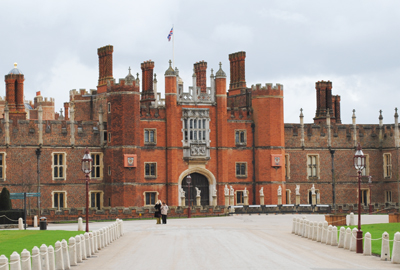
It’s fitting given the important role Hampton Court Palace played in the creation of the King James Bible that we include it in this series. But Hampton Court Palace is also notable for some other events during King James I’s reign. First, however, we turn to the Hampton Court Conference…

It was in 1604 that King James I meet at Hampton Court with representatives of the Church of England, including one party led by Archbishop John Whitgift (representing the church hierarchy) and another party led by John Rainolds (representing the Puritans), to discuss complaints made by the Puritans concerning a range of matters. While a new Bible wasn’t initially on the agenda, the three days of discussions did eventually lead to King James I commissioning the creation of a new Bible which eventually became known as the King James Version.

King James I was already familiar with Hampton Court Palace – it was in the palace that he had celebrated his first Christmas as king the previous year. Notably, it was during this Christmas and New Year period that Shakespeare’s acting company, the King’s Men, performed in the palace’s Great Hall for the king and his court.

At that stage, the palace hadn’t been dramatically updated since Tudor times – in fact, it wasn’t until after the accession of King William III and Queen Mary II following the “Glorious Revolution” in 1689 that the Tudor palace was given a major overhaul.

King James I continued to visit Hampton Court during the remainder of his reign and his visits, which were generally proceeded by a program of repairs, were noted for the lavish entertainment that took place when they occurred.

It was also at Hampton Court Palace that James’ wife, Queen Anne, died of dropsy in 1619. And where his son King Charles I, who had commissioned some improvements to the palace, was imprisoned for a period during the Civil War. But more of that another time…

WHERE: Hampton Court Palace, East Molesey, Surrey (nearest station is Hampton Court from Waterloo); WHEN: 10am to 6pm everyday (winter hours 10am to 4.30pm from 31st October to 26th March); COST: Adult £15.40, Concession £12.65, Child under 16 £7.70 (under fives free), family tickets, garden only tickets and online booking discounts available; WEBSITE:www.hrp.org.uk/HamptonCourtPalace/

Where’s London’s oldest…public park?

Dating from the early 1600s, London’s oldest public park is Finsbury Circus Gardens, located just to the north of London Wall and east of Moorgate.

The now heritage-listed gardens were open as a public park from 1606 (and was originally known as Moor Fields – the moors were drained and gravel walks laid out in 1527 but it wasn’t until 1606 that the area was laid out with elm trees and benches).

The park wasn’t enclosed until 1815-17 when City of London surveyor William Montague laid the area out according to the designs of prominent London architect George Dance the Younger.

The gardens were acquired by the City of London Corporation in 1900 and in 1909 were replanned. The oval-shaped park, the largest of the City’s gardens, is these days home to the City of London Bowling Club, the only bowling club in the City (founded in 1924; the bowling green dates from the following year and the current pavilion from 1968).

During World War II a barrage balloon was anchored here to deter low level air raids. Among it’s other claims to fame is the Tudor era bat (apparently a forerunner of the modern cricket bat) found on the site in the 1980s and skulls which have also been found dating from the Roman period.

The gardens are currently partly closed due to the Crossrail development.

PICTURE: Wikipedia

Lost London – The ‘Tyburn Tree’

For six centuries, the gallows at Tyburn, in the city’s west, was one of London’s sites of public execution. Today, little remains to remind visitors of the infamous past of the area, which lies close to Marble Arch, but for a plaque set in the middle of a road.

From 1196 to 1783, it’s suggested that thousands of people (some have estimated as many as 60,000) were hanged at various gallows erected at Tyburn, known by numerous names over the centuries including ‘The Elms’, the ‘The Deadly Never Green Tree’, and most infamously the ‘Tyburn Tree’.

Hangings were apparently initially carried out using the branches of a tree on the bank of the Tyburn River but the first gallows date from 1220. In Elizabeth times these were upgraded to a larger gallows known as the ‘Triple Tree’ which enabled many more people to be hanged simulteously – as many as 24 at once in 1649.

The gallows was removed in 1759 because it was blocking the road and a mobile gallows used until hangings were moved into Newgate Prison (see our earlier entry on Newgate).

Executions were a public spectacle and it’s estimated that at times the crowds at Tyburn swelled to more than 50,000 people, all eager to witness someone “dancing the Tyburn jig”.

Among those to be hanged at Tyburn were William Fitz Osbern (a champion of London’s poor who was hanged in 1196), Roger Mortimer, 1st Earl of March (hanged in 1330 after being accused of assuming royal power), Perkin Warbeck (pretender to the throne of King Henry VII who was hanged in 1499), and Elizabeth Barton, the ‘Holy Maid of Kent’ (hanged for treason after prophesying King Henry VIII would die within six months of marrying Anne Boleyn).

Others included key figures in the so-called Pilgrimage of Grace (an uprising in England’s north in 1536 which followed King Henry VIII’s break with Rome) and many other Catholics including Oliver Plunkett, the Archbishop of Armagh and Primate of all Ireland (1681).

In an unusual move, the body of already deceased Oliver Cromwell, along with that of John Bradshaw and Henry Ireton, was exumed from his grave and and hanged there to mark the first anniversary of the Restoration.

What is believed to have been the site of the Tyburn Tree is today marked by a plaque set in a traffic island at the corner of Edgware Road and Bayswater Road (nearest tube station is Marble Arch).

There is a Shrine of the Martyrs dedicated to the more than 105 Roman Catholics who were hung at Tyburn for their faith at the Tyburn Convent in Hyde Park Place (for visiting details, see www.tyburnconvent.org.uk).

Note: This article originally referred to the Shrine of the Martyrs commemorating more than 350 Catholic martyrs who died during the Reformation as all being executed at Tyburn but it is believed some 105 were – the greater figure refers to those martyred across England and Wales during the Reformation.

King James I’s London – 6. The Queen’s House, Greenwich

Long an admired landmark of Greenwich, the origins of the Queen’s House go back to the reign of King James I.

It was the Queen, Anne of Denmark, who commissioned the building of The Queen’s House in 1616 and gave it the name by which it is still known. Sadly, however, she died before it was completed.

King James I was said to have been a frequent visitor to the Tudor Palace of Greenwich (the building had earlier been known as the Palace of Placentia and was the birthplace of King Henry VIII in 1491).

King James  is traditionally said to have awarded the Manor of Greenwich to Queen Anne as an apology after he had publicly sworn at her when she had accidentally shot one of his favorite hunting dogs.

In 1616, Queen Anne decided to build a new property on the site as both a private retreat and a place where she could entertain and it was to the rising star Inigo Jones that she turned to for the design (in recognition of his growing status, he was appointed Surveyor of the King’s Works the following year).

The house was Jones’ most important job to date and the design he came up – based on a H with the two sides joined by a bridge over the Greenwich to Woolwich road – with is said to be the first Classical building in England.

Among the original features which survive to this day are the striking black and white geometrically patterned marble floor of the Great Hall (the room having been designed as a perfect cube), the painted ceiling of the Queen’s Presence Chamber and the iron balustrade the Tulip Stairs – said to be the first “geometric self-supporting spiral stair in Britain”.

Queen Anne became ill in 1618 and died the following year without seeing the end result of her commission. The work subsequently was shelved and only restarted (and completed in 1638) after King Charles I gave it to his wife, Queen Henrietta Maria.

She only had possession for a short time before Parliamentary forces seized it during the Civil War. After the Restoration, the Queen’s House was returned briefly to her by her son King Charles II (it was at this time that the original H-shape of the house was altered to a square) before part of it as later used as studio for painters and then as grace and favor apartments.

With the Old Royal Naval College now occupying the surrounding site, in 1805, King George III gave the property to the Royal Naval Asylum – a charity caring for the orphan children of seamen – and it later became part of the Royal Hospital School.

The National Maritime Museum took possession in 1934 and the building now houses the National Martime Museum’s collection of fine art. As an interesting aside, there have been several reported sightings of ghosts in the house, the latest as recently as 2002.

WHERE: The Queen’s House, National Maritime Museum, Greenwich (nearest DLR station is Cutty Sark); WHEN: 10am to 5pm daily (check website for closures); COST: Free; WEBSITE: www.nmm.ac.uk/places/queens-house

King James I’s London – 4. Charterhouse

The Charterhouse School was founded in 1611 – the seventh year of King James I’s reign – on the site of a former Carthusian monastery in Smithfield.

It owes its creation to Thomas Sutton (1532-1611) who bought the site – which then contained a Tudor mansion – from Thomas Howard, Earl of Suffolk, in 1611, the year of Sutton’s death.

A Yorkshireman, Sutton (who is buried in the chapel in Charterhouse) is said to have been the “wealthiest commoner in England” at the time, having made a fortune after discovering coal. He used his resources to endow a school and an almshouse on the site.

Among the school’s alumni were John Wesley, founder of the Methodist Church, and novelist William Makepeace Thackeray.

The school – which is this year celebrating its 400th anniversary – moved to Godalming in Surrey in 1872 and the site was subequently occupied by the Merchant Taylor’s School while the almhouse continued to operate on the western part of the land (it still does today under the name Sutton’s Hospital in Charterhouse).

The school later became the medical college of the nearby St Bartholomew’s Hospital and is now occupied by Barts and The London School of Medicine and Dentistry.

For more on the Charterhouse, see www.thecharterhouse.org (tours run on Wednesday afternoons at 2.15pm from April until August and cost £10 per person). For more on the Charterhouse School, see www.charterhouse.org.uk.

Treasures of London – ‘The Ambassadors’

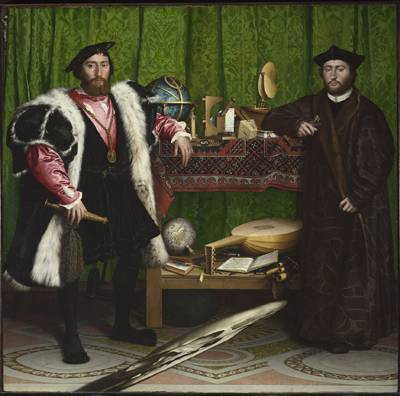
A stunning portrait on a grand scale, The Ambassadors depicts two influential figures from the 16th century – Jean de Dinteville, the then 29-year-old French ambassador to England and Georges de Selve, the then 25-year-old bishop of Lavaur and sometime French ambassador to the Emperor, the Venetian Republic and the Holy See.

The oil on oak work, which is housed in room four of the National Gallery and is also one of the images featured online as part of the Google Art Project, was painted by Hans Holbein the Younger in 1533 and is meant as a portrait to show the men’s power, learning and wealth – they are surrounded by objects which include celestial and terrestrial globes, a portable sundial, a lute (and its case), and books including one of hymns and another of arithmetic as well as richly decorated furnishings.

Yet there’s more to this painting than initially meets the eye – a closer look reveals a distorted skull in the foreground which, when viewed from the painting’s right-hand side comes into its proper perspective. A reflection on mortality perhaps?

And though no typically viewed as a religious work, there are also some striking religious overtones to this image including a broken string on the lyre – often seen as a Christian symbol of disharmony – and, partly hidden behind the curtain on the far left of the painting as you look at it, a crucifix hanging on the wall.

Holbein painted the work during his second stint in England while depicting life at the Tudor court. Among his most famous other images are one of King Henry VIII (held in the National Portrait Gallery) and another of Christina of Denmark (also in the National Gallery – painted to show Henry VIII the image of a potential future wife although the relationship never went any further than that).

PICTURE: Ng1314, Hans Holbein the Younger, Detail of Jean de Dinteville and George de Selve (‘The Ambassadors’), 1533 © The National Gallery, London.

WHERE: Room 4, National Gallery, Trafalgar Square (nearest tube stations Leicester Square and Charing Cross); WHEN: 10am to 6pm (Fridays 10am to 9pm); COST: Free; WEBSITE: www.nationalgallery.org.uk. The image is also available online as part of the Google Art Project here:www.googleartproject.com/museums/nationalgallery/the-ambassadors.

Treasures of London – The Cheapside Hoard

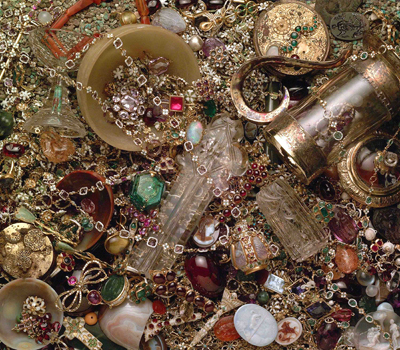
It’s been described as the greatest find of Jacobean and Elizabethan jewellery ever made – an extraordinary cache of some 500 gemstones, jewellery and other related items found buried under the floor during the demolition of a building at 30-32 Cheapside on 18th June, 1912.

Now known as the Cheapside Hoard, it dates from the 16th and 17th centuries and includes neck chains, pendants, hat ornaments, cameos and rings – among the items is a gold watch set into a hinged case made from a Columbian emerald, a tiny bejewelled gold scent bottle, and an onyx cameo of Queen Elizabeth I.

Other items include unfinished ornaments and unmounted gemstones which have origins spanning the world – from Asia and Middle East to South America. While these give support to the idea that the hoard is part of a goldsmith’s reserve stock, mystery still surrounds why it was buried in the building (although Cheapside was known for its goldsmiths during the era which the hoard dates from).

The majority of the hoard is held at the Museum of London where some of the items are on display. Other items are at the British Museum and one, an enamelled gold chain, is at the Victoria & Albert Museum. The Museum of London is planning major exhibition of the hoard starting in late 2013. Stay tuned for more information.

WHERE: Museum of London, 150 London Wall (nearest tube station is Barbican, St Paul’s or Moorgate); WHEN: 10am to 6pm, Monday to Sunday; COST: Free; WEBSITE: www.museumoflondon.org.uk

PICTURE: Museum of London

Lost London – Nonsuch Palace

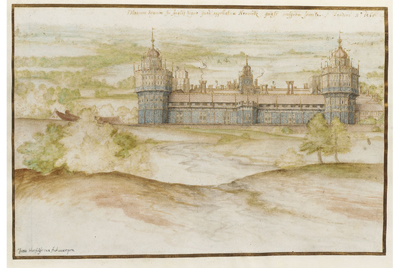
Built as a symbol of the triumphal reign of the Tudor dynasty (not to mention as a response to the French King Francis I’s palace Château de Chambord), Nonsuch Palace near Ewell in Surrey, now part of greater London, was the last palace constructed by King Henry VIII.

Construction on the palace started in 1538, the 30th year of Henry’s reign and only six months after the birth of Henry’s son and heir, later King Edward VI. The medieval village of Cuddington was demolished to make way for the new premises.

The multi-storied building was designed around an inner and an outer courtyard, each entered through a fortified gatehouse, with the royal apartments located in the latter. While plain on the outside, the inner courtyard interior was decorated with stucco reliefs depicting, among other things, Roman emperors, gods and goddesses and Henry VIII with his son Edward. To cap it off, there were two great octagonal towers built at either end.

While the bulk of of the work had been completed when Henry died in 1547, it is believed that the palace may still have been unfinished. In any case, it only remained a royal property for a short time before Queen Mary I sold it to Henry Fitzalan, the Earl of Arundel. It passed back into royal hands when the earl’s son-in-law, John Lumley, was forced to sell it back to Queen Elizabeth I to settle a debt. The queen was said to have stayed frequently at the palace.

King James I granted the palace to his wife, Queen Anne of Denmark, and it was also used by his son Henry, Prince of Wales. King Charles I also granted the palace to his wife, Queen Henrietta Maria, before it was sold off by Parliamentary commissioners after the Civil War. When King Charles II came to the throne, the palace was once again given to Henrietta Maria and then, when she died in 1669, to Barbara Villers, Countess of Castlemaine, a mistress of the king.

The building was demolished in 1682 with the materials and sale of the land used to pay off the countess’ gambling debts. While some parts of the building were carted off to be incorporated into others, no trace of the building remains above the ground but its former site, on the west side of what is now Nonsuch Park in Cheam, is marked by three granite bollards. A separate banqueting house and extensive gardens were also built near the site.

The building, which was only depicted a few works, can be confused with Nonsuch Mansion House, the oldest parts of which date from the 18th century, which still stands on the east side of the park and was probably built on the site of a former keeper’s lodge.

There are exhibitions on the palace in the Honeywood Museum (the heritage centre for the London Borough of Sutton) in Carshalton and in the Tudor house known as Whitehall in Cheam. The Epson and Ewell History Explorer website also have a trail you can follow which encompasses the former site of the palace.

PICTURE: Nonsuch Palace in an engraving by Joris Hoefnagel. Source: Wikipedia.