London Pub Signs – The Dickens Inn…

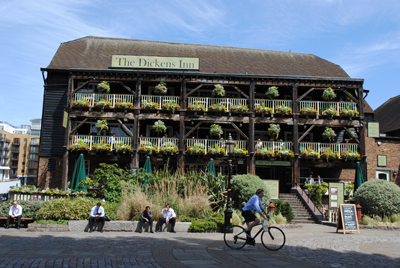
The-Dickens-InnOK, the first thing to note here is that despite the name of this pub, located in St Katharine Docks, it has nothing to do with the famous 19th century novelist Charles Dickens. Well, not directly, at least.

That said, it still has an interesting history – dating back to at least the turn of the 19th century (although there is the suggestion it may be older), it is thought to have formerly been used as a brewery building or a tea warehouse and stood on a site about 70 metres east of its current location.

A brick ‘skin’ was built over the top of the timber building in the 1820s to bring it up to modern standards. It survived the Blitz but was slated to be demolished in the 1970s when the site was to be redeveloped.

But help was at hand and in 1976 the building was saved when it was painstakingly moved to its current site. The building was reconstructed to resemble what the inn’s owners called a “three storey balconied inn of the 18th century” (although there is something doubt whether such buildings ever existed like this in the 18th century).

Ah, and to Dickens. While the writer himself is not known to have visited the building, he did know the area well and its likely he would have frequently passed by it during his lifetime (in fact, when his grandson, Cedric Charles Dickens, formally opened the inn in May, 1976, he is quoted on the inn’s website as saying that: “My Great Grandfather would have loved this inn”.)

Spread over three levels with balconies on the upper two, the inn originally featured a sawdust covered floor and candlelit dining on the balconies. Both practices have since come to an end but the building does offer some great views of the dock and nowadays contains several different facilities including a tavern, pizzeria and restaurant called The Grill. There’s also a suite of function rooms.

Among the famous the establishment claims as visitors in more recent times are the late Joan Rivers and singer Katie Melua.

For more information, see www.dickensinn.co.uk.
Treasures of London – The Isabella Plantation…

Isabella-Plantation2


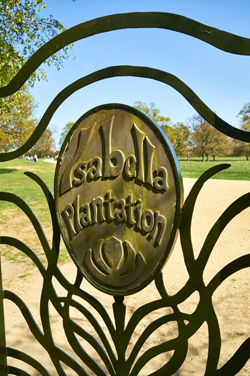
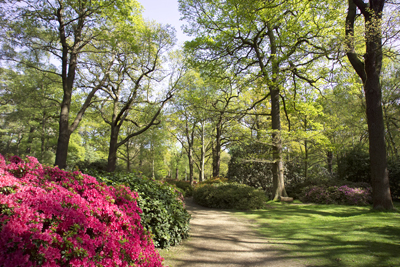
Isabella-PlantationAn area first fenced off within Richmond Park in the early 19th century, this ornamental garden remains an enchanting place to escape city life.

It was former Prime Minister Lord Sidmouth who established the plantation in the south-west corner of Richmond Park in 1831 when he was deputy ranger, enclosing the 42 acre site with fences to keep the deer out and planting oak, beech, and chestnut trees with a view to growing them for timber.

It was also he who, drawing on an older name for the area – Isabella Slade (Isabell is thought to have meant ‘dingy yellow’ in Old English and may refer to the colour of the topsoil in the plantation area while Slade meant a shallow valley) – gave it the name the Isabella Plantation.

The garden as we largely know it now was established on the site in the years immediately after World War II with clearings, ponds and waterways (these are today fed from Pen Ponds), thanks in large part to George Thomson, superintendent of the park from 1951-71, and his head gardener, Wally Miller.

Isabella Plantation was opened to the public in 1953 although improvements – including the Bog Garden which was reconstructed in 2000 – continue to be carried out.

Highlights among the flora include the National Collection of ‘Wilson 50’ Kurume azaleas (introduced by plant collector Ernest Wilson from Japan to the West in the 1920s) and large collections of rhododendrons and camellias. The garden also attracts a wide range of birds as well as other wildlife and offers the visitor something to see all year round.

There’s a number of trails you can download free-of-charge from the Royal Parks website which will help you to fully engage with the plantation.

WHERE: Isabella Plantation, Richmond Park (pedestrian access to the plantation from Peg’s Pond Gate, Broomfield Hill Gate, Bramble Gate, Deer Sanctuary Gate and High Wood Gate); WHEN: Daily (check Richmond Park opening times); COST: Free; WEBSITE: www.royalparks.org.uk/parks/richmond-park/richmond-park-attractions/isabella-plantation.

PICTURES: © Greywolf/The Royal Parks

10 small, ‘secret’ and historic gardens in central London…3. St Dunstan in the East Garden…

St-Dunstan1

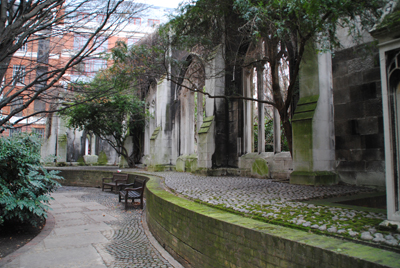
Located amid the remains of the medieval church of St Dunstan in the East, the garden was created in the late 1960s after the church was finally – and irrevocably, apparently – destroyed in the Blitz of World War II.

St-Dunstan2The church’s origins went back to around 1100 and it was subsequently extended with a new south aisle in the late 14th century and repaired in the early 17th century before being severely damaged in the Great Fire of 1666.

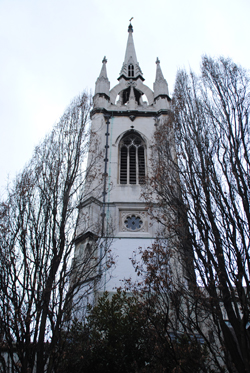
Patched up, with a new steeple and tower added to the building between 1695-1701 by Sir Christopher Wren, the building stood until the early 19th century when much of the church – with the exception of Wren’s additions – had to be rebuilt (for more on the history of the church, see our earlier Lost London post here).

The ‘new’ building was, however, badly damaged during bombing in 1941 and it was decided not to rebuild the church in the aftermath of the war.

The City of London opened a garden, sympathetic with the remains of the Grade I-listed building, on the site in 1971 (although Wren’s tower remains). They won a landscape award only a few years later.

Features in these atmospheric gardens – which seem to capture the essence of the Romantic idea of what ruins should look like – include a fountain which sits in the middle of the nave. In 2010 it was one of five public gardens in the City where award-winning  ‘insect hotels’ were installed.

Maintenance works were carried out in 2015 and new plantings put in (the picture, above, was taken before this).

WHERE: St Dunstan in the East, between Idol Lane and St Dunstan’s Hill, City of London (nearest Tube stations are Monument and Tower Hill); WHEN: 8am to 7pm or dusk (whichever is earlier); COST: Free; WEBSITE: www.cityoflondon.gov.uk/things-to-do/green-spaces/city-gardens/visitor-information/Pages/St-Dunstan-in-the-East.aspx

LondonLife – London’s celebration of sculpture…

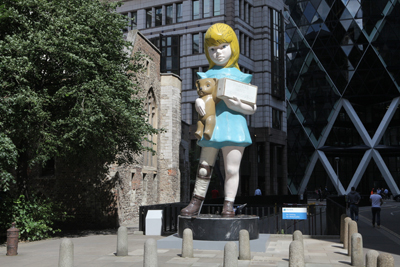
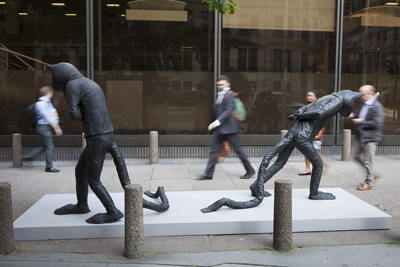
(i)-Damien-Hirst,-Charity.-Sculpture-in-the-City-2015Damien Hirst’s seven foot tall statue Charity (2002-2003) stands in the shadow of the Gherkin as a highlight of this year’s Sculpture in the City event. Kicking off last month, the exhibition – the fifth of its kind – features 14 works by a series of internationally renowned artists. Other sculptures (pictured below) include Adam Chodzko’s 2010 work Ghost (on show at Leadenhall Market), Laura Ford’s 2012 work Day of Judgement – Cats 1 & 2 (150 Leadenhall Street), Sigalit Laudau’s 2011 work ‘O my friends, there are no friends’ (St Helen’s Square), and Kris Martin’s 2012 work Bells II (on the corner of Bishopsgate and Wormwood Street). The works can be seen until May next year. For more (including a map of locations), see www.cityoflondon.gov.uk/sculptureinthecity. PICTURES: Nick Turpin.

Adam-Chodzko's-'Ghost',-Leadenhall-Market.-Sculpture-in-the-City-2015,-Photograph-by-Nick-Turpin

(i)-Laura-Ford's-'Days-of-Judgement---Cats-1-&-2'.-Sculpture-in-the-City-2015,-Photograph-by-Nick-Turpin

(iii)-Sigalit-Landau.-O-my-friends,-there-are-no-friends.-Sculpture-in-the-City-2015.

Kris-Martin--Bells-II_landscape

This Week in London – Buckingham Palace offers a “Royal Welcome”; exploring London’s outdoor spaces; and contemporary portraiture at the V&A…

Buckingham-PalaceBuckingham Palace opened its 19 State Rooms to the public last weekend under the theme of ‘A Royal Welcome’. As well as the chance to see the State Rooms themselves, a series of displays and films are located throughout the palace which show how Royal Household staff are involved in welcoming the tens of thousands of guests who come to the palace each year for receptions, State Banquets, garden parties and investitures. And, for the first time, the public can enter the palace through the Grand Entrance where the Australian State Coach will be displayed. Other highlights include the Palace Ballroom – set up for a State Banquet with silver gilt candelabra and centrepieces from King George IV’s grand service, displays recreating part of the dresser’s workroom and the palace kitchens, pantries and wine cellars in the throes of preparing for a State Banquet, and some of the gifts received during State Visits to the palace. Items of Queen Elizabeth II’s personal jewellery are also on display including the Kokoshnik Tiara, worn at a State Banquet in honour of the President of Mexico this year, Queen Mary’s Dorset bow brooch and the diamond Coronation necklace and earrings. The palace is open until 27th September. Admission charge applies. For more, see www.royalcollection.org.uk.

A new interactive map of public outdoor areas in London has been created to help encourage the city’s residents and tourists to make the most of the great outdoors this summer. The map details more than 200 public spaces including squares, green spaces and public street amenities, many of which have been improved as part of the Mayor of London, Boris Johnson’s Great Outdoors initiative which has seen more than £400 million invested in 242 projects since 2009. To check out the map, follow this link.

A new exhibition examining contemporary portraiture – and its inspiration from traditional modes of portraiture such as miniatures, medals and death masks – opened at the V&A in South Kensington this week. Facing History: Contemporary Portraiture features more than 80 prints and photographs drawn from the V&A’s collection and created by artists including Julian Opie, Grayson Perry, Thomas Ruff, Maud Sulter and Gavin Turk. Works featured include self-referential pieces like Grayson Perry’s pair of prints, Mr and Mrs Perry and Gavin Turk’s Portrait of Something that I’ll Never Really See, portraits of real and fictional characters like Brian D Cohen’s Man with Eyes Closed (Walter White) whose subject is both a character from US TV series Breaking Bad and Bryan Cranston, the actor who played him, Cecilia Mandrile’s identity-card inspired ID-Intensively Displaced series, and 11 pieces from Ellen Heck’s Forty Fridas. Exhibition runs until 24th April. Admission is free. For more, see www.vam.ac.uk.

Send all items for inclusion to exploringlondon@gmail.com

10 small, ‘secret’ and historic gardens in central London…2. Whittington Garden…

Whittington-Garden

The history of this City of London garden can be immediately spotted in the garden’s name.

It’s named for Richard (Dick) Whittington, a four time medieval mayor of London whose name (and cat) has been immortalised in stories and rhymes which continue to be retold in Christmas pantomimes every year (you can read more about the real Dick Whittington in our earlier post here).

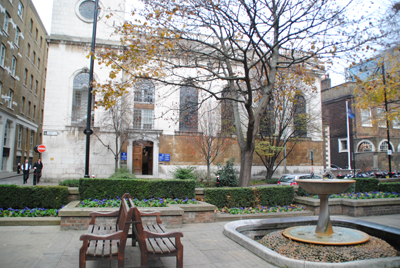
Whittington-Garden2The reason for the garden’s name is in its proximity to the church of St Michael Paternoster Royal – it stands on the other side of College Street – which he poured money into rebuilding during his lifetime and where he was buried (you can read more about the building here). You can also see a Blue Plaque on the former site of Whittington’s house further up College Hill.

The garden (pictured above looking across to the church) stands on what was the river bank during the Roman era at the bottom of College Hill. It was previously the site of buildings connected with the fur trade but these suffered bomb damage during World War II and were subsequently demolished.

The City of London Corporation acquired the site in 1955 and laid out the gardens in 1960 and the small fountain now found there dates from later that decade.

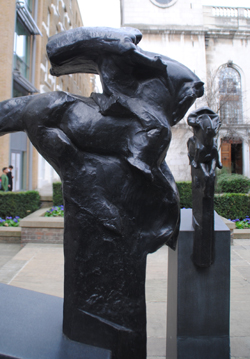
The gardens, which contain some substantial trees and lawn areas as well as hedges and flower beds, were refurbished in 2005. Features include two granite plinths upon which sit two horsemen (pictured). Sculpted by Italian sculptor Duilio Cambellotti, they were presented to the City of London by the Italian President during a state visit in 2005.

WHERE: Whittington Garden, between College Street and Upper Thames Street, City of London (nearest Tube station is Cannon Street); WHEN: Anytime; COST: Free; WEBSITE: www.cityoflondon.gov.uk/things-to-do/green-spaces/city-gardens/visitor-information/Pages/Whittington-Garden.aspx.

This Week in London – Celebrate summer at the Tate; Titian revealed at Apsley House; and, exploring the unconscious at The Freud Museum…

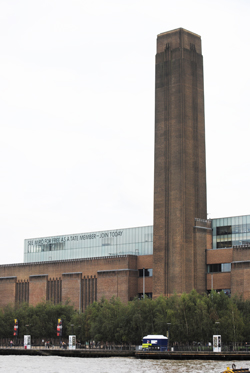
Turbine-HallOn Saturday, the Tate Modern’s Turbine Hall on South Bank will host an “audio-visual feast” of music, performances, art installations and activities. The free Turbine Festival will feature everything from an alternative hair salon and a London bus built on the day by artist John Costi to a pop-up juice bar where you can make your own drinks and a record shop where you can design your own vinyl record sleeve. The day will also feature performances by Grime/HipHop/AfroPop artist Afrikan Boy, Felix’s Machines – who will transform live music and sound into a 3D visual show, and poet Jacob Sam-La Rose, as well as a programme of “bite-sized” films running in collaboration with the London Short Film Festival, and a series of interactive workshops covering everything from beatboxing to crafting. Visitors to the festival, sponsored by Hyundai, are also encouraged to contribute to a special project by My Culture Museum by submitting photographs or bringing objects to be archived and curated. Runs from 12.30pm to 9.30pm. For more, see www.tate.org.uk.

•  Three paintings previously attributed to later followers of 16th century Venetian artist Titian but subsequently found to be by the artist himself and his studio have gone on display together for the first time at Apsley House. The three paintings – which include Titian’s Mistress (c1560), A Young Woman Holding Rose Garlands (c1550) and Danae (c1553) – were all in poor condition before conservation and cleaning by experts from English Heritage, the Museo del Prado in Madrid and the Hamilton Kerr Institute revealed their true quality (and Titian’s signature on two of the paintings). All three works were held in the Spanish Royal Collection and among 160 that Joseph Bonaparte, brother of Napoleon and King of Spain, tried to take out of the country following his defeat by the Duke of Wellington at the Battle of Vittoria in 1813. Wellington was subsequently given the paintings by a grateful King Ferdinand VII. The Titian at Apsley House exhibition, which opened earlier this month, runs at the Duke of Wellington’s home at Hyde Park Corner until 31st October. Admission charges apply. For more, see www.english-heritage.org.uk/visit/places/wellington-arch/.

On Now: Festival of the Unconscious. This festival at Sigmund Freud’s former London home and now home to The Freud Museum sees artists, designers, writers and performers taking another look at Freud’s seminar 1915 paper, The Unconscious. Features of the festival, which runs until 4th October, include specially commissioned films by animators from Kingston University running throughout the house, sound and video installations by London-based art project Disinformation in the dining room and an installation from stage designers at the Royal Central School of Speech and Drama in Freud’s study. There’s also a display by Julian Rothenstein, co-author of Psychobox, and a chance to recline and “free-associate” on a psycho-analytic couch in Freud’s bedroom. An extensive programme of events accompanies the displays. Admission charges apply. For more, see www.freud.org.uk.

Send all items for inclusion to exploringlondon@gmail.com.

10 small, ‘secret’ and historic gardens in central London…1. Goldsmiths’ Garden…

Goldsmiths1

Welcome to the first in our new Wednesday series, looking at some of central London’s small historic gardens which, while not secret in the strictest sense of the word, may tend to get overlooked. Each of the gardens we’re looking at is accessible to the public and has a link to the city’s history as well as providing a peaceful oasis out of the hustle and bustle…

First up, it’s the Goldsmiths’ Garden, located on the site of the former medieval church of St John Zachary at the corner of Gresham and Noble Streets in the City.

Goldsmiths2The church, which dates back to at least the late 12th century, was destroyed in the Great Fire of London in 1666 and not rebuilt (its parish was united with that of St Anne and St Agnes) although its ruins apparently remained until the 19th century. The church’s layout can be seen in the sunken area of the current garden.

The Worshipful Company of Goldsmiths had acquired land in the area in medieval times and built their first hall here in 1339 on the site of the current hall (which lies across the road from the garden and dates from the early 19th century).

The first garden was constructed on the site of the former church in 1941 by fire watchers after the area suffered in the Blitz and it apparently won a Gardener’s Company award for “Best Garden on a Blitzed Site” in 1950.

The garden has since been altered and refurbished several times since, including in around 1960 by landscape architect Sir Peter Shepheard and in the 1990s by landscape architect Anne Jennings.

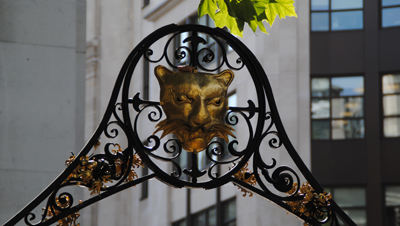
Goldsmiths3Features today include the iron entrance archway (top) which was commissioned by the Blacksmiths Company during the 1990s renovation. It features the leopard’s head hallmark of the Goldsmiths’ Company Assay Office, used to verify the purity of silver since the early 14th century.

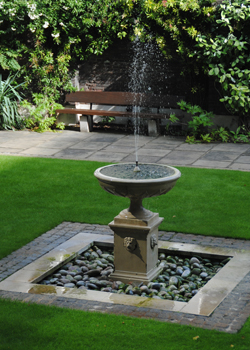
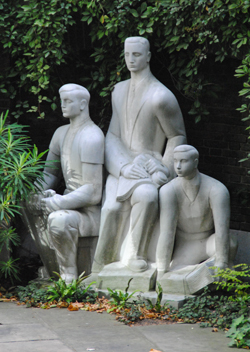
As well as the central fountain installed in the 1990s (and donated by the Constructors’ Company), the garden also features a two metre high, 2.5 tonne Portland stone monument called the Three Printers (pictured right).

The work of Wilfred Dudeney, it was commissioned by the Westminster Press Group in the late 1950s for their new headquarters in New Street Square, off Fleet Street, and depicts a newsboy, editor and printer. It was placed in a demolition yard in Watford when the group moved headquarters before taking its current position in 2009.

WHERE: Goldsmiths’ Garden, corner of Gresham and Noble Streets, City of London (nearest Tube stations are St Paul’s, Bank and Barbican); WHEN: Anytime; COST: Free; WEBSITE: www.thegoldsmiths.co.uk/goldsmiths’-hall/.

For more on London’s parks and gardens, check out Jill Billington’s London’s Parks and Gardens.

LondonLife – From Burning Man to the British Library…

Crossroads

Visual artist David Normal brings the British Library’s collections to life in an “epic suite of murals” called Crossroads of Curiosity. Unveiled at the library at a special event on the eve of the summer solstice (20th June), the art installation – which has its origins in a work first created for Nevada’s Burning Man Festival in 2014 – juxtaposes images from millions of digitised book illustrations the library released onto Flickr in 2013. The installation can be seen in the library’s piazza in King’s Cross until 8th November. Entry is free. For more, see www.crossroadsofcuriosity.com. PICTURES: Courtesy of the British Library.

Crossroads2

This Week in London – Exploring London’s archaeology; Alice in Bloomsbury; and, ‘Soundscapes’ at the National Gallery…

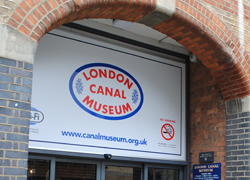
Canal-MuseumDescend into ice wells at the London Canal Museum; delve into the archaeological archives of the Egypt Exploration Society; discover the history of the Spitalfields Charnel House; and, tour the remains of London’s Roman military fort with experts from the Museum of London. The British Festival of Archaeology kicked off last weekend and there’s a plethora of events happening across London as part of the more than 1,000 taking place across the country. For a full programme of events – many of which are free – head to www.archaeologyfestival.org.uk. The festival runs until 26th July.

Follow Alice down the rabbit hole in a new exhibition which opened at the Cartoon Museum in Bloomsbury yesterday. Marking the 150th anniversary of the book’s publication, Alice in Cartoonland looks at how cartoonists, caricaturists, satirists, animators and graphic artists adapted and used author Lewis Carroll (aka Charles Lutwidge Dodson) and original illustrator John Tenniel’s work in social and political commentaries as well as just to have fun. The display features posters, cartoon strips, comic and graphic novels and artwork from TV and film versions of Alice with Low, Vicky, Shepard, Steadman and Gilroy among the artists represented. Runs until 1st November (with some events held in conjunction with it). Admission charge applies. For more, see www.cartoonmuseum.org.

Exploring the National Gallery’s art collection is usually done with the eyes but thanks to an innovative project which kicked off last week, it’s now also about listening. A series of contemporary sound artists and musicians including Nico Muhly, Gabriel Yared, Susan Philipsz, Jamie xx, Chris WatsonJanet Cardiff and George Bures Miller have created sounds and musical pieces in response to works they have chosen from the gallery’s collection. Selected works include the late 14th century The Wilton Diptych (Muhly), Hans Holbein’s 1533 painting The Ambassadors (Philipsz) and Paul Cézanne’s painting Bathers (Les Grandes Baigneuses) (Yared). Soundscapes runs until 6th September in the Sainsbury Wing. Admission charge applies. For more, see www.nationalgallery.org.uk.

Send all items for inclusion to exploringlondon@gmail.com.

Treasures of London – ‘Timepiece’, Thames embankment…

Sundial

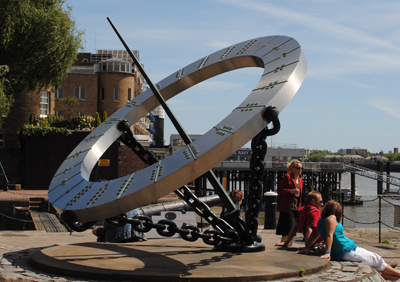
In honour of the sun and the heatwave it’s brought this summer, here’s the giant “equinoctial” sundial on the north bank of the Thames, just east of Tower Bridge. Known as Timepiece, it is the work of London-based sculptor Wendy Taylor and was installed here, beside the lock that leads into St Katharine Docks, in 1973. Measuring more than 3.5 metres across, the dial is made from stainless steel and is supported by three chunky chain link cables. According to the plaque, it was commissioned by Strand Hotels Ltd. It’s now a Grade II-listed structure.

This Week in London – Tudor jousting at Hampton Court; Black British voices heard to Guildhall Art Gallery; and, V&A extends McQueen…

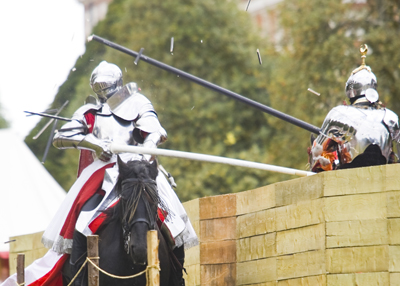
JoustEnjoy a weekend of jousting, music, dancing and Tudor cookery at Hampton Court Palace this weekend as part of the celebrations surrounding the iconic building’s 500th anniversary. England will take on Spain in the jousting while intrigue abounds at the court of Queen Mary I and King Philip II of Spain as actors perform scenes written by award-winning playwright Elizabeth Kuti. The pageant kicks off at 11am each day with the jousts commencing at noon and 3.30pm in the grounds. The event will be followed by a Baroque-themed celebration in August. Admission charges apply. For more, see www.hrp.org.uk/HamptonCourtPalace/. PICTURE: Courtesy Historic Royal Palaces.

Black British cultural identities and creative voices and the struggle they’ve had to have their voices heard are the subject of a new exhibition opening at the Guildhall Art Gallery in the City tomorrow. The exhibition, No Colour Bar: Black British Art in Action 1960-1990, focuses on the life works of Eric and Jessica Huntley and the publishing house, pioneering bookshop and cultural hub they founded in 1969 known as Bogle L’Ouverture Press. The bookshop will be physically recreated in the gallery as a “multi-sensory, interactive installation” sitting alongside works by notable artists of the period including Eddie Chambers, Denzil Forrester and Sokari Douglas-Camp. A programme of events has been created to run with the exhibition. Runs until 24th January. Admission is free. For more, follow this link.

The V&A has announced it will keep its exhibition Alexander McQueen: Savage Beauty open through the night for the final two weekends in the lead-up to its closure on 2nd August. Following the sell out of all existing pre-bookable tickets, the museum has said night tickets are now available for the weekends of 24th to 26th July and 31st July to 2nd August. The exhibition shop will feature special in-house promotions, there will be bar in the Dome with music until 10pm each night and refreshments will be available throughout the night. For more, see www.vam.ac.uk.

Send all items for inclusion to exploringlondon@gmail.com.

LondonLife – Remembering 7/7…

77

Remembering the 52 who were killed and the 784 injured in the bombing attacks in London on 7th July, 2005. Pictured is the Hyde Park memorial which bears testament to the names of those who died in its 52 pillars.

This Week in London – Audrey Hepburn, Barbara Hepworth and Joseph Cornell…

It’s all galleries this week- not a bad way to escape the heat!

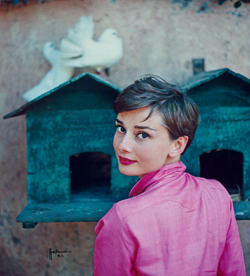
NPG_959_1400_AudreyHepburnbThirty-five photographs of late actor Audrey Hepburn from the personal collection of her sons form the centrepiece of a new exhibition at the National Portrait Gallery. Audrey Hepburn: Portraits of an Icon, which opens today and is the first UK exhibition to be organised with the Audrey Hepburn Estate, explores the life and career of the celebrated film star. Among the images lent by her sons Sean Hepburn Ferrer and Luca Dotti are a portrait of the actor performing a dance recital at the age of 13 in 1942, a photograph of her taken while filming The Nun’s Story in Africa in 1958, and a behind-the-scenes photograph of Hepburn during a costume fitting for the 1954 film Sabrina. Other images in the display include those taken during the shooting of numerous films ranging from 1955’s War and Peace to 1967’s Two for the Road as well as vintage magazine covers. Runs until 18th October. Admission charge applies. For more, see www.npg.org.uk/hepburn. PICTURE: Audrey Hepburn by Philippe Halsman for LIFE magazine, 1954. © Philipe Halsman/Magnum Photos.

The works of Barbara Hepworth, one of the UK’s greatest artists, are on show at the Tate Britain on Millbank. Barbara Hepworth: Sculpture for a Modern World features more than 100 works, from major carvings and bronzes to less familiar pieces. Juxtaposed with works of other great artists – including paintings, prints and drawings of her second husband Ben Nicholson, they include her earliest surviving carvings, her more purely abstract works of the late 1930s, wooden sculptures made while Hepworth lived in Cornwall in the mid-1940s and four large carvings made in the mid-1950s in African hardwood guarea which, reunited for this exhibition, arguably represent the highpoint of her carving career. There are also bronzes from her 1965 retrospective at the Kroller-Muller Museum. Runs until 25th October. Admission charge applies. For more, see www.tate.org.uk.

American artist Joseph Cornell’s art is the subject of an exhibition at the Royal Academy of Arts in Piccadilly which opens on Saturday. Joseph Cornell: Wanderlust, organised in conjunction with Kunsthistoriches Museum in Vienna, features about 80 of the artist’s box constructions, assemblages, collages and films including rarely seen masterpieces lent from public and private collections in the US, Europe and Japan. Arranged in four sections, the display features works from his major series including Museums, Aviaries, Soap Bubble Sets, Palaces, Medici Slot Machines, Hotels and Dovecotes. Runs until 27th September. Admission charge applies. For more, see www.royalacademy.org.uk.

• Send all items for inclusion to exploringlondon@gmail.com.

LondonLife – The Serpentine’s 2015 Pavilion…

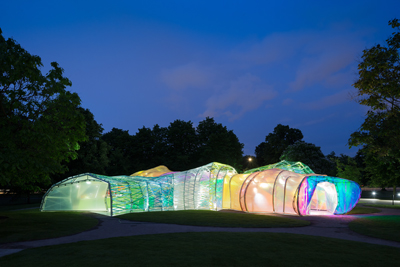
Serpentine-2015This year’s Serpentine Pavilion, marking the 15th anniversary of the annual summer commission by the Serpentine Galleries in Kensington Gardens, is a polygonal multi-coloured structure designed by Spanish architects selgascano. Made from a fluorine-based polymer, the pavilion has multiple entry and exit points and takes as its inspiration the site itself as well as the way in which people move through London, notably via the web-like network of the London Underground. Say selgascano: “We sought a way to allow the public to experience architecture through simple elements: structure, light, transparency, shadows, lightness, form, sensitivity, change, surprise, colour and materials. We have therefore designed a pavilion which incorporates all of these elements.” The architects say the pavilion was also designed as a tribute to the previous pavilion commissions, designed by the likes of Frank Gehry, Oscar Niemeyer and Zaha Hadid. For more, see www.serpentinegalleries.orgPICTURE: © Iwan Baan

This week in London – Napoleon’s draughtsman at Dulwich; the City of London Festival; and, the photography of Captain Linnaeus Tripe…

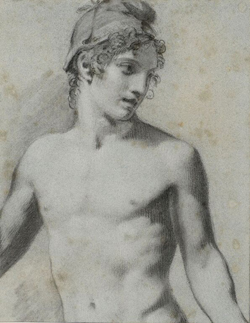
PrudhonThe drawings of “Napoleon’s draughtsman”, Pierre-Paul Prud’hon, have gone on display at the Dulwich Picture Gallery in an exhibition timed to coincide with the bicentenary of the Battle of Waterloo. The exhibition, Prud’hon: Napoleon’s Draughtsman, presents a selection of some of Prud’hon’s best works, including 12 works on paper from Gray’s Musée Baron Martin in eastern France as well as life studies such as Seated Male Nude and Standing Female Nude and a series of sketches from when Napoleon’s wife, Josephine, sat for Prud’hon 15 times in her home outside Paris. Runs until 15th November. Admission charge applies. A series of events is being run in conjunction with the exhibition. For more, see www.dulwichpicturegallery.org.uk.

The City of London Festival has kicked off this week with a three week programme including music, performance and visual art, films, tours, walks and talks. Events include the City Beerfest in Guildhall Yard, a tour of the art of the Mansion House, Bank of England open days and a walk celebrating the democratic institutions of the City marking the 800th anniversary of the Magna Carta. The festival, which includes both ticketed and free events, runs until 10th July. For more, including a full programme, see www.colf.org.

A new exhibition exploring the photographic works of Captain Linnaeus Tripe has opened at the V&A. Captain Linnaeus Tripe: Photographer of India and Burma, 1852-1860 includes more than 60 photographs of architectural sites and monuments, ancient and contemporary religious buildings, landscape vistas and geological formations. The Devon-born Tripe joined the East India Company army in 1839 and was stationed in India throughout the 1840s, learning the art of photography when back in England in the early 1850s. The photographs represent the output from two major expeditions with Tripe the first photographer to capture Burma’s remarkable architecture and landscapes and the first person to do so extensively in south India. The exhibition, part of the V&A India Festival which marks the 25th anniversary of the opening of the museum’s Nehru Gallery, is organised jointly by the National Gallery of Art, Washington, and the Metropolitan Museum of Art in New York in association with the V&A. Runs until 11th October.  Admission is free. For more, see www.vam.ac.uk/linnaeustripe.

Send all items for inclusion to exploringlondon@gmail.com.

This Week in London – The Waddesdon Bequest has a new home; history painted at the Tate; and, early release NYE tickets…

Holy-Thorn-ReliquaryThe Waddesdon Bequest, a collection of medieval and Renaissance treasures left to the British Museum by Baron Ferdinand de Rothschild in 1898, has a new home. Redisplayed in a new gallery which opened at the museum last week, the collection features the Christian relic known as Holy Thorn Reliquary (pictured) – a concocotion of gold, enamel and gems set around a thorn supposedly taken from Christ’s Crown of Thorns, the Lyte Jewel – a diamond-studded locket made in London in 1610-11 to hold a miniature of King James I and presented by the king to Thomas Lyte as thanks for a genealogy he created representing the king as a descendant of the Trojan Brutus, and the Cellini Bell – cast from silver in Nuremberg around 1600 and later displayed by Horace Walpole at his west London villa in Strawberry Hill. The bequest collection, which must always be displayed in a room of its own under its original terms, was first displayed at Baron Ferdinand’s country home of Waddesdon Manor in Buckinghamshire (now a National Trust property) and moved to the museum after his death. The redisplay reconnects the collection with its past at the manor and the history of the museum – the room where it is now displayed, Room 2a, was the museum’s original Reading Room and part of a neo-classical suite of rooms designed by Robert Smirke in 1820. It has been given the “most ambitious digital treatment” of any permanent gallery in the institution. Admission is free. For more, see www.britishmuseum.org.

The “enduring significance and emotional power” of British history painting is under examination in a new exhibition which opened at Tate Britain on Millbank last week. Fighting History features everything from the large scale works of 18th century painters John Singleton Copley and Benjamin West through to 20th century and contemporary works by Richard Hamilton and Jeremy Deller and looks at how they reacted, captured and interpreted key historical events. Works on show include Singleton Copley’s 1778 work The Collapse of the Earl of Chatham in the House of Lords, 7 July, William Frederick Yeames’ 1877 work Amy Robsart, John Minton’s 1952 work The Death of Nelson and Deller’s 2001 work The Battle of Orgreave, a re-enactment of 1984 protest in South Yorkshire. The exhibition also compares traditional and contemporary renderings of events from scripture, literature and the classical world and features a room dedicated to interpretations of the great Biblical flood of Noah. Runs until 13th September. Admission charges apply. For more, see www.tate.org.uk.

A limited number of early release tickets to London’s New Year’s Eve celebrations will go on sale from noon tomorrow (Friday, 19th June). The tickets, the bulk of which will be released in September, cost £10 a person with the proceeds being used to cover costs including printing and infrastructure. As was the case last year, people without tickets will not be able to access the event. To get hold of tickets, head to www.london.gov.uk/nye.

Send all items for inclusion to exploringlondon@gmail.com.

LondonLife – Exposing London’s criminal past…

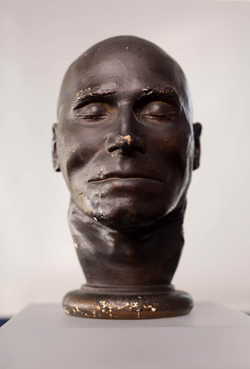
Daniel-GoodThe death mask of Daniel Good, executed outside Newgate prison on 23rd May, 1842, for the murder of his wife Jane Jones. It was thanks to delays in apprehending Good caused by communication problems that a dedicated detective was formed within the Metropolitan Police. Good’s death mask is just one of the many items from the Metropolitan Police’s Crime Museum which will be on display at the Museum of London’s forthcoming exhibition, The Crime Museum Uncovered. Opening in October, the display will feature never-before-seen objects from the police museum which are usually only accessible to police professionals and their invited guests. Along with the death mask, other objects to be seen in the display will include a memoir by Donald Swanson, senior investigating officer on the investigation into the Jack the Ripper killings in the late 1880s, a pin cushion embroidered with human hair by Annie Parker, who died in 1879 after having been arrested more than 400 times for alcohol-related offences, and ‘microdots’ containing secret messages along with a microdot reader founder in Mrs Helen Kroger’s handbag when she was arrested for involvement in the Portland Soviet Spy Ring in 1961. The exhibition will run from 9th October to 10th April, 2016. Admission charges apply. For more, see www.museumoflondon.org.uk.

This Week in London – London Festival of Architecture’s ‘Work in Progress’; objects and sestudes at the Foundling Museum; and, sculpting Sir Tim Berners-Lee…

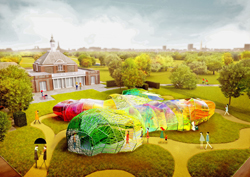
SerpentineThe month-long London Festival of Architecture is underway with this year’s theme ‘Work in Progress’. Highlights of this year’s programme – which includes 220 exhibitions, installations, talks and tours – include a discussion at this year’s Serpentine Gallery (pictured) by architects SelgasCano, access to development sites including Olympic Park, Goodman’s Fields, and Nine Elms, a London Transport Museum tour of London’s first skyscraper, an installation exploring the role of coffee shop as workspace by the Not to Scale Collective, and a Routemaster tour of the West End. For more, including a downloadable PDF of the programme, see www.londonfestivalofarchitecture.org.

A series of  26 ‘sestudes’ – texts exactly 62 words long – are being displayed along with the objects that inspired them in a new exhibition, 26 Pairs of Eyes, at The Foundling Museum in Bloomsbury. The sestudes have been written by the likes of former Poet Laureate Sir Andrew Motion in a bid cast new light on the objects, which are all from the museum’s collection and which range from a pencil which once belonged to Hospital Secretary John Brownlow to George Frideric Handel’s will. The display, which opens today, is on show until 6th September. Meanwhile the museum is also hosting another exhibition, Lines of Beauty, which explores the tradition of decorative plasterwork including the restored Rococo splendour of the hospital’s Court Room (donated by William Wilton in the 1740s and saved when the Foundling Hospital building was demolished in the 1920s). Admission charges apply. For more, see www.foundlingmuseum.org.uk.

A new portrait of the inventor of the World Wide Web, Sir Tim Berners-Lee, has been unveiled at the National Portrait Gallery. The work of Sean Henry, the painted bronze sculpture depicts a two-thirds life size Berners-Lee carrying the leather rucksack in which he keeps his laptop. It was commissioned to mark Sir Tim’s 60th birthday and is the gallery’s first commissioned portrait sculpture for seven years. On display in Room 40. Admission is free. For more, see www.npg.org.uk.

Send all items for inclusion to exploringlondon@gmail.com.

Famous Londoners – Larry the Chief Mouser…

It’s not often that we feature living people in ‘Famous Londoners’, but this prominent figure, albeit not a human, deserves special mention.

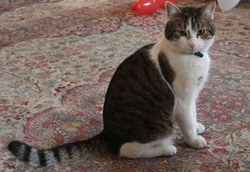
Larry_the_cat_No10A resident of Number 10 Downing Street in Whitehall, Larry the cat is officially Chief Mouser to the Cabinet Office – a position for which he has won accolades (and, at times, reproaches, for a seeming lack of action in the face of invasion – this includes, most recently the arrival of a heron at the residence, with Larry nowhere to be found).

Larry arrived at Downing Street (then home to Conservative PM David Cameron) in February, 2011, then a four-year-old tabby who came from the Battersea Dogs & Cats Home in south London and was apparently recruited to deal with a rodent problem after they were spotted in news broadcasts behind correspondents. It was June, some four months later, before he apparently made his first kill.

Larry has had an at times prickly relationship with the media – it started soon after his arrival at Downing Street when he scratched ITV reporter Lucy Manning who was trying to get him to pose for a news item (you can see it here).

He’s also apparently had some run-ins with visiting dignitaries – although US President Barack Obama apparently was able to stroke him without incident – and with Freya, Chancellor George Osborne’s cat (who has since been exiled to Kent).

Larry isn’t the first cat to live at Downing Street – his predecessors include Wilberforce who lived there for 18 years during the tenure of PMs including Edward Heath, Harold Wilson, Jim Callaghan, and Margaret Thatcher, and Humphrey, who served Ms Thatcher, John Major and, briefly Tony Blair, before he retired in 1997. But Larry is the first who has officially held the title of Chief Mouser to the Cabinet Office.

PICTURE: HM Government (via Wikipedia).