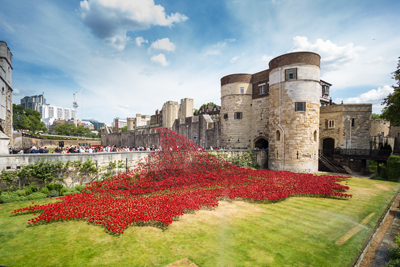
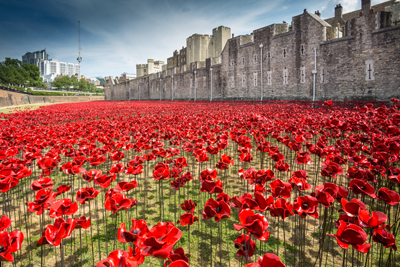
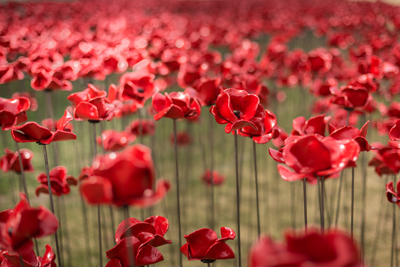
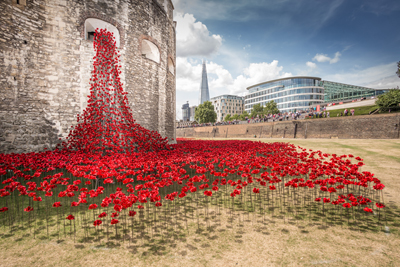
The Tower of London is bidding farewell to the sea of poppies that has filled its dry moat while two major features of the instalment – created to mark the centenary of World War I – prepare to head off on tour. Known as Weeping Window (shown above) and Wave (shown immediately below) – the two features of the Blood Swept Lands and Seas of Red installation will both tour various locations across the UK for the next few years before going on permanent display at the Imperial War Museum in London and Manchester. So, we thought we’d take a look back at what has proved to be one of the most popular and moving memorials to appear in the capital in recent years. Created by ceramic artist Paul Cummins (with setting by stage designer Tom Piper), the project saw as many as 888,246 ceramic poppies – representing all British and Colonial fatalities during the war – planted by volunteers in the moat. The last one was planted on Armistice Day – 11th November – last week before the process of removal began. PICTURES: ©Richard Lea-Hair and Historic Royal Palaces.
Twentieth century
A Moment in London’s History – Peace Day Parade, 1919…
With Remembrance Sunday having been observed earlier this month, we thought it was an appropriate time to take a quick look at the Peace Day Parade of 19th July, 1919, at which the Cenotaph – the National War Memorial – was first unveiled.
The parade, organised by a Peace Celebrations Committee appointed by the War Cabinet, was seen as the high point of a series of celebrations to mark the end of the war which had only officially ended on 28th June with the signing of the Treaty of Versailles.
Prime Minister David Lloyd George, on hearing French troops were to salute a ‘great catafalque’ (a raised structure upon which sits a coffin) built beside the Arc de Triomphe in honour of their war dead as part of their victory march, commissioned architect Edwin Lutyens to create a similar monument for the occasion.
Lutyens had apparently already started sketching, having been sounded out earlier about the possibility of such a structure, and eventually opted for a cenotaph, an empty tomb erected in honour of people buried elsewhere, in place of the catafalque.
The Cenotaph, one of a number of temporary structures built for the day, was unveiled in Whitehall early on the morning of Saturday, 19th July. Made of plaster and wood, it had been constructed in just two weeks (and, of course, it was replaced the following year with the stone Cenotaph which now stands there). Wreaths were soon piled high around its base.
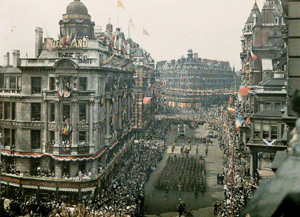
As many as five million people reportedly turned out for the parade along a seven mile route from Knightsbridge (depicted above) through to Westminster and onto Buckingham Palace on Saturday – many of them had arrived from other parts of the country the previous night – and, eager not to miss out, had secured their space by sleeping in parks or streets overnight.
Also known as the London Victory Parade, the procession included some 15,000 Allied forces representing 12 victorious nations including, of course, Britain as well as France, the US, various European and Asian nations and small contingents from Australia, New Zealand and South Africa.
Also marching were military commanders such as Field Marshall Sir Douglas Haig – the British Commander-in-Chief, French Marshal Ferdinand Foch – Supreme Allied Commander during the last year of the war, and General John J Pershing, head of the American Expeditionary Force.
Some veterans apparently refused to take part, seeing the parade as “militaristic celebrations”.
After splitting into two columns and filing past the Cenotaph – inscribed with the words ‘The Glorious Dead”, those in the parade then marched down the Mall, which was lined with stands set aside for widows and orphans before King George V took their salute standing beneath a golden cupola erected at the base of the Victoria Memorial outside Buckingham Palace.
This Week in London – Paddington comes to town; it’s Christmas decorations time; Guards Memorial upgraded; and Grayson Perry…
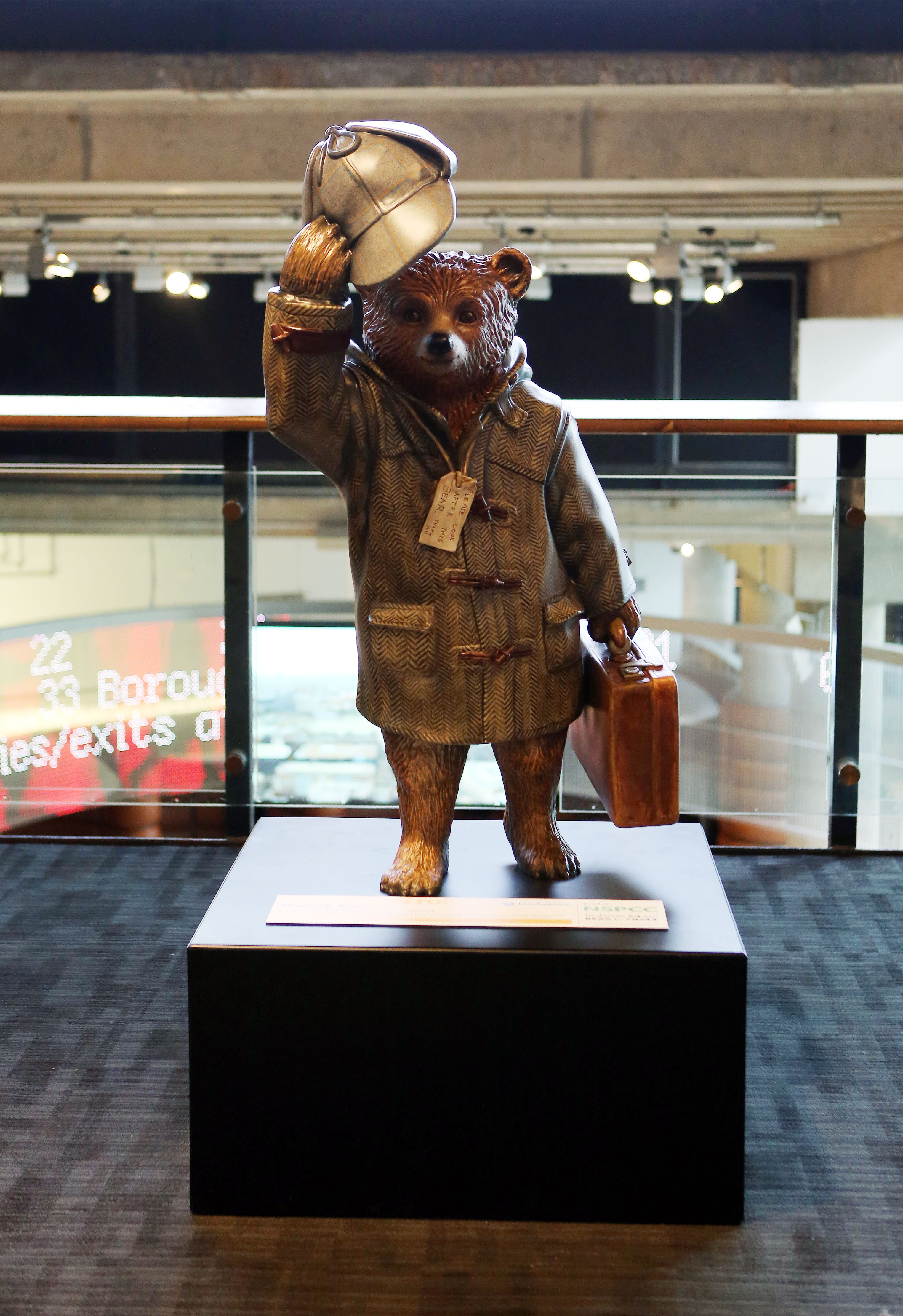
• Paddington comes to the Museum of London in a new exhibition opening tomorrow to coincide with the bear’s big-screen debut. A Bear called Paddington charts the story of the character from his genesis on Christmas Eve, 1956, when creator Michael Bond bought his wife a small toy bear and named him after the railway station near where they loved across the next almost 60 years to today. Objects on display include: a first edition A Bear Called Paddington – dating from 1958, it belonged to Bond’s daughter Karen Jankel; an original illustration of Paddington by Paddy Fortnum; the typewriter Bond used to write Paddington at Work and Paddington Goes To Town; the original Paddington puppet from the 1970s TV animations; and, props from the upcoming film Paddington (released on 28th November). The free exhibition runs until 4th January. See www.museumoflondon.org.uk for more. The museum, meanwhile, is also playing host to a new life-sized statue of the famous bear designed by Benedict Cumberbatch (and known as Sherlock Bear for obvious reasons given Cumberbatch’s penchant for playing a certain detective – pictured). It forms just one stop on the Paddington Trail which, as the work of VisitLondon.com, NSPCC and film-makers StudioCanal, links 50 sites – each with their own statue of the bear – across the capital. Designed by everyone from Mayor Boris Johnson to football star David Beckham and actors Sandra Bullock and Hugh Bonneville, the bears can be found around town until 30th December. For more on the trail, including a map of locations, check out www.visitlondon.com/paddington/.
• While the Oxford Street lights are already switched on (as are those in Covent Garden), Carnaby Street’s Christmas decorations are to be officially launched at 6.30pm tonight. The launch coincides with a shopping party (including 20 per cent discount), live music, free drinks, good bags and “trend masterclasses” with Grazia Magazine’s editor-at-large Angela Buttolph. Oh, and the decorations consist of eight red and white oversized sets of headphones and sunglasses. Meanwhile the Regent Street lights get turned on this Sunday with an event featuring a star-studded cast including Take That’s Mark Owen, Gary Barlow and Howard Donald (who are switching on the lights but not playing). While there’s entertainment along the street from noon, the music kicks off at 4pm and the lights, designed around the theme of the film Night at the Museum: Secret of the Tomb, get switched-on at 5pm and will be followed by a fireworks display. For more, see www.regentstreetonline.com.
• The Guards Memorial in Horseguards Parade, Westminister, has been upgrade to a Grade 1-listed structure on the advice of English Heritage. Unveiled in 1926 by the Duke of Connaught, Senior Colonel of the Guards, and General George Higginson, a Crimean veteran, the memorial commemorates the 14,000 Guardsmen who died in the First World War. Designed by architect Harold Chalton Bradshaw and sculpted by Gilbert Ledward, it features five bronze soldiers, each representing a typical soldier from each of the divisions – Grenadiers, Coldstreams, Scots, Welsh and Irish Guards.
• On Now: Grayson Perry: Who Are You? This exhibition at the National Portrait Gallery near Trafalgar Square features a series of new works created by Perry during the making of his Channel 4 TV series of the same name. Interspersed with 19th and 20th century collections of the gallery, the portraits – which include a tapestry, sculptures and pots – are of families, groups and individuals and include everyone from a young Muslim convert and Celebrity Big Brother contestant Rylan Clark. Runs until 15th March. Entry is free. For more, see www.npg.org.uk.
Send all items for inclusion to exploringlondon@gmail.com.
Famous Londoners – The Pageantmaster…
Last Saturday saw the running of the Lord Mayor’s Show in London – the 799th year the event has been held. So we thought it was a good time to take a look at the office perhaps most famously associated with the annual running of the show (with the exception of the new Lord Mayor, of course) – the Pageantmaster.
The office dates back to at least the mid 16th century – some sources record Richard Baker of the Painter-Stainers Company as being the first to be given the role in 1566. It involves organising the annual grand three-and-a-half mile long procession of the new Lord Mayor (in this case Alan Yarrow) from Mansion House via St Paul’s Cathedral to the Royal Courts of Justice at Temple Bar (and then back again along Victoria Embankment).
The current Pageantmaster, Dominic Reid, took on the role in 1992 following the death of his father John who had carried out the role for the 20 years previously. Pageantmaster Court in the city was named for the role in the early 1990s (it had formerly been known as Ludgate Court). Mr Reid, an architect and soldier, is now the longest serving Pageantmaster in history – his father had held that title before him and before that the record had apparently been held by one Thomas Jourdan who managed 14 shows between 1671-85.
Mr Reid, who like his father before him has been awarded an OBE for his work on the Show, said at a Gresham College lecture in 2011 that as Pageantmaster, he is “responsible for all aspects of the design, organisation and production of the Lord Mayor’s Show. In this role I am the agent of the Senior Alderman below the Chair, and I am employed as a consultant to Lord Mayor’s Show Ltd the not for profit company limited by guarantee that puts on the show.”
The role is now so big – involving more than 7,000 participants, 20 bands, 150 horses and hundreds of vehicles – that it now reportedly takes the Pageantmaster a good nine months to organise all the details.
The Pageantmaster himself takes part each year in the procession and while he has apparently previously ridden a horse, he can now be seen standing on the back of a ceremonial City of London vehicle.
For more of the history of the Lord Mayor’s Show, see our previous entries on Gog and Magog and the State Coach or the official website www.lordmayorsshow.london.
Treasures of London – A fragment of the Berlin Wall…
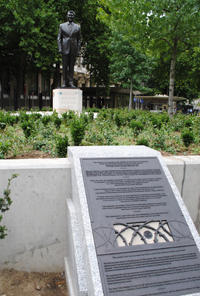
This Sunday marks 25 years since the fall of the Berlin Wall so we decided it was a fitting time to mention the fragment of the wall which accompanies the bronze statue of former US President Ronald Reagan in Grosvenor Square, Mayfair.
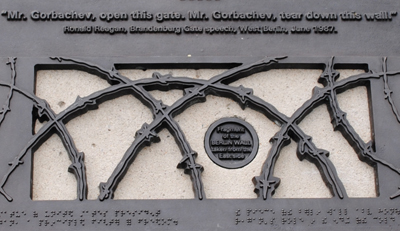
The remnant of the wall, recorded as taken from the “east side”, can be seen through a window in a bronze plaque which commemorates the role President Reagan played in the coming down of the wall.
The plaque also features quotes from President Reagan – including the famous line from his 1987 Brandenburg Gate speech, “Mr Gorbachev, open this gate. Mr Gorbachev, tear down this wall” – and other figures including former UK PM Margaret Thatcher and Mikhail Gorbachev as well as information about the wall itself.
In a dedication to the president, it further reads: “Ronald Reagan, the 40th President of the United States of America, was a principled fighter for freedom. With a clear vision and will, he gave hope to the oppressed and shamed the oppressors. His contribution to world history in the 20th century, culminated in his determined intervention to end the Cold War. President Reagan has left a lasting legacy as a campaigner for global peace.”
The memorial was unveiled on 4th July, 2011, outside the US Embassy by the Ronald Reagan Presidential Foundation, to mark the 100th birthday of the former president. Among those present at the unveiling of the statue were then Foreign Minister William Hague and former US Secretary of State Condoleezza Rice.
There are also larger sections of the wall outside the Imperial War Museum in Lambeth and in the National Army Museum in Chelsea (closed for redevelopment until 2016).
For more on London’s monuments, check out Andrew Kershman’s aptly named London’s Monuments.
This Week in London – Hogarth cartoons; Daniel O’Connell blue plaque; and, Peder Balke paintings on show…
• The works of famed 18th century chronicler of London, William Hogarth, are on show at the Cartoon Museum in Bloomsbury. Marking the 25oth anniversary of his death on the night of 25th/26th October, 1764, the display Hogarth’s London features more than 50 of the artist’s best known satirical prints including A Harlot’s Progress, A Rake’s Progress, The Four Times of Day, Industry and Idleness and Gin Lane and Beer Street. A series of events – including an evening of Baroque dance & music, gin, beer and cartooning on 28th November – accompanies this exhibition which runs until 18th January and is supported by The William Hogarth Trust. Admission charge applies. For more, see www.cartoonmuseum.org/exhibitions/current-exhibitions/hogarth-s-london.
• Nineteenth century Irish political leader Daniel O’Connell has been honoured with an English Heritage blue plaque as his former London home. Known as ‘The Liberator’, O’Connell was an abolitionist who successfully campaigned for civil and Catholic rights – including the right for Catholics to sit in the British Parliament. The first popularly elected MP since the Reformation, he lived in the property at 14 Albermarle Street in Mayfair with his family for several months in 1833 – a year in which a number of his supporters were elected to the House of Commons and in which the act to abolish slavery was given royal assent. For more, see www.english-heritage.org.uk/discover/blue-plaques/.
• On Now: Peder Balke. The first ever UK exhibition focused on the paintings of this 19th century Norwegian artist is underway at the National Gallery on Trafalgar Square. Held in conjunction with the Northern Norway Art Museum, the exhibition features more than 50 paintings, the majority of which have never been seen in the UK before. The display includes works from across Balke’s career, including The Tempest (c 1862), the only painting by a Norwegian artist in the gallery’s collection. This free exhibition runs in the Sunley Room until April. For more, see www.nationalgallery.org.uk.
Send all items for inclusion to exploringlondon@gmail.com.
What’s in a name?…Fulham…
This Thameside area in London’s west has a long and storied history and its name is a reflection of it.
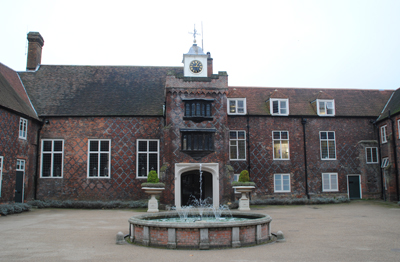
Long home to the ‘country’ manor of the bishops of London (Fulham Palace, pictured above), the name Fulanham is recorded as early as the late 7th century.
While there’s been speculation in the past that the name Fulham (also recorded among other variations as Fullam) was a corruption of ‘fowl-ham’ – relating to the wild fowl that were to be found here – or of ‘foul-ham’, relating to the muddied waters, that’s now apparently generally deemed not to be the case.
Instead, its name most likely owes its origins to an Anglo-Saxon named Fulla and the Old English word ‘hamm’ – a term for a water meadow or piece of land enclosed in a bend in a river (in contrast to the more common ‘ham’ which refers to an estate or homestead) – and referred to the manor he owned here, its boundaries set by a bend in the Thames. (It should be noted there is evidence of earlier occupation of the site by the Romans and as far back as the Neolithic era).
In about 700, the manor of Fulham – which includes the area we now think of as Fulham as well as land stretching as far afield as Acton, Ealing and Finchley – was acquired by Bishop Waldhere of London from Bishop Tyrhtilus of Hereford. Since Tudor times, Fulham Palace was used as the country home of the bishops of London and in the 20th century became their principal residence. It was used as such until 1975 and now houses a museum and reception rooms.
As well as now being used for the area which once contained what became the village of Fulham itself, since 1979 the name has also been used in that of the Borough of Hammersmith and Fulham. Interestingly, Fulham Broadway tube station was known as Walham Green when it first opened in 1880 and was only given its current name in 1952.
The bishop’s palace (and the nearby riverside Bishop’s Park) aside, other landmarks in the area include the Grade I-listed All Saints Church, which is largely late Victorian and which hosts the grave of abolitionist Granville Sharp, and the nearby Powell Almhouses which date from 1869.
It’s also linked by Putney Bridge with Putney on the other side of the Thames; the current bridge is the work of Sir Joseph Bazalgette and was built in 1882 – it replaced an earlier wooden bridge built in 1729 and overlooks where the annual Oxford-Cambridge Boat Race begins (other bridges spanning the river from Fulham include the rather ugly Wandsworth Bridge).
Known during the 18th century as something of a mecca for gambling, prostitution and other debauched leisure activities, these days Fulham is known for its football club, Fulham FC headquartered at Craven Cottage stadium (named for a cottage owned by Baron Craven which once stood here), shopping and is a sought-after residential location.
This Week in London – Science Museum’s new IT gallery; Hornchurch skatepark protected; NHM’s ice rink opens; and Emily Carr at Dulwich…
• Queen Elizabeth II opened the new Information Age gallery at the Science Museum this week by sending her first tweet. Following a tour of the new gallery exploring the way technologies – including everything from the telegraph through to the world wide web – have transformed the way we communicate, the Queen tweeted: “It is a pleasure to open the Information Age exhibition today at the @ScienceMuseum and I hope people will enjoy visiting. Elizabeth R.” The gallery in the South Kensington museum explores the growth of communications technologies through important events such as the sinking of the Titanic in the Atlantic in 1912, the first BBC broadcast in 1922, the TV broadcast of the 1953 coronation of Queen Elizabeth II and the creation of the first international link on the ARPANET network – the forerunner of the internet – by University College London in 1973. Entry to the new gallery is free. For more, see www.sciencemuseum.org.uk.
• In a European first (and only the second time it’s occurred around the world), an East London skatepark has been given heritage protection. Known as ‘the Rom’, the Hornchurch structure was purpose-built in 1978 by leading skatepark designers Adrian Rolt and G-Force. It has been listed as Grade II and is only the second skatepark to in the world to win such protection with the first being the ‘Bro Bowl’ in Tampa, Florida, added to the US National Register of Historic Places in October last year. Heritage Minister Ed Vaizey said the listing is testament to the park’s design. The listing was carried out on the advice of English Heritage.
• The Natural History Museum’s ice rink opens today, the 10th year it’s been positioned outside the stunning South Kensington building. The 1,000 square metre rink has been decorated with 80,000 fairy lights and a 40 foot high Christmas tree, and this year has been joined by an interactive Lindt Christmas chalet where you’ll be able to sample complimentary truffles and join in activities. The rink is open to 4th January. For more, see www.nhmskating.com.
• The works of pioneering Canadian artist Emily Carr are the focus of a new exhibition opening at the Dulwich Picture Gallery in London’s south on Saturday. From the Forest to the Sea: Emily Carr in British Columbia is the first major solo exhibition in Europe dedicated to the modernist artist who lived between 1871 and 1945. It features more than 140 works and indigenous artefacts as well as a recently discovered illustrated journal, Sister and I in Alaska, in which Carr documented her pivotal trip up and down the north-west coast of Canada in 1907. Highlights include Totem and Forest, (Untitled) Seascape and View in Victoria Harbour, one of a number of momentary records left behind in her trunk after her death. Runs until 8th March. Admission charge applies. See www.dulwichpicturegallery.org.uk for more.
Send items for inclusion to exploringlondon@gmail.com.
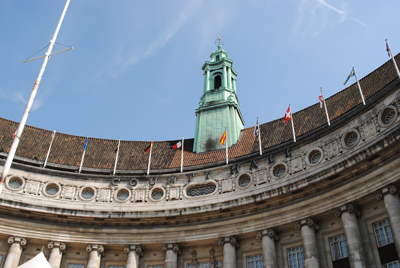
LondonLife – Flying the flags on the London County Hall…
Located on the South Bank of the Thames opposite Whitehall is the former vast headquarters of the London County Council and later, the Greater London Council. The Grade II* listed building, first opened in 1922, these days houses everything from the London Sea Life Aquarium, the London Dungeon and the visitor centre for the London Eye as well as hotels, restaurants and even flats.
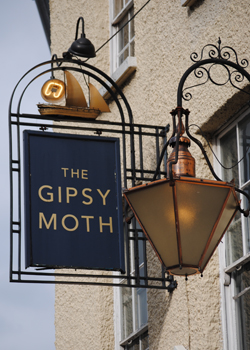
London Pub Signs – The Gipsy Moth…
The boat on this iconic Greenwich pub’s sign probably gives the game away here – the Gipsy Moth is named after a yacht of the same name.
The Gipsy Moth IV was sailed single-handedly around the globe by Sir Francis Chichester, then aged in his 60s, in 1966-67, who broke numerous records as he did so including the fastest voyage around the world by any small vessel, the longest non-stop passage by a small vessel and what was then the longest single-handed passage.
Following the death of Sir Francis on 26th August, 1972 (he had been knighted by Queen Elizabeth II on the steps of the Old Royal Naval College using the same sword that had knighted Sir Francis Drake in the presence of Queen Elizabeth I in 1581), the boat was put on display in a Greenwich dry dock next to the Cutty Sark. Initially open to the public, it was later closed due to deterioration.
Following a restoration in the early Noughties, in 2006 the Gipsy Moth IV was again sailed around the world (on a trip that wasn’t always smooth sailing) to mark the 40th anniversary of Sir Francis’ journey. It is now owned by a charitable trust based in Cowes on the Isle of Wight.
The renovated pub, located at 60 Greenwich Church Street next to the Cutty Sark, is situated in a building which dates from the late 18th century. It apparently changed its name from the Wheatsheaf in the mid-1970s apparently to mark the arrival of the Gipsy Moth IV.
The pub features a beer garden with views of the Cutty Sark. For more information, see www.thegipsymothgreenwich.co.uk.
This Week in London – Giovanni Batista Moroni at the RA; German history on show; and, Afghanistan at the IWM…
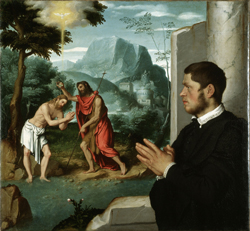
• The works of 16th century artist Giovanni Battista Moroni go on show at the Royal Academy of Arts this week. The exhibition will feature more than 40 works including portraiture as well as his lesser-known religious paintings. They include a number of altarpieces from the churches of Bergamo in northern Italy as well as portraits including Portrait of a Lady (c1556-60), A Knight with a Jousting Helmet (c1556), and The Tailor (1565-1570) – the first known portrait of a man depicted undertaking manual labour. The exhibition in The Sackler Wing, off Piccadilly, runs until 25th January. Admission charge applies. For more, see www.royalacademy.org.uk. PICTURED: A Gentleman in Adoration before the Baptism of Christ, (c.1555-60) (Gerolamo and Roberta Etro).
• This year marks 25 years since the fall of the Berlin Wall and the birth of modern Germany so it’s a fitting time for the British Museum in Bloomsbury to host an exhibition looking at Germany’s tumultuous history. Germany: memories of a nation features 200 objects reflecting themes ranging from ’empire and nation’ to ‘arts and achievement’ and ‘crisis and memory’ spanning a period from the 15th century to today. They include Tischbein’s iconic portrait Goethe in der Campagna, an early edition of Grimm’s fairy tales, a home-made banner from demonstrations in late 1989 and Ernst Barlach’s bronze figure Der Schwebende, designed as a World War I memorial for Gustrow Cathedral. The exhibition, sponsored by Betsy and Jack Ryan, runs until 25th January. Admission charge applies. For more, see www.britishmuseum.org.
• Britain’s 13 year involvement in Afghanistan is the subject of a new display at the Imperial War Museum London in Lambeth. Opening today, War Story: Afghanistan 2014 features new objects, photographs, film and video interviews and looks at the experiences of the Afghan national security forces and UK government and NGO workers as well as those of British troops. Objects, all collected between 2012 and this year, include a beadwork lamp made by Afghan prisoners in training workshops aimed at developing skills prior to their release and an Afghan dress and trousers. The display is part of the War Story project which started in 2009. Runs until 6th September next year. For more, see www.iwm.org.uk.
Send all items for inclusion to exploringlondon@gmail.com.
LondonLife – Long unseen ‘map room’ to be opened at Eltham Palace…
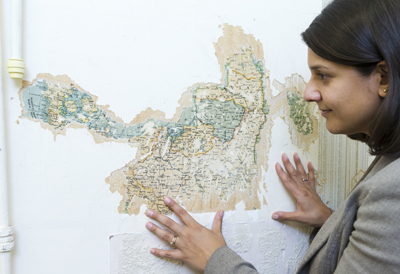
Annie Kemkaran-Smith, curator at Greenwich’s art deco masterpiece Eltham Palace, examines the 1930s ‘map room’, one of five new rooms to be opened at the palace this spring following a major renovation by English Heritage. Alongside the map room – to be opened for the first time in a decade following a renovation for which English Heritage has launched a £25,000 appeal – other rooms include the luxury wartime bunker, a basement billiards room, a walk-in wardrobe and two new bedrooms. The project, work on which started earlier this month, also includes restoration of the gardens, the creation of a new visitor centre, shop and cafe in former glasshouses. The former childhood home of King Henry VIII, Eltham Palace was transformed in the 1930s by art collectors and philanthropists Stephen and Virginia Courtauld and features an interior now boasting a mix of art deco, ocean-liner styles and Swedish design with then cutting-edge features such as under-floor heating, multi-room sound systems and a centralised vacuum system. The palace will remain open to the public on Sundays over winter with the new rooms to be opened in April. For more, see www.english-heritage.org.uk/daysout/properties/eltham-palace-and-gardens/.
This Week in London – Sherlock Holmes at the MoL; Rembrandt’s latter years; and, William Morris’ legacy..
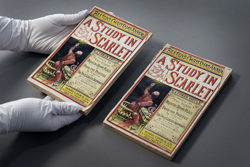
• Sherlock Holmes and his relationship to London, the city in which he lived, is the focus of a new exhibition which opens at the Museum of London from Friday. Sherlock Holmes: The Man Who Never Lived and Will Never Die, the first major temporary exhibition on Sir Arthur Conan Doyle’s famous character to be held in London in more than 60 years, will look at his literary origins and his relationship with late 19th century London, through to his portrayal in popular culture including through stage and screen performances starring everyone from Peter Cushing to Jeremy Brett and Robert Downey, Jr. Highlights of the exhibition include Conan Doyle’s notebook containing the first ever lines of a Sherlock Holmes story and notes in which he experimented with names for his to leading characters (later Holmes and Dr John Watson), a rare oil on canvas painting of Conan Doyle painted by Sidney Paget in 1897 which has never before been on public display in London, the original manuscript of 1903’s The Adventure of the Empty House, the Belstaff coat and the Derek Rose camel dressing gown worn by Benedict Cumberbatch from the BBC series and original pages from Edgar Allan Poe’s 1841 hand-written manuscript of The Murders in the Rue Morgue (Poe was an important influence on Conan Doyle’s writings). The exhibition will also include paintings, drawings, illustrations and photographs of Victorian London along with a vast collection of objects from the period. Runs until 27th April. Admission charge applies. For more, see www.museumoflondon.org.uk/sherlock. PICTURE: Two editions of A Study in Scarlet in which Conan Doyle introduced Holmes and Watson, Beeton’s Christmas Annual 1887.
• The first ever in-depth exploration of Rembrandt’s final years of painting opened at the National Gallery off Trafalgar Square yesterday. Rembrandt: The Late Works features about 40 paintings, 20 drawings and 30 prints with key works including moving The ‘Jewish Bride’ (from Rijksmuseum in Amsterdam), An Old Woman Reading (The Buccleuch Collection in Scotland), Bathsheba with King David’s Letter (Musee du Louvre in Paris) and Lucretia (National Gallery of Art in Washington, DC) as well as the last minute loan of The Conspiracy of the Batavians under Claudius Civilis (from the Royal Academy of Fine Arts in Sweden). The exhibition provides new insights into some of the artist’s most famous works including The Sampling Officials of the Amsterdam Drapers (aka The Syndics), and brings together a number of self-portraits usually seen in different galleries. The exhibition runs in the Sainsbury Wing until 18th January. Admission charge applies. For more, see www.nationalgallery.org.uk.
• The first exhibition devoted to Pre-Raphelite William Morris and his influence on 20th century life opens at the National Portrait Gallery off Trafalgar Square today. Anarchy & Beauty: William Morris and His Legacy, 1860-1960 explores the ‘art for the people’ movement which Morris and the artists of the Pre-Raphelite Brotherhood initiated, reveals the work of Arts and Crafts practitioners inspired by Morris, and shows how Morris’ “radical ideals” influenced the Garden City movement and post-war designers like Terence Conran. Highlights include Morris’ handwritten Socialist Diary, his gold-tooled hardbound copy of Karl Marx’s Le Capital and Burne-Jones’ handpainted Prioresses Tale wardrobe. Admission charge applies. The exhibition runs until 11th January. For more, see www.npg.org.uk.
Send all items to inclusion to exploringlondon@gmail.com.
10 of London’s World War I memorials – 10. Grave of the Unknown Warrior, Westminster Abbey…
In this, the final in our series looking at London’s World War I memorials, we’re taking a look at one of the city’s most visited monuments – the grave of the Unknown Warrior in Westminster Abbey.
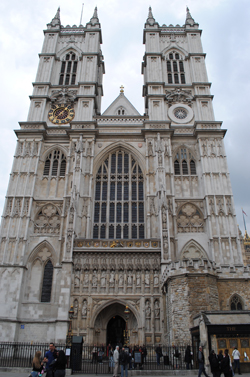
Located at the west end of the minster nave (pictured is the west front of the abbey inside of which lies the grave), the grave is that of a British soldier whose body was brought back from France and buried on the site on 11th November, 1920. The grave, which also contains soil brought from France, is covered by a slab of black marble from Belgium.
The slab bears an inscription written by Herbert Ryle, then dean of the abbey, which commemorates the “many multitudes” who died during World War I. “They buried him among the kings because he had done good toward God and toward his house”.
It is believed the idea for the memorial was that of a chaplain at the front during the war – Rev David Railton – who in 1916 saw a grave in northern France which featured a cross upon which was written, “An Unknown British Soldier”. He wrote to Ryle about what he’d seen and the idea for the new memorial slowly took shape – albeit with the initial misgivings of some including King George V.
Representing servicemen from the army, navy or air force from anywhere within Britain and its dominions who died in the war and have no other memorial or known grave, the unidentified body which lies in the grave is believed to have been selected at random from among a number bodies of soldiers who died early in the war – accounts suggest they numbered either four or six – and which were exhumed from battle areas at the Aisne, the Somme, Arras and Ypres.
Covered with Union flags, the bodies were taken to a chapel at St Pol on 7th November, 1920, and one selected by Brigadier General LJ Wyatt, commander of troops in France and Flanders.
The three remaining bodies were reburied while the selected remains were placed in two coffins, the outer one made of oak harvested from a tree which had grown at Hampton Court Palace. A 16th century crusader’s sword taken from the Tower of London’s collection was placed in the wrought iron bands of the coffin and it was then covered with a flag which Rev Railton had used as an altar cloth during the war (known as the Ypres or Padre’s Flag, it now hangs nearby in St George’s Chapel at the abbey).
The coffin was then transported on the destroyer HMS Verdun to Dover and then taken by train to Victoria Station before, on the morning of 11th November, it was placed on a gun carriage drawn by six black horses and transported through massive but silent crowds which lined the streets.
Pausing at the Cenotaph in Whitehall, King George V unveiled the monument which represent an empty tomb (see our earlier post here) and placed a wreath on the coffin and then, followed by the king, other royal family members and dignitaries, it was taken to the abbey minster and lowered into the grave at a special service attended by the king, Queen Alexandra, the queens of Spain and Norway, and Prime Minister David Lloyd George and former Prime Minister HH (later Lord) Asquith (a recording made of some of the service – apparently conducted simultaneously with one at the Arc de Triomphe in Paris – became the first ever electrical recording to be sold to the public).
Thousands of mourners paid their respects at the open grave before the grave was filled in and covered with temporary stone on 18th November. The marble stone which now stands there was unveiled at a special service on 11th November the following year. A framed US Congressional Medal of Honor, conferred by General John J Pershing on the unknown warrior on 17th October, 1921, hangs from a pillar nearby.
WHERE: Westminster Abbey, Westminster (nearest Tube station is Westminster or St James’s Park); WHEN: Generally open to tourists everyday except Sunday (times vary so check the website); COST: £18 an adult/£15 concessions/£8 schoolchildren (11-18 years), free for children aged under 11/£44 for a family (two adults, two children); WEBSITE: www.westminster-abbey.org.
This Week in London – Rare chance to see four Magna Cartas together; Covent Garden films; Raymond Chandler’s childhood home recalled; and Rembrandt at Kenwood…
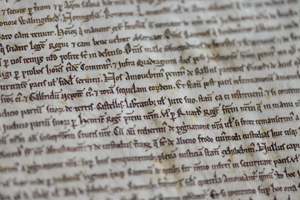
• The only four surviving copies of the original Magna Carta from 1215 will go on display together for the first time ever at the British Library in King’s Cross next February – and you have a chance to be among the 1,215 people to see them. In an event to mark the 800th year of the creation of the document, the library – which holds two copies of the document – along with Lincoln Cathedral and Salisbury Cathedral – each of which holds one copy – are holding a ballot with winners able to attend an event in which they’ll have the unique opportunity to see the documents side-by-side as well as be treated to a special introduction on its history and legacy by historian and TV presenter Dan Jones. The ballot to see the documents is open until 31st October with winners drawn at random. It’s free to enter – head to www.bl.uk/magna-carta to do so. The four documents will subsequently feature separately in displays at each of the three institutions. One not to miss! PICTURE: Salisbury Cathedral’s Magna Carta/Ash Mills.
• The Silent Swoon Free Film Festival kicks off in St Martin’s Courtyard, Covent Garden, next week. The courtyard will be transformed into an open air movie theatre showing a different movie each night – The Talented Mr Ripley on 14th October, Crazy, Stupid, Love on 15th October and Rebel without a Cause on 16th October. Most of the free tickets will be allocated through an online draw but a small number will be allocated each night on a first come, first serve basis. For those with tickets, a range of freebies will be available on the night (including popcorn!). For more information, head to www.stmartinscourtyard.co.uk/silent-swoon-cinema-festival.
• Crime writer and film noir pioneer Raymond Chandler has been remembered with the placement of an English Heritage blue plaque outside his childhood home in Upper Norwood, south east London. Chandler, who received global acclaim for his Philip Marlowe novels and his work on movies like The Blue Dahlia, lived at the home from 1901 after emigrating from the US with his mother, aunt and grandmother at the age of 12. He remained at the double-fronted red brick villa until 1908 – the same year he published his first poem, The Unknown Love. In his early Twenties, Chandler worked as a freelance reporter for London newspapers but, disillusioned with writing, returned to the US in 1912. He spent the next decade working for an oil company before the loss of his job in 1932 pushed him to restart writing. He first novel was published in 1939, and he went on to write further books and movie screenplays to ongoing renown. For more on the blue plaques scheme, see www.english-heritage.org.uk/discover/blue-plaques/.
• Two early works of Rembrandt have gone on display at Kenwood House this month. Anna and the Blind Tobit and Jeremiah Lamenting the Destruction of Jerusalem, both of which date from around 1630, will be seen in the Hampstead landmark until May next year. The two paintings replace Rembrandt’s Portrait of the artist which usually hangs in Kenwood and is on show at the National Gallery and Rijksmuseum in Amsterdam (from where the two paintings now at Kenwood have come). For more, see www.english-heritage.org.uk/kenwood. An exhibition of Rembrandt’s works opens at the National Gallery next week – more details then!
Send all items for inclusion to exploringlondon@gmail.com.
10 of London’s World War I memorials – 9. Great Western Railway War Memorial…
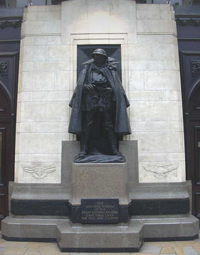
One of many memorials located in London’s railway stations, the Great Western Railway War Memorial is located on platform one of Paddington Station.
The memorial features a bronze figure of a soldier sculpted by Charles Sargeant Jagger standing against a granite and marble backdrop designed by Thomas S Tait. The soldier, who is dressed in battle gear with a helmet on his head and a great coat thrown about his shoulders, is depicted apparently reading a letter from home.
To either side of the soldier are reliefs depicting the emblems of the Royal Air Force and the Royal Navy while inscribed on the plinth beneath him is an inscription dedicated the memorial to employees of the railway who died in World War I. Inside the plinth was placed a sealed casket containing a vellum roll on which is written the names of all 2,524 men who died.
The memorial, known as the ‘GWR Memorial’, was unveiled on Armistice Day by Viscount Churchill, chairman of the Great Western Railway, in 1922 before a crowd estimated at around 6,000 people. It was later updated after World War II.
Restored in 2001, the memorial recently featured in the World War I commemorative project – “Letter to an Unknown Soldier” – in which members of the public were invited to write a letter to the soldier. The statue is also among more than 20 in London which have been brought to life as part of Sing London’s Talking Statues initiative (it has the voice of Patrick Stewart!).
Among our favourite railway memorials, others include the magnificent “Victory Arch” at Waterloo Station.
PICTURE: Cnbrb at the English language Wikipedia
This Week in London – Gothic literature at the British Library; founder of War Graves Commission honoured; and, New Year’s Eve tickets on sale…
•
The UK’s largest exhibition of Gothic literature opens at the British Library in Kings Cross on Saturday (4th October), marking the 250th anniversary of the publication of the breakthrough book, Horace Walpole’s The Castle of Otranto. Terror and Wonder: The Gothic Imagination will feature manuscripts and rare and personal editions of Gothic classics like Bram Stoker’s Dracula, Mary Shelley’s Frankenstein, Robert Louis Stevenson’s Strange Case of Dr Jekyll and Mr Hyde and Charles Dickens’ Oliver Twist as well as the work of contemporary writers like Angela Carter and Mervyn Peake. There will also be Gothic-inspired artworks by the likes of Henry Fuseli and William Blake and modern art, photography, costumes and movies by the likes of Chapman Brothers and Stanley Kubrick. A range of literary, film and music events will accompany the exhibition which runs until 20th January. Admission charge applies. For more, see www.bl.uk/whatson/exhibitions/gothic/. PICTURE: Percival Delivering Belisane from the Enchantment of Urma, Henry Fuselli. © Tate.
• The founder of the Imperial (now Commonwealth) War Graves Commission, Sir Fabian Ware (1869-1949), has been honoured with an English Heritage blue plaque at his former home in Marylebone. Sir Fabian lived at the early 19th century Grade II-listed terraced house at 14 Wyndham Place between 1911 and 1919. It was during this period that he served with the British Red Cross in France and first began recording the graves of soldiers killed in battle. In 1917, the Imperial War Graves Commission was formed with the task of reburying the war dead in permanent cemeteries in France. Knighted in 1920, Sir Fabian was to be director of graves registration and enquiries at the War Office during World War II and it was at this time that he extended the war graves scheme to civilians killed in the conflict. The commission changed its name to the Commonwealth War Graves Commission in 1960. Today it cares for cemeteries and memorials at 23,000 locations in 153 countries. For more, see www.english-heritage.org.uk/discover/blue-plaques/.
• New Year’s Eve in London will be a ticketed event for the first time this year with 100,000 tickets being made available to the public with each costing a £10 administration fee – the entire sum of which will apparently be used to pay for the ticketing system. Making the announcement last month, the Mayor of London, Boris Johnson’s, office, said the growth in numbers of those who have gathered to watch the fireworks on the Thames – from around 100,000 in 2003 to an estimated 500,000 last year – has put an enormous strain on transport and safety infrastructure and meant people have had to turn up earlier and earlier to get a good view, facing hours waiting in cold and cramped conditions, or risk being among the “hundreds of thousands” unable to get a good view or even see the display at all. Booking tickets – people may secure up to four – will guarantee “good views of the celebrations and a better visitor experience”. To book tickets, head to www.london.gov.uk/nye.
Send all items for inclusion to exploringlondon@gmail.com.
10 of London’s World War I memorials – 8. The RAF Memorial…

Aerial combat probably isn’t the first thing that springs to mind when thinking about the fighting in World War I but, as the Royal Air Force Memorial on Victoria Embankment records, air crew played a vital role.
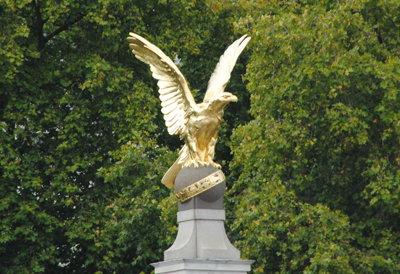
The memorial features a bronze eagle perched on an orb girded with a belt depicting the signs of the zodiac which sits atop a Portland stone pylon. It was designed by Sir Reginald Blomfield with the eagle, inspired by the RAF’s badge, sculpted by William Reid Dick. Along with the dedication, it carries an inscription from the Bible (Exodus 19:4) – “I bare you on eagles wings and brought you unto myself” (sic).
Various other sites were apparently considered for the memorial before the location – amid a string of other memorials between Westminster and Hungerford Bridge – was settled upon (as were other designers including the renowned Edwin Lutyens).
Unveiled on 13th July, 1923, by the Prince of Wales, the memorial was dedicated to the memory of all those who gave their lives in the ranks of the Royal Flying Corps, the Royal Naval Air Service and the Royal Air Force (formed through the amalgamation of the RFC and RNAS at a hotel in Strand in 1918) during World War I, along with those who had died while serving in air forces from across the British Empire.
A further dedication was later unveiled in 1946 on Battle of Britain Sunday remembering the men and women of air forces from across the Commonwealth and Empire who died during World War II.
A simple, yet still evocative, memorial.
This Week in London – Dr Livingstone’s beetles; the Great River Race; Snowdon at the NPG; and Foundlings at War…
• From Dr Livingstone, I presume? A recently unearthed collection of beetles gathered together by Dr David Livingstone during his Zambezi expedition of 1858-64 will go on display in its original box at the Natural History Museum in South Kensington on Friday night. The specimens were found among the museum’s 10 million beetles by beetle curator Max Barclay who stumbled on an unusual box received from a private collector. The collector was later found out to be amateur entomologist Edward Young Western (1837-1924) who apparently bought the specimens from a member of Livingstone’s expedition. The 20 beetles found inside the box are believed to the only surviving specimens known to have been collected by Livingstone. The specimens will be on show as part of Science Uncovered, a free annual after hours event – part of European Researcher’s Night – which will take place at the museum between 3pm and 10.30pm Friday night. Other highlights of the night include the chance to extract DNA from strawberries and bananas, create your own earthquake and chat live with NASA about chasing asteroids. For more, see www.nhm.ac.uk/scienceuncovered. PICTURE: Giant Predatory Ground Beetle, Termophilum alternatum © The Trustees of the Natural History Museum, London.
• Totally Thames – the month long celebration of the great river – is going out with a bang this weekend with more than 300 crews expected to take part in the Great River Race. Running from Millwall to Ham in Surrey, the 21.6 mile long event attracts entries from across the globe. The first boats leave Millwall at 12.40pm. Head to the riverbank between Richmond and Ham at approximately 3.40pm to see the winners cross the line to a cannon broadside. For more on the Great River Race, see www.greatriverrace.co.uk. Other events on as part of Totally Thames this weekend include historic riverside walks – one focused on Brunel and another on London’s ports before the Great Fire of 1666 as well as exhibitions including Richmond’s River at Orleans Gallery House in Twickenham and your last chance to see Florentijn Hofman’s HippopoThames. For more on Totally Thames, see www.totallythames.org.
• Some of Snowdon’s most iconic images will be on show as part of a new exhibition opening at the National Portrait Gallery near Trafalgar Square on Friday. Snowdon: A Life in View will feature studio portraits spanning a period from the 1950s to the 1990s alongside images from Private View, Snowdon’s 1965 examination of the British art world, created in collaboration with art critic John Russell and then director of Whitechapel Gallery, Bryan Robertson. More than 40 black-and-white portraits are included in the display including some works acquired by the gallery last year. To be held in Room 37 and 37a of the ground floor Lerner Contemporary Galleries until 21st June. Admission is free. For more, see www.npg.org.uk.
• On Now: Foundlings at War: World War I. This display at the Foundling Museum in Bloomsbury reveals for the first time the stories of foundlings who fought as well as those of the mothers forced to leave their children at the hospital as a result of bereavement or abandonment of those serving abroad. A free digital ibook, The Foundlings at War: World War I, containing expanded background information was published to coincide with the opening of the display earlier this month and can be downloaded from iTunes. The exhibition is part of a major research project, Foundlings at War, supported by the Heritage Lottery Fund and is the first of several displays examining the institution’s historic links with the military. For more, see www.foundlingmuseum.co.uk.
Send all items for inclusion to exploringlondon@gmail.com.
10 of London’s World War I memorials – 7. The Machine Gun Corps Memorial…
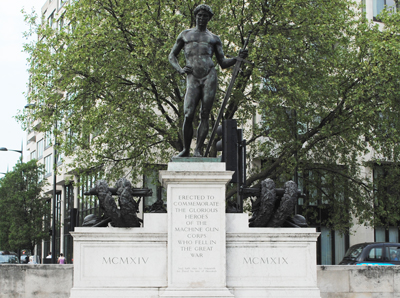
While most of London’s World War I memorials feature sculptures depicting soldiers or weaponry, the controversial Machine Gun Corps Memorial at Hyde Park Corner takes as its centrepiece a more classical theme.
Designed by Francis Derwent Wood (known for his role in making masks for soldiers disfigured during the war), the larger than life-sized sculpture on top of this memorial is a nude statue of the Biblical character, David, who stands holding a giant sword – that of Goliath whose head he cut off. The Biblical theme is also found in an accompanying inscription from the Bible: 1 Samuel 18: 7 – “Saul hath slain his thousands but David his tens of thousands”.
To either side of the bronze figure – which has led to the memorial also being known as The Boy David – are two real bronzed Vickers guns wrapped in laurels while the Italian marble plinth carries a dedicated to the almost 14,000 of the corps who died between the raising of the corps in 1915 and its disbanding in 1922. The reverse of the memorial details the corps’ history, recording its service in “France, Flanders, Russia, Italy, Egypt, Palestine, Mesopotamia, Salonica, India, Afghanistan and East Africa”.
The Grade II* listed monument, which was much criticised thanks to the juxtaposition of the naked figure and machine guns, was unveiled by the Duke of Connaught in 1925. Originally located on a traffic island to the south of the Royal Artillery Memorial it was dismantled in 1945 when roadworks were carried out and it wasn’t until 1963 that it was reassembled on its current site.
Interestingly, there is another statue of The Boy David by Edward Bainbridge Copnall standing atop a column which stands on Chelsea Embankment.