10 (more) historic London garden squares…8. Salisbury Square…

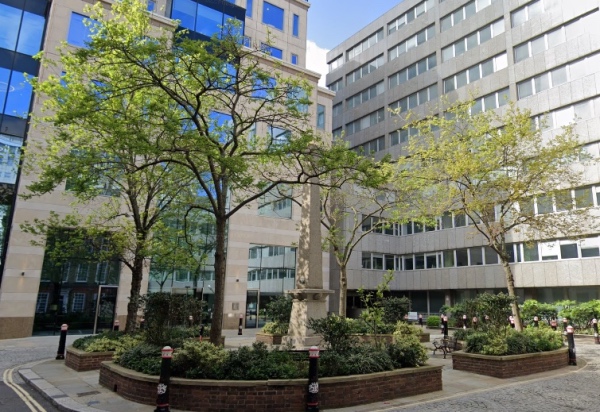
This City of London square sits on the part of the site of what had been Salisbury House, the town house of the bishops of Salisbury.

The house, which later became known as Dorset House, burned down in the Great Fire of London of 1666 and the square, now at the southern end of Salisbury Court, developed in its aftermath.

Lying just to the south of Fleet Street, the square was once home to the Salisbury Court Theatre in the mid-17th century and John Dryden lived here from 1673 to 1682, a period during which he wrote works including Amboyna (1673), All for Love (1678) and The Spanish Fryar (1681). It was also a popular place for actors to reside given its proximity to the Dorset Garden Theatre which was also built on part of the site of Salisbury House.

There was an alehouse here when King George I acceded to the throne – known as a locale frequented by his supporters, it was famous for an incident in 1716 in which it was stormed by a Jacobite mob during which the landlord shot a weaver (he was acquitted but five rioters were hanged at the end of the court.

Samuel Richardson ran a printing shop lived here from 1723 – Pamela was among the works he wrote here. He later pulled down some old residences to expand his printing operations (and it was in his house that Dr Samuel Johnson and William Hogarth first met).

In 1863, all the houses on the south side were replaced by the Salisbury Hotel and this was replaced in  the 1960s by Salisbury Square House when the square was remodelled and the central area laid out. Only number one remains of the early 18th century houses which once stood here.

The now largely paved square features garden boxes in the middle along with an obelisk commemorating Robert Waithman, Lord Mayor of London between 1823-24. It had apparently originally been erected in Farringdon Street but was moved here in the 1970s.

PICTURE: Google Maps.


This Week in London – St Paul’s Watch remembered in digital projections; Buddhism at the British Library; and, Elizabeth Peyton at the National Portrait Gallery…

The story of the St Paul’s Watch, the volunteers who worked to protect St Paul’s Cathedral during the Blitz, will be told in a digital display projected onto the cathedral’s facade this weekend. Where The Light Falls is being held in partnership with Historic England and is part of Fantastic Feats: the building of London – the City of London’s six-month cultural events season. It will see a display of poetry, visuals and photography, created by Poetry Society and Double Take Projections, projected onto the cathedral’s south side, north side and main facade in honour of those men and women who, armed with sandbags and water pumps, risked their lives to save the cathedral. The free show lasts for about 20 minutes and can be seen between 6.30pm and 10pm from tonight until Saturday night and then from 8pm to 10pm on Sunday. Meanwhile, St Paul’s is also open for a special late opening on Friday night during which poets from the Poetry Society will be bringing to life accounts of loss, bravery and sacrifice. Admission charge applies. For more on both events, head here.

The history, teachings and contemporary relevance of Buddhism are being explored in a major new exhibition opening at the British Library on Friday. Buddhism features rare and colourful scrolls, painted wall hangings and folding books and will highlight the theory, practice and art of Buddhism, examine the enduring iconography of Buddha and consider what it means to be Buddhist today. The exhibition, which is accompanied by a program of events, runs until 23rd February. For more, see www.bl.uk.

On Now: Elizabeth Peyton: Aire and Angels. This exhibition at the National Portrait Gallery is the first to situate the work of contemporary artist Elizabeth Peyton within the historical tradition of portraiture. In additional to the more than 40 works on display in the exhibition, Peyton has been honoured by being first artist to be given the run of the entire gallery with a series of displays within the permanent collection which juxtapose Peyton’s art with historic portraits from the Tudor period onwards. Among her portraits on show are those of Napoleon, Queen Elizabeth II, Yuzuru Hanyu, Frida Kahlo, Tyler the Creator, Isa Genzken, David Bowie, Elias Bender Rønnenfelt, David Fray, and Louis XIV. Runs until 5th January. Entry is free. For more, see www.npg.org.uk/elizabethpeyton.

Send all items for inclusion to exploringlondon@gmail.com.

Treasures of London – Beckenham’s ‘Bowie Bandstand’…

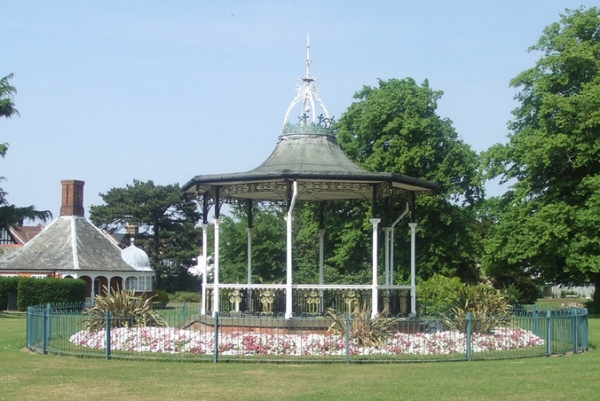
Built in 1905, this south London bandstand, which was recently awarded Grade II heritage status, is famous for being the site where David Bowie performed at the Growth Summer Festival in August, 1969. Bowie and friends had organised the free festival soon after his first hit single, Space Oddity, and the bandstand, located in Croydon Road Recreation Ground, was used as the stage for the day. As well as compering the festival, Bowie was among the performers who played here to a crowd of several hundred people. The festival, which was inspired by the feel of Woodstock and is believed to have been the first of its kind in Britain, inspired Bowie to write the seven minute long Memory of a Free Festival for his second album which was released later that year. It’s also suggested that he may have penned the lyrics to Life on Mars from the bandstand steps. The ironwork bandstand, which is referred to locally as the ‘Bowie Bandstand’, is thought to be the last bandstand from the foundry of Glasgow’s McCallum and Hope Iron Foundry still standing in Britain today. The Borough of Bromley, which owns the bandstand, is currently raising funds for its restoration.

PICTURE: Graham C99 (licensed under CC BY-SA 2.0/image cropped)

This Week in London – A rare surviving piece of Queen Elizabeth’s dress on show?; Inside Ronnie Scott’s Jazz Club, and, Islamic influences on art…

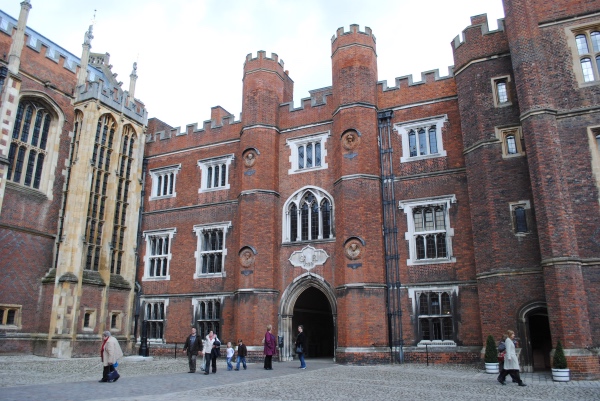
An altar cloth which may have once been part of a dress worn by Queen Elizabeth I goes on show at Hampton Court Palace (pictured) this Saturday. The Bacton Altar Cloth, which was discovered in a church in Bacton in rural Hertfordshire, has undergone two years of conservation work and will be displayed alongside a portrait of the “Virgin Queen” featuring a dress of similar design. The altar cloth has long been associated with Bacton-born Blanche Parry, one of Queen Elizabeth’s servants who became her Chief Gentlewoman of the Bedchamber. Records show the Queen regularly gave her discarded clothing to Parry and for years there has been speculation that the altar cloth was part of one such discarded item. Historic Royal Palaces curator Eleri Lynn, an expert in Tudor court dress, was able to identify previously unseen features and studied the seams of the fabric to show it had once been part of a skirt. Further research – including an examination of the dyes used in the item – have added weight to the theory it was once part of a dress. The altar cloth, on loan from St Faith’s Church in Bacton, can be seen until 23rd February. Admission charges apply. For more, see www.hrp.org.uk. PICTURE: David Adams.

A photographic exhibition of the first ‘golden’ decade of Ronnie Scott’s Jazz Club – featuring images of legendary British and American jazz singers – opens at the Barbican Music Library on Saturday. Ronnie Scott’s 1959-1969: Photographs by Freddy Warren, which marks the club’s 60th anniversary, features Warren’s photographs of the likes of Miles Davis, Duke Ellington, Dizzy Gillespie, Count Basie, Ella Fitzgerald, Zoot Sims, Cleo Laine and Tony Bennett. Warren was the in-house photographer at the Soho club from the opening night in 1959, when it was based in Gerrard Street, and documented the construction of the new site in Frith Street in the mid-1960s along with the arrival in London of big American stars. The exhibition includes rare vintage prints – some which were salvaged from the walls when the club was renovated in 2006, Freddy Warren’s original contact sheets, and previously unseen prints specially produced from the original negatives. The exhibition is free. Runs until 4th January. For more, see www.barbican.org.uk/your-visit/during-your-visit/library.

An exhibition exploring how western artists have been inspired by the Islamic world opens at the British Museum today. Inspired by the east: how the Islamic world influenced western art features paintings by leading ‘Orientalists’ including Eugène Delacroix, John Frederick Lewis and Frederick Arthur Bridgman as well as less well-known pieces like British artist Edmund Dulac’s original illustrations for a 1907 edition of the Arabian Nights, and ceramics by Frenchman Théodore Deck, who in the late 19th century created a range of pieces directly inspired by Islamic originals. The display also includes contemporary reactions to the imagery of Orientalism by Middle Eastern and North African female artists such as Lalla Essaydi’s Women of Morocco triptych and Inci Eviner’s 2009 video work Harem. The display can be seen in The Sir Joseph Hotung Exhibition Gallery until 26th January. Admission charge applies. For more, see www.britishmuseum.org.

Send all items for inclusion to exploringlondon@gmail.com.

This Week in London – Celebrating Rembrandt’s relationship with light; Paul Gauguin’s portraits; and, sacred Japanese images…

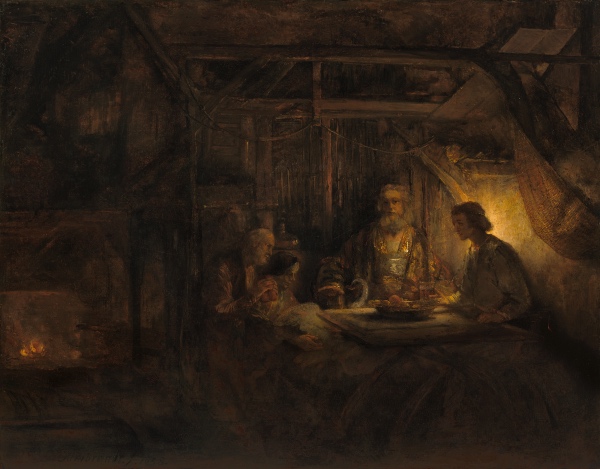
Rembrandt’s mastery of light is the subject of a new exhibition opening at the Dulwich Picture Gallery on Friday to mark 350 years since the Dutch artist’s death. Rembrandt’s Light includes 35 of his greatest paintings, etchings and drawings including international loans The Pilgrims at Emmaus (1648) and – shown for the first time in the UK – Philemon and Baucis, (1658), Tobit and Anna with the Kid (1645) and The Dream of Joseph (1645). The works have been arranged thematically and show how he used light and shadow for dramatic effect, focusing on his work during the middle period of his career – 1639-1658 – while he was living in his “dream house” on Breestraat in Amsterdam where the large windows provided ideal access to light. The display will employ a new LED Bluetooth lighting system installed at the gallery while cinematographer Peter Suschitzky, famed for his work on Star Wars: The Empire Strikes Back; The Rocky Horror Picture Show and Mars Attacks!, has worked with the curators to create what the gallery promises will be an “atmospheric visitor experience”. Admission charge applies. Runs to 2nd February. PICTURE: Rembrandt van Reign, Philemon and Baucis (1658), oil on panel transferred to panel, National Gallery of Art, Washington.

The first ever exhibition devoted to the portraits of Paul Gauguin opens at the National Gallery on Monday. The Credit Suisse Exhibition: Gauguin Portraits shows how the French artist, who was famed for his paintings of French Polynesia, revolutionised the portrait to express himself and his ideas about art. It features more than 50 works including paintings, sculptures, prints, and drawings – many of which have rarely been seen together. They include Madame Mette Gauguin in Evening Dress (1884), Young Breton Girl (1889), Tehura (Teha’amana) (1891-93), Young Christian Girl (1894), Père Paillard (1902) and the last self-portrait he ever completed, made in 1903, probably shortly before the end of his life at the age of 55. Runs until 26th January in the Sainsbury Wing. Admission charge applies. For more, see www.nationalgallery.org.uk.

Fifteen Buddhist and Shinto sacred images from the Nara Prefecture have gone on show at the British Museum. The works, which include five Japanese National Treasures, date from between 600 and 1300 AD and are displayed with related important Japanese and Chinese paintings from the museum’s collection. The objects include a gilt bronze sculpture, Bodhisattva of Compassion, a gilt-bronze libation dish featuring the birth of the Buddha and a pair of imposing wooden sculptures, Heavenly Kings, all of which date from the 700s. Nara: sacred images from early Japan can be seen in Room 3 (the Asahi Shimbun Displays) and the Mitsubishi Corporation Japanese Galleries (Room 93). Runs until 24th November. For more, see www.britishmuseum.org.

Send all items for inclusion to exploringlondon@gmail.com.

10 (more) historic London garden squares…4. Red Lion Square…

This Holborn square was laid out in the 1680s by property speculator Nicholas Barbon and took its name from the Red Lion Inn which once stood here.

The inn, incidentally, is said to be the place where the exhumed bodies of Oliver Cromwell, his son-in-law (and Parliamentarian general) Henry Ireton and John Bradshaw, president of the parliamentary commission to try King Charles I, lay the night before they were taken to Tyburn where they were desecrated (there’s a story that the bodies were switched that night and the real men lay buried in a pit in a square).

The square was laid out on what had been known as Red Lion fields and there were apparently some physical scuffles between the workmen, led by Barbon, and lawyers of Gray’s Inn who objected to the loss of their rural vistas.

The square, meanwhile, soon became a fashionable part of the city – among early residents was Judge Bernard Halle – but by the mid-19th century, its reputation had slumped only to move up again in later years.

Famous residents included Dante Gabriel Rossetti in 1851 and William Morris who lived in a flat on the southern side of the square with Edward Burne-Jones in the later 1850s. The art deco Summit House was built in 1925 on the former residence of John Harrison, inventor of the marine chronometer. Jonas Hanway, the first man to walk London’s streets with an umbrella, apparently also lived on the square.

The square today is home to the Royal College of Anaesthetists and Conway Hall, home of the Conway Hall Ethical Society (in fact, it was Conway Hall which was at the centre of one of the most famous incidents in the square – clashes between anti-fascist protestors and National Front members and subsequent police response which took place on 15th June, 1974, and left a university student, Kevin Gately, dead.

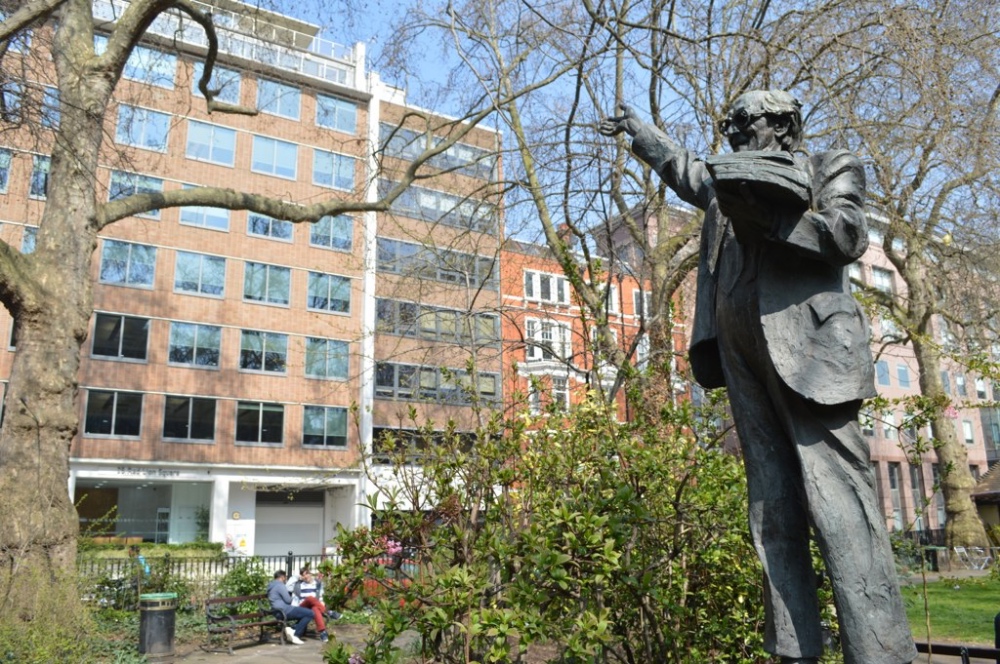
The garden in the centre of the square features a statue of anti-war activist Fenner Brockway and a bust of philosopher, essayist and Nobel laureate Bertrand Russell.

PICTURE: Top – View across part of the square (Google maps)/Below – Fenner Brockway statue (Matt Brown/licensed under CC BY 2.0)

LondonLife – Bob Marley’s former Chelsea home given English Heritage Blue Plaque…

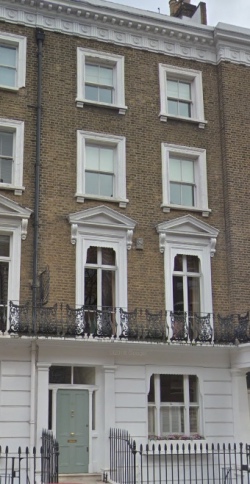
The Chelsea property where Jamaican singer-songwriter Bob Marley lived in 1977 has been given an English heritage Blue Plaque. Marley lived at the four storey terraced house at 42 Oakley Street while he and the Wailers were finishing recording their album Exodus which features hits including Jamming, Waiting in Vain, Three Little Birds and One Love. Marley, who often played football with bandmates at pitches in Battersea Park, said he regarded London as a “second base”. Among the evidence considered in deciding to award the plaque was Marley’s arrest for possession of cannabis on 10th March, 1977, along with bassist Aston ‘Family Man’ Barrett. Court records have Barrett’s address as 42 Oakley Street while Marley’s is recorded as 27 Collingham Gardens. Anecdotal evidence, however, suggests he gave this address to try and prevent the police from searching Oakley Street for drugs and English Heritage says the unanimous recollection of contemporary witnesses is that Oakley Street was both the band headquarters and Marley’s primary address at the time. Other music-related identities who have been honoured with blue plaques include Jimi Hendrix, John Lennon, George Frideric Handel and Wolfgang Amadeus Mozart. For more, see www.english-heritage.org.uk/visit/blue-plaques/. PICTURE: 42 Oakley Street (before plaque) via Google Maps.

Treasures of London – Sir Walter Raleigh, Greenwich…

This Greenwich statue, which stands on King William Walk to the left of the entrance to the Pepys Building – once part of the Royal Naval College, depicts the Elizabethan adventurer and court favourite (well, at times) in a suitably heroic pose. The life-sized bronze of Raleigh (1552-1618), which stands on a stone plinth, was designed by William McMillan. It was originally unveiled by then-US Ambassador John Hay Whitney in 1959 on Raleigh Green outside the Ministry of Defence in Whitehall to mark the 350th anniversary of the foundation of the Commonwealth of Virginia (it was apparently originally suggested it be placed in front of the National Gallery in Trafalgar Square but that didn’t eventuate). Grade II-listed, it stood in Whitehall until 2001 until, deemed as out of scale with other statues, was moved to its current location. PICTURE: Loco Steve (licensed under CC BY-SA 2.0).


This Week in London – Open House London; street food explored; and, Antony Gormley…

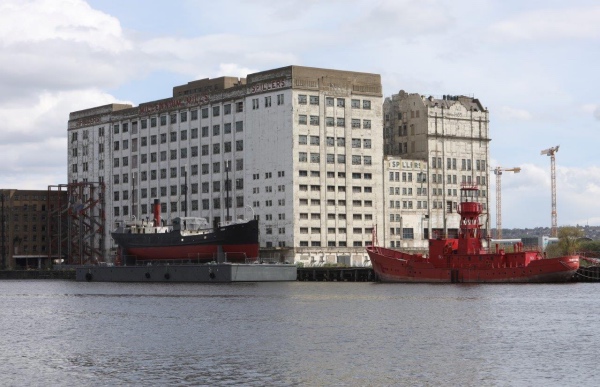
It’s Open House London weekend and that means your chance to explore behind what are normally closed doors. More than 800 buildings are opening up to the public over the two day festival – this year’s theme is ‘social’ – and there’s an extensive programme of walks and architect-led tours with all events free to attend. While some buildings – like Number 10 Downing Street, BT Tower and the US Embassy London – are only open to those who were successful in already-held public ballots, there’s still plenty to see for those who have’t scored a place. Highlights include a chance to see inside first-time participants like Millennium Mills in Royal Docks (pictured above), the new Museum of London in West Smithfield and the new social housing estate, Kings Crescent Estate in Hackney, as well as a Tokyo Bike cycle tour, and By Beck Road 19 – a Bethnal Green terrace serving as an open-door art gallery. There’s also the chance to see inspiring residences like Open Practice Architecture’s Gin Distillery and Nimtim Architect’s Block House, family activities and the Open House ‘Elements’ photography competition to take part it. For the full programme of events, head to www.openhouselondon.org.uk.

Images of London’s street food and hawkers, spanning the 16th to the 19th centuries, have gone on show at a new open-air exhibition in Aldgate Square. Hot Peascods! explores how selling food, which could require little more investment than buying basket and the first batch of pies or eels or gingerbread, provided an income for those who couldn’t find other work and was relied upon as a source of food for those who were so poor they couldn’t afford cooking facilities at home. As well as images, it features interviews recorded in the 1850s by pioneering social reformer Henry Mayhew. The exhibition, which is curated by the City of London Corporation’s Guildhall Library, can be seen in Aldgate Square until 29th September and then moves to Guildhall Yard where it can be seen between 1st and 16th October. Free.

The work of acclaimed British sculptor Antony Gormley is the subject of a new exhibition opening at the Royal Academy of Arts on Saturday. Antony Gormley, which spans all 13 rooms in the RA’s Main Galleries, brings together both existing and specially conceived new works. They include Iron Baby (1999) located in the Annenberg Courtyard, works from the 70s and 80s like Land, Sea and Air (1977-79) and Fruits of the Earth (1978-79) in which natural and man-made objects are wrapped in lead (these evolved into Gormley’s ‘body case’ sculptures), and a series of concrete works from the 1990s including Flesh (1990). There are a series of whole-of-room installations including Lost Horizon I (2008) which features 24 cast-iron figures, and Host in which an entire gallery is filled, to a depth of 23 centimetres, with seawater and clay, while at the centre of the exhibition are two of Gormley’s early ‘expansion’ works, Body and Fruit, both from 1991-3. The exhibition also includes a selection of works on paper including Mould (1981), the Body and Light drawings, Linseed Oil Works (1985-1990), Double Moment (1987), and the Red Earth drawings (1987-1998). Runs until 3rd December. Admission charge applies. For more, see www.royalacademy.org.uk.

Send all items for inclusion to exploringlondon@gmail.com.

Where’s London’s oldest…French patisserie?

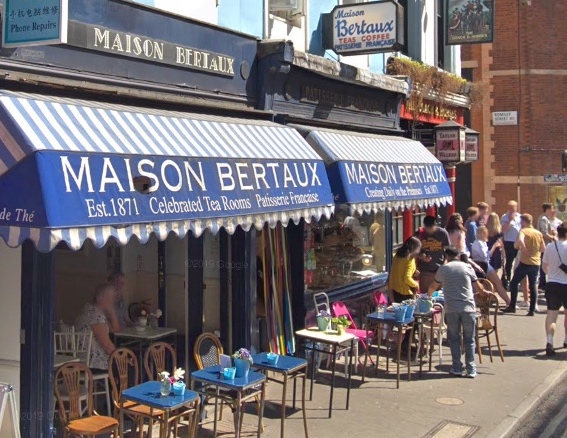
The oldest existing French patisserie in London is said to be Maison Bertaux, based in Greek Street in Soho. 

The premises, where you can still indulge in delights including eclairs, croissants and delectable fruit tarts, was founded in 1871 by one Monsieur Bertaux, apparently a French communard from Paris.

It lies at the heart of what was then the city’s French community and located at number 28, stands next door to another Soho landmark, the Coach and Horses pub.

Bertaux apparently ran the business until 1909 and it’s since passed through a number of hands with current owners, sisters Michele and Tania Wade, reported as having taken over in 1988.

Famous patrons have reportedly included writers Virginia Woolf and Karl Marx,  actors Steve McQueen and Nicole Kidman, artist Grayson Perry and musician Bob Geldof. The patisserie also famously made Lily Allen’s wedding cake and hosted the late fashion designer Alexander McQueen’s 25th birthday party.

Bastille Day celebrations are, of course, a highlight of the year.

For more, see www.maisonbertaux.com.

PICTURE: Google Maps.
London Pub Signs – The Fitzroy Tavern…

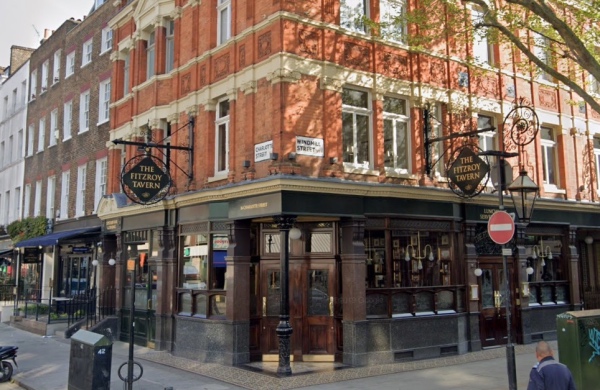
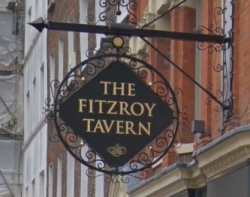
This London institution, located at 16 Charlotte Street in Fitzrovia, is famous for its association with Bohemians and intellectuals including artists Augustus John and Jacob Epstein, and writers Dylan Thomas and George Orwell, all of whom frequented the pub.

The name of the pub, which is from where Fitzrovia gets its name, comes from the Fitzroy family, the Dukes of Grafton, who owned much of the land in the area.

More specifically it was Charles Fitzroy, 1st Baron Southampton and the great-grandson of the first duke (Henry Fitzroy, an illegitimate son of King Charles II), who first developed the northern part of the area, building Fitzroy Square (Fitzroy Street also carries the family name as does Grafton Way).

The pub apparently started life as a coffee house in the early 1880s but had been converted into an establishment where stronger drinks were served in 1897. It was originally known as The Hundred Marks but rebranded The Fitzroy Tavern in 1919.

Other luminaries associated with the pub have included Nina Hamnett, the so-called ‘Queen of Bohemia’, her friend American poet Ezra Pound, MPs Michael Foot and Barbara Castle, and, the infamous occultist Aleister Crowley.

Thanks to the man responsible for converting the establishment into a pub, proprietor Judah ‘Pop’ Kleinfeld, the establishment was also the birthplace of a charity called Pennies from Heaven which raised money for underprivileged children.

The story goes that having witnessed the loser of a darts match throw his dart into the ceiling in exasperation, Kleinfeld came up with the idea of providing customers with darts which had little paper bags attached for people to put small change in before throwing them at the ceiling (and the money then collected for the charity).

Now part of the Samuel Smith chain, the pub which sits on the corner with Windmill Street, has undergone an award-winning refurbishment in recent years with its original Victorian-era look restored including polish mahogany partitions with etched glass.

PICTURES: Courtesy of Google Maps.

A Moment in London’s History – An iconic image of Abbey Road is taken…

It’s 50 years this month – it was last Thursday, 8th August, in fact – when an iconic photograph featuring the Fab Four on a zebra crossing was taken for cover of the Abbey Road album.

The photograph – which featured (in order) George Harrison, Paul McCartney, Ringo Starr and John Lennon striding across the pedestrian walk in St John’s Wood – was taken by the late Scottish photographer Iain Macmillan.

He apparently climbed onto a ladder in the middle of the street while a policeman held back traffic briefly (there are vehicles driving down the road in the distance in the image).

The entire shoot – which was apparently McCartney’s idea – reportedly took just 10 minutes and saw the band walk across the road six times (the chosen image – said to have been taken at 11:38am – was number five; the only one in which all their legs were in a perfect V shape).

The image carries a particular poignancy for Beatles fans because of the fact that they “officially” broke up less than a year later (the album it featured on, Abbey Road, was released on 26th September, 1969, and was the last recorded by the group even though it was released prior to Let It Be).

As well as being recreated by tourists at the site itself, the image has been reproduced and adapted countless times – including its reproduction on a 64p Royal Mail stamp in 2007 and an adaption involving the Simpsons for a Rolling Stone cover in 2002.

Abbey Road Studios – where the Abbey Road album was recorded – is located just a hop, skip and jump away and has operated a live webcam of the crossing since 2002. (For more on Abbey Road and the origins of its name, see our previous post here).

PICTURE: Via Wikipedia.

This Week in London – 16th century altar piece on display for first time in a century; Tudor sports at Hampton Court; and, the most expensive British-made watch…

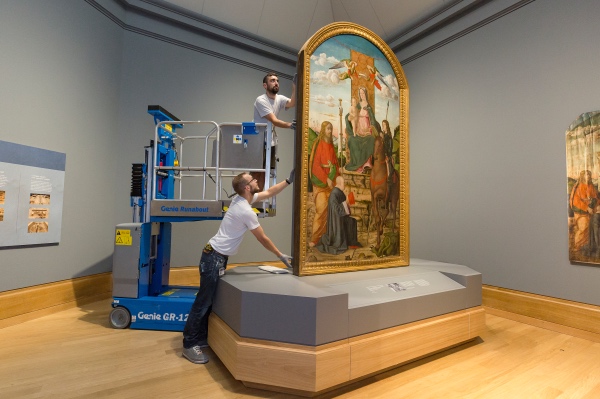
One of the major surviving altarpieces created by Italian Renaissance painter and sculptor Giovanni Martini da Udine in the early 16th century has gone on display at The National Gallery. The Virgin and Child with Saints, said to date from about 1500–25, has undergone an extensive seven year conservation process – described as one of the longest and most complex in the gallery’s history – prior to going on show for the first time in 100 years. The process involved removing old varnish and repaints, dividing the altarpiece into its original three boards and cleaning and repairing them before putting them back together with an additional support and then finally filling and retouching the original paintwork and adding a frame to ensure it can be moved in the future. The painting depicts the Virgin and Child with St James on one side and St George on the other while a man, most likely the artist’s patron, kneels in front. Known as a ‘sacra conversazione’ (holy conversation), this type of painting become increasingly popular over the course of the 15th century. The work can be seen in Room 56. Admission is free. For more, see www.nationalgallery.org.uk. PICTURE: Installation of The Virgin and Child with Saints by Giovanni Martini da Udine in Room 56./©The National Gallery, London

Join in some Tudor sports this weekend at Hampton Court Palace. Until Sunday, families are invited to head to the East Front Gardens where they can try their hand at shooting a crossbow or a bow and arrow, practice some traditional sword fight, and watch demonstrations in hand to hand combat by King Henry VIII and his courtiers. There will also be some falconry displays. Admission to ‘Henry VIII’s Sporting Academy’ is included in general admission charge. For more, check out www.hrp.org.uk/hampton-court-palace/.

The most expensive British watch ever made has gone on show at the Science Museum in South Kensington. The 18ct gold-cased watch, known as the Space Traveller II, was handmade by George Daniels in 1982 and named in honour of the Moon landings. It sold for £3.2 million at auction in 2017. The watch, which has been loaned by a private donor, is being displayed in the Clockmakers’ Museum and sits in an exhibit about Daniels, a former master of the Worshipful Company of Clockmakers who is credited with helping to revive independent watchmaking in the late 20th century. While Space Traveller I was sold soon after its completion, Space Traveller II was used by Daniels until his death in 2011. It displays both solar and sidereal (star) time and also shows the phase of the Moon, an annular calendar, the equation of time and features a stopwatch which functions with either solar or sidereal time. Entry to the Clockmakers’ Museum is free. For more, see www.sciencemuseum.org.uk.

Send all items for inclusion to exploringlondon@gmail.com.

This Week in London – Women in the British Army; communications secrets exposed; and, cinema at Somerset House…

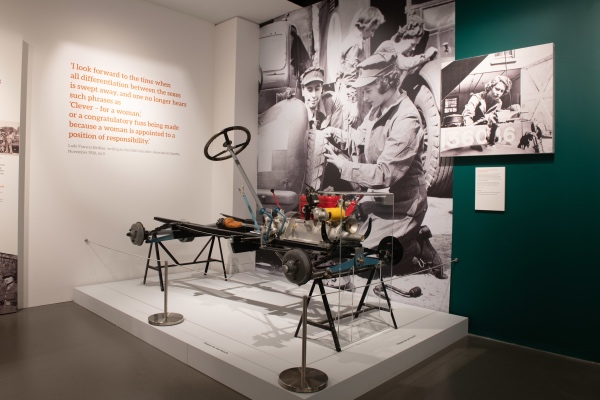
An exhibition exploring the changing roles of women in the British Army from 1917 to the present day has opened at the National Army Museum in Chelsea. Rise of the Lionesses, which is being held in partnership with the WRAC Association, charts the major contributions women have made to the Army’s history as well as how perceptions of “appropriate” roles for females have affected these contributions and how women have fought to redefine those roles. Highlights include the combat shirt and medical kit belonging to Sergeant Chantelle Taylor – the first female British soldier to kill in combat, the first Army-issue bra, and the vehicle chassis used to train Princess Elizabeth (now Queen Elizabeth II) while she served in the Auxiliary Territorial Service during World War II (pictured above). The free display can be seen until 20th October and is accompanied by a programme of public events. For more, head to this link. PICTURE: Courtesy of National Army Museum.

• Communications intelligence and cyber security are explored in an exhibition at the Science Museum, making the centenary of UK intelligence, security and cyber agency,  GCHQ. Top Secret: From ciphers to cyber security features more than 100 objects including cipher machines used during World War II, secure telephones of the type used by British Prime Ministers, and an encryption key used by the Queen. There’s also encryption technology used by Peter and Helen Kroger who, until their arrest in the 1960s, were part of the most successful Soviet spy ring in Cold War Britain, and the remains of the crushed hard drive alleged to contain top secret information which was given by Edward Snowden to The Guardian in 2013 while the work of GCHQ’s National Cyber Security Centre is also explored with visitors able to see a computer infected with the WannaCry ransomware which, in 2017, affected thousands of people and organisations including the NHS. Runs until 23rd February. Admission is free. For more, head to www.sciencemuseum.org.uk.

The pioneering work of Hungarian avant garde artist Dóra Maurer goes on show at the Tate Modern on South Bank next Monday in the first UK exhibition celebrating her five decade career. The free display brings together 35 of her works – from conceptual photographic series and experimental films to colourful graphic works and striking geometric paintings – with highlights including Seven Foldings (1975), Triolets (1981), Timing (1973/1980) and the six-metre-long Stage II (2016). The year-long display is one of several free displays opening at the Tate Modern this month. Others include an exhibition of Sol LeWitt’s graphic woodcut prints, a show featuring photograms, films, painting and drawings by Polish émigré artists Franciszka Themerson and Stefan Themerson, and photography displays by Mitch Epstein, Naoya Hatakeyama and David Goldblatt. For more, see www.tate.org.uk.

Cinema is being celebrated at Somerset House this month with the launch of Film4 Summer Screen at Somerset House. The event includes courtyard screenings, specially curated DJ sets and live performances, and panel discussions from industry insiders. Actor Antonio Banderas will join Spanish director Pedro Almodóvar to introduce the festival’s opening night premiere, Pain and Glory, with other special guests including the cast of Shane Meadows’ BAFTA-award winning film This is England, Francis Lee, the director and writer of God’s Own Country, and  the film’s lead actor Josh O’Connor as well as Peter Webber, director of Inna de Yard. Runs from 8th to 21st August. For more, see www.somersethouse.org.uk.

Send all items for inclusion to exploringlondon@gmail.com.

This Week in London – Queen Victoria at Buckingham Palace; royal etchings; and, Ed Ruscha at Tate Modern…

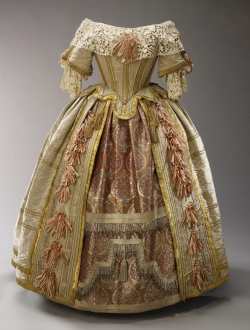
The impact of Queen Victoria on Buckingham Palace, transforming what was empty residence into “the most glittering court in Europe”, is a special focus of this year’s summer opening of Buckingham Palace. Marking the 200th anniversary of the birth of the Queen, the exhibition Queen Victoria’s Palace recreates the music, dancing and entertaining that characterised the early part of the Queen’s reign using special effects and displays. Highlights include the Queen’s costume (pictured) for the Stuart Ball of 13th July, 1851, where attendees dressed in the style of King Charles II’s court. There’s also a recreation of a ball held in the palace’s newly completed Ballroom and Ball Supper Room on 17th June, 1856, to mark the end of the Crimean War and honour returning soldiers which uses a Victorian illusion technique known as Pepper’s Ghost to bring to life Louis Haghe’s watercolour, The Ball of 1856. The table in the State Dining Room, meanwhile, has been dressed with items from the ‘Victoria’ pattern dessert service, purchased by the Queen at the 1851 Great Exhibition, and the room also features the Alhambra table fountain, a silver-gilt and enamel centrepiece commissioned by Victoria and Albert in the same year, and silver-gilt pieces from the Grand Service, commissioned by the Queen’s uncle, King George IV, on which sit replica desserts based on a design by Queen Victoria’s chief cook, Charles Elme Francatelli. The summer opening runs until 29th September. Admission charges apply. For more, see www.rct.uk/visit/the-state-rooms-buckingham-palace. PICTURE: Royal Collection Trust/ © Her Majesty Queen Elizabeth II 2019

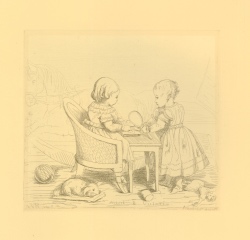
 The Victorian reign is also the subject of a new exhibition at the British Museum where rare etchings by Queen Victoria and Prince Albert have gone on display. At home: Royal etchings by Queen Victoria and Prince Albert features 20 artworks that they created during the early years of their marriage and depict scenes of their domestic lives at Windsor Castle and Claremont including images of their children and pets. The display includes three works donated to the museum by King George V, Queen Victoria’s grandson, in 1926, and it’s the first time they’ve gone on public display. Prince Albert introduced the Queen to the practice of etching soon after their wedding and under the guidance of Sir George Hayter they made their first works on 28th August, 1840. They would go on to collaborate on numerous works together. The display can be seen in Room 90a until mid-September. Admission is free. For more, see www.britishmuseum.org. PICTURE: The Princess Royal and Prince of Wales, 1843, by Albert, Prince Consort (after Queen Victoria) © The Trustees of the British Museum.

American artist Ed Ruscha is the subject of the latest “Artist Rooms” annual free display in the Tate Modern’s Blavatnik building on South Bank. The display features works spanning Ruscha’s six-decade career, including large, text-based paintings and his iconic photographic series. There is also a display of Ruscha’s artist’s books – including Various Small Fires 1964 and Every Building on the Sunset Strip 1966 – as well as some 40 works on paper gifted to Tate by the artist. Highlights include his series of photographs of LA’s swimming pools and parking lots, paintings inspired by classic Hollywood cinema, and works such as DANCE? (1973), Pay Nothing Until April (2003) and Our Flag (2017). Runs until spring 2020. Admission is free. For more, see www.tate.org.uk.

Send all items for inclusion to exploringlondon@gmail.com.

This Week in London – Exploring the Moon; celebrating London’s green spaces; and, Finnish artist Helene Schjerfbeck at the RA…

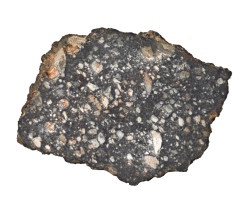
Lunar samples collected during the Apollo 11 mission and objects that travelled to the Moon with the astronauts including Edwin “Buzz” Aldrin’s “Snoopy Cap” and the famous Hasselblad camera equipment are among items on display as part of a new major exhibition which opens at the National Maritime Museum in Greenwich on Friday. Celebrating the 50th anniversary of the 1969 Moon landing, The Moon explores Earth’s relationship with the Moon over time and across civilisations. Other items among the more than 180 objects from public and private collections on show include a rare lunar meteorite from the Natural History Museum’s collection (pictured), a Mesopotamian tablet from 172 BC and a series of contemporary and historical artworks including paintings by JMW Turner and John Constable. There’s also a new version of Christian Stangl’s film Lunar in which animated photographs from Apollo missions allow visitors to experience the Moon landings through the eyes of the astronauts. The Moon can be visited until 5th January. Admission charges apply. For more, see www.rmg.co.uk/moon50. PICTURE: Lunar meteorite Found in the Sahara Desert, North West Africa, 2017 © The Trustees of the Natural History Museum, London.

London’s inaugural and free week long National Park City Festival kicks off on Saturday to celebrate the city’s green spaces, wildlife and waterways. Opening the festival – which is an initiative of the Mayor of London and National Park City Foundation as well as other partners – this weekend is a free cultural programme, run in partnership with the National Theatre, on its outdoor river stage on South Bank which features dance, theatre and music. Other highlights among the more than 300 events being held during the nine day event include the ‘National Park City Rooftops’ initiative – which sees people given free access to some of the city’s most beautiful garden rooftops and natural spaces including Crossrail Place in Canary Wharf, Barbican Conservatory and Ham Yard Hotel in Soho, the ‘National Park City Forest’ initiative which sees a unique audio installation, Living Symphonies, installed in Epping Forest, the ‘National Park City Wildlife’ – a photography competition and exhibition held in partnership with the London Wildlife Trust, and the multi-site ‘National Park City Splash’ initiative in which everybody can try their hand at activities like paddle boarding and open water swimming. The week runs to 28th July. For the complete programme of events, head to https://nationalparkcity.london.gov.uk.

The work of Finnish artist Helene Schjerfbeck (1862 – 1946) is being celebrated at the Royal Academy of Arts. Opening on Saturday, the first solo UK exhibition of Schjerfbeck’s works features some 65 portraits, landscapes and still lifes, and follows the development of the artist’s work from a naturalistic style, inspired by French Salon painters in the early 1880s, to what the RA describes as “a radically abstracted and modern approach from the turn of the 20th century onwards”. The exhibition is being shown in five sections with highlights including Two Profiles (1881) – the earliest work on display, The Convalescent (1888), My Mother (two paintings – one from 1902 and another from 1909), a series of self-portraits and later works like Måns Schjerfbeck (The Motorist) (1933) and Three Pears on a Plate (1945). Runs until 27th October in The Gabrielle Jungels-Winkler Galleries. Admission charge applies. For more, see www.royalacademy.org.uk.

Send all items for inclusion to exploring london@gmail.com.

Famous Londoners – Winnie the Bear…

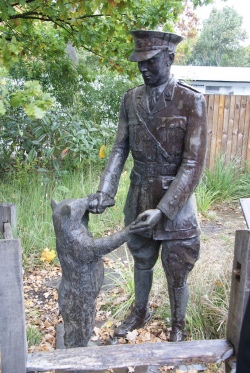
Once one of the most famous residents of ZSL London Zoo, Winnie the Bear was brought to the city by a Canadian soldier – Lt Harry Colebourn – during World War I.

Colebourn, a member of the 34th Fort Garry Horse Regiment of Manitoba and the Canadian Army Veterinary Corps, had purchased the black bear cub at White River, Ontario, for $20, on 24th August, 1914, from a hunter who had killed the cub’s mother.

Colebourn, who named the bear Winnie after his hometown of Winnipeg, subsequently took the bear with him to England where his regiment, the Second Canadian Infantry Brigade, was training on Salisbury Plain ahead of their deployment to France.

The female bear became the mascot’s regiment but when the regiment left for France in December, 1914, she was left at the London Zoo in Regent’s Park for safekeeping.

Colebourn was a frequent visitor during leave from the front – he had initially intended to take Winnie back to Canada at the end of the war. But when the war ended in 1918, Colebourn instead donated the bear to the zoo in appreciation of the care staff had given her.

Among those who came to see the bear at the zoo were writer AA Milne and his son Christopher Robin – Milne subsequently named his famous fictional creation Winnie-the-Pooh after the bear.

Winnie the bear died at the zoo on 12th May, 1934.

There’s a statue of Lt Colebourn and Winnie at the zoo (pictured). The work of Bill Epp, it was presented to the zoo by the people of Manitoba, Canada, on 19th July, 1995. It’s a copy of an original Epp work which was unveiled in Assiniboine Park Zoo, in Winnipeg, Manitoba, on 6th August, 1992.

PICTURE: Chris Sampson (CC BY 2.0)

This Week in London – Culture, heritage and war at IWM; Sir Arthur Pearson honoured; and, Takis at the Tate Modern…

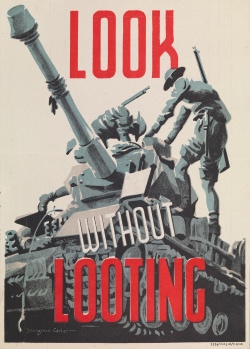
Exhibitions exploring why culture and heritage are attacked during times of war and how cultural treasures in British museums and galleries were protected during World War II open at London’s Imperial War Museum on Friday. What Remains – which highlights both historic and contemporary instances in which buildings, places, art and artefacts have been deliberately targeted during times of conflict as well as examples of resistance, protection and restoration, and, Art in Exile – which looks at the role UK cultural organisations have played in wartime, are both part of Culture Under Attack, a free season of events that explore how war threatens cultural heritage. Also launching as part of Culture Under Attack this week is Rebel Sounds, an immersive exhibition that reveals how music has been used to resist and rebel against war and oppression with examples from Nazi Germany in the 1930s, Northern Ireland in the 1970s, Serbia in the 1990s and present day Mali. All three displays run until 5th January. For more, see www.iwm.org.uk/seasons/culture-under-attack. PICTURE: British Army poster from 1943, created to educate and inform its soldiers of the importance of respecting property, including cultural heritage (© IWM)

• Sir Arthur Pearson, newspaper publisher and founder of St Dunstan’s (Blind Veterans UK), has been remembered with an English Heritage Blue Plaque. The plaque was unveiled at his now Grade II*-listed home on Portland Place in Marylebone last week, the place where he lived with his wife and some of the blinded servicemen supported by St Dunstan’s in the later years of World War I and those following. Pearson had made a fortune as a press magnate, founding the Daily Express in 1900 and later purchasing The Evening Standard but his attention turned to campaigning for the blind after he was told he would lose his sight in 1913. For more on English Heritage Blue Plaques, see www.english-heritage.org.uk/visit/blue-plaques/.

The largest ever exhibition of the work of pioneering Greek artist Takis (Panayiotis Vassilakis) has opened at the Tate Modern this week. Takis features more than 70 works by the self-taught artist – renowned as a “sculptor of magnetism, light and sound” –  including a rarely-seen Magnetic Fields installation, a series of musical devices generating resonant and random sounds, and forests of his antenna-like Signals. Can be seen until 27th October. Admission charge applies. For more, see www.tate.org.uk.

Send all items for inclusion to exploringlondon@gmail.com.

This Week in London – British printmaking; the Taste of London; and, Dickens abroad…

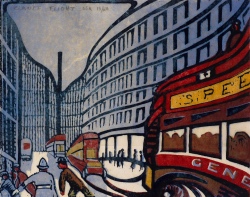
British printmaking between World War I and II is under the spotlight in a new exhibition which opened at Dulwich Picture Gallery this week. Cutting Edge: Modernist British Printmaking, which marks 90 years since the inaugural exhibition on British linocuts was held at the Redfern Gallery, features 120 prints, drawings and posters and spotlights the work of artists of the Grosvenor School including those of teacher Claude Flight and nine of his leading students – Cyril Power, Sybil Andrews, Lill Tschudi, William Greengrass and Leonard Beaumont among them. A number of the works are being displayed publicly for the first tome and several international loans – including prints by the Australian students Dorrit Black, Ethel Spowers and Eveline Syme – are making their debut as part of a major UK showing. The display can be seen until 8th September. Admission charge applies. For more, see www.dulwichpicturegallery.org.uk. PICTURE: Claude Flight, Speed, 1922, © The Estate of Claude Flight. All Rights Reserved, [2019] / Bridgeman Images/ photo Photo © Elijah Taylor (Brick City Projects)

Food festival, the Taste of London, is on again in The Regent’s Park across this weekend. Opened last night, the festival features the chance to sample food from London’s best restaurants as well as learn from world-class chefs, and visit gourmet food and artisan producer markets. For more, including tickets, see https://london.tastefestivals.com.

On Now: Global Dickens: For Every Nation Upon Earth. This exhibition at the Charles Dickens Museum in Bloomsbury paints a global picture of one of London’s favourite sons, starting with his trips to Europe and North America and going on to consider how his influence spread across the world. On display is his leather travelling bag, a Manga edition of A Christmas Carol,  and a copy of David Copperfield that went to the Antarctic on the 1910 Scott expedition. Can be seen until 3rd November. Included in admission charge. For more, see www.dickensmuseum.com.

Send all items for inclusion to exploringlondon@gmail.com.

Where’s London’s oldest….chophouse?

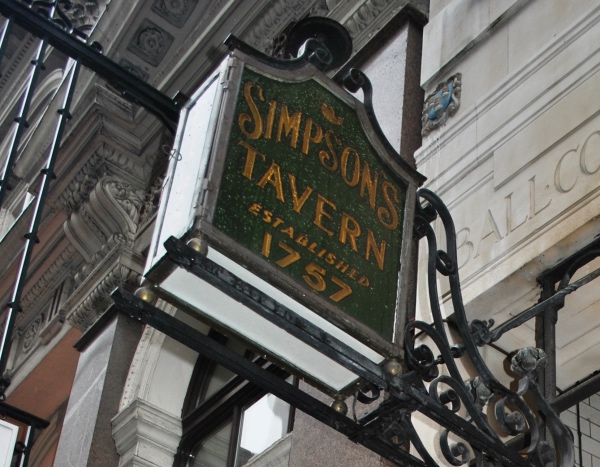
London’s oldest chophouse, Simpson’s, can be found in the City of London, just off Cornhill, and dates from the mid-18th century.

Thomas Simpson had opened his first ‘Fish Ordinary Restaurant’ in Bell Alley, Billingsgate, in 1723, catering to a clientele made up largely of those working at the Billingsgate (Fish) Market.

When that was demolished, he retired briefly before purchasing the Queen’s Arms in Bird in Hand Court off Cheapside.

Located in Ball Court Alley, Simpson opened the current establishment in 1757 (although the Grade II-listed building itself dates from the late 1600s or possibly early 1700s). It was a gift from his father.

Customs at the restaurant included having meals were presided over a chairman who would ensure lunch started promptly as one (their job also included introducing notable guests and measuring the cheese – a task related to a tradition of placing bets on the height, weight and girth of the cheese).

Seating is arranged in stalls and the layout is apparently consistent with that of the 19th century (although some things, thankfully, have changed – ladies were finally admitted in 1916).

For more, see www.simpsonstavern.co.uk.

PICTURES: Elisa.rolle (licensed under CC BY-SA 4.0)