8 structures from the London that never was – 5. Sir Joseph Paxton’s Great Victorian Way…

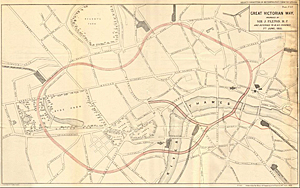
Fresh from the success of designing The Crystal Palace for the Great Exhibition of 1851 (see our earlier post here), in 1855 Sir Joseph Paxton came up with the idea of building a covered elevated railway “girdle” which would circle parts of central and west London and alleviate traffic congestion.

Great-Victorian-WayThe proposed 10 mile long, eight track railway – which would feature trains propelled by air pressure (an “atmospheric” system) rather than conventional steam engines and included  “express” trains which would only stop at select stations – was to be constructed inside a vast, 108 foot high glass covered arcade which would also contain a road, shopping and even housing.

The trains would travel at such a speed that to get from any one point on the “girdle” to its opposite point would only take 15 minutes.

Paxton presented his proposal to a Parliamentary Select Committee in June 1855 – he had already shown it to Prince Albert whom, he said, “gives it his approval”.

He estimated the cost of his proposal – which he thought would carry some 105,000 passengers every day – at some £34 million – a figure which parliament, which had initially been supportive of the idea, found a little hard to stomach.

This was especially thanks to the fact they were already dealing with the costs of Sir Joseph Bazalgette’s vast sewer system (see our earlier post here), created as a result of the ‘Great Stink’ in 1858 when the smell of untreated human excrement and other waste in the Thames became so strong, parliament had to act.

As a result, the project – which would have crossed the Thames three times, once with a spur line that ended near Piccadilly Circus – never eventuated but the Underground’s Circle Line today follows roughly the same route Paxton’s railway would have.

This Week in London – Italian Cast Court reopens at V&A; Christmas Past at the Geffrye; and, last call for NYE celebrations…

Weston-Cast-CourtThe V&A’s spectacular Italian Cast Court will reopen on Saturday after the completion of the first phase in the museum’s programme of renovating its day-lit courts. The Italian court, which has been renamed the Weston Cast Court, features more than 60  19th century reproductions of Italian Renaissance monuments including a five metre high cast of Michelangelo’s David, a cast of the massive Gates of Paradise from Florence Cathedral, a plaster cast of a pulpit from Pisa Cathedral and a monumental cast of Jacopo della Quercia’s great arch from the Basilica of San Petronio in Bologna. The displays have been reconfigured with a new interpretation following extensive examination and preservation of the collection during the gallery’s renovation. The two cast courts at the South Kensington-based museum first opened in 1873. Entry is free. For more, see www.vam.ac.uk. PICTURE: © Victoria and Albert Museum.

The annual ‘Christmas Past’ exhibition – in which 11 period rooms have been decorated in period style for the Christmas season – opened at the Geffrye Museum in Shoreditch this week. Along with the chance to see how Christmas looked in bygone years, there’s a series of Christmas-themed events including “A Georgian Christmas” on 4th December, “festive food” in the cafe and Christmas gifts to stuff your stocking with.  Entry to the museum is free. Christmas Past runs until 4th January. For more, see www.geffrye-museum.org.uk.

We’ve mentioned it already but London’s public New Year’s Eve celebration – featuring its spectacular fireworks and lighting display – will this year be a ticketed event and the final tickets will be released during the first couple of weeks in December. A batch of new tickets will be released at noon each day from the 1st to 15th December. Those wishing to snag a ticket – and you can book up to four with a £10 administration fee payable for each – need to head to www.london.gov.uk/nye. Meanwhile the city is gearing up for Christmas and, in the wake of the Christmas lights getting turned on all across the metropolis, comes the annual lighting of the Christmas Tree in Trafalgar Square. The tree – a gift from the citizens of Oslo as a token of London’s support for them during World War II – takes place next Thursday (4th December) at 6pm (more on further Christmas events next week).

Send all items for inclusion to exploringlondon@gmail.com.

Apologies that the headline originally had a mis-spelling of the Geffrye Museum (auto-correct run amok!)

8 structures from the London that never was – 2. Watkin’s Tower…

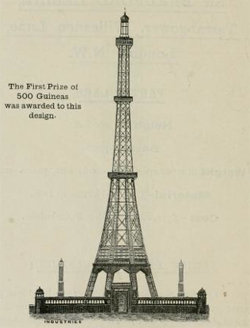
Designed as London’s response to the Eiffel Tower, Watkin’s Tower was the brainchild of railway entrepreneur and MP Sir Edward Watkin.

Watkin's-TowerFollowing the opening of the Eiffel Tower in 1889, Watkin wanted to go one better in London and build a tower than surpassed its 1,063 feet (324 metres) height.

He apparently first approached Gustave Eiffel himself to design the tower which was to be located as the centrepiece for a pleasure park development at Wembley Park in London’s north (which, incidentally, would be reached by one of Sir Edward’s railway lines – he opened Wembley Park station to service it). But Eiffel declined the offer and Watkin subsequently launched an architectural design competition.

Among the 68 designs received from as far afield as the US and Australia were a cone-shaped tower with a railway spiralling up its exterior, a Gothic-style tower (also with a railway), a tower topped with a 1/12 scale replica of the Great Pyramid, one modelled on the spire of Bow Church in Cheapside and one topped by a giant globe (you can see the catalogue of all entries here).

The winning entry was submitted by Stewart, MacLaren and Dunn who proposed a steel eight legged tower soaring 1,200 feet (366 metres) into the sky. To be lit with electric lighting at night, it came with two observation decks with restaurants, theatres and exhibition space as well as winter gardens, Turkish baths, shops, promenades and a 90 room hotel as well as an astronomical observatory. The top of the tower would be reached by a series of elevators.

The first stage of the project – formally known as London Tower or the Wembley Park Tower – had still not been completed when Wembley Park opened in May, 1894 – standing 154 feet (47 metres tall), it was finally finished in September the following year.

It was to never rise higher. The project become mired in problems – Watkin retired through ill health (and died in 1901), the structure started to subside and the construction company went into liquidation. Dubbed Watkin’s Folly and the London Stump, what there was of the tower was eventually demolished between 1904-1907.

While the dream of the tower never came to be, the site nonetheless became a popular vehicle for recreation and the site was later used for the 1924 British Empire Exhibition with Wembley Stadium built over the spot where the tower had once stood.

This Week in London – Hogarth cartoons; Daniel O’Connell blue plaque; and, Peder Balke paintings on show…

The works of famed 18th century chronicler of London, William Hogarth, are on show at the Cartoon Museum in Bloomsbury. Marking the 25oth anniversary of his death on the night of 25th/26th October, 1764, the display Hogarth’s London features more than 50 of the artist’s best known satirical prints including A Harlot’s Progress, A Rake’s Progress, The Four Times of Day, Industry and Idleness and Gin Lane and Beer Street. A series of events – including an evening of Baroque dance & music, gin, beer and cartooning on 28th November – accompanies this exhibition which runs until 18th January and is supported by The William Hogarth Trust. Admission charge applies. For more, see www.cartoonmuseum.org/exhibitions/current-exhibitions/hogarth-s-london.

Nineteenth century Irish political leader Daniel O’Connell has been honoured with an English Heritage blue plaque as his former London home. Known as ‘The Liberator’, O’Connell was an abolitionist who successfully campaigned for civil and Catholic rights – including the right for Catholics to sit in the British Parliament. The first popularly elected MP since the Reformation, he lived in the property at 14 Albermarle Street in Mayfair with his family for several months in 1833 – a year in which a number of his supporters were elected to the House of Commons and in which the act to abolish slavery was given royal assent. For more, see www.english-heritage.org.uk/discover/blue-plaques/.

On Now: Peder Balke. The first ever UK exhibition focused on the paintings of this 19th century Norwegian artist is underway at the National Gallery on Trafalgar Square. Held in conjunction with the Northern Norway Art Museum, the exhibition features more than 50 paintings, the majority of which have never been seen in the UK before. The display includes works from across Balke’s career, including The Tempest (c 1862), the only painting by a Norwegian artist in the gallery’s collection. This free exhibition runs in the Sunley Room until April. For more, see www.nationalgallery.org.uk.

Send all items for inclusion to exploringlondon@gmail.com.

What’s in a name?…Fulham…

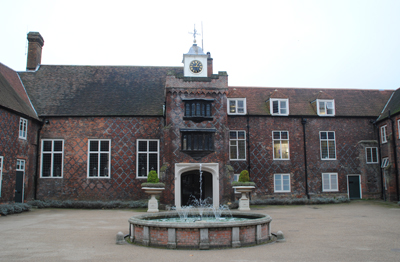
Fulham-PalaceThis Thameside area in London’s west has a long and storied history and its name is a reflection of it.

Long home to the ‘country’ manor of the bishops of London (Fulham Palace, pictured above), the name Fulanham is recorded as early as the late 7th century.

While there’s been speculation in the past that the name Fulham (also recorded among other variations as Fullam) was a corruption of ‘fowl-ham’ – relating to the wild fowl that were to be found here – or of ‘foul-ham’, relating to the muddied waters, that’s now apparently generally deemed not to be the case.

Instead, its name most likely owes its origins to an Anglo-Saxon named Fulla and the Old English word ‘hamm’ – a term for a water meadow or piece of land enclosed in a bend in a river (in contrast to the more common ‘ham’ which refers to an estate or homestead) – and referred to the manor he owned here, its boundaries set by a bend in the Thames. (It should be noted there is evidence of earlier occupation of the site by the Romans and as far back as the Neolithic era).

In about 700, the manor of Fulham – which includes the area we now think of as Fulham as well as land stretching as far afield as Acton, Ealing and Finchley – was acquired by Bishop Waldhere of London from Bishop Tyrhtilus of Hereford. Since Tudor times, Fulham Palace was used as the country home of the bishops of London and in the 20th century became their principal residence. It was used as such until 1975 and now houses a museum and reception rooms.

As well as now being used for the area which once contained what became the village of Fulham itself, since 1979 the name has also been used in that of the Borough of Hammersmith and Fulham. Interestingly, Fulham Broadway tube station was known as Walham Green when it first opened in 1880 and was only given its current name in 1952.

The bishop’s palace (and the nearby riverside Bishop’s Park) aside, other landmarks in the area include the Grade I-listed All Saints Church, which is largely late Victorian and which hosts the grave of abolitionist Granville Sharp, and the nearby Powell Almhouses which date from 1869.

It’s also linked by Putney Bridge with Putney on the other side of the Thames; the current bridge is the work of Sir Joseph Bazalgette and was built in 1882 – it replaced an earlier wooden bridge built in 1729 and overlooks where the annual Oxford-Cambridge Boat Race begins (other bridges spanning the river from Fulham include the rather ugly Wandsworth Bridge).

Known during the 18th century as something of a mecca for gambling, prostitution and other debauched leisure activities, these days Fulham is known for its football club, Fulham FC headquartered at Craven Cottage stadium (named for a cottage owned by Baron Craven which once stood here), shopping and is a sought-after residential location.

A Moment in London’s History – The London Beer Flood of 1814…

For some it sounds like a dream come true but what is known as the London Beer Flood of 17th October, 1814, was a very real tragedy, leaving eight dead in its wake.

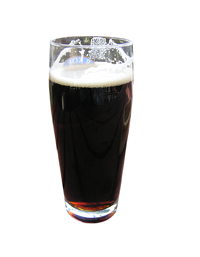
PorterThe flood of more than a million litres of fermenting porter – a dark beer (pictured) – occurred when corrosion caused one of the metal hoops around a three storey high vat to give way inside the Horse Shoe Brewery.

The force of the vat’s collapse – which took place late in the afternoon – caused further vats to rupture and the resulting wave of beer reportedly stood as tall as 15 foot high as it smashed into neighbouring buildings.

Standing at the corner of Tottenham Court Road and Oxford Street in central London, the brewery was located in the midst of the St Giles Rookery – a overcrowded slum filled with flimsy structures. This meant the damage was considerable and while many buildings were at least partially damaged, the worst hit were a pair of homes which were apparently completely destroyed.

Among the dead were four women and a three-year-old boy who were attending a wake for a child in a nearby basement and a four-year-old girl and her mother who were having tea in their house.

While an enterprising watchman apparently charged voyeurs to see the ruins of the vat, it is believed that reports mobs ran amok getting drunk on the spilt beer have no basis in fact.

The brewers, Henry Meux & Co, were subsequently taken to court but, with the incident ruled an “Act of God”, no-one could be held accountable (in fact, the brewers were refunded duties they had paid on the lost beer). The brewery itself was finally demolished in 1922 and the Dominion Theatre now stands on the part of the site.

The nearby Holborn Whippet pub now commemorates the event with a special brew.

PICTURE: Michal Zacharzewski/www.freeimages.com

This Week in London – Sherlock Holmes at the MoL; Rembrandt’s latter years; and, William Morris’ legacy..

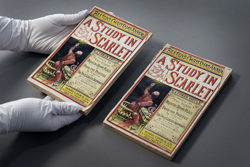
Sherlock-15Sherlock Holmes and his relationship to London, the city in which he lived, is the focus of a new exhibition which opens at the Museum of London from Friday. Sherlock Holmes: The Man Who Never Lived and Will Never Die, the first major temporary exhibition on Sir Arthur Conan Doyle’s famous character to be held in London in more than 60 years, will look at his literary origins and his relationship with late 19th century London, through to his portrayal in popular culture including through stage and screen performances starring everyone from Peter Cushing to Jeremy Brett and Robert Downey, Jr. Highlights of the exhibition include Conan Doyle’s notebook containing the first ever lines of a Sherlock Holmes story and notes in which he experimented with names for his to leading characters (later Holmes and Dr John Watson), a rare oil on canvas painting of Conan Doyle painted by Sidney Paget in 1897 which has never before been on public display in London, the original manuscript of 1903’s The Adventure of the Empty House, the Belstaff coat and the Derek Rose camel dressing gown worn by Benedict Cumberbatch from the BBC series and original pages from Edgar Allan Poe’s 1841 hand-written manuscript of The Murders in the Rue Morgue (Poe was an important influence on Conan Doyle’s writings). The exhibition will also include paintings, drawings, illustrations and photographs of Victorian London along with a vast collection of objects from the period. Runs until 27th April. Admission charge applies. For more, see www.museumoflondon.org.uk/sherlock. PICTURE: Two editions of A Study in Scarlet in which Conan Doyle introduced Holmes and Watson, Beeton’s Christmas Annual 1887.

The first ever in-depth exploration of Rembrandt’s final years of painting opened at the National Gallery off Trafalgar Square yesterday. Rembrandt: The Late Works features about 40 paintings, 20 drawings and 30 prints with key works including moving The ‘Jewish Bride’ (from Rijksmuseum in Amsterdam), An Old Woman Reading (The Buccleuch Collection in Scotland), Bathsheba with King David’s Letter (Musee du Louvre in Paris) and Lucretia (National Gallery of Art in Washington, DC) as well as the last minute loan of The Conspiracy of the Batavians under Claudius Civilis (from the Royal Academy of Fine Arts in Sweden). The exhibition provides new insights into some of the artist’s most famous works including The Sampling Officials of the Amsterdam Drapers (aka The Syndics), and brings together a number of self-portraits usually seen in different galleries. The exhibition runs in the Sainsbury Wing until 18th January. Admission charge applies. For more, see www.nationalgallery.org.uk.

The first exhibition devoted to Pre-Raphelite William Morris and his influence on 20th century life opens at the National Portrait Gallery off Trafalgar Square today. Anarchy & Beauty: William Morris and His Legacy, 1860-1960 explores the ‘art for the people’ movement which Morris and the artists of the Pre-Raphelite Brotherhood initiated, reveals the work of Arts and Crafts practitioners inspired by Morris, and shows how Morris’ “radical ideals” influenced the Garden City movement and post-war designers like Terence Conran. Highlights include Morris’ handwritten Socialist Diary, his gold-tooled hardbound copy of Karl Marx’s Le Capital and Burne-Jones’ handpainted Prioresses Tale wardrobe. Admission charge applies. The exhibition runs until 11th January. For more, see www.npg.org.uk.

Send all items to inclusion to exploringlondon@gmail.com.

What’s in a name?…Chancery Lane

This central London street, which runs between Fleet Street and High Holborn, has long been associated with the law and government, and still is so today with the Royal Courts of Justice standing close to its southern end and Lincoln’s Inn – one of the four Inns of Court – located on the lane’s western side.

Its name is a corruption of the original Chancellor Lane – a moniker which apparently dates back to at least the 14th century – and which referred to the buildings where the official documents of the Lord Chancellor’s Office, known as the Rolls of the Court of Chancellory (Chancery), were stored.

The street was apparently first known as New Street and later as Converts Lane; the latter in reference to the House of Converts (Domus Conversorum) King Henry III founded here in the 1272 for the conversion of Jews to Christianity.

When King Edward I expelled all the Jews from the kingdom in 1290, the ‘house’ continued in use as such for foreign-born Jews, albeit with very small numbers of residents until the early 17th century.

In the meantime, in 1377 King Edward III gave orders that the complex of buildings used by the Domus Conversorum also be given over to the Master of the Rolls for the storage of chancellory documents and it was this move which led to the lane gaining its new name.

The buildings – which included a chapel which had become known as the Chapel of the Master of the Rolls or the simply the Rolls Chapel which had been rebuilt several times including to the designs of 17th century architect Inigo Jones – were finally demolished around the turn of the 20th century and subsumed into the Public Records Office complex on Chancery Lane (this was formerly housed in what is now the Maughan Library of King’s College London).

The lane these days is also home to such august institutions as The Law Society and the London Silver Vaults. It also lends its name to an Underground Station located to the east of the lane entrance in High Holborn.

This Week in London – Dr Livingstone’s beetles; the Great River Race; Snowdon at the NPG; and Foundlings at War…

BeetleFrom Dr Livingstone, I presume? A recently unearthed collection of beetles gathered together by Dr David Livingstone during his Zambezi expedition of 1858-64 will go on display in its original box at the Natural History Museum in South Kensington on Friday night. The specimens were found among the museum’s 10 million beetles by beetle curator Max Barclay who stumbled on an unusual box received from a private collector. The collector was later found out to be amateur entomologist Edward Young Western (1837-1924) who apparently bought the specimens from a member of Livingstone’s expedition. The 20 beetles found inside the box are believed to the only surviving specimens known to have been collected by Livingstone. The specimens will be on show as part of Science Uncovered, a free annual after hours event – part of European Researcher’s Night – which will take place at the museum between 3pm and 10.30pm Friday night. Other highlights of the night include the chance to extract DNA from strawberries and bananas, create your own earthquake and chat live with NASA about chasing asteroids. For more, see www.nhm.ac.uk/scienceuncovered. PICTURE: Giant Predatory Ground Beetle, Termophilum alternatum © The Trustees of the Natural History Museum, London.

Totally Thames – the month long celebration of the great river – is going out with a bang this weekend with more than 300 crews expected to take part in the Great River Race. Running from Millwall to Ham in Surrey, the 21.6 mile long event attracts entries from across the globe. The first boats leave Millwall at 12.40pm. Head to the riverbank between Richmond and Ham at approximately 3.40pm to see the winners cross the line to a cannon broadside. For more on the Great River Race, see www.greatriverrace.co.uk. Other events on as part of Totally Thames this weekend include historic riverside walks – one focused on Brunel and another on London’s ports before the Great Fire of 1666 as well as exhibitions including Richmond’s River at Orleans Gallery House in Twickenham and your last chance to see Florentijn Hofman’s HippopoThames. For more on Totally Thames, see www.totallythames.org.

Some of Snowdon’s most iconic images will be on show as part of a new exhibition opening at the National Portrait Gallery near Trafalgar Square on Friday. Snowdon: A Life in View will feature studio portraits spanning a period from the 1950s to the 1990s alongside images from Private View, Snowdon’s 1965 examination of the British art world, created in collaboration with art critic John Russell and then director of Whitechapel Gallery, Bryan Robertson. More than 40 black-and-white portraits are included in the display including some works acquired by the gallery last year. To be held in Room 37 and 37a of the ground floor Lerner Contemporary Galleries until 21st June. Admission is free. For more, see www.npg.org.uk.

On Now: Foundlings at War: World War I. This display at the Foundling Museum in Bloomsbury reveals for the first time the stories of foundlings who fought as well as those of the mothers forced to leave their children at the hospital as a result of bereavement or abandonment of those serving abroad. A free digital ibook, The Foundlings at War: World War I, containing expanded background information was published to coincide with the opening of the display earlier this month and can be downloaded from iTunes. The exhibition is part of a major research project, Foundlings at War, supported by the Heritage Lottery Fund and is the first of several displays examining the institution’s historic links with the military. For more, see www.foundlingmuseum.co.uk.

Send all items for inclusion to exploringlondon@gmail.com.

Lost London – The General Post Office (aka GPO East)…

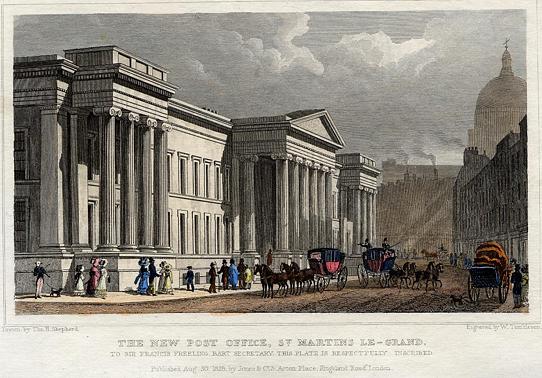
While the history of the General Post Office dates back to the reign of King Charles I, London’s first purpose-built facility for mail was constructed on the east side of St Martins-le-Grand in the 1820s.

GPOThe post office headquarters had hitherto been located in the area of Lombard Street but in 1814 it was decided that the site here couldn’t be developed any further. The site in St Martins-le-Grand was subsequently acquired and plans for the building commenced.

Designed by Sir Robert Smirke (famous for his design of the British Museum), the grand structure was built on the site of what were slums between 1825 and 1829 and featured a 400 foot long “Grecian-style” street frontage. The exterior of the building was lit with 1,000 gas burners at night.

As well as serving as the post office’s administrative headquarters, the building also contained the sorting office and the main London public post office. Along with a grand public hall and offices, it contained rooms – including an armoury – for the guards who protected mail coaches and accommodation for clerks charged with receiving foreign mail (obviously at all hours!).

A new building was added to house the telegraph department on the west side of the street in the 1870s and further buildings followed, leading Smirke’s initial building to become known as ‘GPO East’.

In 1910, the facility was bursting at the seams and so the headquarters was moved to the King Edward VII Building. Smirke’s grand building was somewhat controversially demolished in 1912. A fragment – one of the capitals which topped one of the external columns – is apparently located in Vestry Road in Walthamstow.

For more on London’s postal heritage, visit the British Postal Museum & Archive.

PICTURE: Thomas Shepherd/Wikipedia

Famous Londoners – Madame Tussaud…

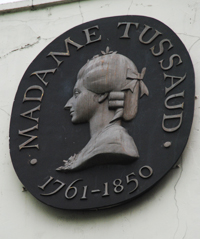
Famed around the world for her London-based wax museum (and the chain of waxworks which now bears her name), French-born Madame Tussaud is a towering figure of the early 19th century.

Born Anna Maria Grosholtz in Strasbourg on 1st December, 1761, Marie Tussaud’s association with waxworks came early when, her father Joseph having apparently died from wounds sustained in the Seven Years War just before her birth, she accompanied her mother Anna Maria Walder to Berne in Switzerland where her mother took up a position as a housekeeper for a physician and anatomical wax sculptor and portraitist Dr Philippe Curtius.

Madame-TussaudIn 1765, Dr Curtius moved to pre-Revolutionary Paris where he was soon to open a couple of establishments – at the Palais-Royal and the Boulevard du Temple (later consolidated at the latter site) – displaying his works in wax. Marie, whom Dr Curtius brought to Paris with her mother in 1768, started working with him on wax models and in 1777, at the age of just 16, produced her first wax figure, that of philosopher Voltaire. Other early works of Madame Tussaud’s depicted Rousseau and Benjamin Franklin.

The story goes that such was the renown of Tussaud and her “uncle” Dr Curtius, that their social circle came to include members of the Royal Family. Tussaud is widely believed to have been an art tutor to King Louis XVI’s sister Elizabeth and may have even taken up residence at Versailles.

Tussaud recounts that she was arrested during the French Revolution – the story goes that she was imprisoned and eventually released thanks to the intervention of family friend and revolutionary Jean-Marie Collot d’Herbois but whether this is true remains a matter of debate.

Tussaud claims she was then forced make death masks of those who ended their life on the scaffold including Louis XVI, Marie Antoinette, Marat and Robespierre. When Curtius died in 1794, she inherited his wax works and the following year married an engineer Francois Tussaud with whom she had two sons, Joseph and Francois (later known as Francis).

In 1802, Madame Tussaud accepted an invitation to go to London to exhibit her work at the Lyceum Theatre but thanks to the outbreak of the Napoleonic Wars, she and her four-year-old son Joseph were unable to return to France. Separated from her husband, she subsequently spent the next three decades travelling with her exhibition – which included relics from the Revolution and, like those of Curtius, was being constantly updated to reflect current affairs – around Britain and Ireland.

Her son Francois joined her in 1822 and Tussaud continued travelling until 1835 when she first established a permanent exhibition in Baker Street, London. Known as the Baker Street Bazaar, it apparently contained more than 400 wax figures. In 1846, Punch Magazine is credited with having invented the term ‘Chamber of Horrors’ for the room where the relics of the French Revolution were displayed.

Tussaud wrote her memoirs in 1838, and, in 1842, completed a wax model of herself. She died in her sleep on 16th April, 1850, in London. Her son Francois became chief artist for the exhibition after her retirement – he was succeeded by his son and then grandson. The exhibition moved to its current site in Marylebone Road in 1884.

Now owned by the Merlin Entertainments Group, Madame Tussauds has branches in cities in some 10 countries as well as its London base. Many of her original models still exist and are on display in the London museum along with the exhibition’s oldest attraction – known as ‘Sleeping Beauty’, it dates from 1863 – a breathing likeness of Louis XV’s sleeping mistress Madame du Barry.

For more on Madame Tussauds today, see www.madametussauds.com.

For more on the life of Madame Tussaud, see Kate Berridge’s book, Waxing Mythical: The Life and Legend of Madame Tussaud.

10 sites from Shakespearean London – 9: Memorialising Shakespeare (part 2)…

Following on from last week’s post, we look at a couple more London memorials to The Bard,  playwright William Shakespeare…

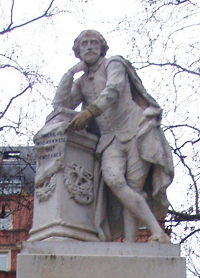
Shakespeare-Leicester-SquareLeicester Square: Returned to the West End square last year following its restoration (and the square’s redevelopment), this statue of Shakespeare – claimed to be the only outdoor one in London – was designed by architect John Knowles in 1874 when the square was constructed. Now Grade II-listed, it depicts Shakespeare leaning on a pedestal, pointing to a scroll which reads “There is no darkness but ignorance”, a quote from Twelfth Night. An inscription on the plinth upon which Shakespeare stands, refers to the laying out of the square by Albert Grant and doesn’t mention the playwright at all. The statue stands in the middle of a fountain, upgraded  as part of the recent overhaul of the site. PICTURE: Carcharoth/Wikipedia.

Primrose Hill: Shakespeare’s Tree on Primrose Hill was originally planted in April, 1864, to mark the 300th anniversary of his birth. An estimated 100,000 people marched to the site to watch the tree planting by poet Eliza Cooke and actor Samuel Phelps which was organised by the Workingmen’s Shakespeare Committee – apparently in response to the lacklustre efforts of a government-backed committee to mark the anniversary. The tree stood for 100 years before it died and was replaced with an oak sapling planted in 1964 actress Dame Edith Evans. A plaque which was attached to the tree detailing when it was planted has long since gone but there is talk of some sort of a permanent new memorial on the site.

There are other numerous places in London where Shakespeare – and his works – are remembered in London. One of our favourites is based in Love Lane and recalls the work of John Heminge and Henry Condell is getting Shakespeare’s works out to the world (for more on this, see our previous post here).

In our final post in this series next week, we take a look at some of the key London locations mentioned in Shakespeare’s plays.

Treasures of London – Speakers’ Corner…

An iconic location in one London’s most well-known Royal Parks, the history of Hyde Park’s Speakers’ Corner as a site of public oratory dates back to at least the mid 1800s (although thanks to the site being located close to where Tyburn Tree once stood, its arguable that the tradition goes further back, to when condemned prisoners were able to have a final word on the gallows – but for more on the Tyburn Tree, see our previous post here).

Located near Marble Arch on the north-east corner of Hyde Park, the area was the scene of massive protests by the Reform League in the mid 1800s which were aimed at extending the voting franchise to the working class. In 1866, protestors tore up the railings and rioted for three days after they approached the area and found themselves locked out of Hyde Park. They returned en masse the following year in defiance of a government ban but were allowed to protest without intervention.

While there was some opposition to the idea of public protests in the area, in 1872, the passing of the Parks Regulation Act meant the park’s authorities could issue permits for speakers (while it didn’t enshrine the right to speak in law, it did establish the general principle of speaking in parts of the park). The area covered by the act is much larger than Speakers’ Corner but tradition has established that as the site where people gather to speak (and listen).

Anyone can now turn up to address the public at Speakers’ Corner whenever the park is open but tradition has meant most of the speaking happens on a Sunday morning (when you’ll certainly encounter some very regular speakers). The only condition is that the speech be considered “lawful”.

Among the more notable speakers who have attended are Karl Marx, Vladimir Lenin, George Orwell, George Bernard Shaw and William Morris. The suffragettes also held meetings there in the early 1900s and, in 2003, it was the scene of a massive rally against the taking of military action in Iraq.

Numerous other countries have since adopted the idea and created their own version of a “speakers’ corner” including Australia, Singapore, Canada and the US.

London’s Speakers’ Corner has undergone a makeover in recent months (somewhat controversial to some) and was last month reopened by the Culture Secretary Sajid Javid who described Speakers’ Corner as a “deeply symbolic space that celebrates freedom of speech”.

The refurbishment included new trees and plantings, resurfacing and the installation of railings, designed by Royal Parks landscape architect Ruth Holmes and landscape architects Burns + Nice and carried out by award-winners Bowls and Wyer.

For more, see www.royalparks.org.uk/parks/hyde-park/hyde-park-attractions/speakers-corner.

This Week in London – Bridges in focus; cheap entry to Tower Bridge; WW1 nurse honoured; and, Dennis Hopper’s photographs…

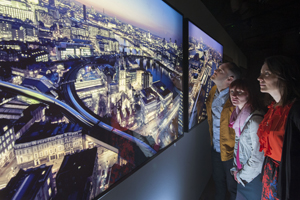
Bridge-ExhibitionA new exhibition on London’s bridges commemorating the 120th anniversary of the opening of Tower Bridge opens at the Museum of London Docklands tomorrow. The largest art exhibition ever staged at the museum, Bridge features rarely seen contemporary and historical works, photography, films and maquettes of London’s bridges and explores the role they play in the city. Highlights include Giovanni Battista Piranesi’s 1766 etching A view of the intended bridge at Blackfriars, London, Charles Ginner’s 1913 work London Bridge, and Ewan Gibbs’ 2007 linocut London. The exhibition will also feature a rare photograph taken by William Henry Fox Talbot in 1845, Old Hungerford Bridge. The oldest photograph in the museum’s collection, it will only be on display for one month from tomorrow. The exhibition, entry to which is free, runs until 2nd November. For more, see www.museumoflondon.org.uk/docklands/. (PICTURE: © Museum of London Docklands).

Don’t forget there is a special admission entry offer of just £1.20 to the Tower Bridge Exhibition this Monday, 30th June – 120 years to the day since the Prince of Wales (later King Edward VII) opened the iconic structure. Tickets must be bought at the door. There will be some Victorian re-enactors at the bridge on the day including police, tourists and engineers and each visitor will receive a special ticket which replicates the design of the invite to the 1894 ceremony (a limited edition commemorative badge will also be available to buy). For more, see www.towerbridge.org.uk.

The Australian-born nurse responsible for the entire nursing operation on the Western Front during World War I has been commemorated with an English Heritage Blue Plaque unveiled at her former home in Chelsea. Maud McCarthy, one-time Army Matron-in-Chief, was in charge of more than 6,000 British, Imperial and American nurses in 1918. Her accolades included the Florence Nightingale Medal – the highest international distinction a nurse can receive. McCarthy lived at 47 Markham Square for almost 30 years after the war, from 1919 until shortly before her death in 1949. For more, see www.english-heritage.org.uk/discover/blue-plaques/.

An exhibition featuring more than 400 photographs taken by the late US actor, film director and artist Dennis Hopper opened at the Royal Academy of Arts off Piccadilly today. Dennis Hopper: The Lost Album is the first time the body of work – first shown in Texas in 1970 – has been displayed in the UK. The photographs document the social and cultural life of the American Sixties and cover a range of themes and subjects. They include portraits of the likes of Paul Newman, Andy Warhol and Jane Fonda, and images depicting members of counter-cultural movements as well as events such as the 1965 march civil rights march from Selma to Montgomery. Admission charge applies. Runs until 19th October. For more, see www.royalacademy.org.uk.

Send all items of interest for inclusion to exploringlondon@gmail.com.

Treasures of London – The grave of Karl Marx…

Karl-Marx3

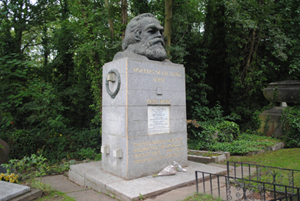
One of the highlights of any visit to Highgate Cemetery, the grave of Karl Marx is one of London’s most visited final resting places even though it didn’t attract a crowd at the time of his death.

Karl-Marx2Marx died in London on 14th March, 1883, having battled ill health for many months beforehand. He was buried at Highgate Cemetery just three days later and there were reportedly only between nine and 11 mourners at the funeral (his wife Jenny was not among them – she had died in late 1881 and is buried in the same grave). Among those who did attend was Friedrich Engels, who, in his eulogy, described Marx as “the greatest living thinker” and told of how he had “peacefully gone to sleep”.

While the original tomb was modest, the grander memorial which stands on the grave today was erected in 1954 by the Communist Party of Great Britain. It is inscribed with Marx’s words “Workers of all lands unite” and “The philosophers have only interpreted the world in various ways – the point however is to change it” and topped with a larger-than-life bust of Marx created by Laurence Bradshaw.

As well as Marx’s wife, others buried in the tomb include Marx’s grandson, Harry Longuet, who died only six days after his grandfather at the age of four, Eleanor Marx, his daughter, who died in 1898, and Helene Demuth, the Marx family housekeeper.

The monument was attacked in 1970 by vandals using a home-made bomb, reportedly causing £600 of damage which was quickly fixed. There have been a couple of further attacks on the tomb.

WHERE: Highgate East Cemetery, Swain’s Lane (nearest Tube station is Archway); WHEN: 10am to 5pm Monday to Friday/weekends and public holidays 11am to 5pm (last admission 4.30pm); COST: £4 adults/children under 18 free (tours additional); WEBSITE: www.highgatecemetery.org

This Week in London – London’s architectural festival; Tower Bridge celebrates its 120th with gifts; and, unseen Nicholsons at Dulwich – plus late addition: this year’s Keats Festival…

The month long London Festival of Architecture kicked off this week with the first of more than 200 activities taking place right across the capital. Now in its 10th year, the festival features talks, exhibitions, film screenings, cycle rides, open studios and the chance to explore the city with experts at hand. Headline events include a gathering of international architects at Balfron Tower where they will come up with new ideas for the surrounding area of Poplar as they explore the influence of emigre architecture on London, a talk by Will Self on architecture, and an exploration of ‘The Death and Life of Great London High Streets’ with experts guided people around newly completed projects. Other highlights include the House of Muses, an architectural installation at the Museum of London, the rare chance to see a late 16th century model of country house Tyringham Hall in Buckinghamshire which was commissioned by Sir John Soane (and will be on display at the Sir John Soane Museum), and the art installation, The Pungent Subway which will see a 55-year-old subway in Elephant and Castle transformed by sweet-smelling herbs and flowers as well as GUN Architects Rainforest in Bedford Square. For a full programme of events, many of which are free, check out details on the website, www.londonfestivalofarchitecture.org.

London icon Tower Bridge celebrates its 120th anniversary this year and to mark the event, the Tower Bridge and its events partner Seasoned Events are giving away free tickets to special sunset event. To take place on its high-level walkway on 30th June, the night, which runs from 7pm to 9.30pm, will feature Victorian-themed entertainment in commemoration of the age in which the great structure was constructed. For your chance to win tickets, look out for special competition posts by Tower Bridge on Facebook (www.facebook.com/towerbridge) and Twitter (@TowerBridge) from 9th June and share them on social media by 19th June. As many as 120 lucky winners will be selected at random and notified by 5pm on 20th June. Each ticket includes entry for two and a drink token (and obviously you must be in London and available to attend on 30th June). Good luck! For those who don’t win, there is a consolation prize – entry to the Tower Bridge Exhibition is being dropped to just £1.20 (120 pence) on 30th June when buying tickets at the door. The exhibition will that day also be playing host to a range of ‘Victorian visitors’ – from policeman and tourists to engineers. For more, see www.towerbridge.org.uk.

• Featuring previously unexhibited or rarely seen works by important 20th century painters Ben and Winifred Nicholson, a new exhibition opened at the Dulwich Picture Gallery in south London yesterday. Art and Life: Ben Nicholson, Winifred Nicholson, Christopher Wood, Alfred Wallis, William Staite Murray, 1920-1931 features more than 80 words with 16 being displayed for the first time including Ben Nicholson’s 1926-27 (still life) and Winifred Nicholson’s Flowers in a Glass Jar. The display is a rare opportunity to see works by the Nicholson’s different views of the same landscapes, seascapes, still-lives and portraits and has the works grouped by locations where they painted including London, Lugarno in Switzerland, Cumberland and Cornwall. Alongside works by the Nicholsons, the display also features the art of their fellow artists and friends including Christopher Wood, the self-taught marine painter Alfred Wallis, and potter William Staite Murray, and the exhibition is curated by the Nicholson’s grandson, art historian Jovan Nicholson. Runs until 21st September. Admission charge applies. For more see www.dulwichpicturegallery.org.uk.

Late addition: The annual Keats Festival kicks off at Keats House in Hampstead on Saturday, 7th June, with highlights including guided tours of the house, plenty of poetry readings and workshops, musical performances, a screen-writing workshop and a family day on 15th June. Other events at the Keats Grove house where the poet lived between 1818 and 1820 include an afternoon tea “in the company of Keats” and an offsite event held at UCL’s Bloomsbury campus next Friday – One Day in the City: A Celebration of London and Literature – which will feature performance poetry, a seminar on Keats and a contemporary retelling of The Canterbury Tales. Many events are free but many require pre-booking. For more information, check out www.cityoflondon.gov.uk/things-to-do/attractions-around-london/keats-house/Pages/Keats-Festival.aspx.

Send all items of interest for inclusion to exploringlondon@gmail.com.

What’s in a name?…Maida Vale

This district in west London – located to the south-west of St Johns Wood – takes its name from the Italian town of Maida in Calabria where, in 1806, the British won a victory over Napoleon.

Led by Sir John Stuart (later Count of Maida), about 5,000 British troops defeated a larger number of French in a battle in what was a much-needed boost to the British after the defeat at Austerlitz in December the previous year.

Regent's-Canal-looking-toward-Little-VeniceThere was apparently a pub located in the area named, in the wake of the victory, ‘The Hero of Maida’ in reference to Stuart and his role in the battle. The pub has since gone but its name lives on in the street and the district which still carries it.

Landmarks in Maida Vale include the basin – complete with houseboats and the puppet theatre barge – known as Little Venice (some say this name was coined by poet Robert Browning; others attribute it to Lord Byron) where Regent’s Canal meets with the Paddington arm of the Grand Junction Canal (pictured is Regent’s Canal looking toward Little Venice).

Maida Vale is also home to the BBC Maida Vale Studios (on Delaware Road) while notable residents have included computer science pioneer Alan Turing who was born at 2 Warrington Crescent in 1912 and David Ben-Gurion, first Prime Minister of Israel, who lived at 75 Warrington Crescent.

The area to the south-west is unofficially known as Maida Hill and this was apparently initially the name used for the entire area until the more romantic Maida Vale came into usage in the mid 19th century. Maida Vale also gives its name to a Tube station – it opened in 1915.

Daytripper – Walmer Castle…

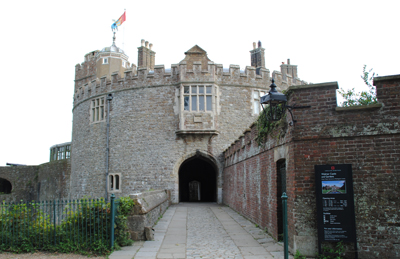
Walmer-CastleA coastal artillery fort built on the orders of King Henry VIII in light of a threatened Catholic invasion, Walmer Castle on the Kentish coast is officially the residence of the Lord Warden of the Cinque Ports.

What was a rather functional artillery platform has been embellished significantly in the years since it became the official residence of the Lord Warden in 1708, creating a comfortable home for holders of the title who have included Queen Elizabeth, the Queen Mother, the Duke of Wellington and bookseller WH Smith.

The ‘castle’, located about a two hour, 10 minute train journey from London (and then a mile walk from Walmer Station), was constructed in 1539 as one of a string of forts – others include nearby Deal Castle and the long gone Sandown Castle – designed to protect the watery stretch between Goodwin Sands and the coast known as the Downs.

Its low circular design, featuring a central ‘keep’ reached by a drawbridge and surrounded by a curtain wall with four projecting, semi-circular bastions, was influenced by the need to defend against heavy artillery and provide a platform for guns.

Initially garrisoned with ten gunners, four soldiers and two porters under the command of a captain and a lieutenant, Walmer saw little action during Tudor times but was the site of a siege during the Civil War.

Obsolete by the end of the 17th century, it was the Duke of Dorset who was the first Lord Warden (an office created in the thirteenth century to oversee the affairs of the Cinque Ports Confederation, a grouping of five ports including Hastings, Romney, Hythe, Dover and Sandwich) to use Walmer Castle as a residence, embarking on a renovation and extension of the existing structure.

Further alterations was carried out by successive Lords Warden, the most extensive being those made by  the 2nd Earl Granville, Lord Warden between 1865 and 1891, who commissioned architect George Devey to oversee the additions.

The gardens, meanwhile, which are well worth visiting in their own right, were also Granville’s work as well as that of an earlier Lord Warden, Prime Minister William Pitt the Younger, who was Lord Warden between 1792 and 1806.

The Duke of Wellington (Lord Warden between 1829 and 1852) reputedly enjoyed his time staying at the castle – he was even visited by the young Princess Victoria here in 1835 (she later stayed for a month with her family when Queen) and died here on 14th September 1852. His room can still be seen inside – the contents include the armchair he was sitting in when he died (the rooms also include a small museum dedicated to Wellington and another dedicated to William Pitt).

Not all Lords Warden enjoyed the property. Sir Winston Churchill, Lord Warden  between 1941 and 1965, never stayed here but Sir Robert Menzies, Prime Minister of Australia and Lord Warden between 1966 and 1978, did and the Queen Mother, Lord Warden between 1978 and 2002, was a regular visitor.

The castle was opened to the public soon after responsibility for it was transferred from the War Office to the Ministry of Works in 1905. It is now under the care of English Heritage and the rooms inside are decorated as they were in the 1930s (it was WH Smith who ensured historic furnishings at Walmer could not be removed). There are even a couple of holiday cottages on site which can now be rented.

WHERE: Walmer Castle, Kingsdown Road, Deal, Kent; WHEN: 10am to 6pm daily (until 6th July); COST: Adults £7.90/Children (5-15 years) £4.70/Concession £7.10; WEBSITE: www.english-heritage.org.uk/daysout/properties/walmer-castle-and-gardens/.
Lost London – Montagu House…

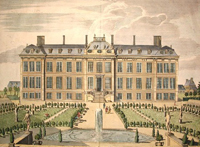
Montagu-HouseThe first home of the British Museum, Montagu House was originally built on what is now the site of the museum in Great Russell Street for courtier and diplomat Ralph Montagu, the 1st Duke of Montagu (among other titles), in the late 1670s.

The Bloomsbury property, which was designed by Robert Hooke and had both French and Dutch influences, had a central block and two service blocks built around a courtyard and featured murals by the Italian artist Antonio Verrio and wall paintings by Frenchman Jacques Rousseau.

In 1686, only a few years after it was completed, the house was gutted in a fire. But the duke had it rebuilt to the designs of French architect Pierre Pouget. It featured a prominent Mansard roof, had interiors created by French artists and formal, much admired, French-inspired gardens (see picture).

In the early 1700s, the 2nd Duke, John Montagu, relocated to the then more fashionable district of Whitehall where he constructed a more modest residence which was later replaced with a mansion.

In 1754, the now neglected Montagu House in Bloomsbury was sold to the trustees of the British Museum and both the gardens and house were restored. The museum, which was officially founded by an Act of Parliament in 1753, opened to the public in the property on 15th January, 1759, with free entry to “all studious and curious persons” (the gardens had opened two years earlier).

The collection was initially based on that of physician, naturalist and collector, Sir Hans Sloane (see our earlier post here), who has bequeathed the 71,000 objects he had collected to King George II (in return for a payment of £20,000 for his heirs).

Montagu House remained the museum’s home until it was replaced by the current museum building, designed by Sir Robert Smirke, which was completed in 1850s.

PICTURE: Wikipedia/James Simon c 1715

A Moment in London’s History – When the last ‘frost fair’ was held on the Thames…

A-view-of-the-River-Thames-1814-by-G-Thompson-©-Museum-of-London

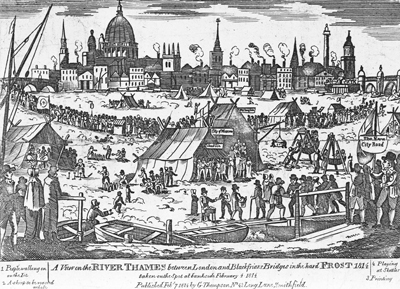
Held during particularly cold winters when the River Thames froze over, ‘frost fairs’ had been part of London’s history, from the Middle Ages up until the last one was held in February 1814, two hundred years ago last month.

The five day revelry started on 1st February and took place on a stretch of the river between Blackfriars and London Bridge (it was the medieval London Bridge in particular – with its 19 arches and wide piers – which helped to slow the river enough to freeze, something unlikely to happen again with the current bridge).

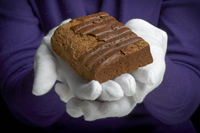
Gingerbread-bought-at-the-last-Frost-Fair-of-1814-©-Museum-of-LondonPeople began to venture out onto the ice and an impromptu fair started taking shape as tents and booths were established selling all manner of food including roast ox, drinks including alcohol like gin as well as hot chocolate, tea and coffee, and souvenirs to take advantage of the passing traffic (a piece of gingerbread from the fair is a star attraction at the Museum of London’s current exhibition on the fair – pictured right). Some of the tents were known by names (similar to a pub sign), such as the Moscow and the Wellington.

Other attractions recorded include children’s play equipment, a gambling den, and printing presses which produced keepsakes to mark the occasion. There were even reports of sightings of an elephant crossing the river.

Several people apparently died at the fair having sunk beneath the ice by the time the snow turned to rain and the ice began to break up. An engraving of the frost fairs by Richard Kindersley can be found on a pedestrian walkway underneath the Southwark end of Southwark Bridge.

The dates for Frozen Thames: Frost Fair 1814 at the Museum of London have been extended until 21st April (there is an accompanying exhibition, Frozen Thames: Frost Fair 1684 running concurrently at the Museum of London Docklands). Admission is free. For more, see www.museumoflondon.org.uk.

MAIN PICTURE: A view of the river Thames, 1814, George Thompson © Museum of London. This print shows the 1814 Frost Fair from the south bank of the Thames, with St Paul’s in the background.