Famous Londoners – John Wesley…

Credited as the founder, along with his brother, of Methodism, it was in London that John Wesley experienced the spiritual awakening that would change his life and lead to the establishment of a new religious movement.

Born on 17th June, 1720, in Epworth, not far from Lincoln, Wesley was the 15th of 19 children born to Samuel Wesley – the rector there – and his wife Susanna. Rescued from a fire in the family rectory at a young age, the event was to have a lasting impression on him leading to his later view that he was set apart for a special purpose – “a brand plucked from the burning”.

Wesley was educated at London’s Charterhouse School and then at Christchurch College in Oxford. Ordained a priest in the Church of England in 1728, he spent two years serving as his father’s curate before returning to Oxford in 1729.

It was there he formed the ‘Holy Club’ with his brother Charles and fellow students including George Whitfield. It’s here that the name ‘Methodist’ was first used as a pejorative term to describe members of the group thanks to their ‘methodical’ way of living – which included religious practises like fasting as well as caring for the ill and prisoners – and which was later adopted by Wesley himself.

Following a largely unsuccessful sojourn in the newly founded American Province of Georgia with his brother Charles (they had been invited by the colony’s first governor, James Oglethorpe, to minister to the new settlers) during which Wesley was involved in a courtship that ended badly, the clergyman fled back to England.

It was in London, on 24th May, 1738, that the clergyman then had his “Aldersgate experience” in which he felt his heart “strangely warmed” while at a religious meeting in Aldersgate Street (there’s a monument – the Aldersgate Flame – to this next to the Museum of London).

Initially influenced by the Moravians (Wesley even visited one of their communities in Germany), he later developed some concerns about some aspects of their teachings and so began forming his own followers into what would become the Methodist Society. Despite considerable opposite from the Church of England (Wesley was still an ordained Anglican minister), the new Methodists continued to work among the poor of London and elsewhere in England.

Barred from many Church of England pulpits thanks to his views on everything from salvation to the role ordinary people could play in the church, Wesley began preaching to large masses in the open air – ‘field preaching’ – as he travelled extensively about the country. He is said to have preached as many as 40,000 sermons and travelled some 250,000 miles during his ministry and campaigned on many social issues – including prison reform and the abolition of slavery – while his brother Charles is credited with writing thousands of hymns.

The first Methodist chapels in the UK were opened in the late 1770s – while the first was in Bristol, the second was opened in City Road, London, in 1778. It is still in use today – you can visit it, the Museum of Methodism (housed in the chapel crypt), and the house where Wesley lived the last 12 years of his life – follow this link for more details. The statue pictured above stands outside.

While he did not ordain ministers in England and throughout his lifetime continued to consider himself an Anglican, in an act which helped lead to the creation of an independent Methodist Church (formally created after his death), in 1784 Wesley ordained ministers to head to the newly independent United States of America after the Anglican Church failed to do so.

John Wesley died on 2nd March, 1791, at the age of 87, in his house. He was entombed at the London chapel.

While at the time of his death, it’s estimated that there were 135,000 members and more than 500 itinerant preachers working under the name  of “Methodist”, Wesley’s legacy was to become far greater as his ideas spread across the globe. It’s now estimated that there are around 70 million Methodists around the world.

Other monuments commemorating Wesley in London include Methodist Central Hall in Westminster – located opposite Westminster Abbey – which was built in the early Twentieth century to mark the centenary of Wesley’s death and a statue of Wesley on St Paul’s Churchyard, erected in 1988.

There’s a terrific walking guide published by the Methodist Church which links sites of relevance to Wesley’s life in London. You can download it here.
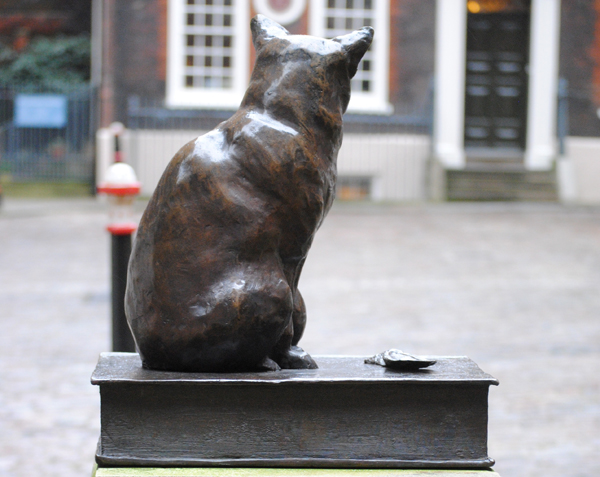
Where is it?…#45


The latest in the series in which we ask you to identify where in London this picture was taken and what it’s of. If you think you can identify this picture, leave a comment below. We’ll reveal the answer early next week. Good luck!

Congrats to Mike, Debbie, Janet, and Zoe (on Facebook), this is indeed the back of the statue of Hodge the cat in Gough Square in the City of London, just outside Dr Johnson’s House at No 17. One of the cats of the famed lexicographer, Dr Samuel Johnson, Hodge had his own moment of stardom in James Boswell’s Life of Johnson in which Dr Johnson is heard remarking that he’s had better cats than Hodge before, apparently in response to Hodge’s reaction, stating that he was “a very fine; a very fine cat indeed” (Johnson was apparently unusual for his love of cats; Boswell did not suffer the same love). This bronze statue of Hodge, by sculptor Jon Bickley and placed here in 1997, has Hodge sitting on a copy of Dr Johnson’s famous dictionary and beside him is some empty oyster shells, referring to Dr Johnson’s habit of buying oysters for his cats to eat. For more on Dr Johnson’s House (where Dr Johnson lived from 1747-59), see www.drjohnsonshouse.org.

Around London – Open House London; 16th century tankard at MoL Docklands; and, Spanish artists shine at the British Museum…

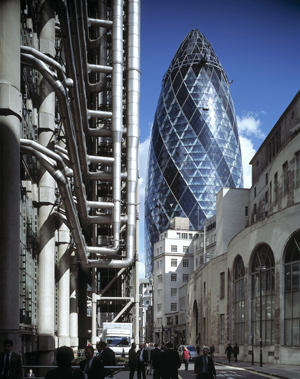
It’s Open House London weekend and that means your chance to enter scores of buildings not normally open to the public. More than 750 buildings are taking part in this, the 20th year the weekend has been held and there’s also an extensive program of free talks, walks and specialist tours. Among the buildings open this year are the iconic Gherkin building in the City (formally known as 30 St Mary Axe, pictured), Heron Tower in Bishopsgate, numerous livery company halls including that of the Apothecaries, Fishmongers and Carpenters, government buildings including Marlborough House, Westminster Hall, and the Foreign Office and numerous historic residences from the Mansion House, home of the Lord Mayor of London to Osterley Park House in west London. Among the events on offer is a moonlit hike through London tomorrow night to raise money for Maggie’s Cancer Caring Centres and rides on the new Emirates Airline cable car as well as boat tours to the Thames Barriers. If you didn’t order a guide, you can see the program online at the Open House London website – www.londonopenhouse.org. PICTURE: (c) Grant Smith/VIEW Pictures

A 16th century wooden tankard, found by a mudlark on the Thames foreshore near Ratcliff in London’s east, has briefly gone on display at the Museum of London Docklands. The large vessel, capable of holding three pints, has the initials RH inscribed on the base. It’s unknown for what purpose it was used, perhaps serving as a decanter rather than for individual use and may have been used on a ship. The vessel will be on display at the museum only until 27th September. For more, see www.museumoflondon.org.uk.

On Now: Renaissance to Goya: Prints and drawings from Spain. Opening at the British Museum today is this new exhibition featuring important prints and drawings by Spanish and other European artists working in Spain and spanning a period from the mid 16th century through to the 19th century. While all the works are drawn from the museum’s collection, many have never been on display before. The artists represented include Diego Velazquez, Alonso Cano, Bartolome Murillo, Francisco Zubaran and Jusepe de Ribera as well as Francisco de Goya. Held in room 90. Admission is free. Runs until 6th January. For more, see www.britishmuseum.org.

Where is it?…#43

The latest in the series in which we ask you to identify where in London this picture was taken and what it’s of. If you think you can identify this picture, leave a comment below. We’ll reveal the answer early next week. Good luck!

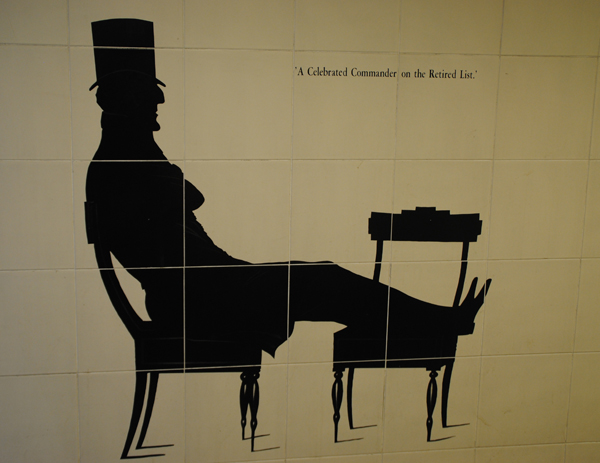
This image is one of many found in a subterranean tunnel surrounding Hyde Park Corner Underground Station and depicts, of course, the 1st Duke of Wellington, Arthur Wellesley, enjoying his latter years. The ‘Iron Duke’ has strong connections to Hyde Park Corner – his former home, Apsley House, No 1. London, is located there as is the Wellington Arch, the Decimus Burton memorial to him. For more on the Duke, see our earlier post here and for more on Wellington Arch, see our earlier ‘Where is it?’ post here.

Lost London – The Savoy Palace…

At one time the grandest of medieval townhouses in London, the history of the Savoy Palace, also known as the Palace of the Savoy, goes back to at least the 13th century.

A mansion was built here by Simon de Montfort, the ill-fated Earl of Leicester, in 1245. Following his death, it and the land between the Strand and the Thames were gifted by King Henry III to Peter, Count of Savoy, and it was renamed the Savoy Palace (apparently originally spelt Savoie).

The uncle of the king’s young wife Eleanor of Provence, Peter had accompanied his niece to London for her wedding to the king at Canterbury Cathedral on 14th January, 1236, and decided to stay. In 1241, the king named him the Earl of Richmond and in 1246 granted him the land upon which the property was built.

After being briefly given to a religious order, Queen Eleanor gifted the property to Prince Edmund (“Edmund Crouchback” – a term referring to his entitlement to wear a crusader’s cross, not a hunchback), the 1st Earl of Lancaster and younger brother to King Edward I.

It was subsequently occupied by Edmund’s successor earls and, later, dukes. Among the ‘guests’ to visit the palace during the 14th century were the French King Jean (John) II, held there for three years following his capture by the Black Prince at the Battle of Poitiers during the Hundred Years War in 1356.

Interestingly, as the property of the Dukes of Lancaster, the precinct around the palace was considered part of County Palatine of Lancaster (created in 1351), meaning that the rule of the dukes was applied here instead of that of the king – a situation which remained in place until the 1800s.

The palace eventually became the property of John of Gaunt, the 2nd Duke of Lancaster and third son of King Edward III. The richest and most powerful man in the kingdom (he was all but king in name during the younger years of King Richard II in whose name he ruled), Gaunt’s home was said to be sumptuous.

It’s perhaps not surprising then that it become a focus of the rebels during the Peasant’s Revolt in 1381 (it had been attacked unsuccessfully a few years earlier). They attacked and destroyed the property, razing it to the ground. (The story includes the tale that 32 men drank themselves to death after becoming trapped in the cellar while the palace burned).

The site, however, continued to be referred to as that of the Savoy and in the early sixteenth century King Henry VII, by order of his will, financed the founding of the Savoy Hospital on the site for the poor people (the Queen’s Chapel of the Savoy is a relic of this building – see our earlier post here). The hospital closed in 1702 and was later demolished (we’ll deal with this in more detail in a later Lost London post).

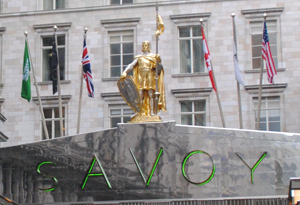
The site, which stands on the north side of the Thames just west of Waterloo Bridge,  is now occupied by the salubrious Savoy Hotel (the entrance of which is pictured above) and the Savoy Theatre, which, like the hotel, was founded by impressario Richard d’Oyly in the 1880s (the theatre was the first building in the country to be entirely lit by electric lighting).

The name of the Savoy Palace is also remembered in street names around the site including Savoy Street, Savoy Hill, Savoy Steps, Savoy Way and Savoy Place.

Where is it? #33…

The latest in the series in which we ask you to identify where in London this picture was taken and what it’s of. If you think you can identify this picture, leave a comment below. We’ll reveal the answer early next week. Good luck!

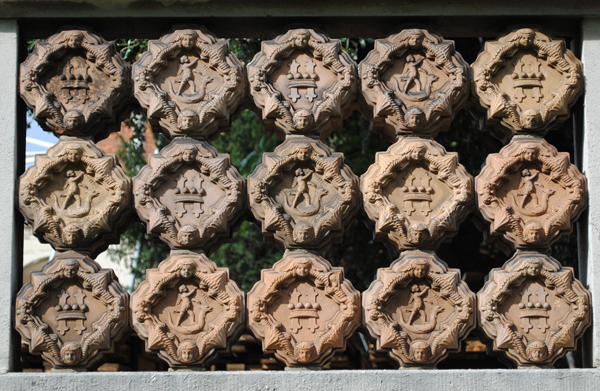
Well done to Marina (via Facebook) who placed this in Holland Park. It is indeed part of a decorative fencing on the site of Holland House. Originally known as Cope Castle, the house was built in 1605 for Sir Walter Cope. For more on the house, see our earlier post here

Around London – Open gardens; new gates mark St Paul’s tercentenary; a new Olympics trail; and, truces at the IWM…

• If you’re not too exhausted after last weekend’s Diamond Jubilee festivities (or if you’re looking for something a little more sedate), this Saturday and Sunday London plays host to Open Garden Squares Weekend. Among the 208 gardens to be opened this weekend is the communal garden at Number 10 Downing Street, home of Prime Minister David Cameron. Laid out in 1736, the L-shaped garden at 10 Downing Street is shared by residents of both Number 10 and Number 11, including Larry, the Downing Street cat (tickets for this garden have already been allocated via a ballot process). Among the more than 200 gardens open to the public as part of the weekend are 24 new gardens and, for the first time, the event is being supported by the National Trust (along with the usual organisers, the London Parks and Gardens Trust). Downing Street aside, other gardens open to the public include the Regent’s Park Allotment Garden, the Royal College of Physicians’ Medicinal Garden, the Kensington Roof Gardens, and the gardens at HMP Wormwood Scrubs. Tickets for the gardens are cheaper if bought online in advance of the weekend and picked up on Saturday or Sunday – it’s not too late to do so, so for tickets and more information, head to www.opensquares.org.

A new pair gates designed to mark St Paul’s Cathedral’s tercentenary were opened in Richmond Park for the first time last week. The gates, which now form part of the historic vista seen from King Henry’s Mound in Richmond Park when looking toward’s St Paul’s Cathedral, were designed by 21-year-old blacksmith Joshua De Lisle and funded through a donation from the family of family of the late environmentalist and The Ecologist magazine founder Edward Goldsmith. Called ‘The Way’, the gates stand on the fence of Sidmouth Woods, and depict oak branches. Sir Christopher Wren, designer of St Paul’s, is acknowledged through the inclusion of a wren on one of the lower branches. For more on the Royal Parks, see www.royalparks.org.uk.

• Now On: Winning at the ancient Games. The British Museum is celebrating the London Olympics with a victory trail bringing together 12 “star objects” in its collection, united by the theme of winning. The ‘stops’ on the trail include a classical Greek statue of a winning charioteer on special loan from Sicily, a previously never exhibited mosaic showing Hercules, the legendary founder of the ancient Games, and the 2012 Olympic Medals. The trail is free. For more information, see www.britishmuseum.org.

Now On: Build the TruceDrawing on the idea of truce that was implemented during the ancient Olympic Games to allow athletes from Greece’s warring cities to compete, this new display at the Imperial War Museum features films, interviews and insights collected during a project investigating the concepts of truce, conflict and resolution and their relevance in the 21st  century. Highlights include excerpts of interviews with former IRA prisoner Seanna Walsh and former UDA prisoner Jackie McDonald -both now involved in peace initiatives in Northern Ireland, Courtny Edwards, who worked with a health service in displaced persons’ camps following civil war in Sierra Leone; and Professor Tony Redmond, who led aid teams in Kosovo following NATO attacks in 1999. Family activities are being run in conjunction with the exhibition on selected weekends. Entry is free. Runs until 23rd September. For more, see www.iwm.org.uk.

Around London – Museums at Night; Ballgowns at the V&A; Edward Lear plaqued; and, the Queen’s portrait at the NPG…

• It’s Museums at Night weekend which means its your chance to see some of London’s best museums after hours. Culture24’s annual event, which runs from 18th to 20th May, features more than 5o late openings and special events in London – from after dark visits to Aspley House, the former home of the Duke of Wellington, to the chance to hear about the history of ‘Bedlam’, one of the world’s oldest psychiatric facilities, at the Bethlem Archives & Museum and Bethlem Gallery, and a “Cinderella shoe” workshop at the Design Museum. As well as organisations like the British Museum and National Gallery, among the lesser known museums taking part are the Cuming Museum in Southwark, the British Dental Association Museum, and the Ragged School Museum in Mile End. For all the details, follow this link

Saturday sees the opening of a new V&A exhibition featuring more than 60 ballgowns dating from 1950 to the present day – the first exhibition to be held in the newly renovated Fashion Galleries. Among those gowns on display as part of Ballgowns: British Glamour Since 1950 will be royal ballgowns including a Norman Hartnell gown designed for Elizabeth, the Queen Mother, Catherine Walker’s ‘Elvis Dress’ worn by Princess Diana (pictured), and gowns worn by today’s young royals. There will also be gowns worn by celebrities including Sandra Bullock, Liz Hurley and Bianca Jagger and works by the likes of Alexander McQueen, Jenny Packham and a metallic leather dress designed by Gareth Hugh specifically for the exhibition. Runs from 19th May to 6th January. Admission charge applies. See www.vam.ac.uk for more. PICTURE: Victoria and Albert Museum, London

The man credited with popularising the modern-day limerick, Edward Lear, has been honored with a green plaque at his former house in Westminster. The Westminster Council plaque was unveiled on Saturday – what would have been his 200th birthday – at 15 Stratford Place where he lived from 1853 until 1869. Lear, who was born in Holloway and raised in Grays Inn Road, was famous for his work The Owl and the Pussycat, and as well as for his writings, was also noted as an artist and illustrator. Councillor Robert Davis reportedly had a go himself at a limerick in honour of the artisy: “There once was man named Lear, who lived in a spot close to here. This plaque unveiled today, is a fitting way, to pay tribute on his two hundreth year”.

• On Now: The Queen: Art and Image. Having been on tour across Britian, this exhibition features some of the most remarkable images ever created of the Queen opened at the National Portrait Gallery this week. Containing works by Cecil Beaton and Annie Leibovitz, Pietro Annigoni and Andy Warhol, the exhibition is the most wide-ranging exhibition of images in different media ever devoted to a single royal sitter. Highlights include full-length 1954-55 painting by Annigoni (pictured, right, it’s displayed with his 1969 portrait), Lucian Freud’s 2000-01 portrait and Thomas Struth’s recent large-scale photograph of both the Queen and the Duke of Edinburgh as well as a never previously loaned 1967 portrait by Gerhard Richter and a specially commissioned holographic portrait. Runs until 21st October. Admission charge applies. For more, see www.npg.org.uk. PICTURE: Queen Elizabeth II, Queen Regent by Pietro Annigoni, 1954-5. The Fishmongers’ Company

Around London – Chiswick House’s Camellia Festival; Picasso at the Tate; and, Mondrian at the Courtauld…

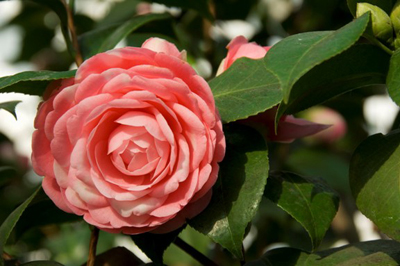
The second annual Camellia Festival kicks off in  gardens surrounding the neo-Palladian property, Chiswick House,  in west London this weekend. The month long festival, run by the Chiswick House & Gardens Trust, was kicked off in 2011 with the aim of showcasing Chiswick’s world renowned Camellia Collection, believed to be the largest in the Western world. Following the success of last year’s festival following a £12.1 million garden restoration project, the flowers will once again be on display in the Conservatory (designed by Samuel Ware in 1813). Complementing the display of camellias will be a showcase of early spring flowers planted in the newly restored Italian Garden (originally created for the 6th Duke of Devonshire in 1814, it was, at the time, at the forefront of horticultural fashion). The Camellia Collection, meanwhile, includes rare and historically significant plants featuring pink, red, white and striped blooms, many of which are descended from the original planting in 1828. Among them is the Middlemist’s Red which was originally brought to Britain from China in 1804 by John Middlemist, a nurseryman from Shepherds Bush. It is one of only two in the world known to exist (the other is in Waitangi in New Zealand). The festival runs from the 18th February to the 18th March.  Admission charge applies. For more information, see www.chgt.org.uk. PICTURE:  The Middlemist’s Red Camellia at Chiswick House © Clare Kendall.

• On Now: Picasso and Modern British Art. This exhibition at Tate Britain explores the influence of Spanish artist Pablo Picasso on British art and the role this played in the acceptance of modern art in Britain as well as celebrating the connections Picasso made with Britain following his first London visit in 1919. It features more than 150 works including 60 by Picasso, among them Weeping Woman and The Three Dancers, as well as works by the likes of Duncan Grant, Wyndham Lewis, Ben Nicholson, Henry Moore, Francis Bacon, Graham Sutherland and David Hockney. Runs until 15th July. Admission charge applies. For more information, see www.tate.org.uk

On Now: Mondrian || Nicholson in Parallel. This show at the Courtauld Gallery tells the story of the extraordinary relationship between celebrated 20th century painter Piet Mondrian and Ben Nicholson, one of the UK’s greatest modern artists. The exhibition will follow the parallel artistic paths taken by the two artists in the 1930s and their subsequent creative relationship. Each of the works selected for the exhibition have a particular historical significance and the presentation also includes archival material such as photographs and letters. Admission charge applies. For more information, see www.courtauld.ac.uk.

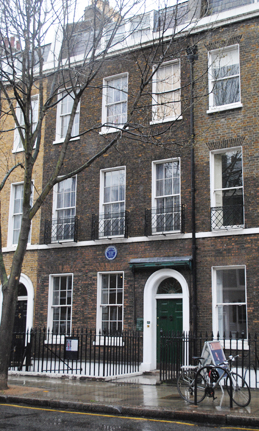
10 London sites to celebrate Charles Dickens – 1. The Charles Dickens Museum

In the first of a new special series written in honor of the bicentenary of the birth of author Charles Dickens (he was born on 7th February, 1812), we take a look at the Charles Dickens Museum.

Housed in one of Dickens’ former London residences at 48 Doughty Street in Bloomsbury, this property is now the focal point for people wanting to find out more about the writer and his life as evidenced by the visit of Prince Charles and Camilla, the Duchess of Cornwall, on Tuesday to officially mark Dickens’ birth.

Dickens lived in the property from 1837 to 1839 and it was here that significant family events, such as the birth of two of his children – Mary and Kate – and the death of his wife Catherine’s 17-year-old sister Mary took place (Mary’s tragic death is believed to be the inspiration for that of the character Little Nell in the novel The Old Curiosity Shop). It was also at the property that he wrote some of his most famous novels, including Oliver Twist, Nicholas Nickleby, and The Pickwick Papers.

A growing demand for space, however, led Dickens to move his household to 1 Devonshire Terrace in 1839. The Doughty Street house meanwhile, the only one of Dickens’ London homes to have survived, remained a residential property but in 1923 it was threatened with demolition and subsequently acquired by the Dickens Fellowship. The museum opened there two years later.

The museum now claims to hold more than 100,000 Dickens-related artifacts. The house is displayed as it might have been when Dickens lived there – artifacts on display over four floors include his personal possessions and furnishings as well as manuscripts, letters, first edition copies of some of his books and portraits, including R.W. Buss’ spectacular (and unfinished) Dickens’ Dream, showing the author at his country home of Gads Hill Place in Kent surrounded by many of the characters that he had created.

It’s important to note that from 9th April, the museum will be closed as it undergoes a £3.2 million project, called Great Expectations, which will involve the restoration and expansion of the museum. It is expected to reopen in December this year in time to celebrate a Dickensian Christmas.

For more on events celebrating Charles Dickens and his works this year, see www.dickensfellowship.org or www.dickens2012.org.

WHERE: 48 Doughty Street, Bloomsbury (nearest Tube stations are Russell Square, Chancery Lane or Holborn). WHEN: 10am to 5pm Monday to Sunday (last admission 4.30pm) COST: £7 adults/£5 concessions/£3 children (under 10 free); WEBSITE: www.dickensmuseum.com.