Daytripper – Windsor Castle…

Given we’re marking the Queen’s Diamond Jubilee with a look at sites of significance to her story located in London, it’s perhaps only fitting that we take a look at the nearest royal residence outside the city.
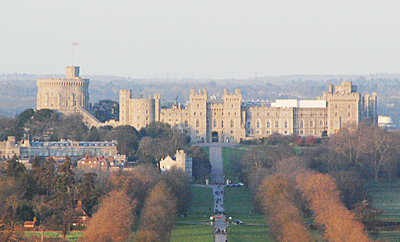
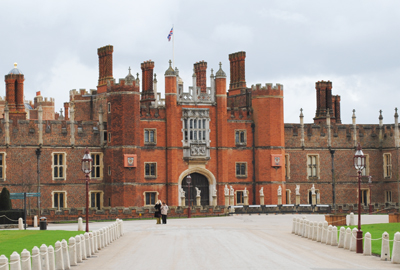
Windsor, located as close as half an hour by train from London’s Paddington station (or around 50 minutes to an hour from Waterloo), boasts plenty to see including the historic town centre, nearby Eton, great river and country walks and, of course, Legoland. But today our attention will remain on Windsor Castle, the oldest and largest inhabited castle in the world.

There has been a fortress on this site since shortly after the Norman invasion when in about 1080 King William the Conqueror ordered it constructed on a ridge above the river bank as part of a series of defensive fortifications around London. The earth and timber Norman castle was gradually added to over the years – King Henry I (reigned 1100-1135), the first king to live here, added domestic quarters while King Henry II (reigned 1154-1189) built substantial royal apartments transforming the castle into a palace and began replacing the outer timber walls with stone fortifications as well as rebuilding the Norman Keep as the Round Tower (parts of which still date from this period). King Henry III (reigned 1216-1272) built upon and expanded his work.

But it was in the reign of King Edward III (1307-1327) that the castle was expanded enormously. This included the reconstruction of the lower ward including the rebuilding of the chapel, naming it St George’s (although the current chapel dates from the reign of King Edward IV – 1461-1470), and the reconstruction of the upper ward complete with apartments for him and his wife, Queen Phillipa, arranged around courtyards (although some of the work wasn’t completed until the reign of his successor, King Richard II – 1377-1399). It was also during King Edward III’s reign that the castle became the base for the Order of the Garter (which he created in 1348), a role it still fulfills.

Other works were ordered by successive Tudor monarchs including King Henry VIII, Queen Elizabeth I, and Queen Mary I. Parliamentary forces seized the castle during the Civil War (Oliver Cromwell did use it as his headquarters for a time) and Royalists were imprisoned here (King Charles I was in fact buried in a vault beneath St George’s Chapel after his execution having been previously imprisoned here).

The next major additions came in the reign of King Charles II (1660-1685) when the Upper Ward and State Apartments were reconstructed in baroque splendor, the latter complete with splendid murals ceiling paintings by Italian artist Antonio Verro (the murals were later destroyed but some of the ceiling paintings survive).

From the time of King William III (1689-1702), monarchs began spending more time at Hampton Court Palace but the focus returned to Windsor with King George III. He ordered a range of improvements and updates including modernising Frogmore House in the Home Park for his wife Queen Caroline (the property was subsequently used by various royals but no-one currently lives there), but many of these were stopped prematurely due to his illness. His son, King George IV, picked up where his father left off.

In the reign of Queen Victoria, Windsor became the royal family’s principal residence and was visited by heads of state including King Louis Philippe in 1844 and Emperor Napoleon III in 1855. The Queen’s husband, Prince Albert, died here on 14th December, 1861.

King Edward VII (1901-1910) and King George V (1910-1936) both had a hand in redecorating the palace and the Queen’s father, King George VI (1936-1952), was living in the Royal Lodge in Windsor Great Park when he succeeded to the throne.

In more recent times, the castle was the home to the Queen, then Princess Elizabeth and her sister Princess Margaret, for much of World War II. The castle suffered its greatest setback in recent times in 1992 when a serious fire broke out in the Queen’s Private Chapel which destroyed several rooms including the ceiling of St George’s Hall which dated from the reign of King George IV. Restoration works took five years to complete.

Today the Queen spends many private weekends at the castle while the court is officially in residence here for a month over the Easter period and during Ascot Week in June – it’s at this time that the Garter Day celebrations take place with the installation of new knights.

The Queen also hosts State Visits here with banquets held in St George’s Hall as well as what are known as a ‘sleep and dine’ in which high profile figures are invited to dinner with the Queen before being shown a special display of items from the Royal Library and then spending the night. The Royal Standard flies from the Round Tower when the Queen is in residence.

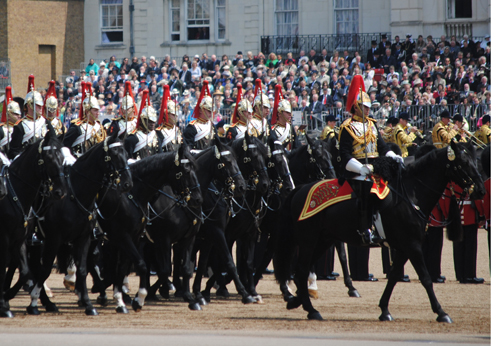
As well as touring the State Apartments, the Gallery, Queen Mary’s Dolls’ House (completed in the 1920s for Queen Mary, wife of King George V), and St George’s Chapel, visitors to the castle can experience the Changing of the Guard at 11am every day but Sundays between May and early August (and every second day after that).

WHERE: Windsor (a short walk from either Windsor Central Station or Windsor & Eton Riverside Station); WHEN: 9.45am to 5.15pm until 27th July (times vary after this date – check the website); COST: £17 an adult/£10.20 a child (under 17s – under fives free)/£15.50 concession/£44.75 family (price includes an audio tour); WEBSITE: www.royalcollection.org.uk/visit/windsorcastle.
Around London – ‘Wild London’; National Trust photography contest; JK Rowling gets Freedom; and, Royal Devotion at Lambeth…

• Celebrate the Diamond Jubilee next Tuesday in Richmond Park as it hosts ‘Wild London’, the borough’s “first festival aimed at celebrating London’s woodlands, parks and gardens”. The event, which is being put on by Richmond Council and Royal Parks, will mark the Queen’s first visit to the borough in 23 years. It will showcase the conservational, recreational and inspirational role that parks and gardens play in London and will include hands-on exhibits, demonstrations, displays and performances. The event will be the first in a series celebrating the Diamond Jubilee held in Royal Parks. For more information, see www.richmond.gov.uk/home/leisure_and_culture/diamond_jubilee.htm

• The National Trust has launched a new photography competition aimed at celebrating green spaces and the life of the Trust founder Octavia Hill. The competition, called Your Space, is running in conjunction with National Trust Magazine and is open for entries until August. The competition was launched by internationally acclaimed photographers – Mary McCartney, Joe Cornish, Arnhel de Serra and Charlie Waite – with a new collection of pictures at National Trust places. One of the three Trust founder, Octavia Hill was a leading environmental campaigner in the Victorian Age and campaigned to save places in and around London like Parliament Hill. Entries in the competition, which aims to capture images of everyday green spaces, could include pictures from the local park or countryside. For details on how to enter, follow this link

• The author of the Harry Potter books, JK Rowling, received the Freedom of the City of London this week. The books have sold an estimated 450 million copies worldwide and have been made into films. The Freedom ceremony took place at Mansion House, the official residence of the Lord Mayor of London. Speaking before the ceremony on Tuesday, Rowling was quoted as saying that both her parents were Londoners. “They met on a train departing from King’s Cross Station in 1964, and while neither of them ever lived in London again, both their daughters headed straight for the capital the moment that they were independent.  To me, London is packed with personal memories, but it has never lost the aura of excitement and mystery that it had during trips to see family as a child. I am prouder than I can say to be given the Freedom of the City, which, on top of all the known benefits (and few people realize this), entitles me to a free pint in The Leaky Cauldron and a ten Galleon voucher to spend in Diagon Alley.” For more, see www.cityoflondon.gov.uk.

• On Now: Royal Devotion. This exhibition in the Great Hall of Lambeth Palace is being held to mark both the Diamond Jubilee of Queen Elizabeth II and the 350th anniversary of the revised Book of Common Prayer. The display charts the relationship between Crown and Church and its embodiment in the history of the Book of Common Prayer, one of the most important books in the English language. As well as the 1662 revision of the Book of Common Prayer, highlights include a 1549 printing of the Book of Common Prayer, medieval illuminated manuscripts, including the Book of Hours of King Richard III, Queen Elizabeth I’s personal prayer book and a copy of the book of private devotions compiled for Queen Elizabeth II in preparation for her coronation, the Book of Common Prayer used at the wedding of Queen Victoria, and King Charles I’s own handwritten revision of State Prayers. Admission fee applies. Runs until 14th July. For more, see www.lambethpalacelibrary.org/

Treasures of London – The Banqueting House…

While we’ve looked at some of the history of the Banqueting House during last year’s special on King James I’s London, we thought we’d take a more in-depth look as part of our Treasures of London series…

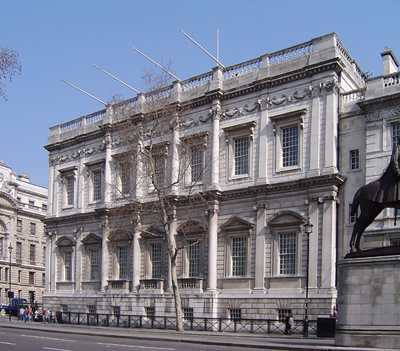
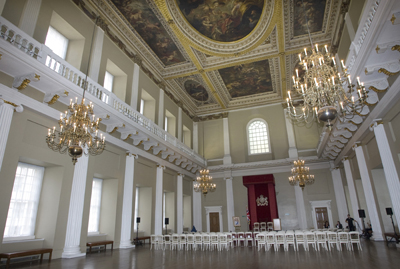
A perfect double cube with a sumptuous painted ceiling, this early 17th century building is the only remaining complete structure from the Palace of Whitehall which was destroyed by fire in 1698.

The building replaced an earlier banqueting hall built on the orders of Queen Elizabeth I and another, shorter-lived hall, built by King James I, which was destroyed by fire in 1619.

Following its destruction, King James had Inigo Jones design a new hall to provide, as the previous hall had, a location for state occasions, plays and masques – something of a cross between an organised dance, an amateur theatrical performance and just a chance to dress up.

Jones, who partnered with Ben Jonson to produce masques, designed the hall – which has a length double the width – with these performances specifically in mind. The first one – Jones and Jonson’s Masque of Augurs – was performed on Twelfth Night, 1622, even before the building was completed (the last masque was performed here, incidentally, in 1635, after which, thanks they were moved to a purpose built structure nearby, ostensibly to save the newly installed paintings from being damaged by the smoke of torches – see below).

The incredible paintings on the ceilings, which celebrate the reign of King James I and will be the subject of their own Treasures of London article at a later date, were installed by March 1636. Produced by Flemish artist Sir Peter Paul Rubens, they had been commissioned by King Charles I, King James’ son, in commemoration of his father. Ironically, it was outside the building where the monarchy was so celebrated that King Charles I was beheaded in 1649 (this is marked in a ceremony held at the Banqueting House on 30th January each year).

Following the king’s execution, Whitehall Palace wasn’t used for several years until Lord Protector Oliver Cromwell took up residence there in 1654, using the Banqueting House as a hall if audience. It stood empty after Cromwell’s death in 1658 until the Restoration in 1660 when King Charles II again used it as a grand ceremonial hall for receiving foreign embassies and conducting court ceremonies (these including the ancient custom of what is known as ‘Touching for the King’s Evil’ to cure those afflicted with the disease of scrofula as well as the washing of the feet of the poor by the sovereign on Maundy Thursday.)

King James II was the last king to live at Whitehall Palace and during his reign, from 1685-88, it was used as a royal storehouse. But it was revived for formal use following his reign – it was here that King William III and Queen Mary II were officially offered the crown on 13th February, 1689.

During their reign, the court’s focus shifted to Kensington but the Banqueting House was used for Queen Mary to lay in state after her death in 1694.

Following the destruction of the remainder of Whitehall Palace in 1698 – the origins of this fire are apparently owed to a maid who had put some linen by a charcoal fire to dry – the Banqueting Hall was used briefly as a Chapel Royal and, following a renovation in the late 1700s, it was used for concerts and, from 1808, as a place of worship for the Horse Guards.

Further renovation works followed and in 1837, it was re-opened as a Chapel Royal and used as such until 1890 when this practice was formally discontinued. In 1893, Queen Victoria gave the Royal United Services Institute the use of the building as a museum – among the things displayed there were the skeleton of Napoleon’s horse, Marengo. In 1962, the exhibits were dispersed and the Banqueting House today is used for a range of royal, corporate and social events.

There is an undercroft underneath, designed as a place where King James I could enjoy drinking with his friends. It was later used for storage.

WHERE: Corner of Whitehall and Horse Guards Avenue (nearest Tube stations are Westminster and Embankment); WHEN: Monday to Saturday 10am to 5pm; COST: £5 adults/£4 concessions/children under 16 free (Historic Royal Palaces members free); WEBSITE: www.hrp.org.uk/BanquetingHouse/.

PICTURE: Courtesy of Historic Royal Palaces/newsteam.co.uk

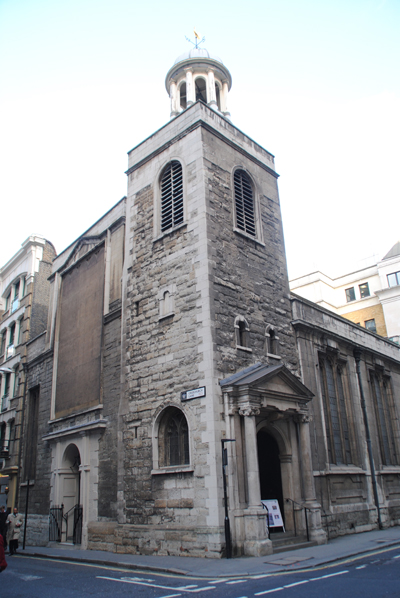
10 curiously named churches of London – 7. St Margaret Pattens

It’s not often you’d come across a church named after a type of shoe, but that’s the case with the church of St Margaret Pattens.

Located in Eastcheap, a church dedicated to St Margaret – a saint who was martyred in Antioch in the Middle East – has stood on the current site for at least 900 years. The earliest reference dates from 1067 and the church was rebuilt at least once in the medieval period, with the costs of construction apparently partly funded out of gifts presented to a crucifix or rood which stood in Rood Lane close to the church.

It’s only since the 17th century, however, when the church was rebuilt to the design of Sir Christopher Wren after the Great Fire of London, that it took on the name ‘Pattens’ to distinguish itself from other churches dedicated to St Margaret.

Pattens were wooden undershoes which were trapped beneath normal footwear and raised the wearer above the street, allowing them to walk across muddy roads and still arrive at their destination cleanshod. This footwear was apparently made and sold near which the church was located.

The trade of pattenmaking, incidentially, died out as streets became paved – according to the church’s website, the last pattenmaker died in the 19th century. There’s still a sign in the church asking women to remove their pattens before entering.

It’s worth noting before we move on that there is an alternative theory as to the origins of the name – this is that it commemorates a benefactor, possibly a canon at St Paul’s named Ranulf Patin – but it’s the former interpretation which is more widely accepted.

St Margaret Pattens, which was united with that of St Gabriel Fen after the latter was destroyed in the Great Fire, was damaged by bombing in World War II but was restored in the mid 1950s.

While the church lost many of its valuables during the Reformation (with the exception of a silver gilt communion cup dating from 1545 – on loan to the Victoria & Albert Museum), notable features inside include a memorial to King Charles I (since 1890, the king has been remembered in a special service each year held on the nearest Thursday to the date of his execution – 30th January) and a Royal Stuart Coat-of-Arms believed to be those of King James II.

There’s also a reredos containing a painting by Italian Carlo Maratta (1625-1713), two unusual canopied pews reserved for churchwardens, an hourglass dating from 1750 used to time the sermons, and a bell which dates from before the Great Fire. It’s also possible to view a set of pattens.

Among those who have been associated with the church is famed medieval Lord Mayor of London, Dick Whittington, apparently at one time the church’s patron (you can see our earlier post on him here), as well as livery companies including, as one would expect, the Worshipful Company of Pattenmakers, and the Worshipful Company of Basketmakers.

WHERE: Corner of Eastcheap and Rood Lane (nearest Tube stations are Monument, Bank and Tower Hill). WHEN: Weekdays from 10.30am (check website for services)COST: Free; WEBSITE: www.stmargaretpattens.org.

10 curiously named churches of London – 6. St Katharine Cree

Contrary to what some may, St Katharine Cree is not named after a person of that name (or at least not entirely). St Katherine, certainly, but the addition of ‘Cree’ is simply a medieval corruption of ‘Christ Church’.

The name Christ Church, abbreviated to Cree, was applied to this church because it was the prior of the Augustinian Priory of the Holy Trinity in Aldgate, also known as Christ Church, who founded St Katharine Cree in 1280 for the use of the area’s parishioners (apparently their use of the priory church was causing problems).

The current building dates from 1630 (although the tower dates from 1504), making it the only surviving Jacobean church in London.

It  was consecrated by William Laud, then Bishop of London (and later beheaded for, among other things, his support of King Charles I). He is commemorated in one of the church’s chapels.

Unlike so many other of London’s churches, St Katharine Cree was not destroyed in the Great Fire of London and only suffered minor damage in the Blitz. But structural problems meant it did need substantial restoration in the 1960s.

Inside, is a mid 17th century font and stained glass dating from the same era which depicts a Catherine wheel (St Katherine/Catherine is said to have died strapped to a spiked wheel when martyred during the time of the Roman Empire.).

There is also a rose window which was modelled on that of old St Paul’s Cathedral (before it was destroyed by the Great Fire). Parts of the organ, which was restored in the early Noughties, date from the 17th century and the original was played by none other than George Frideric Handel and Henry Purcell. The six bells were restored in 2009 following an appeal.

Among those buried at St Katharine Cree are Sir Nicholas Throckmorton, a 16th century diplomat (his monument is inside), and the artist Hans Holbein the Younger (his grave is also claimed by St Andrew Undershaft).

The church today has no parish but is the Guild Church to Finance, Commerce and Industry (its rector is that of St Olave Hart Street). Among its annual events is the Lion Sermon given in October, a tradition that dates back to 1643 and owes its origins to the former Lord Mayor of London, Sir John Gayer, who decided to finance the sermon after he survived an encounter with a lion in Syria.

WHERE: Leadenhall Street, London (nearest Tube stations are Aldgate and Tower Hill); WHEN: See website for service timesCOST: Free; WEBSITE: www.sanctuaryinthecity.net/St-Katharine-Cree.html.

Around London – Lloyd’s gets Grade I; 700,000 historic items online in NT database; and, introducing the Silverdale Hoard…

London’s iconic Lloyd’s Building (also known as the ‘inside out’ building thanks to a design in which utility pipes, lifts and stairways are exposed on the outside) has been listed as a Grade I building, becoming the youngest building to be granted such status. John Penrose, Minister for Tourism and Heritage, made the decision following advice from English Heritage. Roger Bowdler, English Heritage’s designation director, said he was “delighted” at the decision. “Its listing at the highest grade is fitting recognition of the sheer splendour of Richard Rogers’s heroic design. Its dramatic scale and visual dazzle, housing a hyper-efficient commercial complex, is universally recognised as one of the key buildings of the modern epoch.” The futuristic-looking building is one of very few post war buildings to be protected with a Grade I listing. Construction of the tower started in 1981 and was largely completed by May 1984. It was occupied two years later. As well as its futuristic exterior, the building also features a nod to the past with the Adam Room, which dates from the 1760s and was moved here intact from which was moved from Bowood House in Wiltshire. The building is also home to the Lutine Bell, which comes from a French frigate captured by the British in 1793, and was rung to herald important announcements (today these are generally only ceremonial). The history of Lloyd’s goes back to 1688 when it’s believed the first Lloyd’s Coffee House opened in Tower Street.

• More than 700,000 objects in the care of the National Trust can be accessed virtually via a new online database. The database, accessed via www.nationaltrustcollections.org.uk contains details of more than 700,000 objects – everything from artworks by Gainsborough to a laudanum bottle containing remnants of poison and the cotton underwear of a grocer – currently housed at more than 200 properties as well as in storage or on loan to other organisations. Highlights include a costume made from beetle wings for the actress Ellen Terry, an early anti-aging ‘machine’, a furnished Victorian dolls house from Uppark House in West Sussex, and a Bible reputed to have been used at the execution of King Charles I from Chastleton House in Gloucestershire. The database has been in development for 15 years and the work to develop it will continue.

A 1,100-year-old collection of Viking Age objects including silver arm-rings and brooch fragments and coins from the Silverdale Hoard – found in Silverdale, Lancashire, in September – has gone on display in room 2 of the British Museum until early in the New Year. Among the 200 objects in the hoard is a type of coin not seen before and bears the inscription Airdeconut which appears to be an early attempt to represent the name Harthacnut. Lancaster City Museum has reportedly expressed an interest in acquiring the hoard. For more, see www.britishmuseum.org.

The Royal Parks – 8. Bushy Park

And so we come to the final entry in our special series on Royal Parks – Bushy Park (Royal Parks also look after Brompton Cemetery, but given it’s not strictly a park, we’ll deal with that in an upcoming post).

Lying off the beaten track near Hampton Court in south-west London, Bushy Park’s location means it’s perhaps the least glamourous of the Royal Parks we have looked at. Yet, like the other parks, its connection with royalty goes back a long way – in this case to the time of King Henry VIII.

The park was included as part of the Hampton Court estate given to the king by Cardinal Wolsey. Henry immediately transformed what had been farmland (complete with artifical medieval rabbit warrens, the remains of which can still be seen) into a deer chase and enclosed the park with a brick wall (a section of the original wall lies on the north side of Hampton Court Road).

The character of the park was altered again in 1610 when King Charles I ordered the creation of the Longford River, a 12 mile ornamental canal designed to bring water from the River Colne in Hertfordshire to the park’s water features.

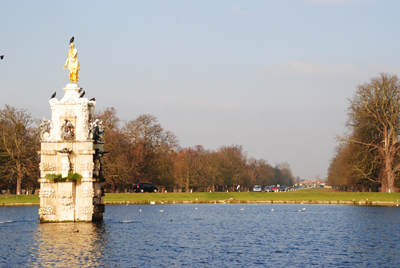
Christopher Wren had a hand in the park’s design in 1699 when he designed Chestnut Avenue – a mile long formal roadway which runs through the centre of the park. He also added the round pond at its end and placed a fountain topped with a statue in its midst.

Known as the Diana Fountain after the Roman goddess of hunting, the statue (pictured above with Chestnut Avenue behind) actually represents one of Diana’s nymphs Arethusa. It was commissioned by King Charles I for his wife, Queen Henrietta Maria, and originally stood at Somerset House before Oliver Cromwell moved it to the Privy Garden at Hampton Court and Wren then moved it to its current location.

The 17th and 18th century also saw the appearance of houses at the park to be used as hunting lodges (and the ranger’s home), and gardens were added.

Worth noting here is the story of shoemaker Timothy Bennet. A resident of nearby Hampton Wick, in 1752, when an old man, he successfully fought to ensure a public right-of-way through the park after the then ranger, Lord Halifax, ordered it closed to the public. There’s a monument to him outside Hampton Wick Gate and a walking path which runs across the park at perpendicular to Chestnut Avenue is still known as Cobbler’s Walk.

More gardens were added in the 20th century including the Waterhouse and Pheasantry Plantations. Other areas include the tranquil Woodland Gardens and the Water Gardens which are comprised of a Baroque-style collection of pools, cascades, basins and the canal. There are also a series of ponds – including a pond for model boats – to the east of Chestnut Avenue.

The park saw service in both World Wars. During the first, Canadian troops were stationed there (there’s a totem pole in the Woodland Garden marking this) and other areas within the park were used for growing produce as part of the “Dig for Victory” campaign.

During the second, it was used again for food production and in 1942 became a US base and later Supreme Headquarters Allied Expeditionary Forces – the location where General Dwight Eisenhower planned Operation Overland, the reinvasion of Europe which kicked off with the D-Day landings. There are memorials concerning this connection in the park’s north-east corner.

Facilities today include the Pheasantry Welcome Centre, which opened in 2009, and includes a cafe, toilets and information. There are also sporting facilities, a small cafe near the carpark and a children’s playground.

WHERE: The park lies north of Hampton Court Palace, just west of Kingston and Hampton Wick and south of Teddington (nearest train station is Hampton Wick or Hampton Court). WHEN: 24 hours except in September and November when it’s open between 8am and 10.30pm; COST: Free; WEBSITE: www.royalparks.gov.uk/Bushy-Park.aspx

The Royal Parks – 7. Richmond Park

Covering almost 1,000 hectares, Richmond Park, located by the Thames in the city’s south-west, is the largest of the Royal Parks. We have talked about some of Richmond Park’s history in an earlier post, but here we’ll give a little more detail.

The park’s association with royalty goes back at least to the time of Edward I, who ruled in the late 13th and early 14th century, when it was part of the Manor of Sheen.

It was King Henry VIII who renamed the manor Richmond (after one he possessed in Yorkshire) but it was King Charles I to whom the park owes its existence as we know it.

Charles, who had brought the court to Richmond in 1625 to escape the plague, enclosed the park – then farmland and pastures – in 1637 with eight miles of walls (these still remain, albeit having been repaired) and kept 2,000 red and fallow deer inside. The move didn’t met with universal approval from his subjects but he did pay compensation and eventually give people a right of way and allow them to collect firewood after complaints.

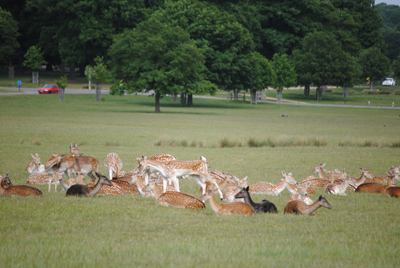
Features within the park – which still contains 650 Red and fallow deer (don’t get too close!) – include King Henry’s mound which features a protected, although tiny, view of St Paul’s Cathedral in the city 12 miles distant – it’s said by some that it was here where King Henry VIII watched for fireworks to be set off at the Tower of London indicating Anne Boleyn had been beheaded although the truth of that remains lost to history (others say it was here he watched hunting parties in the park – perhaps more likely).

The park is also home to White Lodge – it was a hunting lodge built for King George I and is now The Royal Ballet Lower School (complete with ballet museum) – and Pembroke Lodge – this house with stunning views overlooking the Thames Valley, now a restaurant, was once home to Prime Minister Lord John Russell and later the childhood home of his grandson, Nobel Prize-winning philosopher and mathematician Bertrand Russell.

More recently created is the Isabella Plantation – a woodland garden created largely in the 1950s by George Thomson , then park superintendent, his head gardener, Wally Milleron, an area once known as The Sleyt or Isabella Slade. The garden is well worth a visit at any time of year, having been specifically designed to be interesting all year round.

Richmond Park also features a lake divided in two by a causeway – as so known as Pen Ponds – which was dug in 1746 and remains a good place to see waterbirds.

WHERE: The park is located south of the Thames-side village of Richmond (nearest tube is Richmond). WHEN: 7am in summer (7.30am in winter) to dusk; COST: Free to enter; WEBSITE:www.royalparks.org.uk/parks/richmond_park/

The Royal Parks – 6. Greenwich Park

The oldest of the royal parks, the 74 hectare (183 acre) Greenwich Park has been associated with royalty since at least the 15th century.

The area covered by the park had been occupied by the Romans (there are some remains of a building, possibly a temple, near Maze Hill Gate) and later the Danes, who raised protective earthworks here in the 11th century. After the Norman Conquest, it became a manor.

Its enclosure only happened in 1433 after the land came into the possession of Humphrey of Lancaster, Duke of Gloucester and brother of King Henry V. At the time regent to the young King Henry VI, Duke Humphrey also built a tower on the heights above the park – where the Royal Observatory now stands.

Following the duke’s death in 1447, the land was seized by Margaret of Anjou – wife of King Henry VI – and subsequently became known as the Manor of Placentia. King Henry VII later rebuilt the manor house, creating what was known as Greenwich Palace or the Palace of Placentia.

Not surprisingly, it was King Henry VIII, who, having been born at Greenwich Palace, introduced deer to the park. Indeed the park was to have strong associations with others in his family – the king married Catherine of Aragorn and Anne of Cleeves at Greenwich Palace, and his daughters, later Queen Mary I and Queen Elizabeth I, were born there while his son, King Edward VI, died there in 1553 at the age of only 15. (There’s a tree in the park known as Queen Elizabeth’s Oak, which is said to be where she played as a child).

In 1613, King James I gave the palace and accompanying park – which he had enclosed with a high wall – to his wife, Queen Anne of Denmark, apparently as an apology after swearing at her in public when she accidentally shot one of his favorite dogs. Queen Anne subsequently commissioned Inigo Jones to design what is now known as the Queen’s House – for more on that, see our earlier post.

Following the Restoration, King Charles II ordered the palace rebuilt and while this work remained unfinished, the king did succeed in having the park remodelled – it is believed that Andre Le Notre, gardener to King Louis XIV of France, had a role in this.

The works included cutting a series of terraces into the slope – these were known as the Great Steps and lined with hawthorn hedges – as well as creating a formal avenue of chestnut trees (now known as Blackheath Avenue), and some woodlands. Work is currently taking place on restoring an orchard which dates from 1666 at the park.

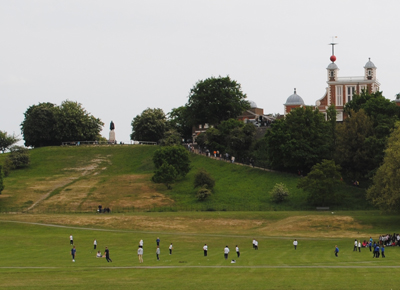
King Charles II also commissioned Sir Christopher Wren to build the Royal Observatory that still stands on the hill overlooking the park – it stands on the site once occupied by the Duke Humphrey Tower (the Royal Observatory is home of the Prime Meridian – see our earlier post on the Royal Observatory for more).

King James II was the last monarch to use the palace and park – his daughter Queen Mary II donated the palace for use as a hospital for veteran sailors and the park was opened to the pensioners in the early 1700s. The hospital later become the Royal Naval College and the National Maritime Museum later moved onto the site (for more on this, see our earlier post).

As an aside, Royal Parks say the truncated shape of some of the trees in the park is apparently due to the fact that when anti-aircraft guns were positioned in the flower garden during World War II, the trees had to be trimmed to ensure a clear field of fire.

Facilities in the park today include a tea house, a children’s playground, sporting facilities such as tennis courts and, of course, the Wilderness Deer Park where you can see wildlife at large. Statues include that of Greenwich resident General James Wolfe, an instrumental figure in establishing British rule in Canada – it sits on the crest of the hill opposite the Royal Observatory looking down towards the Thames.

The park, which is part of the Greenwich World Heritage Site, is slated as a venue for next year’s Olympics – it will host equestrian events and the shooting and running events of the pentathlon.

WHERE: Greenwich Park (nearest DLR station is Cutty Sark – other nearby stations include Greenwich, Maze Hill and Blackheath); WHEN: 6am to at least 6pm (closing times vary depending on the month); COST: Free entry; WEBSITE: www.royalparks.gov.uk/Greenwich-Park.aspx

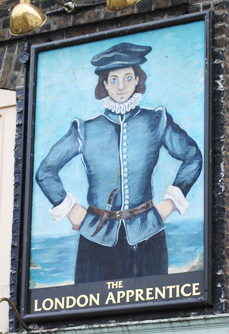
London Pub Signs – The London Apprentice

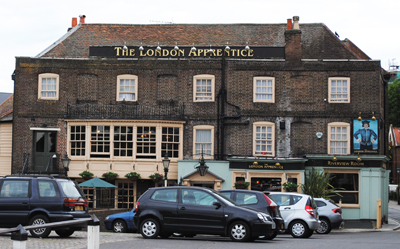
Sitting on the bank of the Thames at Old Isleworth in the city’s west stands The London Apprentice public house.

The pub’s licence dates back to at least 1731 and it has been associated with the likes of such luminaries as King Henry VIII (it’s suggested he met Catherine Howard here – she was later imprisoned in nearby Syon House), King Charles I and King Charles II (the latter apparently cavorted with his mistress, actress Nell Gwynne, here), as well as the ill-fated Lady Jane Grey and Lord Protector Oliver Cromwell.

Others whose names come up in reference to the pub include the ever-present author Charles Dickens (this is said to have been one his favorite pubs) and notorious highwayman Dick Turpin.

While there remain some doubts over its origins, the name of the pub – which stands opposite the small isle known as the Isleworth Ait – is said to stem from the fact that it was here that London apprentices, having faithfully served their masters, came to while away the hours in their downtime. They are said to have entertained themselves by playing about in decorated barges on the river.

There is said to be a tunnel, now blocked, which links the pub with the nearby All Saint’s Church – the story goes that this was used by smugglers to get their contraband into the pub’s cellars.

For more information or to pay a visit, see www.thelondonapprentice.co.uk.

The Royal Parks – 1. Hyde Park

This year marks the 160th anniversary of the transfer of the care of the Royal Parks to the government (meaning the public was freely able to enjoy access for the first time). To celebrate, over the next weeks we’ll be taking a look at the history of each of them. First up is the 142 hectare Hyde Park, perhaps the most famous of all eight Royal Parks.

Formerly owned by Westminster Abbey, King Henry VIII seized the land in 1536 for use as a private hunting ground. He had it enclosed with fences and the Westbourne Stream, which ran through the park – it now runs underground – dammed.

It remained the king and queen’s private domain (Queen Elizabeth I is known to have reviewed troops there) until King James I appointed a ranger to look after the park and permitted limited access to certain members of the nobility in the early 17th century.

The park’s landscaping remained largely unaltered until the accession of King Charles I – he created what is known as the ‘ring’ – a circular track where members of the royal court could drive their carriages. In 1637, he also opened the park to the public (less than 30 years later, in 1665, it proved a popular place for campers fleeing the Great Plague in London).

During the ensuring Civil War, the Parliamentarians created forts in the park to help defend the city against the Royalists – some evidence of their work still remains in the raised bank next to Park Lane.

After King William III and Queen Mary II moved their court to Kensington Palace (formerly Nottingham House) in the late 1600s, they had 300 oil lamps installed along what we know as “Rotten Row’ – the first artificially lit road in the country – to enable them and their court to travel safely between the palace and Westminster.

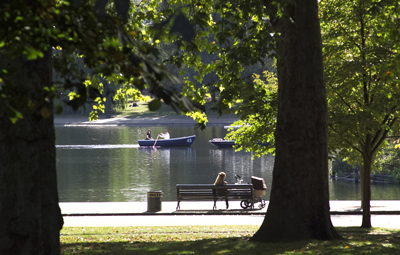
The natural looking Serpentine – the great, 11.34 hectare, lake in the middle of Hyde Park (pictured) – was created in the 1730s on the orders of Queen Caroline, wife of King George II, as part of extensive work she had carried out there. It was Queen Caroline who also divided off what we now know as Kensington Gardens from Hyde Park, separating the two with a ha-ha (a ditch).

The next major changes occurred in the 1820s when King George IV employed architect and garden designer Decimus Burton to create the monumental park entrance at Hyde Park Corner – the screen still remains in its original position while Wellington Arch was moved from a parallel position to where it now stands (see our previous posts for more on that). Burton also designed a new railing fence and several lodges and gates for the park. A bridge across the Serpentine, meanwhile, was built at about the same time along with a new road, West Carriage Drive, formally separating Hyde Park and Kensington Gardens.

While the basic layout of the park has been largely unchanged since, there have been some additions – among them, the establishment in 1872 of Speaker’s Corner as a place to speak your mind in the north-east corner of the park (near Marble Arch), the creation in 1930 of the Lido for bathing in warm weather, and, more recently, the building of the Diana, Princess of Wales’ Memorial Fountain (unveiled in 2004), and the 7 July Memorial (unveiled in July 2009).

Other sculptures in the park include Isis (designed by Simon Gudgeon, located on the south side of the Serpentine), the Boy and Dolphin Fountain (designed by Alexander Munro, it stands in the Rose Garden), and a monumental statue of Achilles, a memorial to the Duke of Wellington designed by Richard Westmacott, near Park Lane. There are also memorials to the Holocaust, Queen Caroline, and the Cavalry as well as a Norwegian War Memorial and a mosaic marking the site of the Reformer’s Tree (the tree was burnt down during the Reform League Riots of 1866).

The park has been integral part of any national celebrations for centuries – in 1814 a fireworks display there marked the end of the Napoleonic Wars, the Great Exhibition – with the vast Crystal Palace – was held there in 1851 and in 1977 a Silver Jubilee Exhibition was held marking Queen Elizabeth II’s 25 year reign. Cannons are fire there on June 2nd to mark the Queen Elizabeth II’s coronation and on 10th June for the Duke of Edinburgh’s birthday.

Facilities these days include rowing and pedal boats, tennis courts, deck chairs, a restaurant and cafe (the latter based in the Lido) and, of course, some Boris bikes. There is a heritage walk through the park which can be downloaded from the Royal Parks website.

WHERE: Hyde Park (nearest tube stations are that of Marble Arch, Hyde Park Corner, Lancaster Gate, Knightsbridge and South Kensington); WHEN: 5am to midnight; COST: Free; WEBSITE: www.royalparks.gov.uk/Hyde-Park.aspx?page=main

PICTURE: Courtesy of Royal Parks. © Indusfoto Ltd 

LondonLife – Open House London, The Middle Temple Hall

Last weekend saw thousands of people make their way to rarely opened properties across London as part of Open House London. Among the properties we visited was the Middle Temple Hall, one the finest example of a 15th century hall in London (if not the UK). The hall was built in the 1560s and early 1570s – by which time the Middle Temple, one of the medieval Inns of Court (more of which we’ll be talking about in an upcoming series), had already existed for about 200 years – and the hall which the Temple currently used, that of the former Templar Knights, was starting to fall apart. The new hall was constructed under the direction of law reporter Edmund Plowden, then Treasurer of the Inn, and funded by members of the Middle Temple. In use by about 1570, Queen Elizabeth I is, according to some stories, said to have dined there many times and it was in the hall that the first performance of Shakespeare’s Twelfth Night took place. While it suffered some damage in World War II bombings, the hall still looks much as it did in the late 1500s. It remains at the centre of the Middle Temple’s collegiate and social life and it is here that members are called to the Bar. Among the notable objects inside are numerous paintings and stained glass memorials of people associated with the Inn (including Sir Walter Raleigh and numerous monarchs – from King Charles I to King Edward VII) as well as the High Table – a table made of three 29 foot long planks from a single oak, it is said to be a gift from Queen Elizabeth I – and the ‘cupboard’, a smaller table which was apparently made from the hatch cover of Sir Francis Drake’s ship, the Golden Hind. Late note: I should add that the Middle Temple Hall is not normally open to the public.

Daytripper – Oxford

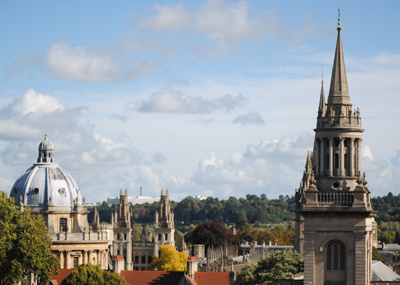
The “city of dreaming spires”, Oxford is a delight for the student of historic architecture, boasting an impressive array of medieval and later, classically-inspired, buildings.

Only about an hour from London by train (leave from Paddington Station), Oxford was established as a town in the 9th century and rose to prominence during the medieval period as the location of a prestigious university, an institution which remains synonymous with the city today.

Major development followed the Norman Conquest the castle was constructed, the remains of which were included in a £40 million redevelopment several years ago of the area in which it stands and which now houses the Oxford Castle Unlocked exhibition which looks at some of the key figures in the castle’s past (you can also climb St George’s Tower for some great views over the city).

The university first appears in the 1100s and gradually expanded over the ensuing centuries gradually evolved to encompass the many medieval colleges which can still be seen there today.

Something of a hotbed of activity during the Reformation, Oxford saw the burning of three bishops – Hugh Latimer, Nicholas Ridley and Archbishop of Canterbury Thomas Cranmer at a site marked by a memorial in Magdalen Street. Constructed in the 1840s, it was designed by Sir George Gilbert Scott who drew inspiration from the Eleanor Crosses King Edward I had erected in honor of his deceased wife, Eleanor of Castile, following her death in 1290.

Oxford was also the site of the headquarters of King Charles I during the English Civil War after the king was forced to leave London (the town eventually yielded to parliamentarian forces after a siege in 1646) and was later home to the court of King Charles II after he fled London during the Great Plague of 1665-66.

Canals arrived in the late 18th century and the railways followed. Industrialisation came – in particular, in the 20th century, in the form of a large car manufacturing plant at the suburb of Cowley – and with it an increasingly cosmopolitan population. But at its heart Oxford remains a student city and it’s the students that continue to provide the lively atmosphere in the city centre.

Look for Carfax Tower to get your bearings – formerly the tower of a 14th century church, this lies at the heart of the town and can be climbed for some great views over the surrounding streets. Some of the colleges are also open to the public (see noticeboards outside the colleges for times) – particularly worth visiting is Christ Church which dates from 1524 and, founded by Cardinal Wolsey, was initially known as Cardinal’s College. It features the Tom Tower, home of the bell Great Tom, which was designed by former student Sir Christopher Wren. The college, which is unique in that the college chapel is also a cathedral, is also home to the Christ Church Picture Gallery.

Other colleges of note include the beautiful Magdalen (pronounced Maudlin, it was founded in 1458 – alumni have included writers John Betjeman, CS Lewis and Oscar Wilde), All Souls (founded in 1438 with King Henry VI its co-founder), and Merton College (the oldest of Oxford’s colleges, it was founded in 1264 and is home to Mob Quadrangle, the oldest quadrangle in the university).

Other university buildings which are a must include the Radcliffe Camera – now the reading room of the Bodleian Library, this Baroque rotunda dates from 1748 and was built as a memorial to 18th century physician Dr John Radcliffe, the Sheldonian Theatre – another of Wren’s designs, it was built in the 1660s as the university’s principal assembly room, and St Mary the Virgin Church – the official church of the university, the present building partly dates from the 13th century and boasts terrific views from the tower.

Make sure you also take the time to wander through the water meadows along the River Cherwell (there are also punt rides) and walk along the River Thames, known as the Isis as it passes through Oxford. Keep an eye out also for the ‘Bridge of Sighs’, similar in design to the Venetian landmark, it spans New College Lane and joins two sections of Hertford College.

Other sites in Oxford include the Ashmolean Museum of Art and Archaeology. Considered of the UK’s best, the original Ashmolean was the first purpose built museum in England, opening in 1683. It now houses treasures include art and antiquities with the late ninth century Alfred Jewel, said to have been made for King Alfred the Great, among its prized objects. Other museums include the Pitt Rivers Museum which cares for the university’s collection of anthropology and world archaeology and includes exhibits brought back to Britain by explorer Captain James Cook.

Take the time also to wander through the covered market off high street which has some interesting shops selling everything from clothes to fresh food and flowers and gifts. Fans of Inspector Morse, meanwhile, may also enjoy seeing some of the sites of particular significance in the TV series – there’s an interactive online map here.

A vibrant city redolent with history, Oxford remains of England’s jewels. Perfect as a day-trip destination from London.

King James I’s London – 10. Westminster Abbey’s Lady Chapel

And so we come to the final instalment in our series on King James I’s London. This week we’re looking at Westminster Abbey’s Lady Chapel where King James I – who was crowned in Westminster Abbey in 1603 – was laid to rest after his death in 1625.

But before we turn to James himself, it’s worth noting that several members of his immediate family are also buried in the abbey’s Lady Chapel (pictured). These include his eldest son, Henry Fredrick, Prince of Wales, who died in 1612 at the age of 18 (and thus opened the way for his younger brother Charles to become King Charles I). He is buried in the south aisle of the magnificent Lady Chapel which had been added at the behest of King Henry VII between 1503 and 1519 and replaced a 13th century chapel.

Three of James’ daughters are also buried in the Lady Chapel – Mary, who died in 1607, aged two, and Sophia, who died in 1606, aged just three days old. Both of them have monuments in the north aisle while their sister Elizabeth, wife of King Fredrick V of Bohemia, who died much later in 1662, is buried near her brother Henry Fitzpatrick.

As we’ve previously mentioned, King James I also outlived his wife, Queen Anne of Denmark, who died of dropsy at Hampton Court Palace on 2nd March, 1619, at the age of 43. She lay in state at Somerset House until her funeral on 13th May and was then buried in the south-eastern area of the Lady Chapel where her gravesite is marked by a modern stone bearing her name. Her wooden funeral effigy is one of a collection which can still be seen in the Abbey’s Museum.

After James himself died on 27th March, 1625, he was laid in the vault beneath King Henry VII’s monument beside Elizabeth of York, Henry’s wife. No monument was erected to mark his passing save for a modern inscription placed nearby (in fact Queen Elizabeth I was the last monarch to be buried with a monument above the site – see below).

It’s also worth noting that in 1612 – nine years into his reign – James arranged for the body of his mother – Mary, Queen of Scots, who was executed in 1587 on the orders of Queen Elizabeth I – to be transferred from its resting place in Peterborough Cathedral to the south aisle of the Lady Chapel where he had an elaborate tomb erected featuring an elegant white marble effigy showing her wearing a coif, ruff and long mantle.

In the north aisle, James had previously erected a marble monument to his predecessor, Queen Elizabeth I and had her body moved from where it had lain in the vault of her grandfather, King Henry VIII, to a place beneath the new monument. Her half-sister, Queen Mary I, is also buried beneath the monument.

That’s the final in our series on King James I’s London – it’s by no means a comprehensive look at significant sites in the early Stuart period and we shall be looking at more from the period down the track, but it’s a good start. Our new special series starts next week. 

WHERE: Westminster Abbey, Westminster (nearest Tube station is Westminster or St James’s Park); WHEN: Open to tourists everyday except Sunday  (times vary so check the website); COST: £16 an adult/£13 concessions/£6 schoolchildren (11-18 years), free for children aged under 11/£38 for a family (two adults, two children); WEBSITE: www.westminster-abbey.org

King James I’s London – 9. Hampton Court Palace

It’s fitting given the important role Hampton Court Palace played in the creation of the King James Bible that we include it in this series. But Hampton Court Palace is also notable for some other events during King James I’s reign. First, however, we turn to the Hampton Court Conference…

It was in 1604 that King James I meet at Hampton Court with representatives of the Church of England, including one party led by Archbishop John Whitgift (representing the church hierarchy) and another party led by John Rainolds (representing the Puritans), to discuss complaints made by the Puritans concerning a range of matters. While a new Bible wasn’t initially on the agenda, the three days of discussions did eventually lead to King James I commissioning the creation of a new Bible which eventually became known as the King James Version.

King James I was already familiar with Hampton Court Palace – it was in the palace that he had celebrated his first Christmas as king the previous year. Notably, it was during this Christmas and New Year period that Shakespeare’s acting company, the King’s Men, performed in the palace’s Great Hall for the king and his court.

At that stage, the palace hadn’t been dramatically updated since Tudor times – in fact, it wasn’t until after the accession of King William III and Queen Mary II following the “Glorious Revolution” in 1689 that the Tudor palace was given a major overhaul.

King James I continued to visit Hampton Court during the remainder of his reign and his visits, which were generally proceeded by a program of repairs, were noted for the lavish entertainment that took place when they occurred.

It was also at Hampton Court Palace that James’ wife, Queen Anne, died of dropsy in 1619. And where his son King Charles I, who had commissioned some improvements to the palace, was imprisoned for a period during the Civil War. But more of that another time…

WHERE: Hampton Court Palace, East Molesey, Surrey (nearest station is Hampton Court from Waterloo); WHEN: 10am to 6pm everyday (winter hours 10am to 4.30pm from 31st October to 26th March); COST: Adult £15.40, Concession £12.65, Child under 16 £7.70 (under fives free), family tickets, garden only tickets and online booking discounts available; WEBSITE:www.hrp.org.uk/HamptonCourtPalace/

LondonLife – Trooping the Colour…

A ceremony first believed to have been performed during the reign of King Charles II, since 1748 the parade has been used to mark the Official Birthday of the Sovereign.

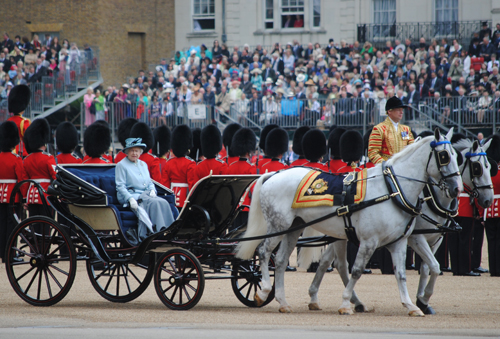
 Queen Elizabeth II inspects the Guards in her phaeton.

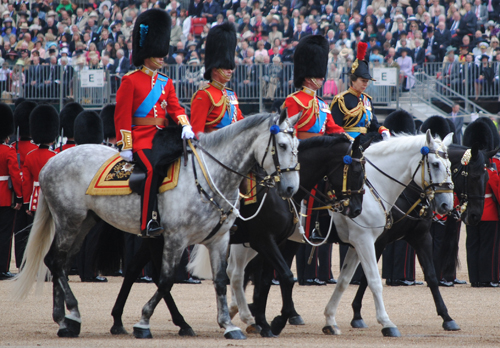
Prince William, Prince Charles, the Duke of Kent and Princess Anne riding Queen’s Escort behind the Queen.

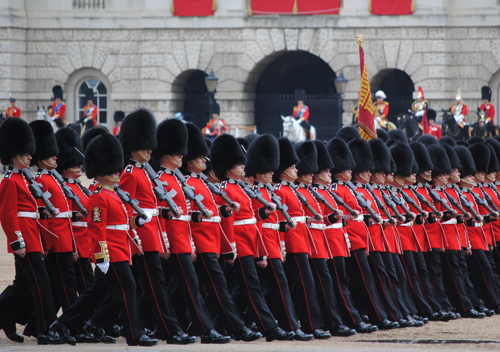
The parade includes six Guards groups. This year it was the turn of the Scots Guards, raised in 1642 at the behest of King Charles I, to parade their colours.

Part of the Household Mounted Cavalry, the Blues and Royals.

At 1pm, back at Buckingham Palace following the firing of a 41 gun salute, the Queen and the Royal Family watch Royal Air Force aircraft performing a fly past overhead.

The RAF’s Red Arrows aerobatic display team perform a colorful flypast over Buckingham Palace.
All images and text are © David S. Adams

Where’s London’s oldest…outdoor statue?

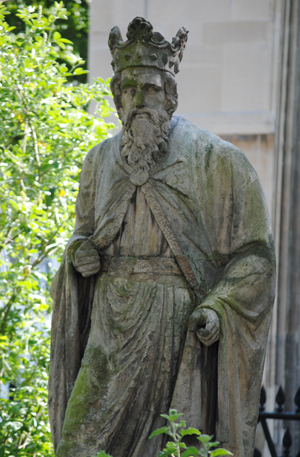
It’s generally believed that London’s oldest outdoor statue is that of King Alfred the Great which stands in Trinity Church Square in Southwark but there are a few others worth mentioning for their age.

But first, to the statue of Alfred the Great. Located now in Trinity Church Square, it is thought to have been made in the late 14th century (although it’s also suggested it could be much younger) in honor of the man who ruled Wessex in the 9th century and is often credited as being the first “king of the English”.

The statue (right) was apparently located at the Palace of Westminster before it was brought to its present location in 1823 at about the time the square was being laid out.

Others among London’s oldest statues is that of King Charles I sitting astride his horse and looking from Whitehall from its position on the southern side of Trafalgar Square.

Credited as being London’s “oldest equestrian bronze”, this statue is the work of French sculptor Hubert Le Sueur and was cast in 1633 (during King Charles I’s rule) at the behest of Richard Weston, one of the king’s favorites, who that year became the 1st Earl of Portland.

It was removed during the Civil War but later reacquired by the Portland family and, following the Restoration, was reinstalled on its current site – once that of the Charing Cross (see our previous entry for more details) – in 1675 by King Charles II.

Another of London’s oldest statues is that of Queen Elizabeth I which stands on the facade of the church St Dunstan-in-the-West in Fleet Street. This statue, which has been attributed to William Kerwin although other names have also been suggested, dates from 1586 (created during her reign) and decorated the west side of Ludgate until its demolition in 1760, after which it was apparently put into storage until being brought to the church in the 19th century.

Standing nearby in the vestry porch as statues of the legendary pre-Roman British king, Lud, and his sons, Androgeus and Tenvantius, which were also removed from Ludgate and probably date from the same period (about 1586).

King James I’s London – 6. The Queen’s House, Greenwich

Long an admired landmark of Greenwich, the origins of the Queen’s House go back to the reign of King James I.

It was the Queen, Anne of Denmark, who commissioned the building of The Queen’s House in 1616 and gave it the name by which it is still known. Sadly, however, she died before it was completed.

King James I was said to have been a frequent visitor to the Tudor Palace of Greenwich (the building had earlier been known as the Palace of Placentia and was the birthplace of King Henry VIII in 1491).

King James  is traditionally said to have awarded the Manor of Greenwich to Queen Anne as an apology after he had publicly sworn at her when she had accidentally shot one of his favorite hunting dogs.

In 1616, Queen Anne decided to build a new property on the site as both a private retreat and a place where she could entertain and it was to the rising star Inigo Jones that she turned to for the design (in recognition of his growing status, he was appointed Surveyor of the King’s Works the following year).

The house was Jones’ most important job to date and the design he came up – based on a H with the two sides joined by a bridge over the Greenwich to Woolwich road – with is said to be the first Classical building in England.

Among the original features which survive to this day are the striking black and white geometrically patterned marble floor of the Great Hall (the room having been designed as a perfect cube), the painted ceiling of the Queen’s Presence Chamber and the iron balustrade the Tulip Stairs – said to be the first “geometric self-supporting spiral stair in Britain”.

Queen Anne became ill in 1618 and died the following year without seeing the end result of her commission. The work subsequently was shelved and only restarted (and completed in 1638) after King Charles I gave it to his wife, Queen Henrietta Maria.

She only had possession for a short time before Parliamentary forces seized it during the Civil War. After the Restoration, the Queen’s House was returned briefly to her by her son King Charles II (it was at this time that the original H-shape of the house was altered to a square) before part of it as later used as studio for painters and then as grace and favor apartments.

With the Old Royal Naval College now occupying the surrounding site, in 1805, King George III gave the property to the Royal Naval Asylum – a charity caring for the orphan children of seamen – and it later became part of the Royal Hospital School.

The National Maritime Museum took possession in 1934 and the building now houses the National Martime Museum’s collection of fine art. As an interesting aside, there have been several reported sightings of ghosts in the house, the latest as recently as 2002.

WHERE: The Queen’s House, National Maritime Museum, Greenwich (nearest DLR station is Cutty Sark); WHEN: 10am to 5pm daily (check website for closures); COST: Free; WEBSITE: www.nmm.ac.uk/places/queens-house

What’s in a name?…Charing Cross

The West End location of Charing Cross is named after the large stone cross that once stood at the top of Whitehall on what is now the southern side of Trafalgar Square – a site currently occupied by a statue of King Charles I.

The cross – an embellished Victorian-era replica of which can be found standing outside Charing Cross Station in the Strand – was one of a series of 12 erected by King Edward I in 1291-94 to commemorate his wife Eleanor of Castile.

They marked the sites where her funeral cortege rested overnight as it made its way from near Lincoln where she died south to Westminster Abbey where she was to be buried (for more on the cross and the Victorian replica, see our previous post here).

The final of these ‘Eleanor Crosses’ – which were originally made from wood before being replaced with stone ones –  was erected on a site which stood in the medieval village of Charing, located between the City of London and Westminster. The cross was pulled down in the 1640s by order of Parliament. Since 1675, the statue of King Charles I (pictured, with Trafalgar Square, once the site of the royal mews, in the background) has occupied the site.

The word Charing is an Anglo-Saxon or “Old English” term and is believed to relate to the nearby bend in the River Thames.

Between the mid-1700s until the mid-20th century, the former site of the Charing Cross was the point from which all distances from London were measured. There was also a famous pillory located here.

King James I’s London – The Banqueting House

This year marks 400 years since the creation of the King James Bible (it was completed in 1611). So, in a new special Wednesday series, we’re taking a look at London during the reign of King James I (he’s the one who commissioned the Bible). First up in our list of some of the key sites from his reign in 1603 to 1625, is the Banqueting House in Whitehall.

All that’s left of the Palace of Whitehall after a fire destroyed the rest in 1698, the Banqueting House was completed towards the end of King James I’s reign in 1622. In a sharp break from the fiddly Elizabethan architecture found in the remainder of the palace, the Banqueting House was the first building in central London which paid homage to the plainer Palladian style, brought back from Italy by ‘starchitect’ Inigo Jones.

The three floor Banqueting House replaced an earlier banqueting house which, funnily enough, had been destroyed by fire only a few years earlier. The new building was built to host royal ceremonies such as the reception of ambassadors and, most importantly, performances of court masques, which at the time were growing in sophistication and were being designed to communicate to audiences messages about the Stuart concept of kingship.

The building is centred on a “double cube” room  – a hall built so that its length is exactly double its width and height. The great chamber also features a balcony believed to have been created not for ministrels but as a space for an audience to watch the proceedings going on below.

It should be noted that the massive ceiling paintings were added after King James I’s death – it was his ill-fated son, King Charles I, who commissioned Flemish artist Peter Paul Rubens to paint them around 1630 (they were in place by March, 1636). It was, incidentally, from one of the windows in the Banqueting House that King Charles I stepped out onto a scaffold and had his head cut off – although that was in 1649, long after the era we’re focusing on here.

Inigo Jones and Ben Jonson’s Masque of Augurs was the first masque performed here in 1622, even before the building was complete. The last was Sir William Davenant’s The Temple of Love in 1635 after which the masques were stopped, apparently because the torches typically used to illuminate them would cause smoke damage to the paintings now on the ceiling.

WHERE: The Banqueting House, Whitehall (nearest tube station is Westminster); WHEN: 10am to 5pm, Monday to Saturday (check website for closing dates as the hall is used for functions) ;  COST: £5 an adult/£4 concessions/children under 16 free; WEBSITE: www.hrp.org.uk/BanquetingHouse/

PICTURE: Wikipedia