London Pub Signs – Doggett’s Coat and Badge…

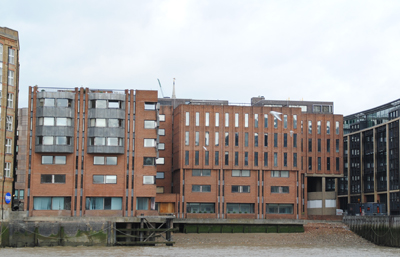
Perhaps not so much a sign as a pub name, the strangely monikered Doggett’s Coat and Badge in South Bank is named after a rowing race – said to be the oldest continuous sporting event in the country – in which apprentice waterman traditionally competed for a prize consisting of waterman’s coat and badge and named after Irish-born actor and theatre manager, Thomas Doggett.

The race – which is held in July and runs over a course of four miles and seven furlongs from London Bridge to Chelsea (the starting and finishing points were originally both marked by pubs called The Swan) – was first held in 1715 when it was first organised by Doggett who financed it up until his death in 1721 after which he left instructions in its will for it to be carried on by The Fishmongers’ Company (which it still is today).

While there’s a nice story that Doggett, who managed the Drury Lane Theatre and later the Haymarket Theatre and carving out a name for himself as a ‘wit’, started the race as thanks to Thames watermen for rescuing him when he fell off a watercraft while crossing the Thames, Doggett – a committed Whig – actually started the race to commemorate the ascension of King George I – the first ruler of the House of Hanover – on 1st August, 1714, following the death of Queen Anne.

This year’s race winner was Merlin Dwan (London Rowing Club) who beat four others to finish in 24 minutes, 28 seconds.

The pub, one of the Nicholson franchise, is located in a multiple storey modern building complex and sits along the course of the race in South Bank. It features a range of bars including Thomas Doggett’s Bar and the Riverside Bar as well as a dining room and other function rooms.

For more on the pub, see www.nicholsonspubs.co.uk/doggettscoatandbadgesouthbanklondon/. For more on the race (which we’ll be mentioning, along with more on Thomas Doggett, in more detail in upcoming posts), see www.DoggettsRace.org.uk.

Lost London – Greyfriars…

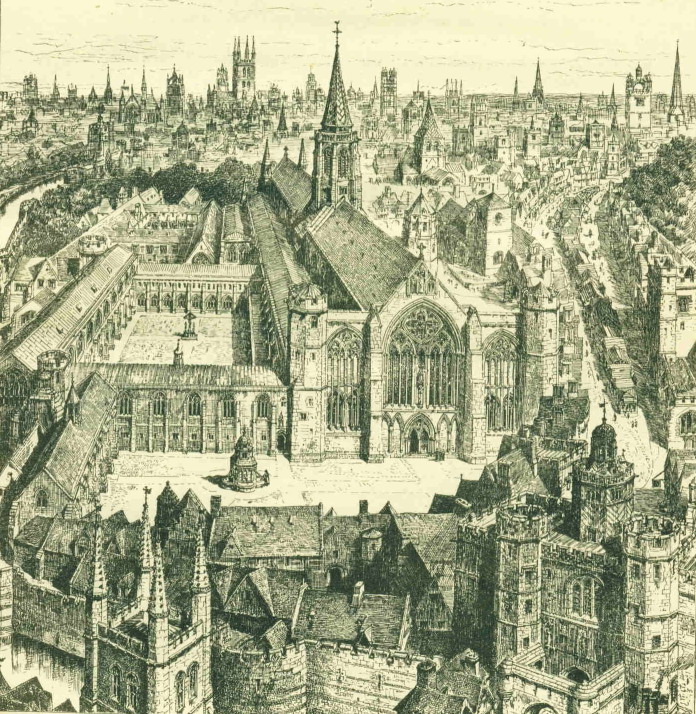
A now long gone Franciscan friary located in the north-west of the City of London near Newgate (just to the north of St Paul’s Cathedral), Greyfriars, so known for the color of the friars’ clothing, was the second Franciscan religious house to have been founded in England.

The foundations of the friary date from the early part of the 13th century – the Franciscans, as members of the Order of Friars Minor were known, had arrived in 1224 and are recorded as settling on land granted to them by a rich mercer, John Iwyn, just inside the City wall, in 1225, in the butcher’s quarter of the city.
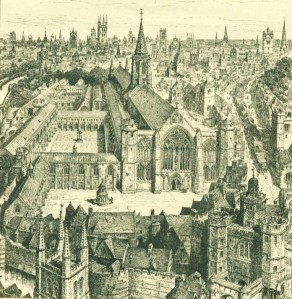
King Henry III apparently gave them some oak to build their own friary in 1229 and by the mid 1200s, there were more than 80 friars living on the site which was gradually extended over the ensuing years to the north and the west.

Using funds given them by Sir William Joyner, Lord Mayor of London in 1239, they built a chapel which was later extensively enlarged and improved in the late 13th and early 14th centuries – the new church was said to be 300 feet long – with much of the work funded by Queen Margaret, second wife of King Edward I, and later in the 14th century, Queen Isabella, wife of Edward III. It apparently suffered some damage in a storm in 1343 but was restored by King Edward III.

When it was finally completed in 1348, the church is said to have been the second largest in London. A library was later added to the buildings, founded by the famous Lord Mayor of London, Richard “Dick” Whittington.

Such was the fame of the church that, the heart of Queen Eleanor, wife of King Henry III, was buried here after her death in 1291 while, despite dying at her castle in Marlborough, Queen Margaret was also buried here in 1318 (apparently wearing a Franciscan habit).

But perhaps the most notorious person to be buried here was Queen Isabella, wife of King Edward II and known by many as the “She-Wolf of France”, after her death in 1358. In fact, it’s said that the ghost of Isabella still haunts the former location of Greyfriars, driven forth from the grave for her role in deposing her husband.

Other non royal luminaries said to have been buried here include the 15th century writer Sir Thomas Mallory, author of Le Morte d’Arthur and 16th century Catholic nun Elizabeth Barton, the so-called ‘mad maid of Kent’ who was executed for her rather unwise prophecies predicting King Henry VIII’s death if he married Anne Boleyn.

The end of the friary, pictured above in the sixteenth century, came in 1538 when it fell victim to King Henry VIII’s policy of dissolving monasteries and was surrendered to his representatives.

Some of the houses were subsequently converted for private use and the church, which was somewhat damaged during this period with many of the elaborate tombs destroyed, was briefly closed before it and other buildings were given to the City of London Corporation who reopened it again in 1547 as Christ Church Greyfriars, a parish church serving the now joined parishes of St Nicholas Shambles and St Ewen.

Only a few year’s later King Edward IV founded a school for poor orphans in some of the old friary buildings known as Christ’s Hospital or informally as The Bluecoat School thanks to the uniforms students wore. Some of the school buildings, along with part of the church which was also used by the school, was destroyed by the Great Fire of London in 1666, but the school was rebuilt and remained in use until the late 1800s when the last of the students were relocated to a new facility in Sussex (where the school still exists today).
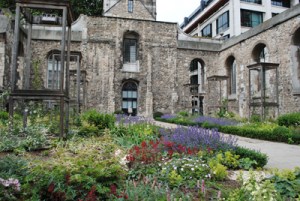
The church (also known as Christ Church Newgate Street), meanwhile, was also rebuilt after the Great Fire – it was one of Sir Christopher Wren’s designs and was completed in 1704. The church remained in use until World War II when a firebomb struck it during a German raid on 29th December, 1940, all but destroying it.

The church was not rebuilt and the parish merged with the nearby St Sepulchre-without-Newgate – the largest parish church in London – and eventually what’s left of the church – the tower with rebuilt steeple and the west and north walls – were converted into a public garden (rose beds were planted where the pews once stood and there are wooden towers representing the church’s pillars). Pictured right, it’s now a terrific place to sit and have lunch pondering the past which the bustle of the city goes on about you.

PICTURE: (top) Wikipedia

For a great biography of Isabella, the She-Wolf of France, see Alison Weir’s Isabella: She-Wolf of France, Queen of England. For more on Sir Christopher Wren’s churches in London, see John Christopher’s Wren’s City of London Churches.

Around London – Naval caricatures; James Bond; a Taliban motorbike; and Sir Peter Lely at the Courtauld…

Naval caricatures of the late 18th and early 19th century go on display in a new exhibition which opens at the National Maritime Museum today. Broadsides! Caricature and the Navy 1756-1815 features a small selection of the museum’s extensive collection of caricatures – one of the largest in the world, it features works by James Gillray, George M Woodward and Thomas Rowlandson. It explores the role the caricatures played in shaping public opinion during the period which included the American War of Independence and wars against revolutionary and Napoleonic France. The exhibition features 20 prints with visitors able to see others in the museum’s collection via the website www.rmg.co.uk/collections. Admission is free. Runs until 3rd February. For more, see www.rmg.co.uk.

Celebrate the 50th anniversary of James Bond and the premiere of the latest film in the franchise, Skyfall, with a look at a rare collection of James Bond posters and other memorabilia as well as the latest Bond vehicle this weekend. The Hospital Club in Covent Garden is hosting the event, in conjunction with Blue Robin, which features about 50 vintage posters from movies such as 1973’s Live And Let Die and 1963’s From Russia With Love. There’s also the chance to have your photo taken beside the double-cab Land Rover Defender which features in the opening chase sequence of Skyfall. Also exhibited will be M’s chauffeur-driven Jaguar XJ long wheel base and the black Range Rover driven by Bill Tanner, M’s chief of staff. The free exhibition is open to the public from 11am to 7pm from tomorrow until Monday (please call reception on 020 7170 9100 before visiting). For more, see www.thehospitalclub.com.

A motorbike captured from Taliban insurgents in Afghanistan by members of the 1st Battalion The Rifles has gone on display at the Imperial War Museum in London. The Honda motorbike forms part of the interactive display, War Story: Serving in Afghanistan, in which visitors can delve into the lives of service personnel taking part in Operation Herrick through personal artefacts, photographs and video. The bike was recovered by soldiers after it was left behind by two insurgents during an encounter on 4th May last year. It is the largest item to be donated through the War Story project and is the only item of enemy equipment acquired by the project to date. The motorbike will be displayed until 18th December. For more, see www.iwm.org.uk.

Now On: Peter Lely: A Lyrical Vision. This newly opened exhibition at the Courtauld Gallery is the first to look at the group of large scale narrative paintings produced by Sir Peter during the turmoil of the Civil War in the 1640s and 1650s. Renowned as the principal painter of King Charles II and the “outstanding artistic figure of Restoration England”, Sir Peter apparently never wished to be seen principally as a portraitist and following his arrival in England in the early 1640s, initially devoted himself to paintings inspired by classical mythology, the Bible and contemporary literature. The exhibition centres on The Courtauld’s own work, The Concert, and features an important group of little known paintings from private collections. Runs until 13th January. Admission charge applies. For more, see www.courtauld.ac.uk/gallery/index.shtml.

Treasures of London – Temple Church knight effigies…

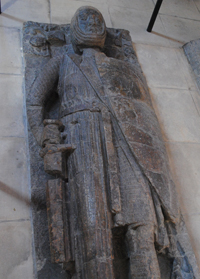
A relic of the early medieval age, the late 12th century Temple Church in the City of London is a marvel in its own right, its circular nave modelled on the Church of the Holy Sepulchre in Jerusalem (for more on its history, see our earlier entry here). But it’s inside the round church – once based inside property that formed the London headquarters of the Templar Knights – that we are concerned with in this piece – for there can be found are series of remarkable effigies of knights which date from the 13th century.

There are nine effigies in all (and one grave cover) and, having survived the Great Fire of 1666, most of them were damaged during World War II when, in a bombing raid on 10th May, 1941, the roof was set alight and came crashing down on top of them. They have since been repaired, using as much of the original material as possible, and still make an imposing sight redolent with the history they depict.

Pre-eminent (at least in his lifetime) among those depicted is William Marshal, the 1st Earl of Pembroke (1146 -1219) and an advisor of kings including King Henry II, King Richard ‘the Lionheart’ and King John who was named Regent during the infancy of King Henry III.

One of the most influential men of his age (described by early thirteenth century Archbishop of Canterbury, Stephen Langton, as the “greatest knight who ever lived”), he lies in the southern group of effigies near his sons William, 2nd Earl of Pembroke (1190-1231) and Gilbert, the 4th Earl of Pembroke (1194-1241). (The 3rd Earl of Pembroke, Richard, was the second son of William – he died after being captured during fighting in Ireland and was buried in Kilkenny). Another of this group is believed t0 depict Robert, Lord de Ros, one of the 25 barons to guarantee the observance of the Magna Carta, signed by King John in 1215.

The only identified effigy in the northern group is that of Geoffrey de Mandeville, the 1st Earl of Essex and a man known for the cruelties he inflicted during the troubled reign of King Stephen (he shifted his allegiances between King Stephen and his rival, the Empress Matilda several times), particularly in the eastern counties where he seized Ramsey Abbey near Peterborough to use as his base.

Interestingly, none of the men named was a Templar but are believed to have been benefactors of the Templar Knights. Some of those shown are cross-legged but whether this denotes a crusader or not remains a matter of debate.

WHERE: Off Fleet Street and down Inner Temple Lane (nearest tube station is Temple); WHEN: Check website for times; COST: £4 (free to under 18s, seniors); WEBSITE: www.templechurch.com.

10 Historic London Markets – 3. Billingsgate Market…

Now the UK’s largest inland fish market (and located in Poplar, east London), the history of Billingsgate Market goes back centuries.

Known originally by various spellings including Blynesgate and Byllynsgate, Billingsgate may have been named for watergate on the north bank of the Thames near where the market was originally established (an alternate theory is that it was named for a man named Biling or an mythological British king, Belin).

The right to collect tolls and customs at Billingsgate, along with Cheap and Smithfield, was granted by King Henry IV in 1400.

Billingsgate only became particularly associated with fish in the 1500s and in 1699, an Act of Parliament was passed making it “a free and open market for all sorts of fish whatsoever” (this was with the exception of eels, restricted to being sold by Dutchmen from boats in the river – a reward for the help they provided after the Great Fire of 1666).

While for much of the market’s history, fish was sold for stalls and sheds around the ‘hythe’ or dock at the site known as Billingsgate, in 1850 the first purpose-built market building was constructed in Lower Thames Street.

Deemed inadequate for the task at hand, however, it was demolished after slightly more than 20 years of service. A new building, designed by then City Architect Sir Horace Jones and constructed by John Mowlem, was opened in on the same site in 1876. In the late 19th century, it is said to have been the largest fish market in the world. The heritage listed former fish market building in Lower Thames Street (pictured above) is now used as a venue for corporate events, catwalk shows, post premiere parties and concerts (see the website for more www.oldbillingsgate.co.uk).

In 1982, the market was relocated to a 13 acre site on the Isle of Dogs, just to the north-east of Canary Wharf. The building contains a trading floor with some 98 stands and 30 shops as well as an 800 tonne freezer store. An average of 25,000 tonnes of fish and fish products are sold through its merchants every year and the market has an annual turnover of around £200 million.

The role of the fish porter – who traditionally have been the only people licensed to move fish around the market – was opened up to anyone following a fiercely fought battle between the porters, traders and the City of London Corporation earlier this year.

The market is open to the general public and tours can be arranged – head to the website for details.

WHERE: Billingsgate Market, Trafalgar Way, Poplar (nearest Tube Station is Canary Wharf); WHEN: 4am to 9.30am Tuesday to Saturday (children under 12 are not permitted on the market floor and non-slip shoes are advisable); COST: Free; WEBSITE: www.cityoflondon.gov.uk/business/wholesale-food-markets/billingsgate/Pages/default.aspx.

Treasures of London – The Becket Casket…

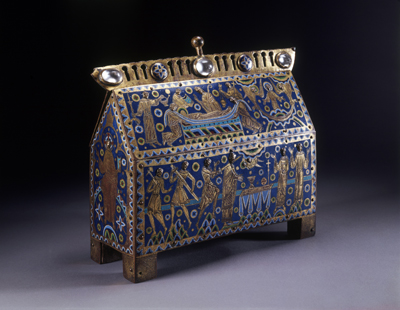
This stunning early medieval casket, dating from around 1180-1190, commemorates one of the most infamous events of the Angevin era – the death of Thomas Becket, Archbishop of Canterbury, who was murdered in Canterbury Cathedral on 29th December, 1170, by four knights of King Henry II.

The murder – for which the king undertook public penance (although whether he ordered the death of Becket, his former chancellor and friend, remains a matter of some dispute) – provoked outrage across Europe and pilgrims soon started flocking to Becket’s tomb.

So much so that the Archbishop was canonised in 1173 and in 1220 a richly decorated shrine was created to house Becket’s remains and serve as a focal point for pilgrims (a pilgrimage to Becket’s shrine is at the heart of Geoffrey Chaucer’s A Canterbury Tale). The shrine was eventually destroyed in 1538 on the orders of King Henry VIII during the Dissolution of the Monasteries.

The beautiful Becket Casket, made of Limoges enamel, depicts, among other things, Becket’s murder, subsequent burial and the ascension of his soul to heaven. On the rear are four long-haired figures who may represent saints or the Cardinal Virtues of Prudence, Justice, Fortitude and Temperance.

One of more than 40 examples still in existence (the British Museum also has one), it was probably made for an important religious house and may have been used to contain relics of the dead saint.

It can now be found in the collection of the V&A’s Medieval and Renaissance Gallery at the museum’s premises in South Kensington.

WHERE: Room 8 (case 20), Victoria & Albert Museum, Cromwell Road, South Kensington (nearest Tube Stations are South Kensington and Knightsbridge). WHEN: 10am to 5.45pm daily (Fridays until 10pm – select galleries after 6pm)COST: Free; WEBSITE: www.vam.ac.uk.

For more on Thomas Becket, see John Guy’s book Thomas Becket: Warrior, Priest, Rebel, Victim: A 900-Year-Old Story Retold.

PICTURE: V&A images

10 Historic London Markets – 1. Borough Market…

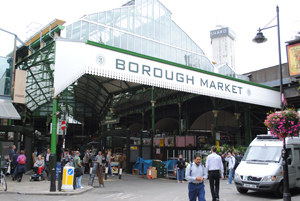
In the first of a new series looking at some of London’s most historic markets, we take a look at the history of Borough Market in Southwark, now the city’s most famous food market.

The origins of a food market in the area go back to at least to the reign of the Anglo-Saxon King Ethelred the Unready in early 11th century (some have suggested as far back as Roman times) with food vendors clustering around the southern end of London Bridge. The market was relocated to Borough High Street in the 1200s.

In 1755, traffic congestion saw Parliament close the market but Southwark residents raised £6,000 and bought a small area of land known as The Triangle – once part of the churchyard of the now long gone church of St Margaret’s – and reopened the market there.

The Triangle still remains at the heart of the market which sits partly under railway arches just to the south of the Southwark Cathedral churchyard. New market buildings were constructed in the mid 1800s but deemed “impractical”, they were replaced by new buildings in the late 1800s and 1930s (the latter was when the art deco entrance on Borough High Street was erected).

The market was refurbished in 2001 and the ornate Grade II-listed Floral Hall, which was originally the south portico on the Floral Hall at Covent Garden (taken down to make way for the Royal Opera House), was installed in 2003.

There are now more than 100 stalls in the wholesale and retail food market, making it one of the largest in London. It is owned by a charitable trust, The Borough Market (Southwark), with the volunteer trustees all local residents. Sections in the market include the Jubilee Market and the Green Market and a blue plaque, declaring the market London’s “oldest fruit and veg market”, was installed by Southwark Council earlier this year.

The amazing variety fine food on offer will tempt even the most jaded of palates but be warned that you have to queue as it can get a little packed with tourists at lunchtimes!

WHERE: 8 Southwark Street (nearest Tube Stations are London Bridge or Borough); WHEN: 10am to 3pm Monday to Wednesday, 11am to 5pm Thursday, 12pm to 6pm Friday, and, 8am to 5pm Saturday; COST: Free entry; WEBSITE: www.boroughmarket.org.uk

Where’s London’s oldest…livery company hall?

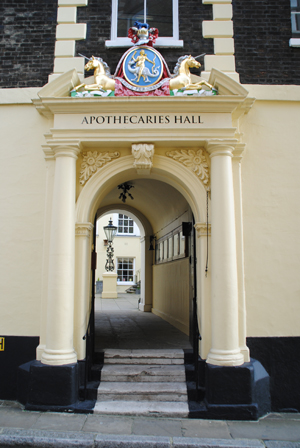
The oldest livery company building, that of the Worshipful Society of Apothecaries of London, dates from just after the Great Fire of London in 1666.

Originally built in 1672 to the designs of surveyor Edward Jerman, it replaced an earlier building which had been destroyed in the fire. It has since been refurbished several times and while the external facade appears as it did in the late 1700s, the interior layout, with Great Room – complete with original Irish Oak panelling, Court Hall and Parlour, is as it was when first built after the Great Fire.

Previously members of the Grocer’s Company (and earlier still, the Guild of Pepperers), the Apothecaries Society was incorporated as a City livery company on 1st December, 1617, when it was granted a royal charter by King James I.

They purchased a building in 1632, known then as Cobham House (previously owned by Lady Anne Howard), on land formerly part of Blackfriars Priory (see our former post on the priory here) – it was this building which was destroyed in 1666.

Among treasures inside the current hall is a portrait of Gideon de Laune, Royal Apothecary to Queen Anne of Denmark, wife of King James I, and credited as founder of the Society which was was presented to the Society  in 1641 and hangs in the Court Room. There’s also a 24-branch candelabrum in the Great Hall which was presented to the society by Sir Benjamin Rawling, Sheriff of London and Master of the Society in 1736.

Now one of the largest of the livery companies in the City and still active in regulating medical practitioners, it is 58th in order of precedence and is still active in its trade with the organisation’s constitution requiring 85 per cent of the Society’s membership belong to the medical profession. Past luminaries have included the Romantic poet, John Keats.

The society is also known for having established the Chelsea Physic Garden in 1673 – making it one of the oldest botanic gardens in the world – on land granted it by Sir Hans Sloane (see more on him in our earlier post here).

The hall is available for hire. For more information on the Society, see www.apothecaries.org. Visits to the hall are by prior arrangement only. Contact the Beadle via the above website to find out more.

Lost London – Princess Caroline’s bath, Greenwich Park

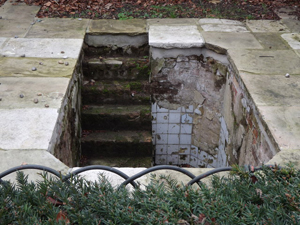
A white tiled plunge bath which once belonged to Princess Caroline of Brunswick, the estranged wife of George, Prince of Wales (later King George IV), still lies in the south-west corner of Greenwich Park between the Rose Garden and Chesterfield Gate.

Princess Caroline, a cousin of the prince, married him in 1795 in an arrangement made so he could get out of debt. Theirs was never a marriage of love – the prince is said to have spread rumours that she was adulterous, had bad breath and never washed – and after Princess Caroline gave birth to a daughter, Princess Charlotte, the couple separated.

Two years later, in 1798, Princess Caroline was banished to live at Montague House near Greenwich Park while the prince dallied with his mistress Maria Fitzherbert. The princess, known for her scandalous and indiscreet behaviour during her residence at the house, used the sunken bath, which the stood inside a bathhouse partly attached to the main building.

The house was demolished in 1815 on the orders of the king (a decision apparently prompted by a fit of pique at the Queen’s lifestyle), a year after Princess Caroline left England for the Continent plagued by rumours that she’d mothered an illegitimate child (a secret commission into her behaviour cleared her of a charge of adultery but did find her behaviour to be improper).

The sunken bath, meanwhile, was filled in during the 1980s and served as a flowerbed until, in 2001, it was re-excavated by Royal Parks in a dig funded by the Friends of Greenwich Park, Greenwich Society, the Friends of Ranger’s House and donations from individuals.

WHERE: Princess Caroline’s Bath, south-west corner of Greenwich Park (nearest DLR station is Cutty Sark – other nearby stations include Greenwich, Maze Hill and Blackheath); WHEN: 6am to at least 8pm (but beware, closing times vary depending on the month); COST: Free entry; WEBSITE: www.royalparks.gov.uk/Greenwich-Park.aspx

PICTURE: © Copyright Colin Smithwww.geograph.org.uk 

Famous Londoners – Grinling Gibbons…

A late 17th and early 18th century wood carver and sculptor, the curiously named Grinling Gibbons is remembered for his magnificent carvings in numerous English buildings including such London icons as St Paul’s Cathedral and Hampton Court Palace.

Not much is known about Gibbons’ early life. The son of English parents (his father was apparently a draper), he was born in Rotterdam in The Netherlands on 4th April, 1648, and, as a young man, is believed to have undertaken an apprenticeship as a sculptor in that country.

Around the age of 19, he moved to England – first to York and to Deptford in the south. It was the quality of his work which led diarist John Evelyn, having discovered Gibbons working on a limewood relief of Tintoretto’s Crucifixion in a small cottage near Deptford in early 1671, that led him to introduce him to Christopher Wren, the architect of the age, and fellow diarist Samuel Pepys and to eventually present him (and his relief) to King Charles II at Whitehall Palace on 1st March the same year.

But Gibbons’ work apparently failed to initially impress at court and it was only following his ‘discovery’ later that year by the court artist Sir Peter Lely that he began to receive major commissions.

It’s apparently not known when Gibbons married his wife Elizabeth and moved to London they were living there by 1672 and were having the first of their at least 12 children (while at least five of their daughters survived into adulthood, none of their sons did).

In 1672, they were living in an inn, called La Belle Sauvage or The Bell Savage, located on Ludgate Hill near St Paul’s, and, while Gibbons continued to maintain a workshop here into the 1680s, the family moved to Bow Street in Covent Garden around the end of the 1670s (the house here apparently collapsed in 1702 and was subsequently rebuilt in brick).

Gibbons, who was admitted to the Draper’s Company in 1672 and held various posts within it over ensuing years, reached the pinnacle of his success when he was made master sculptor and carver in wood to King William III in 1693, and was later made master carpenter to the king, then King George I, in 1719.

Having worked mostly in limewood, Gibbons, recently called the “British Bernini”, is known for his distinct and exuberant style which features cascading foliage, fruit, animals and cherubs. While he worked on numerous important buildings outside of London – including carvings in the Chapel Royal and king’s dining room at Windsor Castle, in a chapel at Trinity College in Oxford, at Blenheim Palace in Oxfordshire and a famous ‘carved room’ at Petworth House in Sussex – and beyond (he also created two presentation panels – known as the ‘Cosimo’ and ‘Modena’ panels which were sent to Italy as royal gifts), Gibbons is also noted for his work on a number of prominent buildings in London.

Among the buildings he worked on or in around London are the churches of St James’s in Piccadilly, St Mary Abchurch, St Michael Paternoster Royal and, famously, St Paul’s Cathedral (where he carved choir stalls, the bishop’s thrones and choir screen) as well as Hampton Court and Kensington Palaces.

While he is primarily remembered for his limewood carvings, Gibbons’ workshop was also responsible for sculpting statues, memorials and decorative stonework. A couple of the workshop’s statues can still be seen in London – one of King Charles II in Roman dress at the Royal Hospital in Chelsea and another of King James II outside the National Gallery in Trafalgar Square – while the magnificent Westminster Abbey memorial to Admiral Sir Clowdisley Shovell is also attributed to him.

Gibbons died at his Bow Street home on 3rd August, 1721, and was buried in St Paul’s Church in Covent Garden (his wife had been buried there several years before).

For more on Grinling Gibbons, check out David Esterly’s Grinling Gibbons and the Art of Carving.

Treasures of London – The Royal Kitchens, Kew…

Given this week’s release of English Heritage’s The London List 2011 – which lists all properties given a new or upgraded heritage listing last year, we thought it was only appropriate to look at one of the properties listed, in this case the Royal Kitchens in Kew Gardens.

Upgraded to a Grade I listing in 2011, the kitchens were opened to the public for the first time in May this year following a £1 million restoration. The origins of the kitchens go back to the 1730s when they were built to the designs of William Kent to serve the White House, the grand mansion of Frederick, Prince of Wales (eldest son and heir of King George II).

While the White House was demolished in 1802, the Georgian kitchens – built in a separate building to mitigate the risk of fire – were kept to serve the nearby premises of Kew Palace (formerly known as the “Dutch House”, it had been originally built in 1631 for a Flemish merchant).

But after the death of Queen Charlotte (wife of King George III) in 1818, members of the Royal family only stayed occasionally and so the kitchen fell into disuse. While the upper floors were given over to accommodation, the lower floor remained untouched, allowing it to survive in a considerable degree of intactness.

The kitchens centre on the double storey ‘Great Kitchen’ featuring three charcoal stoves as well as a rare cooking range with “smoke jack” and fan. Other rooms include a scullery, a bakery, larders and stores for silver and spices while among the surviving furnishings is a preparation table or dresser, cupboards, shelves and baking ovens. Upstairs, the office of the clerk who oversaw the feeding of the Royal Household has been restored.

Historic Royal Palaces, who look after the kitchens, have installed a new permanent exhibition at the site which focuses life on the 6th February, 1789, the date when King George III, having suffered his first bout of ‘madness’ (believed to be porphyria), was given back his knife and fork. William Wybrow was the Master Cook at this time and William Gorton the Clerk of the Kitchen.

WHERE: The Royal Kitchens, Kew Gardens, Kew (nearest Tube Station is Kew Gardens); WHEN: 11am to 5pm daily until 30th September, then Thursday to Sunday until 28th October, then daily again until 4th November; COST: Kew Gardens tickets must be purchased – £16 adults/£14 concessions/children under 16 free – and then tickets to Kew Palace – £6 adults/£4.50 concessions/children under 16 free (or free with annual Historic Royal Palaces membership); WEBSITE: www.hrp.org.uk/kewpalace/stories/palacehighlights/royalkewkitchens.

PICTURE: Forster/HRP

For more on Kew Palace, check out Kew Palace: The Official Illustrated History.

Lost London – Queenhithe…

Not, strictly speaking, lost, Queenhithe – a dock on the north bank of the Thames – is nonetheless these days merely a shadow of its former self.

There has been a dock here since Saxon times when it is recorded that King Alfred (he of ‘The Great’ fame), established a harbour here in 883. It was then known as Ethelred’s Hythe (the Ethelred being that of his brother-in-law and ‘hythe’ being a Saxon word for a trading shore where goods could be traded directly out of boats).

Queenhithe took its name from Queen Matilda, the wife of King Henry I, who was granted dues from goods being traded at the dock in the early 1100’s – a right which was later inherited by future English queens.

The dock reached the peak of its popularity in the 13th century when it became the principal site for the landing of grain and other food supplies to feed London but in the 15th century, the dock’s importance waned as other docks downstream, better suited to larger watercraft, took over much of its trade.

Remains of the wooden timbers which in medieval times lined the Thames waterfront have been found here. The inlet for Queenhithe’s harbour (pictured above) is one of few left on The Thames.

The name these days gives itself to Queenhithe street (which leads to the inlet) and the Queenhithe Ward, one of 25 wards in the City of London. There was also a former church known as St Michael Queenhithe – it was destroyed in the Great Fire of 1666, rebuilt to the designs of Sir Christopher Wren and then demolished in the late 19th century.

Daytripper – Rye

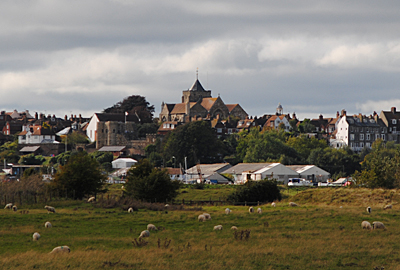
This beautifully preserved medieval town on the East Sussex coast is really worth more than a daytrip – it’s a terrific place to spend a weekend! 

The history of this fortified township – which was once on the coast but now sits some two miles back from open water thanks to the silting up of the harbour – stretches back to at least Saxon times.

But it was in the Middle Ages that, thanks to its position relative to France, it flourished as a port and was eventually given the distinction of being a member of the Cinque Ports Federation (the federation originally included the ports of Hastings, New Romney, Hythe, Dover and Sandwich and was later expanded to include Rye and Winchelsea).

However, the proximity to France also meant the town had an interesting relationship with the French who conducted repeated raids including in 1339 when 52 houses and a mill were burned, and in 1377 when the town was almost completely burnt to the ground and the invaders made off with the bells of St Mary’s Church (dating from 1150, the church is certainly well worth a visit, particularly for the stunning views from the bell tower roof).

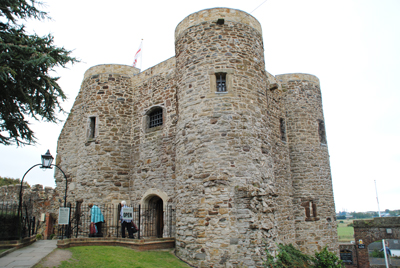
Key surviving fortifications including the 14th century The Ypres Tower (originally called Baddings Tower, this 40 foot high structure – pictured right – with three round towers is now home to half the Rye Castle Museum – the other half being in East Street) and Landgate (this was built as part of a series of walls and gates constructed after the devastating 1377 raid) were built to counter this threat and when the French raided again in 1449, they were successfully resisted.

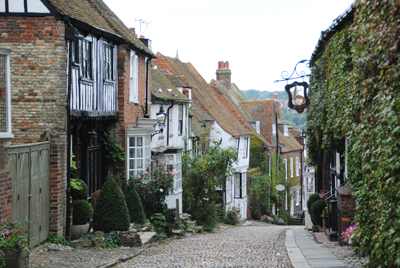
Rye’s location – it now sits at the confluence of the Rother, Tillingham and Brede Rivers – also meant that since its earliest days, it was popular with smugglers despite government efforts to stop them (they did eventually succeed in the early 19th century thanks to customs law reforms and the establishment of a national coastguard service). Among the most famous to frequent the town was the Hawkhurst Gang, who used the Mermaid Inn in the beautiful cobbled Mermaid Street (pictured, below) as one of their bases in the area in the early 18th century (the gang was eventually captured and executed in 1749). The inn apparently may date back as far as the 12th century and has a fascinating history.

Aside from the many Tudor and Georgian homes, notable buildings include the Old Grammar School in High Street (founded in 1636), the Town Hall in Lion Street (1742) and the red brick fronted Lamb House in West Street – once home to authors Henry James and EF Benson and now owned by the National Trust. There’s also a model of the town (complete with sound and light show which gives a great overview of the town’s history) at the Rye Heritage Centre located in an old sail loft on Rye Strand Quay – a good place to visit for information and details of walks and tour options.

Not far from Rye can be seen Camber Castle, a round artillery fort (essentially a glorified gun platform) built by King Henry VIII. It’s now managed by English Heritage and can be visited on tours.

Rye is located about an hour’s journey by car from the M25 and can be reached by train from Charing Cross, London Bridge or Waterloo East or from St Pancras (via Ashford International).

What’s in a Name?…Trafalgar Square

It wasn’t until some time after Admiral Lord Nelson’s victory over the French fleet in the Battle of Trafalgar off the coast of Spain on 21st October, 1805, that the large public space in Westminster we now know as Trafalgar Square took its name.

Prior to the development of the square, much of the area it covers was occupied the King’s Mews – stables linked to the Palace of Whitehall – and was simply seen as part of the district known as Charing Cross (named for the memorial cross which stood close to where the equestrian statue of King Charles I now stands – for more on this, see our earlier post and follow the links).

Following the relocation of the Mews in the early 19th century, plans were drawn up by architect-of-the-age John Nash to redevelop the area while the square itself, completed in 1845, was designed by Sir Charles Barry (best known for his work on the Houses of Parliament).

The final design incorporated a statue of Admiral Lord Nelson atop a column, known as ‘Nelson’s Column’, in the centre – apparently against Barry’s wishes (see our earlier post for more on Nelson’s Column).

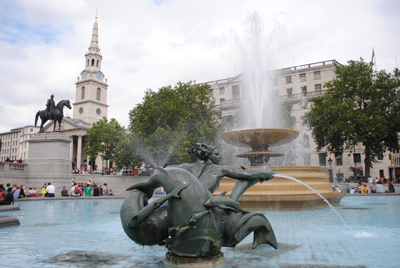
Originally designed with an upper terrace and a lower piazza linked by stairs at the eastern and western end of the terrace, the square contains two fountains on either side of the column – the current fountains were designed by Sir Edwin Lutyens in 1937-9 and replaced earlier ones.

It was originally suggested that the square be named King William IV Square but it was apparently architect George Ledwell Taylor who provided the alternative of Trafalgar Square in honor of Nelson’s great battle.

Bordered by significant landmarks including the National Gallery to the north, the church of St Martin’s-in-the-Fields to the north-east, South Africa House to the east and Canada House to the west, the square stands at the confluence of a number of major roadways including Whitehall, Strand, Charing Cross Road and The Mall.

Aside from the aforementioned statue of King Charles I, monuments within the square include Nelson’s Column along with plinths set in the four corners of the square. These bear statues of King George IV, Victorian military figures General Sir Charles James Napier and Major-General Sir Henry Havelock while the fourth plinth, located in the north-west corner, was originally intended to bear an equestrian statue of King William IV.

Instead, it was left empty for many years before the advent of the Fourth Plinth project under which a variety of contemporary artworks – most recently a massive sculpture of a boy astride a rocking horse – have occupied the space (you can see a picture of the current work in our earlier post here).

The square, once known as the home of thousands of pigeons before these were banished midway through last decade to allow greater public use of the space, also features the busts of three admirals – John Jellicoe, David Beatty and Andrew Cunningham, located against the north wall under the terrace.

There are also two statues on a lawn in front of the National Gallery – these are of US President George Washington and King James II. Curiously, the square also features a small pillar box in the south-east corner, referred to by some as the smallest police station in London.

A renovation project in 2003 pedestrianised the roadway along the north side of the square and installed a central stairway between the the upper and lower levels along with lifts, public toilets and a cafe.

For some more on the history of Trafalgar Square, see Jean Hood’s Trafalgar Square: A Visual History of London’s Landmark Through Time.

London Pub Signs – Tom Cribb…

In keeping with the sporting theme, we decided to take a look at a pub that bears that name of a sportsman – in this case Tom Cribb, a celebrated early nineteenth century boxer.

Born in 1781, Cribb moved to London from his home in Gloucestershire at just the tender age of 13 and worked in various jobs including as a bellhanger and a porter on the wharves before in taking up the sport of bare knuckle boxing with his first public bout in 1805 (he was known as the ‘Black Diamond’ thanks to his previous work as a coal porter).

Further fights followed and Cribb’s skill was such that in 1809 he won the British title and the following year he fought American and former slave Tom Molineaux to become world champion, a feat he repeated the in 1811 by beating Molineaux again.

Cribb retired from boxing in 1812 and later became a publican, running a couple of different pubs before taking up the job the Union Arms, located at 26 Panton Street, in the West End. He did apparently marry and in 1821 was among the prize fighters who guarded the entrance to Westminster Hall on the day of King George IV’s coronation.

Forced to give up his pub to creditors to pay off gambling debts, he retired to Woolwich in 1839 and died there in 1848 – he was buried in St Mary’s Churchyard where there is a memorial to him.

The pub which now bears his name is located on the same site as the Union Arms, although it is numbered 36 due to a numbering change. Inside it features a boxing theme with photos of some of Britain’s greatest boxers adorning the wall.

For more, see www.shepherdneame.co.uk/pubs/london/tom-cribb.

For a book on Tom Cribb, try Tom Cribb: The Life of the Black Diamond.

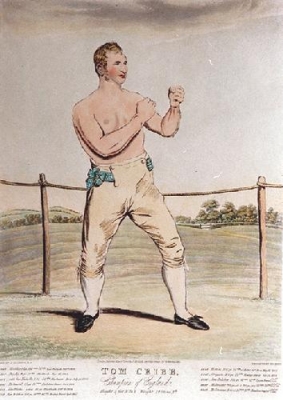
PICTURE: Tom Cribb in an engraving published in 1842. Source – Wikipedia.

Around London – Celebrating the Olympics; Camden Lock’s night market; and, images of London at the Tate…

We’ll kick off this week with just a few more of the plethora of Olympic-related events which are happening around town:

Tower Bridge, site of some spectacular fireworks last Friday night, is currently hosting an exhibition celebrating the 26 cities which have hosted the modern Olympics. Cities of the Modern Games, located on the bridge’s walkways, runs alongside an interactive exhibition looking at the bridge’s construction. Follow the link for details.

The Guildhall Art Gallery is showcasing sculpture and art inspired by sport and the “Olympic values”. The art works are all winning entries from a contest organised by the International Olympic Committee. The chosen works were selected from among 68 submissions made by an international jury. Follow the link for details.

The Design Museum is hosting a new exhibition celebrating the nexus between sport and design. Designed to Win looks at everything from the design of F1 cars to running shoes, bats and bicycles and explores the way in which design has shaped the sporting world. Runs until 9th September. Admission charge applies. See www.designmuseum.org.

• The London Metropolitan Archives is holding an exhibition of playing cards featuring an Olympic theme. Sporting Aces – Playing Cards and the Olympic Games features cards drawn from the collection of the Worshipful Company of Makers of Playing Cards which have an Olympic theme. Admission is free. Runs until 13th September. See www.cityoflondon.gov.uk/lma.

And in other news…

A night market has been launched at Camden Lock over the summer period. Street food stalls and vintage fashion, arts and crafts and book shops will be open until 10pm every Thursday with extras including live music and film screenings. For more, see www.camdenlockmarket.com.

• On Now: Another London: International Photographers and City Life 1930-1980. This exhibition at Tate Britain in Millbank features more than 150 classic photographs of the city and its communities by foreign photographers including such luminaries as Henri Cartier-Bresson. The exhibition features iconic works such as Robert Frank’s London (Stock Exchange) 1951, Cartier-Bresson’s images of King George VI’s coronation, Elliot Erwitt’s depiction of a rain-washed London bus stop, and Bruce Davidson’s image of a child with pigeons in Trafalgar Square alongside works such as Wolfgang Suschitzky’s images of working class families in the East End, from the 1940s, and Karen Knorr’s images of punks in the 1970s. The photographs all come from the Eric and Louise Franck London Collection, which includes more than 1,200 images of London and has been promised as a gift to the Tate. Runs until 16th September. Admission charge applies. See www.tate.org.uk. 

Have we missed something we should be telling others about? Send details in an email to exploringlondon@gmail.com.

Famous Londoners – Mr Punch…

Infamous, perhaps, rather than famous, Mr Punch (one half of Punch & Judy) this year celebrated the 350th anniversary of his first public appearance in London (which, in our view, makes him an honorary Londoner!).

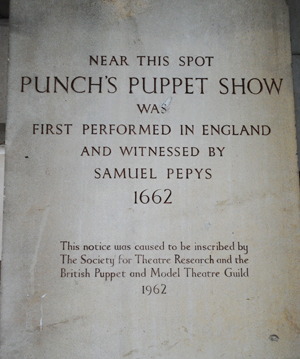
The first documented appearance of the hook-nosed Mr Punch – known for his acrimonious relationship with his wife Judy –  dates back to 9th May, 1662, when diarist Samuel Pepys recorded seeing a Mr Punch puppet performing as part of an Italian marionette show at Covent Garden (officially awarded a Guinness World Record title earlier this year for being the first recorded Mr Punch puppet show).

Mr Punch’s origins go back to Italy (Punchinello is thought to be an anglicised version of the character name of Pulcinella), typically wears a jester’s motley and tall, ‘sugarloaf’, hat with a tassel. Now generally a hand-puppet rather than a marionette, these days he usually performs in a mobile puppet booth with a cast of characters who as well as Judy can include a baby, a police constable and a crocodile.

Storylines – which were initially aimed at adults but are now generally aimed at children – vary but usually include references to current events (and perhaps also some mocking of public figures) and inevitably involve the unruly and often bawdy trickster, Mr Punch, doing away with his foes before uttering the line: “That’s the way to do it!”

Interestingly, Punch & Judy performers refer to themselves as “professors”  – there’s a story, apparently apocryphal, that this title was granted to the performers by King Charles II thanks to his enjoyment of the show. Collecting money from an audience watching the show is known as ‘bottling’ and those who assist the professor by doing so as ‘bottlers’, thanks to the tradition of using a bottle for the task.

Mr Punch reached the height of his popularity in the Victorian and Edwardian ages and could typically be seen carrying on in seaside resorts across the country. The dramatic decline in his popularity since means it can be harder to find a Punch & Judy show today (and even when you do, much of his more brutal antics have been excised from plays so as not to offend modern sensibilities), but it’s still possible to see Punch and Judy performances in many places across the UK including, on occasion, at Covent Garden where there is a plaque (shown above) commemorating the performance seen by Mr Pepys.

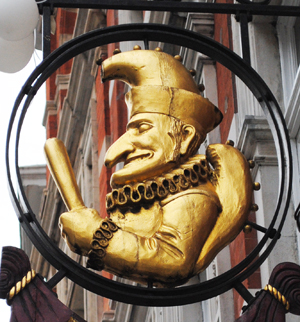
Mr Punch is still celebrated every year at Covent Garden’s May Fayre and Puppet Festival (held close to 9th May – not only the day Mr Pepys saw the puppet but now regarded as Mr Punch’s ‘birthday’) and there is a fellowship of Punch and Judy performers – The Punch & Judy Fellowship – who aim to “preserve, promote and protect” the traditions of the puppet show. Punch can also be seen on the facade of the Punch Tavern in Fleet Street – the sign is pictured above (keep on eye out for our upcoming Pub Signs look at the pub’s history).

Where is it?…#38


The latest in the series in which we ask you to identify where in London this picture was taken and what it’s of. If you think you can identify this picture, leave a comment below. We’ll reveal the answer early next week. Good luck!

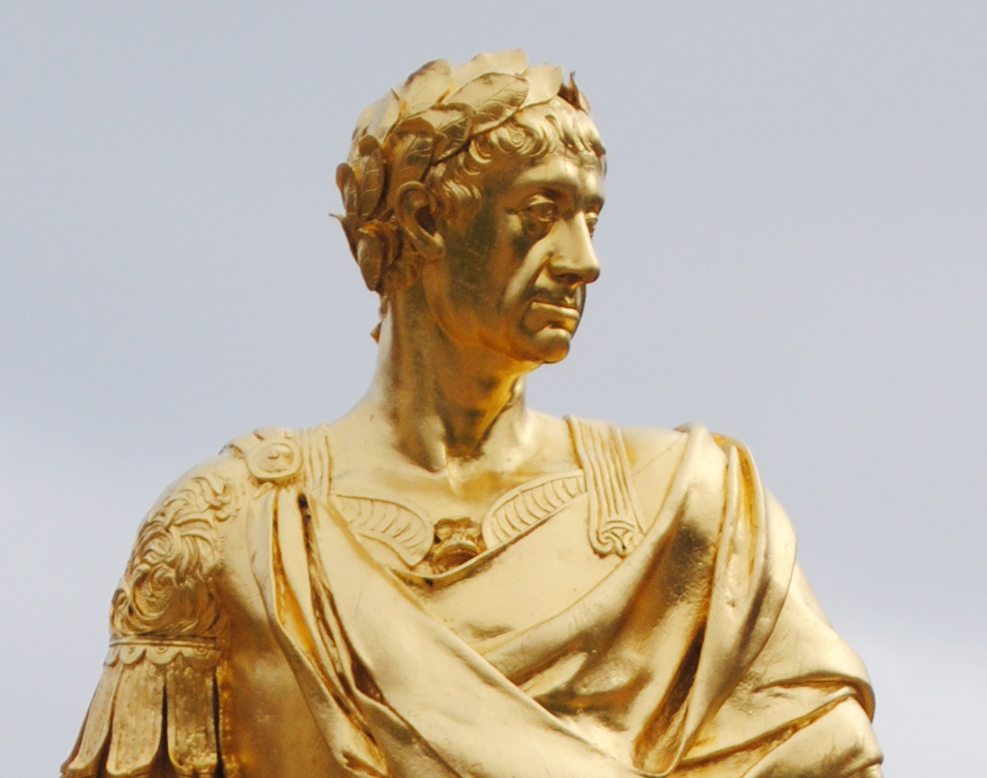
No-one managed it this time. This gilded bronze statue depicts King Charles II dressed as a Roman general and is located in the Figure Court of the Royal Hospital in Chelsea. The king founded the hospital in 1682 to provide a home for retired soldiers (the grand buildings you see are the work of Sir Christopher Wren – see our earlier entry here for more). The 7’6” tall statue, which was re-gilded to celebrate Queen Elizabeth II’s Golden Jubilee in 2002, was presented to the king in 1682 and moved to the hospital after his death in 1685. Although generally attributed to Grinling Gibbons, according to Walking London’s Statues and Monuments, it’s probably actually the work of Arnold Quellin, who worked in Gibbons’ studio. The statue is covered in oak branches on a date around 29th May each year – on a day known as Founders Day or Oak Apple Day – in commemoration of the legendary escape of the future king (by concealing himself in an oak tree) after the Battle of Worcester in 1651, the last battle of the English Civil War. For more on the hospital see www.chelsea-pensioners.co.uk.
Around London: Olympic Torch Relay hits London; mascots pop-up all over the city; and Shakespeare at the British Museum…

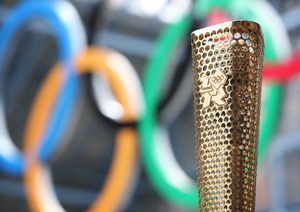
• The Olympic Torch Relay arrives in London tomorrow night before working its way around all of the city’s 33 boroughs and reaching the Olympic Stadium for the Opening Ceremony next Friday.  The torch will arrive in the city by helicopter from Guildford tomorrow night and then be abseiled into the Tower of London where it will spend the night ensconced with the Olympic medals. The relay will travel 200 miles over the next week, carried by more than 980 torchbearers. The route is as follows:

  • Saturday, 21st July – Greenwich via Newham, Tower Hamlets and Hackney to Waltham Forest (highlights include a visit to the Cutty Sark);
  • Sunday, 22nd July – Redbridge via Barking & Dagenham and Havering to Bexley (highlights include a ride on the London Eye and a crossing of the Thames);
  • Monday, 23rd July – Lewisham via Bromley, Croydon, Sutton and Merton to Wandsworth (highlights include a visit to a live filming of Eastenders);
  • Tuesday, 24th July – Kingston via Richmond, Hounslow, Hillingdon and Denham to Ealing (highlights include a visit to Kew Gardens);
  • Wednesday, 25th July – Harrow via Brent, Barnet and Enfield to Haringey (highlights include a visit to Wembley Arena);
  • Thursday, 26th July – Camden via Islington, the City of London, Southwark, Lambeth, Wandsworth, Kensington & Chelsea and Hammersmith & Fulham  to Westminster (the many landmarks to be visited include St Paul’s Cathedral, Shakespeare’s Globe, Trafalgar Square, Buckingham Palace and Hyde Park);
  • Friday, 27th July – From Hampton Court Palace (where it will be taken into the maze) on board Gloriana via the Thames to Olympic Park for the Opening Ceremony.

The 70 day torch relay, which kicked off on 19th May, will have travelled a total distance of about 8,000 miles and have involved 8,000 torchbearers by the time it reaches its end. LOCOG and Transport for London have advised people to see the relay at a location closest to their home given the expected crowds. For more detailed route information, see www.london2012.com/torch-relay/route/. PICTURE: LOCOG

Still talking all things Olympics and London’s largest ever ‘pop up’ shop – where you can buy Olympic merchandise – was officially opened by multiple gold medalist Sir Steve Redgrave in Hyde Park last week. The shop, located on Rotten Row, will be the site of special athlete visits during the Games and visitors can have their photo taken with the Olympic Torch.

• Meanwhile, life-sized versions of the Olympic mascot Wenlock and Paralympic mascot Mandeville are popping up at some of London’s key tourist locations. The 83 two metre tall sculptures capture various elements of life in London with incarnations including a Beefeater, a giant red phone box and a replica of Big Ben. The figures can be found on the routes of Stroll, six new discovery trails designed to help both tourists and Londoners get more out of the city. A QR code on the bottom of each of the sculptures directs smartphone users to further information about the discovery trails. The discovery trails are part of the Mayor of London Presents, a city-wide programme featuring free events, shows and activities. For more on what’s happening in your area, see www.molpresents.com. Some of these events are also being run as part of the Festival of London 2012. For more on this, see http://festival.london2012.com.

• On Now: Shakespeare: staging the world. Part of the World Shakespeare Festival taking place in London, this exhibition at the British Museum looks at the then emerging role of London as a “world city” as interpreted through Shakespeare’s plays and examines the role the playhouse performed in this. The museum has collaborated with the Royal Shakespeare Company to produce the exhibition which features more than 190 objects including paintings, jewels and rare manuscripts. These include the Ides of March coin, a Roman gold aureus commemorating the assassination of Julius Caesar (Julius Caesar), the Lyte Jewel, presented to Thomas Lyte in 1610 in thanks for his work in tracing King James I’s lineage back through Banquo (Macbeth), and a 1610 bird’s-eye view of Venice (Othello and The Merchant of Venice). Runs until 25th November. Admission charge applies. For more, see www.britishmuseum.org.

Around London – Richmond’s upsized Olympic rings; cart marking; ‘Sam’ Mussabini honored; and, Tudor twins at the NPG…

• The largest official Olympic Rings were unveiled at Richmond Park National Nature Reserve in London’s south-west this week, having been mown into the grass by the Royal Parks’ shire horses. The rings, which lie on Heathrow’s flight path and are 300 metres wide and more than 135 metres tall, will welcome athletes as they fly in to compete in the Games which kick off later this month. It took six shire horses to create the giant rings – which represent five continents – but they’ll be maintained by just two – Jim and Murdoch. Horses have worked in Richmond Park since as far back 1637 when King Charles I had the park enclosed as a royal hunting ground. Eleven Olympic events will be held on Royal Parks during the Games including road race cycling in Richmond Park. For more on Richmond Park, see www.royalparks.org.uk/parks/richmond-park. PICTURE: LOCOG.

• Almost 50 vehicles, ranging from handcarts to horse drawn carriages, steam powered vehicles to a new London bus, took part in the Worshipful Company of Carmen’s traditional ‘Cart Marking’ procession through the City of London yesterday. The ‘trade’ of carmen dates back to the 13th century when City authorities passed a bye-law controlling carters. At the ceremony, the carmen bring a variety of vehicles which are branded by placing a red hot iron on a wooden plate, with the year letter and the car number, in the continuation of an ancient tradition. The Worshipful Company of Carmen is said to be the oldest transportation organisation in the world. For more on the livery company, see www.thecarmen.co.uk.

• The late athletics coach Scipio Africanus “Sam” Mussabini (1867-1927) was honored this week with the unveiling of an English Heritage Blue Plaque at his former home in Herne Hill in London’s south. Mussabini, whose role in helping 100 metre sprinter Harold Abrahams win gold at the 1924 Olympics was depicted in the film Chariots of Fire (he was played by Ian Holm),  lived at the house at 84 Burbage Road from 1911 to about 1916. It backs onto the Herne Hill Stadium where he worked as a cycling and athletics coach from the 1890s, a period during which he trained several medal-winning Olympic athletes. All up, Mussabini’s runners won a total of 11 Olympic medals including five golds, between 1908 and 1928. For more, see www.english-heritage.org.uk.

On Now: Double Take: Versions and Copies of Tudor Portraits. This display at the National Portrait Gallery features five pairs of nearly identical Tudor portraits and explores how and why they were made. Among the portraits from the gallery’s collection on display are those of King Henry VIII, his wife Anne Boleyn, Archbishop William Warham, the merchant Thomas Gresham and Lord Treasurer Thomas Sackville – all of which are paired with paintings on loan from other collections. Admission is free. Runs until 9th September. For more information on the Making Art in Tudor Britain research project – of which this is a part – see www.npg.org.uk/research/programmes/making-art-in-tudor-britain.