What’s in a name?…Mayfair

Still the address to have in London, the origins of the name Mayfair are just as they appear – this area to the west of the City was named for the annual May Fair which was held at what is now the trendy (and picturesque) cafe precinct of Shepherd Market during the late 17th and early 18th centuries.
The two week long annual fair was established by King James II as a cattle market on what was then known as Brookfield Market in the 1680s. Attracting other pleasure-related activities, it soon became known for its licentiousness and, having survived Queen Anne’s attempts to have it banned, was eventually stopped in the mid-1700s. Edward Shepherd, who today gives his name to the area on which Brookfield Market once stood, was an architect and developer who subsequently redeveloped the site.

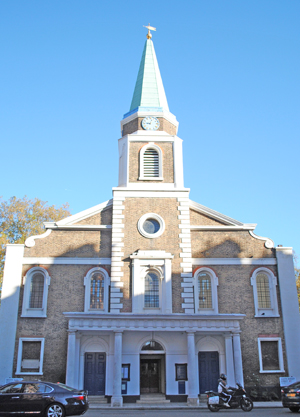
These days Mayfair is generally taken to encompass an area bordered by Hyde Park to the west, Oxford Street to the north, Piccadilly to the south and Regent Street to the east. The area’s development really took off in the century following the mid 1600s (landowners included the Grosvenor family – whose name is reflected in landmarks like London’s third largest square Grosvenor Square and Grosvenor Chapel (pictured) – as well as the Berkeleys and Burlingtons) and it became a favored residential location among the wealthy – indeed, it was this very gentrification which indirectly put an end to the fair.

Today, as well as being known for high end residential real estate, it’s one of London’s most expensive shopping precincts. Landmark buildings in the area today include the hulking bulk of the US Embassy at the western end of Grosvenor Square, the Royal Academy of Arts in Piccadilly, the Handel House Museum (located in what was the home of composer George Frideric Handel), shopping arcades such as the Burlington and Royal Arcades, and various luxury hotels like Claridge’s and The Dorchester in Park Lane.
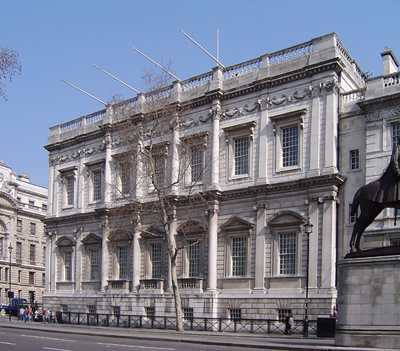
King James I’s London – The Banqueting House

This year marks 400 years since the creation of the King James Bible (it was completed in 1611). So, in a new special Wednesday series, we’re taking a look at London during the reign of King James I (he’s the one who commissioned the Bible). First up in our list of some of the key sites from his reign in 1603 to 1625, is the Banqueting House in Whitehall.

All that’s left of the Palace of Whitehall after a fire destroyed the rest in 1698, the Banqueting House was completed towards the end of King James I’s reign in 1622. In a sharp break from the fiddly Elizabethan architecture found in the remainder of the palace, the Banqueting House was the first building in central London which paid homage to the plainer Palladian style, brought back from Italy by ‘starchitect’ Inigo Jones.

The three floor Banqueting House replaced an earlier banqueting house which, funnily enough, had been destroyed by fire only a few years earlier. The new building was built to host royal ceremonies such as the reception of ambassadors and, most importantly, performances of court masques, which at the time were growing in sophistication and were being designed to communicate to audiences messages about the Stuart concept of kingship.

The building is centred on a “double cube” room  – a hall built so that its length is exactly double its width and height. The great chamber also features a balcony believed to have been created not for ministrels but as a space for an audience to watch the proceedings going on below.

It should be noted that the massive ceiling paintings were added after King James I’s death – it was his ill-fated son, King Charles I, who commissioned Flemish artist Peter Paul Rubens to paint them around 1630 (they were in place by March, 1636). It was, incidentally, from one of the windows in the Banqueting House that King Charles I stepped out onto a scaffold and had his head cut off – although that was in 1649, long after the era we’re focusing on here.

Inigo Jones and Ben Jonson’s Masque of Augurs was the first masque performed here in 1622, even before the building was complete. The last was Sir William Davenant’s The Temple of Love in 1635 after which the masques were stopped, apparently because the torches typically used to illuminate them would cause smoke damage to the paintings now on the ceiling.

WHERE: The Banqueting House, Whitehall (nearest tube station is Westminster); WHEN: 10am to 5pm, Monday to Saturday (check website for closing dates as the hall is used for functions) ;  COST: £5 an adult/£4 concessions/children under 16 free; WEBSITE: www.hrp.org.uk/BanquetingHouse/

PICTURE: Wikipedia

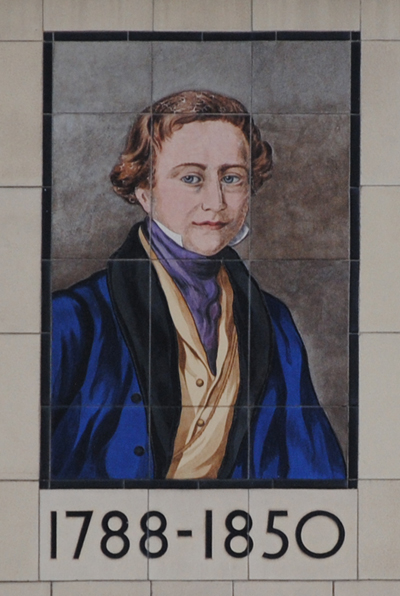
Famous Londoners – Sir Robert Peel

Credited as the creator of the Metropolitan Police Force, Sir Robert Peel was a two-time Prime Minister who oversaw landmark social reforms in arenas ranging from the workplace and prisons to trade.

Born on 5th February, 1788, into a wealthy Lancashire family (his father, also Robert Peel, was a cotton mill owner), Sir Robert was educated at Harrow and Oxford before entering parliament as part of the Duke of Wellington’s Tory government in 1809.

He married in 1820 and he and his wife Julia Floyd, the youngest daughter of General Sir John Floyd, had five sons and two daughters.

Having served in roles including under-secretary for wars and colonies and chief secretary for Ireland during his early political life, Sir Robert was appointed Home Secretary in 1822. It was during his subsequent time in the office that he introduced many reforms related to prisons and law and order – including reducing the number of crimes punishable by death by about 100 – and at the same time ordered the foundation of the Metropolitan Police Force (the terms ‘Bobby’ and ‘Peeler’ are both references to his name).

Having later spent time on the Opposition benches, he became Prime Minister in 1834 after Earl Grey’s Whig Government was dismissed by King William IV. It was during this time that he issued the famous Tamworth Manifesto, seen as a defining moment in the creation of the Conservative Party. But frustrated at the minority government, he resigned a year later.

It wasn’t until 1841 that Sir Robert returned to government, again becoming Prime Minister. Subsequent years saw him overseeing the introduction of laws forbidding the employment of women and children underground, limiting working hours for women and children in factories, and, after a long fight, repealing the trade-restricting Corn Laws – a party-splitting act which was apparently a bid to free up more food for the Irish population then in the midst of a devastating famine.

Sir Robert resigned from politics in 1846 and died four years later on 2nd July, 1850, after he was injured falling from a horse in Constitution Hill, London. He was buried at his home, Drayton Manor, near Tamworth in Staffordshire.

The city’s most famous statue of Sir Robert stands in Parliament Square, outside the Palace of Westminster.


Famous Londoners – Sir Thomas Gresham

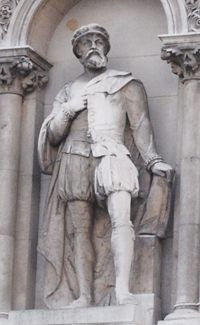
Remembered primarily for having founded the Royal Exchange as a centre for commerce in London and Gresham College, Sir Thomas Gresham was one of London’s leading merchants and financiers and an important advisor to successive monarchs during the sixteenth century.

Gresham was born in Milk Lane, London, to merchant Sir Richard Gresham (himself Lord Mayor of London in 1537-38) around 1518-19. He studied at Cambridge before being apprenticed to learn the family trade with his uncle, Sir John Gresham.

In 1543, he was admitted to the Mercers’ Company and subsequently spent time in the Low Countries, residing principally in Antwerp and acting as an agent for King Henry VIII. In 1544 he married Anne Fernley, widow of another London merchant. He also had a house in Lombard Street at this time.

Sir Thomas became an important advisor  to King Edward VI, helping him alleviate financial concerns, a role he continued to play during the successive reigns of Queen Mary I and Queen Elizabeth I (although he spent some time out of favor during Mary’s reign).

Knighted for his services to the crown in 1559, he proposed to built his ‘exchange’ in 1565, offering to pay for it himself if the City of London and Mercers’ Company provided the land. Modelled on the bourse in Antwerp with a trading floor and shops and offices set around a large central courtyard, it was officially awarded the title ‘royal’ by Queen Elizabeth I in 1571.

Sir Thomas died suddenly in 1579, apparently of a heart attack, and left the majority of his wealth to his widow but included clauses in his will stating that after her death rents from the Royal Exchange be used to create a college which would see seven professors offer free lecturers on subjects ranging from astronomy and geometry to rhetoric and divinity.

Known as Gresham College, it became the first institution of higher education in London when it was founded in 1597 and was initially based at Sir Thomas’ mansion in Bishopsgate (it’s now based in Barnard’s Inn Hall and, as it has for the past 400 years, still offers free public lectures).

In 1666, Sir Thomas’ Royal Exchange burnt down along with much of London but it was rebuilt immediately afterward (King Charles II laid the foundation stone of the new building) and rebuilt again following another fire in 1838 (at the time the building was largely occupied by two insurance companies, one of which was Lloyds of London).

It’s this third building, designed by Sir Thomas Tite to resemble the original plan, which stands on the site today. While trading has long since ceased there – it’s now a luxury-end shopping centre – Sir Thomas’s symbol, the gold ‘Gresham Grasshopper’, can still be seen on the weathervane. For more information on the Royal Exchange, see www.theroyalexchange.co.uk.


Lost London – Winchester Palace

This week we look at another “lost” palace of London but this time it’s not one built primarily for kings and queens. Rather we’re taking a look at the former Thameside home of the Bishops of Winchester.

Located in Southwark, Winchester Palace (also known as Winchester House) was built in the 12th century as the London residence of the bishop, a major landowner in the area.

The palace’s hall was extravagantly decorated and is known to have played host to royalty including King James I of Scotland and Joan Beaufort whose wedding feast was held there in 1424. It’s also suggested that King Henry VIII may have met wife number five, Catherine Howard, there.

The remainder of the palace was arranged around two courtyards and as well as buildings including its own prison and brewhouse, it also boasted a tennis court, bowling alley and pleasure gardens. It was used up until the Civil War – during which it served as a prison – before, in a growing state of deterioration, being let out for tenements and warehouses. Much of what remained was destroyed by fire in 1814.

Today all that remains above ground is a wall which stood at the west end of the great hall, mostly dating for the 14th century. Now in the care of English Heritage, it features a magnificent (albeit glassless) rose window, 13 feet in diameter, and three doors, believed to have led to the buttery, pantry and kitchen.

The palace was located in what was known variously as the ‘Manor of Southwark’, the ‘Liberty of Winchester’ or the ‘Liberty of the Clink’ (the word ‘clink’ refers to the bishop’s notorious prison – more on this another time). This was an area of land under the direct jurisdiction of the Bishop of Winchester and outside the jurisdiction of the City of London and become particularly known for prostitution – the Bishop was granted the power to licence prostitutes in the 12th century – with the prostitutes referred to as “Winchester Geese”.

The current ruins were found during the area’s redevelopment in the 1980s. Remains of Roman buildings were also found underneath where the palace once stood.

WHERE: Clink Street, Southwark (nearest tube station is London Bridge); WHEN: Anytime; COST: Free; WEBSITE: www.english-heritage.org.uk/daysout/properties/winchester-palace/

Happy St David’s Day!

It’s St David’s Day, Wales’ national day of celebration, so you may have noticed the Welsh flag flying in a few places you wouldn’t normally see it – including at 10 Downing Street. In keeping with the theme of all things Welsh, we’re taking a look at a couple of Welsh-related sites in London…

St Benet, Paul’s Wharf – Known as London’s “Welsh church”, the current St Benet’s was rebuilt to the designs of Christopher Wren after the Great Fire of 1666 although a church has stood on this site for 900 years. Services have been held at the church (pictured right) in Welsh since 1879 after Queen Victoria granted Welsh Anglicans the right to worship in their own language there. Known formally at St Benet’s Metropolitan Welsh Church, the premises, located just off Queen Victoria Street in the City, has also been the church of the College of Arms since 1555. Among other historic titbits is the suggestion that both Anne Boleyn and Lady Jane Grey – the “nine day Queen” – may have received the last rites here before going on to their executions at the Tower of London, that 17th century architect Inigo Jones was buried here, and that King Charles II had a special door built for himself in the side of the building and a private room where he could take part in services. See www.stbenetwelshchurch.org.uk

The London Welsh Centre – Located in Gray’s Inn Road, the centre’s origins go back to the founding of the Young Wales Association in 1920, created to provide a focus for young Welsh people in London. The organisation, which initially didn’t have a permanent home, held meetings in several locations before moving to the current premises in the 1930s. Today the premises is used by the London Welsh Centre and is the base for three choirs – the London Welsh Chorale, The London Welsh Gwalia Male Choir and The London Welsh Male Voice Choir. It also provides Welsh language classes and hosts concerts and other cultural events. See www.londonwelsh.org.

Memorial to Welsh poet Iolo Morganwg – A memorial plaque to this Welsh poet and antiquarian stands on Primrose Hill on the site where the first meeting of the Gorsedd of Bards of the Isle of Britain, convened by Morganwg, was held in 1792. The plaque was unveiled in 2009. Follow this link for more information.

Do you know of any other Welsh-related sites in London? Let us know…

Around London – Sir John Soane’s private apartments to be restored; Highland cattle to return to Richmond; and two new photographic exhibitions…

• An appeal has been launched to raise the final £500,000 of a £7 million project to restore Sir John Soane’s private apartments in his former home overlooking Lincoln’s Inn Fields in Holborn. Phase one of the three year restoration project, Opening up the Soane, is expected to be complete by late 2012 with the entire project – which will see all of the rooms open to the public – to be completed by 2o14. The eight rooms being restored in the project, all of which are located on the second floor of No. 13 Lincoln’s Inn Fields – one of three adjoining properties Soane owned , include the architect’s bedroom, bathroom, oratory and book passage as well as Mrs Soane’s morning room and a room containing Soane’s architectural models. The building  already contains the Sir John Soane Museum which features an eclectic and at time outright strange mix of artefacts Soane, designer of the Bank of England (although it has since been substantially altered), collected during his lifetime. For more information, see www.soane.org.

Highland cattle will return to Richmond Park in autumn to help create patches of bare ground for wildflowers to grow after the success of a recent grazing trial. Richmond Park has the most extensive area of natural grassland in London and the type of grassland – known as ‘acid grassland’ – is a nationally rare habitat. Richmond Park is already home to 650 red and fallow deer. For more information, see www.royalparks.org.uk.

On Now – A new exhibition of street photography in London has just opened at the Museum of London. London Street Photography showcases 200 candid images of everyday life in the city with images ranging from sepia-toned scenes of horse-drawn cabs captured by tripod mounted cameras through to the use of digital cameras in snapping images of 21st century residents. Among the 59 photographers whose work is on display is that of Paul Martin, who pioneered the idea of candid street photography in London in the early 1890s, freelance photojournalist Henry Grant who photographed London’s streets in the Fifties and Sixties, and Stephen McLaren, known for his contemporary “quirky and colorful” street images. Entry is free. The exhibition runs until 4th September. For more information, see www.museumoflondon.org.uk.

On Now – The first major exhibition in 30 years of the work of EO Hoppe has opened at the National Portrait Gallery. Hoppe, who lived from 1878 to 1972, is considered one of the most important photographers of the early 20th century and is described as the “prototypical celebrity photographer”, shooting among others Margot Fonteyn, George Bernard Shaw, King George V, David Lloyd George and Ezra Pound. He also published the Book of Fair Women – photographs of women he believed to be the most beautiful of earth – in 1922 and in the Twenties and Thirties increasinly spent time outside the studio photographing street life. Hoppe Portraits: Society, Studio and Street runs until 30th May. For more information, see www.npg.org.uk.

Curious London Memorials – 7. Tower Hill scaffold memorial

Nestled on Tower Hill, somewhat overshadowed by the monumental memorial to the merchant naval casualities of World War I and II nearby, lay a series of plaques commemorating more than 125 people who were executed there.

The plaques, which stand on the site of the former scaffold, list the names of some of the most prominent who died there including Simon of Sudbury, Archbishop of Canterbury, who was beheaded by an angry mob during the Peasant’s Revolt in 1381, John Fisher, the Bishop of Rochester, and former chancellor Sir Thomas More – both of whom were executed in 1535 on the orders of King Henry VIII, and Thomas Cromwell, another chancellor who fell foul of King Henry VIII and was executed in 1540.

Later executions include William Laud, another Archbishop of Canterbury who was executed in 1645, James, Duke of Monmouth, the illegitimate son of King Charles II who was executed in 1685, and Simon Fraser, Lord Lovat, who became the last man to be executed there in 1747 (and the last man in England to be beheaded) after his capture following the Battle of Culloden in Scotland.

An inscription at the site reads that the memorial was created to “commemorate the tragic history and in many cases the martyrdom of those who for the sake of their faith, country or ideals staked their lives and lost”.

It’s worth noting that contrary to popular belief only 10 people were ever executed on Tower Green inside the Tower of London including two of King Henry VIII’s queens – Anne Boelyn (1536) and Catherine Howard (1542) – as well as the tragically young Lady Jane Grey, queen for only nine days before she was beheaded in 1554, and three Black Watch soldiers who were shot in 1743 after being charged with mutiny.

Famous Londoners – Geoffrey Chaucer

Best remembered for his landmark Middle English work in The Canterbury Tales, Geoffrey Chaucer is known by many as “the father of English literature”.

But he also had a distinguished career as a diplomat, civil servant and courtier and while much of his life (and death) remain something of a mystery, there’s no doubt that he spent a considerable part of it in London.

Chaucer (the name comes from the Latin for ‘shoemaker’) was born into a wealthy London family sometime between 1340 and 1345 and nothing is known of his early life or education. In 1357 he was working as a page in the household of Elizabeth, Countess of Ulster and daughter-in-law of King Edward III.

Two years later, he travelled in the retinue of the countess’ husband, Lionel, Duke of Clarence, to France with the army of King Edward III but in 1360 was captured near Rheims. He was subsequently ransomed with the king himself contributing to the sum needed.

Soon after Chaucer formally joined King Edward III’s court and was over the next two decades was sent on numerous missions by him to places as far flung as France, Genoa, Florence and possibly Padua (it was on these trips that he was apparently exposed to the writings of men such as Dante, Boccaccio and Froissart).

In 1366 he married Philippa Roet, a lady-in-waiting to Philippa of Hainault, King Edward III’s queen (and, some suggest, the sister to Katherine Swynford, mistress to John of Gaunt). Chaucer and his wife are believed to have three or four children – their son, Thomas, was later chief butler to English kings and served as the Speaker of the House of Commons.

In 1374, Chaucer was appointed as Comptroller of Customs for the Port of London, a post which he held until 1386 or so. It was during this time that he wrote many of his other major works including Parlement of Foules and Troilus and Criseyde (he had written his first major work, The Book of the Duchess, in honor Blanche of Lancaster, the late wife of his friend John of Gaunt sometime earlier following her death in 1369). Chaucer was also known at this time to have lived rent free in an apartment above the now removed Aldgate.

At some time in the 1380s, it is suggested Chaucer moved out to Kent where he is thought to have started work on The Canterbury Tales and where he also served as a local MP. His wife is believed to have died while they were there.

In 1389, he was appointed to the position of Clerk of the King’s Works and oversaw building projects at the Palace of Westminster, St George’s Chapel at Windsor Castle, and at the Tower of London (building the wharf). Later he served as deputy forester of the royal forest of North Petherton in Somerset.

Chaucer’s name disappears from records in 1400 and he is believed to have died either that year or shortly after. The cause of his death remains unknown although writer Terry Jones, in his book Who Murdered Chaucer?, has suggested Chaucer was murdered in 1402 at the behest of Thomas Arundel, the Archbishop of Canterbury – a claim which has met with short shrift with many.

Chaucer’s remains were later transferred to a more elaborate tomb and he become the first writer to occupy a space in Poet’s Corner – a fitting place for a towering figure of English literature.

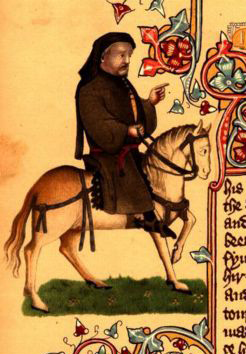
PICTURE: Image of Chaucer as a pilgrim from Ellesmere Manuscript in the Huntington Library in San Marino, California. The manuscript is an early publishing of the Canterbury Tales. Source: Wikipedia.

Happy Valentine’s Day!

It’s Valentine’s Day, so we’re pausing from our usual updates to give you a couple of interesting historical titbits…

• The first recorded written Valentine’s Day card is generally attributed to Charles, the Duke of Orleans, who wrote it to his wife while imprisoned in the Tower of London following King Henry V’s defeat of the French at the Battle of Agincourt in 1415;

• Geoffrey Chaucer, author of 1382 text Parlement of Foules – a poem written in honor of King Richard II’s engagement to Anne of Bohemia which is generally attributed with first linking St Valentine’s Day and romantic love, was born in and lived in London (although it should be noted that many don’t believe Chaucer was referring to 14th February in his reference but to another day associated with a different St Valentine).

PICTURE: Andrew C. (www.sxc.hu)

Lost London – Newgate Prison

The most notorious of London’s many prisons, Newgate remained in use for more than 700 years.

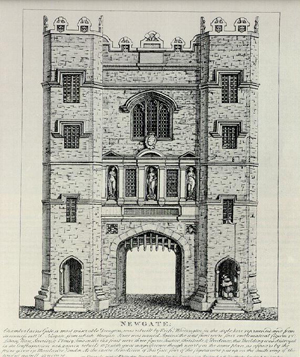
The prison – located on the corner of Newgate Street and Old Bailey on the site of what is now London’s Central Criminal Court (known as the Old Bailey thanks to its position on the street known as Old Bailey) – was apparently first constructed around the end of the 1100s on the orders of King Henry II at the site of one of the gates in the Roman wall (see picture).

It was enlarged and renovated several times over the ensuing centuries (including a complete rebuilding after the Great Fire of London in 1666 and another to the design of George Dance after the prison was badly damaged during the Gordon Riots of 1780, sparked by opposition to Catholic emancipation).

The prison, which was infamous for the squalid conditions in which prisoners were housed, was used for a range of purposes including housing debtors and the incarceration of people awaiting execution (by the 18th century, it’s said that more than 350 crimes had become punishable by death).

In 1783 public executions were moved from Tyburn, west of the city, to a site just outside the prison. In 1868, executions were no longer open to the public at large and the gallows moved inside. The prison closed in 1902 and was eventually demolished in 1904.

Famous prisoners who spent time in Newgate include Shakespeare’ contemporary Ben Jonson (for killing a man in a duel), 17th century author Daniel Defoe (for his authorship of political pamphlets), Captain William Kidd (for piracy), and William Penn, Quaker and founder of Pennsylvania (for contempt of court during a case brought after he was accused of having illegally preached ).

But perhaps the most infamous is the 18th century criminal Jack Sheppard, known for having escaped from the prison several times before finally being hanged at Tyburn (close to where Marble Arch now stands).

The only surviving part of the prison in its original location is part of the prison wall which can be seen in Amen Corner.

PICTURE: Wikipedia.com

What’s in a name?…Covent Garden

Now a favored place for people-watching among Londoners and visitors alike, Covent Garden takes its name from the ‘Convent Garden’ which occupied the site in medieval times.

The ‘convent garden’, said to be a 40 acre kitchen garden, belonged to the Abbey or ‘Convent’ of St Peter in Westminster (Westminster Abbey was once the church of this religious foundation) which owned the site from the 13th century until 1548 when the land passed into control of King Henry VIII during the Great Dissolution.

He granted much of the land to John Russell, the 1st earl of Bedford, and it was the 4th earl, Francis Russell, who commissioned Inigo Jones to design a great public square. The new square featured grand houses along the northern and eastern sides and a church – St Paul’s (pictured right) – on the west while to the south, between the square and the Strand, stood the mansion of the Bedford family.

A fruit and vegetable market was licensed in 1670 but its growth – and the development of other squares offering a much greater level of privacy – led the wealthy who had originally occupied the houses to move elsewhere. The market, meanwhile, continued to grow and in the 1830s, the main market building which still stands there today was constructed.

Further buildings followed in the 1800s and the market continued to occupy the site until as recently as 1973 when it was finally moved out to Nine Elms and the area began a transformation into the shopping precinct it now is.

Treasures of London – The ‘Old Lion’ Maidenhair Tree, Kew Gardens

Celebrated in the 2002 list of 50 “Great British Trees”, the Maidenhair Tree is one of a number at Kew Gardens known as an “Old Lion” – the name collectively given to the few remaining trees with a planting date of 1762.

The Gingko biloba or Maidenhair Tree was one of the first of its species to be planted in Britain and, along with the other ‘Old Lions’, was brought from the Twickenham estate of the Duke of Argyll in 1762.

It was planted in what was then a new five acre arboretum laid out by William Aiton, employed as the gardener at the first botanic garden at Kew (this was established in 1759 at the behest of Princess Augusta, wife of Frederick, Prince of Wales – who had died in 1751 – and mother of King George III, and John Stuart, 3rd Earl of Bute).

Originally located against the wall of the ‘Great Stove’ glasshouse to provide it with protection, the tree has stood alone since 1861 when the glasshouse was demolished. It can now be found adjacent to the Wisteria arch close to the Secluded Garden Conservatory. Several further Gingko trees were planted in the garden in 1773 under the direction of botanist Sir Joseph Banks.

The other four ‘Old Lions’ at Kew are a False Acacia (Robinia pseudoacacia), an Oriental Plane (Platanus orientalis), a Caucasian Elm (Zelkova carpinifolia), and a Pagoda Tree (Sophora japonica).

WHERE: Kew Gardens (nearest tube station is Kew Gardens); WHEN: 9.30am to 4.15pm daily (check closing times for glasshouses); COST: £13.90 adults; £11.90 concessions; children under 17 free; WEBSITE: www.kew.org.

Lost London – York Watergate

There’s several places along Victoria Embankment where it’s possible to see where the River Thames bank stood before the massive mid-19th century project to reclaim land. Not the least of them is located in the downstairs foyer to Somerset House, where looking through the glass floor, you can see the pebbles of the original riverbank.

Another is York Watergate, once the river entrance to the Duke of Buckingham’s London mansion, and now stranded some distance from the water in Victoria Embankment Gardens.

The mansion, known as York House, was originally located on the southside of the Strand. Originally built in the 13th century, it was later acquired by King Henry VIII and granted to the Archbishop of York, Nicholas Heath, in 1556 (hence its name). The house became the home of George Villiers, the first Duke of Buckingham and somewhat sycophantic favorite of King James I, in the early 1620s.

When the duke was stabbed to death in 1628, the property passed to his son, the second Duke of Buckingham (also George), who later sold it to a land developer. It was apparently as a condition of the sale that the streets there now include the duke’s full name – hence George Court, Villiers Street, Duke Street, the slightly ludicrous Of Alley, and Buckingham Street.

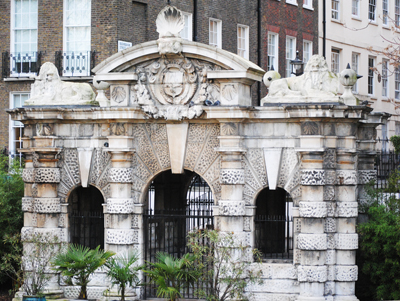
The impressive Italianate watergate, which stands below the junction of Buckingham Street and Watergate Walk just a short walk into the gardens from Embankment tube station, was designed by the irrepressible Inigo Jones and built in 1626. Though weathered, it still bears the coat of arms of the Duke of Buckingham on the front.

What’s in a name?…Isle of Dogs

Located in a great bend of the River Thames to the east of the City, the Isle of Dogs isn’t really an isle at all but a broad peninsula of land jutting out to the south of Poplar, opposite Greenwich.

Formerly known as Stepney Marsh, for centuries the area was protected by a great embankment and in the 13th and 14th centuries came to be home to a small agricultural community. After the embankment was breached, however, the area reverted to marshland and only came back into more intensive use with the opening of the West India and East India docks in the early 1800s (amalgamated in 1838) and Millwall Dock in the 1860s. The linking of these docks in the early 1900s apparently made the “isle” an island for the first time.

At the same time, the area also became noted for shipbuilding – among the vessels constructed here was Isambard Kingdom Brunel’s SS Great Eastern, the biggest ship ever built when launched in the late 1850s.

The population of the area rose thanks to the docks and by 1901 – following the development of Cubitt  Town, named for developer William Cubitt – the population had risen to 21,000. Heavily bombed in World War II, the isle saw a resurgence in the Fifties and Sixties but gradually declined in the following years as new shipping technologies made the docks obsolete. The last of the docks closed in 1980.

The area has since been redeveloped in a project initially driven by the London Docklands Development Corporation and is now in effect a city within a city, housing homes, apartments, retail precincts and office buildings – including One Canada Square, the highest tower in London, at Canary Wharf (the highest tower in London until recently surpassed by the currently-under-construction Shard in Southwark), linked to the rest of the city via the Docklands Light Railway (DLR).

But what about the name Isle of Dogs? One theory is that it was here King Henry VIII kept his hunting dogs (the earliest reference to the Isle of Dogs is apparently on a map dated 1588) while others suggest the name comes from dogs King Edward III kept there. Others have suggested the name is a corruption of ‘Isle of Ducks’, that the area is named for packs of dogs who roamed wild in the marshlands here or that it comes from the fact dead dogs washed up on banks of the Thames here. As for which is the truth? Take your pick.

Tower Hamlets, the local authority, offers a great free walk through the area which gives you a glimpse into its history. See http://bit.ly/dRzcP9.

Treasures of London – The Crown Jewels

No series on the treasures of London would be complete without a mention of the Crown Jewels, housed – except when being used – under tight security in the same place they’ve been since the early 1300s – the Tower of London.

The jewels, which are described as a ‘working collection’, include the coronation regalia and feature some 23,578 gems  – the Imperial State Crown alone boasts 2,868 diamonds, 273 pearls, 17 sapphires, 11 emeralds and five rubies.

The regalia itself is made up of the crowns of the sovereigns, consorts and Princes of Wales as well as sceptres, orbs, rings, swords, spurs, bracelets, robes, and the oldest piece, a 12th century anointing spoon.

It and three steel coronation swords are the only pieces to survive the destruction of all the pre-Civil War regalia in 1649-50, carried out at the behest of Oliver Cromwell following the execution of King Charles I (many of the earlier crown jewels, dating from the Anglo-Saxon period, had already been replaced in the early 13th century after items were lost while being taken across The Wash during the reign of King John in 1216).

Following Cromwell’s destruction, new regalia was made on the orders of King Charles II. Modelled on that of his father, it was used in the king’s coronation on 23rd April, 1661, and cost more than £12,000.

Today, St Edward’s Crown – with which the sovereign is crowned by the Archbishop of Canterbury – is the principal piece of the regalia. Other items include the Sovereign’s Sceptre, topped with 530 carat First Star of Africa – the largest flawless cut diamond in the world, Queen Victoria’s small diamond crown, and the Imperial Crown of India. There is also a crown made for Queen Elizabeth, the Queen Mother, for her 1937 coronation which features the famous Koh-i-Nur (‘Mountain of Light’) diamond.

Until 1303, the Crown Jewels had been housed at Westminster Abbey. Following a successful robbery that year, however (after which most items were recovered), they were moved to the Tower.

The most famous attempt to steal the Crown Jewels was made by an Irishman, Colonel Thomas Blood, in 1671. He and his gang had arranged to see the jewels (this could be done for a fee) but when they arrived, used a mallet to knock out the jewel keeper before stabbing him.

Colonel Blood had hidden King Charles II’s crown under his cloak, squashing its arches of in the process, while his companion Robert Perot had stuck the coronation orb down his breeches and Blood’s son was in the process of sawing the sceptre in half when the keeper’s son returned unexpectedly and raised the alarm.

Arrested, Blood got off rather lightly – King Charles II decided, apparently for some unknown reason, to pardon him. Security around the jewels, however, was tightened – iron bars were used instead of wooden ones and people were thenceforth forbidden from handling the jewels.

The Crown Jewels are now housed in the Jewel House at the Tower, built in 1967 in the west wing of the Waterloo Barracks, and guarded by the Yeomen Warders.

WHERE: Tower of London (nearest tube station Tower Hill); WHEN: 9am to 4.30pm, Tuesday to Saturday, 10am to 4.30pm Sunday to Monday (until 28th February); COST: £18.70 adults; £10.45 children under 15; £15.95 concessions; £51.70 for a family (prices, which include a voluntary donation, are valid until 28th February); WEBSITE: www.hrp.org.uk/toweroflondon/. For more on the Crown Jewels, see www.royal.gov.uk/MonarchUK/Symbols/TheCrownJewels.aspx or the Royal Collection website, http://bit.ly/i9FM3

Curious London Memorials – 3. Charing Cross

Another royalty-related memorial, the Charing Cross – located outside Charing Cross railway station – is actually an embellished Victorian replica of one of a series of medieval memorials the apparently heartbroken King Edward I had erected in memory of his wife, Eleanor of Castile.

The original cross, which was originally located in the south of Trafalgar Square at Charing, was one of 12 built between 1291 and 1294 to mark the nightly resting places of the Queen’s funeral procession as it made it way from Lincoln to Westminster Abbey where she was buried.

The Queen had died at Harby near Lincoln in 1290 while on her way to meet her husband in Scotland. The original monument was demolished in 1647 by Parliamentary order. A plaque on the site indicates it is the point from where all distances on road signs to London were measured.

Only three of the original 12 crosses still stand – at Waltham Cross, Northampton and Geddington – although some remnants of others can be seen. Another London cross – in Cheapside – was demolished in the mid 1600s.

The Victorian era replica outside Charing Cross station dates from 1865. It was unveiled last year following a five year restoration project.

Around London – City’s history goes online; London’s oldest structure discovered?; and, my, how prices have changed…

• Four hundred years of London’s history is being put online as part of a new project on the City of Westminster’s website. The council is publishing a new picture depicting a different historical event from the city’s tumultuous history every day throughout 2011 under its A date with history project. The images, taken from the council’s archives, include photographs, engravings and sketchings. They include a black and white photo of queues of people waiting on Vauxhall Bridge to pay their final respects to King George V lying in state at Westminster Hall after his death on 20th January, 1936, another photograph showing the King and Queen with PM Winston Churchill inspecting damage to Buckingham Palace’s swimming pool following a raid during the Blitz in September, 1940, a hand-colored print depicting the execution of King Charles I on 30th January, 1649, and an engraving showing a comet passing by the spire of St Martin in the Field in 1744. It is the first time the images have been made freely available online. To see the images, head to www.westminster.gov.uk/archives/day-by-day.

What could be London’s oldest structure has been unearthed on the Thames foreshore. Six timber piles up to 0.3 metres in diameter have been discovered only metres from the MI6 headquarters in Vauxhall, part of what archaeologists believe is part of a prehistoric structure which stood on the river bank more than 6,000 years ago during the Mesolithic period when the river was lower. The find, made by a Thames Discovery Programme team, is only 600 metres away from a Bronze Age timber bridge or jetty dating from 1,500 BC which was discovered in 1993. The piles may be able to be seen from Vauxhall bridge during low tides between 10.25am on 22nd January and 11.15am on 23rd January.

Homes in London were purchased for an average price of £14,000 back in 1910, according to land tax valuations documents released online this week. Ancestry.co.uk has placed the London, England Land Tax Valuations 1910 – compiled as part of David Lloyd George’s 1910 Finance Act, known as the Domesday Survey – online to help people discover more about the financial situations of their ancestors. The documents put the value of the Bank of England at £110,000, the Old Bailey at £6,600, and Mansion House at a more impressive £992,000. The average value of property on Fleet Street was £25,000 (compared with £1.2 million today) while in Cannon Street, the average value was £20,000 (£2.2 million) and in Chancery Lane, the average value was just £11,000 (£1.1 million).

Where’s London’s oldest…church?

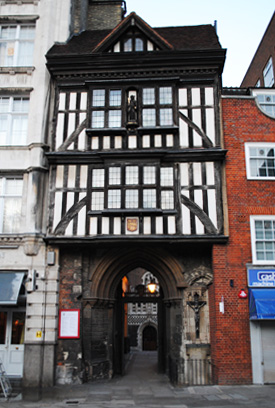
Like many of London’s oldest questions, this depends on what you mean – the oldest site of worship, the oldest continuous site of worship, or the oldest building are but a few possibilities. For our purposes, it’s generally accepted that London’s oldest surviving parish church is St Bartholomew the Great in West Smithfield.

This atmospheric church is now only half the size of what it once was but that part which remains – the original quire, altar, side aisles and lady chapel – was founded in 1123 AD as the priory church for a community of Augustinian Canons.

The church owes its origins to Rahere, a favored courtier of King Henry I, who after the death of King Henry’s wife Queen Matilda and then heir, Prince William, along with some other family members, renounced his way of life and decided to make a pilgrimage to Rome.

In Rome, he sickened, and fearful for his life, vowed to found a hospital for the poor on his return to London. Subsequently recovering, he was about to head home when a vision of St Bartholomew appeared to him and told him that he had helped him to recover and now desired him to found a church in Smithfield.

On his return to London, Rahere did just that – founding the priory with its church and a hospital for the poor. He died 1145. Amazingly, his tomb still lies within the church, on the left hand side of the altar.

The priory grew in importance with income coming not only from offerings and rents but from tolls at St Bartholomew’s Fair which was held on grounds to the north of the the church (as an interesting aside, it’s also known that the church had a low wall built in front of its western facade to separate it from Smithfield. Known as the Cheyne, this could be closed with a chain on market days to stop cattle wandering inside).

The church’s current configuration came about in the Great Dissolution – the priory was dissolved in 1539 and the nave of the church was pulled down, leaving the quire, altar and lady chapel. The church was briefly used by some Dominican friars but since the reign of Queen Elizabeth I has fulfilled the role of parish church. A concerted restoration effort began in the mid-19th century.

Livery companies associated with the church include The Butchers’ Company which still hold a special service here in September prior to electing a new Master. These days, St Bartholomew the Great is a welcome refuge from the hustle and bustle of the City and still gives a strong sense of the life it has known.

WHERE: Off Little Britain, West Smithfield (nearest tube station is Barbican); WHEN: 8.30am to 5pm Monday to Friday (until 14th February), 10.30am to 4pm Saturday, 8.30am to 8pm Sunday (except for services) ; COST: £4 an adult/£3.50 concession/£10 a family; WEBSITE: www.greatstbarts.com

PICTURE: Gatehouse leading into St Bartholomew the Great

Lost London – Nonsuch Palace

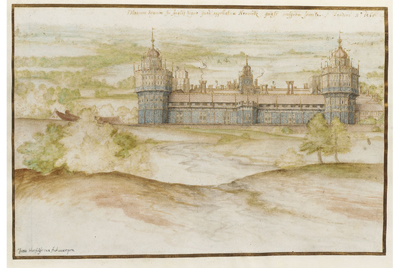
Built as a symbol of the triumphal reign of the Tudor dynasty (not to mention as a response to the French King Francis I’s palace Château de Chambord), Nonsuch Palace near Ewell in Surrey, now part of greater London, was the last palace constructed by King Henry VIII.

Construction on the palace started in 1538, the 30th year of Henry’s reign and only six months after the birth of Henry’s son and heir, later King Edward VI. The medieval village of Cuddington was demolished to make way for the new premises.

The multi-storied building was designed around an inner and an outer courtyard, each entered through a fortified gatehouse, with the royal apartments located in the latter. While plain on the outside, the inner courtyard interior was decorated with stucco reliefs depicting, among other things, Roman emperors, gods and goddesses and Henry VIII with his son Edward. To cap it off, there were two great octagonal towers built at either end.

While the bulk of of the work had been completed when Henry died in 1547, it is believed that the palace may still have been unfinished. In any case, it only remained a royal property for a short time before Queen Mary I sold it to Henry Fitzalan, the Earl of Arundel. It passed back into royal hands when the earl’s son-in-law, John Lumley, was forced to sell it back to Queen Elizabeth I to settle a debt. The queen was said to have stayed frequently at the palace.

King James I granted the palace to his wife, Queen Anne of Denmark, and it was also used by his son Henry, Prince of Wales. King Charles I also granted the palace to his wife, Queen Henrietta Maria, before it was sold off by Parliamentary commissioners after the Civil War. When King Charles II came to the throne, the palace was once again given to Henrietta Maria and then, when she died in 1669, to Barbara Villers, Countess of Castlemaine, a mistress of the king.

The building was demolished in 1682 with the materials and sale of the land used to pay off the countess’ gambling debts. While some parts of the building were carted off to be incorporated into others, no trace of the building remains above the ground but its former site, on the west side of what is now Nonsuch Park in Cheam, is marked by three granite bollards. A separate banqueting house and extensive gardens were also built near the site.

The building, which was only depicted a few works, can be confused with Nonsuch Mansion House, the oldest parts of which date from the 18th century, which still stands on the east side of the park and was probably built on the site of a former keeper’s lodge.

There are exhibitions on the palace in the Honeywood Museum (the heritage centre for the London Borough of Sutton) in Carshalton and in the Tudor house known as Whitehall in Cheam. The Epson and Ewell History Explorer website also have a trail you can follow which encompasses the former site of the palace.

PICTURE: Nonsuch Palace in an engraving by Joris Hoefnagel. Source: Wikipedia.