Lost London: Gates Special – Aldgate

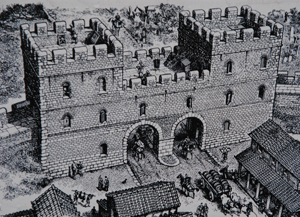
Once the eastern-most gateway into London, Aldgate is another of London’s gates which dates from Roman times.

The gate, which stood over the short street in the City now simply known as Aldgate, was rebuilt several times during the Middle Ages before, thanks again to the need for road widening, it was demolished in 1761.

Some sections of the gate were apparently taken to Bethnel Green, just to the east, where they were rebuilt as an addition to a 17th century mansion known as Aldgate House.

The name Aldgate is generally thought to mean ‘Old Gate’ but alternative theories suggest it derives from ‘Ale Gate’ (a connection with a local alehouse perhaps?) or ‘All Gate’ (that, is, all are free to enter).

The most famous person associated with the gate is the Middle English writer Geoffrey Chaucer – he lived in apartments above it for more than 10 years – from 1374 to 1386 – while working as a customs official.

Aldgate is also one of the wards of the City of London.

PICTURE: An artist’s impression of how Roman Aldgate may have looked as seen on a plaque marking the site of the former gate (part of a series of plaques on the former London Wall Walk).

Lost London: Gates Special – Ludgate

We’re launching a new ‘Lost London’ special looking at some of the now disappeared gates of London. First up is Ludgate which once stood on the western side of the city.

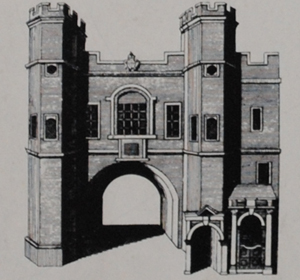
The gate is believed to have been constructed in Roman times and is known to have been rebuilt a several times – once in 1215 and another time after it was destroyed in the Great Fire – before being demolished in 1760 to allow for the road to be widened.

The origins of the name – which is today commemorated in street names like Ludgate Hill and Ludgate Circus – are sketchy but may have been named after the mythical pre-Roman King Lud, who was, so the legend goes, buried underneath this portal (this myth was popularised by the 12th century writer Geoffrey of Monmouth). Others have suggested ‘lud’ is a corruption of ‘flud’ or ‘flood’ and the gate was so named because it prevented the city being flooded by the River Fleet. Another possibility is that ‘lud’ is simply an old English word for a postern gate, a small secondary gate.

Whatever the origins of its name, it has been suggested it was through Ludgate that William the Conqueror passed when first entering the city. In 1377 it became a prison for petty criminals like debtors and trespassers – serious criminals were sent to Newgate – and this lasted until its final destruction.

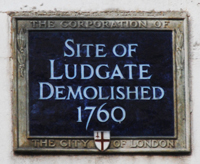
There is a blue plaque on the wall of the church of St Martin-within-Ludgate in Ludgate Hill marking where Ludgate once stood (pictured above). It is believed that some badly corroded statues standing under a porch at the church of St Dunstan-in-the-West on Fleet Street are of Lud and his sons and were taken down from the gate before its demolition. William Kerwin’s statue of Queen Elizabeth I which dates from 1586 sits in a niche on the front of the church is also believed to have been removed from Ludgate.

Lost London – Execution Dock…

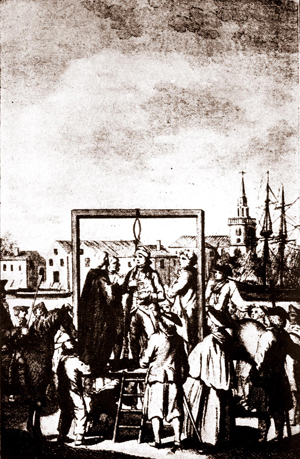
The favoured place to dispatch pirates, Execution Dock was located on the north bank of the River Thames just off Wapping High Street.

Among the most famous to be executed here was Kidd himself who, having been found to have turned pirate while operating as a privateer under the authority of King William III, was hanged here on 23rd May, 1701.

The site, near where a cannon foundry operated supplying the fleet of King Henry VIII, was in-use as an execution ground for more than 400 years, from the 15th century until the last hanging in 1830 (that of pirates George Davis and William Watts).

Those convicted of piracy in the High Court of Admiralty were typically brought to Execution Dock from Marshalsea Prison (or in some cases from Newgate) in a procession across London Bridge and past the Tower of London which was led by the Admiralty Marshal or his deputy who carried a silver oar as a symbol of their authority.

In a public spectacle, the pirates were then hanged on a wooden scaffold built at low tide but unlike at other sites of execution where they were cut down after death, the victims were left hanging to allow three tides to wash over them.

The most notorious of the pirates would then be tarred and put in a gibbet to be exhibited on one of the banks of the Thames as a warning to others (Kidd’s remains were apparently left in such a state for more than 20 years at Tilbury).

The exact location of Execution Dock remains a matter of dispute with favoured locations including a spot near the Town of Ramsgate pub, just along from The Captain Kidd pub near what are now known as King Henry’s Stairs and, between the two locations, a warehouse which stands on the waterfront and is prominently marked with an E (for Execution Dock). Some even suggest the site was outside the Prospect of Whitby pub further east along Wapping High Street.

There’s currently an exhibition on Captain Kidd at the Museum of London Docklands, Pirates: The Captain Kidd Story.  See here for more information.

PICTURE: Wikipedia

Lost London – Billingsgate Roman House and Baths

Hidden beneath an office building in Lower Thames Street opposite the former Billingsgate Fish Market are the remains of some of London’s best preserved Roman ruins in the form of an expansive house and baths complex.

Last weekend, the Festival of British Archaeology presented a rare opportunity to visit the property which has been the subject of an extensive conservation project.

The remains of the buildings were first discovered by workmen building the New Coal Exchange in 1848 (this was demolished in the 1960s and the current office building constructed in its place in the 1970s – the ruins now sit in its basement).

While the house – which may have formed an L-shape or three-sided building stretching around a courtyard – dates back to the 2nd century AD, the baths complex – which is believed to be located in the house’s courtyard – were added the following century. The buildings, both of which feature an underfloor heating system known as a hypocaust, are notable for the fact that they remained in use until the early 5th century AD when much of what had been Roman Londinium was then already in decline.

Visitors to the baths would first have visited the cold room (frigidarium) before moving on to the warm room (tepidarium) and then the hot room (caldarium) which was heated by the hypocaust. There they would pause to remove dirt and oils from their skin using curved metal scrapers known as strigils before retracing their steps to the cold room where they are believed to have either jumped bravely into a plunge pool or splashed cold water over themselves.

The site includes two furnaces – one at the house and another at the baths – used for heating the space under the floors. The fact both buildings were constructed of stone indicates they were either owned by a wealthy family or were for communal use, perhaps as an inn for travellers.

The objects found in the premises include hoard of bronze coins (all minted after 395 AD) and a bronze brooch, believed to have belonged to a Saxon woman who must have dropped it after 450 AD when the bath house may already have been in ruins.

You can follow the conservation work being currently being carried out on the property – a joint project involving the City of London Corporation, the Museum of London, English Heritage, Nimbus Conservation and the Institute of Archeology of University College London – here: www.billingsgatebathhouse.wordpress.com. It’s expected the ruins will next be opened to the public for the Open House weekend on September 17th/18th.

Lost London – Blackfriars Priory

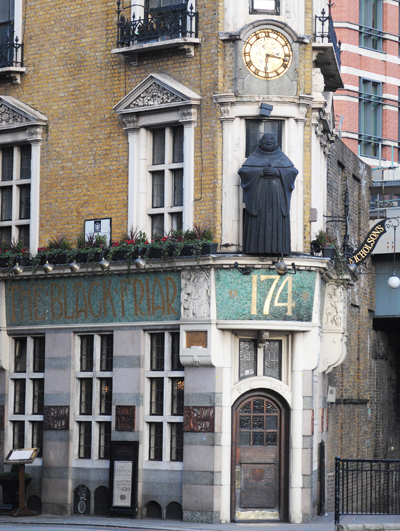
The London area of Blackfriars – centred on Blackfriars Railway Station – takes its name from the former Dominican friary (known as the “black friars” thanks to their dark robes) which stood on the site.

The Dominicans first came to England in the 1220s and soon took up residence in Holborn. But the limitations of that site led them to move to a new location between Ludgate and the River Thames in the latter part of the 13th century. There, they constructed a substantial priory.

The priory subsequently played an important part in London’s civic and religious life – Parliament and the Privy Council is known to have met here and in 1529, a hearing was held here with regard to the divorce of King Henry VIII and Catherine of Aragon.

It was also a place of burial for the wealthy and influential – among those buried there was the beloved wife of Edward I, Eleanor of Castille (at least her heart was – her body was buried at Westminster Abbey).

The priory was dissolved in 1538 during the Dissolution. The Blackfriars Playhouse was built on the site during Elizabethan times and the Apothecaries Company also took up residence there. Those of the original buildings that survived were destroyed in the Great Fire of 1666. In more recent times, the area became the site of Blackfriars Railway Station.

A reminder of the area’s origins can be found on the facade of The Black Friar pub (1875) which sits opposite Blackfriars Bridge at the western end of Queen Victoria Street (pictured). There you can see a statue of a black friar, the work of Henry Poole which dates from around the beginning of the 20th century. There is also a plaque commemorating the friary in nearby Carter Lane.

What’s in a name?…King’s Cross

The location now known as King’s Cross, north-west of the City, takes its name from a monument adorned with an 11 foot high statue of King George IV which once stood on a site now occupied by King’s Cross Railway Station.

The area had been previously known as Broadford Bridge or Battlebridge – the latter a name many associated with the apparently erroneous belief that it was here, at a bridge which once crossed the River Fleet, the Iceni Queen Boudicca (also known as Boadicea) ill-fatedly confronted the Roman Army under the command of Gaius Suetonius Paulinus.

From the 1830’s (King George IV ruled from 1820 to 1830), however, the area took on the name of King’s Cross thanks to the erection of what Walter Thornbury described in his 1878 text, Old and New London, as a “ridiculus octagonal structure crowned by an absurd statue of George IV”.

The structure, said to be 60 feet high, was erected at the intersection of Gray’s Inn Road, Pentonville Road and what we now know as Euston Road, and during its relatively short lifespan, was employed at different times as a police station and as a pub (complete, apparently, with a camera obscura in the upper level).

It was completely removed by 1845 (King’s Cross Railway Station officially opened in 1852).

The area of King’s Cross has been settled back as far as Roman times – St Pancras Old Church is one of the oldest sites of Christian worship in England although the current church is Victorian – but it wasn’t until the 1700s and 1800s that it was transformed in to an urban area with the arrival of canals – including The Regent’s Canal – and the railways.

Traditionally one of London’s poorest areas, it survived World War II bombings but subsequently suffered as the railways declined in the post-war period. By the 1980s, it had become notorious as a red light district.

It has since gone through – and is still going through – a gradual gentrification process, however, with the 67 acre development King’s Cross Central among the projects currently under construction.

Key attractions of the area include The British Library, The London Canal Museum, arts centre King’s Place, and the recently refurbished St Pancras Renaissance London Hotel.

It’s also now home to St Pancras International – London’s Eurostar terminus (having been moved here from Waterloo) – as well as King’s Cross Railway Station which is believed by many, despite the lack of any evidence, to be the burial site of Queen Boadicea (it’s said she still lies beneath platform 9 or 10) and which is the home of the fictitious platform 9 and 3/4 from which Harry Potter catches the train to Hogwarts.

Lost London – The ‘Tyburn Tree’

For six centuries, the gallows at Tyburn, in the city’s west, was one of London’s sites of public execution. Today, little remains to remind visitors of the infamous past of the area, which lies close to Marble Arch, but for a plaque set in the middle of a road.

From 1196 to 1783, it’s suggested that thousands of people (some have estimated as many as 60,000) were hanged at various gallows erected at Tyburn, known by numerous names over the centuries including ‘The Elms’, the ‘The Deadly Never Green Tree’, and most infamously the ‘Tyburn Tree’.

Hangings were apparently initially carried out using the branches of a tree on the bank of the Tyburn River but the first gallows date from 1220. In Elizabeth times these were upgraded to a larger gallows known as the ‘Triple Tree’ which enabled many more people to be hanged simulteously – as many as 24 at once in 1649.

The gallows was removed in 1759 because it was blocking the road and a mobile gallows used until hangings were moved into Newgate Prison (see our earlier entry on Newgate).

Executions were a public spectacle and it’s estimated that at times the crowds at Tyburn swelled to more than 50,000 people, all eager to witness someone “dancing the Tyburn jig”.

Among those to be hanged at Tyburn were William Fitz Osbern (a champion of London’s poor who was hanged in 1196), Roger Mortimer, 1st Earl of March (hanged in 1330 after being accused of assuming royal power), Perkin Warbeck (pretender to the throne of King Henry VII who was hanged in 1499), and Elizabeth Barton, the ‘Holy Maid of Kent’ (hanged for treason after prophesying King Henry VIII would die within six months of marrying Anne Boleyn).

Others included key figures in the so-called Pilgrimage of Grace (an uprising in England’s north in 1536 which followed King Henry VIII’s break with Rome) and many other Catholics including Oliver Plunkett, the Archbishop of Armagh and Primate of all Ireland (1681).

In an unusual move, the body of already deceased Oliver Cromwell, along with that of John Bradshaw and Henry Ireton, was exumed from his grave and and hanged there to mark the first anniversary of the Restoration.

What is believed to have been the site of the Tyburn Tree is today marked by a plaque set in a traffic island at the corner of Edgware Road and Bayswater Road (nearest tube station is Marble Arch).

There is a Shrine of the Martyrs dedicated to the more than 105 Roman Catholics who were hung at Tyburn for their faith at the Tyburn Convent in Hyde Park Place (for visiting details, see www.tyburnconvent.org.uk).

Note: This article originally referred to the Shrine of the Martyrs commemorating more than 350 Catholic martyrs who died during the Reformation as all being executed at Tyburn but it is believed some 105 were – the greater figure refers to those martyred across England and Wales during the Reformation.

Lost London – The Rose Theatre

First opened in 1587, The Rose was one of the first purpose-built theatres in London and the first Elizabethan theatre in Bankside, then an area noted for its entertainments including gambling dens, bear and bull baiting pits, and brothels.

The theatre was built for businessman and theatre developer, Philip Henslowe, and his partner John Cholmley, and subsequently hosted plays including Christopher Marlowe’s The Jew of Malta and Shakespeare’s Henry VI part I and Titus Andronicus. Among the actors was Edward Alleyn, Henslowe’s son-in-law, while among the companies which performed there were Lord Strange’s Men, Sussex’s Men, the Queen’s Men and the Admiral’s Men.

Its success led to the building of rival theatres in the area including The Swan in 1595 and The Globe in 1599. It had apparently fallen out of use by 1603 and was abandoned soon after.

The theatre fell out of history until the late 1980s when, following the demolition of a 1950s office block, archaeologists from the Museum of London uncovered the remains of much of the theatre’s floorplan, revealing that it was a smallish many sided structure based on a 14-sided polyhedron. A campaign to save the remains was launched – attracting support from acting luminaries including Sir Laurence Olivier and Peggy Ashcroft – and much of the site was preserved from development.

Some 700 objects, including jewellery, coins and a fragment of one of the moneyboxes used to collect entrance money, were excavated at the site.

The site was reopened to the public in 1999 – it now features displays and some of the objects found by archaeologists – and part of it has been used as a performance space again since 2007.

WHERE: Rose Theatre, Park Street, Bankside; WHEN: 10am to 5pm Saturdays (Shakespeare’s Globe also offer tours during matinee performances at The Globe when tours there are not available – see www.shakespeares-globe.org for more details); COST: Free (donations welcomed and there is a charge for tours from The Globe); WEBSITE: www.rosetheatre.org.uk

Lost London – Winchester Palace

This week we look at another “lost” palace of London but this time it’s not one built primarily for kings and queens. Rather we’re taking a look at the former Thameside home of the Bishops of Winchester.

Located in Southwark, Winchester Palace (also known as Winchester House) was built in the 12th century as the London residence of the bishop, a major landowner in the area.

The palace’s hall was extravagantly decorated and is known to have played host to royalty including King James I of Scotland and Joan Beaufort whose wedding feast was held there in 1424. It’s also suggested that King Henry VIII may have met wife number five, Catherine Howard, there.

The remainder of the palace was arranged around two courtyards and as well as buildings including its own prison and brewhouse, it also boasted a tennis court, bowling alley and pleasure gardens. It was used up until the Civil War – during which it served as a prison – before, in a growing state of deterioration, being let out for tenements and warehouses. Much of what remained was destroyed by fire in 1814.

Today all that remains above ground is a wall which stood at the west end of the great hall, mostly dating for the 14th century. Now in the care of English Heritage, it features a magnificent (albeit glassless) rose window, 13 feet in diameter, and three doors, believed to have led to the buttery, pantry and kitchen.

The palace was located in what was known variously as the ‘Manor of Southwark’, the ‘Liberty of Winchester’ or the ‘Liberty of the Clink’ (the word ‘clink’ refers to the bishop’s notorious prison – more on this another time). This was an area of land under the direct jurisdiction of the Bishop of Winchester and outside the jurisdiction of the City of London and become particularly known for prostitution – the Bishop was granted the power to licence prostitutes in the 12th century – with the prostitutes referred to as “Winchester Geese”.

The current ruins were found during the area’s redevelopment in the 1980s. Remains of Roman buildings were also found underneath where the palace once stood.

WHERE: Clink Street, Southwark (nearest tube station is London Bridge); WHEN: Anytime; COST: Free; WEBSITE: www.english-heritage.org.uk/daysout/properties/winchester-palace/

Lost London – Newgate Prison

The most notorious of London’s many prisons, Newgate remained in use for more than 700 years.

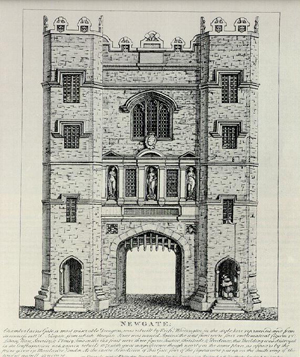
The prison – located on the corner of Newgate Street and Old Bailey on the site of what is now London’s Central Criminal Court (known as the Old Bailey thanks to its position on the street known as Old Bailey) – was apparently first constructed around the end of the 1100s on the orders of King Henry II at the site of one of the gates in the Roman wall (see picture).

It was enlarged and renovated several times over the ensuing centuries (including a complete rebuilding after the Great Fire of London in 1666 and another to the design of George Dance after the prison was badly damaged during the Gordon Riots of 1780, sparked by opposition to Catholic emancipation).

The prison, which was infamous for the squalid conditions in which prisoners were housed, was used for a range of purposes including housing debtors and the incarceration of people awaiting execution (by the 18th century, it’s said that more than 350 crimes had become punishable by death).

In 1783 public executions were moved from Tyburn, west of the city, to a site just outside the prison. In 1868, executions were no longer open to the public at large and the gallows moved inside. The prison closed in 1902 and was eventually demolished in 1904.

Famous prisoners who spent time in Newgate include Shakespeare’ contemporary Ben Jonson (for killing a man in a duel), 17th century author Daniel Defoe (for his authorship of political pamphlets), Captain William Kidd (for piracy), and William Penn, Quaker and founder of Pennsylvania (for contempt of court during a case brought after he was accused of having illegally preached ).

But perhaps the most infamous is the 18th century criminal Jack Sheppard, known for having escaped from the prison several times before finally being hanged at Tyburn (close to where Marble Arch now stands).

The only surviving part of the prison in its original location is part of the prison wall which can be seen in Amen Corner.

PICTURE: Wikipedia.com

Lost London – York Watergate

There’s several places along Victoria Embankment where it’s possible to see where the River Thames bank stood before the massive mid-19th century project to reclaim land. Not the least of them is located in the downstairs foyer to Somerset House, where looking through the glass floor, you can see the pebbles of the original riverbank.

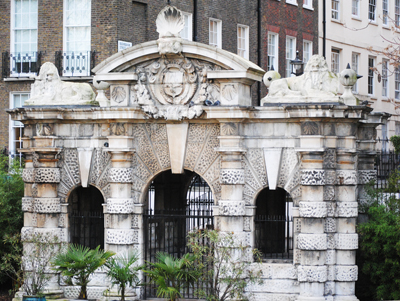
Another is York Watergate, once the river entrance to the Duke of Buckingham’s London mansion, and now stranded some distance from the water in Victoria Embankment Gardens.

The mansion, known as York House, was originally located on the southside of the Strand. Originally built in the 13th century, it was later acquired by King Henry VIII and granted to the Archbishop of York, Nicholas Heath, in 1556 (hence its name). The house became the home of George Villiers, the first Duke of Buckingham and somewhat sycophantic favorite of King James I, in the early 1620s.

When the duke was stabbed to death in 1628, the property passed to his son, the second Duke of Buckingham (also George), who later sold it to a land developer. It was apparently as a condition of the sale that the streets there now include the duke’s full name – hence George Court, Villiers Street, Duke Street, the slightly ludicrous Of Alley, and Buckingham Street.

The impressive Italianate watergate, which stands below the junction of Buckingham Street and Watergate Walk just a short walk into the gardens from Embankment tube station, was designed by the irrepressible Inigo Jones and built in 1626. Though weathered, it still bears the coat of arms of the Duke of Buckingham on the front.

Lost London – London Bridge

In the first of a new regular series looking at “lost” London, Exploring London takes a look at London Bridge.
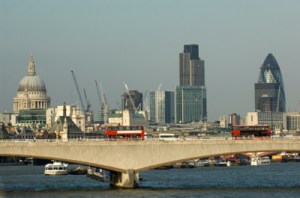
It’s a commonly confused fact that many first-time visitors to London think Tower Bridge and London Bridge are the same. As Londoners know, London Bridge (pictured right with St Paul’s and the city in the background) lies west of Tower Bridge. It’s not a particularly inspiring bridge having been built in the early Seventies. But there’s been a bridge spanning the Thames here for almost 2,000 years. So what happened to Old London Bridge?

The first bridge built across the River Thames on or close to the current site of London Bridge is thought to have been a wooden pontoon bridge constructed by the Romans around 50 AD. It was quickly followed by a more permanent bridge (rebuilt after it was destroyed by Boudicca and her marauding army in 60 AD).

Following the end of the Roman era, the bridge fell into disrepair although it’s known that there was a wooden Saxon bridge on the site by around the year 1,000. A succession of Norman bridges followed the Conquest and in 1176, during the reign of Henry II, construction of a new stone bridge began under the supervision of the priest Peter de Colechurch to service to growing numbers of pilgrims travelling from London to Thomas a Becket’s shrine in Canterbury. The new bridge, which had a chapel dedicated to St Thomas at the centre, wasn’t finished until 1209.

The bridge had 19 arches sitting on piers surrounding by protective wooden ‘starlings’ and a drawbridge and defensive gatehouse. The design of the bridge meant the water shot rapidly through the arches, leading boatmen to describe the practice of taking a vessel between the starlings as “shooting the bridge”.

King John, in whose reign the bridge was completed, licensed the building of houses on the bridge and it soon became a place of business with some 200 shops built upon its length, many of them projecting over the sides and reducing the space for traffic to just four metres. Many of the buildings actually connected at the top, creating a tunnel-like effect.

One of the more remarkable buildings on the bridge was Nonsuch House, built in 1577. A prefabricated building, it had been assembled in the Netherlands before being taken apart, shipped to London, and then reassembled. No nails were used in its construction, just timber pegs.
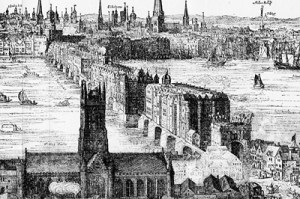
The practice of putting the heads of traitors on pikes above the southern gatehouse (see picture right, dating from 1660) started in 1305 with Scottish rebel William Wallace’s head and continued until it was stopped after 1678 when goldsmith William Stayley’s head was the last to be displayed there. Famous heads to adorn the gateway over the years included Peasant’s Revolt leader Wat Tyler in 1381, rebel Jack Cade in 1450, the former chancellor Sir Thomas More and Bishop John Fisher in 1535, Thomas Cromwell in 1540 and Guy Fawkes in 1606.

Some of the bridge’s arches collapsed over the years and had to be restored and there were several fires which destroyed houses upon it, including those which occurred during the Peasants’ Revolt in 1381 and Jack Cade’s rebellion in 1450.

Congestion reached such a state by the 18th century that in 1756 Parliament passed an act which allowed for the demolition of all the shops and houses upon it (it had remained the only bridge spanning the Thames east of Kingston until Westminster Bridge was completed in 1750). This was carried out in 1758-62 along with the removal of two central arches which were replaced with a single wider span.

With traffic only increasing – by 1896, 8,000 people and 900 vehicles were reportedly crossing the bridge every hour – it was clear a new bridge was needed and work on a new stone bridge with five arches – following a design competition won by John Rennie – began in 1824. The old bridge, located about 30 metres east of the new one, remained in use until the new one was opened in 1831. Widening work carried out the early 20th century, however, was too much for the bridge’s foundations and it began to sink.

What followed was one of the strangest episodes in the bridge’s history when in 1967 the Common Council of the City of London decided to sell the bridge. It was sold the following year to Missourian entrepreneur Robert P. McCulloch of McCulloch Oil for $US2.5 million.

Carefully taken apart piece by piece, the bridge was then transported to the desert resort of Lake Havasu City in Arizona in the US and rededicated in 1971.

The current London bridge, designed by Mott, Hay and Anderson, was built from 1967 to 1972 and opened by Queen Elizabeth II in 1973. It stands on the same site as the previous bridge.

As for the song, “London Bridge is falling down”? There’s several stories to explain its origins – one being that it came about as the result of an attack by a joint force of Saxons and Vikings on Danish held London in 1014 during which they pulled the bridge down, and another being that it became popular after Henry III’s wife, Queen Eleanor, was granted the tolls from the bridge by her husband but instead of spending them on maintenance, used it for her own personal use. Hence, “London Bridge is falling down, my fair lady”.

PICTURES: Top: © Steven Allan (istockphoto.com); Bottom – London Bridge (1616) by Claes Van Visscher. SOURCE: Wikipedia.