Where is it? #73…

Where-is-it--#73

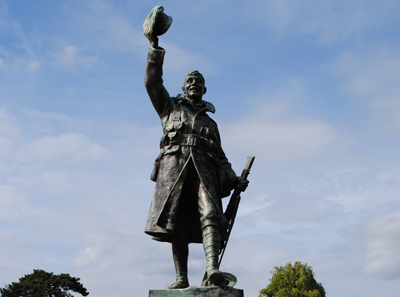
Can you identify where in London this picture was taken and what it’s of? If you think you can, leave a comment below. We’ll reveal the answer early next week. Good luck!

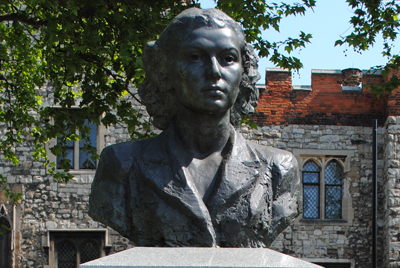
This is actually a picture of the Twickenham War Memorial, commemorating those who died in World War I and World War II. The bronze figure, the work of Mortimer Brown, sits in Twickenham’s Radnor Gardens, once the site of a house owned by the Earl of Radnor which sits on the bank of the River Thames. The memorial was recently restored following a campaign by the Friends of Radnor Gardens after one of its bronze plaques was stolen.

Treasures of London – The lions of Trafalgar Square…

Lion

Dwarfed by the towering form of Nelson’s Column in the southern part of Trafalgar Square, the four lions at the base of the column’s plinth – known to some as Landseer’s Lions – are now a favourite of tourists and Londoners alike. But it wasn’t always so.

While the column was erected in 1843 and the fountains in 1845, it wasn’t until 1867 that the lions – designed by Sir Edwin Landseer – appeared in the square. The reasons for the delay were apparently several including arguments over the artistic vision of the sculptures and funding and Landseer’s own ill-health.

Indeed, Landseer, best known as a painter of animal subjects, wasn’t the first choice as sculptor but was only commissioned after the models of the first sculptor – Thomas Milnes –  was rejected (there’s a terrific painting by John Ballantyne of Landseer working on the lions in the National Portrait Gallery).

As a result when the lions were eventually unveiled, they were held to general ridicule when they finally arrived, costing thousands of pounds more than what had been budgeted for them.

While the lions were initially going to be made of granite, Landseer’s 20 foot long lions were cast by Baron Marochetti in bronze at his Kensington studio. The form of the lions was apparently modelled on a dead lion which, according to Ed Glinert in The London Compendium, were brought to his studio in St John’s Wood by cab from the London Zoo, although all four lions have distinct faces.

Legend has it that the Grade I-listed lions will come to life if Big Ben chimes 13 times.

There has been concern in recent years about the damage people are doing to the lions in climbing on them with one report recommending that the public be banned from climbing on them.

For more, see our previous posts on Nelson’s Column and Trafalgar Square.

For more on London’s monuments, check out Peter Matthews’ London’s Statues and Monuments (Shire Library).

LondonLife – The Monument from St Paul’s…

Monument1

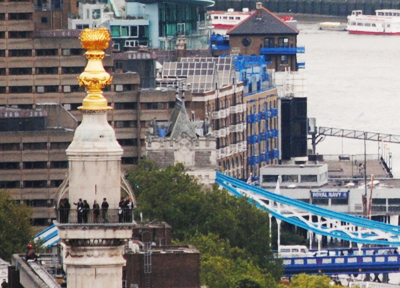
View of the top of the Monument from the top of St Paul’s Cathedral. For more on the history of The Monument, see our earlier post here.

Lost London – St Paul’s Cross…

Paul's-Cross-Memorial

Located in the north-east corner of the churchyard of St Paul’s Cathedral, St Paul’s Cross – also known simply as Paul’s Cross – was a large free-standing cross which served as an open-air pulpit for at least 500 years.

The history of the Cross goes back to at least the 12th century and it long served as a public gathering place for Londoners to hear sermons or matters of public importance. King Henry III met Londoners here in 1259 so they could swear their allegiance, people like 15th century chaplain Richard Walker appeared here to plead guilty for crimes against the church (in his case to charges of sorcery) and it was here that William Tyndale’s testaments were burnt in the 16th century.

Pauls-Cross2Conversely, it was also from here that the English Reformation was preached (there’s a painting in the Houses of Parliament of King Edward VI listening to a sermon preached from the Cross by reformist Bishop Latimer). It has been said that if all the sermons preached here had been collected, they would effectively make a history of the Church of England.

While it was a simpler structure in its earlier years, in the late 15th century, the then Bishop of London, Thomas Kempe, ordered the construction of a ‘preaching station’ on the site. It was an elevated small wooden structure with a lead roof topped by a cross under which a preacher and a couple of others could stand.

The cross and pulpit were destroyed during the English Civil War in 1643.

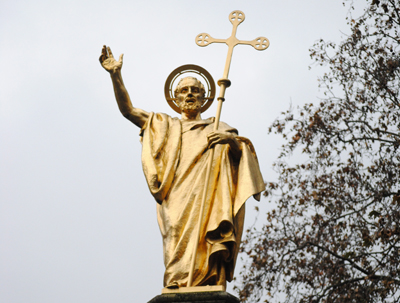
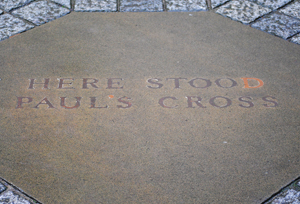
These days there’s a plaque marking the original site of the cross (above). In 1910, the St Paul’s Cross Memorial – a column topped with a gilt statue of St Paul designed by Sir Reginald Blomfield (pictured top), was installed nearby (as ordered by the will of HC Richards, according to a plaque on the site) and remains there today.

The Virtual Pauls Cross website, led by Professor John N Wall of North Carolina State University in the US, reconstructs what the site would have looked like when John Donne gave his Gunpowder Day sermon on 5th November, 1622.

Where is it? #68…

Where-is-it--#68

Can you identify where in London this picture was taken and what it’s of? If you think you can, leave a comment below. We’ll reveal the answer early next week. Good luck!

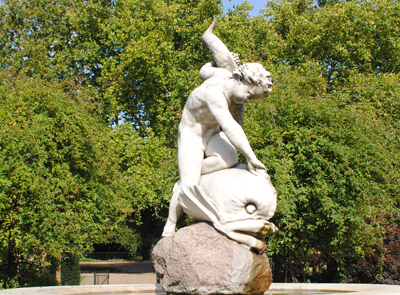
Well done to Renate, John, Diego and José who all correctly named this as the Boy with a Dolphin fountain in Hyde Park’s Rose Garden. The fountain, which is the work of Alexander Munro and dates from 1862, was once the centrepiece of the Victoria-era sunken garden which stood on the site of a former reservoir but was removed to make way for the widening of Park Lane. The fountain was moved to The Regent’s Park in 1960 but returned to Hyde Park in 1995. The Rose Garden, located close to Hyde Park Corner, also contains an older fountain – the Artemis Fountain, which dates from 1822.

Around London – The Bard is back; Foundling Museum displays; and, exhibitions on iconoclasm and explicit Japanese art…

The Bard is back in Leicester Square with the announcement last week that restoration work on the square’s 19th century Grade II listed statue of William Shakespeare – the only full-length statue the playwright in central London – has been completed. The 11 month restoration was carried out as part of £17 million revamp of the square which has seen the installation of a new fountain. The statue, which was the work of James Knowles, has been in the square since it was completed in its current configuration in 1874. Meanwhile, in other sculpture-related news, Sorry, Sorry Sarajevo – a life-size statue of a man holding  a dead or badly injured man in his arms has been placed in St Paul’s Cathedral where it will remain for the rest of the year. The work by Nicola Hicks dates from 1993 – when the Bosnian war was at its height – and has been placed opposite Henry Moore’s 1983 sculpture, Mother and Child: Hood as part of the cathedral’s approach to next year’s World War I centenary.

Two new displays opened at the Foundling Museum in Bloomsbury last month. Hogarth and Copyright, which runs until 5th January, looks at the role the artist William Hogarth played in the passing of the 1735 Engravers’ Copyright Act (also known as Hogarth’s Act – it was the first law to protect artist’s rights over their work) while Handel and Lucretia, presented in conjunction with The Sir Denis Mahon Charitable Trust and running until 26th January, shows Guercino’s painting Lucretia alongside two early manuscripts of Handel’s cantata La Lucretia. Entry is part of admission price. For more, see www.foundlingmuseum.org.uk.

A new exhibition tracing the history of attacks on artworks in Britain from the 16th century to today opened at Tate Britain in Millbank this week. Art under Attack: Histories of British Iconoclasm looks at why and how monuments have been damaged over the past 500 years. The display includes the remarkable pre-Reformation sculpture, the Statue of the Dead Christ (about 1500-1520), which was discovered in 1954 beneath the chapel floor at the Mercer’s Hall. Already damaged – most likely at the hands of Protestant iconoclasts – it may have been buried there to protect it. Also displayed are fragments of monuments destroyed in Ireland last century, paintings including Edward Burne-Jones’ 1898 painting Sibylla Delphica which was attacked by suffragettes in 1913-14, and Allen Jones’ 1969 work Chair – damaged in a feminist attack in 1986. Runs until 5th January. Admission charge applies. For more, see www.tate.org.uk.

A controversial exhibition of sexually explicit Japanese works of art created between 1600-1900 opened at the British Museum this week. Shunga: sex and pleasure in Japanese Art – which carries a warning of “parental guidance for visitors under 16 years – features 170 works including paintings, prints and illustrated books. Drawn from collections in the UK, Japan, Europe and the US, the exhibition of explores the phenomena of what are known as shunga (‘spring pictures’), looking at why it was produced and to whom it was circulated. Admission charge applies. Runs until 5th January. For more, see www.britishmuseum.org.

10 (more) curious London memorials…10. Memorial to 16th century navigators…

16th-century-navigators

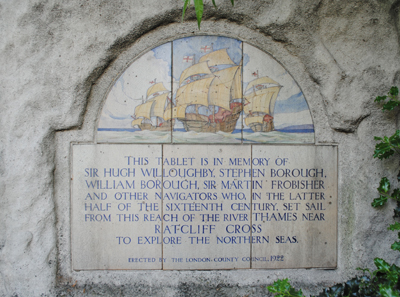
In the final of our series looking at London memorial, we head out to Shadwell in the city’s east where on the bank of the Thames, we find a memorial tablet dedicated to a group of 16th century navigators who set sail from near this point.

Located in Edward VII Memorial Park, the tablet can be found – rather oddly – on the landward side of the Wapping cupola, built to disguise a ventilation shaft and spiral staircase for the Rotherhithe road tunnel which opened in 1908 (the road is the A101). The cupola has a twin on the other side of the river in Rotherhithe.

Erected in 1922, the memorial specifically names arctic explorers Sir Hugh Willoughby, Stephen Borough, William Borough, and Sir Martin Frobisher but then goes on to state that it is also dedicated to the “other navigators who, in the latter half of the sixteenth century, set sail from this reach of the River Thames near Ratcliff Cross to explore the Northern Seas.”

Sir Hugh and his crew died while on an expedition in 1553 after becoming separated from the other ships on the expedition (Stephen Borough, master of one of the other ships, survived that expedition) while Sir Martin Frobisher made several unsuccessful attempts to find the North West passage in the late 1500s.

Ratcliffe Cross was a point on the northern bank of the river located just to the east of the park at the top of Ratcliffe Stairs and was an important navigation point for Thames watermen.

10 (more) curious London memorials…9. The Speke Monument…

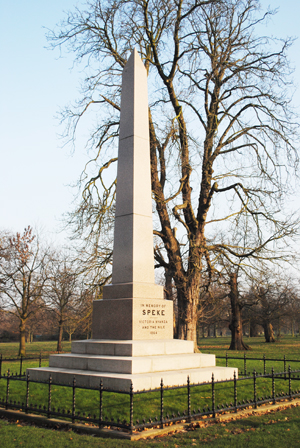
Speke-MonumentWhile thousands walk past this obelisk in Kensington Gardens each day, few probably realise it commemorates the life of John Hanning Speke, a Victorian-era explorer who discovered Lake Victoria in East Africa and named its northern outflow as the source of the Nile.

The red granite monument, designed by Philip Hardwicke and made from stone quarried in Scotland, was paid for by public donations and sponsored by Sir Roderick Murchison, president of the Royal Geographic Society which had paid for two of Speke’s expeditions. It was installed in 1866 and is located near the junction of Lancaster Walk and Budges Walk.

Speke, who had been on several expeditions in Africa, had only died at the age of 37 two years before in relatively controversial circumstances. He was shot by his own gun only the day before he was to participate in a debate with another explorer, Sir Richard Burton, about the source of the River Nile (Speke claimed the source of the Nile was Rippon Falls which flowed out of Lake Victoria; Sir Richard disputed this claim – it was later proven correct). Some have claimed Speke’s death to be suicide; others that it was an accident.

The monument itself was circumspect with regard to Speke’s success – it didn’t directly credit him as being the discoverer of the river’s source. This was rectified in 1995 when a plaque giving credit where it was due was placed on the ground in front of the monument by the Friends of Hyde Park and Kensington Gardens.

10 (more) curious London memorials…8. The SOE Memorial…

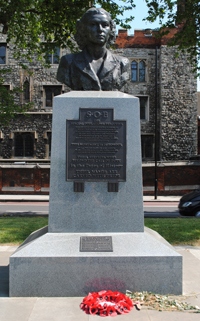
SOE-bigTucked away on Albert Embankment just to the north of Lambeth Bridge, this moving memorial was only unveiled in 2009 and formally honours the under-cover agents who worked for the Allies behind enemy lines during World War II.

The plinth is topped with a larger-than-life bust of Londoner Violette Szabo, sculpted by London artist Karen Newman. Szabo, who here gazes out across the Thames, was tortured and executed after being captured by the Germans while on a mission behind enemy lines following the D-Day landings.

SOEThe daughter of a French mother and English father, Szabo grew up in South London and, when World War II broke out in 1939, volunteered to work as an undercover operative in France as member of the British Special Operations Executive (SOE).

She had successfully completed one mission and had returned to France for a second when she was discovered and sent to a prison camp where she was unsuccessfully tortured for information.

Posthumously awarded the George Cross and the Croix de Guerre, a plaque on the memorial says she was among the 117 SOE agents who did not survive their missions to France. As many as 407 SOE agents were sent on “sabotage missions” to occupied France to fight with the French resistance.

Surprisingly, this SOE Memorial was apparently the first public memorial to honour the work of the unit. Formed on the orders of PM Sir Winston Churchill, it consisted of agents from various countries who were devoted to the Allied cause. Its feats included a raid which destroyed a factory in the Telemark region of Norway where the Germans were trying to produce heavy water which is used in the creation of atomic bombs – an operation which receives a special mention on the memorial.

The memorial was officially unveiled by the Duke of Wellington on 4th October, 2009. One of the plaques on it states that the monument “is in honour of all the courageous S.O.E. Agents: those who did survive and those who did not survive their perilous missions”. “Their services were beyond the call of duty. In the pages of history their names are carved with pride.” Enough said.

For more on the history of women serving in the SOE, see Squadron Leader Beryl E Escott’s book The Heroines of SOE: F Section: Britain’s Secret Women in France.

10 (more) curious London memorials…7. D’Oyly Carte Memorial…

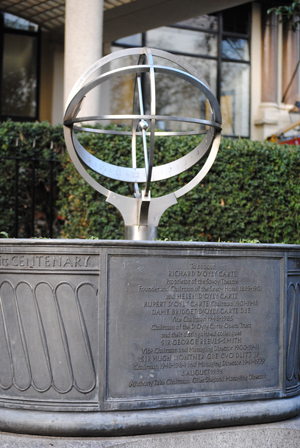
DOyly-CarteThis strange looking globe standing in Victoria Embankment Gardens just off Savoy Place may appear just another random piece of street art but in fact it’s a memorial to a man and his family who established the hotel now housed nearby.

Theatre impresario Richard D’Oyly Carte is known for having formed his own opera company – the D’Oyly Carte Opera Company, it was known for staging Gilbert and Sullivan’s ‘Savoy operas’ –  and for having founded the Savoy Hotel, which stands across the road from the memorial’s location.

The memorial, which was placed here in 1989 to mark the hotel’s centenary, takes the form of an armillary sphere – a model of objects circling the earth – standing in the middle of a cistern.

The inscription accompanying the memorial states that it honors not only Richard D’Oyly Carte but also others – including members of his family – who have since been involved in the hotel’s management. There’s also a note on the rim of the cistern, stating that the garden was “given to London by the Savoy in celebration of its centenary” while inscribed on the armillary sphere’s rings are the words “Savoy Centenary 1989, ‘For excellence we strive.'” and a line from dramatist WS Gilbert (of Gilbert and Sullivan fame) – “Every season has its cheer, life is lovely all the year”.

Where’s London’s oldest…drinking fountain?

A rather humble looking fountain set into the railing outside the Church of St Sepulchre-without-Newgate at the corner of Giltspur Street and Holborn Viaduct, it’s easy to overlook this important part of London’s historic fabric.

FountainBut this free water fountain is London’s oldest and was installed here on 21st April, 1859, by the then Metropolitan Drinking Fountain Association. Established by Samuel Gurney – an MP and the nephew of social reformer Elizabeth Fry, the organisation aimed to provide people with free drinking water in a bid to encourage them to choose water over alcohol.

Within two years of the fountain’s creation, the organisation – which later changed its name to Metropolitan Drinking Fountain and Cattle Trough Association in reflection of its expanded role in also helping animals – had placed as many as 85 fountains across London.

Such was the need for a clean water supply that, according to the Drinking Fountain Association, as many as 7,000 people a day used the fountain when it was first installed.

The fountain on Holborn Hill was removed in 1867 when the nearby street Snow Hill was widened during the creation of the Holborn Viaduct and the rails replaced but it was returned there in 1913. Rather a poignant reminder of the days when water wasn’t the publicly available resource it is today, the marble fountain still features two small metal cups attached to chains for the ease of drinking and carries the warning, “Replace the Cup!”.

PICTURE: Wikipedia/JustinC

10 (more) curious London memorials…6. 7 July Memorial…

77-Memorial

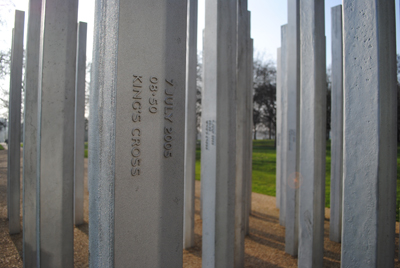
It’s not immediately obvious what this series of upright stainless steel pillars standing on the eastern edge of Hyde Park has been placed there for.

But look a little closer and you’ll see inscribed upon a date which any long-term Londoner immediately recognises – 7th July, 2005: the day when a series of bombs claimed 52 lives on three trains and a bus at various locations around central London.

The memorial, designed by architects Carmody Groarke and engineering team Arup working in consultation with victims’ representatives, Royal Parks and the Department for Culture, Media & Sport, consists of 52 pillars – one for each victim of the bombings.

The 3.5 metre high, 850 kilogram pillars are clustered together in four groups representing the four locations of the bomb attacks – Tavistock Square, Edgware Road, King’s Cross and Aldgate. They are marked with the times, dates and locations of the bombings and there’s also a 1.4 tonne stainless steel plaque upon which are written the names of the victims located nearby.

The RIBA award-winning memorial, which is located just to the north of the colossal statue Achilles and Hyde Park Corner, was unveiled by Prince Charles and Lady Camilla on the fourth anniversary of the attack in 2009.

For more, see the Royal Parks website www.royalparks.org.uk/parks/hyde-park/hyde-park-attractions/7-july-memorial.

10 (more) curious London memorials…5. National Police Memorial…

National-Police-Memorial

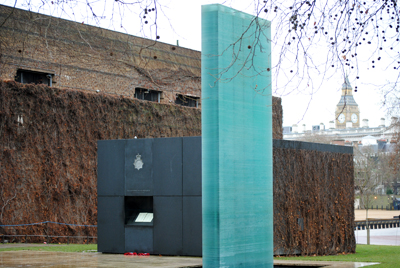
The unobtrusive box-like structure and adjacent glass pillar located on the corner of The Mall and Horse Guards Road in Whitehall is another memorial that is easy to overlook.

Unveiled by Queen Elizabeth II in 2005, it commemorates the 4,000 police officers who have been killed in the course of their duty in the UK and was commissioned by the Police Memorial Trust.

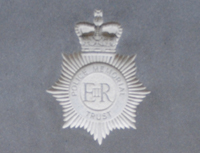
Police-Memorial-TrustThe trust was formed in the mid-1980s by the late film director Michael Winner following the shooting death of WPC Yvonne Fletcher, who was killed while policing a protest outside the Libyan Embassy in St James’s Square on 17th April, 1984.

The Trust ensured an individual memorial to WPC Fletcher now marked the spot of her death and was followed by further memorials to individual police officers before the trust began a campaign for a larger, national memorial in the mid-1990s.

As much as £2.3 million was raised from the public for the memorial which was designed by architectural firm Foster + Partners.

The memorial, which won a RIBA award, consists of a black granite clad wall with a glass chamber set into its face, inside which is a Book of Remembrance listing the names of all UK police officers killed in the course of duty (the pages of the book are apparently turned every two weeks). Above the chamber is carved the Metropolitan Police Crest.

The tall glass pillar which stands nearby in a reflecting pool was designed to pay homage to the blue lamps that once burned outside police stations.

For more on other police memorials in the UK, see www.policememorial.org.uk.

10 (more) curious London memorials…4. ‘People of London’ Memorial…

People-of-London

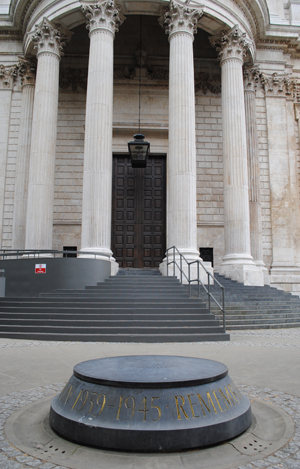
Amid all the grand war-related memorials of London, this rather humble memorial sitting outside the north transept of St Paul’s Cathedral in St Paul’s Churchyard can easily be overlooked. 

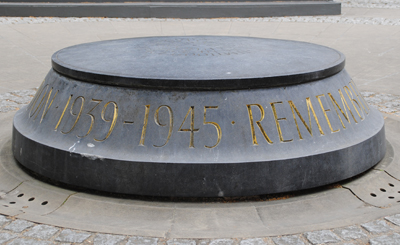
Known as the Memorial to the Londoners killed in World War II Bombardments or simply as the ‘People of London’ memorial as it’s called on the sculptor’s website, it commemorates the 30,000 Londoners who were killed during the Blitz  (not to be confused with the National Firefighters’ Memorial, known informally to many as the Blitz Memorial, which sits opposite the cathedral’s south transept and commemorates firefighters who died during the Blitz).

People-of-London---smallThe round memorial was carved from a three tonne block of Irish limestone and is set into paving (it was initially very shiny).

The gilded inscription which runs around the outside reads “Remember before God the people of London 1939-1945” while on top, written in a spiral, is an inscription written by Sir Edward Marsh – “In war resolution, in defeat defiance, in victory magnanimity, in peace goodwill”, the text of which was used by Sir Winston Churchill in the frontispiece to his history, The Second World War.

Unveiled by the Queen Mother on 11th May, 1999, the memorial is the work of Richard Kindersley, whose other memorials include the Commonwealth Memorial on Constitution Hill.

Kindersley writes on his website, that the “position of the memorial adjacent to St Paul’s is most appropriate, as most people will remember the dramatic photograph of the Cathedral dome of the taken during a devastating attack in 1941.”

It was paid for by public funds raised following an appeal in the Evening Standard newspaper, launched in connection with the 50th anniversary of VE Day.

LondonLife – New life for the Blue Plaques scheme…

Alexander-Pope

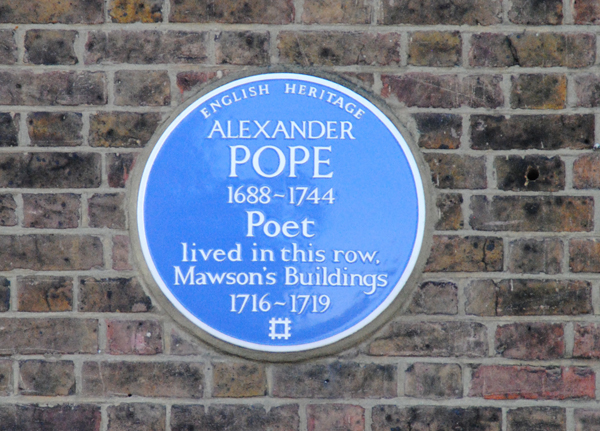
The humble Blue Plaque is set for a new lease on life following an announcement this week. The London Evening Standard has announced it will help breathe new life into English Heritage’s Blue Plaque’s scheme this week with the scheme – which was suspended in January due to funding cuts – set to relaunch next year in association with the newspaper. As many as 20 new plaques have already been funded through a £80,000 donation from property developer David Pearl, says the paper, and the public are being urged to help financially support the programme at www.english-heritage.org.uk/donate. The Standard also noted that from next year its readers will be able to vote for candidates for future plaques. Each Blue Plaque costs about £4,000 to create and install. Pictured is a Blue Plaque commemorating poet Alexander Pope’s residence in a Chiswick property between 1716-1719.  The property is now the Mawson Arms public house.

10 (more) curious London memorials…3. William Wallace Memorial…

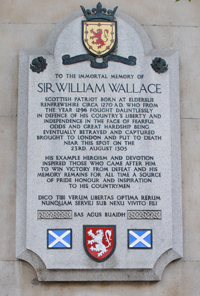
William-Wallace-memorialHe was captured in Scotland but it was actually at Smithfield in London that the Scottish leader, Sir William Wallace, was put to death on 23rd August, 1305.

Erected in 1956 by “Scots and friends at home and abroad”, a plaque located on the wall of St Bartholomew’s Hospital overlooking the former execution ground commemorates the “Scottish patriot” Wallace, saying that from the year 1296 “fought dauntlessly in defence of his country’s liberty and independence in the face of fearful odds and great hardship”. It goes on to note that he was “eventually betrayed”, captured and executed “near this spot”.

Elsewhere the memorial reads: “His example, heroism and devotion inspired those who came after him to win victory from defeat and his memory remains for all time a source of pride, honour and inspiration to his countrymen”.

Having co-led the Scottish to victory against the army of King Edward I at the Battle of Stirling Bridge in 1297, Wallace was later knighted for his efforts and subsequently served as a Guardian of the Kingdom of Scotland.

Following his defeat at English hands in the Battle of Falkirk in 1298, he escaped and continued to evade capture until he was apprehended near Glasgow in August 1305. Brought to London where he was put on trial in Westminster Hall. Summarily found guilty of treason, he was stripped naked and dragged to Smithfield and it was there that he suffered the horrible death of being hung, drawn and quartered.

And while the 1995 movie, Braveheart, had Wallace crying out “Freedom” as he died, his last words are actually not recorded. His tarred head was subsequently displayed on a pike atop London Bridge while his limbs were sent to towns including Stirling in Scotland.

LondonLife – A new season for the Fourth Plinth…

Hahn_Gautier1

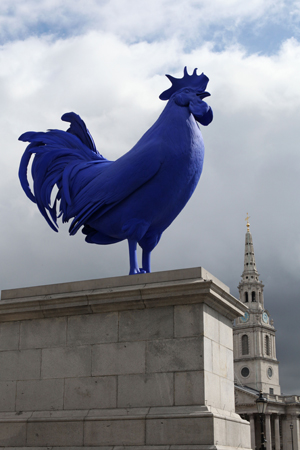
The latest commission for Fourth Plinth was unveiled in Trafalgar Square last Thursday. Katharina Fritsch’s Hahn / Cock, 2013, depicts a 4.72 metre high sculpture of a domestic farmyard cockerel completely coloured in vivid ultramarine blue. Fritsch, one of Germany’s leading contemporary artists, has works featured in the permanent collections of prominent galleries around the world including New York’s Museum of Modern Art. Originally designed by Sir Charles Barry to hold an equestrian statue (which was never completed), the fourth plinth has been most recently occupied by a series of works specially commissioned for the spot under the Mayor of London’s Fourth Plinth Programme. Recent commissions include Yinka Shonibare’s Nelson’s Ship in a Bottle and Antony Gormley’s One and Other. For more details, check out www.london.gov.uk/priorities/arts-culture/fourth-plinthPICTURE: Gautier Deblonde.

Around London – Celebrating the coronation at Buckingham Palace; Royal births at the MoL; the Fourth Plinth unveiled; Menon remembered; and, manufacturing at the Design Museum…

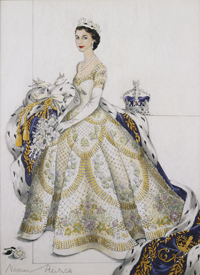
Norman-Hartnell-sketchThe Queen’s Coronation in 1953 is the subject of a special exhibition opening at Buckingham Palace as part of the palace’s summer opening. Celebrating the 60th anniversary of the coronation, the display features an array of outfits including uniforms and robes worn on the historic event on 2nd June, 1953, as well as a series of paintings recording the event, works of art and objects used on the day and film footage and sound recordings. Among the highlights of the exhibition will be sketches made by Norman Hartnell, the principal designer of the outfits worn at the coronation by the Queen, principal ladies of the immediate Royal Family and the Maids of Honour. The State Rooms of Buckingham Palace open on Saturday and remain open until 29th September. An admission charge applies. For more, see www.royalcollection.org.uk. PICTURE: Her Majesty The Queen in her Coronation Dress, 1953, Norman Hartnell. Royal Collection Trust/All Rights Reserved.

Meanwhile in this, the week of the birth of Prince George, it’s only fitting that we mention a small display at the Museum of London showcasing memorabilia relating to royal babies of years past. A Royal Arrival features baby clothes and other items worn by future monarchs. They include a embroidered skullcap worn by the future King Charles I, a tiny linen vest and mitten which once was worn by the future King George III and a dress emblazoned with the three feather insignia which belonged to the future King Edward VII, eldest son of Queen Victoria. The free display will be on show until October. For more, see www.museumoflondon.org.uk.

The new commission for Trafalgar Square’s Fourth Plinth will be unveiled today. The 4.7 metre high sculpture, Hahn/Cock, is the work of contemporary artist Katharina Fritsch. It will sit on the plinth for the next 18 months.  For more details, see www.fourthplinth.co.uk.

Indian statesman VK Krishna Menon has been commemorated by English Heritage with a blue plaque on his former residence in Highgate. A key campaigner for Indian independence, Menon lived at 30 Langdon Road from 1929 to 1931, having moved to England from Madras in 1924. In 1947, Menon was appointed India’s First High Commissioner in London and among his greatest achievements was his work in keeping the country in the British Commonwealth after independence. Having been a local councillor in St Pancras, he later returned to India and embarked upon a political career there. For more, see www.english-heritage.org.uk/discover/blueplaques/.

The-Future-Was-HereOn Now: The Future is Here. A major new exhibition examining the changes taking place in manufacturing around the world, opened this week at the Design Museum. The Future is Here looks at how everything from “cars to shoes” is manufactured, funded, distributed and bought. Among highlights is a ‘Factory’ where visitors can discover how 3D printing works and see production in process. There will also be the chance to make your own ‘action doll’ and see a sofa designed through a crowd-sourcing process which involved members of the public. Runs until 3rd November. Admission charge applies. For more, see www.designmuseum.org.

10 (more) curious London memorials…2. Animals in War Memorial…

Animals-in-War

This week we take a look at another of London’s war-related memorials but unlike the vast majority, this one, as its name says, commemorates animals, not humans.

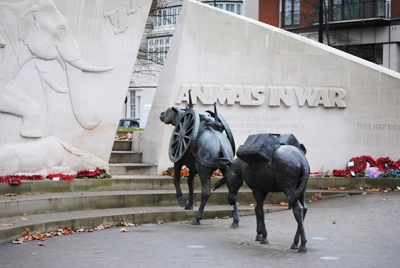
Located in the middle of Park Lane near the intersection with Upper Brook Street on the eastern side of Hyde Park, the memorial is dedicated “to all the animals that served and died alongside British and Allied Forces in wars and campaigns throughout time”. Another inscription on the memorial reads “They had no choice”.

A further dedication at the memorial pays tribute to the “millions” of animals who have died in wars. “From the pigeon to the elephant, they all played a vital role in every region of the world in the cause of human freedom,” it says. “Their contribution must never be forgotten.” It’s been said that as many as eight million horses were killed in World War I alone.

It features a couple of bronze pack mules making their way through a gap in a curved, 58 foot wide Portland stone wall – themselves carrying reliefs of various animals including an elephant, horses, camels and pigeons – while on the other side is a bronze horse and a dog, looking ahead.

The memorial is the work of Somerset-based sculptor David Backhouse and was unveiled by Princess Anne in November 2004, the 90th anniversary of the outbreak of World War I. It was apparently inspired by Jilly Cooper’s book, Animals in War, and commissioned by the Imperial War Museum. It was paid for by £2 million in public donations.

For more, check out www.animalsinwar.org.uk.

10 (more) curious London memorials…1. Kindertransport memorial

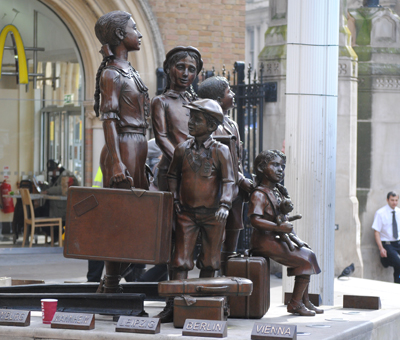
KindertransportWay back in 2011 we ran a series looking at some of London’s most curious memorials. We’ve decided to revisit that theme in our new special series.

To kick it off, we’re taking a look at a group memorial found just outside Liverpool Street Station and dedicated to the thousands of Jewish children who arrived in the UK as refugees over nine months in 1938 and 1939, having fled the Nazis in Europe after the anti-Semitic attacks of the Kristallnacht.

Called Kindertransport – The Arrival, the group of bronze statues representing children with their luggage having just stepped off a train at the station were unveiled in 2006 in Hope Square. A short stretch of railway tracks lays behind them.

The memorial is the work of Frank Meisler – himself a child who travelled on a Kindertransport train from Danzig – and bears an inscription: “Children of the Kindertransport. In gratitude to the people of Britain for saving the lives of 10,000 unaccompanied mainly Jewish children who fled from Nazi persecution in 1938 and 1939. ‘Whosoever rescues a single soul is credited as though they had saved the whole world.’ Talmud.”  It is dedicated by the Association of Jewish Refugees and the Central British Fund for Jewish World Relief.

Around the statue group are a series of blocks upon which is inscribed the names of the cities from which the children fled. They include the cities of Cologne, Hanover, Stuttgart, Frankfurt, Munich, Danzig, Breslau, Prague, Hamburg, Leipzig, Berlin and Vienna along with others.

The statue is one of four, all created by Meisler, which have been erected along the route the children took to reach safety. Others can be found at the main railway station Gdansk in Poland, Friedrichstraße railway station in Berlin, and another in Rotterdam, The Netherlands.

Hope Square also contains another plaque which dedicates the square to the children of the Kinderstransport “who found hope and safety in Britain through the gateway of Liverpool Street Station”.

In late June, an event was held in the St James’s Palace to mark the 75th anniversary of the Kindertransport.