Where’s London’s oldest…Thames foreshore structure?

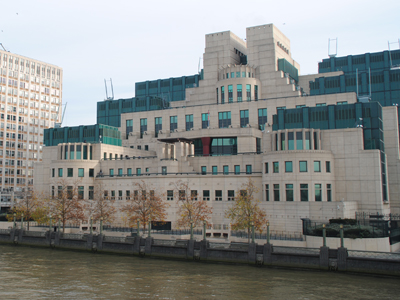
The oldest structure on the Thames foreshore is only a relatively recent discovery. It was in the spring of 2010 that archaeologists found six timber piles driven into the foreshore just in front of the spy agency MI6’s building in Vauxhall (pictured below with the river covering the site). 

The piles – no specific function for which has yet been identified – were up to 0.3 metres in diameter and were found to be more than 6,000 years old.

That date puts them in the Mesolithic period when the level of the river was lower – meaning the structure was probably built on dry land – and the landscape considerably different to what it is today. Radiocarbon dating suggests the trees for the structure were felled between 4790 BC and 4490 BC.

The site, which is at the confluence of the Thames and now largely underground River Effra, was initially kept secret while surveying was carried out. Nearby were found stone tools dating from a similar era to the piles – they included a tranchet adze for woodworking – and pottery fragments from the slightly later Neolithic era.

The discovery near the low tide line was made by archaeologists from the Thames Discovery Programme and the site then surveyed with the assistance of English Heritage and the Museum of London as well as the geomatics teams from Museum of London Archaeology.

The site is 600 metres downstream from a Bronze Age timber jetty (about 1,500 BC) found in the 1990s.

Lost London – Vauxhall Pleasure Gardens

First laid out in the mid 17th century, Vauxhall Pleasure Gardens, on the east bank of the Thames just south of Lambeth, rose in fame to become one of London’s leading public entertainment venues.

The gardens, initially known as New Spring Gardens, are believed to have opened around the time of the Restoration of 1660 on a site which had been formerly an estate owned by vintners John and Jane Vaux (Jane was apparently widowed).
Initially apparently no more than an ale-house with a garden attached, the gardens grew to span several acres and featured a central hub and long avenues for strolling. Admission was initially free with money made from food and drink sold there. Among the earliest recorded visitors to the gardens was John Evelyn in 1661, describing it as a “pretty contrived plantation” and diarist Samuel Pepys, who wrote of a visit he made on 29th May, 1662 (he is known to have returned numerous times).

From 1729, the gardens came under ownership and management of John Tyers, entrepreneur, property developer and patron of the arts, and it was he who, until his death in 1767, oversaw the transformation of the area into an arts hotspot which included sculpture (in particular a fine statue of the composer Handel), music, painting and architecture. Thanks partly due to the patronage of Frederick, Prince of Wales, the gardens become the fashionable place to be seen.

The variety of entertainment on offer at the gardens – the name of which was only officially changed to Vauxhall Gardens in 1785 – grew substantially over the years: from concerts and fireworks displays to performances by tight rope walkers and lion tamers and even re-enactments of famous battles. The gardens became renowned as site for balloon ascents and, for its architecture – the number of buildings there grew over the years to include a rococo ‘Turkish tent’, Chinese pavilion, and, another rococo building, the Rotunda (where concerts could be held in wet weather). There was also a cascade and private ‘supper boxes’ for those who could afford them; those who couldn’t could dine at tables set under the trees.

From the outset, Vauxhall was known as a place where the sexes could mix freely and, therefore, for romantic assignations – in fact, one area of the gardens became known as the ‘Dark Walk’ for the fact it was, unlike other areas of the gardens, never illuminated by lamps and it was in this area, frequented by prostitutes, that many of the more illicit liaisons took place.
By the late 1700s and early 1800s, the gardens, one of a number of pleasure gardens in London, had reached the height of their popularity with reportedly more than 60,000 people said to have  attending a fancy dress party held one night in the late 1700s.

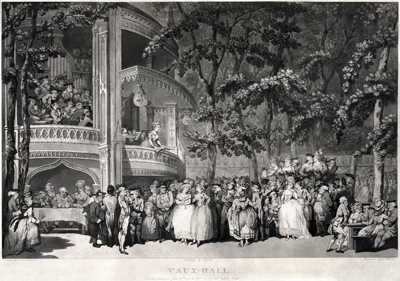
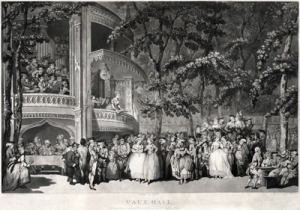
Those who attended events in the gardens included royalty as well as the likes of Samuel Johnson and James Boswell (see Thomas Rowlandson’s image above, Vauxhall Gardens, showing the likes of Johnson and Boswell, along with Georgina, Duchess of Devonshire, and the future King George IV, at the gardens in about 1779) as well as, much later, Charles Dickens (by the time Dickens visited, however, the heyday of the gardens was already well over).

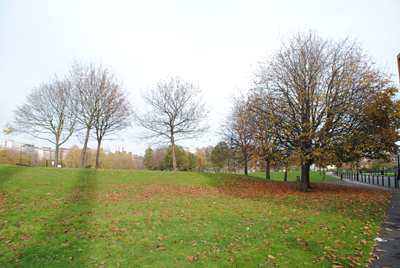
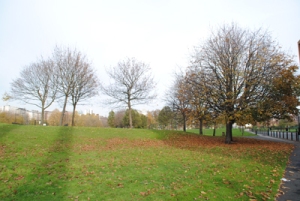
The gardens closed in 1859 due apparently to declining popularity and were eventually replaced with housing. After being badly bombed in World War II, however, the site once again returned to being a garden, known as Spring Gardens. The gardens (pictured) still occupy the site not far from Vauxhall tube station – part of them is used by the Vauxhall City Farm as paddocks for horses and livestock and they also contain a multi-use games court.

For an authoritative and comprehensive work on the Vauxhall Gardens, try David Coke and Dr Alan Borg’s Vauxhall Gardens: A History. There’s also much more information on David Coke’s website here. There’s also a detailed history here.

David Coke is curating an exhibition at The Foundling Museum, The Triumph of Pleasure, which looks at the way in which the gardens and the establishment of the Foundling Hospital in 1739 “changed the face of British art forever”. Runs from 11th May to 9th September. For more, see www.foundlingmuseum.org.uk.

PICTURES: Wikipedia and David Adams
LondonLife – The ‘Royal River’ celebrated at the National Maritime Museum

Canaletto’s image of Greenwich Hospital from the north bank of the Thames (1750-52) is among almost 400 paintings, manuscripts and objects selected to be part of the National Maritime Museum’s new exhibition, Royal River: Power, Pageantry & The Thames.

Curated by historian David Starkey, the exhibition, part of the Diamond Jubilee celebrations, focuses on the use of the river across five centuries covering events including Anne Boleyn’s coronation procession and Admiral Lord Nelson’s stately funeral through to the evolving Lord Mayor’s pageant and the ‘Great Stink’ of the mid-1800s.

Highlights include the oldest known copy of Handel’s Water Music, the sixteenth century Pearl Sword (which the monarch must touch on entering the City of London), a stuffed swan, treasures from the City’s livery companies, and another Canaletto work – this time his famous view of the river filled with boats getting ready for the Lord Mayor’s Day, seen as an inspiration for this year’s Diamond Jubilee Pageant and on show in the UK for the first time since its completion.

As well as celebrating the Diamond Jubilee, the exhibition also marks the 75th anniversary of the opening of the National Maritime Museum by King George VI on 27th April, 1937. The king’s speech from that day and his Admiral of the Fleet uniform also feature in the exhibition.

WHERE: National Maritime Museum Greenwich (nearest DLR station is Cutty Sark); WHEN: Daily 10am to 5pm (opening times may vary during the Paralympic and Olympic Games) until 9th September; COST: £11 adult/£9 concession/family ticket £24.50; WEBSITE: www.rmg.co.uk.

PICTURE: © National Maritime Museum, London

Around London – Cutty Sark reopens; Genghis Khan at Marble Arch; New theatre for the West End; and, Shakespeare’s cash…

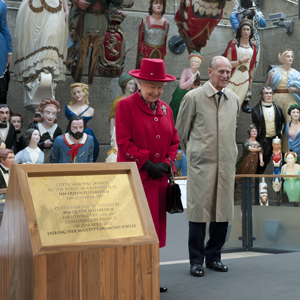
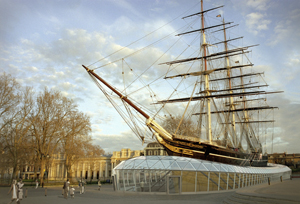
• The Cutty Sark, the world’s last surviving 19th century tea clipper, reopens to the public today following a £50 million, six year conservation project. The project to restore the Greenwich-docked ship has involved raising it more than three metres so visitors can walk underneath and see for themselves the sleek lines which helped the vessel set a then record-breaking speed of 17.5 knots or 20mph in sailing from Sydney to London. As well as raising the ship three metres, the project has involved encasing the ship’s hull in a glass casing to protect it from the weather – this area also contains the museum’s extensive collection of more than 80 ships’ figureheads, never been seen in its entirety on the site. The ship’s weather deck and rigging, meanwhile, have been restored to their original specification and new, interactive exhibitions on the vessel’s history have been installed below deck. Originally launched in 1869 in Dumbarton, Scotland, Cutty Sark visited most major ports around the world, carrying cargoes including tea, gunpowder, whiskey and buffalo horns and made its name as the fastest ship of the era when carrying wool between Australia and England. The ship became a training vessel in the 1920s and in 1954 took up her current position in the dry dock at Greenwich before opening to the public. In November 2006, the ship’s rig was dismantled in preparation for a restoration project – this received a setback on 21st May, 2007, when a fire broke out aboard the ship and almost destroyed it. The ship – which was officially reopened by Queen Elizabeth II and the Duke of Edinburgh (pictured) yesterday – is now under the operational management of the umbrella body, Royal Museums Greenwich. For more (including the online purchasing of tickets), see www.rmg.co.uk/cuttysark or www.cuttysark.org.uk. PICTURE: National Maritime Museum, London.

• A large statue of Genghis Khan has invaded Marble Arch. The 16 foot (five metre) tall sculpture of the Mongolian warlord, created by artist Dashi Namdakov, was erected by Westminster City Council as part of its ongoing City of Sculpture festival which is running in the lead-up to the Olympics. The statue has sparked some controversy – Labour councillors at Westminster have reportedly suggested Dambusters hero Guy Gibson would be a more suitable subject for a statue than the warlord Khan. The Russian artist, who has an exhibition opening at the Halcyon Gallery in Mayfair next month, told the Evening Standard he simply wanted to honor Khan on the 850th anniversary of his birth.

• Development of a new West End theatre, the first to be built in the area in 30 years, has been given the green light. The new 350 seat theatre will be part of a development project located between Charing Cross Road and Oxford Street which will also feature office and retail spaces. The site was occupied by a pickle factory in the 19th and 20th centuries and from 1927 was the home of the Astoria cinema, remodelled as a live venue in the 1980s. Live music was last presented there in 2009 when the site was compulsorily acquired for the Crossrail project.

• On Now: Crowns and Ducats: Shakespeare’s money and medals. This exhibition at the British Museum explores the role of money in Shakespeare’s world and looks at how coins – a frequently recurring motif in Shakespeare’s work – and medals were issued to mark major events. Objects in the display include Nich0las Hilliard’s ‘Dangers Averted’ medal of Elizabeth I and William Roper’s print of the Queen, the first to be signed and dated by a British artist, as well as a money box such as might have been used at the Globe and a hoard of coins, including a Venetian ducat, deposited in Essex around the time of Shakespeare’s birth. Almost every coin mentioned in Shakespeare’s plays will be on show – from ‘crack’d drachmas’ to ‘gilt twopences’. Runs until 28th October in room 69a. Entry is free. For more, see www.britishmuseum.org.

Where is it? #25

The latest in the series in which we ask you to identify where in London this picture was taken and what it’s of. If you think you can identify this picture, leave a comment below. We’ll reveal the answer early next week. Good luck!

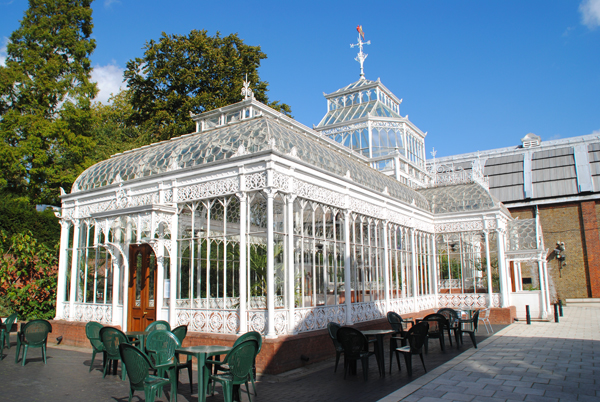
Well done to Charlotte, Sean and Jameson – this is, of course, a picture of the Horniman Conservatory located at the rear of the Horniman Museum located in Forest Hill in London’s south-east.

While the eclectic museum has its own fascinating story (see our earlier post here), so too does the conservatory. It was built in 1894 at the family home of the museum’s founder – wealthy merchant, philanthropist and MP Frederick John Horniman – located at Coombe Cliff in Croydon.

The Grade II listed cast iron and glass building was relocated to its current site by English Heritage in the late 1980s. It can now be hired out for private functions including weddings.

Interestingly, the gardens surrounding the Horniman are currently undergoing a £2.3 million revamp and will be fully reopened later this year. We’ll have more on that at a later date…

Around London – Europe’s oldest intact book at British Library; 100 days to the Games; world’s largest archaeological archive; the London Marathon; and, Turner at the National Gallery…

• The British Library has paid £9 million for a 7th century text, the St Cuthbert Gospel, which is also the oldest intact European book. The acquisition follows the library’s most successful fund-raising effort ever – it included a £4.5 million grant from the National Heritage Memorial Fund. The book – a Gospel of John bound in beautifully tooled red leather – was produced in north-east England in the late 7th century and was placed in the saint’s coffin after his death on the Isle of Lindisfarne in 698. It was retrieved when the coffin was opened at Durham Cathedral in 1104. The Gospel is on display in the Sir John Ritblat Treasures Gallery at the library in St Pancras and following a conservation review, it is anticipated it will soon be displayed with the pages open for the first time. There will be a public event celebrating the acquisition on 15th May. For more, see www.bl.uk/whatson/events/may12/index.html.

• London this week marked 100 days until the Opening Ceremony of the 2012 Olympic Games. This included unveiling the latest installation of the Olympic rings – made of 20,000 plants the 50 metre long rings are located in the Royal Botanic Gardens at Kew in the city’s west and can be seen from planes on the Heathrow flight path. The organising committee also announced the Red Arrows aerobatic display team will perform a nine-ship flypast in ‘big battle’ formation on the day of the Opening Ceremony (27th July) and stated that the games motto will be ‘Inspire a Generation’. For more, see www.london2012.com.

• The Museum of London’s archaeological archive – known as the London Archaeological Archive and Research Centre (LAARC) – is officially the largest in the world according to Guinness World Records. The archive contains more than five million artefacts and the records of almost 8,500 excavations dating back to 1830. Items in the archive include shoes dating back to Roman times, a 200-year-old set of false teeth, ‘witching bottles’ including one with human hair and toenails, and coffin plates from London’s cemeteries. The world record has been recorded as part of World Record London, a series of world record breaking events being held in the run-up to the Olympics. Others have included the Faberge Big Egg Hunt.

• Thousands of people are expected to take part in the Virgin London Marathon this Sunday. The 26.2 mile route starts in Blackheath, passes through Woolwich and Greenwich and crosses the Thames at Tower Bridge before looping around the east end of London, through Canary Wharf, and the west along The Highway (formerly known as The Ratcliffe Highway) and Embankment to Parliament Square, Birdcage Walk and finally to Buckingham Palace. The first London marathon was run in 1981. For more, see www.virginlondonmarathon.com.

• On Now: Turner Inspired – In the Light of Claude. The first major presentation of 17th century artist Claude Gellée’s influence on the English romantic artist J M W Turner, the exhibition focuses on Claude-inspired themes which run through Turner’s work including “the evocation of light and air in landscape, the effect of light upon water and his often radical reworking of contemporary scenes”. The display includes works from large scale oils on canvas through to leaves from Turner’s pocket sketchbooks. Interestingly, the exhibition also explores the story behind the so-called Turner Bequest – that on his death, Turner linked himself to Claude forever by leaving the National Gallery two pictures – Dido building Carthage (1815) and Sun rising through Vapour: Fishermen cleaning and selling Fish (before 1807) –  on condition that they were hung between two pictures by Claude, Seaport with the Embarkation of the Queen of Sheba (1648) and Landscape with the Marriage of Isaac and Rebecca (1648). Runs until 5th June. Admission charge applies. For more, see www.nationalgallery.org.uk.

Around London – Of a dramatic Boat Race; celebrating bluebells; Cockney slang; WT Stead; and, Titian’s early masterpiece…

 • Cambridge took the line honours over Oxford in this year’s Boat Race on the Thames in what has been billed as one of the most dramatic races in its 158 race history. The race was interrupted when a swimmer, described as an anti-elitist protestor, was spotted in the water and, following a restart near the Chiswick Eyot, the boat crews clashed oars and one of the Oxford crew lost his oar’s spoon. Cambridge pulled steadily ahead with Oxford an oar down and was declared the winner by four and a quarter lengths. The presentation ceremony was subsequently not held after Oxford’s bow man collapsed and was rushed to hospital where was reported to be recovering well. The win takes Cambridge’s victories to 81 compared to Oxford’s 76. For more, see http://theboatrace.org. (For more on the history of the Boat Race, see our entry from last year).

Epping Forest’s bluebells are out in force and to celebrate the City of London Corporation is holding a series of events including an art exhibition at The Temple in Wanstead Park. The exhibition, Out of the Blue, celebrates the bluebells of Chalet Wood and features a “miscellany of bluebell images, artwork, folklore and fairies”. A free event, it runs until 27th May. This Sunday the Temple will also host an art afternoon with local artist Barbara Sampson and on 29th April photographer Robert Good will hold a course on photography around the forest. Both are free events. For more details, see www.cityoflondon.gov.uk/epping.

• “Porky pies” (lies) is the most used Cockney phrase, according to a survey of Britons on their knowledge and use of Cockney. The Museum of London survey of 2,000 people, including 1,000 from London, also found that “apples and pears” (stairs) was the most well-known Cockney phrase and that while a majority of people knew what common phrases like “brown bread” meant (in this case dead), only small percentages of people used them. And while 63 per cent of respondents believed Cockney slang was crucial to London’s identity, 40 per cent were convinced it is dying out and 33 per cent were sad at its passing. Strictly speaking, a ‘Cockney’ is someone who was born within the sound of bow bells at the church of St Mary-le-Bow in Cheapside, but according to Alex Werner, head of history collections at the museum, “people from all corners of London identify themselves as being Cockney”. He said that while for many people “Cockney rhyming slang is intrinsic to the identity of London”, the research the Cockney dialect “may not be enjoying the same level of popularity”. The research found that among the least known Cockney rhyming slang phrases included “white mice” (ice), “donkey’s ears” (years), and “loop de loop” (soup). For more from the museum, see www.museumoflondon.org.uk.

• The life of influential newspaper editor and Titanic victim, William Stead, will be celebrated at a two day conference next week. Hosted by the British Library, in association with Birkbeck College and the University of Birmingham, the conference will feature 40 speakers from around the world. Stead, who was editor of The Pall Mall Gazette, was a controversial figure who is credited with being one of the inventors of the modern tabloid. He died on the Titanic‘s maiden voyage – the 100th anniversary of which is being marked this month. W.T. Stead: A Centenary Conference for a Newspaper Revolutionary takes place from 16th to 17th April, 2012. Tickets (£45 for one day or £85 for two days) can be booked by visiting the box office in the St Pancras building or phoning 01937 546546. The programme for the conference can be found at https://sites.google.com/site/stead2012/.

• On Now: Titian’s First Masterpiece: The Flight into Egypt. The National Gallery is hosting a new exhibition focused on the then young artist’s creation of the magnificent painting The Flight into Egypt in the 16th century. The artwork, lent to the National Gallery by the Hermitage Museum, St Petersburg, has recently been restored and the exhibition represents the first time the painting has been seen outside Russia since 1768 when Empress Catherine the Great purchased it in Venice. Admission is free. Runs until 19th August. For more, see www.nationalgallery.org.uk.

Around London – At home in World War II; Hogwarts comes to London; Kew Steam Bridge Museum to be upgraded; and, V&A looks at British design…

• A new exhibition in which visitors can experience life during the Second World War through the eyes of a London family opens today at the Imperial War Museum in London. A Family in Wartime explores the lives of William and Alice Allpress and their 10 children at their South London home during the war as the face events such as the Blitz and the evacuation of the city. The display includes firsthand audio accounts from members of the family, photographs and a detailed model of the family home at 69 Priory Grove. Two of the family’s sons served in the military during the war while three of the daughters joined the Women’s Voluntary Service. Artefacts on display include many everyday household items such as cookery books which gave advice on cooking with limited rations and stirrup pumps which people were encouraged to wear in case of incendiary bombs as well as newspaper clippings, propaganda posters and film footage. There will also be artworks depicting wartime living by artists including Henry Moore, Wilfred Haines and Leila Faithful. Admission is free. For more, see www.iwm.org.uk/visits/iwm-london.

Hogwarts has come to London’s north with the opening of the new Warner Bros Studio Tour in Leavesden. The tour, which was launched this week, features sets, costumes and pros from the Harry Potter series of films and reveals how special effects and animatronics were used in the movies. Highlights include the chance to visit Hogwarts Great Hall, Dumbledore’s office and Diagon Alley as well as see Harry’s Nimbus 2000, the flying Ford Anglia owned by the Weasleys and Hagrid’s motorcycle. For more information, see www.wbstudiotour.co.uk.

The Kew Bridge Steam Museum in London’s west has been awarded a £1.84 million Heritage Lottery Fund grant for a restoration project that will see new visitor facilities and more modern displays as well as new outdoor water-based actvities. Project Aquarius will also see outstanding repairs to the Grade I and Grade II listed buildings – described as the most important historic site of the water supply industry in the UK – completed. The museum, which opened 37 years ago, features four giant working Cornish steam pumping engines as part of its displays telling the story of London’s water supply and attracts some 15,000 visitors a year. For more, see www.kbsm.org.

• On Now: British Design 1948-2012: Innovation in the Modern Age. The V&A’s major spring exhibition, this is a showcase of British design from the 1948 ‘Austerity Olympics’ to present day and features more than 300 objects – from the 1959 Morris Mini Minor to a model of the recently completed Zaha Hadid-designed London Aquatics Centre. Highlighting significant moments in British design, the exhibition looks not only at 60 years worth of fashion, furniture, fine art, graphic design, photography, ceramics, architecture and industrial design but also investigates how the UK continues to nuture artistic talent and the role British design and manufacturing plays around the world. Admission charge applies. Runs until 12th August. For more see www.vam.ac.uk.

We’re taking a break over Easter – posts will resume next Tuesday. In the meantime have a great Easter!

Around London – Crown Jewels polished for Diamond Jubilee; Diana’s dresses at Kensington Palace; a plaque for Ziggy Stardust; and At Home with the World…

• A revamped Crown Jewels display opens today at the Tower of London to mark the Diamond Jubilee of Queen Elizabeth II. The new display features graphics, music and newly restored film footage and will focus on the coronation ceremony as its central theme, exploring how the regalia are used in the ceremony. The regalia – which includes some of the most extraordinary diamonds in the world such as the Star of Africa and Koh-i-Nur – is being displayed in the order in which it is used at the coronation ceremony. The Crown Jewels have been on show to the public at the Tower of London since at least 1661 after they were remade for King Charles II’s coronation. The previous collection had been largely destroyed in the Civil War although some pieces survived including a gilt silver spoon probably made for King Henry II or King Richard I (the “Lionheart”). For more information, see www.hrp.org.uk/TowerOfLondon/.

Five dresses worn by Diana, Princess of Wales, have gone on display at Kensington Palace  which re-opened to the public this week following a £12 million overhaul. The five dresses include a black silk taffeta gown (designed by Emanuel) which Diana wore to a fundraising event at the Goldsmith’s Hall in 1981 – her first official engagement with Prince Charles as well as a formal dinner dress of ivory silk (Catherine Walker) created for a State Banquet for the King and Queen of Malaysia in 1993 and a black ribbed silk shift evening dress (Gianni Versace) worn to the London premiere of Apollo 13 in Hammersmith in 1995. For more on the revamp of the palace see our earlier post. Or visit www.hrp.org.uk/KensingtonPalace/.

• A plaque commemorating the site where the iconic image for the cover of David Bowie’s 1972 album The Rise and Fall of Ziggy Stardust and the Spiders of Mars was photographed has been unveiled in the West End. The plaque at the somewhat innocuous site at 23 Heddon Street, just off Regent Street, was installed by the Crown Estate and unveiled this week by Gary Kemp of Spandau Ballet. The image for the album cover was shot by the late photographer Brian Ward who managed to persuade Bowie to step outside the ‘studio’ space he had rented upstairs despite the fact it was a cold, wet January night.

• On Now: At Home with the World. This exhibition at the Geoffrye Museum explores the cosmopolitan nature of London’s homes over the past 400 years and looks at how diverse cultures have helped shaped the homes – covering everything from Chinese porcelain and the tea craze of the 1700s to the use of Islamic and Indian patterns in the 1800s, the popularity of Scandinavian and American design in the 1900s and the globalism of today. The period rooms on show at the museum have been reinterpreted to highlight the international influences. This is one of a series of Stories of the World: London exhibitions taking place across the city which are exploring four aspects of life – home, identity, journeys and place – as part of the London 2012 Cultural Olympiad program. Runs until 9th September. Entry is free. For more, see www.geffrye-museum.org.uk.

What’s in a name?…St John’s Wood

This well-to-do area in London’s north-west, just outside Regent’s Park, takes its name from the historic ownership of land here by the Order of St John of Jerusalem (also known as the Knights Hospitaller).

The land had previously been part of the Great Forest of Middlesex. The Order of St John of Jerusalem, which since 1140s had its English headquarters in a Clerkenwell priory where St John’s Gate stands (this now houses the Museum of the Order of St John – see our previous entry here), took over ownership of land in the early 1300s after the previous owners, the Knights Templar, fell into disgrace.

Following the Dissolution, it became Crown land and remained so until 1688 after which it passed into the hands of private families, notably the Eyre family who owned much of the area.

It remained relatively undeveloped until the early 19th century when, following the introduction of semi-detached villas on planned estates, it was marketed as a residential alternative for London’s middle classes, away from the smog and congestion of central London.

It became favored by the bohemian set and residents included creative types like artists and authors as well as scientists and traditional craftsmen (apparently in the late 19th century it was also known for its upmarket brothels).

Rebuilt with swanky apartment complexes in the early twentieth century, these days it remains a leafy enclave for the wealthy. Many of the houses which have survived are heritage listed.

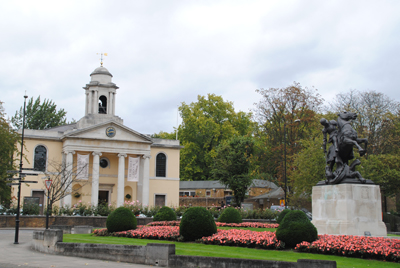
Landmarks include St John’s Church (pictured above, this was consecrated in 1814) and the St John’s Wood Barracks and a Riding School (this was completed in 1825 and is the oldest building still on the site) which is now home to the King’s Troop Royal Horse Artillery which carries out mounted ceremonial artillery duties such as firing royal salutes for the State Opening of Parliament, royal birthdays and state visits.

St John’s Wood is also home to Abbey Road Studios (home of the Beatles and that famous zebra crossing), Lord’s Cricket Ground (officially the home of the Marylebone Cricket Club which was moved here in 1814, the same year the church was consecrated) and the Central London Mosque located on the edge of Regent’s Park.

For more on St John’s Wood, take a look at the website of The St John’s Wood Society.

Around London – Your Roman influences; celebrating the City; and, of Journeys and kinship…

• The Museum of London is calling on Londoners to submit images showing “Roman influences in London today” as part of its forthcoming Our Londinium 2012 exhibition, a revamping of the museum’s Roman gallery. In what is the largest update made to the museum’s Roman gallery since it opened in 1994, the  reworked gallery looks at parallels between Roman London and the city today and features important Roman artifacts such as a bust of the Emperor Hadrian found on the Thames foreshore (part of the British Museum’s collection, this will be displayed for six months before being replaced by a replica) alongside modern objects such as the V for Vendetta masks worn by protestors in the Occupy movement. The exhibition is being co-curated by young people from Junction, the Museum of London’s youth panel, and they’re calling on people to submit their images showing how the city’s Roman past still resonates even today (see example pictured). For details on how to submit images via email of Flickr, head to www.museumoflondon.org.uk/ol2012map.

Secrets will be revealed, we’re promised, as part of the City of London’s Celebrate the City: four days in the Square Mile event to be held from 21st to 24th June. Events held in the City our the four days, many of which will be free, include a musical extravaganza to launch the event in Guildhall Yard as well as exhibitions, walks and talks, a chance to explore buildings like Livery Company Halls, the Bank of England and the Mansion House, family entertainment at the Cheapside Fayre and music and activities at sites across the Square Mile including the Barbican Centre, Museum of London and churches. We’ll have more to come on this. For now, head to www.visitthecity.co.uk/culture2012 for more information.

• Architectural historian and former director of the Sir John Soane Museum, Sir John Summerson, has been honored with an English Heritage blue plaque at his former home  London’s north-west. Sir John (1904-1992) lived at the property at 1 Eton Villas in Chalk Farm for more than 40 years. He was the director of the Sir John Soane Museum from 1945 to 1984. For more, see www.english-heritage.org.uk/discover/blue-plaques/.

• Architecture students are being invited to submit designs for a new stone seating area on the City thoroughfare of Cheapside. The winning student will work with trainee masons from the Cathedral Works Organisation and The Mason’s Company with the new seating area unveiled in October. For an application pack and full brief, see For an application pack and full brief, please contact Melanie Charalambous, Department of the Built Environment, City of London Corporation, PO Box 270, Guildhall, London, EC2P 2EJ or call 020 7332 3155 or email stonebench@cityoflondon.gov.uk.

• Now On: Journeys and kinship. This display at the Museum of London Docklands showcases the creative output of a community collaboration project which involved a group of young Londoners working with visual artist Jean Joseph, Caribbean Calypso musician Alexander D Great and Yvonne Wilson from training organisation Equi-Vision. The centrepiece of the exhibition – which explores themes highlighted in the museum’s permanent gallery, London, Sugar and Slavery, on the city’s involvement in the trans-Atlantic slave trade  – is an artwork by Joseph entitled Sales Over Centuries, 2010, which features plaster face casts of 42 people from the African diaspora who were born in or currently live in London. In response to it, the young Londoners have created their own works including face casts, music, film and photography. Runs until 4th November. Entry is free. For more, see www.museumoflondon.org.uk/Docklands/.

Around London – Cutty Sark to reopen next month; Bed of Ware leaves V&A; and, Quentin Blake at the Foundling Museum…

• London landmark, the 19th century tea clipper Cutty Sark, will reopen to the public on 26th April following a five year, £50 million conservation project. Visitors to the ship will now be able to explore the vessel as well as, for the first time, walk under the ship after it was raised three metres above the dry dock. A glass canopy has been designed to protect the base of the ship’s hull. The Cutty Sark was built in 1869 by ship-builders Scott & Linton at Dumbarton, Scotland, and, one of the last tea clippers built, was designed to move very fast through the water. After the tea trade was taken over by steamers, the Cutty Sark was used to carry more general trade including wool from Australia. Later sold to a Portuguese company and renamed Ferriera, in 1922 Captain Dowman of Falmouth bought the ship and used her in the floating nautical school. Following his death, the clipper was donated to the Thames Nautical Training School at Greenhithe. After the formation of the Cutty Sark Preservation Society in the early 1950s, the ship was moved to Greenwich and permanently installed in a stone dry-dock where the clipper’s appearance restored to that of an active sailing vessel. In November 2006, the ship rig was dismantled in preparation for a full restoration project – this received a set back the following 21st May a fire broke out aboard the ship. But with the restoration now complete, the ship will once again accommodate visitors wishing to explore its 140 year history. For more on the Cutty Sark, see www.cuttysark.org.uk. PICTURE: © Cutty Sark London

• A treasure of the V&A Museum, the 16th century Great Bed of Ware, is being loaned to the Ware Museum, located not surprisingly in the Hertfordshire town of Ware, for a year from early next month. Believed to date from around 1590 and to have been made in Ware, the bed is believed to have been created as a tourist attraction for people traveling the pilgrim route between London and Walsingham or Cambridge University. More than three metres wide, it was said to be able to sleep 12 people and was such an attraction that people apparently stopped in Ware for the night just to sleep in the bed.  It’s even mentioned in Shakespeare’s Twelfth Night – the author has Sir Toby Belch describe a piece of paper as “big enough for the Bed of Ware”. The bed was acquired by the V&A in 1931 and hasn’t left the museum since. For more, see www.vam.ac.uk.

• Now On: Quentin Blake – As large as life. This exhibition at the Foundling Museum in Bloomsbury features more than 60 works by artist Quentin Blake, best known for his illustrations of Roald Dahl’s books and Britain’s first Children’s Laureate. The works – which are recent commissions by UK and French hospitals – are contained in four series of pictures which are displayed throughout the museum. They include Our Friends in the Circus – a 2009 series featuring circus performers, Ordinary Life – a 2o10 series celebrating the “pleasures of everyday life”, the 2007 work Planet Zog – a 2007 series in which aliens and young people swap doctor and patient roles, and Mothers and Babies Underwater – a 2011 series created for a French maternity ward. Admission charge applies. The event draws on the long history of artists’ aiding the work of hospitals and child welfare organisations – including William Hogarth who donated paintings to the Foundling Museum. Runs until 15th April. For more information, see www.foundlingmuseum.org.uk.

Treasures of London – The Battersea Shield…

Found in the River Thames near Battersea, the Battersea Shield dates from the Iron Age and is believed to have been created for ceremonial or display purposes (which could be read as showing off), rather than for use in warfare.

Made of a thin layer of highly polished bronze featuring 27 studs into which were placed pieces of red enamel (opaque red glass), the bronze sheets would have originally been placed over a wooden shield. It was clearly designed with spectacle in mind and would have been quickly destroyed in any serious battle. The circular patterns housing the red enamel are designed in what is called the ‘La Tène style’, named for an Iron Age site in Switzerland.

The Celtic shield, which the British Museum dates between 350 to 50 BC, is believed to have been deliberately thrown or placed in the Thames, perhaps as a votive offering, and lay there undisturbed until 1857 when it was dredged up off the river bed near Battersea Bridge during bridge construction.

For a more detailed look at the Battersea Shield, see I.M. Stead’s The Battersea Shield. Unfortunately we were unable to secure permission to run an image of the shield so to see an image of the shield, click here.

WHERE: Room 50, British Museum, Great Russell Street (nearest Tube Stations are Russell Square, Tottenham Court Road, Holborn and Goodge Street). WHEN: 10am to 5.30pm daily (Fridays until 8.30pm)COST: Free; WEBSITE: www.britishmuseum.org.

Queen unveils final Jubilee Greenway plaque; a Barbican weekend; and, the Transit of Venus at Greenwich…

Queen Elizabeth II this week unveiled the final plaque marking the end of the 37 mile/60 kilometre Jubilee Greenway in front of Buckingham Palace. The circular Greenway – marked by 542 glass plaques – has been created to celebrate the Queen’s Diamond Jubilee. It can be walked or cycled and takes in key sites around London, including Kensington Palace, Regent’s Park, the Thames Barrier and Olympic sites including Greenwich Park (equestrian events), the O2 Arena (hosting gymnastics, trampoline and basketball events) as well as the main stadium at Olympic Park. The Greenway is divided into 10 sections and you can download either the entire walk or brochures for one of the sections only here.

This weekend sees the Barbican Centre play host to the event known as ‘Barbican Weekender’ – two days of free art, dance, music, theatre and film at the Barbican Foyers. Part of London 2012 Festival, the event’s ‘Freestage’ programme features Roxxxan,Dizralie and the Small Gods, young drummers from East London and performance poetry by the Barbican Young Poets. There’s also street dance classes with Boy Blue Entertainment, the chance to make an Opera in a Day with the Hip Hop Shakespeare Company, a Digital Graffiti wall, street food stalls, the Wah Nails Pop-Up boutique and free running by Streets United. For more, see www.barbican.org.uk/weekender.

• On Now – Measuring the Universefrom the Transit of Venus to the edge of the cosmos. Marking the 2012 transit of Venus, this exhibition at the Greenwich Observatory follows the story of man’s ongoing quest to understand the vastness of space, looking at the people and technologies involved in seeing farther than ever before – from the Astronomer Royal, Edmond Halley, to Captain James Cook and Edwin Hubble and through to the possibilities offered by the Cosmic Microwave Background Explorer. It’s accompanied by a series of talks, observing events – including this month’s Daytime Sky Watch sessions – and a planetarium show. Runs until 2nd September. Admission is free. For more information, see www.rmg.co.uk.

Around London – Butler’s Retreat reopens in Epping Forest; Designs of the Year; and, Lucian Freud’s last work…

• Epping Forest’s historic Butler’s Retreat has reopened its doors as a cafe following a refurbishment project to restore the building to its former glory. The building was constructed in the 19th century and is one of the last remaining Victorian-era ‘retreats’ within the forest. Named for its 1891 occupier, John Butler, it was one of a number of retreats built to serve refreshments as part of the Temperance movement – said to have been “extremely popular” with visitors from the East End. The building, which now forms part of the Epping Forest visitor hub, is expected to host a range of events this summer and will have its opening hours extended with the slated opening of a restaurant upstairs in the evenings. Owned by the City of London, Epping Forest is the largest public open space in the London area, stretching across 12 miles from Manor Park in East London to a spot past Epping in Essex. The cafe, the refurbishment of which was carried out with funding provided via the Heritage Lottery’s Branching Out project, will be open from 9am to 5pm weekdays and 8am to 5pm weekends. For more on the cafe, see www.worldslarder.co.uk. For more on Epping Forest, see www.cityoflondon.gov.uk/eppingforest

• On Now – Designs of the Year Exhibition: The London Olympic Torch and the Duchess of Cambridge’s wedding dress are among 90 objects nominated as one of the “best designs in the world” in this year’s Design of the Year competition. The objects, which go on display at the Design Museum today, have been entered in seven categories – architecture, digital, fashion, furniture, graphics, product and transport – with winners to be announced on 24th April. Among the other objects nominated are a wind-propelled landmine detector, a pop-up cinema in Hackney, the London 2012 velodrome and the first Tesco virtual store. An admission charge applies for the exhibition which runs until 15th July.  For more information, see designsoftheyear.com.

On Now – Lucian Freud Portraits. The last work of the late artist Lucian Freud is on show for the first time in this exhibition at the National Portrait Gallery. The unfinished painting, Portrait of the Hound 2011, which depicts Freud’s assistant assistant David Dawson and his dog Eli, is a highlight of the exhibition which also includes works dating back as far as the 1940s. The 130 paintings and works on paper – which feature sitters including artists Francis Bacon and David Hockney along with the likes of Andrew Parker Bowles and Baron Rothschild – have been loaned from museums and private collections around the world. Runs until 27th May, 2012. Admission charge applies. See www.npg.org.uk.

Around London – ‘Cathedral of Middlesex’ to be opened in west London; Roman brothel token on display; wifi in Westminster and Kensington; and, looking at the Hajj at the British Museum…

• A medieval barn in west London, said to be the “Cathedral of Middlesex”, will open to the public in April. The Grade I listed Harmondsworth Barn was built in 1426 by Winchester College, who owned a manor farm at Harmondsworth, and was used to store grain. Nearly 60 metres long, the roof is held up by 13 massive oak trusses. In 2006, the barn was bought by an off-shore company who subsequently agreed to sell it to English Heritage following the issuing of a notice for emergency repairs. English Heritage say the barn, called the “Cathedral of Middlesex” by the late poet-laureate Sir John Betjeman, will now be “run by and for the local community”. “Harmondsworth Barn is one of the greatest medieval buildings in Britain, built by the same skilled carpenters who worked on our magnificent medieval cathedrals,” says Simon Thurley, chief executive of English Heritage. “Its rescue is at the heart of what English Heritage does – protecting this nation’s architectural treasures and helping people discover our national story through them. We will complete the repair of this masterpiece and working with local people, will open it to the public to enjoy.” For more, see www.english-heritage.org.uk. (Image: Copyright English Heritage; Photographer Boris Baggs).

The oldest Roman brothel token to have been discovered in London has gone on temporary display at the Museum of London. The token, which may be the oldest of its kind to have been found in Britain (or, indeed, even the only one of its kind ever found in Britain), was known as a spintria and depicts two reclining human figures on one side and the Roman numeral 14 on the other. It was found on the Thames foreshore near Putney Bridge by a mudlarker using a metal detector. Only the size of a 10 cent piece, its use remains something of a mystery – it may have been exchanged for sexual services or used as gaming piece. The token is on display at the museum until April. For more, see www.museumoflondon.org.uk.

Free wifi is being rolled out across Westminster, Kensington and Chelsea as part of deal between Westminster City Council, the Royal Borough of Kensington and Chelsea and network operator, O2. The network, installation of which began last month, is initially being rolled out in a limited number of areas but will eventually cover all of the boroughs and create the largest free wireless hub in Europe.

Now On: Hajj: journey to the heart of Islam. This exhibition at the British Museum is the first to focus on the pilgrimage to Mecca in Saudi Arabia – a central tenet of the Islamic faith. Organised in partnership with the King Abdulaziz Public Library in Riyadh, it’s based around three central themes: the pilgrim’s journey to Mecca with an emphasis on the major routes taken; the Hajj today and its associated rituals; and the origins and importance of the Hajj to Mecca. Objects featured in the exhibition include a seetanah which covers the door of the Ka’ba as well as gifts offered to the sanctuary and souvenirs taken back home. It’s the first of three exhibitions at the British Museum focused on spiritual journeys. Runs until 15th April. Admission charge applies. For more, see www.britishmuseum.org.

Exploring London’s 10 most popular posts for 2011 – Numbers 2 and 1…

And so we come to it – the most popular posts on Exploring London this year – one of which is perhaps surprising, the other of which not!

2. Treasures of London – The Cheapside Hoard: A look at the “greatest find of Jacobean and Elizabethan jewellery ever made”, much of which is now held at the Museum of London;

1. The Royal Wedding – Eight curious facts about Royal Weddings past and present: Perhaps not a surprising winner, given the worldwide interest in 2011’s Royal Wedding, this post looked at some of the stranger facts surrounding royal weddings in Britain in the relatively recent past.

And that brings our countdown to an end. Our usual coverage resumes next week…

Exploring London’s 10 most popular posts for 2011 – Numbers 10 and 9…

As we approach the end of the year, we’re taking a look back at our 10 most popular posts for 2011. We start the countdown with numbers 10 and 9…

10. LondonLife – The Royal Menageriein which, inspired by what was a new exhibition at the Tower of London, we take at the Royal Menagerie kept there by England’s monarchs for more than 600 years;

9. Treasures of London – Admiral Lord Nelson’s coat: part of a series looking at some of the many, many ‘treasures’ of London, this piece focused on the coat which Admiral Lord Nelson when he was fatally shot aboard the HMS Victory during the Battle of Trafalgar and which can now be seen at the National Maritime Museum in Greenwich (complete with bullet hole).

Stay tuned by numbers 8 and 7 tomorrow. We love to hear from you if there was a particular post that was your favorite. Leave your comment below…

Around London – Lloyd’s gets Grade I; 700,000 historic items online in NT database; and, introducing the Silverdale Hoard…

London’s iconic Lloyd’s Building (also known as the ‘inside out’ building thanks to a design in which utility pipes, lifts and stairways are exposed on the outside) has been listed as a Grade I building, becoming the youngest building to be granted such status. John Penrose, Minister for Tourism and Heritage, made the decision following advice from English Heritage. Roger Bowdler, English Heritage’s designation director, said he was “delighted” at the decision. “Its listing at the highest grade is fitting recognition of the sheer splendour of Richard Rogers’s heroic design. Its dramatic scale and visual dazzle, housing a hyper-efficient commercial complex, is universally recognised as one of the key buildings of the modern epoch.” The futuristic-looking building is one of very few post war buildings to be protected with a Grade I listing. Construction of the tower started in 1981 and was largely completed by May 1984. It was occupied two years later. As well as its futuristic exterior, the building also features a nod to the past with the Adam Room, which dates from the 1760s and was moved here intact from which was moved from Bowood House in Wiltshire. The building is also home to the Lutine Bell, which comes from a French frigate captured by the British in 1793, and was rung to herald important announcements (today these are generally only ceremonial). The history of Lloyd’s goes back to 1688 when it’s believed the first Lloyd’s Coffee House opened in Tower Street.

• More than 700,000 objects in the care of the National Trust can be accessed virtually via a new online database. The database, accessed via www.nationaltrustcollections.org.uk contains details of more than 700,000 objects – everything from artworks by Gainsborough to a laudanum bottle containing remnants of poison and the cotton underwear of a grocer – currently housed at more than 200 properties as well as in storage or on loan to other organisations. Highlights include a costume made from beetle wings for the actress Ellen Terry, an early anti-aging ‘machine’, a furnished Victorian dolls house from Uppark House in West Sussex, and a Bible reputed to have been used at the execution of King Charles I from Chastleton House in Gloucestershire. The database has been in development for 15 years and the work to develop it will continue.

A 1,100-year-old collection of Viking Age objects including silver arm-rings and brooch fragments and coins from the Silverdale Hoard – found in Silverdale, Lancashire, in September – has gone on display in room 2 of the British Museum until early in the New Year. Among the 200 objects in the hoard is a type of coin not seen before and bears the inscription Airdeconut which appears to be an early attempt to represent the name Harthacnut. Lancaster City Museum has reportedly expressed an interest in acquiring the hoard. For more, see www.britishmuseum.org.

Around London – Dickens at the Museum of London; looking at Leicester Square’s past; Mr Chinnery’s art; and, Wellcome’s Miracles & Charms…

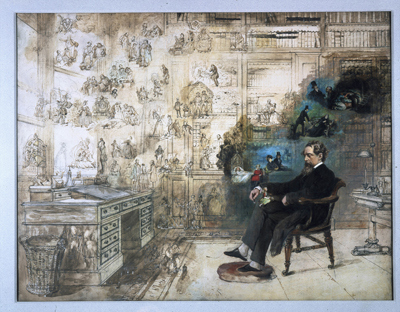
• Dickens fever is well and truly upon us in the lead-up to the bicentenary of his birth in February and tomorrow the Museum of London opens its own unmissable exhibition, Dickens and London. Displays centre on the relationship between Dickens and the city and visitors will be able to follow in the great novelist’s footsteps as they visit some of the places which sparked his imagination as well as confront some of the great social issues of the 19th century – including childhood mortality, prostitution and poverty – and be taking on a tour of some of the age’s greatest innovations – everything from railways and steamboats to the Penny Post. Among the objects on display will be Dickens’ writing desk and chair, his bank ledger, excavated items from Jacob’s Island, a notorious slum which was located near Bermondsey, and manuscript pages describing an East End opium den which was featured in Dicken’s unfinished novel, The Mystery of Edwin Drood (this, along with William Powell Frith’s celebrated portrait of the author, are being lent by the Victoria and Albert Museum). The exhibition also features a specially commissioned film looking at London after dark in Dickens’ time and today. Costumes from the upcoming BBC One drama series, Great Expectations, will also be on display and there is also a specially commissioned window display by acclaimed creative director and set designer Simon Costin showing a wintery London in the mid-19th century. The museum is also offering a new iPhone and iPad graphic novel app, Dickens: Dark London, which will take users on a “journey through the darker side” of Dickens’ London. Opens on 9th December (tomorrow) and runs until 10th June, 2012. Admission charges apply. For more, see www.museumoflondon.org.uk. For more on Dickens, see www.dickens2012.org. PICTURE: Dickens Dream by Robert William Buss (Courtesy Museum of London).

New hoardings have gone up at Leicester Square celebrating the area’s history as work continues on an £18 million plan by Westminster City Council to revitalise the Leicester Square streetscape. The more than 160 square metres of hoardings feature 11 images spanning a period of 250 years (and selected from thousands of archive images of the square). Meanwhile in Trafalgar Square, the famous Norwegian Christmas Tree was lit in a ceremony last Thursday. The tree is an annual gift from the people of Oslo as thanks for British support during Norway’s years of occupation in World War II. It will be lit from noon until midnight every day until 6th January.

And, briefly…..London’s Kew Gardens has been voted the top visitor attraction in Britain at the British Airways magazine travel award while the London Eye and Tate Modern came runner’s up…..Figures released to mark the 10th anniversary of free admission to England’s national museums show that visitor numbers to the museums have more than doubled over the past decade…..and, the first woman Tube driver, Hannah Dadds, reportedly died at the age of 70.

On Now: The Flamboyant Mr. Chinnery: An English artist in India and China. This exhibition at Asia House in New Cavendish Street in the West End, focuses on the work of 19th century artist George Chinnery and features landscapes and portraits he painted while in China and India. Runs until 21st January. Admission is free. For more, see www.asiahouse.org.

• On Now: Miracles & Charms. The Wellcome Collection is hosting this exhibition which features two shows – Infinitas Gracias: Mexican miracle paintings, the first major exhibition of Mexican votive paintings outside of Mexico, and Charmed life: The solace of objects, an exhibition of unseen London amulets from Henry Wellcome’s collection. Runs until 26th February, 2012. For more, see www.wellcomecollection.org.