A new stained glass window depicting bright country scenes was unveiled in Westminster Abbey last week in honour of Queen Elizabeth II. The Queen’s Window, located in the south transept overlooking Poet’s Corner, is the work of world-renowned artist David Hockney and was commissioned by the Dean and Chapter of Westminster to celebrate her reign. The work is Hockney’s first in stained glass and features a Yorkshire scene with hawthorn blossom which uses his distinct colour palette of yellow, red, blue, pink, orange and greens. “The subject reflects The Queen as a countrywoman and her widespread delight in, and yearning for, the countryside,” the abbey said in a statement. The window was created by York-based stained glass artists Barley Studio to Hockney’s designs. Other artists who have completed stained glass works in the abbey include Sir Ninian Comper, Hugh Easton and John Piper with the last stained glass windows, by Hughie O’Donoghue, installed in the Lady Chapel in 2013. PICTURE: Alan Williams/Westminster Abbey
News
This Week in London – Oceanic art and British watercolours at the RA; a celebration of immigrant nurses from Barbados; and NYE tickets on sale…
• The first ever major survey of Oceanic art to be held in the UK opens at the Royal Academy in Piccadilly on Saturday. The exhibition – Oceania – brings together around 200 works created in Melanesia, Micronesia and Polynesia and includes pieces from public and private collections spanning a period of more than 500 years. It’s being held to mark the 250th anniversary of the RA which was founded in 1768, the same year Captain James Cook set sail on the Endeavour on his first expedition to the Pacific. Highlights of the display, which is organised around three major themes – ‘Voyaging’, ‘Place-making’ and ‘Encounter’, include a 14th century wooden Kaitata carving, excavated in 1920, which is one of the oldest known objects to have been found in New Zealand as well as two Maori hoe (canoe paddles) collected during Cook’s first voyage, and a 19th century feather god image from the Hawaiian Islands likely to be have been collected on Cook’s third voyage. There’s also an 18th century mourning costume known as a Heva tupapau which was obtained in Tahiti in 1791, a rare Fijian late 18th or 19th century double-headed whale ivory hook, and Maori sculptor Tene Waitere’s Ta Moko panel (1896-99 – pictured) depicting male and female tattoos as well as a 19th century Nguzunguzu (prow ornament for a war canoe) featuring a pigeon and a never-before-exhibited ceremonial feast bowl measuring almost seven metres in length, both from the Solomon Islands. Runs in the Main Galleries until 10th December. Admission charge applies. For more, see www.royalacademy.org.uk. PICTURE: Tene Waitere, Ta Moko panel, 1896-99. Te Papa (ME004211) © Image courtesy of The Museum of New Zealand Te Papa Tongarewa.
• Meanwhile, in another exhibition at the Royal Academy, 25 British watercolours and drawings – including works from BNY Mellon’s corporate art collection – have gone on show in the Tennant Gallery. British Watercolours: From the Collection of BNY Mellon features the work of prominent Royal Academicians including Thomas Gainsborough, JMW Turner, John Constable and Sir David Wilkie. Highlights include an 1833 view of Hampstead Heath by Constable, Italian landscapes painted in the 1770s by Thomas Jones and John Robert Cozens, John Frederick Lewis’ unfinished Study of a Bedouin Arab (1840s) and an expressive depiction of Venice by John Ruskin in 1876. The British drawings and watercolours in the BNY Mellon collection were largely acquired in the 1980s. The exhibition is being held as part of the Royal Academy’s 250th anniversary. Admission is free. For more, see www.royalacademy.org.uk.
• A free exhibition focusing on one of pioneering groups of people migrating to Britain – the Bajan nurses from Barbados, is opening in Guildhall Yard on Friday as part of Black History Month. Celebrating 70 years of the NHS, the display reveals individual stories of achievements, struggles and leadership with the focus moving from world famous figures to the unsung midwives who helped deliver Britain’s post-war baby boom. The British-Barbadian Nursing Revolution can be seen anytime until 31st October. There’s a series of talks accompanying the display. For more, head to the City of London website.
• New Year’s Eve is coming up fast – yes, it’s that time already! – and the first tickets for the world famous London event go on sale at midday on Friday. Tickets for the event, which features more than 12,000 fireworks, are still priced at £10 (a further batch will be sold in late November). Those without a ticket will not be able to enter the viewing area in central London (although it will, of course, be broadcast on TV). There are a maximum of four tickets per transaction. Head to www.london.gov.uk/nye.
Send all items for inclusion to exploringlondon@gmail.com.
This Week in London – It’s Open House weekend; World War I remembered; and, science and the Romanovs…

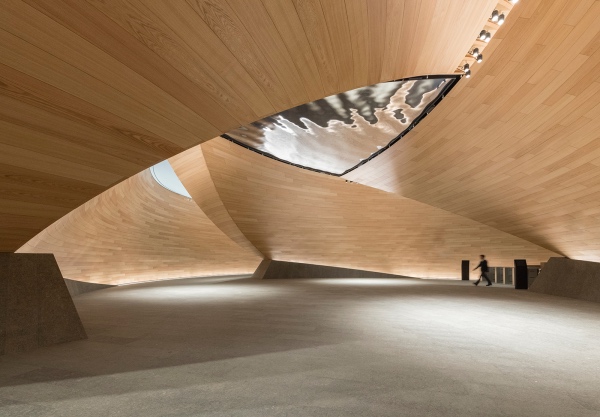
• More than 800 buildings of all kinds open their doors to the public this weekend as part of the 26th Open House London. Highlights of this year’s event include new entries such as the US Embassy, the Royal Opera House and Bloomberg’s new HQ as well as returning favourites such as the BT Tower, The Shard and 10 Downing Street. There’s also a programme of activities “lifting the lid” of Old Oak and Park Royal – the heart of ‘making’ in London, explorations of new London districts such as Wembley Park, Hackney Wick and Barking Riverside, the chance to view RIBA Award-winners including the Belvue School Woodland Classrooms, Hackney Town Hall and No.1 New Oxford Street, the new COS HQ, and 100 “must-see” homes. The full programme of events – which also highlights the contribution women have made in shaping today’s London – can be found at www.openhouselondon.org.uk and there’s a free app to download. PICTURED: Top – Bloomberg European Headquarters (Nigel Young/Foster + Partners) and right – Valetta House (French & Tye) are among properties open to the public.
• A multi-screen art installation remembering the millions of African men and women who served in World War I and an immersive sound installation featuring personal reflections on the Armistice are among four exhibitions opening at the Imperial War Museum in Lambeth on Friday. Projected onto three screens, African Soldier combines a powerful sound score, historic footage and newly created film which has been shot by artist John Akomfrah in various locations around the world to speak to the African experience of World War I while the sound installation, I Was There: Room of Voices, features 32 people who fought and lived through war sharing their personal stories of the Armistice. The exhibitions also include Renewal: Life after the First World War in Photographs – a display of more than 100 black and white photographs showing how lives, landscapes and national identities recovered, evolved and flourished after the war – and Moments of Silence, an immersive installation commissioned from 59 Productions. The exhibitions, which can be seen until 31st March, are part of the IWM’s Making A New World, “a season of art, photography, film, live music, dance and conversations exploring how the First World War has shaped today’s society”. For more see www.iwm.org.uk.
• The role of science in the lives – and deaths – of the last Russian Tsar, Nicholas II, and his family is explored in a new exhibition opening at the Science Museum in South Kensington which marks 100 years since the end of the Romanov dynasty. The Last Tsar: Blood and Revolution explores the influence of medicine on the Imperial Family – everything from how they treated conditions such as the heir Alexei’s haemophilia through to the Tsarina’s fertility and the Red Cross medical training the Tsar’s daughters received – as well as recent advances in medicine and forensic science which have been deployed to transform the investigation into their disappearance. Objects on show include personal diaries, an Imperial Fabergé Egg presented to the Tsar by his wife a year before the fall of the Imperial house and photograph albums created by an English tutor to the Imperial Family. There’s also evidence from the scene of the family’s execution including the dentures of the Imperial physician, a diamond earring belonging to the Tsarina and an icon peppered with bullet holes. Opening on Friday, the exhibition runs until 24th March. For more, see www.sciencemuseum.org.uk/thelasttsar.
Send all items for inclusion to exploringlondon@gmail.com.
LondonLife – Steuart Padwick’s ‘Head Above Water’…
A massive wooden head has temporarily been added to London’s skyline this week as part of the month long celebration of London’s river, Totally Thames. The nine metre high sculpture ‘Head Above Water’, which stands on Queen’s Stone Jetty (also known as Gabriel’s Pier) near Gabriel’s Wharf on South Bank, has been made from cross-laminated timber sourced from sustainable forests. Deliberately gender, ethnicity and age neutral, it is the work of designer/sculptor Steuart Padwick and looks across the Thames at the City of London and St Paul’s Cathedral, standing “as a symbol of hope, bravery, compassion, positivity and change, for those who have come through or are still confronting mental health issues, and the people who support them”. The sculpture has been installed in support of the mental health campaign ‘Time to Change’ and at night is being lit with visitors able to interact with its changing colours to reflect their mood (for instructions on how to get involved, head to www.steuartpadwick.co.uk/head-above-water/.) The head can only be seen until 23rd September.
PICTURE: The head being installed (David Holt/licensed under CC BY 2.0)
This Week in London – Courtauld’s Impressionists visit the National Gallery; the British Library’s ‘Season of Sound’; and, Renzo Piano at the Royal Academy…
• For the first time in 70 years, key Impressionist and Post-Impressionist works from the Courtauld Gallery are going on display at The National Gallery. The 26 works, which include pieces by Daumier, Manet, Renoir, Cézanne, Seurat and Bonnard, were all purchased by Samuel Courtauld in the 1920s and are being displayed alongside paintings from the National Gallery’s own collection which he helped acquire. The works are being loaned as the Courtauld Gallery closes this month for a major transformation project, dubbed Courtauld Connect. The exhibition, Courtauld Impressionists: From Manet to Cézanne, traces the development of modern French painting from the 1860s to the turn of the 20th century and reveals the vision, taste and motivation of Courtauld as he acquired the pieces. Highlights from the Courtauld Gallery’s collection include Renoir’s La Loge (Theatre Box) (1874), Cézanne’s The Card Players (about 1892–6) and Lac d’Annecy (1896 – pictured), Toulouse-Lautrec’s Jane Avril in the Entrance to the Moulin Rouge (about 1892), Manet’s A Bar at the Folies-Bergère (1882), and Seurat’s Young Woman Powdering Herself (about 1888–90). Among the works from The National Gallery’s collection being displayed alongside them are Renoir’s At the Theatre (La Première Sortie) (1876–7); as well as Seurat’s Bathers at Asnières (1884), Cézanne’s Self Portrait (about 1880–1) and Van Gogh’s A WheatKeld with Cypresses (1889) – the first paintings by the latter three artists to enter a British public collection. The display can be seen in The Wohl Galleries from next Monday until 20th January. Admission charge applies. For more, see www.nationalgallery.org.uk. PICTURE: © The Samuel Courtauld Trust, The Courtauld Gallery, London.
• The British Library’s second ‘Season of Sound’ kicks off this month with a series of events celebrating the library’s vast Sound Archive. Among highlights are the pop group Saint Etienne’s only UK performance this year, a live orchestra celebration of ‘library music’ by KPM All Stars and a silent disco. The programme of events at the King’s Cross venue kicks off next Monday. Admission charges apply. For the full programme, see www.bl.uk/events/season-of-sound.
• The work of internationally-renowned architect and honorary Royal Academician, Renzo Piano, goes on show at the Royal Academy in Piccadilly from Saturday. Renzo Piano: The Art of Making Buildings is the first comprehensive survey of Piano’s career to be held in London since 1989 and presents 16 of his most important projects. They include the Centre Pompidou in Paris (1971), the Jean-Marie Tjibaou Cultural Centre in Nouméa (1998), The New York Times Building in New York City (2007), The Shard in London (2012), the Jérôme Seydoux Pathé Foundation in Paris (2014) and the Whitney Museum of American Art in New York City (2015). Among events being held to mark the RA’s 250th anniversary, the display in the Gabrielle Jungles-Winkler Galleries can be seen until 20th January. Admission charge applies. For more, see www.royalacademy.org.uk.
Send all items for inclusion to exploringlondon@gmail.com.
LondonLife – A different perspective on the British Museum…
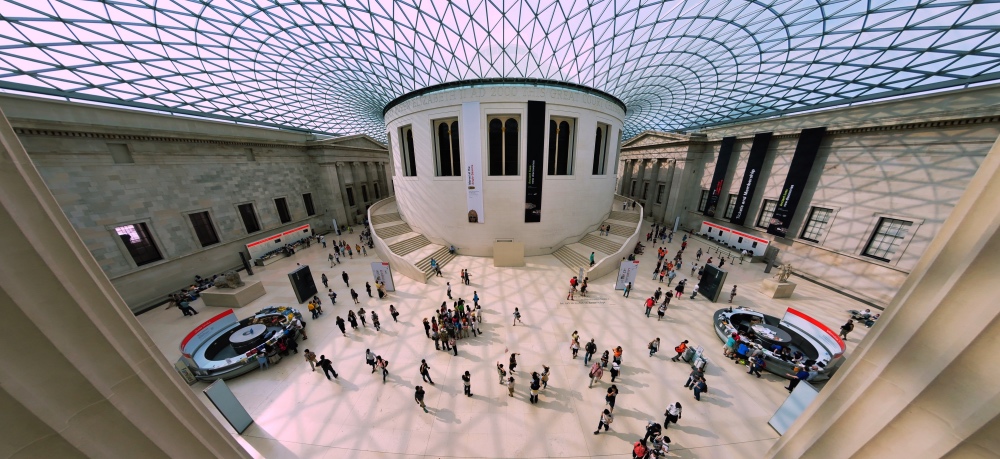
Looking across the Queen Elizabeth II Great Court of the British Museum, off Great Russell Street in Bloomsbury. Designed by Foster and Partners, the two acre court opened in 2000 and was at the time the largest covered public square in Europe. It’s glass and steel roof features more than 3,300 panes of glass, no two of which are the same. The court features a Reading Room at its centre.
PICTURE: Viktor Forgacs/Unsplash
This Week in London – Video games explored; NHM celebrates ‘James and the Giant Peach’; and Thames Mudlarks’ finds on show…
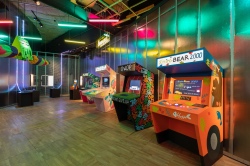
• Video games – their design and use both in terms of gaming but also in pushing boundaries – are the subject of a new exhibition opening at the V&A this Saturday. Videogames: Design/Play/Disrupt will provide rare glimpses into the creative process behind games like The Last of Us, Journey and Kentucky Route Zero through original prototypes, early character designs and notebooks as well as cultural inspirational material ranging from a Magritte painting to a viral cat video. The display also features large scale, interactive and immersive multimedia installations featuring games like Minecraft and League of Legends, and explore how major technological advancements have transformed the way games are designed, discussed and played. Runs in Room 39 and North Court until 24th February. Admission charge applies. For more, see vam.ac.uk/videogames. PICTURE: V&A.
• The Natural History Museum is celebrating Roald Dahl Day (13th September) with a James and the Giant Peach weekend. The South Kensington museum will this weekend offer a range of James and the Giant Peach-inspired family-friendly events and activities including the chance to see insects up close in the Darwin Centre and the Wildlife Garden as well as specimens in the Attenborough Studio. There’s also the chance to take in a ‘Whizzbanging Words’ session with a team from the Roald Dahl Museum and Story Centre, and music from the three-piece band, Roald Dahl’s Giant Bugs. Runs from 11am to 4.50pm on Saturday and Sunday. Admission is free (but some events are ticketed – check website for details). For more, see www.nhm.ac.uk/events/james-and-the-giant-weekend.html
• An exhibition revealing some of the historical artefacts found by some of London’s most prolific Mudlarks along the banks of the River Thames opens on Tuesday as part of Totally Thames. Hannah Smiles has been taking the pictures over the past year and they capture everything from Tudor-era pins to World War II shells, medieval pottery, human teeth and even messages in bottles. The photographs and artefacts themselves both form part of the display. A series of talks by Mudlarks accompanies the free display. It can be viewed at the Art Hub Studios, 5-9 Creekside, in Deptford until 16th September. For more information, head to www.totallythames.org.
Send all items for inclusion to exploringlondon@gmail.com.
LondonLife – The race for Doggett’s Coat and Badge…
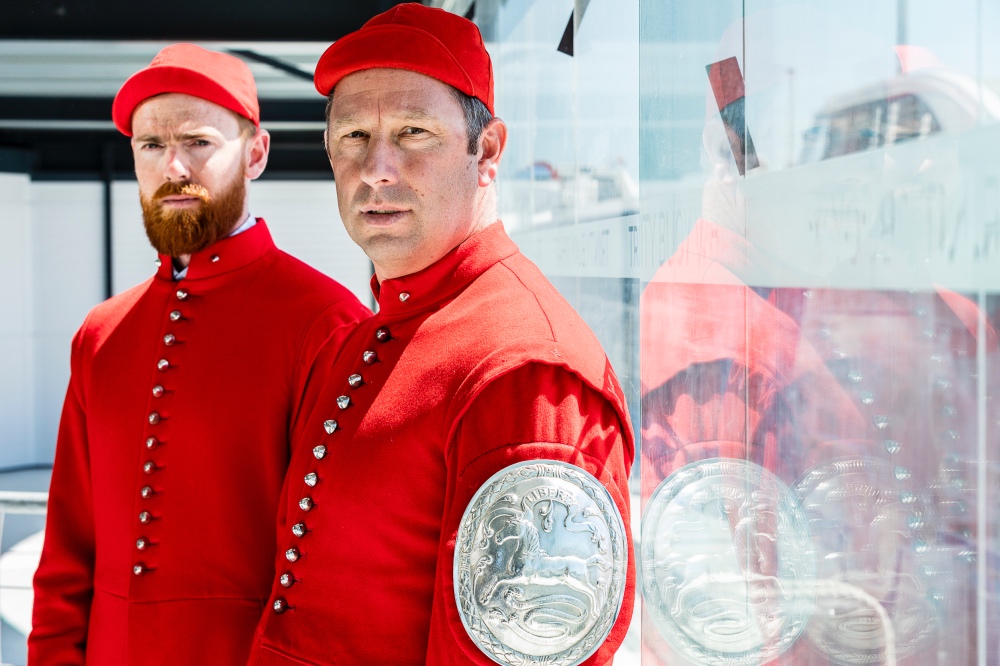
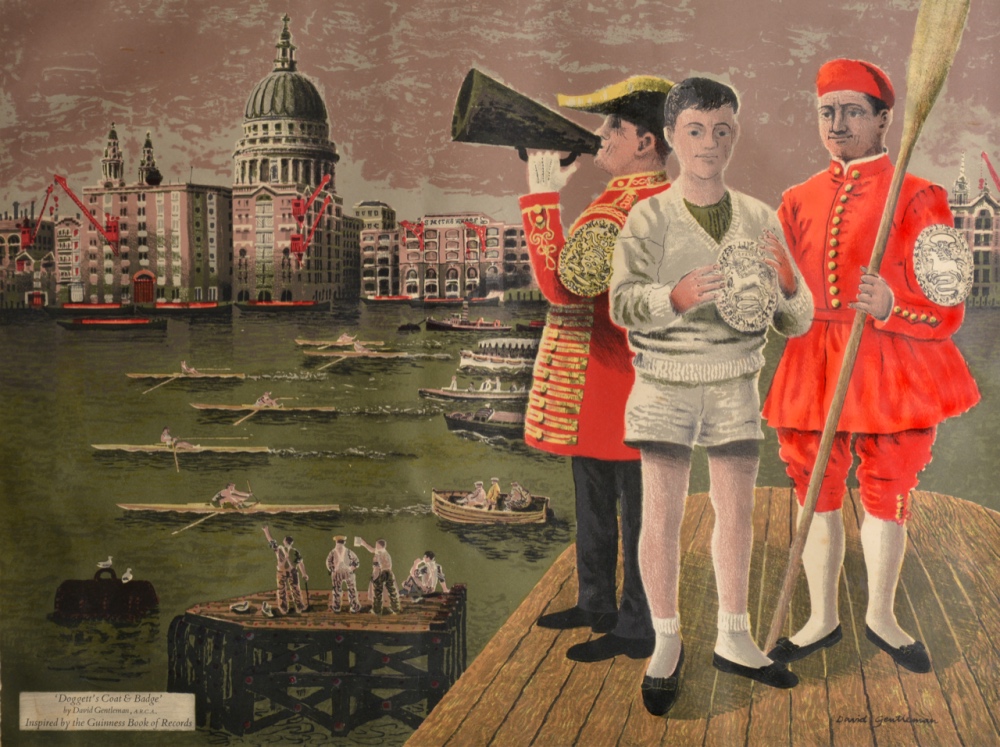
To be held from 4pm today on the River Thames, Doggett’s Coat and Badge Race is a London institution. The race originated in 1715, and sees up to six apprentice watermen (this year there are two – Alfie Anderson and George McCarthy – rowing the four mile, seven furlong course stretching from London Bridge upriver to Cadogan Pier in Chelsea (these days under 11 bridges) as they compete for the prize of a coat and badge (pictured above). The race came about thanks to Thomas Doggett, a Dublin-born actor and noted Whig, who founded it in honour of the accession of the House of Hanover – in the form of King George I – on 1st August, 1714. Doggett himself personally organised the race for the first few years before leaving provisions in his will for it to be continued. It’s been run almost every year since – there was apparently a break during World War II. While it was initially rowed against the tide, since 1873 competitors have had the luxury of rowing with it, meaning race times have dropped from what sometimes stretched to as long as two hours to between 25 and 30 minutes. This year, the event is being held as part of the Totally Thames festival which, among its packed programme of events, also features a series of exhibitions about the race – titled ‘The World’s Oldest Boat Race’, being held at various locations. PICTURES: From The World’s Oldest Boat Race exhibitions. Top – Doggett’s Coat and Badge (© Hydar Dewachi); Below – ‘Doggett’s Coat and Badge’, a coloured lithograph commissioned to mark the first publication of Guinness Book of World Records.
This Week in London – Totally Thames, and, Cooper Car Company commemorated…
• Totally Thames – London’s annual celebration of its river – kicks off on Saturday with a packed programme of walks and talks, performances, exhibitions, and the chance to explore the waterway itself. Among the exhibitions are one focusing on the history of the annual Doggett’s Coat and Badge race and another featuring river-inspired artwork created by young people from across the globe, while variously themed walks include a series taking place along the Thames foreshore at low tide. Other events include a concert series in Tower Bridge’s Bascule Chamber, tours of the Billingsgate Roman House and Baths, and talks including one on the “scandalous” history of whitebait and another on the connections between Florence Nightingale, St Thomas’ Hospital and the river. There’s also the chance this Saturday to see the tall ship, STS Lord Nelson, arrive in London to cross the finish line in ‘Lord Dannatt’s Round Britain Challenge’, the Classic Boat Festival at St Katharine’s Docks (running from 7th to 9th September), and the Great River Race (held on 8th September). For the full programme of events, head to www.totallythames.org. PICTURE: The Thames in central London (NASA/GSFC/METI/ERSDAC/JAROS, and U.S./Japan ASTER Science Team)
• Iconic car manufacturer, The Cooper Car Company, has been commemorated with an English Heritage Blue Plaque. The plaque, unveiled earlier this month at the company’s former works in Hollyfield Road in Surbiton, makes mention of the company’s success in winning two Formula One World Championships in 1959 and 1960. The former works building, the site where Charles Cooper and his son John created a company which became part of motoring history, is a rare surviving purpose-built and architect-designed 1950s motor workshop. It features an unusual curved frontage – described as a “striking example of ‘Thunderbirds’ architecture” – in what is perhaps an intentional homage to the curved design of the Cooper racing cars, something English Heritage believes is quite possible given its architect, Richard Maddock, was the father of the late Cooper chief designer Owen ‘The Beard’ Maddock. For more, see www.english-heritage.org.uk/visit/blue-plaques/.
Email all items for inclusion to exploringlondon@gmail.com.
LondonLife – St Paul’s Cathedral rises over the City…
St Paul’s Cathedral and the City of London. PICTURE: Brunel Johnson/Unsplash
This Week in London – Smithfield Market celebration; Hampton Court’s annual food festival; and, Edwardian illustrators…
• The 150th anniversary of the Smithfield Market will be celebrated at a street party this weekend. The Museum of London and Smithfield Market are joining in offering the free event which, reminiscent of St Bartholomew’s Fair, will feature food, music and historical re-enactments. Performers include Nadia Rose, Stealing Sheep, Girls Rock London, Gandini Juggling and Horrible Histories. Designed by Sir Horace Jones, the redesigned market – which is owned and managed by the City of London Corporation, was officially opened on 24th November, 1868. Runs from 11am to 8pm on Saturday and Sunday. For more, see www.culturemile.london/festival/smithfield-150/.
• Hampton Court Palace is hosting its annual food festival over the August Bank Holiday weekend. Highlights include The Kitchen theatre featuring live cookery demonstrations from top chefs and gastronomic experts including Nadiya Hussain, Melissa Hemsley, Dr Rupy Aujla, Rhiannon Lambert, Lisa Faulkner and Michel Roux, Jr and The Classroom, which will be offering hands-on masterclasses such as sourdough workshops and ‘naked cake’ decorating with the BBC Good Food Cookery Team, gin and cocktail masterclasses and kids’ cookery. There will be stalls from more than 100 food providers offering everything from oysters to sausages, sweet treats and ales as well as a bandstand with live music and activities including vintage games, shire horses and a circus school. The festival runs from 25th to 27th August. Free entry to the palace and gardens is included with the ticket. For more, see www.hrpfoodfestivals.com.
• The work of largely forgotten Edwardian female illustrators Alice Bolingbroke Woodward and Edith Farmiloe is going on show in a new exhibition at the Heath Robinson Museum in Pinner. Peter Pan and the Other Lost Children, which opens Saturday, has been designed around 19 of Woodward’s original watercolour drawings from the first Peter Pan and also includes seven watercolours from her drawings from a 1930s edition of Alice in Wonderland. The display, which also includes works by Farmiloe, has been timed to coincide with the centenary of the Representation of the People Act of 1918. For more, see www.heathrobinsonmuseum.org.
Send all items for inclusion to exploringlondon@gmail.com.

LondonLife – The dragons have returned to Kew…
More than 200 years after they disappeared, the dragons have returned to Kew Garden’s Great Pagoda. The 10 storey octagonal pagoda – which, as we reported, reopened to the public in July after a four year, £5 million restoration project by Historic Royal Palaces in conjunction with the Royal Botanic Gardens, Kew – was built in 1762 to the designs of Sir William Chambers and was a birthday gift for Princess Augusta, founder of the gardens. Used by the Georgian Royal Family to entertain visitors, it was famously adorned with 80 brightly coloured dragons but these disappeared in the 1780s. Rumours suggested they were used as payment for the Prince Regent’s gambling debts but apparently the truth is more banal – Chambers took them off when he restored the building in 1784 and they were found to be rotten. But they’re back (some of the new dragons are gilded with real gold and while some are hand carved from cedar, others were reportedly made on a 3D printer) and to celebrate their return (and the reopening of the pagoda to the public for the first time in decades, complete with a 253 step climb), we today publish some images. Admission charge applies. For more, see www.kew.org/kew-gardens/whats-on/climb-the-great-pagoda. PICTURES: © Richard Lea-Hair – Historic Royal Palaces.
This Week in London – Celebrating Antarctica through dance and science; and, the Freuds in exile…
• A free dance and science festival celebrating Antarctica opens at the Science Museum in South Kensington on Tuesday. Antarctica Live features daily dance performances – including a newly devised performance by award-winning choreographer Corey Baker, workshops and hands-on experiences with real survival equipment to shed light on how the frozen continent is responding to increasing human activity and how its fate can affect us all. Visitors will also be able to see a scale model of the recently launched polar research vessel, the RRS Sir David Attenborough. A special “lates” event on 29th August in the museum’s IMAX Theatre will premiere the documentary film Dancing on Icebergs, which charts the two year making of the short film, Antarctica: The First Dance, featuring Madeleine Graham, star of the Royal New Zealand Ballet (pictured). The screening will be followed by a live Q&A with Corey Baker. Antarctica Live runs until 30th August. For more, see www.sciencemuseum.org.uk/see-and-do/antarctica-live. PICTURE: Madeleine Graham in Antarctica The First Dance © Jacob Bryant.
• On Now: Leaving Today – the Freuds in Exile 1938. This exhibition at the Freud Museum London in Hampstead focuses on the flight and exile of Sigmund Freud, his wife Marta and daughter Anna as, following Hitler’s annexation of Austria, they left Vienna on 4th June, 1938, heading to a new life in London. It features original documents, letters and objects, many of which have never been on public display before. Highlights included the documents Freud and his family required to exit Austria and enter Britain, Freud’s personal correspondence with figures like Albert Einstein and HG Wells, and the first public display of Marie-Louise von Motesiczky’s painting The Psychoanalyst. The exhibition also features a series of works created by young people attending the Baobab Centre for Young Survivors in Exile in collaboration with Barnaby Barford. Runs until 30th September. Admission charge applies. For more, see www.freud.org.uk.
Send all items for inclusion to exploringlondon@gmail.com.
LondonLife – Victorian London in photographs…
Above is a view along Fleet Street in the City of London in 1890, looking east towards Ludgate Hill and St Paul’s Cathedral. It’s one of many early photographic views of London on show in a free exhibition which can be seen in Aldgate Square until Sunday (12th August). Presented by the City of London Corporation’s London Metropolitan Archives, Victorian London in Photographs includes the earliest photograph in the LMA collection (see last Thursday’s entry for that). If you miss it at Aldgate Square, the display will be in Paternoster Square next to St Paul’s Cathedral from 14th to 23rd August. For more on the London Metropolitan Archives, follow this link. ALL PICTURES: London Metropolitan Archives, City of London Corporation
Above – Residents pose for the camera in Market Court, Kensington in 1868.
Above – Following the success of the Great Exhibition in Hyde Park in 1851, the Crystal Palace was relocated to Sydenham Hill. This photograph by Philip Henry Delamotte taken between 1852 and 1854 shows the South Transept during construction.
Above – Work progresses on the masonry and suspension chains during the construction of Tower Bridge in 1892.
View of Iron Wharf and Bull Wharf, with St Paul’s Cathedral in the background. The photograph was taken from Southwark Bridge. Anonymous photographer, c. 1855.
This Week in London – Early London photographs; CRW Nevinson at the British Museum; and, the Worshipful Company of Tylers and Bricklayers…
• Some of the first photographic images of London and Londoners – depicting everything from Victorian families living in slums and the construction of the capital’s first underground railway to well-known icons like Tower Bridge and the Crystal Palace – have gone on show in Aldgate Square. Presented by the City of London Corporation’s London Metropolitan Archives, Victorian London in Photographs also features a daguerreotype (the earliest form of photograph) dating from the 1840s which depicts a view of The Monument (pictured) and is the earliest photograph of the City of London in LMA’s collections. The free exhibition can be seen until 12th August at Aldgate Square after which it moves to Paternoster Square next to St Paul’s Cathedral, where it can be seen from 14th to 23rd August. For more on the London Metropolitan Archives, follow this link. PICTURE: London Metropolitan Archives, City of London Corporation
• A selection of works documenting CRW Nevinson’s experiences during World War I feature in a free exhibition at the British Museum. CRW Nevinson: Prints of War and Peace commemorates the centenary of the artist’s gift of 25 of his prints to the British Museum in 1918 and a number of the works featured on show for the first time. They include a self-portrait while Nevinson was a student at the Slade School of Art, A Dawn and Column on the March, both of which show massed ranks of French soldiers marching to their doom, The Doctor and Twilight which show the conditions wounded soldiers had to endure, and dynamic cityscapes such as Looking down into Wall Street, Looking through Brooklyn Bridge, Wet Evening (depicting Oxford Street in London) and Paris Window and Place Blanche (both dating from 1922 and depicting Paris). The display can be seen in Room 90a, Prints and Drawings Gallery, until 13th September. For more, see www.britishmuseum.org.
• On Now – Worshipful Company of Tylers and Bricklayers. This exhibition at the Guildhall Library marks the 450th anniversary of the granting of the Tylers and Bricklayers’ Company’s charter by Elizabeth I in 1568. As well as tracing the company’s history from its first master in 1416 through to the company today, it also looks at the life of the company’s most famous son, playwright Ben Jonson, and how the company was instrumental in the rebuilding of the City of London after the Great Fire in 1666. Runs until 31st August. Admission is free. For more, follow this link.
Send all items for inclusion to exploringlondon@gmail.com.
Treasures of London – Nelson Mandela memorial stone…
A memorial stone commemorating Nelson Mandela was dedicated at Westminster Abbey on the centenary of his birth this week.
Mandela, who spent 27 years in South African prisons and played a key role in bringing an end to apartheid before serving as President between 1994 and 1999, died in 2013.
The stone, which is located in the floor of the abbey’s nave, was dedicated in a ceremony on 18th July attended by Nomatemba Tambo, the High Commission for South Africa, and Zamaswazi Dlamini-Mandela, granddaughter of Nelson Mandela.
The stone, made of black Belgian marble, was designed and cut by Nicholas Stone. It bears an inscription reading ‘Nelson Mandela 1918-2013’ encircled by the words ‘reconciliation’ and ‘forgiveness’.
Mandela is the first South African to be commemorated with a memorial stone in Westminster Abbey. But a statue of South African martyr Manche Masemola stands over the church’s western entrance and Joost de Blank, former Archbishop of Cape Town, is buried outside St George’s Chapel.
A service of thanksgiving for the life of Mandela was held at the Abbey on 3rd March 2014.
Other monuments to Nelson Mandela in London include a bust located in South Bank and a statue located in Parliament Square.
PICTURE: Courtesy of Dean & Chapter of Westminster
This Week in London – The Ranger’s House reopens; dragons return to Kew; and the art of the Weimar Republic…
• The Ranger’s House in Greenwich – home to a world class art collection known as the Wernher Collection – reopened to the public this week after a makeover by English Heritage. The property – a Georgian villa located on the edge of Greenwich Park – displays the collection – which includes more than 700 works gathered by diamond magnate Julius Wernher in the late 1800s – across 11 period rooms. Highlights include a gold earring in the shape of Victory (the Greek goddess of war) which dates from 2BC, a carved pendant in the shape of a skull from around 1500, a silver gilt, steel and nautilus shell cup dating from 1660 (pictured) and an enamelled jug depicting the Greek god Triton. The collection was originally displayed at Wernher’s London townhouse – Bath House in Piccadilly – and at his country estate, Luton Hoo in Bedfordshire, but after Luton Hoo closed in the 1990s, English Heritage agreed to display the collection at the Ranger’s House (which it had acquired in 1986) on a 125 year loan. Photographs showing how Wernher displayed his collection in his own homes have informed how the objects are presented in the house today. The house is open from Sunday to Wednesday until the end of September. Admission charge applies. For more, see www.english-heritage.org.uk/rangershouse. PICTURE: © English Heritage
• The Great Pagoda at Kew has been reopened to visitors for the first time in years following a four year restoration project. Built in 1762, the pagoda was used by the Georgian Royal Family to entertain visitors and was for the first 20 years famously adorned with 80 brightly coloured wooden dragons (until, that is, they disappeared in the 1780s when they were rumoured to have been used as payment for the Prince Regent’s gambling debts). Thanks to a major restoration project by Historic Royal Palaces in conjunction with the Royal Botanic Gardens, Kew, dragons have returned to the structure and for the first time in decades visitors are being allowed access to the upper floors from where they can gain a birds-eye view of the gardens. They will also be able to learn about the role the pagoda played in planning for the D-Day landings and try out the automata on the ground floor for a tour in miniature of Kew’s Georgian ‘royal route’. Admission charge applies. For more, see www.hrp.org.uk.
• The art of Germany’s Weimar Republic goes on show at Tate Modern on South Bank from Monday. Magic Realism: Art in Weimar Germany 1919-1933 features about 70 paintings and works on paper drawn from The George Economou Collection – some of which have never seen in the UK before – and the Tate’s own collection. The display explores the “paradoxes” of the Weimar era, a time when liberalisation and anti-militarism flourished amid political and economic uncertainty (the title draws on the coining of the phrase ‘magic realism’ – today often associated with the literature of Latin America – by artist and critic Franz Roh in 1925 in an effort to describe the shift from the emotional art of the expressionist era, toward the unsettling imagery of this inter-war period). Works by artists like Otto Dix, George Grosz and Max Beckmann will be presented alongside those of under recognised artists such as Albert Birkle, Jeanne Mammen and Rudolf Schlichter and others whose careers were curtailed thanks to the rise of Nationalist Socialism and its agenda to promote art that celebrated its political ideologies. Admission is free. Runs until 14th July, 2019. For more, see www.tate.org.uk.
Send all items for inclusion to exploringlondon@gmail.com.
This Week in London – ‘Prince and Patron’ opening at Buckingham Palace; International Busking Day; and Pacific portraits at the British Library…
• Buckingham Palace’s annual Summer Opening of the State Rooms kicks off this Saturday and this year, to mark the 70th birthday of Prince Charles, it features a special exhibition of more than 100 works of art – all personally selected by His Royal Highness. Prince and Patron features some of the Prince of Wales’ favourite works of art from the Royal Collection as well as works created by young artists supported by three of charities he’s founded to encourage the revival of dying arts and the maintenance of traditional skills – The Royal Drawing School, The Prince’s Foundation School of Traditional Arts and Turquoise Mountain. Among items featured from the Royal Collection are Johan Joseph Zoffany’s painting The Tribuna of the Uffizi (1772–77), and a cloak of Napoleon Bonaparte which, made of felt and embroidered in silk, was removed from the Emperor’s baggage train in the aftermath of the Battle of Waterloo in 1815 and presented to the future George IV by Field Marshal Blücher. There are also works from his personal collection including Michael Noakes’ oil sketches HM The Queen (1972-73) and Queen Elizabeth The Queen Mother (1973) as well as two preparatory oil sketches of the first official double portrait of Prince William and Prince Harry (the work of Nicky Philipps, they’re on show for the first time) and a previously unseen sketch in pencil on paper by Bryan Organ for the portrait HRH The Duke of Edinburgh. Prince and Patron can be seen as part of the Summer Opening of the State Rooms until 30th September. Admission charge applies. For more, see www.royalcollection.org.uk. PICTURE: Michael Noakes, Queen Elizabeth The Queen Mother (1973), © Anya and Jonathan Noakes/Royal Collection Trust.
• Buskers will be descending on Wembley Park this Saturday as London becomes one of numerous cities around the world marking the third International Busking Day. Multiple Grammy Award-winning composer, producer and guitarist Nile Rodgers will launch the day at 11.30am before performances – including by internationally renowned singer-songwriter Newton Faulkner, Nina Nesbitt and folk/rock band Keywest – kick off 12.30pm. The day, which runs until 7.30pm, will include music, magic, comedy, physical theatre and dance. For more, see http://wembleypark.com/international-busking-day-2018/.
• A free display of Pacific portraits has gone on show at the British Library in what’s described as a “creative response” to its exhibition James Cook: The Voyages. Created by New Zealand Māori photographer Crystal Te Moananui-Squares and New Zealand Māori producer Jo Walsh, Tūhuratanga: Voyage of Discovery features 20 portraits documenting the people of Te-Moananui-a-Kiwa (the Pacific Ocean) who are living in the United Kingdom today. The display can be seen in the Second Floor Gallery until 23rd September. For more, see www.bl.uk/events/tuhuratanga-voyages-of-discovery-photographs-by-crystal-te-moananui-squares.
Send all items for inclusion to exploringlondon@gmail.com.
LondonLife – Sculpture in the City (Vol 8)…
Sculpture in the City is back in the Square Mile, this year featuring 18 artworks ranging from Jean-Luc Moulène’s Body, an aerodynamic tribute to the automobile as sculpture (located in Undershaft – pictured above), to Thomas J Price’s Numen (Shifting Votive) One & Two, an exploration of the ancient Greek, Roman and Egyptian traditions of monumental sculpture (located under The Leadenhall Building – pictured below). Other sculptural works included in this, the 8th edition of the annual event, include Juliana Cerceira Leite’s Climb, a three metre tall obelisk made from the inside out (located in Mitre Square – pictured second below), Sarah Lucas’ Perceval, a life-size horse and cart evocative of the traditional china ornaments that once took pride of place on British mantlepieces (located in Cullum Street – pictured third below), and Karen Tang’s Synapsid, a vivid globular sculpture which brings to mind sci-fi invasion scenarios (outside Fenchurch Street station – pictured fourth below). And, for the first time, the event also includes two sound projects: Marina Abramovic’s Tree, which those passing near a tree at 99 Bishopsgate with insistent, repetitive and distorted birdsong, and Miroslaw Balka’s The Great Escape which, located in Hartsthorn Alley, features the film of the same name’s theme song being whistled repeatedly in a series of slightly different renditions. The display can be seen until April next year – for a map of all the locations, head to www.sculptureinthecity.org.uk. ALL PICTURES: Nick Turpin.
This Week in London – Jousting at Hampton Court; into the shadows at the NHM; and, Bauhaus designers honoured…
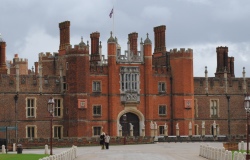
• Jousting returns to Hampton Court Palace this weekend with visitors invited to join King Henry VIII and his court as they watch this sporting spectacle. Along with the thrills and spills of the tourney, visitors can also partake of the delights of Tudor food and music and a specially commissioned play featuring chief minister Thomas Cromwell as he prepares a royal banquet to celebrate the king’s marriage to Anne of Cleves. The event kicks off with a royal procession in which knights will greet the king with a display of heraldic pageantry before they head to the jousting arena at the East Front Gardens. Admission charge applies. Runs on 14th and 15th July. For more, see www.hrp.org.uk. PICTURE: A previous jousting event at Hampton Court Palace (David Adams).
• Venture into the hidden world of shadows in a major new exhibition opening at the Natural History Museum in South Kensington on Friday. Afraid of the dark? takes visitors deep into underground caves, to the depths of the oceans and into the pitch blackness of night as it recreates habitats usually hidden from view and presents hundreds of incredible creatures, some brand new to science, which have adapted to a life without sunlight. The sensory display allows visitors to touch some of Britain’s nocturnal animals, hear the sounds of the deep sea, smell the distinctive aromas of a bat cave and see through the eyes of a cave boa using infrared technology. Runs until 6th January. Admission charge applies (children aged up to 16 are free). For more, see www.nhm.ac.uk.
• Bauhaus designers and teachers Walter Gropius, Marcel Breuer and László Moholy-Nagy have been honoured with an English Heritage Blue Plaque at the Belsize Park home where they lived and worked in the 1930s. Gropius (1883-1969) founded the art school known as Staatliches Bauhaus in Weimar in 1919 with Breuer (1902-1981), who initially joined as a student before becoming director of furniture workshops in 1924, and Moholy-Nagy (1895-1946) who joined the staff in 1923 and edited the house magazine and 14 books. All three went on to have successful careers in the field of design and architecture and live in flats in the Grade I-listed Isokon Building, completed in 1934 and originally known as the Lawn Road Flats, in Belsize Park. For more, see www.english-heritage.org.uk/visit/blue-plaques/.
Send all inclusions to exploringlondon@gmail.com.