Olympics Special – The Olympic Torch Relay, part II…

We take a break from our regular series this week to bring you some images from the second half of the Olympic Torch Relay as it made it’s way around London toward tonight’s Opening Ceremony…


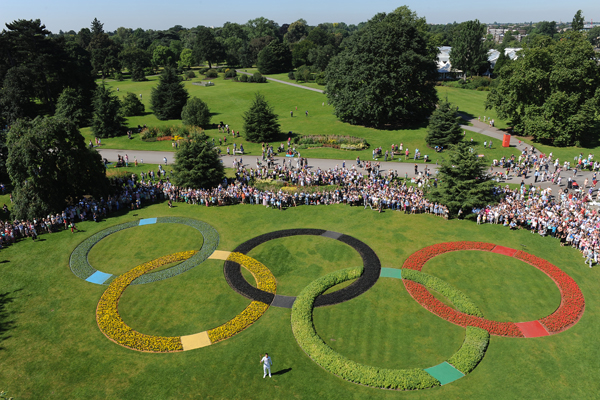
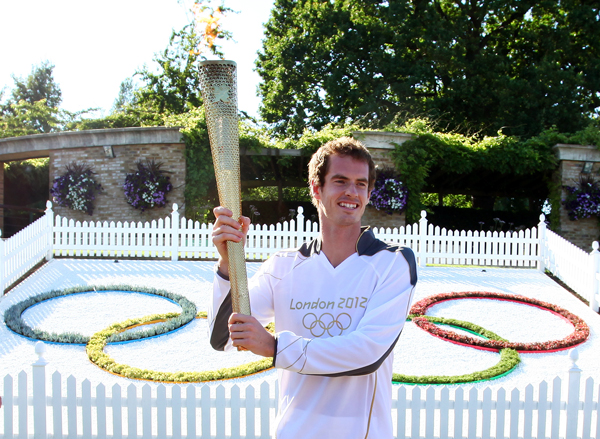
Day 67 (24th July): Tennis player Oliver Golding holds the Olympic Flame in between the Olympic Rings at Kew Gardens, London.

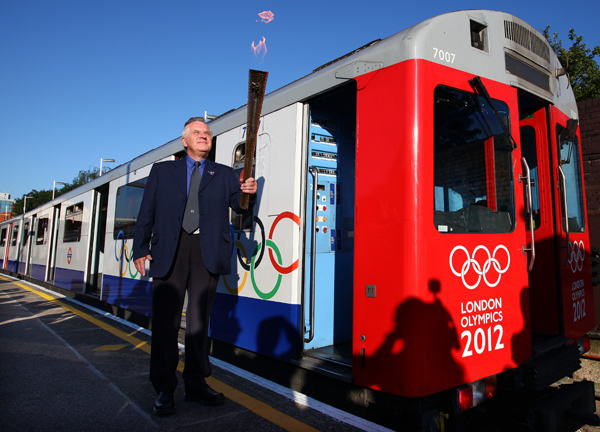
London Underground employee John Light carries the Olympic Flame onto an underground train at Wimbledon Station.

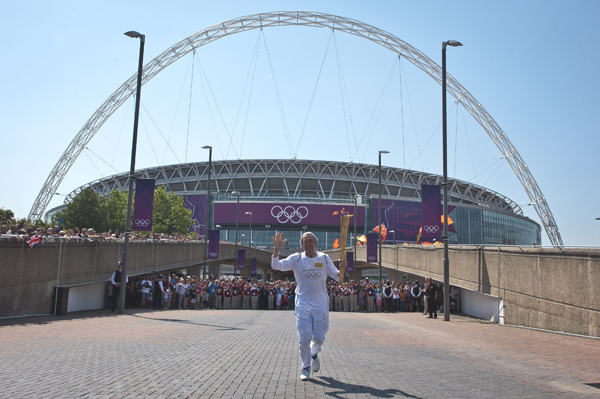
Day 68 (25th July): Former World Cup winning footballer Gordon Banks carries the Olympic Flame down Wembley Way, at Wembley Stadium.


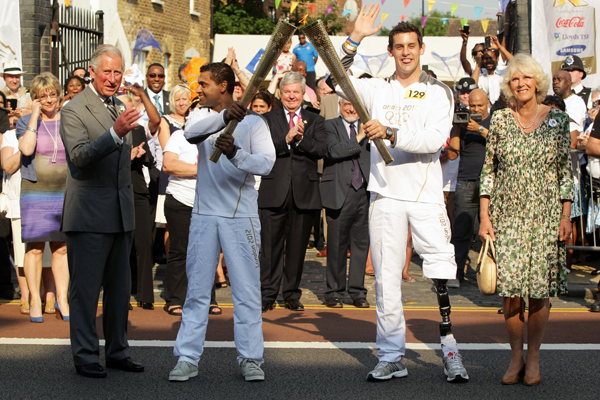
Prince Charles, Duke of Cornwall, and Camilla, Duchess of Cornwall, pose with  young entrepreneur Jay Kamiraz and Paralympian Scott Moorhouse as they kiss together Olympic torches in Tottenham.

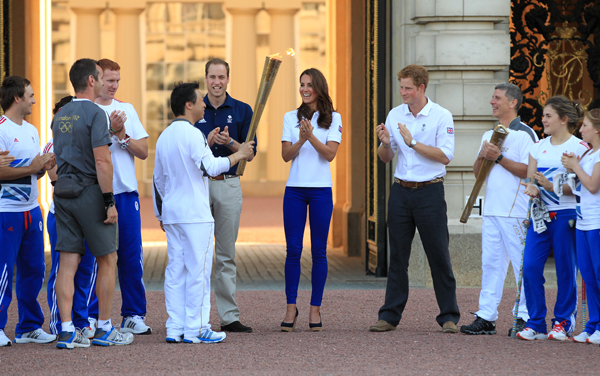
Day 69 (26th July): Disaster mapping charity volunteer Wai-Ming Lee passes the Olympic Flame to mountain rescue team leader John Hulse in front of Buckingham Palace in the presence of Prince William, Kate, Duchess of Cambridge and Prince Harry.

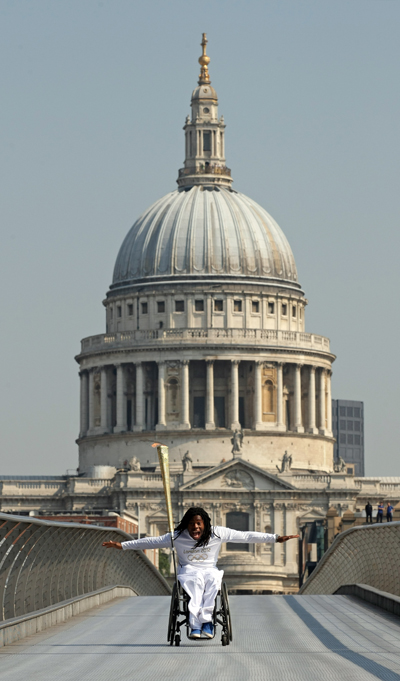
Wheelchair basketballer Ade Adepitan carries the Olympic Flame on Millennium Bridge.

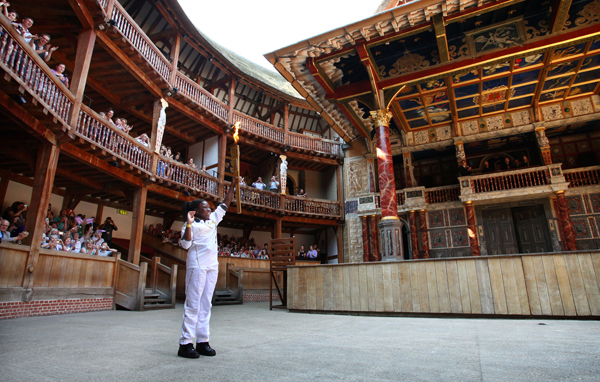
Student Ifeyinwa Egesi holds the Olympic Flame inside the Globe Theatre.

For more on the Torch Relay, see www.london2012.com/torch-relay/

ALL PICTURES: LOCOG.

LondonLife – The Olympic Torch Relay (so far)…

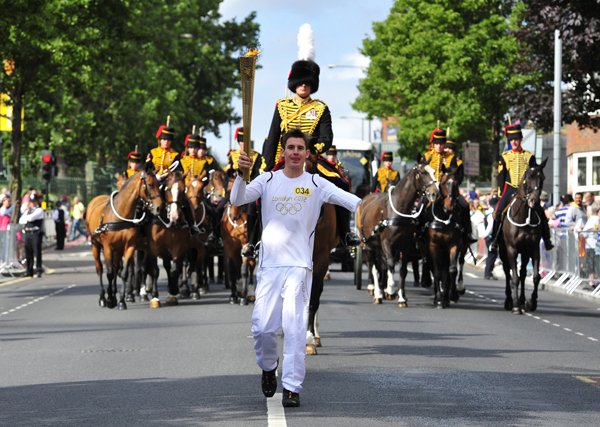
The Olympic Torch Relay arrived in London last Friday night and has been moving around the capital ever since. Here are some of the highlights so far (all images are courtesy of LOCOG)…

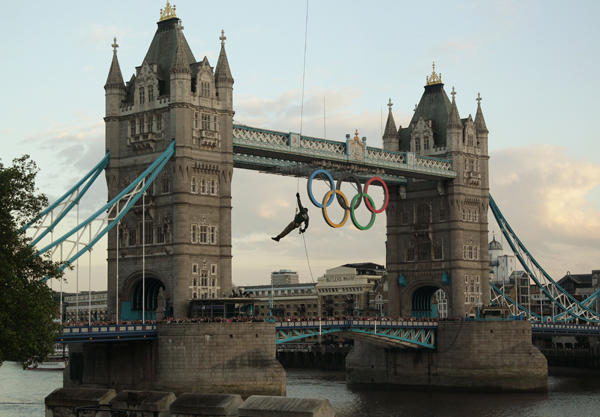
Day 63 (20th July): A Royal Marine, believed to be Martin Williams, is carrying the Olympic Flame as he abseils from a helicopter into the grounds of the Tower of London.

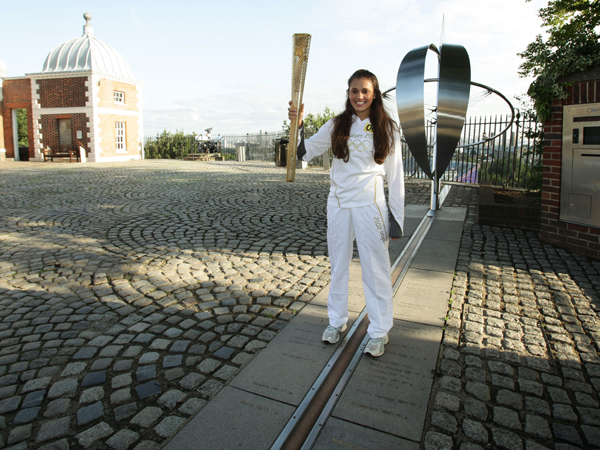
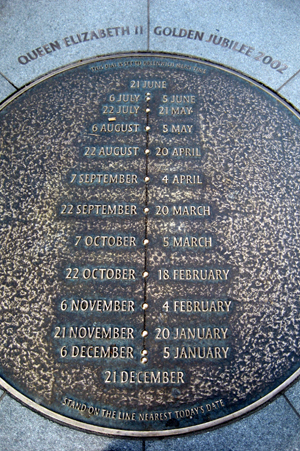
Day 64 (21st July): Swimmer Natasha Sinha holds the Olympic Flame on the Meridian Time Line outside the Royal Observatory in Greenwich.

Jaco-Albert Van Gass carries the Olympic Flame through Greenwich.

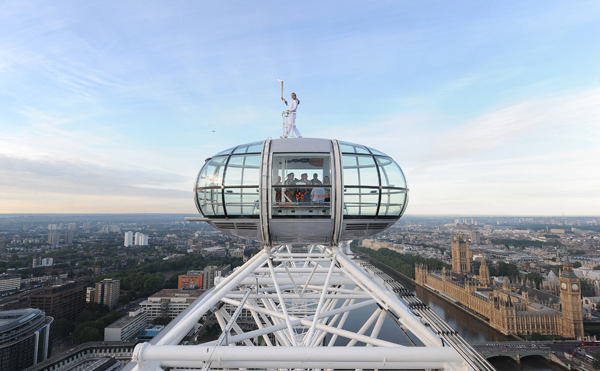
Day 65 (22nd July): Student explorer Amelia Hempleman-Adams poses with the Olympic Flame on top of a London Eye pod.

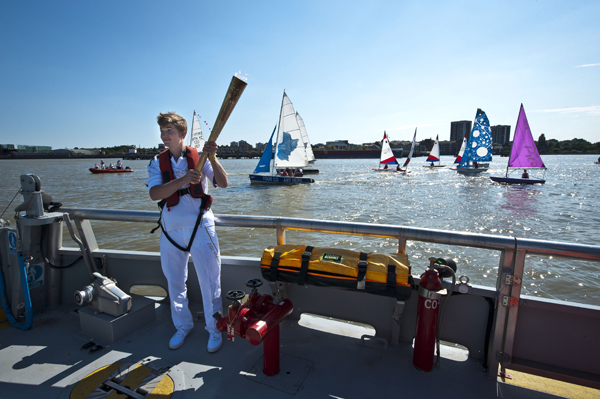
Sailor Aaron Reynolds carries the Olympic Flame on a London Fire Brigade Boat.

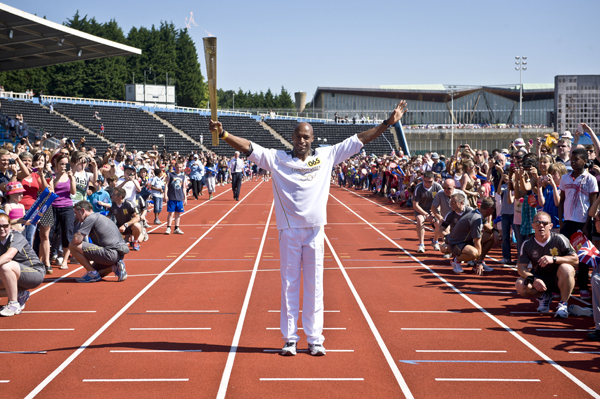
Day 66 (23rd July): Sprinter Marlon Devonish carries the Olympic Flame at Crystal Palace stadium in south London.

Tennis player Andy Murray carries the Olympic Flame at Wimbledon.

For more on the Torch Relay, see www.london2012.com/torch-relay/

ALL PICTURES: LOCOG.

Around London: Olympic Torch Relay hits London; mascots pop-up all over the city; and Shakespeare at the British Museum…

• The Olympic Torch Relay arrives in London tomorrow night before working its way around all of the city’s 33 boroughs and reaching the Olympic Stadium for the Opening Ceremony next Friday.  The torch will arrive in the city by helicopter from Guildford tomorrow night and then be abseiled into the Tower of London where it will spend the night ensconced with the Olympic medals. The relay will travel 200 miles over the next week, carried by more than 980 torchbearers. The route is as follows:

  • Saturday, 21st July – Greenwich via Newham, Tower Hamlets and Hackney to Waltham Forest (highlights include a visit to the Cutty Sark);
  • Sunday, 22nd July – Redbridge via Barking & Dagenham and Havering to Bexley (highlights include a ride on the London Eye and a crossing of the Thames);
  • Monday, 23rd July – Lewisham via Bromley, Croydon, Sutton and Merton to Wandsworth (highlights include a visit to a live filming of Eastenders);
  • Tuesday, 24th July – Kingston via Richmond, Hounslow, Hillingdon and Denham to Ealing (highlights include a visit to Kew Gardens);
  • Wednesday, 25th July – Harrow via Brent, Barnet and Enfield to Haringey (highlights include a visit to Wembley Arena);
  • Thursday, 26th July – Camden via Islington, the City of London, Southwark, Lambeth, Wandsworth, Kensington & Chelsea and Hammersmith & Fulham  to Westminster (the many landmarks to be visited include St Paul’s Cathedral, Shakespeare’s Globe, Trafalgar Square, Buckingham Palace and Hyde Park);
  • Friday, 27th July – From Hampton Court Palace (where it will be taken into the maze) on board Gloriana via the Thames to Olympic Park for the Opening Ceremony.

The 70 day torch relay, which kicked off on 19th May, will have travelled a total distance of about 8,000 miles and have involved 8,000 torchbearers by the time it reaches its end. LOCOG and Transport for London have advised people to see the relay at a location closest to their home given the expected crowds. For more detailed route information, see www.london2012.com/torch-relay/route/. PICTURE: LOCOG

Still talking all things Olympics and London’s largest ever ‘pop up’ shop – where you can buy Olympic merchandise – was officially opened by multiple gold medalist Sir Steve Redgrave in Hyde Park last week. The shop, located on Rotten Row, will be the site of special athlete visits during the Games and visitors can have their photo taken with the Olympic Torch.

• Meanwhile, life-sized versions of the Olympic mascot Wenlock and Paralympic mascot Mandeville are popping up at some of London’s key tourist locations. The 83 two metre tall sculptures capture various elements of life in London with incarnations including a Beefeater, a giant red phone box and a replica of Big Ben. The figures can be found on the routes of Stroll, six new discovery trails designed to help both tourists and Londoners get more out of the city. A QR code on the bottom of each of the sculptures directs smartphone users to further information about the discovery trails. The discovery trails are part of the Mayor of London Presents, a city-wide programme featuring free events, shows and activities. For more on what’s happening in your area, see www.molpresents.com. Some of these events are also being run as part of the Festival of London 2012. For more on this, see http://festival.london2012.com.

• On Now: Shakespeare: staging the world. Part of the World Shakespeare Festival taking place in London, this exhibition at the British Museum looks at the then emerging role of London as a “world city” as interpreted through Shakespeare’s plays and examines the role the playhouse performed in this. The museum has collaborated with the Royal Shakespeare Company to produce the exhibition which features more than 190 objects including paintings, jewels and rare manuscripts. These include the Ides of March coin, a Roman gold aureus commemorating the assassination of Julius Caesar (Julius Caesar), the Lyte Jewel, presented to Thomas Lyte in 1610 in thanks for his work in tracing King James I’s lineage back through Banquo (Macbeth), and a 1610 bird’s-eye view of Venice (Othello and The Merchant of Venice). Runs until 25th November. Admission charge applies. For more, see www.britishmuseum.org.

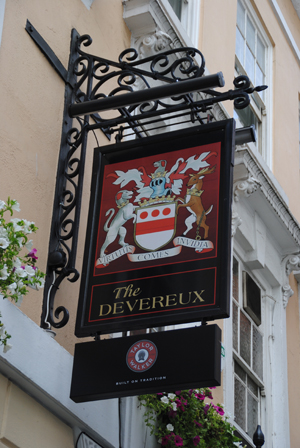
London Pub Signs – The Devereux

Located at 20 Devereux Court, just off the Strand in the area of London known as Temple, The Devereux takes its name from Elizabethan Robert Devereux, the 2nd Earl of Essex, whose mansion, Essex House, once occupied the site on which it stands.

Devereux, a favorite of Queen Elizabeth I, inherited the mansion from his step-father, Robert Dudley, the Earl of Leicester, in 1588 (the house was originally called Leicester House). A spectacular fall from favor which culminated in an abortive coup, however, led to Devereux’s beheading in 1601 (interestingly, he was the last person to be executed inside the Tower of London – the tower where he is held was named after him).

Used by other members of Devereux’s family following his death, a plaque outside the pub explains that the property was sold to property developer, Nicholas Barbon (also noted as the founder of fire insurance), in 1674, and that he had it demolished soon after.

The present building is said to date from 1676 and was originally two houses. Soon after its construction, it became the premises of the famous Grecian Coffee House which had moved from Wapping Old Stairs.

Noted as a meeting place for prominent Whigs, it was also frequented by members of the Royal Society such as Sir Isaac Newton, Sir Hans Sloane and Dr Edmund Halley as well as writer, poet and politician Joseph Addison and Richard Steele, editor of The Tatler (who gave the coffee house as the magazine’s postal address).

The early 1840s, the premises was into lawyers’ chambers and then later into the public house which now occupies it.

There’s a bust of Essex on the facade beneath which is written the inscription, “Devereux Court, 1676”. The pub is these days part of the Taylor-Walker group. For more, see www.taylor-walker.co.uk/pub-food/devereux-temple/pid-C7177.

For a great book on London’s pubs, take a look at London’s Best Pubs: A Guide to London’s Most Interesting & Unusual Pubs.

Lost London – The Savoy Palace…

At one time the grandest of medieval townhouses in London, the history of the Savoy Palace, also known as the Palace of the Savoy, goes back to at least the 13th century.

A mansion was built here by Simon de Montfort, the ill-fated Earl of Leicester, in 1245. Following his death, it and the land between the Strand and the Thames were gifted by King Henry III to Peter, Count of Savoy, and it was renamed the Savoy Palace (apparently originally spelt Savoie).

The uncle of the king’s young wife Eleanor of Provence, Peter had accompanied his niece to London for her wedding to the king at Canterbury Cathedral on 14th January, 1236, and decided to stay. In 1241, the king named him the Earl of Richmond and in 1246 granted him the land upon which the property was built.

After being briefly given to a religious order, Queen Eleanor gifted the property to Prince Edmund (“Edmund Crouchback” – a term referring to his entitlement to wear a crusader’s cross, not a hunchback), the 1st Earl of Lancaster and younger brother to King Edward I.

It was subsequently occupied by Edmund’s successor earls and, later, dukes. Among the ‘guests’ to visit the palace during the 14th century were the French King Jean (John) II, held there for three years following his capture by the Black Prince at the Battle of Poitiers during the Hundred Years War in 1356.

Interestingly, as the property of the Dukes of Lancaster, the precinct around the palace was considered part of County Palatine of Lancaster (created in 1351), meaning that the rule of the dukes was applied here instead of that of the king – a situation which remained in place until the 1800s.

The palace eventually became the property of John of Gaunt, the 2nd Duke of Lancaster and third son of King Edward III. The richest and most powerful man in the kingdom (he was all but king in name during the younger years of King Richard II in whose name he ruled), Gaunt’s home was said to be sumptuous.

It’s perhaps not surprising then that it become a focus of the rebels during the Peasant’s Revolt in 1381 (it had been attacked unsuccessfully a few years earlier). They attacked and destroyed the property, razing it to the ground. (The story includes the tale that 32 men drank themselves to death after becoming trapped in the cellar while the palace burned).

The site, however, continued to be referred to as that of the Savoy and in the early sixteenth century King Henry VII, by order of his will, financed the founding of the Savoy Hospital on the site for the poor people (the Queen’s Chapel of the Savoy is a relic of this building – see our earlier post here). The hospital closed in 1702 and was later demolished (we’ll deal with this in more detail in a later Lost London post).

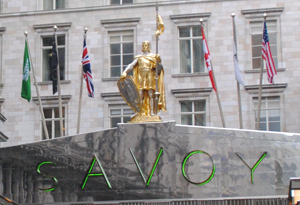
The site, which stands on the north side of the Thames just west of Waterloo Bridge,  is now occupied by the salubrious Savoy Hotel (the entrance of which is pictured above) and the Savoy Theatre, which, like the hotel, was founded by impressario Richard d’Oyly in the 1880s (the theatre was the first building in the country to be entirely lit by electric lighting).

The name of the Savoy Palace is also remembered in street names around the site including Savoy Street, Savoy Hill, Savoy Steps, Savoy Way and Savoy Place.

Where is it?…#35…

The latest in the series in which we ask you to identify where in London this picture was taken and what it’s of. If you think you can identify this picture, leave a comment below. We’ll reveal the answer early next week. Good luck!

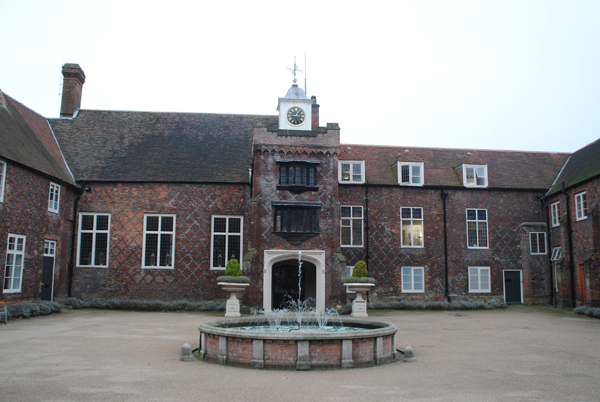
Well done to James and Mike – this is indeed Fulham Palace, former home of the Bishops of London. The site was first acquired by Waldhere, the Bishop of London, from Tyrhtilus, the Bishop of Hereford, in about 700 AD. The site – the current buildings date from the medieval period – were later mainly used as a summer home of the Bishop of London and it wasn’t until the 20th century that it become their principal home. The last bishop to live here was Bishop Stopford who retired in 1975. These days the palace, which is still owned by the Church of England, houses a museum, cafe, gallery and gardens. We’ll be looking at more of the history of Fulham Palace in a later post. In the meantime, see www.fulhampalace.org for more, including details of visiting hours.

Treasures of London – The Clock Tower…

The tower at the northern end of the Houses of Parliament is known to many simply as Big Ben – what isn’t often realised is that (as was pointed out in this earlier article) Big Ben actually refers to a bell inside the tower and not the tower itself. The tower, rather, has the rather plain moniker of The Clock Tower. But in honor of the Queen’s Diamond Jubilee, that’s all about to change.

News broke this week that politicians have decided to rename the tower the Elizabeth Tower in honor of Queen Elizabeth II. The move does have precedent – the great southern tower which stands over the Sovereign’s Entrance to the House of Lords was once known as the King’s Tower but was renamed the Victoria Tower in honor of Queen Victoria’s Diamond Jubilee in 1897 (Queen Victoria is the only other British monarch to have celebrated a Diamond Jubilee).

The 96 metre high tower, part of the Houses of Parliament (officially known as the Palace of Westminster), is not the first clock tower to stand on the site of the palace. The first, located on the north side of New Palace Yard, was built in 1288-90 in the reign of King Edward I and contained a bell and clock.

It was replaced in 1367 with a tower that featured the first public chiming clock in England. This second tower was demolished in 1707 after falling into disrepair and replaced with a sundial.

Following a fire which destroyed much of the Palace of Westminster in 1834, architect Sir Charles Barry was selected to design new buildings to house Parliament but interestingly his initial designs didn’t include a clock tower – this was added to the plans in 1836.

Construction of the new Clock Tower, which was built from the inside out and clad in Yorkshire Anston stone and Cornish granite, began in September 1843 but wasn’t completed until 1859 following considerable delays. The ‘lantern’ at the top is known as the ‘Ayrton Light’, named for Acton Smee Ayrton, an MP and the First Commissioner of Works in the 1870s. Not installed until 1885, it is lit up when either House is sitting at night.

The clock was constructed by Edward John Dent and his stepson Frederick to the designs of Edmund Beckett Denison. It included a “revolutionary mechanism” known as the ‘Grimthorpe Escapement’ (Denison was later created Baron Grimthorpe), which helped ensure the clock’s accuracy despite external factors like wind pressure on the clock’s hands and which was adopted in many subsequent clocks. The design of the dials were a collaboration between Barry and Augustus Welby Pugin.

The clock was installed in April 1859 but the cast-iron hands were too heavy and had to be replaced with copper ones. It began keeping time on 31st May, 1859.

It’s worth noting that the tower tilts at 0.26 degrees to the north-west but experts say this is apparently not going to be a major structural problem for 10,000 years.

For more on the Clock Tower including a terrific virtual tour, see www.parliament.uk/bigben. It is possible to tour the Houses of Parliament – including climbing the 334 steps to the top of the Clock Tower – but this is only open to UK residents (and they book up months in advance). For more on the tours, see www.parliament.uk/visiting/visiting-and-tours/ukvisitors/bigben/.

Around London – Trooping the Colour and Hampton Court celebrations; Park Lane sculptures; pathologist honored; Londoners at play; and, an exploration of gold…

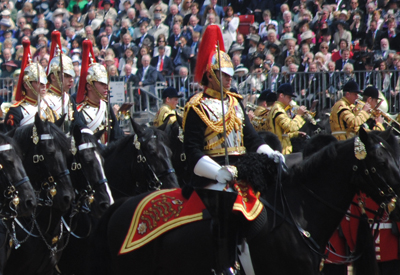
• It’s another weekend of celebration in London with events including Trooping the Colour and the Hampton Court Palace Festival taking place. With Diamond Jubilee fever in the air, expect crowds for this year’s Trooping the Color – the annual celebration of the Queen’s birthday – held at Horse Guards Parade on Saturday. The procession down The Mall kicks off at 10am  with the flypast back at Buckingham Palace at 1pm (organisers advice getting your place by 9am – for more, follow this link). The Hampton Court Palace Festival, meanwhile, kicks off today with a performance by Liza Minnelli and runs through next week until John Barrowman performs at the festival’s closing next Saturday (24th June). The festival, set against the backdrop of Hampton Court Palace, this year celebrates its 20th year – among other performers are Van Morrison, James Morrison, Frankie Valli & The Four Seasons and this Saturday (16th June) sees the holding of the 20th Anniversary Classical Gala and fireworks. For more, see http://hamptoncourtpalacefestival.com/. PICTURE: Trooping the Colour 2011.

• Park Lane’s central reservation is now hosting three new large scale sculptures by artist William Turnbull, considered a pioneer of modernism. The three works – 3×1 (1966), Large Horse (1990) and Large Blade Venus (1990) – have been installed as part of Westminster City Council’s ‘City of Sculpture’ festival. The works are on loan from the artist as well as the Yorkshire Sculpture Park and Chatsworth House, where they have been recently displayed.

• Professor Keith Simpson, a pathologist who has conducted post-mortems as part of the investigation into some of the country’s most infamous murders, has been honored with a green plaque at his former residence at 1 Weymouth Street by Wesminster City Council. The cases he worked on include the 1949 Acid Bath Murders (John George Haigh was hanged for the murder of six people in August that year) and the murder of gangster George Cornell, shot dead by Ronnie Kray in Whitechapel’s Blind Beggar Pub in 1966. Professor Simpson, who died in 1985, worked in the field of pathology for more than 30 years, taught at Guy’s Hospital in London and was renowned as having performed more autopsies than anyone else in the world.

• Now On: Londoners at Play. This exhibition at the Getty Images Gallery in Eastcastle Street explores through images how Londoners spent their leisure time – from the 19th century through to today. The display features 57 images including an image of ‘Last Night of the Proms’ from 1956 featuring conductor Sir Malcolm Sergeant, a print taken from a glass plate negative showing Londoners cycling in Royal Parks in 1895 and a crowd watching a Punch and Judy show in Covent Garden in 1900. Admission is free. Runs until 25th August. For more, see www.gettyimagesgallery.com/Exhibitions/Default.aspx.

• Now On: Gold: Power and Allure – 4,500 Years of Gold Treasures from across Britain. This exhibition at the Goldsmith’s Hall showcases more than 400 gold items, dating from 2,500 BC through to today. Admission is free. Runs until 28th July. For more information, see www.thegoldsmiths.co.uk.

Celebrating the Diamond Jubilee with 10 royal London locations – 9. Royal chapels…

Palaces aside, the Queen also owns a series of chapels – the Chapels Royal – in London which, although not as grand as Westminster Abbey, have each played an important role in the history of the monarchy. 

The term Chapel Royal originally referred to a group of priests and singers dedicated to serving the Sovereign’s personal spiritual needs and as such would follow the monarch around the country. It was in Stuart times that they became more settled establishments with the two main Chapels Royal – the Chapel Royal and the Queen’s Chapel – located in St James’s Palace.

• The Chapel Royal, St James’s Palace. Constructed by King Henry VIII, the chapel was decorated by Hans Holbein the Younger in honor of the king’s (short) marriage to Anne of Cleves. Queen Mary I’s heart is said to be buried beneath the choir stalls and it was here that Queen Elizabeth I apparently prayed waiting for news of the progress of the Spanish Armada. King Charles I took the Sacrament of Holy Communion here before his execution in 1649 and the chapel was where Queen Victoria married Prince Albert (her marriage certificate still hangs on the wall). In more recent times, the coffin of Diana, Princess of Wales, was placed before the altar so family and friends could pay their respects before her 1997 funeral. Among the composers and organists associated with the chapel are Thomas Tallis, William Byrd, Henry Purcell and George Frideric Handel. The chapel is not open to the public except for services.

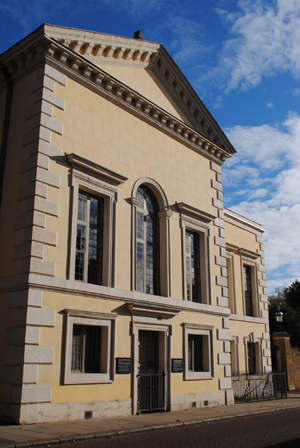
• The Queen’s Chapel, St James’ Palace (pictured right). Now located outside the palace walls, this chapel was built by King James I for the Catholic Henrietta Maria, the bride of his son, then Prince Charles (later King Charles I). Designed by Inigo Jones, Grinling Gibbons and Sir Christopher Wren were also involved in its creation. The chapel was used by Henrietta Maria until the Civil War and later became the home of the Danish Church in London. The chapel is not open to the public except for services.For more on this chapel or the Chapel Royal at St James’s Palace, follow this link.

• The Queen’s Chapel of the Savoy. Built in the Middle Ages to serve the now long gone Savoy Palace, London home of Count Peter of Savoy (uncle to King Henry III’s wife, Eleanor of Provence, the original building was destroyed in the Peasant’s Revolt of 1381. The current building, located in Savoy Hill, off the Strand, was built on the orders of King Henry VII in the late 15th and early 16th century to serve the hospital he founded on the site of the palace. The chapel since served many other congregations – including a German Lutheran congregation – but remains royal property via the Duchy of Lancaster, which is held in trust for the Sovereign and used to provide an income for the British monarch. It is officially the Chapel of the Royal Victorian Order. For more, see www.duchyoflancaster.co.uk/duties-of-the-duchy/the-queens-chapel-of-the-savoy/.

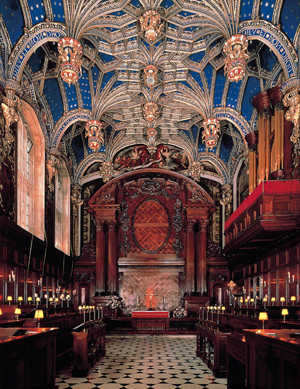
• Chapel Royal, Hampton Court Palace (pictured right). There has been a chapel here since the Knights Hospitallers occupied the site in the 13th century but it was Cardinal Wolsey who built the chapel to its present dimensions after acquiring the property in 1518. The current building, however, dates from the later ownership of King Henry VIII – Wolsey surrendered the property to him when he fell from favour – and further works in the eighteenth and nineteenth centuries. Many subsequent monarchs have worshipped here. The chapel, with its stunning ceiling, is open to the public when visiting Hampton Court Palace. For more, see www.chapelroyal.org. PICTURE: Historic Royal Palaces/newsteam.co.uk

• The Chapel Royal of St Peter ad Vincula, Tower of London. Originally a parish church, this was incorporated into the walls of the Tower in the reign of King Henry III. It was subsequently rebuilt at least twice – in the reign of King Edward I and King Henry VIII – and is home to the graves of important personages executed at the Tower including Henry VIII’s one-time wives, Anne Boleyn and Catherine Howard as well as Jane Grey, the nine day queen, and Sir Thomas More and Bishop John Fisher. The chapel can be accessed during a Yeoman Warder’s tour of the Tower of London. For more, including details of an appeal for its restoration, see www.hrp.org.uk/TowerOfLondon/stories/thechapelproject.

• Chapel Royal of St John the Evangelist, Tower of London. Located within the White Tower, this beautiful chapel – arguably the oldest church in London – dates back to the construction of the tower by King William the Conqueror the late 11th century and remains one of the best preserved examples of Anglo-Norman architecture in England. King Henry III added stained glass windows but for much of its later history the chapel was used for records storage. Tradition records that King Henry VII’s wife, Elizabeth of York, was laid in state here following her death in childbirth and that it was here Queen Mary was betrothed by proxy to Philip of Spain. This can be visited as part of a visit to the Tower of London. For more, see www.hrp.org.uk/TowerOfLondon/Sightsandstories/Prisoners/Towers/ChapelofStJohns

For more on churches in London, check out Stephen Millar’s London’s City Churches
and Stephen Humphrey’s London’s Churches and Cathedrals: A Guide to London’s Most Historic Churches and Cathedrals, Leigh Hatt’s London’s 100 Best Churches: An Illustrated Guide or the Pevsner Architectural Guide London: City Churches.

Lost London – The Lion Tower, Tower of London

Built as a barbican by King Edward I around 1275, the Lion Tower took its name from the fact that it was later used to house the Royal Menagerie.

Visitors to the Tower in the late 13th century would have crossed a causeway and drawbridge over the moat to reach the semi-circular Lion Tower before then heading on, via another causeway to the Middle Tower (the place where you now enter).

It would seem that the Royal Menagerie – which included lions, leopards, mastiffs and other assorted animals – was housed here by 1335 (there is a document dated three years later which refers to the ‘Lion Turret’) and it is known for certain that it was housed here from the 16th century until the menagerie was disbanded in the 1830s and the animals removed, some of which were presented to the Zoological Society of London.

The animals were kept in two stories of wooden ‘houses’ set around the inside face of the tower – these were refurbished during the reign of King James I, an exercise yard was added on land reclaimed from the moat and an improved viewing platform from which to watch the lions was added (people were charged a small fee to come and view the animals). Modifications were again carried out in the 1770s.

The Lion Tower and the surrounding complex of buildings were finally demolished in 1852 to make way for a new ticket office. The foundations of the tower can now be seen as you enter the tower.

For more on the Royal Menagerie, see our previous entry here.

PICTURE: A Yeoman Warder with lifesize wire lion sculptures commissioned for the ‘Royal Beasts’ exhibition at the Tower of London. They are located on the site of the Lion Tower. Courtesy  Historic Royal Palaces/newsteam 

Celebrating the Diamond Jubilee with 10 royal London locations – 8. Golden Jubilee memorials…

UPDATED: Last week we looked at some of the monuments marking Queen Elizabeth II’s Silver Jubilee in London, so this week we’re taking a look at some of the monuments marking the Queen’s Golden Jubilee celebrating what were then 50 years on the throne in 2002.

The year  was marked with celebrations, including a Golden Jubilee Weekend, not unlike that experienced in London over last weekend, which featured public concerts in Buckingham Palace gardens including the ‘Party at the Palace’ pop concert, flyovers including one by a Concorde with the Red Arrows, a National Thanksgiving Service at St Paul’s Cathedral and a Jubilee Procession down The Mall.

In addition, the celebrations included the first ever parade of all the Queen’s bodyguards – this 300 strong group featured detachments from the Gentlemen at Arms (created by King Henry VIII in 1509), the Yeoman of the Guard (created by King Henry VII in 1485) and Yeoman Warders (based at the Tower of London).

As with the Silver Jubilee, the Queen more than 70 towns in the UK and visited countries overseas including Jamaica, New Zealand, Australia and Canada.

Among the monuments in London marking the Golden Jubilee are:

• Golden Jubilee Sundial, Old Palace Yard (pictured). Designed by Quentin Newark, this was Parliament’s gift to the Queen and was installed in 2002 as part of the yard’s revamp. The dial, which is ‘set’ to Greenwich Mean Time and can be found just outside the eastern end of Westminster Abbey, features a quote in its outer circle from William Shakespeare’s play, Henry VI, part III: “To carve out dials quaintly, point by point, thereby to see the minutes how they run: how many makes the hour full complete, how many hours brings about the day, how many days will finish up the year, how many years a mortal man may live.”

• King’s Stairs Memorial Stone, Bermondsey. This memorial stone located on the edge of King’s Stairs Gardens by the Thames in Bermondsey was first installed to mark the Queen’s Silver Jubilee. In 2002, the other side of the stone was inscribed to mark the Golden Jubilee and unveiled in the presence of the Earl and Countess of Wessex.

• Dovehouse Green, Royal Borough of Kensington and Chelsea. We omitted to mention this last week – located on an old burial ground granted by Sir Hans Sloane in 1733,  Dovehouse Green was laid out in 1977 to commemorate the Silver Jubilee and the Golden Jubilee of the Chelsea Society and was refurbished in 2002 to mark the Queen’s Golden Jubilee (it reopened in 2003).

• Great Ormond Street Hospital. Not strictly a Golden Jubilee memorial, there is a plaque close to the hospital’s main entrance which commemorates the Queen’s visit to the hospital to mark its 150th anniversary in 2002, “Her Majesty’s Golden Jubilee Year”.

• Golden Jubilee Footbridges. One memorial accidentally left off the list initially was the Golden Jubilee Bridges which run along either side of the Hungerford Bridge, between Westminster and Waterloo Bridges. The new four metre wide footbridges, which feature a particularly complex design, were named the Golden Jubilee Footbridges in honor of the Queen’s Golden Jubilee. They replaced an earlier – and somewhat notorious – footbridge which cantilevered off the side of the railway bridge.

PICTURE: Wallyg

Treasures of London – The Queen Victoria Memorial…

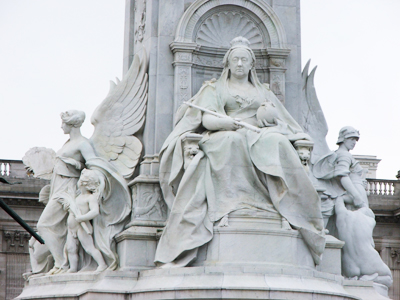
It’s partly obscured now, thanks to preparations for the current Diamond Jubilee, and we have touched on it before (see our earlier post here) but we thought it appropriate to take a look at the main London memorial to the only other British monarch ever to have celebrated a Diamond Jubilee – Queen Victoria.

Prominently located outside of Buckingham Palace at the head of The Mall, work on the Grade I listed Queen Victoria Memorial commenced in 1903.  Dedicated to the Queen, who ruled from 1819-1901, it was unveiled by King George V, grandson of King Victoria, and that of his cousin German Emperor Wilhelm II in May, 1911 (although it wasn’t completed until 1924).

The statue, nicknamed the Wedding Cake, was designed by Sir Aston Webb (he who also designed the currently facade to Buckingham Palace and The Mall – down which the statue of Victoria serenely gazes), and sculpted by Sir Thomas Brock, who, so the story goes, received his knighthood after King George V was so moved at the dedication that he spontaneously decided to knight him then and there.

At 25 metres high, this vast statue is made of 2,300 tons of white marble, 800 tones of granite and 70 tons of bronze. It is the largest statue in London with the exception of that dedicated to Prince Albert in Kensington (it could be described as a companion piece) and is the largest statue of a monarch in England.

The statue is redolent with symbolism – four bronze lions at the base represent the idea of Power (a pair of these was apparently donated by New Zealand) while other bronze figures represent Peace, Progress, Manufacture and Agriculture. There is a nautical theme around the base with depictions of mermaids and ship’s prows among the scenes depicted, all of which evoke Seapower.

On the same level as the seated Queen are Truth, Justice and what’s variously described as Charity or Motherhood while above her are gilded figures representing Courage, Constancy and Winged Victory.

PICTURE: Louise Schuller (www.sxc.hu)

Around London – Diamond Jubilee celebrations special…

UPDATED: Excitement has been building for months ahead of this weekend’s Diamond Jubilee celebrations which include a 1,000 boat flotilla which will sail down the Thames on Sunday, the Diamond Jubilee concert on Monday and National Service of Thanksgiving at St Paul’s Cathedral on Tuesday which will be followed by a ceremonial procession back to Buckingham Palace.

• First to the flotilla. The formal river procession will be held between 2pm and 6pm, starting upriver of Battersea Bridge and finishing downriver of Tower Bridge. The Queen and her family will be boarding the Royal barge, the Spirit of Chartwell, near Albert Bridge at 2.30pm and will travel upriver at the centre of the flotilla with the aim of pulling up alongside HMS President, near Tower Bridge, at 4.15pm.

The flotilla will be one of the largest ever assembled on the river and feature rowing, working and pleasure boats of all shapes and sizes decked out for the occasion. In addition as many as 30,000 people will be aboard passenger boats and there will also be music barges and boats spouting geysers as well as specially constructed craft like a floating belfry. It is estimated that it will take the flotilla around 75 minutes to pass any static point along the route.

Downriver of London Bridge, near the end of the pageant’s seven mile (11 kilometre) course, a gun salute will be fired and the procession will pass through an ‘Avenue of Sail’ formed by traditional sailing vessels, oyster smacks, square riggers, naval vessels and others. For more on the pageant (including the location of large viewing screens – these positions will be regulated from 8am onwards – and road closures as well as an interactive map of the route), head to www.thamesdiamondjubileepageant.org.

• Diamond Jubilee Concert and Beacons. To be held outside Buckingham Palace, close to the Victoria Memorial, on the evening of Monday, 4th June, the concert – which starts at around 7.30pm and features everyone from Elton John to Paul McCartney and Shirley Bassey – will be televised live by the BBC (unless you’re lucky enough to have one of the 10,000 balloted tickets meaning you get to have a picnic in the palace gardens and see the concert). For those who can’t go but would like to experience some of the atmosphere, Royal Parks are setting up screens along The Mall, in St James’s Park and in Hyde Park.

At 10.30pm that night, the Queen will light the National Beacon outside Buckingham Palace, the last in a network of beacons to be lit across the country. More than 4,000 beacons will be lit by communities across the UK and in Commonwealth countries around the world between 10-10.30pm that night (for more on the beacons, see www.diamondjubileebeacons.co.uk).

• National Service of Thanksgiving and Carriage Procession. On Tuesday, the Queen and the Duke of Edinburgh will leave Buckingham Palace at 10.15am and travel by car to St Paul’s Cathedral via the Mall, through Trafalgar Square, down the Strand and Fleet Street and up Ludgate Hill to St Paul’s. There they and the 2,000 invited guests will attend the National Service of Thanksgiving, conducted by the Dean of St Paul’s, the Very Rev Dr David Ison (the Archbishop of Canterbury will preach).

At 11.30am, the Queen and Duke will then head to Mansion House for a reception (via St Paul’s Churchyard and Queen Victoria Street), hosted by the Lord Mayor of London David Wootton, Court of Aldermen and Court of Common Council. Other members of the Royal family will attend a reception at Guildhall. At 12.30pm, the  Queen and members of the Royal Family will then head to Westminster Hall (via Queen Victoria Street, St Paul’s Churchyard, Ludgate Hill, Fleet Street, the Strand, Whitehall and Parliament Square), entering through the Sovereign’s Entrance of the Palace of Westminster (Houses of Parliament) at 12.40pm. There, they will attend the Diamond Jubilee Lunch.

At 2.20pm, the Queen and Prince Philip will lead a carriage procession from the Palace of Westminster to Buckingham Palace (via New Palace Yard, Whitehall, Trafalgar Square and The Mall), riding in a 1902 State Landau. They will be followed by the Prince of Wales and Duchess of Cornwall in a State Landau, and the Duke and Duchess of Cambridge (Prince William and Kate) and Prince Harry in another State Landau. If it’s raining, these will be replaced by the Australian State Coach, Queen Alexandra’s State Coach and the Glass Coach. Military personnel will line the route, a 60 gun salute will be fired and a Guard of Honor will await them in the Buckingham Palace forecourt.

At 3.30pm, the Queen and members of the Royal Family in the carriage procession will appear on the balcony at Buckingham Palace to wave to the crowds and witness an RAF flypast and a Feu de Joie – a celebratory volley of rifle fire – which will be given as a salute in the palace forecourt.

There’s plenty more happening over the weekend including many local street parties – far too much for us to record here. So for more, head to the official Diamond Jubilee site, www.thediamondjubilee.org (or The Big Lunch for local lunches – www.thebiglunch.com). You can purchase a copy of the official souvenir programme online at www.royalcollectionshop.co.uk/diamond-jubilee-1/diamond-jubilee-official-souvenir-programme.html or download it at www.itunes.co.uk.

Reckon you can take a good photo? We’re looking for great images of this weekend’s Diamond Jubilee celebrations (just email us at exploringlondon@gmail.com).

Want to read more about the Queen? Why not check out Sixty Glorious Years: Queen Elizabeth II, Diamond Jubilee, 1952-2012, Queen Elizabeth II: A Diamond Jubilee Souvenir Album, or Debrett’s: The Queen – The Diamond JubileeFor related music, check out Diamond Jubilee: A Classical CelebrationThe Diamond Jubilee Album or Gary Barlow & the Commonwealth Band’s Sing EP (featuring Prince Harry).

Celebrating the Diamond Jubilee with 10 royal London locations – 7. Silver Jubilee memorials…

For those who may not be aware, the current Diamond Jubilee is, of course, not the first jubilee Queen Elizabeth II has celebrated. In 1977, the Queen and the nation marked her Silver Jubilee, celebrating her 25th year on the throne.

Just as this year is designed as a year of celebration, so too was 1977 with the anniversary of the Queen’s accession culminating in a series events run over a week in early June. They included street parties, the lighting of a chain of beacons across the country (the Queen lit the first fire at Windsor), a national service of thanksgiving at St Paul’s Cathedral (which the Queen went to in the Gold State Coach) and a river progress from Greenwich to Lambeth.

To mark the Jubilee, the Queen and Prince Philip also travelled across the country, visiting as many as 36 counties during a Royal Tour, and went overseas where they visited nine countries as far afield as Australia and New Zealand, the West Indies and Canada.

In London, a number of memorials were installed which can still be visited today. They include:

The Silver Jubilee Walkway. Opened by the Queen on 9th junee 1977, this is made up of five circular sections which are themselves located in a 15 mile (24 kilometre) circle around the city and takes in many of the city’s greatest sites, including St Paul’s Cathedral, Buckingham Palace, Tower Bridge and Shakespeare’s Globe. For more on the walk, see www.walklondon.org.uk/route.asp?R=3

• South Bank Jubilee Gardens. Originally created to celebrate the Silver Jubilee in 1977, these gardens, located between Waterloo and Westminster Bridges, have recently been remade – including planting 70 new trees – for the Queen’s Diamond Jubilee and the Olympic Games.

Memorial Urn in Queen Square, Bloomsbury. This monument has inscriptions by poets Philip Larkin (“In times when nothing stood, But worsened or grew strange, There was one constant good, She did not change”) and Ted Hughes (A nation’s a soul, A soul is a wheel, With a crown for a hub, To keep it whole”) in front of and behind it.

King’s Stairs Memorial Stone. This memorial stone (pictured) located on the edge of King’s Stairs Gardens by the Thames in Bermondsey was first installed to mark the Queen’s Silver Jubilee. The other side of the stone was inscribed during the Golden Jubilee in 2002.

• Plaque on Queen Elizabeth II’s birthplace. We’ve mentioned this plaque at 17 Bruton Street in Mayfair in an earlier entry but it’s interesting to note that it was erected in 1977.

Any others you can think of?

Celebrating the Diamond Jubilee with 10 royal London locations – 6. The Mall…

For many Londoners, an opportunity to see the Queen means heading to Buckingham Palace to watch her wave from the balcony – or standing in the Mall to watch as her carriage goes by.

Given that, we thought we’d take the time to have a quick look at the history of The Mall, an important player in events like the annual Trooping the Colour.

This one kilometre long grand processional route which links Trafalgar Square to Buckingham Palace, was originally cut through St James’s Park in 1660 when King Charles II was looking for a new paille-maille pitch (see our earlier entry on Pall Mall for more on this). Two long avenues of trees were planted on either side, giving it a leafy feel that’s still in evidence today.

The Mall had become notorious by the 18th century and was spruced up in 1911 under the eye of Sir Aston Webb (who also designed other elements in the area including a new facade for Buckingham Palace, the Queen Victoria Memorial in front of the palace, and Admiralty Arch at the western end of the route) to become the grand avenue, complete with red-carpet like surface (this was done later), that it is today.

It is bordered by St James’s Park on the south side and on the north side is overlooked by various grand buildings – including Clarence House and the Institute of Contemporary Arts – as well as, toward the western end, Green Park.

These days the Queen publicly processes down The Mall for a number of events throughout the year – among them are the State Opening of Parliament (held earlier this month) as well as military ceremonies like Trooping the Colour and events like last year’s Royal Wedding when is it said that more than a million people were said to have filled the broad street.

The Mall is also the route along which Heads of State process in a horse drawn carriage during official visits (the road is then decorated with Union Jacks and flags of the visitor’s country). During the Olympics, it will be the start and end location of the marathons and cycling road races.

Apart from the Queen Victoria Memorial at the eastern end of The Mall, statues and monuments lining the road include the Queen Mother Memorial, a statue of explorer Captain James Cook, and a recently installed statue of cosmonaut, Yuri Gagarin.

There are apparently a series of tunnels underneath with link Buckingham Palace with Whitehall.

We should also briefly mention Horseguards, which is at The Mall’s eastern end and where Trooping the Colour and Beating Retreat takes place. This was formerly the site of a tiltyard of the Palace of Whitehall and jousting tournaments were held here during the time of King Henry VIII. It has been used for parades and ceremonies since the 17th century. While cars were parked here for much of the 20th century, this practice was stopped in the mid-1990s.

Celebrating the Diamond Jubilee with 10 royal London locations – 5. Buckingham Palace…

Following her coronation, Queen Elizabeth II and Prince Philip, the Duke of Edinburgh, took up residence in Buckingham Palace and have resided there ever since.

The Queen and her family’s appearance on the palace’s balcony to wave to crowds at events like Trooping the Colour and last year’s Royal Wedding have become symbols of her reign.

We’ve already written about some of the history of the 775 room palace (see our earlier post here), so today we’re looking specifically at the palace as the residence of Queen Elizabeth II.

While the focus for visitors to the palace is on the grand state rooms (of which there are 19 located in the west block facing the palace gardens – they include the Throne Room and State Dining Room), the Queen and the Duke of Edinburgh live in private apartments on the north side of the palace while rooms on the upper floors of the palace’s north and east sides are occupied by other members of the Royal Family. A large part of the ground floor and palace’s south wing are occupied by service quarters and members of the Royal Household.

As well as weekly meetings at the palace – including audiences with the Prime Minister, foreign and British ambassadors, clergy and senior members of the civil service, the Queen also hosts a variety of grand events at the palace throughout the year. These include the Diplomatic Reception given for members of the diplomatic corps in the autumn (more than 1,500 people attend from more than 130 countries), three large garden parties in the summer and grand State Banquets which are held in the Ballroom on the first evening of a visit from a foreign head of state. The Queen is also noted for the small private lunch parties she holds to which community leaders are invited.

The head of the 1,200 strong Royal Household is the Lord Chamberlain (since 2006 The Earl Peel), a non-political office responsible for the organisation of ceremonial activities at court as well as the palace’s upkeep. Under him are the various departments heads – these include the Comptroller, who heads the Lord Chamberlain’s Office (this oversees everything from State Visits to the Royal Mews), the Keeper of the Privy Purse (responsible for the management of the sovereign’s financial affairs) and the Master of the Household (responsible for domestic and staff arrangements as well as catering and official entertainment, this position dates back to 1539).

A typical day in the life of the Queen when at the palace involves her spending the morning at her desk where she reviews a sample of incoming letters (an estimated 200 to 300 arrive each day almost all of which are answered by her staff) and meets with her Private Secretaries to deal with official papers which arrive in the famous ‘red boxes’.

The Queen will then often hold a series of audiences during which she’ll meet with a range of people – from retiring senior members of the armed forces to newly appointed ambassadors and judges and people who have won awards for excellence in a particular field. She may then participate in an investiture at which honors and decorations are presented (about 25 of these are held every year, usually in the palace Ballroom).

Lunch is often private although as previously mentioned, the Queen and Duke of Edinburgh are known for hosting small lunch gatherings for a range of people. In the afternoon, the Queen will often attend engagements outside the palace (she attends about 430 engagements and audiences a year) before possibly meeting with the Privy Council.

Evenings are spent reviewing a report of the day’s parliamentary proceedings, meeting with the Prime Minister (something she does every Wednesday when both are in London), attending further engagements or hosting events at the palace.

And, of course, when the Queen is in residence, Buckingham Palace is also home to the Queen’s corgis – Monty, Willow and Holly – and dorgis (a cross between a corgi and a dachshund) – Cider, Candy and Vulcan.

For more on Buckingham Palace and the life of the Queen, go www.royal.gov.uk.

WHERE: State Rooms, Buckingham Palace (includes special exhibition Diamonds: A Jubilee Celebration) (nearest Tube stations are Victoria, Green Park and Hyde Park Corner); WHEN: 9.45am to 6.30pm, 30th June to 8th July and 31st July to 7th October; COST: £18 an adult/£10.50 a child (under 17s/under fives free)/£16.50 concession/£47 family; WEBSITE: www.royalcollection.org.uk/visit/buckinghampalace.

PICTURE: Christa Richert/sxc.hu

Celebrating the Diamond Jubilee with 10 royal London locations – 4. Westminster Abbey…

Westminster Abbey has played a key role in the life of Queen Elizabeth II – it was here on 20th November, 1947, that she was married to Prince Philip (then Lieutenant Philip Mountbatten) and it was here on 2nd June, 1953, that she was crowned Queen Elizabeth II.

First to the wedding. Princess Elizabeth was only the 10th royal to be married in the Abbey (her predecessors included her parents who married here on 26th April, 1923). The ceremony started at 11.30am and the princess, who wore a white dress designed by Norman Hartnell, entered to a specially composed fanfare accompanied by eight bridesmaids and two pages.

Due to post war austerity measures, only about 2,000 people attended the wedding (we’ve previously mentioned that the princess had to save coupons for her wedding dress like any other bride). On the day, the grave of the Unknown Warrior was the only stone that was not covered by the special carpet and the day after the wedding, the now married Princess Elizabeth followed a royal tradition started by her mother, Queen Elizabeth, which involved sending her wedding bouquet back to the Abbey to be laid on the grave.

It was about five-and-a-half years after her wedding that the princess returned to the Abbey to be crowned a queen.

Then Princess Elizabeth was in Kenya (on her way to Australia) when news reached her on 6th February that year of the death of her father, King George VI. After Prince Philip broke the news to her, the new queen chose Elizabeth as her “regnal name”, and the couple returned to England.

Queen Elizabeth II’s grandmother, Queen Mary, died on 24th March, but it was decided to proceed with the coronation anyway (Queen Mary had apparently asked that the coronation not be delayed by her death).

The coronation, the 38th to be conducted in the Abbey, was the first to be televised (with the exception of the anointing and communion) and was “instrumental” in helping to popularise it in the UK and elsewhere.

The building was closed for five months so preparations could be made for the more than 8,000 wedding guests. The Queen’s coronation dress, meanwhile, was made by Norman Hartnell (as had been her wedding dress) and was made of white satin embroidered with emblems of the United Kingdom and the Commonwealth.

Having arrived from Buckingham Palace in the Gold State Coach, the Queen entered the Abbey at 11.20am and, having been invested with the Regalia while seated in the Coronation Chair, was crowned with St Edward’s Crown at 12.34pm. She left the Abbey at 2.53pm and rode through the streets of London back to the palace.

Of course, the Queen has since attended many other events at the Abbey – including thanksgiving services for their golden and silver wedding anniversaries and last year’s Royal Wedding – since her coronation which we don’t have space to talk about here. But it is worth noting before signing off that the Abbey continues to have a special relationship to her – it is a “Royal Peculiar” meaning it is exempt from any ecclesiastical jurisdiction but that of the Sovereign.

WHERE: Westminster Abbey, Westminster (nearest Tube station is Westminster or St James’s Park); WHEN: Open to tourists everyday except Sunday  (times vary so check the website); COST: £16 an adult/£13 concessions/£6 schoolchildren (11-18 years), free for children aged under 11/£38 for a family (two adults, two children); WEBSITE: www.westminster-abbey.org

Celebrating the Diamond Jubilee with 10 royal London locations – 3. Married life at Clarence House…

Princess Elizabeth and Prince Philip were married at Westminster Abbey, a highly significant property in the Queen’s story which we’ll be looking at in more depth shortly, on 20th November, 1947 (and, as did other brides in post-war Britain, the princess had to collect coupons for her wedding dress).

Following their honeymoon at Broadland – the home of Lord Mountbatten in Hampshire and at Birkhall, Balmoral, in Scotland, in 1949, they and their baby son, Charles, moved into Clarence House, their home for the next three years.

The house, which still featured Victorian decor, was refurbished although post-war austerity ensured the decor and furnishings – many of which were wedding presents – remained simple. The house still contains a Georgian dining table and 20 ladder-back chairs which were the gift of the Royal Warrant Holders Association and a mahogany sideboard and four side tables which were a present from Queen Mary, the Queen’s grandmother.

Princess Anne, second child of the Queen and Prince Philip, was born in the house in 1950.

Clarence House was originally built between 1825 and 1827 to the designs of John Nash (he also designed Buckingham Palace) and was designed as the home of George III’s third son, Prince William Henry, Duke of Clarence and his wife Adelaide, and incorporated some of the Tudor buildings of St James’ Palace.

Indeed, Prince William Henry liked the house so much that on succeeding to the throne as King William IV in 1830, he decided not to move to Buckingham Palace and instead remained at Clarence House.

Later occupants have included Queen Victoria’s mother, the Duchess of Kent, and two of her sons, Prince Alfred, Duke of Edinburgh, and Prince Arthur, Duke of Connaught as well as Queen Elizabeth, the Queen Mother, who moved in after the property was vacated by Queen Elizabeth II and remained living at the house until her death in 2002.

Today Clarence House is the official London residence of Prince Charles, Prince of Wales, and his wife Camilla, the Duchess of Cornwall, as well as Prince Harry.

Clarence House is usually open for tours during summer but will not be opening this summer due to the Paralympic and Olympic Games blocking the entrance from The Mall. For details on the 2013 opening, see www.royalcollection.org.uk/visit/clarencehouse.

PICTURE: ChrisO, Wikipedia

Treasures of London – Marble Arch…

Originally installed as a grand entrance to Buckingham Palace, John Nash’s arch was moved to its current location, what is now effectively a traffic island not far from Speaker’s Corner in nearby Hyde Park, in 1851.

The story goes that this took place after it was discovered that the arch was too narrow for the widest of the new-fangled coaches but there are some doubts over this, particularly as the gold state coach passed under it during Queen Elizabeth II’s coronation in 1952. Another story says that it was moved after extensions to Buckingham Palace left insufficient space for it.

Work on the arch had started at Buckingham Palace in the mid 1820s and it was completed by 1833. It was originally moved to replace Cumberland Gate as the new entrance to Hyde Park and to complement Decimus Burton’s arch at Hyde Park Corner. Successive roadworks in the 20th century, however, left it in its current position.

Clad in Carrara marble, the design of the arch was inspired by Rome’s Arch of Constantine and the Arc do Carrousel in Paris. The sculptural ornamentation, which includes works by Sir Richard Westmacott and Edward Hodges Baily, however, was apparently never completed and an equestrian statue of King George IV, originally destined for the top of the arch, instead now stands in Trafalgar Square. The bronze gates – which bear the lion of England, cypher of King George IV and image of St George and the Dragon – were designed by Samuel Parker.

Only senior members of the Royal family and the King’s Troop Royal Horse Artillery are permitted to pass under the central arch of the monumental structure.

The arch stands close to where the Tyburn Tree once stood (for more on this, see our earlier post). It contains three small rooms which, up until the 1950s housed what has been described as “one of the smallest police stations in the world”.

There was some talk in 2005 that the arch would be moved to Speaker’s Corner but this obviously hasn’t eventuated.

Celebrating the Diamond Jubilee with 10 royal London locations – 2. The Queen’s childhood homes

Having spent the first few months of her life at 17 Bruton Street, the future Queen Elizabeth II moved into her parents’ new property at 145 Piccadilly.

The property, located close to Hyde Park Corner, was previously the townhouse of the Marquesses of Northampton (interestingly, it was while living here that her father the Duke of York first started visiting the Harley Street-based Australian speech therapist Lionel Logue, as depicted in The King’s Speech). The 25 bedroom house was later destroyed by a bomb during the war, long after the Yorks had moved out.

As well as the house at 145 Piccadilly, the young Princess Elizabeth (and from 1930 her younger sister and only sibling Princess Margaret) also lived at White Lodge in the centre of Richmond Park in the city’s south-west. The Lodge, a Georgian property built as a hunting lodge for King George II, now houses part of the Royal Ballet School.

She also considerable time outside the city, staying in places including Scotland with her grandparents at either Balmoral Castle (owned by the Royal Family) or at Glamis Castle (owned by the parents of her mother, the Earl and Countess of Strathmore) as well as, from the age of six, at Royal Lodge in Windsor Great Park, the country home of the Yorks. The princess apparently had her own small house, known as Y Bwthyn Bach (the Little Cottage), in the grounds  – a gift from the people of Wales in 1932.

Following the death of King George V and subsequent abdication of King Edward VIII in 1936, new King George VI and his family moved from 145 Piccadilly to Buckingham Palace. Following the outbreak of World War II in 1939, the princesses lived in Balmoral, Scotland, and Sandringham but spent most of the war at Windsor Castle.

Princess Elizabeth, meanwhile, had met Prince Philip of Greece during the 1930s and in 1947, he asked for permission to marry her.