Where’s London’s oldest…(still-in-use) theatre?

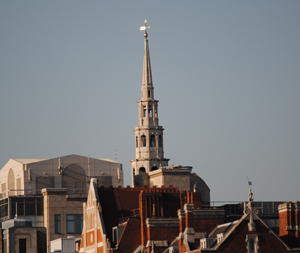
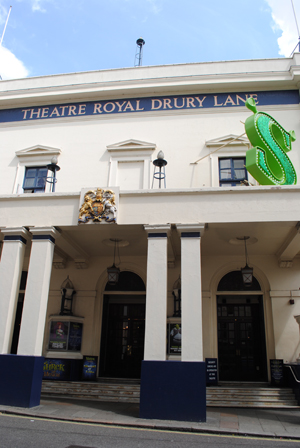
While the remains of some of London’s oldest purpose-built theatres – such as The Rose and The Globe – can be found in once notorious Southwark, London’s oldest, still-in-use theatre is in fact in the West End. The Theatre Royal Drury Lane (not to be confused with the Theatre Royal Haymarket) apparently takes the honor – the latest incarnation of a theatre which has still on the same location since 1663.

First built on the orders of Restoration-era dramatist and theatre manager Thomas Killigrew, the original theatre on the site – where King Charles II’s mistress Nell Gwynn apparently trod the boards and which was originally known as the Theatre Royal in Bridges Street – was burnt down in 1672 only to be rebuilt to the designs of Sir Christopher Wren two years later.

This building lasted for more than a century before it too was demolished – this time to make way for a larger theatre which opened its doors in 1794. Fire seems to have been a perennial problem, for it too burned down in 1809, being rebuilt and opened again in 1812 with a performance of Hamlet (the current building, designed by BenjaminWyatt).

Now owned by star composer Andrew Lloyd Webber via his Really Useful Group, the building has associations with some of London’s theatreland’s finest names – everyone from eighteenth century actor David Garrick (one of the theatre’s managers) to early nineteenth century child actress Clara Fisher and, in more recent times, Monty Python.

Currently hosting Shrek: The Musical, other recent productions there have included Miss Saigon and a musical adaption of Lord of the Rings.

Treasures of London – The White Tower

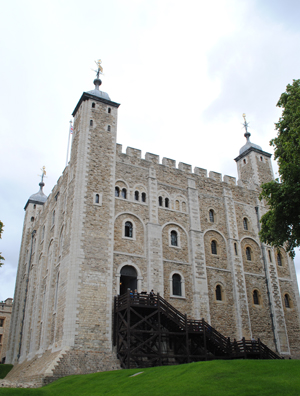
It’s one of London’s most famous landmarks and, having just undergone a three year, £2 million restoration, we thought it was time to take a look at the origins of the White Tower.

Now the keep of the Tower of London, the White Tower was first built by the Norman King William the Conqueror following his defeat of Saxon King Harold Godwinson and the cream of the Saxon army at the Battle of Hastings in 1066.

Following his coronation at Westminster Abbey on Christmas Day, King William then withdrew to Barking Abbey while his men built several temporary strongholds in the city to ensure it wouldn’t cause any trouble – this included an earth and timber keep standing on an artificial mound in the south-east corner of the city’s Roman-era walls.

The White Tower, a permanent structure, replaced this and although the exact date its construction started is unknown, building – under the watchful eye of Gundulf, the Bishop of Rochester, was well underway by the mid-1070s. While the labourers were English, the masons in charge of the building were Norman and then even used some Caen stone imported from William’s homeland (along with Kentish ragstone). By 1097 the tower was complete.

Primarily built as a fortress rather than for comfort, the size of the Tower was intimidating and, at 27.5 metres tall, it would have dominated the skyline for miles. Initial defences surrounding the White Tower included the Roman walls and two ditches although in later years outer walls were added to create the massive fortifications and series of towers one encounters at the site today.

The tower earned its moniker, the White Tower, from the whitewash used on its walls during the reign of King Henry II. The caps on the four turrets which stand at each corner of the tower were originally conical but were replaced with the current onion-shaped domes in the 1500s (the round tower was once home to the Royal Observatory before it moved out to Greenwich). The White Tower’s large external windows are also more modern innovations, these were added in the 1600s by Sir Christopher Wren.

The original entrance to the White Tower was on the first floor, reached by a wooden staircase (that could be removed if necessary), much as it is today while, for security reasons, the internal stone spiral staircase was placed as far from this entry as possible in the north-east turret. A stone forebuilding was later added during the reign of King Henry II but was later demolished.

Inside, accommodation for the king was provided on the second floor – it originally had a gallery above but an extra floor – still there today – was later added. Accommodation for the Tower’s constable was probably on the first floor. Both floors were divided in two – with a large hall on one side and smaller apartments on the other. These rooms now house displays on the Tower’s history – at the present these include the Royal Armouries’ exhibition ‘Power House’.

The White Tower is also home to the Chapel of St John the Evangelist which, made from Caen stone, still looks much the same as it did in Norman times. It was used by the royal family when in residence at the tower but by the reign of King Charles II had become a store for state records. These were removed in 1857. Among some of the events which took place here was the lying in state of Queen Elizabeth of York, wife to King Henry VII, after her death in 1503, and the betrothal of Queen Mary I to Philip of Spain in 1554 (by proxy, Philip was not present). Prince Charles received communion here on his 21st birthday.

Other historic events associated with the White Tower include the apparent murder in 1483 of the ‘Princes in the Tower’ – King Edward V and his younger brother, Richard, Duke of York – while legend says they were killed in the Bloody Tower, the discovery of two skeletons under stairs leading to the chapel during building works in 1674 has led some to believe that they may have been buried here.

It was also in the White Tower that King Richard II was forced to sign away his throne to King Henry IV in 1399 and it was from the White Tower that Gruffydd ap Llywelyn Fawr, the illegitimate son of  Welsh Prince Llywelyn the Great, apparently fell to his death while attempting to escape captivity in 1244.

There are tours of the White Tower daily at 10.45am, 12.45pm, and 2.15pm.

WHERE: Tower of London (nearest tube station Tower Hill); WHEN: 9am to 5.30pm, Tuesday to Saturday, 10am to 5.30pm Sunday to Monday (until 31st October); COST: Included in Tower of London admission – £19.80 adults; £10.45 children under 15; £17.05 concessions; £55 for a family (prices include a voluntary donation); WEBSITE: www.hrp.org.uk/toweroflondon/.

LondonLife – The Royal Menagerie

A new exhibition has opened at the Tower of London celebrating the Royal Menagerie which was located there for more than 600 years.

Over the years featuring everything from lions and leopards to elephants, camels, kangaroos and crocodiles, the menagerie was founded at the Tower of London during the reign of King John (1199-1216), although as far back as the reign of King Henry I (1100-1135) animals were being presented to the king as gifts. Some notable early animals included a ‘white bear’ believed to be a polar bear from Norway and an African elephant, a gift of King Louis IX of France, both of which were presented to King Henry III.

While the early location of the menagerie – which had a long history of attracting curious sightseers – remains unknown, during the rein of King Edward III (1327-1377) there is reference to it being in a position near the Middle Tower (now the main entrance to the Tower) which suggests it was then already located in what became known as the Lion Tower – a now ruined barbican built by King Edward I in 1276-77.

Animal accommodations in the Lion Tower were substantially upgraded during the reign of King James I (1603-1625) – James was noted to have enjoyed watching the lions fight other animals in the tower’s exercise yard). Further upgrades were made under the watchful eye of Sir Christopher Wren, then Surveyor of the King’s Works, between 1672 and 1675.

The office of the menagerie’s ‘keeper’, meanwhile, had been  formalised in the 1400s with the title awarded for life – it was subsequently held by some important officials.

While in 1687 some of the beasts and birds were transferred to new accommodations at St James’s Park, the menagerie remained at the Tower until 1830 when, following the death of King George IV, the decision to move the animals – then said to number 150 – to the recently founded Zoological Society of London’s zoo at Regent’s Park. Initially only some animals were sold to the zoo but by the end of 1835 the menagerie had been completely emptied with many of the remaining animals apparently sold to an American ‘showman’ Benjamin Franklin Brown who exported them to the US.

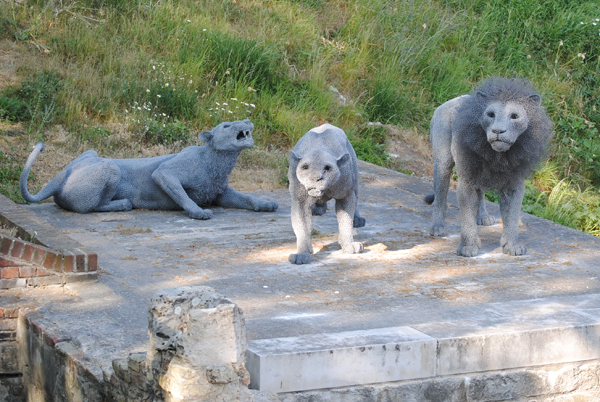
The new exhibition, Royal Beasts, is housed in the newly opened Brick Tower (entry via the Martin Tower, itself entered via the wall walk), and gives visitors views from a hitherto closed-off part of the north wall. There are also a series of life-size sculptures of various animals (see the three lions pictured), created by artist Kendra Haste, located around the tower. And, to gain a feel for how the menagerie was viewed during different eras, you can watch the short live action show featuring some of the “rarees” and “curiosities” which were housed within the tower (check with staff for times).

For more on the menagerie’s history, see Geoffrey Parnell’s guide, ‘The Royal Menagerie at the Tower of London’, available for sale at the Tower (£3.99).

WHERE: ‘Royal Beasts’, Tower of London (nearest tube station Tower Hill); WHEN: 9am to 5.30pm, Tuesday to Saturday, 10am to 5.30pm Sunday to Monday (until 31st October); COST: Included in Tower of London admission – £19.80 adults; £10.45 children under 15; £17.05 concessions; £55 for a family (prices include a voluntary donation); WEBSITE: www.hrp.org.uk/toweroflondon/.

LondonLife – St Paul’s celebrates 300 years since its completion…

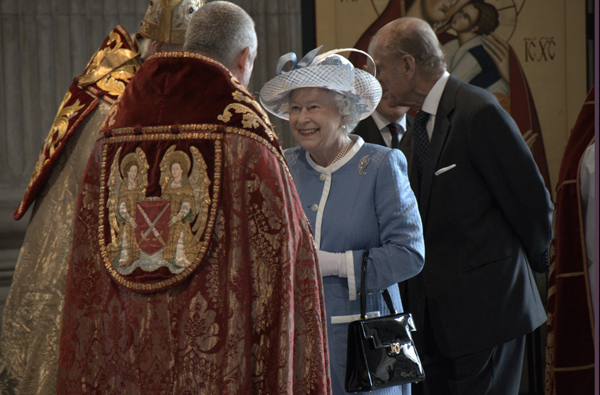
Queen Elizabeth II attends the tercentenary service at St Paul’s. PICTURE: Graham
Lacdao/St Paul’s Cathedral

A service was held at St Paul’s today in celebration of the 300 year anniversary of the cathedral’s completion.

The tercentenary service also marks the end of a massive 15 year, £40 million repair and cleaning project, meaning the cathedral is now clear of scaffolding for the first time in 15 years.

Designed by the indomitable Sir Christopher Wren, work on St Paul’s Cathedral began in 1677 and was formally completed in 1710 (although it had been holding services since 1697). (For more on the history of St Paul’s, see our earlier post, part of our series on Wren’s London, here).

Said to have the largest dome after St Peter’s in Vatican City, St Paul’s has been at the centre of London’s (and the United Kingdom’s) religious and political life for centuries, hosting state funerals (Lord Nelson, the Duke of Wellington and Winston Churchill’s were all held here) as well as the royal wedding of Prince Charles and Lady Diana and many celebration services.

Sights include the crypt – containing the tombs of both Nelson and Wellington – and the Whispering Gallery (see our earlier post on the Whispering Gallery here) as well as the exterior viewing galleries.

To celebrate the cathedral’s liberation from scaffolding, St Paul’s is holding a 300th Anniversary Photography Competition in which photographers are invited to submit their best exterior shots of the building. The 10 winning images will then be displayed in the cathedral crypt. The competition runs until 16th July.

To enter, upload pictures to St Paul’s 300th anniversary competition group at Flickr – www.flickr.com/groups/stpaulslondon/. For more information, see www.stpauls.co.uk/photocomp.

Treasures of London – The Whispering Gallery, St Paul’s Cathedral

Found 98 feet (30 metres) above the cathedral’s floor, the Whispering Gallery at London’s iconic St Paul’s Cathedral is an architectural marvel.

As with other “whispering galleries” found around the world, its construction is such that something whispered into the wall on one side of the gallery, which runs around the interior of the cathedral’s inner dome (part of the first ever ‘triple dome’), can be heard on the other side of the gallery, around 100 feet (30 metres) away.

The dome (pictured right), the design of which draws inspiration from that of St Peter’s Basilica in Vatican City, was constructed to the designs of Sir Christopher Wren. The cathedral, including the dome, was essentially completed in 1708.

As well as giving views down into the cathedral, the Whispering Gallery – a relatively easy climb of only 257 steps – also provides a close-up view of murals painted on the dome’s inner surface by Sir James Thornhill. Painted between 1715 and 1719, these depict images from St Paul’s life.

Two further galleries on the dome are also publicly accessible – the Stone Gallery, which stands 173 feet (53.4 metres) above the cathedral floor, and the Golden Gallery, which stands 280 feet (85.4 metres) above the cathedral floor and offers stunning views of the city as well as southward over the Thames. But be prepared for a long climb – 528 steps – up what are in places narrow, winding staircases.

The current ball and cross on top of the dome date from 1821 (these replaced those which had first topped the cathedral). Together they stand 23 feet (seven metres) high and weigh seven tonnes.

WHERE: St Paul’s Cathedral, St Paul’s Churchyard (nearest tube station is St Paul’s); WHEN: The galleries are open from 9.30am to 4.15pm, Monday to Saturday (small children must be accompanied by an adult)/Cathedral is open from 8.30am;  COST: £14.50 an adult/£13.50 concessions and students/£5.50 a child (6-18 years)/£34.50 a family of four; WEBSITE: www.stpauls.co.uk
What’s in a name?…Pall Mall

This curiously named street in the heart of London’s St James district traces the origins of its moniker back to the 17th century when the game of “pall mall” (“pell mell” and “paille maille” being among a host of alternative spellings) was played there.

The game, mentioned by Samuel Pepys in his famous diary, involves the use of a mallet and ball similar to that used in modern croquet but, according to some commentators, pall mall was more likely a predecessor of golf than croquet, with players attempting to belt the ball as far as possible along a pitch before putting the ball through a hoop suspended high off the ground.

Pall Mall, which runs parallel to The Mall from St James’ Street in the west to Haymarket in the east with an eastern extension, Pall Mall East, completing the journey from Haymarket into the northern end of Trafalgar Square, became famous in the 19th and early 20th centuries for housing numerous ‘gentlemen’s clubs’. Among those still in business are the Travellers Club, the Athaenaeum Club, the Reform Club, the Army and Navy Club, the Oxford and Cambridge Club, and the Royal Automobile Club.

St James’s Palace sits at the street’s western end and it is of note that nearly all of the southern side of the street is still part of the Crown Estate (the exception being a home Charles II is believed to have given to the actress Nell Gwynne, who apparently sensibly demanded the freehold on the property).

Other buildings along the street include Schomberg House, built for the Duke of Schomberg in the late 17th century (only the facade of which remains), and the Sir Christopher Wren-designed Marlborough House, which is tucked in between Pall Mall and The Mall and sits opposite St James’s Palace. The National Gallery and the Royal Academy also both briefly had homes in Pall Mall.

Wren’s London – 10. The Monument, The Temple Bar, and more churches…

So we come to the final in our series on Wren’s London. This week we take a quick look at some of Wren’s remaining London works (keep an eye out for our upcoming ‘daytripper’ on Oxford for some detail of his works there)…

• The Monument. Built between 1671-77 to commemorate the Great Fire of London, it was designed by Wren and Dr Robert Hooke. For further information, see our previous post.

The Temple Bar. Designed by Sir Christopher Wren in 1672 to replace a crumbling wooden predecessor, it’s only recently been returned to the City and now stands adjacent to St Paul’s. For further information, see our previous post.

Churches. We’ve only looked in depth at a few of the existing churches Wren designed in London. But here are some of the others among the more than 50 he designed that still stand:

St Benet Paul’s Wharf. Originally completed in 1685, it claims to be the only “undamaged and unaltered” Wren church in the city, having survived World War II intact. Now the Welsh church of the City of London. See www.stbenetwelshchurch.org.uk.

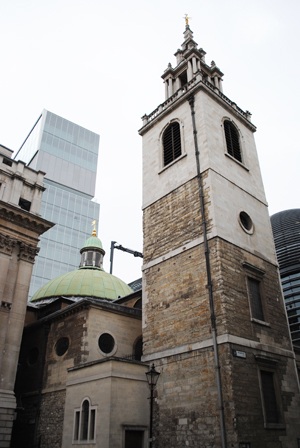
St James Garlickhythe. Built according to Wren’s design, it was completed in 1682 (the tower not until 1717). It is known as ‘Wren’s Lantern’ due to its light interior. See www.stjamesgarlickhythe.org.uk.

St Margaret Pattens. Built between 1684 and 1687 after the previous church was destroyed in the Great Fire, the church gets its unusual name of ‘pattens’ from wooden undershoes that were worn to elevate people out of the mud, and were sold nearby. See www.stmargaretpattens.org.

• St Margaret Lothbury. Completed in 1692, it now incorporates seven adjacent parishes thanks to losses in the Great Fire, World War II and building projects and is now officially known as the parish church of “St Margaret Lothbury and St Stephen Coleman St with St Christopher-le-Stocks, St Bartholomew-by-the-Exchange, St Olave Old Jewry, St Martin Pomeroy, St Mildred Poultry and St Mary Colechurch.” See www.stml.org.uk.

St Martin-within-Ludgate. Rebuilding was largely completed by 1680. The previous church on the site was where William Penn, founder of Pennsylvania, was married. See www.stmartin-within-ludgate.org.uk.

Others, some of which have been rebuilt since Wren’s day, include St Andrew-by-the-Wardrobe, St Andrew Holborn, St Anne and St Agnes (Now St Anne’s Lutheran Church), St Clement Eastcheap, St Lawrence Jewry, St Mary Abchurch, St Mary Aldermary, Mary-le-Bow, St Michael, Cornhill, St Michael Paternoster Royal, St Nicholas Cole Abbey (being redeveloped as a centre for religious education), St Peter upon Cornhill, and St Vedast alias Foster. (We’ll be featuring some in more detail in later entries).

Wren’s London – 9. Marlborough House

We’re nearing the end of our series on Wren’s London (next week we’ll take a final look at some of the Wren designs we’ve not yet mentioned), so this week we look at one of his lesser known (and less accessible) designs – Marlborough House.

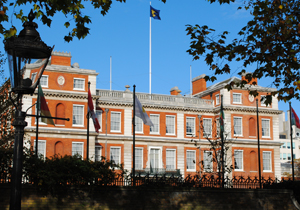
Tucked away behind high brick walls next to St James’ Palace just off Pall Mall, Marlborough House was built for Sarah Churchill, the Duchess of Marlborough – a confidant of Queen Anne – and completed in 1711.

The duchess, who secured a lease of the site from Queen Anne, selected Sir Christopher as the architect in preference to Sir John Vanbrugh, but she later fell out with Wren and, after dismissing him, oversaw the completion of the building herself. It is believed that the design of the house was actually the work of Wren’s son, also named Christopher, although the plans were undoubtedly drawn up under Wren senior’s watchful eye.

The house, built of red Dutch bricks brought to England as ballast in troop transports, was noted for its plain design. But the walls of the central salon and staircases were decorated with scenes of battles the Duke had fought in.

The property remained in the hands of the Dukes of Marlborough until it was acquired by the Crown in 1817. The building – which was substantially extended in the mid 1800s to the designs of Sir James Pennethorne – was subsequently used by members of the royal family including Princess Charlotte (only daughter of the future King George IV) and her husband Prince Leopold (later the King of the Belgians), Queen Adelaide, widow of William IV, Edward, Prince of Wales (later Edward VII), George, Prince of Wales (later George V), King Edward VII’s widow, Queen Alexandra, and, lastly, Queen Mary, widow of  George V.

Following the death of the Queen Dowager in 1953, Queen Elizabeth II donated it for use by the Commonwealth Secretariat who still occupy the building today.

WHERE: Pall Mall (nearest Tube stations are Green Park and Piccadilly); WHEN: Two hour tours are usually held every Tuesday morning (check first); WEBSITE: www.thecommonwealth.org/Internal/191086/34467/marlborough_house/

Wren’s London – 8. Old Royal Naval College, Greenwich

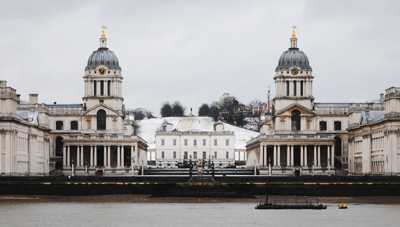
Hunkering down on the south bank of the Thames, the Old Royal Naval College at Greenwich is yet another Wren masterpiece and the centrepiece of the UNESCO-listed Greenwich Maritime World Heritage Site.

What is now known as the college was originally designed as a ‘hospital’ or retirement home for old or infirm sailors. Established by Royal Charter in 1694, it was King William III who pushed the project into fruition as per the wishes of his then late wife Queen Mary II.

Wren was selected to design the building and along with the diarist John Evelyn, who had been appointed treasurer, laid the foundation stone on 30th June, 1696.

Wren’s initial design – for a three side courtyard facing the river – was rejected by Queen Mary who insisted the view from the existing Queen’s House to the river be maintained. So, instead, the hospital was built as a series of four pavilions, each with its own court, with the Queen’s House standing as it’s centrepiece when viewed from the river.

Wren himself never lived to see the building’s completion – it was in the end completed by a number of other famous architects including Sir John Vanbrugh, Thomas Ripley, and Wren’s pupil Nicholas Hawksmoor. Fortunately Wren had laid out all the foundations which ensured the basic design conformed to his plans.

The first 42 pensioners moved in in 1706 and the numbers grew as buildings were completed to a peak of 2,710 in 1814. However, declining numbers of pensioners by the mid 1800s – thanks to a period of peace on the seas and the success of a program which saw more pensioners living with their families, eventually led to the hospital’s closure in 1860.

In 1873, the Royal Naval College took over the premises, assuming the role of both the former Naval College at Portsmouth and the School or Naval Architecture and Marine Engineering which had been based in South Kensington. The Naval Staff College opened on the site in 1919 and further navy departments including the Department of Nuclear Science and Technology moved there in later years. The Royal Navy left the college in 1998.

Now in the care of the Greenwich Foundation, the college is now used by the University of Greenwich and the Trinity College of Music as well as for public events. The public can also visit certain parts of the former college including the grounds, the spectacular Painted Hall and the Chapel.

The domed Painted Hall, which features a series of classically themed paintings with King William III and Queen Mary II at its heart, was originally planned by Wren to be the hospital’s dining hall but due to the length of time it took for Sir James Thornhill to complete – 19 years – his paintings it was never used as such. Instead it stood empty until the body of Admiral Lord Nelson was brought there to lie in state in January 1806. In 1824 it became the National Gallery of Naval Art but in the 1930s became a dining room again with the gallery’s contents transferred to the National Maritime Museum.

The Chapel of St Peter and St Paul, meanwhile was completed in 1751 to the design of Sir Thomas Ripley but was gutted by fire only 28 years later. It was then rebuilt, largely to the designs of James “Athenian” Stuart with some of the detailing designed by his Clerk of Works William Newton, and was reopened in 1789. Restored in the 1950s, it is said to look “almost as it was” when it opened in 1789. The chapel is still in use for services.

WHERE: Located adjacent to Greenwich Pier with entry from Cutty Sark Gardens, College Approach, Romney Road Gate, Royal Gate or Park Row, Greenwich (nearest DLR station is Cutty Sark for Maritime Greenwich); WHEN: The Painted Hall and Chapel are open daily from 10am to 5pm (chapel used for worship on Sunday mornings, open for sightseeing  from 12.30pm); COST: Free (Booked guided tours are available for £5 an adult/children under 16 free); WEBSITE: www.oldroyalnavalcollege.org

Wren’s London – 7. Kensington Palace

A once favored residence of British monarchs, Kensington Palace’s connections with royalty date back to 1689 when, then a private country home known as Nottingham House, the building was purchased by King William III and Queen Mary II.

The royal couple turned to Sir Christopher Wren, then Surveyor of the King’s Works, who was charged with adapting the property into a suitably regal residence.

Wren’s work included the addition of four new pavilions – one at each corner – to provide extra accommodation for the king and queen. The King’s Apartments, approached by a Grand Staircase, were located in the south east, and the Queen Apartment’s in the north west. While many later additions were made, the basic layout of these buildings remains true to Wren’s original design.

Among the many spectacular original rooms is the King’s Gallery, built for William in 1695. It features an 1694 wind dial connected to a weather vane which turns according to the direction of the prevailing wind.

The property’s subsequent royal residents have included Queen Anne, King George I and King George II (it was King George III who made Buckingham Palace his primary London residence). Princess (later Queen) Victoria was born here in 1819 (it was she who first opened the State Apartments to visitors in 1899) while more recent residents in the palace’s private areas have included Princess Margaret and, of course, Diana, Princess of Wales.

WHERE: The Broad Walk, Kensington Gardens, Kensington (nearest tube stations are High Street Kensington or Queensway); WHEN: Daily 10am to 5pm (last admission 4pm); COST: £12.50 adult/£11 concession/£6.25 child/£34 family (online booking discounts available, Historic Royal Palaces members free); WEBSITE: www.hrp.org.uk/KensingtonPalace

PICTURE: Historic Royal Palaces/newsteam.co.uk

Wren’s London – 6. St Stephen Walbrook, St Mary-le-Bow, and St Mary-at-Hill

Sir Christopher Wren was responsible for designing more than 50 churches in the City of London after the Great Fire of 1666. We’ve already touched on a couple in this series – St Paul’s, of course, and St Bride’s in Fleet Street – and while we won’t be looking at all of rest in detail, here are three stars that have survived…

• St Stephen Walbrook, which is the parish church of the Lord Mayor and was that of Wren himself, is a little gem of a church and is generally thought to be the finest of Wren’s city churches from an architectural perspective. Tucked away behind Mansion House in Walbrook, the church as we know it was built between 1672-79 (although there may have been a Christian church on the site as early as 700 AD) and features a beautiful coffered dome (a sign of what was to come when Wren built St Paul’s). These days the chairs are arranged around white altar stone by sculptor Henry Moore which has been placed under the centre of the dome. Other features worth noting are Wren’s original altar screen and a glass-encased telephone which was the first dedicated help-line in London for the suicidal established by the charity Samaritans. These days the church is home to the London Internet Church. For more information, see http://ststephenwalbrook.net.

• St Mary-le-Bow, which is named for the bow-shaped arches in the Norman-era crypt, was rebuilt by Wren in 1670-80 after the Great Fire. In keeping with the church’s name, he designed a steeple with arches resembling the ‘bows’ below. While the church, located in Cheapside, was badly damaged when bombed in World War II, the steeple – topped by an original 1674 weathervane shaped like a dragon – remained standing along with the outer walls. The church was restored in the mid-Twentieth century and the bells, destroyed in a German air raid, rehung. It’s said that only those born within the sound of St Mary’s bells can be said to be true Cockneys (the Bow bells were also those Dick Whittington apparently heard when leaving London, leading him to turn around and embrace fame and fortune). For more information, see www.stmarylebow.co.uk.

• St Mary-at-Hill, which has served the parish of Billingsgate for almost 1,000 years, was one of the first to be rebuilt after the Great Fire. Both Wren and his assistant Robert Hooke were believed to have been involved in building the church, which was completed in 1677 and lies in Lovat Lane, just off Eastcheap. It was designed as a Greek cross with a dome at its centre  – Wren later put forward a similar design for for St Paul’s which was rejected. Overhauled in the late 1700s and a couple of times in the 1800s, it survived World War II only to be damaged extensively by fire in 1988 after which it was restored. The church’s connection to Billingsgate – the site of London’s former fish market lies just down the road – means that the fish harvest is still celebrated here every October. For more information, see www.stmary-at-hill.org.

Wren’s London – 5. Royal Hospital Chelsea

Known as the home of the scarlet-coated ‘Chelsea Pensioners’, the Royal Hospital Chelsea’s origins go back to December 1681 when King Charles II issued a Royal Warrant authorising the building of a royal hospital to care for old and maimed soldiers.

Sir Christopher Wren, then Charles II’s Surveyor-General of Works, was subsequently commissioned to design and construct the new buildings on a site next to the River Thames in Chelsea. Sir Stephen Fox, a commissioner of the Treasury, had the unenviable task of finding enough money to fund it – a task he managed through tapping a range of different sources.

Charles II didn’t live to see the completed project (although he did inspect the partially complete work just before his death in 1685) which was finally finished in 1692. The first pensioners were admitted in February that year.

Wren’s initial design comprised a single quadrangle with accommodation blocks for more than 400 veterans and their officers on the sides, and a chapel and great hall in a colonnaded building at the northern end while the southern end is open to the river (the picture above shows the ‘rear’ of the Hospital as seen from Royal Hospital Road). Known as Figure Court, it was named after a 7′ tall statue of Charles II which stands within it and which depicts the king as a Roman general.

Before the work was complete, however, Wren had realised that the design would not be large enough and added a two further quadrangles – one on each side of the original, they are known as Light Horse and College Courts – to the design.

There are some 300 ‘in-pensioners’ who still live in the hospital’s ‘berths’. When inside, they are encouraged to wear the Royal Hospital’s blue uniform while their famous scarlet coats with tricorne hats are worn on ceremonial occasions including Founder’s Day.

Held on a day close to 29th May – Charles II’s birthday and the date of his restoration – Founder’s Day commemorates his escape after the Battle of Worcester in 1651 and is known as Oak Apple Day in remembrance of the story that the fleeing Charles had to hide in an oak tree to avoid capture by parliamentary forces.

Women were first admitted to the hospital in 2009.

WHERE: Royal Hospital Road, Chelsea (nearest tube station is Sloane Square); WHEN: Entry to the courts, chapel and Great Hall is from 10am to 12pm, 2pm to 4pm; the museum is open Monday to Saturday, 10am to noon, 2pm to 4pm and Sundays 2pm to 4pm (closed Sundays from October to March); COST: Free; WEBSITE: www.chelsea-pensioners.co.uk

Wren’s London – 4. Hampton Court Palace

Hampton Court Palace in London’s outer south-west is known to many as the palace of Henry VIII. Yet a considerable part of the complex of buildings we see today was also created during the reign of some time joint rulers William III and Mary II.

It was to Christopher Wren – assisted by the able Nicholas Hawksmoor – that the rulers turned when looking to update the Royal Apartments. Wren’s designs for a domed baroque palace to rival Versailles in France were apparently so ambitious that they were only half-built (and built in haste – two workmen died and another 11 were injured when the main wall collapsed in 1689). The death of the queen in 1694 also meant work on the palace stopped – it was resumed in 1697 (under control of Wren’s deputy William Talman who had offered a lower price than Wren) but again stalled after the death of the king in 1702.

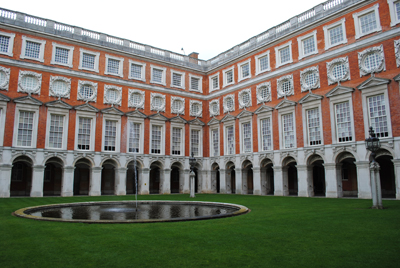
Wren’s imprint is on the palace we see today is nonetheless considerable and includes the Baroque-style South and East Front (the size of the formal gardens which radiate out from the latter give a glimpse into the grand plans Wren had for the palace), Fountain Court which replaced the Tudor Cloister Court and around which were located new state apartments for both the king and queen, and the Orangery.

Among those who worked on the interiors of were the famous woodcarver Grinling Gibbons and painter Antonio Verrio.

WHERE: Hampton Court Palace, East Molesey, Surrey (nearest station is Hampton Court from Waterloo); WHEN: 10am to 6pm everyday (winter hours 10am to 4.30pm from 31st October to 26th March); COST: Adult £15.40, Concession £12.65, Child under 16 £7.70 (under fives free), family tickets, garden only tickets and online booking discounts available; WEBSITE: www.hrp.org.uk/HamptonCourtPalace/

Wren’s London – 3. The Royal Observatory, Greenwich

Leaving Wren’s churches momentarily, we turn this week to another of Wren’s designs, that of the Royal Observatory in Greenwich in London’s east.

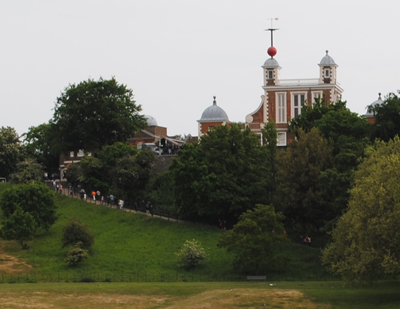
Commissioned in 1675 by King Charles II, the first part of the observatory – Flamsteed House, named for the first Astronomer Royal, John Flamsteed – was designed by Wren with, it is believed, the assistance of architect and scientist Robert Hooke.

Built using second-hand materials including stone brought from a Tudor fort at Tilbury, Flamsteed House was located on the former site of Greenwich Castle which had been previously used as a guest house and hunting lodge by Henry VIII. It is said to be the first purpose-built scientific research facility in the country.

The turreted building includes the Octagon Room from which Flamsteed made observations of events in the skies (although its position meant its use for this was somewhat limited), as well as living quarters for the astronomer. On top of the house is a red time ball which, since it was first used in 1833, has marked the time by falling at 1pm each day.

These days part of the National Maritime Museum and a UNESCO World Heritage Site since 1997, the site also hosts the Prime Meridian and is the place from where Greenwich Mean Time, since 1884 the basis for all world time, is calculated.

WHERE: Blackheath Avenue, Greenwich (nearest DLR station is Cutty Sark); WHEN: 10am to 5pm Monday to Sunday; COST: Entry is free; WEBSITE: www.nmm.ac.uk/places/royal-observatory/

Wren’s London – 2. St Bride’s

While St Paul’s Cathedral is certainly his best-known work, Sir Christopher Wren designed 50 other churches in London in the wake of the Great Fire of 1666. Rather than look at each individually, we’ll just highlight a couple with the first being the “wedding cake” church, St Bride’s.

The site of St Bride’s has been home to at least eight churches, the first of which is believed to have been founded in the Dark Ages. Dedicated to the sixth century Irish nun St Bride – or St Bridget, the church – thanks to its location on Fleet Street – has had a long association with printers and later newspapers and journalists and, despite the fact most news organisations have long since departed the area, is still regarded as “the journalist’s church”.

The medieval St Bride’s was completely consumed in the Great Fire but a new church was opened in 1675 after works were carried out to Wren’s design (among his assistants on the job was Nicholas Hawksmoor who became a celebrated architect in his own right).

Despite the return of worshippers, however, the building remained unfinished and Wren was approached in the early 1680s about constructing the steeple. This was completed in 1703 and has become a London landmark with many believing its tiered design was the basis for the modern “wedding cake” design.

The steeple – at 226 feet or almost 70 metres, the tallest in London – was one of few things which survived after a firebomb destroyed much of the building during the Blitz in 1940. The church was subsequently restored according to Wren’s original designs (albeit with a shorter steeple than Wren’s original – eight feet or 2.4 metres were knocked off when it was struck by lightning in 1764.)

As well as its association with the printing industry and the press, these days St Bride’s is also notable for its US connections – the first American child of English descent, Virginia Dare, was the daughter of two former St Bride’s parishioners (there is a bust of Virgina above the font). The parents of Edward Winslow, three-time Governor of Plymouth in Massachusetts, were also married in St Bride’s.

The crypt contains remains dating back to Roman times.

WHERE: Fleet Street (nearest tube St Paul’s); WHEN: 8am to 6pm Monday to Friday, 11am to 3pm Saturday, 10am to 1pm and 5pm to 7.30pm Sunday; COST: Entry is free but guided tours are available on Tuesday afternoons at 3pm for £5 a person; WEBSITE: www.stbrides.com.

Wren’s London – 1. St Paul’s Cathedral

In a new special, we’re taking a look at some of the key sites London landmarks designed by renowned 17th century architect Sir Christopher Wren. To kick it off, we’re taking a look at the building for which he is most known, St Paul’s Cathedral.

Wren’s involvement with the current St Paul’s came after the Great Fire of London in 1666 left the old medieval cathedral in ruins (there is believed to have been four previous cathedrals built on the site with the first dating from around the early 600s). He had already been involved in repairing the old cathedral and had even submitted plans for a new domed cathedral on the site when the Great Fire swept through the city.

Wren had already been appointed Surveyor to the King’s Works when, in 1668, he was asked to submit plans for the a new cathedral. After his first few designs were rejected and abandoned, Wren’s plans, albeit substantially altered, were finally approved and the first stone laid in 1677.

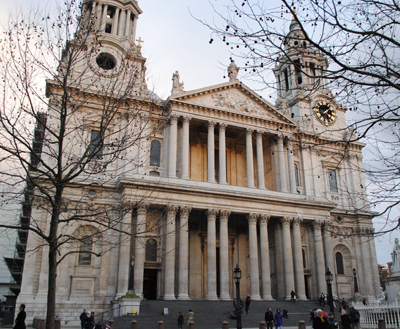
The design was ambitious and the church now features what is the second biggest dome in the world after that of St Peter’s in Rome as well as a monumental west-facing facade complete with two towers (the final form of the western facade wasn’t settled until 1707 and both of the towers were originally designed to hold clocks. In the end only the right tower did.)

Building took more than 30 years and it wasn’t until 1710 that the new cathedral was officially declared completed. Interior features include the Whispering Gallery (located 30 metres above the floor below the central dome, it gets its name from the fact that a person whispering into the wall can be heard across the dome by someone who puts their ear to the wall), choir stalls which feature the work of renowned woodcarver Grinling Gibbons, and poet/preacher John Donne’s memorial from 1631, the only pre-Great Fire monument to survive intact. There are spectacular views over London from the Stone Gallery or the highest point of public access, the Golden Gallery.

Since its opening, St Paul’s has hosted the burials of numerous of Britain’s luminaries – the tombs of Admiral Horatio Nelson and the Arthur Wellesley, the Duke of Wellington, are both in the crypt as are those of 18th century painter Sir Joshua Reynolds and Sir Alexander Fleming, the man who discovered penicillin along with a host of memorials. Others events hosted at the cathedral include Winston Churchill’s funeral and the wedding of Prince Charles and Lady Diana in 1981.

Wren, who died in 1723, was the first person to be interred in the crypt. His tomb bears an inscription in Latin which says: “Reader, if you seek a monument, look around you.”

WHERE: Ludgate Hill. Nearest tube is St Paul’s; WHEN: Monday to Saturdays, 8.30am to 4pm. COST: £12.50 adults/£11.50 seniors/£9.50 students/£4.50 children (aged 6-16)/£29.50 family; WEBSITE: www.stpauls.co.uk
10 sites in London you may not know about – 3. Temple Church

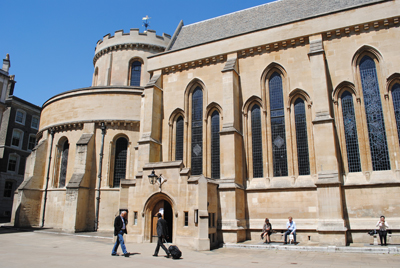
Located just outside the west end of the medieval city walls, the Temple Church is an anomaly in a city where, thanks to the Great Fire of 1666, few medieval churches remain.

First consecrated in 1185, the church – like all Templar churches – features a round nave – known as the Round Church – modelled on that of the Holy Sepulchre in Jerusalem. It adjoins a ‘Hall Church’ which features three bays dating from the 13th century.

While they have been moved several times, the Round Church contains a number of tomb effigies including those believed to be that of William Marshall, 1st Earl of Pembroke and one of the towering figures of the 12th and early 13th centuries.

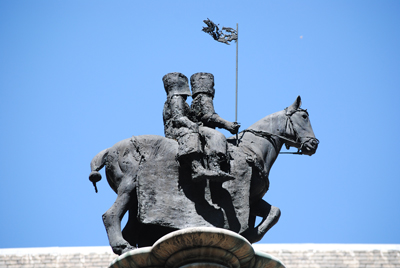
It also features a series of faces around the outer wall (these were renewed and replaced in the 1820s), each of which shows a different and, at times, plain odd expression.

The church is located in the midst of what was once a large landholding – located between Fleet Street and the Thames – once owned by the Templar Knights which included quarters for the knights and serjeants. Following the disbanding of the order in early 1300s, the Temple Church passed into the hands of the Knights Hospitaller and then became the property of the Crown during the 16th century reformation.

In 1608, James I granted all the Templar’s land to the societies of the Inner and Middle Temple, two of London’s Inns of Court – the inns are still dedicated to housing those studying and practising law and it’s the inns which maintain the church today.

One of the most famous figures connected to the church is Richard Hooker, Master of the Temple between 1585-91, and author of Of The Laws of Ecclesiastical Polity, an important document in Anglican theological thought.

Christopher Wren also left his mark here – he refurbished the church’s interior in the 1670s although much of work was later removed – as did World War II – the roof of the Round Church was brought down during the Blitz.

Make sure you pop in for one of the free organ recitals which are held over lunchtimes each Wednesday.

WHERE: Off Fleet Street and down Inner Temple Lane (nearest tube station is Temple); WHEN: Check website for times; COST: £4 (free to under 18s and seniors); WEBSITE: www.templechurch.com

10 London sites you might not know about – 2. The Monument

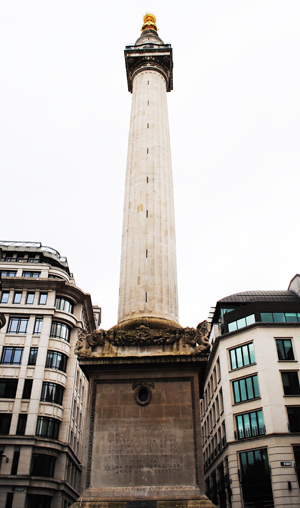
The MonumentIt was a toss-up whether to include The Monument in this list but, surprisingly perhaps, there are still many visitors to London who overlook what is a unique site in the old city of London and a reminder of one of the key events which have shaped the city.

The tallest free-standing stone column in the world, it was built between 1671-77 to commemorate the Great Fire of London in 1666 and the subsequent rebuilding of the city. The fire broke out in a baker’s shop in nearby Pudding Lane on Sunday, 2nd September, 1666, and burned until the following Wednesday, destroying much of the city in the meantime (although, thankfully, there was actually little loss of life).

Sir Christopher Wren (architect of St Paul’s fame and then Surveyor-General to King Charles II) and Dr Robert Hooke (Surveyor to the City of London and Wren’s assistant) designed the memorial which is topped by a drum and copper urn from which flames are emerging and stands 61 metres above the ground and which, if toppled, reaches the point in Pudding Lane where the fire began.

A spiral stone staircase winds it way up the column’s middle to a platform where you can get come stunning views of the city (but be warned at 311 steps, it’s quite a climb, although at least since 1842 there’s been an iron railing around the platform).

The reliefs on the western side of the base shows Charles II in all his glory while inscriptions on the other three sides tell the story of the great fire (incidentally, the main inscription, was altered in 1681 to include the words “But Popish frenzy, which wrought such horrors, is not yet quenched” which were removed in 1831). The site is now owned by the City of London Corporation.

WHERE: Junction of Monument Street and Fish Street Hill (Nearest Tube station is Monument). WHEN: Daily (9.30am-5.30pm). COST: Adults £3/concessions £2/children £1. WEBSITE: www.themonument.info

The return of the Temple Bar

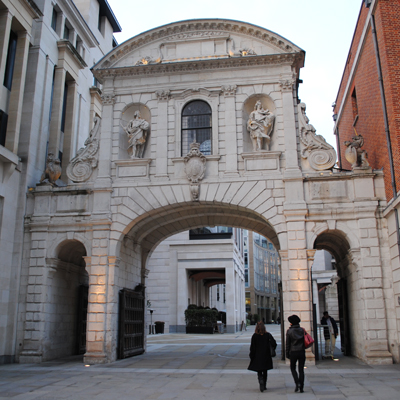
Temple Bar, LondonIt’s been a while since I was in London so I was delighted to find that the Temple Bar had been restored (not to its original site, but to the city as a whole!). The only surviving gateway into the city of London, it was constructed in 1672 to replace a crumbling wooden predecessor and was designed by Sir Christopher Wren (he of St Paul’s fame). The Temple Bar stood at the junction of Fleet Street and the Strand until 1878 when, to help traffic flow, it was removed. Apparently it was intended that it would be rebuilt somewhere else in the city, but time passed and no suitable site was found, so it eventually ended up on an estate in Hertfordshire. Where it remained until 2004 when – thanks to the work of the Temple Bar Trust – it was able to be returned to the city – it is now located between St Paul’s and Paternoster Square – for all to now enjoy.

WHERE: Between Paternoster Square and St Paul’s Cathedral. Nearest tube station is St Paul’s. COST: Free to see (actual building not open to public). WEBSITE: www.thetemplebar.info.

The Temple Bar isn’t the only ‘monument’, for want of a better word, which has been relocated in London. Another is the Wellington Arch, a magnificent structure which was originally finished (though not really completed) in 1830. Then known as the Green Park Arch, it stood parallel with the Hyde Park Screen (it was created to be seen in conjunction with it) and was later adorned with a huge – and controversial – statue of Wellington. But by the 1880s, traffic flow was again a problem and so it was decided to move the arch to its current location, perpendicular to the Hyde Park Screen. As a footnote, when the arch was moved in 1883, the statue of Wellington was not placed back on top but moved to a new site – Aldershot, where it is now.

WHERE: Grosvenor Place, Westminster, SW1X 7. Nearest tube station is Hyde Park Corner. COST: Adults £3.70/child £1.90 (English Heritage members free – there is a joint offer for others combined with Apsley House). WEBSITE: www.english-heritage.org.uk/daysout/properties/wellington-arch/.