10 notable blue plaques of London – 4. Oldest surviving blue plaque commemorating a woman…

Much has been made about the dearth of women featured on blue plaques in this 150th year of the scheme – according to English Heritage, only 13 per cent of the 900 odd blue plaques in London commemorate a woman.

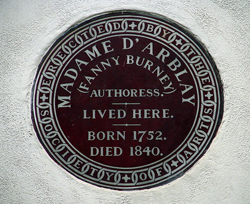
Fanny-Burney-plaqueAmong them are ballet dancer Margot Fonteyn, suffragette Sylvia Pankhurst, socialite Nancy Astor, and, in recent times, cookery writer Elizabeth David.

The oldest surviving blue plaque commemorating a woman, however, is that commemorating what is today a less well-known name, that of Fanny Burney.

Burney (1752-1840), who was known as Madame D’Arblay after she married, was a widely applauded novelist who was also noted for her diaries which record her involvement in the literary circles around Samuel Johnson and the Bluestocking Group.

The blue plaque commemorating her residence at 11 Bolton Street in Mayfair was erected in 1885 by the Society of Arts (which means that like others erected by the society, later the Royal Society of Arts, it’s brown not blue).

Burney, whose most profitable work, Camilla, was published in 1796 after she had spent five years as Second Keeper of the Robs to Queen Charlotte, lived in the house following the death of her husband, the Frenchman Alexandre D’Arblay.

She spent 10 years here – from 1818 until 1828 – and had apparently thought it would be her last residence but she went on to move into three further properties after this one.

PICTURE: Simon Harriyott/CC BY 2.0

10 notable blue plaques of London – 3. The City of London’s only ‘blue plaque’ (and it’s not even blue)…

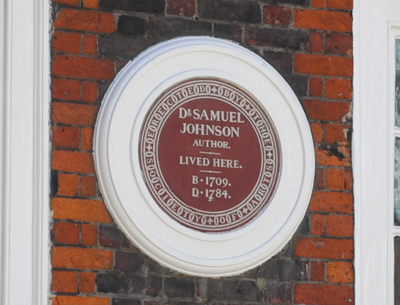
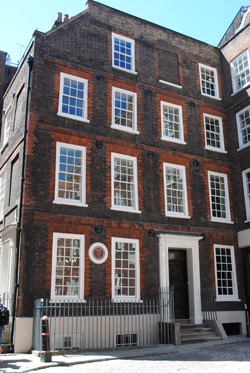
Samuel-Johnson-plaqueThere is only one official blue plaque in the square miles of the City of London – that which marks the property of lexicographer Dr Samuel Johnson in Gough Square (he always did like to stand out from the crowd) – and, like many of the plaques in the scheme, it’s not even blue.

Samuel-Johnson-plaque2The plaque was among the 35 erected in the first 35 years of the scheme – this one in 1876 – and was done so by the Society of Arts which then ran the scheme (later the Royal Society of Arts). In common with most of the first 35 plaques, it is brown in colour.

In 1879, just three years after this plaque was erected, the Society of Arts came to an agreement with the Corporation of the City of London that the corporation – the governing body of the square mile – would commemorate sites of historic significance within its boundaries and the agreement has stood ever since.

The hundreds of “blue plaques” since erected by the City of London Corporation are rectangular in nature and commemorate everything from structures like the long-gone historic gate of Aldgate (88 Aldgate High Street) to homes of the notable such as martyred Archbishop of Canterbury Thomas á Becket (86 Cheapside).

There’s a searchable database of all the City of London plaques which can be found here.

And, of course, Dr Johnson’s house, which he lived in from 1748-59 which compiling his famous A Dictionary of the English Language (the first comprehensive English language dictionary), is now a museum – for details of that, see our earlier post here.

Famous Londoners – Dr John Dee…

The subject of a current exhibition at the Royal College of Physicians, Dr John Dee – mathematician, courtier, astrologist and ‘magician’ are just some of the tags he is labelled with – is one of the most enigmatic figures of Tudor England.

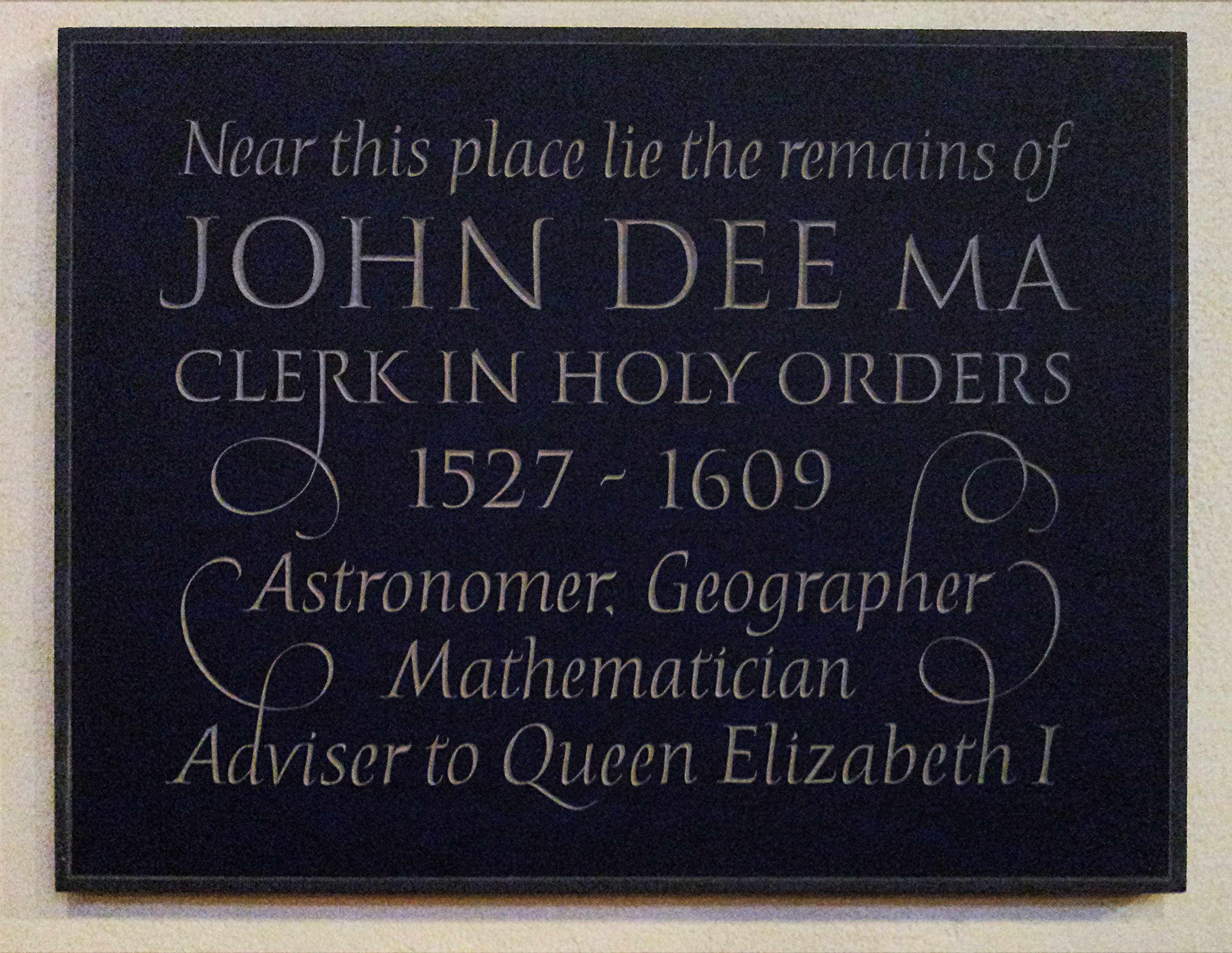
John_Dee_memorial_plaque_at_S_Mary_the_Virgin_MortlakeBorn in London’s Tower ward in 1527, Dee was of Welsh descent and the son of Roland Dee, a mercer and courtier to King Henry VIII, and Johanna Wild. He attended school in Chelmsford and, at the age of 15 entered St John’s College, Cambridge, awarded a Bachelor of Arts in 1545 and a master’s degree in 1548. He was also a founding fellow of Trinity College when it was founded in 1546.

Dee travelled through Europe during the late 1540s and early 1550s, studying and lecturing at places including Louvain, Paris and Brussels. It was during this trip that he met mathematicians and cartographers like Gemma Frisius and Gerardus Mercator.

Back in England, Dee was appointed rector at Upton-upon-Severn (apparently on the recommendation of King Edward VI), and in 1555 was made a member of the Worshipful Company of Mercers. He had, meanwhile, turned down offers of professorships at both the Sorbonne in Paris and the University of Oxford, ostensibly because he had hopes of obtaining an official position at court.

It was perhaps in pursuit of this that he subsequently appeared at England’s Royal Court where he took on the role of teacher of the mathematical sciences while also serving as an astrologer to Queen Mary I and courtiers.

The latter role led to Dee’s arrest and imprisonment in 1555 on charges of being a ‘magus’ (magician) – he would go on to appear for questioning in the infamous Star Chamber – but he was eventually cleared of all charges.

In 1558, Dee became a scientific and medical advisor to Queen Elizabeth I and, by the mid-1560s, had established himself in the village of Mortlake (now in the south-west of Greater London) where he built a laboratory and gathered together what was the largest private library in the country at the time, said to have consisted of more than 4,000 books and manuscripts (and the subject of the current exhibition).

Dee was also associated with several English voyages of exploration for which he provided maps and navigational instruments, most famously  Sir Martin Frobisher’s expedition to Canada in 1576-78.

He is also known for his strong views on natural philosophy and astrology and the occult, which included the idea that mathematics had a special, supernatural power to reveal divine mysteries. Some of his occult-related ideas were explored in his 1564 text Monas hieroglyphics – one of numerous works he authored – but his most influential work is said to have been a preface he wrote to an English translation of Euclid’s Elements published in 1570 in which he argued for the central role of mathematics.

Dee is said to have married three times – the first in the mid-1560s and, following the deaths of his previous two wives, the last time in 1578 when he was wedded to Jane Fromond, who was less than half his age and who had been a lady-in-waiting to the Countess of Lincoln. She bore him some eight children (although there are questions over the paternity of at least one) and died in 1604 of the plaque.

By the 1580s, having failed to win the influence he hoped to have at court and wanting to further his explorations into the supernatural (in particular, communication with ‘angels’ through occult practice of crystal-gazing), he travelled to Europe with a convicted counterfeiter and medium Edward Kelley to Europe.

Returning to England, after much lobbying, Queen Elizabeth I appointed him warden of Manchester College in 1596, but despite this, he returned to London in 1605 where his final years were marked by poverty.

He is believed to have died in March, 1609, at the London home of a friend and was apparently buried in Mortlake (pictured, above, is a memorial plaque at St Mary the Virgin in Mortlake).

It’s believed that William Shakespeare modelled the figure of Prospero in the 1611 play The Tempest on Dee (it’s also claimed that he was the model for Marlowe’s Doctor Faustus).

Scholar, courtier, magician: the lost library of John Dee runs at the Royal College of Physicians at 11 St Andrews Place, Regent’s Park, until 29th July. Entry is free (check website for opening hours). For more, see www.rcplondon.ac.uk.

PICTURE: Robert Smith/CC BY-SA 3.0/Wikipedia

This Week in London – Talking Shakespeare; Dickens’ letter in support of ‘fallen women’; and, wallpaper at the Geffrye…

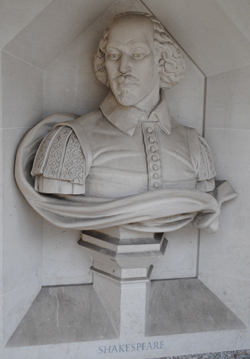
William-Shakespeare6• Guildhall is hosting an “open mic” Shakespeare day this Tuesday as part of commemorations marking the 400th anniversary of his death. Speeches, Soliloquies and Songs from Shakespeare will be opened with recitals from actors Simon Russell Beale and John Heffernan before members of the public will have their chance to recite their favourite piece from Shakespeare. Participants are invited to sign up by emailing ghlevents@cityoflondon.gov.uk or calling 020 7332 1868. The event will run between 10am to 12pm and 1.30pm to 3.30pm at the Basinghall Suite in the Guildhall Art Gallery. For more, see www.cityoflondon.gov.uk/things-to-do/visit-the-city/attractions/guildhall-galleries/Pages/guildhall-art-gallery.aspx.

A letter written by author Charles Dickens to the governors of the Foundling Hospital has gone on display at the Foundling Museum in Bloomsbury. The letter was written to the governors in support of an application for a new matron and touches on Dickens’ belief that the downward path of a ‘fallen woman’ wasn’t irreversible and inevitable but that reform was possible. Tempted to Virtue: Dickens and the Fallen Woman can be seen until 22nd May. In a related event, Lynda Nead, curator of the recent exhibition, The Fallen Woman, will join Jenny Earle, programme director at the Prison Reform Trust, in discussing the hidden stories of vulnerable women in the 19th century and today on 21st May. This event is free but booking is essential. For more, see www.foundlingmuseum.org.uk.

An exhibition celebrating how wallpaper is made is running at the Geffrye Museum in Shoreditch as part of London Craft Week. The Craft of Wallpaper demonstrates the variety of processes being used to make wallpaper in today’s world and features papers by some of the UK’s most innovative makers including Claire Coles, Elise Menghini, Helen Morley, Identity Paper, Juliet Chadwick, Linda Florence, Erica Wakerly, Fromental, CUSTHOM, Tracey Kendall and Graham & Brown who are showcasing six of their most successful wallpaper designs: from its first design in 1946, Original, to the 2016 Wallpaper of the Year, Marble. You’ll have to be quick – only runs until Sunday. For more, see www.londoncraftweek.com.

Send all items for inclusion to exploringlondon@gmail.com.
This Week in London – Of Empress Catherine the Great and Capability Brown; a blue plaque double; and, the British graphic novel on show…

A once forgotten collection of watercolour paintings and drawings owned by Empress Catherine the Great of Russia has gone on show at Hampton Court Palace as part of commemorations marking the 300th anniversary of the birth of Lancelot ‘Capability’ Brown. The Empress and the Gardener exhibition features almost 60 intricately detailed views of the palace and its park and gardens during the time when Brown worked there as chief gardener to King George III between 1764 and 1783. The works came to be in the collection of the Empress – a renowned fan of English gardens – after Brown’s assistant, John Spyers, sold two albums of his drawings of the palace to the her for the considerable sum of 1,000 roubles. The albums disappeared into her collection at the Hermitage (now the State Hermitage Museum) and lay forgotten for more than 200 years before they were rediscovered by curator Mikhail Dedinkin in 2002. As well as the collection – on public show for the first time, the exhibition features portraits of Brown and the Empress, previously unseen drawings of her ‘English Palace’ in the grounds of the Peterhof near St Petersburg, and several pieces from the ‘Green Frog’ dinner service, created for the Empress by Wedgwood, which is decorated with some of the landscapes the prolific Brown created across England. Runs until 4th September. Admission charge applies. For more, see www.hrp.org.uk/hampton-court-palace/.

A house in Chelsea has become only one of 19 homes in London to bear two official blue plaques. Number 48 Paultons Square has the honour of having been home to two Nobel prize winners (albeit in different fields) – dramatist Samuel Beckett, who lived there for seven months in 1934 while writing his first novel, Murphy, and physicist Patrick Blackett, noted for his revolutionary work in U-boat detection during World War II, who lived there from 1953 to 1969. Other ‘doubles’ include 20 Maresfield Gardens in Hampstead (home to Sigmund Freud and Anna Freud) and 29 Fitzroy Street in Fitzrovia (home to George Bernard Shaw and Virginia Woolf). This year marks the 150th anniversary of the blue plaques scheme. For more, see www.english-heritage.org.uk/visit/blue-plaques/.

The rise of the British graphic novel is the subject of a new exhibition at the Cartoon Museum in Bloomsbury. The Great British Graphic Novel features works by 18th century artist William Hogarth as well as Kate Charlesworth, Dave Gibbons (one of the creators of the ground-breaking Watchmen), Martin Row, Posy Simmonds (creator of the Tamara Drewe comic strip) and Bryan and Mary Talbot. It runs until 24th July. Admission charge applies. For more, see www.cartoonmuseum.org.

Send all items for inclusion to exploringlondon@gmail.com.
 

10 iconic London film locations…9. A chapel of many faces…

There’s an ancient church in London which has taken on the role of various other cathedrals and churches in many recent historic films, most notably in the 1998 film Shakespeare in Love (a fitting reference this week, given the 400th anniversary of the Bard’s death last weekend).

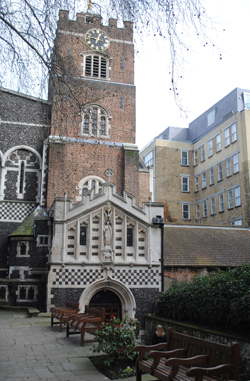
St-BartsBut the church – location of the scene in the film in which Shakespeare’s begs forgiveness after the death of Kit Marlowe – has also been seen in everything from the 1991 Kevin Costner-vehicle, Robin Hood: Prince of Thieves (where it represented the interior of Nottingham Cathedral) to Guy Ritchie’s 2009 film Sherlock Holmes (where it represented St Paul’s Cathedral, location of a ritual sacrifice being conducted by the evil Lord Blackwood).

It has also appeared in the 1996 Victorian-era drama Jude, 2006’s Amazing Grace – the story of William Wilberforce’s effort to combat the slave trade, 2007’s Elizabeth: The Golden Age (where it hosts the execution of Mary, Queen of Scots), 2008’s The Other Boleyn Girl, and the 2012 fantasy epic, Snow White and the Huntsman.

Oh, and the church? The priory church of St Bartholomew The Great (St Bart’s) located in West Smithfield, which has a history dating back 900 years (for more on the history of the church, see our earlier post here).

But the church hasn’t just been seen in films of the historic genre – it’s also played roles in more contemporary movies as well, from 1994’s Four Weddings and Funeral (St Julian’s where a wedding doesn’t take place) to 1999’s The End of the Affair and, more recently, the 2014 film Muppets: Most Wanted.

It’s doubtful there’s a church interior in London that’s been in so many movies in recent times. For more on the church itself, see www.greatstbarts.com.

This Week in London – Beacons to mark Queen Elizabeth II’s 90th; 4,000 years of Sicilian history; underwear’s history exposed; a Shakespearean banknote remembered…

• Queen Elizabeth II’s 90th birthday is being marked in various ways across the capital today. Along with street parties, gun salutes in Hyde Park and at the Tower of London, beacons will be lit in numerous locations across the city (as well as around the country and even internationally) tonight. Further celebrations will be held across May and June.

Sicily

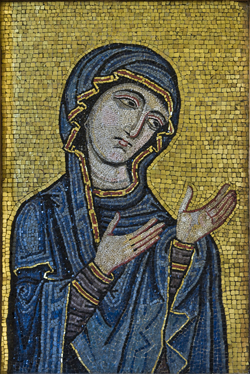
More than 4,000 years of Sicily’s history is being explored in a new exhibition opening at the British Museum in Bloomsbury today. Sicily: culture and conquest features more than 200 objects and focuses on two major eras: the arrival of the Greeks in the latter half of the 7th century BC and their subsequent encounters with earlier settlers and the Phoenicians; and, the period under Norman rule between 1100 and 1250 AD. Highlights include a spectacularly well preserved terracotta altar from about 500 BC, a terracotta sculpture of a Greek Gorgon, an iconic marble sculpture of a warrior from ancient Akragas, a bronze battering ram used by the Romans to sink enemy ships, a 12th century Byzantine-style mosaic and marble, and wooden Islamic-influenced architectural decorations along with ceremonial glassware and ivory, gold pendants and intricate enamel mosaics and cameos from the Norman period. The exhibition, being run in conjunction with Regione Siciliana, Assessorato dei Beni Culturati e dell’Identita Siciliana, runs in Room 35 until 14th August. Admission charges apply and a programme of events accompanies the exhibition. For more, see www.britishmuseum.org/sicily.

• The largest ever museum exhibition of underwear has opened at the V&A in South Kensington. Undressed: A Brief History of Underwear charts the history of underwear from the 18th century to today and features some of the more than 60 individual pieces of mostly contemporary underwear the museum recently acquired for its permanent collection as well as loaned objects. Among the objects on display are an “austerity corset” dating from 1917-18 which has been made from woven paper twine, a man’s waist belt used on the wearer’s wedding day which dates from 1842, a late 19th century corset designed for cycling as well as a rare surviving example of a 1978 panty thong designed by Rudi Gernreich (credited with giving the thong its name) and numerous contemporary pieces – everything from a butt lifter and waist trainer for women to a pair of EnlargetIt briefs designed by aussieBum to add volume to a man’s crotch and a mastectomy bra and prosthesis. The exhibition can be seen until 12th March next year. For more, see www.vam.ac.uk/undressed.

Banknote designer Harry Norman Eccleston’s Shakespearean-related design for the now out of circulation £20 banknote is the subject of an exhibition at the Bank of England Museum in the City. Held as part of commemorations marking 400 years since the Bard’s death, Eccleston’s Shakespeare explores the design elements used in the note, first issued in July, 1970, from his rendering of William Kent’s statue of Shakespeare to his drawing of the balcony scene of Romeo and Juliet. Entry is free. For more, see www.bankofengland.co.uk.

Send all items for inclusion t0 exploringlondon@gmail.com.

Famous Londoners – Lancelot ‘Capability’ Brown…

This year marks 300 years since the birth of Lancelot “Capability” Brown, the most famed landscape designer of the Georgian age and a man who has been described as the “father of landscape architecture”.

Capability-BrownBrown is understood to have been born in 1716 in the village of Kirkharle in Northumberland, the fifth of six children of a land agent and a chambermaid (he was baptised in on 30th August so it is believed his birth happened sometime earlier that same year).

He attended the village school before he worked as apprentice or assistant to the head gardener in Sir William Loraine’s kitchen garden at Kirkharle Hall.

Having left home in 1741 he joined the gardening staff of Lord Cobham, as one of the gardeners at his property in Stowe, Buckinghamshire.

There he worked with William Kent, another famed landscape architect of the Georgian age and one of the founders of the new English style of gardens, until, at the age of 26, he was appointed head gardener.

He remained in Stowe until 1750 and while there, in 1744, married Bridget Wayet (with whom he went on to have nine children). During his time there, he also created the Grecian Valley and also took on freelance work from Lord Cobham’s noble friends, a fact which allowed him to produce a body of work that would start to make his reputation.

Having struck out on his own from Stowe, he settled with his family in Hammersmith, London, in the early 1750s, already widely known and considered by some the finest gardener in the kingdom.

The work continued to flow in and it’s believed that, over the span of his career, Brown was responsible for designing or contributing to the design of as many as 250 gardens at locations across the UK, – many of which can still be seen today. As well as Stowe, these included gardens at Blenheim Palace, Appuldurcombe House on the Isle of Wight, Warwick Castle, Harewood House and Petworth House in West Sussex.

Following on from the work of Kent, Brown was known for his naturalistic undulating landscapes, in particular their immense scale, flowing waterways and a feature known as a ‘ha-ha’, a ditch which blended seamlessly into the landscape but which was aimed at keeping animals away from the main house of the estate.

His style, which contrasted sharply with the more formalised, geometric gardens epitomised in the French style of gardening, did not, however, meet with universal praise. Criticisms levelled against him including that he had often erased the works of gardeners of previous generations to complete gardens which were, in the end, described by some as looking no different to “common fields”.

It’s worth noting that Brown also dabbled in architecture itself – his first country house project was the remodelling of Croome Court in Worcestershire and he went on to design and contribute to the design of several houses including Burghley House Northamptonshire as well as outbuildings including stable blocks.

The nickname ‘Capability’ apparently came from his habit of informing his client that their estates had great “capability” for improvement. It’s wasn’t apparently a name he used himself.

So established became his reputation that in 1764 Brown was appointed King George III’s Master Gardener at Hampton Court Palace (as well as Richmond and St James’ Palaces), taking up residence with his family at Wilderness House. He also worked on the gardens at Kew Palace.

Brown died on 6th February, 1783, in Hertford Street in London at the door of his daughter Bridget’s house (she had married architect Henry Holland with whom he Brown had, at times, collaborated). He was buried in the churchyard of St Peter and St Paul, the parish church of a small estate Brown owned at Fenstanton Manor in Cambridgeshire.

Brown impact on garden design in England is now undisputed although it wasn’t always the case – his contribution was largely dismissed in the 18th century and it was only in the later 20th century that he had become firmly established as a giant figure in the gardening world.

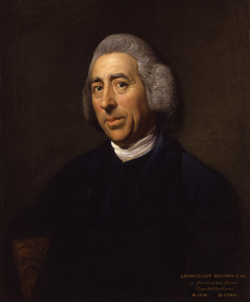
A celebrated portrait of Brown (pictured above) – painted by Nathaniel Dance in about 1773 – is in the collection of National Portrait Gallery.

For more on events surrounding the 300th anniversary of Brown’s birth, see www.capabilitybrown.org.

PICTURE: Capability Brown by Nathaniel Dance, circa 1773. © National Portrait Gallery, London


Lost London – The Tabard Inn…

Famed for its mention in Geoffrey Chaucer’s iconic 14th century work, The Canterbury Tales, The Tabard Inn once stood on Borough High Street in Southwark.

The inn was apparently first built for the Abbot of Hyde in 1307 as a place where he and his brethren could stay when they came to London and stood on what had been the main Roman thoroughfare between London and Canterbury.

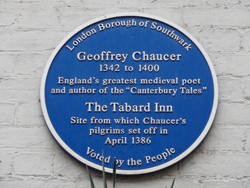
Blue_plaque,_Tabard_InnIt became a popular hostelry for pilgrims making their way from the Chapel of St Thomas á Becket on London Bridge to the saint’s shrine in Canterbury Cathedral and was one of a number of inns which eventually came to be built in Southwark at the London end of the pilgrim route.

It’s in this context that it earns a mention in Chaucer’s 14th century work as the pilgrims set off on their journey.

The inn passed into private hands following the Dissolution and in 1676, 1o years after the Great Fire of London, burned down in a fire which devastated much of Southwark (the back part of it had been damaged by fire a few years earlier). Earlier patrons may have, it’s been suggested, included the Bard himself, William Shakespeare.

It was subsequently rebuilt as a galleried coaching inn and came to be renamed The Talbot (it’s been suggested this was due to a spelling mistake by the signwriter). Its neighbour, the George Inn, still stands in Talbot Yard (it was also apparently burnt down and rebuilt after the 1676 fire).

Business for the coaching inns dropped away, however, with the coming of the railways and the building was converted into stores before eventually being demolished in 1874.

A plaque to the inn can be seen in Talbot Yard (named for the inn’s later incarnation) – it was unveiled by Terry Jones in 2003.

PICTURE: BH2008/Wikimedia.

This Week in London – Seminal moments in Shakespearean performance; Maria Merian’s Butterflies; and, British conceptual art…

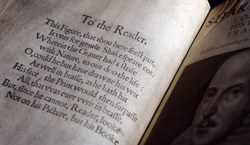
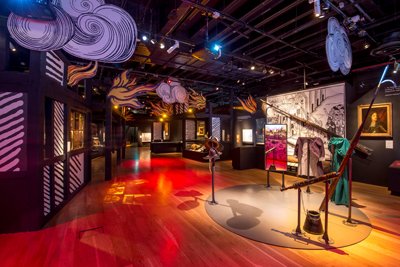
ShakespearesFirstFolio1623BritishLibraryPhotobyClareKendall It’s the 400th anniversary of Shakespeare’s death (in case you missed that), and among the many events marking the occasion comes a major exhibition at the British Library focusing on 10 key performances that it says have made the Bard the “cultural icon” he is today. Shakespeare in Ten Acts, which opens on Friday, focuses on performances which may not be the most famous but which represent key moments in shaping his legacy. They span the period the first performance of Hamlet at the Globe theatre in around 1600 to a radical interpretation of the same play from US theatre company The Wooster Group in 2013. Among the exhibition highlights are a human skull which was given to the actress Sarah Bernhardt by writer Victor Hugo (and which she used as Yorik’s skull when she played Hamlet in 1899), a dress worn by Vivien Leigh playing Lady Macbeth in the 1955 production of Macbeth at the Royal Shakespeare Company, the only surviving play script written in the Bard’s own hand and rare printed editions including Shakespeare’s First Folio and the earliest printed edition of Hamlet from 1603 (one of only two copies in the world). The exhibition, which runs until 6th September, is accompanied by a season of events. Admission charge applies. For more, see www.bl.uk. PICTURE: Shakespeare’s First Folio 1623 British Library Photo by Clare Kendall.

Still talking exhibitions commemorating Shakespeare’s death and a manuscript of William Boyce’s Ode to the Memory of Shakespeare will be on display at The Foundling Museum’s Handel Gallery from tomorrow. The work, which was composed in 1756, was performed annually at the Theatre Royal in Drury Lane. The manuscript, the first page of which was thought to be lost until it was acquired in 2006, formerly belonged to Samuel Arnold, who compiled the first complete edition of Handel’s works. Runs at the Bloomsbury-based museum until 30th May. Admission charge applies. For more, see www.foundlingmuseum.org.uk.

 Exquisite watercolours depicting the natural world go on show in The Queen’s Gallery at Buckingham Palace from tomorrow. Maria Merian’s Butterflies features 50 works produced by the eighteenth century German artist and entomologist Maria Sibylla Merian. The works – many of which record the flora and fauna of the then Dutch colony of Suriname in South America, were published in the 1706 work Metamorphosis Insectorum Surinamensium (The Metamorphosis of the Insects of Suriname) and partially printed, partially hand-painted versions of the plates were purchased by King George III for his library at Buckingham House (later Buckingham Palace). As well as insects, the works – which were based on a visit Merian made to the colony in 1699, depict lizards, crocodiles and snakes as well as tropical plants such as the pineapple. The exhibition runs until 9th October. Admission charge applies. For more, see www.royalcollection.org.uk/visit/the-queens-gallery-buckingham-palace.

The evolution of conceptual art in Britain is the subject of a new exhibition at Tate Britain in Milbank  Conceptual Art in Britain 1964-1979 features 70 works by 21 artists and positions conceptual art “not as a style but rather a game-changing shift in the way we think about art, how it is made and what it is for”. Highlights include Michael Craig-Martin’s An Oak Tree (1973) and Roelof Louw’s Soul City (Pyramid of Oranges) (1987) as well as Victor Burgin’s Possession (1976), Mary Kelly’s Post-Partum Document (1974-78) and Conrad Atkinson’s Northern Ireland 1968 – May Day 1975 (1975-76). Admission charge applies. Runs until 29th August. For more, see www.tate.org.uk.

Send all items for inclusion to exploringlondon@gmail.com.

This Week in London – Botticelli at the V&A; Shakespeare recalled in free sound and light show; and, ‘punk’ captured on film…

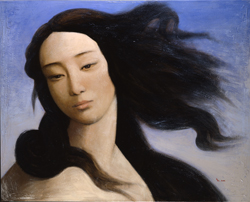
VenusA major new exhibition opening at the V&A this Saturday will feature more than 150 works from around the world in a display exploring how artists and designers have responded to the artistic legacy of Botticelli. Italian artist Sandro Botticelli (1445-1510) was largely forgotten for more than 300 years after his death but is now widely recognised as one of the greatest artists of all time. Botticelli Reimagined features painting, fashion, film, drawing, photography, tapestry, sculpture and print with works by Dante Gabriel Rossetti, Edward Burne-Jones, William Morris, René Magritte, Elsa Schiaparelli, Andy Warhol and Cindy Sherman. The exhibition is divided into three sections: ‘Global, Modern, Contemporary’, ‘Rediscovery’, and ‘Botticelli in his own Time’. Runs until 3rd July. Admission charge applies. For more, see www.vam.ac.uk/Botticelli. PICTURE: Venus, after Botticelli by Yin Xin (2008). Private collection, courtesy Duhamel Fine Art, Paris. (Name of artist corrected)

The historic facade of Guildhall in the City of London will become a canvas for a free son et lumiére show on Friday and Saturday nights to mark the 400th anniversary of the death of William Shakespeare. The display, which runs on a 20 minute loop between 6.45pm and 8.45pm, will feature period images and music from the City’s extensive archives and use 3D projection mapping techniques to transform the Dance Porch of the 15th century building. The Guildhall Art Gallery will be open from 6pm to 9pm and, as well as allowing people to view a property deed for a house in Blackfriars which was signed by the Bard, will feature a pop-up bar with a Shakespeare-themed cocktail. For more on this and other events, see www.cityoflondon.gov.uk/shakespeare400.

The 40th anniversary of punk is the subject of a new photographic exhibition drawn from the archives of world renowned music photographer and rockarchive.com founder Jill Furmanovsky which opened at the City of London Corporation’s Barbican Music Library this week. Chunk of Punk, which runs until 28th April, features many of Furmanovsky’s well-known punk-related images as well as hitherto unseen pictures with The Ramones, Buzzcocks, The Clash, The Sex Pistols, Blondie, The Undertones, Siouxsie and the Banshees, Blondie and Iggy Pop among the bands featured. The exhibition forms part of Punk.London: 40 Years of Subversive Culture. For more, see www.cityoflondon.gov.uk.

Send all items for inclusion to exploringlondon@gmail.com.

Treasures of London – William Shakespeare’s last will and testament…

William-Shakespeares-Will

Recently conserved by the National Archives, Shakespeare’s last will and testament is at the heart of a new exhibition on show at Somerset House.

By Me William Shakespeare: A Life In Writing, the first joint exhibition of the National Archives and King’s College London, features four of the six known signatures of Shakespeare still in existence and, along with his last will and testament, shows some of the most significant Shakespeare-related documents in the world tracking his existence as everything from a London citizen, businessman, family man, servant to possibly even a thief and subversive.

But back to the will. While not written in the Bard’s hand, the will is signed by him in three places and indicates the wealth and status he had garnered by the time of his death on 23rd April, 1616.

Evidence shows that Shakespeare revised his will as his estate changed, and just before his death, he added personal bequests including that a silver bowl be given to his second eldest daughter Judith, memorial rings to actor friends in London and his second best bed to his wife Anne. He left most of his property to his eldest daughter, Susanna, although his will, according to the National Archives, indicates that he had hoped to establish a male legacy.

Other beneficiaries named in the will include his sister Joan and her sons and his grand-daughter Elizabeth Hall while Susanna and her husband John Hall were named as his executors.

The exhibition, which is being held in the Inigo Jones Rooms in Somerset House’s East Wing as part of the series of events being held to mark the 400th anniversary of Shakespeare’s death, runs until 29th May. Admission charge applies.

Other documents featured in the display – all of which are registered with UNESCO – include accounts listing the grant of four-and-half yards of red cloth to Shakespeare by King James I for participation in his coronation procession in 1604, accounts from the Master of Revels showing when plays were performed at court (useful for helping to date when Shakespeare wrote particular plays), and a document recording testimony Shakespeare gave in court when his landlord, Christopher Mountjoy, failed to provide his son-in-law with a dowry for his daughter’s hand (Shakespeare is likely to have played a role in arranging the marriage).

For more on the exhibition, see www.bymewilliamshakespeare.org.

10 iconic London film locations…4. Greenwich’s Old Royal Naval College becomes Lilliput…

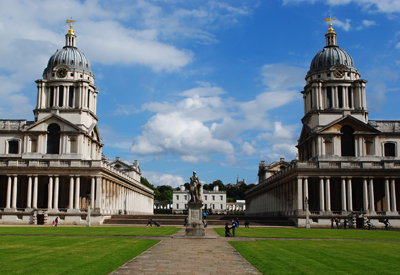
Old-Royal-Naval-College

When the makers of the 2010 Jack Black movie Gulliver’s Travels were looking for suitably grand buildings to represent the Lilliputian capital, they turned to the Old Royal Naval College in Greenwich.

Designed by Sir Christopher Wren, the World Heritage-listed site made a grand backdrop for the film in which a supersized Black plays Gulliver, the hero of Jonathan Swift’s book (incidentally Blenheim Palace near Oxford also makes an appearance in the film).

It’s not the first time, of course, that the location has featured in recent films – in fact, such has been its popularity that Empire asked last year whether it was the most popular film location in the world.

Other films in which the Old Royal Naval College appears have included The Dark Knight Rises (where it features in the epilogue), Les Miserables (where the buildings represent a part of a Paris featuring a gigantic wooden elephant which is home to the street urchin Gavroche), and Pirates of the Caribbean: On Stranger Tides (where the spectacular Painted Hall, designed by Wren and Nicholas Hawksmoor, represents the King’s palace).

It has also appeared in both of the recent Sherlock Holmes films as well as a host of others – everything from The Mummy Returns to The Madness of King George and Charlotte Gray.

For more on the history of the Old Royal Naval College, check out our previous post here and here.

What’s in a name?…Camden Town…

Camden-Lock

As with so many London locations, the name Camden Town comes from a previous landowner – but more indirectly it originates with the great 16th and 17th century antiquarian and topographer William Camden.

The story goes like this: late in his life William Camden – author of Britannia, a comprehensive description of Great Britain and Ireland – settled near Chislehurst in Kent on a property which became known as Camden Place.

In the 18th century, the property came into the possession of Sir Charles Pratt, a lawyer and politician (among other things, he was Lord Chancellor in the reign of King George III), who was eventually named 1st Earl of Camden.

It was Pratt who, having come into the possession of the property by marriage, in about 1791 divided up land he owned just to the north of London (which has apparently once been the property of St Paul’s Cathedral) and leased it, resulting in the development of what became Camden Town (Pratt, himself, meanwhile, is memorialised in the name of Pratt Street which runs between Camden High Street and Camden Street).

In 1816, the area received a boost when Regent’s Canal was built through it – the manually operated, twin Camden Lock is located in the heart of Camden Town.

Although it has long carried a reputation of one of the less salubrious of London’s residential neighbourhoods (a reputation which is changing), Camden Town is today a vibrant melting pot of cultures, thanks, in no small part, to the series of markets, including the Camden Lock Market, located there as well as its live music venues.

Past residents have included author Charles Dickens, artist (and Jack the Ripper candidate) Walter Sickert, a member of the so-called ‘Camden Town Group’ of artists, and, in more recent times, the late singer Amy Winehouse.

Of course, the name Camden – since 1965 – has also been that of the surrounding borough.

Lost London – The King’s Mews at Charing Cross…

National-Gallery2The Royal Mews – a stables and carriage house – is these days located at Buckingham Palace but prior to being moved there, the Royal Mews, previously usually referred to as the King’s and Queen’s Mews depending who was on the throne, was located on the site where the National Gallery (pictured) and Trafalgar Square now stand.

The name ‘mews’ actually refers to the fact that, from at least the reign of King Richard II in the late 14th century (although official records suggest there may have been a mews on the site as far back as the reign of King Edward I), the royal hawks were initially housed on the site – then in the village of Charing Cross – (the word ‘mew’ refers to the moulting of the birds and originally referred to when they were confined here for that purpose but later come to simply mean the place were the birds were caged).

The title of Keeper of the King’s Mews became a sought-after honour during the 15th century (although largely honorary with the actual work done by deputies) but among those who held the honour were Richard Neville, Earl of Warwick, known, during the Wars of the Roses as the ‘Kingmaker’.

In 1534, the King’s Mews was destroyed by fire and when it was rebuilt a few years later, it took the form of a stable but kept the original name of mews (although it has been suggested the change of use took place before the fire).

During the Civil War, the Mews were apparently used as a prison by the Parliamentarians for captured Royalists and during the Commonwealth, soldiers were apparently quartered here. Diarist Samuel Pepys also apparently visited several times.

In 1732 the building was again rebuilt, but this time it was to the grand designs of William Kent – images show a grand building with turrets and a great open square before it. In the 1760s, King George III had some of his horses and carriages moved to facilities on the grounds of Buckingham Palace (he had purchased this from the Duke of Buckingham for his wife’s use) but the bulk remained on the Charing Cross site.

In the early 19th century they were opened to the public but in the 1820s, King George IV – making Buckingham Palace his main residence – had the entire stables moved (the Royal Mews which now stand at Buckingham Palace were designed by John Nash and completed in 1825).

The old mews were subsequently demolished and Trafalgar Square – another Nash design – built on the site between 1827 and 1835 while the National Gallery opened in 1838.

London Pub Signs – The Grenadier…

The-GrenadierThe name of the pub, like some many London pubs, comes from the building’s former purpose – in this case part of a barracks. 

The pub, located at 18 Wilton Row not far from Belgrave Square in Belgravia, was apparently first constructed in 1720 and, located in the barracks of the 1st Royal Regiment of Foot Guards, originally housed the officer’s mess.

It first opened as a pub in 1818 and was initially known as The Guardsman but subsequently renamed The Grenadier after the regiment was renamed – by Royal Proclamation – the First Grenadier Regiment of Foot Guards in honour of their actions in fending off the French at the Battle of Waterloo in 1815.

A bright red painted sentry box – matching the patriotic red, white and blue of the pub –  stands outside the pub today in honour of its history.

Renowned around the world for its Bloody Mary, it has apparently attracted the patronage of some big names – back in the day these included King George IV and the Iron Duke Arthur Wellesley, and, in more recent times, Prince William and Madonna.

There is said to be ghost – known as ‘Cedric’ – which haunts the pub – it’s often referred to as the most haunted pub in London – and is apparently that of a young guardsman who was flogged a little over-enthusiastically after cheating at cards and ended up dead. He is apparently most active in September – said to be the time of year when he was killed.

A tradition of attaching money to the ceiling and walls has developed in an effort to pay off Cedric’s debt (and presumably stop the haunting). Along with the memorabilia relating to the pub’s history, the walls also feature a collection of newspaper clippings about the haunting.

For details, including opening times, head to the Taylor Walker website here.

PICTURE: Ewan Munro/Flickr/CC BY-SA 2.0 (image has been cropped).

Famous Londoners – Joseph Grimaldi…

Grimaldi-memorialThe most renowned of English clowns, Joseph Grimaldi rose to the heights of fame in early 19th century London despite a private life characterised by hardships and pain.

Grimaldi was born in Clare Market, London on 18th December, 1778, the son of actor and clown Joseph Giuseppe Grimaldi (known simply as the “Signor”), and Londoner Rebecca Brooker, a dancer who was more than 50 years younger than Grimaldi when she become one of a string of mistresses.

Grimaldi-imageJoe was groomed for the stage by his father from an early age and made his debut at Sadler’s Wells Theatre in late 1780. He was soon also working at Drury Lane Theatre, running between the two to make performances (at the same time, he did attend a theatrical academy in Putney known for educating the children of performers).

Joe’s father died when he was just nine-years-old and he became the family’s main breadwinner and while he was still able to work at both Sadler’s Wells and Drury Lane, his pay was cut after his father’s death meaning the family had to move out of their home in Holborn and into the slum of St Giles where they took lodgings in Great Wild Street.

In 1799, having met three years before, he married Maria Hughes, the eldest daughter of Richard Hughes, the proprietor of Sadler’s Wells Theatre. The newlyweds moved to a home at 37 Penton Street in Pentonville. It was not to be a long-lasting marriage – Maria died during childbirth on 18th October, 1800.

Further hardship was to come soon after when, while performing at Drury Lane Theatre, he accidentally shot himself in his foot and was forced to bed to recover. But there was a silver lining – his mother employed a dancer, Mary Bristow, to look after him during his rehabilitation and they formed a bond which led to them being married on 24th December, 1801.

After recovering from his injury, meanwhile, he had resumed his hectic schedule at London theatres as well as country venues and it was during this period that he redesigned the way in which he painted his face – adopting a white face design still used by many clowns today – and created the iconic clown which he named simply ‘Joey’.

In 1802, his only child was born – Joseph Samuel, known simply as ‘JS’ – and from the age of 18 months, he was introduced to the theatre, making his own acting debut at Sadler’s Wells in 1814.

In 1806, Joe played what is arguably his most famous roles – as both Bugle and the Clown in Thomas Dibdin’s Harlequin and Mother Goose, which opened at the Covent Garden Theatre on 29th December, 1806, and ran for the next two years.

Financial need saw him continue to take on roles in London and elsewhere but finally, in 1823, ill health – the consequence of his many years of physically abusing his body for his act – forced him into retirement. In 1828, two farewell benefit performances were held in which he had a limited role, his last was at Drury Lane on 27th June.

The last years of his life were marked with tragedy – relations which his son were strained (and they spent years estranged) before JS died on 11th December, 1832, at just the age of 30 while his wife died in 1834.

Grimaldi spent the last years of his life living alone in Southampton Street, Islington, before he was found dead in his bed by his housekeeper on 1st June, 1837. He was buried in St James’s churchyard, Pentonville, on 5th June, 1837 – the area is now Joseph Grimaldi Park and features, as well as his grave, a coffin-shaped memorial (pictured, top) that plays musical notes when danced upon (it’s apparently possible to play his signature song, Hot Codlins when “dancing upon his grave”).

Described as being the pre-eminent entertainer of his day, Grimaldi is credited with transforming the role of the Clown in pantomime and ushering in a whole new era in the art of clowning. His legacy – still remembered by clowns everywhere – received a boost when after his death, Charles Dickens edited his memoirs in 1838.

He is remembered in an annual service held on the first Sunday in February every year in Holy Trinity Church, Hackney (the Sunday just past), an event which is attended by clowns in full get-up.

For a detailed look at the life of Grimaldi, see Andrew McConnell Stott’s The Pantomime Life of Joseph Grimaldi: Laughter, Madness and the Story of Britain’s Greatest Comedian.

This Week in London – London illuminated; commemorating Shakespeare’s death; and, of bees and pollination…

Westminster-Abbey-west-front The biggest ever light festival to hit London opens tonight. Lumber London, produced by Artichoke with the support of the Mayor of London and visitlondon.com, will see a host of international artists transform a series of iconic buildings and locations in four areas across the city – Piccadilly, Regent Street and St James’s, Trafalgar Square and Westminster, Mayfair and King’s Cross. The 30 installations include French collective TILT’s Garden of Light featuring giant illuminated plants in Leicester Square, Patrice Warrener’s The Light of the Spirit which envelopes the west front of Westminster Abbey in colour and light, Deepa Mann-Kler’s Neon Dogs – a collection of 12 neon dogs inspired by the balloon dogs seen at children’s parties, this sits near Trafalgar Square, and, Pipette, a colourful installation by Miriam Gleeman (of The Cross Kings) and Tom Sloan (of Tom Sloan Design) which sits in the pedestrian subway, the King’s Cross Tunnel. Other highlights include Julian Opie’s work Shaida Walking, 2015 which will be permanently located in Broadwick Street, Soho, and Janet Echelon’s enormous net sculpture 1.8 London which is strung between buildings at Oxford Circus. The festival runs from 6.30pm to 10.30pm over the next four nights. You can download a free map on the installations or use the free London Official City Guide app to locate them. For more information – including the full programme – see www.visitlondon.com/lumiere.

A property deed signed by playwright William Shakespeare and one of the most complete first folios of his works have gone on show in the London Heritage Gallery at the Guildhall Art Gallery. Alongside the two documents which dates from 1613 and 1623, the Shakespeare and London exhibition marks the 400th anniversary of Shakespeare’s death – to be commemorated on 23rd April this year – will also display other documents related to the story of London’s playhouses. The property deed – which relates to a property in Blackfriars – is only one of six surviving documents to bear the playwrights authenticated signature while the first folio is one of five of the most complete copies in existence and is apparently usually only brought out for consultation by Shakespearean scholars and actors. The exhibition runs until 31st March. Admission is free. For more on it and other events being run to commemorate the Bard’s death, see www.cityoflondon.gov.uk/shakespeare400. For more on other events this year, check out www.shakespeare400.org.

• See your art featured in an upcoming exhibition on the importance of bees and pollination by attending a drop-in workshop at Victoria Tower Gardens next to the Houses of Parliament next week. The workshop, which will be held from 10am to 2pm on 20th January, will see participants create their own 3D flowers based on famous paintings by Vincent Van Gogh and Jan Van Huysum currently in The National Gallery’s collection – all as part of a focus looking at what plants bees are attracted to. The art created in the workshop will be seen in an exhibition A Right Royal Buzz which is the result of a collaboration between The Royal Parks, The National Gallery and Mall Galleries and will be seen across all three venues (Victoria Tower Gardens representing the Royal Parks) from 17th t0 20th February. For more, head to this link.

Send all items for inclusion to exploringlondon@gmail.com.
10 London ‘battlefields’ – 10. The Battle of London…

The final in our series looking at London ‘battlefields’, this week we take a look at the so-called Battle of London, the air war fought over London during World War II which, along with the bombing of other British cities, is best known by the phrase The Blitz (it forms part of the greater Battle of Britain).

Blitz-memorialTaking place from the afternoon of 7th September, 1940, until May, 1941, the Blitz saw London sustain repeated attacks from the German Luftwaffe, most notably between 7th September and mid November when the city was bombed on every night bar one.

The night of 7th September, the first night of the Blitz (a short form of ‘Blitzkrieg’ – German for ‘lightning war’), was among the worst – with more than 450 killed and 1,300 injured as wave after wave of bombers attacked the city. Another 412 were killed the following night.

One of the most notorious raids took place on 29th December when  incendiary bombs dropped on the City of London starting what has been called the Second Great Fire of London. Around a third of the city was destroyed, including more than 30 guild halls and 19 churches, 16 which had been rebuilt by Sir Christopher Wren in the aftermath of the Great Fire of London in 1666.

The city was only attacked sporadically in the early months of 1941 but the night of the last major raid of the Blitz – that of 10th May, a night subsequently known as The Longest Night – saw the highest casualties of any night with almost 1,500 people reportedly killed.

The Blitz killed almost 30,000 civilian in London, and destroyed more than a million homes with the worst hit districts poorer areas like the East End.

The battle wasn’t one-sided – the RAF fought the Luftwaffe in the skies and did have some wins – on 15th September (a day known as Battle of Britain Day), for example, they shot down some 60 aircraft attacking London for the loss of less than 30 British fighters.

It was this victory which led the Germans to reduce the number of daylight attacks in favour of night-time raids which, until the launch of the RAF’s night-time fighters in 1941, meant they met little effective resistance. This included that of ground defences – throughout December, 1940, it’s said that anti-aircraft fire only brought down 10 enemy planes.

Yet, the Blitz did not lead to a German victory. For the Nazi regime, the purpose of the constant bombing of London (and other cities) was aimed at sapping the morale of its residents to the extent that they would eventually be forced to beg for peace. But the plan failed and Londoners, digging deep, proved their mettle in the face of fear.

Hundreds of thousands of people were involved in  Civil Defence working in a range of jobs – everything from air raid shelter wardens to rescue and demolition teams – and worked alongside firefighters whose numbers were supplemented by an auxiliary service. Naturally all suffered a high level of casualties.

As the weeks passed, the carnage mounted in terms of the loss of and damage to life, destruction of property and psychological toll. And yet the Londoners – sheltering Underground, most famously in the tunnels of the Tube – survived and, as had been the case after the first Great Fire of London, the ruined city was eventually rebuilt.

There are numerous Blitz-related memorials in London, many related to specific bombings. But among the most prominent are the National Firefighters Memorial, located opposite St Paul’s Cathedral, which pays tribute to the firefighters who lost their lives in the war (as well as in peacetime), and a riverside memorial in Wapping honouring civilians of East London killed in the Blitz.

Top posts of 2015 – The ‘lost’ chapel of St Thomas; and, inside King Henry V’s chantry chapel…

2016 is fast approaching and to celebrate, we’re looking back at the 10 most popular posts we published in 2015. Today, we present our most popular and second most popular articles posted this year…

London-Bridge-chapel2. Our second most popular article, posted in August, was another in our Lost London series and this time looked at a long-lost feature of Old London Bridge – Lost London – Chapel of St Thomas á Becket.

1. And we are finally there – the most popular of our posts published this year was run in conjunction with the 600th anniversary of the Battle of Agincourt. Part of our LondonLife series, it took a look inside King Henry V’s rarely opened chantry chapel in Westminster Abbey – LondonLife – A rare glimpse inside King Henry V’s chantry chapel.