10 London sites associated with Sir Winston Churchill – 10. Odd Churchill memorials…

We finish our series on Winston Churchill, we take a look at a couple of the more odd memorials to him in London.

St-Mary-Aldermanbury

First up, it’s the remains of the church of St Mary Aldermanbury in the City. Among the scores of churches destroyed in the Great Fire of London, it was rebuilt to the designs of Sir Christopher Wren but was again gutted by fire during the Blitz of 1940, leaving only the walls standing. In 1966, the town of Fulton, Missouri, in the US had the remains of the building transported to their town where they were reconstructed in the grounds of Westminster College. It was there that he had made his famous “Iron Curtain” speech in 1946 and the citizens had the church restored as a  memorial to him (beneath the reconstructed church now lies National Churchill Museum). The scant remains of the church in London (pictured above), meanwhile, is now a green oasis in the midst of the city. There’s a memorial plaque at the site which were added by the US college. (The grounds, incidentally are also home to a monument to John Heminge and Henry Condell, two actors and friends of Shakespeare – you can read more on that in an earlier post here).

Bracken-House-clockThe second odd Churchill memorial we’re looking at is a clock face located on the facade of Bracken House – a building which sits opposite St Paul’s in the City. The astronomical clock, the work of Philip Bentham, features shows the time, date and astronomical symbol as well as a sunburst at its centre – look closely and you’ll see a familiar face at the centre. The building, which dates from the 1950s, is apparently named after Brendan Bracken, onetime chairman of the Financial Times which was published in the building until the 1980s. The Churchill connection comes in thanks to the fact that Bracken was a close personal friend of Churchill and served as his Minister of Information from 1941 to 1945.

And that brings to an end our series on Churchill. Next week we kick off a new Wednesday series.

10 London sites associated with Sir Winston Churchill – 9. Memorialising Churchill…

There are numerous memorials to Sir Winston Churchill around London and today we’ll look at a handful of them (while next week we’ll take a look at a couple of the most unusual memorials). We’ve already looked at the most famous statue of him in Parliament Square (in an earlier post here), but here’s some more…

Allies1 AlliesMayfair. These almost life-size bronze statues, located at the juncture of Old and New Bond Streets, depict Churchill and US President Franklin D Roosevelt in an informal pose, sitting and talking together on a bench. The sculpture was a gift from the Bond Street Association to the City of Westminster and was unveiled by Princess Margaret on 2nd May, 1995 commemorating 50 years since the end of World War II. It is the work of US sculptor Lawrence Holofcener. There’s a space between the two World War II leaders where the passerby can sit and have their picture taken between them.

• Member’s Lobby, House of Commons. We’ve already mentioned this bronze statue (see our previous post here), erected in 1969, which stands just outside Churchill Arch opposite one of another former PM, David Lloyd George.  It is the work of Croatian-born sculptor Oscar Nemon who also created numerous other busts of the former PM now located both in the UK (one of which is mentioned below) and around the world.

Great Hall, Guildhall. Commissioned by the Corporation of the City of London and unveiled in 1955, this bronze statue shows Churchill, wearing a suit and bow tie, seated in an armchair and looking ahead. Another work of Nemon’s, it was commissioned as a tribute to “the greatest statesman of his age and the nation’s leader in the Great War of 1939-1945”.

Outside former Conservative Club, Wanstead. A very thick-necked bust of Churchill, erected in 1968, sits outside the 18th century mansion in Wanstead High Street, north-east London, which was once the Conservative Club and is now occupied by a restaurant. The bigger than life-sized bust is the work of Italian artist Luigi Fironi and stands on a plinth once part of old Waterloo Bridge. Churchill was the Conservative member for this area between 1924-1964 and based at the club from 1930 to 1940.

 • Woodford Green. Another tribute from his former constituents, this full length bronze statue in north-east London is the work of Scottish artist David McFall and was unveiled in 1959 in the presence of Churchill himself and Field Marshal Viscount Montgomery. Churchill was the MP for Woodford between 1945 and 1964.

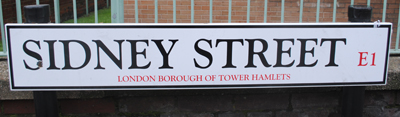
10 London sites associated with Sir Winston Churchill – 8. Sidney Street, Stepney…

Sidney-Street

Sir Winston Churchill will be forever associated with this now rather nondescript East London street, thanks to a series of events that occurred when he was Home Secretary.

Known as the Siege of Sidney Street or the Battle of Stepney, the event was sparked when, on 16th December, 1910, a gang of Russian and Latvian exiles attempted to break into a jewellers in Houndsditch by tunnelling from an adjacent property in Exchange Buildings.

Tipped off by a neighbour, the police arrived and in the series of events that followed, a number of officers were shot and three – Sergeant Charles Tucker, PC Walter Choate and Sergeant Robert Bentley – were killed (Sergeant Tucker died at the scene and the latter two later that day in hospital). The event became known as the Houndsditch Murders.

The gang members largely escaped – although one gang member, George Gardstein, was later found dead of wounds he had received during the gunfight – and an intensive manhunt commenced for the gang.

Some two weeks later, on 2nd January, 1911, police were informed that several members of the gang, including the alleged mastermind known as Peter the Painter (who may not have even existed or who may have been a Polish decorator Peter Piaktow), were hiding at a property at 100 Sidney Street.

Expecting fierce resistance, several hundred police officers moved in to surround the property the next day and, at dawn – after encountering heavy fire from the building, the siege began.

When the then 36-year-old Churchill received word of the siege (apparently while taking a bath), he made his way to the site, already attracting crowds of onlookers, to observe and apparently offer advice.

At the scene he authorised the use of the military – including a detachment of Scots Guards from the Tower of London and 13 pounder artillery pieces. These, drawn by the Royal Horse Artillery, had just arrived when a fire began to consume the building (it may have been sparked by a bullet hitting a gas pipe). The fire brigade attended but Churchill apparently refused them entry until the shooting stopped.

The gang members inside the building never attempted to escape the building and the remains of two of them – Latvians Fritz Svaars and William Sokolow – were subsequently found in its ruins.

Along with the thee policemen killed at the attempted burglary, a firefighter – Charles Pearson – was also killed, struck by falling debris. There is a memorial plaque to him at the former site of 100 Sidney Street.

Seven supposed members of the gang were eventually captured by police but all either had the charges dropped, were acquitted or had their convictions quashed.

Churchill’s role at the six hour siege was the matter of some controversy and former PM (and then Opposition Leader) Arthur Balfour was among those who accused him of acting improperly and risking lives.

There’s a famous photo of Churchill – who was recorded by one of his biographers saying the event had been “such fun” – peering around a corner at the scene (there’s a story that a bullet tore through his top hat, almost killing him, during the siege) while the event was also one of the first news stories to be captured on film (by Pathe News).

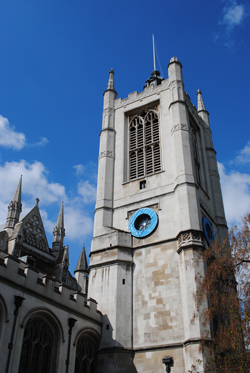
10 London sites associated with Sir Winston Churchill – 7. St Margaret’s Church…

Nestled next to Westminster Abbey opposite the Houses of Parliament, St Margaret’s has long been known as the “parish church of the House of Commons” (although we should point out it’s not officially a parish church). As a result, it probably doesn’t come as a surprise that it has a couple of significant links to former PM Winston Churchill.

St-Margarets-ChurchAmong the most momentous personal occasions was when Churchill married Clementine Hozier in the church on 12th September, 1908, after a short courtship. A headline in the Daily Mirror called it ‘The Wedding of the Year’.

After the fighting of World War II ended in 1945, on VE Day Churchill, in a move reflecting that taken by then PM David Lloyd George after World War I, led the members of the House of Commons in procession from the Houses of Parliament into the church for a thanksgiving service.

In 1947, the church was the scene of another Churchill wedding, this time that of Sir Winston’s daughter, Mary who was wedded to Captain Christopher Soames of the Coldstream Guards on 11th February. 

WHERE: St Margaret’s Church, Westminster (nearest Tube stations are St James’s Park and Westminster); WHEN: 9.30am to 3.30pm weekdays/9.30am to 1.30pm Saturday/2pm to 4.30pm Sunday; COST: Free; WEBSITE: www.westminster-abbey.org/st-margarets-church.


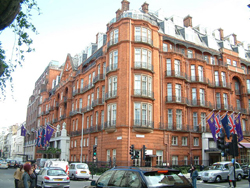
10 London sites associated with Sir Winston Churchill – 6. Claridge’s…

Churchill’s association with this landmark Mayfair hotel was a long one – not only did he convene key meetings here during World War II, the hotel also served as his residence.

ClaridgesEntertaining the upper crust since the mid 1800s, Claridge’s was the scene of many meetings during World War II, including all night meetings convened by Churchill with US military intelligence personnel which would only end when Churchill’s barber appeared at 6am.

The Brook Street hotel became something of a haven for deposed heads of state both in the lead-up to and during World War II – King Peter II and his family had moved in after he was exiled in 1941 and it was at the orders of Sir Winston that in 1945 Suite 212 was declared Yugoslavian territory so Crown Prince Alexander II could be born on “home soil” (there’s a story that a clod of earth from Yugoslavia was  placed under the bed during the birth).

Alongside the king of Yugoslavia, other heads of state to have stayed here during this period include the kings of Greece and Norway.

The scene of many a Churchill dinner, Churchill and Lady Clementine made Claridge’s – specifically the sixth floor penthouse suite – their home for a period after his election defeat in 1945 (Churchill apparently wasn’t that keen on the idea of living so high up!).

For more on the history of Claridge’s, check out the hotel’s website here: www.claridges.co.uk.

PICTURE:  © Copyright Tim Westcott and licensed for reuse under this Creative Commons Licence

10 London sites associated with Sir Winston Churchill – 5. London residences…

Throughout his life – as a child, bachelor, husband and family man, Sir Winston lived in many properties in London (although, of course, a couple of the most famous properties associated with him – his birthplace, Blenheim Palace, and the much-loved family home, Chartwell in Kent – are located outside the city). But, those and 10 Downing Street aside, here are just some of the many places he lived in within London…

29 St James’s Place, St James: Having been born at Blenheim Palace in Oxfordshire and then having spent time in Dublin, at the age of five (1880) he came to live here with his family. He remained here until 1882 when he was sent off to school in Ascot (he later attended schools in Sussex and, most famously, Harrow School). The family, meanwhile, moved to a townshouse at 2 Connaught Place which backed on to Hyde Park.

33 Eccleston Square, Pimlico: The Churchills moved here in 1909 and it was here that their first two children Diana and Randolph were born in 1909 and in 1911. The family remained here until 1913. A blue plaque marks the property.

• Admiralty House, Whitehall: The Churchills first moved into Admiralty House – part of the Admiralty complex on Whitehall – in 1913 (from the aforementioned Eccleston Square) after Churchill was made First Lord of the Admiralty. They remained here until 1915 – years he would go onto to describe as the happiest in his life – before he resigned but returned in 1939 when he was once again appointed to the position.

• 2 Sussex Square, Bayswater: In 1920, the Churchills bought this property just north of Hyde Park which they kept until 1924 when they moved into 11 Downing Street (see below). The property is marked with a blue plaque.

• 11 Downing Street, Whitehall: The Churchills lived at 11 Downing Street when Sir Winston was Chancellor of the Exchequer, from 1925 to 1929. The property, located in Downing Street, is not accessible to the public.

11 Morpeth Mansions, Morpeth Terrace, Westminster:  The Churchill family lived at this Westminster address between 1930 and 1939 (prior to him becoming Prime Minister). The property is marked by a brown plaque.

28 Hyde Park Gate, Kensington: Churchill died in this Grade II-listed, mid 19th century property on the morning of 24th January, 1965. The couple moved in after the end of World War II and, while it’s not clear whether they fully vacated the residence when he was prime minister between 1951-55, it remained their property until his death 10 years later. The property next door, number 27, provided accommodation for his staff. The property is marked with a blue plaque.

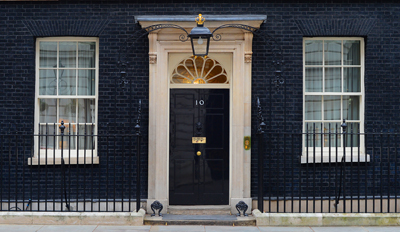
10 London sites associated with Sir Winston Churchill – 4. 10 Downing Street…

10-Downing-Street

Sir Winston Churchill lived a number of residences in London but, of course, the most famous in its own right is the traditional home of British PMs, 10 Downing Street.

Located in a short street just off Whitehall (now closed to the public), the property has been home to Prime Ministers since Sir Robert Walpole, officially First Lord of the Treasury but effectively the first PM, took up residence in 1735.

Churchill moved in following his election to the office of Prime Minister in 1940 and he and his wife Clementine took up residence in a second floor flat. It was in this property where, cigar in hand, he is famously known to have dictated speeches and letters to his secretary while propped up in bed.

The building suffered some bomb damage during the Blitz – on 14th October, 1940, a bomb fell on nearby Treasury Green and damaged the home’s kitchen and state rooms. Three civil servants doing Home Guard duty were killed but the kitchen staff were saved thanks to Churchill who, dining in the Garden Rooms when the bombing raid began, ordered them to leave their duties and get into a bomb shelter.

The Garden Rooms – which included a bedroom, meeting area and the small dining room – were subsequently reinforced with steel and heavy metal shutters although these apparently would have made little difference had there been a direct hit.

Cabinet moved out of Number 10 into the underground bunker complex now referred to as the Churchill War Rooms (see last week’s post) in October, 1939, and, after several near misses, the Churchills – Sir Winston apparently very begrudgingly – moved into the Number 10 Annex above the war rooms in 1940 (although Churchill continued to visit Number 1o for working and dining).

Much of the furniture and valuables were removed from Number 10 and only the Garden Rooms, Cabinet Room and Private Secretaries’ office remained in use (along with a reinforced bomb shelter built underneath – King George VI is known to have sheltered here when he was dining with Churchill when a raid began).

At the end of the war the Churchills quickly moved back into Number 10 and it was from the Cabinet Room that he made his Victory in Europe (VE) Day broadcast on 8th May, 1945.

He vacated the premises after his election defeat later in 1945 but returned when re-elected PM in 1951 and left after he resigned in 1955 having held a dinner party attended by Queen Elizabeth II and Prince Philip the night before.

A couple of interesting facts about Churchill’s time at number 10: Churchill had many pets who usually had free rein in the house – even at 10 Downing Street his poodle Rufus was known to have wandered into a meeting in the Cabinet Room (before he was ejected) – while in 1958, Georgina Landemare, the cook during his time at number 10, famously published a book, Recipes from No. 10, which featured an introduction by Churchill’s wife, Clementine.

There are apparently two portraits of Churchill among those of other PMs which grace the wall of the Grand Staircase.

For more on the history of 10 Downing Street, see www.gov.uk/government/history/10-downing-street

PICTURE: Sergeant Tom Robinson RLC/Crown Copyright 


10 London sites associated with Sir Winston Churchill – 3. Churchill War Rooms…

Churchill2

Now a museum, the Churchill War Rooms is actually the underground bunker system beneath Whitehall from where Churchill directed operations during the Blitz of World War II.

Churchill1The subterranean complex includes a series of historic rooms where Churchill and his cabinet met which remain in the same state they were in when the lights were switched off at the end of the war in 1945. There’s also a substantial cutting-edge museum dedicated to exploring Churchill’s life which boasts an interactive “lifeline” containing more than 1,100 images and a similar number of documents as well as animations and films.

With the coming conflict on the horizon, the complex was constructed from 1938 to 1939 as an emergency government centre in the basement of the now Grade II* listed government building then known as the New Public Offices (and now home to HM Treasury). It became operational on 27th August, 1939, shortly before the outbreak of the war.

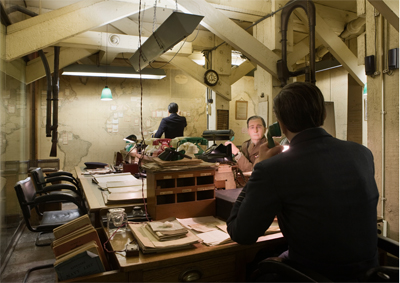
Key rooms include the Map Room (pictured, top, it was manned around the clock by military officers producing intelligence reports) and the War Cabinet Room where more than 100 meetings of Cabinet were held (including just one gathering of Prime Minister Neville Chamberlain’s cabinet in October, 1939).

Other facilities included a private office/bedroom for Churchill (this came with BBC broadcasting equipment which Churchill used four times and, although it had a bed, Churchill apparently rarely used it), the Transatlantic Telephone Room (pictured above, it was disguised as a toilet) from where Churchill could speak directly to the US President. There are also staff dormitories, bedrooms for officers and government ministers, and rooms for typists and telephone switchboard operators.

In October, 1940, a massive layer of concrete – up to five feet thick and known simply as ‘The Slab’ – was added to protect the rooms. Other protective devices included a torpedo net slung across the courtyard overhead to catch falling bombs and an air filtration system to prevent poisonous gases entering.

Abandoned after the war, the premises hosted some limited tours but, despite growing demand to see inside, it wasn’t until the early 1980s when PM Margaret Thatcher pushed for the rooms to be opened to the public that the Imperial War Museum eventually took over the site. The museum opened on 4th April, 1984, in a ceremony attended by the PM as well as members of Churchill’s family and former staff.

Then known as the Cabinet War Rooms, they were extended in 2003 to include rooms used by Churchill, his wife and associates, and, in 2005, following the development of the Churchill Museum, it was rebranded the Churchill Museum and Cabinet War Rooms. In 2010, the name was shortened to the Churchill War Rooms. The entrance to the premises was redesigned in 2012.

Among the objects in the museum are one of Churchill’s famous “siren suits”, an Enigma machine and the flag from his funeral.

WHERE: Churchill War Rooms, Clive Steps, King Charles Street (nearest Tube stations are Westminster and St James’s Park); WHEN: 9.30am to 6pm daily; COST: £18 adults (with donation)/£9 children aged 5-15 (with donation)/£14.40 concessions (with donation) (family tickets available); WEBSITE: www.iwm.org.uk/visits/churchill-war-rooms/

PICTURES: Churchill War Rooms/Imperial War Rooms

10 London sites associated with Sir Winston Churchill – 2. Houses of Parliament…

Houses-of-Parliament

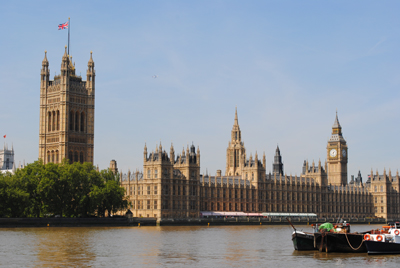
Of course, no look at London sites associated with Sir Winston Churchill would be complete without a mention of the Palace of Westminster, better known as the Houses of Parliament.

Churchill made his maiden speech in the House of Commons on 18th February, 1901, having won the seat of Oldham for the Conservative Party the year before (he switched to the Liberal Party in 1904 and eventually rejoined the Conservatives in 1924).

Over his long career in politics (he was an MP for 62 years), he served in a variety of roles including the President of the Board of Trade, Home Secretary, First Lord of the Admiralty, Minister of Munitions, Chancellor of the Exchequer, and twice, Prime Minster.

Some of the most famous speeches Churchill gave in the House of Commons were during World War II – they include the ‘blood, toil, tears and sweat’ speech given on 13th May, 1940 – the first after he had been made Neville Chamberlain’s replacement as PM, the ‘we shall fight them on the beaches’ speech given on 4th June, 1940, and the ‘this was their finest hour’ speech of 18th June, 1940, in which he gave the ‘Battle of Britain’ its name and, as the name suggests, first recorded the phrase “their finest hour” (the speech ended with it).

Churchill’s last speech to Parliament was given on 1st March, 1955, in which he spoke about the British development of a hydrogen bomb.

There’s several places within the Houses of Parliament which now bear Churchill’s name. Among them are the Churchill Room (named as such in 1991 when ownership of the room passed from the Lords to the Commons, it features two of his paintings and a bronze bust of the PM).

They also include the Churchill Arch – this leads from the Members’ Lobby into the Commons Chamber and is flanked by a 1969 statue of Churchill ( and one of fellow former PM, David Lloyd George (one foot on each of the statues has been burnished thanks to the practice of MPs to touch them as they enter the Commons Chamber).

It took on its current name after it was rebuilt following damage from bombs during World War II – at Churchill’s suggestion damaged stone was reused in its construction as a memorial to the “ordeal” Westminster had endured during the war. The statue of Churchill, incidentally, was the focus of recent commemorations on the 50th anniversary of his death.

Churchill’s stamp can also be seen on the Commons Chamber itself – it was he who recommended that when the chamber was rebuilt after World War II that it retain its rectangular shape rather than be redesigned in a semi-circle.

Churchill’s body lay in state in Westminster Hall prior to his funeral service in January, 1965 (for more on that, see our previous post here.

For more on Churchill’s Parliamentary career, check out the UK Parliament’s Living History page here: www.parliament.uk/about/living-heritage/transformingsociety/private-lives/yourcountry/collections/churchillexhibition/.

This Week in London – Churchill’s Scientists; Waterloo online; a Chelsea murder case reopened; exploring Crossrail; and, astronomical photography…

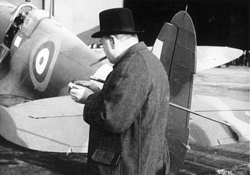
Churchill-with-a-Spitfire-from-Castle-Bromwich,-credit-Philip-Insley,-CBAF-Archive-Vickers-ArchiveSyndics Marking the 50th anniversary of the death of Winston Churchill, a new exhibition at the Science Museum in South Kensington looks at his passion for science and the influence that had on bringing World War II to an end. Churchill’s Scientists celebrates the individuals who flourished under Churchill’s patronage (and , as well as helping to bring about the end of World War II, also launched a post-war “science renaissance”) – from Robert Watson-Watt (inventor of radar) through to Bernard Lovell (creator of the world’s largest telescope) – and also delves into more personal stories of Churchill’s own fascination with science and tech. The display include objects from the museum’s collection as well as original archive film footage, letters and photographs. Highlights include the high speed camera built at Aldermaston to film the first microseconds of the detonation of the UK’s first home grown atomic bomb, the cigar Churchill was smoking when he heard news of his re-election as PM in 1951, and a one-piece green velvet “siren suit” designed by Churchill to wear during air raids (only one of three originals known to exist, it’s never been on public display outside of the tailors who created it). The free exhibition runs until 1st March and is part of the Churchill 2015 programme of events. Visit www.sciencemuseum.org.uk/churchill for more. PICTURE: Churchill with a Spitfire from Castle Bromwich (Philip Insley, CBAF Archive Vickers ArchiveSyndics).

The National Army Museum and Waterloo2oo have launched an online gallery which will eventually comprise images and information on more than 200 artefacts associated with the Battle of Waterloo ahead of the 200th anniversary in June. Among the objects featured on Waterloo200.org are the Duke of Wellington’s boots, a French eagle standard captured in battle and the saw used to amputate the Earl of Uxbridge’s leg. One hundred items – drawn from the Army Museum’s collection as well as from European museums and private collections – can already be seen on the site with a further 100 to be added before the bicentenary on 18th June.

The Talk: Death in Disguise: The Amazing True Story of the Chelsea Murders. On 12th February, the Guildhall Library in the City of London will host Gary Powell as he examines the facts of this double murder which took place in Chelsea in May, 1870, and left Victorian society reeling. For more events at the library, follow this link.

On Now: Breakthrough: Crossrail’s tunnelling story. This exhibition at the London Transport Museum in Covent Garden brings a new perspective on the massive Crossrail project currently underway in the city. Visitors will experience the tunnel environment through a five metre high walk-through installation featuring a computer simulation of a giant boring machine as well as learn about how the project is shaping up, play interactive tunnelling games and hear firsthand from those who work underground. Admission charge for adults applies. Runs until August. For more, see www.ltmuseum.co.uk.

Extended: Astronomy Photographer of the Year Exhibition. This exhibition at the Royal Observatory Greenwich features the winning images from last year’s competition. They include the Briton James Woodend’s image of a vivid green aurora in the Icelandic night sky; American Patrick Cullis’ view of earth taken from 87,000 feet above ground; and, New Zealander Chris Murphy’s image of dusty clouds dancing across the Milky Way. The exhibition can be seen for free in the Observatory’s Astronomy Centre until 19th July. For more, see www.rmg.co.uk/astrophoto.

• Send all items for inclusion to exploringlondon@gmail.com. 

10 London sites associated with Sir Winston Churchill – 1. St Paul’s Cathedral…

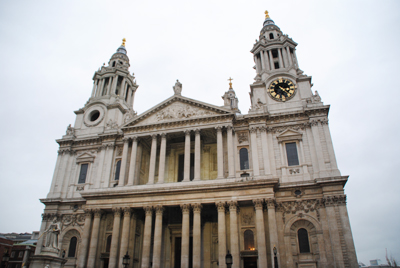
St-Paul'sThe world recently paused to mark the 50th anniversary of the death of former British PM, Sir Winston Churchill (see our earlier post here), so we’re launching a new series looking at 10 sites associated with Churchill in London.

Given the recent anniversary, we’re starting at a site close to the end of his story, at St Paul’s Cathedral, where his state funeral was held on 30th January, 1965.

Code-named ‘Operation Hope Not’, the funeral had been thoroughly planned in the years leading up to the former PM’s death and took place just six days after he passed. Having lain in state in Westminster Hall for three days (during which time it’s estimated 320,000 filed past his flag draped body), his coffin, carried on a gun carriage pulled by 120 members of the Royal Navy, was escorted by more than 2,300 personnel from the military as it made its way through city streets lined with thousands of people to St Paul’s for the service.

During the service, the catafalque containing Churchill’s body stood on a raised platform beneath the central dome surrounded by six candlesticks. Among the official pallbearers – who marched before it down the aisle – were another former PM, Clement Attlee, along with military figures like Field Marshal Lord Slim and Admiral of the Fleet Lord Mountbatten of Burma.

A plethora of world leaders representing 112 nations attended the funeral service including six sovereigns, six presidents and 16 prime ministers. Among them – in an unprecedented move for a state funeral – was Queen Elizabeth II (sovereigns do not normally attend non-family funerals) along with Prince Philip and Prince Charles.

It’s estimated that as some 350 million people around the globe tuned in to watch the funeral on TV.

After the service, Churchill’s body was taken to Tower Pier (near the Tower of London) where, to the sound of a 19-gun salute fired by the Royal Artillery, he was loaded on the MV Havengore. Sixteen RAF Lightning aircraft then did a flypast as he was transported upriver to Festival Pier with dockers dipping their cranes in salute as the boat passed (this journey was recreated last week using the original barge in commemoration of the 50th anniversary of his death).

On its arrival at Festival Pier, the body was then taken to Waterloo Station from where it went via train in a specially prepared carriage (the refurbished funeral train has been brought back together at the National Railway Museum at York) to be buried in St Martin’s churchyard in Bladon, Oxfordshire – a site not far from his birthplace at Blenheim Palace.

A bronze memorial plaque commemorating where Churchill’s catafalque stood in St Paul’s is set before the Quire steps while in 2004, the Winston Churchill Memorial Screen was unveiled in the crypt where it stands in line with the final resting places of both Admiral Lord Nelson and the Duke of Wellington.

For more on the state funeral, St Paul’s has a great page of detail which you can find here, including downloadable copies of the Order of Service and other documents. 

Treasures of London – Winston Churchill statue, Parliament Square…

Winston-ChurchillFormer British PM, Sir Winston Churchill, died 50 years ago tomorrow, so we thought it was a good time to take a look at one of London’s most iconic statues.

Standing tall among some of the towering figures of British politics (and others), the over life-sized bronze statue of Sir Winston Churchill on Parliament Square in Whitehall was designed by Welsh sculptor Ivor Roberts-Jones and is located on a site on the square’s north-east corner chosen by the great man himself.

Standing 12 feet (3.6 metres) high on an eight foot (2.4 metre) high pedestal opposite the Houses of Parliament (which he faces), Churchill, who was 90 when he died, is portrayed during the years of World War II wearing a navy greatcoat but wears no hat and leans on a cane.

The full length, Grade II-listed statue, which Roberts-Jones was commissioned to create in 1970, was unveiled by Lady Churchill with the aid of Queen Elizabeth II in 1973.

Interestingly, it’s said that there’s a mild electric current which runs through the statue to ensure pigeons don’t perch and snow doesn’t gather on his head. Another quirky fact – Roberts-Jones was subsequently commissioned to make another Churchill statue in 1977 – this one for New Orleans.

PICTURE: Adam Carr

This Week in London – New gallery at Hampton Court; Northwest Passage explorers remembered; and, celebrating Churchill’s birthday…

A new gallery opens today in the restored Cumberland Suite at Hampton Court Palace. The Gothic Revival suite of rooms, designed by William Kent for William Augustus, Duke of Cumberland and the youngest son of King George II, were the last major royal commission ever undertaken at the palace. They will now house a selection of the Royal Collection’s finest paintings including masterpieces by Holbein, Van Dyck, Rembrandt, Caravaggio, Bassano and Gainsborough. The restoration followed two years of research aimed at returning the rooms to a state which as closely as possible represents Kent’s original decorative scheme. One of the rooms – the duke’s large light closet – is being opened to the public for the first time in 25 years and will house 12 of Canaletto’s smaller Grand Canal views of Venice. Admission charge applies. For more, see www.hrp.org.uk/HamptonCourtPalace/.

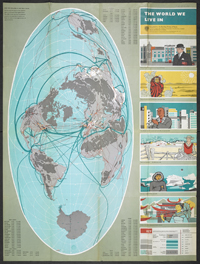
Map• The exploration of the Northwest Passage is the subject of a new exhibition which has opened at the British Library in King’s Cross. Lines in the Ice: Seeking the Northwest Passage looks back over 400 years with exhibits including King Charles II’s personal atlas, 19th century woodcut illustrations and wooden maps made by Inuit communities, and artefacts related to three of the most eminent explorer to seek out the Northwest Passage – Martin Frobisher, Sir John Franklin and Roald Amundsen, the first man to reach the South Pole. The exhibition has opened just weeks after the discovery of the HMS Erebus, one of Sir John Franklin’s lost ships. There’s a full programme of events to accompany the exhibition. Runs until 29th March. Admission is free. For more, see www.bl.uk. PICTURE: The world we live in, c. 1958, on display in Lines in the Ice. Courtesy of British Library.

Celebrate Winston Churchill’s birthday at a special after-hours event in the Churchill War Rooms in Whitehall next week. Advance booking is required to buy tickets for the event which will include a silent disco, drink tasting workshops and the chance to strike your best Churchill pose in a special photo booth. The event runs on the evening of 27th November. To book, head to www.iwm.org.uk/events/churchill-war-rooms/lates-at-churchill-war-rooms-churchill-s-birthday.

 Send all items for inclusion to exploringlondon@gmail.com.

What’s in a name?…Bond Street…

Bond-Street

No, the name of the famous Bond Street in Mayfair has nothing to do with James Bond. Rather, the street – in fact, two streets named Old and New Bond Street – takes its name from a 17th century courtier, Sir Thomas Bond.

Bond was the comptroller of the household of Queen Henrietta Maria, then the Queen Mother thanks to being the widow of King Charles I and the mother of King Charles II. He was also something of a land developer – the head of a consortium that purchased Albermarle House from Christopher Monck, the 2nd Duke of Albermarle, in 1683.

The house was promptly demolished and the area redeveloped with what is now Old Bond Street – which runs from Piccadilly to Burlington Gardens – laid out in 1686 and given Sir Thomas’ surname (he’d died the previous year).

AlliesThe northern extension of Old Bond Street (which runs from Burlington Gardens to Oxford Street) – named New Bond Street – was developed in the 1720s. Caroline Taggart, in The Book of London Place Names, says it was residents of Old Bond Street who insisted on the use of ‘new’ in the name, no doubt to differentiate between themselves and the newcomers or, as Taggart suggests, ‘upstarts’.
Traditionally known as a location for art dealers (Sotheby’s auction house – identified by an ancient Egyptian bust of the goddess Sekhmet which sits on the facade – has stood there for more than a century), the street has become increasingly known for its luxury fashion and accessories retailers such as Asprey’s, Chanel, Cartier, Dolce & Gabbana, Bulgari and Tiffany & Co (see the Bond Street Association for more). Other landmark buildings in the street include the home of the Fine Art Society and the Royal Arcade.

Bond Street is also home to US sculptor’s Lawrence Holofcener’s work, Allies (pictured above), depicting former British PM Winston Churchill and US President Franklin D Roosevelt, and at the northern end stands the Bond Street Underground Station which opened in 1900.

Famous residents have included Admiral Horatio Nelson – who stayed at number 147 in 1797-98 while he recovered after losing his arm at Tenerife, eighteenth century satirist Jonathan Swift and politician William Pitt the Elder, as well as twentieth century spy Guy Burgess, who lived at Clifford Chambers before his defection to USSR.

Around Christmas, the street plays host to a rather special display of lights (pictured top).

What’s in a name?…Bayswater

The origins of the name of this inner west London location on the northern side of Hyde Park and Kensington Gardens go back to at least the 14th century when it was recorded as Bayard’s or perhaps Baynard’s watering place.

Bayard was the word for a bay-coloured horse but it is thought that instead the name here comes from a local landowner – it’s been suggested he may be the same Baynard whose name is was remembered in the long gone Norman fortification Baynard’s Castle in the City.

The name probably referred to a site where people on their way out of or headed to London stopped for a rest and some water; the water aspect may relate to springs or to the Westbourne Stream which ran through the area.

It’s now known for its culturally diverse population and high concentration of hotels. It’s also known for Georgian terraces – many of which have been converted into flats, mansion blocks and garden squares.

Notable residents have included Peter Pan author JM Barrie and former PM’s Tony Blair and Winston Churchill while landmarks include Whiteleys, a department store which first opened in the mid 19th century (and was later rebuilt after burning down).

Daytripper – Walmer Castle…

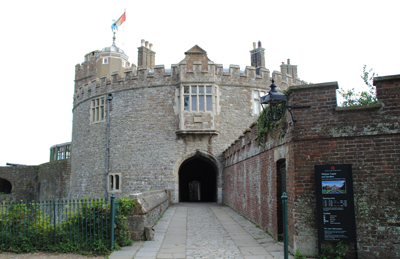
Walmer-CastleA coastal artillery fort built on the orders of King Henry VIII in light of a threatened Catholic invasion, Walmer Castle on the Kentish coast is officially the residence of the Lord Warden of the Cinque Ports.

What was a rather functional artillery platform has been embellished significantly in the years since it became the official residence of the Lord Warden in 1708, creating a comfortable home for holders of the title who have included Queen Elizabeth, the Queen Mother, the Duke of Wellington and bookseller WH Smith.

The ‘castle’, located about a two hour, 10 minute train journey from London (and then a mile walk from Walmer Station), was constructed in 1539 as one of a string of forts – others include nearby Deal Castle and the long gone Sandown Castle – designed to protect the watery stretch between Goodwin Sands and the coast known as the Downs.

Its low circular design, featuring a central ‘keep’ reached by a drawbridge and surrounded by a curtain wall with four projecting, semi-circular bastions, was influenced by the need to defend against heavy artillery and provide a platform for guns.

Initially garrisoned with ten gunners, four soldiers and two porters under the command of a captain and a lieutenant, Walmer saw little action during Tudor times but was the site of a siege during the Civil War.

Obsolete by the end of the 17th century, it was the Duke of Dorset who was the first Lord Warden (an office created in the thirteenth century to oversee the affairs of the Cinque Ports Confederation, a grouping of five ports including Hastings, Romney, Hythe, Dover and Sandwich) to use Walmer Castle as a residence, embarking on a renovation and extension of the existing structure.

Further alterations was carried out by successive Lords Warden, the most extensive being those made by  the 2nd Earl Granville, Lord Warden between 1865 and 1891, who commissioned architect George Devey to oversee the additions.

The gardens, meanwhile, which are well worth visiting in their own right, were also Granville’s work as well as that of an earlier Lord Warden, Prime Minister William Pitt the Younger, who was Lord Warden between 1792 and 1806.

The Duke of Wellington (Lord Warden between 1829 and 1852) reputedly enjoyed his time staying at the castle – he was even visited by the young Princess Victoria here in 1835 (she later stayed for a month with her family when Queen) and died here on 14th September 1852. His room can still be seen inside – the contents include the armchair he was sitting in when he died (the rooms also include a small museum dedicated to Wellington and another dedicated to William Pitt).

Not all Lords Warden enjoyed the property. Sir Winston Churchill, Lord Warden  between 1941 and 1965, never stayed here but Sir Robert Menzies, Prime Minister of Australia and Lord Warden between 1966 and 1978, did and the Queen Mother, Lord Warden between 1978 and 2002, was a regular visitor.

The castle was opened to the public soon after responsibility for it was transferred from the War Office to the Ministry of Works in 1905. It is now under the care of English Heritage and the rooms inside are decorated as they were in the 1930s (it was WH Smith who ensured historic furnishings at Walmer could not be removed). There are even a couple of holiday cottages on site which can now be rented.

WHERE: Walmer Castle, Kingsdown Road, Deal, Kent; WHEN: 10am to 6pm daily (until 6th July); COST: Adults £7.90/Children (5-15 years) £4.70/Concession £7.10; WEBSITE: www.english-heritage.org.uk/daysout/properties/walmer-castle-and-gardens/.

This Week in London – New drawbridge for the Tower; Churchill War Rooms celebrate 30 years; and, the mid-Twentieth century home at the Geffrye…

There’s a working drawbridge at the Tower of London, something not seen at the fortress since the 1970s. The bridge, which would have originally spanned a water-filled moat, was created in 1834 to allow munitions to be brought into the basement level of the White Tower from the wharf (the moat was drained in 1843 on the orders of the then-Constable, the Duke of Wellington). The bridge has been altered many times but the last time it was completely replaced was in 1915 while the tradition of raising it was carried on until the 1970s before it was permanently fixed in 1978. The new bridge draws on historic designs from 1914 and has been constructed of steel and English oak. It will be raised and lowered on “high days” and holidays and for educational purposes. For more, see www.hrp.org.uk/TowerOfLondon/.

The Churchill War Rooms – a complex of underground rooms from where then PM Winston Churchill and others directed the course of Allied troops during World War II – is celebrating the 30th anniversary of its public opening with a new displaying showcasing never before seen objects related to its creation as a tourist attraction. The objects include a private admissions ticket from the days when the only way inside was via specially granted permission, correspondence about the fate of the War Rooms and a poster from 1984 advertising the opening of the Cabinet War Rooms to the public. Admission charge applies. For more, see www.iwm.org.uk/visits/churchill-war-rooms.

On Now: John Pantlin: photographing the mid-century home. This free exhibition at the Geffrye Museum in Shoreditch celebrates the work of Pantlin who is noted for his extensive work for the architectural press in the 1950s and 1960s. The small exhibition focuses on his shots of domestic interiors with shots of sun-filled living rooms and bedrooms filled with toys with all images drawn from the Robert Elwall Photographs Collection. Runs until 29th June. For more, see www.geffrye-museum.org.uk.

10 (more) curious London memorials…8. The SOE Memorial…

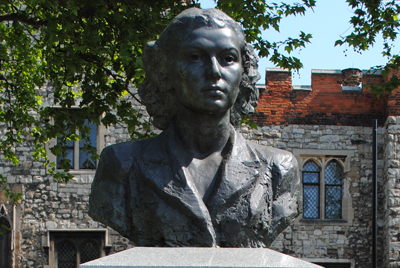
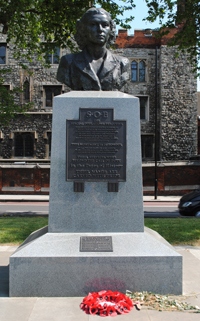
SOE-bigTucked away on Albert Embankment just to the north of Lambeth Bridge, this moving memorial was only unveiled in 2009 and formally honours the under-cover agents who worked for the Allies behind enemy lines during World War II.

The plinth is topped with a larger-than-life bust of Londoner Violette Szabo, sculpted by London artist Karen Newman. Szabo, who here gazes out across the Thames, was tortured and executed after being captured by the Germans while on a mission behind enemy lines following the D-Day landings.

SOEThe daughter of a French mother and English father, Szabo grew up in South London and, when World War II broke out in 1939, volunteered to work as an undercover operative in France as member of the British Special Operations Executive (SOE).

She had successfully completed one mission and had returned to France for a second when she was discovered and sent to a prison camp where she was unsuccessfully tortured for information.

Posthumously awarded the George Cross and the Croix de Guerre, a plaque on the memorial says she was among the 117 SOE agents who did not survive their missions to France. As many as 407 SOE agents were sent on “sabotage missions” to occupied France to fight with the French resistance.

Surprisingly, this SOE Memorial was apparently the first public memorial to honour the work of the unit. Formed on the orders of PM Sir Winston Churchill, it consisted of agents from various countries who were devoted to the Allied cause. Its feats included a raid which destroyed a factory in the Telemark region of Norway where the Germans were trying to produce heavy water which is used in the creation of atomic bombs – an operation which receives a special mention on the memorial.

The memorial was officially unveiled by the Duke of Wellington on 4th October, 2009. One of the plaques on it states that the monument “is in honour of all the courageous S.O.E. Agents: those who did survive and those who did not survive their perilous missions”. “Their services were beyond the call of duty. In the pages of history their names are carved with pride.” Enough said.

For more on the history of women serving in the SOE, see Squadron Leader Beryl E Escott’s book The Heroines of SOE: F Section: Britain’s Secret Women in France.

10 (more) curious London memorials…4. ‘People of London’ Memorial…

People-of-London

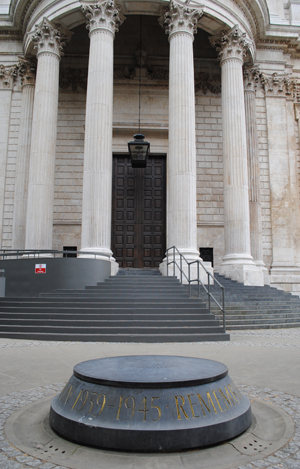
Amid all the grand war-related memorials of London, this rather humble memorial sitting outside the north transept of St Paul’s Cathedral in St Paul’s Churchyard can easily be overlooked. 

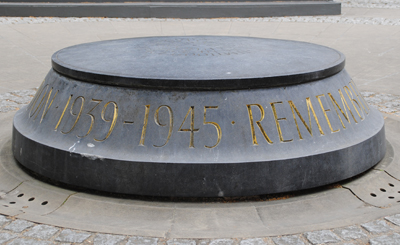
Known as the Memorial to the Londoners killed in World War II Bombardments or simply as the ‘People of London’ memorial as it’s called on the sculptor’s website, it commemorates the 30,000 Londoners who were killed during the Blitz  (not to be confused with the National Firefighters’ Memorial, known informally to many as the Blitz Memorial, which sits opposite the cathedral’s south transept and commemorates firefighters who died during the Blitz).

People-of-London---smallThe round memorial was carved from a three tonne block of Irish limestone and is set into paving (it was initially very shiny).

The gilded inscription which runs around the outside reads “Remember before God the people of London 1939-1945” while on top, written in a spiral, is an inscription written by Sir Edward Marsh – “In war resolution, in defeat defiance, in victory magnanimity, in peace goodwill”, the text of which was used by Sir Winston Churchill in the frontispiece to his history, The Second World War.

Unveiled by the Queen Mother on 11th May, 1999, the memorial is the work of Richard Kindersley, whose other memorials include the Commonwealth Memorial on Constitution Hill.

Kindersley writes on his website, that the “position of the memorial adjacent to St Paul’s is most appropriate, as most people will remember the dramatic photograph of the Cathedral dome of the taken during a devastating attack in 1941.”

It was paid for by public funds raised following an appeal in the Evening Standard newspaper, launched in connection with the 50th anniversary of VE Day.

10 Historic London Garden Squares…5. Berkeley Square…

Berkeley-Square

Located in the south-west of Mayfair in London’s West End, Berkeley Square was originally laid out by architect William Kent in the mid 1700s.

It takes its name from the Berkeley family of Gloucestershire (the first Lord Berkeley of Stratton was a Royalist commander in the Civil War) whose London residence, Berkeley House, stood on what is now the south side of the square until it was destroyed in a fire in 1733 (Devonshire House, whose residents included the 5th Earl of Devonshire and his somewhat notorious wife Georgiana, was subsequently built on the site and remained there until it was demolished in the 1920s).

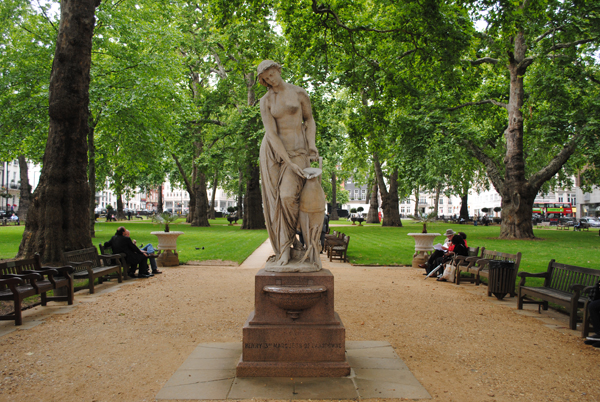
The gardens, which feature some of the city’s oldest London Plane trees (dating from 1789), have a pump house at the centre which was built in 1800 and is now Grade II listed (it stands on the site of an earlier equestrian statue of King George III). Other features including the statue Lady of Sumaria (Water Carrier) – pictured above – which was made by Pre-Raphaelite sculptor Alexander Munro in 1858 and stands at the garden’s southern end.

Among notable buildings which face onto the square are Lansdowne House – located on the south-west corner of the square, it was designed by Robert Adam and now home of the Lansdowne Club – and number 50 Berkeley Square, home of short-lived early 19th century PM George Canning (and said to be the most haunted house in London). The square was also the home of society favorite, Gunter’s Tea Shop, which dated from the mid-1700s.

Famous residents have included wartime PM Sir Winston Church (he lived at number 48 as a child); Horace Walpole, some of the first Prime Minister Robert Walpole (he lived at number 11 during the 1700s), Robert Clive (more famously known as Clive of India, he committed suicide in number 45 in 1774), and the fictional Bertie Wooster and his valet Jeeves (creations of author PG Wodehouse). The square also featured in the famous wartime song, A Nightingale Sang in Berkeley Square.

The square is open from 8am daily with closing times varying based on the season.