Eight historic department stores in London…4. Harrods…

harrods

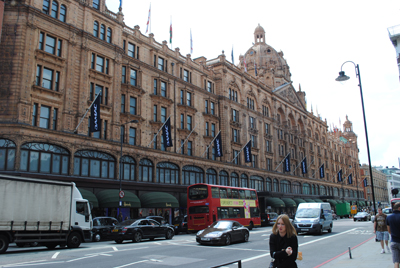
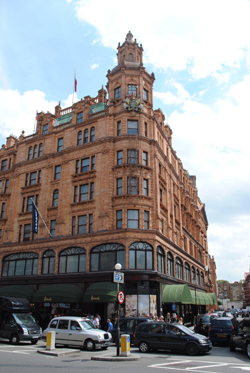
Famed as a luxury shopping destination for the rich and famous, Harrods on Brompton Road in Knightsbridge takes its name from founder Charles Henry Harrod.

Harrod first established a drapery business in Southwark in 1824 and in 1832, founded Harrods & Co Grocers in Clerkenwell. Two years later he established another grocery, this time in Stepney, with a particular interest in tea.

harrods2In 1849, to capitalise on trade to the upcoming Great Exhibition in Hyde Park in 1851, he took over a small shop on the site of the current store – initially with just two assistants and a messenger boy. In 1861 his son, the similarly-named Charles Digby Harrods, took over the business and by 1880, the store was employing more than 100 people offering customers everything from medicines and perfumes to clothing and food and already attracting the wealthy customers it would become known for.
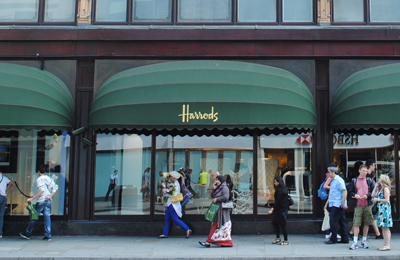
Even the burning down of the store in late 1883, failed to dint its long-term success, and Harrod took the opportunity to build a capacious new building on the site. Designed by Charles Williams Stephens, the building, which wasn’t finished until 1905, featured Art Nouveau windows and was topped with a dome. One of its attractions opened on 16th November, 1898, when it became home to England’s first “moving staircase” (escalator). Nervous customers were apparently offered a brandy once they’d made the journey.

Harrods’ fame continued to grow and over the years a who’s who of London society has been associated with the store – everyone from writers like Oscar Wilde, and AA Milne, actors Ellen Terry, Charlie Chaplin and Laurence Olivier and luminaries such as the “father of psychoanalysis” Sigmund Freud and many members of the Royal family.

Under the motto of Omnia Omnibus Ubique (All Things for All People, Everywhere), the store became famous for selling whatever the customer wanted including, thanks to an exotic pets department which lasted up until the 1970s, a lemur called Mah-Jongg which was sold to Stephen and Virginia Courtauld in 1923 and lived with them at Eltham Palace and a lion called Christian to Australian expats John Rendall and Anthony “Ace” Bourke in 1969 (it was later set free in Kenya).

The ownership meanwhile has long since left the Harrods family – Charles Digby had sold his shares as far back as 1889 when the company was floated on the London Stock Exchange and renamed Harrods Stores Limited with Sir Alfred James Newton as chairman and Richard Burbridge as managing director. Burbridge was succeeded by his son in 1917 and he by his son in 1935.

In 1959, the company was bought by House of Fraser and in 1985, the store was sold to the Al-Fayed brothers (Mohamed Al-Fayed famously had two memorials created inside dedicated to Diana, Princess of Wales, and his son Dodi Fayed, both of whom died in a car crash in Paris in 1997. He also decided not to renew the company’s Royal warrants – it has had up to four). Current owners Qatar Holding, the sovereign wealth fund of Qatar, bought the company in 2010.

The company has opened a number of other Harrods stores over the years – including its only ever foreign branch (long since independent) in Argentina in 1914 and, in 2000, a shop aboard the ship RMS Queen Elizabeth 2.

The Knightsbridge store, meanwhile, has been twice bombed by the IRA – in 1983 when six were killed and scores more injured after a car bomb exploded in an adjoining street and in 1993 when a bomb was placed in a litter bin, injuring four. In 1989, it controversially introduced a dress code, banning casual wear like flip-flops and Bermuda shorts.

Now the largest department store in Europe, the Brompton Road store has more than million square feet of selling floor over seven stories. It attracts some 15 million customers a year to its more than 300 different departments and other facilities including more than 25 restaurants and cafes, a concierge, bank, spa and personal shopping service.

harrods3

Eight historic department stores in London…3. Fortnum & Mason…

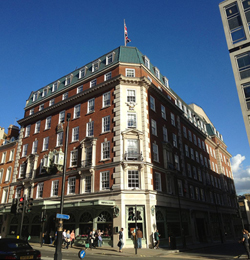
Now a Piccadilly institution, Fortnum and Mason’s origins (which we dealt with in 2011 in a London’s oldest post but couldn’t resist looking at again) famously go back the early 17th century when Hugh Mason rented out a spare room to William Fortnum, a Footman in the household of Queen Anne.

fortnum-masonThe entrepreneurial Fortnum decided to supplement his income by selling Queen Anne’s half-used candle wax (new candles were required every night) for a small profit. It was he who convinced his landlord, who also had a small shop in St James’s Market, to join with him in a joint venture – the first Fortnum & Mason – in Duke Street in 1707.

Initially founded as a grocery store, Fortnum & Mason, which moved to its current site at 181 Piccadilly in 1756, become known for its high quality and rare goods – in particular tea – and during the 18th and 19th centuries supplied the gentry who were in London for the ‘season’. Departments inside the store have included a rather bizarre ‘Expeditions Department’ which apparently supplied King Tut’s finder Howard Carter and a 1922 expedition to Mount Everest.

It has held numerous Royal Warrants since the mid 1800s with the first granted in 1863 when the firm was appointed as grocers to the then Prince of Wales.

A supplier of British officers during the Napoleonic Wars, Fortnums was also active during the Crimean War when Queen Victoria had shipments of “concentrated beef tea” sent to Florence Nightingale for use in her hospitals there.

Other claims to fame include the creation of the first Scotch egg in 1738 as a food for travellers and that in 1886, it became the first store in Britain to stock tins of Heinz baked beans. It also operated a post office between 1794 and 1839 when the General Post Office was founded.

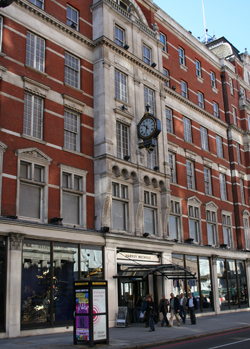
The iconic clock which hangs on the facade of the building was commissioned in 1964 by Canadian businessman Garfield Weston who bought the business in 1951. Every hour models of Mr Fortnum and Mr Mason come forth and bow to each other. Other features on the building itself include four colonies of bees which have lived on the roof since 2008 in uniquely-designed hives.

The store, now famous for its luxury food hampers, underwent a £24 million restoration in the lead-up to its 300th anniversary in 2007. As well as the flagship store, it also now operates stores in St Pancras (2013) and Heathrow Airport (2015) as well as, since last year, in Dubai (it did open a store on Madison Avenue in New York in the 1930s but the business was short-lived thanks to the Depression). Fortnum & Mason products can also be found in a growing number of department stores around the world.

The Piccadilly store houses a number of eateries including The Parlour, The Gallery and The Wine Bar as well as, since it was opened by Queen Elizabeth II herself in 2012, the Diamond Jubilee Tea Salon – already famous for its afternoon teas.

See www.fortnumandmason.com.

PICTURE: Gryffindor/Wikimedia/CC BY-SA 4.0

Eight historic department stores in London…2. Liberty & Co…

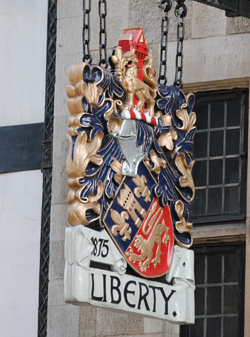
liberty1Liberty, now a West End institution, was founded by Arthur Lasenby Liberty in 1875 with a vision to transform the way people thought of fashion and homewares.

Born the son of a Buckinghamshire draper, Liberty worked with relatives from a young age before he eventually started work with a women’s fashion house, Farmer and Rogers. Rising to management, when they refused to make him a partner in the business, he decided to strike out on his own and established Liberty & Co at 218a Regent Street, an ‘oriental warehouse’ selling ornaments, fabric and objets d’art. He named the property East India House.

libertyOnly 18 months after he first set up shop – financed with a £2,000 loan from his future father-in-law and employed three staff – he was already expanding his premises into properties to the south in Regent Street to house furnishings and carpets. He eventually took over all the buildings between 140 to 150 and named the extended building Chesham House.

The costume department was introduced in 1884 and together with its director EW Godwin, Liberty created in-house fashions to challenge those of Paris. He is also noted for having encouraged and collaborated with designers like Archibald Knox and William Morris.

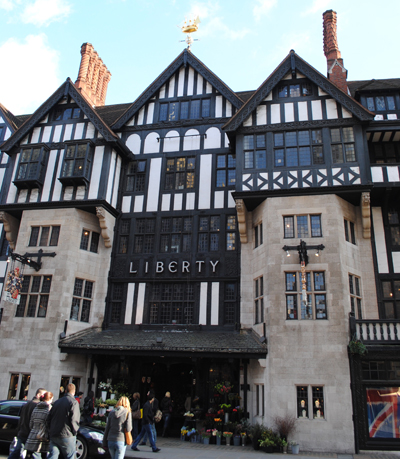
Liberty, who took the company public in 1894, was knighted in 1913. He died in 1917, seven years before the current Liberty store – the mock-Tudor building on the corner of Regent Street and Great Marlborough Street – was built.

Designed by Edwin T Hall and son, the shop was built from the timbers of two ships, the HMS Impregnable and the HMS Hindustan (and the shop frontage measures the same length as the latter). It was built around three light wells, each of which was surrounded by smaller rooms – many of which have fireplaces and were designed to give the feel of rooms in a house.

Features on the Grade II*- listed building include its weathervane – an exact replica of the Mayflower, which took pilgrims to the US in 1620, decorative shields including the arms of Shakespeare and those of the wives of King Henry VIII, and the clock above the Kingly Street entrance.

Liberty, which is generally acknowledged to have been a powerful influence on 19th and 20th century fashions and tastes, was bought by its current owners, BlueGem in 2010.

~ www.libertylondon.com

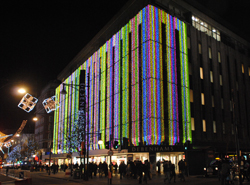
Eight historic department stores in London…1. Selfridges…

selfridges
Christmas lights are appearing already and shop windows are being unveiled. So in the lead-up to the yuletide celebrations this year, we’re taking a look at eight of London’s most historic department stores.

To kick it off, we’re looking at how it all started for Selfridges, the department store started by American Harry Gordon Selfridge and made famous, in recent times, as the setting for the TV series, Mr Selfridge.

Selfridge, who had been born in Wisconsin in the US, formed the company Selfridges & Co in 1906, having made his way to London from Chicago where he had been extensively involved in the department store Field & Leiter (later Marshall Fields) rising to become a junior partner in the business (he had, after leaving Marshall Fields, apparently subsequently opened his own store in Chicago but not wanting to compete with his former employees, decided to head for London).

As well as drawing on his own resources, he was backed by Samuel Waring of furniture makers Waring & Gillow, who did so on condition that he not sell furniture in his store, a condition respected long after W&G had ceased trading.

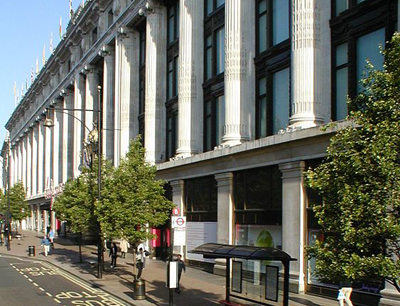
Work began on his new purpose-built neo-classical department store at 400 Oxford Street soon after. Featuring rows of columns and taking up a whole block, it was designed by American architect Daniel Burnham whom Selfridge knew from Chicago and wasn’t fully completed until 1928. As mentioned in a previous post, an idea for a colossal tower on the building was never realised.

The grand opening was held on 15th March, 1909, and, a master of the theatrical, Selfridge’s publicity campaigns had ensured a crowd and as many as 30 police officers were apparently required to help hold back the crowds.

Known to his staff as The Chief, Selfridge – who now preferred the name Gordon to Harry, kept the masses talking about his store when in July that same year he put on display the plane French aviator Louis Bleriot had used when making the first flight over water. More than 150,000 people came to see it.

Selfridge, driven by his credo that “the customer is always right”, revolutionised the way the British shopped – particularly women – with his stylish display of goods in-store and in the windows, not to mention store features like the women’s toilets (a novelty for the age), Art Deco lifts, rooftop gardens and the Palm Court Restaurant (destroyed by fire caused by bombing in the 1940s). Other facilities included a post office, theatre booking office, library and an information bureau.

And the innovations kept coming: in 1910, he opened a beauty department inside the ground-floor entrance and in 1911, the Bargain Basement was born. The world’s biggest bookshop became part of the store in 1911 as well as a pet department. He also launched a delivery system using a fleet of horse-drawn vans and then petrol and electric powered vans.

And Selfridge continued to draw crowds with events ranging from a gala charity ball on the rooftop in 1913 to a showing of John Logie Baird’s televisor in 1925. In 1931, the famous clock, The Queen of Time was installed over the flagship store’s entrance.

Selfridge, who was forced to retire in 1939 after losing much of his personal fortune – thanks at least in part to his free-spending lifestyle, died in 1947.

Aside from the flagship store in London, Selfridges stores can now be found in Birmingham and Manchester (two).

PICTURE: Russ London/Wikimedia/CC BY-SA 2.5/Image cropped

For more on the history of Selfridges, see Lindy Woodhead’s Shopping, Seduction & Mr Selfridge.

Special – 10 sites commemorating the Great Fire of London – The recap…

So we’ve come to the end of our current Wednesday series – 10 sites commemorating the Great Fire of London – to mark the Great Fire’s 350th. So here’s the recap in case you missed any:

10 sites commemorating the Great Fire of London – 1. Thomas Farriner’s plaque

10 sites commemorating the Great Fire of London – 2. The Golden Boy of Pye Corner…

10 sites commemorating the Great Fire of London – 3. The Templar’s column…

10 sites commemorating the Great Fire of London – 4. St Paul’s ‘Resurgam’…

10 sites commemorating the Great Fire of London – 5. Paternoster Square Column…

10 sites commemorating the Great Fire of London – 6. A rare survivor…

10 sites commemorating the Great Fire of London – 7. The ancient plaque commemorating St Olave Silver Street…

10 sites commemorating the Great Fire of London – 8. St Paul’s memorial to John Donne…

10 sites commemorating the Great Fire of London – 9. A memorial to a fire prevention breakthrough (erected on the Great Fire’s 110th)…

10 sites commemorating the Great Fire of London – 10. Two mysterious mice…

We’ll kick off a new Wednesday series next week!


10 sites commemorating the Great Fire of London – 10. Two mysterious mice…

To end our series on memorials in London commemorating the Great Fire of 1666 – marking the event’s 350th anniversary – we’re taking a look at what is one of the smallest monuments in the City (and, despite all rumour, possibly not a memorial to the Great Fire at all).

philpot-lane-miceMidway up the wall of a building at the corner of Eastcheap and Philpot Lane, not far from The Monument (for more on its history, see our earlier post here), can be seen two brown mice fighting over a piece of cheese.

The mice are commonly said to be a memorial, not to anyone who died during the fire, but to two men who died while building The Monument itself.

The cheese apparently relates to the story in that the two men fell to the deaths while fighting after one accused the other of eating his cheese sandwich. The two mice, one for each of the men, relate to the fact that it was apparently mice who were later found to be the culprits.

But we need to point out that not all agree on the memorial aspect of the mice, which have apparently been decorating the building’s cornice since the mid-1800s – and there are legitimate questions: why, for example, would the Victorians when constructing the property commemorate two long dead workers and how had the story even reached them of their deaths?

One theory is that the mice do commemorate two men who died in the circumstances described, but while building the property they are located upon and not The Monument at all.

The building, meanwhile, is said to have been constructed as offices and warehouses for spice merchants Hunt & Crombie – it’s been suggested the mice were merely part of the decorations made for the building and not a memorial at all.

Whatever the origins of the mice – and whether they represent a memorial or not – we thought they were a nice way to close out the special series on Great Fire of London commemorative sites. We’ll kick off a new Wednesday series shortly.

PICTURE: Spudgun67/Flickr/CC BY 2.0

10 sites commemorating the Great Fire of London – 9. A memorial to a fire prevention breakthrough (erected on the Great Fire’s 110th)…

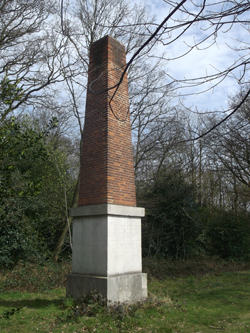
This rather unremarkable obelisk on Putney Heath actually commemorates the invention of ‘Fireproof House’ and was erected, not coincidentally, on the 110th anniversary of the great conflagration.

hartley-obeliskThe rather eccentric David Hartley, an inventor and MP, came up with the idea of sheathing joists under floorboards with thin layers of what were initially iron and later iron and copper plating to prevent the spread of fire in homes and ships and was granted a patent for his system in 1773.

Known as ‘Hartley’s Fire Plates’, he claimed in a pamphlet that a single fireplate might have prevented the Great Fire – a claim which got other MPs excited and led them to grant him cash – £2,500 – to continue his experiments as well as an extension on his patent, from the usual 15 to 31 years.

His experiments included building homes for the express purpose of setting them alight to test his invention, one of which he built on Wimbledon Common. Known as the ‘Fireproof House’, the property was repeatedly set alight in front of prominent witnesses.

These included MPs, the Lord Mayor of London and Aldermen of the City of London – who granted Hartley the Freedom of the City and encouraged fire plates to be included in all new buildings in London – and, of course, King George III and his wife Queen Charlotte. One of the tests was apparently carried out while the royal family was eating breakfast in an upstairs room inside (they survived unscathed – one hates to think of Hartley’s fate should they not have).

The house is now gone but the Hartley Memorial Obelisk, erected just off Wildcroft Road in what were formerly the grounds of Wildcroft Manor, remains.

The red brick and stone Grade II-listed structure was erected by the City of London Corporation in 1776, the 110th anniversary of the Great Fire of London, to commemorate Hartley’s invention of fire plates. The first stone in the monument – which is attributed to George Dance – was laid by the then Lord Mayor, John Sawbridge.

PICTURE: David Antis/Geograph/CC BY-SA 2.0

10 sites commemorating the Great Fire of London – 8. St Paul’s memorial to John Donne…

As mentioned earlier, there are several memorials to the Great Fire of London at St Paul’s Cathedral – we’ve already mentioned one of them, the Resurgam, which can be found on the south side of the cathedral’s exterior. 

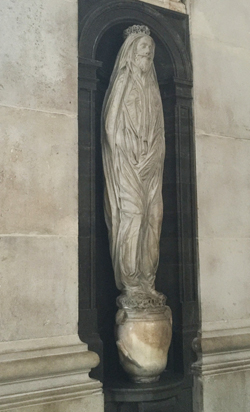
john-donneAnother can be found in a monument which actually commemorates the poet and priest, John Donne, a dean of St Paul’s who died in 1631 (incidentally, it’s not the only place he’s commemorated – there’s also a bronze bust of him outside the cathedral, placed there in 2012).

The marble effigy inside the cathedral, however, is significant because, erected within 18 months of his death,  it is among the few monuments to survive the Great Fire of London. Located in the south quire aisle, the effigy, the work of Nicholas Stone, depicts Donne in his funeral shroud (he apparently posed for it while still alive, wrapped in a sheet).

The effigy was apparently saved by the fact that when the fire raged through the cathedral, it fell into the crypt. And, in a poignant reminder of the fire’s destructive power, if you look closely at the base you can still see scorch marks from the blaze.

It lay in the crypt among other remains of the Great Fire until the late 19th century when it was recovered and restored to its place in the cathedral above in a position close to where it had formerly stood in the Old Cathedral.

PICTURE: Victor Keegan/Flickr/CC BY 2.0/image cropped and lightened.

10 sites commemorating the Great Fire of London – 7. The ancient plaque commemorating St Olave Silver Street…

st-olave-silver-streetMany of the monuments commemorating the Great Fire of London, date from succeeding centuries (the Monument being a notable exception), one of the earliest can apparently commemorating the site of the Church of St Olave Silver Street.

The church dated from at least the 12th century and is one of a number in London which were apparently named after King Olaf, the first Christian King of Norway who fought alongside the Anglo-Saxon King Ethelred II against the Danes in England in the 11th century.

The church served as the parish church of the silversmiths and apparently in recognition of that boasted a figure of Christ on the cross which had silver shoes.

The church had been rebuilt in the early 1600s but was completely destroyed in the Great Fire of London and never rebuilt, the parish united with that of St Alban Wood Street.

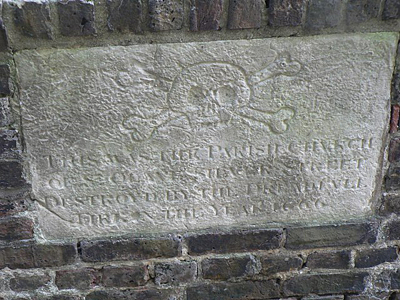
The site of the church, now on the corner of London Wall and Noble Street, is now a garden and boasts an almost illegible plaque featuring a skull and crossbones, which is believed to date from the late 17th century, and which commemorates the destruction of the church in the Great Fire.

PICTURE: © Chris Downer/CC BY-SA 2.0

10 sites commemorating the Great Fire of London – 6. A rare survivor…

Walk around the streets of the City of London and it’s hard to miss the myriad of plaques commemorating many buildings lost in the Great Fire of London. On the Strand, however, can be found a plaque which commemorates a building that survived the fire.

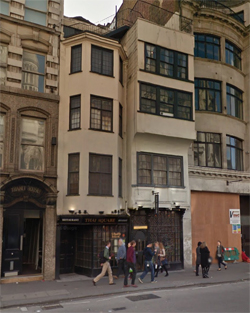
strand-buildingLocated at 230 Strand (opposite the Royal Courts of Justice), the narrow four storey building, complete with projecting second floor, dates from 1625 and was apparently originally built as the home of the gatekeeper of Temple Bar.

According to the sign upon it, the now Grade II* building was the only structure on the Strand to survive the fire of 1666.

Now a rather plain-looking building, it has been much altered over the years and for much of the 20th century housed the Wig and Pen Club for journalists and lawyers – running from at least 1908, it closed in 2003.

Along with the late 17th century building next door (the two are pictured above with number 230 on the right), it’s now part of a Thai restaurant.

PICTURE: Google Street View

10 sites commemorating the Great Fire of London – 5. Paternoster Square Column…

paternoster-square-column2
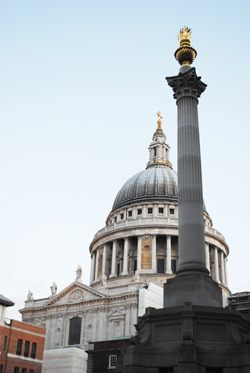
Located just to the north of St Paul’s Cathedral can be found Paternoster Square in the centre of which stands a column.

paternoster-square-columnThe 75 foot (23.3 metre) tall Corinthian column of Portland stone, which was designed by Whitfield Architects and erected in 2003, is topped by a gold leaf covered flaming copper urn which is lit up at night.

While it has been said that the column is “purely decorative”, the developers of Paternoster Square claim on their website that it actually serves several purposes in this case including both commemorative and practical.

Not only is it part of the ventilation system for the carpark underneath, they say its design is apparently a recreation of columns designed by Inigo Jones for the west portico of Old St Paul’s Cathedral.

And then there’s the three metre high urn on top which, not unlike that found on The Monument, they say commemorates the fact the site of the square has twice been destroyed by fire – the first time in the Great Fire of 1666 and the second in the Blitz during World War II.

The area around Paternoster Square was once home to booksellers and publishers’ warehouses.

10 sites commemorating the Great Fire of London – 4. St Paul’s ‘Resurgam’…

Resurgam3
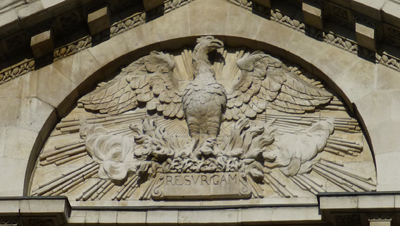
Old St Paul’s Cathedral was certainly the largest and most famous casualty of the Great Fire of London of 1666. And its passing – and rebirth – is recorded on several memorials, one of which can be found on the building itself.

Set on the pediment which, carved by Caius Gabriel Cibber, sits above south portico off Cannon Street, the memorial depicts a phoenix rising from clouds of smoke (ashes), a symbol of Sir Christopher Wren’s new cathedral which rose on the site of the old Cathedral in the wake of the fire. Below the phoenix is the Latin word, ‘Resurgam’, meaning “I Shall Rise Again”.

The story goes that Wren had this carved after, having called for a stone to mark the exact position over which St Paul’s mighty dome would rise, the architect was shown a fragment of one of the church’s tombstones which had been inscribed with the word.

The foundation stone for the new cathedral, largely built of Portland stone, was laid without any fanfare on 21st June, 1675, and it only took some 35 years before it was largely completed. Some of the stonework from the old cathedral was used in the construction of the new.

We should note that the old cathedral was in a state of some disrepair when the fire swept through it – the spire had collapsed in 1561 and despite the addition of a new portico by Inigo Jones, it was generally in poor condition.

Stonework from the Old St Paul’s – everything from a Viking grave marker to 16th century effigies – are now stored in the Triforium, rarely open to the public (tours of the Triforium are being run as part of the programme of events being held at the cathedral to mark the 350th anniversary of the Great Fire – see www.stpauls.co.uk/fire for more).

PICTURE: givingnot@rocketmail.com/CC BY-NC 2.0 (image cropped)

10 sites commemorating the Great Fire of London – 3. The Templar’s column…

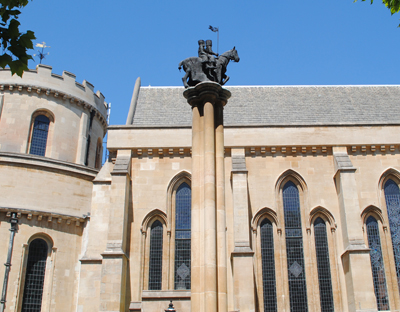
Knights-atop-the-columnStanding outside the Temple Church, in the west of the City of London (between Fleet Street and the River Thames), stands a pillar topped with a pair of Templar knights riding a horse in an obvious commemoration of the military order that once had its preceptory here.

But what many people don’t realise is that the column was also erected, apparently like the Golden Boy of Pye Corner, to commemorate another point where the all-consuming Great Fire of London was finally stopped.

The 10 metre high column was erected in 2000 (another of its purposes was to mark the millennium) in what was once the cloister courtyard of the headquarters of the Templars, which had originally founded to protect pilgrims to the Holy Land in 1119.

The bronze figures of the two men atop a single horse which caps the column was a representation of the image found on the order’s official. It represents the poverty of those who initially joined it – so poor they could only afford one horse for every two men, a situation which was to change dramatically in coming centuries as the order accumulated wealth, a situation which, eventually, in France, led to its downfall.

London Remembers reports that the column was designed in the gothic style, similar to the Purbeck marble columns in the church (which, incidentally, are said to be the oldest surviving free-standing examples of their kind) and deliberately made to contrast with the more florid column of Sir Christopher Wren’s Monument, which marks where the fire started and, also, according to a signboard, “the arrival of the new classical order”.

The column, designed by Ptolemy Dean, and the sculpture, designed by Nicola Hicks, were the gift of Lord Lloyd of Berwick, Treasurer of the Inner Temple in 1999. A Latin inscription around the base of the column reads: “Lest the Temple should be without a memorial of the start of the third millennium the Inner Temple caused this monument to be erected for the greater glory of God.”

For more on Temple and the Temple Church, see our earlier posts here and here and here.

10 sites commemorating the Great Fire of London – 2. The Golden Boy of Pye Corner…

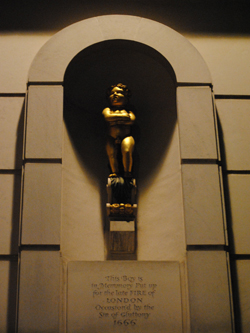
Golden-Boy-of-Pye-CornerWe’ve mentioned this memorial before but it’s worth a revisit. While last week’s entry looked at a plaque marking the site of the start of the Great Fire of London in September, 1666, this week we’re taking a (second) look at one of the sites where it was stopped.

Positioned high on a building on the corner of Giltspur Street and Cock Lane in Smithfield, this small wooden gilt 17th century statue, by an unknown maker, was once located on front of the pub, The Fortune of War, which stood on the site until it was demolished in 1910 (it was apparently used by body-snatchers as a place to display stolen corpses for surgeons from the nearby St Bartholomew’s Hospital to take their pick from).

The statue marks one of the locations on the city fringes where the fire was ‘stayed’ through the demolition of buildings. It bears an inscription which reads “This Boy is in Memmory put up for the late Fire of London Occasion’d by the Sin of Gluttony 1666”.

Well below it is an explanatory note below explains that the boy was made deliberately fat (the statue was apparently originally known as ‘The Fat Boy’ although to the modern eye it doesn’t look particularly so) in reference to the rather odd claim the fire was started in Pudding Lane as a result of the sin of gluttony and not by Papists as had been originally claimed on The Monument.

It has been said that the statue – which is believed to have once had wings and which is the reason why the building it is upon carries a Grade II heritage listing – was merely a shop sign and originally had nothing to do with the Great Fire, which may well be the case, but that said it is known that the fire stopped here (sparing St Bart’s further up Giltspur Street).

PICTURE: David Adams

10 sites commemorating the Great Fire of London – 1. Thomas Farriner’s plaque

This year marks 350 years since the Great Fire of London destroyed much of the City of London and to mark the anniversary, we’re today launching a new special series looking at some of the lesser known – and, in some cases, more unusual – memorials and plaques commemorating the event.

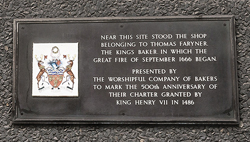
Thomas-Farriner-plaqueSure, everyone knows about The Monument near London Bridge erected to commemorate the event (see our earlier post on it here). But often overlooked is the plaque located in nearby Pudding Lane commemorating the site where the fire began in the early hours of 2nd September, 1666 – the bakery of Thomas Farriner (also variously spelt Faryner or Farynor).

The plaque, located close to the corner of Pudding Lane and Monument Street, was erected in 1986 by the Worshipful Company of Bakers to mark the anniversary of their Royal Charter being granted by King Henry VII some 500 years earlier. It reads (in part): “Near this site stood the shop belonging to Thomas Faryner, the King’s baker, in which the Great Fire of September 1666 began.”

While that fits with the long-held idea that the location of the bakery was 202 feet (61 metres) from the where the Monument stands, the same height of the memorial column itself, new research claims that the site of the bakery was not actually where Pudding Lane now stands but in nearby Monument Street instead.

Drawing on a planning document dating from 1679 and found within the London Metropolitan Archives, academic Dorian Gerhold reportedly cross-referenced the document with later maps and concluded that the baker’s oven was actually located on what is now Monument Street, 60 feet to the east of the intersection with Pudding Lane.

Farriner, meanwhile, was, as a king’s baker, a supplier to the Royal Navy. During the fire, the widower managed to escape the flames along with his three children (although their housemaid, unable or unwilling to escape out a window, perished). He was later able to rebuild the bakery and his home and when he died only a few years after the fire, left considerable sums to his children.

Incidentally, Farriner, his daughter Hanna and his son Thomas were all in the jury which convicted Frenchman Robert Hubert of starting the fire in their bakery by tossing a grenade in through the window (Hubert had confessed and, despite the fact that it’s believed few thought him actually guilty, he was convicted and hanged at Tyburn on 27th October, 1666, for the crime of arson.)

PICTURE: Steve James/Flickr/CC BY_NC-ND 2.0 (cropped and straightened)

Special – English Heritage blue plaques – And the nomination is…

Last week we finished our series looking at notable English Heritage blue plaques and before we move on to our next special Wednesday series, we’re turning things over to you.

Bearing in mind that the criteria for having a blue plaque includes the fact that the person must have been dead at least 20 years and that at least one building associated with the figure must survive within Greater London (but not the City of London, which isn’t covered by the scheme), who do you think should be commemorated by an English Heritage blue plaque but as yet hasn’t been?

Leave your answer in the comments section below…

Meantime, here’s a recap of the last series (and don’t forget to vote for your favourite below):

10 notable blue plaques of London – 1. The oldest surviving blue plaque…

10 notable blue plaques of London – 2. The (now long gone) first Blue Plaque…

10 notable blue plaques of London – 3. The City of London’s only ‘blue plaque’ (and it’s not even blue)…

10 notable blue plaques of London – 4. Oldest surviving blue plaque commemorating a woman…

10 notable blue plaques of London – 5. Five Londoners with more than one blue plaque…

10 notable blue plaques of London – 6. A blue plaque for a deadly bomb…

10 notable blue plaques of London – 7. A blue plaque for a ship…

10 notable blue plaques of London – 8. A notorious ‘tree’ recalled…

10 notable blue plaques of London – 9. A family affair…

10 notable blue plaques of London – 1. The oldest surviving blue plaque…

Tell us which one you found most interesting here…

10 notable blue plaques of London – 10. A man…and his work…

We finish our series looking at notable English Heritage blue plaques with a look at a plaque which not only commemorates a prominent Londoner but, unusually, also displays there for all to see the reason (well, an important part of it, anyway) for his prominence.

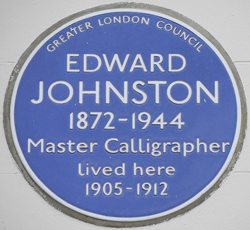
Edward-Johnston1Yes, we’re talking about Edward Johnston (1872-1944), a master calligrapher who was not only credited with starting the modern revival of the art but is also noted for having created the famous Johnston typeface which he developed for London Transport in the early 20th century.

In a lovely touch, the sans serif typeface he created is that used on the plaque – located at premises at 3 Hammersmith Terrace in Chiswick where he lived from 1905-1912 – itself.

The plaque, which was erected on the building in 1977 by the Greater London Council, was the first to feature the typeface but isn’t the only one: in fact there are four, all of which commemorate people related to London Transport.

The other three commemorated include Frank Pick (1878-1941), a London transport administrator who steered the development of London’s corporate identity – he’s commemorated with a plaque on his former property at 15 Wildwood Road, Hampstead Garden Suburb, with a Greater London Council plaque erected in 1981).

They also include Albert Henry Stanley, Lord Ashfield (1874-1948), the first chairman of London Transport (placed on his former home at 43 South Street, Mayfair, in 1984 by London County Council); and, the most recent plaque commemorating Harry Beck (1902-1974), designer of the London Underground map (placed by English Heritage in 2013 on his former property at 14 Wesley Road in Leyton).

PICTURE: Edwardx/CC BY-SA 4.0

10 notable blue plaques of London – 9. A family affair…

Freud-Museum

The fact the properties can have many residents with the passing of the years means that there’s a select number of properties in London (18 to be exact) which bear more than one English Heritage blue plaque – among them 4 Carlton Gardens in St James’s (home to 19th century PM Lord Palmerston and where General Charles De Gaulle set up the headquarter of the free French forces in 1940).

But among that group is an even more select group – properties which bear two blue plaques with both of those people commemorated coming from the same family.  The home at 20 Maresfield Gardens in Hampstead (pictured above) falls into this group.

Now a museum, the home’s celebrated occupants have included psycho-analyst Sigmund Freud, who lived here briefly in the final years of his life (between 1938 and his death on 23rd September, 1939), and his daughter Anna Freud, the youngest of his six children and herself a pioneering psycho-analyst, who lived here from 1938 until her death in 1982.

Both occupants have their own blue plaques on the property: Sigmund’s original London County Council blue plaque was unveiled on the site by his daughter Anna – then still occupant in the home – in 1956, the 100th anniversary of his birth. It had deteriorated and was replaced in 2002, at the same time a plaque to Anna herself was unveiled.

When Freud had moved to London from Vienna in June, 1938 – following the annexation of Austria by the Third Reich, he had initially lived in Primrose Hill before settling in the property in Maresfield Gardens along with his family and a significant collection of furniture from his Vienna consulting rooms.

In 1986, four years after Anna’s death, property was reopened as the Freud Museum and the public can still go inside and see Freud’s study, including his famed consulting couch, just as it was when he lived there.

The Freuds aren’t, of course, the only family members commemorated by English Heritage Blue Plaques – others include suffragette mother and daughters Emmeline and Christabel and Sylvia Pankhurst (the first two commemorated on a single plaque at 50 Clarendon Road in Notting Hill and the latter at 120 Cheyne Walk in Chelsea), and father and son Prime Ministers William Pitt the Elder and his son William Pitt the Younger (at 10 St James’s Square in St James’s and 120 Baker Street in Marylebone respectively).

WHERE: Freud Museum London, 20 Maresfield Gardens, Hampstead (nearest Tube stations are Finchley Road and Swiss Cottage);  WHEN: Noon to 5pm, Wednesday to Sunday; COST: £7 adults; £5 seniors; £4 concessions (including children 12-16); children under 12 free; WEBSITE: www.freud.org.uk.

PICTURE: Rup11/CC BY-SA 3.0/Wikimedia.

10 notable blue plaques of London – 8. A notorious ‘tree’ recalled…

To look at it, you wouldn’t necessarily imagine the memorial marking the former site of the ‘Tyburn Tree’ near Marble Arch was part of the English Heritage Blue Plaques scheme. 

Tyburn-Tree2But, located on the ground on a traffic island at the junction of Edgware and Bayswater Roads, this memorial commemorating the site of the former gallows at what was once London’s execution grounds (and those who died upon it) is just that.

It’s estimated by some that as many as 60,000 people may have been executed here over the 600 years until the late 1700s

While the plaque only mentions one of the names by which the various gallows erected here were known – Tyburn being the name of the village originally here, others included ‘The Elms’, the ‘The Deadly Never Green Tree’ and the ‘Triple Tree’, the latter presumably a reference to the famous three-sided gallows set up here during the reign of Queen Elizabeth I.

The last gallows was removed in 1759 when executions were moved into Newgate Prison (for more on the Tyburn Tree, see our earlier post here).

The plaque was erected on the site in 1964 by the London County Council; it replaced an earlier triangular plaque the council had erected here in 1909.

The memorial was restored and rededicated in a ceremony in 2014 with the placement of three oak trees around it (this picture was taken before the restoration).

There is a green City of Westminster plaque nearby which commemorates 105 Roman Catholic martyrs who lost their lives on the gallows between 1535 and 1681 while the deaths of the more than 350 Roman Catholics who died across England and Wales during the Reformation, including those on the Tyburn Tree, are also recalled in a shrine at the nearby Tyburn Convent.

10 notable blue plaques of London – 7. A blue plaque for a ship…

As mentioned last week, there are a number of official English Heritage blue plaques in London which commemorate events rather than people.

Alongside the blue plaque commemorating the first V1 flying bomb to hit London (the subject of last week’s entry) is a blue plaque commemorating the site where one of world’s most famous ships – the SS Great Eastern – was built.

THE_GREAT_EASTERN_(_launched_1858_)_largest_steamship_of_the_century_was_built_here_by_I.K._Brunel_and_J.Scott_RussellThe plaque is located at Burrells Wharf, 262 Westferry Road, on the Isle of Dogs in the Docklands, and it was there that the design of Isambard Kingdom Brunel, who had previously designed the SS Great Western and the SS Great Britain, was realised under the direction of naval architect and ship builder John Scott Russell, of J Scott Russell & Co.

The ship, which had a double hull and immense paddle wheels, took some five years to build at a site in Millwall on the Isle of Dogs (if you’re interested in the etymology of the latter, see our earlier post here).

It was supposed to be launched before a crowd of thousands on 3rd November, 1857, (the Great Eastern Ship Company had sold tickets). But the launch was unsuccessful as the equipment supposed to haul the ship to the water failed (and it was during this unsuccessful attempt that the ship was apparently initially christened SS Leviathan;  her name was changed to the SS Great Eastern soon after).

A couple of further unsuccessful attempts were made before, on 31st January, 1858, the 211 metre long ship – aided by an unusually high tide – was finally sent into the Thames (unusually, it was launched sideways).

The outfitting of the ship, which started in January, 1859, took six months and on 6th September, the ship made its maiden voyage from London to Weymouth, a voyage which was marred by the tragic death of a number of stokers in a boiler explosion. Sadly, Brunel himself died soon after the maiden voyage, not in the sort of triumphant circumstances he might have hoped for.

While it was originally designed to sail to India and the Far East, it was in the Atlantic where the ship took up the passenger trade. Her first voyage to North America took place in June the following year and the SS Great Eastern continued to cross the Atlantic over the next few years (including during the American Civil War when she took British troops to Canada) but, blighted by back luck (including, in 1862, running into an uncharted rock in New York harbour) and facing the competition of faster, smaller ships, she was never really a commercial success.

Sold off, the SS Great Eastern was reinvented in the mid 1860s as a cable-laying ship and did so in various parts of the world until, after being laid-up in 1874, sailing to Liverpool where she became something of a tourist attraction and a floating billboard before eventually being scrapped in 1889.

There was legend that two skeletons were found between the two hulls when the ship was broken up – that of a riveter and his ‘bash boy’ (a young lad charged with heating and putting the rivets in the hole) – and it was believed by some that it was their deaths which had brought the ship such bad luck.

The plaque was erected in 1992.

PICTURE: Spudgun67/CC BY-SA 4.0/Wikipedia