10 Historic Sporting Events in London – 5. The ‘Ashes’ are born…

While England and Australia played their first test match as far back as 1877 (at the Melbourne Cricket Ground), the origins of The Ashes go back to a game played at The Oval (now officially known as The KIA Oval) in Kennington in 1882.
Playing their only test of that tour, the Australians only made 63 runs in their first innings, giving England a 38 run lead with a total of 101. Australia followed this up with 122 leaving England just 85 runs to win. They were stopped just eight runs short of victory.

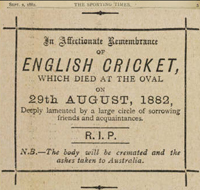
The English team were berated in the press for the loss and on 2nd September that year, a mock obituary for English cricket appeared in The Sporting Times stating that, having died at The Oval on 29th August, 1882, it will be “deeply lamented”. There was a note at the bottom of the obituary (picture right) which said that the body would be cremated and the ashes taken to Australia. And so the name, the Ashes, was born.

English captain Ivo Bligh subsequently promised that he would regain the ashes during the 1882-83 English cricket team’s tour of Australia while the Australian captain WL Murdoch vowed to defend them. It was during a social match played at Rupertswood Estate outside the city of Melbourne that Bligh was presented with the tiny terracotta ashes urn (today on display at the MCC Museum at Lord’s – see our earlier post for more).

The history of The Oval goes back to the mid-1840s when, following the establishment of the Surrey Cricket Club, it was granted a lease for the land from the Duchy of Cornwall (who still own it). The Ashes aside, memorable moments there have included the playing of the first match in the Australian Aboriginal team’s tour of England in 1868 (the first tour of England by a foreign side) and the first England v Australia test match to be played in England (1880). The Oval was also the location for the first international football match, played between England and Scotland in 1870, and the first FA Cup Final, played here in 1872.

Interestingly, The Oval also held a particular attraction for the US billionaire philanthropist,  J Paul Getty II, who built a replica of the ground at his estate at Wormsley Lodge in England’s south.

The history of Lord’s, London’s most famous cricket ground, meanwhile, goes back somewhat further. The current ground is the third to bear the name of Lord’s – the first was created on what is now Dorset Square in Marylebone at the behest of entrepreneur Thomas Lord (from whom it derives its name) and the first match staged there in 1787, the date on which the Marylebone Cricket Club was formed. Between 1811 and 1813, the ground was relocated to Marylebone Bank in Regent’s Park before moving to its current home in St John’s Wood (then the site of a duck pond).

Both grounds continue to host a range of cricketing and other events, such as the current Olympic archery competition being held at Lord’s.

WHERE: The Oval, Kennington Oval, Kennington (nearest Tube stations are Oval, Vauxhall and Kennington); WHEN: 90 minute tours of the ground are available (check website for booking details); COST: Tours cost £10 an adult/£5 under 16s/£25 a family ticket; WEBSITE: www.kiaoval.com.

WHERE: Lord’s Cricket Ground, St John’s Wood Road, St John’s Wood (nearest Tube Stations are Warwick Avenue, St John’s Wood, Marylebone and Maida Vale); WHEN: 100 minute tours of the ground (which include a visit to the MCC Museum) are available daily (check website for times – note that there are no tours during the Olympics, these resume on 21st August); COST: Tours cost £15 an adult/£9 concessions/£40 a family ticket; WEBSITE: www.lords.org.

PICTURE: Wikipedia
10 Historic Sporting Events in London – 4. The 1966 FIFA World Cup at Wembley…

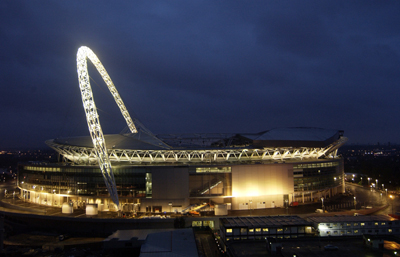
The home of English football, in 1966 Wembley Stadium in north-west London played host to the FIFA World Cup and witnessed England win the coveted cup.

Led out onto the ground by Bobby Moore, the English team, under manager Alf Ramsey, were locked in a 2-2 draw with West Germany when the game went into extra time. English player Geoff Hurst, who had already scored a goal, went on to score two more goals (one of which was particularly controversial with some still believing it didn’t cross the goal-line), giving him a hat-trick of goals and handing England the cup in a 4-2 win.

The team received the Jules Rimet trophy (named for former FIFA president Jules Rimet and replaced with the current FIFA World Cup Trophy in the 1970s) from Queen Elizabeth II.

While the history of Wembley goes back to 1923 when the Empire Stadium, referred to as the “Twin Towers” thanks to its distinctive two domed towers, was built on the site, the current stadium was only officially opened in 2007. Capable of seating 90,000, it is the second largest stadium in Europe.

As the Empire Stadium, the ground – originally built for a British Empire Exhibition – had played host to events including the 1934 Empire Games, the 1948 Olympics, and numerous football finals including the so-called “White Horse final” when a mounted policeman went on the pitch to contain the estimated 200,000 fans who watched the Bolton Wanderers FC defeat West Ham United FC 2-0 in the 1923 FA Cup final.

The current stadium with its iconic arch now plays host to the FA Cup as well as other high-profile matches like the FA Community Shield and large events including rock concerts (a recent vote on the Wembley website found that the greatest event ever held there was a 2007 concert by Muse).

This Olympics, Wembley is hosting numerous football matches including the gold medal match for both men and women, on the 11th and 9th August respectively (the last time the men’s final was played here during an Olympics was in 1948 when England won the bronze). It’s hoped a new record will be set for the number of people attending a women’s Olympic football match (the current record of 76,489 was recorded at the 1996 Olympics in Georgia at the Stanford Stadium) during the Games.

With a one kilometre circumference, the stadium encloses some four million square metres (equivalent apparently to the space taken up by 25,000 London double-decker buses) and features a Royal Box in the middle of the north stand from where all trophies are presented. The roof is partly closable.

There are tours of the stadium (although it’s closed during the Olympics), details of which are below.

WHERE: Wembley National Stadium, Wembley (nearest Tube stations are Wembley Park and Wembley Central or the Wembley Stadium British Rail station); WHEN: Selected dates – see website for details; advance booking strongly recommended (the stadium is closed for events, including the Olympics and before and after); COST: £16 an adult/£9 a child (under 16, under five’s free)/£9 seniors/£41 family ticket (zip wire ride extra); WEBSITE: www.wembleystadium.com/Wembley-Tours.aspx.

PICTURE: Action Images/Paul Harding (courtesy of Wembley National Stadium).

10 Historic Sporting Events in London – 3. The 1934 Empire Games…

Come the end of this year, London will have become the first city in the world to host three Olympic Games. But it’s only hosted the Commonwealth Games – then known as the Empire Games (one of several names changes the Games have been through) – once, in 1934.

Only the second time the Games were held (following the holding of the first British Empire Games in Hamilton, Canada, in 1934), London was selected after the Games were initially awarded to Johannesburg in South Africa but concerns were raised, notably by Canada, about the impact South Africa’s Apartheid policy would have on visiting athletes and officials.

The Games were held in early August and involved 500 competitors from 16 different nations (as a comparison, almost 7,000 competitors attended the 2010 Commonwealth Games held in Delhi, India). Among those countries sending competitors for the first time were Hong Kong and India, Caribbean nations Jamaica and Trinidad, and Rhodesia (now Zimbabwe) in Africa as well as Newfoundland, representatives of which took part independent of the Canadian team, and the Irish Free State (the only Games in which they participated).

Six sports were featured in the Games and, following its use in the 1908 Olympic Games, organisers again turned to White City to host most of the events which included athletics, boxing, lawn bowls and wrestling (although cycling was held in Manchester and swimming and diving (seen as one sport) at the Empire Pool in Wembley). In what was seen as a breakthrough for women everywhere, selected athletic events were included for females (those not deemed “too exhaustive” apparently).

England topped the medal tally with 72 medals (29 gold) followed by Canada, Scotland, South Africa and Australia. Numerous new records were set in the pool.

Celebrating the Diamond Jubilee with 10 royal London locations – 10. Royal relatives…

In this, the final in our series looking at the Queen’s relationship to London we take a look at some of the key monuments to her family in the city.

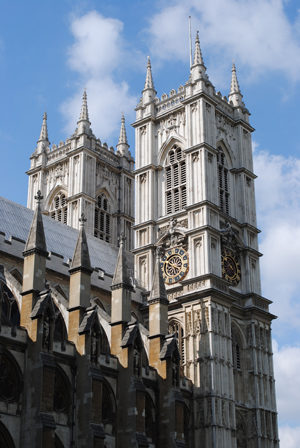
King George V (1865-1936). Queen Elizabeth II’s paternal grandfather, King George V, can be seen in a statue in Old Palace Yard, overlooked by Westminster Abbey (pictured here complete with pigeon). The work of Sir William Reid Dick, it was erected in 1947 and depicts the king wearing the robes of the Order of the Garter.

• Queen Mary (1867-1953). Paternal grandmother to the current Queen, Queen Mary the consort of King George V is commemorated with a small profile relief in The Mall, close to the corner of Marlborough Road. Also the work of Sir William Reid Dick, it was unveiled in 1967.

• King Edward VIII (1894-1972). The older brother of King George VI who infamously abdicated his crown thanks to his love for American divorcee Wallis Simpson, it’s perhaps not surprising that there are no public statues to King Edward VIII in London (at least, none we’re aware of – if you know differently, please let us know).

• King George VI (1895-1952). The father of Queen Elizabeth II is commemorated in a statue in Carlton Gardens, just off The Mall. Erected in 1956, it was the work of William McMillan and as with that of King George V, depicts the king wearing Garter robes. It was moved in 2008 from nearby to its current site to form part of the joint memorial to the Queen’s  parents.

• Elizabeth, The Queen Mother (1900-2002). The long-lived Elizabeth Bowes-Lyon, who died in 2002 at the age of 101, is commemorated in the other half of the joint monument which stands just off The Mall. Unveiled in 2009, the statue of the Queen is the work of sculptor Philip Jackson and shows the Queen in her younger days wearing the robes of the Order of the Garter.

Next week we start a new Wednesday series looking at the history of some of London’s Olympic sites…

Celebrating the Diamond Jubilee with 10 royal London locations – 9. Royal chapels…

Palaces aside, the Queen also owns a series of chapels – the Chapels Royal – in London which, although not as grand as Westminster Abbey, have each played an important role in the history of the monarchy. 

The term Chapel Royal originally referred to a group of priests and singers dedicated to serving the Sovereign’s personal spiritual needs and as such would follow the monarch around the country. It was in Stuart times that they became more settled establishments with the two main Chapels Royal – the Chapel Royal and the Queen’s Chapel – located in St James’s Palace.

• The Chapel Royal, St James’s Palace. Constructed by King Henry VIII, the chapel was decorated by Hans Holbein the Younger in honor of the king’s (short) marriage to Anne of Cleves. Queen Mary I’s heart is said to be buried beneath the choir stalls and it was here that Queen Elizabeth I apparently prayed waiting for news of the progress of the Spanish Armada. King Charles I took the Sacrament of Holy Communion here before his execution in 1649 and the chapel was where Queen Victoria married Prince Albert (her marriage certificate still hangs on the wall). In more recent times, the coffin of Diana, Princess of Wales, was placed before the altar so family and friends could pay their respects before her 1997 funeral. Among the composers and organists associated with the chapel are Thomas Tallis, William Byrd, Henry Purcell and George Frideric Handel. The chapel is not open to the public except for services.

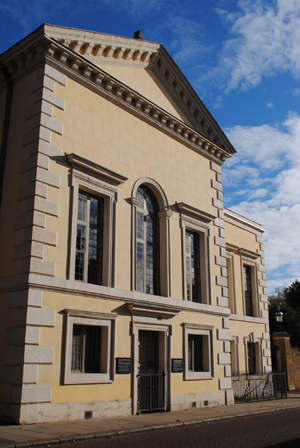
• The Queen’s Chapel, St James’ Palace (pictured right). Now located outside the palace walls, this chapel was built by King James I for the Catholic Henrietta Maria, the bride of his son, then Prince Charles (later King Charles I). Designed by Inigo Jones, Grinling Gibbons and Sir Christopher Wren were also involved in its creation. The chapel was used by Henrietta Maria until the Civil War and later became the home of the Danish Church in London. The chapel is not open to the public except for services.For more on this chapel or the Chapel Royal at St James’s Palace, follow this link.

• The Queen’s Chapel of the Savoy. Built in the Middle Ages to serve the now long gone Savoy Palace, London home of Count Peter of Savoy (uncle to King Henry III’s wife, Eleanor of Provence, the original building was destroyed in the Peasant’s Revolt of 1381. The current building, located in Savoy Hill, off the Strand, was built on the orders of King Henry VII in the late 15th and early 16th century to serve the hospital he founded on the site of the palace. The chapel since served many other congregations – including a German Lutheran congregation – but remains royal property via the Duchy of Lancaster, which is held in trust for the Sovereign and used to provide an income for the British monarch. It is officially the Chapel of the Royal Victorian Order. For more, see www.duchyoflancaster.co.uk/duties-of-the-duchy/the-queens-chapel-of-the-savoy/.

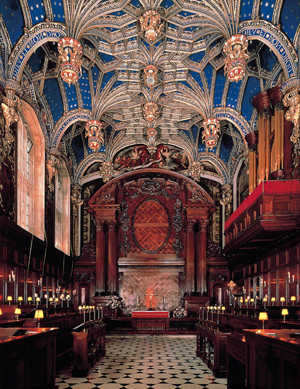
• Chapel Royal, Hampton Court Palace (pictured right). There has been a chapel here since the Knights Hospitallers occupied the site in the 13th century but it was Cardinal Wolsey who built the chapel to its present dimensions after acquiring the property in 1518. The current building, however, dates from the later ownership of King Henry VIII – Wolsey surrendered the property to him when he fell from favour – and further works in the eighteenth and nineteenth centuries. Many subsequent monarchs have worshipped here. The chapel, with its stunning ceiling, is open to the public when visiting Hampton Court Palace. For more, see www.chapelroyal.org. PICTURE: Historic Royal Palaces/newsteam.co.uk

• The Chapel Royal of St Peter ad Vincula, Tower of London. Originally a parish church, this was incorporated into the walls of the Tower in the reign of King Henry III. It was subsequently rebuilt at least twice – in the reign of King Edward I and King Henry VIII – and is home to the graves of important personages executed at the Tower including Henry VIII’s one-time wives, Anne Boleyn and Catherine Howard as well as Jane Grey, the nine day queen, and Sir Thomas More and Bishop John Fisher. The chapel can be accessed during a Yeoman Warder’s tour of the Tower of London. For more, including details of an appeal for its restoration, see www.hrp.org.uk/TowerOfLondon/stories/thechapelproject.

• Chapel Royal of St John the Evangelist, Tower of London. Located within the White Tower, this beautiful chapel – arguably the oldest church in London – dates back to the construction of the tower by King William the Conqueror the late 11th century and remains one of the best preserved examples of Anglo-Norman architecture in England. King Henry III added stained glass windows but for much of its later history the chapel was used for records storage. Tradition records that King Henry VII’s wife, Elizabeth of York, was laid in state here following her death in childbirth and that it was here Queen Mary was betrothed by proxy to Philip of Spain. This can be visited as part of a visit to the Tower of London. For more, see www.hrp.org.uk/TowerOfLondon/Sightsandstories/Prisoners/Towers/ChapelofStJohns

For more on churches in London, check out Stephen Millar’s London’s City Churches
and Stephen Humphrey’s London’s Churches and Cathedrals: A Guide to London’s Most Historic Churches and Cathedrals, Leigh Hatt’s London’s 100 Best Churches: An Illustrated Guide or the Pevsner Architectural Guide London: City Churches.
Celebrating the Diamond Jubilee with 10 royal London locations – 7. Silver Jubilee memorials…

For those who may not be aware, the current Diamond Jubilee is, of course, not the first jubilee Queen Elizabeth II has celebrated. In 1977, the Queen and the nation marked her Silver Jubilee, celebrating her 25th year on the throne.

Just as this year is designed as a year of celebration, so too was 1977 with the anniversary of the Queen’s accession culminating in a series events run over a week in early June. They included street parties, the lighting of a chain of beacons across the country (the Queen lit the first fire at Windsor), a national service of thanksgiving at St Paul’s Cathedral (which the Queen went to in the Gold State Coach) and a river progress from Greenwich to Lambeth.

To mark the Jubilee, the Queen and Prince Philip also travelled across the country, visiting as many as 36 counties during a Royal Tour, and went overseas where they visited nine countries as far afield as Australia and New Zealand, the West Indies and Canada.

In London, a number of memorials were installed which can still be visited today. They include:

The Silver Jubilee Walkway. Opened by the Queen on 9th junee 1977, this is made up of five circular sections which are themselves located in a 15 mile (24 kilometre) circle around the city and takes in many of the city’s greatest sites, including St Paul’s Cathedral, Buckingham Palace, Tower Bridge and Shakespeare’s Globe. For more on the walk, see www.walklondon.org.uk/route.asp?R=3

• South Bank Jubilee Gardens. Originally created to celebrate the Silver Jubilee in 1977, these gardens, located between Waterloo and Westminster Bridges, have recently been remade – including planting 70 new trees – for the Queen’s Diamond Jubilee and the Olympic Games.

Memorial Urn in Queen Square, Bloomsbury. This monument has inscriptions by poets Philip Larkin (“In times when nothing stood, But worsened or grew strange, There was one constant good, She did not change”) and Ted Hughes (A nation’s a soul, A soul is a wheel, With a crown for a hub, To keep it whole”) in front of and behind it.

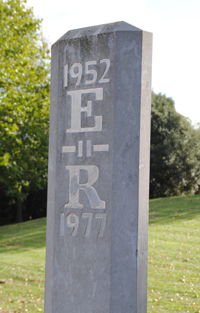
King’s Stairs Memorial Stone. This memorial stone (pictured) located on the edge of King’s Stairs Gardens by the Thames in Bermondsey was first installed to mark the Queen’s Silver Jubilee. The other side of the stone was inscribed during the Golden Jubilee in 2002.

• Plaque on Queen Elizabeth II’s birthplace. We’ve mentioned this plaque at 17 Bruton Street in Mayfair in an earlier entry but it’s interesting to note that it was erected in 1977.

Any others you can think of?

Celebrating the Diamond Jubilee with 10 royal London locations – 6. The Mall…

For many Londoners, an opportunity to see the Queen means heading to Buckingham Palace to watch her wave from the balcony – or standing in the Mall to watch as her carriage goes by.

Given that, we thought we’d take the time to have a quick look at the history of The Mall, an important player in events like the annual Trooping the Colour.

This one kilometre long grand processional route which links Trafalgar Square to Buckingham Palace, was originally cut through St James’s Park in 1660 when King Charles II was looking for a new paille-maille pitch (see our earlier entry on Pall Mall for more on this). Two long avenues of trees were planted on either side, giving it a leafy feel that’s still in evidence today.

The Mall had become notorious by the 18th century and was spruced up in 1911 under the eye of Sir Aston Webb (who also designed other elements in the area including a new facade for Buckingham Palace, the Queen Victoria Memorial in front of the palace, and Admiralty Arch at the western end of the route) to become the grand avenue, complete with red-carpet like surface (this was done later), that it is today.

It is bordered by St James’s Park on the south side and on the north side is overlooked by various grand buildings – including Clarence House and the Institute of Contemporary Arts – as well as, toward the western end, Green Park.

These days the Queen publicly processes down The Mall for a number of events throughout the year – among them are the State Opening of Parliament (held earlier this month) as well as military ceremonies like Trooping the Colour and events like last year’s Royal Wedding when is it said that more than a million people were said to have filled the broad street.

The Mall is also the route along which Heads of State process in a horse drawn carriage during official visits (the road is then decorated with Union Jacks and flags of the visitor’s country). During the Olympics, it will be the start and end location of the marathons and cycling road races.

Apart from the Queen Victoria Memorial at the eastern end of The Mall, statues and monuments lining the road include the Queen Mother Memorial, a statue of explorer Captain James Cook, and a recently installed statue of cosmonaut, Yuri Gagarin.

There are apparently a series of tunnels underneath with link Buckingham Palace with Whitehall.

We should also briefly mention Horseguards, which is at The Mall’s eastern end and where Trooping the Colour and Beating Retreat takes place. This was formerly the site of a tiltyard of the Palace of Whitehall and jousting tournaments were held here during the time of King Henry VIII. It has been used for parades and ceremonies since the 17th century. While cars were parked here for much of the 20th century, this practice was stopped in the mid-1990s.

Celebrating the Diamond Jubilee with 10 royal London locations – 5. Buckingham Palace…

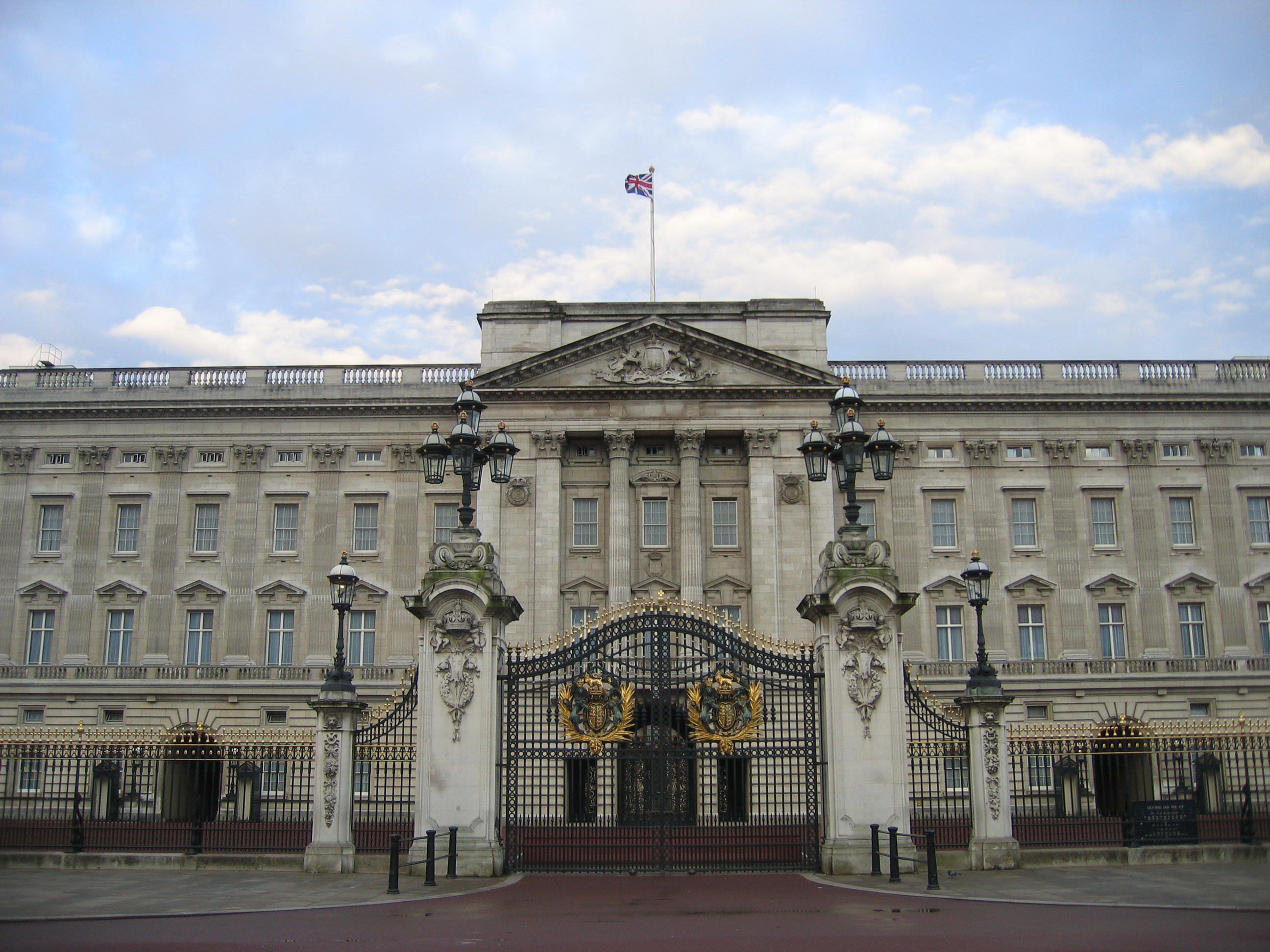
Following her coronation, Queen Elizabeth II and Prince Philip, the Duke of Edinburgh, took up residence in Buckingham Palace and have resided there ever since.

The Queen and her family’s appearance on the palace’s balcony to wave to crowds at events like Trooping the Colour and last year’s Royal Wedding have become symbols of her reign.

We’ve already written about some of the history of the 775 room palace (see our earlier post here), so today we’re looking specifically at the palace as the residence of Queen Elizabeth II.

While the focus for visitors to the palace is on the grand state rooms (of which there are 19 located in the west block facing the palace gardens – they include the Throne Room and State Dining Room), the Queen and the Duke of Edinburgh live in private apartments on the north side of the palace while rooms on the upper floors of the palace’s north and east sides are occupied by other members of the Royal Family. A large part of the ground floor and palace’s south wing are occupied by service quarters and members of the Royal Household.

As well as weekly meetings at the palace – including audiences with the Prime Minister, foreign and British ambassadors, clergy and senior members of the civil service, the Queen also hosts a variety of grand events at the palace throughout the year. These include the Diplomatic Reception given for members of the diplomatic corps in the autumn (more than 1,500 people attend from more than 130 countries), three large garden parties in the summer and grand State Banquets which are held in the Ballroom on the first evening of a visit from a foreign head of state. The Queen is also noted for the small private lunch parties she holds to which community leaders are invited.

The head of the 1,200 strong Royal Household is the Lord Chamberlain (since 2006 The Earl Peel), a non-political office responsible for the organisation of ceremonial activities at court as well as the palace’s upkeep. Under him are the various departments heads – these include the Comptroller, who heads the Lord Chamberlain’s Office (this oversees everything from State Visits to the Royal Mews), the Keeper of the Privy Purse (responsible for the management of the sovereign’s financial affairs) and the Master of the Household (responsible for domestic and staff arrangements as well as catering and official entertainment, this position dates back to 1539).

A typical day in the life of the Queen when at the palace involves her spending the morning at her desk where she reviews a sample of incoming letters (an estimated 200 to 300 arrive each day almost all of which are answered by her staff) and meets with her Private Secretaries to deal with official papers which arrive in the famous ‘red boxes’.

The Queen will then often hold a series of audiences during which she’ll meet with a range of people – from retiring senior members of the armed forces to newly appointed ambassadors and judges and people who have won awards for excellence in a particular field. She may then participate in an investiture at which honors and decorations are presented (about 25 of these are held every year, usually in the palace Ballroom).

Lunch is often private although as previously mentioned, the Queen and Duke of Edinburgh are known for hosting small lunch gatherings for a range of people. In the afternoon, the Queen will often attend engagements outside the palace (she attends about 430 engagements and audiences a year) before possibly meeting with the Privy Council.

Evenings are spent reviewing a report of the day’s parliamentary proceedings, meeting with the Prime Minister (something she does every Wednesday when both are in London), attending further engagements or hosting events at the palace.

And, of course, when the Queen is in residence, Buckingham Palace is also home to the Queen’s corgis – Monty, Willow and Holly – and dorgis (a cross between a corgi and a dachshund) – Cider, Candy and Vulcan.

For more on Buckingham Palace and the life of the Queen, go www.royal.gov.uk.

WHERE: State Rooms, Buckingham Palace (includes special exhibition Diamonds: A Jubilee Celebration) (nearest Tube stations are Victoria, Green Park and Hyde Park Corner); WHEN: 9.45am to 6.30pm, 30th June to 8th July and 31st July to 7th October; COST: £18 an adult/£10.50 a child (under 17s/under fives free)/£16.50 concession/£47 family; WEBSITE: www.royalcollection.org.uk/visit/buckinghampalace.

PICTURE: Christa Richert/sxc.hu

Celebrating the Diamond Jubilee with 10 royal London locations – 4. Westminster Abbey…

Westminster Abbey has played a key role in the life of Queen Elizabeth II – it was here on 20th November, 1947, that she was married to Prince Philip (then Lieutenant Philip Mountbatten) and it was here on 2nd June, 1953, that she was crowned Queen Elizabeth II.

First to the wedding. Princess Elizabeth was only the 10th royal to be married in the Abbey (her predecessors included her parents who married here on 26th April, 1923). The ceremony started at 11.30am and the princess, who wore a white dress designed by Norman Hartnell, entered to a specially composed fanfare accompanied by eight bridesmaids and two pages.

Due to post war austerity measures, only about 2,000 people attended the wedding (we’ve previously mentioned that the princess had to save coupons for her wedding dress like any other bride). On the day, the grave of the Unknown Warrior was the only stone that was not covered by the special carpet and the day after the wedding, the now married Princess Elizabeth followed a royal tradition started by her mother, Queen Elizabeth, which involved sending her wedding bouquet back to the Abbey to be laid on the grave.

It was about five-and-a-half years after her wedding that the princess returned to the Abbey to be crowned a queen.

Then Princess Elizabeth was in Kenya (on her way to Australia) when news reached her on 6th February that year of the death of her father, King George VI. After Prince Philip broke the news to her, the new queen chose Elizabeth as her “regnal name”, and the couple returned to England.

Queen Elizabeth II’s grandmother, Queen Mary, died on 24th March, but it was decided to proceed with the coronation anyway (Queen Mary had apparently asked that the coronation not be delayed by her death).

The coronation, the 38th to be conducted in the Abbey, was the first to be televised (with the exception of the anointing and communion) and was “instrumental” in helping to popularise it in the UK and elsewhere.

The building was closed for five months so preparations could be made for the more than 8,000 wedding guests. The Queen’s coronation dress, meanwhile, was made by Norman Hartnell (as had been her wedding dress) and was made of white satin embroidered with emblems of the United Kingdom and the Commonwealth.

Having arrived from Buckingham Palace in the Gold State Coach, the Queen entered the Abbey at 11.20am and, having been invested with the Regalia while seated in the Coronation Chair, was crowned with St Edward’s Crown at 12.34pm. She left the Abbey at 2.53pm and rode through the streets of London back to the palace.

Of course, the Queen has since attended many other events at the Abbey – including thanksgiving services for their golden and silver wedding anniversaries and last year’s Royal Wedding – since her coronation which we don’t have space to talk about here. But it is worth noting before signing off that the Abbey continues to have a special relationship to her – it is a “Royal Peculiar” meaning it is exempt from any ecclesiastical jurisdiction but that of the Sovereign.

WHERE: Westminster Abbey, Westminster (nearest Tube station is Westminster or St James’s Park); WHEN: Open to tourists everyday except Sunday  (times vary so check the website); COST: £16 an adult/£13 concessions/£6 schoolchildren (11-18 years), free for children aged under 11/£38 for a family (two adults, two children); WEBSITE: www.westminster-abbey.org

Celebrating the Diamond Jubilee with 10 royal London locations – 3. Married life at Clarence House…

Princess Elizabeth and Prince Philip were married at Westminster Abbey, a highly significant property in the Queen’s story which we’ll be looking at in more depth shortly, on 20th November, 1947 (and, as did other brides in post-war Britain, the princess had to collect coupons for her wedding dress).

Following their honeymoon at Broadland – the home of Lord Mountbatten in Hampshire and at Birkhall, Balmoral, in Scotland, in 1949, they and their baby son, Charles, moved into Clarence House, their home for the next three years.

The house, which still featured Victorian decor, was refurbished although post-war austerity ensured the decor and furnishings – many of which were wedding presents – remained simple. The house still contains a Georgian dining table and 20 ladder-back chairs which were the gift of the Royal Warrant Holders Association and a mahogany sideboard and four side tables which were a present from Queen Mary, the Queen’s grandmother.

Princess Anne, second child of the Queen and Prince Philip, was born in the house in 1950.

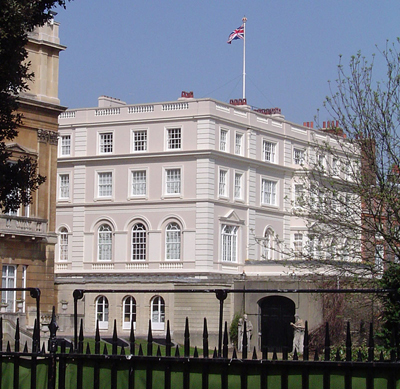
Clarence House was originally built between 1825 and 1827 to the designs of John Nash (he also designed Buckingham Palace) and was designed as the home of George III’s third son, Prince William Henry, Duke of Clarence and his wife Adelaide, and incorporated some of the Tudor buildings of St James’ Palace.

Indeed, Prince William Henry liked the house so much that on succeeding to the throne as King William IV in 1830, he decided not to move to Buckingham Palace and instead remained at Clarence House.

Later occupants have included Queen Victoria’s mother, the Duchess of Kent, and two of her sons, Prince Alfred, Duke of Edinburgh, and Prince Arthur, Duke of Connaught as well as Queen Elizabeth, the Queen Mother, who moved in after the property was vacated by Queen Elizabeth II and remained living at the house until her death in 2002.

Today Clarence House is the official London residence of Prince Charles, Prince of Wales, and his wife Camilla, the Duchess of Cornwall, as well as Prince Harry.

Clarence House is usually open for tours during summer but will not be opening this summer due to the Paralympic and Olympic Games blocking the entrance from The Mall. For details on the 2013 opening, see www.royalcollection.org.uk/visit/clarencehouse.

PICTURE: ChrisO, Wikipedia

Celebrating the Diamond Jubilee with 10 royal London locations – 2. The Queen’s childhood homes

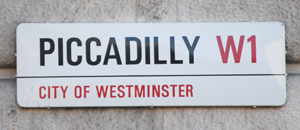
Having spent the first few months of her life at 17 Bruton Street, the future Queen Elizabeth II moved into her parents’ new property at 145 Piccadilly.

The property, located close to Hyde Park Corner, was previously the townhouse of the Marquesses of Northampton (interestingly, it was while living here that her father the Duke of York first started visiting the Harley Street-based Australian speech therapist Lionel Logue, as depicted in The King’s Speech). The 25 bedroom house was later destroyed by a bomb during the war, long after the Yorks had moved out.

As well as the house at 145 Piccadilly, the young Princess Elizabeth (and from 1930 her younger sister and only sibling Princess Margaret) also lived at White Lodge in the centre of Richmond Park in the city’s south-west. The Lodge, a Georgian property built as a hunting lodge for King George II, now houses part of the Royal Ballet School.

She also considerable time outside the city, staying in places including Scotland with her grandparents at either Balmoral Castle (owned by the Royal Family) or at Glamis Castle (owned by the parents of her mother, the Earl and Countess of Strathmore) as well as, from the age of six, at Royal Lodge in Windsor Great Park, the country home of the Yorks. The princess apparently had her own small house, known as Y Bwthyn Bach (the Little Cottage), in the grounds  – a gift from the people of Wales in 1932.

Following the death of King George V and subsequent abdication of King Edward VIII in 1936, new King George VI and his family moved from 145 Piccadilly to Buckingham Palace. Following the outbreak of World War II in 1939, the princesses lived in Balmoral, Scotland, and Sandringham but spent most of the war at Windsor Castle.

Princess Elizabeth, meanwhile, had met Prince Philip of Greece during the 1930s and in 1947, he asked for permission to marry her.

Celebrating the Diamond Jubilee with 10 royal London locations – 1. The Queen’s birthplace

This week we start a new series in honour of this year being the Diamond Jubilee of Queen Elizabeth II. We’ll be looking at locations across the city which have played an important role in the story of the Queen. First up, it’s the Queen’s birthplace – a now non existent townhouse in Mayfair.

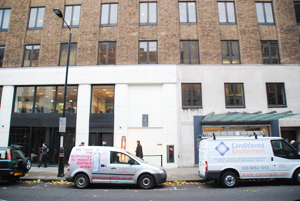
The property at 17 Bruton Street, which is marked by a small plaque installed in 1977 – the Queen’s Silver Jubilee (it’s in the middle of the image to the right), was actually the home of the Queen Mother’s parents, the Earl and Countess of Strathmore. It and the neighbouring townhouse at 18 Bruton Street have both been demolished and replaced with a rather bland office building.

Born here at 2.40am on 21st April, 1926, the Queen, named Elizabeth Alexandra Mary, was the first child of the then Duke and Duchess of York (later King George VI and Queen Elizabeth). At her birth, Queen Elizabeth II was only third in line to the throne after her uncle, the Prince of Wales (later, briefly, King Edward VIII), and her father.

The Queen’s grandparents, King George V and Queen Mary, both visited the newborn child at the property (along with an apparently large crowd outside). Elizabeth was christened five weeks later at the Chapel Royal in Buckingham Palace. She spent the first few months of her life living in a room at 17 Bruton Street which had been previously used by her mother before her marriage.

Recent books on the Queen include Andrew Marr’s  The Diamond Queen: Elizabeth II and Her People, the souvenir album Queen Elizabeth II: A Diamond Jubilee Souvenir Album, and Sarah Bradford’s Queen Elizabeth II: Her Life in Our Times.

• Correction: Bruton Street was mistakenly copied here as Brunton Street. It has been corrected. Apologies for the error!

Celebrating Charles Dickens – 10. Four Dickens daytrips…

And so we come to the final in our series celebrating the bicentenary of the birth of author Charles Dickens. This week we thought we’d take a look at a few of the key places you can go for a daytrip from London to find more Dickens-related sites…

• Portsmouth. Dickens was born here on 7th February, 1812, and the modest home in which this took place is now the Charles Dickens Birthplace Museum (www.charlesdickensbirthplace.co.uk). The house featured three furnished rooms and an exhibition room with a display on Dickens’ connections with Portsmouth and memorabilia including the couch on which he died at Gad’s Hill Place. Fans from all over the world will be converged in Portsmouth later this year when the International Dickens Fellowship Bicentenary Conference 2012 is held over 9th to 14th August (www.dickensfellowship.org/Events/annual-conference-2012).

• Chatham and Rochester, Kent.  Dickens spent five years of his childhood (from 1817 to 1822) living in Chatham and as a result it and the neighbouring Medway town of Rochester helped to inspire some of the characters and places in some of his most famous works. Restoration House in Rochester, for example, is believed to have been the inspiration for Satis House, where Miss Havisham lived in Great Expectations while Eastgate House (pictured) features as Westgate in both The Pickwick Papers and as the Nun’s House in The Mystery of Edwin Drood. Until 2004, the house served as the Charles Dickens Centre and interestingly, the Swiss chalet in which Dickens wrote was moved here in the 1960s from Gad’s Hill Place – it can be seen over the fence. The area has celebrated its connections with Dickens with an annual festival every year since 1978 – this year’s takes place on the 8th, 9th and 10th June. See www.medway.gov.uk/leisureandculture/events/dickensfestival.aspx for more. (Late addition: We neglected to mention Dickens World located at Chatham, an interactive experience which recreates nineteenth century England – you can find more about it here www.dickensworld.co.uk).

• Broadstairs, Kent. Dickens first came to stay at this seaside resort in 1837 when he was 25-years-old and already had a reputation on the rise. He repeatedly returned over the next couple of decades. The Dickens House Museum (www.dickensfellowship.org/branches/broadstairs) was once the home of Miss Mary Pearson Strong on whom much of the character of Miss Betsey Trotwood in David Copperfield is believed to be based. It features a range of Dickens-related artefacts, including letters he wrote from or about Broadstairs. The Broadstairs Dickens Festival runs from 16th to 22nd June.

• Gad’s Hill Place, Higham, Kent. Dickens died here in 1870 after spending the last 13 years of his life living at the property. It’s now a school (www.gadshill.org) but the ground floor will be open to the public this summer, from 25th July to 19th August, for pre-booked tours of reception rooms and the study where he wrote Great ExpectationsOur Mutual FriendA Tale of Two Cities and the unfinished novel Edwin Drood. For more information on the tours, see www.dickensmuseum.com/news/gads-hill-place-to-open-to-public/.

This was the last in our series on Charles Dickens – next week we start a new series in honor of Queen Elizabeth II’s Diamond Jubilee. For more events surrounding the Dickens celebrations both in London and elsewhere, see www.dickens2012.org.

Celebrating Charles Dickens – 9. Dickens’ literary connections, part 2…

In which we continue our look at some of London’s connections with Dickens’ writings…

• ‘Oliver Twist’ workhouse, Cleveland Street. The building, recently heritage listed following a campaign to save it, is said to have served as the model for the workhouse in Oliver Twist and was apparently the only building of its kind still in operation when Dickens wrote the book in the 1830s. Dickens had lived as a teenager nearby in a house in Cleveland Street and was living less than a mile away in Doughty Street (now the Charles Dickens Museum) when he wrote Oliver Twist. Thanks to Ruth Richardson – author of Dickens and the Workhouse: Oliver Twist and the London Poor – for mentioning this after last week’s post.

• Clerkenwell Green. It is here that Mr Brownlow first comes into contact with Oliver Twist and, mistakenly suspecting him of stealing from him, chases him through the surrounding streets. Interestingly, the grass (which you would expect when talking about a green) has been gone for more than 300 years – so it wasn’t here in Dickens’ time either.

• Barnard’s Inn, Fetter Lane. It was here, at one of London’s Inns of Court, that Pip and Herbert Pocket had chambers in Great Expectations. Barnard’s Inn, now the home of Gresham College, is only one of a number of the Inns of Court with which Dickens and his books had associations – the author lived for a time at Furnival’s Inn while Lincoln’s Inn (off Chancery Lane) features in Bleak House and the medieval Staple Inn on High Holborn makes an appearance in his unfinished novel, The Mystery of Edwin Drood. And, as mentioned last week, Middle Temple also features in his books.

• ‘Dickens House’, Took’s Court. Renamed Cook’s Court in Bleak House, the house – located in a court between Chancery and Fetter Lane – was where the law stationer Mr Snagsby lived and worked in the book. It’s now occupied by music promoter and impresario Raymond Gubbay.

• London Bridge. The bridge, a new version of which had opened in 1831 (it has since been replaced), featured in many of Dickens’ writings including Martin Chuzzlewit, David Copperfield and Great Expectations. Other bridges also featured including Southwark Bridge (Little Dorrit) and Blackfriars Bridge (Barnaby Rudge) and as well as Eel Pie Island, south-west along the Thames River at Twickenham, which is mentioned in Nicholas Nickleby.

We’ve only included a brief sample of the many locations in London related in some way to Dickens’ literary works. Aside from those books we mentioned last week, you might also want to take a look at Richard Jones’ Walking Dickensian London,  Lee Jackson’s Walking Dickens’ London or, of course, Claire Tomalin’s recent biography, Charles Dickens: A Life.

Celebrating Charles Dickens – 8. Dickens’ literary connections, part 1…

London is redolent with sites which appeared in the books of Charles Dickens and, having had a look at his life, it’s time we turn our attention to some of the sites relevant to his writing. For the next two weeks, we’re looking at just a few of the many, many sites which feature in his novels. So, here’s seven places to get us going…

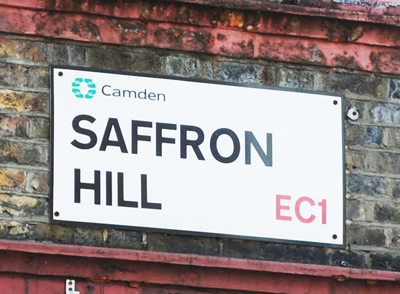
• Saffron Hill, Clerkenwell. Once a notorious slum akin to St Giles (see last week’s entry) and the city’s Italian Quarter, Saffron Hill is where Fagin and his gang of thieves operate in Oliver Twist and have their den.

• Chancery Lane, Holborn. Much of the novel Bleak House is set around this narrow street between High Holborn and Fleet Street – Tom Jarndyce kills himself in a coffee shop here in the novel and Lincoln’s Inn Hall – formerly home of the High Court of Chancery – also features.

• The Old Bailey. Some have suggested Dickens worked here as a court reporter although there is no compelling evidence he did so. But the the Old Bailey (the current building dates from the early 20th century, well after Dickens’ death) and Newgate Prison certainly featured in his books – it is here that Fagin is eventually hung in Oliver Twist.

• Child & Co’s Bank, Fleet Street. While the present building dates from 1878, Dickens is believed to have used the bank as the model for Tellson’s Bank in A Tale of Two Cities.

• St Dunstan-in-the-West, Fleet Street. In David Copperfield, David and his aunt, Betsy Trotwood, make a special trip to see the giants Gog and Magog strike the church bells. It also features in Barnaby Rudge and Dickens dedicated his Christmas story, The Chimes, to the church.

• Garden Court and Fountain Court (pictured), Middle Temple. Garden Court is where Pip lived in Great Expectations and where Abel Magwitch turned up to reveal himself as Pip’s benefactor. Fountain Court features in Martin Chuzzlewit as the site for the romance of Ruth Pinch and John Westlock.

• Golden Square, Soho. Mentioned in Nicholas Nickleby – Nicholas’ uncle, Ralph Nickleby, was thought to live in a previous building at number seven.

There’s some great books about London sites which appear in Dickens’ books – among them are Ed Glinert’s Literary London: A Street by Street Exploration of the Capital’s Literary Heritage and Michael Paterson’s Inside Dickens’ London as well as Paul Kenneth Garner’s 
A Walk Through Charles Dickens’ London.

Celebrating Charles Dickens – 7. Five other London sites of significance…

We’ve looked at Charles’ Dickens childhood in London and some of his residences, workplaces and the pubs he attended. Before we take a look at some of the sites relevant to his writings, Exploring London takes a look at just a handful of the many other London sites associated with the famous Victorian author…

• Seven Dials and the former St Giles slum, Soho. An notorious slum of the 19th century, this area was among a number of “rookeries” or slums toured by Dickens in 1850 in the company of Inspector Field and police from Scotland Yard, and later helped to inform much of his writing. Seven Dials itself – located at the junction of Mercer and Earlham Streets and Upper St Martin’s Lane (pictured right is the monument at the junction’s centre) – has just undergone a renovation but much of the St Giles area is now irrevocably modernised. We’ll be mentioning another notorious slum located in Saffron Hill, Clerkenwell, in an upcoming week.

• Holland House, Kensington. Dickens became a friend of Lady Holland’s after attending one of her exclusive soirees at the age of 26. He was a guest at the house, now a youth hostel, in Holland Park on numerous occasions.

• Royalty House, Dean Street, Soho. The former site of the Royalty Theatre, known in Dickens’ day as Miss Kelly’s Theatre, it was here on 21st September, 1845, that Dickens and a group of friends performed Ben Jonson’s play, Every Man in his Humour (1598). Dickens acted as stage manager and director as well as playing the part of Captain Bobadil.

• Buckingham Palace. It was here in March 1870 – not long before his death – that Dickens had his only face-to-face meeting with Queen Victoria. She apparently found him to have a  “large, loving mind and the strongest sympathy with the poorer classes”.

• Westminster Abbey. Our final stop for it was here that Dickens was buried on 14th June, 1870, following his death at his home near Rochester in Kent. Dickens had apparently wanted to be buried in Rochester but given his public profile, Westminster Abbey was seen as the only fitting place of rest for him (his wishes for a small, private funeral were, however, respected but thousands did visit the site in the days following). His grave sits in Poet’s Corner.

Celebrating Charles Dickens – 6. Dickens the philanthropist

As the fame of author Charles Dickens grew, so too did his philanthropy and today we’re highlighting a couple of the London institutions he was known to support (and yes, we’ve changed the title for this series as most of the entries comprised more than one site!)…

1. Urania Cottage. A home for the redemption of “fallen women” or prostitutes, Urania Cottage was founded by an initially reluctant Dickens in Shepherd’s Bush in the city’s west in the late 1840s following an approach by Angela Burdett Coutts, heiress to the Coutts banking fortune. The home was founded as an alternative to existing institutions for such women – known for their “harsh and punishing” routines – and instead looked to provide an environment where they could learn skills, such as reading and writing, to help them successfully reintegrate into society (this would be overseas as all the women who spent time at the house were apparently required to emigrate following their time there). After founding the home in Lime Grove, Dickens became heavily involved in establishing the day-to-day running of the home – including interviewing prospective residents and personally searching prisons and workhouses for suitable candidates. It’s estimated that 100 women graduated from the home between 1847 and 1859. (For more, see Jenny Hartley’s Charles Dickens and the House of Fallen Women).

2. Great Ormond Street Hospital. Dickens played an important role in helping to publicise the work of this hospital – then known as the Hospital for Sick Children in Great Ormond Street, it opened in a converted 17th century townhouse in Great Ormond Street in 1852 and, initially with just 10 beds, was the first hospital in Britain to offer inpatient care only to children. The hospital was apparently initially regarded with suspicion by many and had few patients but Dickens, a close friend of Dr Charles West, the principal founder of the hospital, was able to write a powerful article about the hospital in his publication Household Words and so help to popularise its ground-breaking work. Dickens was a regular at the hospital’s annual fundraising dinner, was appointed an honorary governor and helped save the church from financial collapse in 1858 when he gave a public reading at St Martin-in-the-Fields’ church hall to raise funds. For more on the history of Great Ormond Street, see www.gosh.nhs.uk/about-us/our-history/.

3. Battersea Dogs & Cats Home. Clearly concerned with the well-being of all creatures great and small, Dickens was an influential supporter of the dogs home – then housed in a disused barn in Hollingsworth Street, Holloway – writing an article in the 1860s in his magazine All The Year Round about how dogs were cared for at the then fledgling organisation. In honor of the bicentenary of his birth, the home has been naming some of the animals in its care after some of the characters created by the Victorian author – these include a Staffordshire bull terrier called Copperfield and a bull mastiff cross called Dodger. For more on the home, see www.battersea.org.uk.

We’d be interested to hear from you if there are any other organisations you’re aware of which Dickens supported…

10 London sites to celebrate Charles Dickens – 5. Seven pubs associated with Dickens (including one he never visited)…

There hardly seems to be a pub in London which doesn’t claim some connection with the Victorian author but we thought we’d confine ourselves to five pubs with more well-established credentials…

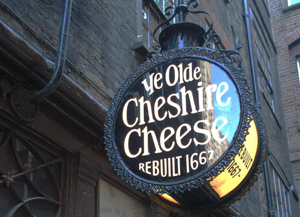
• Ye Olde Cheshire Cheese. This pub is a Fleet Street institution with parts of the current building dating back to 1667 when it was rebuilt following the Great Fire. Dickens was among numerous literary figures who frequented the premises – the pub is perhaps most famously associated with the lexicographer Dr Samuel Johnson (although there is apparently no recorded evidence he ever attended here); other literary figures who came here include Mark Twain and Sir Arthur Conan Doyle – and, according to a plaque in Wine Court, worked out of the pub for a period while producing his journal All The Year Round.

• The One Tun, Saffron Hill. Said to have been established as an ale house on its present site in 1759, the pub was rebuilt in the mid-Victorian era  and was apparently patronised by Dickens between 1833 and 1838. It’s also apparently the inspiration for the pub called The Three Cripples in Oliver Twist (The Three Cripples was actually a lodging house next door to the One Tun and didn’t sell ale). For more, see www.onetun.com

• The George Inn, Southwark. Dating from the 17th century, the George Inn in Borough High Street is the last galleried coaching inn left standing in London and is now cared for by the National Trust (and leased for use by a private company). Dickens is known to have come here when it was running as a coffee house and he mentions it in the book, Little Dorrit. For more, see     www.nationaltrust.org.uk/george-inn/.

• George & Vulture, Castle Court (near Lombard Street). Established in the 18th century on the site of an older inn, this well-hidden pub was not only frequented by Dickens but is mentioned in The Pickwick Papers more than 20 times.

• The Grapes, Limehouse. Formerly known as The Bunch of Grapes, there has been a pub on the site for almost more than 430 years. Dickens was known to be a patron here (his godfather lived in Limehouse) and mentioned the pub – renamed The Six Jolly Fellowship Porters – appears in his novel Our Mutual Friend. For more, see www.thegrapes.co.uk.

• Ye Olde Mitre, Ely Place. This pub dates from the mid 1500s by Bishop Goodrich of Ely to house his retainers and later rented out to Sir Christopher Hatton (it still houses the remains of a cherry tree which Sir Christopher is said to have danced around during a May Day celebration with none other than the future Queen Elizabeth I). Dickens (and the ubiquitous Dr Johnson) are both said to have drunk here.

• And lastly, The Dickens Inn in St Katharine Docks. It’s worth noting up front that Charles Dickens had nothing to do with this pub – dating back to at least 1800, it was once a warehouse and is thought to have been used to either house tea or play a role in a local brewing operation – but it was his great grandson, Cedric Charles Dickens, who formally opened the pub in 1976, apparently declaring, “My great grandfather would have loved this inn”. For more, see www.dickensinn.co.uk.

This list is by no means comprehensive – we’d love to hear from you if you know of any other pubs Dickens frequented…

10 London sites to celebrate Charles Dickens – 4. Dickens at home…

We’ve already mentioned Charles Dicken’s Doughty Street house (now the Charles Dickens Museum) and his many childhood homes, but where else in London did Dickens reside during his adult life?

Following his marriage to Catherine Hogarth on 2nd April, 1836, at St Luke’s Church in Chelsea, Dickens and his new bride settled into chambers the writer had taken the now non-existent Furnival’s Inn (the author had been living there prior to his marriage), the site of which  is now occupied by the Holborn Bars Building).

In January the following year the couple had their first child – Charles Culliford Boz Dickens – and shortly afterwards made the move to the property at 48 Doughty Street. As we mentioned, the house was where two of his children were born and where Catherine’s 17-year-old sister Mary died (her death is believed to be the inspiration for that of the character Little Nell in the novel The Old Curiosity Shop) as well as being where Dickens wrote some of his most famous novels, including Oliver TwistNicholas Nickleby, and The Pickwick Papers.

In 1839, however, the family upsized into a much grander property at 1 Devonshire Terrace in Marylebone near Regent’s Park. This property at what is now 15-17 Marylebone Road was demolished in the late Fifties but there is a sculptural frieze on the wall marking where the property once stood.

Among the works Dickens wrote while living here were The Old Curiosity Shop, A Christmas Carol, Martin Chuzzlewit and David Copperfield. Six of Dickens’ children were born while he lived in this property. During this time, Dickens also made his first visit to North America and also travelled with his family in Europe for considerable periods.

In November 1851, Dickens moved the family again – this time to Tavistock House, located Tavistock Square in Bloomsbury. The property was demolished in 1901 and the site is now occupied by the headquarters of the British Medical Association (there’s a blue plaque commemorating Dickens’ time here).

Among the works Dickens wrote while living here were Bleak House, Hard Times, Little Dorrit and A Tale of Two Cities. The last of Dickens’ 10 children were born here – Edward Bulwer Lytton Dickens, later an Australian MP – and it was while living here, that in 1858 he separated from his wife Catherine. Dickens also put on amateur theatricals in the property.

Dickens’ time at Tavistock house ended around 1860 when Gad’s Hill in Kent became the main family home.

PICTURE: A section of the sculptural frieze depicting Dickens and some of his characters on the building that now stands at what was 1 Devonshire Terrace now in Marylebone Road. PICTURE: grahamc99 

10 London sites to celebrate Charles Dickens – 3. Recalling a journalistic career…

We kick off this week’s special – which looks at some of the London premises in which Dickens spent his working life – where we left off last week. Charles Dickens, now 15, had once again been forced to leave school and seek employment – this time as a solicitor’s clerk. From 1827 to 1828, the future author worked at two firms before, having taught himself shorthand, he launched his career as a journalist.

Dickens started his life in his new profession as a freelance law reporter working out of Doctor’s Commons where civil cases were heard (the site of which is marked with a blue plaque on the north side of Queen Victoria Street). Around 1830, he began to work for the newspaper, Mirror of Parliament, which was owned by his uncle and then, in 1832 he was employed at the True Sun newspaper.

His first published literary works started appearing in Monthly Magazine in December the following year (his first printed story was initially entitled A Dinner at Poplar Walk) and eight months later, in August 1834, he took on a new job as a reporter at the influential Whig paper, the Morning Chronicle. His writing was subsequently also published in the Evening Chronicle.

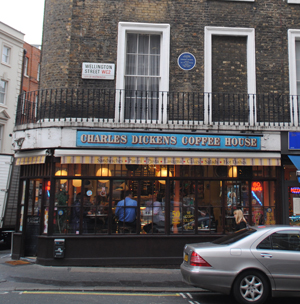
Among the magazine’s Dickens edited were Bentley’s Miscellany – this was the vehicle in which Oliver Twist was first published – and Household WordsHard Times was first published in this – as well as All the Year RoundA Tale of Two Cities and Great Expectations were both first serialised in this magazine which was located at 26 Wellington Street not far from Covent Garden. The building is now the home to the Charles Dickens Coffee House (pictured).

Next week we’ll be taking a look at some of places in London where Dickens lived…