Wren’s London – 2. St Bride’s

While St Paul’s Cathedral is certainly his best-known work, Sir Christopher Wren designed 50 other churches in London in the wake of the Great Fire of 1666. Rather than look at each individually, we’ll just highlight a couple with the first being the “wedding cake” church, St Bride’s.
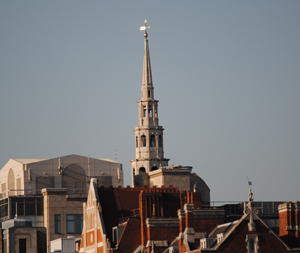
The site of St Bride’s has been home to at least eight churches, the first of which is believed to have been founded in the Dark Ages. Dedicated to the sixth century Irish nun St Bride – or St Bridget, the church – thanks to its location on Fleet Street – has had a long association with printers and later newspapers and journalists and, despite the fact most news organisations have long since departed the area, is still regarded as “the journalist’s church”.

The medieval St Bride’s was completely consumed in the Great Fire but a new church was opened in 1675 after works were carried out to Wren’s design (among his assistants on the job was Nicholas Hawksmoor who became a celebrated architect in his own right).

Despite the return of worshippers, however, the building remained unfinished and Wren was approached in the early 1680s about constructing the steeple. This was completed in 1703 and has become a London landmark with many believing its tiered design was the basis for the modern “wedding cake” design.

The steeple – at 226 feet or almost 70 metres, the tallest in London – was one of few things which survived after a firebomb destroyed much of the building during the Blitz in 1940. The church was subsequently restored according to Wren’s original designs (albeit with a shorter steeple than Wren’s original – eight feet or 2.4 metres were knocked off when it was struck by lightning in 1764.)

As well as its association with the printing industry and the press, these days St Bride’s is also notable for its US connections – the first American child of English descent, Virginia Dare, was the daughter of two former St Bride’s parishioners (there is a bust of Virgina above the font). The parents of Edward Winslow, three-time Governor of Plymouth in Massachusetts, were also married in St Bride’s.

The crypt contains remains dating back to Roman times.

WHERE: Fleet Street (nearest tube St Paul’s); WHEN: 8am to 6pm Monday to Friday, 11am to 3pm Saturday, 10am to 1pm and 5pm to 7.30pm Sunday; COST: Entry is free but guided tours are available on Tuesday afternoons at 3pm for £5 a person; WEBSITE: www.stbrides.com.

Famous Londoners: Samuel Johnson

The man behind what is perhaps the most famous quote about London – “When a man is tired of London, he is tired of life” – Samuel Johnson was a noted writer, critic and raconteur of the 18th century whose work included a then unparalleled English language dictionary.

Often simply referred to as “Dr Johnson”, Johnson was also the subject of one of the most famous biographies ever written – that of his friend James Boswell’s aptly named Life of Samuel Johnson.

Born in 1709 in Lichfield, Staffordshire (the home is now a museum), Johnson – who often struggled with poor health and depression – was the son of a bookseller who managed to help fund his brief time at Pembroke College in Oxford before lack of funds meant he had to leave without a degree (he was later awarded an honorary degree).

He worked with his father and as a tutor before eventually, in 1737, heading to London with his friend and former pupil, actor David Garrick, and there worked for the rest of his life as a writer producing works including magazine articles and essays, poetry, sermons, and biographies.

In 1746, he was commissioned to produce the dictionary and rented  a property at 17 Gough Square, not far from Fleet Street, where he would spend the nine years working in it. Published in 1755, the dictionary was a remarkable work which not only won him acclaim ever since but also resulted in King George III granting Johnson a modest pension for the rest of his life (he had previously been arrested for debt).

The Gough Square house is these days open to the public and includes an exhibition on Johnson’s life, particularly with regard to his time there (there’s a statue of his cat Hodge in the square itself). Other sites which Johnson is known to have frequented include Ye Olde Cheshire Cheese in Fleet Street, the Anchor Inn in Bankside, the Theatre Royal Covent Garden (now the Royal Opera House) in Bow Street where the Beefsteak Club met, and St John’s Gate in Clerkenwell where he once had an office.

Johnson married an older widow, Elizabeth Porter, in 1735, but she died in 1752 and it was following her death that Francis Barber, a former Jamaican slave, moved in as his servant, eventually becoming Johnson’s heir.

Johnson’s friends included some of the great luminaries of the time, including artist Joshua Reynolds, philosopher Edmund Burke, poet Oliver Goldsmith, and, of course, Boswell.

Following a series of illnesses, Johnson died in 1784 and was buried in Westminster Abbey. The 300th anniversary of his death was marked with a series of events last year including a re-enactment of the walk Johnson and Garrick made from Lichfield to London.

Dr Johnson’s House (17 Gough Square, nearest tube is Temple, Holborn or Chancery Lane) is open Monday to Saturday, 11am-5.30pm (5pm from October to April). Entry costs £4.50 an adult, £3.50 for concessions, £1.50 for children and family tickets are available for £10. For more information, see www.drjohnsonshouse.org.

Where’s London’s oldest…cinema?

The oldest purpose built and continuously operated cinema in London is believed to be the Phoenix in East Finchley, north London. Built in 1910, it opened in 1912 and has known several incarnations including as the East Finchley Picturedrome, the Coliseum, the Rex and the Phoenix. It was one of the first theatres in the UK to introduce pictures with sound (it did so in 1929). The theatre, which has appeared in several movies including The End Of The Affair, recently reopened following a £1.1 million restoration. There’s a touring exhibition of the cinema’s history (follow this link to find out where you can see it). Other contenders for the oldest cinema in London include the Electric Cinema in Portobello Road, Notting Hill, which opened in 1911.

Around London…

• It’s only a week to go until the annual Open House London event. Held on the 18th and 19th September, Open House London is your chance to get inside all manner of buildings – from private homes through to grand edifices – which are often normally closed to the public. Be warned, however, that some buildings, such as the BT Tower (open for the first time) require bookings to be made. These close 15th September, so you’ll have to be quick. The free event, which has run for 18 years, also includes neighbourhood walks, cycle tours and talks. For more information on the event, to purchase the guide (an electronic copy can be downloaded for £3.50) or to find out how to book, head to www.openhouselondon.org.uk.

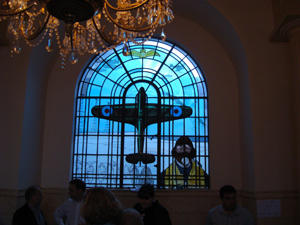
Looking for a weekend out of the city? English Heritage’s Heritage Open Days program – which doesn’t cover London – runs from today until Sunday and grants free access to properties around the country which are either normally closed to the public or usually charge admission fees. The program includes buildings ranging from medieval castles and Georgian townhouses through to World War II cemeteries and 21st century eco-homes. Among the properties within easy reach of daytrippers from London are Waverley Abbey in Fareham, Surrey – founded in 1128, it was the first in England housing Cistercian monks; an historic ‘net shop’ in Hastings, East Sussex; the Battle of Britain command centre at Bentley Priory in Stanmore, Hertfordshire (see picture of the entrance hall above); and, the new Aardman Animation headquarters in Bristol, home to the creators of Wallace and Gromit. Some places require prebooking so check before heading off. For more information, see www.heritageopendays.org.uk.

• The headless skeleton of a rare North Atlantic right whale recently found in the Thames has gone on display at the Museum of London Docklands. The seven metre long, half tonne skeleton was unearthed at Bay Wharf Greenwich by archaeologists and is believed to be the largest single object ever found at an archaeological dig in the city. The skeleton is only on display in the museum’s foyer until 14th September when it goes to the Natural History Museum. Entry is free. For more information, see www.museumindocklands.org.uk.

Wren’s London – 1. St Paul’s Cathedral

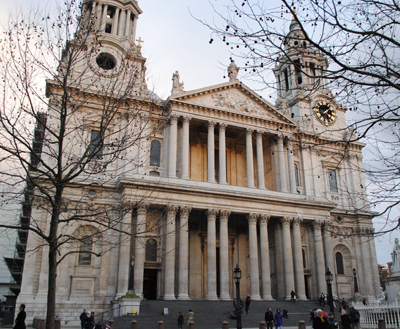
In a new special, we’re taking a look at some of the key sites London landmarks designed by renowned 17th century architect Sir Christopher Wren. To kick it off, we’re taking a look at the building for which he is most known, St Paul’s Cathedral.

Wren’s involvement with the current St Paul’s came after the Great Fire of London in 1666 left the old medieval cathedral in ruins (there is believed to have been four previous cathedrals built on the site with the first dating from around the early 600s). He had already been involved in repairing the old cathedral and had even submitted plans for a new domed cathedral on the site when the Great Fire swept through the city.

Wren had already been appointed Surveyor to the King’s Works when, in 1668, he was asked to submit plans for the a new cathedral. After his first few designs were rejected and abandoned, Wren’s plans, albeit substantially altered, were finally approved and the first stone laid in 1677.

The design was ambitious and the church now features what is the second biggest dome in the world after that of St Peter’s in Rome as well as a monumental west-facing facade complete with two towers (the final form of the western facade wasn’t settled until 1707 and both of the towers were originally designed to hold clocks. In the end only the right tower did.)

Building took more than 30 years and it wasn’t until 1710 that the new cathedral was officially declared completed. Interior features include the Whispering Gallery (located 30 metres above the floor below the central dome, it gets its name from the fact that a person whispering into the wall can be heard across the dome by someone who puts their ear to the wall), choir stalls which feature the work of renowned woodcarver Grinling Gibbons, and poet/preacher John Donne’s memorial from 1631, the only pre-Great Fire monument to survive intact. There are spectacular views over London from the Stone Gallery or the highest point of public access, the Golden Gallery.

Since its opening, St Paul’s has hosted the burials of numerous of Britain’s luminaries – the tombs of Admiral Horatio Nelson and the Arthur Wellesley, the Duke of Wellington, are both in the crypt as are those of 18th century painter Sir Joshua Reynolds and Sir Alexander Fleming, the man who discovered penicillin along with a host of memorials. Others events hosted at the cathedral include Winston Churchill’s funeral and the wedding of Prince Charles and Lady Diana in 1981.

Wren, who died in 1723, was the first person to be interred in the crypt. His tomb bears an inscription in Latin which says: “Reader, if you seek a monument, look around you.”

WHERE: Ludgate Hill. Nearest tube is St Paul’s; WHEN: Monday to Saturdays, 8.30am to 4pm. COST: £12.50 adults/£11.50 seniors/£9.50 students/£4.50 children (aged 6-16)/£29.50 family; WEBSITE: www.stpauls.co.uk

Marking 70 years since the Blitz began…

Today – 7th September – marks 70 years since the start of the Blitz when, between 7th September 1940 and 10th May 1941, more than 43,000 civilians were killed, at least 140,000 injured and an estimated million homes across the UK suffered damage or destruction as a result of air raids.

London, which suffered 57 consecutive nights of attacks starting on 7th September, features numerous memorials relating to World War II including the National Firefighters Memorial located on the Jubilee Walkway, just south of St Paul’s in the City. It depicts firefighters in action during the Blitz and serves as a tribute to those who fought against the fires caused by the raids as well as commemorating the lives of all firefighters who have died while on active duty. For more on the memorial, see www.firefightersmemorial.co.uk.

For a series of interesting reconstructed photos showing the difference between London during the Blitz and now, visit Sky News here. Or for more on the history of the Blitz, see the dedicated BBC website here. And for a terrific graphic showing fire brigade callouts in London on the first day of the Blitz, see The Guardian’s datablog.

Meanwhile, the London Transport Museum in Covent Garden has today opened a new exhibition, Under Attack, which explores the role public transport played during World War II in three cities – London and Coventry – both of which are marking 70 years since the start of the Blitz, and Dresden in Germany which is marking the 65th anniversary of the Dresden Firestorm. The exhibition, developed in conjunction with Coventry Transport Museum and the Verkehrsmuseum Dresden, runs until 31st March next year. For more details, visit www.ltmuseum.co.uk.

What’s in a name? – Soho

The first in an occasional series looking behind some of London’s place names. To kick it off, we’re taking a look at the origins of the name of the inner metropolitan suburb of Soho.

The name was apparently taken from a hunting cry – ‘So Ho’  and is believed to have been first used to describe this area of London in the 1600s (the cry was also later used as a rallying cry by the James Scott, the Duke of Monmouth’s men when he tried to overthrow James II at the Battle of Sedgemoor in 1685).

The area was used as grazing lands before becoming part of Henry VIII’s hunting grounds and then in the later 1600s started to undergo development, becoming known as a refuge for immigrants from Greece and France (the French Protestant Church on Soho Square is indicative of the diverse population who have lived there).

It later morphed into a somewhat seedy and bohemian entertainment district and became home to some big name writers, artists, intellectuals and musicians. Over the years, famous residents have included everyone from Karl Marx to poet William Blake.

These days, while elements of entertainment industry remain – in particular the film industry as well as some seedier establishments – the area, bordered by Oxford and Regent Streets, Charing Cross Road and Piccadilly Circus to the south, is also home to large numbers of trendy cafes, pubs and restaurants and still boasts a healthy nightlife.

10 sites in London you may not know about – 10. Highgate Cemetery

Cemeteries can often provide a fascinating insight into past lives and among the most prominent in London is Highgate Cemetery, located in the city’s north.

With the population of London growing rapidly in the early 1800s, the 17 acre Highgate cemetery was first opened in 1839 with the first burial taking place in May that year.

The cemetery quickly became one of London’s most fashionable and was extended by 20 acres before the opening in 1856 of a new cemetery to the east. These days both are open to tourists although the West Cemetery can only be explored on a guided tour, thanks at least partly to vandalism.

The atmospheric East Cemetery is primarily known for being the resting place of Karl Marx but also features the graves of authors George Eliot (Mary Ann Evans) and Douglas Adams, Australian painter Sidney Nolan and co-founder of Foyles – London’s famous Charing Cross bookstore – William Foyle.

Features at the West cemetery, meanwhile, include an avenue of Egyptian-style vaults and the vaults in an inner ring known as the Circle of Lebanon. Among those buried there are physicist Michael Faraday and the parents and brother of Charles Dickens.

The cemetery is now operated by a non-profit charity, the Friends of Highgate Cemetery.

WHERE: Swain’s Lane. Nearest tube is Archway; WHEN: Eastern Cemetery – daily from 10am (11am weekends) to 5pm (4pm between November and February), Western Cemetery – guided tours only (weekdays at 2pm with phone bookings required, weekends hourly from 11am to 4pm (3pm between November and February); COST: Eastern Cemetery – £3 adults/£2 students, Western Cemetery tours – £7 adults/£3 children aged 8-16; WEBSITE: www.highgate-cemetery.org

Around London…

• A 145-year-old replica of an Eleanor’s Cross was unveiled outside Charing Cross railway station last month following a major restoration. The monument, located near Trafalgar Square, was built in 1865 and was a copy of one of the 12 which were constructed by King Edward I to mark the route where the body of his wife Eleanor of Castile rested each night on its way to Westminster Abbey following her death in 1290. Only three of the original crosses remain intact – at Geddington north of Northamptonshire, Hardingstone near Northamptonshire, and Waltham Cross in Hertfordshire. The original monument at Charing Cross, which was demolished in 1647, marked the point from which distances are measured from London (a plaque now marks the site). The restoration involved replacing some 100 damaged and missing features. Due to deterioration, the monument has been hidden behind scaffolding for the past five years.

None of London’s Barclay bikes will be available to tourists until the end of the year, reports the London Evening Standard. The newspaper says plans to widen the scheme to allow tourists to hire the bikes have been put on hold after the emergence of logistical problems. The hire scheme was launched for locals at the end of July.

A new heritage trail has been opened at Kenley Common in the city’s outer south to commemorate the 70th anniversary of the Battle of Britain. The 56 hectare common in Surrey surrounds Kenley Airfield, a former Battle of Britain airfield these days used by the RAF for glider training. The trail, which was an initiative of a range of organisations including the Kenley Airfield Friends Group, RAF Association, Tandridge District Council, English Heritage, the Ministry of Defence and City of London Corporation, kicks off at the RAF Tribute on Kenley Common (off Hayes Lane in Surrey) and features a series of interpretative panels, the first two of which are mounted on scaled down Spitfire wings. These explain the role the area played in defending London from attacks and the significance of the tribute and the World War II blast pens. For more information, follow this link. For information on London’s Battle of Britain memorial, head here www.bbm.org.uk.

Famous Londoners: Richard ‘Dick’ Whittington

In the first in an occasional series on famous Londoners, we take a look at who Dick Whittington really was.

While he’s remembered by many today as a poor boy who made a fortune by cleverly trading his mice-catching cat, Richard Whittington was in fact born into a noble Gloucestershire family around 1350 and, after coming to London, rose in power and influence to become a four time Mayor of London who, after his death, set a new standard in philanthropy.

Sir Richard was born in the 1350s as the youngest son of Sir William Whittington, Lord of the Manor of Pauntley. As the second son, he was not able to inherit and so left home when his father died to seek work in London. There he served as an apprentice, before becoming a mercer (a dealer in costly fabrics) and subsequently became a supplier of valuable materials like silks and cloth of gold to King Richard II and later King Henry IV as well as other members of court.

Growing in wealth and influence (as well as dealing in cloth, he lent considerable sums to both kings and as a result was granted part of the wool tax collected at various ports), Whittington became a city alderman in 1393 and was chosen by the king as mayor in 1397 when the incumbent, Adam Bamme, died. He was subsequently re-elected in 1398, again in 1406, and in 1419.

Whittington died in 1423 and, as he and his wife Alice (who had died before him) had no children, he left his substantial fortune – estimated at some £5,000 – to charity. The money was used to establish almshouses (entrusted to the care of the Mercer’s Company, of which Sir Richard was master three times), as well as libraries and other public works including rebuilding Newgate Gaol and building a public lavatory known as ‘Whittington’s longhouse’. The Charity of Sir Richard Whittington is still operational. It’s undoubtedly his charity which touched so many Londoners which led to his fame.

While many versions of Whittington’s life have been told since the first recorded retellings in the late 16th and early 17th century, the story as we generally know it today (and one which has become a panto favorite) is that he was a poor boy from Gloucestershire who walked to London to seek his fortune and indeed found work there in the home of a rich merchant, Fitzwarren. He slept in the attic and kept a cat to keep down the numbers of mice.

Fitzwarren is said to have invited his servants to invest in a sailing voyage and as Dick had no money, he offered his cat, usually named ‘Tommy’, instead. Some time later he decided to leave London for his home and set out on foot but when on Highgate Hill on his way out, he heard the bells of London summoning him back, saying ‘Turn again, Whittington, three times Lord Mayor of London’. (Although Whittington actually served as mayor four times, the first two times were back-to-back, meaning some may have considered it as three).

So he did and returning to the merchant’s house, he found the ship had returned and that his cat had played a starring role in saving the court of the King of the Barbary Coast from being overrun with mice. The king apparently paid a large sum to buy the cat and Whittington became a wealthy man, marrying Fitzwarren’s daughter Alice and, as the bells prophesised, becoming ‘Lord Mayor of London’ (actually mayors at the time of the real Dick Whittington weren’t given the title Lord).

These days a statue of Whittington’s cat – the Whittington Stone (picture above) – still sits on Highgate Hill, marking the site where he apparently ‘turned again’ (among other references to Dick Whittington in London is the Dick Whittington ‘ale trail’ – a free downloadable pub guide).

As to whether he actually had a cat? While there’s apparently no evidence he did, it’s nice to think there was a real cat behind the myth (even if he didn’t rid the Kingdom of Barbary of its mice)!

10 sites in London you may not know about – 9. Regent’s Canal

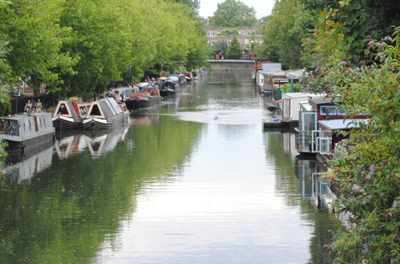
Opened in 1820 as a link between the Grand Junction Canal and the London docks in the east, Regent’s Canal remains a terrific way to see another, oft forgotten (at least in visitor terms), part of the city.

Once at the heart of London’s goods transportation system, the canal is now a recreational and residential precinct. There’s a terrific tow path which runs between Camden Lock, home of great markets including terrific food, and the pool of Little Venice in Paddington – taking in Regent’s Park, canal-side mansions, and the London Zoo along the way.

If you don’t want to walk, you can take a boat trip (among those offering trips between Little Venice and Camden Lock are the London Waterbus Company and Jason’s Trip; for kayaking, see Thames River Adventures) along largely the same route (although the tow path takes you over the top of Maida Hill while the boats head through a tunnel underneath).

John Nash, designer of Regent’s Park, was one of the proponents of the canal seeing it as nice addition to his park (he apparently originally wanted the route to run through the park but was convinced otherwise thanks to some fears over the language of those involved in steering boats along the canal).

He become one of the directors of the company which developed the canal following the passing of an act of parliament in 1812. It was named for the then Prince Regent, later King George IV.

You can find out more about the history of the canal at the London Canal Museum, located further to the east on the Regent’s Canal between St Pancras Lock and the Islington Tunnel.

WHERE: While the canal runs to the docks, the journey from Camden Lock to Little Venice is a walk of around 5 kilometres. Nearest tube stations are Warwick Avenue at the Little Venice end and Camden Town at the Camden Lock end; WHEN: Daily, tow path is open from dawn to dusk between Camden Lock and Little Venice (see the boating company websites for trip times); COST: The tow path is free, one way trips on boats between Little Venice and Camden Lock start at around £6.50WEBSITE: For more on the history of the Regent’s Canal, see www.canalmuseum.org.uk/history/regents.htm.

The Tip – In Westminster and need to go?

There’s nothing worse than getting caught without a toilet nearby – especially when travelling with kids. Westminster City Council operate a handy text service, Sat Lav, to locate the nearest public toilet to where you are. Just text 80097 and they’ll reply with the location. It’s in operation 24/7.

Around London…

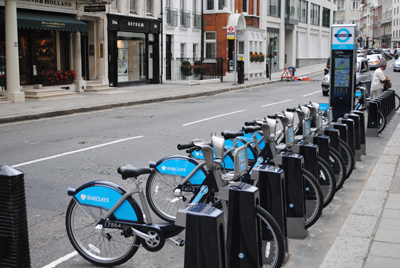
London’s bicycle hire scheme is up and running. The scheme was launched at the end of July and boasts 5,000 bikes which can be found at 315 docking stations. More than 21,000 people signed up in the first weeks and some of the early popular hire sites included Soho Square, Drury Lane in Covent Garden and Wardour Street. The bikes are available 24 hours a day, seven days a week. Members of the scheme must be 18 years old and you must be at least 14 years old to ride the bikes. A membership key costs £3 while the membership itself costs at £1 for a 24-hour membership, £5 for seven days and £45 for an annual membership. The first 30 minutes of any journey is then free (with fees applicable after that). As the bikes don’t come with a lock, it’s expected people will simply make a journey to another docking station before getting off. For more information on the Barclay’s Cycle Hire scheme, see Transport for London’s website at www.tfl.gov.uk. Meanwhile, in other transport news, the first air-conditioned Tube train is now in active service on the Metropolitan Line.

A cafe has been opened at Buckingham Palace, 173 years after Queen Victoria first moved in following her accession to the throne. Located on the West Terrace overlooking the lawn and lake, the Garden Café is open during visiting hours. The Palace’s State Rooms, meanwhile, are open to the public until 1st October. The palace this year hosts The Queen’s Year exhibition which features displays of ceremonial robes, gifts, uniforms, dresses and jewellery, as well as archive photography and film in an illustration of the monarch’s work throughout the year at everything from the State Opening of Parliament to the Garter Day ceremony at Windsor Castle and investitures, garden parties and State Visits. Entry to the State Rooms – which comprise just 19 of the palace’s 775 rooms – is £17.00 an adult, £15.50 concessions, £9.75 for under 17s and under fives are free. Family tickets are £45 and combined tickets – including the Royal Mews and the Queen’s Gallery – are also available. www.royalcollection.org.uk/default.asp?action=article&ID=30. For more on the special exhibition, see www.royalcollection.org.uk/microsites/thequeensyear/

The Tower of London was the most visited royal site in Britain last year, attracting 2.4 million tourists, according to a report from VisitBritain. The tourism agency found that while overseas tourists spent some £4.6 billion while in the UK last year, more than £500 million was spent on tourism associated with the Royal Family. The top 10 most visited sites included several royal attractions – Edinburgh Castle came in at number six with 1.2 million visitors, Windsor Castle at number seven with 987,000 and Buckingham Palace at number 11 with 402,000. Other top London sites included the National Maritime Museum in Greenwich (#2 – 2.4 million), the Victoria and Albert Museum in South Kensington (#3 – 2.3 million), St Paul’s Cathedral (#4 – 1.8 million), Westminster Abbey (#5 – 1.4 million) and Hampton Court Palace (#9 – 541,646).

LondonLife – A maze in Trafalgar Square

Trafalgar Square has been transformed with a temporary hedge maze which takes visitors through a potted history of some of the streets of London’s West End. The maze, created by the West End Marketing Alliance, is full of fascinating facts – did you know, for example, that the area we now know as Covent Garden was originally known, during Saxon times, as Convent Garden? Or that the Beatles last ever gig was performed on a rooftop in Savile Row? The maze is only in Trafalgar Square for this week, so get in quick if you want to visit (and pick up a free badge for your effort in conquering the maze). When Exploring London visited, waiting time was only about 10 minutes. For more, see www.WestEndLondon.com.

10 sites in London you may not know about – 8. Jewel Tower

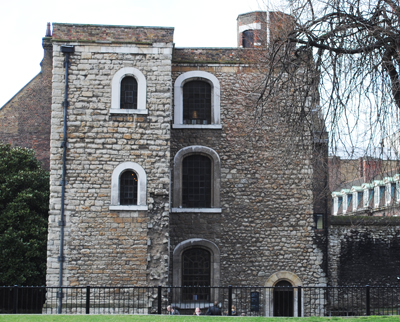
Overshadowed by its more impressive neighbours, Westminster Abbey and the Houses of Parliament, the Jewel Tower is just one of few remnants of medieval London left in the city.

The L-shaped, three story tower was built of white Kentish stone in the mid 1365 during the reign of Edward III in order to provide a safe place to store the king’s personal jewels (as distinct from the Crown Jewels which were held in the Tower of London).

It remained in use as the home of the King’s Privy Wardrobe until 1512 when, following a fire at the Palace of Westminster, the court moved to Whitehall and the jewels were taken to a new home there. Later, in 1621, it became the official house for the records of Parliament and in 1869 it changed roles again, this time becoming the home of the official Weights and Measures Office.

In 1938, the Standards Department moved to a new location in Westminster and, following the war – during which the timber roofs were extensively damaged as a result of air raids – it underwent substantial conservation works.

Now in the care of English Heritage, the building currently houses a fascinating exhibition on the history of parliament and its own past as well as giving access to some of it’s most impressive original features including a vaulted ceiling in the ground level room, complete with carved stone bosses.

Worth visiting to gain a sense of what the medieval Palace of Westminster must have been like not to mention the exhibitions it contains, the Jewel Tower is itself a jewel in London’s medieval heritage.

WHERE: Abingdon Street, Westminster (opposite Victoria Tower at the southern end of the Houses of Parliament). Nearest tube is Westminster; WHEN: Daily, 10am-5pm (summer hours); COST: £3.20 adults/£2.70 concessions/£1.20 children; WEBSITE: www.english-heritage.org.uk/daysout/properties/jewel-tower/

Around London…

• A team of archaeologists from the Museum of London have unearthed the remains of a brewhouse close to the purpose-built theatre, known simply as The Theatre, where Shakespeare first acted. The brewhouse could represent what became a dedicated ‘tap room’ aimed at theatre customers and may well have been a watering hole of the Bard himself. It – and a nearby bakehouse – were originally part of Holywell Priory, once one of the richest in England, which was dissolved in 1539. You can follow the dig’s progress here: www.mymuseumoflondon.org.uk/blogs/blog/category/excavations-at-shakespeare’s-theatre/

London’s Dickens Museum has unveiled the long-lost tombstone of a cartoonist who took his own life after he was believed to have been rejected by the famous author. Robert Seymour apparently took his own life after Charles Dickens was believed to have informed him that he would no longer be employed to illustrate The Pickwick Papers (there remains considerable debate over whether Dickens should be blamed for his death). The gravestone had been missing for a century but was reportedly discovered in the crypt of a London church by scholar Stephen Jarvis. It will now be displayed in the back garden of the museum which is housed at 48 Doughty Street in Dicken’s only surviving London home (he lived there between 1837 and 1839 while writing novels including The Pickwick Papers and Oliver Twist). The museum is preparing to celebrate the bicentenary of Dickens’ birth in 2012.  www.dickensmuseum.com

• Sir William and Sir Joseph Hooker – the father and son responsible for transforming Kew Gardens in the nineteenth century – have been honored with a blue plaque at their former home on Kew Green. The home where Princess Alexandra was to unveil the plaque became the official residence of the garden’s director when Sir William moved there in 1851. Sir William had been appointed director of the Botanic Gardens 10 years before and during his 24 year tenure not only greatly expanded them but also opened them to the public. His son, Sir Joseph, had travelled aboard the HMS Erebus as it explored the southern oceans between 1839-1843 before succeeding his father as director upon his death in 1865. www.english-heritage.org.uk/about/news/princess-alexandra-unveils-blue-plaque-for-former-directors-of-kew-gardens

The Tip – Walk under the Thames

Walk under the Thames. Heading to Greenwich for a day out? While the Docklands Light Railway (DLR) will take you from Tower Hill to Cutty Sark station in the heart of Greenwich itself, get off a station early at Island Gardens and you can walk to Greenwich instead, taking the foot tunnel under the Thames. Opened in 1902, the 387 metre long tunnel, which runs about 15 metres underneath the river, was built so labourers from south London could walk to work in the docks on the Isle of Dogs and surrounding areas. Signs mark the way to the tunnel which is marked at either end by a dome at each end containing stairs and a lift. http://bit.ly/aQMujS

10 sites in London you may not know about – 7. Geffrye Museum

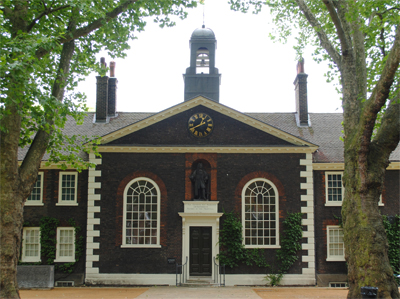
Tucked away just north-east of the city of London, this surprisingly interesting museum features reconstructed interiors of London homes from the 1600s through to modern times. The museum is located in former almhouses built in the early 1700s by the Company of Ironmongers using a bequest left them by Sir Robert Geffrye, a former twice-master of the company and a former Lord Mayor of London.

Worth visiting for the almhouses alone, these were used until early in the 20th century when, given the overcrowding in Shoreditch, the company decided to relocate the remaining pensioners. Thankfully, due to the fact that the almshouses were built around a large garden not to mention the lack of public open space in the area, the almhouses and grounds were preserved; the former to be used as a museum.

The museum itself features a series of informational rooms between those in which the lavishly detailed reconstructions – which are largely of the main living rooms – are contained and there’s an audio guide which is well worth taking the time to listen to as you work your way through. There’s also a restaurant and special exhibition spaces on site (contained in a modern wing opened in 1998) and preserved within the museum are the chapel once used by the pensioners and the promenade which overlooks gardens at the rear.

For those who want a closer look at what life was like for the pensioners, for a £2 fee you can take a tour of one of the former almshouses which has been restored to show the living conditions of the almhouses in the 18th and 19th centuries. At the rear of the museum, meanwhile, lies some magnificent gardens including a walled herb garden filled with herbs from Roman times onward and a series of ‘period garden rooms’. Keep an eye out as well for the statue of Sir Robert which adorns the front of the building.

WHERE: 136 Kingsland Road, Shoreditch. Nearest tube is Liverpool Street or Old Street (a fair walk) or Hoxton Overground Station (next door); WHEN: Tuesdays to Saturdays, 10am-5pm or Sundays and Bank Holidays, 12-5pm; COST: Free (admission to almhouses £2 at set times during the day); WEBSITE: www.geffrye-museum.org.uk

Around London…

This year marks the 400th anniversary of Ham House in south west London. Located on the south bank of the Thames, between Richmond and Kingston, the property was built for Sir James Vavasour, Knight Marshall to James I with later owners including William Murray, the ‘whipping boy’ of Charles I (that is, the boy who took Charles’ punishment if he was naughty – let’s hope they got on well!), and his daughter, Elizabeth, Countess of Dysart. To find out more about the property, now under the care of the National Trust, and how they’re celebrating the 400th anniversary, see http://www.nationaltrust.org.uk/main/w-hamhouse.

The former treasury in  the crypt beneath St Paul’s is hosting a new exhibition – Oculus: An Eye Into St Paul’s – which aims to bring 1400 years of the history of the church and surrounding streets of London to life through a 270 degree film experience. The film takes visitors from the streets of Saxon London in 604 AD when the first cathedral was constructed on the site to the its destruction in the Great Fire in 1666 and the days of the Blitz in World War II when it stood as a symbol of English defiance. The exhibition also opens up access of areas of the cathedral to the less mobile – with virtual tours of the dome including the Whispering Gallery and the view from the Golden Gallery. See www.stpauls.co.uk.

The Monument has won the City of London’s City Heritage Award for 2010. The city has recently spent £4.5 million in a restoration project which included a new balustrade on the viewing platform of the memorial to the Great Fire of 1666, regilding the flaming orb, and the installation of a real-time feed of the panoramic views from the top to web with updates every minute. See www.themonument.info.

10 sites in London you may not know about – 6. Borough Market

London has a plethora of markets selling everything from fresh flowers to antiques and clothes. For food, it’s hard to beat Borough Market. Located next to Southwark Cathedral on the south bank of the Thames, the market stalls are contained in a maze of passageways which, when it’s in full swing, buzz with excitement and color.

The market’s history goes back to the Middle Ages when traders gathered close to London Bridge to sell produce and livestock and was officially located around it’s current site in the 1700s

With about 130 individual stalls, there’s everything here you could want – fresh seafood and meats, fruit and vegetables, cheeses and dairy products and all the cakes and pastries you could want as well as a range of alcoholic drinks.

It’s a great place to do some shopping but equally good as a place to duck in for lunch – the Boston Sausage Company’s sausages make for a great bite on the run or to eat while sitting in the cathedral grounds watching the passersby.

WHERE: Between the Thames River and Borough High Street, Southwark. Nearest tube is London Bridge or Borough.  WHEN: Thursdays, Fridays and Saturdays; COST: Free to enter; WEBSITE: www.boroughmarket.org.uk