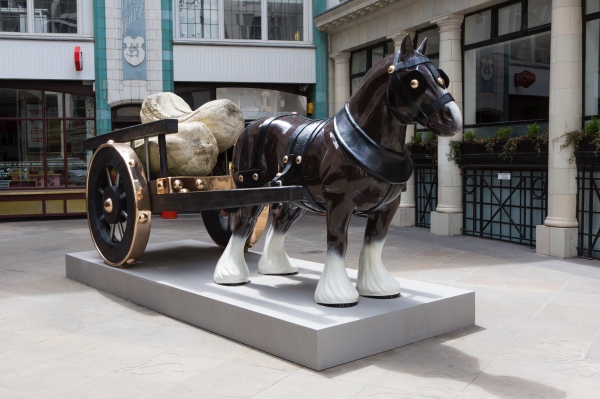
Sculpture in the City is back in the Square Mile, this year featuring 18 artworks ranging from Jean-Luc Moulène’s Body, an aerodynamic tribute to the automobile as sculpture (located in Undershaft – pictured above), to Thomas J Price’s Numen (Shifting Votive) One & Two, an exploration of the ancient Greek, Roman and Egyptian traditions of monumental sculpture (located under The Leadenhall Building – pictured below). Other sculptural works included in this, the 8th edition of the annual event, include Juliana Cerceira Leite’s Climb, a three metre tall obelisk made from the inside out (located in Mitre Square – pictured second below), Sarah Lucas’ Perceval, a life-size horse and cart evocative of the traditional china ornaments that once took pride of place on British mantlepieces (located in Cullum Street – pictured third below), and Karen Tang’s Synapsid, a vivid globular sculpture which brings to mind sci-fi invasion scenarios (outside Fenchurch Street station – pictured fourth below). And, for the first time, the event also includes two sound projects: Marina Abramovic’s Tree, which those passing near a tree at 99 Bishopsgate with insistent, repetitive and distorted birdsong, and Miroslaw Balka’s The Great Escape which, located in Hartsthorn Alley, features the film of the same name’s theme song being whistled repeatedly in a series of slightly different renditions. The display can be seen until April next year – for a map of all the locations, head to www.sculptureinthecity.org.uk. ALL PICTURES: Nick Turpin.
City of London
This Week in London – 40 years of IVF; City Beerfest; and, ‘The Great British Seaside’…
• The Science Museum is marking the 40th anniversary of IVF (in vitro fertilisation) with a special exhibition opening today. IVF: 6 Million Babies Later tells the story of the development of IVF from the work of early pioneers like Robert Edwards, Patrick Steptoe and Jean Purdy through to the birth of Louise Brown on 25th July, 1978, and on to the latest research in reproductive science. Items on show include one of the ‘Oldham Notebooks’ in which the scientific data collected by Purdy and Edwards between 1969 and 1978 was recorded along with examples of the equipment they used such as the glass desiccator used by Edwards to incubate embryos. The display also includes press coverage and personal correspondence and gifts received by Louise’s parents from around the world. A special late night opening will take place on 25th July. Runs at the South Kensington museum until November. Admission is free. For more, see www.sciencemuseum.org.uk/ivf.
• The City of London Beerfest returns to Guildhall Yard today with musical performances and the chance to enjoy some of the UK’s finest ales, beers and ciders. Now in its sixth year, City Beerfest runs from 12.30pm to 9pm with proceeds going toward The Lord Mayor’s Appeal, which supports the Lord Mayor’s dedicated charities, and the City Music Foundation, which helps young musicians gain valuable entrepreneurial skills for successful careers. For more, see www.citybeerfest.org.
• On Now: The Great British Seaside. This major exhibition of photography at the National Maritime Museum in Greenwich features more than 100 photographs taken by some of Britain’s most popular photographers, including Tony Ray-Jones, David Hurn and Simon Roberts, as well as new works by Martin Parr. Runs until 30th September. Admission charge applies. For more, see www.rmg.co.uk/see-do/Great-British-seaside.
Send all information for inclusion to exploringlondon@gmail.com.
London Pub Signs – The Crosse Keys…
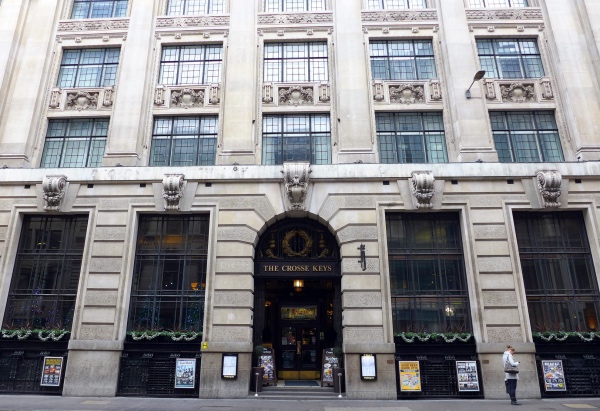
This City of London pub – a sizeable establishment to say the least, takes its name from a building that no longer exists.
Located at 9 Gracechurch Street, The Crosse Keys is located in a former purpose-built bank – that of the Hong Kong and Shanghai Banking Corporation. Designed by W Campbell Jones, the Grade II-listed building opened in 1913 and featured the largest banking floor in the City at the time.
The bank moved out in the latter part of the 20th century and JD Wetherspoon moved in, opening it as The Crosse Keys and keeping much of the original opulent interior, including marble pillars and fireplaces and a magnificent glass dome above the stairwell.
Oh, and the name? That comes from The Crosskeys Inn, a famous coaching inn which once stood on the site and took its name from the keys of heaven, held by St Peter (the crossed keys form part of the Holy See’s coat of arms).
The origins of the inn go back to before the Great Fire of London in 1666 (the inn’s yard also served as a playhouse during the Elizabethan era – the Lord Chamberlain’s Men, of which Shakespeare himself was a member, were said to be among those who performed here).
It was destroyed in the Great Fire, rebuilt and burnt down again in 1734. Rebuilt again, by the late 1800s, it had become a well known coaching inn, said to cater for some 40 or more coaches a day.
There’s a City of London blue plaque marking the site and inside, plenty of historical facts and figures in a series of prints on the walls.
For more, see www.jdwetherspoon.com/pubs/all-pubs/england/london/the-crosse-keys-city-of-london.
PICTURE: The rather grand facade of The Crosse Keys (Ewan Munro; licensed under CC BY-SA 3.0)
LondonLife – More new benches for City of London…
As we reported last Thursday, a series of specially designed new benches have been rolled out across the City of London as part of this month’s London Festival of Architecture. We loved the designs so much, we thought we’d show you some of the others. Above is Nicholas Kirk Architects’ Money Box which, located outside London Bridge Station, is formed of 45,000 stacked pennies while immediately below is McCloy + Muchemwa’s A Bench for Everyone. Located Inside One New Change, its folded shape is designed to evoke the “memory and much-loved comforts of home furniture”. The festival runs until the end of the month. PICTURES: All images © Agnese Sanvito
Above – Mariya Lapteva’s City Ghosts which, located in front of the Royal Exchange, is inspired by the history of the area including East India House and the little shopfronts along Leadenhall Street.
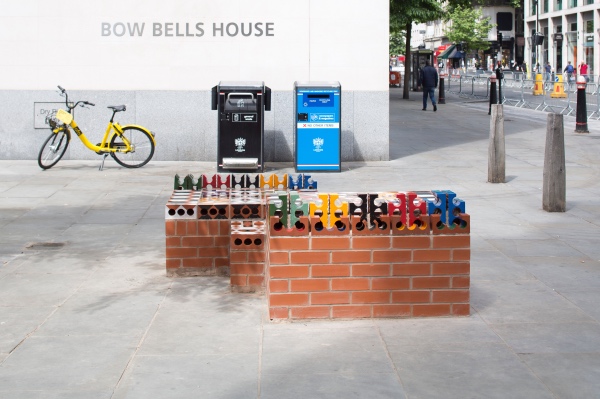
Above – Maria Gasparian’s Ceramic City Bench in Bow Church Yard featuring colours inspired by the “multi-layered context of the City of London that has for centuries been a place for trade, exchange and religious diversity”.
Above – Mills Turner’s Double Bench in Fen Court has been designed to be easy to assemble and adjustable and features an “organic silhouette” which follows the natural curve of the human body.
This Week in London – New City of London benches for LFA; summer concerts in Regent’s Park; and Romania and World War I…
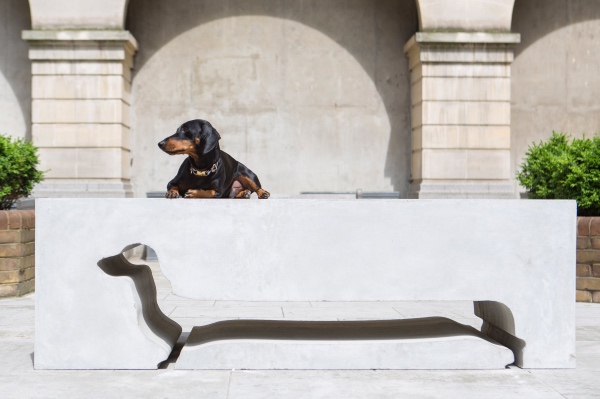
• A series of new “one-off” public benches are being unveiled across London as part of the month-long London Festival of Architecture currently underway in the city. Designed by emerging artists and designers and installed in partnership with the City of London Corporation and Cheapside Business Alliance, the benches include Patrick McEvoy’s doggy design, Here Lies Geoffrey Barkington (pictured), located in Jubilee Gardens in Houndsditch, Maria Gasparian’s Ceramic City Bench in Bow Church Yard, McCloy + Muchemwa’s sinuous A Bench for Everyone inside One New Change, and Nicholas Kirk Architects’ Money Box – formed of 45,000 stacked penny coins – outside London Bridge Station. The festival runs until the end of the month and there’s still a plethora of activities to take part in. For more, see www.londonfestivalofarchitecture.org. PICTURE: © Agnese Sanvito (Via LFA)
• A free summer series of concerts kicks off in The Regent’s Park Bandstand this weekend in what has been described as a “new chapter” in the bandstand’s history. To be held every Sunday afternoon between 3pm and 5pm (with an extra concert to be held at the same time on the Bank Holiday of 27th August) until 2nd September, the concerts range from classic rock to big bands and jazz. Those performing include the Brixton-based South London Symphonic Winds, Regent Community Brass and the Barnes Concert Band as well as the Heroes Band – which raises funds for Help for Heroes – and Royal Academy of Music-associated acts, the Jonny Ford Jazz Quintet and Metropolitan Brass. The concerts have been organised by the Friends of Regent’s Park & Primrose Hill, working with The Royal Parks charity, the Royal Academy of Music and the Crown Estate Paving Commission, and it’s hoped they’ll become an annual fixture in the park. For more, see www.royalparks.org.uk/parks/the-regents-park.
• Romania’s role in World War I is the subject of a free, temporary display at the National Army Museum in Chelsea. Romania and the Great War charts the “years of neutrality (1914-1916), the fierce battles of 1916 on the Entente side, the painful retreat to Moldavia, the striking victories of 1917 and the momentous victory of 1918, which offered a strategic foundation to the political unification of all Romanian provinces and the creation of a modern, democratic state”. Objects on show include photographs, maps, uniforms and original First World War medals. Runs until 15th July. For more, see www.nam.ac.uk.
Send all items for inclusion to exploringlondon@gmail.com.
A Moment in London’s History – The last public hanging…
This month marks 150 years since the last public hanging in London (and, indeed, in Britain). It took place outside Newgate Prison and involved a Fenian (Irish nationalist) bomber named Michael Barrett.
Barrett had been arrested following the bombing of the Clerkenwell House of Detention in 1867 which, in a botched effort to free another Fenian, Richard O’Sullivan Burke, a number of bystanders were killed. Barrett’s case was a controversial one (he was the only one of six people to stand trial for the crime who was convicted) and his execution apparently postponed twice because of questions over his guilt.
The crowd at the hanging on the morning of 26th May, 1868, was said to be large – a “great surging mass” (indeed, such was the interest that seats in nearby houses were said to have sold for £10) – but described in The Times as “unusually orderly”.
“With the first sound of the bells came a great hungry roar from the crowd outside, and a loud, continued shout of ‘Hats off’, till the whole dense, bareheaded mass stood white and ghastly-looking in the morning sun, and the pressure on the barriers increased so that the girls and women in the front ranks began to scream and struggle to get free,” the newspaper reported.
“Amid such a scene as this, and before such a dense crowd of white faces, Barrett was executed…To neither cheers nor hisses did the culprit make the slightest recognition. He seemed only attentive to what the priest was saying to him, and to be engaged in fervent prayer. The hangman instantly put the cap over his face and the rope round his neck. Then Barrett turning spoke through his cap and asked for the rope to be altered, which the hangman did. In another moment Barrett was a dead man…He died without a struggle. It is worthy of remark that a great cry rose from the crowd as the culprit fell – a cry which was neither an exclamation nor a scream, but it partook in its sound of both.”
The hanging was carried out by William Calcraft, the orphaned son of an Essex farmer who many years earlier had found what was to be an almost life-long calling when, apparently while selling pies at a hanging he was noticed by his predecessor in the job and became his apprentice before taking in the job himself in 1829.
Calcraft, who was known for his use of controversial ‘short drops’ which meant the condemned would slowly strangle to death rather than have their necks broken, was to preside over the last public hanging – of Barrett – as well as the first private hanging inside Newgate – of 18-year-old murderer Alexander Mackay in September, 1868 – before eventually retiring in 1874 and dying shortly after.
Barrett, meanwhile, was buried under the ‘Birdcage Walk’ (also known as ‘Dead Man’s Walk’), the stone corridor which linked the prison with the Old Bailey. His body was transferred to the City of London Cemetery in 1903 as Newgate was demolished. The grave is marked with a plaque commemorating his place in history.
Public hangings were banned just three days after Barrett died when Parliament passed the Capital Punishment Amendment Act of 1868.
PICTURE: Image from an “execution broadside” of Barrett’s hanging in 1868. These were commonly sold at public executions in the 18th and 19th centuries.
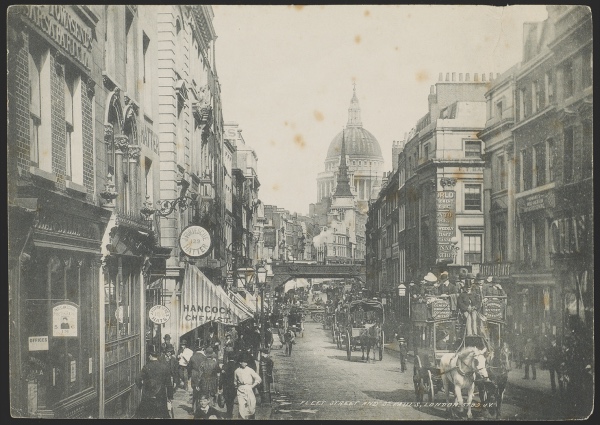
Where’s London’s oldest…statue of a female?
News recently that Parliament Square has its first female statue (more about that in an upcoming post) so we thought it timely to consider London’s oldest statue of a female.
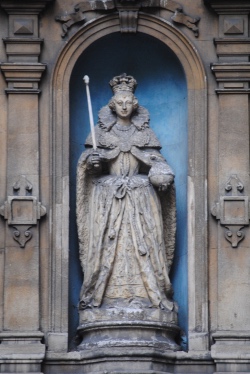
It’s actually of a queen – Elizabeth I – and can be found on the facade of the Church of St Dunstan-in-the-West on Fleet Street in the City of London (also home to a rather famous clock).
Believed to have been made in 1586, the statue is said to be the work of one William Kerwin and originally adorned Ludgate.
It was moved to its current position over the church’s vestry door in 1760 when Ludgate was demolished due to road widening. Along with other statues from the gate, it had been given to Sir Francis Gosling who had it placed at the church.
The statue features a rather regal looking Queen, standing formally in royal robes with sceptre and orb.
Lost London – The Church of St Peter-le-Poer…
This medieval-era church, located on Broad Street in the City of London, survived the Great Fire of 1666 but was demolished in the early 20th century when, due to the lack of residents in the City, it was no longer needed as a church.
The church, also sometimes referred to as St Peter-le-Poor, was in existence by the end of the 12th century but it’s thought the name ‘le poer’ (generally said to refer to either the poverty of the surrounding area or its proximity to an Augustinian monastery) didn’t come to be added until the 16th century.
The church was rebuilt in 1540 and then enlarged and repaired – including the addition of a new steeple – in the first half of the 17th century.
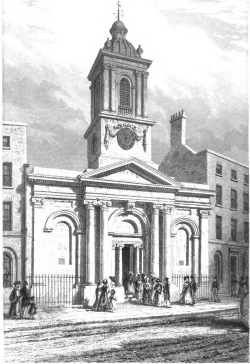
By 1788, the church had, however, fallen into such disrepair that it had to be rebuilt and the new building, designed by Jesse Gibson and located further back from Broad Street (into which it had previously projected), was consecrated in November, 1792.
The layout of the new church was somewhat unusual – the altar was located on the north-west side of the church, opposite the entrance (altars were traditionally located in the east), and the nave was circular with a wooden gallery running around the interior.
There was a large lantern in the centre with glass walls. The entrance on the eastern side of the church, featured a facade which gave no hint of the circular nature of the building behind – it featured a square tower and columned entrance.
With the declining population living in the City of London, the church was no longer needed as a place of worship by the early 20th century and so it was demolished in 1907.
The parish was united with St Michael Cornhill and the proceeds from the sale of the site were used to build the church of St Peter-le-Poer in Friern Barnet. This church was also given the City property’s font, pulpit and panelling.
10 of London’s modern icons…9. 20 Fenchurch Street (The Walkie Talkie)…

Nick-named the ‘Walkie Talkie’ due to its distinctive, top-heavy, bulbous shape, 20 Fenchurch Street is a 38 storey building in the City of London.
Completed in early 2014 after a five year build with the public access areas opening the following year, the building contains 690,000 square feet of office space with the top three floors – reached by an express lift – housing a “sky garden” – described as the city’s “highest public garden” – with specially planted terraces as well as bars, restaurants and a public viewing deck.
Designed by New York City-based Uruguayan architect Rafael Vinoly, the 160 metre high building was controversial from the get-go, both for its impact on the skyline and surrounding streetscapes but also for the way its exterior cladding acted as a concave mirror and focused intense light on streets which lay to the south.
The heat was so intense that it damaged parked cars, leading some wags to dub it the ‘Walkie-Scorchie’ or ‘Fryscraper’, while a newspaper reporter famously fried an egg on the pavement below to demonstrate just how hot it was getting down there. Permanent sun shading was subsequently installed on the tower to deal with the issue.
The building was awarded the dreaded Carbuncle Cup in 2015, an annual award given to the ugliest building of the year, with one of the judges describing it as a “Bond villain tower” and another as a “gratuitous glass gargoyle”.
The building, which continues to draw strong opinions, was reportedly sold last year for a record £1.3 billion.
WHERE: 20 Fenchurch Street (nearest Tube station is Monument); WHEN: Visiting hours for the Sky Garden are 10am to 6pm weekdays and 11am to 9pm weekends (only a limited number of tickets available each day); COST: Free; WEBSITE: https://skygarden.london
PICTURES: Nigel Tadyanehondo/Unsplash
LondonLife – Sunrise over the City…
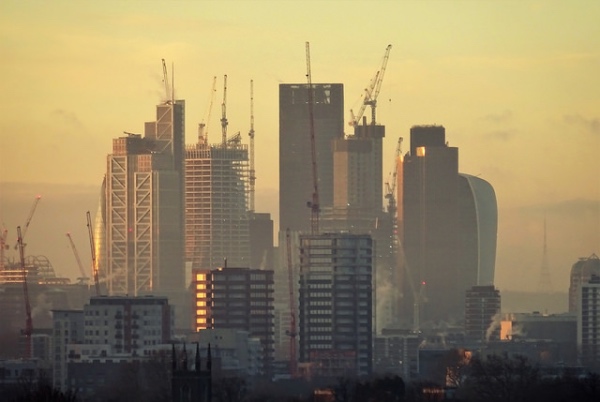
PICTURE: David Holt (licensed under CC BY 2.0)
This Week in London – Suffragette stories, and, recalling the “golden age” of ocean liners…
• Untold stories of suffragettes are uncovered in a new display at the Museum of London marking the centenary of women’s suffrage. Votes for Women tells the story of the likes of Emily ‘Kitty’ Willoughby Marshall – arrested six times and imprisoned three times in Holloway including once for throwing a potato at the resident of then-Home Secretary Winston Churchill, Winefride Mary Rix – sentenced to two months hard labour for smashing a window at the War Office, and Janie Terrero – a suffragist since the age of 18 who was imprisoned in Holloway for four months for window smashing during which time she twice went on a hunger strike and was force-fed. The objects on display include Emmeline Pankhurst’s iconic hunger strike medal, a pendant presented to suffragette Louise Eates on her release from prison, and a silver necklace commemorating Willoughby Marshall’s three prison terms. There’s also a newly commissioned film installation highlighting the individual commitment and courage of the lesser known suffragette women. The exhibition opens tomorrow and there’s a special family-friendly festival this weekend featuring interactive performances, workshops and special events. The exhibition Votes for Women runs until 6th January next year. For more, including the full programme of events, see www.museumoflondon.org.uk.
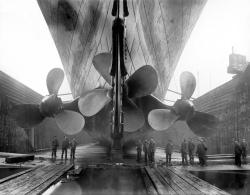
• The golden age of ocean liners is recreated in a new exhibition opening at the V&A this Saturday. Ocean Liners: Speed & Style showcases more than 250 objects with highlights including a Cartier tiara recovered from the doomed Lusitania in 1915, a panel fragment from the Titanic‘s first class lounge, Goyard luggage owned by the Duke of Windsor dating from the 1940s, and Stanley Spencer’s painting The Riveters from his 1941 series Shipbuilding on the Clyde. Other artists, architects and designers whose work is featured in the display include Le Corbusier, Albert Gleizes, Charles Demuth and Eileen Gary. Among the “design stories” explored in the exhibition is that of Brunel’s Great Eastern along with Kronprinz Wilhelm, Titanic and its sister ship Olympic (all known for their Beaux-Arts interiors), the Art Deco Queen Mary, Normandie and the Modernist SS United States and QE2. The display also features objects related to some of the ocean liner’s most famous passengers as well as the couturiers who saw ocean travel as a means of promoting their designs. These include a Christian Dior suit worn by Marlene Dietrich as she arrived in new York aboard the Queen Mary in 1950, a Lucien Lelong gown worn for the maiden voyage of the Normandie in 1935, and Jeanne Lanvin’s Salambo dress, which, as one of the most important flapper dresses in the V&A collection, once belonged to wealthy American Emilie Grigsby who regularly travelled between the UK and New York aboard the Aquitania, Olympic and Lusitania in the 1910s and 1920s. Runs until 10th June. Admission charge applies. For more, see www.vam.ac.uk/oceanliners.
PICTURE: Titanic in dry dock, c1911, Getty_Images (Courtesy Victoria & Albert Museum).
Send all items for inclusion to exploringlondon@gmail.com.
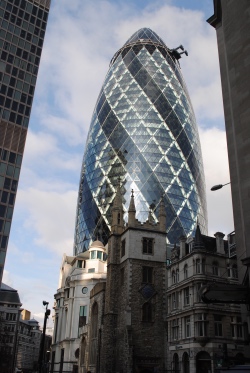
10 of London’s modern icons…2. 30 St Mary Axe (aka ‘The Gherkin’)
This rocket-ship shaped glass skyscraper made its mark on the City of London skyline in the early Noughties after plans to build a much taller building on the site were shelved.
The award-winning building stands on the site of what was the late Victorian-era Baltic Exchange which was extensively damaged by an IRA bomb which went off in the neighbouring street, St Mary Axe (for more on the origins of the street name, see our earlier post here), in 1992.
It was initially proposed that a 92 storey building, to be known as Millennium Tower, be built on the site – it would have been the tallest building in Europe. But the plan was shelved after both Heathrow and London City Airports objected to the interference it would have on flight paths while others pointed to the rather dramatic impact it would have on the City skyline.
The site was subsequently sold to reinsurance giant Swiss Re who then commissioned Sir Norman Foster (Foster + Partners) to design a building for its UK headquarters. The resulting 41 storey, 180 metre (591 foot) tall skyscraper – which features some 24,000 square metres of glass and was said to be the first environmentally sustainable skyscraper in London – was eventually completed in late 2003 and opened in 2004.
The glass dome which sits at the top of the building offers panoramic, 360 degree views of the surrounds and is said to be a reference to the glass dome that once sat over part of the ground floor of the Baltic Exchange.
Interestingly, the nickname for the building, The Gherkin, is actually an abbreviated form of a name first coined by some design critics who described the building as an “erotic gherkin”, according to The Guardian. Some wags have also used the nickname ‘Towering Innuendo’ for the property.
PICTURES: Top – Samuel Zeller/Unsplash; Right – David Adams.
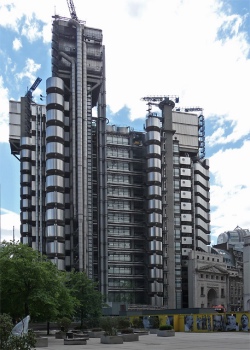
10 of London’s modern icons…1. Lloyd’s of London building
This iconic building – home to the venerable insurance firm Lloyd’s of London – stands on the former site of East India House on the corner of Lime and Leadenhall Streets in the City of London.
Designed by the Richard Rogers Partnership (now Roger Stirk Harbour + Partners) in conjunction with structural engineers Arup, this 12 storey building – which features galleries adjoining a series of towers located around a central, glass-topped atrium – was completed in 1986 after eight years of construction. The £75 million building was officially opened by Queen Elizabeth II.
The building, which was granted grade I-listed status in 2011 (making it the youngest building to receive the honour), used more than 33,000 cubic metres of concrete, 30,000 square metres of stainless steel cladding and 12,000 square metres of glass in its creation.
Among its most famous innovations is the location of services – including lifts, toilets and tubes containing wiring and plumbing – on the exterior of the building in an effort to maximise space inside (inviting comparisons with the Centre Pompidou in Paris, which Rogers was involved in the design of, along with Renzo Piano, prior to working on this building).
The building incorporates – in Leadenhall Street – part of the facade of the previous Lloyd’s building which had occupied the site since 1928 (the corporation had been founded in 1688 in Tower Street by Edward Lloyd and endured several moves before coming to its current home).
The 11th floor Committee Room incorporates the Adam Great Room, an adaptation of the original dining room from Bowood House in Wiltshire which was designed by Robert Adam for the 1st Earl of Shelbourne. It was purchased from Bowood in 1956 and incorporated into Lloyd’s former Heysham building before being moved into the current building.
Also present in the building, hanging from the Rostrum on the ground floor, is the famous Lutine Bell. It was recovered from the wreck of HMS Lutine – lost at sea with all hands and cargo in 1799 and, as a result, the subject of a claim against Lloyd’s which was paid in full – in 1859 and has since graced Lloyd’s underwriting rooms. While it was formerly rung to announce when news of an overdue ship arrived – once for a loss, twice for its safe return – these days it is only used on ceremonial occasions.
The building’s futuristic and iconic look meant it’s served as a location in numerous films including 2014’s Guardians of the Galaxy, Mamma Mia (2008) and The Ghost Writer (2010). It has also, in recent years, attracted climbers, leading Lloyd’s to seek an injunction to prevent such actions.
PICTURE: Stephen Richards/licensed under CC BY-SA 2.0
10 subterranean sites in London – A recap…
Recapping our recent Wednesday series. We kick off a new series next week…
10 subterranean sites in London – 1. The Greenwich Foot Tunnel…
10 subterranean sites in London – 2. The London Silver Vaults…
10 subterranean sites in London – 3. The Banqueting House undercroft…
10 subterranean sites in London – 4. St Paul’s Cathedral Crypt…
10 subterranean sites in London – 5. Whitefriars Priory crypt…
10 subterranean sites in London – 6. Guildhall crypts…
10 subterranean sites in London – 7. Alexander Pope’s Grotto…
10 subterranean sites in London – 8. Priory of St John of Jerusalem church crypt…
Exploring London’s 10 most popular (new) posts of 2017 – Numbers 4 and 3…
The countdown continues…
4. Lost London – Pasqua Rosee’s Coffee House…
3. Where’s London’s oldest…street sign?
Come back tomorrow for the two most popular posts…
Exploring London’s 10 most popular (new) posts of 2017 – Numbers 6 and 5…
The countdown continues…
6. 10 (more) fictional character addresses in London – 8. A square in Soho?…
5. What’s in a name?…Hanging Sword Alley…
Come back tomorrow for the next two…
Famous Londoners – Ebenezer Scrooge…
OK, so infamous may be a better label but the journey of Scrooge – the star of Charles Dickens’ A Christmas Carol, is one of redemption.
Christmas is almost upon us so we thought he was an appropriate figure to look at for our Famous Londoners series this week (and yes, we know he’s a fictional figure!)
Scrooge, who first appeared in 1843 when Dickens’ novel was published, runs a London-based counting-house and subjects his clerk, the hapless Bob Cratchit, to a gruelling workload on low pay (even complaining about him having Christmas Day off).
Refusing to give anything for the relief of the poor, the incorrigible Scrooge retires for Christmas Eve and is subsequently visited by the ghost of his former business partner, Jacob Marley, who thanks to his own greed and lack of charity is damned to wander the Earth for eternity. Marley then warns Scrooge that he risks the same fate and that, in a final chance for redemption, he will be visited by three spirits of Christmas – past, present and yet-to-come.
It’s not giving too much away to say that Scrooge, then experiencing these visions, repents and becomes a model of love and generosity, offering his help and support to Bob Cratchit and his family – particularly his ailing son, Tiny Tim (one of the best versions of the story is that of The Muppet Christmas Carol!)
There’s been much speculation over the years who was Dickens’ inspiration for the character with possible subjects including Edinburgh banker Ebenezer Lennox Scroggie, the theory being that while in the Scottish city to deliver a lecture on 1841, Dickens misread Scroggie’s gravestone as being a “mean man” instead of a “meal man” (corn merchant).
Another theory says the character was based on John Elwes, born as John Meggot in 1714, who was noted for his miserliness. He apparently preferred, despite inheriting a fortune, to spend his nights in the kitchen with the servants so he didn’t have to light a fire in another room (although perhaps he just preferred their company), refused to pay for the maintenance on his house, dressed in ragged clothes and ate rotten food. Such was his thriftiness that Elwes, who was elected MP for Berkshire in 1772, apparently left some £500,000 to his two sons when he died in 1789.
As to where Scrooge’s counting house was located? The book never precisely locates it but there’s a few clues including that Bob Cratchit went on an ice slide in Cornhill, in the City of London, when making his way from work to his home in Camden and that Scrooge’s business was near a church tower. These two pieces of evidence have led some to place it alongside the church of St Michael’s, Cornhill, in Newman’s Court. Scrooge’s house, meanwhile, lies not too far away and is also close to a church leading some to place it at 45 Lime Street (now the home of Lloyds).
PICTURE: Marley’s ghost visits Scrooge in an original illustration by John Leech.
10 subterranean sites in London – 6. Guildhall crypts…
Located beneath Guildhall’s Great Hall is the oldest surviving part of the structure, the largest of London’s medieval crypts.
Dating from the reign of King Edward the Confessor in the 11th century, the vaulted East Crypt is considered to be one of the finest examples of its kind in England with a ceiling featuring a series of carved bosses depicting heads, shields and flowers.
It features a series of stained glass windows depicting five famous Londoners – Geoffrey Chaucer, William Caxton, Sir Thomas More, Sir Christopher Wren and Samuel Pepys.
The pillars holding up the roof, meanwhile – once located at ground level – show signs of where horses were once tied up while their riders went about their business.
The West Crypt, which is believed to date from the 13th century, was sealed off after collapsing under the weight of the roof of the Great Hall which fell down during the Great Fire of London in 1666. It was reopened in 1973.
The windows of the West Crypt represent some of the City of London’s livery companies (pictured above, right).
One of the most famous incidents took place in the crypts on 9th July, 1851, when Queen Victoria attended a banquet here during a state visit.
The crypts today are available to hire for atmospheric events.
WHERE: Guildhall, Guildhall Yard, City of London (nearest Tube stations are Bank, Mansion House and Moorgate); WHEN: 10am to 4.30pm daily (when not being used for events); COST: Free; WEBSITE: www.cityoflondon.gov.uk/things-to-do/visit-the-city/attractions/guildhall-galleries/Pages/guildhall.aspx.
10 subterranean sites in London – 5. Whitefriars Priory crypt…
Located in the basement of a modern office building (and visible through glass) are the remains of a 700-year-old crypt that once lay beneath Whitefriars Priory.
Reached via Magpie Alley (off Bouverie Street which runs south from Fleet Street), the remains are all that is visibly left of the priory, founded here in the 13th century.
Known as ‘White Friars’ because of the white mantle they wore over their brown habits, the Carmelites (their proper name) were founded in what is now Israel in the mid-12th century. After the region fell to the Saracens in the mid-13th century, some members of the order made their way to England with the aid of Richard, Earl of Cornwall, brother of King Henry III. In 1241, Sir Richard Grey of Codnor founded the Priory of Our Lady of Mount Carmel on this site.
The priory – which counted towering medieval figure John of Gaunt among its patrons – once stretched from Fleet Street to the Thames and to the Temple in the west and what is now Whitefriars Street in the east. It included a church – enlarged in the 14th century – as well as cloisters, a garden and cemetery.
The priory survived until the Dissolution after which King Henry VIII granted various buildings to the King’s Physician and the King’s Armourer and the great hall become the famous Whitefriars Playhouse.
Whitefriars became part of the rather infamous slum known as Alsatia, a ‘liberty’ seen as a place of sanctuary for those fleeing the law. The priory was gradually subsumed into the slum – there’s a suggestion that the crypt may have been used as a coal cellar.
The remains of the 14th century vaulted crypt, which had been located beneath the prior’s house on the east side of the former priory site, were apparently found in the late 19th century and restored in the 1920s when the now defunct newspaper News of the World was expanding. During a redevelopment in the 1980s (which came after News International moved out to Wapping), the remains were moved to their current location.
WHERE: Whitefriars Crypt, Ashentree Court, City of London (nearest Tube stations are Temple and Blackfriars); WHEN: Daily; COST: Free; WEBSITE: None.
PICTURE: The crypt at seen at this year’s Open House London event. (Andrea Vail licensed under CC BY-ND 2.0.)
10 subterranean sites in London – 4. St Paul’s Cathedral Crypt…
A highlight of any journey through subterranean London is spending some time in the St Paul’s Cathedral crypt, famously the resting place of, among others, Admiral Lord Nelson and Arthur Wellesley, the Duke of Wellington.
Built as an integral part of Sir Christopher Wren’s masterpiece, the crypt is said to be the largest in Europe and runs the complete length of the building above. It features some 200 memorials.
Nelson’s resting place is under the centre of the dome – his remains, brought back from the 1805 Battle of Trafalgar in a keg of naval brandy, are entombed inside a wooden coffin made from one of the French ships he defeated at the Battle of the Nile which is then contained in a black sarcophagus. Originally made for Cardinal Wolsey in the 1520s but left unused when the Cardinal fell from favour, it’s now topped with Nelson’s viscount coronet in place of where the cardinal’s hat would have stood.
The Duke of Wellington, meanwhile, lies just to the east in a tomb of Cornish porphyritic granite set atop a block of Peterhead granite carved with four sleeping lions at its four corners. The coffin was lowered through a specially created hole in the cathedral floor above Nelson’s tomb and then moved into the sarcophagus.
Other memorials – not all of which commemorate people actually buried here – include one to the architect, Sir Christopher Wren, which features the words, written in Latin, ‘Reader, if you seek his monument, look around you’.
There’s also memorials to everyone from artist Sir Joshua Reynolds and William Blake to Crimean War nurse Florence Nightingale, architect Sir Edwin Lutyens, Lawrence of Arabia and, more recently, one for Gordon Hamilton Fairley, killed by a terrorist bomb in 1975. There’s even a bust of the first US President, George Washington.
The crypt also contains a number of war memorials and is the location of the OBE Chapel, dedicated at a service attended by Queen Elizabeth II in 1960, honouring those who have given distinguished service to the nation.
Other features of the crypt include the Treasury where more than 200 items are on display including some of the cathedral’s plate and vestments (much of which has been lost over the years including when a major robbery took place in 1810), liturgical plate from other churches in the diocese and some Wren memorabilia including his penknife, measuring rod and death mask.
The crypt is also home to the cathedral’s gift shop and cafe where you can stop for a refreshment before heading back out into the streets above.
WHERE: The Crypt, St Paul’s Cathedral, City of London (nearest Tube stations are St Paul’s and Mansion House); WHEN: 8.30am to 4.30pm Monday to Saturday; COST: £18 adults (18+)/£8 children (aged 6 to 17)/£16 concessions/£44 family ticket; WEBSITE: www.stpauls.co.uk.
PICTURE: Admiral Lord Nelson’s tomb (Marcus Holland-Moritz/ licensed under CC BY-NC-ND 2.o)