Still a favourite at tea rooms across the world, the Chelsea bun – a squarish, sticky spiced fruit bun – owes its origins to Richard Hand’s establishment in what was Jew’s Road and is now Pimlico Road in what is now Pimlico, on the border with Chelsea.
The single storey premises opened early in the 18th century and in the interior Mr Hand, apparently known as “Captain Bun”, kept a curious collection of clocks, models, paintings, statues and other curiosities.
The bun house, known variously as the Old Chelsea Bun House and the Original Chelsea Bun House, was a huge hit, attracting a clientele which included royalty – King George II and Queen Caroline visited with their daughters as did King George III and Queen Charlotte – and also, famously, the political figure and Jonathan Swift, who bought a stale one for a penny in 1711 and recorded that he didn’t like it.
The tradition of eating a hot cross bun on Good Friday lead to huge crowds at the bun house on that day in particular – said to number more than 50,000 some years – and such were that crowds that in 1793, Mrs Hand, following complaints from her neighbours, declared in a public notice that she would only be selling Chelsea buns, and not cross buns, on Good Friday that year.
The house did, however, return to selling hot cross buns on Good Friday – it is said to have sold an enormous 24,000 on Good Friday in 1839 (some sources have out the figure as high as 240,000 but that may have been a misprint).
Despite the success of Good Fridays, according to The London Encyclopaedia, the closure of the nearby Ranelagh Pleasure Gardens in 1804 had impacted the business.
In 1839, following the death of the Hands’ two sons and with no further family member to take over the business, it was closed and the bakery reverted to the Crown. The building was subsequently demolished.
PICTURE: Chelsea buns today. Duncan Hull under licence CC BY 2.0.


 The prison, originally based in two houses apparently known as the Crane and the Angel (Angel Place bears witness to the latter), was first used for those convicted at the travelling court of the King’s Bench.
 Founded in the early 17th century (and meeting on the first Friday of each month), its members included such literary luminaries as Ben Jonson, John Donne and Francis Beaumont.
 Rosée had come to England as the manservant of Daniel Edwards, a member of the Levant Company who had first encountered him in Smyrna (in modern Turkey) and returned with him. One story says that Rosée decided to start the business after a falling out with Edwards on their return to England; another that Edwards helped Rosée start the business when they realised the interest people had in trying the new drink.

 .
.

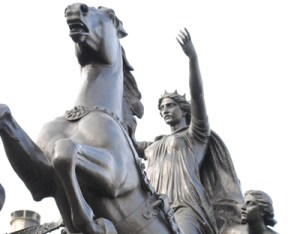 4. Number four is another in our current series on London battlefields – this time looking at the site where Queen Boudicca is believed to have been defeated by the Romans –