
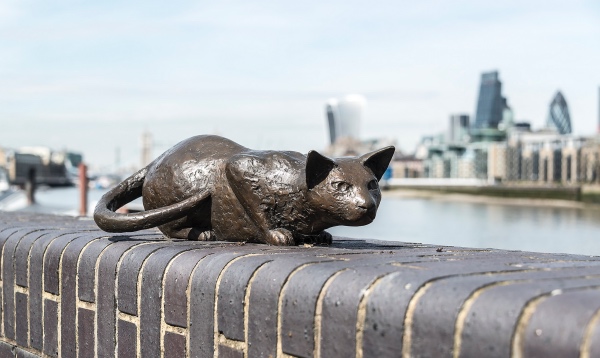
Since 1991, a statue of Dr Alfred Salter (as well as his daughter Joyce and cat) had sat on the south bank of the River Thames in Bermondsey.
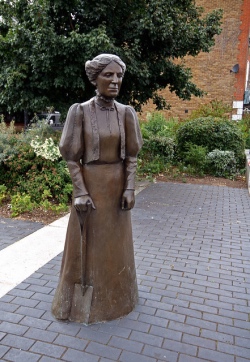 But after the statue of Dr Salter – MP for Bermondsey for many years – was stolen in 2011 (presumably for scrap value) and the statues of Joyce and the cat subsequently put into storage, it was decided to reassemble the group but this time adding in a new figure – that of Dr Salter’s wife Ada, whose story was certainly as significant as his.
A social reformer, environmentalist and pacifist, Ada Salter (1866-1942) was co-founder and president of the Women’s Labour League, one of the first women councillors in London (she was elected to Bermondsey in 1909) and, on being appointed Mayor of Bermondsey in 1922, the first woman mayor in London and the first Labour woman mayor in Britain.
In 1931, she was elected chair of the National Gardens Guild. Together the couple, who were both Quakers, dedicated much of their lives to helping the people of Bermondsey, regenerating slums, building model housing and planting thousands of trees.
A campaign was subsequently launched to raise funds to replace the statue of Dr Salter and install a new one of Ada and, on raising £120,000 (the £60,000 raised was matched by Southwark Council), artist Diane Gorvin, who had designed the original statue of Dr Salter, was commissioned to make them.
The resultant statues – known collectively as ‘The Salter Statues’ and ‘Dr Salter’s Daydream’ – were unveiled where the previous grouping had been found at Bermondsey Wall East near the Angel pub, in November, 2014.
While Dr Salter sits on a granite bench looking toward the river and his daughter Joyce, who leans against the river wall watched by the family cat, Ada stands nearby – also looking at her daughter – but with a spade in her hand.
Writes the artist: “The idea was to show Dr Salter in old age remembering his young daughter when she was still alive. Ada is represented with a spade as she was so instrumental in tree and planting schemes for Bermondsey. Her left hand is designed to hold real flowers. It was important to celebrate the work of this couple who dedicated their lives to helping the local community.”
There’s a poignant aspect to the statues in that Joyce, the couple’s only child, had died at the age of eight from scarlet fever in 1910.
Ada Salter also has a garden named after her in Southwark Park.
PICTURE: Top – Loz Pycock (licensed under CC BY-SA 2.0 – image cropped and lightened); Right – Marc Pether-Longman (licensed under CC-BY-NC-ND-2.0); Below – Steve James (licensed under CC-BY-NC-ND 2.0).
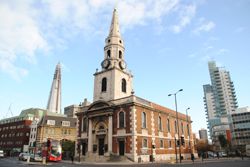 The prison, originally based in two houses apparently known as the Crane and the Angel (Angel Place bears witness to the latter), was first used for those convicted at the travelling court of the King’s Bench.

 A detailed picture of the inhabitants of Roman London, known as Londinium, has been created for the first time, the Museum of London announced this week. Detailed analysis of the DNA of four skeletons has revealed a culturally diverse population. The examined skeletons include that of a Roman woman (pictured left), likely to have been born in Britain with northern European ancestry, found buried with high status grave goods at Harper Road, Southwark, in 1979, and another of a man, whose DNA revealed connections to Eastern Europe and the Near East, who was found at London Wall in 1989 with injuries to his skull which suggest he may have been killed in the nearby amphitheatre before his head was dumped in a pit. The other two skeletons examined were found to be that of a blue-eyed teenaged girl found at Lant Street, Southwark, in 2003, believed to have been born in north Africa, whose ancestors lived in south-eastern Europe and west Eurasia, and that of an older man found at Mansell Street who was born in London and whose ancestry had links to Europe and north Africa. The examination – the first multi-disciplinary study of the inhabitants of a Roman city anywhere in the empire – also revealed that all four suffered from gum disease. Caroline McDonald, senior curator at the museum, said that while it has always been understood Roman London was a culturally diverse place, science was now “giving us certainty”. “People born in Londinium lived alongside people from across the Roman Empire exchanging ideas and cultures, much like the London we know today.” The four skeletons will form the basis of a new free display, Written in Bone, opening at the Museum of London on Friday. PICTURE: © Museum of London
 Little is known of Jack Cade until the former soldier from Kent led an uprising against the rule of King Henry VI during the Hundred Years War with France. And London was a key site of fighting during the uprising.


 .
.
 .
.
 Exploring London
