Treasures of London – Restored 17th century fire engine…

Fire-Engine-Restoration

Originally built in the late 1670s by John Keeling in the aftermath of the Great Fire of London, the engine was acquired by the Museum of London in 1928.

Late-19th-century-photographThen only consisting of the central barrel and pump, it has been restored for the current exhibition, Fire! Fire!, being held to mark the 350th anniversary of the fire which wiped out much of the City of London.
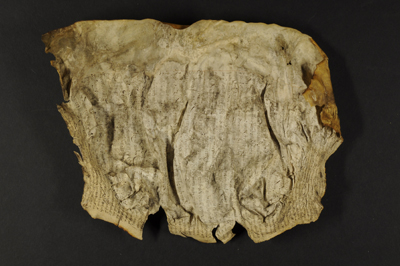
Based on a 19th century photograph (pictured) which showed it still intact with undercarriage, wheels, tow bar and pumping arm, the restoration was carried out by the museum in partnership with Kent-based Croford Coachbuilders using traditional techniques and materials over a three month period.

Meriel Jeater, curator of the Fire! Fire! exhibition, said the reconstruction had revealed new insights into how the fire engine worked and shows that, weighing more than 500 kilograms without water, it would have been extremely difficult to manoeuvre along London’s narrow streets.

“Also, the relatively crude pump mechanism was only able to squirt out about six pints of water over a rather short distance, so it would have been perilously close to the flames to have had any chance of putting them out.”

Fire! Fire! can be seen at the Museum of London until 17th April. Admission charge applies. For more, see www.museumoflondon.org.uk/fire-fire.

PICTURES: © Museum of London.

Treasures of London – Great Parchment Book…

Great-Parchment-BookHeld in the collections of the London Metropolitan Archives, the Great Parchment Book of The Honourable the Irish Society was recently inscribed upon the UK register of the UNESCO Memory of the World.

Described as a “hugely significant record of the Ulster Plantation of the early 17th century”, the book was compiled in 1639 by a commission instituted under the Great Seal of King Charles I and is a survey of all the estates in Derry managed by the City of London Corporation through the Irish Society and City of London livery companies.

As such, manuscript and provides a unique insight into this important period in the history of Northern Ireland, containing key data about landholdings and the population in Ulster at the time of its creation including for both English and Scottish settlers and the native Irish population (as well as, exceptionally, for many women at all levels of society).

The Great Parchment Book was badly damaged in a fire in 1786 and as a result was unavailable to researchers for more than 200 years until its successful reconstruction using cutting edge digital imaging technology.

It is the fourth item in the care of the London Metropolitan Archives to be inscribed to the UK register of the UNESCO Memory of the World, a programme which aims to facilitate preservation of the world’s documentary and audio-visual heritage, to assist universal access and to increase awareness worldwide of the existence and significance of this documentary heritage.

The three other objects inscribed on the list which are in the LMA’s care include the Charter of William I to the City of London, London County Council Bomb Damage Maps and Robert Hooke’s Diary 1672-83.

~ www.greatparchmentbook.org

WHERE: London Metropolitan Archives, 40 Northampton Road, Clerkenwell (nearest Tube stations are Farringdon and Angel); WHEN: Open Monday to Thursday and selected Saturdays (check website for times); COST: Free; WEBSITE: www.cityoflondon.gov.uk/things-to-do/london-metropolitan-archives/Pages/default.aspx.

PICTURE: Courtesy London Metropolitan Archives.


Treasures of London – Elfin Oak, Kensington Gardens…

Elfin-OakDelightfully carved out of a hollow oak tree, the Elfin Oak takes its name from the many colourful figures that adorn it.

The sculpture, which sits beside the Diana Princess of Wales Memorial Playground is the work of children’s book illustrator Ivor Innes.

He spent two years – 1928 to 1930 – carving “Little People” upon an ancient oak tree trunk that had been found in Richmond Park and relocated to Kensington Gardens (and in 1930, with his wife Elsie, published the children’s book, The Elfin Oak of Kensington Gardens).

The characters depicted include animals and fanciful creatures such as a gnome called Huckleberry, a series of elves including Grumples and Groodles and a witch named Wookey.

The hollow, incidentally, had been presented to The Royal Parks by Lady Fortescue in response to an appeal run to improve facilities in line with a scheme by George Lansbury (among other things, he also founded the Serpentine Lido).

Now a Grade II listed structure (and well protected by wire mesh), it has a few pop culture associations – among them, the fact that it appeared on the cover of Pink Floyd’s 1969 album, Ummagumma (the head of the band’s lead singer and guitarist David Gilmour can be seen projecting from the trunk).

Meanwhile, in 1996, Spike Milligan – long a fan of the oak – was the face of a successful campaign to raise funds for its restoration.

Announcing the Grade II listing in 1997, then Heritage Minister Tony Banks noted that the oak sat alongside the late Victorian fascination with Little People and complemented Sir George Frampton’s statue of Peter Pan (also located within the gardens).

“Together the two sculptures make Kensington Gardens very much the world capital of fairies, gnomes and elves,” he reportedly said.

PICTURE: Lonpicman/Wikimedia/CC BY-SA 3.0/

Treasures of London – The Golden Hinde II…

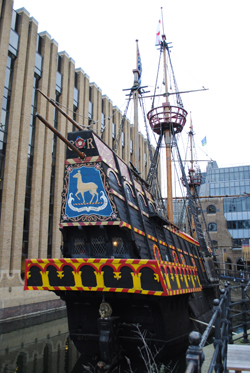
Launched in 1973, this full-sized, working replica of the galleon sailed by Elizabethan seafarer and courtier Sir Francis Drake on his circumnavigation of the globe between 1577 and 1580 is moored at St Mary Overie Dock in Bankside.

Golden-HindeThe ship was made at the behest of two American businessmen, Albert Elledge and Art Blum, who wished to commemorate the 400th anniversary of Sir Francis Drake’s landing on the west coast of North America in 1579.

The ship was designed by Loring Christian Norgaard, a Californian naval architect, who spent three years researching it, drawing on original journals of the crew members and other manuscripts.

The two year job of building the vessel was given to J Hinks & Son who did so in Appledore, North Devon, using traditional methods and tools (with a few modern concessions).

The ship was officially launched from the Hinks shipyard by the Countess of Devon on 5th April, 1973. She sailed out of Plymouth on her maiden voyage in late 1974 and arrived in San Francisco the following May to commemorate Sir Francis’ proclamation of New Albion at a site believed to have been in northern California in 1579.

Since then, the ship has sailed more than 140,000 miles around the world – like its forebear, it has circumnavigated the world – and been feared in various films including Shogun (1979), Drake’s Venture (1980) and St Trinian’s 2: The Legend of Fritton’s Gold (2009).

It has been moored in Southwark since 1996 – it did leave briefly for a visit to Southampton in 2003 – and as well as hosting school visits, is also open for tours and can be booked for private functions.

WHERE: Golden Hinde II, Bankside (nearest Tube station is London Bridge); WHEN: Self-guided tours 10am to 5.30pm daily (check website for other tour times and dates); COST: Various (depending on tour); WEBSITE: www.goldenhinde.com.

Treasures of London – The Knowledge of London…

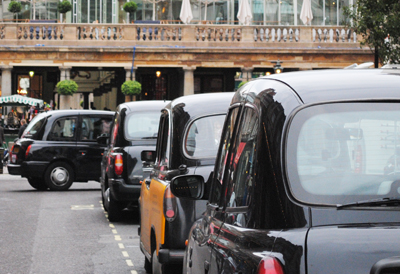
Black-cabsHaving celebrated its 150th anniversary last year, The Knowledge of London is the world famous test given to the city’s black cab drivers.

The test dates back to 1865 and involves drivers memorising 320 routes, 25,000 street names and some 20,000 landmarks and places of public interest including museums, theatres, churches, police stations, schools and parks within a six mile radius of Charing Cross.

The routes through central London – which previously numbered as many as 468 – are contained within the Blue Book (there’s also a series of ‘Knowledge schools’ to help would-be drivers prepare for the test).

The test includes a written exam and a series of one-to-one interviews, known as appearances, in which the prospective driver is given start and finish points and expected to describe the shortest route between them. It is overseen by the Public Carriage Office, once part of the Metropolitan Police Force, but now part of Transport for London.

It was introduced by Sir Richard Mayne, First Joint Commissioner of the Metropolitan Police Service, after thousands of complaints were received about the lack of knowledge of London cabbies from visitors to the Great Exhibition in Hyde Park in 1851.

It apparently takes on average between two and four years to learn all you need to know to pass the test and you can often spot what are fondly known as ‘knowledge boys (or girls)’ riding scooters around the city with a clipboard attached to the handlebars as they learn what they need to know for the test.

Treasures of London – William Shakespeare’s last will and testament…

William-Shakespeares-Will

Recently conserved by the National Archives, Shakespeare’s last will and testament is at the heart of a new exhibition on show at Somerset House.

By Me William Shakespeare: A Life In Writing, the first joint exhibition of the National Archives and King’s College London, features four of the six known signatures of Shakespeare still in existence and, along with his last will and testament, shows some of the most significant Shakespeare-related documents in the world tracking his existence as everything from a London citizen, businessman, family man, servant to possibly even a thief and subversive.

But back to the will. While not written in the Bard’s hand, the will is signed by him in three places and indicates the wealth and status he had garnered by the time of his death on 23rd April, 1616.

Evidence shows that Shakespeare revised his will as his estate changed, and just before his death, he added personal bequests including that a silver bowl be given to his second eldest daughter Judith, memorial rings to actor friends in London and his second best bed to his wife Anne. He left most of his property to his eldest daughter, Susanna, although his will, according to the National Archives, indicates that he had hoped to establish a male legacy.

Other beneficiaries named in the will include his sister Joan and her sons and his grand-daughter Elizabeth Hall while Susanna and her husband John Hall were named as his executors.

The exhibition, which is being held in the Inigo Jones Rooms in Somerset House’s East Wing as part of the series of events being held to mark the 400th anniversary of Shakespeare’s death, runs until 29th May. Admission charge applies.

Other documents featured in the display – all of which are registered with UNESCO – include accounts listing the grant of four-and-half yards of red cloth to Shakespeare by King James I for participation in his coronation procession in 1604, accounts from the Master of Revels showing when plays were performed at court (useful for helping to date when Shakespeare wrote particular plays), and a document recording testimony Shakespeare gave in court when his landlord, Christopher Mountjoy, failed to provide his son-in-law with a dowry for his daughter’s hand (Shakespeare is likely to have played a role in arranging the marriage).

For more on the exhibition, see www.bymewilliamshakespeare.org.

Treasures of London – Queen Alexandra Memorial…

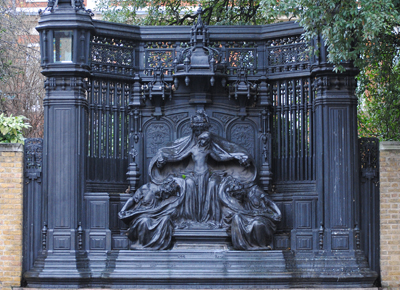
Queen-Alexandra-MemorialErected to the memory of Queen Alexandra, the consort of King Edward VII, the memorial – an ornate bronze screen – is located on the exterior of the garden wall of Marlborough House – the Queen’s former home – in Marlborough Road, opposite St James’ Palace.

Queen-Alexandra-Memorial-smallThe now Grade I-listed bronze memorial, which is the work of Alfred Gilbert and was erected in 1932, is sometimes described as London’s only Art Nouveau statue.

It depicts a central figure, described as “Love Enthroned”, supporting a young girl (perhaps a symbol of the Queen’s support for the next generation), and attended by two crowned bowing figures which it’s believed represent faith and hope. An inscription – “Faith, hope, love – The guiding virtues of Queen Alexandra” – sits below.

The memorial was unveiled on 8th June, 1932, with the Archbishop of Canterbury, Cosmo Gordon Lang, in attendance. Queen Alexandra’s Memorial Ode, composed by Sir Edward Elgar, was first performed at the ceremony.

The memorial was the last public artwork to be completed by Gilbert, noted for having also created what is arguably London’s most famous statue – that of Eros in Piccadilly (see our earlier post here), who was knighted by King George V after the unveiling.

The Queen lived at the property during her widowhood until her death in 1925.

Apologies – we neglected to put in the link! Now corrected.

Treasures of London – The Lampedusa Cross…

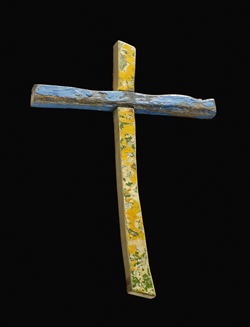
The-Lampedusa-CrossDonated to the British Museum in October (the last acquisition made under former director Neil MacGregor), the Lampedusa Cross was constructed by carpenter Francesco Tuccio out of wreckage from a refugee boat which sank off the Italian island of Lampedusa on 3rd October, 2013. At least 349 of the 500 refugees on board were drowned, some of whom were Eritrean Christians fleeing persecution, while 151 survived. Mr Tuccio, a resident of Lampedusa, decided to make a series of small crosses from the wreckage after meeting some of the refugees in the church of San Gerlando as a gift for them to both reflect their salvation and as a symbol of hope for the future. He was subsequently also asked to make a further cross which was carried by Pope Francis at the memorial service for the survivors. Asked by the British Museum if it could acquire a cross for its collection, Mr Tuccio made a cross specifically for the museum which he then donated to the institution, saying after he received a letter of thanks that “it is I who should thank you for drawing attention to the burden symbolised by this small piece of wood.” The cross went on display in Room 2 of the museum on 18th December (the last day of Mr MacGregor’s directorship). Entry is free. For more on the British Museum, see www.britishmuseum.org. PICTURE: © Trustees of the British Museum.

Treasures of London – Royal Charter for the Society of Artists in Great Britain……

RA-Charter-10

The Charter for the Society of Artists of Great Britain and its associated Roll of Obligation have been rediscovered at the Royal Academy of Arts, 250 years after was society was founded. The documents, long thought to have been missing, date from 1765 and signify the formation of artists as a professional group in Britain. They form a crucial piece in history of the development of the Royal Academy of Arts, which formed in 1768 when a group of artists broke away from the society. The Charter, which consists of three pages of vellum with a portrait of a young King George III, hadn’t been seen since 1918. It and the Roll of Obligation – which features the crossed-out names of artists ‘expelled’ from the society, including the RA’s first president, artist Joshua Reynolds and German-born Johann Zoffany – were rediscovered earlier this year during an audit of the RA collections. The finding coincides with the 250th anniversary of the formal foundation of the society when it was granted a Royal Charter by King George III. Both documents will go on show from 2018 – the 250th anniversary of the founding of the RA – in new exhibition areas being created as part of the transformation taking place at the RA. For more on the Royal Academy, see www.royalacademy.org.uk.

Treasures of London – ‘Locking Piece’…

Locking-Piece

A Henry Moore original, Locking Piece was created in 1963-64 and first located on its current site on Riverwalk Gardens at Millbank, site of the former Millbank Penitentiary, four years later. The bronze sculpture consists of, as the name suggests, two interlocking pieces. There’s a couple of conflicting stories about where the idea for the work came from – in one, Moore said he was visiting a gravel pit near his home at Perry Green in Hertfordshire where he was playing with two pebbles which suddenly locked together (and hence came the idea of a sculpture of two interlocking pieces); and in another, Moore said the idea came from a bone fragment featuring a socket and joint found in his garden. Originally loaned to Westminster City Council, in 1978 the sculpture was given to the Tate Gallery which subsequently decided to leave the piece in situ. It’s one of numerous Moore works in London. For more on Henry Moore’s London works, see www.henry-moore.org/works-in-public/world/uk/london.

Treasures of London – Duke of Wellington’s cloak…

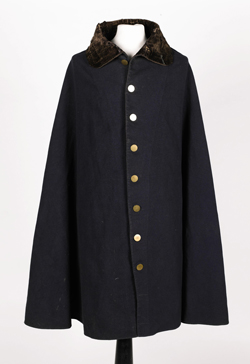
Duke-of-Wellingtons-CloakRecently acquired by the National Army Museum (fittingly given this is the 200th anniversary of the Battle of Waterloo), this cloak was worn by the Duke of Wellington during the Waterloo Campaign.

Spattered with mud, the cloak is made from blue wool and trimmed with a navy collar and facings. Purchased by the museum at auction for £38,000, it will now form part of a collection of other Waterloo and Napoleonic items in the museum’s permanent collection.

The cloak can apparently be traced back to Lady Caroline Lamb, who had an affair with Wellington in the summer of 1815 and is believed to have been given the cloak as a memento. The first documented owner was Grosvenor Charles Bedford who was given the cloak in 1823 by the surgeon and anatomist Anthony Carlisle.

On presenting Bedford with the cloak, Carlisle had commented that it had been given to him by Lady Caroline who had received it from the duke. The cloak has been passed down within Bedford’s family ever since.

The National Army Museum in Chelsea already possesses a portrait of Wellington by Edward Stroehling (1768-1826) which depicts him wearing a similar cloak.

The cloak will go on display when the museum reopens next year. For more on the museum in the meantime, see www.nam.ac.uk.

PICTURE: Courtesy National Army Museum.

Treasures of London – The Cordwainer…

The-CordwainerThis bronze sculpture, located in Watling Street in the City of London, commemorates Ward of Cordwainer which in medieval times was home to London’s shoe-making industry.

The term ‘cordwainer’ relates to a shoemaker who makes shoes from new leather and is derived from the fact that shoe-makers used leather – “cordovan” – from the then Moorish town of Cordoba in Spain (in London this trade was controlled by the Worshipful Company of Cordwainers).

The statue, the work of Alma Boyes, was erected in 2002 in celebration of the centenary of the Ward of Cordwainer Club and was a joint initiative of the club and the City Corporation. Initially erected in Bow Churchyard, it was relocated to its present location alongside St Mary Aldermary Church, close to the Queen Victoria Street end of Watling Street, a couple of years later.

Treasures of London – The Isabella Plantation…

Isabella-Plantation2


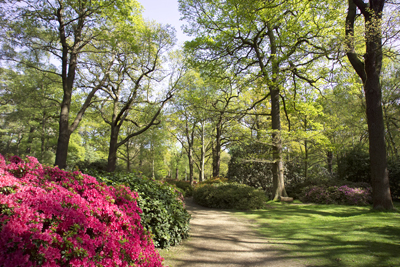
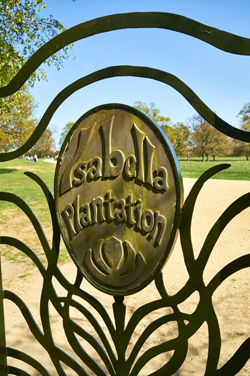
Isabella-PlantationAn area first fenced off within Richmond Park in the early 19th century, this ornamental garden remains an enchanting place to escape city life.

It was former Prime Minister Lord Sidmouth who established the plantation in the south-west corner of Richmond Park in 1831 when he was deputy ranger, enclosing the 42 acre site with fences to keep the deer out and planting oak, beech, and chestnut trees with a view to growing them for timber.

It was also he who, drawing on an older name for the area – Isabella Slade (Isabell is thought to have meant ‘dingy yellow’ in Old English and may refer to the colour of the topsoil in the plantation area while Slade meant a shallow valley) – gave it the name the Isabella Plantation.

The garden as we largely know it now was established on the site in the years immediately after World War II with clearings, ponds and waterways (these are today fed from Pen Ponds), thanks in large part to George Thomson, superintendent of the park from 1951-71, and his head gardener, Wally Miller.

Isabella Plantation was opened to the public in 1953 although improvements – including the Bog Garden which was reconstructed in 2000 – continue to be carried out.

Highlights among the flora include the National Collection of ‘Wilson 50’ Kurume azaleas (introduced by plant collector Ernest Wilson from Japan to the West in the 1920s) and large collections of rhododendrons and camellias. The garden also attracts a wide range of birds as well as other wildlife and offers the visitor something to see all year round.

There’s a number of trails you can download free-of-charge from the Royal Parks website which will help you to fully engage with the plantation.

WHERE: Isabella Plantation, Richmond Park (pedestrian access to the plantation from Peg’s Pond Gate, Broomfield Hill Gate, Bramble Gate, Deer Sanctuary Gate and High Wood Gate); WHEN: Daily (check Richmond Park opening times); COST: Free; WEBSITE: www.royalparks.org.uk/parks/richmond-park/richmond-park-attractions/isabella-plantation.

PICTURES: © Greywolf/The Royal Parks

Treasures of London – Daniel Defoe grave memorial, Bunhill Fields…

Daniel-Defoe-memorial2
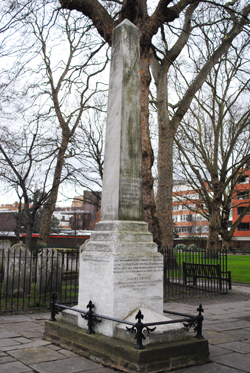
Located in Bunhill Fields Burial Ground in City Road, this memorial to Daniel Defoe, the author of numerous books including Robinson Crusoe and Moll Flanders as well as a journalist, pamphleteer and ‘provocateur’ or spy, wasn’t erected until 1870, almost 140 years after his death.

After he died in 1731 at the age of 70, Defoe was among the more than 120,000 people buried in Bunhill Fields, a Nonconformist cemetery which opened in 1665 and had closed by 1853. He was apparently buried under the name Dabow, thanks to a spelling mistake made by the gravedigger.

Daniel-Defoe-memorialWhen he died in relative obscurity (he was believed to have been hiding from his creditors at the time), his fame rose after his death – due in large part to the rising popularity of Robinson Crusoe, and by the mid-19th century, it was believed that the simple headstone over his grave didn’t do justice to him.

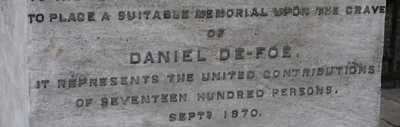
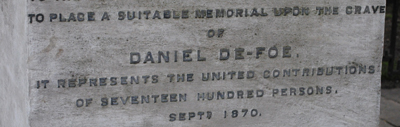
Hence an appeal was run by children’s magazine Christian World for a more suitable memorial for the writer – named as Daniel De-Foe on the memorial – and more than £150 was raised from 1,700 people, an amount which apparently exceeded expectations.

Sculptor Samuel Horner was subsequently commissioned to carve the memorial obelisk, which features projections at the base resembling a coffin lid, to the designs of CC Creeke of Bournemouth. It was unveiled on 16th September, 1870, in a ceremony attended by three of Defoe’s great grand-daughters.

There was apparently a newspaper story that the sculptor uncovered a coffin bearing Defoe’s name in preparing the site for the monument and had to get the aid of police to prevent watchers from making off with the bones from within.

The monument, which may not mark the exact location of Defoe’s grave site due to the movement of graves in the burial ground, is now Grade II*-listed (and the burial ground itself Grade I-listed). Others buried at Bunhill Fields include author John Bunyan, artist William Blake and Susanna Wesley, mother of John Wesley, founder of Methodism.

WHERE: Bunhill Fields Burial Ground, 38 City Road (nearest Tube station is Old Street); WHEN: 7.30am to 7pm or dusk; COST: Free; WEBSITE: www.cityoflondon.gov.uk/things-to-do/green-spaces/city-gardens/visitor-information/Pages/Bunhill-Fields.aspx

Treasures of London – ‘Timepiece’, Thames embankment…

Sundial

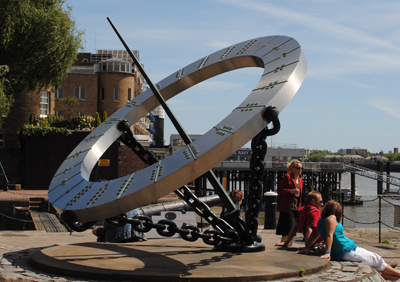
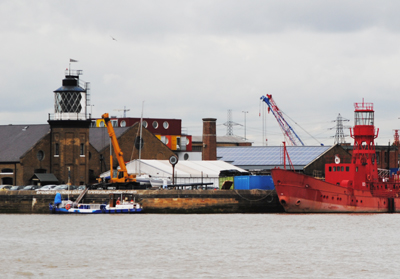
In honour of the sun and the heatwave it’s brought this summer, here’s the giant “equinoctial” sundial on the north bank of the Thames, just east of Tower Bridge. Known as Timepiece, it is the work of London-based sculptor Wendy Taylor and was installed here, beside the lock that leads into St Katharine Docks, in 1973. Measuring more than 3.5 metres across, the dial is made from stainless steel and is supported by three chunky chain link cables. According to the plaque, it was commissioned by Strand Hotels Ltd. It’s now a Grade II-listed structure.

Treasures of London – The Great Pagoda, Kew Gardens…

pagoda

News this week that Historic Royal Palaces and the Royal Botanic Gardens are embarking on a two year project to restore eighty decorative dragons to the Kew Pagoda has led us to take a look at the history of the exotic tower set amid the trees.

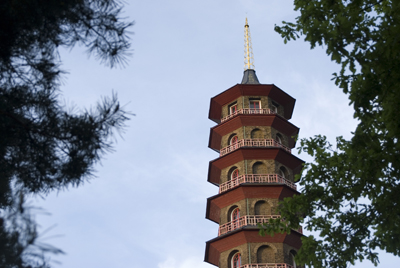
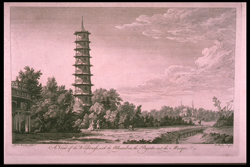
pagoda15Designed by architect Sir William Chambers (one of his drawings is depicted here), the pagoda was built in 1762 during the eighteenth century craze for Chinoiserie and was probably commissioned by Princess Augusta as part of the ongoing works she undertook in the gardens after the death of her husband Prince Frederick, eldest son of King George II and Queen Caroline.

Standing 163 feet (or almost 50 metres) high, the 10 storey pagoda was originally decorated with eighty golden dragons. It was designed to be the high point of a world tour through the gardens which also took in Roman ruins and Arabic mosques.

While the pagoda remains, the dragons were only on the structure for some 22 years before being removed in 1784 during roof repairs. Thanks to rumours they were made of solid gold, it was suggested they were sold off to pay the debts of the Prince Regent (the future King George IV), but experts say the wooden figures had simply rotted and so had to be removed.

Following their removal, the dragons subsequently disappeared and despite several attempts to find them – including one by Decimus Burton, architect of the famous Palm House (for more on that, see our earlier post), in 1843 – they have never been found.

Historic Royal Palaces and the Royal Botanic Gardens have now decided to replace them with new ones, drawing on contemporary accounts and drawings and using a team of specialist craftsmen to create them.

The restored pagoda – complete with new dragons – will be open to the public in 2017.

It is one of several ornamental buildings still located in the gardens. Others include a Japanese gateway and a Japanese wooden house called a minka.

WHERE: The Great Pagoda, Kew Gardens (nearest Tube station is Kew Gardens); WHEN: 10am daily (closing times vary – see websites for details); COST: £16.50 adults/£13 concessions/children £3.50 (discounts apply for online bookings); WEBSITE: www.kew.org.

PICTURES: RBG Kew

Treasures of London – Australian War Memorial…

Australian-War-Memorial

Tomorrow is the 25th April – commemorated every year as Anzac Day in Australia in memory of that country’s soldiers who lost their lives. This year marks 100 years since Australian troops first landed at Gallipoli during World War I. 

While attention will be focused on Anzac Cove in modern Turkey and the Australian war memorials on what was the Western Front in western Europe, in London there will be several events including a wreath laying ceremony at The Cenotaph in Whitehall, a commemoration and thanksgiving service in Westminster Abbey and a dawn service held at the Australian War Memorial in Hyde Park Corner.

This last memorial, dedicated to the more than 100,000 Australians who died in both world wars, was unveiled on Armistice Day, 2003, in the presence of Queen Elizabeth II, then-Australian PM John Howard and then British PM Tony Blair.

It records the 23,844 names of town where Australians who served in World War I and II were born.

Superimposed over the top are 47 of the major battles they fought. Principal architect Peter Tonkin said the somewhat curvaceous design of the memorial, made of grey-green granite slabs, “reflects the sweep of Australian landscape, the breadth and generosity of our people, the openness that we believe should characterise our culture”.

For more on the wall – including the ability to search for town names – see www.awmlondon.gov.au.

Treasures of London – The Triton Fountain, The Regent’s Park…

Triton-Fountain

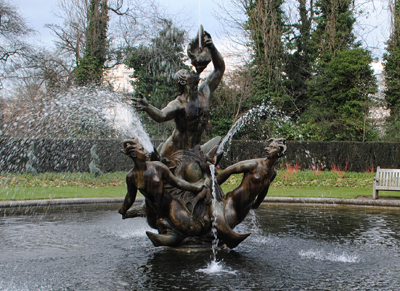
Located in Queen Mary’s Gardens in The Regent’s Park, this round fountain features a bronze centrepiece depicting a sea triton blowing on a conch shell with two mermaids (also sometimes referred to as dryads or nereids) springing out of the water at his feet. 

Designed by William McMillan (he also designed one of the fountains in Trafalgar Square), the sculpture was offered to the gardens by the painter and sculptor Sigismund Goetze when the gardens were redesigned. 

Goetze lived in Grove House (now Nuffield House) on the northern perimeter of the gardens for 30 years until his death in 1939 and had a studio within the grounds; this sculpture was one of a number of features he donated to Queen Mary’s Gardens.

The sculpture, however, was not finished due to the interruption of World War II and it was only in 1950, long after Goetze’s death that it was erected and dedicated by his wife Constance to Sigismund’s memory – “painter, lover of the arts and benefactor of this park”.

The site on which the fountain – which received a gold medal for being the best sculpture exhibited in London that year – was located was formerly occupied by a conservatory which belonged to the Royal Botanical Society.

Incidentally, in 1944 Constance Goetze founded the Constance Fund which funded fountains in Green Park and Hyde Park.

WHERE: Queen Mary’s Gardens, The Regent’s Park (nearest Tube stations are Regent’s Park, Great Portland Street and Baker Street); WHEN: 5am to 7pm daily (closing times vary depending on the month); COST: Free; WEBSITE: www.royalparks.org.uk/parks/the-regents-park.

Treasures of London – Winston Churchill statue, Parliament Square…

Winston-ChurchillFormer British PM, Sir Winston Churchill, died 50 years ago tomorrow, so we thought it was a good time to take a look at one of London’s most iconic statues.

Standing tall among some of the towering figures of British politics (and others), the over life-sized bronze statue of Sir Winston Churchill on Parliament Square in Whitehall was designed by Welsh sculptor Ivor Roberts-Jones and is located on a site on the square’s north-east corner chosen by the great man himself.

Standing 12 feet (3.6 metres) high on an eight foot (2.4 metre) high pedestal opposite the Houses of Parliament (which he faces), Churchill, who was 90 when he died, is portrayed during the years of World War II wearing a navy greatcoat but wears no hat and leans on a cane.

The full length, Grade II-listed statue, which Roberts-Jones was commissioned to create in 1970, was unveiled by Lady Churchill with the aid of Queen Elizabeth II in 1973.

Interestingly, it’s said that there’s a mild electric current which runs through the statue to ensure pigeons don’t perch and snow doesn’t gather on his head. Another quirky fact – Roberts-Jones was subsequently commissioned to make another Churchill statue in 1977 – this one for New Orleans.

PICTURE: Adam Carr

Treasures of London – Newgate execution bell…

Contained in a glass cabinet within the walls of St Sepulchre-without-Newgate, this bell was traditionally rung 12 times outside the condemned cell in nearby Newgate Prison at midnight on the eve of an execution (ensuring, no doubt, that no-one had a good night’s sleep before their final morning). 

Execution-BellAccording to an inscription on the cabinet, the sexton of St Sepulchre – who reached the condemned cell from the church via a tunnel under the road – recited the following verse  (other sources have a longer a version thereof) while standing outside the cell:

“All you that in the condemned hole do lie,
Prepare you for tomorrow you shall die;
Watch all and pray: the hour is drawing near
That you before the Almighty must appear;
Examine well yourselves in time repent,
That you may not to eternal flames be sent.
And when St Sepulchre’s Bell in the morning tolls
The Lord above have mercy on your soul.”

The tradition of ringing the bell apparently dates from 1605 and has its origins in a bequest of £50 made by one Robert Dow(e), a prominent member of the Worshipful Company of Merchant Taylors. (Dow had apparently wanted a clergyman to be the one to ring the bell but his money didn’t stretch that far).

A rather grim piece of London’s history.

WHERE: St Sepulchre-without-Newgate, Holborn Viaduct (nearest Tube stations are St Paul’s, Blackfriars and Farringdon); WHEN: Check website for service times; COST: Free; WEBSITE: www.stsepulchres.org