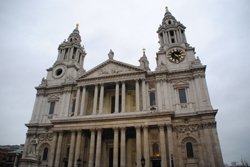
Old St Paul’s Cathedral was certainly the largest and most famous casualty of the Great Fire of London of 1666. And its passing – and rebirth – is recorded on several memorials, one of which can be found on the building itself.
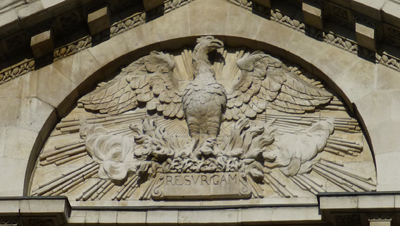
Set on the pediment which, carved by Caius Gabriel Cibber, sits above south portico off Cannon Street, the memorial depicts a phoenix rising from clouds of smoke (ashes), a symbol of Sir Christopher Wren’s new cathedral which rose on the site of the old Cathedral in the wake of the fire. Below the phoenix is the Latin word, ‘Resurgam’, meaning “I Shall Rise Again”.
The story goes that Wren had this carved after, having called for a stone to mark the exact position over which St Paul’s mighty dome would rise, the architect was shown a fragment of one of the church’s tombstones which had been inscribed with the word.
The foundation stone for the new cathedral, largely built of Portland stone, was laid without any fanfare on 21st June, 1675, and it only took some 35 years before it was largely completed. Some of the stonework from the old cathedral was used in the construction of the new.
We should note that the old cathedral was in a state of some disrepair when the fire swept through it – the spire had collapsed in 1561 and despite the addition of a new portico by Inigo Jones, it was generally in poor condition.
Stonework from the Old St Paul’s – everything from a Viking grave marker to 16th century effigies – are now stored in the Triforium, rarely open to the public (tours of the Triforium are being run as part of the programme of events being held at the cathedral to mark the 350th anniversary of the Great Fire – see www.stpauls.co.uk/fire for more).
PICTURE: givingnot@rocketmail.com/CC BY-NC 2.0 (image cropped)

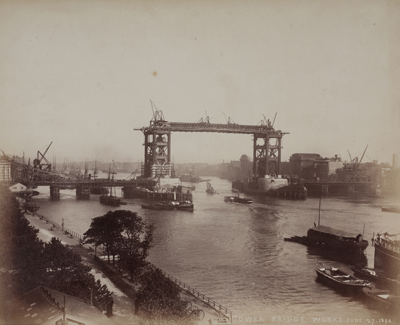
 Albury Street in Deptford, 1911. The image, taken by the London County Council, is just one of thousands which form part of a new free, online resource, Collage – The London Picture Archive. The world’s largest collection of images of London, the archive contains more than 250,000 images of London spanning the period from 1450 to the present day. It includes more than 8,000 historical photographs of life on the capital’s streets as well as major events – everything from the Great Fire of London in 1666 to the construction of Tower Bridge in the late 19th century. The photographs, maps, prints, paintings and films in the collection are all drawn from the collections of the City of London Corporation’s Guildhall Art Gallery and the London Metropolitan Archives in Clerkenwell. Other images shown here include (above right) ‘Street Life in London’, 1877 (taken by Adolphe Smith and John Thomson, this image was an early use of photography); (below) ‘Construction of the Metropolitan Railway (the first tube line)’, 1862 (taken at King’s Cross Station); and (far below), ‘The Construction of Tower Bridge’, 1891-1892 (taken from Tower Embankment). Collage – The London Picture Archive is free to access and available at
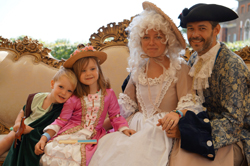 • Join Queen Caroline, wife of King George II, for a garden party in the grounds of Kensington Palace this weekend. The celebrations include music, military drills and live performances in a bid to bring the era of the Georgians to life. Visitors can listen to court gossip, learn how to play popular music and devise ways to amuse the queen as they pop in and out of a range of tents set up in the gardens, each of which contains a different activity, from uncovering dress secrets to designing a mini-garden fit for a king or queen. There’s even the chance to sample some Georgian ice-cream in the ice-house. The days will be held from today until 21st August. Admission charges apply. For more, see

 Then only consisting of the central barrel and pump, it has been restored for the current exhibition, Fire! Fire!, being held to mark the 350th anniversary of the fire which wiped out much of the City of London.