Where is it? #79…And the answer is…

Where-is-it--#79

Can you identify where in London this picture was taken? If you think you can, leave a comment below. We’ll reveal the answer next week. Good luck!

This bronze sculpture is indeed located in Spitalfields. Named A Pear and A Fig, the still life was created by Ali Grant in 2006 and installed in Bishops Square just outside the western end of Spitalfields Market. There’s a suggestion it has been moved – we’ll endeavour to confirm that!

Treasures of London – Sculptures and reliefs on 55 Broadway…

Night

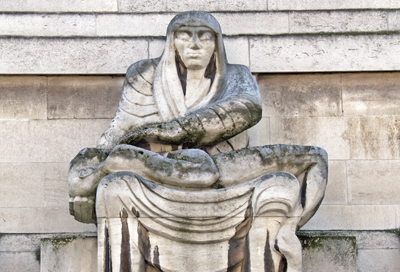
Controversial when first unveiled in the late 1920s, Jacob Epstein’s sculptures of Day and Night adorn the facade on the Grade I-listed building at 55 Broadway – home, for the present at least, to the London Underground HQ and St James’s Park Underground station.

It was the nudity and, no doubt, the stark modernist styling which provoked outrage (and newspaper campaigns) when the two sculptures – Day, depicting a seated smiling male figure with a naked boy standing in front of him and the other, Night, depicting a cowled female seated and cradling a prone, apparently resting, figure (pictured above) – were unveiled.

Such was the outcry that Frank Pick, the then head of the Underground Electric Railways Company of London (predecessor to London Underground and the organisation for whom the building was constructed), even apparently offered his resignation over it. But a compromise was reached – Epstein agreed to alter the naked figure of the boy (a rather painful snip) and the fuss soon died down. These days many people pass the building without even noticing the sculptures upon it.

Epstein’s statues aren’t the only sculptural works to adorn 55 Broadway – a series of eight smaller relief works representing the winds of each cardinal point can also be seen on the facade. All eight representations are of nude figures of different genders and were created by six different artists –  Eric Gill, Alfred Gerrard, Allan Wyon, Eric Aumonier, Samuel Rabinovitch and Henry Moore (interestingly, it was Moore’s first public commission).

It’s been reported that London Underground will be vacating the building next year with the property to be converted into rather expensive flats.

PICTURE:  Wikipedia

This Week in London – William Kent at the V&A; new City Visitor Trail; and, Veronese at the National Gallery…

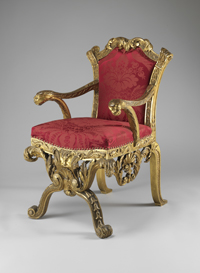
Armchair_for_Devonshire_House_ca._1733-40__Devonshire_Collection_Chatsworth._Reproduced_by_permission_of_Chatsworth_Settlement_Trustees._Photography_by_Bruce_WhiteThe life and work of William Kent, the leading architect and designer of early Georgian Britain, is the subject of a new exhibition opening at the V&A on Saturday. William Kent: Designing Georgian Britain covers the period 1709 to 1748 which coincides with the accession of the first Hanoverian King George I. the tercentenary of which is being celebrated this year. The display features more than 200 examples of Kent’s work – from architectural drawings for buildings such as the Treasury (1732-37) and Horse Guards (1745-59), to gilt furniture designed for Houghton Hall (1725-25) and Chiswick House (1745-38), landscape designs for Rousham (1738-41) and Stowe (c 1728-40 and c 1746-47) as well as paintings and illustrated books. The exhibition, the result of a collaboration between the Bard Graduate Center, New York City, and the V&A,  features newly commissioned documentary films and will have a section focusing on designs Kent created for the Hanovarian Royal family including those he produced for a Royal Barge for Frederick, the Prince of Wales (1732) and a library for Queen Caroline at St James’ Palace (1736-37). Runs until 13th July. Admission charge applies. See www.vam.ac.uk. PICTURE: Armchair for Devonshire House ca. 1733-40, © Devonshire Collection, Chatsworth. Reproduced by permission of Chatsworth Settlement Trustees.

A new City Visitor Trail has been unveiled by the City of London, taking visitors on a 90 minute self-guided tour of some of the City’s main attractions (or longer if you want to linger in some of the places on the itinerary). The trail – a map of which can be picked up from the City Information Centre – goes past iconic buildings such as St Paul’s Cathedral, Guildhall, Mansion House, Monument, the Tower of London and Tower Bridge as well as lesser-known sites. As well as the main route, there’s also five specially themed routes – ‘Law and literature’, ‘London stories, London people’, ‘Culture Vulture’, ‘Skyscrapers and culture’, and ‘Market mile’ – and a City Children’s Trail, provided in partnership with Open City, which features three self-guided routes aimed at kids. As well as the map, the City has released an app – the City Visitor Trail app – which provides a commentary at some of the city’s main attractions which can either by read or listened to as it’s read by people closely associated with the locations (available for both iPhone and Android). For more, follow this link.

The works of the 16th century Venetian artist known as Veronese (real name Paolo Caliari) are being celebrated in a new exhibition, Veronese: Magnificence in Renaissance Venice at the National Gallery. More than 50 of his works are featured in the display including two altarpieces never before seen outside Italy: The Martyrdom of Saint George (about 1565) from the church of San Giorgio in Braida, Verona, and The Mystic Marriage of Saint Catherine (1565-70) from the Gallerie dell’Accademia, Venice. Others include early works like The Supper at Emmaus (about 1565), the beautiful Portrait of a Gentleman (c 1555) and the artist’s last autograph work, the altarpiece for the high altar of San Pantalon in Venice (1587). Runs until 15th June. Admission charge applies. For more, see www.nationalgallery.org.uk.

Send all items of interest for inclusion to exploringlondon@gmail.com.

10 significant sites from Georgian London – 4. St Martin-in-the-Fields…

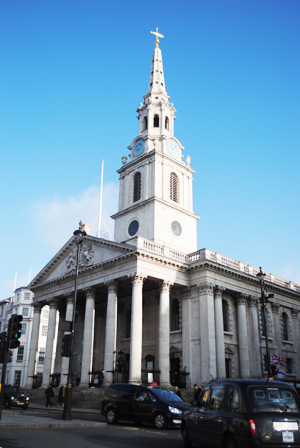
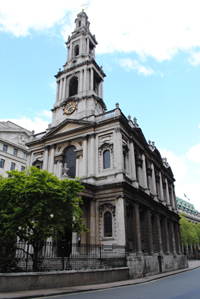
This iconic church on the edge of Trafalgar Square, known for its musical associations, is another of the works of architect James Gibbs and, as with St Mary le Strand, the current building was constructed in the first half of the 18th century to replace an earlier building.

St-Martin-in-the-fieldsThe first references to a church on the site of the present building date back to the 13th century when, constructed upon a Roman burial site, it was apparently used by monks from Westminster. It was replaced by King Henry VIII around 1542 and enlarged in 1602 before finally being demolished in 1721.

Gibbs’ apparently first suggested the design feature a round nave with a dome over the top but the proposal was rejected as too expensive and a simpler, rectangle-shaped church was subsequently agreed upon and eventually completed in 1726. Part of the design inspiration comes from Sir Christopher Wren, although Gibbs’ integration of the tower into the church was a departure from Wren’s designs (the church spire rises 192 foot into the air).

Among the features of the interior are ceiling panels in the nave which feature cherubs and shells and are the work of ceiling experts Giuseppe Artari and Giovanni Bagutti. Other items of interest include Chaim Stephenson‘s sculpture, Victims of Injustice and Violence, remembering all victims during apartheid in South Africa (it was dedicated by Desmond Tutu in 1994), a statue of St Martin and the Beggar by James Butler, and, on the porch, Mike Chapman‘s sculpture marking the millennium, Christ Child. Paintings include one of James Gibbs himself by Andrea Soldi and dating from 1800.

Among those buried in the church are furniture-maker Thomas Chippendale, sculptor Louis-François Roubiliac and notorious robber Jack Sheppard (he’s buried in the churchyard). The crypt also contains a life-sized marble statue of Henry Croft, London’s first pearly king, which was moved there from St Pancras Cemetery in 2002.

As well as being the location of the first religious broadcast, its musical heritage includes performances by Handel and Mozart and being the location of the first performance of its namesake chamber orchestra, the Academy of St Martin in the Fields.

Since the early 20th century, the church has been noted for its work with the homeless (thanks in particular to the work of Vicar Dick Sheppard). Meanwhile, its connections with music – which date back to its rebuilding – continue in the concerts held in the crypt cafe. The crypt also hosts art exhibitions.

The church underwent a £36 million renewal project in the Noughties. Additions included the new east window by Shirazeh Houshiary.

WHERE: St Martin-in-the-Fields on the north-east corner of Trafalgar Square (nearest tube stations are Charing Cross, Leicester Square and Embankment); WHEN: Open weekdays and weekends – times vary, see website for details; COST: free; WEBSITE: www.stmartin-in-the-fields.org.

A Moment in London’s History – When the last ‘frost fair’ was held on the Thames…

A-view-of-the-River-Thames-1814-by-G-Thompson-©-Museum-of-London

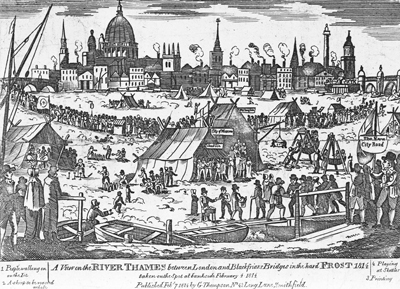
Held during particularly cold winters when the River Thames froze over, ‘frost fairs’ had been part of London’s history, from the Middle Ages up until the last one was held in February 1814, two hundred years ago last month.

The five day revelry started on 1st February and took place on a stretch of the river between Blackfriars and London Bridge (it was the medieval London Bridge in particular – with its 19 arches and wide piers – which helped to slow the river enough to freeze, something unlikely to happen again with the current bridge).

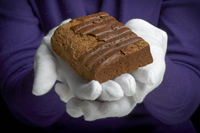
Gingerbread-bought-at-the-last-Frost-Fair-of-1814-©-Museum-of-LondonPeople began to venture out onto the ice and an impromptu fair started taking shape as tents and booths were established selling all manner of food including roast ox, drinks including alcohol like gin as well as hot chocolate, tea and coffee, and souvenirs to take advantage of the passing traffic (a piece of gingerbread from the fair is a star attraction at the Museum of London’s current exhibition on the fair – pictured right). Some of the tents were known by names (similar to a pub sign), such as the Moscow and the Wellington.

Other attractions recorded include children’s play equipment, a gambling den, and printing presses which produced keepsakes to mark the occasion. There were even reports of sightings of an elephant crossing the river.

Several people apparently died at the fair having sunk beneath the ice by the time the snow turned to rain and the ice began to break up. An engraving of the frost fairs by Richard Kindersley can be found on a pedestrian walkway underneath the Southwark end of Southwark Bridge.

The dates for Frozen Thames: Frost Fair 1814 at the Museum of London have been extended until 21st April (there is an accompanying exhibition, Frozen Thames: Frost Fair 1684 running concurrently at the Museum of London Docklands). Admission is free. For more, see www.museumoflondon.org.uk.

MAIN PICTURE: A view of the river Thames, 1814, George Thompson © Museum of London. This print shows the 1814 Frost Fair from the south bank of the Thames, with St Paul’s in the background.

Where is it? #78…And the answer is…

Where-is-it--#78

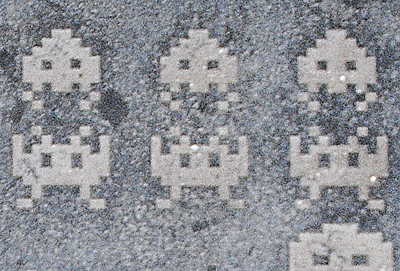
Can you identify where in London this picture was taken (and what it represents)? If you think you can, leave a comment below. We’ll reveal the answer early next week. Good luck!

These space invaders are located on the ground at the entrance to St Dunstan’s Court, just off the north side of Fleet Street. The plaque commemorates the role new computer technologies played in the demise of the traditional Fleet Street printing process. It’s one of a series of eight plaques referring to aspects of the printing industry located at the entrance to courts.

Lost London – Strand Cross…

Many of us are familiar with the story of Charing Cross and why it was so named (see our earlier post here), but maybe not so much with another of London’s ‘crosses’ – Strand Cross.

Earlier this week we posted a story on St Mary le Strand – one of the details we didn’t mention (deliberately, it has to be said) was that the current church now stands on the site once occupied by the cross.

Believed to have dated from at least Norman times, Strand Cross – which stood just outside the city gates – may have begun life as a market cross and it’s recorded that in the 13th century, justices held court in front of it.

By the early 14th century has been rather elaborately rebuilt in a fashion not unlike that of the Eleanor Crosses.

In the late 17th century, the cross – which had apparently already lost its top – was replaced by a windmill to pump water – apparently there was a well or spring nearby – and this in turn was later replaced by one of London’s most famous maypoles (we’ll be looking at maypoles in more detail in a later post).

This Week in London – Copying Hans Holbein; the Needlemakers’ 350th; and, 16th century woodcuts…

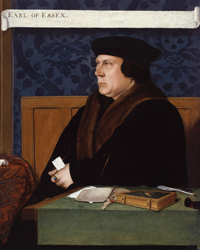
ThomasCromwellA new display exploring the demand for copies and remakes of portraits originally created by Tudor court painter Hans Holbein the Younger has opened at the National Portrait Gallery. Hans Holbein Re-made features a selection of copies of Holbein’s works from the gallery’s collection including portraits of William Warham, John Fisher, Sir Thomas More and Sir Richard Southwell, all of which have undergone new technical analysis as part of the gallery’s Making Art in Tudor Britain project. The research reveals new details about how and when the paintings were made and the techniques used. The display also includes a portrait of Thomas Cromwell, Earl of Essex – thought to be one of the first miniatures Holbein painted alongside a digital screen which enables this work of Holbein’s to be compared with that of another artist working in his studio. In Room 3. Runs until 31st August. Admission is free. For more, see www.npg.org.uk. PICTURE: Thomas Cromwell, Earl of Essex, after Hans Holbein the Younger, early 17th century (1533-1534). © National Portrait Gallery, London.

This year marks the 350th anniversary of King Charles II’s granting of a Royal Charter to The Worshipful Company of Needlemakers and to commemorate the occasion, the Guildhall Library is hosting an exhibition of some of the company’s treasures and history. Among the displays are tools used in 19th and 20th centuries, 18th century silverware, and the Company Arms (gifted to it in 1995) as well as examples of their craft from both early and recent periods. The exhibition closes on 29th March, so you’ll have to be quick. Admission is free. For more, see www.cityoflondon.gov.uk/things-to-do/visiting-the-city/archives-and-city-history/guildhall-library/exhibitions/Pages/The-Worshipful-Company-of-Needlemakers.aspx

A new display of revolutionary sixteenth century woodcuts opens at the Royal Academy of Arts on Saturday. Renaissance  Impressions: Chiaroscuro woodcuts from the Collections of Georg Baselitz and the Albertina, Vienna, looks at the development of the printing technique of the chiaroscuro woodcut and presents more than 100 rare prints by artists from Germany, Italy and The Netherlands which have come from the collection of the Albertina Museum in Vienna and the personal collection of Honorary Royal Academician Georg Baselitz. The new technique – the first known example of which is widely believed to have been created by Hans Burgkmair the Elder with his 1508 depiction of Emperor Maximilian on Horseback – involved supplementing the key ‘black line block’ with one or several ‘tone blocks’ with chiaroscuro woodcuts the first colour woodcuts to make dramatic use of light and shadow to suggest form, volume and depth. Runs until 8th June in the Sackler Wing of Galleries. Admission charge applies. For more, see www.royalacademy.org.uk.

10 significant sites from Georgian London – 3. St Mary le Strand…

This oddly located church on the Strand is the work of acclaimed architect James Gibbs – the first public project he embarked upon after returning from Italy where he had trained.

St-Mary-le-StrandWhile the history of St Mary le Strand goes at least back to the Middle Ages (and it initially stood just south of the current churches’ position on land currently occupied by Somerset House), the construction of the current church – the first of 50 built in London under a special commission aimed at, well, seeing more churches built in the capital to meet the needs of the growing population – began around 1715 (the foundation stone was laid on 25th February, the year after the accession of King George I.)

While building was briefly delayed by the Jacobite rising which broke out in 1715, the church was finally consecrated for use on 1st January, 1723.

Gibbs, who trained under a baroque master – a style which contrasted with the Palladian-style favoured by Lord Burlington and others, had apparently originally intended the church to be in the Italianate style with a campanile over the west end instead of the steeple  but this scheme also included a 250 foot high column surmounted by a statue of Queen Anne located to the west of the church which would celebrate the work of the commission (it’s also worth noting that the churches built by the committee – and they didn’t get close to building 50 – were known as “Queen Anne Churches” despite their construction taking place largely after her death).

However, plans for the column were abandoned on the queen’s death on 1st August, 1714, and instead Gibbs – a Roman Catholic who thanks to his supposed Jacobite sympathies apparently finished the project without pay, was ordered to use the stone which had been gathered to build the steeple and, thanks to that, amend his plans for the church into an oblong form rather than the square form he had initially intended. The work shows the influence of Sir Christopher Wren as well as churches in Italy.

The interior has been remodelled several times since its creation. The white and gold plastered ceiling was apparently inspired by the work of Italian sculptor and architect Luigi Fontana on two Roman churches and other features include paintings by American artist Mather Brown (these were put in place in 1785 and are located on panels on the side walls of the chancel – they were restored in 1994), while the crucifix behind the altar was presented by parishioners in 1893.

It the late 1800s, the London County Council proposed demolishing the church so it could widen the Strand for traffic but this plan was abandoned after an outcry led by artist Walter Crane (although the graveyard was removed).

Famous faces associated with the church include Charles Dickens’ parents, John and Elizabeth, who were married here in 1809, and there’s a story that during a secret visit to London in 1750, Bonnie Prince Charlie (Charles Edward Stuart) renounced the Roman Catholic Church by receiving Anglican communion here. The parish currently includes that of nearby St Clement Danes after the church was bombed in 1941 (it’s now central church of the Royal Air Force).

WHERE: St Mary le Strand, Strand (nearest tube stations are Temple, Covent Garden, Holborn, Charing Cross and Embankment); WHEN: Usually open 11am to 4pm from Tuesdays to Thursdays and 10am to 1pm Sundays; COST: free; WEBSITE: www.stmarylestrand.org.

LondonLife – Chocolate kitchens rediscovered at Hampton Court Palace…

Chocolate-kitchen

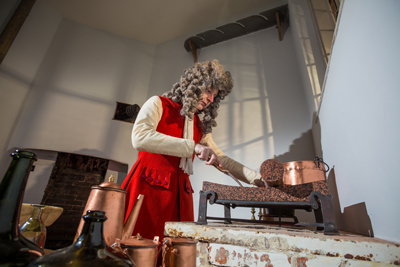
Once making chocolate for kings including William III, George I and George II, a special royal chocolate-making kitchen has opened at Hampton Court Palace – the only surviving example of its kind in the country. The opening – which is part of Historic Royal Palaces’ celebration of the 300th anniversary of the Hanoverian accession – comes after research identified the exact location of the kitchen which, having been used as a storeroom, was found in a “remarkably well preserved” state with original fittings such as the stove and furniture intact. Among those known to have worked in the kitchen is Thomas Tosier (pictured above), personal chocolatier to King George I, and it was in here he prepared special chocolate drinks. (Interestingly, Tosier’s wife Grace apparently traded on her husband’s royal association to promote her own chocolate house in Greenwich). A new display in the kitchen explores how the chocolate was made for the king and features copper cooking equipment and bespoke chocolate serving silverware, glassware and linens from the 18th century. The Royal Chocolate Kitchen will also play host to live Georgian chocolate making sessions. PICTURE: © Historic Royal Palaces/Richard Lea Hair.

WHERE: Hampton Court Palace, East Molesey, Surrey (nearest station is Hampton Court from Waterloo); WHEN: 10am to 4.30pm until 29th March after which it’s open to 6pm); COST: Adult £18.20, Concession £15.40, Child under 16 £9.10 (under fives free), family tickets, garden only tickets and online booking discounts available; WEBSITE:www.hrp.org.uk/HamptonCourtPalace/.

Vikings at the British Museum; World War I portraits; and, Ruin Lust…

RoskildeThe Vikings come to the British Museum from today with the first major exhibition in more than 30 years. Vikings: life and legend, the first exhibition to be held in the new Sainsbury Exhibition Gallery, was developed with the National Museum of Denmark and the Staatliche Museen zu Berlin (National Museums in Berlin) and looks at the Viking period from the late 8th century to the early 11th century. Featuring many new archaeological discoveries and objects never seen before in the UK alongside items from the British Museum’s own collection, the exhibition is centred on the surviving timbers of a 37 metre long Viking warship excavated from the banks of the Roskilde fjord in Denmark (pictured). Other items include skeletons recently excavated from a mass grave of executed Vikings in Dorset, the Vale of York Hoard (discovered in 2007) and a stunning hoard of silver from Gnezdovo in Russia. A unique live broadcast event presented by historian Michael Wood taking cinema audiences around the exhibition will be shown in cinemas across the nation on 24th April. Admission charge applies. Runs until 22nd June. For more, see www.britishmuseum.org/whats_on/exhibitions/vikings.aspx. PICTURE: Copyright of the National Museum of Denmark. 

The commemorations of the World War I centenary have commenced at the National Portrait Gallery with The Great War in Portraits. The first of a four year programme of events and displays at the gallery, the exhibition features iconic portraits of figures such as Winston Churchill, Kaiser Wilhelm, Siegfried Sassoon and Wilfred Owen as well as major art works by the likes of Lovis Corinth, Max Beckmann, and Kirchner, whose painting Selbstbildnis als Soldat (Self-portrait as a Soldier) is featured, and Harold Gillies’ photographs of facially injured soldiers from the Royal College of Surgeons. Among the highlights are Jacob Epstein’s The Rock Drill, a contrasting pair of British and German films about the Battle of the Somme, and a press photograph of Gavrilo Princip, the student who sparked the flames of war when he assassinated Archduke Franz Ferdinand. Elsewhere among the 80 works on display are portraits of war heroes such as VC winners are contrasted with those of soldiers disfigured by war, POWs and those shot for cowardice. Admission is free. Runs until 15th June. For more, see www.npg.org.uk/whatson/firstworldwarcentenary/exhibition.php.

Our fascination with ruins is the subject of a new exhibition which opened this week at Tate Britain. Including more than 100 works from the likes of JMW Turner, John Constable, John Martin, Eduardo Paolozzi, Rachel Whiteread and Tacita Dean, Ruin Lust examines the craze for ruins that overtook creative types in the eighteenth century and the subsequent revisiting – and at times mocking – of this fascination by later figures. Works on show include Turner’s Tintern Abbey: The Crossing and Chancel, Looking towards the East Window 1794, Constable’s Sketch for ‘Hadleigh Castle’ c 1828-9, Graham Sutherland’s Devastation series 1940-1 – showing the aftermath of the Blitz, Jon Savage’s images of London in the late 1970s, and Whitehead’s Demolished – B: Clapton Park Estate 1996, showing the demolition of Hackney tower blocks. Runs until 18th May. Admission charge applies. For more, see www.tate.org.uk/whats-on/tate-britain/exhibition/ruin-lust.

10 significant sites from Georgian London – 2. Burlington House…

Now the home of the Royal Academy of Arts, the origins of Burlington House on Piccadilly go back to the 1660s but it was Richard Boyle, the 3rd Earl of Burlington, who had the property reworked into the Palladian building it is today. 

It was Sir John Denham, Surveyor-General of the King’s Works for King Charles II, who first began building a red brick mansion on the site in the 1660s before he sold the still unfinished building to Richard Boyle, the 1st Earl of Burlington, in about 1667. He completed the house the following year.

Burlington-HouseThe property next underwent major changes during the minority of the 3rd Earl (also Richard Boyle, 1612-1698) – his mother, the 2nd Countess, Lady Juliana, had architect James Gibbs carry out some alterations including the addition of a semi-circular colonnade at the front of the house and reconfiguration of the main staircase.

But around 1717-1718, the 3rd Earl (1694-1753), who himself was something of an architect, commissioned architect Colen Campbell to take over from Gibbs. The property was then reworked to a Palladian design – particularly the southern front of the building and William Kent was summoned to redesign interiors – the surviving interior of the Saloon is credited as the first ‘Kentian’ interior in England.

Lord Burlington soon shifted his attention to Chiswick House (see our earlier post here), and on his death in 1753, the house passed to the Dukes of Devonshire before it was eventually purchased by the 4th Duke’s younger son, Lord George Cavendish, around 1812. He had some of the interiors reworked by Kent admirer Samuel Ware, keeping them sympathetic to the Palladian vision.  Four years after the purchase, Burlington Arcade was built along the western side of the premises.

In 1854, the property was sold to the British Government who initially intended demolishing the structure and using the site for the University of London but after strong opposition to the plan, it was occupied by the Royal Society, the Linnean Society and the Chemical Society while the Royal Academy – which had been founded by King George III in 1768 – took over the main block on a 999 year lease in 1867.

The building subsequently underwent further alterations – among them Sidney Smirke added a third floor to the main building – the Diploma Galleries – and the Main Galleries and the Art School on a garden to the north of the house. Later, three story ranges were raised around the courtyard and the three aforementioned learned societies moved into these and were later joined by the Geological Society of London, the Royal Astronomical Society and the Society of Antiquities.

The Royal Society left in 1968 and the British Academy moved in but this august institution moved out in 1998, leaving the building now home to the Royal Academy and the five learned societies, the Geological Society of London, the Linnean Society of London, the Royal Astronomical Society, the Society of Antiquaries of London, and the Royal Society of Chemistry.

More recent works at the property – the last survivor of four townhouses built along Piccadilly in the 1660s – have included a 1991 remodelling of the Diploma Galleries by Norman Foster – now known as The Sackler Wing of Galleries – and the restoration of the former state rooms including The Saloon, reopened as the John Madejski Fine Rooms.

WHERE: Royal Academy of Arts, Burlington House, Piccadilly (nearest Tube stations are Piccadilly Circus and Green Park);  WHEN: 10am to 6pm Saturday to Thursday/10am-10pm Friday (opening times for the John Madejski Fine Rooms may vary); COST: Varies depending on the exhibition (there are free guided tours of the John Madejski Fine Rooms – check the website for details); WEBSITE: www.royalacademy.org.uk

PICTURE: Installation by Ãlvaro Siza, part of the Sensing Spaces: Architecture Reimagined exhibition which runs until 6th April. Photo: Royal Academy of Arts. Photography: James Harris/Ãlvaro Siza 

LondonLife – Brompton Road tube station sells for £53 million…

BromptonThe Brompton Road tube station, which closed in 1934 after being made redundant following the opening of other stations, sold for a reported £53 million over the weekend. The former Piccadilly Line station, located between South Kensington and Knightsbridge stations, opened in 1906 and was designed by architect Leslie Green for the Great Northern, Piccadilly and Brompton Railway. It was used as a command centre for anti-aircraft guns during World War II and the story goes was where Nazi Rudolf Hess was interrogated after being captured in 1941. Owned up until the sale by the Ministry of Defence, it was most recently used as a training centre for air cadets and naval reservists. It will reportedly be converted into residential flats.

Famous Londoners – Wynkyn de Worde…

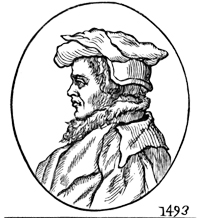
Known as the “Father of Fleet Street”, Wynkyn de Worde was key figure in the early use of the printing press in England.

Wynkyn_de_WordeBorn on the continent (candidates include Wœrth in Alsace in north-east France and Wœrden in The Netherlands), Wynkyn – whose name comes in various spellings, although it is said to have originally been Jan van Wynkyn – is believed to have become apprenticed to a printer in Cologne before meeting with famed pioneering English printer William Caxton in the early 1470s.

He apparently accompanied Caxton from Cologne to Bruges and then back to London in the late 1470s or early 1480s where he started working with Caxton at his premises in Westminster. During this period he is said to have lived with his English wife Elizabeth in a premises located with the sanctuary of Westminster Abbey (they are known to have attended St Margaret’s Church and even rented a pew there until Elizabeth’s death in 1498, after which Wynkyn is believed to have remarried.)

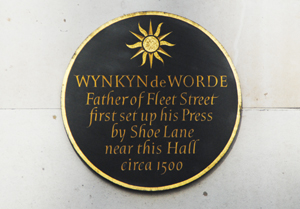
After Caxton’s death in 1492, Wynkyn took over his printing business and, around 1500, he relocated his office from Caxton’s Westminster premises to the “sign of the Sun” in Fleet Street near Shoe Lane – in fact, he is credited as being the first printer to locate in the street which becomes famously associated with publishing. There’s a plaque (pictured below), on the wall of the hall of the Worshipful Company of Stationers, located off Ave Maria Lane near St Paul’s Cathedral, commemorating the move (although Shoe Lane is located some distance away). Wynkyn later also ran a shop in St Paul’s Churchyard.

Wynkyn-de-Worde2While Wynkyn, like Caxton before him, relied on the patronage of the rich and famous (Margaret Beaufort, mother of King Henry VII among them), he also printed relatively inexpensive books in a bid to capture a wider market. In all he published more than 400 different books in at least 750 editions ranging from religious texts and poetry to fictional romantic works, educational textbooks and books aimed at children. He is noted for his use of woodcuts illustrations while his other claims to fame include being the first English printer to use italic type and the first to print music from moveable type.

De Worde died around 1534 but his legacy lives on through the mass media publishing of today (albeit not longer from Fleet Street). There is a Wynkyn de Worde Society based in Suffolk which is aimed at furthering the printing industry.

PICTURE: Wikipedia

Where is it? #77…And the answer is…

Where-is-it--#77

Can you identify where in London this picture was taken? If you think you can, leave a comment below. We’ll reveal the answer early next week. Good luck!

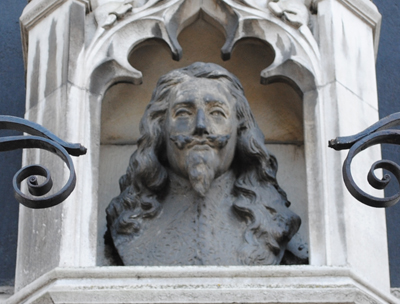
Sorry about the delay in getting the answer to you! But yes, as Baldwin and Jennifer both answered, this bust of King Charles I does indeed sit on the wall of St Margaret’s Church opposite the Houses of Parliament, above a blocked doorway. There is a story that the statue of Oliver Cromwell which stands opposite, outside Westminster Hall, has his eyes deliberately averted from the King (after all, he did help him lose his head). But Cromwell statue, by Hamo Thornycroft, was placed in position well before the bust – it’s placement dates from the turn of the 19th century while the bust (one of a pair) wasn’t placed on the church until 1956 (a gift of The Society of King Charles the Martyr which annually commemorates the king’s death). Still, it’s a fitting placement.

This Week in London – Data visualisation at the BL; Kenneth Williams honoured; and, celebrating ‘frost fairs’…

NASA's-Perpetual-Ocean-cropAn examination of the historical use of visual data has opened at the British Library. Beautiful Science, which is running in The Folio Society Gallery, features the work of scientists and statisticians down the ages and focuses on the key themes of public health, weather and evolution. Among items on display are Robert Fludd’s Great Chain of Being (1617), Florence Nightingale’s seminal ‘rose diagram’ (1858) which illustrated that more Crimean War deaths were being caused by poor hospital conditions that battlefield wounds, and a contemporary moving infographic from NASA showing ocean currents (pictured). A programme of events is running with the exhibition which closes on 26th May. Entry is free. For more, see www.bl.uk/beautiful-science. PICTURE: NASA’s Perpetual Ocean © NASA/Goddard Space Flight Center

Comic Kenneth Williams (1926-1988) has been honoured with an English Heritage Blue Plaque at the London apartment he lived in during the hey day of the ‘Carry On’ series of films during the 1960s. Williams lived in flat 62 on the top floor of Farley Court, located between Madame Tussauds and Baker Street station, between 1963 and 1970 during which he starred in such films as Carry on Cleo and Carry on up the Khyber and also appeared in radio comedy programmes such as Round the Horne and Just a Minute. For more, see www.english-heritage.org.uk/discover/blue-plaques/.

Two exhibitions celebrating London’s Frost Fairs are underway at the Museum of London and its Docklands sister. Frozen Thames: Frost Fair 1814 at the Museum of London in the City and Frozen Thames: Frost Fair 1684 at the Museum of London Docklands both feature objects, paintings, keepsakes, engravings and etchings from the museum’s collection. Highlights at the Museum of London exhibition include the only surviving piece of gingerbread from the 1814 fair, the last fair of its kind, as well as etchings by satirical artist George Cruikshank and a print by George Thompson while among the items on display at the Docklands museum are two paintings by a Dutch artist Abraham Hondius (c. 1625-91). Both exhibitions are free and both run until 30th March. For more, see www.museumoflondon.org.uk.

What’s in a name?…Holland Park…

Holland-House2

This name lends itself both to a 55 acre park and the abutting area in the Royal Borough of Kensington and Chelsea in inner west London.

Both take their name from Holland House, a Jacobean mansion which started life as Cope Castle – the home of Sir Walter Cope, Chancellor of the Exchequer for King James I – but changed its name to Holland House when it was the property of Henry Rich, Cope’s son-in-law and the 1st Earl of Holland (Rich ended up being executed for his support of the Royalists in the Civil War). For more on the house – the remains of which can still be seen in the park – see our earlier post here.

The surrounding area became known as the abode of artists in the late 19th century – including Frederic Leighton, whose magnificently decorated house (now known as the Leighton House Museum) you can visit at 12 Holland Park Road, so much so that they became known as the Holland Park Circle.

Today the area is one of London’s most exclusive residential districts and contains a number of embassies. The streets include the Grade II*-listed Royal Crescent, designed in 1839 by Robert Cantwell in imitation of the more famous Royal Crescent in Bath.

Notable buildings include the 18th century Aubrey House (formerly known as Notting Hill House), located in the Campden Hill area (one of the most expensive parts of London for residential real estate), which was named by Aubrey de Vere who held the manor of Kensington at the time of the Domesday Book, and stands on the site of a former spa called Kensington Wells. At the end of the 1990s, it was reportedly thought to be London’s most expensive home.

PICTURE: Part of the restored Holland House, now a youth hostel.

This Week in London – Finds from below London on display; Reassessing the German Renaissance; and, Powell and Pressburger’s Blue Plaque…

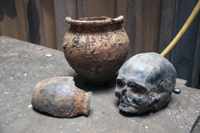
Roman-skull-found-at-Liverpool-Street-ticket-hall-_102065More than 50 objects – including skulls from the Roman era – unearthed as part of the Crossrail project have gone on display to the public for the first time. Portals to the Past also features a Roman cremation pot (which still contained remains when discovered), 16th century jewellery, and flint used by Londoners some 9,000 years ago. The free exhibition runs at the Crossrail Visitor Information Centre behind Centre Point at 6-18 St Giles High Street until 15th March. To coincide with it, Crossrail archaeologists will be running a series of lectures on Wednesday evenings starting at 6pm. No booking is required but numbers are limited so it’s recommended that attendees turn up early. For more information, www.crossrail.co.uk/sustainability/archaeology/archaeology-exhibition-portals-to-the-past-february-2014.

A new exhibition celebrating the artists of the German Renaissance opened at the National Gallery yesterday. Strange Beauty: Masters of the German Renaissance features paintings, drawings and prints by the likes of Hans Holbein the Younger, Albrecht Durer and Lucas Cranach the Elder and examines how perceptions of the pieces have changed over time. Works include Holbein’s Anne of Cleves, Hans Baldung Grien’s Portrait of a Young Man with a Rosary, and Matthias Grunewald’s drawing of An Elderly Woman with Clasped Hands. There is also a reconstruction of the Liesborn altarpiece, created in 1465 and originally housed at the Benedictine Abbey of Liesborn in Germany. Runs until 11th May. Admission charge applies. For more, see www.nationalgallery.co.uk.

Film-makers Michael Powell (1905-1990) and Emeric Pressburger (1902-1988) have been commemorated with the placement of an English Heritage Blue Plaque at the site of their former workplace, a flat in Dorset House, on Gloucester Place in Marylebone. It was from Flat 120 in the apartment block that they oversaw the production of some of their greatest films including The Life and Death of Colonel Blimp (1943), A Matter of Life and Death (1946), Black Narcissus (1947) and The Red Shoes (1948) between 1942 and 1947. Film director Martin Scorsese was among those who unveiled the plaque. For more, see www.english-heritage.org.uk/discover/blue-plaques/.

Send all items of interest for inclusion to exploringlondon@gmail.com.

10 significant sites from Georgian London – 1. Chiswick House…

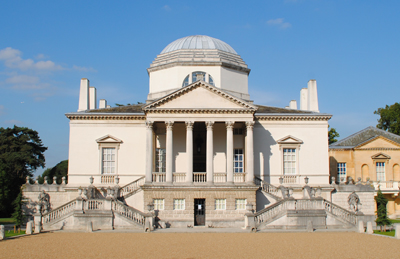
Chiswick-HouseAn icon of the Georgian era, Chiswick House in west London is one of the pre-eminent examples of neo-Palladian architecture in Britain and exemplifies the elegance of the time.

Designed by Richard Boyle, the third Earl of Burlington (1694-1753), the two storey, domed villa was inspired by what Lord Burlington had seen of ancient and sixteenth century architecture during his tours of Italy – in particular the work of Andrea Palladio – as well as the work of Palladio admirer, famed English architect Inigo Jones (his statue along with that of Palladio can be seen outside),

Chiswick-House2It was constructed in the 1720s, most likely between 1727 and 1729, on a site which had been purchased by the first Earl of Burlington (his grandfather) in 1682 and which was already occupied by a Jacobean-era house (this property, which the third Earl significantly renovated, was eventually pulled down in 1788). The interiors were designed by William Kent in collaboration with Burlington and feature luxurious rooms with velvet-covered walls such as the magnificently restored Blue Velvet Room.

The exact purpose of the property remains something of a mystery – it’s been suggested it was built to as a pavilion for private contemplation, grand entertainments and to house the Earl’s art collection and the fact it had no kitchen is supportive of such a conclusion. But there is evidence it was also used as a functioning house – the fact Lady Burlington died in her bedchamber in the premises in 1758 and the link which was eventually built by Lord Burlington between it and the older property on the estate are suggestive of this.

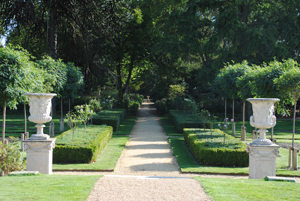
Chiswick-House3Whatever its purpose, the architectural and artistic masterpiece was complemented by formal gardens which Lord Burlington, again, along with the aid of Kent, extensively altered to create a highly planned but naturalistic-looking landscape. Known as the “birthplace of the English Landscape Movement”, the gardens have influenced everyone from ‘Capability’ Brown to the design of New York City’s Central Park.

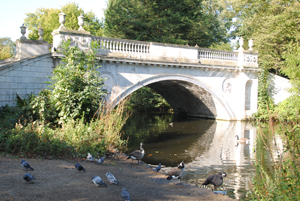
Following Lord Burlington’s death in 1753, the house passed into the hands of his grandson, the fifth Duke of Devonshire (his wife was the rather infamous Duchess Georgiana). He extended the house into a large mansion, adding new wings (these weren’t removed until the 1950s) and improved the gardens, adding the stone bridge (pictured) that still stands over the lake.

Upon the fifth Duke’s death in 1811, the house passed into the hands of the sixth Duke, known as the ‘Bachelor Duke’. He made considerable use of the property and guests included Tsar Alexander I of Russia, King Fredrick William III of Prussia, Queen Victoria and Prince Albert, and Tsar Nicholas I (again, of Russia). The Bachelor Duke also extended the grounds and brought a range of exotic animals into them, including an elephant, kangaroos and emus.

Upon his death in 1858, he left the property to his sister and after her death only four years later, it was subsequently let to some rather high-brow tenants including the Prince of Wales who received the Shah of Persia there in 1873,

The estate was eventually sold by the ninth Duke to the Middlesex County Council and after the war, gifted to the Minister of Works. In 1984, care for the house was transferred to English Heritage. The gardens are now owned by the London Borough of Hounslow.

Along with the Chiswick House and Gardens Trust, English Heritage recently completed a £12 million restoration of the gardens which, this year will host the fourth annual Camellia Festival next month. But this stunning property is well worth a visit any time of the year.

WHERE: Chiswick House, Burlington Lane, Chiswick (nearest Tube station is Turnham Green/nearest train station is Chiswick);  WHEN: 10am to 4pm Saturday and Sunday (until 31st March); COST: £5.90 adults/£3.50 children (5-15 years)/£5.30 concession/£15.30 family; WEBSITE: www.english-heritage.org.uk/daysout/properties/chiswick-house/ or www.chgt.org.uk.

LondonLife – Bringing some colour to winter…

Houses-near-Sloane-Square

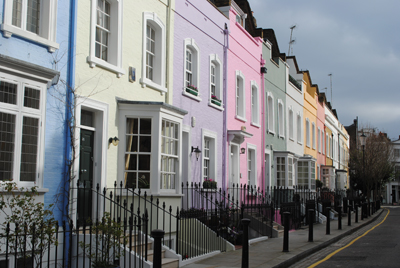
Colourful terraced homes located in Bywater Street, a pretty cul-de-sac just off King’s Road, in Chelsea. Incidentally, number 9, was the fictional home of spy George Smiley in John le Carré’s Tinker Tailor Soldier Spy. Number 10 as used as the home in the BBC TV series of the same name dating from 1979.