Around London – Aliens at the Royal Observatory; celebrating spring at the British Library; Blue Plaques for Heal and Mendelssohn; and, Barocci at the National Gallery…

It’s alien season at the Royal Observatory in Greenwich and to kick off a series of special events around all things extra-terrestrial, a new exhibition looking the history with things not of this earth opens tomorrow. Alien Revolution, which looks at man’s obsession with intelligent alien life – a trend which began in the century following Copernicus’ discovery that the earth was a planet and the sun a star, will be held in the observatory’s Astronomy Centre until August. Runs until 8th September. Admission is free. Other events include shorts courses looking at science fiction and astronomy, family events and special planetarium shows such as We Are Aliens which runs in April. For more on the events, see www.rmg.co.uk.

The British Library’s Spring Festival kicks off tomorrow with five days of film, design and fashion including the unveiling of a new artwork by fashion illustrator and artist Julie Verhoeven. Verhoeven – who has worked for fashion houses Louis Vuitton, Versace and Mulberry – will be joined by Dylan Jones, editor-in-chief of GQ, to talk about what inspires them while others among fashion’s leading names will be contributing postcards in a one night only pop-up exhibition – Late at the Library: Fashion Flashback – which will also feature talks involving Jones and illustrator Tanya Ling. The event also features a spring market held in the library’s piazza at which designers will be selling wares inspired by the library’s collection. Other events include the showing of a series of short films.  For more about the Spring Festival events, head to www.bl.uk/whatson/exhibitions/spring-festival-2013/index.html.

Furniture designer Sir Ambrose Heal was honoured with the unveiling of an English Heritage Blue Plaque at his former home in Pinner yesterday – the date marking 120 years since he joined the family firm, Heal’s. The house – at Fives Court, Moss Lane in Pinner – was Sir Ambrose’s home from 1901-1917 during the period when he began exerting his influence over the business, having won a silver medal at the 1900 Paris Exhibition for a bedroom suite. Heal was knighted in 1933 and appointed a royal designer for industry in 1939. Meanwhile, a Blue Plaque for 19th century composer Felix Mendelssohn was unveiled at 4 Hobart Place earlier this month, commemorating the house he stayed in at the height of his career during his numerous visits to London. The house was the home of the Hanoverian embassy secretary, Karl Klingemann, at the time. For more on Blue Plaques, see www.english-heritage.org.uk.

On Now: Barocci – Brilliance and Grace. This landmark exhibition at the National Gallery is the first major monographic exhibition dedicated to the art of 16th and 17th century Italian artist Frederico Barocci – pioneer of the Baroque style. Highlights include his spectacular altarpiece, The Entombment of Christ, from the coastal town of Senigallia, the Last Supper – painted for Urbino Cathedral, as well as two altar pieces from Rome – Visitation from the Chiesa Nuova and Institution of the Eucharist from Santa Maria sopra Minerva. Also included are portraits, smaller devotional paintings, Aeneas’ Flight From Troy – his only secular narrative, and more than 65 preparatory drawings, pastel studies and oil sketches. Runs until 19th May. Admission charge applies. For more, see www.nationalgallery.org.
10 of London’s greatest Victorian projects – 6. Victoria and Albert Embankments…

We’ve already mentioned these two riverside embankments as part of our previous piece on Sir Joseph Bazalgette’s revolutionary sewer system. But so important are they to the shape of central London today – not to mention a great place to take a stroll – that we thought they’re also worth a mention in their own right.

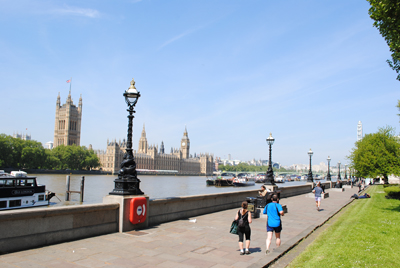
Albert-EmbankmentAs mentioned, the Victoria and Albert Embankments (the latter is pictured right) – named, of course, for Queen Victoria and her by then late consort, Prince Albert, who had died in 1861 (see our previous post What’s in a name?…Victoria Embankment) – were located on opposite sides of the River Thames and involved reclaiming a considerable amount of the river so new sewers could be laid.

Construction of Victoria Embankment – which was also seen as a way to relieve traffic congestion in the central London area – started in the mid 1860s and was complete by 1870. Running along the north and western banks of the Thames between Westminster and Blackfriars bridges, its creation involved the demolition of many riverside buildings as a new walk and roadway were constructed behind a wall.

Numerous monuments have since been located along this promenade – they include the Battle of Britain Monument, RAF Memorial and the mis-named Cleopatra’s Needle (see our earlier post to find out why) – as well as a number of permanently berthed ships including the HQS Wellington – the base of the Honorable Company of Master Mariners – and the HMS President.

The walkway also features original decorative lamps – interestingly, Victoria Embankment was the first roadway in London to be permanently lit  by electric-powered lighting (from 1878).

The parks, collectively known as Victoria Embankment Gardens, contain numerous statues and monuments (including one to Bazalgette himself – it’s located close to the intersection with Northumberland Avenue) as well as a bandstand. They also contain the remains of York Watergate – once fronting on to the river, it shows how much land was reclaimed for the project (you can also visit the riverside entrance to Somerset House to gain a feel for where the river once was – look through the glass floor and you’ll see the old riverbank below).

Albert Embankment, meanwhile, runs between Vauxhall and Westminster Bridges on the eastern side of the river. Constructed around the same time as Victoria Embankment, it was designed to prevent flooding of the low-lying areas of Vauxhall and Kennington and to help in Bazalgette’s sewage system plan (although it apparently doesn’t have the same large sewers as can be found on the other side of the river).

Sadly, the demolition did see the centre of what was once the village of Lambeth removed to make way for the new promenade and roadway. But like Victoria Embankment, Albert Embankment features delightfully decorative lamps along the riverfront promenade and is a great place for a walk in any weather.

LondonLife – ‘Hans of Antwerp’ at The Queen’s Gallery…

Hans-of-AntwerpRecently conserved, Hans Holbein the Younger’s portrait Hans of Antwerp is one of 27 works by the painter on display in the exhibition, The Northern Renaissance: Durer to Holbein, at The Queen’s Gallery, Buckingham Palace. The portrait was first recorded in the Royal Collection in 1639 when it was said to have been hung in King Charles I’s Chair Room at Whitehall (it was painted in the 1530s by Holbein, best known as King’s Painter to King Henry VIII). While it has been previously thought the sitter was a goldsmith (a close friend of Holbein and witness to his will in 1543), Royal Collection Trust conservators have now definitively ruled it to be that of a merchant, possibly a German of the Hanseatic League based at the London Steelyard. You’ll have to be quick to see the exhibition – it winds up on 14th April. Admission charge applies. For more, see www.royalcollection.co.uk.

PICTURE: Royal Collection Trust/ © 2012, Her Majesty Queen Elizabeth II.

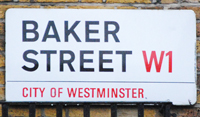
What’s in a name?…Baker Street

Synonymous with Sherlock Holmes, where does the name Baker Street actually come from? Not from a baker located there, as some might expect. Rather, Baker Street was apparently named after a Dorset luminary, Sir Edward Baker.

Baker-StreetSir Edward, created 1st Baronet Baker of Ranston in Dorset in 1802, was a friend and neighbour of the Portman family who developed the area in the late 1700s and early 1800s. Sir Edward (who later changed his name to Sir Edward Baker Baker) had apparently lent the Portmans a helping hand in developing the area.

A fashionable place to live when it was created, Baker Street remains famous for the house at number 221b, which, according to Sir Arthur Conan Doyle, served as the home to literary characters Sherlock Holmes and Dr John Watson between 1881-1904. The Sherlock Holmes Museum, which actually sits between numbers 237 and 241 Baker Street, now claims the address.

Other attractions to have been located in Baker Street include Madame Tussaud’s waxworks which in 1835 set up in premises known as ‘The Baker Street Bazaar’ before moving to its current premises around the corner on Marylebone Road in 1884.

Among the notable buildings still in Baker Street is the London Beatles Store (located at 231/233) where you can purchase all manner of memorabilia related to the group.

Famous residents have included 19th century Prime Minister William Pitt the Younger, actress Sarah Siddons, author and politician Edward Bulwer-Lytton, explorer Sir Richard Burton, and singer Dusty Springfield. The street was almost immortalised in Gerry Rafferty’s 1970s hit, Baker Street.

Where is it?…#58

Where-is-it--#58

Can you identify where in London this picture was taken? If you think you can, leave a comment below. We’ll reveal the answer early next week. Good luck!

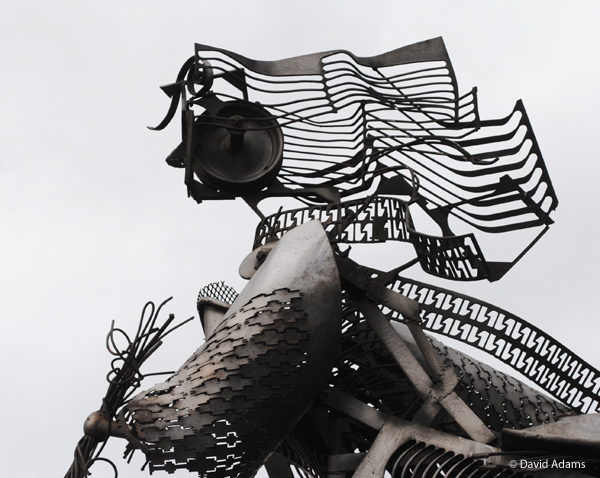
A bit of a harder one this week (so we thought we’d leave a bit longer before giving you the answer!). This is a sculptural figure – aptly named Figurehead for Docklands – which stands at the north-east corner of Poplar Dock in East London. Designed in 1997 by Anna Bisset, it’s made of cast iron and welded steel and was inspired by the idea of ship’s figureheads. Initially put on show at Tidal Basin, Royal Victoria Dock, over the summer of 1995 as part of an outdoor exhibition organised by the University of East London and the London Docklands Development Corporation, it was subsequently purchased by the LLDC and put on permanent display in its current location. For more of Anna Bisset’s work, visit www.annabisset.co.uk.

We’ll post our next Where is it? over the weekend…

Lost London – The King’s Wardrobe…

In the medieval period, the royal wardrobe – that is, the splendid robes and other clothes worn on state occasions – were kept at a range of different locations including the Tower of London and Westminster Abbey. In the 1360s, however, it moved to a more permanent location in what had been a house near Blackfriars priory.

King's-WardrobeSold to King Edward III by the executors of the will of Sir John Beauchamp, the house served as the key storage site for  royal clothes including not only those of the monarch but various people attached to the court such as the royal family, king’s ministers and Knights of the Garter.

The building, which was considerably extended over the years to include everything from a great hall and chapel to stables, was destroyed in the Great Fire of 1666 and the wardrobe was moved to another building in Buckingham Street although by this stage its importance had declined considerably (the last Master of the Wardrobe held office in the late 18th century).

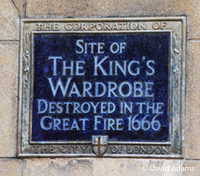
Its name lived on in that of the church St Andrew-by-the Wardrobe and that of the well-hidden and intimate Wardrobe Place (it’s located between St Andrew’s Hill and Addle Hill). There is a blue plaque which marks the site of the former building (pictured above).

Around London – Prehistoric life on show at Wellington Arch; Your favourite Michael Caine movie; Lichtenstein at the Tate; and, looking at Classical Greece through 19th century eyes…

Apologies for missing our series on Great Victorian Projects yesterday. It will resume next week. In the meantime…

Fourteen rare Victorian paintings of life in prehistoric times have gone on display at Wellington Arch near Hyde Park Corner. The watercolors – which were commissioned by MP and archaeologist Sir John Lubbock in 1869 and have never before been displayed in public together – form the centrepiece of a new English Heritage exhibition, The General, The Scientist & The Banker: The Birth of Archaeology and the Battle for the Past. The “ground-breaking” works were painted by animal illustrator Ernst Griset and were ‘informed’ by then-recent archaeological finds including stone tools and fossils. The exhibition, which also includes rare artefacts, drawings and manuscripts tells the story of archaeological pioneers who fought to bring about recognition and legal protection for Britain’s ancient monuments and looks in detail at the achievements of three men – scientist Charles Darwin, archaeologist General Pitt-Rivers and banker Sir John Lubbock. The exhibition is the first of five being held in the arch’s Quadriga Gallery to mark the centenary of the 1913 Ancient Monuments Act. Runs until 21st April. Admission charge applies. For more, see www.english-heritage.org.uk/daysout/properties/wellington-arch/.

Get Carter or The Ipcress File? Alfie or Educating Rita? The Museum of London is asking fans to vote for their favourite Michael Caine movie ahead of the opening of their new free exhibition on the actor next month. Voting for Caine on Screen can be found by following this link and closes at 5pm on 14th March after which the top four films will be revealed.  A full list of Sir Michael’s movies – and there’s more than 100 – is available on the voting form. More on the exhibition to come.

On Now: Lichtenstein: A Retrospective. This exhibition on level two of the Tate Modern on South Bank is the first major retrospective on the Pop artist Roy Lichtenstein (1923-1997) for 20 years and brings together more than 125 of his most definitive paintings and sculptures as it reassesses his work and legacy. Key works include Look Mickey (1961), Whaam! (1963) and Drowning Girl (1963). Co-organised by The Art Institute of Chicago and Tate Modern, it runs until 27th May. Admission charge applies. For more, see www.tate.org.uk.

On Now: In search of Classical Greece: Travel drawings of Edward Dodwell and Simone Pomardi, 1805-1806. This free exhibition at the British Museum looks at Greece through the eyes of classical late eighteenth and early nineteenth century scholar Edward Dodwell and his Italian artist Simone Pomardi and features works produced during their travels in 1805-06. Lent by the Packard Humanities Institute, the works have never been seen in public before. See them in Room 90. Runs until 28th April. For more, see www.britishmuseum.org.

LondonLife – Kingston Bridge, south-west London…

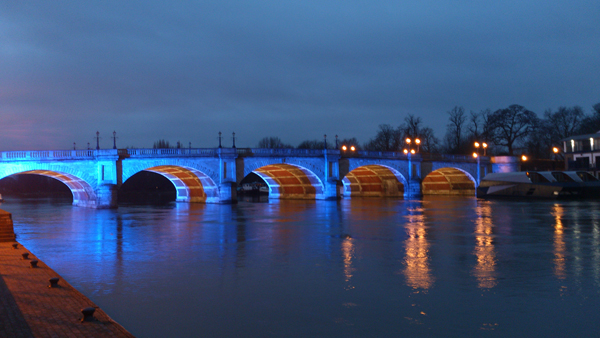
Kingston-BridgeThe photographer, TC Nepomuceno, says “I took this photo…when I was cycling by the riverside from Fulham to Kingston upon Thames. Was amazing to spot so terrific bridge! Kingston upon Thames (is) really worth a visit!”

 Taken an interesting photograph of somewhere in London? We’re always looking for interesting images of the city so if you’ve got one you reckon captures a snippet of life in London, please contact us at exploringlondon@gmail.com or via Flickr at www.flickr.com/groups/exploringlondon/.

10 Questions – Simon Murphy, curator at the London Transport Museum…

Simon Murphy is a curator at the London Transport Museum in Covent Garden – the museum is currently celebrating the 150th birthday of the Underground with a series of events including a landmark exhibition on the art of the Tube (Poster Art 150 – London Underground’s Greatest Designs)…

Underground-2How significant was the construction of the London Underground in world terms? And how does it stack up 150 years later? “The Metropolitan Railway was a true world class pioneer, but like all pioneers it made mistakes that subsequent operators learned from. Similarly the first tube railways tested the ground for others to follow. But these pioneering lines are still part of today’s world class Tube network, and some of the original stations, like King’s Cross, are still amongst the busiest, so they must have been on the right track.”

I understand the initial stretch of line ran between Farringdon and Paddington. How quickly were other sections opened? “The Metropolitan Railway’s first extension was authorised by Parliament in 1861, two years before the original line even opened. The railway made a profit in its first year, so financial backing was relatively easy to find, and the extension east to Moorgate opened in 1865, with a westward extension to South Kensington following in 1868. The Met’s main competitor, the Metropolitan District Railway, opened its first section from South Ken to Westminster in 1868. The plan was for the two companies to work together to create an Inner Circle service, but their respective directors fell out and the Circle was not completed until 1884.”

How many miles of line is the Underground composed of today? “The first underground started with less than four miles of track and seven stations; today’s system has 250 miles of track, serving 270 stations.”

When were steam trains on the Underground replaced? “Steam trains worked in central London until 1905, but were still used on the furthest reaches of the Met until 1961.”

When did the Underground take on the name ‘Tube’? “The Central London Railway opened with a flat fare of 2d in 1900, and was promoted as the Twopenny Tube – the name caught on, although the Underground has only been referring to itself officially as the Tube since the 1990s.”

Underground1It’s fairly widely known that Underground stations and tunnels were used as air raid shelters during World War II. Do you know of any other different uses they have been put to? “The station at South Kentish Town on the Northern Line closed in 1924, but the surface building, still looking very much like a station is now occupied by a branch of Cash Converters. During the war unfinished tunnels on the Central line were occupied by a secret factory run by Plessey Components. Also during the war, paintings from the Tate Gallery were stored in  a disused part of Piccadilly Circus station for safe keeping.”

Stylish design has always been an important part of the Underground’s appeal. What’s your favourite era stylistically when it comes to the Underground and why? “Most people admire the golden age of the 1920s and 30s when the Underground’s corporate identity and personality reached its peak with Charles Holden’s architecture, the roundel, Harry Beck’s diagrammatic map and the amazing posters issued in that era, but personally I find the earlier period from 1908 to 1920 more interesting. You can trace the roots of each element of today’s brand being developed at this time, under Frank Pick’s critical eye, starting with the early solid-disc station name roundels, the joint promotion of the individual tube railways under the UndergrounD brand and the introduction of Edward Johnston’s typeface. You can see the company gaining confidence and momentum, especially in relation to the increasingly sophisticated posters and promotion that Pick commissioned.”

Can you tell us a bit about how the London Transport Museum is marking the 150th anniversary? “
We started the year by bringing steam back to the Circle line, after restoring an original Metropolitan Railway carriage and overhauling an original Met steam locomotive, and have just opened our fabulous overview of the 150 best Underground posters at the museum in Covent Garden, which runs until October. We are opening our Depot store, near Acton Town station in April for a steam weekend, and have a range of lectures and evening events at Covent Garden linking to the history of the Underground and its poster art heritage. There’s also our comprehensive new history of the Tube published last year and a wide range of new products and souvenirs in our amazing shop.”

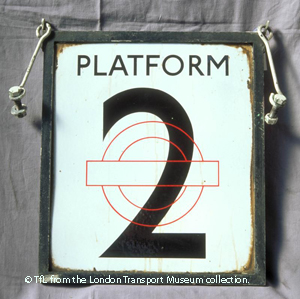
Underground3What are some of your favourite Underground-related objects on display at the museum? “The Design for Travel gallery on the ground floor is the literal and metaphorical heart of the Museum for me. Packed with close to 300 objects including signs, posters, models, leaflets and other documents, it’s hard to single out individual items, but I love the simplicity of the small ‘Platform 2’ hanging sign (pictured right) – it’s a real example of the design consistency and attention to detail that I associate with the Underground.”

And lastly, can you tell us a couple of little-known facts about the Underground? History is more than a chronological list of facts, and what one person finds fascinating sends another to sleep, so it’s quite a challenge to choose something that is little known, but genuinely interesting, but I’ll try: I grew up near Brent Cross station so I might be biased, but I reckon that if there was a top trumps for Underground lines, the Northern line would win. It has the longest escalators (at Euston), the deepest lift shaft (at Hampstead), the highest point ve sea level (on a viaduct near Mill Hill East), the longest tunnels (between East Finchley and Morden – 17 miles) and has had more names than any other line – it only became the Northern line in 1937.”

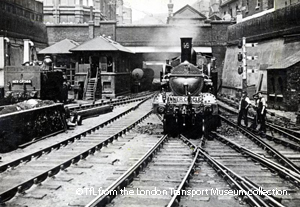
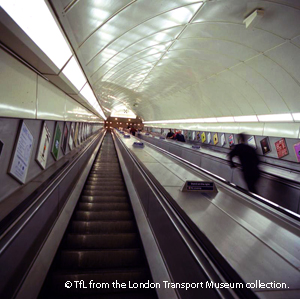
IMAGES: Top: Steam engine at Aldgate (1902); Middle: Platform 2 sign, 1930s design; and Bottom, Angel Underground Station (1990s). © TfL from the London Transport Museum collection. 

Poster Art 150 – London Underground’s Greatest Designs runs at the London Transport Museum until October. Admission charge applies. For more (including the many events around the exhibition), see www.ltmuseum.co.uk/whats-on/events/events-calendar#posterart150.

Where is it?…#57

Where-is-it--#57

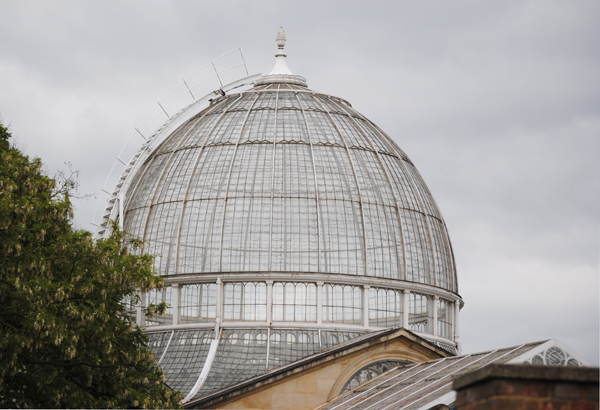
Can you identify where in London this picture was taken (obviously out of season!)? If you think you can, leave a comment below. We’ll reveal the answer early next week. Good luck!

Well done to Mike, Visiting Houses and Gardens and Roberta Stimson (via Facebook) – this is indeed the Great Conservatory at Syon Park – London home of the Duke of Northumberland – located on the banks of the Thames in west London. The magnificent structure was commissioned by the third duke, Hugh Percy, and designed by architect Charles Fowler in 1826. Constructed of gunmetal, Bath stone and glass, it is said to have inspired Joseph Paxton in his designs for the Crystal Palace. For more on Syon Park, see www.syonpark.co.uk.

Around London – Celebrating the art of the Underground and art on the web; Picasso at the Courtauld; and, Frederic Church at the National…

A new exhibition celebrating the art of the Underground opens at the London Transport Museum in Covent Garden tomorrow. Poster Art 150 – London Underground’s Greatest Designs showcases 150 posters with examples taken from each decade over the past 100 years. Artists include the likes of Edward McKnight Kauffer, Paul Nash and Man Ray. The posters were selected from the museum’s archive of more than 3,300 by a panel of experts. Visitors to the exhibition will be able to vote on their favorite poster as well as online with the most popular poster to be revealed at the end of the exhibition. The last major exhibition of Underground posters – the first commission of which was in 1908 – was held in 1963 to celebrate the system’s centenary. The exhibition is based around six themes – ‘Finding your way’, ‘Brightest London’, ‘Capital culture’, ‘Away from it all’, ‘Keeps London going’ and, ‘Love your city’. Runs until 27th October. Admission fee applies. For more on the exhibition and surrounding events, see www.ltmuseum.co.uk.

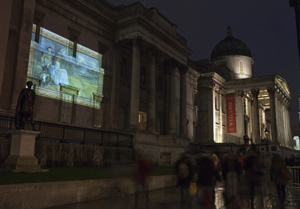
National-Gallery The external facade of the National Gallery in Trafalgar Square was decorated with artworks last Friday night (pictured right) in celebration of the completion of Your Paintings – a website which hosts the UK’s entire national collection of oil paintings (more than 210,000!). The projections – which were happening in 28 UK cities simultaneously – featured two National Gallery paintings – Van Gogh’s Sunflowers and Gainsborough’s Mr and Mrs Andrews. To see the website, head to www.bbc.co.uk/arts/yourpaintings/. PICTURE: © The National Gallery, London.

• On Now: Becoming Picasso: Paris 1901. This exhibition at The Courtauld Gallery in Somerset House on The Strand tells the story of Pablo Picasso’s break-through year as an artist – 1901 – when the then 19-year-old launched his career in Paris at a summer exhibition. The display follows Picasso from his debut and into the start of his Blue period. Works exhibited are among the first to bear his famous signature. Runs until 26th May. There is an admission charge. For more, see www.courtauld.ac.uk/gallery/index.shtml.

On Now: Through American Eyes: Frederic Church and the Landscape Oil Sketch. This free exhibition of 30 works at the National Gallery focuses on the work of Frederic Church (1826-1900), a member of the Hudson River School of artists and considered by many to be the greatest of the American landscape oil sketch artists. Works on display include those made at exotic locations such as Ed Deir, Petra, painted in Jordan in 1868, and Distant View of the Sangay Volcano, Ecuador, painted in 1857, as well as the paintings created closer to home, such as Hudson, New York at Sunset, painted in 1867. The exhibition is held in Room 1. Runs until 28th April. For more see www.nationalgallery.org.uk.

10 of London’s greatest Victorian projects – 5. Sir Joseph Bazalgette’s sewer system…

Precipitated at last by the so-called ‘Great Stink’ of 1858, Sir Joseph Bazalgette’s subterranean sewer system was a remarkable feat of engineering and made radical new inroads in improving the health on Londoners during the Victorian age.

Joseph-BazalgetteThe state of the River Thames – basically an open sewer – and the city’s water supplies had become a growing cause for concern as the population of the city – and the amount of waste they produced – increased.

Not surprisingly in the mid-1800s this led to outbreaks of cholera which killed tens of thousands (the outbreaks were generally attributed to a miasma in the air until the work of Dr John Snow eventually proved otherwise – see our earlier entry on the Dr John Snow pub here for more). But it wasn’t until the hot summer of 1858 that – unable to escape the stink of the river under their noses at Westminster – politicians decided something had to be done.

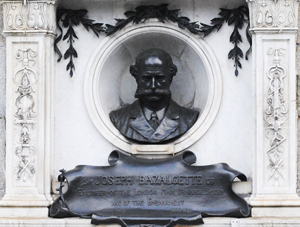
Bazalgette (depicted right in a monument at Victoria Embankment) was chief engineer at the newly formed Metropolitan Board of Works (he was appointed in 1856) when legislation was passed which paved the way for the board to create a sewer system underneath London’s streets to serve the growing metropolis. He designed an ingenious system in which the flow from existing sewers and underground rivers was intercepted before it could reach the river and diverted along new low level sewers to treatment works.

All up, the £4.2 million project involved the construction of 1,100 miles of street sewers and five major brick-walled sewer tunnels which ran for some 82 miles along the banks of the Thames and were large enough to cope with the rising demand as the city grew. It also meant the creation of several massive embankments along the river, narrowing the Thames as land was reclaimed from the river.

The work proceeded apace and much of the system was completed by 1866 (it was officially declared open by Edward, the Prince of Wales in 1865). The Victoria and Albert Embankments – located on the northern and southern banks of the Thames respectively – were both open by 1870 and the Chelsea Embankment further upriver was completed in the mid-1870s. Bazalgette was knighted for his efforts in 1875.

The system, which also featured a series of ornately decorated pumping houses, has since been considerably extended and upgraded but at its heart is still that which was created by Sir Joseph and his team.

For more on the creation of Bazalgette’s sewer system, try Stephen Halliday’s The Great Stink of London: Sir Joseph Bazalgette and the Cleansing of the Victorian Metropolis. For a mystery set against the backdrop of London in the mid-1800s, check out Clare Clark’s novel The Great Stink.

LondonLife – ‘White Shirt Week’ in St James’s…

Freddie-Fox-launches-White-Shirt-Week-in-St-James's-London


Freddie Fox (who plays Lord Alfred Douglas opposite Rupert Everett as Oscar Wilde in David Hare’s The Judas Kiss now playing at the Duke of York Theatre) marks the start of ‘White Shirt Week’ which kicked off in St James’s on Monday. The West End area is home to Jermyn Street which apparently boasts “the highest number of world renowned shirt makers on one luxury shopping street” with each shirt maker having their own signature design. While the origins of the white shirt date back as far as ancient Egypt, it was only in more recent centuries that in the UK the white shirt developed from being simply an undergarment to a fashion item in its own right – in fact, by the 19th century, the white shirt was worn by gentlemen as a statement that they weren’t engaged in manual labour and could employ servants to launder it. For more on St James’s, see www.stjameslondon.co.uk.

Where’s London’s oldest….shopping arcade?

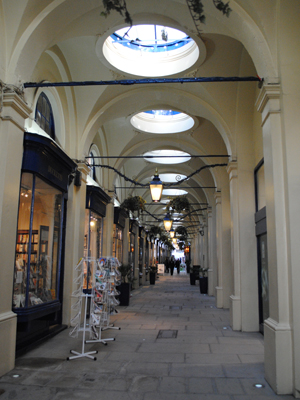
Royal-Opera-ArcadeFollowing our recent article on John Nash (see the earlier post here), we’re taking a look at one of his projects as part of our series on London’s oldest. Built between 1816-18,  the Royal Opera Arcade – which features a series of shops running down the side of a covered central hall – is not only the oldest existing shopping arcade of its type in London but apparently in the world.

The 12 foot wide covered arcade was built on the west side of what was previously the Royal, King’s or Haymarket Opera House – Nash and George Repton completed the exterior of the property originally built by Sir John Vanbrugh at the same time the arcade was built – but is now the site of Her Majesty’s Theatre (the former theatre was destroyed in a fire in 1867).

It extends between Pall Mall and Charles II Street in the West End, running parallel with Haymarket. Burlington Arcade, frequently cited as the city’s oldest, was in fact completed a year later.

The arcade originally had 19 shops – each with a cellar and mezzanine level – running down its west side. It now features shops which sell everything from fine wines and art to books and sandwiches.

For more on the Royal Opera Arcade, see www.royaloperaarcade.com.

Treasures of London – ‘Drake’s Cupboard’…

One of the foremost seafarers of the Elizabethan age, Sir Francis Drake became the second sea captain to circumnavigate the globe when he did so in his renamed vessel, The Golden Hind, between 1577 and 1580.

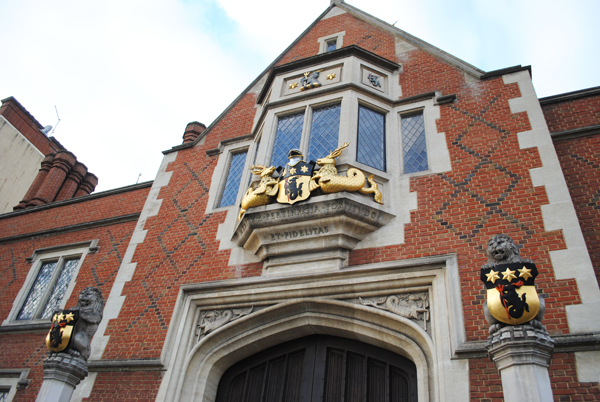
Drake's-CupboardWhile it is not believed he was a member of the Middle Temple – one of the Inns of Court, he certainly had some connections and a visit to Middle Temple Hall is recorded in August, 1586, when he was congratulated having just returned from a voyage to the Spanish Indies.

His ongoing connection to the inn can be found in two objects which remain at the hall today.

The first is a ‘cupboard’, known as Drake’s Cupboard (cup board being an alternative for table), it is reputedly to have been made from a hatch cover off the Golden Hind (there’s a replica of this ship in Southwark). Replacing an earlier table, the cupboard is used in various ceremonial aspects of life at the Inn such as, for example, being the table on which members sign a book when they are called to the Bar.

The second, meanwhile, is a lantern which hangs over the entrance to the hall and was reputedly taken from the poop deck of the ship (this was destroyed during the bombings of World War II and a replica now hangs in its place).

Both items can only be viewed when the hall is opened to the public on rare occasions like the annual Open House London event. For more on Middle Temple Hall, see our earlier entry here and www.middletemple.org.uk.

Around London – Chinese New Year; Orchids at Kew; Lucian Freud’s donation to the National Gallery; and, Man Ray at the NPG…

Chinese New Year celebrations will go off with a bang in Chinatown in the West End this Saturday. The festivities, which are the largest outside Asia, will include a lion dance, fireworks, and a variety of performers – all gathered to herald the start of the Year of the Snake. The celebrations will kick off with a parade which will leave Trafalgar Square at 10am and end at Rupert Street in Chinatown at 11am. At 12pm, dignitaries will gather in Trafalgar Square for the Dotting of the Eye ceremony which will bring the dragons and lions to life and performances will the take place until 5.30pm. At 5.55pm a fireworks display will mark the end of the day’s celebrations. For more, see www.chinatownlondon.org/page/chinese-new-year-2013/378.

Like orchids? Want to escape the gloom of winter? Kew Gardens are celebrating the exotic plant with a dazzling display in the Princess of Wales Conservatory. Thousands of orchids will be on show as part of ‘Orchids at Kew’ and the plants will be used to recreate the giant waterlily flower, Victoria amazonica, which can normally be seen in the conservatory in the summer months. There are special behind the scenes tours, food and an adult education course for the truly interested. Charges apply. Opening on Saturday, 9th February, the display can be seen until 3rd March. For more, see www.kew.org.

The late artist Lucian Freud has donated a treasured portrait – Jean-Baptiste Camille Corot’s L’Italienne ou La Femme à la Manche Jaune (The Italian Woman, or Woman with Yellow Sleeve) – to the nation in gratitude for the welcome his family received when they arrived as refugees from Berlin. The Corot has been allocated to the National Gallery by the Arts Council England and was done under the Acceptance in Lieu scheme, which allows people to transfer works of art into public ownership instead of paying inheritance tax.  The painting – which was last seen in a show at the Louvre, Paris, in 1962, and was previously owned by Hollywood Golden Age star Edward G. Robinson – is on display on Room 41 of the gallery. For more, see www.nationalgallery.org.uk.

On Now: Man Ray Portraits. The first museum exhibition to focus on the photographic portraiture of the 20th century artist Man Ray, this display at the National Portrait Gallery features more than 150 vintage prints taken between 1916 and 1968. Subjects include everyone from Catherine Deneuve and Ava Gardner to Salvador Dali and Aldous Huxley. The majority of works have never been exhibited in the UK before. Runs until 27th May. Admission charge applies. For more, see www.npg.org.uk.

Like to tell others about your upcoming event in London? If you’ve got an event coming up, please send any press releases or details to exploringlondon@gmail.com.

10 of London’s greatest Victorian projects – 4. The Palace of Westminster…

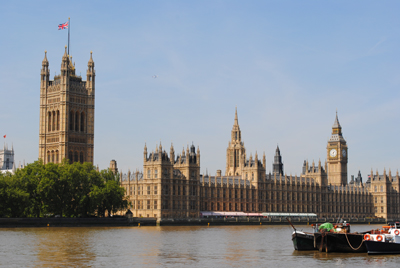
Commonly thought to be older than it actually is due to its Gothic stylings (although, to be fair, parts of it do date from medieval times), the Palace of Westminster – or, as it’s more commonly known, the Houses of Parliament – didn’t actually take on much of its current appearance until the latter half of the 19th century.

The need for a new building for parliament arose after 1834 when a fire, caused by the overheating of two underfloor stoves used to incinerate the Exchequer’s obsolete tally sticks, tore through the former complex, leaving only some structures from the old palace intact. They included the 11th century Westminster Hall (the largest in Europe when it was built), 14th century Jewel Tower and a chapterhouse, crypt and cloisters, all of which was once attached to the now gone St Stephen’s Chapel.

Houses-of-Parliament2While King William IV offered the use of Buckingham Palace for Parliament, the idea – along with a host of other options – was rejected as unsuitable. Instead, a competition was held for a new design and after almost 100 entries were considered, architect Charles Barry and his design for a new palace in the perpendicular Gothic style was chosen. Interestingly, while Barry was a classical architect, under the terms of the competition, designs were required to be in a Gothic style, thought to embody conservative values .

Incorporating some of the remains of the old palace – including Westminster Hall but not the Jewel Tower which to this day stands alone – the design was based around a series of internal courtyards with the House of Commons and House of Lords located on either side of a central lobby (first known as Octagonal Hall). The design involved reclaiming some land from the Thames so the building’s main river-facing facade could be completed.

Towers stand at either end of the complex – the Victoria Tower over the Sovereign’s Entrance at the southern end of the complex (for many years the tallest square stone tower in the world) and the narrower tower formerly known as the Clock Tower which houses the bell Big Ben, at the northern end – and there is a central Octagonal Tower which stands directly over the Central Lobby. The Clock Tower, incidentally, was renamed the Elizabeth Tower last year in honour of Queen Elizabeth II’s Diamond Jubilee (for more on it and Big Ben, see our earlier entries here and here).

Other towers include the Speaker’s Tower (located at the northern end of the building on the waterfront, this contains a residence for the Speaker), the Chancellor’s Tower (located at the southern end, it too contained a residence originally used by the Lord Chancellor) and St Stephen’s Tower – located in the middle of the building’s west front, it contains the public entrance to the building. Significant other rooms in the palace complex include the Robing Room – where the Queen puts on her ceremonial robes and crown before the State Opening of Parliament – and the Royal Gallery, used for state occasions.

The foundation stone (the building was constructed out of sand-coloured limestone from Yorkshire) was laid in 1840 and construction of the monumental building – which features more than 1,100 rooms and two miles of passageways – wasn’t completely finished until the 1870s although most of the work had been completed by 1860 (the year Barry died). The House of Lords first sat in their new chamber in 1847 and the House of Commons in 1852 (it was at this point that Barry was knighted for his work).

The cost, meanwhile, originally estimated at less than £750,000, ended up coming in at more than £2 million.

Much of the interior decoration owes its appearance to the Gothic revivalist Augustus Pugin who designed everything from wallpapers, to floor tiles and furnishings. Pugin also helped Barry with the external appearance but like Barry died before the project was completely finished (in 1852).

The palace was bombed numerous times in World War II – in one raid, the Commons Chamber was destroyed as firefighters opted to save the much older Westminster Hall instead. It was later rebuilt under the direction of Sir Giles Gilbert Scott and completed by 1950. Other aspects of the building have also been restored.

A Grade I-listed building classified as a World Heritage Site, Barry’s Houses of Parliament remain one of London’s most iconic structures. We’ll be looking in more detail at some of the building’s features in future posts.

WHERE: Houses of Parliament (nearest Tube stations are Westminster, St James’s Park and Embankment); WHEN: Tours (75 minutes) are run from 9.15am to 4.30pm on Saturdays (also six days a week during summer opening); COST: £15 adults/£10 concessions/£6 children five to 15 years (children under five are free). Prices go up after 1st April – check website for details and to purchase tickets (tours for UK residents, including climbing the Elizabeth Tower, can also be arranged through your MP); WEBSITE: www.parliament.uk.

For more, see Robert Wilson’s guide to the The Houses of Parliament or David Cannadine’s indepth,  The Houses of Parliament: History, Art, Architecture. For more on the story of the fire in 1834, see head parliamentary archivist Caroline Shenton’s recent book The Day Parliament Burned Down.

LondonLife – The one-time home of King Richard III…

Crosby-HallIn honour of the stunning news this week that a skeleton found under a Leicester carpark last year is indeed that of the King Richard III, here’s a picture of the front of Crosby Hall, London home to the king when he was still merely the Duke of Gloucester.

Now located in Cheyne Walk, Chelsea, the Grade II* hall was previously located in Bishopsgate and was the great hall of the 15th century property Crosby Place. As well as being occupied by Richard who rented it from the owner in 1483, a wool merchant named Sir John Crosby (in fact, it also appears in a scene of William Shakespeare’s play, Richard III), the property – built between 1466-75 – was also, from 1523-24, the home of Sir Thomas More, the ill-fated sixteenth century chancellor of King Henry VIII.

The hall was moved piece-by-piece to Chelsea in 1910 when it was threatened with demolition and now stands on land where there was once an orchard owned by Sir Thomas. It served as a dining hall for the British Federation of University Women but is now in private ownership.

The body was confirmed as being, “beyond reasonable doubt”, that of King Richard III, England’s last Plantagenet king, at an extraordinary press conference at the University of Leicester yesterday. Bent by severe scoliosis of the spine, the skeleton’s back had been further twisted to fit into the hole dug for it near the high altar at the church of Grey Friars which had previously stood on the site. Work has now begun a new tomb for the king at nearby Leicester Cathedral.

King Richard III was killed at the Battle of Bosworth on 22nd August, 1485, and was the last English king to die in battle. The researchers found the body was likely to have been killed by one of two fatal wounds – one in which the base of his skull had been sliced off with a weapon believed to be a bladed weapon like a halberd and another from a sword which penetrated his brain. The evidence showed the body had been significantly mutilated after death with a total of 10 wounds on the skeleton.

While radiocarbon dating placed the body in the right time frame and the wounds on the body and burial site were consistent with historical evidence, the key to the identification was the matching of the bones’ DNA with that of a Canadian man, Michael Ibsen, a direct descendant of the king’s sister, Anne of York.

For more on the amazing find, see www.le.ac.uk/richardiii/.

Famous Londoners – John Nash…

Arguably the greatest architect of Regency London, John Nash’s imprint can still be seen in numerous sites around the city, from the master-planning of Regent’s Park and Regent Street to the beautiful buildings of All Soul’s Church in Langham Place and Marble Arch on the edge of Hyde Park.

Born the son of a Welsh millwright in Lambeth, London, on 18th January, 1752, Nash – who went on to work in a range of different architectural styles – trained as a draughtsman under the tutelage of architect Sir Robert Taylor and in 1777 established his own business as a builder and surveyor.

John-NashBut he certainly didn’t meet with immediate success and, following failure as a building speculator (he built properties in Bloomsbury Square and Great Russell Street but failed to make enough money from the venture – there’s a blue plaque on one of the houses, which he lived in, at 66 Great Russell Street), was declared bankrupt in 1783.

Meanwhile, his personal life was also in turmoil during these years – in 1775 he had married, Jane Kerr, the daughter of a Surrey surgeon, but separated from her in the early 1780s after various troubles including her eventually apparently having a child with a Welshman named Charles Charles, who is said to have died in prison after he was jailed for adultery.

Brought down by his misfortune, in the mid 1780s Nash moved to Carmarthen in Wales where he had family. Taking up work here, by the late 1780s he was designing prisons – the first was at Carmarthen – and worked on a number of other prominent buildings including St David’s Cathedral and various country houses.

Rising to prominence in Carmarthen society, by 1797, however, Nash was again working in London, initially in partnership with the renowned landscape architect Humphrey Repton with whom he had formed a business relationship some years earlier (although the partnership had soured over finances by 1800).

He built a substantial home at 29 Dover Street in Mayfair and in 1798, his first wife presumably dead, he married his second wife, Mary Anne Bradley, and soon started work on building a Gothic-inspired residence for them, known as East Cowes Castle, on the Isle of Wight. It was completed in 1802 but enlarged some years later.

Nash designed numerous country properties in the early 19th century, inspired by everything from castles to Italianate architecture, both in England and Ireland and soon came to the attention of the Prince Regent, the future King George IV (there was a rumour his wife was one of the prince’s discarded mistresses).

In 1806 he was officially made Deputy Surveyor General in the Office of Woods and Forests – the office which managed the Crown estate, and from 1815 on, he largely worked for the prince alone. Among the major London commissions from his royal patron were the design of Regent Street (he and his wife moved into number 14 in 1823) and the development of Regent’s Park on land formerly known as Marylebone Park and surrounding housing estates (for more on The Regent’s Park, see our earlier entry here). He also redeveloped St James’s Park.

In 1815, he was commissioned to develop the Prince Regent’s Marine Pavilion in Brighton and by 1822 had transformed the building into the spectacular Royal Pavilion which can be visited there today.

Nash was also involved in the development of The Regent’s Canal – which linked the Grand Union Canal in London’s west to the River Thames in London’s east and was completed in 1820 – and built many of the grand villas which still line it (for more on Regent’s Canal, see our earlier entry here).

Becoming an official architect to the Office of Works in 1813 (an appointment which only ended in 1832, three years before his death), Nash went on to design churches – including All Soul’s in Langham Place (he’s depicted above in a bust at the church) – as well as West End theatres including the Haymarket Theatre and the Royal Opera House (which burnt down in 1867) as well as the adjacent Royal Opera Arcade and residences including Carlton House Terrace and Clarence House (for more on this, see our earlier entry here).

Other major commissions included the redevelopment of Buckingham Palace (parts of the current building are his work but the main facade isn’t – for more on the palace history, see our earlier entry here) and the Royal Mews, and the creation of Marble Arch, originally envisaged as the main gateway to the palace (see our earlier entry here). Nash also designed a conservatory for Kew Gardens.

Nash’s close relationship with the Prince Regent (who become King George IV on 29th January, 1820), meant that when the king died in 1830, he found himself on the outer (and his reputation took many years to recover thanks to his association with the unpopular king). With no knighthood forthcoming for his efforts (unlike many of his contemporaries) and the chance of further work unlikely (his work on Buckingham Palace had been left unfinished due to concerns over rising costs), Nash retired to his house on the Isle of Wight.

He died there on 13th May, 1835, and was buried in the churchyard at St James’s Church in East Cowes. He was survived by his wife who, having settled his debts, retired to Hampstead.

For an in-depth study of Nash, try Geoffrey Tyack’s book, John Nash: Architect of the Picturesque.

Where is it?…#56

Where-is-it--#56

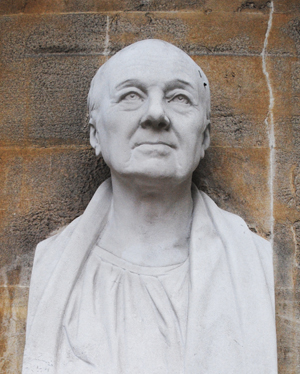
Can you identify where in London this picture was taken and who the statue represents? If you think you can, leave a comment below. We’ll reveal the answer early next week. Good luck!

No takers this week. This is a statue of John Flaxman (1755-1826), located on the facade of Burlington House in Piccadilly, home of the Royal Academy of Arts since 1867. The sculptor and draughtsman, a leading figure of the Neoclassicism movement, was made an associate of the RA in 1797. For more on the Royal Academy of Arts, see www.royalacademy.org.uk.