Where is it?…#54

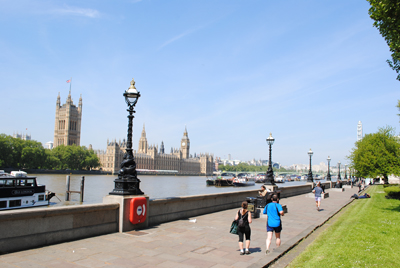
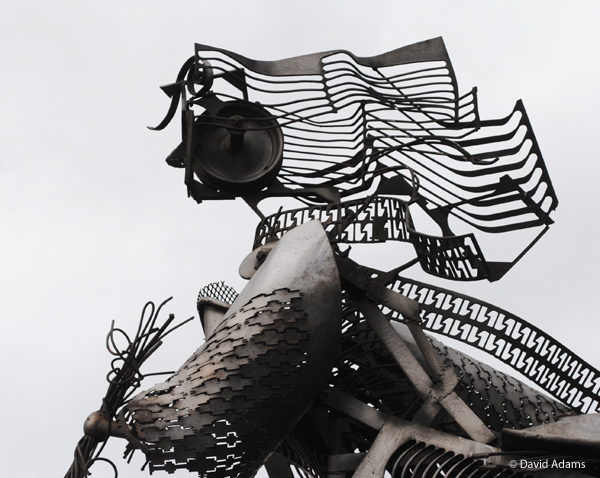
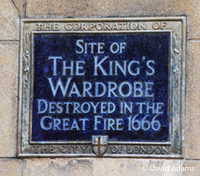
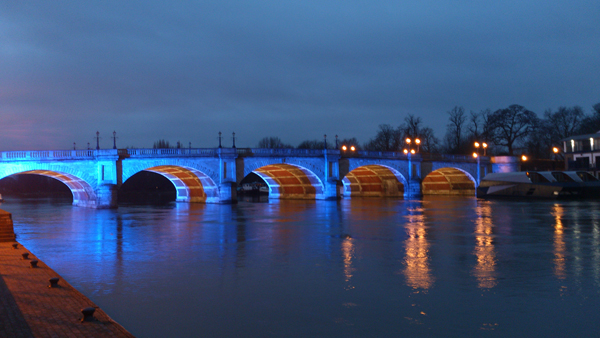
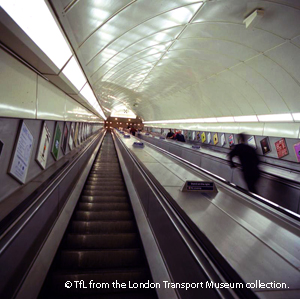
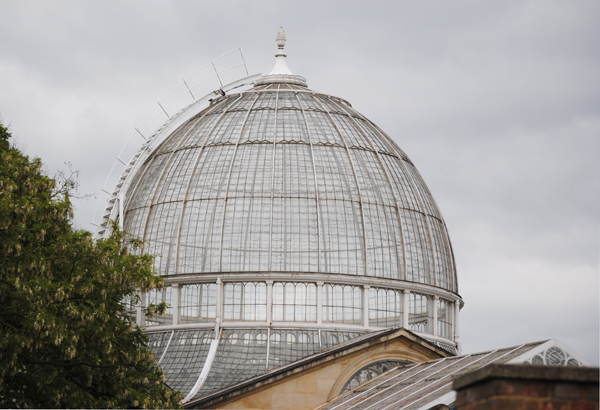
Where-is-it--#54The return for 2013 of our series in which we ask you to identify where in London this picture was taken. If you think you can identify this picture, leave a comment below. We’ll reveal the answer early next week. Good luck!

Thanks for the comments Parktown but this ship is not in Rotherhithe nor does it have anything to do with Lloyds! This is part of the decorative scheme of Chelsea Bridge which crosses the Thames between Chelsea and Battersea Park in London’s west. Initially known as Victoria Bridge, the first bridge here opened in 1857 (Albert Bridge, which opened later, is located further west). But increased traffic eventually led to its demolition in the 1930s (it had been renamed some years earlier to avoid the association of a royal name with a bridge which had become structurally unsound) and the current bridge, the first self-anchored suspension bridge (that is, the suspension cables attach to the deck and don’t extend to the ground) in Britain, was opened on the site in 1937. This gilt galleon sits atop a decorative lamp post at the bridge’s entrance (there are several) and below it is the coat-of-arms of the now defunct London County Council.

Lost London – Frost fairs…

 As London undergoes the big chill with much of the rest of the country, we thought we’d take a quick look at the frost fairs which were once held on top of the frozen River Thames.

While records reveal the Thames froze over as far back as the city’s Roman era, the first recorded ‘frost fair’ dates from the mid-16th century (Queen Elizabeth I is said to have attended one in 1564) while the last was held in 1814.

Frost_Fair_of_1683While the lower temperatures played a role in allowing the ice to get thick enough to hold frost fairs on top (the period between the 14th and 19th centuries is known as the ‘Little Ice Age’ in northern Europe), so too did the fact that the Thames was broader and shallower than it is now, not to mention the narrow arches of Old London Bridge (it was demolished in 1831 – for more on this, see our earlier entry) which slowed the waters of the Thames.

The fairs were set up in a range of locations along the river. Descriptions of them talk of a range of activities being carried out on the river’s frozen surface – yes, the use of sleds and skates but also things like bear-baiting, coach, horse racing, dancing and puppet plays as well as the setting up of booths or stalls from which traders sold food, souvenirs, and, importantly, drink.

One of the longest of the fairs – recorded by diarist John Evelyn – was held over the winter of 1683-84 and located between Temple and Southwark. It featured streets of stalls with different traders grouped in different areas. King Charles II himself was a visitor.

During the last and biggest frost fair, held on the river near Blackfriars Bridge, a street known as ‘City Road’ ran down the middle of the Thames and donkeys gave people rides.

There is a frieze depicting a ‘frost fair’ underneath the southern end of Southwark Bridge.

PICTURE: Detail of an image of the Frost Fair of 1684 with London Bridge in the background. Source: Wikipedia.

Around London – Duchess of Cambridge at the NPG; Imperial War Museum closed for now; and, Frozen London…

The controversial first official painted portrait of Kate Middleton, the Duchess of Cambridge, has gone on display at the National Portrait Gallery. Unveiled on 11th January, the portrait by Paul Emsley has already sparked considerable criticism. Emsley, the 2007 winner of the gallery’s BP Portrait Award competition, was chosen by the gallery’s director Sandy Nairne to paint the portrait which took three-and-a-half months to paint. It is now on permanent display in the gallery as part of Contemporary Collections in the Lerner Galleries in Room 36, on the ground floor. Admission is free. For more (including a film on the making of the portrait), see  www.npg.org.uk.

The Imperial War Museum has closed its doors until July this year as the museum undergoes an extensive refurbishment. In July, the museum will launch a new exhibition –  Horrible Histories®: Spies, and also reopen of The Lord Ashcroft Gallery: Extraordinary Heroes, The Holocaust Exhibition, Secret War, A Family in Wartime and the Explore History Centre. The redevelopment, meanwhile, will continue until summer 2014 when the brand new First World War Galleries will be opened, marking the 100-year anniversary of the start of the First World War. For more, see www.iwm.org.uk/visits/iwm-london.

On Now: Frozen London. This exhibition at the London Metropolitan Archives looks at the impact of some of the most severe winters the city has ever experienced which occurred between 1683 and 1895. A highlight is a look at the Frost Fairs which took place on the River Thames during that time. Runs until April 25th. Admission is free. For more, follow this link. Correction: Opened 21st January-25th April.

10 of London’s greatest Victorian projects – 1. Royal Albert Hall…

The London Underground’s first railway journey took place on 9th January, 1863, and to celebrate we’re taking a look at 10 great Victorian-era projects in London. First up is Royal Albert Hall in South Kensington.

Royal-Albert-HallOpened on 29th March, 1871 (and in continuous use ever since), Royal Albert Hall was built in fulfilment of Prince Albert’s dream of creating a hall that would stand in the heart of the South Kensington estate and provide a focal point for the promotion of the arts and sciences.

It was on the back of the success of the Great Exhibition held in Hyde Park in 1851, that Prince Albert, Prince Consort to Queen Victoria, proposed the creation of a permanent arts and sciences precinct in South Kensington and advised the purchase of land for that purpose (the hall is located on land once occupied by Gore House). But it wasn’t until after his death in 1861 that his vision was actually realised.

Construction of the hall – which was to serve as the centrepoint of the cultural precinct which became known, somewhat derisively, as Albertopolis – started in April 1867 (initially to be known as The Central Hall of Arts and Sciences, the hall apparently had its named changed to the Royal Albert Hall of Arts and Sciences by Queen Victoria while she was laying the foundation stone on 20th May that year – around 7,000 people attended the event). It was designed by engineers Captain Francis Fowke and, after his death, Lieutenant Colonel Harry Darracott Scott, based on concepts put forward by the man described as the “driving force” behind the project, Henry Cole (later the first director of what is now the Victoria and Albert Museum). He had been inspired by the Roman amphitheatres he had seen while touring in southern France.

While initial proposals had suggested the hall would accommodate as many as 30,000 people, this was later scaled back to about 7,000 (and today the figure is apparently about 5,500 thanks to fire regulations).

The central auditorium, measuring 185 feet by 219 feet, is covered by a glazed dome constructed of wrought iron girders and was the largest structure of its kind in the world at the time of its building. The hall’s exterior was built from about six million red bricks and features an 800 foot long terracotta frieze showing figures engaged in a range of cultural pursuits. Much of the interior decorative detail was added later.

So overcome was Queen Victoria at the building’s opening in 1871 that Edward, the Prince of Wales, had to speak in her place, declaring it open on her behalf before a crowd which included then Prime Minister Benjamin Disraeli. Her only reported comment on the hall was that it reminded her of the British constitution.

The Grade One listed hall – which thankfully only suffered minor damage during World War II bombing raids (the German pilots apparently used its bulk as a navigation aid) – has since undergone substantial modifications including works undertaken to improve the hall’s acoustics, the replacement of gas lighting (electricity was first demonstrated in the hall in 1873) and demolition in 1889 of an adjoining glass conservatory to its south. A massive programme of improvements was carried out between 1996 and 2004 at the cost of more than £69 million.

The list of those who have performed or spoken at the hall reads something like a who’s who – among them are classical composers Wagner, Verdi, Elgar and Rachmaninov, singers and musicians including Frank Sinatra, Jimi Hendrix, The Beatles, The Who, Eric Clapton, Elton John, Adele, and Jay Z as well as sports personalities including boxer Mohammed Ali and tennis player John McEnroe, explorers like Sir Ernest Shackleton, world figures such as Queen Elizabeth II, Sir Winston Churchill, former South African president Nelson Mandela, the Dalai Lama and former US president Bill Clinton and other high profile personalities such as Albert Einstein, Alan Ginsberg and Paul Robeson.

Among the other events held in the hall have been a marathon race, Greco-Roman wrestling and two Welsh National Eisteddfod’s (in 1887 and 1909). One of the most popular series of events now held there each year are the BBC Promenade Concerts, known as The Proms they include more than 70 events, which have been held in the hall since World War II.

A Victorian masterpiece. For more on the hall, see www.royalalberthall.com.

LondonLife – Celebrating London Underground’s 150th…

London-Underground1

Metropolitan Locomotive No 1 recreated the first London Underground journey, which took place on 9th January, 1863, on the Metropolitan Line between Paddington and Farringdon, as part of the network’s 150th anniversary celebrations last Sunday. The newly restored locomotive was the last to be built at Neasden in 1898 by the Metropolitan Railway. It was pulling the Metropolitan Railway Jubilee Carriage No 353, the oldest operational underground carriage in existence. Ex Metropolitan Railway electric Locomotive No.12 Sarah Siddons also formed part of the train. The train will also be running this coming Sunday (20th January) and on special occasions throughout this year and is just one of a series of events planned by the London Transport Museum to mark the anniversary of what is the world’s oldest underground railway. They include an upcoming exhibition of London Underground’s poster art (more on that to come). For more, see www.ltmuseum.co.uk. PICTURES: © Transport for London from the London Transport Museum collection.

London-Underground3

Where’s London’s oldest…Thames tunnel?

While the Greenwich foot tunnel may these days be more well-known due to the fact it is still open to pedestrians, London’s oldest under-Thames tunnel (also credited as the oldest underwater tunnel in the world) actually runs between Rotherhithe on the river’s southern bank and Wapping on the northern.

Thames_Tunnel-in-2010First opened in 1843, the Thames Tunnel (pictured left during a brief reopening to pedestrians in 2010) was the first major project of star Victorian engineer (and delightfully named) Isambard Kingdom Brunel (who, at the age of just 19 started work on the job with his father, a French engineer named Marc Isambard Brunel) and was known for a time as the eighth Wonder of the World.

It was constructed after demand grew for a way to transport goods across the crowded Port of London to the east of London Bridge. Given the height of the masts of larger ships, a bridge was deemed impracticable with the ramps required to take wheeled transport to the necessary height far too long (although this problem was overcome at the end of the 1800s by the use of new bascule technology in the construction of Tower Bridge).

Following several failed attempts to dig a tunnel under the Thames, Marc Brunel was given permission to build the new tunnel in the mid 1820s. The project relied on the use of a ‘tunnelling shield’, a then state-of-the-art technological solution to under river tunnelling which had only a few years earlier been patented by Marc Brunel and Thomas Cochrane, and Brunel initially thought the project would only take three years (it ended up taking as many as 18).

Construction by the newly formed Thames Tunnel Company, which had the support of none other than the Duke of Wellington, commenced in early 1825 at the Rotherhithe end. The shield enabled miners to dig out the tunnel while bricklayers came along behind them. While it significantly reduced the risk of a collapse (although several floods still did occur, taking the lives of six men – a fact which didn’t apparently much deter the sightseers who paid for the privilege of seeing the shield in operation), working conditions remained terrible with the men constantly showered with water from the river which was at that time the city’s main sewer. How many died indirectly as a result of working on the project is unknown.

Brunel-plaqueIndeed, such was the stress of the project that Marc Brunel, later knighted for his efforts in building the tunnel, himself suffered a stroke during its construction. Isambard Brunel, who took over as the project’s engineer when the resident engineer fell ill in 1826, himself came close to being killed when he had to flee the flooding tunnel.

After much delay (including seven years in which the unfinished tunnel was left untouched) and several more disasters, the tunnel was finally completed in November, 1841.

After being fitted out with lighting, spiral staircases and roads in the following years, it was finally opened to pedestrians only on 25th March, 1843. While it was originally envisaged that the primary purpose of the tunnel would be to transport goods under the river, this never occurred.

Still, it did capture the public’s attention and as many as 50,000 people walked through the tunnel on the opening day (among the initial visitors to the tunnel was Queen Victoria herself). Within 10 weeks of its opening, a million people (a figure equal to what was then half the population of London) had reportedly passed through it.

Despite the number of people initially using it, however, the tunnel was still not a financial success and over the ensuing years became noted as a gathering place for unsavoury types. In 1865 it was purchased by the East London Railway Company which subsequently incorporated the tunnel into its railway network with both the Wapping and Rotherhithe entrance shafts converted into stations. It later become part of the London Underground network – the  – and since 2010 has been part of the London Overground.

Both stations are still in use and you can get a good sense of what the tunnel was like by riding the overground between Rotherhithe and Wapping. The Brunel Museum in Rotherhithe – actually housed within a building originally used to house machinery for draining the tunnel – see plaque above – is also a great place to find out more about the project and Brunel. Visit www.brunel-museum.org.uk for details.

PICTURES: Top – Lars Plougmann (Wikipedia)/Other – David Adams

For more on the life of Brunel, see Steven Brindle’s Brunel: The Man Who Built the World.

Exploring London’s taking a very short break…

After a busy year, we’re taking a week off – our usual coverage will resume on 14th January. In the meantime, feel free to browse through our extensive archives. And stay tuned for some new features being launched this year…

Exploring London’s 10 most popular posts for 2012 – 2 and 1…

And so we come to the final two entries in our countdown and both, not suprisingly, are part of our Diamond Jubilee related coverage…

2. LondonLife – A look back at Queen Elizabeth II’s reign. Concerning a V&A exhibition of portraits of the Queen.

1. Celebrating the Diamond Jubilee with 10 royal London locations – 5. Buckingham Palace. One of a series looking at London locations associated with the Queen, this examined some of the history of London’s most famous palace.

Wishing all our readers a very Happy New Year!

Exploring London’s 10 most popular posts for 2012 – 4 and 3…

4. Around London – Olympic Rings unveiled on Tower Bridge; London from above; Blake on Primrose; V&A illustrations; and, Munch at the Tate Modern. More on an Olympic theme.

3. LondonLife – Florence Nightingale remembered. A piece mentioning the annual service at Westminster Abbey commemorating the life of the ‘Lady with the Lamp’. Part of our LondonLife series.

Exploring London’s 10 most popular posts for 2012 – 6 and 5…

Both of the next two are from our Thursday updates – Around London…

6. Around London: Olympic Torch Relay hits London; mascots pop-up all over the city; and Shakespeare at the British Museum – not a surprising mention, given the Olympic theme;

5. Around London – Butler’s Retreat reopens in Epping Forest; Designs of the Year; and, Lucian Freud’s last work. The reason for this update’s inclusion remains a bit of a mystery – but it was a big year for the late Lucian Freud.

Exploring London’s 10 most popular posts for 2012 – 8 and 7…

8. Olympics Special – London bridges aglow. A piece showing how many of inner London’s bridges were illuminated at night during the Games.

7. LondonLife – The Queen visits the newly transformed Kensington Palace. Queen Elizabeth II pays a visit to mark the completion of a £12 million, two year renovation project at Kensington Palace.

Exploring London’s 10 most popular posts for 2012 – 10 and 9…

And so the countdown begins…

10. LondonLife – Unveiling the Bomber Command Memorial. Marking the unveiled of the much anticipated Bomber Command Memorial in Green Park in late June.

9. Where’s London’s oldest…shop? Part of our series looking at London’s oldest buildings and features, this looked at The Old Curiosity Shop in Portsmouth Street, commonly credited with being London’s oldest shop. The fact that it tied in with the bicentenary of the birth of author Charles Dickens, who wrote a book of the same name, no doubt helped it into our list.

Merry Christmas from Exploring London!

Christmas3Wishing you a very Merry Christmas for 2012! We’ll be posting our most popular posts of 2012 countdown later this week…

LondonLife – Forget the halls, they’re decking the city…part two…

There’s still a weekend to go before Christmas and if, having finished all Christmas shopping, you’re still in the mood for seeing some light displays, here’s some more places to look for some amazing (and in some cases historic), Christmas decorations (for the first part of this overview, head here)…

Carnaby-StreetLast week we mentioned some of the key sites to look for light displays in the West End this Christmas. Some of the other places to look include: the iconic shopping strip of Carnaby Street (decorations there this year are inspired by the 50th anniversary of the Rolling Stones – pictured) as well as South Molton Street, off Oxford Street (which again features some beautiful illuminated archways), and streets throughout St James (the St James Christmas lights were this year switched on by opera star Katherine Jenkins who earlier led a carol service at St James’s Church) and Mayfair.

Around Bow Lane and Watling Street in the City of London. Daubed with more than 10,000 lights, these narrow streets provide a wonderful sense of London past.

Marylebone. The lights here are well worth venturing out for. Turned on this year by Strictly Come Dancing‘s Claudia Winkleman.

Historic West End arcades. Still a place for fashionable shopping and tasteful Christmas decor, these include the Burlington Arcade, Royal Arcade, Princes Arcade and the Piccadilly Arcade.

And, of course, throughout London many shops have Christmas window displays. They include that of Fortnum & Mason in Piccadilly which this year have a Dick Whittington theme (see our earlier post here); Harvey Nichols in Knightsbridge which have gone with an oriental theme; Harrods in Brompton Road which have a Disney Princess theme; and Liberty in Great Marlborough Street which have gone with a theme inspired by the age of steam trains.

Of course, our list is by no means been comprehensive and is only confined to London’s heart – please share any other sensational Christmas decorations you’ve come across elsewhere in the city…

Around London – Christmas at the Tower and Kew Gardens; Old Flo on display; African Diaspora on show at MoL Docklands; and, Mariko Mori at the Royal Academy…

Victorian-Christmas The Tower of London is going Victorian this Christmas with visitors able to experience some of what the Yuletide celebrations in the foreboding, much storied buildings were like in the mid-to-late 1800s. Visitors will be shown how many of the Christmas customs we now participate in each year – like writing cards, pulling crackers and the setting up of family Christmas trees – owe their origins to the Victorian era. The Yeoman Warders will be receiving a Victorian makeover and writer of the age – Charles Dickens – will be reciting some of his works before joining in a “raucous” lunch party with some of his fellow writers, artists and benefactors. It’s even rumoured that Queen Victoria and Prince Albert themselves may make an appearance (take that as a given). Bah! Humbug! A Very Merry Victorian Christmas runs from 27th until 31st December. The festivities will all be included in the usual admission price. For more, see www.hrp.org.uk. PICTURE: Nick Wilkinson/NewsTeam.

Kew Gardens are celebrating Christmas with a host of events including a “Twelve trees of Christmas” family trail. The trail, a map of which can be picked up as you enter, includes facts about trees along the route. Volunteer guides are also leading free tours of seasonal highlights and the Kew Christmas tree can be seen at Victoria Gate. Other festive treats at Kew include the chance to see Father Christmas in his grotto (until Sunday only) and a vintage carousel on the Kew Palace Lawn. Many of the Christmas-related events end on 6th January. See www.kew.org for more.

A display focusing on the history of Henry Moore’s sculpture, Draped Seated Woman (better known as Old Flo), has opened at the Museum of London Docklands. Henry Moore and the East End provides a glimpse into 1950s East London and looks at why public art was considered important at the time. It features some of the maquettes (scale models) Moore used in creating the piece. The exhibition was opened following a decision by the Mayor of Tower Hamlets, Lutfur Rahman, to sell Old Flo (now at the Yorkshire Sculpture Park) rather than display the artwork in a public space. The move is being contested by the Museum of London Docklands who have offered to put the work on public display. An online exhibition can be seen at www.museumoflondon.org.uk/oldflo and a ‘pop-up exhibition’ on Old Flo will be launched in January. The museum is also encouraging people to tweet their views about the selling of the sculpture under the hashtag #saveoldflo.

On Now: Take Another Look. Still at the Museum of London Docklands, this exhibition focuses on the visual representation of people from the African Diaspora who were living and working in Britain in the late 18th and early 19th century. The display of 17 exhibits in the London, Sugar and Slavery gallery features prints by artists including Thomas Rowlandson and George Cruikshank as well as newspaper cuttings, mostly dating from 1780-1833, which show black Britons in perhaps what were unexpected roles – soldiers, musicians and sportsmen – during what was the period in which the abolition of slavery occurred. There are a series of events planned around the exhibition which runs until 4th August. Entry is free. For more see www.museumoflondon.org.uk/Docklands/.

On Now: Mariko Mori: Rebirth. The first major museum exhibition of the New York-based Japanese artist Mariko Mori in London since 1998 has opened at the Royal Academy of Arts in Piccadilly. The exhibition features some of the artist’s most acclaimed works from the last 11 years, many of which have never before been seen in the UK, as well as works created just for the exhibition. Highlights include Tom Na H-iu, a five metre high glass monolith lit by hundreds of LED lights and connected back to the Institute for Cosmic Ray Research at the University of Tokyo; Transcircle, described as a “modern day Stonehenge”; and, Flatstone, an installation of “22 ceramic stones assembled to recreate an ancient shrine”. Runs until 17th February. Admission charge applies. For more, see www.royalacademy.org.uk.

LondonLife – Dick Whittington at Fortnum & Mason…

Dick-Whittington-at-FM
“Turn again, Dick Whittington!” This year’s Christmas window display at Piccadilly’s Fortnum & Mason tell the story of thrice Lord Mayor of London (and popular panto figure), Dick Whittington. The windows were unveiled by the current Lord Mayor of London, Roger Gifford (his wife Clare has just written a new version of the story) and the cast from Hackney Empire’s Dick Whittington. For more on the story of Dick Whittington, see our earlier post here. For more on Fortnum & Mason see our earlier post here. PICTURE: Courtesy of Fortnum & Mason.

Where is it?…#53

Where-is-it--#53

The latest in the series in which we ask you to identify where in London this picture was taken. If you think you can identify this picture, leave a comment below. We’ll reveal the answer early next week. Good luck!

Well done to Angelo and Carol – this is indeed part of a series of sculptures which project out of the facade of Allington House (formerly known as Saga House) at the junction of Victoria and Allington Streets. The sculptures – known as The Endangered Species Triptych, they include an elephant, tiger, orang-utan, shark and birds – have reportedly adorned the building since the 1980s and are the work of Barry Baldwin. Weighing more than 12 tonnes, they project almost a metre out of the building’s facade. There are indeed plans to demolish the building and a campaign, spearheaded by London historian and guide Peter Berthoud, has been launched to save the sculptures. You can find out more and sign a petition here: www.change.org/en-GB/petitions/land-securities-stop-the-demolition-of-the-sculptures-at-allington-house#.

Treasures of London – The Burghers of Calais…

One of 12 casts made of an original which stands in Calais, France, this sculptural group commemorates one of the most poignant moments of the bloody Hundred Years War.

Burghers-of-CalaisThe original work, by the renowned Auguste Rodin who beat five others with his design, was completed in 1889 and stands outside Calais’ town hall. This cast was produced in 1908 and presented to the nation in 1914 by the National Art Collections Fund. It stands in Victoria Tower Gardens, just to the south of the Houses of Parliament in Westminster.

The sculpture commemorates an event which took place in 1347. Calais, then, as now, an important French port, had been besieged by the English for more than a year and, in a desperate situation as the townspeople starved (and despite orders from the French King Philip IV to hold out), the city authorities were seek terms from the English king, Edward III, still flushed with the success of the Battle of Crecy the year before.

Edward’s conditions for their surrender were harsh – six of the city’s leaders had to be handed over and the rest of the city would be spared. But more than that, the six had to leave the city stripped of almost all their clothes, wearing nooses around their necks and carrying the keys to the city and castle.

Six burghers, led by Eustache de Saint Pierre and also including John Daire and brothers James and Peter Wisant, did so and it is the scene of them making their way to King Edward that Rodin has captured. Their bravery was rewarded – while King Edward apparently order them to be beheaded, his pregnant English Queen, Philippa of Hainault, intervened on their behalf and they were spared execution, dressed and fed before they were safely escorted away.

Only 12 casts of the group were ever permitted under French law – the London cast was the third to be made.

Around London – A West End institution reopens; Barnet’s Foundling Hospital under the spotlight; English landscape masters at the RA…

• A West End institution which has hosted a who’s who of Londoners – including the likes of Oscar Wilde, Arthur Conan Doyle, Rudyard Kipling and Winston Churchill as well as, more recently, David Bowie, Mick Jagger and Princess Diana – has reopened its doors to the public after a four year redevelopment. Originally opened in 1865 by French wine merchant Daniel Nicholas Thévenon and his wife Celestine, Café Royal at 68 Regent Street – overlooking Piccadilly Circus – has been relaunched as five star hotel featuring more than 150 rooms, six historic suites and a variety of dining venues – including the spectacular Grill Room – as well as a private members club, meeting rooms and wellbeing centre. The redevelopment of this storied building, which centres on the original premises – retaining John Nash’s Grade I-listed facade, has seen the restoration of grand public rooms, originally dating from the 1860s and 1920s, as well as an expansion into neighbouring buildings – all under the watchful eye of David Chipperfield Architects and Donald Insall Associates. For more, see www.hotelcaferoyal.com.

 • One of six small hospitals set up by the Bloomsbury-based Foundling Hospital, the Barnet branch operated in Monken Hadley in west London from 1762-1768. It’s now the subject of one of two new exhibitions which opened at the Barnet Museum at the beginning of the month. The Barnet Foundling Hospital, Monken Hadley, 1762-1768, features a range of objects relating to some of the children placed in the hospital including identifying coin tokens left by mothers, and letters written by manager Prudence West. The exhibition initially runs until 14th January – after which objects will be replaced with prints – and then until 28th February. The second exhibition, Foundling Voices, is on tour from the Foundling Museum and features oral histories of some of the last people to be cared for by the Foundling Hospital in Berkhamsted which closed in 1954. This runs until 13th January. Admission to both is free. For more, see www.barnetmuseum.co.uk.

On Now: Constable, Gainsborough, Turner and the Making of Landscape. This exhibition, recently opened in the John Madejski Fine Rooms and Weston Rooms at the Royal Academy of Arts, features works of art by three “towering figures” of English landscape painting – John Constable, Thomas Gainsborough and JMW Turner. The 120 works on display includes paintings, prints, books and archival material. Highlights include Gainsborough’s Romantic Landscape (c 1783), Constable’s The Leaping Horse (1825) and Boat Passing a Lock (1826), and Turner’s Dolbadern Castle (1800). There are also works by their 18th century contemporaries and artifacts including letters written by Gainsborough, Turner’s watercolour box, and Constable’s palette. Admission charge applies. Runs until 17th February. For more, see www.royalacademy.org.au.

LondonLife – Forget the halls, they’re decking the city…

We’ve decided not to kick off our next Wednesday series until the new year so in the meantime, we’ll take a look at where you can find some of the best – and some of the most historic – Christmas decorations in London (and we’d love to hear your thoughts as well!). Here is some of what you’ll find in the West End this year…

Trafalgar-Square-Christmas-Tree1. Trafalgar Square Christmas Tree:  A symbol of Christmas in London since 1947, this massive tree (usually a Norwegian spruce) is an annual gift from the people of Norway as thanks for British support during Norway’s years of occupation in World War II. The tree – which is usually around 50 to 60 years old, more than 20 metres high and resident in the forests around Oslo – is felled in November in a ceremony attended by the Lord Mayor of Westminster, the Mayor of Oslo and the British ambassador to Norway before being brought to the UK by sea. This year’s tree lighting ceremony took place on 6th December and a program of choirs will be singing at the tree during evenings in the lead-up to Christmas.

2. Regent Street Christmas Lights: The street’s stunning Christmas light displays apparently date back to the early 1950s when the lifting of wartime lighting restrictions allowed the display. The lighting ceremony has since become an annual event – this year’s lights – which stretch over a mile and tell the story of the 12 Days of Christmas – were turned on by some 40 Olympians and Paralympians in November and will remain up until early January next year.

3. Oxford Street Christmas Lights: Switched on in early November by singer Robbie Williams (with supporting act Leona Lewis), the Oxford Street Christmas display – this year more properly known as the Marmite Oxford Street Christmas Lights – has been a West End tradition since 1959. This year’s mile long display involves 300,000 LED bulbs. Among the stars who have switched on the lights over the display’s 53 year history are the Spicegirls, Westlife and The Saturdays, who held the honor last year.

4. Bond Street Christmas Lights: A more boutique display than its more celebrated neighbours, this year’s lights were switched on by Gareth Malone and the Military Wives Choir.

5. Covent Garden decorations: This year’s decorations include an innovative display from United Visual Artists in the Market Building as well as a giant Lego advent calendar with a new window opened each day at 4pm in the lead-up to Christmas. Other Christmas-related features include a 32 foot high topiary reindeer as well as the chance for kids to pet a real reindeer on Saturdays. There’s also a food market and choir singing.