10 notable blue plaques of London – 9. A family affair…

Freud-Museum

The fact the properties can have many residents with the passing of the years means that there’s a select number of properties in London (18 to be exact) which bear more than one English Heritage blue plaque – among them 4 Carlton Gardens in St James’s (home to 19th century PM Lord Palmerston and where General Charles De Gaulle set up the headquarter of the free French forces in 1940).

But among that group is an even more select group – properties which bear two blue plaques with both of those people commemorated coming from the same family.  The home at 20 Maresfield Gardens in Hampstead (pictured above) falls into this group.

Now a museum, the home’s celebrated occupants have included psycho-analyst Sigmund Freud, who lived here briefly in the final years of his life (between 1938 and his death on 23rd September, 1939), and his daughter Anna Freud, the youngest of his six children and herself a pioneering psycho-analyst, who lived here from 1938 until her death in 1982.

Both occupants have their own blue plaques on the property: Sigmund’s original London County Council blue plaque was unveiled on the site by his daughter Anna – then still occupant in the home – in 1956, the 100th anniversary of his birth. It had deteriorated and was replaced in 2002, at the same time a plaque to Anna herself was unveiled.

When Freud had moved to London from Vienna in June, 1938 – following the annexation of Austria by the Third Reich, he had initially lived in Primrose Hill before settling in the property in Maresfield Gardens along with his family and a significant collection of furniture from his Vienna consulting rooms.

In 1986, four years after Anna’s death, property was reopened as the Freud Museum and the public can still go inside and see Freud’s study, including his famed consulting couch, just as it was when he lived there.

The Freuds aren’t, of course, the only family members commemorated by English Heritage Blue Plaques – others include suffragette mother and daughters Emmeline and Christabel and Sylvia Pankhurst (the first two commemorated on a single plaque at 50 Clarendon Road in Notting Hill and the latter at 120 Cheyne Walk in Chelsea), and father and son Prime Ministers William Pitt the Elder and his son William Pitt the Younger (at 10 St James’s Square in St James’s and 120 Baker Street in Marylebone respectively).

WHERE: Freud Museum London, 20 Maresfield Gardens, Hampstead (nearest Tube stations are Finchley Road and Swiss Cottage);  WHEN: Noon to 5pm, Wednesday to Sunday; COST: £7 adults; £5 seniors; £4 concessions (including children 12-16); children under 12 free; WEBSITE: www.freud.org.uk.

PICTURE: Rup11/CC BY-SA 3.0/Wikimedia.
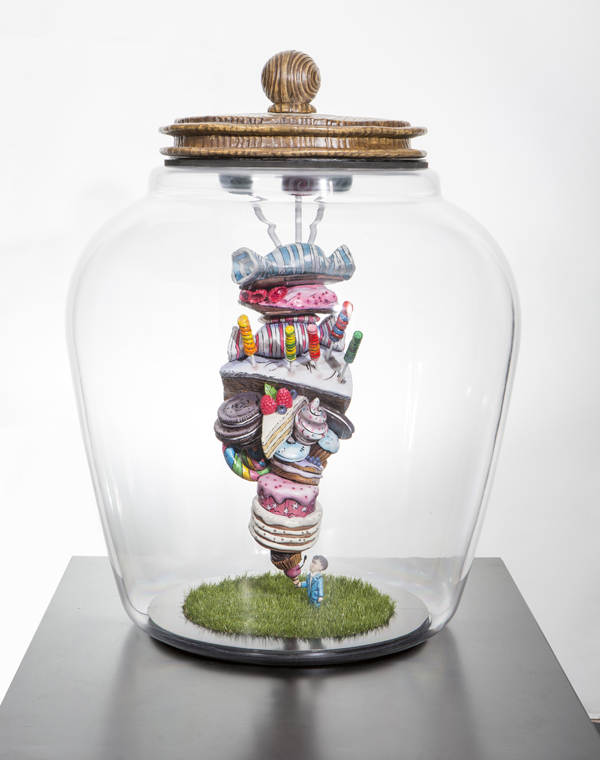
LondonLife – Childhood dreams captured in a jar for all to see…

Steven-SpielbergDirector Steven Spielberg, actor and playwright Mark Rylance, physicist Professor Stephen Hawking, TV personality Simon Cowell, and The Duchess of Cornwall are among 50 high profile personalities who have put their childhood dreams and aspirations on show around the country – including in London – to mark not only the release of the film The BFG but also the 100th anniversary of Roald Dahl’s birth. Launched last weekend, the ‘BFG Dream Jar Trail’ features a series of up-to-six-foot-tall ‘Dream Jars’, each of which contains a sculpture representing the childhood dreams of a different personality. The free trail – which takes in London sites such as Trafalgar Square, the Tower of London, Leicester Square, Harrods, Emirates Stadium and The Shard – has been created in support of the work of Save the Children and a specialist nursing programme supported by Roald Dahl’s Marvellous Children’s Charity with the jars to be auctioned in collaboration with Paddle8 later this year to raise money for both causes (the auction will be launched on the film’s premiere on 17th July). At least 34 jars have already gone on display with more to be unveiled in coming days. The joint creation of  Save the Children, the Roald Dahl Literary Estate, Entertainment One and VisitLondon.com with support from Unilever, the trail can be seen until 31st August. To see the art trail map and discover the stories behind each jar and its location, head to www.visitlondon.com/bfg. For more on the 100th anniversary of Roald Dahl’s birth, head to www.roalddahl.com/roalddahl100. PICTURED: Above – director Steven Spielberg’s self-designed jar, on display in Leicester Square, illustrating his childhood fantasy of having all the sweets in the world but none of the ill effects from overindulgence.

Treasures of London – Great Parchment Book…

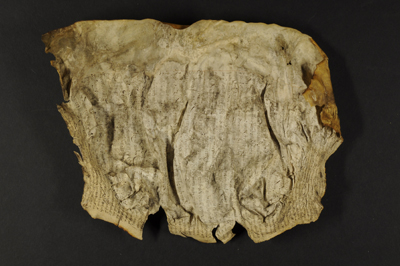
Great-Parchment-BookHeld in the collections of the London Metropolitan Archives, the Great Parchment Book of The Honourable the Irish Society was recently inscribed upon the UK register of the UNESCO Memory of the World.

Described as a “hugely significant record of the Ulster Plantation of the early 17th century”, the book was compiled in 1639 by a commission instituted under the Great Seal of King Charles I and is a survey of all the estates in Derry managed by the City of London Corporation through the Irish Society and City of London livery companies.

As such, manuscript and provides a unique insight into this important period in the history of Northern Ireland, containing key data about landholdings and the population in Ulster at the time of its creation including for both English and Scottish settlers and the native Irish population (as well as, exceptionally, for many women at all levels of society).

The Great Parchment Book was badly damaged in a fire in 1786 and as a result was unavailable to researchers for more than 200 years until its successful reconstruction using cutting edge digital imaging technology.

It is the fourth item in the care of the London Metropolitan Archives to be inscribed to the UK register of the UNESCO Memory of the World, a programme which aims to facilitate preservation of the world’s documentary and audio-visual heritage, to assist universal access and to increase awareness worldwide of the existence and significance of this documentary heritage.

The three other objects inscribed on the list which are in the LMA’s care include the Charter of William I to the City of London, London County Council Bomb Damage Maps and Robert Hooke’s Diary 1672-83.

~ www.greatparchmentbook.org

WHERE: London Metropolitan Archives, 40 Northampton Road, Clerkenwell (nearest Tube stations are Farringdon and Angel); WHEN: Open Monday to Thursday and selected Saturdays (check website for times); COST: Free; WEBSITE: www.cityoflondon.gov.uk/things-to-do/london-metropolitan-archives/Pages/default.aspx.

PICTURE: Courtesy London Metropolitan Archives.


This Week in London – I am London; Gerrit Dou’s women reunited; and, Georgia O’Keeffe…

A new free exhibition featuring 60 Londoners photographed in front of an historic building or special place to them opens in Kings Cross on Monday. The Historic England exhibition I am London features well-known Londoners, such as reproductive health expert Professor Lord Robert Winston, philosopher AC Grayling, feminist activist and journalist Caroline Criado Perez, artist Bob and Roberta Smith, designer Morag Myerscough and performer Amy Lamé as well as “unsung Londoners” – everyone from a Yeoman Warder at the Tower of London and the park manager at Kensington Gardens to a 7/7 paramedic, an apprentice at a Savile Row tailors and a student at the Royal School of Needlework – in telling stories which illustrate how the city’s heritage can be “inspirational, provocative, frustrating, fun, familiar, humbling and home”. Taken by Historic England photographer Chris Redgrave, the photographs will be displayed in the UAL Window Galleries at Central Saint Martins along with a selection of objects the sitters chose to be photographed with, including the Pearly King of Finsbury’s jacket, Bob and Roberta Smith’s ‘Vote Bob Smith’ badge and a submarine once owned by Morag Myerscough’s father. Can be seen until 4th September. For more, see https://historicengland.org.uk/get-involved/visit/exhibitions/i-am-london/.

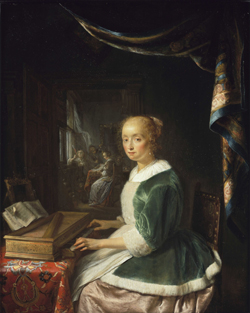
Gerrit-Dou Two of 17th century Dutch painter Gerrit Dou’s finest works – Woman playing a Clavichord and Lady Playing a Virginal (pictured), both dating from about 1665 – have been reunited for the first time in 350 years at the Dulwich Picture Gallery in south London. Opening this week, Dou in Harmony examines how Dou created two distinctly different takes on a similar subject and will be accompanied by a contemporary sound installation in the Mausoleum. Composed and played on the viola da gamba by Liam Byrne, the modern piece takes its cue from 17th century music and aims to evoke the mood of Dou’s paintings. The display is the latest in the Making Discoveries: Dutch and Flemish Masterpieces series which showcases four artists from the gallery’s collection: Van Dyck, Rubens, Dou and Rembrandt (whose work will be featured in an upcoming display in November). Runs until 6th November. Admission charge applies. For more, see www.dulwichpicturegallery.org.uk.

Georgia O’Keeffe’s celebrated work, Jimsyn Weed, White Flower No 1 (1932), is among highlights at the major retrospective of the US artist’s work which opened at the Tate Modern this week. The display marks a century since O’Keeffe’s debut in New York in 1916 and, with none of her works in public collections in the UK, provides a “once-in-a-generation opportunity” for audiences outside the US to view her portfolio of works in such depth. The display features more than 100 major works and charts the progression of O’Keeffe as an artist over a span of six decades. Runs until 30th October. For more, see www.tate.org.uk.

Send all items for inclusion to exploringlondon@gmail.com.

10 notable blue plaques of London – 8. A notorious ‘tree’ recalled…

To look at it, you wouldn’t necessarily imagine the memorial marking the former site of the ‘Tyburn Tree’ near Marble Arch was part of the English Heritage Blue Plaques scheme. 

Tyburn-Tree2But, located on the ground on a traffic island at the junction of Edgware and Bayswater Roads, this memorial commemorating the site of the former gallows at what was once London’s execution grounds (and those who died upon it) is just that.

It’s estimated by some that as many as 60,000 people may have been executed here over the 600 years until the late 1700s

While the plaque only mentions one of the names by which the various gallows erected here were known – Tyburn being the name of the village originally here, others included ‘The Elms’, the ‘The Deadly Never Green Tree’ and the ‘Triple Tree’, the latter presumably a reference to the famous three-sided gallows set up here during the reign of Queen Elizabeth I.

The last gallows was removed in 1759 when executions were moved into Newgate Prison (for more on the Tyburn Tree, see our earlier post here).

The plaque was erected on the site in 1964 by the London County Council; it replaced an earlier triangular plaque the council had erected here in 1909.

The memorial was restored and rededicated in a ceremony in 2014 with the placement of three oak trees around it (this picture was taken before the restoration).

There is a green City of Westminster plaque nearby which commemorates 105 Roman Catholic martyrs who lost their lives on the gallows between 1535 and 1681 while the deaths of the more than 350 Roman Catholics who died across England and Wales during the Reformation, including those on the Tyburn Tree, are also recalled in a shrine at the nearby Tyburn Convent.

LondonLife – Digging up Greenwich Park’s past…

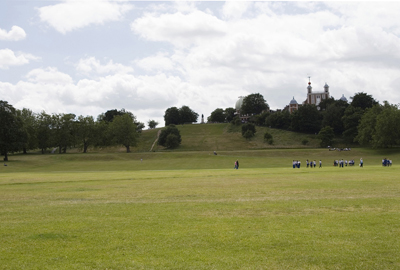
Greenwich-Park-in-summerThe remains of the 17th century Old Keeper’s Cottage in Greenwich Park are being brought to light in an archaeological dig underway in the park this week. The lodge stood close to Queen Elizabeth’s Oak near the centre of the park and was demolished in 1853. This year’s dig is the final of a three year project to unearth the lodge’s remains, sparked after tiles were discovered near the site of the cottage in 2010. Finds so far include a second century Roman brooch, post-medieval pottery and a Victorian watch-winder. The digs have also revealed remains associated with the lodge including two buildings and part of the boundary of the complex. Toni Assirati, head of education and community engagement at Royal Parks, says while much is already known about the history of Greenwich Park – which dates back to 1427 – much remains to be yet discovered about its social history. “This project will hopefully help us find out more about the lives of the people who worked and lived in the park.” Members of the public are invited to attend from 3pm to 6pm on 13th July to hear more about the project from the archaeologists involved as well as see some of the unearthed artefacts. For more about Greenwich Park, see our earlier post here or head to www.royalparks.org.uk/parks/greenwich-park. PICTURE: Greenwich Park, looking toward Observatory Hill (the site of the dig is to the left of the hill). © Anne Marie Briscombe/Royal Parks.

London Pub Signs – St Stephen’s Tavern, Westminster…

The origins of the name of this pub apparently lie in something of a mistake (well, sort of).

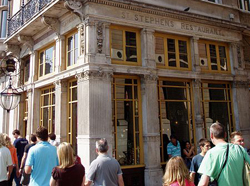
St-Stephens-TavernLocated at 10 Bridge Street on the corner of Canon Row – just across the road from the clock tower at the north end of the Houses of Parliament, its name apparently lies in mistaken belief that the tower was named St Stephen’s Tower.

It never was, at least not officially. Prior to recently being renamed the Elizabeth Tower – in honour of Queen Elizabeth II’s 60 years on the throne, the tower, which contains the bell known as Big Ben, was simply known as the Clock Tower (another common error has been to call the tower itself Big Ben).

The name St Stephen’s Tower apparently was the fault of Victorian journalists. They had the habit of referring to stories relating to the goings-on in the House of Commons as “news from St Stephen’s” because MPs, prior to the destructive fire of 1834, used to sit in St Stephen’s Hall (the entrance to the hall can be found down the road opposite Westminster Abbey).

Hence we have St Stephen’s Tavern, a favoured watering hole of many politicians – including apparently PMs Stanley Baldwin, Winston Churchill and Harold MacMillan.

The pub has been around since at least Victorian times – it was demolished in 1868 when Westminster tube station being built and rebuilt a few years later. In 1924, the pub was expanded to take over the Queen’s Head next door.

It closed in the late 1980s but was reopened in 2003 with many of the original fittings restored. These include one of only 200 parliamentary division bells, located above the bar, which calls MPs back to parliament when it’s time for them to vote (tourists apparently often think it’s a fire alarm and flee when it goes off).

For more, see www.ststephenstavern.co.uk.

PICTURE: Ewan Munro/Flickr/CC BY-SA 2.0 (image cropped)

This Week in London – Commemorating the Battle of the Somme; Transported by Design; and, Winifred Knights at Dulwich…

Battle-of-the-SommeThe Imperial War Museum in Lambeth is holding a free late night opening tonight featuring live music, film screenings, immersive theatre and poetry to mark the 100th anniversary of the Battle of the Somme. Highlights of Night Before the Somme, which runs from 8pm to midnight tonight, include slam poet Kat Francois’ critically acclaimed play Raising Lazarus, poet and broadcaster Ian McMillan’s show Magic Lantern Tales, and extracts from the immersive production Dr Blighty – which tells the story of the million Indians who travelled to fight in the war. Visitors will also have the chance to watch the film, The Battle of the Somme (filmed and screened in 1916, it was the first feature-length documentary about war), listen in to a series of Q&A’s with experts on the battle, and preview the major exhibition, Real to Reel: A Century of War Movies. Real to Reel, which officially opens on Friday, explores how film-makers have found inspiration in compelling personal stories and the real events of wars from the past century. As well as audio-visual installations, the display features film clips, costumes, props, scripts, sketches and designs from films such as The Dam Busters, Where Eagles Dare, Apocalypse Now, Battle of Britain, Das Boot, Casablanca, Jarhead, Atonement and War Horse along with original archival material and artefacts from the IWM collections. The exhibition, which is divided into five sections, runs until 8th January. Admission charges apply. See www.iwm.org.uk for more. PICTURE: © IWM (Q 70164. Staged scene from The Battle of the Somme film, 1916 British troops go ‘over the top’ into ‘No Man’s Land’. This scene was staged for the camera at a training school behind the lines.

• Don’t forget tonight’s vigil at Westminster Abbey to mark the 100th anniversary (as mentioned in last week’s entry here).

Still on the centenary of the Battle of the Somme and a new exhibition opened at the Science Museum in South Kensington this week focusing on the innovations in medical practice and technologies developed as a result of the new kind of industrialised warfare seen in the battle. Wounded: Conflict, Casualties and Care has at its centre a collection of historic objects from the museum’s World War I medical collections including stretchers adapted for use in narrow trenches and made-to-measure artificial arms fitted to the wounded in British hospitals as well as lucky charms and personal protective items carried by frontline soldiers. There are also artworks from the period including Henry Tonk’s famous pastel drawings of facial injuries and a 1914 painting by John Lavery that depicts the arrival of the first British wounded soldiers at the London hospital. Admission is free and the exhibition can be seen until early 2018. For more, see www.sciencemuseum.org.uk.

Regent Street will be transformed on Sunday, 3rd July, with the Transported by Design Festival featuring transport designs which have shaped and will shape London. The festival, which will stretch from Piccadilly Circus to Oxford Circus Tube stations, will see the street divided into three zones – past, present and future. Among the objects on show in ‘past’ section will be a horse-drawn bus and other heritage buses, a 1927 train carriage and an exhibition of classic advertising posters and signage while the ‘present’ section will feature ‘Cycle Spin Fun’ by Santander Cycles, Moquette Land – a showcase of fabric used across the transport network, and, a ‘design a bus’ competition, and the ‘future’ section will feature a range of technologies, including virtual reality headsets, exploring what transport could look like in 2040. The free festival, part of the ‘Summer Streets’ program which sees Regent Street closed to traffic on Sundays over summer, runs from noon to 6pm. For more, see www.tfl.gov.uk/campaign/transported-by-design/event-calendar?intcmp=40582.

• The work of artist Winifred Knights, the first British woman to win the Prix de Rome scholarship, is the subject of a recently-opened exhibition at the Dulwich Picture Gallery. The display, the first major retrospective of the work of Knights (1899-1947), brings together more than 70 preparatory studies and her most ambitious works including The Deluge (1920), The Potato Harvest (1918) and Leaving the Munitions Works (1919). Winifred Knights (1899-1947) runs until 18th September. Admission charge applies. For more, see www.dulwichpicturegallery.org.

Send all items for inclusion to exploringlondon@gmail.com.

10 notable blue plaques of London – 7. A blue plaque for a ship…

As mentioned last week, there are a number of official English Heritage blue plaques in London which commemorate events rather than people.

Alongside the blue plaque commemorating the first V1 flying bomb to hit London (the subject of last week’s entry) is a blue plaque commemorating the site where one of world’s most famous ships – the SS Great Eastern – was built.

THE_GREAT_EASTERN_(_launched_1858_)_largest_steamship_of_the_century_was_built_here_by_I.K._Brunel_and_J.Scott_RussellThe plaque is located at Burrells Wharf, 262 Westferry Road, on the Isle of Dogs in the Docklands, and it was there that the design of Isambard Kingdom Brunel, who had previously designed the SS Great Western and the SS Great Britain, was realised under the direction of naval architect and ship builder John Scott Russell, of J Scott Russell & Co.

The ship, which had a double hull and immense paddle wheels, took some five years to build at a site in Millwall on the Isle of Dogs (if you’re interested in the etymology of the latter, see our earlier post here).

It was supposed to be launched before a crowd of thousands on 3rd November, 1857, (the Great Eastern Ship Company had sold tickets). But the launch was unsuccessful as the equipment supposed to haul the ship to the water failed (and it was during this unsuccessful attempt that the ship was apparently initially christened SS Leviathan;  her name was changed to the SS Great Eastern soon after).

A couple of further unsuccessful attempts were made before, on 31st January, 1858, the 211 metre long ship – aided by an unusually high tide – was finally sent into the Thames (unusually, it was launched sideways).

The outfitting of the ship, which started in January, 1859, took six months and on 6th September, the ship made its maiden voyage from London to Weymouth, a voyage which was marred by the tragic death of a number of stokers in a boiler explosion. Sadly, Brunel himself died soon after the maiden voyage, not in the sort of triumphant circumstances he might have hoped for.

While it was originally designed to sail to India and the Far East, it was in the Atlantic where the ship took up the passenger trade. Her first voyage to North America took place in June the following year and the SS Great Eastern continued to cross the Atlantic over the next few years (including during the American Civil War when she took British troops to Canada) but, blighted by back luck (including, in 1862, running into an uncharted rock in New York harbour) and facing the competition of faster, smaller ships, she was never really a commercial success.

Sold off, the SS Great Eastern was reinvented in the mid 1860s as a cable-laying ship and did so in various parts of the world until, after being laid-up in 1874, sailing to Liverpool where she became something of a tourist attraction and a floating billboard before eventually being scrapped in 1889.

There was legend that two skeletons were found between the two hulls when the ship was broken up – that of a riveter and his ‘bash boy’ (a young lad charged with heating and putting the rivets in the hole) – and it was believed by some that it was their deaths which had brought the ship such bad luck.

The plaque was erected in 1992.

PICTURE: Spudgun67/CC BY-SA 4.0/Wikipedia

LondonLife – Spying a new view of London in a 40 second rush…

TOP-OF-SLIDE-MOCK-UP
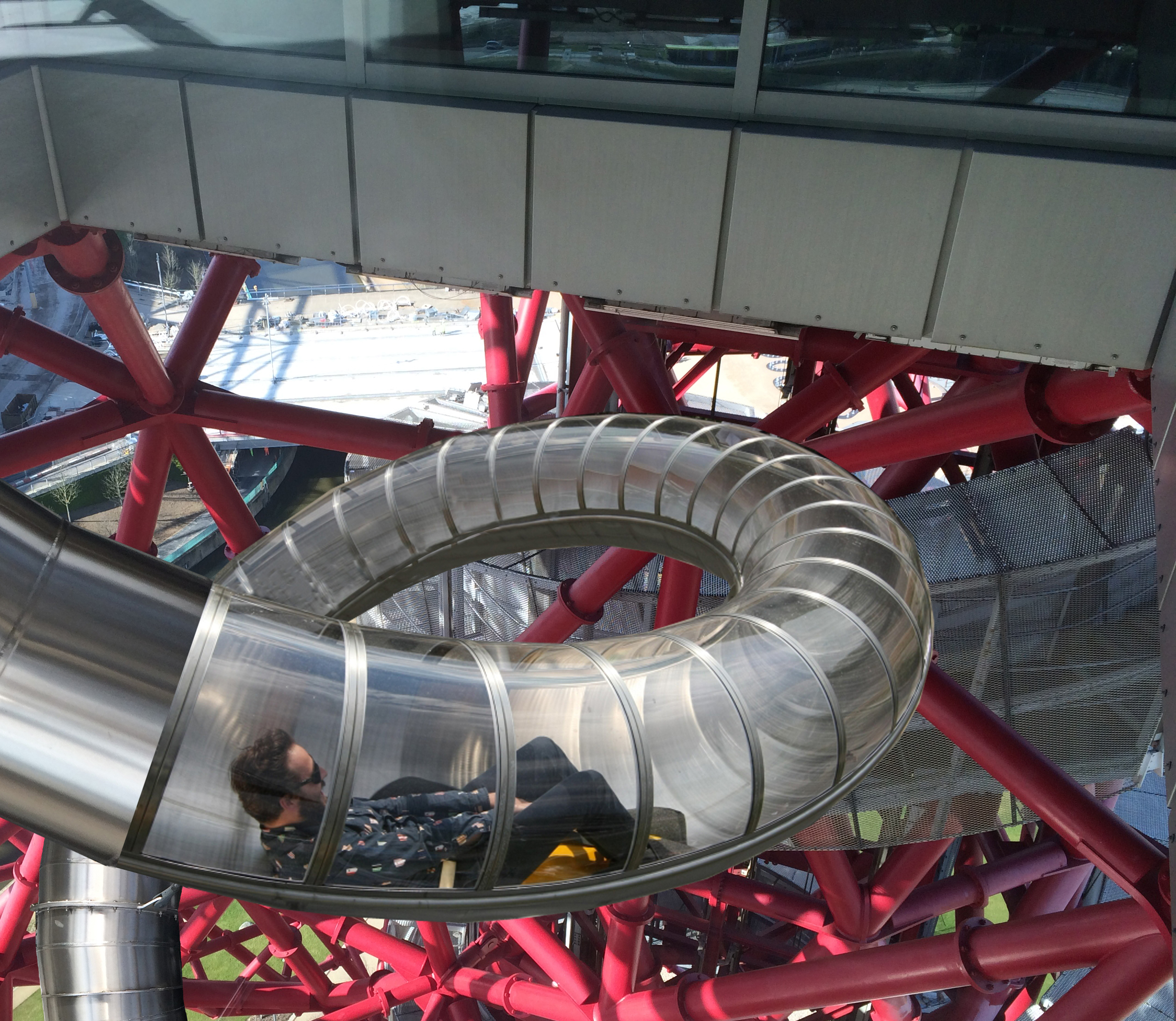
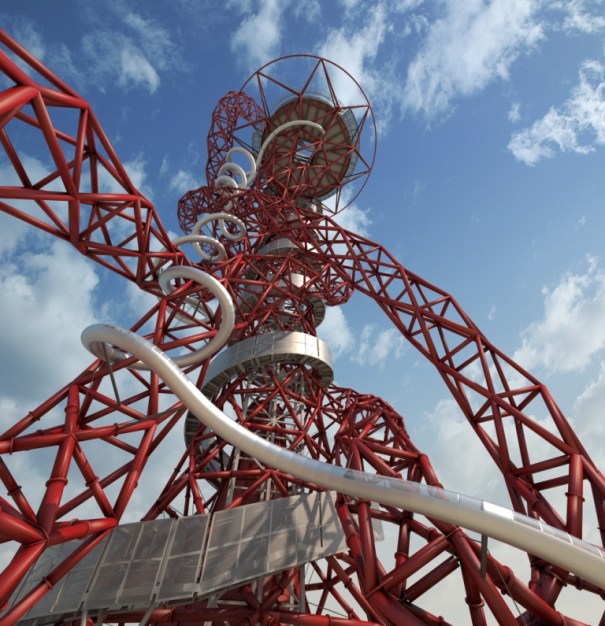
The world’s longest and tallest tunnel slide opened at the ArcelorMittal Orbit sculpture in Queen Elizabeth Olympic Park – the UK’s tallest public artwork – in London’s east last week.
Standing 178 metres high, the slide wraps around the sculpture 12 times as it descends toward earth, providing a 40 second ride of speeds up to 15 kph through a series of twists and turns including a tight corkscrew section known as the ‘bettfeder’ (named after the German word for ‘bedspring’). The slide, which was designed by Belgian artist Carsten Höller at the invitation of Sir Anish Kapoor, designer of the ArcelorMittal Orbit (constructed for the 2012 Olympic Games), is open until 30th December. For more on the Slide and to book, see http://arcelormittalorbit.com/whats-on/the-slide/. PICTURES: Supplied.

Copy-of-Slide-CGI-3

Famous Londoners – Sir Joseph Paxton…

Sir Joseph Paxton was one of the pre-eminent landscape gardeners and architects of the Victorian age, although his name is remembered today in great part because of his role in creating one of the most famous buildings of the era – London’s Crystal Palace.

Joseph Paxton ILNThe palace opened 165 years ago this year – it was built for the 1851 Great Exhibition in Hyde Park. But before we get to that, we have to go back a few years to the origins of its designer.

Paxton was born to a large Bedfordshire farming family on 3rd August, 1803 (although the year has been a matter of dispute at times, apparently because, wanting to appear older than he was, early on in his career he claimed that he had been born in 1801).

He attended school locally before venturing into the gardening profession (a number of other family members were already involved in gardening), taking on a number of gardening-related jobs before his first break came in 1823 when he was admitted by the Horticultural Society of London to work as a student gardener in the experimental gardens of Chiswick House in London’s west – then leased by the society from the Duke of Devonshire.

His work was soon noticed and, in 1826, the duke, with whom Paxton would come to have a close friendship, was apparently so enamoured that he appointed him to the position of head gardener at Chatsworth House, his family pile in Derbyshire.

It was something of a dream job for the then still young Paxton, who, over the ensuing years would be responsible for designing gardens as well as fountains (including the Emperor Fountain, named after Emperor Nicholas I of Russia), an arboretum, a model village, a conservatory of unprecedented size – known as the Great Conservatory, and a lily house, the latter featuring a design based on the leaves of the giant Victoria amazonica water lily.

Paxton’s ties to Chatsworth were strengthened further when he married the niece of Chatsworth’s housekeeper, Sarah Bown, in 1827. They would have eight children, six of whom survived.

Chatsworth became the most famous garden in England under Paxton’s watch but for many, it is his instrumental role in the Great Exhibition pavilion which stands out as his greatest achievement.

His involvement was really that of an opportunist – all of the original 245 plans for the main exhibition hall had been rejected when Paxton, on hearing of this while in London on business with regard for his role as a director of the Midland Railway, delivered his own design.

Inspired very much by the lily house he had designed (and which had yet to be completed) at Chatsworth, the design was innovative for a number of reasons, including its modular and prefabricated nature and the copious amounts of glass it used (only possible due to recent technological developments concerning the use of iron and glass).

Following its acceptance (this despite the fact it apparently breached the design competition’s rules), it took some 2,000 men eight months to build the 500 metre long building which, despite some criticism, was such a success at the Great Exhibition that in October of 1851 – some five months after its opening – Paxton was knighted by Queen Victoria. (For more on the Crystal Palace, see our earlier entry here).

Following the Great Exhibition, the building, with Paxton’s aid, was relocated to Sydenham in south London after the exhibition where it remained until it burned down in 1936.

Paxton, meanwhile, returned to his post as head gardener at Chatsworth (a role he fulfilled until 1858), but he is also credited with numerous other projects including the design of public parks in places as far afield as Liverpool and Glasgow, and the design of the London Road Cemetery in Coventry.

He was also involved in the commission charged with improving the Royal Botanic Gardens at Kew and designed numerous residences, the most famous being Mentmore Towers which he designed for Baron Mayer de Rothschild (among his other contributions to the world of design was a plan for an ‘atmospheric railway in London’ which was never built – for more on that, see our previous post here).

Paxton, who also acted as a Liberal MP for Coventry for the last 11 years of his life and was for many years involving in publishing various gardening-related magazines, general newspapers and writing a couple of books, became wealthy by speculating on the growing railway industry.

He died on 8th June, 1865, at his home, Rockhills, in Sydenham and was buried in St Peter’s Churchyard at Edensor on the Chatsworth Estate. His wife Sarah continued to live at Chatsworth until her death in 1871.

PICTURE: Via Wikimedia Commons.

This Week in London – Westminster Abbey open overnight for Somme vigil; ‘Painters’ Paintings’; and, the East End Canal Festival…

Westminster Abbey is to remain open all night next Thursday (30th June) for a vigil in commemoration of the 100th anniversary of the Battle of the Somme. It’s the first time the abbey has been open for an all-night vigil since the Cuban missile crisis more than 50 years ago. The vigil around the Grave of the Unknown Warrior will be mounted from 8.45pm next Thursday, 30th June, through to 7.30am on Friday, 1st July (last entry to the abbey is at 7.15am). The public are invited to attend the vigil following an evening service at 8pm on Thursday which will be attended by Queen Elizabeth II and broadcast live on BBC Two. The vigil, which will end with the firing of World War I guns in Parliament Square by The King’s Troop Royal Horse Artillery, will see a series of 15 minute watches kept by service personnel and community groups representing those involved in the battle and there will also be readings from contemporary accounts. No tickets are required and entry, which is free, is via the abbey’s visitor entrance at the North Door. For more, see www.westminster-abbey.org.

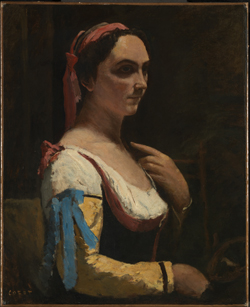
CorotEver wondered what attracts artists to collect particular paintings? Answers abound at a new summer exhibition opening at The National Gallery today. Painters’ Paintings’: From Freud to Van Dyck features a series of ‘case studies’, each of which is devoted to works gathered by a particular ‘painter-collector’ including Lucien Freud, Henri Matisse, Hillaire-Germain-Edgar Degas, Frederic, Lord Leighton, Sir Thomas Lawrence, Sir Joshua Reynolds and Sir Anthony van Dyck. The display was inspired by Jean-Baptiste-Camille Corot’s work Italian Woman which was left to the nation by Lucien Freud following his death in 2011. “It made us start considering questions such as which paintings do artists choose to hang on their own walls,” explains Anne Robbins, curator of the exhibition. “How do the works of art they have in their homes and studios influence their personal creative journeys? What can we learn about painters from their collection of paintings? Painters’ Paintings’: From Freud to Van Dyck is the result.” The exhibition features works from the gallery’s own collection as well as loans from public and private collections. Admission charges apply. Runs until 4th September. For more, see www.nationalgallery.org.uk. PICTURE: Jean-Baptiste-Camille Corot’s Italian Woman, or Woman with Yellow Sleeve (L’Italienne) about 1870/© The National Gallery, London.

The East End Canal Festival takes place at the Art Pavilion, Mile End Park this Sunday. The programme, being run by the Friends of Regent’s Canal, includes boat trips as well as guided canal history walks and a range of performances, films, stalls, exhibitions featuring historic photos and locally made artworks, children’s activities and food. The festivities at the Clinton Road site are free. For more, see http://friendsofregentscanal.org/events/eecf.html.

Send all items for inclusion to exploringlondon@gmail.com.

10 notable blue plaques of London – 6. A blue plaque for a deadly bomb…

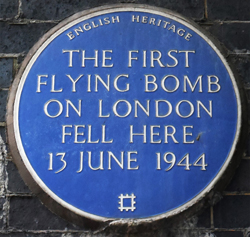
V1-flying-bombNot all of the plaques in the English Heritage blue plaques scheme commemorate people, some also commemorate places and events – the saddest of which is no doubt the landing of the first deadly V1 flying bomb on London during World War II.

Located in Bow in the East End is a plaque commemorating the site where the first flying bomb fell on London on 13th June, 1944, a week after D-Day and several months since the last bombs had fallen on London in what was known as the “mini-blitz”.

Carrying some 850 kilograms of high explosive, the unmanned, fast-moving bomb dived to the ground at about 4.25am on the morning of the 13th, badly damaging the railway bridge and track, destroying houses and, sadly, killing six people.

It was to be the start of a new bombing offensive which would eventually see around 2,500 of the V1 flying bombs reach London between June, 1944, and March, 1945.

They were responsible for killing more than 6,000 people and injuring almost 18,000 and were followed by the even more advanced V2 long range rockets – the world’s first ballistic missiles – in September, 1944. These were responsible for another 2,754 deaths in London before the war’s end.

The current plaque on the railway bridge in Grove Road was erected in 1998 by English Heritage and replaced one which was erected by the Greater London Council in 1985 and subsequently stolen.

PICTURE: Spudgun67/CC BY-SA 4.0

LondonLife – The Hive arrives at Kew…

The-Hive1

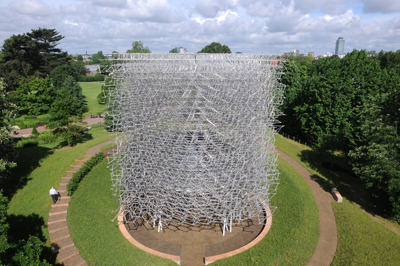
An award-winning art installation exploring the world of the British bee has been installed at Kew Gardens in west London. Designed by artist Wolfgang Buttress and created by BDP, Simmonds Studio and Stage One, the Hive was the centrepiece of the UK Pavilion at the 2015 Milan Expo and has become the first British pavilion to be brought home and reused. The 17 metre-high, 40 tonne installation, which has been set in a flower meadow, twists into the sky suggesting the shape of a swarm of bees. Inside, thousands of flickering LED lights create a sense of what life is like inside a beehive while a soundtrack inspired by the deep humming of the bees fills the air. Both sound and light inside the hive will change in intensity as energy levels in a real beehive located elsewhere in the gardens changes, providing a unique insight into life inside a bee colony. Between 2nd July and 30th October, the installation is being accompanied by a ‘Pollination Trail’ across the gardens which explores the relationship between bees and plants and a series of specially trained ‘hive explainers’ will also be on hand inside The Hive. The gardens are also hosting a series of special talks, films, workshops and ‘lates’ as well as special, family-oriented events. For more see, www.kew.org. PICTURES: Jeff Eden, RBG Kew.

The-Hive2

What’s in a name?…St Mary Overie…

The-Legend-of-St-Mary-Overie

Now the name of a dock on Bankside (pictured below), St Mary Overie (also spelt as Overy) also forms part of the formal name of Southwark Cathedral, more properly known as The Cathedral and Collegiate Church of St Saviour and St Mary Overie.

St-Mary-OverieThe simple version of the name’s origins is that it simply means St Mary “over the river” (that is, St Mary on the south side of the Thames) which was used in relation to a priory founded there in the Norman era by two knights (it’s to this foundation that what is now Southwark Cathedral owes its origins, something we’ll take a more detailed look at the nunnery in an upcoming Lost London post).

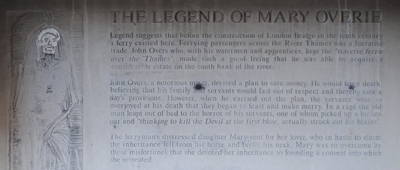
But there’s also another, more romantic version, of the name’s origins. That story, as it’s told on a plaque located at the dock (pictured above), goes back to before the Norman founding of priory, back to the days when, before the building of London Bridge, a ferry ran between the two banks of the River Thames.

The man responsible for the ferry was John Overs, a “notorious miser”, who decided to save money by feigning his death and thus plunging his household into mourning, saving that day’s provisions. As one may imagine, however, Overs was not a popular man and his servants, instead of fasting in their mourning, held a feast in celebration of his death.

In rage, the old master leapt out of his bed and a servant, terrified and imaging some sort of demonic manifestation, struck him fatally with an oar on the head.

Overs’ daughter, Mary, sent for her lover so that he may come and together with her claim her father’s inheritance but such was his haste, he fell from his horse and broke his neck. So overcome was Mary by her misfortunes that she founded a convent into which she subsequently retired (this was subsequently ‘refounded’ by the two Norman knights).

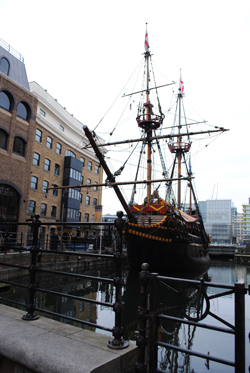
The dock, meanwhile, is today the berthing place of the Golden Hinde II, a sea-worthy replica of the flagship in which Elizabethan explorer Sir Francis Drake circumnavigated the globe (for more on the ship, see our earlier post here).

Lost London – Exeter/Essex House…

Located on the south side of the Strand, the then-named Exeter House was built in the 1300s as the London palace of the Bishops of Exeter on land which had previously been occupied by the Knights Templar.

The-DevereuxIt was Bishop Walter Stapledon who had the palace constructed – as well as being Bishop of Exeter, he was Lord High Treasurer to the unpopular King Edward II, a role which eventually led to him being dragged from his horse in the City of London and murdered.

King Henry VIII gave the property to his Secretary of State, William, Lord Paget, and, in the late 16th century, it came into the hands of Robert Dudley, the 1st Earl of Leicester. He rebuilt it and renamed it Leicester House which it remained until, following his death in 1588, it was inherited by his stepson, Robert Devereux, the 2nd Earl of Essex and a favourite of Queen Elizabeth I, and renamed Essex House.

The house was rather large and in 1590 was reported as having as many as 42 bedrooms as well as a picture gallery, a banqueting suite and chapel.

Devereux ended up beheaded for treason on Tower Hill in 1601 but his son, also Robert Devereux, became a distinguished general for the Parliamentarians during the Civil War. He received a delegation from the House of Commons at the property to offer their congratulations after the Battle of Newbury in 1643 and was laid out in state there in 1646 (insatiable diarist Samuel Pepys, then a 13-year-old boy, was among those who saw the body).

After the Civil War, the family’s debts resulted into the property passing into the hands of other families. The main part of the house was eventually demolished in the 1670s and part of the property sold to developer Nicholas Barbon. He built Essex Street, which still stands in the area, was built on the site.

The remaining part of the house, meanwhile, was used to house the Cotton Library before, in 1777, it too was demolished.

The mansion’s chapel, meanwhile, became a dissenters meeting house, known as the Essex Street Chapel, which became the birthplace of Unitarianism in England. The denomination’s headquarters, named Essex Hall, still stands on the site.

The pub The Devereux (pictured above), named for Robert Devereux, is among the buildings which now stand on the site (for more on the pub, see our earlier post here).

This Week in London – Engineering feats explained; Tate Modern reopens; app for blue plaques; and, the RA’s summer exhibition…

Sydney_Opera_House_under_construction_6_April_1966__Robert_Baudin_for_Hornibrook_Ltd._Courtesy_Australian_Air_PhotosThe stories behind some of the world’s most iconic buildings – from the Sydney Opera House to the Centre Pompidou in Paris – and engineering projects like London’s Crossrail will be exposed in a new exhibition at the V&A on the work of Ove Arup – arguably the most influential engineer of the 20th century. Engineering the World: Ove Arup and the Philosophy of Total Design, which is being staged on conjunction with the global engineering and design company he founded – Arup, surveys the life, work and legacy of Arup (1895-1988) and features more than 150 previously unseen prototypes, models, films, drawings and photographs as well as new immersive digital displays featuring animations, simulations and virtual reality. As well as presenting information relating to a selection of Arup’s most ground-breaking projects – including collaborations with architects such as Richard Rogers and Norman Foster, the display, which is divided into several distinct sections arranged chronologically, also explores the pioneering work of Arup today on projects like Crossrail, technologies for acoustics studies like SoundLab and SolarLeaf – an experimental bio-reactive facade system that uses micro algae to generate renewable energy. The first major exhibition led by the V&A’s new Design, Architecture and Digital Department, Engineering the World runs at the South Kensington museum until 6th November. Admission charges apply. For more, see www.vam.ac.uk/EngineeringSeason. PICTURE (above): Sydney Opera House under construction, 1966; © Robert Baudin for Hornibrook Ltd. Courtesy Australian Air Photos.

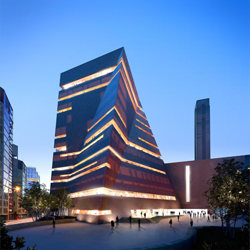
New-Tate-ModernThe new Tate Modern opens its doors to the public tomorrow following a £260 million renovation and expansion. Designed by architects Herzog & de Meuron (who also designed the original conversion of the Battersea Power Station which opened in 2000), the new Switch House building increases the size of the Tate Modern by 60 per cent. As well as redisplaying the 800 works previously on show, the revamped Tate Modern – which still features the Turbine Hall at its centre – also offers a range of new experiences for visitors, from the  subterranean concrete ‘Tanks’ – the first permanent museum spaces dedicated to live art, and a panoramic public viewing terrace on level 10. The museum’s reopening will be celebrated by a free programme of live performances, new commissions and other special events and the museum will stay open until 10pm each evening this weekend when events will include a specially commissioned choral work being performed by more than 500 singers from community choirs around London at 5pm on Saturday. Entry to the Tate Modern on Bankside is free. For more, see www.tate.org.uk/visit/tate-modern. PICTURE: © Hayes Davidson and Herzog & de Meuron/Tate 

English Heritage blue plaques were unveiled to ballet dancer Dame Margot Fonteyn and choreographer Sir Frederick Ashton earlier this month. Dame Margot’s plaque was unveiled at her former flat at 118 Long Acre in Covent Garden (conveniently close to the nearby Royal Opera House where she performed) while Sir Frederick’s plaque was unveiled at his former property at 8 Marlborough Street in Chelsea. The pair’s 25 year relationship produced many of her most celebrated performances and his greatest ballets, including Daphnis and Chloe (1951), Sylvia (1952) and Ondine (1958). The unveiling coincided with the release of a new free Blue Plaques app which, as well as helping users to find blue plaques and uncover the stories of those they commemorate, is also intended to provide an expanding series of walking tours. The first, ‘Soho’s Creatives and Visionaries’, follows a route from Oxford Circus to Tottenham Court Road Station, taking in the property where Karl Marx began writing Das Kapital, the house where Canaletto lived and the attic rooms where John Logie Baird first demonstrated television in 1926. For more, see www.english-heritage.org.uk/visit/blue-plaques/.

The 248th ‘summer exhibition’ – featuring the work of 15 international artistic duos in a display curated by leading British sculptor Richard Wilson – opened at the Royal Academy of Arts this week. On display in the Piccadilly institution’s main galleries, the exhibition’s highlights include a new large scale, suspended kite sculpture by Heather and Ivan Morison, two hand-coloured prints from Jake and Dinos Chapman’s Human Rainbow II series, and, an atmospheric photographic installation from Jane and Louise Wilson’s seminal Chernobyl series. Turkish film-maker and artist Kutlug Ataman’s monumental multi-image video installation, THE PORTRAIT OF SAKIP SABANCI, featuring 10,000 LCD panels will also be displayed. Can be seen until 21st August. Admission charges apply. For more, see www.royalacademy.org.uk.

Send all items for inclusion to exploringlondon@gmail.com.

10 notable blue plaques of London – 5. Five Londoners with more than one blue plaque…

There’s quite a few whose London residence (or otherwise) is commemorated by more than one blue plaque. So, breaking away from our usual ‘one plaque’ format, here were listing five of those who have made the grade…

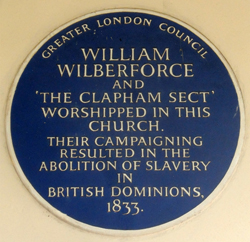
William-Wilberforce-blue-plaque1. William Wilberforce (1759-1833). The late 18th century and early 19th century politician and anti-slavery campaigner tops our list with three English Heritage blue plaques. The first is at 111 Brookwood Road in Battersea – the site of Brookwood House where Wilberforce resided during his anti-slavery campaign. The second is on Holy Trinity Church on Clapham Common, the church where Wilberforce and the Clapham Sect with whom he is associated worshipped. And the third is on a property at 44 Cadogan Place in Chelsea where Wilberforce died.

2. Dr Samuel Johnson (1709-1784). Like Wilberforce, the 18th century lexicographer Dr Johnson has three English Heritage blue plaques to his name. The first, on his famous Gough Square property in the City of London we’ve already mentioned (see our earlier post here), while the second is on a property at 8 Russell Street, Covent Garden, then occupied by bookseller Thomas Davies, which was where Dr Johnson famously first met James Boswell in 1763. The third time Dr Johnson’s name appears, more unusually, is on a plaque commemorating Essex Street – Dr Johnson is among a number of names listed on it for his role in establishing an “evening club” at the pub, the Essex Head, in the street in 1783.

3. Samuel Pepys (1633-1703): The 17th century diarist seems to pop-up everywhere in central London so it’s not surprising there are two plaques in the English Heritage blue plaques scheme dedicated to him (although both are located in the same street – one he apparently liked very much). The plaques are located at number 12 and number 14 Buckingham Street in Covent Garden and both mark the site of a Pepys residence.

4. Virginia Woolf (1882-1941): The writer, publisher and literary critic’s name appears on two properties – at 29 Fitzroy Square in Fitzrovia where Woolf lived between 1907-1911 and on Hogarth House at 34 Paradise Road in Richmond where she and Leonard Woolf lived between 1915-1924 (and also where they founded the Hogarth Press in 1917).

5. William Morris (1834-1896): The poet and artist has two English Heritage blue plaques to his credit – the first on 17 Red Lion Square in Holborn where Morris lived in a flat from 1856-1859 with Sir Edward C Burne-Jones, and the second on Red House in Bexleyheath where he and his wife Jane Burden lived from 1860-1865.

PICTURE: Spudgun67/Wikimedia/CC BY-SA 4.0 (image cropped)

LondonLife – The Queen’s 90th birthday marked at Trooping the Colour…

Queen-in-The-Mall

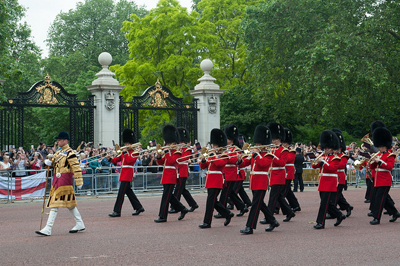
Photographer John Pannell was among the crowds who gathered in The Mall to witness Trooping the Colour on Saturday. Traditionally held to mark the Queen’s birthday, this year’s event – in honour of the fact that the Queen has turned 90 (her actual birthday being 21st April) – was followed on Sunday by a lunch for 10,000, known as the Patron’s Lunch, in The Mall. Trooping the Colour has marked the official birthday of the sovereign since the reign of King George II. Above are the Queen and Prince Philip while below are part of the Massed Bands of the Household Division, among those who marched, and, RAF planes fly-past Buckingham Palace while watched from the palace’s famed balcony by the Queen and the royal family.

Trooping-the-Colour
PlanesPICTURES: John Pannell/Flickr

10 notable blue plaques of London – 4. Oldest surviving blue plaque commemorating a woman…

Much has been made about the dearth of women featured on blue plaques in this 150th year of the scheme – according to English Heritage, only 13 per cent of the 900 odd blue plaques in London commemorate a woman.

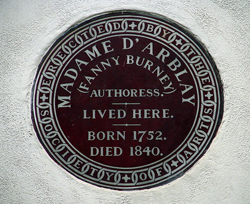
Fanny-Burney-plaqueAmong them are ballet dancer Margot Fonteyn, suffragette Sylvia Pankhurst, socialite Nancy Astor, and, in recent times, cookery writer Elizabeth David.

The oldest surviving blue plaque commemorating a woman, however, is that commemorating what is today a less well-known name, that of Fanny Burney.

Burney (1752-1840), who was known as Madame D’Arblay after she married, was a widely applauded novelist who was also noted for her diaries which record her involvement in the literary circles around Samuel Johnson and the Bluestocking Group.

The blue plaque commemorating her residence at 11 Bolton Street in Mayfair was erected in 1885 by the Society of Arts (which means that like others erected by the society, later the Royal Society of Arts, it’s brown not blue).

Burney, whose most profitable work, Camilla, was published in 1796 after she had spent five years as Second Keeper of the Robs to Queen Charlotte, lived in the house following the death of her husband, the Frenchman Alexandre D’Arblay.

She spent 10 years here – from 1818 until 1828 – and had apparently thought it would be her last residence but she went on to move into three further properties after this one.

PICTURE: Simon Harriyott/CC BY 2.0