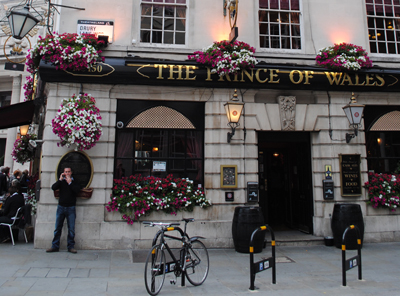
London Pub Signs – The Prince of Wales…

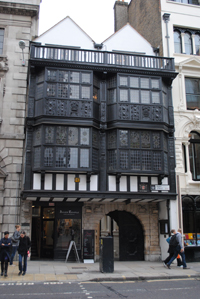
Prince-of-WalesAnother Drury Lane pub, the origins of this one go back to 1852 when it was established by Henry Wells on the site of what was once a potato warehouse. 

The name, in this case, comes from Queen Victoria and Prince Albert’s eldest son, Albert Edward.

Only about 11-years-old when this West End pub was first built, he remained Prince of Wales until succeeding his mother as King Edward VII (nonetheless, the location proved somewhat prescient – Albert Edward was to become known for his bon vivant lifestyle including his love of the theatre (along with, of course, his love of philandering.))

Located close to theatres and the Royal Opera House, the pub at 150-151 Drury Lane (on the corner of Long Acre) was rebuilt in Portland stone in the early 20th century when the street was widened.

Now part of the Taylor Walker group, it remains a popular pub for theatre goers (and even hosts its own events). For more, see www.taylor-walker.co.uk/pub/prince-of-wales-covent-garden/c0659/.

LondonLife – Remembering Agatha Christie…

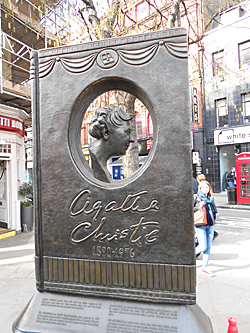
Agatha_ChristieToday marks 125 years since the birth of the world’s best-selling novelist, Agatha Christie, subject of this memorial which was unveiled in Covent Garden in 2012.

Standing at St Martin’s Cross – the intersection of Cranbourn and Great Newport Streets, the memorial – which also marks 60 years and 25,000 performances of her record breaking long-running London play The Mousetrap – is the work of sculptor Ben Twiston-Davies.

It takes the form of a 2.4 metre high book with a bust of Christie in profile and features a series of motifs from Christie’s works as well as a ‘bookshelf’ of her best sellers in English and other languages, the titles of which were selected in a competition involving fans.

Christie, who was born on 15th September, 1890, in Torquay, Devon, and died on 12th January, 1976, is famous for the scores of detective novels she wrote – featuring the likes of detectives Miss Marple and London’s own Hercule Poirot – which have gone on to sell more than two billion copies around the world.

The memorial was unveiled on 18th November, 2012, by Christie’s grandson, Matthew Pritchard, along with Sir Stephen Waley-Cohen, chairman of Mousetrap Productions, and the Lord Mayor of Westminster, Cr Angela Harvey.

For more on the memorial, see www.agathachristiememorial.co.uk. For more on events surrounding the anniversary, see www.agathachristie.com.

PICTURE: Diagram Lajard

This Week in London – London Tree Week kicks off; illustrated London at the LT Museum; and, Joshua Reynolds at the Wallace Collection…

London Tree Week kicks off on Saturday with a range of free events happening across the city. They include ‘tree walks’ in Richmond and Greenwich Royal Parks, a tour of paintings featuring trees at the National Gallery in Trafalgar Square, an exhibition at City Hall featuring some of the city’s great trees, and family-friendly activities at Stave Hill Ecological Park in the city’s south-east. Londoners can also download a free ‘Tree Route’ app which uses the Tube map to showcase the capital’s trees including “must see” trees located near Underground stations such as St Pauls (a swamp cypress) and Angel (a black poplar). There’s also a photo sharing challenge where you can upload photos of trees that have made a difference to your part of London to Instagram or Twitter using the hashtag #LondonTreeWeek. For the complete listing of what’s on, follow this link. Runs until 31st May.

One hundred illustrations capturing a variety of aspects of life in London form the heart of an exhibition, The Prize for Illustration 2015: London Places & Spaces, which has opened at the London Transport Museum in Covent Garden. The artworks – which range from the past to the present and the contemplative to the loud – are all on the shortlist for the prestigious Prize for Illustration and were selected from more than 1,000 entries. Each of the works is accompanied by a short description written by the artist. The works are on show until 6th September. Admission charge applies. For more, see www.ltmuseum.co.uk.

On Now – Joshua Reynolds: Experiments in Paint. Now entering its final days, this exhibition at the Wallace Collection in Marylebone provides a fresh perspective on a giant of the British art world, 18th century portraitist Joshua Reynolds and features such famous works as Nelly O’Brien, Mrs Abingdon as Miss Prue, and Self Portrait Shading the Eyes. Admission is free. Runs until 7th June. For more information, see www.wallacecollection.org.

Send items for inclusion to exploringlondon@gmail.com

London Pub Signs – The Lamb & Flag…

We’ve mentioned this Covent Garden pub, redolent with history as it is,  before but we thought it worth a second look.

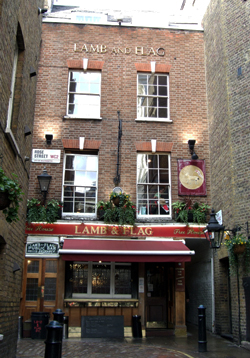
Lamb-and-FlagThere’s not much mystery surrounding the origins of the name – the Christian symbolism of the sign is fairly obvious and the symbol, which was used by the Templars and is also that of the Middle Temple, was apparently a reasonably common one for pubs. But the Lamb & Flag hasn’t always been its name.

While there’s been a pub on the site dating as far as back as the 17th century (the building was survivor of the Great Fire of 1666), it was apparently only named the Lamb & Flag in 1833.

Prior to that it was apparently known as the Cooper’s Arms (in what we assume was a reference to barrel-makers) and at one time in its long history was nick-named the ‘Bucket of Blood’ thanks to the location being used for prizefights.

The core of the present, Grade II-listed, building at 33 Rose Street is said to date from 1772, but the brick facade is 20th century. A narrow passageway known as Lazenby Court, which dates from the late 17th century and connects Rose Street to Floral Street, runs alongside it.

Regular patrons have included author Charles Dickens (one of the many London pubs he apparently attended not infrequently) and other famous associations include the poet John Dryden – he is famously associated with Rose Street thanks to the fact he was beaten up there twice in 1679 after upsetting people with his satires (the pub’s upstairs room is named after him).

For more on the pub, see www.lambandflagcoventgarden.co.uk.

PICTURE: Ewan Munro, Flickr (CC BY-SA 2.0)

This Week in London – Churchill’s Scientists; Waterloo online; a Chelsea murder case reopened; exploring Crossrail; and, astronomical photography…

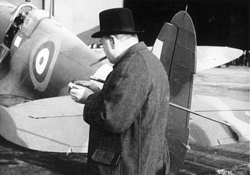
Churchill-with-a-Spitfire-from-Castle-Bromwich,-credit-Philip-Insley,-CBAF-Archive-Vickers-ArchiveSyndics Marking the 50th anniversary of the death of Winston Churchill, a new exhibition at the Science Museum in South Kensington looks at his passion for science and the influence that had on bringing World War II to an end. Churchill’s Scientists celebrates the individuals who flourished under Churchill’s patronage (and , as well as helping to bring about the end of World War II, also launched a post-war “science renaissance”) – from Robert Watson-Watt (inventor of radar) through to Bernard Lovell (creator of the world’s largest telescope) – and also delves into more personal stories of Churchill’s own fascination with science and tech. The display include objects from the museum’s collection as well as original archive film footage, letters and photographs. Highlights include the high speed camera built at Aldermaston to film the first microseconds of the detonation of the UK’s first home grown atomic bomb, the cigar Churchill was smoking when he heard news of his re-election as PM in 1951, and a one-piece green velvet “siren suit” designed by Churchill to wear during air raids (only one of three originals known to exist, it’s never been on public display outside of the tailors who created it). The free exhibition runs until 1st March and is part of the Churchill 2015 programme of events. Visit www.sciencemuseum.org.uk/churchill for more. PICTURE: Churchill with a Spitfire from Castle Bromwich (Philip Insley, CBAF Archive Vickers ArchiveSyndics).

The National Army Museum and Waterloo2oo have launched an online gallery which will eventually comprise images and information on more than 200 artefacts associated with the Battle of Waterloo ahead of the 200th anniversary in June. Among the objects featured on Waterloo200.org are the Duke of Wellington’s boots, a French eagle standard captured in battle and the saw used to amputate the Earl of Uxbridge’s leg. One hundred items – drawn from the Army Museum’s collection as well as from European museums and private collections – can already be seen on the site with a further 100 to be added before the bicentenary on 18th June.

The Talk: Death in Disguise: The Amazing True Story of the Chelsea Murders. On 12th February, the Guildhall Library in the City of London will host Gary Powell as he examines the facts of this double murder which took place in Chelsea in May, 1870, and left Victorian society reeling. For more events at the library, follow this link.

On Now: Breakthrough: Crossrail’s tunnelling story. This exhibition at the London Transport Museum in Covent Garden brings a new perspective on the massive Crossrail project currently underway in the city. Visitors will experience the tunnel environment through a five metre high walk-through installation featuring a computer simulation of a giant boring machine as well as learn about how the project is shaping up, play interactive tunnelling games and hear firsthand from those who work underground. Admission charge for adults applies. Runs until August. For more, see www.ltmuseum.co.uk.

Extended: Astronomy Photographer of the Year Exhibition. This exhibition at the Royal Observatory Greenwich features the winning images from last year’s competition. They include the Briton James Woodend’s image of a vivid green aurora in the Icelandic night sky; American Patrick Cullis’ view of earth taken from 87,000 feet above ground; and, New Zealander Chris Murphy’s image of dusty clouds dancing across the Milky Way. The exhibition can be seen for free in the Observatory’s Astronomy Centre until 19th July. For more, see www.rmg.co.uk/astrophoto.

• Send all items for inclusion to exploringlondon@gmail.com. 

London Pub Signs – The Nell of Old Drury…

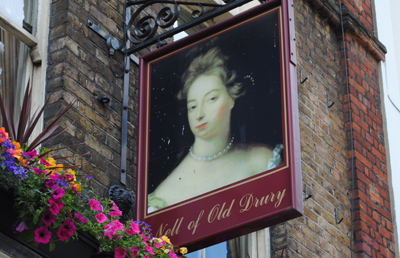
Nell-of-Old-DruryThis Covent Garden pub in London’s West End is named after Nell Gwyn, the 17th century orange seller turned actress who became most famous for being the mistress of King Charles II (for more on Nell, see our earlier post here)

‘The Nell’, as its known, is one of the area’s oldest pubs – a sign says there has apparently been a pub on the site since before 1660 when the Theatre Royal Drury Lane – located opposite – was built.

Nell-of-Old-Drury2There’s supposedly an underground tunnel that connects the theatre and the pub which is said to have been used by the king when he was visiting Nell (we’re not sure if it was Nell or the king who was in the pub). It was also apparently used by other theatre-goers who were warned to return to the theatre when intermission was over by a bell located inside the pub.

Now located at 29 Catherine Street pub (the street was formerly known as Brydges Street – we’ll deal with its renaming in an upcoming post), was apparently originally called The Lamb and then renamed the Sir John Falstaff in the nineteenth century, during which period it hosted exhibitions featuring a tattooed man from the South Seas and a Zulu warrior woman, before assuming its current moniker.

The pub was also apparently a regular for many prominent literary and theatrical figures, not to mention market traders from nearby Covent Garden. The exterior of the pub appears in the Alfred Hitchcock film, Frenzy.

For more on the pub, see www.nellofolddrury.com.


This Week in London – Rare chance to see four Magna Cartas together; Covent Garden films; Raymond Chandler’s childhood home recalled; and Rembrandt at Kenwood…

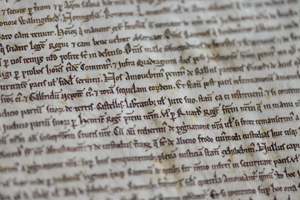
Magna-Carta• The only four surviving copies of the original Magna Carta from 1215 will go on display together for the first time ever  at the British Library in King’s Cross next February – and you have a chance to be among the 1,215 people to see them. In an event to mark the 800th year of the creation of the document, the library – which holds two copies of the document – along with Lincoln Cathedral and Salisbury Cathedral – each of which holds one copy – are holding a ballot with winners able to attend an event in which they’ll have the unique opportunity to see the documents side-by-side as well as be treated to a special introduction on its history and legacy by historian and TV presenter Dan Jones. The ballot to see the documents is open until 31st October with winners drawn at random. It’s free to enter – head to www.bl.uk/magna-carta to do so. The four documents will subsequently feature separately in displays at each of the three institutions. One not to miss! PICTURE: Salisbury Cathedral’s Magna Carta/Ash Mills.

The Silent Swoon Free Film Festival kicks off in St Martin’s Courtyard, Covent Garden, next week. The courtyard will be transformed into an open air movie theatre showing a different movie each night – The Talented Mr Ripley on 14th October, Crazy, Stupid, Love on 15th October and Rebel without a Cause on 16th October. Most of the free tickets will be allocated through an online draw but a small number will be allocated each night on a first come, first serve basis. For those with tickets, a range of freebies will be available on the night (including popcorn!). For more information, head to www.stmartinscourtyard.co.uk/silent-swoon-cinema-festival.

Crime writer and film noir pioneer Raymond Chandler has been remembered with the placement of an English Heritage blue plaque outside his childhood home in Upper Norwood, south east London. Chandler, who received global acclaim for his Philip Marlowe novels and his work on movies like The Blue Dahlia, lived at the home from 1901 after emigrating from the US with his mother, aunt and grandmother at the age of 12. He remained at the double-fronted red brick villa until 1908 – the same year he published his first poem, The Unknown Love. In his early Twenties, Chandler worked as a freelance reporter for London newspapers but, disillusioned with writing, returned to the US in 1912. He spent the next decade working for an oil company before the loss of his job in 1932 pushed him to restart writing. He first novel was published in 1939, and he went on to write further books and movie screenplays to ongoing renown. For more on the blue plaques scheme, see www.english-heritage.org.uk/discover/blue-plaques/.

Two early works of Rembrandt have gone on display at Kenwood House this month. Anna and the Blind Tobit and Jeremiah Lamenting the Destruction of Jerusalem, both of which date from around 1630, will be seen in the Hampstead landmark until May next year. The two paintings replace Rembrandt’s Portrait of the artist which usually hangs in Kenwood and is on show at the National Gallery and Rijksmuseum in Amsterdam (from where the two paintings now at Kenwood have come). For more, see www.english-heritage.org.uk/kenwood. An exhibition of Rembrandt’s works opens at the National Gallery next week – more details then!

Send all items for inclusion to exploringlondon@gmail.com.

This Week in London – London’s World War I transport in focus; Museums at Night; and, Tony Hancock remembered…

Opening tomorrow, a major exhibition at the London Transport Museum will take an in-depth look at the role transport played in London during World War I – from how London bus drivers took their vehicles to the front lines to the advance of women into the transport workforce for the first time and, of course, how Londoners fared under the deadly aerial attack of the Luftwaffe. Key among the objects on display as part of Goodbye Piccadilly at the Covent Garden site will be ‘Ole’ Bill’ – a 1911 bus on loan from the Imperial War Museum which was requisitioned for the front and, taking its name from Bruce Bairsfather’s popular cartoon character, featured regularly in Armistice Day parades until the 1960s. Other highlights include World War I recruitment posters, a 1914 female bus conductor’s uniform and a newly acquired piece of ‘trench art’ – a decorated Daimler bus steering wheel. Runs until 8th March. Admission charge applies. For more, see www.ltmuseum.co.uk.

The annual Museums at Night event kicks off tonight and runs until Saturday night. Among the premises participating this year is the Hunterian Museum at the Royal College of Surgeons in Lincoln’s Inn Fields which is showing a selection of rarely seen materials from its archives, the Banqueting House in Whitehall, Keat’s House in Hampstead and the Petrie Museum of Egyptian Archaeology at University College London which is running a murder mystery event Friday night. Some events are ticketed and some have an admission charge so check out the website before you go. For more, see www.culture24.org.uk/places-to-go/museums-at-night.

The late comedian Tony Hancock was honoured with an English Heritage Blue Plaque at his former home in South Kensington on Monday on what would have been his 90th birthday. Hancock, famous for Hancock’s Half Hour on radio and TV, lived on the fourth floor of a Grade II-listed building at 20 Queen’s Gate Place with his wife Cicely Romanis between 1952 and 1958. It was the longest time he lived at any property in London and coincided with the most creative and successful period of his career with the show first board cast on BBC radio in 1954 and also appearing on TV from 1956 onwards. Hancock died in 1968. For more, see www.english-heritage.org.uk/discover/blue-plaques/.

Send all items of interest for inclusion to exploringlondon@gmail.com.

This Week in London – A rare chance to walk through a Thames tunnel; Matisse at the Tate; and, Spitting Image on show…

It’s a rare chance to walk the historic Thames Tunnel between Wapping and Rotherhithe – the first tunnel ever dug under a navigable waterway. Transport for London and London Overground are offering the chance to purchase tickets to walk the tunnel – built by Marc Brunel, it’s now used by the London Overground – over the May Bank Holiday weekend on 24th to 26th May. Tickets, which cost £18 plus booking fee, go on sale today at 10am via the London Transport Museum in Covent Garden and are strictly limited (with no on the day admissions allowed). Proceeds from the day will go to the Railway Children’s Charity and the Brunel Museum. Also, worth noting is that the London Transport Museum is offering tours of its depot this Friday and Saturday. Admission charge applies. For more, see www.ltmuseum.co.uk.

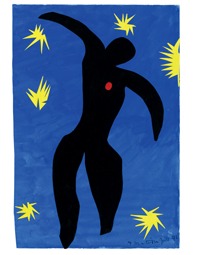
MatisseThe paper cut-outs of Henri Matisse are the focus of a landmark exhibition which opened at Tate Modern last week. Henri Matisse: The Cut-Outs features about 130 works created between 1937 and 1954 with many seen together for the first time. Highlights include maquettes featured in the 1947 book Jazz, The Snail and its sister work Memory of Oceania (both 1953) and the largest number of the Blue Nudes ever shown together. The display takes an in-depth look at the methods and materials Matisse used in the production of the cut-outs. Runs until 7th September (and keep an eye out for the accompanying film, Matisse: Live in cinemas). Admission charge applies. For more, see www.tate.org.uk. PICTURE: Henri Matisse, Icarus 1946, Maquette for plate VIII of the illustrated book Jazz 1947, Digital image: © Centre Pompidou, MNAMCCI, Dist. RMN-Grand Palais / Jean-Claude Planchet, Artwork: © Succession Henri Matisse/DACS 2014.

On Now: Spitting Image. This exhibition at the Cartoon Museum in Bloomsbury centres on the partnership of three dimensional artists Peter Fluck and Roger Law and their key role in the creation of what became known as Spitting Image. It features caricature drawings and photographs created for magazines in the 1970s and 1980s of the likes of Paul McCartney, Michael Jackson, Kate Moss, Saddam Hussein, Billy Connolly, Rupert Murdoch, Jo Brand and John Paul II as well as members of the Royal Family and politicians including Margaret Thatcher. Also present are some of the puppets used in the TV show which ran for 18 series between 1984 and 1996 – these include those of Thatcher, The Queen, Princess Diana and Mr Spock. Runs until 8th June (with selected late opening nights). Admission charge applies. For more, see www.cartoonmuseum.org.

Send all items of interest for inclusion to exploringlondon@gmail.com.

This Week in London – William Shakespeare’s influence; new Fourth Plinth commissions; the car and landscape; and London Stories…

First up, apologies that we were unable to launch our new Wednesday series yesterday due to some technical difficulties (stayed tuned for next week). And now, on with the news…

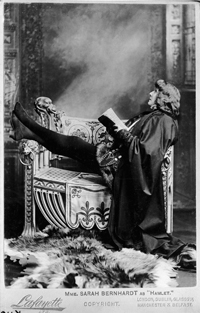
Sarah_Bernhardt_by_Lafayette_Ltd_1899_c__Victoria_and_Albert_Museum_London__William Shakespeare’s influence on successive generations of theatrical performance is the subject of a new exhibition at the V&A to mark the 450th anniversary of his birth on 23rd April. Shakespeare: Greatest Living Playwright centres on the Bard’s First Folio which, published in 1623, contains 36 plays including 18 works – Macbeth, The Tempest and Twelfth Night among them – which would be unknown without it. The display includes interviews, archive footage and photography and objects from the V&A collections as well as an audio-visual presentation by Fifty Nine Productions featuring interviews with contemporary theatre practitioners such as actors, directors and designers. Objects on display include a skull used by Sarah Bernhardt when playing Hamlet in 1899, an embroidered handkerchief used by Ellen Terry when playing Desdemona in 1881 at the Lyceum Theatre, and a pair of red boots worn by actor-manager Henry Irving in an 1887 production of Richard III. Runs in the V&A’s Theatre and Performance Galleries until 21st September. Admission is free. For more, see www.vam.ac.uk. PICTURE: Sarah Bernhardt as Hamlet, 1899, © Victoria and Albert Museum, London.

A skeletal horse and a giant hand giving a thumbs up will adorn the Fourth Plinth in Trafalgar Square during 2015-16. Hans Haacke’s Gift Horse is derived from an etching by painter George Stubbs and, while being a comment on the equestrian statue of King William IV which was intended for the plinth, also features an electronic ribbon displaying a live ticker of the London Stock Exchange on its front leg. Meanwhile David Shrigley’s Really Good is a 10 metre high hand giving a thumbs up – sending a positive message to those who see it. For more, see www.london.gov.uk/priorities/arts-culture/fourth-plinth.

The impact of the car on England’s landscape and the listed buildings of motoring history are the focus of a new exhibition in Wellington Arch. Carscapes: How the Motor Car Reshaped England features archive photographs, historic advertising, cartoons and motoring magazines as well as a 1930s traffic light, a petrol pump and other accessories and memorabilia. Wellington Arch, which is managed by English Heritage, is a fitting location for the exhibition – it was moved to its current position due to increasing traffic back in 1883. Admission charge apply. For more, see www.english-heritage.co.uk.

A new exhibition exploring some of the true and not-so-true stories inspired by and produced in London opens at the London Transport Museum in Covent Garden tomorrow. London Stories features the best entries from The Serco Prize for Illustration 2014 with more than 50 works of art on display depicting a well-known or obscure London narrative. The short-listed illustrations tackle everything from ghost buses to Buffalo Bill’s Wild West Show of 1887, a Pearly King and Queen, Lenin’s ‘Love letter to London’ and an escaped monkey jazz band. There’s also a host of musical and literary references – everything from Mary Poppins to Sweeney Todd and Oranges and Lemons. Tomorrow there will be a late opening of the exhibition complete with cash bar, DJ and story-telling for adults as well as the chance to create your own London story with illustration workshops and a photo-booth. Organised by London Transport Museum in partnership with the Association of Illustrators, it runs until 6th April. Admission charge applies. For more, see www.ltmuseum.co.uk.

Send all items of interest for inclusion to exploringlondon@gmail.com.

Famous Londoners – Jonathan Wild…

The self-styled “Thief-Taker General”, Jonathan Wild was one of the most famous figures of London’s underworld in the early 18th century, credited by some as being the city’s first organised crime boss.

Jonathan-WildBorn to a family in Wolverhampton, Wild – who had at some point undertaken an apprenticeship as a buckle-maker – was married and had a son when he first came to London as a servant in 1704 and although he returned to the city of his birth after being dismissed, he apparently abandoned his family and returned to the capital in 1708.

Little is known of the first couple of years he spent in London but records show he was arrested for debt in March 1710 and sent to Wood Street Compter where he quickly ensconced himself and was even awarded the “liberty of the gate” – meaning he could leave the prison at night to aid in the apprehension of thieves.

It was also during this period that he came under the influence of a prostitute Mary Milliner. Upon his release in 1712 – thanks to an Act of Parliament passed to help debtors – he lived with her as her husband (despite his earlier marriage – and hers) in Covent Garden.

Acting as her protector when she was on the street, Wild also branched into the business of being a fence or receiver of stolen goods and racketeering offences like extortion. In 1713, he joined Charles Hitchen to be his assistant. Hitchen, who had been suspended from his position as the City’s Under Marshal thanks to his practice of extorting thieves and their victims (it’s thought he may have taught Wild the craft), was then working as a thief-taker.

Wild apparently took to the new role with fervour for when Hitchen was reappointed to his post as Under Marshal, Wild parted from his company and continued his work as a thief-taker, opening his own office in the Blue Boar Tavern in Little Old Bailey.

Wild’s method of operation was simple enough – he would organise thieves to steal items and then, when it was announced that said items were stolen, claimed to have found them and would return them to the rightful owners for a “reward”. At the same time, he’d often also aid the police by bringing to justice thieves from rival gangs (including Hitchen’s, for they were now rivals) or those of his own gang who had crossed him – and in all his dealings manage to keep at arm’s length from the actual business of stealing and receiving.

By 1718, Wild – who wore a sword as a sign of his authority and had pretensions of being a “squire” – was calling himself the “Thief-Taker General of Great Britain and Ireland”. It’s said that more than 60 thieves were sent to the gallows on the back of his testimony including the prolific housebreaker (and jail escapee) Jack Sheppard and his associate Joseph “Blueskin” Blake (who almost succeeded in killing Wild while he was awaiting trial).

Wild’s pursuit of Sheppard was the beginning of his own downfall (although authorities had as early as 1717 passed an Act of Parliament aimed squarely at ending his criminal enterprise, it seemed to have had little effect, at least initially). Sheppard’s demise had been unpopular with the masses and the press of the day – and in February 1725, Wild himself was arrested for assisting in the jailbreak of one of his gang members. Other members of the gang turned against him and eventually, in May that same year, he was sentenced to death for the theft of lace.

Having unsuccessfully attempted to kill himself by drinking laudanum before his execution, Wild was hanged at Tyburn on 24th May before a large and raucous crowd which apparently included an 18-year-old Henry Fielding.

Wild was buried in secret in the churchyard of St Pancras Old Church next to his third wife (and one of his many lovers), Elizabeth Mann (she had died in 1718 and he apparently married another woman shortly after). His body was later reported to have been dug up and eventually, following the recovery of a body with a hairy chest from the Thames which was identified as being Wild’s, a skeleton said to have been his was donated to the Royal College of Surgeons (it’s now on display in the Hunterian Museum).

The subject of numerous articles, books and ballads, Wild’s story has been since told numerous times and for varying purposes. Among them are Daniel Defoe’s True and Genuine Account of the Life and Actions of the Late Jonathan Wild, published in 1725, Henry’s Fielding’s ironic The History of the Life of the Late Mr Jonathan Wild the Great (1743), and John Gay and John Rich’s The Beggar’s Opera (1728) which features the character Peachum, said to have been based on Wild.

PICTURE: From “Ticket to the Hanging of Jonathan Wild”/Wikimedia Commons

To read more about Jonathan Wild, see Gerald Howson’s Thief-taker General: The Rise and Fall of Jonathan Wild.

LondonLife – London in a snow globe at Covent Garden…


Covent-Garden-LEGO-snow-globe

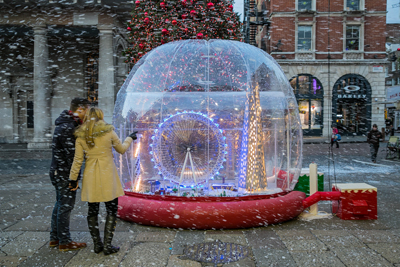
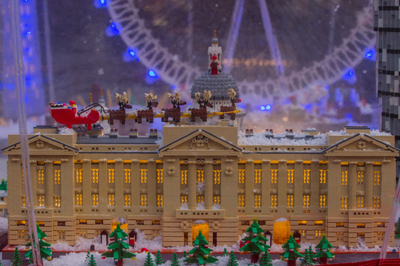
Following on from its LEGO advent calendar and Christmas tree, Covent Garden is home to a giant LEGO snow globe this Christmas. Made of 120,000 bricks, it features 14 of London’s most iconic landmarks – from Nelson’s Column, Buckingham Palace (see below) and the London Eye to The Shard, Shakespeare’s Globe and, of course, Covent Garden. The models took Duncan Titmarsh, the UK’s only certified LEGO professional, around 75 days to build. Hidden among the models are a number of LEGO Santas – count them to win prizes and press a button to make snow fall inside the globe. For more, see www.coventgardenlondonuk.com.

Covent-Garden-LEGO-snow-globe2

Lost London – Mrs Salmon’s Waxworks…

Before Madame Tussaud arrived in London, there was Mrs Salmon and her famous waxworks, one of several such establishments in London.

Prince-Henry's-RoomsFirst sited at the Sign of the Golden Ball in St Martin’s Le Grand – where it filled six rooms – in 1711, the display was relocated to the north side of Fleet Street where it remained until 1795 when it moved across the road to number 17 Fleet Street, now housing Prince Henry’s Room (pictured, room takes its name from Prince Henry, eldest son of the king, who died at the age of 18 and was apparently the inspiration for an inn which previously occupied the building called The Prince’s Arms).

The waxworks were apparently originally run by Mr Salmon – there are references to him being a “famous waxwork man” – but his wife, Mrs Salmon, continued it alone after his death in 1718 until her own death, variously said to have been in 1760 or as late as 1812. At some point after his death, Mrs Salmon is said to have remarried, to a Mr Steers.

Described in a handbill published soon after its initial move to Fleet Street, the exhibitions were said to include a scene of King Charles I upon the scaffold, another of the ill-fated Queen Boudicea, and more exotic tableaux including one showing Canaannite ladies offering their children in sacrifice to the god Moloch, another of a Turkish seraglio, and another of Margaret, Countess of Heningbergh with the 365 children she is said to have given birth to (all at once!). There was also a mechanised figure of the “famous English prophetess” Old Mother Shipton, who is said to have given a boot to visitors as they left.

While some accounts say the waxworks – which, according to the City of London website remained at the site until 1816 – were taken over by a Chancery Lane surgeon named Clarke after Mrs Salmon’s death (and by his wife after his death), it is also suggested that at some point they moved to Water Lane in east London where they were ruined by thieves.

Whatever its fate, it’s generally accepted that the famous waxworks were visited by the likes of James Boswell and artist William Hogarth. They were also mentioned by author Charles Dickens in David Copperfield. 

For more of London’s past, see Philip Davies’ Lost London 1870-1945.

Famous Londoners – Jane Austen…

It’s probably a bit of a stretch to call Jane Austen a ‘famous Londoner’ (although the city does make a fairly regular appearance in her books) but she did have some strong associations. Given the 200th anniversary of Pride and Prejudice earlier this year, we thought it was only fitting to take a quick look at a five places associated with the author in London…

10 Henrietta Street, Covent Garden: Austen stayed in a flat here during the summer of 1813 and during March 1814. The premises was the home of her older brother Henry, then a banker, who moved here after the death of his wife Eliza. While here, Austen visited theatres including The Lyceum and The Theatre Royal, Drury Lane. The building is now occupied by offices.

23 Hans Place, Belgravia: The home of her brother Henry (after he moved from Covent Garden), Austen lived for two years in a house here in 1814-15 and is said to have particularly enjoyed the garden. The current building on the site apparently dates from later in the 19th century. There’s a blue plaque located on the house.

50 Albemarle Street, Mayfair: The former office of publishers John Murray who counted Austen among their first clients were located here.

Westminster Abbey: Austen is not buried here but in Winchester Cathedral. However, you will find a small memorial to her in Poet’s Corner, put here in 1967. It simply reads ‘Jane Austen 1775-1817’.

The British Library, St PancrasAusten’s rather tiny writing desk can be found here, usually on display in the Sir John Ritblat Gallery. It was donated to the library in 1999 by her Canadian descendents.

10 Questions – Simon Murphy, curator at the London Transport Museum…

Simon Murphy is a curator at the London Transport Museum in Covent Garden – the museum is currently celebrating the 150th birthday of the Underground with a series of events including a landmark exhibition on the art of the Tube (Poster Art 150 – London Underground’s Greatest Designs)…
Underground-2How significant was the construction of the London Underground in world terms? And how does it stack up 150 years later? “The Metropolitan Railway was a true world class pioneer, but like all pioneers it made mistakes that subsequent operators learned from. Similarly the first tube railways tested the ground for others to follow. But these pioneering lines are still part of today’s world class Tube network, and some of the original stations, like King’s Cross, are still amongst the busiest, so they must have been on the right track.”

I understand the initial stretch of line ran between Farringdon and Paddington. How quickly were other sections opened? “The Metropolitan Railway’s first extension was authorised by Parliament in 1861, two years before the original line even opened. The railway made a profit in its first year, so financial backing was relatively easy to find, and the extension east to Moorgate opened in 1865, with a westward extension to South Kensington following in 1868. The Met’s main competitor, the Metropolitan District Railway, opened its first section from South Ken to Westminster in 1868. The plan was for the two companies to work together to create an Inner Circle service, but their respective directors fell out and the Circle was not completed until 1884.”

How many miles of line is the Underground composed of today? “The first underground started with less than four miles of track and seven stations; today’s system has 250 miles of track, serving 270 stations.”

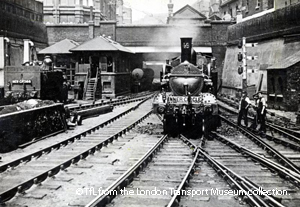
When were steam trains on the Underground replaced? “Steam trains worked in central London until 1905, but were still used on the furthest reaches of the Met until 1961.”

When did the Underground take on the name ‘Tube’? “The Central London Railway opened with a flat fare of 2d in 1900, and was promoted as the Twopenny Tube – the name caught on, although the Underground has only been referring to itself officially as the Tube since the 1990s.”

Underground1It’s fairly widely known that Underground stations and tunnels were used as air raid shelters during World War II. Do you know of any other different uses they have been put to? “The station at South Kentish Town on the Northern Line closed in 1924, but the surface building, still looking very much like a station is now occupied by a branch of Cash Converters. During the war unfinished tunnels on the Central line were occupied by a secret factory run by Plessey Components. Also during the war, paintings from the Tate Gallery were stored in  a disused part of Piccadilly Circus station for safe keeping.”

Stylish design has always been an important part of the Underground’s appeal. What’s your favourite era stylistically when it comes to the Underground and why? “Most people admire the golden age of the 1920s and 30s when the Underground’s corporate identity and personality reached its peak with Charles Holden’s architecture, the roundel, Harry Beck’s diagrammatic map and the amazing posters issued in that era, but personally I find the earlier period from 1908 to 1920 more interesting. You can trace the roots of each element of today’s brand being developed at this time, under Frank Pick’s critical eye, starting with the early solid-disc station name roundels, the joint promotion of the individual tube railways under the UndergrounD brand and the introduction of Edward Johnston’s typeface. You can see the company gaining confidence and momentum, especially in relation to the increasingly sophisticated posters and promotion that Pick commissioned.”

Can you tell us a bit about how the London Transport Museum is marking the 150th anniversary? “
We started the year by bringing steam back to the Circle line, after restoring an original Metropolitan Railway carriage and overhauling an original Met steam locomotive, and have just opened our fabulous overview of the 150 best Underground posters at the museum in Covent Garden, which runs until October. We are opening our Depot store, near Acton Town station in April for a steam weekend, and have a range of lectures and evening events at Covent Garden linking to the history of the Underground and its poster art heritage. There’s also our comprehensive new history of the Tube published last year and a wide range of new products and souvenirs in our amazing shop.”
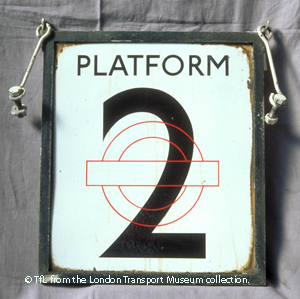
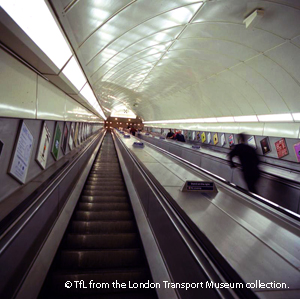
Underground3What are some of your favourite Underground-related objects on display at the museum? “The Design for Travel gallery on the ground floor is the literal and metaphorical heart of the Museum for me. Packed with close to 300 objects including signs, posters, models, leaflets and other documents, it’s hard to single out individual items, but I love the simplicity of the small ‘Platform 2’ hanging sign (pictured right) – it’s a real example of the design consistency and attention to detail that I associate with the Underground.”

And lastly, can you tell us a couple of little-known facts about the Underground? History is more than a chronological list of facts, and what one person finds fascinating sends another to sleep, so it’s quite a challenge to choose something that is little known, but genuinely interesting, but I’ll try: I grew up near Brent Cross station so I might be biased, but I reckon that if there was a top trumps for Underground lines, the Northern line would win. It has the longest escalators (at Euston), the deepest lift shaft (at Hampstead), the highest point ve sea level (on a viaduct near Mill Hill East), the longest tunnels (between East Finchley and Morden – 17 miles) and has had more names than any other line – it only became the Northern line in 1937.”

IMAGES: Top: Steam engine at Aldgate (1902); Middle: Platform 2 sign, 1930s design; and Bottom, Angel Underground Station (1990s). © TfL from the London Transport Museum collection. 

Poster Art 150 – London Underground’s Greatest Designs runs at the London Transport Museum until October. Admission charge applies. For more (including the many events around the exhibition), see www.ltmuseum.co.uk/whats-on/events/events-calendar#posterart150.
Around London – Celebrating the art of the Underground and art on the web; Picasso at the Courtauld; and, Frederic Church at the National…

A new exhibition celebrating the art of the Underground opens at the London Transport Museum in Covent Garden tomorrow. Poster Art 150 – London Underground’s Greatest Designs showcases 150 posters with examples taken from each decade over the past 100 years. Artists include the likes of Edward McKnight Kauffer, Paul Nash and Man Ray. The posters were selected from the museum’s archive of more than 3,300 by a panel of experts. Visitors to the exhibition will be able to vote on their favorite poster as well as online with the most popular poster to be revealed at the end of the exhibition. The last major exhibition of Underground posters – the first commission of which was in 1908 – was held in 1963 to celebrate the system’s centenary. The exhibition is based around six themes – ‘Finding your way’, ‘Brightest London’, ‘Capital culture’, ‘Away from it all’, ‘Keeps London going’ and, ‘Love your city’. Runs until 27th October. Admission fee applies. For more on the exhibition and surrounding events, see www.ltmuseum.co.uk.

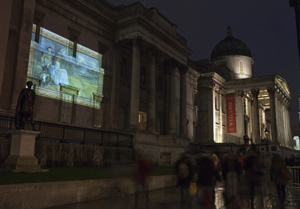
National-Gallery The external facade of the National Gallery in Trafalgar Square was decorated with artworks last Friday night (pictured right) in celebration of the completion of Your Paintings – a website which hosts the UK’s entire national collection of oil paintings (more than 210,000!). The projections – which were happening in 28 UK cities simultaneously – featured two National Gallery paintings – Van Gogh’s Sunflowers and Gainsborough’s Mr and Mrs Andrews. To see the website, head to www.bbc.co.uk/arts/yourpaintings/. PICTURE: © The National Gallery, London.

• On Now: Becoming Picasso: Paris 1901. This exhibition at The Courtauld Gallery in Somerset House on The Strand tells the story of Pablo Picasso’s break-through year as an artist – 1901 – when the then 19-year-old launched his career in Paris at a summer exhibition. The display follows Picasso from his debut and into the start of his Blue period. Works exhibited are among the first to bear his famous signature. Runs until 26th May. There is an admission charge. For more, see www.courtauld.ac.uk/gallery/index.shtml.

On Now: Through American Eyes: Frederic Church and the Landscape Oil Sketch. This free exhibition of 30 works at the National Gallery focuses on the work of Frederic Church (1826-1900), a member of the Hudson River School of artists and considered by many to be the greatest of the American landscape oil sketch artists. Works on display include those made at exotic locations such as Ed Deir, Petra, painted in Jordan in 1868, and Distant View of the Sangay Volcano, Ecuador, painted in 1857, as well as the paintings created closer to home, such as Hudson, New York at Sunset, painted in 1867. The exhibition is held in Room 1. Runs until 28th April. For more see www.nationalgallery.org.uk.

LondonLife – Forget the halls, they’re decking the city…

We’ve decided not to kick off our next Wednesday series until the new year so in the meantime, we’ll take a look at where you can find some of the best – and some of the most historic – Christmas decorations in London (and we’d love to hear your thoughts as well!). Here is some of what you’ll find in the West End this year…

Trafalgar-Square-Christmas-Tree1. Trafalgar Square Christmas Tree:  A symbol of Christmas in London since 1947, this massive tree (usually a Norwegian spruce) is an annual gift from the people of Norway as thanks for British support during Norway’s years of occupation in World War II. The tree – which is usually around 50 to 60 years old, more than 20 metres high and resident in the forests around Oslo – is felled in November in a ceremony attended by the Lord Mayor of Westminster, the Mayor of Oslo and the British ambassador to Norway before being brought to the UK by sea. This year’s tree lighting ceremony took place on 6th December and a program of choirs will be singing at the tree during evenings in the lead-up to Christmas.

2. Regent Street Christmas Lights: The street’s stunning Christmas light displays apparently date back to the early 1950s when the lifting of wartime lighting restrictions allowed the display. The lighting ceremony has since become an annual event – this year’s lights – which stretch over a mile and tell the story of the 12 Days of Christmas – were turned on by some 40 Olympians and Paralympians in November and will remain up until early January next year.

3. Oxford Street Christmas Lights: Switched on in early November by singer Robbie Williams (with supporting act Leona Lewis), the Oxford Street Christmas display – this year more properly known as the Marmite Oxford Street Christmas Lights – has been a West End tradition since 1959. This year’s mile long display involves 300,000 LED bulbs. Among the stars who have switched on the lights over the display’s 53 year history are the Spicegirls, Westlife and The Saturdays, who held the honor last year.

4. Bond Street Christmas Lights: A more boutique display than its more celebrated neighbours, this year’s lights were switched on by Gareth Malone and the Military Wives Choir.

5. Covent Garden decorations: This year’s decorations include an innovative display from United Visual Artists in the Market Building as well as a giant Lego advent calendar with a new window opened each day at 4pm in the lead-up to Christmas. Other Christmas-related features include a 32 foot high topiary reindeer as well as the chance for kids to pet a real reindeer on Saturdays. There’s also a food market and choir singing.

10 Historic London Markets – 8. Columbia Road Flower Market…

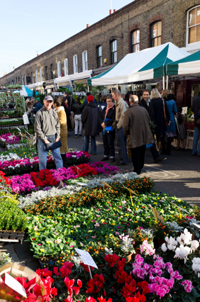
Originally founded in the early 1800s, the Columbia Road market in East London has since evolved into a specialist flower market on Sundays.

First emerging as a general street market in the early 1800s, the market was formalised in the mid 1800s when banking heiress Angela Burdett-Coutts financed the construction of the now demolished – and somewhat architecturally fanciful – Columbia Market. This opened in 1869 at the northern end of the road but didn’t prove a great success. Despite efforts to save it – including apparently relaunching it as a fish market – it closed in 1885.

The market building – which is said to have resembled the sort of market hall that might be found in rural areas – was later used as a warehouse but after suffering bomb damage in World War II were demolished.

The market, meanwhile, reappeared on the street and as the area’s Jewish population grew, moved to a Sunday, a decision which allowed traders from Covent Garden and Spitalfields to trade their leftover goods from the previous day.

The introduction of new regulations – including those introduced in the 1960s requiring traders to attend regularly – saw the market gradually transform itself into the colorful market selling cut flowers, plants and bulbs you can find there today. Popular with film makers and photographers thanks to the colourful backdrop it provides, the surrounding streets also feature a range of interesting independent shops and cafes.

WHERE: Columbia Road, Bethnal Green (nearest Tube stations are Shoreditch, Liverpool Street, Aldgate East and Bethnal Green); WHEN: 8am to 2pm Sunday; COST: Free; WEBSITE(S): www.columbiaroad.info/www.columbia-flower-market.freewebspace.com/index.html.

PICTURE: Dynasoar/www.istockphoto.com

Famous Londoners – Sir Peter Lely…

One of the most famous painters of his age, Dutchman Sir Peter Lely – currently the subject of an exhibition at London’s Courtauld Gallery – rose to become the foremost portrait painter at the English Court during the latter half of the 17th century.

Born to Dutch parents on 14th September, 1618, in Westphalia (now part of Germany) where his father was serving as an infantry captain, Peter – originally named Pieter van der Faes – studied art as an apprentice in Haarlem in what is now The Netherlands. While there he is believed to have changed his name to Lely based on a heraldic lily which appeared on the gable of the house where his father was born in The Hague.

Lely appeared in London in the early 1640s and, while he initially devoted himself to the sort of narrative-style paintings inspired by classical mythology, the Bible and literature he had been working on in Haarlem but having found no great success there, soon turned his hand to portraiture.

The death of court portraitist Anthony van Dyck in 1641 had left a vacuum he stepped into the gap, soon becoming the most in-demand portrait painter at the Royal Court, his sitters including none other than King Charles I himself.

However, Lely, who was made a freeman of the Painter-Stainers Company in London in 1647, managed to straddle the political divide and after the beheading of King Charles I and the end of the English Civil War in 1651, was able to continue painting portraits of the most powerful people in the land including Oliver Cromwell – whom he painted “warts and all” as per the Lord Protector’s request – and his Cromwell’s brother Richard.

Already renowned as the best artist in the country, following the Restoration in 1660, Lely became Principal Painter of King Charles II, placed on an annual stipend as van Dyck had been before him during the reign of King Charles I.

Lely’s workshop was large and its output prolific, with his students and employees – who at one stage apparently included scientist and architect Robert Hooke – often completing his paintings after he sketched out some details, only painting the sitter’s face in any great detail.

Among his most famous works are a series of 10 portraits known as the Windsor Beauties (currently at Hampton Court Palace), a series of portraits of senior naval officers who served in the Second Anglo-Dutch War, known as the Flagmen of Lowestoft (most of the works at are the National Maritime Museum in Greenwich) and Susannah and the Elders (currently at Burghley House in Cambridgeshire) as well as some of the paintings in the current Courtauld exhibition including Nymphs by a Fountain (usually found at the Dulwich Picture Gallery) and Boy as a Shepherd (also the Dulwich Picture Gallery).

Lely was also known as an avid collector of art and is credited as being the first artist in England to do so in any serious manner – among his purchases were works which formerly formed part of King Charles I’s collection. At the time of his death, he is said to have owned more than 500 paintings, although more than half of these were works of his or his studio.

Sir Peter, who never married but had two children who survived him with a common-law wife Ursula, lived at a house in the north-east corner of Covent Garden from about 1650 until his death in 1680 (some sources have him knighted in this year, others in 1679) but also had a house at Kew and owned property outside of London including in Lincolnshire and The Hague.

He was apparently working at his easel in the studio of his Covent Garden house when he died on 30th November, 1680. He was buried at St Paul’s Church, Covent Garden. The monument to him, the work of Grinling Gibbons, was destroyed by fire in 1795.

Peter Lely: A Lyrical Vision – which focuses on some of his early non-portrait works – runs at The Courtauld Gallery until 13th January. For more on the exhibition, visit www.courtauld.ac.uk/gallery/exhibitions/2012/peter-lely/index.shtml. Running alongside the exhibition is a display of some of the drawings from Sir Peter’s own collection, Peter Lely: The Draughtsman and His Collection.

10 Historic London Markets – 5. Covent Garden Market…

We’ve had a quick look at the origins of Covent Garden before (as part of our What’s in a name? series) but it’s worth a recap.

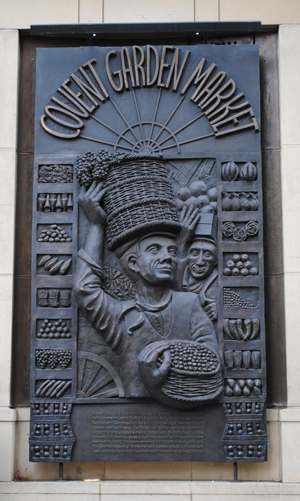
Now a favorite of tourists visiting London, Covent Garden is these days largely known as a specialty shopping and entertainment precinct in the West End. But its beginnings as a market go back at least to the 1600s when a licence was formally granted to hold a market in the piazza.

The land had been formerly owned by the Abbey (or Convent) of St Peter in Westminster which had established 40 acre kitchen garden here (hence ‘Convent Garden’) and had passed into the hands of the Crown at the Dissolution. Later owned by the Earls of Bedford, it was the 4th earl, Francis Russell, who commissioned Inigo Jones to design a great residential square- including St Paul’s Church, known as the Actor’s Church – on the site.

By 1650, fruit and vegetable markets were regularly been held on the site and, interestingly, around this time the market adopted the pineapple, a symbol of wealth, as its emblem (it was also around this time that Punch and Judy shows were introduced to the area (see our earlier post on Mr Punch here)). Covent Garden’s rise to prominence as a market came when the Great Fire of London destroyed many of London’s other markets leaving it as the foremost fruit, vegetable and flower market. In May 1670, the 5th Earl of Bedford, William Russell (later 1st Duke of Bedford), obtained the formal right to hold a market on the site from King Charles II.

The growth of the market and the development of fashionable residential developments further west in Soho and Mayfair saw many of the affluent people who had lived around the market move out and the character of the square changed (in an indication of this, a list of Covent Garden prostitutes was published in 1740).

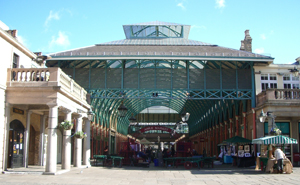
In 1813, the 6th Duke of Bedford, John Russell, secured an Act of Parliament regulating the market and in the late 1820s began to redevelop the site, commissioning architect Charles Fowler to design new buildings (up until then the market was housed in makeshift stalls and sheds). These include the grand main market building which still stands on the site today.

The market continued to grow – there is said to have been 1,000 porters employed at the market’s peak – and in 1860 a new flower market was built on the south piazza (where the London Transport Museum now stands), while in the 1870s, a glass roof was added to the market building. A “foreign” flower market opened in what is now Jubilee Hall in 1904.

In 1918, the Bedford family sold the market to the Covent Garden Estate Company. The next major installment in the market’s life came in 1974 when the market, which had outgrown the West End site, moved out to a new site in Nine Elms at Vauxhall in London’s inner south.

The Covent Garden site was left to fall into disrepair but, saved from demolition and redevelopment largely through the efforts of Geoffrey Rippon, then Secretary of State for the Environment, it subsequently underwent restoration, reopening as a speciality shopping centre in 1980 with areas including the Apple Market (pictured above), the East Colonnade Market and the Jubilee Market. Now owned by Capital & Counties who purchased it in 2006, the market – along with the larger 97 acre Covent Garden area – remain under the care of the Covent Garden Area Trust.

Meanwhile, the New Covent Garden Market at Nine Elms is these days the largest fruit, vegetable and flower market in the UK and boasts more than 200 businesses. There are currently plans to redevelop the 57 acre market site which will include providing more space for market tenants as well as new homes, shops and community facilities like parks.
.
Covent Garden
WHERE: King Street, Covent Garden (nearest Tube stations are Covent Garden, Leicester Square and Embankment); WHEN: Public areas are open 24 hours; check with individual shops for opening times; COST: Free; WEBSITE: www.coventgardenlondonuk.com
.
New Covent Garden Market
WHERE: New Covent Garden Market, Nine Elms, Vauxhall (nearest Tube station is Vauxhall); WHEN: The fruit and vegetable market’s core trading hours are between midnight and 6am, Monday to Saturday, while the flower market’s core trading hours are between 2am and 8am, Monday to Saturday (times may vary for individual businesses); COST: Free (charge for cars); WEBSITE: www.newcoventgardenmarket.com.
.
PICTURE: Apple Market Picture courtesy of www.coventgardenlondonuk.com.