Once a significant estate on the northern outskirts of London, the palace of the Bishops of Ely was used for some 500 years as their London residence.
Holborn
London pub signs – Three quirky pub names (briefly) explained…
We pause from our usual London pub names entries to mention three pub names which, while they don’t come from any association with important historical figures or events of the past, do have an interesting, if briefly explained, origin story.
First up its John the Unicorn, located in a former decorator’s shop at 157-159 Rye Lane in Peckham. The story goes that the pub’s first landlord (and it’s only been opened since 2016), named it after his child’s toy – a fluffy unicorn named, you guessed it, John.
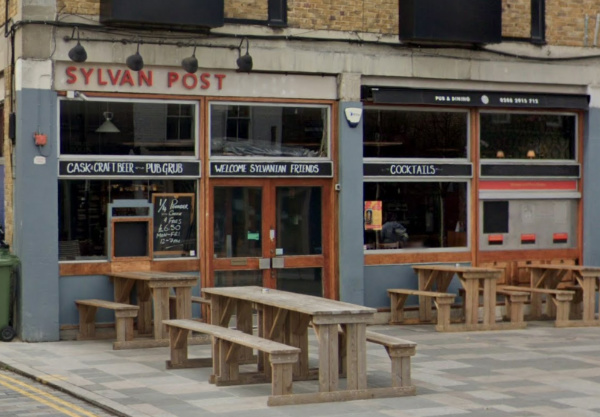
The Sylvan Post at 24-28 Dartmouth Road in Forest Hill is located – yes, you guessed it – in a former post office. The “Sylvan” part comes from the location in Forest Hill. Get it?
Then we come to The Pregnant Man at 40 Chancery Lane. Located under the headquarters of advertising behemoth Saatchi & Saatchi, the pub was named for one of their most memorable ad campaigns of the 1970s which, run on behalf the Family Planning Association, featured a pregnant man with the caption, “Would you be more careful if it was you who got pregnant?”.
What’s in a name?…Theobolds Road…
This north London thoroughfare, which runs north-east from Southampton Row through Holborn to Gray’s Inn Road is named for the destination it once led to – a country house in Hertfordshire known as Theobolds which once belonged to King James I.
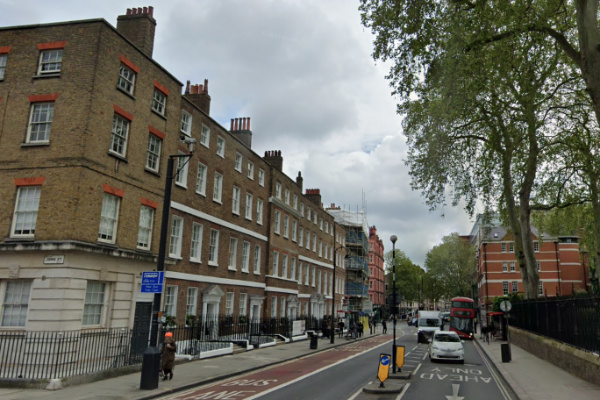
The house, which has been rebuilt many times and is now a conference centre, was actually where King James I died. Prior to his residency, it was home to Queen Elizabeth I’s advisor, William Cecil, Lord Burghley, and then his son, Robert Cecil, the first Earl of Salisbury.
The road, which the modern Theobolds Road forms part of, was apparently also known as the King’s Way due to its royal traveller – this royal connection is still retained in the nearby roadway known as Kingsway.
Among the famous residents of Theobolds Road was Prime Minister Benjamin Disraeli who was born at number 22 in 1804 (and is now commemorated with an English Heritage Blue Plaque, although this one is actually brown).
London pub signs – The Ship Tavern, Holborn…
This Holborn pub apparently has a history dating back to 1549.
It is believed to have been established to cater to farm labourers working in nearby Lincoln’s Inn Fields.
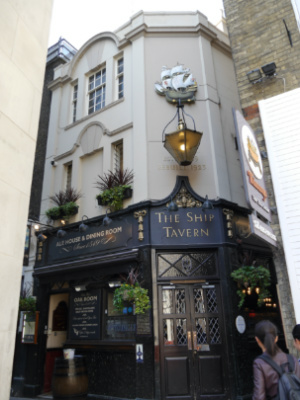
Its name, however, is said to be related to its proximity to the now-underground River Fleet which runs through Holborn and linked the area with the River Thames. It’s said that the pub’s clientele soon included dock workers and that it may have even had connections to smuggling and pirates. It was apparently these connections that gave the pub the name it still has today.
These days tucked down a narrow alleyway at 12 Gate Street in a building dating from 1923 (apparently considerably bigger than the original), the pub, which features wood panelled walls and leaded windows, has a storied history.
Having been established during the reign of King Edward VI, the pub is known to have provided a space for banned Catholic worship (complete with spotters to warn if officials were seen in the area and hiding places for the priests should the officials decide to raid the premises).
Indeed, the pub would have also served those who attended executions of Catholics such as Robert Morton and Hugh More who were executed in 1588 in the nearby Lincoln’s Inn Fields (other executions there included that of Anthony Babington, executed in 1586 after being convicted of plotting against Queen Elizabeth I, and Lord Russell, executed in 1683 for his involvement in the Rye House Plot).
Other clientele, meanwhile, may have come from the nearby thoroughfare of Whetstone Park which was once notorious for gambling houses and other illicit behaviours.
The Ship also has Freemason connections, being officially consecrated as a Masonic Lodge in 1736 by the then-Grand Master, the Earl of Antrim.
Famous figures said to have been associated with this pub include Richard “Trusty Dick” Penderell, who aided Charles I’s escape after the Battle of Worcester in September, 1651, the antiquarian John Bagford, the French diplomat and spy Chevalier d’Eon who lived both as a man and, later in life, as a woman, and John Smeaton, the builder of a lighthouse once located at Eddystone in Cornwell. It’s even been suggested Shakespeare visited.
There’s also said to be a number supernatural clients at the pub with mysterious figures seen sitting at tables and glasses being moved around (it’s been suggested some of these relate to the persecution of Catholics on the site).
For more, visit theshiptavern.co.uk.
A Moment in London’s History – The first bananas go on sale…
It’s widely reported that the first banana went on sale in London in the mid-17th century but there is evidence bananas had been in the capital well before that date.
Subscribe for full access for just £3 a month.
This Week in London – ‘Spies, Lies and Deception’ at IWM London; the printing of Shakespeare’s plays; and, Georgian illuminations at the Sir John Soane’s Museum…
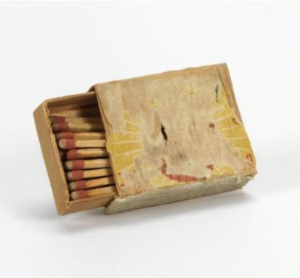
secret messages used during World War II. © IWM (EPH 178)
• A free exhibition exploring the “tricks, tools and elaborate plots that make up the secret world of spying and deception” has opened at IWM London. Spies, Lies and Deception features more than 150 objects including gadgets, official documents, art and newly digitised film and photography. Highlights include Operation Mincemeat mastermind Ewen Montagu’s private papers relating to the World War II plot – which fooled German High Command about the location of the next major Allied assault by planting a dead body with fake military documents off the Spanish coast – along with an oar from the submarine’s dinghy which deposited the body. There is also a box of matches with a match specially adapted for writing secret messages (pictured), footprint overshoes made by SOE (Special Operations Executive) in South-East Asia during World War II to disguise the wearer’s real footprints, and papier-mâché heads used to deceive snipers in World War I trenches. The exhibits also detail the work of the World War I Postal Censorships department – which examined letters sent to foreign locations including testing letters for invisible ink and tell the story of SOE operative Noor Inayat Khan – the first female wireless operator sent by SOE into Occupied France, she successfully transmitted messages to London for four months before being betrayed, captured and executed. There’s also a newly commissioned interview with Eliot Higgins, founder of Bellingcat, an international collective of researchers who used open source data to uncover the real identities of those responsible for the Salisbury Novichok poisonings in 2018, along with a photo album of double agent Kim Philby in Siberia after he escaped to the Soviet Union following his discovery in 1963. The free display can be seen until 14th April next year. For more, see iwm.org.uk/events/spies-lies-and-deception.
• A exhibition looking at the history of printing William Shakespeare’s plays has opened at the Guildhall Library. Folio 400: Shakespeare in Print covers everything from the printing of the small ‘Quartos’ of the late 16th century to the reworking of the text in the 18th century and the rediscovery of original texts in the 19th century. Running in parallel is a display at the City of London Heritage Gallery at Guildhall Art Gallery which features the library’s copy of the First Folio, widely regarded as one of the finest and most complete. Entry is free. Runs until 30th January. For more, see www.cityoflondon.gov.uk/things-to-do/history-and-heritage/guildhall-library.
• An exhibition centring on the spectacular light illuminations of the Georgian period has opened at Sir John Soane’s Museum. Georgian Illuminations celebrates the light shows of the period and the impressive and the elaborate temporary architectural structures created for them, often designed by leading architects and artists, including Sir John Soane. It features newly discovered linen transparencies, which were back-lit in Georgian windows as patriotic decoration during the Napoleonic Wars, as well as a contemporary work by light artist Nayan Kulkarni light artist which sees the facade of the museum at Lincoln’s Inn Fields illuminated each night from dusk until about 11pm. A series of events accompanies the exhibition. Runs until 7th January, 2024. Entry is free. For more, see www.soane.org/exhibitions/georgian-illuminations,
Send all items to exploringlondon@gmail.com for inclusion.
Where’s London’s oldest…surviving cabmen’s shelter?
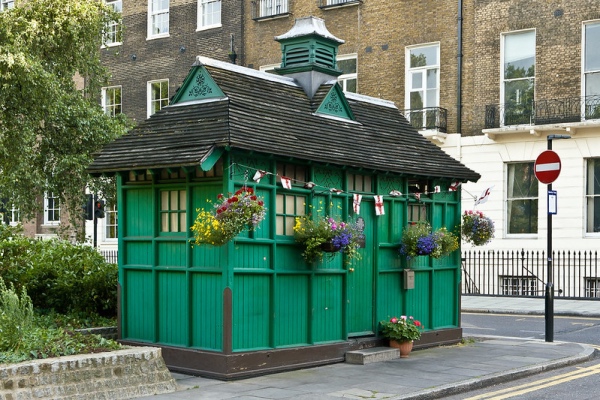
More than 60 of these shelters were built at major cab stands around London between 1875 and 1914 in order to allow cabmen to seek refreshment without leaving their vehicle.
The narrow, rectangular, green huts were constructed by the Cabmen’s Shelter Fund – which was established in 1875 by a philanthropically-minded group including the newspaper publisher Sir George Armstrong and the Earl of Shaftesbury (the group also had the support of the Prince of Wales, later King Edward VII).
The story goes that it was Sir George who pushed the idea forward after a servant he sent to find a cab in some inclement weather took a long time in returning thanks to the fact the cabbies were all off seeking a hot meal in nearby pubs.
The shelters, which police specified were not allowed to be larger than a horse and cart given their position on a public highway, were initially very simple in design but become more ornamental as time went on (architect Maximilian Clarke, who designed a shelter for Northumberland Avenue which was built in 1882, was a key proponent of this more ornate style).
Most were staffed by attendants who sold food and drink to the cabbies (there were also kitchen facilities for them to cook their own as well as tables to sit at and a variety of reading materials). Drinking and gambling, as well as swearing, were apparently strictly forbidden.
The first of these shelters, which reportedly cost around £200 each, was erected in Acacia Road, St John’s Wood, but that shelter is long gone. Just 13 of the huts now survive and all are Grade II-listed. They have various nicknames assigned to them by London’s cabbies – one on Kensington Road, for example, is apparently known as ‘The All Nations’ thanks to its proximity to the site of the Great Exhibition of 1850, while another at Temple Place is simply known as ‘The Temple’.
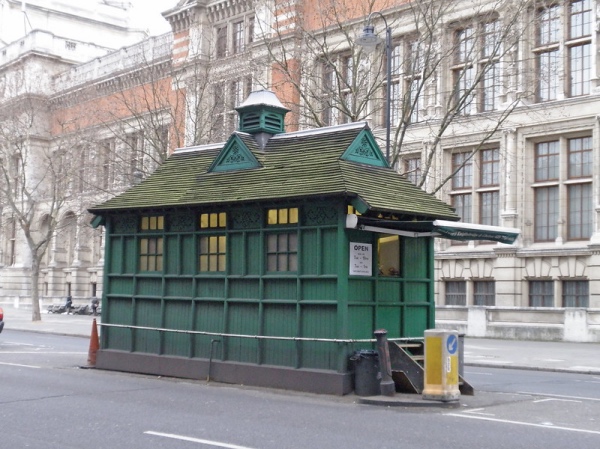
As to which is the oldest?
Well, that’s proved a bit of a vexed question. According to listings on the Historic England website, the oldest we could find dated from 1897. They included one located in Hanover Square, another in Russell Square (this having been relocated from its previous position in Leicester Square), and a third in Thurloe Place in South Kensington, opposite the Victoria and Albert Museum.
But there were three for which we could find no details of the date on which they were built. They include one on the Chelsea Embankment near the Albert Bridge, another in St George’s Square in Pimlico, and the final one in Wellington Place in St John’s Wood near Lord’s cricket ground.
Update: According to our cabbie correspondent – see comments below – the Cabmen’s Shelter Fund have said the oldest shelter is that in Kensington Park Road, which they dated to 1877. Historic England have this one listed as dating 1909 – perhaps a rebuild?
Correction: The shelter known as ‘The All Nations’ is in Kensington Road, not Kensington Park Road as originally reported.
PICTURES: Top – The Russell Square shelter (David Nicholls, licensed under CC BY-NC 2.0); Below – the Cabmen’s Shelter in Thurloe Place opposite the Victoria and Albert Museum in South Kensington (Amanda Slater, licensed under CC BY-SA 2.0)
Lost London – The Sardinian Embassy Chapel…
A Roman Catholic located in Lincoln’s Inn Fields, the Sardinian Embassy Chapel went through several incarnations prior to its destruction in the early 20th century.
 A Franciscan chapel was founded on the site in the mid-17th century – it was sacked during the Glorious Revolution – but by the early 18th century the chapel which stood here served the Embassy of the Kingdom of Sicily.
Because embassy chapels – of which this was apparently the oldest in London – were viewed as the sovereign territory of the state they belonged to, Catholic worship was permitted there (despite being illegal elsewhere in England) and English Catholics were among those who attended services (among those said to have done so was James Boswell).
Those English subjects who attended were on occasion harassed for doing so and the chapel itself was attacked several times over its existence including in the Gordon Riots of 1780 which left it significantly damaged (but following government compensation, it was restored and reopened in 1781).
In 1798, the Sardinian Ambassador closed the chapel but thanks to a generous Catholic purchaser, it – and the embassy itself – passed into the hands of Bishop John Douglass, vicar-apostolic of the London district.
Repaired, the chapel was reopened in 1799 (although it was no longer part of the Sardinian Embassy, it continued to be under the patronage of the King of Sardinia until the 1850s). In the mid-1850s, the name of the chapel was changed to the Church of St Anselm and St Cecilia.
The chapel building was demolished in 1909 due to the creation of the Kingsway. A new site for the church was created a little further north on Kingsway where it remains today.
Inside the church are some of the fittings from the Sardinian Embassy Chapel including a marble font, an organ dating from 1857, the coat-of-arms of the House of Savoy, a large painting of the ‘Deposition’ (Christ’s descent from the cross), and the Lady Altar. The plate from the Sardinian Embassy Chapel is now in the V&A.
PICTURE: Sardinia Street, on the corner with Kingsway. The name of the street commemorates the site of the Sardinian Embassy and chapel.
10 (lesser known) monuments featuring animals in London – 6. Sam the cat…
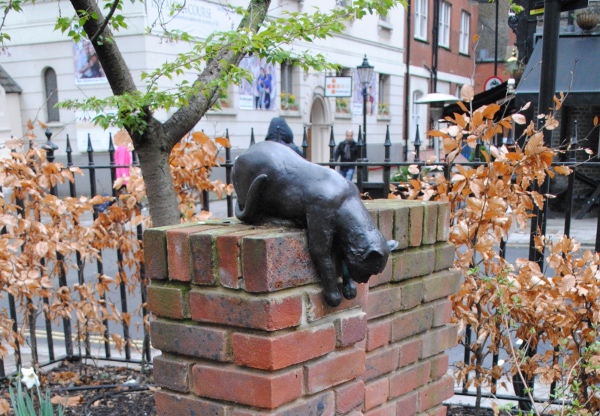
Captured preparing to jump off a red brick wall, this small playful statue of a domestic cat named Sam can be found in the south-west corner of Queen Square Gardens in Holborn.
The bronze statue actually commemorates Patricia Penn (1914-1992), a former resident in the square who was a nurse, “champion of local causes” and member of the Queen Square Resident’s Association. The statue was donated by the local community in Penn’s memory.
As is clear from the monument, Penn was also a cat lover. Sam was, of course, one of her pet cats.
Sadly, the original version of Sam – which was installed in 2002 to mark the 10th anniversary of Penn’s death, was stolen in 2007. But a replacement was installed in 2009 – this time with steel rods running into the bricks to prevent it being taken again.
10 (more) historic London garden squares…4. Red Lion Square…

This Holborn square was laid out in the 1680s by property speculator Nicholas Barbon and took its name from the Red Lion Inn which once stood here.
The inn, incidentally, is said to be the place where the exhumed bodies of Oliver Cromwell, his son-in-law (and Parliamentarian general) Henry Ireton and John Bradshaw, president of the parliamentary commission to try King Charles I, lay the night before they were taken to Tyburn where they were desecrated (there’s a story that the bodies were switched that night and the real men lay buried in a pit in a square).
The square was laid out on what had been known as Red Lion fields and there were apparently some physical scuffles between the workmen, led by Barbon, and lawyers of Gray’s Inn who objected to the loss of their rural vistas.
The square, meanwhile, soon became a fashionable part of the city – among early residents was Judge Bernard Halle – but by the mid-19th century, its reputation had slumped only to move up again in later years.
Famous residents included Dante Gabriel Rossetti in 1851 and William Morris who lived in a flat on the southern side of the square with Edward Burne-Jones in the later 1850s. The art deco Summit House was built in 1925 on the former residence of John Harrison, inventor of the marine chronometer. Jonas Hanway, the first man to walk London’s streets with an umbrella, apparently also lived on the square.
The square today is home to the Royal College of Anaesthetists and Conway Hall, home of the Conway Hall Ethical Society (in fact, it was Conway Hall which was at the centre of one of the most famous incidents in the square – clashes between anti-fascist protestors and National Front members and subsequent police response which took place on 15th June, 1974, and left a university student, Kevin Gately, dead.
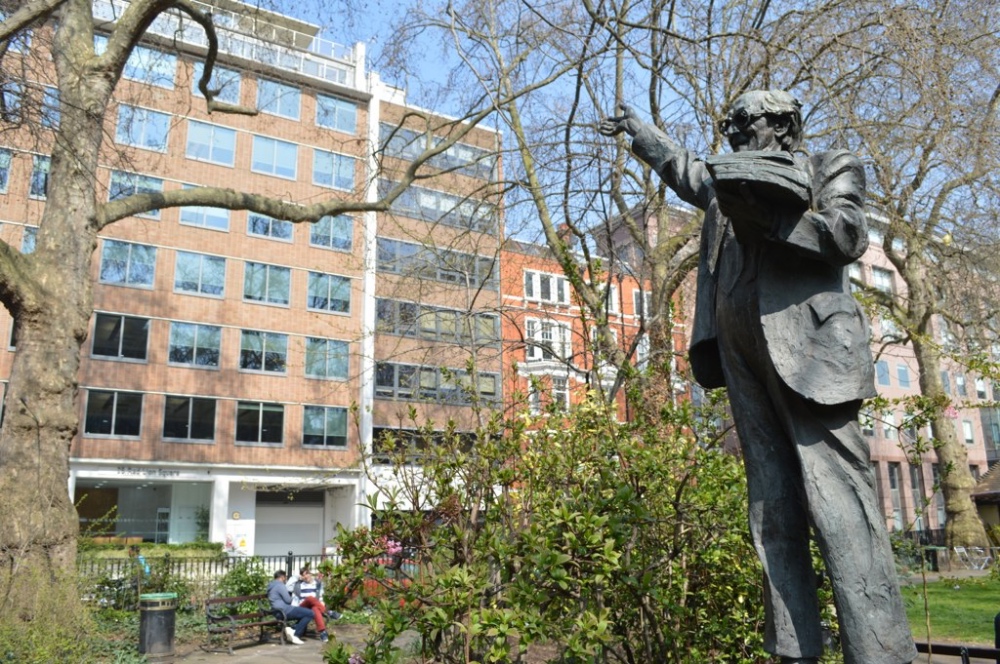
The garden in the centre of the square features a statue of anti-war activist Fenner Brockway and a bust of philosopher, essayist and Nobel laureate Bertrand Russell.
PICTURE: Top – View across part of the square (Google maps)/Below – Fenner Brockway statue (Matt Brown/licensed under CC BY 2.0)
A Moment in London’s History – Sir Henry Cole sends Christmas cards…
The practice of sending Christmas cards really began in the Victoria era and it was in London, in 1843, that the first commercial Christmas cards are widely said to have been designed and printed.
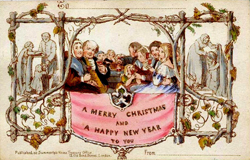 The idea had come from Sir Henry Cole, the first director of the Victoria and Albert Museum, who, overwhelmed with the volume of correspondence he was receiving, conceived it as answer to his problem, allowing him to send Christmas greetings to a wide group of people – all at once.
He asked his friend, artist John Callcott Horsley, to design the card and an edition of 1,000 were printed by Jobbins of Warwick Court in Holborn.
The hand-coloured card, published by Summerley’s Home Treasury Office in Old Bond Street, showed a family gathered for a Christmas celebration with two side images showing people engaged in charitable acts and a message, ‘A Merry Christmas and a Happy New Year to You’. Designed as a single flat card (not foldable like they are today), it came complete with ‘To’ and ‘From’ spaces for the sender to fill in.
The cards which Sir Henry didn’t need for his personal use were placed on sale for a shilling each but it was a fairly steep price and that – and the fact that the image of people drinking at the festive season apparently roused the ire of temperance campaigners, helped to ensure the cards weren’t an immediate success.
Nonetheless, further cards were produced in the following years and within a couple of decades, they were being mass produced.
One of Sir Henry’s original cards was reportedly sold at an auction in 2013 for £22,000.
London Pub Signs – The Seven Stars, Holborn…
 Located at 53 Carey Street in Holborn, this rather plain looking pub boasts a heritage apparently dating back to before the Great Fire of London.
Said to date from 1602, the Grade II-listed pub was apparently built as an alehouse, though the facade is 19th century as is much of the interior. Its location, just to the west of Temple Bar, meant it survived the Great Fire of London – though only just.
The name apparently relates to an appeal to Dutch sailors – it is said to have been so named in reference to the Seven United Provinces of The Netherlands (it’s also been said that the pub’s location is in the midst of an area of London in which Dutch settlers lived during the period).
It was apparently formerly known as The Log and Seven Stars or The Leg and Seven Stars, although it’s been speculated these are simply a corruption of The League and Seven Stars – a story which might make sense given the origins of the pub’s name (‘league’ referring to the union of the seven provinces).
The pub these days lies in the heart of the city’s legal community – the Royal Courts of Justice lies just to the south and Lincoln’s Inn, one of the four inns of court, to the north.
For more, see www.thesevenstars1602.co.uk.
PICTURE: Mike Quinn/CC BY-SA 2.0
10 notable blue plaques of London – 5. Five Londoners with more than one blue plaque…
There’s quite a few whose London residence (or otherwise) is commemorated by more than one blue plaque. So, breaking away from our usual ‘one plaque’ format, here were listing five of those who have made the grade…
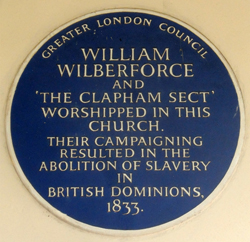 1. William Wilberforce (1759-1833). The late 18th century and early 19th century politician and anti-slavery campaigner tops our list with three English Heritage blue plaques. The first is at 111 Brookwood Road in Battersea – the site of Brookwood House where Wilberforce resided during his anti-slavery campaign. The second is on Holy Trinity Church on Clapham Common, the church where Wilberforce and the Clapham Sect with whom he is associated worshipped. And the third is on a property at 44 Cadogan Place in Chelsea where Wilberforce died.
2. Dr Samuel Johnson (1709-1784). Like Wilberforce, the 18th century lexicographer Dr Johnson has three English Heritage blue plaques to his name. The first, on his famous Gough Square property in the City of London we’ve already mentioned (see our earlier post here), while the second is on a property at 8 Russell Street, Covent Garden, then occupied by bookseller Thomas Davies, which was where Dr Johnson famously first met James Boswell in 1763. The third time Dr Johnson’s name appears, more unusually, is on a plaque commemorating Essex Street – Dr Johnson is among a number of names listed on it for his role in establishing an “evening club” at the pub, the Essex Head, in the street in 1783.
3. Samuel Pepys (1633-1703): The 17th century diarist seems to pop-up everywhere in central London so it’s not surprising there are two plaques in the English Heritage blue plaques scheme dedicated to him (although both are located in the same street – one he apparently liked very much). The plaques are located at number 12 and number 14 Buckingham Street in Covent Garden and both mark the site of a Pepys residence.
4. Virginia Woolf (1882-1941): The writer, publisher and literary critic’s name appears on two properties – at 29 Fitzroy Square in Fitzrovia where Woolf lived between 1907-1911 and on Hogarth House at 34 Paradise Road in Richmond where she and Leonard Woolf lived between 1915-1924 (and also where they founded the Hogarth Press in 1917).
5. William Morris (1834-1896): The poet and artist has two English Heritage blue plaques to his credit – the first on 17 Red Lion Square in Holborn where Morris lived in a flat from 1856-1859 with Sir Edward C Burne-Jones, and the second on Red House in Bexleyheath where he and his wife Jane Burden lived from 1860-1865.
PICTURE: Spudgun67/Wikimedia/CC BY-SA 4.0 (image cropped)
What’s in a name…Hatton Garden…
A street and small district based just to the north of Holborn in the Borough of Camden, the origins of Hatton Garden’s name stem from the Elizabethan-era courtier Sir Christopher Hatton.
 Sir Christopher, Lord Chancellor during the reign of Queen Elizabeth I and one of her favourites, acquired land here in the 1570s after the Queen forced the bishops of Ely to rent him some of the land they owned which was attached to their London residence, Ely Palace (commemorated today in nearby Ely Place, still home to London’s oldest Catholic church).
Hatton, whose annual rent was apparently fixed at £10, 10 stacks of hay and a red rose at midsummer, subsequently built a property, Hatton House, on the garden.
This survived until the mid-1600s when a series of properties were laid out on the site, centred on what is now the street known as Hatton Garden (Sir Christopher, who was buried in Old St Paul’s Cathedral, had died in 1591). Wren House, originally apparently a chapel and later a charity school, which still stands in Hatton Garden, was built around this time.
The houses were mostly replaced in the mid 18th century with new homes built for prosperous merchants but, as the years passed, while the street itself remained home to some of the wealthy, the same could not be said of some other streets nearby, like Saffron Hill, which became notorious slums.
In the early 1800s artisans started moving into Hatton Garden – London’s Little Italy was born around this time just to the north when Italian craftsmen started moving in (the St Peter’s Italian Church opened in 1863 in Clerkenwell Road) – and the area was gradually transformed into a commercial district.
Jewellery and watch-makers, who had long been based in Clerkenwell, started moving in and the street soon became particularly noted as a centre for cutting diamonds, initially those from India. It was an association which only grew stronger following the discovery of diamonds in South Africa’s Kimberley diamond field in the 1870s.
Today, the street known as Hatton Garden – which runs between Holborn and Clerkenwell Road – still contains the most concentrated cluster of jewellery retailers in the UK (as well as apparently an extensive subterranean network of tunnels and passageways as well as many heavily guarded underground vaults) and is still the centre of London’s diamond trade.
Incidentally, the street was also home to workshops at number 57 which, from 1881, produced the rapid firing Maxim Gun following its invention by Sir Hiram Maxim (and, of course, it was also the location of last year’s safe depository robbery and another famous jewellery robbery back in 1993).
A short side note – it was the wife of Sir Christopher Hatton’s nephew, Lady Elizabeth Hatton, who become associated with Bleeding Heart Yard (you can revisit that story in our earlier post here).
What’s in a name?…Bleeding Heart Yard
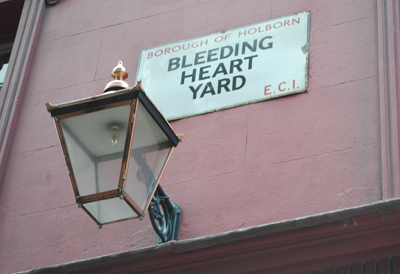
There’s a couple of different suggestions as to how Bleeding Heart Yard – a small courtyard located in the Farringdon area of the City of London, just north of Ely Place – obtained its rather descriptive – and gory – name.
The more prosaic answer is that it was named after an inn which, from the 16th century, stood on the yard and had a sign showing the heart of the Virgin Mary pierced by five swords.
The more interesting answer, on the other hand, is that the name commemorates the horrible murder of Lady Elizabeth Hatton (of the famed Cecil family), second wife of Sir William Hatton (formerly known as Newport), and, after his death, wife of Sir Edward Coke.
The story goes that her corpse was found here on 27th January, 1626, with the beating heart torn from the body.
A version of the legend – albeit with a slightly different protagonist – appears in a story published in Bentley’s Miscellany in 1837 which told of how the wife of Sir Christopher Hatton (he was actually the uncle of Sir William Hatton), made a somewhat ill-conceived pact with the Devil to secure wealth, position and a mansion in Holborn. The Devil dances with her during the housewarming party at the new home and then tears out her heart, found beating in the yard the next morning.
The yard also features in Charles Dickens’ Little Dorrit where it is the location of the home of the Plornish family.
London Pub Signs – The Princess Louise…
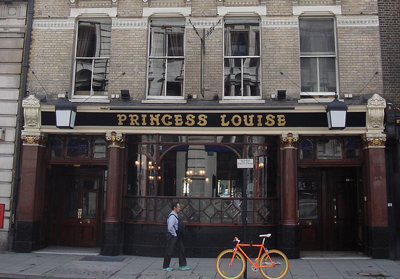 This historic High Holborn pub is named in honour of the sixth child and fourth daughter of Queen Victoria and Prince Albert, Princess Louise, Duchess of Argyle.
The Grade II*-listed pub, which has been described by Peter Haydon and Tim Hampson in their book London’s Best Pubs as a “national treasure” and “the finest, most complete, most original, best preserved, most authentic high-Victorian pub interior in London”, was apparently built in the early 1870s and then remodelled in 1891.
While rather plain externally, this “monument to 19th century craftsmen” boasts a much-vaunted, richly detailed Victorian interior dating from this remodelling which features polychromatic tile work, stained and etched glass and mahogany bar fittings as well as a staggering amount of decoration. The heritage listing even makes reference to the men’s toilets and its marble urinals in the basement.
The pub, at 208 High Holborn, is part of the Samuel Smith Brewery chain who restored it to its former glory in 2007 (including reintroducing glass walled cubicles). It’s also been notable, apparently, for its significant role in hosting folk clubs as part of a revival which occurred in the late 1950s and early 1960s.
Why exactly the pub was named after Princess Louise is something of a mystery and it has been suggested that, thanks to the fact pubs aren’t usually named after living members of the Royal Family, the pub must have originally had a different name.
Princess Louise, meanwhile, is notable for having briefly lived in Canada when her husband served as the Governor-General of that nation. She spent her retirement years at Kensington Palace.
For more, see www.princesslouisepub.co.uk.
PICTURE: Edwardx/Wikipedia
10 sites from London at the time of the Magna Carta – 3. The Temple…

Not much remains today of the original early medieval home of the Templar Knights which once existed just west of the City of London. While the area still carries the name (as seen in the Underground station, Temple), most the buildings now on the site came from later eras. But there are some original elements.
First though, a bit of history. The Templar precinct which become known as the Temple area of London was the second site in the city given to the military order, known more completely as the Knights of the Temple of Solomon (thanks to their Jerusalem HQ being located near the remains of the Temple of Solomon).
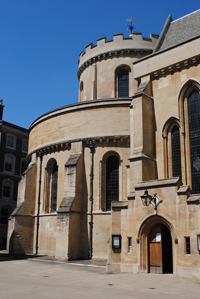 The first was in Holborn, located between the northern end of Chancery Lane and Staple Inn, and was known as the ‘Old Temple’ after which, in the latter years of the 12th century, the Templars moved their headquarters to the new site – ‘New Temple’ or Novum Templum – on unoccupied land on the bank of the River Thames.
This new precinct included consecrated and unconsecrated areas. The consecrated part was a monastery and was located around what is now Church Court with the monastic refectory built on the site of what is now Inner Temple Hall – the medieval buttery is the only part of the original building which survives.
The lay or unconsecrated part of the precinct lay east of Middle Temple Lane, where a second hall was built on the site of what is now the Middle Temple Hall (you’ll find more on that here) which was used to house the lay followers of the order.
The original buildings also included the still existing Templar Church (pictured, along with a monument depicting the Templars outside the church), which was consecrated in 1185 during the reign of King Henry II by Heraclius, the Patriarch of Jerusalem, on a visit to London. Like all other Templar churches, its circular design was based on the design of the Church of the Holy Sepulchre in Jerusalem (the chancel was added later and consecrated in the presence of King Henry III in 1240 – for more on the Temple Church, you can see our earlier post here.
The New Temple become an important site in London (and the kingdom as a whole – the Masters of the Temple were the heads of the order in England) and was used by many of the nobility as a treasury to store valuables (and to lend money). It also had close connections with the monarchy and was, as we saw earlier this week, a power base for King John and from where he issued what is known as the King John Charter in 1215. He also used it for a time as a repository for the Crown jewels.
In an indication of the Temple’s prominence in state affairs, some of the great and powerful were buried here during this period including William Marshal, 1st Earl of Pembroke, who died in 1219, and his sons William and Gilbert (for more on those buried in the Temple, see our earlier post here). There were also apparently plans to bury King Henry III and his Queen here – this apparently spurred on the building of the chancel on the church – but they were eventually buried in Westminster Abbey instead.
Numerous relics were also apparently housed here during the Templar times including a phial believed to contain Christ’s blood and pieces of the true Cross.
The Templar era came to an end in 1312 when the order was dissolved on the authority of Pope Clement V amid some heinous allegations of blasphemy and sexual immorality which had the support of King Philip IV of France. While the pope awarded their property to the rival order, the Knights of the Hospital of St John of Jerusalem (also known as the Hospitallers), King Edward II had other ideas and ignored their claims with regard to the London property and instead, claimed it for the Crown (a dispute which went on for some years).
It later became associated particularly with lawyers, although lawyers would have certainly been at work in the New Temple given its role as banker to the wealthy (but more on its later associations with lawyers in later post).
For more on the history of the Templars, see Malcolm Barber’s The New Knighthood: A History of the Order of the Temple.
London Pub Signs – The Knights Templar…

Located in a former bank at the corner of Chancery Lane and Carey Street, this pub takes its name from the Crusader order known as the Knights Templar who once owned the land upon which the lane was constructed.
The Knights Templar was founded in Jerusalem in 1118 to protect Christian pilgrims and took its name from the Temple of Solomon upon the remains of which its headquarters in Jerusalem was built.
The order arrived in London later that century and Chancery Lane was created to connect the site of their original headquarters in Holborn with their subsequent home which lay between Fleet Street and the Thames – with the latter centred on a chapel (consecrated in 1185) which still stands and is now known as the Temple Church.
The pub, which opened in 1999, was formerly the home of the Union Bank of London Ltd, built in 1865 to the design of architect FW Porter.
Original features inside the Grade II-listed building – built in the ‘high Renaissance’-style – include cast iron columns and ornate detailing.
It is now part of the Wetherspoon’s chain. For more information, see www.jdwetherspoon.co.uk/home/pubs/the-knights-templar-chancery-lane.
Treasures of London – Newgate execution bell…
Contained in a glass cabinet within the walls of St Sepulchre-without-Newgate, this bell was traditionally rung 12 times outside the condemned cell in nearby Newgate Prison at midnight on the eve of an execution (ensuring, no doubt, that no-one had a good night’s sleep before their final morning).
 According to an inscription on the cabinet, the sexton of St Sepulchre – who reached the condemned cell from the church via a tunnel under the road – recited the following verse (other sources have a longer a version thereof) while standing outside the cell:
“All you that in the condemned hole do lie,
Prepare you for tomorrow you shall die;
Watch all and pray: the hour is drawing near
That you before the Almighty must appear;
Examine well yourselves in time repent,
That you may not to eternal flames be sent.
And when St Sepulchre’s Bell in the morning tolls
The Lord above have mercy on your soul.”
The tradition of ringing the bell apparently dates from 1605 and has its origins in a bequest of £50 made by one Robert Dow(e), a prominent member of the Worshipful Company of Merchant Taylors. (Dow had apparently wanted a clergyman to be the one to ring the bell but his money didn’t stretch that far).
A rather grim piece of London’s history.
WHERE: St Sepulchre-without-Newgate, Holborn Viaduct (nearest Tube stations are St Paul’s, Blackfriars and Farringdon); WHEN: Check website for service times; COST: Free; WEBSITE: www.stsepulchres.org
What’s in a name?…Holborn…

The origins of the name of this part of central London, to the west of the City, lie in the fact that the Fleet River runs through the area (albeit, since the 18th century, underground).
Mentioned as far back as the 950s, the name Holborn comes from the Old English “hol” or “holh” (“hollow”) and “burne” or “bourne” (“stream”) and means the “stream in the hollow” with the hollow in this case being the valley over which the Holborn Viaduct was built in the 1860s.
The term ‘Holburne’ was either used to refer to a tributary of the Fleet or part of the river itself. There was a bridge which apparently bore the same name and spanned either the Fleet or its tributary up until the river was covered.
The street now known as High Holborn – the main street in the area – was originally a Roman road and by the 19th century had become a centre for the entertainment industry featuring theatres, restaurants and pubs (including one of our favorites, the Cittee of Yorke).
The street is also home to the Holborn Bar, which marked the boundary of the City of London and was once site of a toll gate – it’s now the site of the Royal Fusilier’s War Memorial.
Other famous monuments in the area include an equestrian statue of Prince Albert – the City of London’s official statue of him – which was removed from its position in the centre of Holborn Circus in the east of the area to a new position on the western side of the intersection during a renovation last year.
Now dominated by offices and some shopping precincts (these include a street market in Leather Lane), among other notable buildings are pre-Great Fire of London survivor Staple Inn (see our earlier post here), churches including St Andrew Holborn, and St Alban the Martyr, Holborn, and, to the east, St Etheldreda’s Church (see our earlier post here) and Ye Olde Mitre pub (see our earlier post here).
The area is also home to the Inns of Court Lincoln’s Inn and Gray’s Inn and the Grade II*-listed Prudential Assurance Building (pictured above), constructed on the former site of Furnival’s Inn in the late 19th century/early 20th century, as well as Hatton Garden, famous for being the centre of London’s jewellery trade.
 Exploring London